1 Introduction
Educators and researchers have advocated that the integration of learning technologies should engage students in the learning process, but teachers then have to find approaches to achieve that goal (Chen, Lambert & Guidry, Reference Chen, Lambert and Guidry2010). Engagement represents active participation in the learning process, which consists of activities and perceptions that learners are involved in in the form of attention, interest, curiosity, and motivation (Trevino & Webster, Reference Trevino and Webster1992). Such emphasis on learners’ engagement is in alignment with the constructivist view of learning, whereby students develop deeper understanding when they are actively engaged via the processes of peer discussion (Blumenfeld, Marx, Soloway & Krajcik, Reference Blumenfeld, Marx, Soloway and Krajcik1996; Littleton & Häkkinen, Reference Littleton and Häkkinen1999), gaming (Kiili, Reference Kiili2005), or construction activities (Harel & Papert, Reference Harel and Papert1991). It is therefore worth investigating how the incorporation of a new technology influences learners’ engagement in the learning of a subject domain.
Web 2.0 technologies allow students to create, share, collaborate, and publish their work on the internet. Extensive studies have explored how the features of Web 2.0 technologies can be exploited to support a social constructivist approach for language learning (e.g. Asoodar, Atai, Vaezi & Marandi, Reference Asoodar, Atai, Vaezi and Marandi2014; Shih, Reference Shih2011). In addition, research indicates that students encounter different types of barriers associated with technologies and learning tasks that can cause their disengagement during different phases of learning (Herrington, Oliver & Reeves, Reference Herrington, Oliver and Reeves2003; O’Brien & Toms, Reference O’Brien and Toms2008). However, students’ engagement in technology-assisted learning follows a complex and dynamic pattern. Thus educators need to be aware of the patterns of learner engagement in such activities in order to address important pedagogical considerations in different stages of learning when incorporating internet technology in real educational contexts (Pawan, Reference Pawan2003).
As various studies indicate, flow theory and the strategic motivation framework are useful constructs for displaying student engagement in learning. Research shows that students in a flow state, i.e. where they are totally immersed in and pay full attention to a learning task (Csikszentmihalyi, Reference Csikszentmihalyi1975), are more likely to learn through exploratory and participatory activities and demonstrate multiple strategies while learning (Hoffman & Novak, Reference Hoffman and Novak1996; Liu, Cheng & Huang, Reference Liu, Cheng and Huang2011). Moreover, students’ engagement may vary as a function of their intrinsic and extrinsic motivations for the task as well as their beliefs about the value of the task (Pintrich & Schrauben, Reference Pintrich and Schrauben1992). Thus, to obtain a better understanding of students’ engagement patterns, flow theory (Csikszentmihalyi, Reference Csikszentmihalyi1975) and the strategic motivation framework (Pintrich, Smith, Garcia & McKeachie, Reference Pintrich, Smith, Garcia and McKeachie1991) were used to guide the investigation. This study aims to gain a holistic understanding of students’ engagement in Web 2.0 activities at two levels: at a macro level, exploring changes in motivation in the beginning, middle and late phases during the activities; and at a micro level, analyzing the students’ flow perceptions associated with the activities to identify their engagement patterns. The research questions that were formulated to guide the investigation are as follows:
∙ RQ1: How did students participate in the Web 2.0 learning activities over time?
∙ RQ2: How did the students’ motivation evolve and engagement patterns change in the different stages of the Web 2.0 learning activities?
∙ RQ3: What is the impact of the Web 2.0 learning activities on the students’ language proficiency?
2 Related studies
2.1 Student engagement in Web 2.0 language learning activities
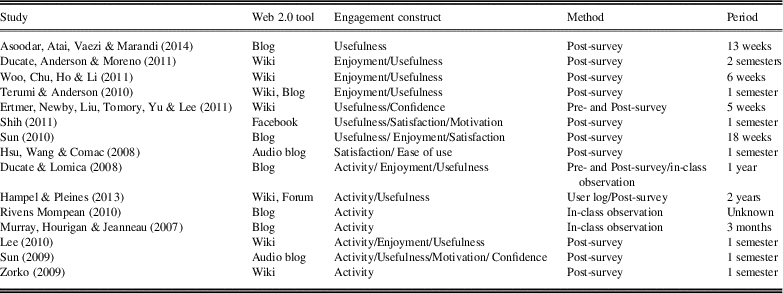
Previous studies have explored language learners’ engagement with diverse types of Web 2.0 tools incorporated into the learning environment, such as wikis, blogs, audio blogs, and social networking tools (Table 1). Table 1 provides an overview of studies investigating how these tools impacted student engagement based on different engagement constructs, including their perceptions toward engagement and their actual engagement in activities.
Engagement constructs and methods of studies in Web 2.0 language learning

Relating to students’ perceptions toward engagement, some studies (e.g., Asoodar et al., Reference Asoodar, Atai, Vaezi and Marandi2014; Ducate et al., Reference Ducate, Anderson and Moreno2011; Terumi & Anderson, Reference Terumi and Anderson2010; Woo et al., Reference Woo, Chu, Ho and Li2011) explored students’ sense of enjoyment and the perceived usefulness of Web 2.0 learning activities at a general level. Focusing on engagement constructs such as satisfaction, confidence, and motivation, other studies (e.g., Ertmer et al., Reference Ertmer, Newby, Liu, Tomory, Yu and Lee2011; Hsu et al., Reference Hsu, Wang and Comac2008; Shih, Reference Shih2011; Sun, Reference Sun2010) aimed to understand students’ overall perceptions after participating in a certain Web 2.0 activity. The findings of these studies reveal that these activities had a positive impact on language learners’ engagement (Woo et al., Reference Woo, Chu, Ho and Li2011; Hsu et al., Reference Hsu, Wang and Comac2008). Moreover, it was found that this type of learning experience increased students’ satisfaction with learning a language using technology (Ertmer et al., Reference Ertmer, Newby, Liu, Tomory, Yu and Lee2011) and significantly enhanced their interest and motivation (Shih, Reference Shih2011).
While most studies focused on students’ perceptions rather than their actual engagement in the activities, a number of them attempted to clarify students’ engagement by investigating how they participated in the learning process. It was observed that students’ application of high-level learning skills increased, including self-reflection, interaction, and collaboration (Ducate & Lomica, Reference Ducate and Lomicka2008; Murray et al., Reference Murray, Hourigan and Jeanneau2007; Rivens Mompean, Reference Rivens Mompean2010). However, the findings did not address the issue of pedagogical guidelines needed for implementing Web 2.0 learning activities; Hampel and Pleines (Reference Hampel and Pleines2013) therefore suggest that Web 2.0 technologies should link to assessment in order to increase students’ participation in online learning activities.
The body of literature above confirms that the use of Web 2.0 technologies engages students in the language learning process; however, they address relatively few aspects and are not supported by a sound theoretical framework. As an increasing number of studies have noted (Kiili, Reference Kiili2005; Liu et al., Reference Liu, Cheng and Huang2011), flow is a high-engagement state during which an individual “is in control of his actions, and in which there is little distinction between self and environment, between stimulus and response, or between past, present and future” (Csikszentmihalyi, Reference Csikszentmihalyi1975: 36). In addition, research also shows that Pintrich’s strategic motivation framework (Pintrich et al., Reference Pintrich, Smith, Garcia and McKeachie1991) can be used to guide students’ engagement from different perspectives (e.g. Cheng & Chau, Reference Cheng and Chau2012; MacIntyre & Blackie, Reference MacIntyre and Blackie2012), including how they value a learning activity, the level of intrinsic/extrinsic interest in the activity, and the self-efficacy in their learning, which have been found to have a significant impact on the depth of learning. In all, the findings indicate that the use of flow and strategic motivation is beneficial for research that aims to understand not only students’ engagement in but also their expectations of the learning activities.
2.2 Dynamic pattern of engagement
It is believed that engagement is an essential condition of learning, and thus both technology-enhanced learning materials and activities should engage students (Salvo, Reference Salvo2002; Webster & Ho, Reference Webster and Ho1997). In an educational context, engagement is conceptualized as the time and effort students put into educational activities or active participation in class (Kuh, Reference Kuh2009). Researchers have asserted that factors such as media, sense of control, level of perceived difficulty and interactivity might profoundly influence the level of student engagement in learning activities (Hedman & Sharafi, Reference Hedman and Sharafi2004).
As shown in Table 1, most studies used surveys to investigate students’ engagement at two points, before and after the activities, except for three where observations were employed to identify students’ engagement (Ducate & Lomica, 2008; Murray et al., Reference Murray, Hourigan and Jeanneau2007; Rivens Mompean, Reference Rivens Mompean2010). These researchers observed different types of students’ engagement in language learning activities, such as self-reflection, interaction, and collaboration; however, those were identified at a single point in time, which did not necessarily speak to the flow and the pattern of engagement.
Researchers who attempted to identify the dynamic pattern of engagement found that students’ engagement in learning activities varied based on a certain pattern over time (Pawan, Reference Pawan2003; Pearce, Ainley & Howard, Reference Pearce, Ainley and Howard2005). More specifically, the findings indicated that engagement is a process comprising several distinct stages rather than a static status, including engagement, disengagement, and reengagement (Herrington et al., Reference Herrington, Oliver and Reeves2003; O’Brien & Toms, Reference O’Brien and Toms2008). Thus the aforementioned two studies identified many reasons that might explain the dynamic pattern of engagement. For example, the initial engagement resulted from the effect of “willing suspension of disbelief” (Herrington et al., Reference Herrington, Oliver and Reeves2003: 65), indicating that students overlooked the limitations or challenges associated with the activity during their initial contact and thus instantly accepted the technology as a tool for learning and engaged in the activity. Students were also found to turn their attention to the other activities that occurred in the external environment (O’Brien & Toms, Reference O’Brien and Toms2008), indicating that engagement decreased when the novelty effect of technology wore off (Clark, Reference Clark1983; Hur & Oh, Reference Hur and Oh2012). Herrington et al. (Reference Herrington, Oliver and Reeves2003) further found that students soon experienced disengagement when they learned that they needed to spend time exploring a variety of learning materials and dealing with unstructured tasks, which was a result of the fact that many students are accustomed to a teacher-centered paradigm. In addition, students found it difficult to change their dependent learning habits, so frustration can arise when they have to deal with open-ended and complex tasks (Hoffman & Ritchie, Reference Hoffman and Ritchie1997; Taplin, Reference Taplin2000).
Research to date indicates that Web 2.0 learning activities have a positive impact on student engagement in classrooms, including satisfaction, confidence, motivation, interaction, and collaboration. However, there has been little direct exploration of students’ engagement patterns while taking part in activities as such, and in particular of how engagement varies, the difficulties encountered during different phases, and how to overcome them. This study thus aims to investigate the dynamic features of student engagement while participating in Web 2.0 digital storytelling activities from flow theory and the strategic motivation framework.
3 Method
3.1 Participants
The current study investigated students’ engagement patterns when they participated in Web 2.0 digital storytelling activities in the classroom. The participants were 24 third-grade students, typically nine to ten years old, in an elementary school in northern Taiwan, where English education at school starts in grade 1, meaning that they were still in the early stages of learning English with a focus on learning basic vocabulary and sentence patterns. In addition, the teacher stated that participants had no prior experience of using Web 2.0 applications, indicating that their reactions to and perceptions of the activities would be helpful for understanding their engagement patterns in classroom settings.
3.2 The Web 2.0 digital storytelling activity
The Web 2.0 digital storytelling activities aimed to encourage participants to learn target vocabulary and sentences. Their tasks were to create digital stories using a storytelling application connected to an online platform. The participants were divided into twelve pairs and provided with an iPad e-book containing fifteen stories, each of which included texts with oral narrations. Each pair was instructed to start reading any story of their choice and work collaboratively using the Web 2.0 application to re-tell the story, including drawing pictures and recording oral narrations. They were also instructed to continue working on re-telling and publishing the stories at their own pace. After that, they were asked to share the story via an online platform where all participants could view their work. The teacher additionally invited pairs to share the stories that they had completed during an in-class sharing activity to acknowledge their achievement on a weekly basis.
3.3 Instruments
3.3.1 Story & Painting House, the Web 2.0 application
To provide participants with the opportunity to utilize the language they learned from the e-book, Story & Painting House (Liu, Wu, Chen, Tsai & Lin, Reference Liu, Wu, Chen, Tsai and Lin2014), a Web 2.0 application on iPads connecting to an online platform, was developed to facilitate the process of story creation and sharing. Story & Painting House supports multimedia authoring functions, including easy-to-use drawing tools, text, and the option to record oral narrations. After reading an e-book story, participants used the application to create a multimedia story with drawings and oral narrations. With the functions supported by Story & Painting House, participants could practice the vocabulary and sentences they had just learned, and improve their oral reading ability. The application also allows them to share their stories on the online platform. As shown in Figure 1, the platform provides a repository for students to publish the stories they created.
Examples of students’ stories
3.3.2 The flow survey
One of the main purposes of this study was to understand students’ engagement patterns associated with the digital storytelling activities. Extensive literature has linked engagement to flow theory since both engagement and flow share some psychological attributes such as focused attention, feedback, control, activity orientation and motivation (Kiili, Reference Kiili2005). Therefore, this study sought to discover students’ flow perceptions associated with the learning activities to understand their engagement. Among the diverse instruments that have been used to investigate and measure individuals’ flow perceptions, Trevino and Webster (Reference Trevino and Webster1992) proposed a flow model focusing on cognitive absorption and consisting of four dimensions to describe flow perceptions, including control, attention, curiosity, and intrinsic interest. Since this study aimed to examine the students’ engagement patterns across nineteen weeks, it was necessary to measure their flow perceptions each week. Thus, a survey guided by Trevino and Webster’s flow measurement framework to analyze basic flow components was administered each week in a way that would not interfere with the students’ learning activities. The survey is listed in Appendix A. To ensure that the survey was comprehensible for young participants, all items were reviewed by two experienced English teachers. This survey consists of four 5-point Likert questions (with 5 as the highest level and 1 as the lowest) to measure the level of control, attention, curiosity, and intrinsic interest that the students perceived when they participated in the activities. The students’ responses to the four questions in the flow survey in each week were averaged to represent their flow perception for that week. The reliability coefficient of the survey was 0.72, indicating that this survey is a reliable instrument for assessing the students’ engagement in this study.
3.3.3 Motivated Strategies for Learning Questionnaire (MSLQ)
The MSLQ (Pintrich et al., Reference Pintrich, Smith, Garcia and McKeachie1991) was used to assess participants’ motivation in the following dimensions: self-efficacy, extrinsic/intrinsic goal orientation, task value, and peer learning. To further understand how levels of students’ motivation changed during different periods of the activity, the MSLQ was administered in the beginning, middle, and end phases during the storytelling activities. Participants’ responses were also analyzed to examine their motivation. The objective of the analysis was to uncover the long-term impact of the activities on their motivation. The MSLQ was adapted based on the context, containing 25 items, all of which were reviewed by two experienced English teachers. The questionnaire used by this study is listed in Appendix B. The Cronbach reliability (alpha) regarding the extrinsic/intrinsic goal orientation, self-efficacy, task value and peer learning of the subjects of this study are .75, .73, .96, .89 and .70 respectively, indicating that the questionnaire is adequately reliable.
3.3.4 The English test
The English test contains two parts: word game and oral test. First, two word game tests, A and B, were developed and administered before and after the activities to assess participants’ English learning progress. Each test contained 20 test items involving vocabulary retrieved from stories in the e-book. Participants were asked to select the appropriate corresponding meaning in Chinese for each test item. Participants were divided into two groups, where one group took test A as the pre-test and test B as the post-test and the other group took B as the pre-test and A as the post-test. Such an arrangement was implemented to ensure that the pre-test and post-test could be fairly compared as their learning effect on the test items were avoided. To evaluate participants’ sentence and oral narration abilities, an oral test was conducted before and after the activities. The rater randomly selected one sentence from each story of the e-book and asked the students to read these sentences aloud. The oral test contained a total of fifteen sentences (76 words). The number of words that each participant could read was counted as an indicator of their oral reading ability. Participants’ words correct per minute (WCPM) was also counted and recorded (Shinn, Reference Shinn1989).
3.4 Procedure
The study took place between late November 2013 and mid-June 2014. The English test was given before the first activity took place, to be able to understand the baseline of participants’ vocabulary and oral abilities. Each week, participants underwent an 80-minute digital storytelling session and they completed a total of nineteen sessions. In every session, each pair spent time reading the stories and practicing the vocabulary and sentences together before they worked on re-telling the story. They were instructed to include drawings and oral narration in their digital stories and then publish their stories on the online platform. After each activity session, participants answered the flow survey. Therefore, a sequence of nineteen sets of flow survey results was obtained for analysis of their engagement patterns. To understand participants’ motivation in the different phases of the activities, the MSLQ surveys were administered after they had some experience with the activities: in weeks 5, 12, and 19, providing data in the beginning, middle, and end of the activities. Both the results of the flow survey and the MSLQ were analyzed to reveal the engagement patterns. After the activity, the English test was given again to assess participants’ vocabulary and oral reading ability.
3.5 Analysis
A series of analyses were conducted to answer the three research questions. To answer RQ1, participants’ digital stories on the online platform were analyzed to understand their participation in the activities. More specifically, the total number of stories they published each week were analyzed to examine their activity engagement during the nineteen weeks. To answer RQ2, ANOVA analysis with repeated measures on participants’ responses to the MSLQ was performed to show the temporal pattern associated with their motivation. The repeated measure analysis was applied to help identify whether there was a significant dynamic pattern among participants’ motivation in the three different phases. Furthermore, the same analysis was also applied to identify whether there was a specific dynamic pattern that could describe students’ flow perceptions during the nineteen sessions of the activities. More specifically, ANOVA with repeated measures was performed to confirm whether the students perceived significantly different levels of flow experience at the critical time points. If the repeated measure analysis revealed significant change in the students’ flow perceptions, a dependent-samples t-test was used to compare the differences in flow perceptions at the two critical time points. By identifying the critical time points, we could understand whether there was a specific dynamic pattern that could describe the dynamic engagement patterns. Futhermore, participants’ English vocabulary test scores in the pre- and post-test were compared with a dependent t-test to answer RQ3. The analyses to answer RQ2 and RQ3 were based on data collected from 23 participants because one participant did not complete all required surveys and tests even though he completed the process of participating in the activities.
4 Results
4.1 Student content development activity
Figure 2 displays the total number of stories that participants created during the nineteen weeks. As seen, the tweleve pairs completed fourteen stories during the first seven weeks, which averaged approximately one book per pair. The total number increased to 26, 37, 50, and 61 in weeks 10, 13, 16, and 18 respectively, indicating that the students picked up their pace in creating and publishing stories. In other words, in the beginning phase of the activity, it took students a considerable amount of time to get themselves ready to complete the assigned tasks. However, in the middle phase, they appeared to have become more efficient in retelling and publishing stories. On average, they completed and published their 2nd, 3rd and 4th stories in three weeks each. Following that, the 5th story was published in another two weeks.
Pattern of students’ story output
It was observed that the quality of participants’ digital stories have improved in the later phase of the activities. As seen in Figure 3, the pair used simple lines to illustrate their first story; however, more colorful drawings with more story elements, such as lively character facial expressions and actions, were included in their 3rd story. Such a result reflected that the students became more skilled in completing their stories and demonstrated higher quality work, indicating a higher level of engagement in the activities in the later phase.
Examples of students’ story development
4.2 Student motivations
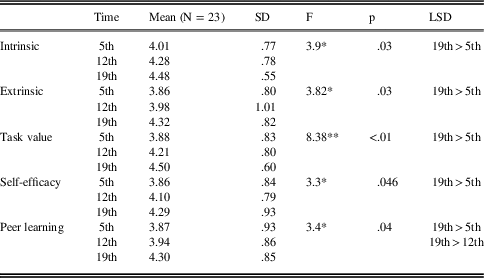
The repeated measure analysis revealed that all the components of the students’ motivation gradually increased to a significant level from week 5 to week 19. As shown in Table 2, the students expressed a significantly higher level of intrinsic and extrinsic motivation in the 19th week than they did in the 5th week (F=3.9, p<.05; F=3.82, p<.05 respectively). Such an increase was also seen in the task value and self-efficacy component in week 19 than in week 5 (F=8.38, p<.01; F=3.3, p<.05). Moreover, the students also reported a significantly higher level of peer learning in the end phase than they did in the beginning and middle phases of the Web 2.0 learning activity (F=3.4, p<.05), indicating that the students were not particularly motivated by the Web 2.0 language learning activity at their initial encounter. However, their motivation progressively rose to a higher level as they continued to participate in the activities.
The result of repeated measure analysis of student motivation
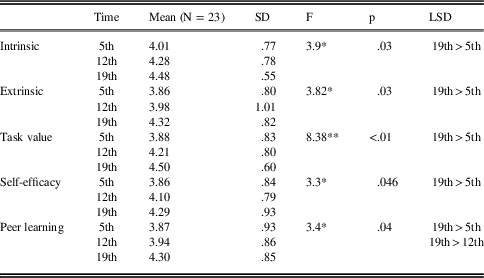
*p<.05 **p<.01.
Triangulating the changes in participants’ motivation with their storytelling activities revealed that in the 5th week, the participants were still creating their first story. This could be due to the diverse types of difficulties they encountered, which would explain the reason why their intrinsic/extrinsic motivation, self-efficacy in participating in the activities and perception of task value were still at a relatively low level. The results above indicated that the participants’ motivation associated with the digital storytelling activity was not static but rather a dynamic process, which might have evolved along with the content development activity. In addition, participants’ motivation gradually increased to a higher level as they made progress in publishing stories on the online platform.
4.3 The pattern of flow perceptions
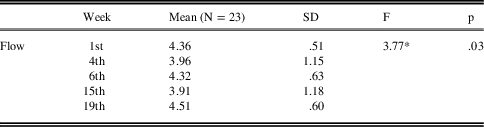
A repeated measure analysis was performed to examine participants’ flow perceptions over the nineteen weeks. Figure 4 displays the overall nineteen-week flow perceptions obtained from participants’ reponses to the flow survey. It was shown that students’ flow perceptions changed significantly week after week during the activity and that the 1st, 4th, 6th, 15th, and 19th weeks were the crtitical time points at which the students had a relatively low or high flow perception. To confirm whether they perceived a significant change in flow perception in these five critical weeks, the changes in flow perception were analyzed with repeated measure anlysis. As shown in Table 3, the results of the analysis revealed that the students’ flow perceptions changed significantly in these five critical weeks (F=3.77, p<.05).
Pattern of students’ flow perceptions
The result of repeated measure analysis on the five-week flow perceptions
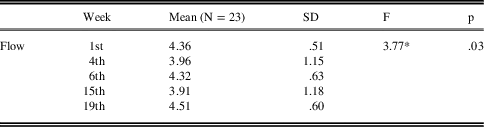
*p<.05.
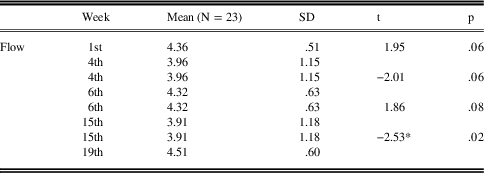
In order to understand the changes between two consecutive weeks, a dependent t-test was performed for any two consecutive critical weeks as a post-hoc test of the repeated measure. As seen in Table 4, the results of the post-hoc test showed that the students demonstrated different levels of flow between the consecutive critical weeks at either a significant level or a nearly significant level. The results of the repeated measure and dependent t-test showed that the students experienced significantly different levels of flow perceptions in these critical weeks.
The dependent t-test of flow perceptions on consecutive critical weeks
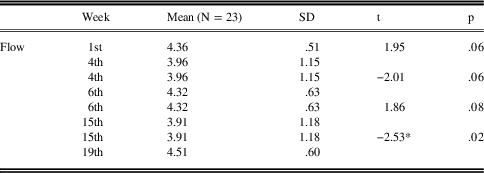
*p<.05.
The five critical time points revealed important engagement phases relating to students’ participation in the digital storytelling activities. The five critical points divided the whole learning process into four important phases, including disengagement due to novelty effect wear-off (1st – 4th), accomplishment reengagement (4th–6th), disengagement due to repetition (6th–15th), and social reengagement (15th–19th):
∙ Disengagement due to novelty effect wear-off (1st–4th weeks): At the first encounter, participants were very curious about Story & Painting House and thus reported a high level of curiosity. However, participants’ flow perception rapidly faded afterwards. This disengagement phase occurred because participants were striving to complete their first story. Such fading might be due to the difficulties they encountered while trying to understand and re-tell their first story, such as making decisions on what to include in their stories, which in turn, made the novelty effect wear off. As shown in Figure 2, only four pairs published their first story before week 4. In addition, as most participants perceived themselves at a low level of control in knowing how to use Story & Painting House to create digital stories, their sense of curiosity dropped and as a result, their flow perceptions decreased due to these difficulties.
∙ Accomplishment Reengagement (4th–6th weeks): This phase took place when most pairs successfully published their first story. In week 5, most pairs successfully finished publishing their first story and the total number of published stories increased to ten, which gave participants a sense of achievement. The difficulties they encountered in previous weeks were alleviated and their sense of control, attention and interest increased and thus led them into the reengagement phase.
∙ Disengagement due to repetition (6th–15th weeks): After participants published their first story, they went into the repeated activities where they read new stories and retold those stories in the digital form. As shown in Figure 2, each pair continued to publish their 2nd and 3rd stories during this phase. As they repeatedly took part in creating and publishing stories, they did not perceive a high level of intrinsic motivation and felt bored, which led to another disengagement phase. Such disengagement occured when clear direction was not provided to help students enhance the quality of their stories, even though the difficulties in content development had been alleviated.
∙ Social Reengagement (15th–19th weeks): In this phase, students’ flow perception significantly increased from 3.91 to 4.51 (t = −2.53, p<.05), which was triggered by the social learning activity where participants started noticing the high quality stories of their peers. At this time, each pair had published an average of four stories and thus was perceived to have a rich experience in creating stories and obtaining a higher level of control of the tool. Such an improvement was demonstrated in the in-class sharing activity in the 14th week. Consequently, participants turned their attention to how to improve the quality of their stories and became curious about what others would share in the next sharing activity, leading them into the reengagement phase again. In such a phase, the in-class sharing activity played an important role in promoting their awareness of others’ achievements. Such awareness could be the factor that engaged them again in the learning process.
4.4 English test scores
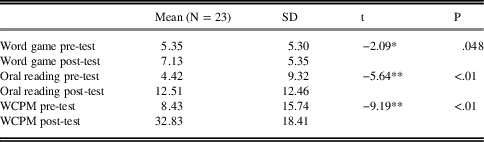
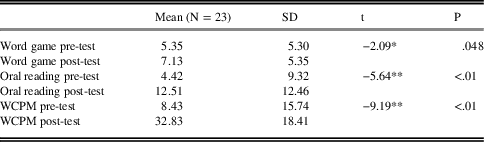
Participants’ test scores in the pre- and post- tests were recorded and analyzed to understand the impact of the activities. As seen in Table 5, participants’ average score for the word game (vocabulary) post-test was significantly higher than the score in the pre-test (t=−2.09, p<.05), indicating that their vocabulary ability was significantly enhanced after the storytelling activities. The same enhancement also appeared in the oral test as their average oral reading test scores increased from 4.42 words to 12.51 words, indicating a significant enhancement in accuracy (t = −5.64, p<.01). Moreover, their WCPM in the oral test increased from 8.43 to 32.83 words. This result indicated that the students’ oral reading fluency was also improved (t = −9.19, p<.01), which could be attributed to the recording feature of the Story & Painting House that allowed participants to practice their narrations multiple times and the platform that allowed them to showcase their stories. The findings above support the view that digital storytelling activities allowed students to apply language to generate public visibility in a learning community and helped them develop their language proficiency.
The students’ achievement in the English learning pre- and post-tests
*p<.05, **p<.01.
5 Conclusions and discussion
Examining students’ engagement in nineteen-week Web 2.0 language learning activities using flow theory and the strategic motivation framework, this study analyzed the change in flow perceptions and motivations and found that the students’ engagement was not a static process but rather evolved in a certain pattern. The engagement pattern included four phases: disengagement due to novelty effect wear-off, accomplishment reengagement, disengagement due to repetition, and social reengagement. It was found that triangulating data from flow, motivation, and the content development activity were useful for analyzing the students’ engagement in the Web 2.0 language learning activities as the three resources allowed researchers to triangulate student engagement from different perspectives to provide robust evidence.
The results also showed that the students’ vocabulary and oral reading fluency were improved after participating in the storytelling activities for nineteen weeks, which echoes the constructivist perspective that effective learning and knowledge construction occurs when the students take part in constructing a learning product that is visible to an audience (Harel & Papert, Reference Harel and Papert1991). While previous results were found in the higher education context (Arslan & Sahin-Kizil, Reference Arslan and Sahin-Kizil2010; Ducate & Lomicka, Reference Ducate and Lomicka2008), this study focused on elementary students and still found the same effect. Thus, it informs the design of the Web 2.0 app, in particular the value of connecting the application that allows voice narration and drawing of content development to the online platform to facilitate a constructivist approach.
In addition to confirming previous results of a positive effect that Web 2.0 technologies had on students’ motivation and engagement, the findings of the present study shed further light on how students’ motivation evolved through different phases of Web 2.0 learning activities. First, students’ motivation in a series of nineteen-week digital storytelling activities was a dynamic process showing a lower level of motivation in the initial phase and increasing to a higher level as they made progress in publishing their stories on the online platform. Moreover, students’ engagement pattern was a dynamic pattern, including two cycles of disengagement and reengagement. The first cycle echoes the finding of O’Brien and Toms (Reference O’Brien and Toms2008) and Herrington et al. (Reference Herrington, Oliver and Reeves2003) that students experienced a higher level of engagement due to the effect of “willing suspension of disbelief” during their initial encounter with technologies, but soon went into disengagement because of the external challenges they faced in developing and publishing their stories, such as not knowing what they had to do in such a participatory learning activity. Such a finding suggests the importance of why and how educators should guide students through developing their first work when incorporating the Web 2.0 language learning activities in educational settings.
The results of this study further indicate that students encountered a second cycle of disengagement and reengagement, which lasted for a longer period of time than the previous one. This disengagement occurred when students were engaged in the repeated actions in the activities without receiving clear directions to pursue quality improvement of their work. Such disengagement was reversed when students had the opportunity to see the higher quality stories that were created and published by their peers. Such a cycle suggests that social learning, such as the whole class sharing activity where students learn how others improve the quality of their work is critical to engagement (Chung, Lee & Liu, Reference Chung, Lee and Liu2013). The findings informed educators of the need to strengthen such social learning mechanisms in classrooms in order to trigger reengagement. Moreover, extending such whole class sharing activity to the online platform where students can provide feedback for individual stories can be an alternative mechanism to improve the quality of student work.
To summarize, the results of this study contribute to a sound understanding of dynamic engagement patterns in the use of Web 2.0 technologies for English learning and suggest that these digital storytelling activities had a positive impact on the students’ learning of English. However, one thing we would like to note is that this study followed an exploratory design where students’ English test scores were not compared with those of a control group. We cannot, therefore, say that the improvement of English test scores can be attributed soley to the Web 2.0 digital storytelling activities. Further investigation is needed, with a wider sample, to provide additional evidence. It would be interesting to see how students at different stages, such as higher education students, engage in long-term Web 2.0 language learning activities. Furthermore, this study only analyzed the overall evolution pattern of the participants’ flow perceptions. How the individual flow components, such as interest, curiosity, attention, and control, evolve and change requires more detailed analysis. It would also be worthwhile to investigate how other types of social learning activities could be applied to trigger social reengagement. Gathering information on these issues through further studies would help obtain a thorough understanding of student engagement patterns while undertaking Web 2.0 learning activities. This would inform educators and teachers of English.
Acknowledgment
This research was partially funded by the Ministry of Science and Technology, R.O.C. under 103-2511-S-008 -014 -MY3 and 104-2511-S-008 -014 -MY3.
Appendix A Flow survey
1. When using Story & Painting House to create English stories, I feel that it’s easy for me to learn about the content I want to learn.
2. When using Story & Painting House to create English stories, I feel that I can be fully concentrated.
3. I feel that using Story & Painting House to create English stories arouses my curiosity.
4. I feel that using Story & Painting House to create English stories keeps me interested in the task.
Appendix B The Motivated Strategies for Learning Questionnaire (MSLQ) (adapted from Pintrich et al., Reference Pintrich, Smith, Garcia and McKeachie1991)
1. When using Story & Painting House to create English stories, I prefer the materials that really challenge me so I can learn new things.
2. When using Story & Painting House to create English stories, I prefer the materials that arouse my curiosity, even if it is difficult to learn.
3. When using Story & Painting House to create English stories, the most satisfying thing for me is to understand the content as thoroughly as possible.
4. When using Story & Painting House to create English stories, I choose the stories that I would like to learn even though they do not guarantee a good evaluation.
5. When using Story & Painting House to create English stories, getting a good evaluation is the most satisfying thing for me.
6. When using Story & Painting House to create English stories, my main concern is getting a good evaluation.
7. When using Story & Painting House to create English stories, I want to get better evaluation than most of the other students.
8. When using Story & Painting House to create English stories, I want to do well in the activity because it is important to show my English ability to my family, friends, or others.
9. When using Story & Painting House to create English stories, I think I will be able to use the English I learn from the stories to real life contexts.
10. When using Story & Painting House to create English stories, it’s important for me to learn the content covered in the stories.
11. When using Story & Painting House to create English stories, I am very interested in the content of the stories.
12. When using Story & Painting House to create English stories, I think the content covered in the stories is useful for me to learn.
13. When using Story & Painting House to create English stories, I like the themes and topics covered in the stories.
14. When using Story & Painting House to create English stories, it is important for me to understand the themes and topics covered in the stories.
15. When using Story & Painting House to create English stories, I often explain the content covered in the stories to my partner.
16. When using Story & Painting House to create English stories, I try to work with my partner to complete the story.
17. When using Story & Painting House to create English stories, I often spend time discussing the content of the stories outside of class time.
18. When using Story & Painting House to create English stories, I believe my story will receive an excellent evaluation.
19. When using Story & Painting House to create English stories, I am certain that I can understand the most difficult content covered in the stories.
20. When using Story & Painting House to create English stories, I am confident that I can understand the words, sentences, and the content of the stories.
21. When using Story & Painting House to create English stories, I am confident that I can understand the most complex parts of the stories.
22. When using Story & Painting House to create English stories, I am confident that I can do an excellent job creating the stories.
23. When using Story & Painting House to create English stories, I can do well in creating the stories.
24. When using Story & Painting House to create English stories, I’m certain that I can master the skills in retelling and creating the stories in English.
25. When using Story & Painting House to create English stories, I think that my English ability is sufficient to meet the requirement of the task.