Introduction
Vestibular schwannomas are benign neoplasms arising from the Schwann cells of the vestibular divisions of the VIIIth cranial nerve. Due to the improvements in imaging accuracy afforded by magnetic resonance imaging (MRI), these tumours are now diagnosed at an early stage.Reference Valvassori and Guzman1, Reference Strasnick, Glasscock, Haynes, McMenomey and Minor2 This also means that useful hearing is present in a good number of patients at diagnosis. Hearing preservation has thus become a further treatment goal, in addition to complete tumour removal and preservation of facial nerve function, in this group.
Previous studies have suggested that these patients' quality of life (QoL) may be adversely affected by surgical intervention, but little is known about the effect of hearing preservation on QoL.
The aims of our study were to assess the QoL of all patients who underwent surgical resection of vestibular schwannoma, and to separately assess the result in those whose hearing had been usefully preserved.
Materials and methods
One hundred and four consecutive patients who had undergone surgery for vestibular schwannoma between 1998 and 2004 were included in the study.
All surgical procedures were undertaken by the same two surgeons. Procedures using a middle cranial fossa approach were all conducted by the same surgeon.
Patients comprised 60 women and 44 men, with a mean age of 52 years (range 28–80).
Thirty-five per cent of the tumours were predominantly intra-canalicular, while 65 per cent had an extra-canalicular (cerebellopontine angle) extension averaging 14 mm (range 5 to 30). Surgery employed a middle cranial fossa approach in 24 cases and a translabyrinthine approach in 79. Only one patient underwent surgery using a retrosigmoid approach. Epidemiological and clinical data were collected prior to surgery (as per normal department protocols), while QoL information was acquired at least six months post-operatively. All patients were requested to complete and return the SF-36 as well as the Glasgow Benefit Inventory, both of which are well validated QoL research tools. Out of a total of 104 patients, 83 replied (80 per cent response). Of the translabyrinthine group, 64 of 79 replied (81 per cent), and 19 of 24 in the middle fossa group (79 per cent). Of the patients with successful hearing preservation, 13 out of 14 responded.
The Glasgow Benefit Inventory is an 18-item questionnaire specifically used to interpret QoL following otolaryngological procedures. It assesses three separate domains: general, social and physical. Each of the questions allows five responses: a score of three indicates no change in QoL, scores of four and five indicate an improvement, and scores below three indicate a deterioration. These individual scores are then converted to a total score on a scale of −100 to 100, with zero corresponding to an individual score of three. The questionnaire is designed to compare the patient's self-perceived QoL before and after the intervention, with negative scores indicating worsening QoL and positive scores denoting improvement.
The SF-36 is a more generic QoL assessment tool containing 36 questions, each with five responses, and measuring eight domains (i.e. physical function, physical role, body pain, general health, vitality, social function, emotional role and mental health).
SF-36 data was scored using software developed by Qualitymetric Inc (Lincoln, Rhode Island, USA). Mean scores were converted to a zero to 100 scale, and then compared for the translabyrinthine versus middle fossa groups, and also against an age- and sex-matched normal population of New Zealand.
The middle fossa cohort also underwent pre- and post-operative hearing assessment, including pure tone averages (PTAs) (at 0.5, 1, 2 and 4 kHz) and speech discrimination scores.
Statistical analysis of both the SF-36 and Glasgow Benefit Inventory results was performed using the Statistical Package for the Social Sciences software package. A p value of less than 0.05 was considered to denote statistical significance.
Results
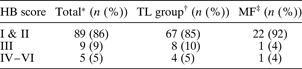
Hearing preservation was intended in the 24 patients who underwent a middle fossa approach. The pure tone average was 31 dB pre-operatively and only decreased to 38 dB post-operatively; however, there was a significant reduction in speech discrimination scores, from 91 to 67 per cent, respectively. Six patients of the total 24 of Middle cranial fossa group had no hearing post-operatively. Table I shows post-operative facial function. Most patients had excellent post-operative facial function: House–Brackmann grades I and II in 86 per cent following translabyrinthine surgery and in 92 per cent after middle fossa surgery.
Patients' post-operative facial function

*n=104; †n = 79; ‡n = 24. HB = House–Brackmann; TL = translabyrinthine surgical approach; MF = middle cranial fossa surgical approach
The mean Glasgow Benefit Inventory score for the translabyrinthine group was −7.5 (confidence interval (95 per cent CI) –2.5 to –13.5) and that for the middle fossa group –4 (CI −13.5 to 5.5). The three domains of the Glasgow Benefit Inventory were analysed separately, showing a reduction in general aspects but no change in physical aspects and an improvement in social aspects. The Glasgow Benefit Inventory scores of those patients whose hearing had been preserved also showed similar results (Table II).
Patients' Glasgow Benefit Inventory domain scores

Data represent means and 95 per cent confidence intervals. *Of 14 patients with preserved hearing, 13 responded. TL = translabyrinthine surgical approach; MF = middle cranial fossa surgical approach
Patients' SF-36 scores were compared against age- and sex-matched controls. The mean differences were then compared using one sample t-test. A significant reduction in social function scores was found (p = 0.035). Separate analysis of the translabyrinthine group showed similar results, with social function being the only domain to show significant deterioration (p = 0.007). However, the middle fossa group showed no significant reduction in any of the domains. The SF-36 scores obtained for the translabyrinthine and middle fossa groups were also compared using the Mann–Whitney U test. This confirmed no significant difference, apart from social function (p = 0.015), which was better in the middle fossa group.
Discussion
There have been many recent publications assessing the effects of surgery and conservative management on the QoL of patients with vestibular schwannoma.Reference Andersson, Ekvall, Kinnefors, Nyberg and Rask-Andersen3–Reference Lassaletta, Alfonso, Del Rio, Roda and Gavilan19 Most surgical series have involved translabyrinthine or retrosigmoid surgical approaches; very few studies have assessed the middle cranial fossa technique, intended to enable hearing preservation.Reference Inoue, Ogawa and Kanzaki6, Reference Baumann, Polligkeit, Blumenstock, Mauz, Zalaman and Maassen14 In our study, we analysed the outcomes of translabyrinthine and middle fossa approaches and compared them with an age- and sex-matched New Zealand population.
Gardner and Robertson have devised a system of determining the usefulness of residual hearing in cases of vestibular schwannoma.Reference Gardner and Robertson20 This approach takes into account the PTA and speech discrimination scores. Post-operatively, 14 of our 24 middle fossa group patients had useful (i.e. grade I or II) hearing, and four had grade III hearing (Figure 1).
Gardner & Robertson grading of pre- and post-operative hearing in the middle cranial fossa group. Grades I & II = pure tone average (PTA) 50 dB or better, speech discrimination (SD) ≥50 per cent; grade III = PTA 50–70 dB; grade IV = PTA > 70 dB

The total Glasgow Benefit Inventory scores of both the translabyrinthine and middle fossa groups indicated a decreased QoL, with mean scores of −7.5 (CI −2.5 to 13.5) and −4 (CI −13.5 to 5.5), respectively. Analysis of Glasgow Benefit Inventory domains showed a decrease in general aspects of QoL, with the translabyrinthine group scoring −20 (CI −25 to −10) and the middle fossa group −12 (CI −25 to 0). There was no significant change in the physical aspects domain for either group. Interestingly, scores for the social aspects domain were improved following surgery: the mean score for the translabyrinthine group was 0 (CI 13 to 27) and that for the middle fossa group 21 (CI 5.5 to 37.5) (Table II).
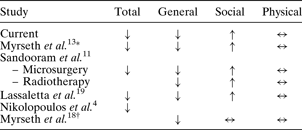
Table III compares our results with those of other published series using the Glasgow Benefit Inventory. From this, we conclude that the effects of surgery are most obvious as regards general aspects of QoL, such as optimism about the future, self-confidence and ‘feel good factors’, rather than physical aspects of QoL. Interestingly, some other studies obtained similar results following radiotherapy and conservative management.Reference Sandooram, Grunfeld, McKinney and Gleeson11, Reference Myrseth, Moller, Wentzel-Larsen, Goplen and Lund-Johansen18
Comparison of studies using Glasgow Benefit Inventory in patients with vestibular schwannoma

*Microsurgery; †conservative treatment. ↑= Improvement in quality of life (QoL); ↓= deterioration in QoL; ↔= no change; Empty cells; results not mentioned that paper
The SF-36 has been used widely all over the world to measure QoL. The Ministry of Health in New Zealand has carried out a QoL assessment using this tool on a sample of the normal population of New Zealand (a total of 7,445 subjects were surveyed including 3,090 males and 4,355 females).21 They found that New Zealanders' self-perceived quality of life was better than that of people in many other countries, including Australia and the USA. This analysis also showed that men scored significantly higher on most scales, and that QoL decreased with increasing age.
In our study, patient scores were compared with age- and sex-matched controls. The mean differences were then calculated and analysed using one sample t-test, comparing against zero. Even though statistically significant differences were obtained for body pain, general health and social function, the mean differences between the New Zealand normal population and our study patients were negative for body pain and general health (i.e. patients scored better than controls). Therefore, these categories cannot be considered clinically significant. The social function scores indicated a significant QoL reduction for the vestibular schwannoma patients overall (p = 0.035, mean difference 5.5, CI 0.39 to 10.68). Similar results were obtained for the translabyrinthine subgroup (p = 0.007). In contrast, the middle fossa group did not reveal any statistically significant difference when compared with age- and sex-matched controls. Table IV compares our results with those of other studies also using the SF-36 to assess patients with vestibular schwannoma treated surgically and conservatively. There seems to be a wide variation in reported results, even when the same questionnaire is used. Our results were similar to those obtained by Myrseth et al. Reference Myrseth, Moller, Wentzel-Larsen, Goplen and Lund-Johansen18
Comparison of studies using SF-36 questionnaire in patients with vestibular schwannoma

SF-36 = SF-36 questionnaire; pts = patients; PF = physical pain; RP = role physical; BP = body pain; GH = general health; VT = vitality; SF = social function; RE = role emotional; MH = mental health; += statistically significant reduction; MF = middle cranial fossa approach; empty data cells represent no reduction in QoL
• Vestibular schwannoma surgery may reduce patients' quality of life (QoL)
• Many such tumours are now diagnosed very early and some patients have good hearing; however, hearing preservation surgery may not lead to improved QoL
• A ‘wait and watch’ policy, with serial magnetic resonance imaging, should be considered in the initial management of these patients
Our study found a reduction in QoL following surgery for vestibular schwannomas, affecting mainly general and social aspects. Even though hearing preservation was achieved in a good number of those undergoing middle fossa procedures, these patients still experienced a reduction in general aspects of QoL.
Conclusion
The natural history of vestibular schwannoma is variable, and we know that many tumours do not grow beyond a certain point. Surgical treatment, even with hearing preservation, may reduce patients' QoL. Outcomes from conservative management show that there is no reduction in QoL in this group.Reference Sandooram, Grunfeld, McKinney and Gleeson11, Reference MacAndie and Crowther12 Thus, a ‘wait and watch’ policy, with serial MRI scanning, may be suitable in the management of selected patients with vestibular schwannoma.
Some published studies of the QoL of vestibular schwannoma patients have used non-validated questionnaires. Those using validated questionnaires, including this study, have either relied on patients' memories (e.g. Glasgow Benefit Inventory) or compared results against a control population (e.g. the SF-36). We believe that it would be a useful and more accurate strategy to conduct a pre- and post-operative comparison of QoL in these patients, and are currently pursuing a prospective study of vestibular schwannoma patients undergoing surgery.