The most extensively researched and validated treatment for bulimia nervosa (BN) is cognitive behaviour therapy for eating disorders (CBT-E; Fairburn, Reference Fairburn2008). The National Institute for Health and Care Excellence (NICE, 2004) recommends CBT as the first-line psychological treatment for BN, and in a systematic review of randomised controlled trials, Hay (Reference Hay2013) found that the evidence base continues to favour CBT for BN. More recently, Fairburn et al. (Reference Fairburn, Bailey-Straebler, Basden, Doll, Jones, Murphy, O'Conner and Cooper2015) conducted a randomised controlled trial of the efficacy of CBT-E for people with eating disorders (above BMI 17.5) and reported full remission in 69% of their participants at the end of a 60-week period of follow-up.
In spite of the evidence base for the efficacy of CBT-E, there continues to be a need for the development of alternative treatments. First, in the above RCT (Fairburn et al., Reference Fairburn, Bailey-Straebler, Basden, Doll, Jones, Murphy, O'Conner and Cooper2015) 66% patients achieved remission (defined as a global score less than 1 standard deviation above the community mean on the Eating Disorder Examination Questionnaire; EDE-Q, Fairburn & Beglin, Reference Fairburn and Beglin1994), leaving 34% who did not. Furthermore, CBT-E is intended to be delivered twice weekly for the first eight sessions (Fairburn, Reference Fairburn2008), something that cannot be offered by all services in the context of limited resources. Finally, extending the range of therapies on offer would contribute to the important value of patient choice (NICE, 2004).
One approach to developing effective treatments for individuals with BN is to consider additional core processes at the heart of eating disorders that might not already be a focus of mainstream treatments such as CBT-E. Gale, Gilbert, Read, and Goss (Reference Gale, Gilbert, Read and Goss2014) have taken this approach, remarking on the prominence of shame and self-directed hostility or criticism in those with eating disorders (e.g., Troop, Allan, Serpell, & Treasure, Reference Troop, Allan, Serpell and Treasure2008). Indeed, Skårderud's (Reference Skårderud2007) qualitative interview study illustrated the role of shame as potentially not only a result but also a cause of eating disorders. Gale et al. cited the presence of shame and self-criticism as a possible reason for the limited effectiveness of current treatment approaches. These authors proposed that compassion-focused therapy (CFT), which targets these processes, is another candidate treatment for eating disorders.
CFT proposes three major emotional systems — threat, drive, and soothing — each having evolved to serve its own set of functions (Gilbert, Reference Gilbert2009). A key focus of CFT is to help patients bring these three systems into an adaptive equilibrium, which usually involves helping people to access their soothing system, such as through compassionate imagery (see Gilbert, Reference Gilbert2009, for a fuller description). Goss and Allan (Reference Goss, Allan, Fox and Goss2012) have conceptualised eating disorders within the CFT model, proposing that patients with eating disorders tend to over-rely on the drive system (associated with emotions such as excitement and pride) as a means of regulating the negative emotions of the threat system, or else access the soothing system in a way that is maladaptive, such as through binge eating. One aim of CFT for eating disorders, therefore, is to help patients to use the three systems in a healthier and more balanced way.
CFT first developed as an intervention for mood disorders, and the first systematic review of CFT showed it to be a promising intervention for these difficulties, especially when there are high levels of self-criticism (Leaviss & Uttley, Reference Leaviss and Uttley2015). The evidence for CFT as a treatment for eating disorders is as yet limited. Adams and Leary (Reference Adams and Leary2007) showed that self-compassion is amenable to change in people with eating-disordered behaviours. Gale et al. (Reference Gale, Gilbert, Read and Goss2014) tested the clinical effectiveness of a CBT group program with CFT elements included and found 73% of patients with BN to make significant and clinically reliable improvements; this suggests that CFT elements can be used with people with eating disorders in a group setting. Finally, the service in which this current study took place has already demonstrated the effectiveness of group CFT treatment for eating disorders (Tsivos, Sampson, & Hamilton, Reference Tsivos, Sampson and Hamilton2013).
To the best of our knowledge, no study to date has investigated whether CFT for eating disorders might be feasible when delivered individually. It would not be reasonable to conclude that evidence for the feasibility of CFT in a group setting automatically speaks to the possibility for CFT to be delivered in an individual format: CFT aims to help individuals to activate their soothing system as an adaptive means of emotional regulation, and it could be argued that a group setting in which patients come into contact with others who have similar experience would have an advantage over individual treatment in activating this system.
The aim of this paper was to evaluate the feasibility of delivering individual CFT for BN and related eating disorders by investigating preliminary outcomes for a case series of nine patients. Unlike the session frequency standard for CBT-E (twice weekly sessions, then weekly; Fairburn, Reference Fairburn2008), the patients presented in this article received fortnightly sessions (a measure to reduce the service's waiting list and provide treatment in a more timely fashion); another aim therefore was to evaluate the feasibility of individual CFT for eating disorders when service limitations demand less frequent treatment sessions.
Method
Baseline Patient Characteristics
The entire sample (N = 9) was female. The average body mass index (BMI) was 23.20 (SD = 3.59), with a range of 18 to 30.5. The mean age of the total sample was 29.33 years (SD = 6.50) and the range was 18 to 40. According to the Diagnostic and Statistical Manual of Mental Disorders (5th ed.; DSM-5; American Psychiatric Association, 2013), five patients met criteria for BN at baseline and four met criteria for other specified feeding or eating disorders (OSFED; when there is a diagnosable eating disorder that does not meet full criteria for one of the specified eating disorders like BN). Of these four patients who met criteria for OSFED, three did so as they were similar to BN in presentation but did not have sufficiently frequent episodes of binge eating and compensatory behaviours to be diagnosed with BN, and one met criteria for ‘purging disorder’, in which there were no self-reported binge episodes but there were regular vomiting episodes.
Research Design
This study was a retrospective evaluation of questionnaire data from a specialist regional Eating Disorder Service collected routinely for patients from June 2014 until July 2016. Questionnaire data were collected at baseline (at the start of treatment) and at the final session of treatment.
Patients were referred to the service by NHS clinicians, typically their general practitioner (GP). Patients were assessed and deemed eligible for treatment if they met criteria for an eating disorder according to the DSM-5 (APA, 2013). When patients presented with very high levels of risk that could not be safely managed within the limited remit of the service, external agencies, such as community mental health teams, were involved to manage this risk. When there were significant levels of alcohol or substance misuse that required concurrent input from a substance misuse service, patients were requested to abstain from alcohol or drugs from the evening prior to the appointment. Approval to collect, store, and publish these anonymised data was granted by the NHS Trust's research and development office.
Outcome Measure
The Eating Disorder Examination Questionnaire (EDE-Q; Fairburn & Beglin, Reference Fairburn and Beglin1994) is a 36-item, self-report measure of the current (past 4 weeks) frequency/severity of four key eating disorder behaviours/preoccupations (subscales), and produces an overall global scale that combines the four subscales. The four subscales are: restraint, eating concern, shape concern, and weight concern. Subscale items are rated on a 7-point Likert scale from 0–6 where high scores indicate increased frequency/severity of eating disorder behaviour/preoccupation. The EDE-Q is a well-validated measure with normed data in undergraduate samples, has good to excellent internal consistency (α = 0.78 to 0.93), and good to excellent test–retest reliability from 0.81 to 0.94 (Luce & Crowther, Reference Luce and Crowther1999).
Compassion-Focused Therapy for Eating Disorders
The individual CFT treatment program adapted for eating disorders was a two-step model of treatment consisting of an initial block of sessions for psychoeducation and motivational enhancement (step 1). Seven patients received six sessions in step 1, and the remaining two patients received five sessions and seven sessions; the variability in these sessions owes to different levels of motivation and readiness to progress to step 2, where patients again received a variable number of sessions (range: 10–27), due to patients benefitting from treatment at different rates.
Step 1 involved working with a therapist to complete a standardised workbook that provided information on what eating disorders are, their physical and psychological effects, and how they can develop. Patients completed pen-and-paper tasks in the workbook designed to assess and enhance motivation to make changes.
In step 2, all patients received individual CFT, which focused on addressing unhelpful self-criticism through the development of self-compassion. Sessions were delivered fortnightly, and were usually 50 minutes in duration and no longer than an hour. The first main component of step 2 involved socialising patients to the CFT model, characterised by a non-blaming philosophy with the aim of understanding the development and maintenance of the eating disorder. This model draws heavily on an evolutionary understanding of the brain (see Gilbert, Reference Gilbert2009). All patients collaboratively developed a CFT formulation to facilitate a better understanding of their eating disorder. Patients were taught distraction techniques and ways to self-soothe with their senses, and were encouraged to practise such techniques between sessions. Following this, patients were taught specific CFT skills, including developing an imaginary safe place and a compassionate image to visualise. Those patients who reported a sufficient level of access to the soothing system were taught compassionate letter writing, which involved practising writing a narrative of the development of their eating disorder and its maintenance from a self-compassionate and non-blaming perspective, including compassionate advice on steps that could be taken to recover from the eating disorder.
Specialist dietetic appointments were offered to patients, which provided: (1) nutritional assessment; and (2) education about normal, healthy eating with tailored guidance for the patient in the form of a collaboratively-developed meal plan. All but one of the patients received a specialist dietetic appointment in step 1, and the remaining patient received theirs during step 2; this was due to variability in patients’ readiness to engage with dietetic support, which can be anxiety provoking due to its focus on changing highly valued eating patterns. Patients decided on the number of dietetic appointments they received (range: 2– 11) based on their desire for further sessions.
Therapist preparation
Individual CFT treatment was delivered in English by clinical psychologists, cognitive behaviour therapists, and a trainee clinical psychologist. All clinicians received monthly supervision in delivering CFT from a CFT specialist working in another eating disorder service. Treatment took place in community settings. No incentives were offered to patients.
Results
Data Analysis
Five scales of the EDE-Q were analysed: the four subscales and the global scale. Analyses were performed using SPSS Version 20. All scales were found to have a normal distribution and no outliers, and therefore met the assumptions of a paired samples t-test.
Group-Level Analysis
Changes on EDE-Q
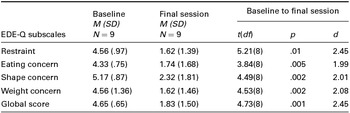
Analyses showed a statistically significant decrease in eating-disordered thoughts and behaviours between baseline and final session, as measured by the EDE-Q: all of its subscales, and the global score, showed a significant mean decrease between baseline and final session, with large effect sizes (d > .8) according to Cohen's (1988) guidelines on effect sizes: restraint, t(8) = 5.21, p = .001, d = 2.45; eating concern, t(8) = 3.84, p = .005, d = 1.99; shape concern, t(8) = 4.50, p = .002, d = 2.01; weight concern, t(8) = 4.53, p = .002, d = 2.08; global, t(8) = 4.73, p = .001, d = 2.45 (see Table 1).
Means and Effect Sizes for All EDE-Q Subscales at Baseline and Final Therapy Session

Individual-Level Analyses
Remission
‘Remission’ was defined as having a global EDE-Q score less than 1 standard deviation (SD) above the community mean (i.e., 1.74; as reported in Fairburn et al., Reference Fairburn, Bailey-Straebler, Basden, Doll, Jones, Murphy, O'Conner and Cooper2015); this is a common way of calculating clinical remission (e.g., Fairburn et al.). All patients in the present study demonstrated a baseline global EDE-Q score above 1 standard deviation of the community norm; at the final session of treatment, this was no longer true for five patients (56%).
Behaviour change
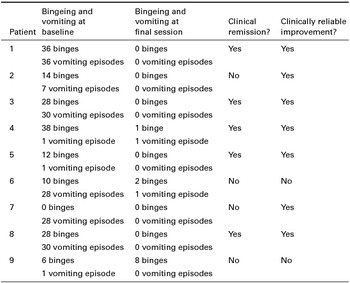
According to the EDE-Q scores at baseline, all patients demonstrated eating-disordered behaviours; at the final session, five patients no longer reported any eating-disordered behaviours on the EDE-Q. Of the remaining four patients, one no longer reported bingeing or vomiting at the final session, but continued to engage in exercise as a means of weight control (down from 10 at baseline to 4 at the final session). One patient had gone from reporting bingeing 28 times and vomiting once at baseline to bingeing once and vomiting once at the end of treatment. One patient had gone from reporting bingeing 10 times and vomiting 28 times at baseline to bingeing twice and vomiting once at the end of treatment. Finally, one patient had gone from reporting bingeing six times and vomiting once at baseline to bingeing eight times and not vomiting at all at the end of treatment (see Table 2).
Individual Patients’ Bingeing and Vomiting at Baseline and Final Session as Indicated by EDE-Q Scores

Note: Clinical remission as defined by final global EDE-Q scores less than 1 SD above the community mean and clinically reliable improvements based on RCI calculations of global EDE-Q scores.
Reliable Change Index
Seven patients demonstrated clinically reliable improvement in their EDE-Q scores by the end of treatment based on EDE-Q Reliable Change Index (RCI) scores (indicated by RCI > 1.96; Jacobson & Truax, Reference Jacobson and Truax1991). Two patients did not show clinically reliable improvement based on their RCI scores (see Table 2).
Discussion
This is the first study, to the best of the authors’ knowledge, that investigates the feasibility of delivering CFT for eating disorders on an individual basis. The nine patients in this case series showed a significant group decrease in eating disorder symptomatology following individual CFT, as measured by the EDE-Q. Individual-level analyses of EDE-Q scores indicated clinically reliable change in all but two patients, and clinical remission in five patients by the final session of treatment. Five patients demonstrated full cessation of all eating-disordered behaviours by the final session of treatment; not all of these reached clinical remission, as behaviour is only one measure of ED symptomatology on the EDE-Q. The remaining four patients, while not reaching full cessation of eating-disordered behaviours, all showed a decrease in these behaviours.
The above can be taken as preliminary evidence that patients with BN and related eating disorders could benefit from CFT. Furthermore, as this article reports outcomes of real-world clinical practice, it suggests an intervention that could deliver positive outcomes when sessions take place fortnightly (a strategy used by some services as a way to reduce service waiting times), whereas the current most evidenced treatment for BN and OSFED in adults — CBT-E — requires twice-weekly sessions to begin with before moving to weekly sessions (Fairburn, Reference Fairburn2008), something that many services would find difficult to deliver due to resource issues.
Tentatively, we can compare the number of patients in the present study who achieved clinical remission (55%) with the 66% reported by Fairburn et al. (Reference Fairburn, Bailey-Straebler, Basden, Doll, Jones, Murphy, O'Conner and Cooper2015) in their study of CBT-E for eating disorders; however, the small sample size of the present study limits the generalisability and reliability of the reported data, thereby limiting the usefulness of any comparison with such large-scale research outcomes.
Another limitation of the present study is the lack of a comparison group, meaning that it is not possible to conclude with total confidence that the significant group decline in EDE-Q scores was not due to spontaneous symptom remission; however, the limited data on spontaneous recovery from eating disorders suggests this is not very likely (e.g., Keski-Rahkonen, Hoek, Lina, & Raevouori, Reference Keski-Rahkonen, Hoek, Lina and Raevouori2009). There are two related limitations: (1) that dietetic sessions were offered alongside therapy sessions, which reduces our ability to interpret the results in favour of CFT as opposed to dietetic input; (2) that CFT in the service is generally offered to those patients who find such an approach to be acceptable and, as such, there is an inherent bias in which those patients who were studied might have been those who were already more likely to respond favourably to treatment.
The lack of a follow-up period is a further limitation and reflects the fact that the study is a retrospective analysis of service outcomes. As such, this study cannot conclude anything about the longevity of the treatment gains or relapse rates following CFT.
Given that therapy was delivered by clinicians with skills in a range of models, including CBT-E, another limitation is the fact that there were no formalised checks regarding therapist adherence to CFT other than routine clinical supervision. As such, this study does not allow us to assess to a high level of certainty the mechanism of therapeutic gains.
Recommendations for Future Research
Future case series could collect additional data on patient self-compassion at multiple time points in treatment in order to fine-tune the analysis of change mechanisms when CFT is provided for eating disorders. Any future case series would also benefit from formalised checks, such as ratings of audio-recorded sessions, to assess therapist compliance with the treatment modality. It would be worthwhile to establish patient consent to be contacted for follow-up after the end of treatment in order to examine the duration of any treatment benefits.
Future research might wish to investigate the feasibility of CFT as a treatment for other eating disorders, in particular anorexia nervosa, as it is possible that significantly low weight could somehow impede the effectiveness of such an intervention; CFT could be said to involve more conceptual processing than its better-researched counterpart, CBT-E — at least in the early stages of treatment — which might be more of a challenge for low-weight patients. A larger sample size would be required in order to establish the generalisability and reliability of the present study's findings. Finally, randomised controlled trials would be needed in order to allow for reliable comparisons between CFT and, for example, CBT-E, to clarify the question of which approach is generally superior.
Acknowledgments
The authors would like to thank all other clinicians who have contributed data to this project: Nuria Francos, Kirsty Sturzaker, and Pauline Hamilton. We would also like to thank Angela Hughes for the specialist dietetic input she provided to our patients. Special thanks go out to our fantastic administrator, Karen Kelly. Final thanks go to Ken Goss for providing training and supervision in the delivery of CFT for eating disorders. This research received no specific grant from any funding agency, commercial, or not-for-profit sectors.
Declaration of Interest
None.