“As far as law enforcement, I can touch on that … If you’re darker [skinned], I don’t know, it’s like they have more fear. I’ve heard cops say that before. I don’t know if they’d be afraid that we’ll want revenge—I don’t know. They say we’re violent.”
—34-year-old, dark-skinned Black man
“Even if you look at just all the shootings that have happened, that’s a very blatant and obvious statement to me that yes, they’re treating them differently based on the color of their skin … And even if you think about the color of the skin of people that have been shot, they’re almost always on the darker spectrum of skin color.”
—26-year-old, light-skinned Black woman
The Black Lives Matter (BLM) movement has crafted a multidimensional framework for understanding racialized experiences with police brutality. As Bonilla and Tillery (Reference Bonilla and Tillery2020, 2) summarize: “the most visible Black Lives Matter activists quickly coalesced around the view that intersectionality is the ‘master frame’ of the movement (Chatelain and Asoka 2015; Garza, Tometti, and Cullors 2014).” This has included drawing more attention to the marginalization of women and LGBT individuals, for example, through hashtags like #SayHerName and #BlackTransLivesMatter (Garza Reference Garza and Hobson2016; Tillery Reference Tillery2019). This strategy “opens our collective eyes to multiple dimensions of state and state-sanctioned anti-Black violence” (Lindsey Reference Lindsey2015, 235). Further, these efforts suggest a belief that highlighting the nuances of racialized experiences with police are crucial towards raising awareness of the problems being faced and their potential solutions (Lindsey Reference Lindsey2015; Rickford Reference Rickford2016; Tillery Reference Tillery2019).
A less emphasized axis of marginalization relevant to BLM is that of skin color. Growing empirical evidence highlights that darker skin color is associated with more negative outcomes and experiences both within and across racial groups (e.g., Branigan et al. Reference Branigan, Freese, Sidney and Kiefe2019; Burch Reference Burch2015; Monk Reference Monk2018, Reference Monk2021; Ostfeld and Yadon Reference Ostfeld and Yadon2021; Yadon Reference Yadon2020; Yadon and Ostfeld Reference Yadon and Ostfeld2020). On average, darker-skinned Black individuals have less wealth, lower wages, higher unemployment, less education, lower occupational prestige, greater social rejection, and worse health outcomes than lighter-skinned Black people (Burch Reference Burch2015; Goldsmith, Hamilton, and Darity Reference Goldsmith, Hamilton and Darity2007; Harburg et al. Reference Harburg, Gleibermann, Peter Roeper and Schull1978; Hebl et al. Reference Hebl, Williams, Sundermann, Kell and Davies2012; Johnson, Farrell, and Stoloff Reference Johnson, Farrell and Stoloff.1998; Keith and Herring Reference Keith and Herring1991; Krieger, Sidney, and Coakley Reference Krieger, Sidney and Coakley1998; Monk Reference Monk2015). In many cases, the magnitude of color-based disparities between lighter- and darker-skinned Black Americans is equal to or larger than that of racial disparities between Black and white Americans (Monk Reference Monk2018, Reference Monk2021).Footnote 1
Evidence of these color-based disparities, or “colorism,” also extend to the criminal justice realm. Darker-skinned Black Americans are significantly more likely to be arrested, incarcerated, or sentenced to death, even after accounting for other background characteristics and context (Eberhardt et al. Reference Eberhardt, Davies, Purdie-Vaughns and Johnson2006; Kizer Reference Kizer2017; Monk Reference Monk2018; White Reference White2015). Additionally, while lighter-skinned Black Americans and whites receive comparable criminal sentencing outcomes, medium- and darker-skinned Black Americans receive sentences that are 5% longer (Burch Reference Burch2015). In sum, the combination of race and color leave darker-skinned Black people to face the most unjust institutional outcomes.
Media discourse and social movement responses to police brutality largely exclude a recognition of skin color discrimination, however. Given that BLM intentionally incorporates the multidimensional experiences of Black individuals, one could imagine their messaging extending to include skin color as another meaningful axis of marginalization. Building from the foundations of scholars and activists who have noted and theorized the importance of colorism (e.g., Banks Reference Banks1999; Brown and Lemi Reference Brown and Lemi2021; Burch Reference Burch2015; Hochschild and Weaver Reference Hochschild and Weaver2007; Jones Reference Jones2000), this paper examines examine the following questions: Do Black Americans perceive skin color as informing police interactions in addition to race? Do many Black Americans support incorporating skin color into anti-brutality movement messaging? Is there variation in opinion based on one’s own skin color?
This paper seeks to seek to examine how Black Americans navigate the multidimensional nature of race in the context of organizing efforts against institutionalized racism. This is important as colorism and racism coexist to maintain a hierarchy that props up whiteness as the “ideal” (Banks Reference Banks1999; Brown and Lemi Reference Brown and Lemi2021; Burch Reference Burch2015; Fanon Reference Fanon1952; Lemi and Brown Reference Lemi and Brown2020). Colorism operates as a feature of anti-Blackness, with one’s color serving as a cue for proximity to whiteness or Blackness. Both historically and in the present day, darker skin signals one’s closeness to Blackness and results in a stronger application of racialized stereotypes—e.g., being perceived as aggressive, intimidating, or dangerous (Banks Reference Banks1999; Maddox and Gray Reference Maddox and Gray2002; Monk Reference Monk2021).
Drawing from interdisciplinary literatures, I argue that Black Americans, particularly those with darker skin, view skin color as informative for police interactions and may support incorporating skin color into anti-police brutality movements like BLM. Skin color is one of many factors influencing how race is experienced and serves as an especially important marker given its salience and visibility (Ostfeld and Yadon Reference Ostfeld and Yadon2022). Color can be a consequential cue among institutional actors, like police, to inform their interactions with civilians (Lee Reference Lee1993). I expect that this differential treatment based on both race and skin color is observed by Black Americans and subsequently influences their views of policing and social movement organizing against police brutality. In turn, this may also suggest an openness to discussing color-based discrimination alongside other intersectional language within BLM’s messaging.
A central contribution of this project is incorporating measures of self-identified skin tone and colorism to highlight associations between race, skin color, and public opinion towards anti-brutality movements. To this end, it is important to recognize the value associated with different measures of skin color. Each measure of color—self-assessed, interviewer-assessed, or machine-rated using a light-reflectance meter—provides different but useful information about associations between color and various potential outcomes. Self-reported color, as used here, reflects how one conceptualizes and positions oneself in society. Thus, self-reported color can incorporate goals and aspirations not readily apparent to an observer. In contrast, interviewer-assessed skin color provides insight into how one is perceived externally—which may inform treatment or institutional outcomes—but may not align perfectly with perceptions of oneself. Machine-ratings can provide a precise measurement of the light-reflectance from one’s skin absent the social influences involved with human-assessments. Yet machine ratings do not shed light on meaningful factors associated with color, require expensive technology, are invasive (requiring physical contact), and can raise ethical concerns harkening back to the use of pseudo-scientific physical “measures” by eugenicists (Ostfeld and Yadon Reference Ostfeld and Yadon2022). Thus, scholars must carefully consider which measure is appropriate for their purposes. In this study, understanding perceptions of colorism and the Movement for Black Lives benefits most clearly from using self-identified color. This measurement strategy also complements the numerous studies documenting criminal justice system biases against those with dark skin that rely on coder-assessed measures of skin color but do not incorporate self-perceptions of one’s identification or experiences.
Combining in-depth interviews alongside national survey data with measures of self-identified skin color and colorism, this study enhances understandings of the multidimensional associations between race, phenotype, and political views. I find that while most Black Americans believe that skin color influences criminal justice interactions and protests, many also believe the potential cost of explicitly highlighting this disparity is too great. This hesitancy stems from concerns that referencing multidimensional experiences—including skin color or gender—would be divisive and potentially hinder efforts towards reducing race-based violence. This also reveals a tension between organizers’ efforts and public opinion. Moreover, it underscores the persistent marginalization of certain group members as a result of concerns about movements losing support by highlighting subgroup disparities (Cohen Reference Cohen1999). In combination with other recent evidence (Bonilla and Tillery Reference Bonilla and Tillery2020; Bunyasi and Smith Reference Bunyasi and Smith2019), this leaves scholars and activists with a tension between supporting especially vulnerable group members and simultaneously crafting political messaging that will resonate effectively. As a whole, this study highlights the structural impacts of race and color in police interactions with community members, as well as the psychological and movement responses among impacted communities.
The Double Penalty of Race and Skin Color
A variety of sources—including prominent explorers, political philosophers, religious leaders, and scholars—have perpetuated the denigration of darker-skinned people for centuries. In turn, color has been used to determine who should and should not have access to basic rights and protections (Banks Reference Banks1999; Fanon Reference Fanon1952; Jablonski Reference Jablonski2021; Ostfeld and Yadon Reference Ostfeld and Yadon2022). Even in the present day, darker skin and more Afrocentric features are associated with greater perceptions of being threatening, aggressive, and less competent (Maddox Reference Maddox2004; Maddox and Gray Reference Maddox and Gray2002). The widespread and long-standing nature of these associations means that gatekeepers—who largely tend to be white—use skin color as a metric for determining who is worthy of receiving access, trust, and better opportunities (Monk Reference Monk2021). Consistent with this, a body of evidence demonstrates the connection between darker skin across ethnoracial groups in the United States and more negative outcomes or discrimination, particularly in the criminal justice realm (e.g., Burch Reference Burch2015; Monk Reference Monk2021; Reece Reference Reece2021).
Recognizing the importance of skin color in combination with race and other demographic characteristics is rooted in an understanding that access to power and opportunity stems from a combination of factors. Given that race is a social construction (Omi and Winant Reference Omi and Winant1994; Roth Reference Roth2016), many components influence the racialized experience. These include some of the same characteristics that are often studied alongside race—e.g., class, religion, culture, or neighborhood. Recent conceptualizations argue that these various components are not all equally meaningful towards understanding race and racialized experiences. In this view, components that are “stickier” and more visible will more powerfully inform how race is experienced because these components serve as clearer markers for institutions and institutional actors to use in exerting power (Ostfeld and Yadon Reference Ostfeld and Yadon2022). The complexity of race suggests that institutional actors like police can use skin color as a highly visible cue that powerfully signals information about how to interact with an individual.
Is there an awareness among Black Americans that skin color influences interactions with or treatment by police? If there is a widespread recognition that both race and color influence one’s treatment by police, how do Black Americans navigate prioritizing these two components in discourse and movement messaging concerning police brutality? Of course, social movement organizing and messaging strategies are crucial components influencing public opinion, mobilization, and civic engagement at both the mass and elite levels (Gillion Reference Gillion2013, Reference Gillion2020; Parker Reference Parker2009; Phoenix Reference Phoenix2019; Towler and Parker Reference Towler and Parker2018; Walton Reference Walton1985). Political mobilization combining institutional means, like voting, and non-institutional means, like protest, can occur in reaction to perceived threats (Parker Reference Parker2009; Towler and Parker Reference Towler and Parker2018). Moreover, protest can signal the public’s issue preferences and priorities to elites, particularly when protest occurs for or by marginalized groups for whom protest participation is more costly (Gause Reference Gause2022a, Reference Gause2022b; Gillion Reference Gillion2013, Reference Gillion2020).
Consequently, an important component of movement organizing is sending signals to the broader public and elites regarding the movement’s concerns, priorities, and goals in hopes of drawing in supporters. One consideration, then, is how to effectively frame these issues for the public. In the case of BLM, the movement’s leaders have made efforts to explicitly incorporate discrimination based on gender and sexual orientation into their messaging (Board et al. Reference Board, Spry, Nunnally and Sinclair-Chapman2020; Bonilla and Tillery Reference Bonilla and Tillery2020; Bunyasi and Smith Reference Bunyasi and Smith2019; Garza Reference Garza and Hobson2016). This concerted effort suggests that the organizers believe that highlighting the multidimensionality of racialized experiences with police is important for raising awareness, shoring up movement support, and developing solutions. At least some people endorse this more inclusive messaging strategy (Tillery Reference Tillery2019). And the summer 2020 Floyd protests suggests that BLM’s inclusive messaging, at minimum, did not detract from widespread participation in the largest protests in U.S. history (Putnam et al. Reference Putnam, Chenoweth and Pressman2020). If there is public support for discussing gender or sexual orientation within BLM’s messaging, could there also be support for discussing skin color?
Accordingly, I examine how perceptions of skin color and color-based treatment are associated with political views in response to police brutality. While the link between darker skin and more unjust institutional outcomes seems clear, there are no published studies to my knowledge examining the link between self-identified skin color and views about anti-brutality movements. Evidence about the association between skin color and general political views among Black Americans between the 1970s and 1990s suggest there may not be an association (Hochschild and Weaver Reference Hochschild and Weaver2007; Seltzer and Smith Reference Seltzer and Smith1991). Hochschild and Weaver (Reference Hochschild and Weaver2007) theorize that a “skin color paradox” exists where, despite color-based disparities in experiences, no differences in political attitudes based on color are detectable. They argue this is “because most blacks see the fight against racial hierarchy as requiring their primary allegiance, they do not see or do not choose to express concern about the internal hierarchy of skin tone” (643). Thus, the history of the one-drop rule leads to prioritizing efforts towards reducing racial discrimination. In turn, one might not expect to see a recognition that color influences treatment by police or a belief that anti-brutality movements should address colorism.
There are two primary reasons to believe that the “skin color paradox” may not continue to hold as strongly today, however. First, significant sociodemographic shifts in the last several decades—namely, growing levels of immigration; incorporation of new and sizable ethnoracial groups into the United States (e.g., Latinos, Asian Americans); and increased levels of multiracial identification—have contributed to a reshaping of the American racial hierarchy (Davenport Reference Davenport2018; Masuoka Reference Masuoka2017; Monk Reference Monk2021; Reece Reference Reece2021). These sociodemographic shifts have increased the number of categories included within the racial hierarchy and contributed to a blurring of boundaries around many of these groups (Ostfeld and Yadon Reference Ostfeld and Yadon2022). If there is greater variance in experiences among members of a shared racial group due to factors such as color, this has the potential to influence the salience of color on lived experiences and corresponding political views.
Second, skin color might be more politically meaningful in domains where skin color disparities are especially pronounced (Yadon Reference Yadon2020).Footnote 2 That is, the salience of the issue may influence whether skin color is meaningfully associated with political views, and whether it may extend beyond public opinion to attitudes about movement organizing strategies. Given the association between darker skin and stronger application of racial stereotypes such as perceived aggression, skin color may influence how one is treated by police and corresponding responses via anti-brutality movements. In combination, this suggests that
(H1) Black people will perceive that police treat darker-skinned Black Americans worse than lighter-skinned Black Americans.
This complements growing evidence that institutional discrimination occurs based on skin color at multiple levels within the criminal justice system. Further, it would highlight conditions under which the “skin color paradox” may be weakening.
Of course, everyone holds a combination of identities and the salience of a given identity or set of identities varies across contexts (Citrin and Sears Reference Citrin, Sears, Abdelal, Herrera, Johnston and McDermott2009; Garcia-Bedolla Reference Garcia-Bedolla2007; Montoya et al. Reference Montoya, Bejarano, Brown and Gershon2021). Just as racial identity operates in distinct ways alongside ethnicity, gender, or sexual orientation (Brown Reference Brown2014; Cohen Reference Cohen1999; Greer Reference Greer2013), the same is also true with respect to color. In some contexts, darker skin can be empowering while in other contexts it can be stigmatizing. Indeed, darker skin is viewed as more prototypical and darker-skinned Black Americans are often viewed as having greater racial authenticity, which can be a point of pride and empowerment (Harvey et al. Reference Harvey, LaBeach, Pridgen and Gocial2005; Maddox and Gray Reference Maddox and Gray2002). Greater perceived authenticity can allow darker-skinned people to be viewed as speaking with more authority on certain issues or taking on leadership positions working on behalf of the group (Hogg Reference Hogg2001; Hunter Reference Hunter2007). This may mobilize darker-skinned Black people to not only be especially likely to recognize color-based disparities but also to speak out most strongly against police brutality. Indeed, that members of in-groups are more attentive to issues and discrimination based on group membership than out-group members is well-documented (Bobo Reference Bobo, Krysan and Lewis2004; Tajfel and Turner Reference Tajfel, Turner, Worchel and Austin1986). This suggests the following:
(H2) Self-identified darker-skinned Black Americans will be more prone to recognizing color-based disparities in policing than their self-identified lighter-skinned Black counterparts.
Importantly, this does not mean that self-identified lighter-skinned Black people will not recognize skin color as important, but that the combination of race and color is likely to be more salient for darker-skinned individuals given the impact of skin color on their day-to-day experiences—including the potentially deadly consequences of institutionalized discrimination via policing.
As previously noted, mainstream discourse largely avoids discussing color-based disparities. Could there be a public desire to change this by incorporating skin color into movement messaging? Alternatively, is there a sense that race should be prioritized because it is more consequential, or because emphasizing skin color might dilute racial solidarity within BLM? Since darker skin color within racial groups is linked with worse criminal justice outcomes, skin color may be viewed as pertinent to BLM’s inclusive framing. Color may also be especially relevant in the digital age, where photos or video footage of police encounters are often recorded and widely circulated (Bonilla and Rosa Reference Bonilla and Rosa2015; Walsh and O’Connor Reference Walsh and O’Connor2019). Therefore, characteristics like skin color and racialized features of those involved will be immediately visible and salient to the public. In this case,
(H3a ) If subgroup disparities such as those based on skin color are perceived to influence police interactions, many Black Americans will support incorporating subgroup disparities into BLM messaging.
Perhaps opinions of the organization’s messaging strategy may vary based on one’s own skin color and corresponding experiences. Consistent with the logic behind H2, if the combination of race and skin color are perceived as informing police treatment, then one’s own skin color may be associated with views of whether it is valuable to discuss color-based disparities in messaging strategies as well. There may be a clearer and more intense application of color-based group identification to political views among darker-skinned individuals given the connection between darker skin and worse police treatment. In contrast, lighter-skinned Black people may view color-based discrimination as less urgent or view racial discrimination as being the primary avenue through which police brutality occurs. In turn, this would suggest that discussing color-based discrimination would be of lower importance. In this case,
(H3b ) Self-identified darker-skinned Black Americans will be more open to discussing skin color alongside race within anti-police brutality messaging than lighter-skinned Black Americans.
Alternatively, there may be a general preference for focusing BLM’s messaging on the racial group without highlighting subgroup variation based on characteristics like skin color or gender. Recent evidence highlights potential backlash to subgroup messages. For example, employing subgroup messaging based on gender may fail to mobilize Black women and may demobilize Black men (Bonilla and Tillery Reference Bonilla and Tillery2020; Bunyasi and Smith Reference Bunyasi and Smith2019). This evidence suggests a hesitancy among some Black Americans to incorporate any subgroup messaging. Thus, focusing on the racial group—as opposed to subgroups—may be viewed as most effective for the movement towards achieving their goal of reducing police brutality. This hesitation to incorporate discussions of color would also be consistent with long-standing efforts towards “unifying” the racial group by setting aside intra-group disparities such as those based on color (DuBois Reference DuBois1903; Hochschild and Weaver Reference Hochschild and Weaver2007; Monk Reference Monk2014; Reece Reference Reece2021). Put differently,
(H3c) Black Americans may prefer to focus on broader racial disparities in BLM messaging without noting subgroup disparities, such as those based on color.
Overall, examining race as multidimensional helps illuminate the nuances associated with perceptions of policing and political responses via BLM. Scholarly shifts towards understanding the influence of overlapping characteristics such as race along with gender (Lemi and Brown Reference Lemi and Brown2020), sexual orientation or HIV status (Brown Reference Brown2014; Cohen Reference Cohen1999), motherhood status (Brown Reference Brown2014), veteran status (Parker Reference Parker2009), and—in this specific project, race and skin color—serve to more fully illuminate how racial hierarchies operate. Importantly, while the combination of factors like race and color may influence how one prioritizes efforts or messaging strategies in the efforts to mitigate police brutality, it does not imply disagreement among Black Americans on the broader goal of ending police brutality.
Data, Methods, and Measures
One reason that examining race and skin color is often more difficult than examining other combinations of characteristics—like race, gender, and/or class—is measurement. When measures of skin color are not regularly incorporated into political surveys, studying whether or how race and color are associated with political views is challenging. Indeed, only a limited set of existing surveys have measures of skin color, political outcomes, and large enough samples of non-white respondents to allow for subgroup analyses.Footnote 3
An additional challenge is that while survey items related to race-based discrimination or policies are commonplace, the same is not true with respect to color-based issues. For example, published work on skin color and political attitudes among Black Americans has been conducted on a relatively small number of political issues such as ideology, racial group attachment, experiences with discrimination, and civil liberties (Hochschild and Weaver Reference Hochschild and Weaver2007; Seltzer and Smith Reference Seltzer and Smith1991). This initial research on political attitudes and skin color leaves open the possibility that skin color may be meaningful in other areas, perhaps especially in domains where color-based disparities are well-documented (Yadon Reference Yadon2020). Shifts in the American racial landscape in recent decades may also contribute to the growing potential of color’s importance. These changes have been fueled by growing levels of immigration and shifts in racial identification options—including steady growth of multiracial identification—as well as changing perceptions of the “most important” issues in society (Bobo et al. Reference Bobo, Charles, Krysan, Simmons and Marsden2012; Davenport Reference Davenport2018; Reece Reference Reece2021). Together, these factors leave open the possibility that skin color may be associated with political views in several domains of primary interest to social scientists today—including policing and anti-brutality movement organizing.
To begin addressing these measurement challenges, I developed multiple studies incorporating measures of participants’ self-assessed skin tone alongside questions involving race and color. These data collection efforts circumvent concerns associated with traditional surveys by including items related to skin color and colorism as the primary variables of interest. The first data collection effort involved sixty-seven in-depth interviews with Black Americans in the metro-Detroit area.Footnote 4 The semi-structured interviews were advertised as a conversation about Black experiences in society via multiple methods of advertisement—student, faculty, and staff e-mail listservs at a large public university near the metro-Detroit area, flyers posted at local coffee shops and libraries, postings in local church bulletins, as well as local Craigslist postings—and by employing a snowball sampling technique. After completing a pre-screening form to ensure variation on key demographic factors of interest (e.g., gender, level of education), individuals were invited to participate in an interview.
These interviews were conducted from October 2016 through September 2017 and discussed experiences associated with the multidimensionality of race, discrimination, and politics (refer to online appendix 1 for more detail). The interview conversations lasted over an hour on average. Although the sample is from one Midwestern metropolitan area, the distribution of gender and education maps onto Census estimates for the national Black population (Rastogi et al. Reference Rastogi, Johnson, Hoeffel and Drewery2011). Interviewees were 55% women and 45% men, with education levels ranging from less than a high school diploma through PhD. The average age of participants was forty years. At the end of the interviews, participants were asked to identify their skin tone, with self-reported color ranging from “very light” to “dark.” Interviews were audio-recorded and participants received a Visa gift card as a token of appreciation. As discussed further in online appendix 1, interviews were conducted by either a white or Black female interviewer and subsequently transcribed by the interviewer. After all transcripts were reviewed multiple times for themes and patterns, a coding scheme was developed and used in subsequent analyses.
Turning to communities directly affected by colorism provides vital insight into both experiences and perceptions of how this phenomenon operates. This is especially valuable towards understanding the impacts that systems of oppression have on the oppressed (Weaver and Prowse Reference Weaver and Prowse2020). The richness of these conversations allows for depth and nuance that is not possible in traditional surveys, which often use instruments that may lack real-world applicability particularly on less-studied topics (Bryman Reference Bryman2008; Hochschild Reference Hochschild1981; Parker Reference Parker2009; Weaver and Prowse Reference Weaver and Prowse2020). In contrast, the interviews are a regional convenience sample and, compared to traditional surveys, involve a relatively small number of participants. To enhance these analyses, I sought to see if the interview trends generalized on a national scale by developing survey items drawing from thematic comments expressed by interview participants.Footnote 5
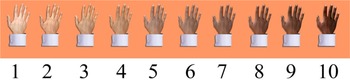
The first-order goal of these large-scale surveys is examining how perceptions of skin color are associated with institutionalized violence and what role skin color should play in conversations about discrimination. The secondary goal is examining how participants’ self-identified skin color may be associated with their views. Across both national surveys, I included a measure of self-reported skin tone using the first validated, interval-level Yadon-Ostfeld Skin Color Scale (figure 1). This scale was developed using an iterative process involving a light-reflectance spectrophotometer and graphic designer to create even spacing and realistic skin coloring at every point on the scale. As a result, this scale is the first in the social sciences designed to feature consistent and gradual color changes between each hand on the 10-point scale (Ostfeld and Yadon Reference Ostfeld and Yadon2021, Reference Ostfeld and Yadon2022).
Yadon-Ostfeld skin color scale

For the purposes of this study, the key question of interest is how Black Americans perceive anti-brutality movement organizing efforts. Because I am interested in these perceptions, it is valuable to rely on self-reported skin color since this measure provides insight into how an individual thinks of themselves and how they want to position themselves within society. Some argue that skin color is a form of “embodied social status” and reflects one’s social experiences over the course of their life, including a combination of perceived past, present, and future opportunities (Monk Reference Monk2015). Put differently, self-reported color is likely to reflect some combination of phenotype and aspirations that meaningfully inform how one interacts with the world.
Importantly, self-assessed color is not just another measure of Black Americans’ political views or racial identity strength. Recent evidence underscores that experiences with discrimination, strength of racial identity, and political views, including those related to policing, do not predict how one reports their skin color (Monk Reference Monk2015; Ostfeld and Yadon Reference Ostfeld and Yadon2022).Footnote 6 Thus, while self-reported color likely reflects “embodied social status,” it is not interchangeable with one’s experiences or views. In a society in which skin color is increasingly meaningful given shifts to the racial hierarchy, it is important to understand how people position and conceptualize themselves and their experiences through measures of self-assessed skin color.Footnote 7 Consequently, participants’ self-identified color is used in analyses of both qualitative and quantitative data here. The use of self-reported color complements existing examinations of skin color biases in the criminal justice realm given that prior studies largely rely on coder-assessments of color. In turn, this study sheds light on how one’s self-positioning is associated with perceptions of these issues surrounding policing and anti-brutality movements.
Whether self-reports of skin color are more appropriate or useful than third-party assessments depends on the purpose of the study. Importantly, interviewer assessments are no more “objective” than self-assessments. Interviewer assessments are often influenced by context and sociodemographic factors—e.g., based on the race of the interviewer or contextual cues such as neighborhood, education level, and income of the participant (Hannon Reference Hannon2014; Hannon and DeFina Reference Hannon and DeFina2016; Hill Reference Hill2002). Other work has demonstrated that Black Americans who were classified by interviewers as having darker skin were also more likely to be classified as having low levels of information, even after controlling for levels of educational attainment and scores on various knowledge tests (Leal and Hess Reference Leal and Hess1999). In my data, the face-to-face nature of the qualitative interviews creates an opportunity for interviewer-assessed color to be recorded and compared to self-reports. I find a strong correlation between self-reported and interviewer-assessed color (r=0.83). Substantively, interview participants had a clear sense of how they identified their own color and could readily and easily share stories related to their self-reported color categorization. In sum, examining self-identified skin color is central to the primary hypotheses tested in this study, as well as highlighting how individuals situate themselves and make sense of their experiences.
I coupled the Midwest-based interviews with national surveys to ascertain whether the findings were consistent on a national scale. Both national surveys were conducted prior to the summer 2020 protests, providing insight into perceptions of policing and skin color before some of the highest-profile BLM activities. The first survey was conducted in summer 2018 with a national sample of 1,825 Black Americans using the survey firm Lucid.Footnote 8 The second survey was drawn from NORC AmeriSpeak’s probability-based, nationally representative panel in early 2019 and included 1,043 Black Americans.Footnote 9 In addition to self-assessments of skin color as the primary independent variable, these surveys include a number of standard sociopolitical items—e.g., gender, age, education, income, region, partisanship, ideology, and racial group identity importance (refer to online appendix 3). These items are used as controls in the linear regression models to clarify the association between self-identified skin color and perceptions of policing.
Furthermore, I included original survey items related to skin tone and colorism based on the interview conversations to expand the breadth with which we understand perceptions of differential treatment, experiences, and opportunities in society. The first of these dependent variables, Perceived Colorism among Police, appeared in both the 2018 and 2019 surveys. This question asks how often one believes the following statement is true: “Black people with darker skin receive harsher treatment by police compared to those with lighter skin” (always, most of the time, about half of the time, some of the time, never). The second dependent variable was asked only in the 2019 AmeriSpeak survey. This item—Skin Tone Distracts from Race—asks participants how often they feel this statement is true: “Talking about skin tone is just a way to divide Black people and keep us from talking about the bigger issue of race” (always, most of the time, about half of the time, some of the time, never). Combining in-depth interviews alongside two high-quality, national survey samples serves to paint a clearer portrait of how Black Americans perceive and navigate the multidimensionality of race within the context of police violence and corresponding social movements.
Results
As a foundation to answering the central questions regarding political responses to police brutality, I examine whether Black Americans perceive skin tone as important in this domain. To answer this question, I turn to my in-depth interviews first, followed by the survey evidence.
Throughout the interviews, participants described multiple socially and politically relevant domains where they felt skin tone was meaningful. Any mention of a given topic or issue as being associated with skin color (e.g., stereotypes, dating, job opportunities, interpersonal interactions) was coded and then a categorization scheme was developed to organize these individual mentions into broader, related domains (refer to online appendix 1, table A1.3). The most frequently mentioned institutional domain involved policing and criminality-associated stereotypes. Specifically, participants often referenced stereotypes that linked darker skin to greater perceived aggression and physical strength. Consistent with prior work, then, the stronger application of racialized stereotypes to those with darker skin leads to a “double penalty” for darker-skinned Black Americans (Hochschild and Weaver Reference Hochschild and Weaver2007; Maddox and Gray Reference Maddox and Gray2002).Footnote 10
Complementing the growing body of evidence demonstrating the importance of skin color in criminal justice outcomes, the interviews underscore that Black people are well aware of the importance of skin color in interactions with police. Indeed, 25% of the total mentions of domains where color matters involved policing or criminality-related stereotypes, with 60% of interviewees referencing these topics (n=40; refer to online appendix 1, table A1.3).Footnote 11 Interview participants believed that police treat darker-skinned Black people worse than those with light skin because darker skin is perceived as more threatening and proximate to Blackness. Stereotypes regarding physical strength, aggression, or appearing suspicious are perceived to lead to worse outcomes at the hands of police:
I’ve been in a situation a couple of times where it’s like the police will mess with one of my [darker-skinned] friends before they mess with me. They’ll ask me a couple of questions, get a couple answers, and move on. But they’ll f**k with them and get rowdy with them and try to make them pop. And you weren’t just talking crazy to me and trying to make me get upset, but now you talking to him being all aggressive with him? … You looking at me like I’m innocent because I’m a brighter skin tone than him and he had to do it because he’s darker. —23-year-old, light-skinned Black man
I don’t know what it is about a darker-skinned African American, [police officers] feel automatically like they have to defend themselves more around a darker skin than a lighter skin. —31-year-old, light-skinned Black woman
[My cousin] has a DUI. He has like 3 of them. He got pulled over with a pistol. He’s very light. [The police] didn’t throw him down. They was so nice to him. They just talked to him calm and they only gave him 60 days. You know, people usually get 5 years. 60 [days] and then he’ll be out. But I feel like if he were my complexion … it would have been different. —34-year-old, dark-skinned Black man
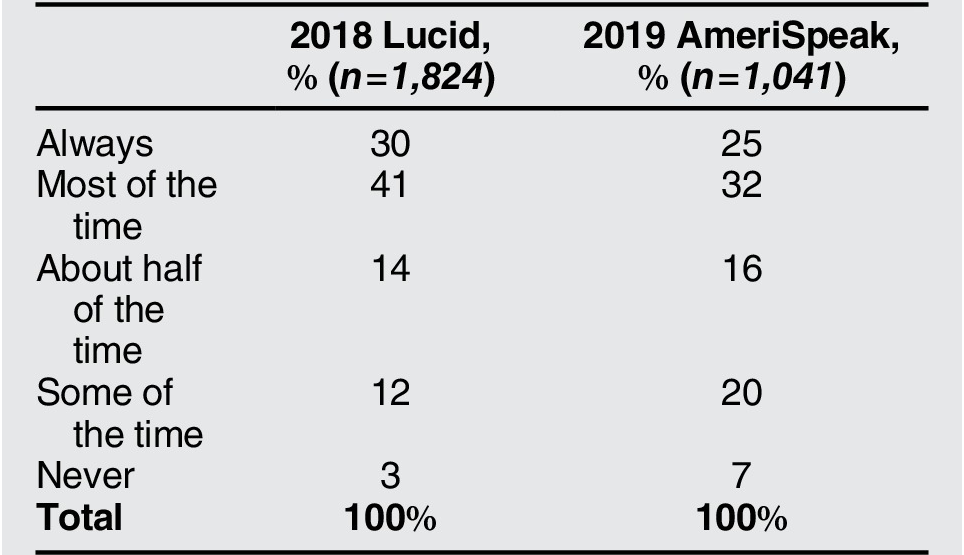
The evidence thus far provides support for the hypothesis that Black Americans recognize that both race and skin color influence police treatment (H1). But this data is limited to a regional sample. To further examine how Black Americans perceive skin color dynamics—as well as how one’s own appearance may be associated with recognition of targeted policing practices—I turn to evidence from two national surveys. In both surveys, I asked the Perceived Colorism among Police question. As shown in table 1, the survey evidence broadly supports the qualitative evidence. Looking at the response distribution in the 2018 survey, 85% of Black respondents said that darker-skinned Black people are treated worse by police at least half the time compared to lighter-skinned Black people. Similarly, in the 2019 survey, 73% of Black respondents said darker-skinned people receive worse treatment at least half the time. In other words, most Black Americans believe that darker-skinned people habitually receive worse treatment by police than their lighter-skinned counterparts. Combining across all three datasets, then, there is strong evidence observed in support of H1—i.e., a majority of Black Americans perceive skin color as powerfully informing treatment by police.
Belief that police treat darker-skinned people worse

Given the link between darker skin and racial stereotypes, higher perceived prototypicality, and higher incidences of external labeling, skin color may be especially salient to the views of darker-skinned Black Americans themselves (H2). Because both surveys include large samples of Black people and a self-reported measure of skin color via the Yadon-Ostfeld Skin Color Scale, this presents an opportunity explore these subgroup dynamics. The models estimated using the 2018 survey highlight that even after controlling for factors like socioeconomic status and racial group identity importance, self-identified darker-skinned Black participants are ten percentage points more likely to believe it is common that police treat darker-skinned people worse than lighter-skinned Black people (p<.001; figure 2). This is substantively equivalent to saying that, on average, this happens between “half of the time” and “most of the time” among self-identified lighter-skinned respondents to firmly believing this happens “most of the time” among darker-skinned respondents. This pattern replicates in the 2019 survey with an even more extensive battery of controls. Here, self-identified darker-skinned respondents are nine percentage points more likely than their lighter-skinned counterparts to believe darker-skinned people are treated worse by police (p<.06; figure 2). This emphasizes the lived experiences associated with one’s skin color do influence views of policing.
Belief that police treat darker-skinned people worse, by respondent’s skin tone
Notes: OLS regression models in both datasets estimated with 95% confidence intervals and control for age, education, gender, income, region, partisanship, ideology, racial group importance, and survey design effects. Estimates from 2018 Lucid also control for Hispanic ethnicity, while estimates from 2019 AmeriSpeak also control for homeownership and unemployment.
Tables corresponding to these model estimations are included in Appendix 4.

In combination, the qualitative and quantitative evidence thus far underscore that Black Americans are deeply aware of the ways in which both race and skin tone powerfully influence perceived police brutality. In addition to a general belief among Black Americans that darker-skinned people regularly receive worse police treatment, self-identified darker-skinned respondents are even more likely to believe this to be true. This suggests an association between skin color and political views among Black Americans in domains where skin color is especially salient. Further, it confirms that subjective perceptions of police treatment among Black Americans are consistent with the objective reality. These results complement evidence in other fields finding disparities in arrest and sentencing outcomes based on skin color.
How do perceptions about the role of skin color in policing outcomes map onto beliefs about what messaging tactics should be used by movements like BLM in the fight against police brutality? Specifically, with BLM organizers basing messages on gender and sexual orientation, does the public support adding skin color to the conversation as well? Alternatively, do people prefer that the movement remain focused on race, without highlighting subgroup disparities such as those based on skin color or gender? To answer these questions, I turn back to my interview data before examining the survey evidence.
Interview participants held an overwhelmingly positive view towards BLM, with 72% of interviewees expressing support for the movement.Footnote 12 Participants were also asked whether skin color was associated, implicitly or explicitly, with BLM organizing in their view.Footnote 13 Approximately 60% of interviewees asked this question expressed that higher-profile BLM protests and movement activity centered darker-skinned Black victims (n=27):
The original creators of Black Lives Matter, most of them are dark-skinned. And the way that I think of dark-skinned people—I think the victims of all this police brutality that are the most noteworthy are dark-skinned. —26-year-old, light-skinned Black woman
It’s very implicit. I agree. I agree 100 percent with that. It’s that Black folks know that the darker you are as a man, the more likely you’re going to be perceived as a threat, you know… I think it wasn’t necessarily talked about [by BLM] but it was definitely understood that this is what’s going on. —39-year-old, medium-skinned Black man
I do [think color is implicated in the movement], ’cause society created this problem. It goes back to like the blacker you are, they’re promoting “Watch out for this person because he’s really black and he looks mean.” And a lot of people have been fooled by that. —58-year-old, dark-skinned Black man
Another 13% of interview participants wavered between believing skin color of victims is implicated with BLM organizing and feeling that the movement should not take color into account (n=6). Consistent with the “skin color paradox,” these participants often felt that focusing on issues of color would detract from making progress against racial disparities in police violence overall:
I mean I think that [darker-skinned victims] are there, but I think that the issue as a whole of Black people being killed in the United States is really the big focus. So it’s not like—I’m not really trying to unpack if a lighter-skinned dude or darker-skinned dude or a female is getting attacked. I’m focusing on the fact that there are Black people that are getting attacked regularly in the United States and the police are not protecting them. In fact, they’re murdering us. —29-year-old, medium-skinned Black woman
Another 9% of participants noted they sometimes felt darker-skinned victims resulted in higher-profile BLM protests, but were not confident their observation reflected reality. As a result, they were hesitant to think skin color should be discussed explicitly because it may not be worth focusing on. The final 18% of participants disagreed that skin color was in any way implicated in or associated with responses to police brutality via BLM (n=8). These individuals did not feel that protests were more likely to occur after police victimizing a darker-skinned person:
I don’t think that colorism is a huge thing that matters with BLM. I’ve seen super fair people of color to super dark people of color be highlighted by the hashtag because of whatever incident that happened, or their deaths. —32-year-old, medium-skinned Black woman
Thus, most interviewees felt that skin color was associated with BLM organizing and protest activity in response to police brutality, though this was not universal. While we should be hesitant to extrapolate too much from the distribution of interview responses given the small numbers and regional nature of the sample, the patterns suggest a potential association between self-identified skin color and views about BLM organizing efforts. Nearly all of the self-identified dark-skinned interview participants—89% (n=16)—noted this pattern of police violence against darker-skinned people receiving higher-profile responses via BLM. In contrast, self-identified light-skinned interviewees had a more mixed pattern of responses. A slight majority—54% of those asked (n=12)—also reported noticing a pattern of protest responses based on skin color and police violence. The remainder of self-identified light-skinned interviewees were split between being uncertain that skin color influenced BLM organizing or feeling strongly that color was not implicated. These patterns suggest that perceptions of BLM’s organizing efforts may vary based on one’s own skin color.
Overall, there is a widespread recognition of skin color’s importance in determining the treatment one receives from police and beliefs that BLM organizing implicitly features darker-skinned victims of police violence. Nevertheless, the next set of findings suggests that there does not appear to be support among many Black people for incorporating skin color or other subgroup disparities into messaging around BLM (H3).
A final question added during the course of qualitative data collection asked participants whether they believed the Black Lives Matter movement should discuss subgroup disparities based on characteristics like skin color or gender.Footnote 14 Consistent with BLM organizers’ efforts to incorporate more intersectional messaging into the movement, this question sought to examine how people viewed the efficacy of messaging that incorporated subgroup disparities alongside racial disparities versus messaging that focused solely on the broader racial group. The overwhelming response among interview participants was that race should remain the primary focus of BLM and that other characteristics—like skin color or gender—should not be used as part of the movement’s messaging. Despite a majority of interviewees believing that police treat dark-skinned Black Americans worse, almost none felt that skin color should be incorporated into conversations about police brutality and responses by BLM. Thus, feelings that BLM discussing color-based disparities would serve as a distraction was nearly universal—with 94% of interviewees asked this question expressing this sentiment (n=34).
In a way, by only focusing on dark-skinned Black men, it takes away from lighter-skinned Black men still experiencing police brutality. Or just like Black women in general, who also experience a large amount of police brutality. —19-year-old, dark-skinned Black woman
If we focus on the complexities of gender and color, we lose—It causes more room for dissension in the movement between ranks and people, already more than what there was. So you sort of take it. Not take it, but you have to go with the bigger issues. —27-year-old, medium-skinned Black woman
I think that implicitly colorism probably does play a huge part in the movement. But I don’t know how explicit those concerns are. I think we within the community know and recognize that. Who’s being arrested, who’s being beat up, who’s being victimized in these situations. And we do notice their skin color. But I don’t know—Like I said earlier, I don’t know if it would be the wisest thing to say “Let’s protect our dark-skin to medium-brown-skin African American brothers and sisters.” —50-year-old, light-skinned Black woman
Running counter to BLM organizers’ goals of intersectional messaging, then, interview participants overwhelmingly prefer BLM to maintain a focus on the racial group. These patterns complement recent work demonstrating challenges associated with the use of other subgroup messaging (Bonilla and Tillery Reference Bonilla and Tillery2020; Bunyasi and Smith Reference Bunyasi and Smith2019).
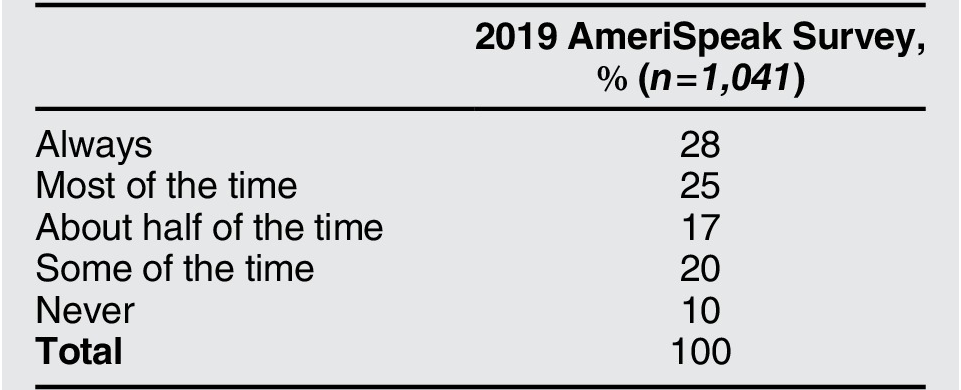
Does this pattern hold in a broader sample of Black Americans? To assess this, I turn to the Skin Tone Distracts from Race item in my 2019 AmeriSpeak survey. While this item does not reference BLM explicitly, it engages with the themes emerging from the interview conversations about BLM by asking if discussing skin tone distracts from the bigger issue of racial disparities. As table 2 shows, this generalized item in the 2019 survey has more variation than the BLM-specific question asked of interview participants. Still, a general agreement remains that skin color can distract from broader issues of race, with 53% of Black respondents saying this is the case “most of the time” or “always.” This finding further highlights a hesitancy to focus on skin color disparities given concerns it may inhibit progress on resolving racial disparities. Despite a broad recognition that darker-skinned Black people face harsher treatment at the hands of police, respondents feel that discussing color-based disparities can serve as a distraction from resolving racial disparities.
Belief that discussing skin tone distracts from discussing bigger issue of race

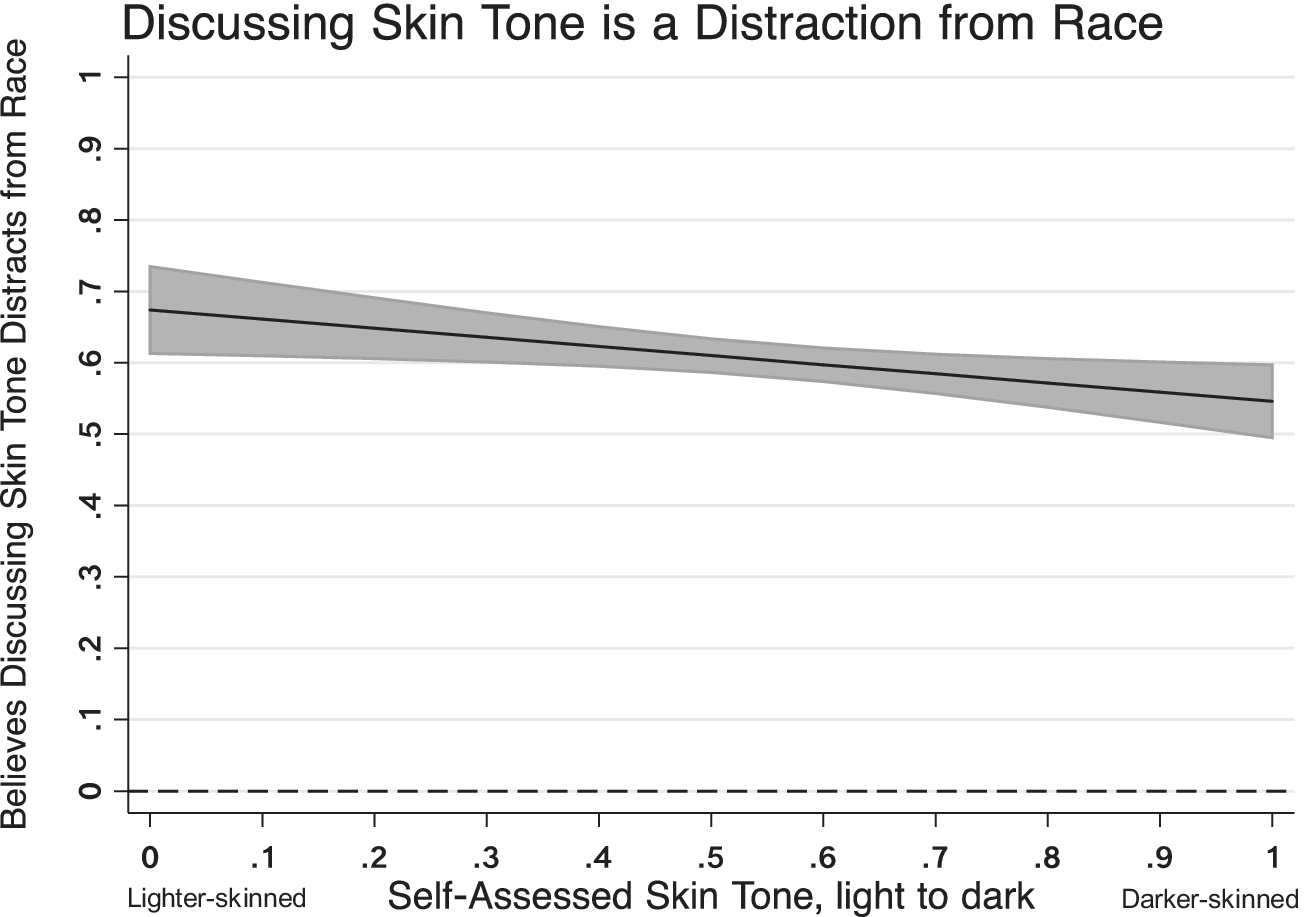
Similar to the earlier findings, one’s self-identified skin color also appears to inform their views on the Skin Tone Distracts from Race item. Consistent with my theoretical framework, self-identified darker-skinned participants are thirteen percentage points less likely than their lighter-skinned counterparts to believe that talking about skin color is a distraction from race (p<0.01; figure 3). This is substantively equivalent to self-assessed lighter-skinned Black people saying that skin tone distracts from race “most of the time” while darker-skinned people say this is the case “half of the time.” This underscores that while Black Americans of all hues are united against Black people facing undue police violence, differences exist in what messaging tactics color-based subgroups feel may be most effective for movement organizing. While most respondents exhibit a general hesitancy to incorporate discussions of color alongside race, self-identified darker-skinned individuals are more open to discussing both axes of marginalization than their lighter-skinned counterparts.
Belief that discussing skin tone distracts from discussing bigger issue of race, by respondent’s skin tone (AmeriSpeak 2019)
Note: OLS regression model estimated with 95% confidence intervals and controls for gender, education, region, income, age, partisanship, ideology, homeownership, unemployment, racial group importance, and survey design effects.

In sum, Black Americans widely believe that police use skin color as a marker by which to gauge their interactions with Black civilians, and many believe that BLM organizing implicitly rallies strongly around darker-skinned victims. Yet respondents are also hesitant to have BLM explicitly incorporate discussions of subgroup disparities into anti-brutality messaging. While general reluctance exists across the samples, self-assessed darker-skinned Black Americans display more openness to recognizing the importance of color alongside race. This hesitancy suggests mixed evidence for the continued relevance of the “skin color paradox” (Hochschild and Weaver Reference Hochschild and Weaver2007). On one hand, color is viewed as strongly tied to the institutional domain of policing as well as being (implicitly) associated with BLM movement responses against police brutality. On the other hand, many Black Americans prefer messaging tactics to focus only on racial disparities as opposed to acknowledging subgroup disparities based on skin color or gender.
Discussion
A body of literature rightfully points to racial disparities with respect to criminal justice outcomes. Evidence of these disparities helps inform anti-police brutality movements that ultimately provoke responses from elected officials (e.g., Bonilla and Tillery Reference Bonilla and Tillery2020; Gause Reference Gause2022a, Reference Gause2022b; Gillion Reference Gillion2013). Importantly, though, disparities in criminal justice outcomes are also stratified within racial groups based on skin color. In fact, the magnitude of these intra-group differences between lighter- and darker-skinned Black Americans rival inter-group differences between Black and white Americans (Monk Reference Monk2018). Although both race and skin color are meaningful axes of marginalization, media discourse and social movement responses to police brutality have emphasized race and paid minimal attention to skin color. While color-based discrimination across a range of institutions and institutional actors seems clear, this project examines how perceptions of skin color and color-based treatment are associated with Black Americans’ views of police brutality and corresponding political movement messaging.
The evidence throughout this study indicates that the “skin color paradox” may not hold in certain contexts, particularly on one of the most pressing issues in society: perceptions of and movement responses to police brutality. The findings highlight how politically relevant opinions vary based on one’s self-identified skin color. This suggests potentially increasing opportunities for generating political responses based on both race- and color-based disparities. This underscores the need for further examination of other politically relevant domains where skin color is perceived as consequential and for which there may be similar divides in opinion based on one’s color (Hutchings et al. Reference Hutchings, Jefferson, Lewis and Yadon2016; Yadon Reference Yadon2020). In the face of increasing racial fluidity and multidimensional racialized experiences, as well as shifts within the traditional racial hierarchy (Davenport Reference Davenport2018; Monk Reference Monk2021; Reece Reference Reece2021), better understanding how one’s skin color identification and color-based experiences are politically meaningful will be increasingly important in light of evolving American racial dynamics.
Still, in contrast to BLM organizers’ attempts to avoid marginalization of certain subgroups (Garza Reference Garza and Hobson2016; Lindsey Reference Lindsey2015), there is a hesitancy among many Black Americans to discuss subgroup disparities in anti-police brutality movement messaging. My interview participants were largely unaware of BLM’s inclusive messaging framework. Consistent with recent evidence indicating public hesitancy among many Black Americans to endorse messaging around subgroup disparities (Bonilla and Tillery Reference Bonilla and Tillery2020; Bunyasi and Smith Reference Bunyasi and Smith2019), there was a similar reluctance among both interview and survey participants in my samples. In turn, this presents challenges for naming and combatting color-based disparities while also increasing movement support.
These findings may also signal a concerning form of secondary marginalization through which darker-skinned Black Americans are relegated to suffer disproportionately at the hands of police. Respondents express concern that even mentioning skin color disparities—despite them being well-known within Black communities—will detract from efforts towards achieving racial justice. Importantly, this hesitancy exists even among self-identified darker-skinned individuals, who are more supportive of discussing colorism than their lighter-skinned counterparts but certainly not overwhelmingly so. This reluctance underscores the emphasis placed on efforts towards racial unity as opposed to recognizing the multidimensional nature of racialized experiences and uplifting group members in the most vulnerable positions. In turn, this leaves darker-skinned people to face the greatest injustices at the hands of police without explicit efforts towards mitigating this double penalty based on race and color. The tension between widespread recognition of colorism and widespread opposition to incorporating it into movement messaging highlights challenges for movement organizers, scholars, and policy-makers towards effectively mitigating the pernicious effects of colorism. This is especially important given that policies developed to reduce inequities based on race are not effective at resolving finer-grained disparities based on skin color (Hochschild and Weaver Reference Hochschild and Weaver2007; Monk Reference Monk2021).
Nonetheless, there have been impressive efforts by BLM’s organizers towards inclusivity, namely including gender and sexual orientation as primary components of movement organizing. Despite skin color not being explicitly included in BLM’s messaging, many interview participants believed that the highest-profile BLM protests were in response to the killing of darker-skinned Black victims. This raises questions of how organizers determine what strategies will be most effective or important, especially given that intersectional messaging regarding police violence appears relatively unpopular among the public. Could this reluctance towards discussing subgroup disparities stem from a concern that these messages should not be shared with other racial groups? If BLM’s messages are viewed as primarily “educating” or recruiting potential allies from other racial groups, referencing subgroup disparities may be perceived as detracting from this goal by creating an overly complex message. Moreover, perhaps there is an expectation that in-group members will pick-up on the implicit color cue without it being made explicit through BLM messaging. To better understand this pattern of hesitancy towards incorporating intersectional messages in the fight against police brutality, a combination of focused conversations with the public and movement organizers would be especially valuable. Future work would also do well to continue creatively developing and testing messaging strategies with an eye toward acknowledging and combating meaningful subgroup disparities.
In the time since data collection occurred for this study, attention to BLM has only increased. Estimates suggest that millions of Americans participated in protests across the country against police brutality in the Summer of 2020 (Buchanan et al. Reference Buchanan, Bui and Patel2020). Indeed, there is evidence that support for BLM has increased among both Black and Hispanic Americans, although not among whites (Chudy and Jefferson Reference Chudy and Jefferson2021). These patterns suggest that BLM has likely become more racially and geographically diverse since my data collection. Consequently, these changes may influence organizing efforts or receptiveness to different messaging. Is it possible that invoking discussions of color-based discrimination would resonate with Asian Americans, Latinos, or immigrants, given that they too have differential interactions with institutions based on color gradations (Dixon and Telles Reference Dixon and Telles2017; Hamilton Reference Hamilton2019; Hersch Reference Hersch2011; Monk Reference Monk2021; Rondilla and Spickard Reference Rondilla and Spickard2007)? Consistent with recent evidence of “people of color” emerging as a political identity (Perez Reference Perez2021), individuals from varied ethnoracial groups who share a similar skin color may have increasing political commonality. Might this contribute to potential alliances, organizing efforts, and/or reorganization of historically marginalized groups in the United States around an increasingly relevant color-based identification? While the answers to these questions remain to be seen, it is likely that darker-skinned Black Americans will continue to face the harshest treatment at the hands of police given the historical legacy connecting race, color, stereotypes, and police violence in the United States. By contrast, other ethnoracial group members—even those of a darker hue—can use other markers to distinguish themselves from native-born Black Americans (Monk Reference Monk2021). Despite shifts to the racial hierarchy, its inherent structure prioritizing whiteness and lightness will leave darker-skinned Black Americans to continue facing a double penalty based on both race and color—potentially exacerbating current disparities even further over time.
Overall, this project complements the growing literature on color-based discrimination by using a mixed-methods approach to study the political consequences of perceptions of targeted policing practices. A key contribution of this project is including measures of self-identified skin tone and colorism to highlight associations between race, color, and public opinion towards anti-brutality movements. As discussed at the outset of this article, scholars must carefully consider where and when it is appropriate to thoughtfully incorporate such measures. In this study, understanding perceptions of colorism and BLM requires measuring self-identified color to provide insight into how people perceive themselves and their experiences. This also serves to triangulate self-reported experiences alongside the growing literature demonstrating the significance of skin color in criminal justice contacts that largely relies on other measures of skin color.
These efforts to incorporate better measures of skin color and colorism into studies of politics highlight the nuanced experiences associated with marginalization and access to power among those sharing a common racial identification. To this point, there have been some recent calls for the adoption of a two-part racial identification question that asks both a standard categorical racial identification item along with a skin-tone self-identification item to better capture the inherent multidimensionality of racialized experiences (Reece Reference Reece2021; Roth Reference Roth2016). In a similar vein, a growing body of literature demonstrates that the combination of characteristics associated with one’s appearance have a variety of social implications and so, too, might there be political associations for citizens or political candidates alike (e.g., Brown and Lemi Reference Brown and Lemi2021; Lemi Reference Lemi2018, Reference Lemi2020). Carefully incorporating a broader array of characteristics that inform the multidimensionality of race—e.g., skin color, racialized features, size, perceived attractiveness (Monk Reference Monk2021; Reece Reference Reece2021)—could provide a fuller picture related to public opinion, political behavior, and other meaningful political outcomes. Crucially, though, such efforts would require great care and consideration to be done appropriately and avoid harkening back to measures, methods, or explanations rooted in biological racism.
Looking ahead, other sociopolitical domains—including broader sets of policy preference, as well as political or civic engagement—would be fruitful avenues to continue exploring the multidimensionality of race. Future research should consider consistently incorporating a larger battery of items related to colorism across domains. Incorporating such measures into mainstream political surveys would help paint a clearer portrait of when and how combinations of factors like race, color, and gender are associated with politics. Thinking about the future of BLM and its political efficacy, there is much left to learn with respect to public opinion and political mobilization. For example, research shows that criminal justice contacts are associated with worse socioeconomic and health outcomes, as well as having political consequences (Lerman and Weaver Reference Lerman and Weaver2014; Soss and Weaver Reference Soss and Weaver2017; Walker Reference Walker2020; Weaver et al. Reference Weaver, Prowse and Piston2019). Individuals with criminal justice contact are often less likely to vote or participate in civic groups (Lerman and Weaver Reference Lerman and Weaver2014). Other evidence suggests that when carceral contact is perceived to be driven by one’s identity as opposed to one’s actions, contact with the carceral state can actually mobilize political contact (Walker Reference Walker2020). In combination with the findings here, this suggests that opportunities for mobilization may vary within racial groups based on factors such as color. Put differently, while the recognition that police are more likely to brutalize darker-skinned Black people is widespread, this is especially salient to self-identified darker-skinned people. Consistent with recent evidence of mobilization in the face of threat (Towler and Parker Reference Towler and Parker2018), darker-skinned individuals may be especially prone to mobilization efforts in response to police violence. If citizens are “sleeping giants” who use protests and voting to hold elected officials accountable (Gillion Reference Gillion2013; Hutchings Reference Hutchings2005), the political salience of color has important implications for the future of social movements and political turnout in America.
Supplementary Materials
To view supplementary material for this article, please visit http://doi.org/10.1017/S1537592722001013.
Appendix 1. Methodology and Descriptive Statistics from Qualitative Interviews
Appendix 2. Descriptive Statistics from Survey Samples
Appendix 3. Survey Instrument from 2018 Lucid and 2019 AmeriSpeak Surveys
Appendix 4. Tables Featuring Model Estimations for Figures 2 and 3
Appendix 5. Distribution of Attitudes towards Black Lives Matter among Black Respondents in 2016 ANES
Acknowledgements
The author expresses sincere thanks to Kiela Crabtree, LaGina Gause, Daniel Gillion, Vince Hutchings, Mara Ostfeld, Spencer Piston, Crystal Robertson, Hannah Walker, and Carly Wayne, as well as the anonymous reviewers and editors, for helpful feedback on earlier iterations of this paper. She is indebted to the National Science Foundation and Time-Sharing Experiments for the Social Sciences (TESS) for financial support to collect the data for this project, as well as to Kamri Hudgins for excellent research assistance.