Introduction
Loneliness has been defined as ‘the subjective, unwelcome feeling of a lack, or loss, of companionship’ (Cattan et al., Reference Cattan, White, Bond and Learmouth2005: 42), thus it denotes a difficult and personal emotional experience. As well as being unpleasant in its own right, numerous researchers have identified further negative effects of loneliness. Bolton (Reference Bolton2012) argued that being lonely leads to the loss of hope and energy, Victor and Bowling (Reference Victor and Bowling2012) linked loneliness with an increased mortality rate and Valtorta et al. (Reference Valtorta, Kanaan, Gilbody, Ronzi and Hanratty2016a) to a greater risk of cardio-vascular disorder. A number of policy and programme interventions directed at reducing loneliness have been developed, such as the Ageing Better Programme (funded by the National Lottery Community Fund), the Campaign to End Loneliness and the Jo Cox Commission on Loneliness. In 2018 the government of the United Kingdom (UK) created the world's first Minister for Loneliness, and launched the UK's first Loneliness Strategy, ‘a connected society: a strategy for tackling loneliness’ (HM Government, 2018).
Research commissioned by the British Red Cross and Co-op has suggested that approximately one-fifth of the UK population are always or often lonely (Kantar Public, 2016). The Jo Cox Commission on Loneliness, in conjunction with the Royal Voluntary Service, has estimated that eight million men (of all ages) feel lonely at least once a week, while for nearly three million it is a daily occurrence (Campaign to End Loneliness, 2017). Beach and Bamford (Reference Beach and Bamford2015) estimated that around 550,000 older men in the UK experience loneliness, and predict that this number will rise alongside a predicted 65 per cent increase in older men living alone by 2030. Numerous academic studies have found older women are aggregately lonelier than older men, particularly if they are directly asked whether they feel lonely (Victor and Bowling, Reference Victor and Bowling2012; Victor and Yang, Reference Victor and Yang2012; Nicolaisen and Thorsen, Reference Nicolaisen and Thorsen2014; Hansen and Slagsvold, Reference Hansen and Slagsvold2016). However, many authors have suggested that this may show that men are less likely to admit they are lonely, and have cited that asking indirectly about loneliness shows a smaller, or no, gender difference (Pinquart and Sörenson, Reference Pinquart and Sörensen2001; Nicolaisen and Thorsen, Reference Nicolaisen and Thorsen2014; De Jong Gierveld et al., Reference De Jong Gierveld, Van Tilburg, Dykstra, Vangelisti and Perlman2018; Rokach, Reference Rokach2018). Further still, some studies have emphasised that activities aimed at reducing loneliness tend to display a ‘feminine’ focus and assumption (Ruxton, Reference Ruxton2006; Reynolds et al., Reference Reynolds, Mackenzie, Medved and Roger2015), and that this may discourage men from participation. Overall, then, existing evidence suggests that loneliness is a potential challenge for older men, and that it may be a gendered experience.
However, as Milligan et al. (Reference Milligan, Payne, Bingley and Cockshott2015: 141) note, ‘research on how age and gender constructions jointly influence older men is limited’, thus how loneliness fits within this is even less well understood. Accordingly, this paper focuses on the intersection of age and gender in older men's constructions and experiences of loneliness, and the subsequent programme and policy response required, asking three research questions:
(1) How do older men construct loneliness?
(2) How do older men experience loneliness?
(3) What do older men's constructions and experiences mean for policy and practice aiming to alleviate loneliness among older men?
To answer these questions, the paper presents findings from two qualitative empirical studies: an investigation of older men's constructions and experiences of loneliness; and a study of the effectiveness of a service for older men which was designed to alleviate loneliness among older people more generally. Prior to presenting the empirical findings, and to provide a theoretical framework for them, research around masculinities and loneliness, and ageing and loneliness, is considered. This is followed by an outline of the methodological approach for each study; a summary of each study's findings; a discussion of the implications; and, finally, our conclusions.
Background
Before outlining evidence from the two empirical studies, existing research on masculinities and loneliness, and ageing and loneliness, are first considered in turn.
Masculinities and loneliness
Connell's (Reference Connell2005) influential conceptualisation of masculinities advocates that men, and to a lesser degree women, engage with and construct multiple masculinities that can be placed in four social positions. The most well known of these are ‘hegemonic’ masculinities, which are cultural ideals implicitly emphasising male domination, that is, they are an ‘answer to the problem of the legitimacy of patriarchy’ (Connell, Reference Connell2005: 77). In contrast, ‘subordinate’ masculinities are those that Connell suggests are incompatible with hegemonic masculinities, such as the masculinities of gay men. ‘Complicit’ masculinities, on the other hand, represent men who do not fulfil ‘hegemonic’ masculinities, but continue to benefit from men's aggregate dominance. Lastly, ‘marginalised’ masculinities are those which can engage with hegemonic masculinities, such as ethnic minority or working-class men, but by virtue of this other intersection of identity, their masculinity remains culturally marginalised. Critically, none of these masculine standpoints, nor any masculinity, can be said to represent a universal set of masculine traits (Connell and Messershmidt, Reference Connell and Messerschmidt2005), and notions of a single ‘black’ or ‘gay’ masculinity are equally meaningless (Connell, Reference Connell2005). Rather, they represent engagement with an unequal gendered world, in which these positions of masculinity interact with historical gender norms.
Using a theoretical approach heavily influenced by Connell's ideas, and particularly the notion of ‘hegemonic’ masculinities, research on health and wellbeing has repeatedly suggested that many men are often reticent to seek help for health and/or emotional challenges, as to do so would imply weakness and vulnerability (Courtenay, Reference Courtenay2000; Addis and Mahalik, Reference Addis and Mahalik2003; Kupers, Reference Kupers2005; Vogel et al., Reference Vogel, Heimerdinger-Edwards, Hammer and Hubbard2011; Addis and Hoffman, Reference Addis, Hoffman, Levant and Wong2017). In other words, as men are disinclined to display vulnerability, they may also be disinclined to acknowledge feelings of loneliness openly, hence their purported unwillingness to admit to loneliness when being asked directly (Pinquart and Sörenson, Reference Pinquart and Sörensen2001; Nicolaisen and Thorsen, Reference Nicolaisen and Thorsen2014; De Jong Gierveld et al., Reference De Jong Gierveld, Van Tilburg, Dykstra, Vangelisti and Perlman2018; Rokach, Reference Rokach2018).
Just as ethnicity, class and sexual orientation can play a role in the constructing and enacting of masculinities (Connell, Reference Connell2005; Connell and Messershmidt, Reference Connell and Messerschmidt2005), so too can age, and a range of research suggests that older men do not enact masculinities equally and identically to younger men. Barnes and Parry (Reference Barnes and Parry2004), for instance, found that ‘traditional’ gender roles dominate discourse among older people when they discuss retirement and, similarly, Avital (Reference Avital2017) found that older people's leisure activities are more gendered than younger peoples, concluding that relatively ‘conservative’ attitudes to gender are the reason for this. Older men may therefore hold particularly ‘hegemonic’ values, and thus be even less likely to acknowledge or seek help for loneliness than younger men. This evidence of differential notions of hegemonic masculine values between older and young men may, of course, be attributable to generational differences rather than age per se.
Bartholomaeus and Tarrant (Reference Bartholomaeus and Tarrant2016) posit that ‘middle-adulthood’ occupies a privileged space across the age strata, and stress that older men's masculinities involve a number of inherent ‘tensions and disjunctures’ with (younger) hegemonic ideals. This results in re-affirmed masculine identities as a ‘sage’, an identity which, theoretically at least, may facilitate help-seeking behaviour if it is constructed as ‘wise’. Similarly, Thompson and Langendoerfer (Reference Thompson and Langendoerfer2016) construct a ‘blueprint’ of older men's masculinities, and conclude that masculine identity is aggregately re-embodied and reformulated according to the physical and cultural realities of ageing, and also reference this as being a ‘sage’. This blueprint, though, also constructs older men's masculinity as an emotional ‘rock’ who stays strong in the face of difficult circumstances, thus suggesting a disinclination to discuss feelings of weakness, which could potentially include loneliness. How older men's masculinities influence their constructions and experiences of loneliness, particularly with regard to the important notion of whether they will acknowledge and seek help for it, therefore requires further investigation.
Ageing and loneliness
The association of loneliness with ageing is well established (Heylen, Reference Heylen2010; Victor and Yang, Reference Victor and Yang2012), yet the evidence around this is mixed. Some studies suggest that loneliness increases with age (AARP, 2010; Griffin, Reference Griffin2010; Victor and Bowling, Reference Victor and Bowling2012), others suggest a ‘U-shaped’ relationship, where the youngest people are the loneliest and the oldest a close second (Dykstra, Reference Dykstra2009; Victor and Yang, Reference Victor and Yang2012). Others still argue that people in middle-adulthood are the loneliest (Nolen-Hoeksema and Ahrens, Reference Nolen-Hoeksema and Ahrens2002; Lauder et al., Reference Lauder, Sharkey and Mummery2004) and, most recently, a large BBC radio survey found that loneliness gradually decreases with age (Hammond, 2018). This mixed array of evidence has led some to suggest that loneliness is unduly associated with old age (Kantar Public, 2016). Nevertheless, some older people do experience loneliness, and age-related factors such as retirement, bereavement, entering a care home and loss of mobility have been evidenced as risk factors for becoming lonely (Tijhuis et al., Reference Tijhuis, De Jong-Gierveld, Feskens and Kromhout1999; Alpass and Nevill, Reference Alpass and Neville2003; Barnes and Parry, Reference Barnes and Parry2004; Victor and Yang, Reference Victor and Yang2012; Time to Shine Leeds, 2017). It is, therefore, critical to emphasise that although there may be a stereotypical associating of loneliness with age, loneliness can still be a challenge for older people. Moreover, it is necessary to acknowledge this stereotypical association of loneliness with later life as it may impact people's, and particularly older people's, constructions and experiences of it.
In summary, loneliness can be an emotionally distressing experience for older people, yet may also be a stereotypical and marginalising experience. For older men, masculine identity appears to be a complex mesh of hegemonic, complicit, subordinate and marginalised discourse. Furthermore, the stereotypical and marginalising element of loneliness, as well as the implicitly ‘vulnerable’ aspect, is unlikely to be conducive to enacting ‘hegemonic’ masculinities. Indeed, some studies suggest older men are less likely to admit loneliness, and others that services designed to tackle loneliness are viewed as feminine, thus inappropriate for men. However, existing research has not specifically investigated the cultural intersection of age and gender in older men's interpretations and actions relating to experiences of, and interventions to reduce, loneliness. The remainder of this paper aims to build knowledge of older men's subjective constructions and experiences of loneliness, and loneliness interventions, to help us understand better how older men are affected by loneliness, and the kinds of interventions and services that can help prevent and/or alleviate it.
Methodology
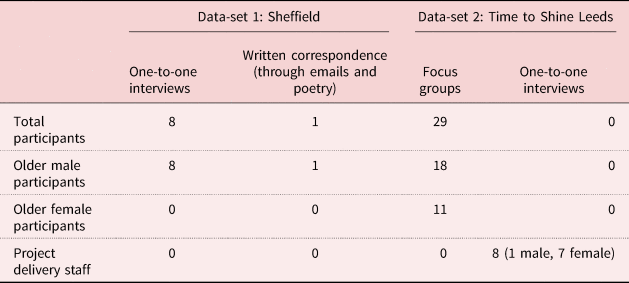
The empirical evidence for this paper draws on two data-sets, which were analysed sequentially, and which together draw on interviews, focus groups and written evidence with 46 individuals undertaken between August 2016 and May 2018 (see Table 1). For the first data-set this includes: eight interviews with older men in Sheffield, England; and written evidence from a ninth older man. For the second data-set this includes: eight interviews with individuals responsible for delivering loneliness services for older people in Leeds; and five focus groups involving 29 older people (18 male and 11 female) all of whom were accessing loneliness services in Leeds, England.
Total participants across the two data-sets

The first data-set consists of primary data collected through qualitative interviews with older men living in Sheffield. This aimed to explore older men's constructions and experiences of masculinity and loneliness, and how these may be interconnected. The second data-set re-examined data collected from an evaluation of the Time to Shine (TTS) programme, designed to reduce loneliness among the older population in the nearby city of Leeds. In this, we investigated whether the constructions and experiences of masculinity and loneliness emerging from the first data-set could be identified, or had any influence on, the design, delivery and relative success of the TTS service.
Methodological philosophy
Subjective understandings of gender, age and loneliness, and emotional responses to them, are critical to the empirical investigations reported here. Consequently, an epistemological framework that aimed to interpret human perceptions of their social world was required (Mason, Reference Mason2002). To do this, the first data-set used largely unstructured interviews for their ability to manifest ‘moods, feelings, emotions, (and) subjectivities’ (Plummer, Reference Plummer2001: 141), and because they allowed Hollway and Jefferson's (Reference Hollway and Jefferson2000) technique of ‘free associating’ to be employed. Specifically, this allowed the researcher to ‘pick up on incoherences’ (Hollway and Jefferson, Reference Hollway and Jefferson2000: 37) by allowing the participant a large degree of freedom in their responses, akin to a sociological version of a Rorschach ‘inkblot’ test. Through this, ‘hegemonic’ cultural frameworks, implicit by nature, could be identified in the ‘incoherent’ aspects of the narratives.
This also framed the philosophical justification for analysing the second data-set – while the TTS data were not collected to provide information on older men's interpretations of masculinity and loneliness, or even on how to alleviate loneliness specifically in older men, it was focused on alleviating loneliness in older people, including men. As such, it provided an appropriate setting for investigating whether the constructs identified in the first data-set are relevant to people's lived reality, and for applying theoretical ideas to practical contexts, from which more robust recommendations for policy and practice could be constructed.
Sampling and data collection
Data-set 1: Interviews with nine older men in Sheffield
Nine older men living in Sheffield were sampled opportunistically. Four were recruited by attending a ‘lunch club’, two by sending advertisements to Third Sector organisations, and three by utilising the University of Sheffield staff and student mailing list (two of whom were family or friends of people associated with the university, and one a staff member). As men may be disinclined to admit to feeling lonely, and this part of the study was focused on broader, potentially ‘hegemonic’, constructs of masculinities and loneliness, the recruitment material emphasised that participants did not need to have experienced loneliness. Data were collected between April and June 2017.
Six people were interviewed in person, two via telephone and one declined to be interviewed, but sent emails and poems that were deemed relevant. Two were currently married; one never married, but was previously engaged; two were widowed, one of whom had found another partner whom he lived with until she also died; three were divorced, of whom one man was single, another was living with a new partner and the third in a relationship whilst living apart; and the last man was in an unmarried but long-term relationship living apart. All were heterosexual, three had a university education, eight were White British, the other White Irish. Four had spent most of their lives in low-paid occupations (two with periods of unemployment), two had consistently been in professional occupations, one had been in lower-paid occupations but received a large sum of money after retiring and two spent large amounts of time in low-paid occupations before becoming affluent in their later careers. The age range was 60–88, with a mean of 71.
The interviews in this data-set covered the following four areas of questioning, which were usually employed chronologically: the interviewee's personal life; discussions of loneliness they or their peers had experienced, and whether it has changed as they have aged; masculinity, and how this may have changed with age; and, finally, how masculinity and loneliness may intersect. Participants, though, were largely allowed to talk without interruption, therefore some interviews deviated from this pattern. In this way, the ‘free association’ of ideas and cultural constructs was encouraged, whilst maintaining a focus on the key areas of relevance to this study. Interviews were conducted by a heterosexual white male aged in his late twenties, of working-class origins, who was local to the region.
Data-set 2: Interviews with eight service delivery staff and five focus groups involving 29 older people accessing loneliness services in Leeds
The second data-set drew on evidence from the TTS project, which was funded by the National Lottery's ‘Ageing Better’ programme, and aimed to reach and support lonely and/or socially isolated older people in Leeds. The data are taken from eight interviews with project delivery staff, and five focus groups with 29 services users, from case studies of four TTS projects: The Cara Project (aimed at older Irish people, including a concerted effort to attract men, encompassing both one-to-one support and community development work); Small Funds (financial support for numerous projects aimed at different target groups, five of which targeted older men); the Sage project (encouraging socially isolated older lesbian, gay, bisexual and transgender (LGBT+) people to connect with services through a mix of one-to-one support and awareness raising); and Digital Angels (supporting people to get online and network with others through one-to-one and group sessions).
Project delivery staff were identified by project leaders, then contacted by the researcher to see if they were willing to be interviewed. Seven were female and one male. Interviews followed a semi-structured schedule, and lasted between 25 and 80 minutes. Four of the interviews were carried out face to face and four by telephone. Topics explored in the interviews included: the commissioning process; connections and capacity building; monitoring and evaluation; achieving aims and objectives (involving separate sub-sections on co-production and reaching different types of beneficiaries, including men); learning; barriers; partnership working; what had and had not worked well; specific issues about the TTS programme; and suggestions as to how the programme could be improved.
To find focus group participants, posters advertising the research were displayed in various TTS service provider venues, and the TTS programme team used their connections to identify service users who wished to take part. Twenty-nine service users took part in the focus groups, all of whom were provided with a £10 gift voucher. All focus group participants were over 50, 18 were male and 11 female (see Table 1). Participants were predominantly White British, but data on the personal characteristics of the participants (such as ethnicity, sexual orientation or exact age) were not collected. However, as The Cara Project was aimed at older Irish people and the Sage project supports the older LGBT+ community, it is likely that a proportion of the focus group participants are from these communities. Nevertheless, it should be said that no obvious differences were cited in the responses of these focus group attendees in relation to the issues explored in this paper, when compared to the overall sample of focus group participants.
All the focus groups were held at a neutral venue in central Leeds and lasted between 60 and 90 minutes. The sessions were guided by a semi-structured schedule which explored themes around the ways in which people had participated in the TTS programme, as well as exploratory questions on why and how people experienced loneliness. The focus groups were carried out by a white female in her forties, supported by a local woman, aged over 50, who had been trained for the task by the research team. For more details on the TTS evaluation, see Wigfield and Alden (Reference Wigfield and Alden2017).
Ethical framework
Asking for older men's ‘moods, feelings, and emotions’, whilst critically examining ‘incoherent’ narratives, suggests an ethical dilemma – on the one hand, focusing on the welfare of the participants could result in a ‘figure of a white male victim’ (Robinson, Reference Robinson and Gardiner2002), and undermine efforts towards women's emancipation, yet on the other, critically questioning and analysing incoherencies in participant's narratives on loneliness and ageing could be a distressing experience. Nevertheless, this was overcome by framing the research around Plummer's (Reference Plummer2001) notion of ‘critical humanism’, and by re-affirming the nature of ‘hegemony’. According to Plummer (Reference Plummer2001: 14), a humanistic stance ‘walks a tightrope between a situated ethics of care … and a situated ethics of justice’. As such, it acknowledges the need to relate individuals pragmatically to their wider social context. Turning to hegemony, Callinicos (Reference Callinicos2007: 213) defines it as ‘intellectual, moral, and political leadership’ that sets an invisible framework for public discourse and debate. Individuals, then, may simultaneously reify and challenge inequalities, benefit from them, yet be marginalised or suffer from them in other ways, all in a manner which is at least partially latent and assumed.
This meant that, in this study, analysing the sociological ramifications of interviewees’ narratives, without dismissing their perspectives and personal issues, was not only ethically required, it was sociologically paramount. This resulted in two noteworthy actions: firstly, it was considered critical to display fairly the interviewees’ manifest ideals and motives as well as their implicit ‘hegemonic’ constructions; and secondly, to ensure that no-one can be identified by a person who is aware of an individual's participation in the study, demographic details are not associated with pseudonyms (Bell, Reference Bell2010).
Analysis
For both data-sets, interviews and focus groups were audio recorded and transcribed. The two data-sets were analysed sequentially, with data-set 1 being analysed first, from which themes were identified and searched for in data-set 2. For data-set 1, analysis was conducted in NVivo, and consisted of three broad stages. The first stage was a direct coding of the manifest answers to the questions asked – in other words, what they said after being asked a question; secondly, the data were searched for themes not directly in response to a question; and, lastly, these two sets of codes were juxtaposed to manifest incoherent or assumed themes and associations. The emails and poetry offered by one participant were transcribed into a single NVivo transcript and analysed alongside the interviews using the same techniques, albeit the first stage recorded the manifest meaning of their email or poetry rather than involving the asking of a question by a researcher.
For the second data-set, interviews and focus group transcripts were inserted into a single document, and the data were coded according to the themes identified in the first study, as well as any new themes that were related to gendered constructions of loneliness. Following this, additional themes, particularly those relevant for policy and services, were added as sub-codes to the initial thematic findings, and juxtaposed with the constructions and experiences of masculinity and loneliness as previously found. A record of the data source was kept throughout.
Findings
The first part of this section explores men's constructions and experiences of masculinity and loneliness by drawing on the data originating from the nine older men in Sheffield. These findings are examined through the following key themes: older men's constructions of masculinity; older men's constructions of loneliness; and older men's experiences of loneliness. The second part of the section explores the implications of older men's constructions and experiences of masculinity and loneliness for designing effective loneliness services for older men, by drawing on the interviews and focus groups from the TTS programme evaluation. This latter section identifies and examines the following themes: masculine constructs as an engagement tool; avoiding negative terminology as an engagement tool; the gender balance of services; and good services as overcoming hegemonic masculinities.
Older men, masculinity and loneliness
This section presents and analyses the interviews and other communication with the nine older men in Sheffield, which explored older men's constructions and experiences of masculinity and loneliness.
Older men's constructions of masculinity
All but one of the nine men displayed explicit opposition to patriarchal ideals associated with masculinities. Patrick, for instance, stated that ‘there's some really bright women out there, but men are still keeping them down … there should be equality with the sexes!’, and Ron proclaimed ‘I don't believe in gender stereotypes.’ They also tended to construct masculinity as somewhat oppressive, particularly in regard to the showing of emotions, such as where Paul talked about the ‘masculine straitjacket that people are brought up in. Men don't cry! Men certainly don't cry in public’, and Jack, who, when talking about his own experiences, said ‘[I] sit at back of room like, I can have a little weep without me [my] sister even knowin’ … it's just emotional, don't really matter does it?’ Similar examples were also stated in relation to the body, e.g. Patrick stressed that masculinity is ‘not being muscular and big’ and Jack considered masculinity to be ‘if yer in a pub, yer don't want yer belly button showing off, stuff like that’. Lastly, some men even implied masculinity to be a negative personality trait, such as Charles, who, when discussing the ex-partner of a friend, stated ‘He was a great big I am. There's a lot of men like that.’
Despite this, none of the participants rejected masculinity completely, but sought to reform it, with three common reformulations emerging across these interviews – masculinity as ‘strength of mind’, ‘caring’ and ‘responsibility’. Aspects of the older men's masculinities could be defined as what Connell termed ‘complicit’ – by reforming masculinity this way, a ‘traditional’ gender role was constructed, in which they are ‘caring’ and ‘responsible’ for their (heterosexual and nuclear) family. Furthermore, some of that which was framed as ‘oppressive’ was latently reified – ‘strength of mind’, for instance, is potentially inconsistent with crying. These reformed definitions of masculinity are exemplified by Edward: ‘masculinity, people will come up with all kinds of definitions on that subject, mine being strength of mind and purpose’, and Christopher, who explained that:
…it's not, to me, a macho thing, to me, it's being responsible, taking care of your loved ones. I think it's not how tough you are, that kind of thing, but kind of – caring! I see a lot of people … you wouldn't describe as masculine but they're very caring and gentle people.
Taking responsibility, being emotionally strong and supportive, and caring for the vulnerable, were all assumed to be ‘morally congratulable’ actions. This manifests a powerful latent element of the men's masculine identities, the implicit importance of ‘pride’ and ‘shame’. Indeed, there were numerous references to sources of, and risks to, the men's pride, with one man, Edward, summarising this quite succinctly by noting that ‘You may think that I'm an old codger but I've still got my pride.’ Moreover, though the participants of this study did not explicitly state it to be an aspect of masculinity, previous studies have touched upon the importance of pride to masculine identity (Barrett, Reference Barrett1996; King, Reference King1997). In this way, the seemingly incoherent rejection of patriarchal and hegemonic ideals, yet support for ‘complicit’ notions of ‘strength of mind’, ‘caring’ and ‘responsibility’, can make sense – ‘strength of mind’, ‘caring’ and ‘responsibility’ are ‘morally congratulable’ ideals, associated with positive forms of male action rather than patriarchy, thus fulfilment of them can bestow pride, and failure a sense of shame.
Older men's constructions of loneliness
It was through these competing conceptualisations of masculinity that loneliness was both discussed and understood. First and foremost, loneliness was constructed as not masculine: ‘loneliness is a weakness … if I were to give it a gender, I would suggest it is feminine. And perhaps weak in some ways. You're vulnerable. If you're lonely, you're vulnerable’ (Rob). The notion of being a ‘burden’ also arose on several occasions, such as with Rob again, who, when discussing support for loneliness from his family and peers, suggested ‘you wouldn't want to let it be a burden on them’. Implicitly, then, the association of loneliness with vulnerability, and being cared for, suggested a lack of ‘strength of mind’, an inability to take ‘responsibility’ or an inability to ‘care’ for others, hence it is purported ‘femininity’. Additionally, the importance of ‘pride’ was again stated, this time through an association of loneliness with failure – ‘to say you're depressed or lonely is a kind of admission of “I'm not as good at living”, and nobody wants to say things like that’ (Paul).
An assumed association of loneliness with later life was equally essential to the participants’ constructions of loneliness, and was noted as stereotypical, such as when Charles explained that ‘I would think that anybody assessing my life without knowing anything about it would say that I was a lonely old man. Totally wrong’. Further to this, the interviews revealed a powerful discursive association – that watching television is a negative act related to loneliness and ageing. Indeed, this was present in six of the interviews, such as in Rob's discussion of retirement, where he said ‘[I] found it extremely challenging. I couldn't get myself to do anything, I knew every daytime television programme – Judge Rinder is not that good I tell you!’, or in Christopher's sadness that other older people are ‘living all alone, stuck in front of a TV’. Loneliness, then, was not only incompatible with masculinity, it also represented a marginalising stereotype of age, the discursive abstract of which was the ‘shameful’ notion of being a ‘lonely old man stuck in front of a television’. In this way, the older men's masculinities in these interviews, already noted for possessing aspects of ‘complicity’ and ‘hegemony’, were also ‘subordinate’ masculinities, in that the men were aware of an inherent subordination of their masculine person by virtue of their age.
This combination of masculine ideals and subordinating stereotypes framed a very different construction of loneliness to that which is prevalent in academia. Usually, researchers frame it as a difficult emotion that is not experienced by choice (Perlman and Peplau, Reference Perlman and Peplau1981; Cattan et al., Reference Cattan, White, Bond and Learmouth2005; Valtorta et al., Reference Valtorta, Kanaan, Gilbody and Hanratty2016b). However, in this study, the men often constructed loneliness as a passive and absolute state of being which must be embraced and enacted – as Charles stated, ‘as far as loneliness comes to mind, loneliness is what you make it, or as Ron describes:
some people, or older people, can be lonely and depressed, and again, if I was in bad health, I think I could easily become depressed but it – I think it's a question of trying to adapt and trying to think positively. (Ron)
In other words, for the participants of this study, loneliness is not always or necessarily a feeling, it is a role one must accept. As such, when Frank said ‘I've not got a huge amount to admit to, except saying sometimes I'm lonely’, it represents two separate uses of the term ‘lonely’ – one in which he can feel lonely in the sense of it being a difficult emotion, and another in which he is rejecting the role of being lonely, which represents a subordinate social position.
Older men's experiences of loneliness
Perhaps unsurprisingly, all the participants explicitly denied they were lonely. However, some aspects of their narratives appeared incongruous with this denial: Rob, for instance, lamented that people rarely visited him; Jack repeatedly stated he does not ‘mix’ much; and Charles jokingly suggested the researcher was ‘running off without him’ when the interview concluded. Furthermore, many of the interviewees were openly disinclined to tell people they were lonely. Patrick, for instance, stated that he'd ‘keep it hidden’, and Jack, when asked whether he could talk to his friends and family about feeling lonely, said ‘I don't think I'd tell ’em to be honest’.
As noted, though, the men did not construct loneliness as an emotional experience, but as a subordinate role, therefore their statements and actions attempted to distance them from that role. Sometimes this was in their language forms, such as how Jack, when discussing his weight, stated that it had ‘put me off mixing more, but I'm quite happy doing what I'm doing’, or Rob, who used humour to downplay the importance of when he had felt lonely. The interviewees also spent large swathes of the interviews relaying their involvement in hobbies and/or organisations. Crucially, however, their primary motive did not appear to be social interaction – some activities, such as writing poetry, short stories and gardening, did not even involve any, and others still focused on activities many decades earlier. Rather, as Charles's comment about gardening demonstrates ‘anything you can think of, I grew it, and made a success of it’, by involving a level of skill, achievement or wider social significance, these activities constituted a source of pride that distanced them from the ‘lonely old man stuck in front of the television’ role. Counteracting loneliness, therefore, was not necessarily about interacting with other people, it was being able to construct a proud sense of self by conducting (or having previously conducted) activities of perceived social worth.
The implications of older men's constructions and experiences of masculinity and loneliness for designing effective loneliness services for men in later life
The way in which older men construct and experience both masculinities and loneliness, which has just been outlined, will now be explored further in relation to its implications for the design and delivery of loneliness services for older men. Evidence is drawn from the interviews and focus groups from the TTS programme evaluation.
Masculine constructs as an engagement tool
Masculine constructs similar to ‘responsibility’ and ‘caring’, mentioned by the older men in Sheffield, were frequently discussed as a method for men engaging with services through the TTS programme. However, perhaps due to the service evaluation context, the discourse was focused on the related notions of ‘helping out’, ‘doing a favour’ and ‘giving something back’, as well as the pride resulting from these activities. One service provider, who supported men to volunteer at a local charity shop, summarised this by stating that ‘men don't sign up to self-help groups … but they do want to help and do have skills to offer’. Supporting men to help others, or to use skills, was demonstrated across different projects. One man, who was encouraged to volunteer at a local charity shop, explained that ‘one day the staff were struggling to get something down off a shelf and asked if I could help, and [I] just took it from there. Now they can't get rid of me’. Similarly, an older male volunteer, who helps support other older people to use the internet, explained how volunteering had given him a sense of purpose and fulfilment:
I find it gives me satisfaction, helping people to get out of the place they are in, if they are in a care home, you can show them how to travel the world on Google Maps, they are getting out of their environment, even if it is virtual I would like to hope they would do that in their spare time instead of being lonely.
Though the specific discourse differed to that of the men's in the first data-set, engagement was similarly focused on the construction of a proud masculine self through acts of perceived social worth. For instance, as a man who volunteered as a gardener said, ‘I feel I have my self-worth back and equally important I have things to look forward to’, or as a man who volunteered as a befriender explained, ‘it is something to focus on, and to give back, I have got from [the project] … I started befriending, it's a two-way process, I have got a hell of a lot out of it, it is something for me to focus on’. It is for this reason, perhaps, that a number of roles in which men were ‘helping out’ were emphasised throughout the TTS study, including teaching digital skills, volunteering in a charity shop and being a ‘befriender’ to other. By being the ‘teacher’ or person that helped others by ‘befriending’ them, the men constructed a sense of pride.
Avoiding ‘negative’ terminology as an engagement tool
The logical opposite of pride, that of ‘shame’, was equally apparent in the narratives about engagement. Older male participants made it clear that they did not wish to be seen as either ‘old’ or ‘lonely’, and were reluctant to admit either. Furthermore, service providers emphasised that, from their experience, interventions should avoid terminology with purportedly ‘negative’ connotations such as ‘lonely’ and ‘old’ – as one service provider said, ‘there is a stigma as loneliness is associated with failure, some do not ask for help due to pride; you need to use positive language … we try to promote positives’.
Critically, though, no participant appeared to actually believe loneliness, or ageing, should be a cause for ‘shame’. Rather, the notion that ‘lonely’ and ‘old’ are ‘negative’ was assumed, suggesting that the participants were implicitly aware that, as the first data-set had found, to be a ‘lonely old man’ is a subordinate identity. As a result, such language was consistently avoided to the extent that, at one point in the study, the male participants were clearly perplexed when they were asked about loneliness, and some subsequently suggested that they would not have got involved if they had been aware the service existed to alleviate loneliness. Indeed, one staff member, who worked at a project encouraging men to volunteer at a charity shop, suggested service users often expressed annoyance when asked to complete surveys which included questions on whether they felt lonely. The staff member said: ‘getting paperwork out, it kills the vibe, changes the relationship, upsets the balance from adult to adult, to, adult to child’.
The gender balance of services
As some literature has indicated (Ruxton, Reference Ruxton2006: 19; Reynolds et al., Reference Reynolds, Mackenzie, Medved and Roger2015), the men in the focus groups sometimes perceived that social activities aimed at reducing loneliness are for women, with participants in one focus group suggesting men might feel ‘overpowered’ if they attended services largely consisting of women:
I go to a dancing [activity] … there was around 20 women, and only about four men – and women tended to get up and dance, and men would not … I understand why this would be the case, I love dancing. But for some men, an activity may feel overpowering, if too female orientated. (Male focus group participant)
Nevertheless, it was not suggested that men ubiquitously preferred male-only settings. One man, for instance, linked men's relative desire for female company to personal circumstances:
One man [in the group] lives with his wife, but it is different for men who are separated or bereaved and live alone, they might crave female company, whereas [the participant] who lives with his wife has a female contingent. (Male focus group participant)
Despite the frequent focus on the gender balance of services, then, this did not appear to relate primarily to the ratio of men to women. Indeed, as another male participant said, ‘I don't mind attending something where women are present as long as the conversation isn't too non-masculine’, something he then qualifies by criticising assumptions that older men's interests involve ‘alcohol and football’. Rather, there seemed to be an implicit acknowledgement that masculinity did not necessarily relate to specific interests or topics of conversation, but the avoidance of discussion considered to be too ‘non-masculine’. Indeed, neither this man, nor any other, stated what would make an activity or conversation ‘non-masculine’.
Returning to the concepts arising in the first data-set offers some insight to this seemingly incoherent aspect of the narratives. In that, as we saw, the men explicitly challenged ‘oppressive’ masculinities, yet reconstructed hegemonic ideals in latent and implicit ways. Similarly, then, these narratives may signify latent, sometimes seemingly incoherent, interactions with hegemonic masculinities, that can be understood once hegemonic masculinities are understood as an ‘invisible framework for public discourse and debate’. In other words, the dislike of assuming men want ‘alcohol and football’ may display a desire to distance oneself from ‘oppressive’ masculinities, and the need for services that were not ‘overpowering’ or ‘too feminine’, or which could play a part in replacing the role of a ‘wife’, suggests that services may attract men by constructing reformulated versions of hegemonic masculinities.
Good services as overcoming hegemonic masculinities
Reformulating hegemonic masculinities to engage men, of course, is deeply problematic. It is paramount to note, then, that in narratives that praised a service, it was often implied that they had overcome hegemonic ideals, rather than reproduced them:
Men aren't as forthcoming about their feelings as women … unless there is a group that you feel comfortable with … when I first came [to the project], I felt I was going to like it here, I felt I was going to fit in here nicely. It's feeling that you belong somewhere. (Male focus group participant)
In this quote, the male protagonist identifies a masculine disinclination to discuss ‘feelings’, yet commends the group for facilitating an environment in which he could do so enough to forge meaningful relationships. This suggests that providing a ‘supportive’ atmosphere can, in effect, deconstruct a hegemonic reticence to be ‘forthcoming about feelings’. Moreover, as the initial TTS evaluation concluded that a service is more likely to be successful if members perceive other members to be ‘likeminded’ (Wigfield and Alden, Reference Wigfield and Alden2017), it may be that bringing together ‘likeminded’ individuals can facilitate the deconstruction of hegemonic masculinities if it can provide a space for engaging in socially interactive emotional reflexivity. In other words, if the group enables men to discuss their ‘weaknesses’ openly, it tacitly undermines hegemonic requirements to construct a dominant persona.
It was also noted that some men in the focus groups, who attended a breakfast club, acknowledged that they had particular needs, and suggested that the provision of support had aided their participation:
providing breakfast helped … I would not be able to attend an earlier event without food being provided, as due to health issues by the time I [got out] of bed, got ready, and had food, it would be too late. (Male focus group participant)
In the TTS evaluation (Wigfield and Alden, Reference Wigfield and Alden2017), this was framed as something which was helpful as it saved time for participants, a fact which is not disputed here. Rather, this re-examination of the data uncovered a second dimension to this – that the provision of breakfast does not logically undermine ‘strength of mind’ in the same way receiving support for loneliness might. To this end, it is notable that several authors have suggested men show a more pronounced disinclination to seek help for emotional problems than for other health issues (Möller-Leimkühler, Reference Möller-Leimkühler2002; Emslie et al., Reference Emslie, Ridge, Ziebland and Hunt2006; Robertson, Reference Robertson2007; Yousaf et al., Reference Yousaf, Grunfeld and Hunter2015). Focusing on support for physical health, then, may provide a more palatable route to engagement, from which point hegemonic masculinities can be deconstructed, and loneliness can be prevented or alleviated too.
Discussion
In the first data-set, the men in Sheffield constructed masculinity as ‘strength of mind’, ‘caring’ and ‘responsibility’, and in the second, similar notions of ‘helping out’, ‘doing a favour’ and ‘giving something back’ were noted as masculine ideals that encouraged men to engage with services. Across both, ‘pride’ and ‘shame’ were implicitly central to masculine constructs, and provided the emotional framework for masculinities to be ‘hegemonic’ – by denoting ‘morally congratulable’ ideals that do not suggest vulnerability, they bestow a sense of dominant masculine pride if fulfilled, or shame if they are not.
Both studies also strongly supported the notion that men are disinclined to acknowledge feeling lonely, and two different perspectives framed this, yet ‘pride’ was invisibly, but centrally, critical to both. Firstly, as existing literature suggested may be the case (Courtenay, Reference Courtenay2000; Addis and Mahalik, Reference Addis and Mahalik2003; Connell, Reference Connell2005; Vogel et al., Reference Vogel, Heimerdinger-Edwards, Hammer and Hubbard2011; Addis and Hoffman, Reference Addis, Hoffman, Levant and Wong2017), loneliness emerged as incompatible with masculinity. Specifically, a man cannot show ‘strength of mind’, nor is he ‘helping out’, if he is emotionally vulnerable and requiring support for loneliness. Secondly, loneliness was not commonly understood as a ‘subjective, unwelcome feeling’ (Cattan et al., Reference Cattan, White, Bond and Learmouth2005: 42), but often as a social role, and part of a ‘shameful’ and stereotypical discourse related to later life. In the Sheffield study, this was discursively represented as the ‘lonely old man stuck in front of a television’ role, and though the TTS data-set did not show the same association of television with loneliness and ageing, the words ‘lonely’ and ‘old’ were openly considered to possess ‘negative’ connotations.
This aspect of the participants’ discourse resonates with work that has emphasised the importance of dignity in later life (Woolhead et al., Reference Woolhead, Calnan, Dieppe and Tadd2004; Kitson et al., Reference Kitson, Marshall, Bassett and Zeitz2013; Barclay, Reference Barclay2016). If being a ‘lonely old man’ is ‘shameful’, then it is reasonable to assume that to be treated or labelled as such may undermine ‘dignity’. Furthermore, the study by Woolhead et al. (Reference Woolhead, Calnan, Dieppe and Tadd2004) found older people's discursive focus was on situations where ‘dignity’ is jeopardised by carers’ actions. Our results, therefore, suggest it may be important to move away from traditional models of service provision, where something is offered or ‘done to’ the person, and instead ensure men feel useful, valued and relational.
Our findings offer a contribution to the way in which loneliness services might be more effectively designed for older men. We identify an additional perspective to existing research which suggests that services offering activities matching men's interests are most successful (Ruxton, Reference Ruxton2006; Beach and Bamford, Reference Beach and Bamford2015). Though this may constitute an element of encouraging engagement, we found that the actual nature of an activity was secondary to its ability to bestow a sense of meaning and pride through participation. Indeed, there was little clarity in establishing what a masculine activity might be, but notable enthusiasm for activities such as volunteering in a shop, which seem unlikely to constitute a particular ‘interest’, yet do suggest they are ‘helping out’. Services, then, may be better served by providing activities of perceived social worth, and by assessing how interventions are marketed and promoted – as described above, the phrases ‘lonely’ and ‘old’ implied a subordinate and marginalised identity.
In the TTS data-set, narratives about the gender balance of services were common, and it was induced that this was latently framed by a complex mesh of resistance to, and reformulations of, hegemonic masculinities. Nevertheless, truly successful interventions seemed to be defined by an ability to overcome ‘oppressive’ hegemonic masculinities. To provide holistically beneficial services, then, which assist those most in need, service providers are faced with the difficult task of challenging hegemonic discourse even though reformulating hegemonic masculine identities can help secure engagement in some men. In other words, services should seek to deconstruct ideals such as ‘strength of character’, ‘responsibility’, ‘caring’, ‘helping out’, ‘doing a favour’ and ‘giving something back’ in a way that emphasises an inability to enact these is neither shameful nor feminine, thus undermining the toxic effects for men who are unable to enact these ideals, as well as broader patriarchal ideals that marginalise women. Moreover, this does not only apply to masculinities – the negative connotations applied to ‘ageing’ and ‘television’ also represent stereotypical and subordinating ideals that may facilitate a sense of shame in older women as well as men. Indeed, past research has suggested five million older people in the UK describe television as their main source of company (Davidson and Rossall, Reference Davidson and Rossall2015), further emphasising a need to deconstruct subordinating stereotypes of this kind.
To this end, we identify a series of steps which loneliness service providers should consider when seeking to support older men. Firstly, services may benefit from being packaged in a way which will be appealing to older men, whilst acknowledging the complexity of their perceptions of ageing, loneliness and masculinity. This can be achieved by offering and marketing interventions emphasising the positive use of men's skills, achievements and ability to help others, rather than providing a ‘prescription for loneliness’. Terminology such as ‘loneliness’ and ‘old’ are generally best avoided, while language implying ‘skills’ and ‘helping’ should be emphasised. Secondly, services should include older men in the design and delivery to ensure that they feel useful, valued and relational, rather than having services enforced on them. This can be achieved by ‘co-producing’ services with all key stakeholders, older lonely men included (Wigfield and Alden, Reference Wigfield and Alden2017).
These steps largely relate to engaging with older men, but do little to ‘deconstruct’ hegemonic masculinities that may be detrimental to older men's wellbeing. For this, it is difficult to provide detailed descriptions, as by nature ‘masculinities’ are inconsistent, and ‘hegemonic’ ones are both implicit and entrenched. Nonetheless, suggestions can be wrought from the data. Service providers can aim to achieve relatively equal ratios of male and female service users – the men in this study did not indicate that they preferred a men-only setting, only that being heavily outnumbered was uncomfortable, and as ‘hegemonic’ ideals are inherently related to patriarchal ideals, the presence of women may undermine the power of such ideals.
A further strategy is to create opportunities for men to meet and interact with ‘like-minded’ people, as this may allow them to be more comfortable displaying and discussing ‘weaknesses’. This can be achieved by having a traditionally ‘masculine’ focus in the way that services such as ‘men in sheds’ and ‘walking football’ (Beach and Bamford, Reference Beach and Bamford2015; Milligan et al., Reference Milligan, Payne, Bingley and Cockshott2015) have opted for. However, our findings have also shown that the ‘masculine’ focus of these kinds of services may discourage some men from getting involved. For men who prefer a less traditionally ‘masculine’ focus, activities such as those based on physical support or food, like the TTS breakfast club, can be effective in bringing together ‘like-minded’ people. Offering physical support can enable men to acknowledge and come to terms with their ‘weaknesses’ by seeing and talking to others in a similar situation, whilst encouraging men to eat together can provide an environment where men feel able to express themselves and discuss the issues affecting them.
Limitations
This study purports to make general recommendations for policy and practice, yet is based on two qualitative studies, inherently ill-suited to mass generalisability (Bryman, Reference Bryman2016). Though the case studies in the TTS study were of organisations aimed at a variety of demographic groups, the majority of participants across the two studies were heterosexual and White British or White Irish, thus little could be gleaned about masculinities and loneliness in different cultural contexts. Furthermore, as only men took part in the Sheffield study, the themes identified may not be as gendered as this article suggests. It had been hoped that re-examining the TTS data, which included women, could offer more robust conclusions in this regard. However, in these, women's constructions and experiences of loneliness appeared to be an assumed standard, meaning no specific ‘femininities’ were identified. Finally, the use of the TTS data meant that, whilst relevant thematic areas often arose, these were similar in nature to the original report, and where new ideas were identified, the inability to ask follow-up questions meant they could not always be thoroughly investigated.
Conclusions
This article adds important new perspectives to the study of masculinities, age and loneliness. Across the two studies, older men's masculinities were constructed around ideals of ‘strength of mind’, ‘responsibility’, ‘caring’, ‘helping out’, ‘doing a favour’ and ‘giving something back’. However, it was the often implicit notion of ‘pride’, and its inverse ‘shame’, that were truly central to masculine identity – these masculine ideals were constructed as ‘morally congratulable’, therefore the enactment of them denoted a proud gendered identity. As a result, the men often opposed patriarchal masculinities, yet ‘complicit’ masculinities were reformulated via these ‘hegemonic’ ideals. Moreover, ‘loneliness’ appeared to be incompatible with these notions of masculinity, an issue exacerbated by an assumed association of loneliness with ageing. As such, the older male participants were openly disinclined to admit, or seek help, for loneliness, as it signified a subordinate masculine identity.
For policy and practice aiming to alleviate loneliness, particularly among older men, this meant that avoiding phrases such as ‘old’ and ‘lonely’, and framing services as activities of perceivable social worth, were effective methods of securing engagement. However, for truly effective services, overcoming hegemonic ideals, particularly those facilitating a barrier in men's capacity to display, and deal with, emotions and vulnerability, appeared important. This, of course, is a challenging and long-term societal goal. Nonetheless, service providers can contribute to it, without sacrificing the wellbeing of the older men they aim to support, by: including older men in the design and delivery of the services; providing mixed-gender activity options; and facilitating a supportive atmosphere of ‘like-minded’ men in which hegemonic masculine norms can be rejected. The latter may be facilitated by offering services, such as breakfast clubs or physical support, which do not focus on traditional masculine norms. Progress can also be made in this direction within the services that do offer traditional ‘masculine’ activities, such as ‘men in sheds’ or ‘walking football’, by attempting to facilitate an atmosphere of co-operation and support for vulnerability.
It cannot be forgotten, though, that challenging such broad and assumed social constructs is difficult, and beyond the scope of what a service, or even a policy maker, can achieve on their own and in the short term. Furthermore, the extent of these constructions and experiences of loneliness across the UK and beyond, and how other intersections of identity such as ethnicity, sexuality and social class may affect them, requires more research. Nonetheless, if this study is appropriately viewed as providing new theoretical perspectives for academics interested in ageing, masculinities and loneliness, and recommendations for consideration among policy makers and service providers, the results can be utilised to assist in the alleviation of loneliness in older men, in a manner that appropriately acknowledges the wider social contexts of gender and ageing.
Author contributions
JR wrote much of the final article, conducted and analysed the first of the two studies presented, and assisted with analysis of the second. AW designed the second study presented in this paper, had a significant role in analysing it and wrote much of the second study's findings. SA had a significant role in conducting and analysing the second study, in writing the second study's findings and in writing the discussion.
Conflict of interest
The authors declare no conflicts of interest.
Ethical standards
Both empirical studies presented in the article were granted ethical permission by the Department of Sociological Studies Ethics Committee at the University of Sheffield.