Introduction
Antarctica is one of the few places in the world where science and a cooperative international government are the dominant activities, but its uniqueness is also expressed through its extreme, pristine and singular environments. After the first Antarctic Treaty Consultative Meeting (ATCM, held in 1961), Chile quickly noted the need to strengthen national polar scientific development due to its actions having been few and of weak global significance (Retamales Reference Retamales2014). The creation of the Chilean Antarctic Institute (Instituto Antártico Chileno; INACH) in 1963 was inspired by the obligations assumed by the country as part of the Antarctic Treaty (signed in 1959) in terms of carrying out scientific research within a framework of international cooperation. Chile as a claimant nation and as a Consultative Party has conducted substantial scientific work on the continent, as shown by several bibliometric studies (Dudeney & Walton Reference Dudeney and Walton2012, Gray & Hughes Reference Gray and Hughes2016, Kim & Jung Reference Kim and Jung2016).
In the last 20 years, Antarctic science has been marked by three key milestones: the Fourth International Polar Year (IPY; 2007–2008), the Scientific Committee on Antarctic Research (SCAR) Horizon Scan and the Antarctic Roadmap Challenges (ARC) project (Summerhayes Reference Summerhayes2008, Kennicutt et al. Reference Kennicutt, Chown, Cassano, Liggett, Massom and Peck2014, Reference Kennicutt, Chown, Cassano, Liggett, Peck and Massom2015). The Fourth IPY was a very important benchmark for the Chilean Antarctic Science Program (PROCIEN), as, in 2005, INACH defined three priority thematic areas of Chilean Antarctic research for the 2005–2010 period, establishing a direct link with areas of the IPY: (1) the Antarctica-South America connection; (2) the human influence in Antarctica; and (3) Antarctica and its global influence.
PROCIEN's projects are selected annually following open and transparent selection processes from several research proposal calls. The selection procedures mainly consider an international scientific peer-review evaluation, ranking of results by an ad hoc science committee, logistical feasibility and environmental fulfilment analysis. The final granted projects are chosen by a selection panel composed of SCAR national members and a national science agency representative, together with INACH's Directorate. The projects are financed from various sources (including funding by INACH), and their execution is organized, coordinated and controlled by INACH, interacting directly with principal investigators, universities and centres for scientific research.
Since 2009, Chilean research in Antarctica has developed particular strengths in the study and understanding of the Antarctic environment, its physical and biological character both past and present, as well as in future scenarios. At that time, these research areas were circumscribed primarily into four research lines, as identified by INACH, in accordance with SCAR programmes. These main areas of research were: (I) relationships between South America and Antarctica; (II) global warming and climate evolution; (III) the abundance and diversity of Antarctic organisms; and (IV) the Antarctic environment and its bioresources. In 2012, considering the increase in new studies addressing the impacts of the human footprint in Antarctica, a new research line named ‘The Environment’ was incorporated by PROCIEN. In 2014, PROCIEN was once again restructured to maintain the link with the SCAR scientific research programmes, establishing a stronger research focus on the state of the Antarctic and its dynamics, relationships and trends at the physical and ecosystem levels. The new defined research lines were: (I) State of the Antarctic Ecosystem; (II) Antarctic Thresholds: resilience and adaptation of the ecosystem; (III) Climate Change in Antarctica; (IV) Earth and Astronomical Sciences; (V) Microbiology, Molecular Biology and Biotechnology; and (VI) Antarctic Environment. In 2018, following the global trend that SCAR replicated, a new research line of social sciences and humanities was incorporated, although this added only two projects to PROCIEN.
In recent decades, different analyses of productivity and scientific outputs related to research station capacity use and the level of interaction within international collaboration networks focusing on Antarctic research have been published (Dastidar Reference Dastidar2007, Dudeney & Walton Reference Dudeney and Walton2012, Ji et al. Reference Ji, Pang and Zhao2014, Gray & Hughes Reference Gray and Hughes2016, Kim & Jung Reference Kim and Jung2016, Jang et al. Reference Jang, Doh and Choi2020). In the Latin American context, three studies have been published regarding bibliometric patterns in Antarctic science research, which focused on Brazilian research (Stefenon et al. Reference Stefenon, Roesch and Pereira2013, Boyadjian et al. Reference Boyadjian, Câmara, Barros-platiau and Albergaria2020, Câmara et al. Reference Câmara, Barros-Platiau, Andrade and Hillebrand2021). Bibliometric studies on the research output of Chilean institutions have mainly focused on several biological disciplines (Krauskopf Reference Krauskopf2008) or have explored the development of astronomy in Chile (Cortes et al. Reference Cortes, Depoortere and Malaver2018). Even though the number of Antarctic science publications over time has been used as an INACH management goal indicator, the contribution of Chilean scientists to Antarctic research has not been analysed in detail.
Here, we show the advances of PROCIEN in terms of bibliometric productivity, geographical coverage, research platforms (e.g. research vessels (RVs), research stations, databanks) and cooperation networks, quantifying the production and impact of Chilean Antarctic science publications. Based on our analyses, we also identify the scientific and logistical gaps and discuss the ongoing priorities for the future of Chilean Antarctic research.
Materials and methods
We analysed scientometric indicators of Antarctic science publications from between 2009 and 2019. This was the period that was reviewed before our institute developed and adopted a new strategic plan for 2020–2025. Our analysis was done using the Web of Science (WoS) database (www.webofknowledge.com), a powerful platform of Clarivate Analytics widely used worldwide for the study of scientometric indicators. It is composed of the Core Collection, which includes prestigious international journals that incorporate serious editorial revision processes prior to publication. In order to analyse Antarctic WoS publications of researchers with Chilean affiliations, we used the term ‘Antarc*’ as the search criterion for scientific papers published during the study period, with the address set to ‘Chile’. Documents including the terms ‘Durvillaea antarctica’, ‘Candida antarctica’ and ‘Nothofagus antarctica’ were manually excluded from the database in order to avoid the inclusion of studies focused on subantarctic species that, despite their names including ‘antarctica’ are not present in Antarctica. We also used the Journal Citation Report (JCR) to determine the impact factors (Ifs) of the journals where the WoS Antarctic science papers were published. The IF of a journal is calculated as the quotient between the number of citations of the articles published and the number of articles published in the previous 2 years by the journal (according to the JCR). As the IF varies each year, we therefore consulted the values for each year of the study period. Then, we built a database of all Antarctic science WoS publications that included researchers with Chilean affiliations for the studied period. This database contains important information related to authors, institutions, countries, funding sources, platforms used and areas studied.
Indicators of impact
The number of citations for each paper was divided by the number of years since publication, generating an index of mean citations per year (CY).
Each publication was assigned to one of seven research lines according to the last PROCIEN structure: (I) State of Antarctic Ecosystems; (II) Antarctic Thresholds: resilience and adaptation of ecosystems; (III) Climate Change; (IV) Geosciences and Astronomy; (V) Biotechnology; (VI) Human Footprints; and (VII) Social Sciences and Humanities.
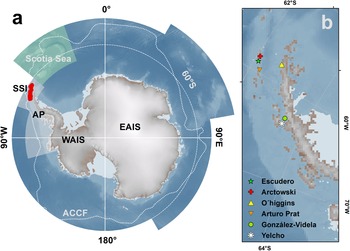
Key information from the ‘Methods’ and ‘Acknowledgements’ sections of each publication was also extracted, including the geographical domains, data sources, research platforms and financial support. Geographical domains were classified according to the main geographical regions mentioned in the studies (Fig. 1). Often, the geographical domains of the studies extended outside Antarctica, such as those comparing the Antarctic Peninsula and Chile or South America, but our research focused solely on the Antarctic component of those studies.
Fig. 1.Sectorization of Antarctica with reference to a. geographical domains cited throughout the study and b. position of the more frequently mentioned research stations by Chilean researchers. South Shetland Islands (SSI) are shaded in red and the Antarctic Peninsula (AP) is in shaded grey. Studies locations on both the SSIs and the AP were considered to be within the AP geographical domain. EAIS = East Antarctic Ice Sheet; WAIS = West Antarctic Ice Sheet.
Trends of Chilean production (2009–2019)
Simple linear models were used to estimate production (number of published papers) over time according to the IF quartile (a quartile is the ranking based on the IF, citations and indexing of that particular journal - this classification is divided in four different quartiles from Q1, Q2, Q3 through Q4), research line and funding source (whether the study was supported by INACH - funding or logistical support - or other funding sources).
Research platforms, geographical domains and data sources
Several published papers (67) acknowledged the use of multiple data sources or research platforms; for instance, while some studies mixed data from satellites with fieldwork sampling, others conducted their fieldwork on one or multiple RVs and one or multiple research stations. Therefore, in order to quantify the contributions of each method of acquiring data and on-site research platform to the research line and impact of the publications, the units considered were platforms per publication. The percentage of mentions of a given platform was calculated as the number of acknowledgements divided by the total number of publications. To represent the geographical extent of each publication, each of them was classified into ‘geographical domains’. Therefore, the publications were classified into seven domains: South Shetland Islands (SSI; land or marine within a 50 km radius of the coastline); Antarctic Peninsula (land, West Antarctica north of 74°S or marine within the Domain 1 area), West Antarctic Ice Sheet (WAIS; land, West Antarctica), East Antarctic Ice Sheet (EAIS; land, East Antarctica), Continent (land, involving both East and West Antarctica or the whole continent), Marginal Oceans (marine pelagic, involving one or two of the Atlantic, Pacific or Indian oceans) and Circumpolar (marine pelagic or coastal, involving all three of the Atlantic, Pacific and Indian oceans; Fig. 1). Platforms were grouped into research station, RV or databank, being represented as publications using databanks, satellite information and data from climate forecasts or oceanographic/climate forcing models. The previous variables, together with the IF and CY, were analysed to detect relationships between them. A multiple correspondence analysis (MCA) with computations based on a Burt matrix (Kamalja & Khangar Reference Kamalja and Khangar2017) performed using the ‘FactoMineR’ R package (Kostov et al. Reference Kostov, Bécue-Bertaut and Husson2013) was used to identify associations between publication research line impacts, geographical domains, research platforms and funding source. The domain WAIS was left out of the analysis as publications on the WAIS used the same proportions of camping sites, research stations and RVs (on the edge of sea-ice shelf), so entering this domain into the MCA reduced substantially the inertia (proportion of variation) of the analysis. Contributions of each variable group were evaluated using the ‘dimdesc‘ function, which uses a generalized partial least squares procedure to separate categorical groups based on the scores of the MCA dimensions (Jöreskog & Goldberger Reference Jöreskog and Goldberger1972).
International cooperation
The network of international co-authorship for the Chilean WoS Antarctic science publications from 2009 to 2019 was analysed using VOSviewer 1.6.8 software, which is a useful tool for mapping analyses of bibliographical data (van Eck & Waltman Reference Van Eck and Waltman2010). Networks were created by clustering, with the exclusion of countries with < 10 publications, using full counting (all authors entered with the same weight), attraction set to 2 and repulsion set to 1 (van Eck & Waltman Reference Van Eck and Waltman2010). The strength of the links between items was normalized using a modularity normalization (Noack Reference Noack2009). The distance between two items in the visualization indicates the relatedness of the items in terms of co-authorship links, where the size of the symbol is determined by the weight of the item (number of papers) and the colour by the cluster to which the item belongs. Lines between items represent links and line thickness indicates the number of co-authors shared between countries (van Eck & Waltman Reference Van Eck and Waltman2010).
Results
Production and impact
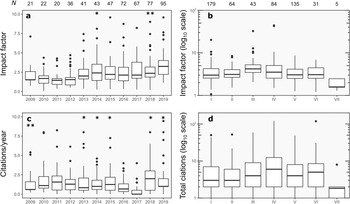
A total of 541 Antarctic science publications with authors from Chilean institutions were published in WoS peer-reviewed journals between 2009 and 2019. Chilean scientists published in 221 journals during this 11 year period. The journal with the highest number of publications was Polar Biology (13.8%), followed by Antarctic Science (4.1%), PLoS ONE (3.3%) and Revista Chilena de Historia Natural (3.1%). All other journals had < 2% of the publications. The number of publications significantly increased over the course of the period (Fig. 2a), with an estimated rate of increase of eight new papers per year (F 1,9 = 73.05, R 2 = 0.89, 95% CI = 8.22 ± 0.96, t = 8.55, P < 0.001). The median IF of the journals where Chilean scientists published their studies also increased over time (F 1,539 = 61.99, P < 0.001; Fig. 2a). The mean IF was higher in 2019 (3.93 ± 1.92), with an absolute maximum of 43.07. While research lines I, IV and V produced the highest numbers of studies, the research line III published more studies in journals with higher IFs (Fig. 2b). The average number of citations per year did not change significantly over time (F 1,539 = 1.34, P = 0.278; Fig. 2c), and papers from research line IV had a higher number of citations (Fig. 2d).
Fig. 2.Quartile boxplots of trends on journal impact factors and numbers of citations of studies published by Chilean scientists in Antarctic research topics between 2009 and 2019. a. Impact factors over these years and b, for each research line: (I) State of Antarctic Ecosystems; (II) Antarctic Thresholds: resilience and adaptation of ecosystems; (III) Climate Change; (IV) Geosciences and Astronomy; (V) Biotechnology; (VI) Human Footprint; and (VII) Social Sciences and Humanities. c. The number of citations/year and d. total number of citations for papers published within each research line. Numbers above panels are the total numbers of studies published for each year (a. & c.) or research line (b. & d.). For a., * = one study in a journal with and impact factor > 10; ** = two studies in a journal with an impact value > 10. For c., * = one study with more than 10 citations per year; ** = two studies with more than 10 citations per year. Note that b. and d. are presented in log10 scale.
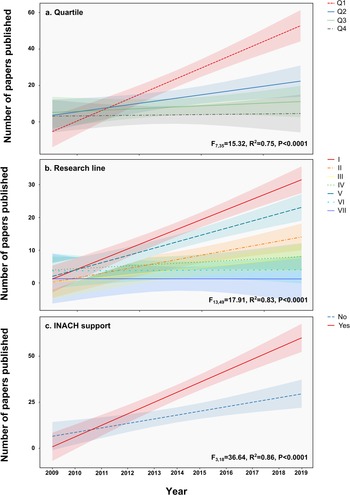
The increase in the number of publications was higher in journals belonging to the first quartile of journals (Q1) (F 7,35 = 15.32, R 2 = 0.75, P < 0.0001), from research lines I, II and V (F 13,49 = 17.91, R 2 = 0.83, P < 0.0001) and for studies whose research received logistical support or funding from INACH (F 3,18 = 36.54, R 2 = 0.86, P < 0.0001; Fig. 3). It is important to mention that most studies received support from more than one source; therefore, INACH was not the only acknowledged supporting institution.
Fig. 3.Linear trends ± standard deviations (shaded areas) of numbers of papers published by Chilean scientists in Antarctic research topics between 2009 and 2019 grouped by a. impact factor quartile, b. research line and c. whether the study received Chilean Antarctic Institute (Instituto Antártico Chileno; INACH) support.
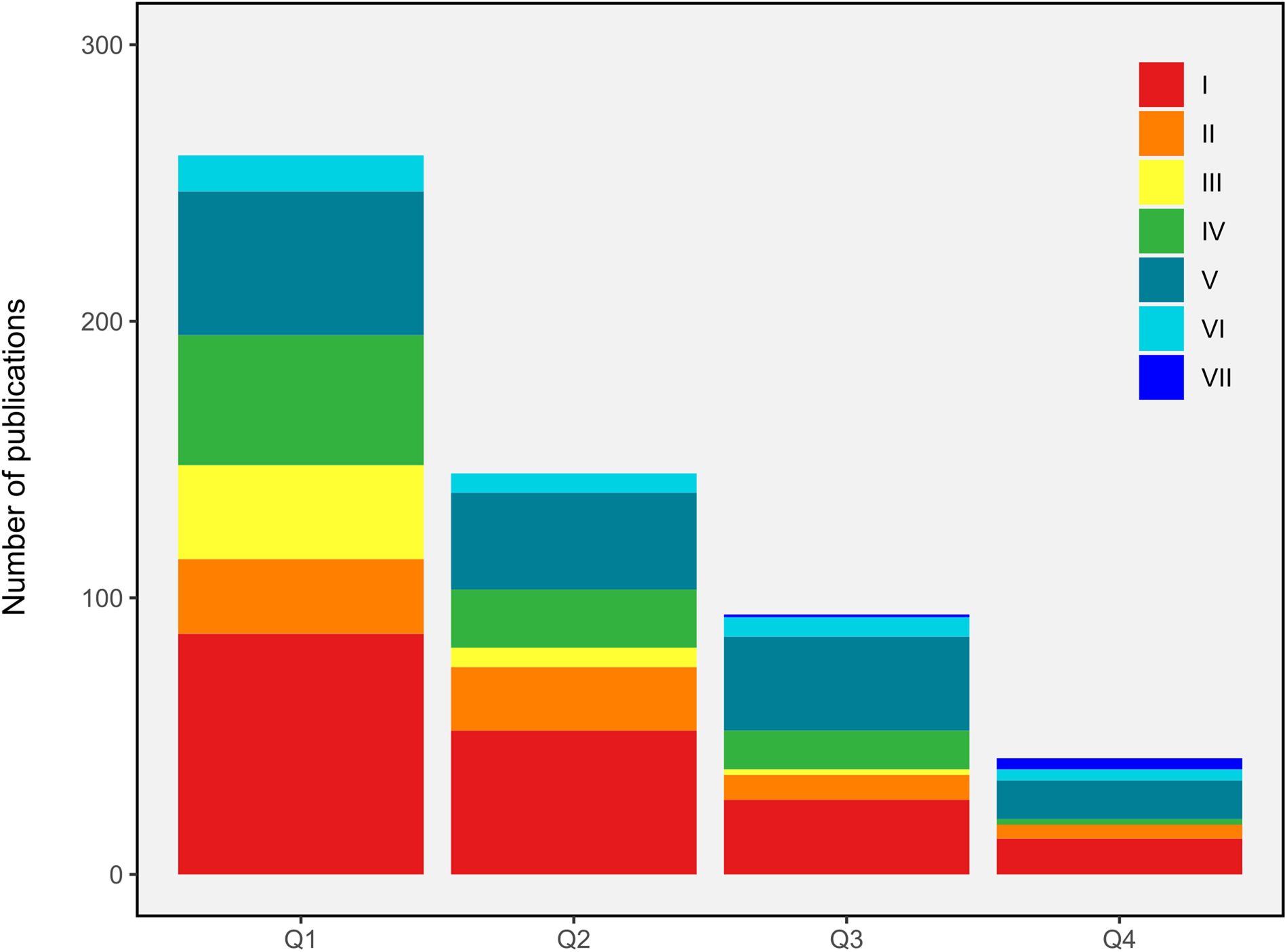
During the period analysed, research lines I and V contributed the highest numbers of articles published in journals from all quartiles. Research line VII of Social Sciences and Humanities had the lowest number of articles compared with the other lines, being absent from Q1 and Q2 (Fig. 4).
Fig. 4.Numbers of Antarctic science papers published by Chilean authors by quartile and research line during the 2009–2019 period.
Network of international collaborative publications over time
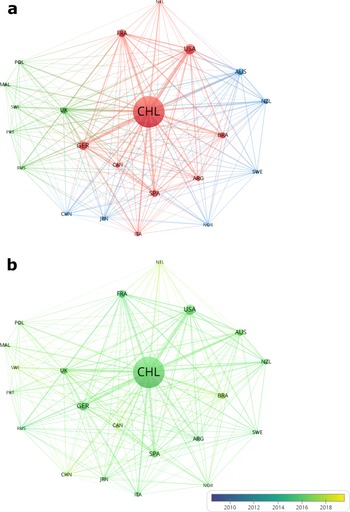
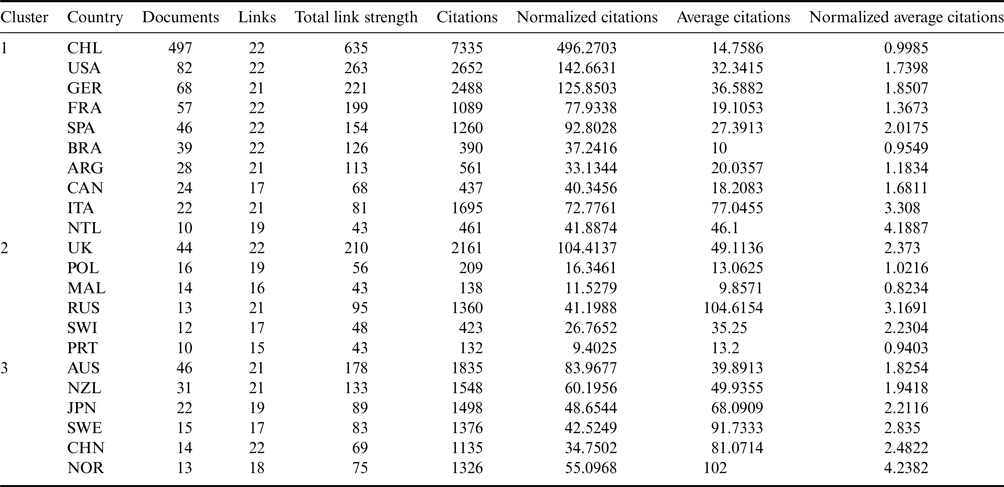
The network map of the international collaborations of researchers with Chilean affiliations and authors from different countries is shown in Fig. 5a. This analysis revealed that 72 countries collaborated with scientists from PROCIEN to some degree. From this total, only 24 such countries produced 10 or more publications, where three clusters were clearly distinguishable. The most important countries in each cluster (apart from Chile) were the USA, the UK, Germany, France, Spain and Australia. Analysis of the networking map over time shows more intense collaboration between 2014 and 2017 (Fig. 5b & Table I). Papers including co-authors from the USA constituted the leading contributions, followed by four European countries (Germany, France, the UK and Spain) and two South American countries (Brazil and Argentina).
Fig. 5.a. Network of international collaborative Antarctic science publications for the 2009–2019 period involving Chilean scientists. Clusters are represented by different colours. b. Overlay visualization map of international collaboration where years of collaboration are represented by colours. The analysis considered the authors' affiliations (countries) with at least 10 documents and two citations; counting method: full counting; normalization method: modularity; attraction: 2; repulsion: 1. ARG = Argentina; AUS = Australia; BRA = Brazil; CAN = Canada; CHL = Chile; CHN = China; FRA = France; GER = Germany; ITA = Italy; JPN = Japan; MAL = Malaysia; NTL = The Netherlands; NZL = New Zealand; NOR = Norway; POL = Poland; PRT = Portugal; RUS = Russia; SPA = Spain; SWE = Sweden; SWI = Switzerland.
Table I.Countries that have collaborated in Antarctic scientific publications with Chilean researchers. The analysis considered a threshold of documents being cited at least twice.
Spatial coverage and platforms
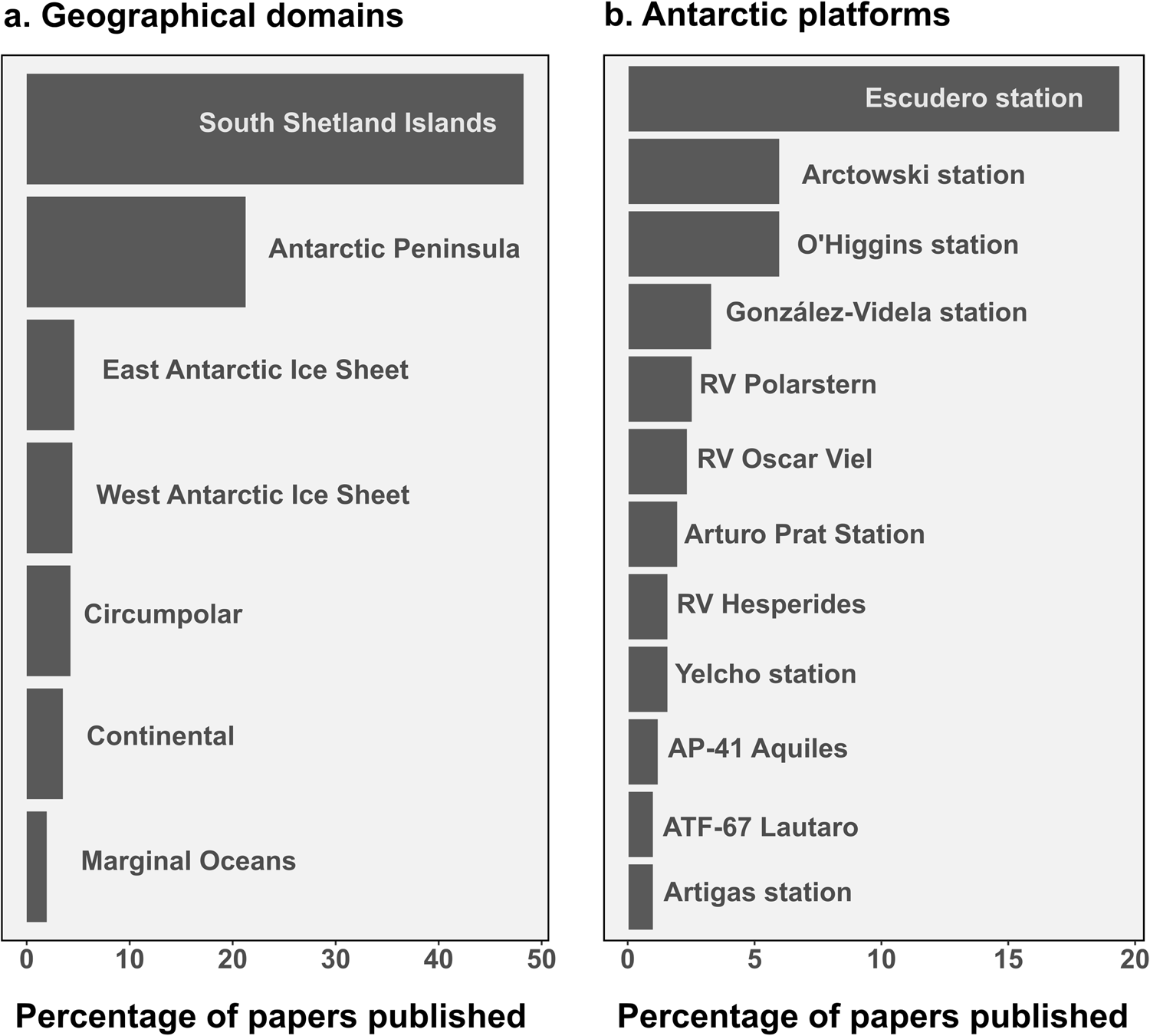
Most publications were developed in one or multiple sites at the SSIs followed by the Antarctic Peninsula (261 and 115 papers, respectively; Fig. 6a). Only 16 publications did not have an explicit geographical domain, corresponding to microbiological laboratory studies, mathematical models of ice-sheet dynamics, reviews and comments. Out of the 541 publications, 355 (65.6%) explicitly mentioned the research platform used for data acquisition. Most publications (63.24%) were focused on data analysis resulting from fieldwork activities conducted by one or more of the authors. Publications focused on data analysis from fieldwork were mostly conducted on research stations, and among them, Chilean stations were most frequently mentioned, followed by the Polish Research Station Arctowski and the German RV Polarstern (Fig. 6b).
Fig. 6.a. Percentages of papers published on different geographical domains of Antarctica. b. Percentages of on-site research platforms mentioned in published studies; only research platforms mentioned in more than five publications are presented. ATF = Chilean Navy vessel; RV = research vessel.
*Non-Chilean platforms.
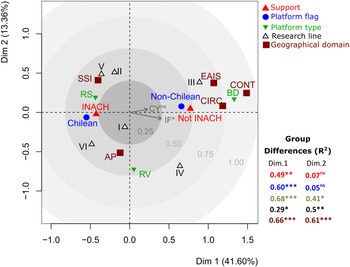
The MCA showed that the first two dimensions captured 54.96% of the data variability (Fig. 7). This indicated that there is a large proportion of data that is not encompassed in the trends detected by the analysis. Dimension 1 segregated groups in all variables except the research lines, which were more associated with Dimension 2 (Fig. 7). Dimension 1 separated publications with INACH support using Chilean research platforms (with the predominance of publications on research lines II, V and VI on the SSI and Antarctic Peninsula) from those without INACH support on non-Chilean platforms (with the predominance of publications on research line III, on the EAIS or at the Circumpolar and Continental level, using predominantly previously collected data or data deposited in databanks or repositories). Dimension 2 separated those studies on the SSIs (mostly associated with research stations) from those on the Antarctic Peninsula (mostly associated with RVs). Correlations between supplemental numerical variables (IF and CY) and dimensions were weak; therefore, there was no clear separation in terms of the impact of the publications based on domain, research line, platform or INACH support.
Fig. 7.Multiple correspondence analysis factor map for group centroids superimposed on dimension (Dim.) correlation circles (light grey areas correspond to different values of correlation between variables and dimensions) and supplemental numeric variables for impact factor (IF) and citations/year (CY; arrows). Group differences were measured using generalized partial least squares computing R 2 and significance (nsP > 0.05, *P < 0.05, **P < 0.01, ***P < 0.001). Support for such research was given by the Chilean Antarctic Institute (Instituto Antártico Chileno; INACH) or other institutions (not INACH) on research stations (RS), research vessels (RV) or using databanks (DB) for studies in the South Shetland Islands (SSI), Antarctic Peninsula (AP), East Antarctic Ice Sheet (EAIS) or over a Circumpolar (CIRC) or Continental (CONT) level. Research lines: (I) State of Antarctic Ecosystems; (II) Antarctic Thresholds: resilience and adaptation of ecosystems; (III) Climate Change; (IV) Geosciences and Astronomy; (V) Biotechnology; and (VI) Human Footprint.
Discussion
The analysis presented here provides a clear picture of how changes introduced in 2005 to the development strategies of Antarctic science carried out by Chilean researchers have enhanced the scientific productivity of PROCIEN. The numbers of articles published by Chilean researchers in Antarctic science revealed sustained growth throughout the 11 year period analysed, with increasing numbers of articles and citations in journals with greater IFs, showing the strong interest of the Chilean scientific community in Antarctica. A similar trend has been observed in the past two decades for global Antarctic studies (Dastidar Reference Dastidar2007, Ji et al. Reference Ji, Pang and Zhao2014). Latin America has also shown a significant increase in scientific production over the past two decades, and investment in research has increased in most countries (Van Noorden Reference Van Noorden2014). Despite serious governance problems, several examples of outstanding researchers and institutions in the region have been highlighted (Ciocca & Delgado Reference Ciocca and Delgado2017). Nonetheless, the gap between developed countries and Latin American countries is alarming (Ciocca & Delgado Reference Ciocca and Delgado2017). The increase of investment in research, however, is not necessarily explained by the increase in gross domestic product (GDP) that countries allocate to scientific development but rather to investment strategies. In the case of Chilean Antarctic science, the rate of increase of eight papers per year could be attributed to two main factors. First is the improvement of the quality of Chilean Antarctic science through the increased availability of resources and the establishment of a competitive funding system with international parameters of excellence, as well as the incorporation of other funding agencies in this task. Second is the adoption of a strategy to strengthen Magallanes (the southernmost region of Chile) as an Antarctic region (Antarctic gateway), creating strategic alliances with other nations, improving the country's infrastructure and incorporating the regional government and the private sector, in collaboration with other Antarctic operators.
The production of scientific articles is one of the criteria used to demonstrate substantial research activity under the Antarctic Treaty. During the past decade, Chile has shown a greater degree of engagement in international decision-making processes regarding Antarctic matters, as measured by the numbers of working papers and scientific papers produced (Dudeney & Walton Reference Dudeney and Walton2012, Stotz et al. Reference Stotz, Salgado-Luarte, Rios, Acuña-Rodriguez, Carrasco-Urra, Molina-Montenegro and Gianoli2013). However, analyses including only research articles (excluding grey literature, working papers, theses and dissertations) and databases can produce varying results from such productivity analyses. Gray & Hughes (Reference Gray and Hughes2016) investigated metrics that evaluate research activity by measuring the quantity and quality of scientific publications and the national focus on Antarctic science. Their results showed that the number of scientific publications generated by Chile during the 2011–2015 period was 385, while our data from the same period indicated 187 such articles. The lower number of scientific publications could be explained by the databases consulted, which in our study was WoS, while Gray & Hughes (Reference Gray and Hughes2016) performed their bibliometric searches using the Scopus database (Elsevier).
Most articles were published in specialized journals such as Polar Biology or Antarctic Science, both of which have IFs close to 2.0. This trend is similar to that described by Tejedo et al. (Reference Tejedo, Gutiérrez, Pertierra and Benayas2015) suggesting that 31.2% of studies developed on Deception Island (Maritime Antarctic) produced between 1964 and 2012 were published in those two journals. The use of other journals with broader scope and greater IFs may explain the increase we observed in the mean IF to closer to 4.0 in 2019. However, we cannot ignore that the diversification in funding sources that PROCIEN has experienced and the increase in international cooperation on projects could explain the increase in the number of articles published in journals with greater IFs, as such aspects have been shown to identify cross-disciplinary patterns in the relationship between funding and research outputs (Yan et al. Reference Yan, Wu and Song2018).
Clear patterns were observed when comparing PROCIEN research lines over the study period. The research lines ‘State of Antarctic Ecosystems’ and ‘Biotechnology’ showed a significant increase in the number of papers published in Q1 and Q2 journals. Chile has a long history of research in the field of Antarctic ecological research, supported by a large number of facilities that have experienced important temporal continuity both in the SSIs and in the Antarctic Peninsula (Stotz et al. Reference Stotz, Salgado-Luarte, Rios, Acuña-Rodriguez, Carrasco-Urra, Molina-Montenegro and Gianoli2013). This has facilitated Chilean groups in consolidating their study of Antarctic plants and marine ecosystems. Improvements in scientific infrastructure such as laboratories, scientific equipment of greater complexity and the ability to maintain the cold chain from the field all the way to Punta Arenas (Chile) have made it possible to improve the quality of the information obtained in the field. On the other hand, the rapid technological advances in -omics have allowed improvements in the characterization of Antarctic microorganisms, phylogenetics and functional studies in plants and different Antarctic organisms, with several of them being highly focused within biotechnology (Clark et al. Reference Clark, Clarke, Cockell, Convey, Detrich and Fraser2004, Martínez-Rosales et al. Reference Martínez-Rosales, Fullana, Musto and Castro-Sowinski2012). This has also been accompanied by an increase in the number of highly qualified specialists, research centres and developed infrastructure, similar to what has happened with the development of astronomical science in Chile.
In other areas such as astronomy and mathematics, Chile has had an impact rate similar to those of developed countries, although the number of publications Chile has produced has been much smaller. For instance, Chilean scientific publications in astronomy and astrophysics have performed well during the last 10 years (Cortes et al. Reference Cortes, Depoortere and Malaver2018). It is expected that in the next 10 years astronomy and astrophysics publications within PROCIEN may improve the performance level of the rest of Chilean science. To improve the impact of projects funded by the PROCIEN, it is necessary to be able to continuously evaluate their performance related to research assessment/management. In this regard, the use of bibliometric indicators is helpful, as they are objective, reliable and cost-effective measures of peer-reviewed research outputs (Campbell et al. Reference Campbell, Picard-Aitken, Côté, Caruso, Valentim and Edmonds2010).
The three research lines that showed more total citations in the period studied corresponded to ‘Geosciences’, ‘State of the Antarctic Ecosystem’ and ‘Biotechnology’. The high number of Geosciences citations is explained by a few articles published in high-impact journals being cited well above the average. However, this research line produced fewer articles compared to the other lines. Research on the state of the Antarctic ecosystem is a traditional topic in the Chilean national programme, whereas biotechnology has presented a significant increase in projects associated with a high number of publications. It is worth mentioning that the low scientific output and representation of research lines in the humanities and social sciences is explained by the absence of grants for these research areas until 2018, when INACH decided to make them eligible for funding.
According to the analysis presented by Ji et al. (Reference Ji, Pang and Zhao2014), Chile ranks 21st among the top 25 most productive countries in terms of Antarctic research for the 1993–2012 period. The other two most active South American countries in polar research were Argentina and Brazil at 12th and 20th, respectively. This work also found that 65% of articles showed international collaboration, with the USA and Germany being the main partners of Chile. Chile has continued to maintain a high level of internationalization in terms of scientific output, increasing its links with other productive countries. While co-authorship is only a partial indicator of collaboration, in the call for funding proposals for Antarctic research in Chile, extra points are given to proposals that explicitly include international collaboration (indicating levels of funding, use or access to laboratories, facilities or financial support for sample analysis). As has been shown by Bartneck & Hu (Reference Bartneck and Hu2010), greater levels of collaboration in multidisciplinary fields increase the scientific output associated with each investigation.
The Chilean network of scientific collaboration reported here is quite similar to that indicated by a Brazilian study developed by Boyadjian et al. (Reference Boyadjian, Câmara, Barros-platiau and Albergaria2020), where the main collaborating countries were the USA, France, Argentina, the UK and Spain. Interestingly, although more than 20 countries that carry out research in the Antarctic Peninsula operate from Punta Arenas, some South American (e.g. Uruguay, Colombia, Ecuador, Peru) and Asian countries (e.g. South Korea) are producing few or no publications with Chilean institutions. Another important platform regarding the number of articles published by Chilean scientists was Poland's Arctowski station; however, Poland together with Switzerland and Malaysia form a group that has had only a low level of interaction with Chilean scientists (Figs 5 & 6). This could be explained by the historical logistical support provided by Poland to Chilean researchers to access areas near Arctowski Station where conspicuous populations of Antarctic plants can be found, hence providing a good example of a logistical rather than scientific collaboration.
Studies on the Antarctic Peninsula, and particularly the SSIs, dominated Chilean production. This area, due to its proximity to South America, has facilitated the installation of scientific bases, increasing the influx of research and/or tourist ships and flights (Brooks et al. Reference Brooks, Jabour, van den Hoff and Bergstrom2019). Access to the Antarctic Peninsula is made easier for scientists from South American Antarctic programmes due to its geographical proximity, which is reflected in the presence of infrastructure of those countries in the area; therefore, it could be expected that high numbers of publications would relate to studies conducted at the Antarctic Peninsula. Infrastructure at the SSIs, for instance, allowed for increased production in the biotechnological area (e.g. Órdenes-Aenishanslins et al. Reference Órdenes-Aenishanslins, Anziani-Ostuni, Vargas-Reyes, Alarcón, Tello and Pérez-Donoso2016, Nunez-Montero et al. Reference Núñez-Montero, Lamilla, Abanto, Maruyama, Jorquera and Santos2019, Shene et al. Reference Shene, Garcés, Vergara, Peña, Claverol, Rubilar and Leyton2019) and increased numbers of studies testing the physiological responses of organisms (research line II; e.g. Vargas-Chacoff et al. Reference Vargas-Chacoff, Muñoz, Ocampo, Paschke and Navarro2019, Rondon et al. Reference Rondon, González-Aravena, Font, Osorio and Cárdenas2020).
On the other hand, publications with a wider geographical extent were mostly associated with non-Chilean platforms. In this context, efforts from scientists of several nationalities to collect and compile information from different places are crucial to generating wider perspectives. While such trends were clear from our results, they were not definitive, as more than 40% of the variability was not explained by our analysis. Therefore, several large-scale studies that received support from INACH and used Chilean platforms produced highly impactful publications (e.g. González-Wevar et al. Reference González-Wevar, Chown, Morley, Coria, Saucède and Poulin2016, Fraser et al. Reference Fraser, Morrison, Hogg, Macaya, Van Sebille and Ryan2018, Frugone et al. Reference Frugone, Lowther, Noll, Ramos, Pistorius and Dantas2018). Comparatively, studies using remote-sensing resources, such as satellites with open access to the scientific community (i.e. Bozkurt et al. Reference Bozkurt, Rondanelli, Marin and Garreaud2018), still represent a small proportion of Chilean Antarctic science publications (< 3% of publications). In addition, another area of research that is not well represented is oceanography. This is mainly explained by the lack of vessels with adequate facilities for this kind of research, as Chile has used navy vessels for that purpose. This has slightly changed in recent years with the arrival of the INACH's 24.5 m-long RV Karpuj, which has facilitated the development of research on biological oceanography, traditionally associated with research carried out onboard international RVs (e.g. the German RV Polarstern). The arrival of a new Chilean icebreaker (by 2024–2025) is expected to expand spatial coverage and to improve the development and scope of oceanographic research, as it will carry state-of-the-art technology for physical and biological oceanography as well as marine geology and bioacoustics.
Conclusion
The results presented here highlight the need for improved links in terms of scientific collaboration in the SSIs and the Antarctic Peninsula area. This study can help national Antarctic programmes and researchers to identify gaps and establish new partnerships that will improve multidisciplinary and international research projects, which normally require complex logistics (Kennicutt et al. Reference Kennicutt, Chown, Cassano, Liggett, Peck and Massom2015), and to resolve high-priority challenges such as the production of terrestrial/coastal biological time series linking the ocean and atmosphere to elucidate biotic-abiotic interactions, one of the keys to monitoring the status and trends of indicators of the health and trajectories of Antarctic ecosystems (Kennicutt et al. Reference Kennicutt, Bromwich, Liggett, Njastad, Peck and Rintoul2019).
The scientific productivity of PROCIEN have shown significant improvement in the last decade. However, it is strongly recommended to increase and strengthen cooperation links with countries that have scientific stations on King George Island and the SSIs (e.g. Korea, Brazil, Argentina, China, Spain). The addition of a new icebreaker in 2024–2025 with state-of-the-art scientific capacity and the planned improvements to research stations that form the network of Chilean research stations are expected to close gaps in underrepresented research lines (e.g. oceanography). However, it is necessary to continue strengthening international collaboration by proposing transdisciplinary projects with other countries, as is the participation of Chilean scientists in international initiatives (e.g. the SCAR Integrated Science to Inform Antarctic and Southern Ocean Conservation (Ant-ICON) or Near-term Variability and Prediction of the Antarctic Climate System (AntClimNOW) scientific research programmes), as well as continuing to increase the number of national researchers that present the results of their research at international forums.






 You have
Access
Introduction
Antarctica is one of the few places in the world where science and a cooperative international government are the dominant activities, but its uniqueness is also expressed through its extreme, pristine and singular environments. After the first Antarctic Treaty Consultative Meeting (ATCM, held in 1961), Chile quickly noted the need to strengthen national polar scientific development due to its actions having been few and of weak global significance (Retamales Reference Retamales2014). The creation of the Chilean Antarctic Institute (Instituto Antártico Chileno; INACH) in 1963 was inspired by the obligations assumed by the country as part of the Antarctic Treaty (signed in 1959) in terms of carrying out scientific research within a framework of international cooperation. Chile as a claimant nation and as a Consultative Party has conducted substantial scientific work on the continent, as shown by several bibliometric studies (Dudeney & Walton Reference Dudeney and Walton2012, Gray & Hughes Reference Gray and Hughes2016, Kim & Jung Reference Kim and Jung2016).
In the last 20 years, Antarctic science has been marked by three key milestones: the Fourth International Polar Year (IPY; 2007–2008), the Scientific Committee on Antarctic Research (SCAR) Horizon Scan and the Antarctic Roadmap Challenges (ARC) project (Summerhayes Reference Summerhayes2008, Kennicutt et al. Reference Kennicutt, Chown, Cassano, Liggett, Massom and Peck2014, Reference Kennicutt, Chown, Cassano, Liggett, Peck and Massom2015). The Fourth IPY was a very important benchmark for the Chilean Antarctic Science Program (PROCIEN), as, in 2005, INACH defined three priority thematic areas of Chilean Antarctic research for the 2005–2010 period, establishing a direct link with areas of the IPY: (1) the Antarctica-South America connection; (2) the human influence in Antarctica; and (3) Antarctica and its global influence.
PROCIEN's projects are selected annually following open and transparent selection processes from several research proposal calls. The selection procedures mainly consider an international scientific peer-review evaluation, ranking of results by an ad hoc science committee, logistical feasibility and environmental fulfilment analysis. The final granted projects are chosen by a selection panel composed of SCAR national members and a national science agency representative, together with INACH's Directorate. The projects are financed from various sources (including funding by INACH), and their execution is organized, coordinated and controlled by INACH, interacting directly with principal investigators, universities and centres for scientific research.
Since 2009, Chilean research in Antarctica has developed particular strengths in the study and understanding of the Antarctic environment, its physical and biological character both past and present, as well as in future scenarios. At that time, these research areas were circumscribed primarily into four research lines, as identified by INACH, in accordance with SCAR programmes. These main areas of research were: (I) relationships between South America and Antarctica; (II) global warming and climate evolution; (III) the abundance and diversity of Antarctic organisms; and (IV) the Antarctic environment and its bioresources. In 2012, considering the increase in new studies addressing the impacts of the human footprint in Antarctica, a new research line named ‘The Environment’ was incorporated by PROCIEN. In 2014, PROCIEN was once again restructured to maintain the link with the SCAR scientific research programmes, establishing a stronger research focus on the state of the Antarctic and its dynamics, relationships and trends at the physical and ecosystem levels. The new defined research lines were: (I) State of the Antarctic Ecosystem; (II) Antarctic Thresholds: resilience and adaptation of the ecosystem; (III) Climate Change in Antarctica; (IV) Earth and Astronomical Sciences; (V) Microbiology, Molecular Biology and Biotechnology; and (VI) Antarctic Environment. In 2018, following the global trend that SCAR replicated, a new research line of social sciences and humanities was incorporated, although this added only two projects to PROCIEN.
In recent decades, different analyses of productivity and scientific outputs related to research station capacity use and the level of interaction within international collaboration networks focusing on Antarctic research have been published (Dastidar Reference Dastidar2007, Dudeney & Walton Reference Dudeney and Walton2012, Ji et al. Reference Ji, Pang and Zhao2014, Gray & Hughes Reference Gray and Hughes2016, Kim & Jung Reference Kim and Jung2016, Jang et al. Reference Jang, Doh and Choi2020). In the Latin American context, three studies have been published regarding bibliometric patterns in Antarctic science research, which focused on Brazilian research (Stefenon et al. Reference Stefenon, Roesch and Pereira2013, Boyadjian et al. Reference Boyadjian, Câmara, Barros-platiau and Albergaria2020, Câmara et al. Reference Câmara, Barros-Platiau, Andrade and Hillebrand2021). Bibliometric studies on the research output of Chilean institutions have mainly focused on several biological disciplines (Krauskopf Reference Krauskopf2008) or have explored the development of astronomy in Chile (Cortes et al. Reference Cortes, Depoortere and Malaver2018). Even though the number of Antarctic science publications over time has been used as an INACH management goal indicator, the contribution of Chilean scientists to Antarctic research has not been analysed in detail.
Here, we show the advances of PROCIEN in terms of bibliometric productivity, geographical coverage, research platforms (e.g. research vessels (RVs), research stations, databanks) and cooperation networks, quantifying the production and impact of Chilean Antarctic science publications. Based on our analyses, we also identify the scientific and logistical gaps and discuss the ongoing priorities for the future of Chilean Antarctic research.
Materials and methods
We analysed scientometric indicators of Antarctic science publications from between 2009 and 2019. This was the period that was reviewed before our institute developed and adopted a new strategic plan for 2020–2025. Our analysis was done using the Web of Science (WoS) database (www.webofknowledge.com), a powerful platform of Clarivate Analytics widely used worldwide for the study of scientometric indicators. It is composed of the Core Collection, which includes prestigious international journals that incorporate serious editorial revision processes prior to publication. In order to analyse Antarctic WoS publications of researchers with Chilean affiliations, we used the term ‘Antarc*’ as the search criterion for scientific papers published during the study period, with the address set to ‘Chile’. Documents including the terms ‘Durvillaea antarctica’, ‘Candida antarctica’ and ‘Nothofagus antarctica’ were manually excluded from the database in order to avoid the inclusion of studies focused on subantarctic species that, despite their names including ‘antarctica’ are not present in Antarctica. We also used the Journal Citation Report (JCR) to determine the impact factors (Ifs) of the journals where the WoS Antarctic science papers were published. The IF of a journal is calculated as the quotient between the number of citations of the articles published and the number of articles published in the previous 2 years by the journal (according to the JCR). As the IF varies each year, we therefore consulted the values for each year of the study period. Then, we built a database of all Antarctic science WoS publications that included researchers with Chilean affiliations for the studied period. This database contains important information related to authors, institutions, countries, funding sources, platforms used and areas studied.
Indicators of impact
The number of citations for each paper was divided by the number of years since publication, generating an index of mean citations per year (CY).
Each publication was assigned to one of seven research lines according to the last PROCIEN structure: (I) State of Antarctic Ecosystems; (II) Antarctic Thresholds: resilience and adaptation of ecosystems; (III) Climate Change; (IV) Geosciences and Astronomy; (V) Biotechnology; (VI) Human Footprints; and (VII) Social Sciences and Humanities.
Key information from the ‘Methods’ and ‘Acknowledgements’ sections of each publication was also extracted, including the geographical domains, data sources, research platforms and financial support. Geographical domains were classified according to the main geographical regions mentioned in the studies (Fig. 1). Often, the geographical domains of the studies extended outside Antarctica, such as those comparing the Antarctic Peninsula and Chile or South America, but our research focused solely on the Antarctic component of those studies.
Sectorization of Antarctica with reference to a. geographical domains cited throughout the study and b. position of the more frequently mentioned research stations by Chilean researchers. South Shetland Islands (SSI) are shaded in red and the Antarctic Peninsula (AP) is in shaded grey. Studies locations on both the SSIs and the AP were considered to be within the AP geographical domain. EAIS = East Antarctic Ice Sheet; WAIS = West Antarctic Ice Sheet.
Trends of Chilean production (2009–2019)
Simple linear models were used to estimate production (number of published papers) over time according to the IF quartile (a quartile is the ranking based on the IF, citations and indexing of that particular journal - this classification is divided in four different quartiles from Q1, Q2, Q3 through Q4), research line and funding source (whether the study was supported by INACH - funding or logistical support - or other funding sources).
Research platforms, geographical domains and data sources
Several published papers (67) acknowledged the use of multiple data sources or research platforms; for instance, while some studies mixed data from satellites with fieldwork sampling, others conducted their fieldwork on one or multiple RVs and one or multiple research stations. Therefore, in order to quantify the contributions of each method of acquiring data and on-site research platform to the research line and impact of the publications, the units considered were platforms per publication. The percentage of mentions of a given platform was calculated as the number of acknowledgements divided by the total number of publications. To represent the geographical extent of each publication, each of them was classified into ‘geographical domains’. Therefore, the publications were classified into seven domains: South Shetland Islands (SSI; land or marine within a 50 km radius of the coastline); Antarctic Peninsula (land, West Antarctica north of 74°S or marine within the Domain 1 area), West Antarctic Ice Sheet (WAIS; land, West Antarctica), East Antarctic Ice Sheet (EAIS; land, East Antarctica), Continent (land, involving both East and West Antarctica or the whole continent), Marginal Oceans (marine pelagic, involving one or two of the Atlantic, Pacific or Indian oceans) and Circumpolar (marine pelagic or coastal, involving all three of the Atlantic, Pacific and Indian oceans; Fig. 1). Platforms were grouped into research station, RV or databank, being represented as publications using databanks, satellite information and data from climate forecasts or oceanographic/climate forcing models. The previous variables, together with the IF and CY, were analysed to detect relationships between them. A multiple correspondence analysis (MCA) with computations based on a Burt matrix (Kamalja & Khangar Reference Kamalja and Khangar2017) performed using the ‘FactoMineR’ R package (Kostov et al. Reference Kostov, Bécue-Bertaut and Husson2013) was used to identify associations between publication research line impacts, geographical domains, research platforms and funding source. The domain WAIS was left out of the analysis as publications on the WAIS used the same proportions of camping sites, research stations and RVs (on the edge of sea-ice shelf), so entering this domain into the MCA reduced substantially the inertia (proportion of variation) of the analysis. Contributions of each variable group were evaluated using the ‘dimdesc‘ function, which uses a generalized partial least squares procedure to separate categorical groups based on the scores of the MCA dimensions (Jöreskog & Goldberger Reference Jöreskog and Goldberger1972).
International cooperation
The network of international co-authorship for the Chilean WoS Antarctic science publications from 2009 to 2019 was analysed using VOSviewer 1.6.8 software, which is a useful tool for mapping analyses of bibliographical data (van Eck & Waltman Reference Van Eck and Waltman2010). Networks were created by clustering, with the exclusion of countries with < 10 publications, using full counting (all authors entered with the same weight), attraction set to 2 and repulsion set to 1 (van Eck & Waltman Reference Van Eck and Waltman2010). The strength of the links between items was normalized using a modularity normalization (Noack Reference Noack2009). The distance between two items in the visualization indicates the relatedness of the items in terms of co-authorship links, where the size of the symbol is determined by the weight of the item (number of papers) and the colour by the cluster to which the item belongs. Lines between items represent links and line thickness indicates the number of co-authors shared between countries (van Eck & Waltman Reference Van Eck and Waltman2010).
Results
Production and impact
A total of 541 Antarctic science publications with authors from Chilean institutions were published in WoS peer-reviewed journals between 2009 and 2019. Chilean scientists published in 221 journals during this 11 year period. The journal with the highest number of publications was Polar Biology (13.8%), followed by Antarctic Science (4.1%), PLoS ONE (3.3%) and Revista Chilena de Historia Natural (3.1%). All other journals had < 2% of the publications. The number of publications significantly increased over the course of the period (Fig. 2a), with an estimated rate of increase of eight new papers per year (F 1,9 = 73.05, R 2 = 0.89, 95% CI = 8.22 ± 0.96, t = 8.55, P < 0.001). The median IF of the journals where Chilean scientists published their studies also increased over time (F 1,539 = 61.99, P < 0.001; Fig. 2a). The mean IF was higher in 2019 (3.93 ± 1.92), with an absolute maximum of 43.07. While research lines I, IV and V produced the highest numbers of studies, the research line III published more studies in journals with higher IFs (Fig. 2b). The average number of citations per year did not change significantly over time (F 1,539 = 1.34, P = 0.278; Fig. 2c), and papers from research line IV had a higher number of citations (Fig. 2d).
Quartile boxplots of trends on journal impact factors and numbers of citations of studies published by Chilean scientists in Antarctic research topics between 2009 and 2019. a. Impact factors over these years and b, for each research line: (I) State of Antarctic Ecosystems; (II) Antarctic Thresholds: resilience and adaptation of ecosystems; (III) Climate Change; (IV) Geosciences and Astronomy; (V) Biotechnology; (VI) Human Footprint; and (VII) Social Sciences and Humanities. c. The number of citations/year and d. total number of citations for papers published within each research line. Numbers above panels are the total numbers of studies published for each year (a. & c.) or research line (b. & d.). For a., * = one study in a journal with and impact factor > 10; ** = two studies in a journal with an impact value > 10. For c., * = one study with more than 10 citations per year; ** = two studies with more than 10 citations per year. Note that b. and d. are presented in log10 scale.
The increase in the number of publications was higher in journals belonging to the first quartile of journals (Q1) (F 7,35 = 15.32, R 2 = 0.75, P < 0.0001), from research lines I, II and V (F 13,49 = 17.91, R 2 = 0.83, P < 0.0001) and for studies whose research received logistical support or funding from INACH (F 3,18 = 36.54, R 2 = 0.86, P < 0.0001; Fig. 3). It is important to mention that most studies received support from more than one source; therefore, INACH was not the only acknowledged supporting institution.
Linear trends ± standard deviations (shaded areas) of numbers of papers published by Chilean scientists in Antarctic research topics between 2009 and 2019 grouped by a. impact factor quartile, b. research line and c. whether the study received Chilean Antarctic Institute (Instituto Antártico Chileno; INACH) support.
During the period analysed, research lines I and V contributed the highest numbers of articles published in journals from all quartiles. Research line VII of Social Sciences and Humanities had the lowest number of articles compared with the other lines, being absent from Q1 and Q2 (Fig. 4).
Numbers of Antarctic science papers published by Chilean authors by quartile and research line during the 2009–2019 period.
Network of international collaborative publications over time
The network map of the international collaborations of researchers with Chilean affiliations and authors from different countries is shown in Fig. 5a. This analysis revealed that 72 countries collaborated with scientists from PROCIEN to some degree. From this total, only 24 such countries produced 10 or more publications, where three clusters were clearly distinguishable. The most important countries in each cluster (apart from Chile) were the USA, the UK, Germany, France, Spain and Australia. Analysis of the networking map over time shows more intense collaboration between 2014 and 2017 (Fig. 5b & Table I). Papers including co-authors from the USA constituted the leading contributions, followed by four European countries (Germany, France, the UK and Spain) and two South American countries (Brazil and Argentina).
a. Network of international collaborative Antarctic science publications for the 2009–2019 period involving Chilean scientists. Clusters are represented by different colours. b. Overlay visualization map of international collaboration where years of collaboration are represented by colours. The analysis considered the authors' affiliations (countries) with at least 10 documents and two citations; counting method: full counting; normalization method: modularity; attraction: 2; repulsion: 1. ARG = Argentina; AUS = Australia; BRA = Brazil; CAN = Canada; CHL = Chile; CHN = China; FRA = France; GER = Germany; ITA = Italy; JPN = Japan; MAL = Malaysia; NTL = The Netherlands; NZL = New Zealand; NOR = Norway; POL = Poland; PRT = Portugal; RUS = Russia; SPA = Spain; SWE = Sweden; SWI = Switzerland.
Countries that have collaborated in Antarctic scientific publications with Chilean researchers. The analysis considered a threshold of documents being cited at least twice.
ARG = Argentina; AUS = Australia; BRA = Brazil; CAN = Canada; CHL = Chile; CHN = China; FRA = France; GER = Germany; ITA = Italy; JPN = Japan; MAL = Malaysia; NTL = The Netherlands; NZL = New Zealand; NOR = Norway; POL = Poland; PRT = Portugal; RUS = Russia; SPA = Spain; SWE = Sweden; SWI = Switzerland.
Spatial coverage and platforms
Most publications were developed in one or multiple sites at the SSIs followed by the Antarctic Peninsula (261 and 115 papers, respectively; Fig. 6a). Only 16 publications did not have an explicit geographical domain, corresponding to microbiological laboratory studies, mathematical models of ice-sheet dynamics, reviews and comments. Out of the 541 publications, 355 (65.6%) explicitly mentioned the research platform used for data acquisition. Most publications (63.24%) were focused on data analysis resulting from fieldwork activities conducted by one or more of the authors. Publications focused on data analysis from fieldwork were mostly conducted on research stations, and among them, Chilean stations were most frequently mentioned, followed by the Polish Research Station Arctowski and the German RV Polarstern (Fig. 6b).
a. Percentages of papers published on different geographical domains of Antarctica. b. Percentages of on-site research platforms mentioned in published studies; only research platforms mentioned in more than five publications are presented. ATF = Chilean Navy vessel; RV = research vessel.
*Non-Chilean platforms.
The MCA showed that the first two dimensions captured 54.96% of the data variability (Fig. 7). This indicated that there is a large proportion of data that is not encompassed in the trends detected by the analysis. Dimension 1 segregated groups in all variables except the research lines, which were more associated with Dimension 2 (Fig. 7). Dimension 1 separated publications with INACH support using Chilean research platforms (with the predominance of publications on research lines II, V and VI on the SSI and Antarctic Peninsula) from those without INACH support on non-Chilean platforms (with the predominance of publications on research line III, on the EAIS or at the Circumpolar and Continental level, using predominantly previously collected data or data deposited in databanks or repositories). Dimension 2 separated those studies on the SSIs (mostly associated with research stations) from those on the Antarctic Peninsula (mostly associated with RVs). Correlations between supplemental numerical variables (IF and CY) and dimensions were weak; therefore, there was no clear separation in terms of the impact of the publications based on domain, research line, platform or INACH support.
Multiple correspondence analysis factor map for group centroids superimposed on dimension (Dim.) correlation circles (light grey areas correspond to different values of correlation between variables and dimensions) and supplemental numeric variables for impact factor (IF) and citations/year (CY; arrows). Group differences were measured using generalized partial least squares computing R 2 and significance (nsP > 0.05, *P < 0.05, **P < 0.01, ***P < 0.001). Support for such research was given by the Chilean Antarctic Institute (Instituto Antártico Chileno; INACH) or other institutions (not INACH) on research stations (RS), research vessels (RV) or using databanks (DB) for studies in the South Shetland Islands (SSI), Antarctic Peninsula (AP), East Antarctic Ice Sheet (EAIS) or over a Circumpolar (CIRC) or Continental (CONT) level. Research lines: (I) State of Antarctic Ecosystems; (II) Antarctic Thresholds: resilience and adaptation of ecosystems; (III) Climate Change; (IV) Geosciences and Astronomy; (V) Biotechnology; and (VI) Human Footprint.
Discussion
The analysis presented here provides a clear picture of how changes introduced in 2005 to the development strategies of Antarctic science carried out by Chilean researchers have enhanced the scientific productivity of PROCIEN. The numbers of articles published by Chilean researchers in Antarctic science revealed sustained growth throughout the 11 year period analysed, with increasing numbers of articles and citations in journals with greater IFs, showing the strong interest of the Chilean scientific community in Antarctica. A similar trend has been observed in the past two decades for global Antarctic studies (Dastidar Reference Dastidar2007, Ji et al. Reference Ji, Pang and Zhao2014). Latin America has also shown a significant increase in scientific production over the past two decades, and investment in research has increased in most countries (Van Noorden Reference Van Noorden2014). Despite serious governance problems, several examples of outstanding researchers and institutions in the region have been highlighted (Ciocca & Delgado Reference Ciocca and Delgado2017). Nonetheless, the gap between developed countries and Latin American countries is alarming (Ciocca & Delgado Reference Ciocca and Delgado2017). The increase of investment in research, however, is not necessarily explained by the increase in gross domestic product (GDP) that countries allocate to scientific development but rather to investment strategies. In the case of Chilean Antarctic science, the rate of increase of eight papers per year could be attributed to two main factors. First is the improvement of the quality of Chilean Antarctic science through the increased availability of resources and the establishment of a competitive funding system with international parameters of excellence, as well as the incorporation of other funding agencies in this task. Second is the adoption of a strategy to strengthen Magallanes (the southernmost region of Chile) as an Antarctic region (Antarctic gateway), creating strategic alliances with other nations, improving the country's infrastructure and incorporating the regional government and the private sector, in collaboration with other Antarctic operators.
The production of scientific articles is one of the criteria used to demonstrate substantial research activity under the Antarctic Treaty. During the past decade, Chile has shown a greater degree of engagement in international decision-making processes regarding Antarctic matters, as measured by the numbers of working papers and scientific papers produced (Dudeney & Walton Reference Dudeney and Walton2012, Stotz et al. Reference Stotz, Salgado-Luarte, Rios, Acuña-Rodriguez, Carrasco-Urra, Molina-Montenegro and Gianoli2013). However, analyses including only research articles (excluding grey literature, working papers, theses and dissertations) and databases can produce varying results from such productivity analyses. Gray & Hughes (Reference Gray and Hughes2016) investigated metrics that evaluate research activity by measuring the quantity and quality of scientific publications and the national focus on Antarctic science. Their results showed that the number of scientific publications generated by Chile during the 2011–2015 period was 385, while our data from the same period indicated 187 such articles. The lower number of scientific publications could be explained by the databases consulted, which in our study was WoS, while Gray & Hughes (Reference Gray and Hughes2016) performed their bibliometric searches using the Scopus database (Elsevier).
Most articles were published in specialized journals such as Polar Biology or Antarctic Science, both of which have IFs close to 2.0. This trend is similar to that described by Tejedo et al. (Reference Tejedo, Gutiérrez, Pertierra and Benayas2015) suggesting that 31.2% of studies developed on Deception Island (Maritime Antarctic) produced between 1964 and 2012 were published in those two journals. The use of other journals with broader scope and greater IFs may explain the increase we observed in the mean IF to closer to 4.0 in 2019. However, we cannot ignore that the diversification in funding sources that PROCIEN has experienced and the increase in international cooperation on projects could explain the increase in the number of articles published in journals with greater IFs, as such aspects have been shown to identify cross-disciplinary patterns in the relationship between funding and research outputs (Yan et al. Reference Yan, Wu and Song2018).
Clear patterns were observed when comparing PROCIEN research lines over the study period. The research lines ‘State of Antarctic Ecosystems’ and ‘Biotechnology’ showed a significant increase in the number of papers published in Q1 and Q2 journals. Chile has a long history of research in the field of Antarctic ecological research, supported by a large number of facilities that have experienced important temporal continuity both in the SSIs and in the Antarctic Peninsula (Stotz et al. Reference Stotz, Salgado-Luarte, Rios, Acuña-Rodriguez, Carrasco-Urra, Molina-Montenegro and Gianoli2013). This has facilitated Chilean groups in consolidating their study of Antarctic plants and marine ecosystems. Improvements in scientific infrastructure such as laboratories, scientific equipment of greater complexity and the ability to maintain the cold chain from the field all the way to Punta Arenas (Chile) have made it possible to improve the quality of the information obtained in the field. On the other hand, the rapid technological advances in -omics have allowed improvements in the characterization of Antarctic microorganisms, phylogenetics and functional studies in plants and different Antarctic organisms, with several of them being highly focused within biotechnology (Clark et al. Reference Clark, Clarke, Cockell, Convey, Detrich and Fraser2004, Martínez-Rosales et al. Reference Martínez-Rosales, Fullana, Musto and Castro-Sowinski2012). This has also been accompanied by an increase in the number of highly qualified specialists, research centres and developed infrastructure, similar to what has happened with the development of astronomical science in Chile.
In other areas such as astronomy and mathematics, Chile has had an impact rate similar to those of developed countries, although the number of publications Chile has produced has been much smaller. For instance, Chilean scientific publications in astronomy and astrophysics have performed well during the last 10 years (Cortes et al. Reference Cortes, Depoortere and Malaver2018). It is expected that in the next 10 years astronomy and astrophysics publications within PROCIEN may improve the performance level of the rest of Chilean science. To improve the impact of projects funded by the PROCIEN, it is necessary to be able to continuously evaluate their performance related to research assessment/management. In this regard, the use of bibliometric indicators is helpful, as they are objective, reliable and cost-effective measures of peer-reviewed research outputs (Campbell et al. Reference Campbell, Picard-Aitken, Côté, Caruso, Valentim and Edmonds2010).
The three research lines that showed more total citations in the period studied corresponded to ‘Geosciences’, ‘State of the Antarctic Ecosystem’ and ‘Biotechnology’. The high number of Geosciences citations is explained by a few articles published in high-impact journals being cited well above the average. However, this research line produced fewer articles compared to the other lines. Research on the state of the Antarctic ecosystem is a traditional topic in the Chilean national programme, whereas biotechnology has presented a significant increase in projects associated with a high number of publications. It is worth mentioning that the low scientific output and representation of research lines in the humanities and social sciences is explained by the absence of grants for these research areas until 2018, when INACH decided to make them eligible for funding.
According to the analysis presented by Ji et al. (Reference Ji, Pang and Zhao2014), Chile ranks 21st among the top 25 most productive countries in terms of Antarctic research for the 1993–2012 period. The other two most active South American countries in polar research were Argentina and Brazil at 12th and 20th, respectively. This work also found that 65% of articles showed international collaboration, with the USA and Germany being the main partners of Chile. Chile has continued to maintain a high level of internationalization in terms of scientific output, increasing its links with other productive countries. While co-authorship is only a partial indicator of collaboration, in the call for funding proposals for Antarctic research in Chile, extra points are given to proposals that explicitly include international collaboration (indicating levels of funding, use or access to laboratories, facilities or financial support for sample analysis). As has been shown by Bartneck & Hu (Reference Bartneck and Hu2010), greater levels of collaboration in multidisciplinary fields increase the scientific output associated with each investigation.
The Chilean network of scientific collaboration reported here is quite similar to that indicated by a Brazilian study developed by Boyadjian et al. (Reference Boyadjian, Câmara, Barros-platiau and Albergaria2020), where the main collaborating countries were the USA, France, Argentina, the UK and Spain. Interestingly, although more than 20 countries that carry out research in the Antarctic Peninsula operate from Punta Arenas, some South American (e.g. Uruguay, Colombia, Ecuador, Peru) and Asian countries (e.g. South Korea) are producing few or no publications with Chilean institutions. Another important platform regarding the number of articles published by Chilean scientists was Poland's Arctowski station; however, Poland together with Switzerland and Malaysia form a group that has had only a low level of interaction with Chilean scientists (Figs 5 & 6). This could be explained by the historical logistical support provided by Poland to Chilean researchers to access areas near Arctowski Station where conspicuous populations of Antarctic plants can be found, hence providing a good example of a logistical rather than scientific collaboration.
Studies on the Antarctic Peninsula, and particularly the SSIs, dominated Chilean production. This area, due to its proximity to South America, has facilitated the installation of scientific bases, increasing the influx of research and/or tourist ships and flights (Brooks et al. Reference Brooks, Jabour, van den Hoff and Bergstrom2019). Access to the Antarctic Peninsula is made easier for scientists from South American Antarctic programmes due to its geographical proximity, which is reflected in the presence of infrastructure of those countries in the area; therefore, it could be expected that high numbers of publications would relate to studies conducted at the Antarctic Peninsula. Infrastructure at the SSIs, for instance, allowed for increased production in the biotechnological area (e.g. Órdenes-Aenishanslins et al. Reference Órdenes-Aenishanslins, Anziani-Ostuni, Vargas-Reyes, Alarcón, Tello and Pérez-Donoso2016, Nunez-Montero et al. Reference Núñez-Montero, Lamilla, Abanto, Maruyama, Jorquera and Santos2019, Shene et al. Reference Shene, Garcés, Vergara, Peña, Claverol, Rubilar and Leyton2019) and increased numbers of studies testing the physiological responses of organisms (research line II; e.g. Vargas-Chacoff et al. Reference Vargas-Chacoff, Muñoz, Ocampo, Paschke and Navarro2019, Rondon et al. Reference Rondon, González-Aravena, Font, Osorio and Cárdenas2020).
On the other hand, publications with a wider geographical extent were mostly associated with non-Chilean platforms. In this context, efforts from scientists of several nationalities to collect and compile information from different places are crucial to generating wider perspectives. While such trends were clear from our results, they were not definitive, as more than 40% of the variability was not explained by our analysis. Therefore, several large-scale studies that received support from INACH and used Chilean platforms produced highly impactful publications (e.g. González-Wevar et al. Reference González-Wevar, Chown, Morley, Coria, Saucède and Poulin2016, Fraser et al. Reference Fraser, Morrison, Hogg, Macaya, Van Sebille and Ryan2018, Frugone et al. Reference Frugone, Lowther, Noll, Ramos, Pistorius and Dantas2018). Comparatively, studies using remote-sensing resources, such as satellites with open access to the scientific community (i.e. Bozkurt et al. Reference Bozkurt, Rondanelli, Marin and Garreaud2018), still represent a small proportion of Chilean Antarctic science publications (< 3% of publications). In addition, another area of research that is not well represented is oceanography. This is mainly explained by the lack of vessels with adequate facilities for this kind of research, as Chile has used navy vessels for that purpose. This has slightly changed in recent years with the arrival of the INACH's 24.5 m-long RV Karpuj, which has facilitated the development of research on biological oceanography, traditionally associated with research carried out onboard international RVs (e.g. the German RV Polarstern). The arrival of a new Chilean icebreaker (by 2024–2025) is expected to expand spatial coverage and to improve the development and scope of oceanographic research, as it will carry state-of-the-art technology for physical and biological oceanography as well as marine geology and bioacoustics.
Conclusion
The results presented here highlight the need for improved links in terms of scientific collaboration in the SSIs and the Antarctic Peninsula area. This study can help national Antarctic programmes and researchers to identify gaps and establish new partnerships that will improve multidisciplinary and international research projects, which normally require complex logistics (Kennicutt et al. Reference Kennicutt, Chown, Cassano, Liggett, Peck and Massom2015), and to resolve high-priority challenges such as the production of terrestrial/coastal biological time series linking the ocean and atmosphere to elucidate biotic-abiotic interactions, one of the keys to monitoring the status and trends of indicators of the health and trajectories of Antarctic ecosystems (Kennicutt et al. Reference Kennicutt, Bromwich, Liggett, Njastad, Peck and Rintoul2019).
The scientific productivity of PROCIEN have shown significant improvement in the last decade. However, it is strongly recommended to increase and strengthen cooperation links with countries that have scientific stations on King George Island and the SSIs (e.g. Korea, Brazil, Argentina, China, Spain). The addition of a new icebreaker in 2024–2025 with state-of-the-art scientific capacity and the planned improvements to research stations that form the network of Chilean research stations are expected to close gaps in underrepresented research lines (e.g. oceanography). However, it is necessary to continue strengthening international collaboration by proposing transdisciplinary projects with other countries, as is the participation of Chilean scientists in international initiatives (e.g. the SCAR Integrated Science to Inform Antarctic and Southern Ocean Conservation (Ant-ICON) or Near-term Variability and Prediction of the Antarctic Climate System (AntClimNOW) scientific research programmes), as well as continuing to increase the number of national researchers that present the results of their research at international forums.
Author contributions
MG-A, LK and CAC developed the study concept and design. Material preparation, data collection and analysis were performed by RJ, AA-L, ML, RR, FS-C, CS and CT. Lorena Rebolledo constructed and visualized the bibliometric networks with VOSviewer. Statistical analysis was performed by LK and FS-C. The first draft of the manuscript was written by MG-A and all authors commented on subsequent versions of the manuscript. All authors read and approved the final manuscript.
Acknowledgements
The authors would like to thank the anonymous reviewers for their feedback.
Financial support
LK and CAC are supported by ANID-Millennium Science Initiative Program – ICN2021_002.