Introduction
Numerous studies have shown that patients with chronic schizophrenia have higher smoking rates (50–90%) than the general population (Dalack et al. Reference Dalack, Healy and Meador-Woodruff1998; de Leon et al. Reference de Leon, Gurpegui and Diaz2007; Winterer, Reference Winterer2010; Zhang et al. Reference Zhang, Li, Li, Zheng, Zhang, Yan, Liu, Kang, Wang, Chen, Xiu and Kosten2010). Even after adjusting for marital and socio-economic status, alcohol use, antipsychotic medications and institutionalization, these high smoking rates in schizophrenia persist across cultures and countries (de Leon & Diaz, 2005). Smokers with schizophrenia also have higher daily cigarette consumption, favor stronger cigarettes and extract more nicotine from their cigarettes than other smokers (Olincy et al. Reference Olincy, Young and Freedman1997; Strand & Nybäck, Reference Strand and Nybäck2005). It is also more difficult for people with schizophrenia to quit smoking compared with the general population (de Leon & Diaz, Reference de Leon and Diaz2005). Consequently, this population is at greater risk of smoking-related illnesses, reduced quality of life, and death (Ziedonis et al. Reference Ziedonis, Williams and Smelson2003; Kelly et al. Reference Kelly, McMahon, Wehring, Liu, Mackowick, Boggs, Warren, Feldman, Shim, Love and Dixon2011).
In contrast to these detrimental health consequences, it has been suggested that smoking may reduce the side-effects of antipsychotic medication, alleviate negative symptoms and/or neurocognitive deficits in attention, executive function and spatial working memory in people with schizophrenia (George et al. Reference George, Vessicchio, Termine, Sahady, Head, Pepper, Kosten and Wexler2002; Harris et al. Reference Harris, Kongs, Allensworth, Martin, Tregellas, Sullivan, Zerbe and Freedman2004; Sacco et al. Reference Sacco, Termine, Seyal, Dudas, Vessicchio, Krishnan-Sarin, Jatlow, Wexler and George2005; Smith et al. Reference Smith, Warner-Cohen, Matute, Butler, Kelly, Vaidhyanathaswamy and Khan2006). Alleviation of some deficits may reflect nicotinic receptor stimulation, which has been shown to normalize deficits in auditory sensory gating in schizophrenic patients and their first-degree relatives (Leonard et al. Reference Leonard, Gault, Hopkins, Logel, Vianzon, Short, Drebing, Berger, Venn, Sirota, Zerbe, Olincy, Ross, Adler and Freedman2002; Freedman et al. Reference Freedman, Olincy, Ross, Waldo, Stevens, Adler and Leonard2003; Olincy et al. Reference Olincy, Harris, Johnson, Pender, Kongs, Allensworth, Ellis, Zerbe, Leonard, Stevens, Stevens, Martin, Adler, Soti, Kem and Freedman2006, Reference Olincy, Braff, Adler, Cadenhead, Calkins, Dobie, Green, Greenwood, Gur, Gur, Light, Mintz, Nuechterlein, Radant, Schork, Seidman, Siever, Silverman, Stone, Swerdlow, Tsuang, Tsuang, Turetsky, Wagner and Freedman2010; Martin & Freedman, Reference Martin and Freedman2007; Mobascher & Winterer, Reference Mobascher and Winterer2008). Cigarette smoking may thus be a form of self-medication in this population (Kumari & Postma, Reference Kumari and Postma2005; Leonard et al. Reference Leonard, Mexal and Freedman2007; Lieberman et al. Reference Lieberman, Javitch and Moore2008).
Two small studies (n = 22 and n = 30 respectively) in medication-naive patients with a first episode of schizophrenia have assessed smoking rates (McEvoy & Brown, Reference McEvoy and Brown1999; Scottish Schizophrenia Research Group, 2000) but no studies have compared first-episode schizophrenia (FES) patients and normal controls or reported the association between smoking and clinical symptoms and cognition in FES patients. In this younger population the illness may not have been complicated by medical or substance abuse, co-morbidity, chronic disability or long-term medication regimens.
The aims of the present study were therefore to (1) compare the rates of smoking in never-medicated, FES patients and healthy controls, (2) describe smoking behavior at the onset of psychosis, and (3) determine the relationship between smoking and psychopathological symptoms and cognitive functioning among patients with schizophrenia compared to appropriately matched controls.
Method
Subjects
We recruited 244 never-medicated, FES patients (male/female = 164/80; age range 16–46 years) from consecutive admissions to the in-patient unit of Beijing HuiLongGuan Hospital, a Beijing city-owned psychiatric hospital. Diagnosis was made using DSM-IV criteria and confirmed 3–6 months later. Diagnoses were made for each patient at baseline and at follow-up by two independent experienced psychiatrists trained to use the Chinese version of the Structured Clinical Interview for DSM-IV (SCID; First et al. Reference First, Spitzer, Gibbon and Williams2002; Phillips et al. Reference Phillips, Shen, Liu, Pritzker, Streiner, Conner and Yang2007).
Normal controls were recruited from the local community in Beijing during the same period. The resident registration files provided a random sample of control subjects (age 16–46 years), and we sent each subject a letter explaining the purpose of the study. We selected those normal subjects who had similar educational levels and socio-economic status to the patients. Local officials and health centers arranged for the interviews and measurements to take place at the center office at times convenient to the participants. All participants were interviewed by trained investigators supervised by a research psychiatrist. Current mental status and personal or family history of any mental disorder was assessed using unstructured interviews. No controls had either a personal history or a family history of a psychiatric disorder. Of the 356 eligible subjects, 256 (male/female = 176/80) completed the baseline interview (participation rate: 72%), and were matched for age, gender and education.
All subjects were Han Chinese recruited during the same period from the Beijing area. We obtained a complete medical history, physical examination and laboratory tests from both patients and control subjects. Subjects with medical abnormalities were excluded from both groups. Neither schizophrenic patients nor control subjects suffered from either current or lifetime drug or alcohol abuse/dependence. Two participants (0.8%) with FES were excluded for concomitant alcohol abuse/dependence, and both were smokers.
All subjects gave written informed consent to take part in the study, which was approved by the Institutional Review Board of Beijing HuiLongGuan Hospital.
Measures
Trained research staff administered a detailed questionnaire documenting sociodemographic characteristics, medical illnesses and psychological conditions for each subject. Patient self-reports of the average number of cigarettes smoked per day in the week before entry into the study, along with details of their smoking history and family history of smoking, were verified in interviews with family members. The Chinese translation of the standardized Fagerström Test for Nicotine Dependence (FTND; Fagerström, Reference Fagerström1978) was used to measure the degree of nicotine dependence. Additional information was collected from available medical records and collateral data from the family and/or treating clinician. Additional visits were requested to clarify missing or ambiguous data.
Based on the literature (de Leon & Diaz, Reference de Leon and Diaz2005; Zhang et al. Reference Zhang, Liang, Chen, Xiu, He, Cheng, Wu, Yang, Haile, Sun, Lu, Kosten and Kosten2012), the subjects were defined as smokers if they reported smoking more than one cigarette daily and had smoked regularly for more than 1 year. Former smokers were defined as those who had previously smoked more than one cigarette daily for 1 year or more, but had quit smoking for more than 1 year. Individuals who had smoked less than 100 cigarettes during their lifetime were defined as ‘never smokers’ (Wing et al. 2011). We defined heavy smoking as smoking ⩾30 cigarettes (or 1.5 packs) per day by self-report based on definitions from epidemiological survey and schizophrenia studies (de Leon & Diaz, Reference de Leon and Diaz2005). Smoking status was verified biochemically by expired carbon monoxide (CO) levels ⩾10 ppm (Wing et al. 2011), assessed using the BreathICO device (Vitalograph, UK). As there were only two and five former smokers in the FES patient and healthy control groups respectively, never smokers and former smokers were combined and defined as ‘non-smokers’.
Psychopathological assessment
Four psychiatrists assessed levels of schizophrenia psychopathology using the Positive and Negative Syndrome Scale (PANSS; Kay et al. 1987). All psychiatrists had been trained in the appropriate use of the rating scales before the study began. After training, repeated assessment showed that the psychiatrists maintained an inter-observer correlation coefficient greater than 0.8 for the PANSS total score.
Cognitive function
The Repeatable Battery for the Assessment of Neuropsychological Status (RBANS; Randolph et al. Reference Randolph, Tierney, Mohr and Chase1998) was administered individually to measure cognitive functioning. The RBANS comprises 12 subtests that are used to calculate five age-adjusted index scores and a total score. The test indices were: Immediate Memory (comprising List Learning and Story Memory tasks); Visuospatial/Constructional (comprising Figure Copy and Line Orientation tasks); Language (comprising Picture Naming and Semantic Fluency tasks); Attention (comprising Digit Span and Coding tasks); and Delayed Memory (comprising List Recall, Story Recall, Figure Recall and List Recognition tasks). Our group has translated the RBANS into Chinese and established its clinical validity and test–retest reliability among normal Chinese populations and schizophrenia patients (Zhang et al. Reference Zhang, Tan, Zhang, Wang, Yang, Shi, Zhang and Zhou2009).
Each patient came to the testing room on a separate day on which a researcher introduced the patient to the laboratory and provided a training session to allow acclimation to the testing environment and the computerized tasks. To reduce or eliminate nicotine withdrawal effects on cognitive functioning, participants who smoked were allowed to smoke cigarettes before testing and during breaks. Acute psychotic symptomatology did not seem to influence completion of the RBANS.
All clinical measures were administrated before any psychotropic or other medication was started, typically no more than 1 week following admission.
Statistical analysis
The prevalence of smoking was analyzed by diagnostic groups stratified by gender with odds ratios (ORs) comparing patients and healthy controls. We used the Breslow–Day statistic to test the difference in the risk for smoking between schizophrenic women and men. Demographic and clinical variables for smokers and non-smokers in schizophrenia patients and healthy controls were compared using an analysis of covariance (ANCOVA), with gender, age and education as covariates.
For the main models, a multivariate analysis of variance (MANOVA) on the RBANS total score and each subscale score was constructed, with diagnostic group and smoking status as factors, and with age and education as the covariates. Then the main effect of diagnostic group × smoking interaction was tested. We also used an ANCOVA to compare the RBANS scores among the four groups, with Bonferroni adjustment for post-hoc pairwise, between-group comparisons.
Correlations among demographic and clinical variables were examined by Pearson correlation coefficients. In the patient group, correlations between the RBANS total score and the PANSS total score and its subscale scores, years of education, age of onset, hospitalization, smoking status, and the number of cigarettes smoked per day were examined. In multivariate regression analyses, all variables were initially entered simultaneously to determine the overall influence, and then forward stepwise procedures were used to determine the most significant contributors to any associations.
All statistical analyses and database manipulations were performed with SPSS version 15.0 (SPSS Inc., USA). All p values were two-tailed at a significance level of 0.05.
Results
Prevalence and risk of co-morbid smoking in FES patients
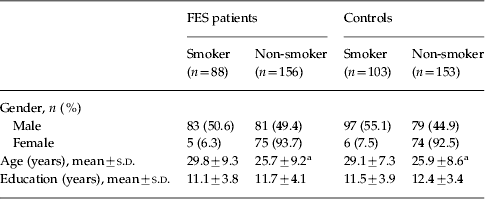
There were no significant differences between FES patients and healthy controls with regard to gender, age or education (all p > 0.05) (Table 1). The smoking rate among FES patients (36%) was not significantly different from that of healthy controls (40%). Although smoking prevalence was substantially greater in males than females for both patients (male/female: 51% v. 6%, χ2 = 45.9, df = 1, p < 0.0001) and healthy controls (male/female: 55% v. 8%, χ2 = 51.9, df = 1, p < 0.0001), smoking rates did not differ between FES and healthy control women or between FES and healthy control men (both p > 0.05). The ORs for smoking among FES patients compared to controls for men and women were not significantly different (1.27 v. 1.20, p > 0.05). In addition, both the quantity of smoking (15.9 ± 10.0 v. 14.8 ± 9.6 cigarettes/day) and the FTND scores (6.4 ± 1.7 v. 6.7 ± 1.9) were not significantly different between FES patients and healthy controls (both p > 0.05). Furthermore, both the frequency of heavy smoking (35% v. 33%) and the prevalence of smoking cessation (former smokers) (8% v. 10%) were not significantly different between the FES patients and the healthy controls (both p > 0.05).
Characteristics of smoker and non-smoker drug-naive, first-episode schizophrenia (FES) patients and healthy controls
s.d., Standard deviation.
There were no significant differences in the demographic data between schizophrenic patients and healthy controls (all p > 0.05). Although smoking prevalence was substantially greater in males than females for both patients (p < 0.0001) and healthy controls (p < 0.0001), smoking rates did not differ between female patients and controls or between male patients and controls (both p > 0.05).
a There was a significant age difference between those with and without a history of smoking in both patient and control groups (both p < 0.02). However, neither smokers nor non-smokers showed an age difference between patients and controls.
Among both FES patients and healthy controls, smokers were older than those without a history of smoking (both p < 0.02). However, neither smokers nor non-smokers showed an age difference between patients and controls.
Smoking among the schizophrenic patients
No significant differences in schizophrenia subtypes, occupation, marital status and educational level were found between those with and without a history of smoking after controlling for sex and age (all p > 0.05). Because too few women patients were smokers, the following analyses were performed only in men. Of the 83 schizophrenic patients who had ever smoked, 68% started to smoke before the onset of their schizophrenic illness, 7% approximately at the time of onset of illness, and 25% after the onset. The mean age at which patients started to smoke was 5.3 ± 6.6 years younger than the mean age of illness onset. There was no significant correlation between age at starting to smoke and age at onset of illness (r = 0.16, p > 0.05).
Clinical characteristics associated with co-morbid smoking in male FES patients
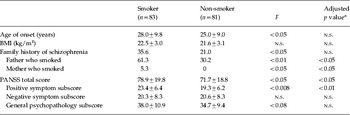
Comparison of FES smokers and non-smokers with regard to demographic and clinical variables shows that age of onset of psychosis was significantly later in smokers than non-smokers (p < 0.05) (Table 2). However, this difference was not independently significant after controlling for age (p > 0.05). In addition, a family history of both smoking (especially the father's smoking rate) and schizophrenia was greater in FES smokers than non-smokers (all p < 0.05).
Characteristics of smoking and non-smoking male schizophrenic patients

BMI, Body mass index; PANSS, Positive and Negative Symptom Scale; n.s., not significant.
Values given as percentage or mean ± standard deviation.
a Adjusted for age.
Smokers also showed a significantly higher PANSS total score (p < 0.01) and positive symptom score (p < 0.001) than non-smokers (Table 2). The general psychopathology and negative symptom scores did not differ between smokers and non-smokers (both p > 0.05). In the smokers with schizophrenia, no significant correlations were found between the numbers of cigarettes smoked per day and the PANSS total score and its subscale scores (all p > 0.05). In addition, there was no significant difference between former and never smokers on demographics or clinical variables (all p > 0.05).
Cognitive functioning in male smokers and non-smokers: case-control comparison
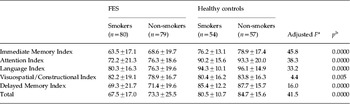
Comparison of the RBANS total and subscale scores between 80 male FES smokers and 79 non-smokers, and between 54 control smokers and 57 non-smokers, showed that total scores differed among smokers with schizophrenia (67.5 ± 17.0), non-smokers with schizophrenia (73.3 ± 25.5), control smokers (80.5 ± 10.7) and control non-smokers (84.7 ± 15.6) (F = 41.5, df = 3,264, p < 0.0001) (Table 3). Differences in mean index scores for the four groups were also significantly different (from p < 0.005 to p < 0.0001), and remained significant after adjusting for age and education.
Total and index scores on the RBANS in FES patients versus healthy controls grouped by smoking

RBANS, Repeatable Battery for the Assessment of Neuropsychological Status; FES, first-episode schizophrenia.
Values given as mean ± standard deviation.
a The variables age and education were adjusted in the ANCOVA.
b The p values indicate the comparisons among four groups: schizophrenia smokers, schizophrenia non-smokers, control smokers and control non-smokers. The results of post-hoc tests showed significant differences between diagnostic groups but not between smokers and non-smokers.
Significant smoking × diagnosis effects were observed for all of the RBANS total and subscale scores (all p < 0.05). Furthermore, there were significant diagnosis effects on cognitive scores on the RBANS and all of its five subscales (all p < 0.05), except for the Visuospatial Constructional Index after controlling for age and education. However, there were no significant smoking effects on the RBANS total or any subscale scores (all p > 0.05). The schizophrenic smokers and non-smokers, and the normal smokers and non-smokers, did not differ in the RBANS total score and individual index score (all p > 0.05). Excluding former smokers from the non-smoker group, these results remained unchanged (all p > 0.05). In addition, there was no significant difference in the RBANS total score and individual index score between former and never smokers either in the whole group or when the normal controls and patients were examined separately (all p > 0.05).
Among FES patients, including both smokers and non-smokers, significant correlations were observed between RBANS total scores and each of the following: years of education; and PANSS total, general psychopathology, negative and positive symptom scores. The following were not significantly correlated: age; age at onset; duration of illness; schizophrenia subtype; smoking status (smokers v. non-smokers); and FTND score. A multivariate regression analysis showed that three variables accounted for approximately 44% of the variance of the RBANS total score: years of education (t = 4.2, p = 0.001), PANSS negative symptom score (t = –3.8, p = 0.01), and PANSS general psychopathology score (t = –2.4, p = 0.03).
In addition, no significant correlations were observed between the RBANS total score or its domain scores and the numbers of cigarettes smoked per day either in the whole smoker group or when the normal controls and patients were examined separately (all p > 0.05).
Discussion
This study of smoking among FES patients found that, first, smoking rates did not differ between drug-naive FES patients and a matched sample from the general population. Second, a gender difference in smoking prevalence was noted in both patients and healthy controls, but smoking rates for FES patients and controls were similar within each gender. Third, positive symptoms were more often reported by FES smokers than non-smokers. Fourth, FES patients had significantly poorer cognitive performance than healthy controls (Zanelli et al. Reference Zanelli, Reichenberg, Morgan, Fearon, Kravariti, Dazzan, Morgan, Zanelli, Demjaha, Jones, Doody, Kapur and Murray2010), but smokers showed similar performance in cognitive function comparing to non-smokers in the FES group or the healthy control group respectively.
Smoking prevalence in drug-naive FES patients
The smoking rate in our general population sample of 40% is similar to other reports from China (Lee et al. Reference Lee, Guo, Tsang, Huang, He and Kessler2009). However, Gu et al. (Reference Gu, Kelly, Wu, Chen, Samet, Huang, Zhu, Chen, Chen, Duan, Klag and He2009) showed a prevalence of current or former smoking, defined as smoking at least 1 cigarette daily for at least 1 year, among Chinese men at 63% in a nationally representative sample. A possible reason for this discrepancy may lie in the age of the participants. We found the high smoking prevalence of 79.6% for the schizophrenic patients and 63.0% (353/560) for the control group at an average age of 46.2 and 46.7 years respectively (Zhang et al. Reference Zhang, Liang, Chen, Xiu, He, Cheng, Wu, Yang, Haile, Sun, Lu, Kosten and Kosten2012), whereas the average age for FES patients and matched controls was only 27.0 years in our present study. The gap between smoking rates in men and women is considerably different between the USA and European countries because of cultural and social factors (de Leon & Diaz, Reference de Leon and Diaz2005). It is possible that our findings in FES patients may be specific to Chinese people or individuals with Asian ancestry and may not apply to western FES patients; two previous studies reported significantly higher smoking rates in western FES patients, although the sample sizes were smaller and control groups were not available for comparison (McEvoy & Brown, Reference McEvoy and Brown1999; Scottish Schizophrenia Research Group, 2000).
The smoking rate in our FES patients was comparable to the local population (36% v. 40%) but substantially lower than that reported in two previous studies (McEvoy & Brown, Reference McEvoy and Brown1999; Scottish Schizophrenia Research Group, 2000) of non-Chinese FES patients (77% and 73% respectively), which included few FES patients (n = 22 and n = 30) and assessed a different ethnic group. The results in this Chinese sample may be different from previous literature because of cultural and economic differences across the samples. Most of the previous research on smoking, and that cited in the literature, was completed more than a decade ago (McEvoy & Brown, Reference McEvoy and Brown1999; Scottish Schizophrenia Research Group 2000). Smoking behavior has changed considerably, even in western countries, over this time. Cultural differences and different geographical regions, along with the high rates of smoking in China, may account for these differences from western samples. It may be that our findings in the present study cannot be generalized to those in western samples. In addition, the smoking rate in our FES patients was significantly smaller than our previous study in chronic patients with schizophrenia (Zhang et al. Reference Zhang, Liang, Chen, Xiu, He, Cheng, Wu, Yang, Haile, Sun, Lu, Kosten and Kosten2012), suggesting that exposure to antipsychotic medications and progression of the disease may influence smoking rates. Future studies would benefit from including a matched group of consecutively admitted, previously medicated patients with schizophrenia as a control comparison, which would help to address the impact of antipsychotic medication on smoking rates.
Numerous reports show that chronic schizophrenic patients have higher smoking rates than the general population (de Leon & Diaz, Reference de Leon and Diaz2005; Winterer, Reference Winterer2010). Data from the current study suggest that smoking rates may increase sharply as the illness progresses from its early stages. The reasons for this significant increase in smoking are unclear. Several hypotheses have been offered to explain the high prevalence of smoking in patients with schizophrenia. A popular hypothesis is the ‘self-medication hypothesis’, in which cigarette smoking or cerebral nicotine exposure may improve symptoms, decrease extrapyramidal side-effects of antipsychotics, and ameliorate cognitive or theoretically related neurophysiological deficits of schizophrenic patients (Dalack et al. Reference Dalack, Healy and Meador-Woodruff1998; Kumari & Postma, Reference Kumari and Postma2005). Another possibility is that schizophrenia and smoking have a shared genetic or neurobiological susceptibility that is activated through a common environmental interaction with these vulnerability factors (Dalack et al. Reference Dalack, Healy and Meador-Woodruff1998; Leonard et al. Reference Leonard, Gault, Hopkins, Logel, Vianzon, Short, Drebing, Berger, Venn, Sirota, Zerbe, Olincy, Ross, Adler and Freedman2002; de Leon & Diaz, Reference de Leon and Diaz2005, Reference de Leon and Diaz2012; Martin & Freedman, Reference Martin and Freedman2007). Genetic studies lend some support to this shared vulnerability model (Leonard et al. Reference Leonard, Gault, Hopkins, Logel, Vianzon, Short, Drebing, Berger, Venn, Sirota, Zerbe, Olincy, Ross, Adler and Freedman2002; Freedman et al. Reference Freedman, Olincy, Ross, Waldo, Stevens, Adler and Leonard2003). Indeed, identical twins who are discordant for schizophrenia both show significantly higher rates of daily smoking and reduced success in attempts to quit (Lyons et al. Reference Lyons, Bar, Kremen, Toomey, Eisen, Goldberg, Faraone and Tsuang2002). In addition, there are a variety of behavioral and social factors that may partially contribute to smoking, including chronic illness, boredom, reduced quality of life, poor social adjustment and lower socio-economic status (Samele et al. Reference Samele, Patel, Boydell, Leese, Wessely and Murray2007). For example, 12% of patients with schizophrenia have reported that smoking helps them to relax and pass the time enjoyably rather than under tension (Forchuk et al. 2002). Discovering neurobiological reasons among these multiple factors may lead to the future development of novel drugs for treatment, but psychosocial interventions are clearly crucial for addressing this lack of tension-relieving activities other than smoking (Winterer, Reference Winterer2010).
Some studies suggest that nicotine administration can improve cognitive performance in non-smokers with schizophrenia (Barr et al. Reference Barr, Culhane, Jubelt, Mufti, Dyer, Weiss, Deckersbach, Kelly, Freudenreich, Goff and Evins2008), especially attentional functioning (Harris et al. Reference Harris, Kongs, Allensworth, Martin, Tregellas, Sullivan, Zerbe and Freedman2004). Moreover, nicotine may initially ameliorate the pre-morbid or prodromal attention deficits, which are commonly recognized in schizophrenia patients and some of their first-degree relatives (Smith et al. Reference Smith, Warner-Cohen, Matute, Butler, Kelly, Vaidhyanathaswamy and Khan2006). Furthermore, tobacco use is not associated with an earlier onset of psychosis (Myles et al. 2012); instead, we found that the onset age of psychosis was significantly later in smokers than non-smokers, which is consistent with these findings of nicotine improving cognition. As nicotine relieves this core symptom of psychosis and schizophrenia, smoking may delay the age of onset of psychosis (Ma et al. 2010). Whether patients initiate smoking to self-medicate their pre-morbid neurophysiological and cognitive deficits before the full symptoms present needs attention, as this difference in psychosis onset between smokers and non-smokers disappeared after controlling for age (Weiser et al. Reference Weiser, Reichenberg, Grotto, Yasvitzky, Rabinowitz, Lubin, Nahon, Knobler and Davidson2004). Previous studies have shown that regular tobacco use often precedes the onset of psychosis (Ma et al. 2010; Zhang et al. Reference Zhang, Li, Li, Zheng, Zhang, Yan, Liu, Kang, Wang, Chen, Xiu and Kosten2010), but early tobacco uptake may act as a protective factor rather than constituting a risk factor for developing psychotic illness (Weiser et al. Reference Weiser, Reichenberg, Grotto, Yasvitzky, Rabinowitz, Lubin, Nahon, Knobler and Davidson2004).
Our findings showed that the PANSS total and positive symptom scores were greater in FES patients who smoked than in non-smokers. In most of our patients, smoking preceded the onset of schizophrenia. It is possible that smoking may have even resulted in more severe symptoms. Alternatively, patients with more severe symptoms may have smoked to counteract these symptoms or used smoking to improve subtle psychotic symptoms occurring before the onset of full-blown psychosis. However, we found that chronic schizophrenic patients who were smokers displayed significantly fewer negative symptoms than non-smokers (Zhang et al. Reference Zhang, Liang, Chen, Xiu, He, Cheng, Wu, Yang, Haile, Sun, Lu, Kosten and Kosten2012). Taking all these results together, the self-medication concept of smoking in schizophrenia may apply better to patients with chronic schizophrenia.
Cigarette smoking and symptoms
Numerous studies link smoking and symptomatology associated with schizophrenia, but very few corroborate an association between smoking and a reduction in negative symptoms (Dalack et al. Reference Dalack, Healy and Meador-Woodruff1998). For example, acute cigarette smoking following 6–12 h of abstinence was reported to reduce negative symptoms of schizophrenia (Smith et al. Reference Smith, Infante, Ali, Nigam and Kotsaftis2001), but this finding is not consistent across studies (Aguilar et al. Reference Aguilar, Gurpegui, Diaz and de Leon2005). Moreover, Goff et al. (Reference Goff, Henderson and Amico1992) found higher levels of both negative and positive symptoms in smokers compared with non-smokers. A study by Kelly & McCreadie (Reference Kelly and McCreadie1999) also failed to demonstrate significant symptom differences between smokers and non-smokers. Other investigators have shown lower levels of negative symptoms in heavy smokers compared to light smokers and non-smokers with schizophrenia (Ziedonis et al. Reference Ziedonis, Kosten, Glazer and Frances1994). Consistent with this difference within schizophrenic smokers, Aguilar et al. (Reference Aguilar, Gurpegui, Diaz and de Leon2005) reported high PANSS total scores in highly dependent smokers but lower scores in mildly dependent smokers. Our study corroborates this finding in that positive symptoms were more often reported by schizophrenic smokers than non-smokers. We postulate that the neurobiological mechanism for our finding of higher positive symptoms in smokers than non-smokers with schizophrenia may be associated with the increased dopamine (DA) function caused by cigarette smoking. Smoking increases the release of DA in the mesolimbic DA system (Montgomery et al. Reference Montgomery, Lingford-Hughes, Egerton, Nutt and Grasby2007). Positive symptoms of schizophrenia were thought to reflect hyperactivity of the DA system, especially in subcortical areas (Moncrieff, Reference Moncrieff2009). However, George et al. (Reference George, Vessicchio, Termine, Sahady, Head, Pepper, Kosten and Wexler2002) and Evins et al. (Reference Evins, Deckersbach, Cather, Freudenreich, Culhane, Henderson, Green, Schoenfeld, Rigotti and Goff2005) reported that smoking cessation was not associated with significant improvement in positive symptoms, with or without smoking cessation treatments that have low potency in increasing central DA such as bupropion and/or nicotine replacement therapy (NRT), which tends to argue against our speculation. Thus, this speculation that smoking affects the DA system causing increased positive symptoms needs further evidence.
Smoking and cognition in FES patients
To our knowledge, the present study is the first to compare cognitive function between smokers and non-smokers in FES patients and healthy controls. Our findings suggest that smoking has no association with additional cognitive impairment or improvement in FES patients. These results do not support the self-medication hypothesis (Kumari & Postma, Reference Kumari and Postma2005), and are not in agreement with previous studies showing that nicotinic agonists may improve cognition in chronic patients with schizophrenia (Harris et al. Reference Harris, Kongs, Allensworth, Martin, Tregellas, Sullivan, Zerbe and Freedman2004; Sacco et al. Reference Sacco, Termine, Seyal, Dudas, Vessicchio, Krishnan-Sarin, Jatlow, Wexler and George2005; Barr et al. Reference Barr, Culhane, Jubelt, Mufti, Dyer, Weiss, Deckersbach, Kelly, Freudenreich, Goff and Evins2008). However, it is noteworthy that, although there was no significant difference in cognitive performance on pairwise comparison of male non-smokers with schizophrenia relative to male smokers with schizophrenia, the numbers in these cohorts were small. Moreover, because of high inter-individual variability in performance, very little can be concluded from a cross-sectional, between-subject comparison of cognitive performance. Hence, the effects of smoking on cognitive performance need further investigation before firm conclusions can be drawn.
Several limitations of this study should be noted. First, we selected the healthy controls to be matched on education to the patients with schizophrenia. This suggests that the controls were selected from lower cognitive strata than the patients, because most patients with schizophrenia have limited educational opportunities on account of their pre-morbid cognitive difficulties. Furthermore, the healthy controls in this study performed comparatively poorly on the cognitive measure (Dickerson et al. Reference Dickerson, Stallings, Vaughan, Origoni, Khushalani, Dickinson and Medoff2011). The RBANS sets a mean of 100 and a standard deviation (s.d.) of 15 for a healthy control sample (Randolph et al. Reference Randolph, Tierney, Mohr and Chase1998). Compared to US norms, the controls in this sample performed 1 s.d. below the mean. Therefore, the healthy controls in the present study could not be considered a representative sample of healthy controls. This methodological weakness should be considered as a caveat to this study. Second, the PANSS was administered only to FES patients and not the healthy controls. As we compared smoking status to clinical characteristics, it would be of interest to compare smoking with the subset of individuals who exhibit psychotic symptoms but do not meet full criteria for schizophrenia. However, we excluded any healthy controls who reported any psychotic symptoms on our screening examination, and did not have any subjects to address the question of these symptoms without schizophrenia. Future studies might be able to address that question. Third, although the RBANS is a well-established neurocognitive assessment tool and has previously been used in people with schizophrenia, it is a fairly brief assessment that does not capture all aspects of cognitive function. In particular, cognitive domains such as sustained attention (e.g. the Continuous Performance Task), visuospatial working memory and executive function (e.g. the Stroop Color–Word Test and the Wisconsin Card Sorting Task) may be more sensitive to identify differences between smokers and non-smokers with schizophrenia.
In summary, this study failed to show a link between smoking rates and FES. Among FES patients, however, smoking was associated with greater psychotic symptoms, specifically positive symptoms. This may reflect the action of nicotine in increasing mesolimbic DA and thereby exacerbating symptomatology. Furthermore, smoking was not related to cognitive function in this FES sample. Taken together, the results of our study fail to lend support to the self-medication hypothesis in FES patients, that is that these patients smoke to alleviate symptoms related to schizophrenia or cognitive impairment. On the contrary, smoking was associated with an increase in psychotic symptoms in FES patients. Future studies are needed to examine this phenomenon in a larger prospective sample and perhaps in different ethnic populations.
Acknowledgments
This study was funded by the National Natural Science Foundation of China (81000509), the Beijing Municipal Excellent Talents Foundation (2010D003034000032), the United States National Institute of Health (U01-MH79639, K05-DA0454 and P50-DA18827) and the Stanley Medical Research Institute (03T-459 and 05T-726).
Declaration of Interest
None.