




No CrossRef data available.
Article contents
Similar patterns of cognitive deficits in the preclinical phases of vascular dementia and Alzheimer's disease
Published online by Cambridge University Press: 01 May 2004
Abstract
We investigated whether (1) cognitive deficits are present among persons who will be diagnosed with vascular dementia (VaD) 3 years later, and (2) the pattern of such deficits is similar to that observed in preclinical Alzheimer's disease (AD). The VaD diagnosis was a diagnosis of post-stroke dementia. Population-based samples of 15 incident VaD cases, 43 incident AD cases, and 149 normal controls were compared on tests of episodic and short-term memory, verbal fluency, and visuospatial skill. Both dementia groups showed preclinical impairment relative controls on tasks assessing episodic memory 3 years before diagnosis, and there were no differences between these groups on any cognitive measure. The existence of a preclinical phase in the present VaD cases suggests that circulatory disturbance may affect cognitive performance before the occurrence of stroke that leads to clinical VaD. These results extend previous findings of similar patterns of cognitive deficits in the early clinical phases of AD and VaD to the preclinical phases of these diseases. (JINS, 2004, 10, 382–391.)
Information
- Type
- Research Article
- Information
- Journal of the International Neuropsychological Society , Volume 10 , Issue 3 , May 2004 , pp. 382 - 391
- Copyright
- © 2004 The International Neuropsychological Society
INTRODUCTION
Numerous studies have demonstrated that there is a preclinical period in Alzheimer's disease (AD) during which cognitive deficits are detectable. Although such deficits are observed across multiple cognitive domains, including perceptual speed (Fabrigoule et al., 1998), attention (Linn et al., 1995), verbal ability (Jacobs et al., 1995), reasoning (Fabrigoule et al., 1996), and visuospatial skill (Small et al., 1997), the most consistent impairment is seen for tasks assessing episodic memory (e.g., Grober et al., 2000; Howieson et al., 1997; Linn et al., 1995; Small et al., 1997; Tierney et al., 1996). However, little or no research has addressed the possibility of a preclinical phase in the second most common dementia disease, vascular dementia (VaD). There are several reasons to believe that cognitive deficits may be observed before the actual VaD diagnosis.
First, the conception of VaD has shifted from a multi-infarct-based definition (Hachinski et al., 1974) toward a multifactorial etiology encompassing strategic infarcts and subcortical small vessel changes (Chui et al., 1992; Erkinjuntti, 1999; Roman et al., 1993). Also in cases where one or several strokes appear to be the immediate cause of dementia, most VaD patients have a history of hypertension, atrial fibrillation, white matter abnormalities, or other kinds of cerebrovascular pathology (Nyenhuis & Gorelick, 1998; Skoog, 1994). These circulatory disturbances may cause gradual, more subtle cerebral changes long before the event of an actual stroke. Different forms of vascular alterations have been found to affect cognitive functioning without the presence of dementia. This includes evidence that (1) high blood pressure may predict poor cognitive performance several decades later (Elias et al., 1993; Launer et al., 1995), (2) atherosclerotic disease may be associated with poor global cognitive performance (Breteler et al., 1994a), and (3) cardiovascular signs, such as cardiac murmur, dyspnea, and edema in the lower limbs, may be related to lower scores on tests measuring various cognitive abilities (Fahlander et al., 2000). In addition, also in normal aging cognitive functioning is influenced by the presence of white matter lesions (Breteler et al., 1994b; Skoog et al., 1996) and silent strokes (Maeshima et al., 2002), features that are typically associated with VaD. Thus, given that VaD may develop through a combined effect of various vascular mechanisms that influence cognitive functioning, cognitive deficits should be possible to observe before the condition reaches its clinical threshold and results in a VaD diagnosis.
A second reason to expect preclinical cognitive deficits in VaD is the overlap in the underlying brain pathology between this disorder and AD (de la Torre, 2002; Shi et al., 2000). Autopsy evidence suggests that as many as one third of all patients diagnosed with AD or VaD may exhibit cerebral pathology primarily characteristic of the other disorder, and that some degree of cerebrovascular pathology is present in almost all AD cases (Kalaria & Ballard, 1999). Thus, despite differences in etiology, it appears that AD and VaD are not such distinct entities as has been previously thought.
A third reason is that there are many similarities between AD and VaD with regard to patterns of cognitive impairment in the early clinical phases. Although some research suggests a more pronounced impairment of episodic memory in AD and special difficulties in executive tasks in VaD (Looi & Sachdev, 1999), the bulk of evidence indicates strikingly similar patterns of cognitive deficits in the two diseases (Almkvist et al., 1993, 1999; Erker et al., 1995; Erkinjuntti et al., 1986; Fahlander et al., 2002; Hassing & Bäckman, 1997). Given that early clinical AD and VaD have a similar effect on many cognitive functions, similarities in preclinical manifestations might be expected as well.
The aim of this study was twofold. First, we sought to determine whether there are preclinical cognitive deficits in VaD. A second aim was to investigate whether such a preclinical phase could be distinguished from that observed in AD. Using data from a population-based study, persons with VaD, AD, and control participants were assessed with a cognitive test battery 3 years before the dementia diagnosis was made.
METHODS
Research Participants
The samples were selected from the Kungsholmen Project, a longitudinal population-based study of very old adults (Fratiglioni et al., 1991, 1992). For the original population, baseline assessment was accomplished through a two-phase study design. In an initial screening phase, all inhabitants of the Kungsholmen parish of Stockholm, Sweden, who were ≥ 75 years on October 1, 1987 (N = 2368) were invited to participate. As a part of a longer interview, a cognitive screening test, the Mini-Mental State Examination (MMSE; Folstein et al., 1975), was administered to 1810 individuals. Participants who scored < 24 out of a maximum of 30 on the MMSE (n = 314) were considered to have suspected dementia. They were invited back for further assessment together with a random sample matched for age and sex (MMSE > 23, n = 354). This clinical phase involved extensive medical, neurological, and psychiatric examinations; social and family interviews; laboratory blood analyses; and comprehensive cognitive assessment. All participants in the screening phase were invited back to participate in follow-up assessments, approximately 3 and 6 years later. The same comprehensive clinical protocol was used at the subsequent examinations. The Kungsholmen Project has been approved by the ethics committee of the Karolinska Institutet, Stockholm, Sweden, and informed consent was obtained from all participants.
Diagnosis of dementia at baseline and follow-up visits was made according to the Diagnostic and Statistical Manual–Third Edition–Revised (DSM–III–R; American Psychiatric Association, 1987), using a three-step procedure. First, the examining physician made a preliminary diagnosis. Second, a physician external to the data collection made an independent preliminary diagnosis based on computerized data only. In cases of agreement between the two preliminary diagnoses, this was considered the final diagnosis. In cases of disagreement, a supervising physician made the final diagnosis. For participants who died before the follow-up examination, dementia diagnosis was based on clinical records, discharge diagnoses, and death certificates according to the same three-step procedure.
Differential diagnosis between AD and VaD was based solely on clinical data. Symptoms and signs of cerebrovascular disorder as well as progression of the disease and the temporal sequence of relevant events were taken into account. The Hachinski Ischemic Scale (HIS; Hachinski et al., 1975) was used to support the clinical judgment. A HIS score greater than 6 indicated VaD, a score of 5 or 6 mixed dementia, and a score lower than 5 indicated AD. Both sensitivity and specificity of the HIS score have been shown to be as high as .89 in differentiating between AD and VaD in pathologically verified cases (Moroney et al., 1997). Because brain imaging or neuropathological examinations could not be performed, the majority of participants diagnosed with VaD in the Kungsholmen Project have a history of one or several clinically significant strokes, related in time to the onset of dementia symptoms. In other words, the VaD diagnosis is a diagnosis of post-stroke (i.e., strategic or multi-infarct) dementia with an abrupt onset. A diagnosis of mixed dementia was made only in cases where it was clear that vascular pathology had contributed significantly to the dementia disorder. Psychiatric diseases were diagnosed according to DSM–III–R criteria at baseline, and according to DSM–IV criteria (American Psychiatric Association, 1994) at subsequent examinations.
For the present study, the sample consisted of those persons who participated in the clinical examination and completed the cognitive battery either at baseline or the first follow-up of the Kungsholmen Project (n = 542). To increase the statistical power, we used incident dementia cases from both first and second follow-up. Participants who died before follow-up but received a dementia diagnosis based on a review of medical records were also included. Time 1 was defined as the assessment preceding time of diagnosis (Time 2) for all participants. Thus, Time 1 was either baseline or first follow-up, depending on whether time of diagnosis was first or second follow-up. The follow-up interval was around 3 years for all participants (M= 2.91 years, SD = .59). The focus of this study concerns cognitive performance at Time 1 for those who were diagnosed with either VaD or AD at Time 2, and those who remained non-demented during the follow-up period.
Fourteen of the 21 participants (67%) with incident VaD received their diagnosis at first follow-up and seven (33%) at second follow-up. The sample was screened for major depression, dysthymia, other psychiatric disorders, and Parkinson's disease at Time 1. Four cases were excluded because of a diagnosis of major depression or dysthymia, and two cases were excluded because of missing cognitive data. Thus, 15 incident VaD cases, including three cases with mixed dementia were included in the study.
The incident AD group was selected in the same way as the incident VaD group. Sixty-one of the 74 subjects (82%) with incident AD were diagnosed at first follow-up and 13 (18%) at second follow-up. Nine persons were excluded because of a diagnosis of major depression or dysthymia, and two because of a diagnosis of psychosis. Also, 20 cases were excluded because of missing cognitive data. Hence, 43 incident AD cases were included.
The control participants were selected from those participants who were non-demented at baseline or first follow-up (n = 406). First, the controls were randomly assigned a Time 1 measurement point. This was done in order to match controls and incident dementia cases in terms of age and potential training effects on the cognitive tests. An equal proportion of controls and dementia cases was selected to have the Kungsholmen Project baseline as their Time 1. Thus, 79% (n = 321) of the controls had their Time 1 assessment at baseline. For the remaining 21% (n = 85), the first follow-up constituted Time 1. The same screening procedure was then applied as for the incident dementia cases. This resulted in the exclusion of 35 persons with major depression or dysthymia, four persons with psychosis, one person with Parkinson's disease, and 64 persons who did not have complete cognitive data. In addition, those who developed dementia at some point during the follow-up period (n = 75), and those for whom diagnostic information at Time 2 was missing due to the fact that the person had died (n = 57), moved (n = 2), or refused further participation (n = 19), were excluded. A total of 149 controls remained after these exclusion criteria were applied.
We gathered information concerning the presence of any vascular disease between 1969 and the Time 1 assessment for all participants. This information was derived from the Stockholm inpatient register, which contains the admission and discharge diagnoses for all occasions where habitants of Stockholm have received hospital care since April 1969 and onwards. The diagnoses used were hypertensive disease (ICD-8: 400–404; ICD-9: 401–405), diabetes (ICD-8: 250), cerebrovascular disease (ICD-8: 430–438), ischemic heart disease (ICD-8: 410–414), heart failure and arrhythmia (ICD-8: 427–428).
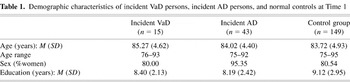
Time 1 demographic characteristics of incident VaD persons, incident AD persons, and control participants are presented in Table 1. The incident dementia groups were somewhat older and less educated than the control group. Also, the incident AD group had a higher proportion of women than the other groups. However, univariate analyses of variance showed that differences in age (F < 1) and education [F(2,204) = 2.09, p = .13] were not statistically significant. A χ2 test revealed that group differences in sex distribution were marginally significant, χ2(2) = 5.48, p = .06. As could be expected, the incident VaD persons were more likely to be affected by vascular disease prior to Time 1 than the controls (47% vs. 15%), χ2(1) = 8.89, p < .01. Prior vascular disease was also more common in the incident VaD persons compared to the incident AD persons (14%), χ2(1) = 6.84, p < .01. After applying the exclusion criteria, the average proportion of persons who had the Kungsholmen Project baseline as their Time 1 measurement point was 69% (incident VaD = 53%; incident AD = 77%; controls = 68%). There were no significant group differences with regard to whether baseline or first follow-up served as Time 1, χ2(2) = 2.95, p = .23.
Demographic characteristics of incident VaD persons, incident AD persons, and normal controls at Time 1

Cognitive Assessment
Short-term memory
As a measure of short-term memory, we used the Digit Span subtest from the Wechsler Adult Intelligence Scale–Revised (WAIS–R; Wechsler, 1981). The test was administered according to standard procedures. Forward and backward Digit Span were analyzed separately. Maximum score for the two tasks was 9 and 8, respectively.
Episodic memory
For a more detailed description of the episodic memory tests, see Bäckman and Forsell (1994). In face recognition, participants were presented with photographs of famous faces, half of which portrayed persons who attained their fame between 1930 and 1950, and half of which were persons who became famous during the 1980s. During study, 40 photos were shown consecutively at a rate of 5 s/face. Immediately following study, participants received a self-paced yes–no recognition test, in which the 40 target faces were presented along with an equal number of distractors (20 dated and 20 contemporary). The recognition measure used in this study was number of hits minus number of false alarms (maximum score = 20). Because performance for dated and contemporary faces was strongly related (r = .77, p < .001), a composite face recognition score was used in the analyses.
Word recall and recognition were assessed by means of three different word lists administered at different times during the cognitive testing. Each list comprised 12 concrete nouns presented both orally and visually. The lists were comparable with regard to word length, word frequency, and concreteness, as determined by a previous normative study (Molander, 1984). In free recall and recognition of random words, all items belonged to different taxonomic categories. One list was presented at a fast rate (2 s/word), and the other at a slow rate (5 s/word). Following presentation of each list, participants were given 2 min for an oral free recall test. Immediately following free recall, participants were given a self-paced yes–no recognition task in which the 12 target words were presented randomly intermixed with 12 distractors. Recognition was again measured as number of hits minus number of false alarms. Performance for rapidly and slowly presented words was related in both free recall (r = .52, p < .001) and recognition (r = .57, p < .001). Thus, these measures were aggregated into one random recall and one word recognition composite score, each with a maximum of 12.
For free and cued recall of organizable words, 12 concrete nouns belonging to four taxonomic categories (e.g., furniture, musical instruments) were presented consecutively at a rate of 5 s/word. Participants were first given an immediate free recall task. Following completion of this task, a cued recall task was administered, in which the four taxonomic category names were provided as retrieval cues. Two min were allowed for each of these recall tasks. An organized recall composite score (maximum score = 12) was used in the analyses, as the free and cued recall measures were highly correlated (r = .81, p < .001).
Visuospatial ability
We used a modified version of Block Design from the WAIS–R (Wechsler, 1981). The modification was done in order to increase the possibility to grade also severely demented persons. The task consisted of seven designs, each involving four blocks. One design was entirely red and another was a check of red and white. The remaining designs were the first five designs from the WAIS–R. Standard rules for administration and scoring were used. Maximum score was 24.
The Clock Test (Christensen, 1984) consisted of two parts, clock setting and clock reading. For both tasks, participants were shown five clockfaces with marks indicating the number locations, although no numbers were displayed. In clock setting, participants were asked to draw the hands on the clocks to indicate a given time. The times used were two o'clock, five o'clock, three o'clock, ten-forty-five, and seven-fifteen. In clock reading, participants were asked to report the time indicated by the hands of the clocks. The times used in this task were eleven o'clock, eight o'clock, one-fifteen, twelve-thirty, and three-fifteen. The test was self-paced and maximum score was 5 for each task.
Verbal fluency
Three tests measuring verbal fluency (Lezak, 1995) were administered. In category fluency, participants were asked to generate as many food items as possible in 60 s. For the letter fluency tasks, participants were given 60 s to generate as many words as they could, beginning with the letter N and S, respectively. They were instructed that proper names, numbers, or words with a different suffix were not credited. Because of the strong relationship between the two letter fluency measures (r = .74, p < .001), a composite letter fluency score was used in the analyses.
Data Analyses
First, we examined mean-level differences on the cognitive variables at Time 1 for incident VaD, incident AD, and normal control participants. A multivariate analysis of covariance (MANCOVA) was conducted on the cognitive data 3 years before diagnosis, using age, sex, and education as covariates. Second, we examined the strength of the association between cognitive test performance and future dementia status by means of three logistic regression analyses contrasting (1) incident VaD participants and non-demented persons, (2) incident AD participants and non-demented persons, and (3) incident VaD and incident AD participants. In all regressions, the demographic variables were entered as covariates in the first block. The cognitive measures were then entered in stepwise forward fashion. All variables except sex were converted into standard (z) scores before analysis, in order to facilitate comparison of the relative importance of the variables.
RESULTS
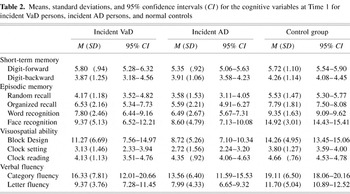
Raw scores for the cognitive measures for incident VaD persons, incident AD persons, and controls are presented in Table 2. For illustrative purposes, the relative impairment of the incident VaD and AD persons across tasks is displayed in Figure 1. This figure shows the means for the two incident dementia groups expressed in z scores, after subtracting the mean of the control group. As can be seen from the figure, the general pattern indicates poorer performance for both incident dementia groups compared to the controls.
Means, standard deviations, and 95% confidence intervals (CI) for the cognitive variables at Time 1 for incident VaD persons, incident AD persons, and normal controls


Results on the cognitive tests at Time 1 expressed in z scores for incident VaD and AD persons relative to the reference group (control means set at 0).
A 3 (group) × 11 (cognitive variables) MANCOVA, controlling for the demographic factors, revealed a significant overall effect of group, Wilks' λ = .52, F(22,382) = 6.72, p < .001. As to the cognitive variables, significant group differences were found for random recall, F(2,201) = 30.10, MSE = 2.00, p < .001, η2 = .23; organized recall, F(2,201) = 21.19, MSE = 3.50, p < .001, η2 = .17; word recognition, F(2,201) = 33.66, MSE = 3.70, p < .001, η2 = .25; face recognition, F(2,201) = 61.26, MSE = 11.82, p < .001, η2 = .38; Block Design, F(2,201) = 17.49, MSE = 20.83, p < .001, η2 = .15; clock setting, F(2,201) = 8.41, MSE = 1.58, p < .001, η2 = .08; clock reading, F(2,201) = 3.60, MSE = .68, p = .029, η2 = .04; category fluency, F(2,201) = 13.29, MSE = 40.89, p < .001, η2 = .12; and letter fluency, F(2,201) = 8.14, MSE = 20.60, p < .001, η2 = .08. There were no group differences on the two Digit Span tests (p > .10).
Bonferroni post-hoc comparisons (p < .05) were made on the estimated marginal means. These tests indicated lower performance for the incident VaD persons compared to the controls on three out of four episodic memory measures: random recall, word recognition, and face recognition. The incident AD group performed worse than those who remained non-demented on all measures of episodic memory, and also on the fluency and visuospatial measures, except for clock reading. The incident VaD and incident AD groups did not differ reliably on any cognitive measure.
To investigate possible differences between the two incident dementia groups more thoroughly, individual t tests were performed contrasting these groups on all cognitive tests, thereby decreasing the risk of committing type II errors. However, no significant differences in cognitive performance were found (p > .10). Further, as can be seen in Table 2, the confidence intervals around the means of the two incident dementia groups overlapped for all cognitive measures. When comparing differences in cognitive performance between the incident VaD and AD groups, the average effect size (d) was .34, a small effect according to Cohen (1992). To detect a difference of that size with a power of .80, approximately 140 persons would be required in each group. Given the incidence rates of AD and VaD, this is an unrealistic expectation.
An interesting possibility is that some persons in the incident dementia groups may have a preclinical cognitive deficit, whereas others have not. This issue was addressed by examining the distribution of scores in different quartiles. When defining cognitive impairment as scoring within the first quartile on at least one cognitive measure, only one participant in each preclinical dementia group was unimpaired. If only the episodic memory measures were considered, two incident VaD persons (13%), and 11 incident AD persons (26%) were unimpaired.
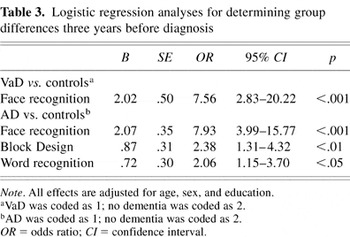
Three logistic regression analyses were conducted with diagnostic category at Time 2 as the outcome variable. The results from the logistic regressions are shown in Table 3. Face recognition was the only measure that showed an independent association with incident VaD 3 years later. This measure also showed the strongest association with future AD. In addition, Block Design and word recognition were independently associated with incident AD. Consistent with the results from the mean-level analyses, it was not possible to separate the two dementia types on the basis of their cognitive performance at Time 1.
Logistic regression analyses for determining group differences three years before diagnosis

All analyses were repeated after excluding the mixed dementia cases (n = 3) from the incident VaD group. The conclusions from these analyses were identical to those described above and, therefore, only the analyses that included all participants are presented here.
DISCUSSION
The main finding from this study was that we were able to document a preclinical phase with cognitive deficits 3 years prior to the diagnosis of VaD. Specifically, persons with incident VaD showed lower baseline performance than the controls on three out of four measures of episodic memory (face recognition, word recognition, and random recall). This pattern of preclinical impairment may be compared to that of the incident AD cases. The latter group performed at a lower level than the controls on all episodic memory and verbal fluency measures, and also on two measures of visuospatial skill (Block Design and clock setting). Although the incident AD cases showed somewhat larger impairment relative to the controls than the incident VaD cases, the two groups did not differ from each other on any cognitive measure.
These findings (see Figure 1) suggest that the preclinical impairment in AD and VaD alike extends beyond episodic memory. In addition, separate analyses indicated that a certain proportion (13% in the VaD group and 26% in the AD group) of the preclinical cases showed relatively normal episodic memory performance at baseline. The lack of preclinical effects on the Digit Span measures for both dementia groups is in agreement with prior research indicating that relatively passive primary memory operations are unaffected prior to the diagnosis of dementia (Elias et al., 2000; Howieson et al., 1997).
In the logistic regression analyses, only face recognition was independently associated with future VaD, whereas face and word recognition and Block Design were included in the corresponding model for AD. Thus, although the preclinical cognitive deficits were more widespread in the AD group compared to the VaD group, episodic memory impairment dominated in both groups. Although the reduction of variables included in the logistic regressions relative to those showing group differences in the univariate analysis reflects colinearity among the predictors, it also indicates the relative importance of the cognitive tests. Toward this end, it is of interest to note that the face recognition task was most effective in signaling an impending dementia disease in VaD and AD alike. This task involves a substantial amount of cognitive support as it provides cues at both encoding (the presentation of familiar faces) and retrieval (a recognition test with copy cues). The large preclinical deficits in this task may reflect the fact that also non-demented older adults have difficulties in less supported episodic memory tasks such as free recall (Bäckman et al., 2001; Craik & Jennings, 1992). In other words, marked deficits in supported memory tasks may be indicative of conditions other than normal aging such as incipient dementia.
Conceivably, the cognitive deficits observed in preclinical VaD reflect the presence of a generalized vascular pathology that affects cognitive functioning before resulting in a VaD diagnosis. It is known that risk factors for VaD, such as hypertension, have an effect on cognitive functioning without the presence of dementia (Elias et al., 1993; Launer et al., 1995). Chronic hypertension causes the arteries to develop thicker walls, which leads to a reduced cerebral blood flow. Insufficient blood flow damages the small vessels of the brain and also leads to a decreased glucose metabolism, resulting in poorer cognitive functioning (Farkas & Luiten, 2001). Cerebral blood flow also has an immediate effect on cognition, as indicated in research showing that induced cerebral hypoperfusion, caused by occlusion of the carotid artery, has a direct impact on sustained attention (Marshall et al., 2001). Moreover, cognitive functioning in normal aging is influenced by pathology typically associated with VaD, such as silent strokes (Maeshima et al., 2002) and white matter lesions (Breteler et al., 1994b; Skoog et al., 1996). The prevalence of silent infarcts among elderly adults with no self-report of stroke or TIA was reported to be as high as 28% in a community-based study (Bernick et al., 2001). Also for white matter lesions, high prevalence rates in non-demented older adults have been observed with markedly increasing prevalence with increasing age (de Leeuw et al., 2000). As both silent infarctions (Bernick et al., 2001) and white matter lesions (Wong et al., 2002) have been associated with an increased risk of future stroke in the general population, the prevalence rates can be assumed to be even higher in a population of preclinical VaD cases.
The lack of significant differences in cognitive functioning between VaD and AD at the preclinical stage may be viewed in light of the fact that past research has generally failed to differentiate between the two diseases at the early clinical stages (Almkvist et al., 1993, 1999; Erker et al., 1995; Erkinjuntti et al., 1986; Fahlander et al., 2002; Hassing & Bäckman, 1997). It has been suggested that measures of executive function should be added to the diagnostic procedure of dementia in order to improve early detection of VaD (Roman & Royall, 1999). In the present study, several tasks that can be considered to measure executive function were included, such as clock setting and verbal fluency. However, performance on the episodic memory tasks rather than the executive tasks was found to be most effective in identifying incident VaD cases. Having said that, it should be noted that deficits in executive functioning may be most pronounced in subcortical VaD (Kramer et al., 2002; McPherson & Cummings, 1996). The present VaD group consists of persons with post-stroke dementia and it might be that the pattern of cognitive deficits is different in other subtypes of VaD.
The fact that the largest and most consistent deficit was observed for episodic memory in both incident dementia groups does not necessarily imply that the two conditions affect the same regions in the brain, as different mechanisms may cause comparable impairment at the behavioral level. Reed and coworkers (2000) found a double dissociation between memory dysfunction and regional glucose metabolic activity in AD and subcortical stroke. Specifically, performance on a verbal recognition task correlated with left hippocampal and temporal lobe metabolism in AD patients, and with prefrontal lobe metabolism in patients with subcortical stroke. It is well documented that proficient episodic remembering draws on a large distributed network involving the hippocampal complex, thalamus, specific parietal regions, cerebellum, and the fronto-striatal circuitry (Cabeza & Nyberg, 2000). Thus, alterations at any of the multiple sites in this network may be capable of disrupting performance and producing functionally similar impairment.
Although the two incident dementia groups displayed a similar pattern of cognitive impairment, the deficits were somewhat more pronounced in the incident AD group. Does this mean that cognitive functioning is more affected in preclinical AD than in preclinical VaD? An alternative explanation is differences in statistical power for the group comparisons, given that the incident AD group was more than twice as large as the incident VaD group. However, when comparing the raw scores of the two incident dementia groups (see Table 2), it is clear that the incident AD group performed at a lower level than the incident VaD group on most tasks. Also, the standard deviations of the cognitive tests for the two incident dementia groups were very similar, and thus provide no evidence that marked heterogeneity in preclinical VaD could explain the obtained pattern of results.
An issue that has been raised concerning the preclinical phase in AD is whether it represents unrecognized mild dementia (Morris et al., 2001). In the present study, none of the participants fulfilled the criteria for questionable dementia at Time 1. Still, the two incident dementia groups showed clear cognitive impairment relative to the controls. Regarding the case of post-stroke dementia, the demarcation line between preclinical and clinical dementia should be easier to distinguish than in the case of AD. This is so because diagnosis requires a clinically significant stroke related in time to the onset of dementia symptoms. In addition, VaD has the potential of being reversed before it reaches its clinical stage. Therefore, the terms preclinical VaD or vascular cognitive impairment (Hachinski, 1994) may fill an important function.
A limitation of the present study is that it lacked neuroimaging or neuropathological confirmation of the diagnosis. Still, fairly strict criteria for VaD were used, corresponding to the National Institute of Neurological Disorders and Stroke and the Association Internationale pour la Recherche et l'Enseignement en Neurosciences (NINDS-AIREN) criteria for possible VaD (Roman et al., 1993). All participants diagnosed with VaD had suffered a clinically significant stroke, or had other strong indicators of a vascular origin of the dementing disorder. It is therefore quite certain that vascular factors were the primary cause of dementia in the present VaD group. On the other hand, the VaD persons in the present study all had multi-infarct or some other type of post-stroke dementia. Thus, cases of VaD originating mainly from subcortical small-vessel disease would not be included in the VaD group. Given the overlap in pathology between VaD and AD that has been found in previous research (Kalaria & Ballard, 1999), the possibility remains that degenerative processes characteristic of AD were working in parallel with the vascular changes among the incident VaD persons (and vice versa). This might be particularly likely in this sample of very old adults, as the occurrence of mixed pathology increases in late senescence (Agüero-Torres et al., 1999). An obstacle in VaD research is that an increased risk of VaD also implies an increased risk of dying as a result of the cerebrovascular disorder (Qiu et al., 2002). Consequently, many persons may die before they receive a dementia diagnosis. In the current study, we tried to minimize this possibility by reviewing clinical records, discharge diagnoses, and death certificates of persons who died before follow-up in order to establish if dementia was present prior to death. Part of the problem with differential survival was thereby avoided.
The results of the present study provide evidence of a preclinical phase in VaD 3 years before diagnosis. The pattern of cognitive deficits in preclinical VaD was found to be similar to that observed in preclinical AD, although the cognitive impairment seems to be somewhat less pronounced in preclinical VaD than in preclinical AD. More research is needed in order to determine the physiological correlates of the cognitive deficits found in preclinical VaD. A precise mapping of the preclinical phase of VaD would add valuable information concerning the development of this disease, and also help refining the tools to recognize and treat the disease at an early stage.
ACKNOWLEDGMENTS
This research was supported by grants from the Swedish Research Council, the Swedish Council for Working Life and Social Research, and the Solstickan Foundation. We thank Stuart W. S. MacDonald for valuable suggestions regarding the analyses of the data.
References
REFERENCES
Agüero-Torres, H.,
Winblad, B., &
Fratiglioni, L.
(1999).
Epidemiology of vascular dementia: Some results despite research
limitations.
Alzheimer Disease and Associated Disorders,
13 (Suppl. 3),
15–20.Google Scholar
Almkvist, O.,
Bäckman, L.,
Basun, H., &
Wahlund, L.-O.
(1993).
Patterns of neuropsychological performance in Alzheimer's
disease and vascular dementia.
Cortex,
29,
661–673.Google Scholar
Almkvist, O.,
Fratiglioni, L.,
Agüero-Torres, H.,
Viitanen, M., &
Bäckman, L.
(1999).
Cognitive support at episodic encoding and retrieval: Similar
patterns of utilization in community-based samples of Alzheimer's
disease and vascular dementia patients.
Journal of Clinical and Experimental Neuropsychology,
21,
816–830.Google Scholar
American Psychiatric Association.
(1987).
Diagnostic and Statistical Manual of Mental Disorders
(3rd ed., rev.).
Washington, DC:
American Psychiatric Association Press.
American Psychiatric Association.
(1994).
Diagnostic and Statistical Manual of Mental Disorders
(4th ed.).
Washington, DC:
American Psychiatric Association Press.
Bäckman, L. &
Forsell, Y.
(1994).
Episodic memory functioning in a community-based sample of old
adults with major depression: Utilization of cognitive support.
Journal of Abnormal Psychology,
103,
361–370.Google Scholar
Bäckman, L.,
Small, B.J., &
Wahlin, Å.
(2001).
Aging and memory: Cognitive and biological perspectives. In
J.E. Birren &
K.W. Schaie (Eds.),
Handbook of the psychology of aging
(5th ed., pp.
349–377).
San Diego, California:
Academic Press.
Bernick, C.,
Kuller, L.,
Dulberg, C.,
Longstreth, W.T.,
Manolio, T.,
Beauchamp, N., &
Price, T.
(2001).
Silent MRI infarcts and the risk of future stroke: The
cardiovascular health study.
Neurology,
57,
1222–1229.CrossRefGoogle Scholar
Breteler, M.M.B.,
Claus, J.J.,
Grobbee, D.E., &
Hofman, A.
(1994a).
Cardiovascular disease and distribution of cognitive function in
elderly people: The Rotterdam study.
British Medical Journal,
308,
1604–1608.Google Scholar
Breteler, M.M.B.,
van Amerongen, N.M.,
van Swieten, J.C.,
Claus, J.J.,
Grobbee, D.E.,
van Gijn, J.,
Hofman, A., &
van Harskamp, F.
(1994b).
Cognitive correlates of ventricular enlargement and cerebral white
matter lesions on magnetic resonance imaging: The Rotterdam study.
Stroke,
25,
1109–1115.Google Scholar
Cabeza, R. &
Nyberg, L.
(2000).
Imaging cognition II: An empirical review of 275 PET and fMRI
studies.
Journal of Cognitive Neuroscience,
12,
1–47.Google Scholar
Christensen, A.-L.
(1984).
Luria's neuropsychological investigation.
Copenhagen, Denmark:
Munksgaard.
Chui, H.C.,
Victoroff, J.I.,
Margolin, D.,
Jagust, W.,
Shankle, R., &
Katzman, R.
(1992).
Criteria for the diagnosis of ischemic vascular dementia proposed
by the State of California Alzheimer's Disease Diagnostic and
Treatment Centers.
Neurology,
42,
473–480.CrossRefGoogle Scholar
Craik, F.I.M. &
Jennings, J.M.
(1992).
Human memory. In
F.I.M. Craik &
T.A. Salthouse (Eds.),
Handbook of aging and cognition (pp.
465–478).
Hillsdale, New Jersey:
Erlbaum.
de la Torre, J.C.
(2002).
Alzheimer disease as a vascular disorder: Nosological evidence.
Stroke,
33,
1152–1162.Google Scholar
de Leeuw, F.-E.,
de Groot, J.C., &
Breteler, M.M.B.
(2000).
White matter changes: Frequency and risk factors. In
L. Pantoni,
D. Inzitari, &
A. Wallin (Eds).
The matter of white matter: Clinical and pathophysiological aspects of
white matter disease related to cognitive decline and vascular dementia
(pp.
19–33).
Utrecht, the Netherlands:
Academic Pharmaceutical Productions.
Elias, M.F.,
Wolf, P.A.,
D'Agostino, R.B.,
Cobb, J., &
White, L.R.
(1993).
Untreated blood pressure level is inversely related to cognitive
functioning: The Framingham study.
American Journal of Epidemiology,
138,
353–364.Google Scholar
Elias, M.F.,
Beiser, A.,
Wolf, P.A.,
Au, R.,
White, R.F., &
D'Agostino, R.B.
(2000).
The preclinical phase of Alzheimer disease: A 22-year prospective
study of the Framingham cohort.
Archives of Neurology,
57,
808–813.Google Scholar
Erker, G.J.,
Searight, H.R., &
Peterson, P.
(1995).
Patterns of neuropsychological functioning among patients with
multi-infarct and Alzheimer's dementia: A comparative
analysis.
International Psychogeriatrics,
7,
393–406.Google Scholar
Erkinjuntti, T.
(1999).
Cerebrovascular dementia: Pathophysiology, diagnosis and treatment.
CNS Drugs,
12,
35–48.Google Scholar
Erkinjuntti, T.,
Laaksonen, R.,
Sulkava, R.,
Syrjäläinen, R., &
Palo, J.
(1986).
Neuropsychological differentiation between normal aging,
Alzheimer's disease and vascular dementia.
Acta Neurologica Scandinavia,
74,
393–403.Google Scholar
Fabrigoule, C.,
Lafont, S.,
Letenneur, L.,
Rouch, I., &
Dartigues, J.-F.
(1996).
WAIS similarities subtest performances as predictors of dementia in
elderly community residents.
Brain and Cognition,
30,
323–326.Google Scholar
Fabrigoule, C.,
Rouch, I.,
Taberly, A.,
Letenneur, L.,
Commenges, D.,
Mazaux, J.-M.,
Orgogozo, J.-M., &
Dartigues, J.-F.
(1998).
Cognitive process in preclinical phase of dementia.
Brain,
121,
135–141.CrossRefGoogle Scholar
Fahlander, K.,
Wahlin, Å.,
Fastbom, J.,
Grut, M.,
Forsell, Y.,
Hill, R.D.,
Winblad, B., &
Bäckman, L.
(2000).
The relationship between signs of cardiovascular deficiency and
cognitive performance in old age: A population-based study.
Journal of Gerontology: Psychological Sciences,
55B,
1–7.Google Scholar
Fahlander, K.,
Wahlin, Å.,
Almkvist, O., &
Bäckman, L.
(2002).
Cognitive functioning in Alzheimer's disease and vascular
dementia: Further evidence for similar patterns of deficits.
Journal of Clinical and Experimental Neuropsychology,
24,
734–744.Google Scholar
Farkas, E. &
Luiten, P.G.M.
(2001).
Cerebral microvascular pathology in aging and Alzheimer's
disease.
Progress in Neurobiology,
64,
575–611.CrossRefGoogle Scholar
Folstein, M.F.,
Folstein, S.E., &
McHugh, P.R.
(1975).
“Mini-Mental State”: A practical method for grading the
cognitive state of patients for the clinician.
Journal of Psychiatric Research,
12,
189–198.Google Scholar
Fratiglioni, L.,
Grut, M.,
Forsell, Y.,
Viitanen, M.,
Grafström, M.,
Holmén, K.,
Ericsson, K.,
Bäckman, L.,
Ahlbom, A., &
Winblad, B.
(1991).
Prevalence of Alzheimer's disease and other dementias in an
elderly urban population: Relationship with age, sex, and
education.
Neurology,
41,
1886–1892.CrossRefGoogle Scholar
Fratiglioni, L.,
Viitanen, M.,
Bäckman, L.,
Sandman, P.-O., &
Winblad, B.
(1992).
Occurrence of dementia in advanced age: The study design of the
Kungsholmen Project.
Neuroepidemiology,
11,
29–36.CrossRefGoogle Scholar
Grober, E.,
Lipton, R.B.,
Hall, C., &
Crystal, H.
(2000).
Memory impairment on free and cued selective reminding predicts
dementia.
Neurology,
54,
827–832.CrossRefGoogle Scholar
Hachinski, V.C.
(1994).
Vascular dementia: A radical redefinition.
Dementia,
5,
130–132.Google Scholar
Hachinski, V.C.,
Iliff, L.D.,
Zilhka, E.,
Du Boulay, G.H.,
McAllister, V.L.,
Marshall, J.,
Russel, R.W.R., &
Symon, L.
(1975).
Cerebral blood flow in dementia.
Archives of Neurology,
32,
632–637.Google Scholar
Hachinski, V.C.,
Lassen, N.A., &
Marshall, J.
(1974).
Multi-infarct dementia: A cause of mental deterioration in the
elderly.
Lancet,
2,
207–210.CrossRefGoogle Scholar
Hassing, L. &
Bäckman, L.
(1997).
Episodic memory functioning in population-based samples of very old
adults with Alzheimer's disease and vascular dementia.
Dementia and Geriatric Cognitive Disorders,
8,
376–383.CrossRefGoogle Scholar
Howieson, D.B.,
Dame, A.,
Camicioli, R.,
Sexton, G.,
Payami, H., &
Kaye, J.A.
(1997).
Cognitive markers preceding Alzheimer's dementia in the
healthy oldest old.
Journal of the American Geriatrics Society,
45,
584–589.Google Scholar
Jacobs, D.M.,
Sano, M.,
Dooneief, G.,
Marder, K.,
Bell, K.L., &
Stern, Y.
(1995).
Neuropsychological detection and characterization of preclinical
Alzheimer's disease.
Neurology,
45,
957–962.Google Scholar
Kalaria, R.N. &
Ballard, C.
(1999).
Overlap between pathology of Alzheimer disease and vascular
dementia.
Alzheimer Disease and Associated Disorders,
13 (Suppl. 3),
115–123.Google Scholar
Kramer, J.H.,
Reed, B.R.,
Mungas, D.,
Weiner, M.W., &
Chui, H.C.
(2002).
Executive dysfunction in subcortical ischaemic vascular disease.
Journal of Neurology, Neurosurgery and Psychiatry,
72,
217–220.CrossRefGoogle Scholar
Launer, L.J.,
Masaki, K.,
Petrovitch, H.,
Foley, D., &
Havlik, R.J.
(1995).
The association between midlife blood pressure levels and late-life
cognitive function: The Honolulu-Asia aging study.
Journal of the American Medical Association,
274,
1846–1851.CrossRefGoogle Scholar
Lezak, M.D.
(1995).
Neuropsychological assessment
(3rd ed.).
New York:
Oxford University Press.
Linn, R.T.,
Wolf, P.A.,
Bachman, D.L.,
Knoefel, J.E.,
Cobb, J.L.,
Belanger, A.J.,
Kaplan, E.F., &
D'Agostino, R.B.
(1995).
The “preclinical phase” of probable Alzheimer's
disease: A 13-year prospective study of the Framingham cohort.
Archives of Neurology,
52,
485–490.CrossRefGoogle Scholar
Looi, J.C.L. &
Sachdev, P.S.
(1999).
Differentiation of vascular dementia from AD on neuropsychological
tests.
Neurology,
53,
670–678.Google Scholar
Maeshima, S.,
Moriwaki, H.,
Ozaki, F.,
Okita, R.,
Yamaga, H., &
Ueyoshi, A.
(2002).
Silent cerebral infarction and cognitive function in middle-aged
neurologically healthy subjects.
Acta Neurologica Scandinavia,
105,
179–184.Google Scholar
Marshall, R.S.,
Lazar, R.M.,
Pile-Spellman, J.,
Young, W.L.,
Duong, D.H.,
Joshi, S., &
Ostapkovich, N.
(2001).
Recovery of brain function during induced cerebral hypoperfusion.
Brain,
124,
1208–1217.CrossRefGoogle Scholar
McPherson, S.E. &
Cummings, J.L.
(1996).
Neuropsychological aspects of vascular dementia.
Brain and Cognition,
31,
269–282.CrossRefGoogle Scholar
Molander, B.
(1984).
Imagery, visual and tactual dimensions of imagery, and meaningfulness:
Swedish norms for 854 nouns
(Tech. Rep. No. 178).
Umeå, Sweden:
University of Umeå.
Moroney, J.T.,
Bagiella, E.,
Desmond, D.W.,
Hachinski, V.C.,
Mölsä, P.K.,
Gustafson, L.,
Brun, A.,
Fisher, P.,
Erkinjuntti, T.,
Rosen, W.,
Paik, M.C., &
Tatemichi, T.K.
(1997).
Meta-analysis of the Hachinski Ischemic Score in pathologically
verified dementias.
Neurology,
49,
1096–1105.Google Scholar
Morris, J.C.,
Storandt, M.,
Miller, P.,
McKeel, D.W.,
Price, J.L.,
Rubin, E.H., &
Berg, L.
(2001).
Mild cognitive impairment represents early-stage Alzheimer disease.
Archives of Neurology,
58,
397–405.Google Scholar
Nyenhuis, D.L. &
Gorelick, P.B.
(1998).
Vascular dementia: A contemporary review of epidemiology,
diagnosis, prevention, and treatment.
Journal of the American Geriatrics Society,
46,
1437–1448.Google Scholar
Qiu, C.,
Skoog, I., &
Fratiglioni, L.
(2002).
Occurrence and determinants of vascular cognitive impairment. In
T. Erkinjuntti &
S. Gauthier (Eds.),
Vascular cognitive impairment (pp.
61–83).
London:
Martin Dunitz.
Reed, B.R.,
Eberling, J.L.,
Mungas, D.,
Weiner, M.W., &
Jagust, W.J.
(2000).
Memory failure has different mechanisms in subcortical stroke and
Alzheimer's disease.
Annals of Neurology,
48,
275–284.Google Scholar
Roman, G.C. &
Royall, D.R.
(1999).
Executive control function: A rational basis for the diagnosis of
vascular dementia.
Alzheimer Disease and Associated Disorders,
13 (Suppl. 3),
69–80.CrossRefGoogle Scholar
Roman, G.C.,
Tatemichi, T.K.,
Erkinjuntti, T.,
Cummings, J.L.,
Masdeu, J.C.,
Garcia, J.H.,
Amaducci, L.,
Orgogozo, J.-M.,
Brun, A.,
Hofman, A.,
Moody, D.M.,
O'Brien, M.D.,
Yamaguchi, T.,
Grafman, J.,
Drayer, B.P.,
Bennett, D.A.,
Fisher, M.,
Ogata, J.,
Kokmen, E.,
Bermejo, F.,
Wolf, P.A.,
Gorelick, P.B.,
Bick, K.L.,
Pajeau, A.K.,
Bell, M.A.,
DeCarli, C.,
Culebras, A.,
Korczyn, A.D.,
Bogousslavsky, J.,
Hartmann, A., &
Scheinberg, P.
(1993).
Vascular dementia: Diagnostic criteria for research studies: Report
of the NINDS-AIREN International Workshop.
Neurology,
43,
250–260.Google Scholar
Shi, J.,
Perry, G.,
Smith, M.A., &
Friedland, R.P.
(2000).
Vascular abnormalities: The insidious pathogenesis of
Alzheimer's disease.
Neurobiology of Aging,
21,
357–361.CrossRefGoogle Scholar
Skoog, I.,
Berg, S.,
Johansson, B.,
Palmertz, B., &
Andreasson, L.A.
(1996).
The influence of white matter lesions on neuropsychological
functioning in demented and non-demented 85-year-olds.
Acta Neurologica Scandinavia,
93,
142–148.Google Scholar
Small, B.J.,
Herlitz, A.,
Fratiglioni, L.,
Almkvist, O., &
Bäckman, L.
(1997).
Cognitive predictors of incident Alzheimer's disease: A
prospective longitudinal study.
Neuropsychology,
11,
413–420.Google Scholar
Tierney, M.C.,
Szalai, J.P.,
Snow, W.G.,
Fisher, R.H.,
Nores, A.,
Nadon, G.,
Dunn, E., &
St. George-Hyslop, P.H.
(1996).
Prediction of probable Alzheimer's disease in memory-impaired
patients: A prospective longitudinal study.
Neurology,
46,
661–665.CrossRefGoogle Scholar
Wechsler, D.
(1981).
Manual for the Wechsler Adult Intelligence Scale–Revised.
New York:
The Psychological Corporation.
Wong, T.Y.,
Klein, R.,
Sharrett, A.R.,
Couper, D.J.,
Klein, B.E.K.,
Liao, D.-P.,
Hubbard, L.D., &
Mosley, T.H.
(for the ARIC Investigators).
(2002).
Cerebral white matter lesions, retinopathy, and incident clinical
stroke.
Journal of the American Medical Association,
288,
67–74.CrossRefGoogle Scholar
Demographic characteristics of incident VaD persons, incident AD persons, and normal controls at Time 1
Means, standard deviations, and 95% confidence intervals (CI) for the cognitive variables at Time 1 for incident VaD persons, incident AD persons, and normal controls

Results on the cognitive tests at Time 1 expressed in z scores for incident VaD and AD persons relative to the reference group (control means set at 0).
Logistic regression analyses for determining group differences three years before diagnosis
 You have
Access
- 43
- Cited by