1. INTRODUCTION
Surface conditions as well as the modification of the surface by laser irradiation plays an important role in laser matter interaction phenomena and has important applications (Cook et al., Reference Cook, Kozioziemski, Nikroo, Wilkens, Bhandarkar, Forsman, Haan, Hoppe, Huang, Mapoles, Moody, Sater, Seugling, Stephens, Takagi and Xu2008; Bagchi et al., Reference Bagchi, Kiran, Bhuyan, Bose, Ayyub, Krishnamurthy and Kumar2008; Beilis, Reference Beilis2007; Kasperczuk et al., Reference Kasperczuk, Pisarczyk, Kalal, Martinkova, Ullschmied, Krousky, Masek, Pfeifer, Rohlena, Skala and Pisarczyk2008; Bashir et al., Reference Bashir, Rafique and Ul-Haq2007; Bussoli et al., Reference Bussoli, Batani, Desai, Canova, Milani, Trtica, Gakovic and Krousky2007), such as micromachining, thin films deposition, biological investigations, photolithography, magnetic materials, etc. In most of the cases, surface modification is characterized by visual changes like cracks, ripples, spikes, etc., observed at lower energy, when the material does not leave the surface, but undergoes structural modification (Fernandez et al., Reference Fernandez, Hegelich, Cobble, Flippo, Letzring, Johnson, Gautier, Shimada, Kyrala, Wang, Wetteland and Schreiber2005). Electronic and optical properties of materials can be improved by surface microstructuring addressing significant areas of research like liquid crystal alignment, light emitting diodes, optical memories, and nonlinear optical generations (Li et al., Reference Li, Lo, Yin, Sui, Li, Qian and Wang2002). The adhesion, corrosion protection, and mechanical characteristics, all can be improved for the surface performing nano-structuring by laser (Pereir et al., Reference Pereir, Cros, Deloporte, Geogioo, Mano, Marine and Sentis2004; Wang et al., 2002). Particularly, the laser induced periodic surface structures (LIPSS) can be utilized to develop the surfaces exhibiting the hydrophobic properties (Li et al., Reference Li, Diver, Atkinson, Giedl-Wagner and Helml2006), micro grating fabrications, and wave guides in thin films. It also disturbs the accuracy of laser process in microstructuring (Wanger et al., Reference Wang, Xu, Zhou, Chu and Fu2007).
The transformation of laser energy into the ripple formation is a unique and versatile phenomenon, occurring at the target surface, especially when the targets are irradiated under ambient conditions (Gill & Saini, Reference Gill and Saini2007; Bashir et al., Reference Bashir, Rafique and Ul-Haq2007; Hora, Reference Hora2006; Wagner & Gottmann, Reference Wagner and Gottmann2007; Ozaki et al., Reference Ozaki, Bom, Ganeev, Kieffer, Suzuki and Kuroda2007). The ripples spacing and periodicity are both dependent on the incident laser wavelength, refractive index of materials, and pulse repetition rate (Tan & Venkatakrishnan, Reference Tan and Venkatakrishnan2006; Fuh et al., Reference Fuh, Ko-Ting and Chia-Rong2006). Low fluence irradiation and reasonable number of pulses are helpful in producing the required ripple structure (Bashir et al., Reference Bashir, Rafique and Ul-Haq2007). However, the combined effect of surface stress, surface scattered waves, and boundary effects play vital roles in ripple formation (Wong et al., Reference Wong, Chan, Yeung and Lau2003; Chen et al., Reference Chen, Lu, Cho, Zeng and Wu2002; Jia et al., Reference Jia, Zhao, Huang, Chen, Qiu, Li, Xu and Kuroda2006). Experimental investigation on laser induced period ripple structures induced at micro- and nano-level (Kerr et al., Reference Kerr, Omer, Clerk and Emmony1990, Gakovic et al., Reference Gakovic, Trica, Batani, Desai, Panjan and Vasiljevic-Radovic2007), is being explained in the context of the theoretical models based on interference between incident and reflected and/or scattered radiation (Guosheng et al., Reference Guosheng, Fauchet and Siegman1982), resonance phenomenon between incident radiation and charge polarization (Tample & Soileau, Reference Tample and Soileau1981), by freezing of capillary waves (Jeff et al., Reference Jeff, Young, Sipe and Driel1984), surface waves (Lu et al., Reference Lu, Yu and Choi1997; Tomita et al., Reference Tomita, Fukumori and Kinoshita2008) surface waves along laser induced electric field. Inhomogeneous energy interaction with the surface roughness, defects, and spatial variation of dielectric constant plays a vital role in the well established models (Lasagni, et al., Reference Lasagni, Manzoni and Mocklich2007).
LIPSS has been analyzed very well in the light of the properties of the laser beam and of target material. There is not sufficient detail about the effect of number of laser shots on ripple periodicity. The main objective of our study is concentrated on the effect of number of laser shots on ripple periodicity. We are also addressing the heat conduction in different channels and cone formation at the center of the crater.
2. EXPERIMENTAL SETUP
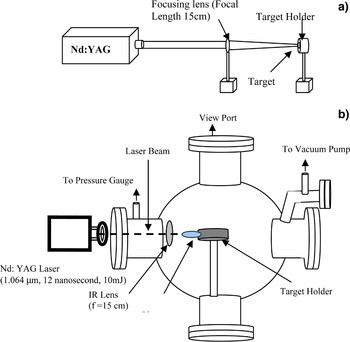
The experiments are aimed to examine the surface morphological changes of two most commonly used metals Au and Cu. First, the annealed and fine polished samples (4 N purity, 1.0 × 1.0 × 0.3 cm3) of both the metals are prepared and then exposed to laser radiation in air, and under high vacuum (~10−6 Torr) as well, using Q-Switched Nd:YAG laser (1.1 MW, 1.064 µm, 12–14 ns) with Gaussian profile. The focal spot size and the power density at the target surface are measured 12 µm and 3 × 10¹⁰ watt/cm2, respectively. Exposed samples are analyzed under scanning electron microscope (SEM). The micro features are investigated using Motic Image Analyzer 6 to measure the ripple periodicity with an error of less than ± 1 µm. The schematic of laser irradiation in air is given in Figure 1, the further experimental details are given elsewhere (Rafique et al., Reference Rafique, Khaleeq-ur-Rahman, Anwar, Mehmood, Ashfaq and Siraj2005).
(Color online) (a) Schematic of experimentation to irradiate the metal targets in air. (b) Schematics of experimental arrangement for irradiation under vacuum.

3. RESULTS AND DISCUSSION
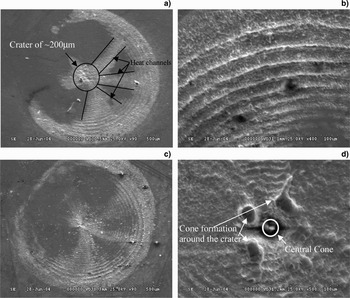
Ag and Cu targets are irradiated for 25, 50, 75, and 100 shots with an infrared laser beam in air and under vacuum. Figure 2 indicates the SEM micrographs of air irradiated Ag samples, which reveals the signatures of a nonsymmetrical damage about the crater. Micro ripples are dominant in the damage zone. The ripple periodicity decreases with the increase of ripple's spacing from center to edge, and also increased with the increase of the laser shots. Along with ripples, particular heat conduction channels are also observed between central crater and outer edge of the damage along one side (see Figs 2A, 2C). The affected area is increased from 1062 µm to 1120 µm with the increment of the laser shots. For irradiation with 100 laser shots, micro cons also formed at the center because of dominancy of thermal and hydrodynamic splashing.
SEM micrographs of laser irradiated silver samples in air with (a) 25, (b) 50, (c) 75, and (d) 100 shots. Ripples, heat conduction channels and micro cone formation is very clear.

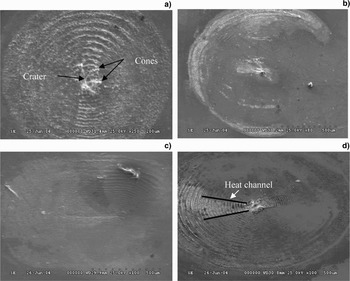
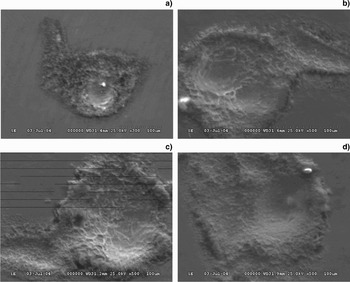
Figure 3 reveals the development of ripple structures, heat channels, and cone formation about the crater for Cu samples. The periodicity of the ripples has the same variations from center to edge that Ag have, but the spacing is lower for Cu (see Fig. 6). The damage length is from 1200 µm to 1300 µm that is slightly larger compared to Ag. It predicts the higher heat loss for Ag because of higher heat conduction compared to Cu. When same target samples (Cu and Ag) are irradiated in vacuum, the ablation of melted material is dominant rather than the ripples structures (see Figs 4 and 5). The damage length is quite less than air irradiated samples, which is about 400 µm to 500 µm for both samples.
SEM micrographs of laser irradiated copper samples in air with (a) 25, (b) 50, (c) 75, and (d) 100 shots. Laser induced effects like ripples, heat conduction channels and cones are indicated.

SEM micrographs of laser irradiated silver in vacuum for (a) 25, (b) 50, (c) 75, and (d) 100 shots. The signatures of ablation, splashing and crater formation are dominate over the ripple formation.

SEM micrographs of laser irradiated copper in vacuum for (a) 25, (b) 50, (c) 75, and (d) 100 shots. Laser induced thermal effects are only present with out induction of microstructures.

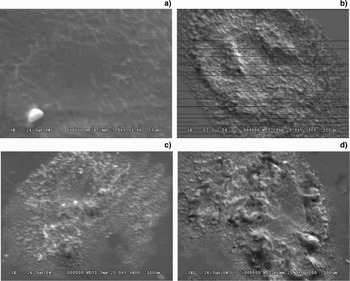
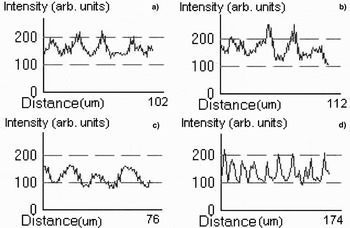
Surface morphology profile to measure the ripple period for samples irradiated in air (a) silver irradiated with 25-laser shots (b) silver with 50 shots (c) laser irradiated Cu with 25 shots (d) Cu irradiated with 50 shots.

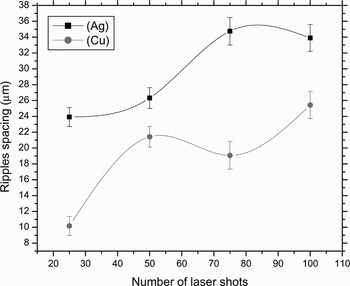
Figure 7 is the investigation of ripple periodicity versus the distance from laser focus spot that reveals the splitting of ripples. The ripples near the laser spot have the two-fold periodicity compared at the edge of the damaged area. It is also observed that with increase in laser shot in case of air irradiation, the ablation takes place in the form of cons at the center of the crater regardless to the samples.
Ripple periodicity versus laser shots, which explains the effect of laser shots on ripple periodicity.

The electromagnetic energy of the laser beam transformed to target by the interaction, can be categorized into different forms like excitation energy, thermal energy of atoms (Chrisey & Hubler, Reference Chrisey and Hubler1994; Wahab et al., Reference Wahab1999), anisotropic stresses (Zhigilei et al., Reference Zhigilei and Ivanov2005), shock waves (stress waves) (Yu et al., Reference Yu and Lu1999; Duff & Zhigliei, Reference Duff and Zhigliei2007), and even into photochemical energy. The excitation energy is responsible for electric breakdown and induction of the current, which might be able to conduct heat (Anwar et al., Reference Anwar, Latif, Iqbal, Rafique, Khaleeq-ur-Rahman and Siddique2006). Thermal energy of atoms can melt the irradiated area and the rate of melting is the main parameter to measure the ablation mechanism (Chrisey & Hubler, Reference Chrisey and Hubler1994). The threshold fluence to melt the sample at room temperature T o is given by,
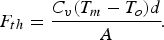
where C v is the volumetric heat capacity, T m is the melting point, d is the thickness of the melt, and A is the absorption coefficient. If d is replaced by the skin depth, which is on the order of the inverse of absorption coefficient, then Eq. (2) would be,
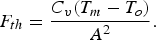
Threshold fluence for Ag is about 7.62 J/cm2 and for Cu is 3.66 J/cm2. So Cu would be melted at about 52% lower fluence required to melt the silver in the result Cu would have more thermal effects, but 7% higher thermal conductivity of Ag solidify the Ag target faster compared to the Cu.
Pulsed laser matter interaction is a rapid energy transform phenomenon that might generate the cracks in the target (Khaleeq et al., Reference Khaleeq-ur-Rahman, Anwar, Rafique and Haider2007). Anisotropic stresses and stress waves can increase the dislocation density and roughness of the melting front (Duff & Hubler, 2007, Zhigliei et al., 2007), which might open the particular heat conduction channels. In our case, the heat conduction channels are always along one side, which indicates the collective effect of laser, induced anisotropic stress, cracking, and current into the target (see Figs 2A, 2C, 3A).
Laser ablation of Cu and Ag with the formation of ripples, cones, and splitting of ripple periodicity can be explained using the theory of Lu et al. (Reference Lu, Yu and Choi1997). Lu et al. (Reference Lu, Yu and Choi1997) has proposed a theory to explain the mechanism for the induction of surface microstructures in silicon oxide/silicon and silicon oxide/aluminum bilayer systems with the interaction of infrared laser radiation. The upper surface layer (silicon oxide) can behave as an elastic layer that can oscillate with the molten sublayer and provide an extra restoring force to the surface waves. The high rate of resolidification is responsible for freezing of surface waves in the form of ripple structures. Thus, thickness of the oxide layer and resolidification are the main factors to define the ripple periodicity, which is given by,

where Λo = 2πh is the periodicity of uncapped or bare target, h s is the thickness of capped layer or upper layer, K is the constant dependent on the ratio of mass density for capped layer for upper surface and molten surface,

The theoretical investigations reveal that ripple periodicity is linearly dependent on capped layer. This theory does not include any effect of the number of laser shots.
Laser radiation interaction with metals can produce the plasmon at the surface of the solid target with several hundreds of eV electron temperature with particular plasmon frequency (Chunlei et al., Reference Chunlei2006). The optical response of conducting materials is sensitive to the plasmon frequency, which is proportional to the electron concentration (Rhodes et al., Reference Rhodes, Franzen, Maria, Losego, Leonard, Laughlin, Duscher and Weibel2006),
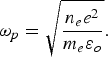
where n e is the electron density, ɛo is the permittivity of mass, e and m e is the charge and mass of electron, respectively. The incident laser beam of frequency less than plasmon frequency would be reflected, while for higher laser frequency, the conducting materials would behave as transparent. The absorption will take place at resonance condition when frequency of incident radiation and the plasmon frequency are the same (Rhodes et al., Reference Rhodes, Franzen, Maria, Losego, Leonard, Laughlin, Duscher and Weibel2006). Plasmon frequency of Cu and Ag are 8eV and 3.9eV, respectively (Bussjager & Macleod, Reference Bussjager and Macleod1996; Hatta et al., Reference Hatta, Suzuki and Suetaka1989; Hussain et al., Reference Hussain, Roy and Pal2005; Raether, Reference Raether1982). Thus, both of these samples have the high reflectivity for a laser of 1.13 eV photons, which we used in our experiments. The plasmon frequency for metals oxide is about 1eV (Rhodes et al., Reference Rhodes, Franzen, Maria, Losego, Leonard, Laughlin, Duscher and Weibel2006) so Cu and Ag oxides are transparent for the above mentioned laser radiation.
Mostly oxide layer is fashioned over the metallic target in open air that can cap the surface. Such kind of oxide layer can also be induced during exposure with first few laser shots in air. For such case, laser radiation passed through the infrared transparent oxide layers into the metals, and absorbed there within the penetration depth. So, infrared laser energy is absorbed under a capped layer. In this way, we might have a molten subsurface having a capped layer in solid form. The elasticity of the capped layer can generate surface waves. Those can freeze quickly due to high thermal conduction of Cu and Ag metals. The repeated laser pulses perturb the target properties, which can be one of the reasons to make a relation between numbers of shots and ripple periodicity. Such a relation that we analyze in our investigation is shown Figure 7. The multi laser shots at one spot can defiantly increase roughness of target and might affect the resolidification factor. That is why ripples periodicity is increased with the increase of laser shots up to a saturation value. Upper solid layer might be melted and splashed out due to the force generated from inside the target (Jain et al., Reference Jain, Kulkarni, Sood and Uppal1981). This splashing is not only dependent on properties of target material but also on force generated inside the target material. Then two kinds of splashing are expected, exfoliation splashing, and subsurface boiling. First is dominant for insulator materials due to high bulk modulus while the second one is dominant in case of metals due to high heat conduction to boil the subsurface. But the important thing is that both phenomenon of the splashing are intense under vacuum because of higher pressure gradient. The transit melting is resulted out in the form of thermal and hydrodynamic splashing and/or sputtering that initiate the cone formation on target surface. Cones are generally formed when surrounding material is removed using successive laser shots. The length of cone increases with the increase in laser exposure and pointed out in the direction of incoming laser radiation (Chrisey & Hubler, Reference Chrisey and Hubler1994; Rafique et al., Reference Rafique, Khaleeq-ur-Rahman, Anwar, Mehmood, Ashfaq and Siraj2005). The capillary forces and gradients surface tension are also one of the reasons for the microstructures formation (Dolgaev et al., Reference Dolgaev, Kirichenko, Simakin and Shafeev2007).
CONCLUSIONS
Polished and annealed Ag and Cu samples are irradiated with a Q-Switched Nd:YAG laser in air and vacuum with 25, 50, 75, and 100 number of shots. The SEM and Motic Image Analyzer 6 investigations reveal the ripple formation in case of air exposure but not for vacuum exposure. The ripple spacing is strongly dependent on the number of laser shots beside the laser wavelength, refractive index of the target material. The ripple spacing increases with laser shots up to a saturation value. Nonuniform heat conduction in the form of channels is also observed. The cone formation is occurred with the increase of the laser shots. More theoretical work is needed to investigate the effect of number of laser shots on laser induced ripple's periodicity.