Since 1949 China has been very jealous of guarding its national sovereignty, especially in the first two decades when its national security often came under threat from both the USA and the USSR. Shaped by its ideology and the harrowing experience in the Korean War, China reviled UN peacekeeping operations for being tools for the two superpowers to intervene into the domestic affairs of weak states. This hostile attitude continued until its reform and when it opened up to the outside world. In 1981 China demonstrated a less negative attitude towards UN peacekeeping as shown in its willingness to pay its share of the peacekeeping costs and its approval, for the first time, of the extension of the UN Peacekeeping Force in Cyprus. It joined the UN Special Committee on Peacekeeping Operations in 1988, and started to send peacekeeping forces, albeit limited, to various troubled spots around the world in 1990. China's contribution has expanded rapidly since the late 1990s.Footnote 1 In the first nine months of 2010, it committed a total of 1,995–2,137 personnel per month to the peacekeeping operations, accounting for 1.97 per cent–2.13 per cent of the total UN force. Among the five permanent members of the UN Security Council (UNSC), its contribution was slightly more than France (1.61 per cent–2.00 per cent), and far more than Russia, the United Kingdom and the US combined.Footnote 2 However, as a result of a string of atrocities against humanity in Africa, the Balkans and Southeast Asia in the 1990s, the notions of national sovereignty and conflict resolution have undergone a process of reconceptualisation alongside the advance of humanitarian intervention since the late 1990s. Against this background, one may ask if and how China involves in conflict resolution through humanitarian intervention.Footnote 3
This article focuses on how China perceives the legitimacy of humanitarian intervention vis-à-vis the principle of sovereign equality and the norm of non-intervention, and how its thinking shapes the handling of the most acute humanitarian crisis in Africa in the early 21st century. Africa is singled out for analysis here because of the controversy over humanitarian intervention in Darfur, Sudan and because of the intense debates about China's increasing foray into African affairs. The article consists of four sections. Section 1 briefly examines the evolution of the norm of humanitarian intervention in the West, and the raging debates about the legitimacy of humanitarian intervention. Section 2 describes how the West interprets the unfolding of the humanitarian catastrophe in Darfur and the role of China in it. In light of the controversies surrounding humanitarian intervention in the West, one may readily expect that the debate will be fiercer when the notion meets China. Section 3 discusses how China perceives humanitarian intervention and spells out the justifications it offers for its reluctance to give full support to the West's efforts to put the concept into practice in tackling the Darfur crisis. We do not fully agree with the conventional claim that oil is the only or the most decisive factor in China's reservation about humanitarian intervention in Darfur. Paradoxically, in spite of being an illiberal state, China succeeds in crafting new rules about humanitarian intervention for the UN, which in effect denounces intervention. A set of three-layered rules involving the host country, the regional organisation and the UN has been subsequently applied to Darfur and will likely become a precedent for future conflict resolution. This is in sharp contrast to the work that highlights the role of intergovernmental organisations and transnational civil society groups in socialising repressive countries into embracing liberal human-rights norms and practices.Footnote 4 Employing the notions of norm diffusion, internalisation and socialisation, both Rosemary Foot and Ann Kent show that China's engagement with the UN human-rights regime and discourse in the 1990s contributed to a gradual change in the country's internal human-rights policies and practices in the decade.Footnote 5 Along the line of constructivism, but in a more explicit manner than both Foot and Kent, Alastair Iain Johnston argues that China's leaders have been socialised into liberal internationalist norms in the course of greater engagement with international security organisations in the 1980s and 1990s, and discusses how the micro-processes of socialisation took place.Footnote 6 In Section 4 we explain a seeming anomaly, in which China is not at the receiving end of the new norm of forceful intervention for humanitarian purposes; rather it makes the ground rules for such intervention. While we agree with Johnston that China's behaviour cannot be accounted for by material incentives alone, we assert that China refuses to internalise the norm of humanitarian intervention because the norm runs counter to the deeply entrenched principles of national sovereignty and non-intervention and has adverse implications for China's territorial integrity and state-building. Due to its historical encounter with the West, China comes to value its identity as a non-Western, albeit not necessarily anti-Western, rising power that decries the self-righteousness of the West. We also discuss the possible implications of this study for international politics.
Humanitarian intervention: a contested concept
A standard definition of humanitarian intervention is that it is ‘the threat or use of force across state borders by a state (or group of states) aimed at preventing or ending widespread and grave violations of the fundamental human rights of individuals other than its own citizens, without the permission of the state within whose territory force is applied’.Footnote 7 Key to this definition is that force is used to intervene in another state's domestic affairs without the prior consent of the host government for the purpose of protecting innocent civilians of the target state.
Obviously, humanitarian intervention is an affront to the notions of national sovereignty and non-intervention. At the core of sovereignty is constitutional independence, which entails the principle of juridical equality of states and the regulative rules of non-intervention and reciprocity or equal treatment.Footnote 8 Originated in the European state-system in the 17th century, the non-intervention principle was, however, supposed to be only applicable to relations between European states and not to relations between European states and ‘uncivilized’ non-European peoples. Christian European powers had held that it was legitimate for them to intervene in the rest of the world to protect the life and property of their subjects, thereby justifying the imposition of extraterritoriality on non-European states, which had to meet a standard of ‘civilization’ in order to be accepted into international society as full members.Footnote 9 The adoption of the UN Charter in 1945 signalled the first time the principles of sovereign equality and non-intervention were universally accepted by all UN member states, and it was universally agreed that sovereign states were the fundamental units of world order.Footnote 10 Although there were a few cases of ‘humanitarian’ intervention in the Cold War period, including India's intervention in East Pakistan (1971), Vietnam's overthrow of Cambodia's Pol Pot regime (1978), and the invasion of Uganda by Tanzania to depose the Idi Amin government (1979), the intervening governments did not invoke ‘humanitarianism’ to justify their actions.Footnote 11 The international community still upheld the organising principles of national sovereignty and non-intervention and rejected unilateralism.
However, these principles were no longer deemed absolute and sacrosanct in the wake of a series of humanitarian catastrophes in Somalia (1992–94), Rwanda (1994), Srebrenica (1995), Kosovo (1999) and East Timor (1999). They called into question the philosophical foundation of the state system, namely national sovereignty. Two outcomes grew out of these new developments. First, as discussed in detail below, it led to a redefinition of sovereignty – from sovereignty as right of exclusivity to sovereignty as responsibility for human dignity.Footnote 12 Second, in viewof the failed intervention in Somalia, the belated and ineffective intervention in Rwanda and the contested nature of the intervention into Kosovo by the North Atlantic Treaty Organization (NATO) without UNSC authorisation, there has been an ongoing debate about the legality, legitimacy and practicality of humanitarian intervention.
Opponents of humanitarian intervention argue that the UN Charter – in particular its Articles 2(4) and 2(7) – forbids forceful interventions unless they are sanctioned by the Security Council under Chapter VII. Therefore, unauthorised humanitarian intervention is unlawful,Footnote 13 and the UNSC Resolution 794 on Somalia in December 1992 was hence considered a watershed for humanitarian intervention.Footnote 14 While the UNSC has been relaxing its interpretation of threats to international peace and security since the end of the Cold War, it has often emphasised the uniqueness, exceptional and extraordinary circumstance of each of the humanitarian crises since 1991 when authorising humanitarian intervention,Footnote 15 and sought the consent of the host state, a departure from the past unilateral practice of humanitarian intervention.Footnote 16
In response to the question of whether humanitarian intervention can be justifiable or morally legitimate,Footnote 17 a powerful utilitarian argument in favour of military intervention is that it will be just ‘if it saves more lives than it costs’.Footnote 18 In addition, states have a moral duty to intervene in cases of gross and systematic human-rights violations because rational human beings are bound by common moral duties to the oppressed. Settlement of international disputes by peaceful means and respect for and observance of human rights are affirmed in Articles 1(3), 55 and 56 of the UN Charter. The principle of non-intervention should not provide unqualified protection to pariah states if they are unwilling or unable to protect their citizens.Footnote 19
However, in countering such arguments, opponents say that intervention may do away with the legal restriction on the use of force between states, further threatening international order. Furthermore, to rebut the moral debate, natural law theorists maintain that the duty is never perfect. That one ought to intervene cannot directly be translated into that they are under legal obligation to do so. Other theorists contend that intervention will be unjust if it endangers the well-being of the citizens of the intervening state, that is, if it harms the ‘national interest’ of the latter.Footnote 20 Despite these divergent arguments, one can conclude that in the post-Cold War period, authorised humanitarian intervention is permissible by international law, but the international community is under no obligation to intervene. Many states may tend to free-ride if their vital ‘national interests’ are not at stake.Footnote 21
After the Kosovo crisis, Canada sponsored the establishment of the International Commission on Intervention and State Sovereignty (ICISS) to examine the guiding principles of humanitarian intervention. In its report entitled The Responsibility to Protect (or R2P for short), the Commission held that in joining the UN and signing its Charter every individual sovereign state has indicated their acceptance of the primary responsibility to protect its citizens from life-threatening dangers. If a state is unable or unwilling to fulfil its responsibility, then the international community of states has a residual or fallback responsibility to respond and the principle of non-intervention will yield to the international responsibility to protect.Footnote 22 The modern state system is understood as a means to achieving the overriding goal of promoting the well-being and freedom of individuals. As soon as sovereignty per se becomes an impediment to this accomplishment, sovereignty ‘can, should and must be discarded’.Footnote 23 After a watered-down compromise, this notion was adopted by the UN General Assembly in its 2005 World Summit.Footnote 24
Despite the endorsement by the global institution, one may find a trace of the ‘standard of “civilization”’ argument, in which Christian European states had maintained that non-Christian, non-European states were not entitled to sovereign status and the principles of sovereign equality and non-intervention could not be applied to them. Couched in different terms or discourses notwithstanding, liberal democratic states today still feel it is legitimate for them to intervene in those which fail to reach the standard of Western ‘civilization’.Footnote 25 Seen in this perspective, one can understand why a large number of developing states disagree with the principle of humanitarian intervention.Footnote 26 The principle was further discredited by the US-led War on Terror in Iraq due to a number of reasons.Footnote 27 An unintended result of the Bush doctrine is that it renews the call for non-intervention rather than undermining the principle of national sovereignty.Footnote 28
Humanitarian intervention in Darfur: the Western understanding
The atrocities in Sudan's Darfur, which broke out in February 2003, are widely regarded as the most serious humanitarian crisis of the early 21st century. However, not until July 2007 did the UNSC pass Resolution 1769 to deploy a hybrid international force of up to 26,000 UN and African Union (AU) soldiers and police officers, UNAMID, to Darfur in a bid to put an end to the humanitarian casualties in the region. Up to 300,000 people are believed to have been killed and at least 2.5 million displaced in the region.Footnote 29 The deployment of the UN troops in Darfur has proceeded slowly, principally because of a deadlock between the UN and the Sudanese government over the composition of the UN force. As discussed in detail below, Sudan insisted that non-African troops could not enter the country until after African troops had been fully deployed. As a result, by January 2008, only 9,000 of the envisioned 26,000 UNAMID peacekeeping force were stationed in Darfur.Footnote 30 By the end of December 2009, only 18,810 (or 72.3 per cent) were on the ground; it grew slowly to 84.5 per cent by the end of September 2010.Footnote 31
In the West, it is widely believed that the major obstacle to halting the brutal conflict in Darfur is Beijing's political support of Khartoum. China buys two-thirds of the crude oil that Sudan produces and the Sudanese government imports weapons from China.Footnote 32 As early as December 2005, in a comprehensive statement about US policy towards China delivered to the National Committee on US-China Relations, Robert Zoellick, then US Deputy Secretary of State, criticised China of locking up energy supplies in the world and of dealing with Sudan in order to achieve energy security, regardless of the poor governance in the host country.Footnote 33 According to British officials, who co-sponsored Resolution 1769 with the French, the vote was passed after China dropped its objections. China's new stance was prompted by its move to head off an imminent international human-rights backlash against the 2008 Olympic Games in Beijing. This outweighed China's oil interests in Sudan.Footnote 34 Nevertheless, for many in the West, China's politico-economic partnership with Sudan is widely perceived as a formidable barrier to a successful humanitarian intervention in Darfur. They lashed out at China for its unwillingness to impose sanctions against the Sudanese authorities due to its concerns for oil.Footnote 35
Humanitarian intervention in Darfur: China's policy
Contrary to conventional wisdom, we argue that petroleum is a factor but not the sole factor that figures prominently in China's behaviour towards the Darfur crisis. On the one hand, Chinese national oil corporations (NOCs) have pursued oil interests in countries where Western companies are not present, of which Sudan is exemplary.Footnote 36 The Clinton Administration imposed economic sanctions against Sudan in October 1997 and the US Congress passed the Sudan Peace Act in October 2002 requiring the President to take steps to ‘deny the Government of Sudan access to oil revenues’.Footnote 37 China National Petroleum Corporation (CNPC)'s activities in Sudan can date back to 1995. A year later it bought 40 per cent of Greater Nile Petroleum Operating Company (GNPOC) in Sudan, which was granted in March 1997 a contract to develop three blocks in Southern Sudan. CNPC and China Petroleum and Chemical Corporation (Sinopec) later combined to take a 47 per cent stake in the second largest oil consortium in Sudan, Petrodar Operating Company (PDOC), to develop two blocks in northern Upper Nile. CNPC also invested in infrastructure and refinery. On the other, the Chinese government was internally divided over its Sudan policy when it faced mounting external pressure to tackle the Darfur atrocities. Some hard-liners called on the government not to bow to the pressure from the West while some ‘regarded Sudan as not worth damage to China's international standing’.Footnote 38
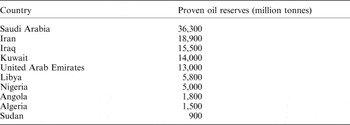
To understand China's complex stance, one may need to know that Sudan is only a medium-sized oil producer, though it has become a net oil exporter since 1999 and its proven reserves have risen remarkably due to increased exploration. Sudan only held 900 million tonnes of crude oil at the end of 2009,Footnote 39 much below other African and Middle East oil-producing countries (see Table 1). The same source shows that China itself possessed 2,000 million tonnes of oil in proven reserves in the same year. It is reasonable to assert that Sudan is not and will not be a significant player in international oil politics. According to China's Ministry of Commerce, China bought 10.3 million tonnes of crude oil from Sudan in 2007, accounting for only 6.32 per cent of China's total oil imports.Footnote 40
Proven oil reserves of major Middle East and African countries, end-2009

Source: BP, BP Statistical Review of World Energy (2010), p. 6.
Although China's NOCs are state-owned enterprises, they do not always put the national interest of energy security above their corporate interests. They often sell most of their equity oil to the highest bidder for the commodity.Footnote 41 The total African output of Chinese NOCs in 2006 was about 13.3 million tonnes, of which 81 per cent was from Sudan.Footnote 42 While details of the destinations of Chinese equity oil in Sudan are sketchy, one estimate shows that only 24 per cent of the oil in 2006 was shipped back to China while 65 per cent was sold to Japan, China's arch-rival in energy security.Footnote 43 Even if China had taken home all the oil it owned in Sudan (about 10.7 million tonnes), Sudanese oil would not have helped much to address China's ever-growing energy shortage, which registered a production-consumption gap of 166.1 million tonnes in the year.Footnote 44 In addition, due to the rise of economic nationalism in Sudan and its wish to diversify the sources of foreign investors, CNPC was reportedly not given an equal and fair treatment in its investment in the Sudanese oil industry. Khartoum rejected CNPC's offer to purchase the stake of Canada's Talisman in GNPOC, when Talisman was pushed by human-rights advocacy groups to sell its assets in Sudan in 2002–2003. Instead, the Sudanese government directed the sale of the 25 per cent shares to India's Oil and National Gas Corporation, an Indian NOC as well as a major competitor with Chinese NOCs for global energy resources.Footnote 45 In addition to China, India, Malaysia and other countries in the Middle East and the West are equity investors in Sudan.Footnote 46
It is fair to argue that given the above factors, it would be excessively costly, in political and commercial terms, to fully back up such a questionable regime. Would the Chinese interests be harmed if the al-Bashir regime were to be overthrown in civil strife or if the oil-rich Southern Sudan, where many Chinese-invested oilfields are located, opted for independence in a referendum scheduled for January 2011 as promised by the peace agreement (see below for detail)?Footnote 47 Beginning in 2007 China no longer offers financial incentives to its oil companies to invest in Sudan.Footnote 48 To hedge against secession of Southern Sudan, China has been pragmatically mending fence with Juba and exploring with the Kenya Pipeline Corporation to build a pipeline that would deliver Southern Sudanese oil to Lamu, a coastal port in Kenya, reducing the reliance of Southern Sudanese oil exports on the infrastructure in the north. China expressed interest in the venture after Toyota Tsusho, a Japanese trading firm, unveiled the pipeline and port development proposal in March 2010.Footnote 49 Furthermore, if China focused solely on acquiring oil from ‘rogue’ states where Western companies were absent, why was there no ‘marriage of convenience’ between China and Libya when the Gaddafi regime was isolated by the West until 2003,Footnote 50 and why has China largely – albeit grudgingly – cooperated with other major powers in imposing sanctions against Iran over its alleged nuclear weapons programme? Considering that the oil factor cannot fully account for why Khartoum receives political backing from Beijing against external intervention into Darfur, the Chinese perspectives on humanitarian intervention should be studied to understand the motives behind China's behaviour in Sudan.
As noted above, China since 1981 has been more flexible and pragmatic towards UN peacekeeping. However, owing to the revival of a siege mentality in response to international sanctions against it in the wake of the Tiananmen crisis of 1989, China was highly sensitive to external interference in its internal affairs in the name of human rights and democracy. China's subsequent behaviour has appeared paradoxical. On the one hand, China did not want to isolate itself from the international system and started to send peacekeeping forces to various conflict-ridden countries in 1990. On the other, it has insisted that such dispatches of forces are made on the condition of obtaining a UN mandate and the consent of the host countries. While Beijing in general accepts the principle of humanitarianism, it is adamantly opposed to interventionism. As a victim of European imperialism and colonialism in the 19th century, China harbours much scepticism about any move that would erode the legal basis of national sovereignty and more detrimentally bring about a return of the Eurocentric division of the international community into ‘civilized’ and ‘uncivilized’ worlds in disguised terms.Footnote 51 China's apprehension about the norm of humanitarian intervention is evident in the Position Paper on the UN Reforms it released in June 2005. China maintains that the reforms should safeguard the principles of sovereign equality and non-interference in internal affairs. Even if a massive humanitarian crisis takes place, it says, the opinions of the country in question and the regional organisations concerned should be respected, and that it is eventually the responsibility of ‘the Security Council to make the decision [to ease and defuse the crisis] in the frame [sic] of [the] UN in light of specific circumstances […]’.Footnote 52 In other words, the target state, the pertinent regional organisation and the Security Council must be involved in interventions. Forceful interventions must not be unilaterally hijacked by a great power, notably the US. In this light, it comes as no surprise that the military intervention by NATO in Kosovo, populated by ethnic Albanians, in the former Yugoslavia in 1999 without the mandate of the UNSC has elicited strong reactions from China.
Beijing's reactions to the Kosovo crisis reflected its deep concerns about humanitarian intervention and the alleged quest for global hegemony by the US. China was concerned that ‘what happened yesterday in Yugoslavia could occur tomorrow in Asia, especially in China, whose minority and human-rights policies are always criticized by the US and its allies’.Footnote 53 The Chinese were dismayed not only by the ‘accidental’ bombing of the Chinese embassy in Belgrade by a US warplane in May 1999, but also by the fact that without UNSC authorisation, the US-led NATO used armed forces against the former Yugoslavia, a sovereign state which was not a member of the regional organisation and posed no direct threat to it. Sudan – and likely China, which is also mired in ethnic conflicts – had reasons to be suspicious that the US had a hidden agenda for armed intervention in Darfur after three prominent Democrat politicians openly advocated in October 2006 adopting the Kosovo model of conflict resolution to ‘save’ Darfur.Footnote 54 As soon as Kosovo unilaterally declared independence from Serbia in February 2008, China expressed grave concern that the issue was not only about peace and stability in the Balkans, but also about the ‘basic norms governing international relations’.Footnote 55
Central to China's stance on humanitarian intervention are the statist principles that military intervention for humanitarian purposes within the territory of a sovereign state cannot be made without the latter's consent, that the sovereignty and territorial integrity of the target state must be duly respected, and that the crisis in Darfur should best be handled by African countries.Footnote 56 When Chinese President Hu Jintao visited Khartoum in February 2007, he laid down four principles in resolving the Darfur problem:Footnote 57
1. To respect Sudan's sovereignty and territorial integrity;
2. To resolve the issue by peaceful means and by sticking to dialogue and coordination based on equality;
3. The African Union and the UN should play constructive roles in a peacekeeping mission in Darfur and,
4. To improve the situation in Darfur and the living conditions of the local people.
Because both the Sudanese government and the AU rejected outside intervention,Footnote 58 China did not contemplate UN sanctions and intervention. It was also in China's interest to have the AU empowered to tackle this regional crisis, enabling the organisation to become a powerful force in the multipolar world favoured by Beijing. Moreover, China is deeply wary that outside humanitarian interventions would lead to foreign infringement and national disintegration, a possibility that still haunts Chinese leaders. The Chinese do not entertain a repetition of the intervention into Kosovo, which eventually led the minority region to seek independence from Serbia and has stirred up Taiwan's claim to statehood based on the principle of self-determination.Footnote 59
Chinese leaders' understanding of the nature of the Darfur crisis is also coloured by the relatively limited detailed studies of Sudan and its Darfur crisis by Chinese International Relations analysts.Footnote 60 They argue that the crisis had its origins in internal conflicts over water and grazing resources and racial, identity conflicts between black Africans and Arabs. They lay the blame for the atrocities on the non-state actor, the Janjaweed (local militias recruited from Darfur's Arab tribes). Because of the preoccupation with the civil war in the south, Khartoum was slow to respond to the conflict in Darfur. Their analyses, however, fail to address the claim that Sudan was in a grave imminent danger of disintegration because of prevalent centre-periphery confrontations – not limited to Darfur and Southern Sudan.Footnote 61 The explosion of the long-running Darfur discord into a rebellion was partly provoked by the peace agreement made between Khartoum and the southern rebels, which left the periphery in the west out of the negotiation process. The unrest in the west as well as the south has been fuelled by economic marginalisation and political exclusion of the non-Arab peripheries by the Arab-dominated central government.Footnote 62 These Chinese analyses might strengthen Beijing's belief that economic development in the region as well as in the country would be the key to conflict resolution. With a robust national economy, the Sudanese central government should be able to maintain the unity of the country;Footnote 63 humanitarian intervention from the outside simply masks the ulterior motive to control the country's energy resources.Footnote 64 Apparently the notion of responsibility to protect has not crossed the Chinese mind when dealing with Sudan and Darfur. Rather, its stance on humanitarian intervention is influenced by three factors, namely China's aspiration (1) to uphold the norms of national sovereignty and non-intervention in international politics; (2) to play the role, and cultivate an image, of a ‘responsible great power’ and, (3) to develop warm ties with Third World countries and the regional organisations that they form. While the last two are more recent factors, the first has its historical root which harks back to China's bitter experiences of foreign aggression and extraterritoriality since the Opium War of 1839–1842 up to the early months of the founding of the People's Republic when Mao Zedong negotiated hard with Joseph Stalin over the Sino-Soviet Treaty of Friendship, Alliance and Mutual Assistance. This so-called ‘century of humiliation’ cuts deep into the Chinese psyche.
Lurking behind the concern about the erosion of state sovereignty has been the resentment against the age-old standard of ‘civilization’ criterion whereby ‘uncivilized’ states – which have always been referred to the non-Western countries that fail to measure up to the cultural standards laid down by the more powerful Western powers – are denied the full rights of sovereign equality and the protection of non-intervention. As a result, China has been very sensitive in guarding its sovereignty and the principle of non-intervention to avert a reversion in the post-Cold War Western hegemonic era to this imperialist principle that had justified Western infringement into Chinese sovereignty since the Opium War. Premier Zhou Enlai could not conceal this ingrained anti-imperialist resentment during his visit to Sudan in January 1964 when he emphasised the ‘common colonial past of the Chinese and Sudanese peoples’ and thanked the Sudanese for killing British General Charles ‘Chinese’ Gordon in the Anglo-Sudanese Mahdist revolt in 1885.Footnote 65 Forty-five years later, China invoked the same sentiment in its defence of the execution of Akmal Shaikh, a British citizen convicted of drug smuggling in China, in December 2009. After the execution, the Chinese Embassy in London said that ‘In China, given the bitter memory of history and the current situations, the public has a particular and strong resentment towards [drug trafficking]’, obviously referring to the Opium War. The Chinese Embassy also claimed that almost all of the respondents in a web survey endorsed the court ruling.Footnote 66 A message left by a Chinese netizen in the blog site Global Voices hit out at the humiliating practice of extraterritorialityFootnote 67 by saying that, ‘Today when the British drug dealer violated the law on our land, we can openly and rightfully punish him without any mercy. We don't need to follow the order of others anymore.’Footnote 68 Seen from this angle, Sudan's claim that the UNSC Resolution 1556 (2004), which gave Sudan 30 days to disarm the Janjaweed and prosecute human rights abusers, was ‘the result of a domineering, colonial mindset’ might have resonated with China's lingering fears and suspicions.Footnote 69
China as a rule-maker?
Under Chinese promotion, a new rule about humanitarian intervention is applied to Darfur, which is likely to set a precedent for future interventions. In essence this ‘conditional’ intervention is undertaken by actors at three levels: the host country at the national level; a pertinent intergovernmental organisation at the regional level; and the UN at the global level. Why can China, as an illiberal, authoritarian state, make rules for the world regarding humanitarian intervention? Why is it not the other way round in which international institutions socialise China into accepting the liberal humanitarian norms? The following analysis shows China's greater determination in guiding the debates and the formulation of interventionist policy in the UN. In contrast, the US and the EU could not muster up political will to act.
One needs to contextualise the issue in order to understand how the international response to the crisis has unfolded and why China can fill the void left by the West's inertia. Paul Williams and Alex Bellamy cogently argue that due to strategic reasons Western states were not prepared to match the noble notion of responsibility to protect with actions to send their troops to Darfur. Western powers were concerned, among others, that any military intervention in Darfur would derail the enforcement of the Machakos/Naivasha peace accord between the Sudanese government and the opposition force in the south, the Sudan People's Liberation Movement/Army (SPLM/A), which was eventually signed in January 2005 and known as the Comprehensive Peace Agreement (CPA).Footnote 70 The EU approach to the crisis was led by France, which until 2007 cared more about the political stability of Chad, where French troops were stationed, than the alleviation of human suffering in Darfur.Footnote 71 Political elites in the US were split into two camps: the ‘realists’ in the State Department, the CIA and the Defense Intelligence Agency; and the pro-Garang lobby on Capitol Hill and in the US Agency for International Development (USAID).Footnote 72 After the fiasco in Somalia in 1993–1994, the so-called ‘Somalia syndrome’,Footnote 73 the US government has resisted military intervention in Africa. To enlist Sudan's support for its counter-terrorism campaign, the realists in Washington had an additional reason for arguing against pressing Khartoum too hard. Indeed the US in May 2004 removed Sudan from a list of countries identified as uncooperative in the War on Terrorism.Footnote 74 With no interest in breaking up Sudan, the US was in favour of putting the AU at the centre of the international effort to halt the turmoil.Footnote 75 However, the deployment of 7,000 under-resourced AU troops was unsuccessful in stopping the brutality, while attention to the crisis by international mass media and the West as well as the UN began to gain momentum in 2004 when a series of forums were held to commemorate the tenth anniversary of the Rwandan genocide. As 2004 was a presidential election year for the US, the George W. Bush administration wished to pre-empt criticism by John Kerry, the Democrat candidate, of its Darfur policy. Having sought legal advice which opined that the US would not be required by the 1948 UN Genocide Convention to intervene even if it referred the killings in Darfur as ‘genocide’, Colin Powell, the then US Secretary of State, declared for the first time in September 2004 that the Sudanese government and the militia it backed committed genocide. Washington passed on the issue to the UNSC, which set up in the same month a commission of inquiry to examine if genocide had occurred in Sudan.Footnote 76 Under a strong lobby by human-rights groups and with the aim of burnishing its blemished reputation in the wake of military setbacks in Iraq, the Bush administration began to be more active in mobilising international support to put an end to the conflict. While Bush wanted the US to be remembered as a state that could bring peace to such an Islamic country as Sudan, he was careful not to deploy US troops into another Islamic country.Footnote 77 The US in January 2006 expressed support for the idea of sending UN peacekeeping troops to replace the beleaguered AU forces. A month later, John Bolton, then US ambassador to the UN, called for the deployment of UN peacekeeping forces.Footnote 78 In early 2006 Kofi Annan requested the US and other Western powers to provide close air support for the AU forces in Darfur while the Bush administration also explored the possibility of sending NATO troops to the region. But both the Sudanese government and the AU were adamantly opposed to seeing ‘white, European troops coming into Sudan’.Footnote 79 As soon as it was apparent that the collapse of the Darfur Peace Agreement, signed in May 2006, was another nail in the peace process's coffin,Footnote 80 the UNSC adopted in August of the same year Resolution 1706, asking for Sudan's consent to the expansion of the existing UN Mission in Sudan (UNMIS) to cover Darfur.Footnote 81 In the light of the defiance of the al-Bashir government, the US and China initiated in November 2006 a compromise solution for a hybrid UN-AU force. This was eventually accepted by Khartoum after a series of hard bargaining, in which China tried the tactic of ‘influence without interference’ to urge Sudan to acquiesce in a tripartite mechanism China was promoting. Key to it was to allow the deployment of UN peacekeeping mission in Darfur.Footnote 82 The hybrid force, however, ‘should have a predominantly African character and the troops should, as far as possible, be sourced from African countries’.Footnote 83
As a non-Western power, China's personnel are allowed to enter Darfur.Footnote 84 In November 2007 a vanguard of 135 Chinese engineers arrived in Darfur to start peacekeeping duties.Footnote 85 Although these Chinese peacekeepers were welcomed by the Sudanese government, rebel groups in Darfur like the Justice and Equality Movement and the SPLM/A had demanded their withdrawal, saying that the Chinese presence was there for the oil, not for human rights.Footnote 86 Beijing stepped up pressure on Khartoum to cooperate with the UN shortly after Steven Spielberg, a renowned film director, withdrew in mid-February 2008 in a high-profile way from the post of artistic advisor to the Beijing Olympic Games. Spielberg criticised China of failing to use its leverage on Sudan to make peace in Darfur.Footnote 87 In his visit to Sudan and Darfur in the same month, Liu Guijin cajoled Khartoum into ‘remov[ing] obstacles to full deployment of a joint UN-African Union peacekeeping force’.Footnote 88 As of September 2010 China committed a total of 781 police officers, military observers and troops to the UN peacekeeping operations deployed in Sudan, including Darfur,Footnote 89 representing 39.1 per cent of its total contributions to UN peacekeeping activities at that time.
China's participation in the humanitarian intervention in Darfur, albeit grudgingly, indicates that a new Chinese approach to conflict resolution is in the making. It is far from fully socialised into accepting the norm of humanitarian intervention because of its non-Western identity as well as grave concern over national disintegration.Footnote 90 The fact that it and many developing countries are in company with regard to human-rights protection and memories of colonialism also explains why socialisation into humanitarian intervention has not happened in China.Footnote 91 Nevertheless, it no longer simply rhetorically vows to adhere to its age-old principle of non-intervention and opposes humanitarian intervention. The non-intervention principle, in practice, has undergone subtle transformation. More importantly China puts forward new rules for enforcing humanitarian intervention while many Western powers are resistant to taking action in Africa. Naming it ‘conditional interference’, Pang Zhongying of Renmin (People's) University, Beijing, explains in detail why there is such a subtle change in Chinese attitude towards humanitarian intervention.Footnote 92 Present-day China does not only open its door to foreign goods, services and investments, it is also a source of foreign direct investment in the global economy. With emerging global interests, China has to, under certain circumstances, intervene in the internal affairs of other states where and when the interests of its companies and citizens are at stake. In addition, under US pressure to play the role of a ‘responsible stakeholder’ in the global society, China finds that a rigid adherence to the non-intervention policy would not be helpful in cementing close working relations between the two countries. Finally, some regional bodies such as the AU and the Association of Southeast Asian Nations (ASEAN) treat the non-intervention principle in a more flexible manner than China does. While the African and Southeast Asian countries are firmly opposed to intervention by Western countries, especially their former colonial powers, they allow a certain degree of intervention into a member state by other states in the groupings, as evidenced in their respective Constitutive Act and Charter.
Two distinctive features of China's orchestrated humanitarian intervention in Darfur stand out. First, although it is sanctioned by the UNSC, the real agent for intervention is the African Union, the regional intergovernmental organisation. The presence of Western powers is almost non-existent. This stands in stark contrast to the minimal role played by the Organization of African Unity, the predecessor of AU, in the humanitarian crisis in Somalia, and by ASEAN in East Timor, in the 1990s. Second, even though no prior consent of the Sudanese government was required by the UNSC Resolution 1769,Footnote 93 in effect not only was host-country consent sought but also Khartoum dictated the terms of reference of the peacekeeping operation.Footnote 94 These new rules provide China with adequate de facto protection against external intervention into its internal affairs in the name of human rights.
At the slight risk of overemphasising the implication, it is tempting to argue that this episode could become a watershed in international relations. While China's rapid rise to global-power status has become common knowledge, previous studies on China's international behaviour have rather been focused on whether a rising China would comply with the norms and rules devised and espoused by the West.Footnote 95 Despite their consistent arguments that China has been compliant with the international system of rules in many issue-areas, they do not suggest that China can make rules for the rest of the world. Until very recently students of International Relations might thus afford to pay scant attention to the specifics of Chinese preferences, because as a rule-taker the country was largely in conformity with Western preferences over many global issues, especially in the ‘high politics’ of regional security and arms control. But our study of Chinese perspectives on humanitarian intervention indicates that this assumption may no longer hold true. In cases where China's core interests, particularly those related to its national integration and state-building, are at stake and where the West is reluctant to embroil itself or wants to avoid a head-on confrontation with China, China may make international rules.
Another case, which partly relates to territorial sovereignty and the contested legality and legitimacy of deployment of armed forces to a foreign country's territory, deserves our growing attention. It is whether a country's navy can operate in the exclusive economic zones (EEZs) of other countries. China intends to make the rule that it cannot while the US goes to great lengths to preserve its ‘right’ to do so. In July 2010 the US and South Korean naval forces held joint military exercises in the waters off South Korea after blaming North Korea for torpedoing a South Korean warship, the Cheonan, in March of the year. Initially the military drills were to be conducted in the Yellow Sea between the Korean peninsula and China. While the 1982 UN Convention on the Law of the Sea (UNCLOS), to which China but not the US is a signatory country, does not stipulate explicitly whether foreign military ships can operate in a country's EEZ of 200 nautical miles, China has argued that the Convention is not applicable to military vessels and vehemently protested against the conducting of the exercises in the Yellow Sea.Footnote 96 On the one hand, the US made tacit concessions to China by relocating the July 2010 drills to the Sea of Japan;Footnote 97 on the other, apprehensive about setting a precedent that could impair its naval diplomacy, the US refused to fully yield to China's demand. As a gesture of defiance, the US announced weeks later that it would conduct another exercise with South Korea in the Yellow Sea. However, the most noteworthy feature of the second exercise was that the US scaled it down by not involving the more threatening nuclear-powered aircraft carrier, the USS George Washington.Footnote 98 As Daniel Blumenthal, a former US defence official, has noted, ‘As [China] grows more powerful, it desires to change international rules written when it is weak.’Footnote 99 Apparently – and with limited success – China wants to lay down a new international ‘soft’ rule, which requires that foreign military ships refrain from operating in the EEZ of a coastal state without the consent of the latter while the US is resistant to completely playing by this new informal rule.Footnote 100
Although it may be premature to argue at this stage that China can and will make rules for the world in various issue-areas,Footnote 101 China began in the early 21st century to emerge as a genuine global power, showcasing its will to make rules in the areas of primary concerns to it. It is time for us to study carefully China's preferences, how they come into being, and how China can shape the formation of international policy in the pursuit of its interests.
Conclusion
This analysis of Chinese perspectives on humanitarian intervention shows that both material and ideational factors matter in China's foreign policymaking. In particular, it reveals a fundamental conflict in political values between China and the West. China is at pains to defend a state-based international system, placing emphasis on the principles of national sovereignty, non-intervention and territorial integrity. Its previous calamitous interactions with imperialist powers in the 19th century have constituted the social identity of contemporary China as not to be a fully compliant and socialised member of the Western-dominated international order. It has flatly refused to accept that Western values and norms such as human rights are universal. Instead, it aspires to a great power by restoring the greatness of its civilisation and completing national integration. A necessary condition for this is to ensure national autonomy from outside intervention. In contrast, the West, notably the US, has made strenuous efforts to make a new world order by spreading Western democratic and liberal values and institutions to the ‘uncivilized’ part of the world. Similar to their European counterparts in the 17th–19th centuries, politicians of contemporary Western states do not regard national sovereignty of the ‘uncivilized’ states outside the West as sacrosanct in the process of creating a new world order. Pariah regimes are believed to be ‘immune to internal change’ and consequently ‘only outside force can bring about their end and the consequent diffusion of [Western] values and political or legal institutions’.Footnote 102 To employ the language of the English School of International Relations, China goes to great lengths to defend a pluralist world order based on cultural and political diversity while the West works hard to make a solidarist world order built on liberal democratic values. At the heart of Chinese perspectives on humanitarian intervention are not only material interests – oil in the case of Sudan – but a rejection of the ‘liberal’ global order, which divides countries around the globe into ‘civilized’ and ‘uncivilized’ worlds. The former, composed mostly of major Western powers, feels legitimate to intervene into the latter to compel it to accept the standard of ‘civilization’. As a corollary, what lies at the root of Chinese preference for non-intervention is not an outright rejection of all kinds of outside intervention but rather a rebuttal of the long-standing, condescending Eurocentric world view, which conjures up painful memories of the ‘unequal treaties’ whereby the colonial powers in the West forcefully imposed their values and rules on the Chinese, and more detrimentally resulted in national disintegration of their country.
On the defensive and with core interests and international image at stake,Footnote 103 China is more determined than the West in redefining humanitarian intervention. Whereas there were norm entrepreneurs, champions and brokers for humanitarian intervention leading to the emergence of the idea of R2P, there lacked an organised political will on the part of the West to translate the emergent norm into practical rules to address the humanitarian crisis in Darfur.Footnote 104 Capitalising on the paralysis of the Western powers, China effectively prevents inviting Western forces into the non-Western world and kills the standard definition of intervention. Not only must humanitarian intervention be undertaken under the auspices of the UNSC, host-state consent and the involvement of the pertinent regional organisation of which the target state is a member must also be in place. In so doing, China shows some initial signs of making rules for the world. Furthermore, with continued growth in material power relative to the US, particularly in the wake of the global economic crisis that has engulfed Western economies since 2007, China is increasingly assertive in defining and securing its ‘core interests’ regarding national sovereignty and territorial integrity. There is a tendency for China and the US to jointly make new international rules about how a country's military forces can legitimately operate in other countries' territories. The rule-making process is likely to be shaped by mutual interactions and delicate negotiations between the two major powers.