

Introduction
Scavenging chicken production is a profitable enterprise that contributes to poverty reduction especially among the resource challenged rural communities in most parts of the world (Melesse, Reference Melesse2014). In a large numbers of developing countries in Africa and Asia, indigenous birds constitute up to 80 percent of the standing poultry population (Pym, Reference Pym2010). Indigenous chicken are better adapted to scavenging systems characterized by continuous exposure to diseases, inadequate quantity and quality of feeding, poor housing and health care (Rai and Ahlawat, Reference Rai and Ahlawat1995).
The poultry species of importance in India is chicken (Gallus gallus), which accounts more than 95 percent of the total poultry and contributes 97.4 percent to the total eggs produced. Total egg production in India during the year 2013 was 69.2 billion eggs. Of which, 55.2 million eggs (79.8 percent) were produced from commercial farms. Out of 457 million chicken in India in the year 2006, 52 percent was of an indigenous (desi) type. However, Kerala, one among 29 states of India, has 70 percent desi chicken population (BAHS, 2015). This was possible only because chicken rearing in Kerala remained predominantly extensive backyard type unlike its neighbouring states, which switched over to intensive commercial types after 1960.
Our previous study documented the rearing practices of indigenous chicken of India (Kumar et al., Reference Kumar, Churchil, Jalaludeen, Narayanankutty, Joseph, Kannan and Anitha2013). According to our observations, village chicken is managed mostly by womenfolk in Kerala reared under extensive farming conditions with minimum or no input. The average flock strength is 5.62. The birds must scavenge for most of their nutritional needs. Very minimal shelter or enclosure with virtually no health cover is provided. Both eggs and meat of indigenous chicken command two to threefold higher price compared with those from industrial origin (Kumar et al., Reference Kumar, Churchil, Jalaludeen, Narayanankutty, Joseph, Kannan and Anitha2013). Despite their low growth rates and egg production, indigenous chicken are generally better in disease resistance and could maintain higher level of performance under poor nutrition and high environmental temperatures compared with commercial strains under village systems. Egg weight of the village hen reviewed by Sorensen (FAO, Reference Sorensen2010) ranged between 42.2 and 45.8 g and the number of clutches of the village hen per year varies from 1 to 5. The data on annual egg production collected by questionnaire method ranged between 31.6 and 78 eggs (FAO, Reference Sorensen2010). However, there is dearth of in situ egg recording studies in the literature revealing information on annual egg production and egg production pattern of indigenous chicken.
There were few attempts made either to record egg production of indigenous chicken of India in intensive system (Haunshi, Doley and Shakuntala, Reference Haunshi, Doley and Shakuntala2009) or to study the characteristics other than egg production in extensive system (Chatterjee et al., Reference Chatterjee, Rai, Pramanik, Sunder, Senani and Kundu2007). Altogether, studies targeted to understand behavioural characteristics, mortality pattern, level and kind of predation, egg production and laying pattern of indigenous fowls under extensive production system in India are limited. Therefore, this study was carried out with the aim of recording the behavioural characters such as distance and height of flight, territory radius and mothering ability and mortality pattern during different stages of growth through survey and laying pattern and egg number by conducting an egg recording study in indigenous chicken of Kerala state, India.
Materials and methods
Study area
The study was undertaken in Northern Midlands agro-climatic zone, one among 13 different agro-ecological zones of Kerala comprised Kozhikode and Kannur districts (Figure 1) covering a total area of 5 311 km2. This zone extends from latitudes 11°17′ to 12°28′N and from longitude 75°18′ to 76°14′E. The region has a humid climate with an oppressive hot season from March to the end of May followed by the Southwest Monsoon till the end of September and Northeast Monsoon from October and November. The annual average rainfall is 3 352 mm and more than 80 percent of it occurs during the period of Southwest Monsoon. This zone is a low-altitude region of Kerala, endowed with humid tropical climate. The population density in this region is 1 677 persons km2.
Map of Kerala state of India with highlighted study area.

Study population and data collection
The deep pockets of Northern Midlands agro-climatic zone of Kerala is endowed with pure populations of native chicken (desi) by virtue of their remoteness. Only desi chicken with history of non-mixture of exotic germplasm in the past and also based on the phenotypic characters of the birds true to the native chicken were subjected to the study. Villages close to town and urban areas were not sampled as they tend to be influenced by urban farming. The system of management of village chicken rearing in the study area is extensive free range type with (98.4 percent) or without (1.6 percent) the provision for night shelter (Kumar et al., Reference Kumar, Churchil, Jalaludeen, Narayanankutty, Joseph, Kannan and Anitha2013). A survey and a field egg recording were conducted in this study. A structured questionnaire is used in survey; whereas, a separate datasheet was used for field egg-recording study. The survey was conducted in 64 indigenous chicken farming families identified by two-stage cluster sampling. A structured questionnaire was designed to collect data on height and distance of flight, radius of territory, mothering ability and age at sexual maturity (ASM). The questionnaire was prepared by Centre for Advanced Studies in Poultry Science, Kerala Agricultural University. Before the commencement of the survey, the questionnaires were pretested using sample farmers and appropriate adjustments were made on specific contents. The interviews were conducted at farmers’ houses with the assistance of local veterinary surgeons and ward member of local governing body.
Survey study
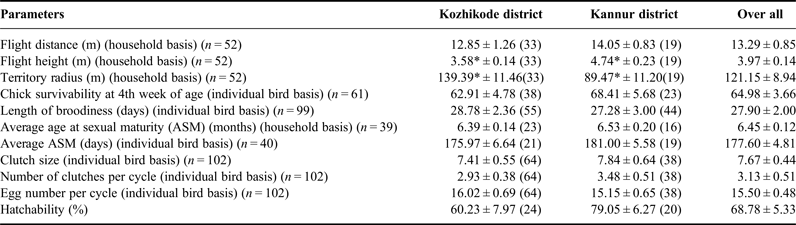
The survey study was conducted from 64 households of two districts of Northern Kerala, namely, Kozhikode (43) and Kannur (21). The information on flight height and distance and territory radius were retrieved from the households. A total of 52 farmers (33 from Kozhikode and 19 from Kannur districts), could provide this information. These data are of subjective type collected from farmers’ knowledge. The farmers were asked to show an end point the birds might travel upon excitement. The distance was measured to flight distance. The households were also asked to show the highest places like tree branches and roof tops normally their birds climb in a single takeoff and the height was measured to record flight height. They were asked to show the farthest place their birds travel from coop and distance was measured to record territory radius.
The parameters such as length of broodiness, age at first egg (AFE) in days, clutch size, number of clutches per cycle and egg number per cycle were collected only from those farmers who can provide correct data in this respect on individual birds they reared in the recent past or during the time of survey. The earliest age of laying among all birds was expressed as AFE in the flock and the average value was expressed as average ASM. The number of observations varied from trait to trait and is given along with the mean value in Table 1.
Behavioural characters, egg production and egg production-related traits of indigenous chicken studied by the survey method.

*Means bearing different superscripts within a row differ significantly (P < 0.05).
The ability of broody hen in saving its hatchlings up to 4th week of age was considered as the mothering ability. The mortality details from day-old to 72 weeks were retrieved only from the farmers who can provide complete data about the hatches in the recent past. The data were then assembled to calculate mortality pattern at chick (up to 8 weeks), grower (9–20 weeks) and layer (21–72 weeks) stages. Egg shell colour and sex-pooled body weight at day-old and 8th week of age and sex-separate body weights at 20th and 40th weeks of age were also recorded during survey. The unhatched eggs from 21 natural settings involving 212 total hatching eggs were break-opened to determine the fertility and hatchability of indigenous chicken.
Field egg recording study
A 1-year long field egg recording study was conducted to study the production performance and laying pattern of indigenous chicken. A total of 54 birds from 17 to 20 weeks of age available in 38 households at the start were used. The exact age of the birds was determined by ‘recalling method’ of interviewed farmers (women farmers can easily recall the date of hatch with associating other co-incidences). Finally, 43 ready-to-lay pullets from 31 farming households with their hatch date undoubtedly known with their owners willing to co-operate to this yearlong exercise were subjected for the study. The daily egg recording was done by the farmers on individual chicken basis in a datasheet with date of hatch and identification terminology about the chicken in farmers’ own description written on it. Weekly follow up was carried out to sustain the interest of farmers and to gather the data collected by them. The farmers retained the eggs at 28, 40 and 72 weeks of age to enable the author to record weight during his weekly visit. The mortality, cause of death and days of broodiness were also marked. Age at fist egg and average ASM were calculated from date of hatch and egg production record of each bird.
Data analysis
These data were assembled in a Microsoft excel spreadsheet and the parameters like AFE, average ASM, hen-housed (HH) (the number of birds at 21st week was considered as HH) and hen-day (HD) egg production, length of broodiness, clutch size, length of pause, number of clutches per cycle and number of eggs per cycle were arrived at. The mean values between the two districts of the study were compared using t-test. The livability percent was calculated for the period from 21 to 72 weeks of age. Linear and curvilinear regression analyses were performed on HH percent egg production to evaluate the fitness. Statistical analyses were run with SPSS software package (Version 12.0 for Windows; SPSS Inc., Chicago, IL).
Results
Behavioural characteristics
Flight distance and height
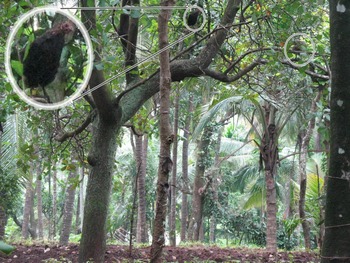
The results of survey on flight height, flight distance, territory radius and mothering ability are presented in Table 1. The overall flight distance reported was 13.29 m with vast majority of the farmers (80.77 percent) recounted values ranging between 10 and 15 m. The overall flight height reported by the farmers is 3.97 m with many farmers (46.15 percent) opining that the village chicken can fly a vertical height of 3–4 m in a single takeoff (Figure 2).
Perching behaviour of indigenous chicken.

Territory radius
The overall territory radius covered by the cocks from their coops was 121.15 m with many farmers (40.39 percent) giving values ranging from 51 to 150 m.
Mothering ability
The survival rate of chicks up to 4 weeks of age collected from 61 natural broodings revealed that 40.98 percent of the mother hens could save 76–100 percent of their hatchlings to 4 weeks. Overall chick survivability at 4 weeks of age was 64.98 percent.
Broodiness
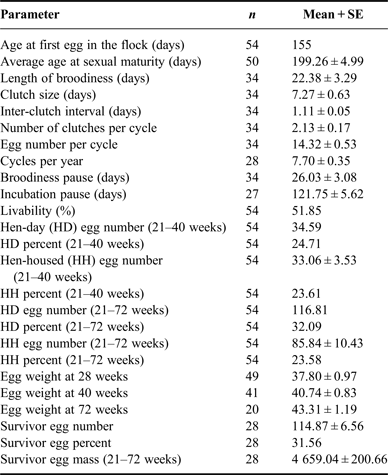
The data from 105 hens showed that majority of the indigenous hens are habitual brooders (98.1 percent) and very few were occasional brooders (1.9 percent). The survey data on 99 birds on length of broodiness revealed a wide variation among birds ranging from 7 to 65 days with a mean value of 27.90d. The length of broodiness estimated directly from egg recording study was 22.38d (Table 2).
Egg production and related parameters of indigenous chicken under daily field egg recording study from 21 to 72 weeks of age.

Mortality pattern
Overall mortality
The details on mortality in indigenous chicken collected from 41 farmers who could provide correct information on a total of 454 birds. The overall mortality in indigenous chicken from day-old to 72 weeks was 69.38 percent. Predation due to mongoose (29.52 percent) and death due to diseases (26.67 percent) are the major causes of mortality.
Chick stage
The graphical representation of the results for different stages is given in Figure 3. Out of 454 chicks at start, 278 from Kozhikode and 176 from Kannur districts, 130 (28.63 percent) died during chick stage. Among this, only 10 (7.69 percent) were due to disease, while the rest 120 (92.31 percent) was by predation. Predation due to mongoose was the most prevalent (44.63 percent), followed by shikra (16.15 percent), crow (9.23 percent), eagle and dog (6.93 percent each), cat (6.15 percent) and snake (2.31 percent).
Mortality pattern in indigenous chicken: (a) chick stage, (b) grower stage and (c) layer stage.

Grower stage
During growing stage, the total mortality was 21.6 percent of 324 birds (188 in Kozhikode and 136 in Kannur districts) entered into grower stage. The mortality due to diseases was 20 percent, while the rest 80 percent was due to predation. The dominant predator of this stage was wolf (24.29 percent), followed by mongoose (22.86 percent), cat (15.71 percent), shikra (7.14 percent), eagle (5.71 percent) and dog (4.29 percent).
Adult stage
From 254 birds (133 in Kozhikode and 121 in Kannur districts) available at the start (21 weeks of age), 115 birds (45.28 percent) died up to 72 weeks of age. The mortality due to disease, out of total mortality was 52.18 percent and the rest was due to predation (47.82 percent) by dog (18.26 percent), mongoose (16.52 percent) and wolf (13.04 percent). The mortality during adult stage (21–72 weeks of age) recorded directly from field egg recording study was 48.15 percent.
Diseases
The important diseases affecting indigenous chicken as perceived by the farmers are Respiratory Tract Infections (RTI) (37.21 percent), Ranikhet disease (34.89 percent), fowl pox (18.60 percent) and ectoparasites (9.3 percent). Most of the farmers felt that the diseases are common in summer season (76.47 percent) compared with winter and rainy seasons (25.53 percent).
Body weight
The early (day-old) and late (8th week of age) juvenile body weights of unsexed indigenous chicken from the study area were 28.83 ± 0.31 (n = 69) and 347.24 ± 12.17 g (n = 48), respectively. The pubertal body weight (20th week of age) of males and females were 1,428.42 ± 85.91 (n = 18) and 1,114.04 ± 45.01 g (n = 34) and the adult body weight (above 40 weeks of age) for males and females were 1,936.67 ± 96.83 (n = 22) and 1,445.63 ± 51.47 (n = 29), respectively.
Egg weight
The mean egg weight recorded from the birds under egg recording study at 28, 40 and 72 weeks of age was 37.80, 40.74 and 43.31 g, respectively (Table 2). The overall egg weight and average egg mass per bird recorded in field egg recording study from 21 to 72 weeks of age among the survivors was 42.24 and 4,659.04 g, respectively.
Shell colour
The eggs of indigenous chicken (n = 196) were dark brown (2.04 percent) or medium brown (12.24 percent) or light brown (73.48 percent) or creamy white (12.24 percent) in colour.
Fertility and hatchability
The break-open study of unhatched eggs revealed fertility of 71.22 percent and hatchability of 62.26 percent on total eggs set and 87.42 percent on fertile egg set.
Egg production and related characteristics
The mean values of egg production traits up to 72 weeks studied by indirect (survey) method from 64 women households who could provide complete production information on 164 hens they reared in the recent past are presented in Table 1 and that of direct egg recording study are given in Table 2.
Age at first egg
A vast majority (61.54 percent) of respondents opined that the AFE in indigenous chicken is between 6 and 7 months of age with the average ASM of 6.45 months. The AFE of 40 birds retrieved from 29 farmers by recalling method was 144d with the individual values ranging from 144 to 230d and ASM of 177.60d. Thirdly, the field egg recording study revealed AFE of 155d and ASM of 199.26d with individual variations ranging from 155 to 244d.
Laying cycle
The survey on clutch pattern retrieved by recalling memory on 102 hens revealed that number of clutches in a cycle ranged from one to 16 with most of the birds (38.24 percent) having three clutches; the mean clutch number per cycle was 3.13. The clutch size ranged from one to 25 eggs with majority of the birds (53.92 percent) having clutch size of five to eight eggs with the mean clutch size of 7.67 eggs. The egg production in a laying cycle ranged from four to 30 with a mean value of 15.50 eggs.
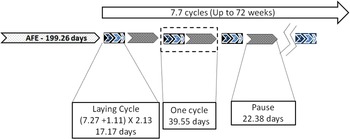
The field egg recording study revealed that there were 2.13 clutches in a cycle with inter-clutch intervals of 1.11d. The average clutch size was 7.27 giving rise to 14.32 eggs per cycle. There was an average of 7.7 cycles in 1 year production period (21–72 weeks of age). The graphical representation of laying pattern of indigenous chicken is depicted in Figure 4.
Laying pattern of indigenous chicken.

Pause
The broodiness pause documented from egg-recording experiment was 26.03d and the combined length of natural incubation and brooding (incubation pause) studied from 27 natural settings was 121.75d.
Egg number
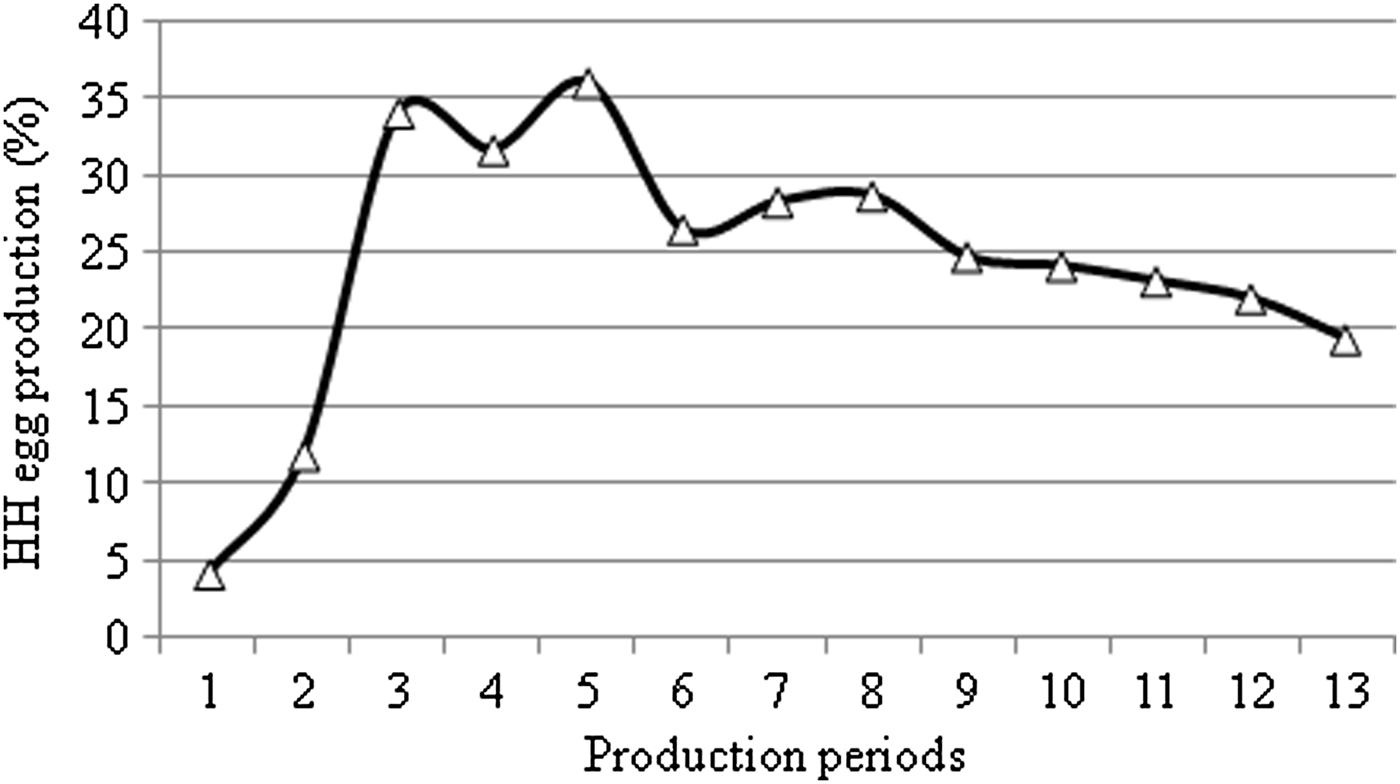
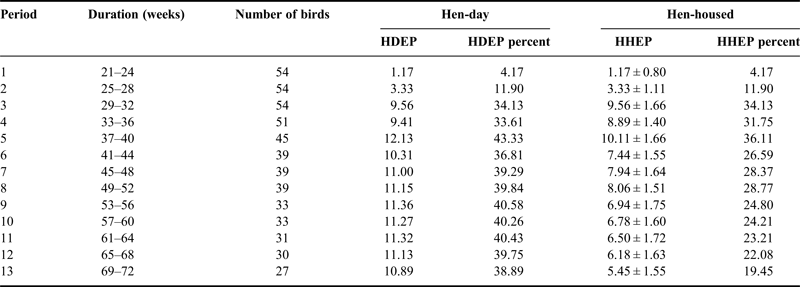
The graphical representation of period-wise HD egg production is presented in Table 3 and Figure 5, and the mean values are provided in Table 2. The mean egg number up to 40 weeks of age on HD and HH basis in indigenous chicken was 34.59 (24.71 percent) and 33.06 (23.61 percent) and the respective values up to 72 weeks of age were 116.81 (32.09 percent) and 85.84 (23.58 percent), respectively. The survivor egg number at 72 weeks of age was 114.87 (31.56 percent). The period-wise egg number was highest at fifth period (37–40 weeks of age) both in terms of HD (12.13 eggs or 43.33 percent) and HH (10.11 eggs or 36.11 percent) egg production. Although the period-wise HH percent egg production does not observe linear regression (R 2 = 0.02), a high degree of curvilinear fitness (R 2 = 0.82) was observed in indigenous chicken.
Egg production curve in indigenous chicken.

Period-wise egg production of indigenous chicken collected from field egg recording study.

HDEP, hen-day egg production; HHEP, hen-housed egg production.
Discussion
The ability of chicken to fly a horizontal and vertical distance of around 13 and 4 m respectively is an adaptability trait of indigenous chicken to evade predation. The horizontal flight is the effective way of evading aerial predators; whereas, vertical takeoff helps in escaping from terrestrial predators. It is therefore the farmers feel that exotic breeds or hybrid crosses are not able to move swiftly as effective as indigenous chicken when situation demands therefore not suited to this hilly agro-climatic terrain. The light body with strong wings of indigenous chicken gives them a greater chance of evading predators by fast running and flying to a safer place. Flying also assists the birds to perch on the tree branches to evade predators while resting. Similar explanation has earlier been offered by Kumar and Kumar (Reference Kumar and Kumar2007) on local hill fowls of Uttarakhand.
The cocks in the study area cover an average radius of 121.15 m from their coop. The average land holding per household in the area is only 29.45 cents or nearly 1,200 m2. It can be deduced from these data that the village chicken flocks are open flocks with cock of one household having overlapping territory on the neighbouring households. This possibly provides justification of our previous findings (Kumar et al., Reference Kumar, Churchil, Jalaludeen, Narayanankutty, Joseph, Kannan and Anitha2013) of 58 percent of households not maintaining cock in their flock also incubate eggs taking chance of their hens being mated by cocks from neighbourhood.
There was 35.02 percent depletion in chicks during first month of their life. More than 92 percent mortality during chick stage ascribed to predation as observed in this study explains the challenging task before the mother hens. A very poor chick survival rate of 13.43 and 9.73 percent at the end of 8 weeks has been reported from two districts of Kenya (Olwande et al., Reference Olwande, Ogara, Okuthe, Muchemi, Okoth, Odindo and Adhiambo2010). According to Sørensen (FAO, Reference Sorensen2010) indigenous chickens are ideal mothers, good setters, hatch their own eggs and excellent foragers.
The indigenous chicken exhibits strong broodiness character lasting for about 3–4 weeks as assessed by both direct and indirect methods in this study. Most of the farmers (92.7 percent) agreed that broodiness that is lacking in exotic breeds and hybrid crosses is indispensable from village chicken farming. In a similar study, Iqbal and Pampori (Reference Iqbal and Pampori2008) reported 82 percent hens with 12–15d and remaining 18 percent with up to 30d broodiness in indigenous chicken of Kashmir. Most of the indigenous chicken breeds of Indian subcontinent are reported to be broody (Vijh et al., Reference Vijh, Vij, Tantia and Ahlawat2005) except Nicobari breed of Nicobar Island, India (Vijh et al., Reference Vijh, Chatterjee, Vij, Tantia and Ahlawat2006).
During chick stage, the death due to diseases was only 7.69 percent while the rest was due to predators (92.31 percent). Terrestrial predators (61.01 percent) such as mongoose, dog, cat and snake dominate aerial predators (32.3 percent) such as shikra (Accipiter badius and A. virgatus) (local name – Prappidiyan), crows and eagle in flock destruction. In the growing stage, the role of terrestrial predators remained high (67.15 percent), whereas that of diseases had a positive shift (20 percent) with diminishing influence of aerial predators (12.85 percent). In adult stage, the highest damage was caused by diseases (52.18 percent) followed by terrestrial predators (47.82 percent). This result was in sharp contrast with the findings of Vij et al. (Reference Vij, Tantia, Anilkumar, Vijh and Ahlawat2007), who reported almost zero mortality from Tellichery chicken of this area. However, in Danki birds of India, Vijh et al. (Reference Vijh, Vij, Tantia and Ahlawat2005) documented a mortality rate of around 20–30 percent during first 2 months of age, similar to the result of present study. In grower stage, a very closer value of 21 percent mortality was documented in Baladi chicken in Saudi Arabia (Yousef and Al-Yousef, Reference Yousef and Al-Yousef2007). The study revealed that altogether there is 69.38 percent depletion from day-old to 72 weeks of age in village chicken much higher than that of intensively reared commercial layers (Farooq et al., Reference Farooq, Mian, Durrani and Syed2012). Biswas et al. (Reference Biswas, Uddin, Barua, Roy, Biswas, Ahad and Debnath2008) earlier reported that crow, eagle and mongoose are the main predators of day; while foxes, jackals and wild cats are the main predators of night. The village flocks are devastated by predators, especially during chick stage. This underlines the need for establishing Government chick nurseries to supply grownup desi birds as emphasized by the farmers of this region earlier (Kumar et al., Reference Kumar, Churchil, Jalaludeen, Narayanankutty, Joseph, Kannan and Anitha2013). The survey revealed that RTI and Newcastle disease (Local name: Kozhi vasantha) are the major disease conditions compared with fowl pox (local name: Aakkurippu) and ectoparasites (local name: Kozhipaén). Similar to the results of the present study, preponderance of Newcastle disease (Olwande et al., Reference Olwande, Ogara, Okuthe, Muchemi, Okoth, Odindo and Adhiambo2010; Melesse, Reference Melesse2014) and high disease occurrence in dry summer seasons (Sonaiya and Swan, Reference Sonaiya and Swan2004) in village chicken have already been established. The dry and windy nature of summer season that facilitates the dispersion of infectious agents in the environment in the form of dust, stress due to low availability of scavengeable feed and hot climate could be ascribed for high disease occurrence in this season.
The body weights at different age were in general, slightly higher than that of earlier reports (Yakubu, Ogah and Barde, Reference Yakubu, Ogah and Barde2008; Haunshi, Doley and Shakuntala, Reference Haunshi, Doley and Shakuntala2009) but similar only to that of indigenous chickens of Kenya (Olwande et al., Reference Olwande, Ogara, Okuthe, Muchemi, Okoth, Odindo and Adhiambo2010). The higher body weight observed in the study could partially be ascribed to the monsoon season during which the study was undertaken when abundant scavengeable feed resources (SFR) are available.
The range of AFE recorded by both direct and indirect method falls in line with the earlier report of 153–230d from Ethiopian indigenous chicken (Reta, Reference Reta2009). Vij et al. (Reference Vij, Tantia, Anilkumar, Vijh and Ahlawat2007) reported that the Tellichery breed of chicken from the area of present study had ASM ranging from 150 to 240 days with a mean value of 180 days which closely compare with the results of present study. However, a higher value of 201.6d reported in Indian native chicken breeds (Vijh et al., Reference Vijh, Chatterjee, Vij, Tantia and Ahlawat2006) might be ascribed to genetic and environmental variations between these populations.
The egg weight of indigenous chicken in literature showed high degree of variation with the present values falling above that of Ethiopia (Mogesse, Reference Mogesse2007), Sudan (Mohammed et al., Reference Mohammed, Abdalsalam, Kheir, Jin-Yu and Hussein2005) and Nigeria (Yakubu, Ogah and Barde, Reference Yakubu, Ogah and Barde2008) but below that of other parts of India (Iqbal and Pampori, Reference Iqbal and Pampori2008) and other countries (Olwande et al., Reference Olwande, Ogara, Okuthe, Muchemi, Okoth, Odindo and Adhiambo2010). The involvement of both genetics and environment could be attributed to this wide variation. Although not much information is available in the literature, the egg mass determined in this study is closer to the value of indigenous chicken of Ethiopia with Naked Neck morphology but higher than that of four other morphologies reported by Reta (Reference Reta2009) under on-farm conditions. With regard to shell colour, a closer observation of 77.1 percent brown and 22.9 percent white egg colours were reported from indigenous chicken of Kashmir (Iqbal and Pampori, Reference Iqbal and Pampori2008). Mogesse (Reference Mogesse2007) also reported shell colours of light brown, cream and white from scavenging indigenous chicken of West Ethiopia.
The hatchability rate observed in this study falls within the range of 70–80 percent observed earlier by Vij et al. (Reference Vij, Tantia, Anilkumar, Vijh and Ahlawat2007) in Tellicherry chicken of same area and closer to other indigenous breeds of India (Vij et al., Reference Vij, Tantia, Vijh and Ahlawat2005; Vijh et al., Reference Vijh, Vij, Tantia and Ahlawat2005) and Turkey (Sekeroglu and Aksimsek, Reference Sekeroglu and Aksimsek2009) but higher than the indigenous chicken eggs collected from Ethiopian markets (Reta, Reference Reta2009). Our earlier findings of more than 58 percent households not maintaining cock in their flocks (Kumar et al., Reference Kumar, Churchil, Jalaludeen, Narayanankutty, Joseph, Kannan and Anitha2013) could explain the poor fertility obtained. The hatchability of fertile eggs was comparable with commercial hatching using incubators indicating the ability of the indigenous mother hens in providing optimum incubation conditions to the hatching eggs as that of modern equipment. Many farmers believe that thunder and lightning can reduce the hatchability and placing pieces of iron and charcoal under the hens of natural incubation can subvert this.
The study revealed that the annual egg production of indigenous chicken is spread in 7.70 cycles separated by periods pause spanning 26.03 (direct assessment) to 27.90d (indirect assessment). The average egg production in a cycle was found to be 14.32 (direct assessment) to 15.50 (indirect assessment). The eggs in a cycle is laid in 2.13 (direct assessment) to 3.13 (indirect assessment) clutches and the clutches are separated by an inter-clutch interval of 1.11d (direct assessment). If the broody hen is allowed to incubate the eggs the length of pause extends to 121.75d. This period covers incubation (3 weeks) brooding (2–3 months) and recuperation periods after brooding (around 2 weeks). The number of eggs per cycle in the present study was higher than the previous reports (FAO, Reference Dinesh, Geerlings, Sölkner, Thea, Thieme and Wurzinger2009) but comparable with that of Iqbal and Pampori (Reference Iqbal and Pampori2008). The population under study recorded higher number of cycles per year compared with the indigenous chickens in other parts of India (Iqbal and Pampori, Reference Iqbal and Pampori2008) and other countries (FAO, Reference Dinesh, Geerlings, Sölkner, Thea, Thieme and Wurzinger2009; Reta, Reference Reta2009). The period of broodiness was also found to be shorter than that of indigenous chicken of Ethiopia (Reta, Reference Reta2009). The interventions adopted by the farmers to break broodiness and expedite the resumption of next cycle are dipping in water, rattling the nest, introducing new cocks, tethering the birds in unfamiliar surroundings and by inserting a quill feather through and through the nostrils. The egg number at 72 weeks of age was higher in the studied population compared with many other indigenous chicken populations in India (Vij et al., Reference Vij, Tantia, Vijh and Ahlawat2005; Vijh et al., Reference Vijh, Vij, Tantia and Ahlawat2005) and abroad (FAO, Reference Dinesh, Geerlings, Sölkner, Thea, Thieme and Wurzinger2009). The better genetic potential could be partially ascribed to the practice of selective breeding largely adopted by the housewives of the region. Clearly, more studies are required to evaluate the local germplasm for drawing definite conclusions. The analysis of egg production in indigenous chicken revealed a shift in the pattern with delayed peaking compared with breeds like White Leghorn (Savegnago et al., Reference Savegnago, Cruz, Ramos, Caetano, Schmidt, Ledur, El-Faro and Munari2012).
Conclusions
The present study revealed good egg-laying potential of indigenous chicken of this agro-climatic zone possibly due to their genetic merit or environment or both. The variability (CV) for egg production is very high in the studied population disclosing the possibility for genetic improvement by selective breeding. Multi-stage selection programme with selection for conformation traits like shank length during growing stage to resist predation and egg production and broodiness at laying stage can be adopted. Longer production cycle with short broodiness could be the selection criteria for improvement in egg number with retention of broodiness character. The studied zone should possibly possess a high degree of SFR as is endowed with diverse fauna and flora with very high rain fall. However, quantification of SFR needs to be taken up to ascertain the involvement of nutritional factors, if any, on high egg production of indigenous chicken of this region and also to recommend flock strength to this area. Phenotypic and molecular characterization to assess genetic diversity for evolving promising indigenous chicken varieties need to be taken up. Although, improved hybrids are not the choice of local farmers, they could hardly resist hybrid chicks when available at free of cost through Government schemes. The grownup birds of genetically improved indigenous chicken produced in state-run nurseries rather than hybrids can be disseminated to the farmers. This can revitalize the sector and protect from exotic and improved hybrids making inroads and associated problems on traditional poultry farming. As emphasized earlier by Magothe et al. (Reference Magothe, Okeno, Muhuyi and Kahi2012), a holistic strategy that increases productivity without increasing production costs or leading to loss of biodiversity must be developed. Such a strategy must take into account the various uses of the indigenous chicken in a rural household. A policy decision is the need of the hour to discriminate the zones which need the supply of hybrids from those in need of reintroduction of genetically improved indigenous chicken. Developing zone-specific indigenous germplasm could be the lasting solution in this direction to prevent genetic erosion.
Acknowledgements
This study was a part of the MVSc Thesis of P. Girish Kumar. The authors acknowledge the finance and infrastructure provided by the Kerala Agricultural University, Thrissur, Kerala, India for the successful conduct of the study.
Statement of interest
None.