The Inca Empire emerged from the Cuzco basin, at the heart of the valleys of the central Andes Cordillera (∼3,400 m asl) and expanded across the Andes in the generations preceding the arrival of the Spanish conquerors in the sixteenth century. For a long time, the common perception of this political entity was that of an expansionist state driven by internal security and economic goals (Collier et al. Reference Collier George, Rosaldo and Wirth1982). Over time, the univocal model developed from a literal reading of the Spanish chronicles proved increasingly incompatible with the archaeological evidence. Inca domination strategies adapted to the peoples and specific conditions they encountered. Thus, these strategies were not the same everywhere and depended particularly on the interest of the resources involved, the degree of cooperation of the populations, their level of social hierarchy, the earliness of their integration into the empire, and the distance from the capital (Alconini and Malpass Reference Alconini, Malpass, Malpass and Alconini2010). This highly utilitarian vision of imperial ambitions depicts the Incas above all as managers, administrators, and skilled negotiators who used the deterrent power of their armies to coerce peoples into submission (and brute force to quell rebels). For the same reasons, religious aspects in the chronicles, and then by a form of contagion in scientific works, have often been detached from the rest of the social interaction sphere, as if the sacred constituted an isolate that could be approached and studied separately from the rest. This was, in line with New Archaeology, the prevailing view, even though alternative perspectives have been proposed (e.g., Conrad and Demarest Reference Conrad and Demarest1984).
Since the beginning of this century, this trend seems to be reversing. Without neglecting the pragmatic aspects of the Inca expansion process, the motivations for this expansion are now being reconsidered in the light of Native ontology and the Incas’ worldview. Indeed, an increasing number of researchers are emphasizing a fundamental factor: the sacred entities and their control (e.g., Acuto and Leibowicz Reference Acuto and Leibowicz2020; Eeckhout Reference Eeckhout2004a; Scott Reference Scott2009). To understand this process, as much as possible, one must attempt to “think Inca” (D’Altroy Reference D’Altroy2015:119–173). The Incas lived in an “animated” world, where natural landscape elements like mountains, rocks, lakes, or springs are endowed with their own form of life and consciousness and a capacity to act in the world (Bray Reference Bray2015). This agency makes them interlocutors of humans, who must behave appropriately toward these sacred entities, these huacas, so that the balance of the universe (yanantin) is maintained and, if necessary, restored (Topic Reference Topic, Curatola and Ziołkowski2008). It is for this purpose that rituals are performed, at different levels and at all scales, from the humble daily offerings to Pachamama to the most spectacular ceremonies: mass pilgrimages and human sacrifices.
The networks formed by these huacas shape the environment like a map of identity and memory because of myths and legends attached to them. From such a source emerged the first founding ancestor of the lineage; such a mountain is a deity whose exploits are recounted through oral tradition; such a lake was the scene of a fabulous episode from the myth of origin of the local populations, and so forth. Thus, the paths one traverses cross territories deeply imbued with collective memory, where humans are just one of the active components, in constant interaction with the rest of the universe (Yaeger and López Bejarano Reference Yaeger, María López Bejarano, Alconini and Covey2018). This vision of the world is both general and specific: it is shared by all Andean populations, but each according to its own frame of reference, and it preceded the empire. The Incas were initially just one of the myriad ethnic groups that populated the central Andes. There were thus local, regional, and under the Incas, imperial huacas. Each people had its mythology and the entities that embodied it in its own environment.
Given all this, conquering a territory is not merely a trivial military or materialistic operation but also a complex process involving multiple actors, human and otherwise, that must all be reconciled under Inca rule. This is fundamental for understanding how the Incas conducted their conquests and built their empire: in their eyes, all huacas exist, whether Inca or not, and all are potentially active and agentive. They must therefore be conciliated and not eliminated or scorned, as the Spaniards would later do. The huacas are intimately part of the life of societies, and consequently, they are considered in the first instance to subjugate them.
Among these preexisting huacas, two seem to have held a privileged position: Pachacamac, on the central coast of Peru, and the Island of the Sun on Lake Titicaca, in the Bolivian altiplano. Their regional importance prior to the Late Horizon, and the prominent place subsequently given to them by the Incas in their cosmology, make them particularly interesting case studies that we aim to explore in this article—including the so-called capacocha figurines, which were discovered in significant numbers at both sites. However, unlike the well-documented capacocha ceremony in ethnohistorical and archaeological sources, no sacrifices appear to be explicitly associated with these figurines in the archaeological remains at either Pachacamac or Titicaca. To understand the meaning that can be attributed to them, we will first briefly summarize what is known about this ceremony, then take a closer look at the figurines, the historical trajectory of the two sites, and the privileged link that united them—along with Cuzco—in Inca cosmology.
The Capacocha Ceremony and Its Material Correlates
The capacocha was a ritual triggered in response to specific events that affected the entire empire. It may concern the death or coronation of a sovereign, or even an illness from which he suffers, or epidemics, particularly severe drought periods, or any other episode of cosmic tension, when the natural order of things is weakened, threatened, or questioned, in this universe of constant interaction where the Incas lived (Rowe Reference Rowe and Steward1946).
If one of the main reasons for conducting the capacocha was to implore the huaca to ensure the smooth running of the Inca’s reign, the way the ceremony unfolded and the multiple actors mobilized denote a universal involvement; that is, all people and all deities. Indeed, all the provinces participated by first sending to Cuzco children or young adolescents specially selected for their beauty and physical perfection. Once in the capital, they received great attention, and the Sapa Inca presided over the rituals to which they were subjected, over 10 days. Then, the children left Cuzco in all directions, distributed into different processions following the ceques, straight pathways from which they could not deviate, regardless of obstacles. This journey could last weeks, or even months, depending on the destination. The destination was always a sacred place, and for the Incas, the mountainous apus are of utmost importance. Once they arrived at the location, the children were sacrificed, the climax of this long ritual that encompassed the entire territory and all the peoples under Inca domination (Cobo Reference Cobo1990 [1653]:Book I, Chapter 32:154–157; Molina Reference Cerrón-Palomino and Astete2021 [1575]:253–259).
We do not have material traces of most of this ceremony, except for its final phase, as consensus has formed around the idea that children buried at the tops of the Andean mountains in Argentina, Chile, or Peru, indeed correspond to capacocha sacrifices. These are highly codified, and the contributions of archaeology and related sciences help to better understand both how things were carried out, how they were prepared by the Incas, and the general framework in which these rituals fit (e.g., Wilson et al. Reference Wilson, Brown, Villa, Lynnerup, Healey, Ceruti and Reinhard2013).
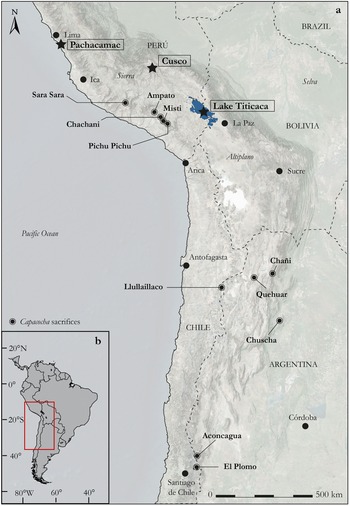
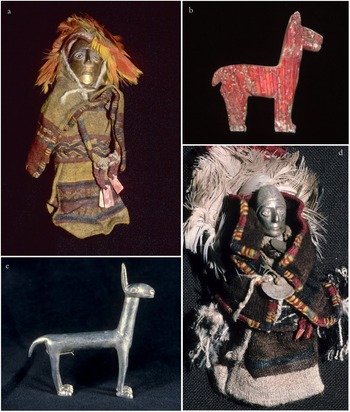
Archaeologically documented contexts for capacocha sacrifices are rare, with a total of 11, only one of which (Llullaillaco) has been found completely intact (Figure 1). The ritual furnishings accompanying the sacrificed children is sumptuous, and notwithstanding taphonomic factors, it is possible to identify certain recurring patterns in the types of associated objects (Supplementary Material 1).Footnote 1 Most of these items (ceramics, clothing, and certain accessories) can be found in contexts other than those of capacocha, and their isolated presence cannot therefore be considered diagnostic of this specific ceremony. However, there are two exceptions: elaborate wooden spoons and anthropomorphic and zoomorphic figurines made from precious materials (gold, silver alloys, or Spondylus). These small figurines (depicting both sexes) and miniature llamas (Figure 2) regularly accompanied human sacrifices but were also present in offering contexts without any explicitly associated sacrificial individuals (Bachraty Reference Bachraty2025; Dransart Reference Dransart and McEwan2000). Male and female figurines could be identified as representations of Inca elites or even as the emperor and his wife, the coya (Albornoz Reference Albornoz1967 [1571]:17; Bachraty Reference Bachraty2025). However, the very concept of representation in Inca art is increasingly debated. Based on the ethnographic theory of perspectivism, Alberti (Reference Alberti, Alberti, Jones and Pollard2013:46) argues that “the conventional sense of representation does not exist. Thus, archaeological artifacts do not ‘make visible’ the general principles of a culture or a society but are examples or manifestations of those principles.” Like other unusually shaped natural objects or artifacts with peculiar iconography (Bray Reference Bray2009; Sillar Reference Sillar2009), capacocha miniatures appear as acting entities; that is, endowed with agency, while being symbolically associated with Inca supreme power.Footnote 2
(a) Location of Pachacamac on the Pacific Ocean coastline, Cuzco in the Sierra, and Lake Titicaca in the northern altiplano, along with the 11 capacocha sacrifice sites mentioned in this article (Ceruti Reference Ceruti1999, Reference Ceruti and Schobinger2001, Reference Ceruti2003; Horta Tricallotis Reference Horta Tricallotis2023; Reinhard and Ceruti Reference Reinhard and Ceruti2010); (b) location of the study area on the South American continent. (Color online)

Figure 1 Long description
A map of South America highlighting capacocha sacrifice sites. Key locations include Pachacamac on the Pacific Ocean coastline, Cuzco in the Sierra and Lake Titicaca in the northern altiplano. Other marked sites are Sara Sara, Chachani, Pichu Pichu, Ampato, Misti, Llullaillaco, Quehuar, Chani, Chuscha, Aconcagua and El Plomo. The map includes major cities such as La Paz, Sucre, Antofagasta and Santiago de Chile. The inset map shows the study area on the South American continent, with a red box indicating the region of interest. The map uses symbols to denote sacrifice sites, with stars marking key locations and dots indicating other sites. The map scale is 500 km and geographic boundaries of countries like Peru, Bolivia, Chile and Argentina are visible.
Examples of capacocha offerings from (a, b) Ampato; (c) Llullaillaco; (d) Copiapo (courtesy of Johan Reinhard). (Color online)

Figure 2 Long description
Four photographs arranged as a two-by-two collage on dark backgrounds. First photograph: A standing figurine wearing layered woven textiles. A metallic face is set into the figure. A feathered headdress surrounds the top. A small hanging ornament is attached near the front. Second photograph: A llama-shaped figure with a rectangular body and four legs. The surface shows scattered marks and worn areas. Third photograph: A metallic llama-shaped figure with a long neck, four legs and a flat base. Fourth photograph: A seated figurine wrapped in woven textiles. A metallic face is set into the figure. A feathered headdress surrounds the top. A round disc-shaped ornament rests at the front.
Through these precious figurines, the emperor and even the royal couple participated directly in all sacrificial expeditions. Their sacred aura and power are tied to each ceremony, ensuring its proper execution. Following this line of reasoning, we can better understand why precious miniatures could be deposited without any direct association with a sacrifice (Hamilton Reference Hamilton2018:233; Ondegardo Reference Ondegardo and Ferrario2012 [1583]:f. 29, p. 7). They were sacred entities, referring to the primordial, founding mythical couple (Delaere and Capriles Reference Delaere and Capriles2020; Horta Tricallotis Reference Horta Tricallotis2023). This is why we refer to them as capacocha-related—in the sense that the rituals involved were of an imperial scale, directly involving Inca royalty, as attested by these precious figurines. The latter wore miniature garments directly inspired by the outfits of the Cuzco elites. However, it appears that two types of finery are specific to capacocha figurines: plain rectangular mantles (yacolla) with edges embroidered with alternating-colored blocks and miniature pins (tupu).
From an archaeological perspective, the remains of such high-profile rituals can be present with or without a corpse—either because the latter has not been preserved due to taphonomic factors or because the sacrifice simply did not take place, or did not occur at the same location, as we will later argue. In disturbed contexts, diagnostic elements for such sacrifices include elaborately worked wooden spoons, while those associated with figurines include specific yacollas and miniature tupus. These components of the capacocha and high-profile ritual contexts, variable but recurrent, are valuable clues that allow us to attest or at least suggest that these ceremonies took place even when only part of the remains of it have reached us. In terms of material culture, they thus prove diagnostic of this type of ritual, as has been argued for sites like Isla de la Plata in Ecuador (Dorsey Reference Dorsey1901), Túcume in the Lambayeque Valley (Narváez Reference Narváez, Heyerdahl, Sandweiss and Narváez1995), Yayno in the Callejón de Huayllas (Lau Reference Lau2019), Corral Redondo in the Churunga Valley (King Reference King2016), or Chokepukio in the Lucre Basin, Cuzco region (Gibaja Oviedo et al. Reference Gibaja Oviedo, McEwan, Chatfield and Andrushko2014). Although similar to high mountain contexts in some ways, those evidences are also different in others, from one site to another, suggesting adaptations and some form of local agency.
Lake Titicaca and the Island of the Sun
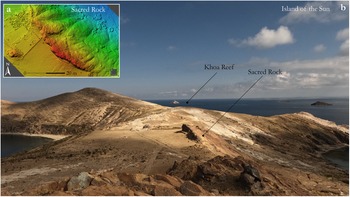
Lake Titicaca is a vast expanse of water covering an area of 8,560 km2 on the border between Peru and Bolivia in the highlands (Figure 1). Spanning nearly 14.3 km2, the Island of the Sun is separated from the Copacabana peninsula by a strait over 1 km wide (Delaere and Guédron Reference Delaere and Guédron2022). The island is about 12 km long and 8 km at its widest part and surrounded by numerous small islands, islets, and reefs—rocky spurs that are outcropping or submerged at shallow depths—including Khoa reef located to the north. The Island of the Sun has been inhabited since at least the beginning of the second millennium BC (Stanish and Bauer Reference Bauer2004:23-25). Upon the arrival of the Spaniards in the sixteenth century AD, the “Sacred Rock” (Titikala), located in the northern part of the island, is considered the birthplace of the Sun and the Moon, and by association, that of the primordial couple of the Inca dynasty (Stanish Reference Stanish2001:225). Under Inca rule, it became part of a vast complex named the Sanctuary area, which was the climax of the imperial pilgrimage. The sector of the Sacred Rock corresponds to a large rocky outcrop whose south face dominates, over 80 m in length and 5.5 m in height, a large plaza whose western side is delimited by the remnants of an Inca wall with trapezoidal doors and windows (Bauer and Stanish Reference Stanish2001; Figure 3).
(a) Digital elevation model (DEM) of the Sacred Rock of the Island of the Sun; (b) view of the Sacred Rock and the Khoa reef north of the Island of the Sun (photo and model by Christophe Delaere). (Color online)

Figure 3 Long description
A small inset digital elevation model shows terrain with contour lines and the label Sacred Rock. A scale bar reads 20 m. The main photograph shows a wide, elevated view over rocky hills and a large body of water under a sky with scattered clouds. Text labels read Island of the Sun, Khoa Reef and Sacred Rock. Two leader lines extend from the labels Khoa Reef and Sacred Rock toward points on the water and shoreline area.
Control of the lake basin by the Incas is attested around AD 1450–1475 (Stanish Reference Stanish2003:237; Yaeger and López Bejarano Reference Yaeger, María López Bejarano, Alconini and Covey2018). According to the standard version of the conquest’s history, the Incas, leveraging ancient rivalries, formed a coalition with the Lupaqas to defeat the Collas before turning against the former (Bouysse-Cassagne Reference Bouysse-Cassagne1992:122–123). The Incas profoundly transformed the demography and layout of the Island of the Sun at this time: only a reduced population of selected settlers (mitimae) was maintained on the island along the agricultural zones, to meet the needs of the priestly class administering the island’s sanctuaries (Bauer and Stanish Reference Stanish2001:160–161). The interest of the Island of the Sun for the Incas, and that of Lake Titicaca in general, is probably better explained by its ideological rather than economic significance. More specifically, Bauer and Stanish (Reference Stanish2001:53) report the visit of a priest from the Island of the Sun to the sovereign of Cuzco: “The priest told the royal Inca about a rock that was already widely recognized by the local population as the origin place of the Sun.” The potential preexistence of a Sun cult outside of Cuzco and the presence of active priests on the island prior to the Inca period are noteworthy. The new rulers probably changed the name from “Island of Titicaca” to “Island of the Sun” (Bandelier Reference Bandelier1910).
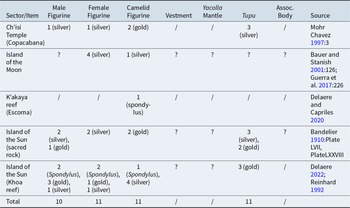
At Lake Titicaca, various capacocha-related offerings have been found on coast hilltops, on islands, and in the lake. To date, we have identified at least 32 figurines made of metal or Spondylus from this place, as well as numerous associated material remnants such as miniature gold or silver tupus (Table 1). First, at the center of the semisubterranean temple of Chis’i, located on a hilltop on the Copacabana peninsula and dated to the Early Intermediate period (200 BC–AD 650), an offering context from the late Inca era was discovered during the 1993–1995 excavation campaigns. This consisted of a hollow silver female figurine associated with three small silver tupus, and about 2.5 m from the first context, a solid silver male figurine associated with two gold llama figurines (Mohr Chavez Reference Mohr Chavez1997). This example illustrates the Incas’ intent to honor and reconcile with the ancient huacas of the lake basin.$
Capacocha-Related Offerings South of Lake Titicaca, Bolivia (32 Figurines; 22 from the Island of the Sun).

Table 1 Long description
The table lists counts and materials of male, female, and camelid figurines by sector, plus associated items such as vestments, yacolla mantles, tupu pins, and whether a body was associated. Overall totals are close across figurine types: ten male, eleven female, and eleven camelid. The Island of the Sun dominates the assemblage: the sacred rock area includes three male and two female figurines and two camelids, while the Khoa reef has the largest and most varied set, including multiple gold, silver, and spondylus figurines across all three categories. Ch’isi Temple has small numbers of silver male and female figurines and two gold camelids, along with three silver tupu pins. Island of the Moon reports four female figurines and one camelid, but several entries are unknown. K’akaya reef records only one camelid figurine made of spondylus. Vestments and yacolla mantles are mostly unreported, and the presence of associated bodies is generally absent or unknown, so comparisons for those columns are limited.
Note: The table includes only figurines and artifacts associated with them, such as the accessories of anthropomorphic figurines, as well as the presence or absence of human sacrifice.
Another example is three female figurines and one llama figurine, all in silver, currently preserved at the Ethnologisches Museum in Berlin, which originated from Coati Island (Guerra et al. Reference Guerra, Fischer, Radtke and Reinholz2017), also called the Island of the Moon. Adolph Bandelier is said to have discovered a silver female figurine on the island (Bauer and Stanish Reference Stanish2001:126, photo 5.15). Although the contexts are not documented, the presence of the ruins of an acllahuasi (house of the chosen women) on Coati Island (Iñak Uyu) illustrates the Incas’ investment in other islands of the lake, particularly this insular space located opposite the Island of the Sun.
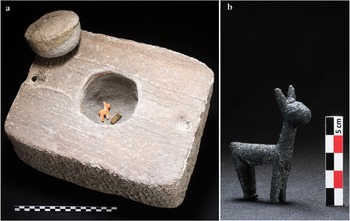
Most of the miniature Inca figurines from Titicaca have been discovered around natural rock formations. First, on the Island of the Sun at the Sacred Rock, where at least seven gold and silver figurines, along with five small tupus, were reportedly discovered around the rock by local inhabitants and purchased by Bandelier at the end of the nineteenth century (Bandelier Reference Bandelier1910:Plates LVII and LXXVIII; Table 1). Second, they were discovered on two submerged reefs, both characterized by their distance from the shores in the middle of the lake. The first reef, K’akaya, which faces the bay of Escoma on the eastern shore of the lake (Delaere and Capriles Reference Delaere and Capriles2021), is an isolated underwater Inca offering that demonstrates the widespread practice of Inca ceremonies involving offerings in lake waters. The box contains two items: a camelid figurine made of Spondylus shell and a cylindrical gold sheet, which could represent a miniature version of a chipana—a bracelet usually worn by Inca noblemen on their right forearms (Besom Reference Besom2013:269; Figure 4a).
Underwater Inca offerings found at Lake Titicaca: (a) K’akaya Reef; (b) Khoa Reef (photos by Teddy Seguin). (Color online)

Figure 4 Long description
The image A showing a studio-style photograph on a plain dark background of a rectangular stone container with a circular cavity. A round stone lid rests on the container. Inside the cavity are two small items: one cross-shaped piece and one small curved piece. A horizontal measurement scale with alternating blocks runs along the lower edge of the photograph. The image B showing a studio-style photograph on a plain dark background of a small llama-shaped figurine standing on four legs. A vertical measurement scale stands next to the figurine. The scale is labeled 0, 1, 2, 3, 4, 5 with the text centimeter and the top label reads 5 centimeter.
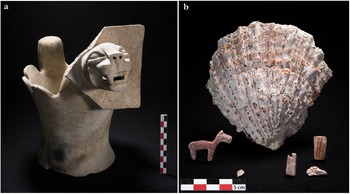
The second reef, Khoa, is located north of the Island of the Sun (Delaere, Reinhard, et al. Reference Delaere, Reinhard, Huanca, Siñanis, Elkin and Delaere2023). It is now completely submerged, but environmental reconstructions (Delaere,Guédron, and Fritz Reference Delaere, Guédron and Fritz2023; Guédron et al. Reference Guédron, Delaere, Fritz, Tolu, Sabatier, Devel, Heredia, Vérin, Alves and Baker2023) show that the Khoa reef was a natural rock that protruded above the water during the Inca period. In 1977, amateur divers uncovered Inca underwater offerings around this submerged reef (Ponce Sanginés et al. Reference Ponce Sanginés, Reinhard, Portugal, Pareja and Ticlla1992). Subsequent expeditions, conducted between 1988 and 2013 (Delaere Reference Delaere2020; Ponce Sanginés et al. Reference Ponce Sanginés, Reinhard, Portugal, Pareja and Ticlla1992; Reinhard Reference Reinhard and Saunders1992), have reconstructed a rich assemblage of offerings, uncovering not only artifacts from the Inca period but also those dating back to the Tiwanaku period. The Tiwanaku offering kit (AD 500–1000) primarily consisted of incense-burners (Figure 5a), camelid sacrifices, and Spondylus shell objects (Figure 5b; Delaere et al. Reference Delaere, Capriles and Stanish2019). The underwater offerings made by the Incas (AD 1450–1532) represent a particularly fascinating variant of the capacocha ceremony. At least 28 of these Inca boxes have been discovered (Delaere Reference Delaere, Luján Dávila, Lane and Eeckhout2022), which illustrates the extraordinary ritual investment of the Incas in this place. They consist of a series of cylindrical or cubic stone boxes containing gold, silver, and shell miniatures of males, females, and camelids, all meticulously deposited at the bottom of the lake from boats in their box (Figure 4b). Although the majority of the stone boxes were no longer intact, whether due to taphonomic factors or looting, at least 15 figurines have been recorded, either inside the four intact coffers that were discovered or in the surrounding sediment (Delaere Reference Delaere, Luján Dávila, Lane and Eeckhout2022:21, Figure 3). There were also other elements, likely textile, as evidenced by the presence of miniature tupus at the site, but these have not survived the ravages of time.
(a, b) Underwater Tiwanaku offerings found at Khoa Reef (photos by Teddy Seguin). (Color online)

Figure 5 Long description
Two side-by-side studio photographs on a plain dark background. Left photograph: A sculpted ceramic vessel stands upright. A raised animal figure is attached to the vessel and a flat rectangular piece rises behind the figure. A vertical measuring scale with alternating blocks is placed to the right of the vessel. Right photograph: A single fan-shaped shell is centered. Below the shell are several small objects, including a four-legged animal figurine and multiple small rectangular pieces. A horizontal scale bar at the bottom shows the text “5 cm” and a segmented bar.
The Lurín Valley and the Oracle of Pachacamac
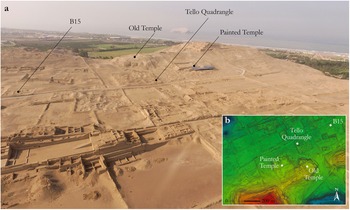
Covering nearly 5 km2 at the mouth of the Lurín River on the central coast of Peru, facing the Pacific Ocean, the site of Pachacamac consists of three concentric sectors (see Eeckhout Reference Eeckhout2013:Figure 1). The Sacred Precinct, to the south near the sea, contains the main temples: the Old Temple of Pachacamac, the Painted Temple, and the Temple of the Sun, as well as a funerary structure called the Tello Quadrangle and a vast necropolis (Figure 6). The Second Precinct includes numerous monumental adobe buildings, notably elite residences known as ramped pyramids, but also other buildings and plazas, the most important of which, the Pilgrims’ Plaza, dates from the Inca period. The Third Precinct, the largest and least explored, appears today as a desert, its dunes covering the many low buildings that formed the suburbs of Pachacamac. It also contains an acllahuasi, built by the Incas near the Urpi-Wachak Lagoon, northeast of the Pilgrims’ Plaza.
(a) View of the Sacred Precinct at Pachacamac from the south, showing the four sectors mentioned in this article; (b) digital elevation model (DEM) highlighting the Painted Temple, Old Temple, Tello Quadrangle, and B15 (photo and model by Alexandre van Dongen). (Color online)

Figure 6 Long description
A) An aerial view of the Sacred Precinct at Pachacamac, Peru, showing labeled locations: B15, Old Temple, Tello Quadrangle and Painted Temple. The landscape is arid with visible structures and the Pacific Ocean in the background. B) A digital elevation model (DEM) of the same area, highlighting the Painted Temple, Old Temple, Tello Quadrangle and B15. The model uses elevation gradients to depict the terrain, with labels indicating the positions of these structures. The DEM provides a detailed topographic representation of the site.
Founded during the Early Intermediate period (200 BC–AD 650), the site was occupied until the arrival of the Incas in the fifteenth century. Pachacamac was one of the first settlements visited by the conquistadors, as early as January 1533. They described it as the sanctuary of an oracular deity, the object of mass pilgrimages from the reaches of Tawantinsuyu (Eeckhout Reference Eeckhout, Petrocchi and Ziolkowski2008). One of the main motivations of the faithful was the hope that the deity would heal the sick and infirm, of whom many examples have been found in funerary contexts (Davies-Barrett et al. Reference Davies-Barrett, Lawrence and Peter2021; Owens and Eeckhout Reference Owens, Eeckhout, Eeckhout and Owens2015). According to the standard version of the history of Inca conquests, Topa Yupanqui and his troops arrived at Pachacamac in AD 1476 and took the city of the Oracle (Rowe Reference Rowe1945). The specifics of this incorporation are not known (the chronicles mention a form of voluntary surrender), but it is clear that the Ychsma polity was not a significant opponent against the imperial armies. Historical and archaeological data also indicate that the Incas were less interested in the military or strategic character of the site—which was quite negligible—than in its symbolic and religious role (Rostworowski de Diez Canseco Reference Rostworowski de Diez Canseco1992). It is this role that they developed, elevating what was essentially a local/regional cult to a pan-Andean scale. In addition to physically reshaping the site, the new rulers also changed the name of the site from Ychsma to Pachacamac (“the Creator of the World”), and the name of the valley to Lurín—that is, “Hurin,” meaning “down/bottom” (Santillán Reference Santillán and Santillán1879 [1563]:32–33), according to the binary structural opposition categories common among the Incas. There are explicit statements of repeated capacocha sacrifices and offerings to Pachacamac in the ethnohistorical record (Ávila Reference Ávila and Taylor1987 [1608?]:22:331; Eeckhout Reference Eeckhout2004b:13–18).
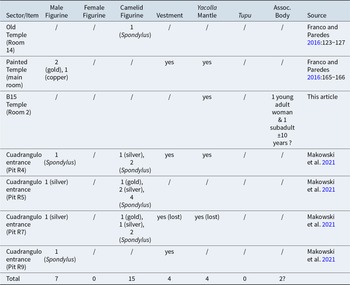
At Pachacamac, capacocha-related offerings have been found in intrusive caches within the Sacred Precinct, particularly in the Old Temple, the Painted Temple, and the Tello Quadrangle, but also in B15, a 1,400 m2 ritual-dedicated building we excavated nearby and located in the Second Precinct (Figure 6). To date, we have catalogued at least 22 metal or Spondylus figurines discovered at Pachacamac, not to mention numerous material remnants, miniature clothing accessories, and components of the “offering kit.” Given the looting that the sanctuary has experienced since the sixteenth century, these remains are likely just a fraction of what the capacocha offering practice at Pachacamac once was (Table 2).$
Capacocha-Related Offerings at Pachacamac (22 Figurines).

Table 2 Long description
The table inventories figurines and related items by excavation context, listing counts of male, female, and camelid figurines by material, plus associated garments, pins, and any linked human remains. Totals indicate seven male figurines and fifteen camelid figurines, with no female figurines recorded. Camelids appear in four contexts, peaking at Cuadrangulo entrance Pit R5 with one gold, two silver, and four Spondylus camelids; other Cuadrangulo pits include mixed silver, gold, and Spondylus camelids. Male figurines occur mainly at the Cuadrangulo entrance pits and the Painted Temple, including two gold and one copper male figurines in the Painted Temple main room. Clothing items are limited: vestments and yacolla mantles are each noted in four contexts, including the Painted Temple and several Cuadrangulo pits, with one pit listing these garments as lost. No tupu pins are reported in any context. Associated bodies are mentioned only for B15 Temple Room 2, described as one young adult woman and one subadult around ten years old, with uncertainty noted for the subadult age estimate.
Note: The table includes only figurines and artifacts associated with them, such as the accessories of anthropomorphic figurines, as well as the presence or absence of human sacrifice
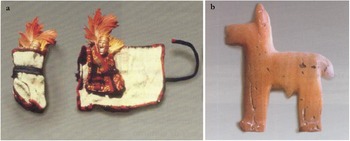
In the Old Temple of Pachacamac, a carved Spondylus artifact was found in room R14 (Recinto de los Cántaros). It represents a camelid and was associated with soil fill covering a series of intrusive vases placed there as offerings after the temple was abandoned (Franco and Paredes Reference Franco and Paredes2016:123–127, Figure 131; Figure 7b). These are superimposed on other ceramic offerings dated to the end of the Middle Horizon, attesting to the uninterrupted sacredness of the place for centuries, up to the Inca period. This small camelid exhibits the typical stylistic characteristics of the Late Horizon and is very similar to one found in an Inca underwater context at Lake Titicaca (see Figure 4a). Just like at Pachacamac, the continuity of offerings over time is also evident at Lake Titicaca, as illustrated by another Spondylus camelid figurine (Figure 5b), which dates to the Middle Horizon. Although both figurines are extremely similar, the Middle Horizon figurine was found in a Tiwanaku stratigraphic context, clearly separated from the Inca level by 20 cm of sediment (Delaere Reference Delaere2020:143, Figure 5.46).
(a) Gold figurine dressed in a shirt (unku), a mantle, a pouch (chuspa), and a belt-like headband (chumpi) from Pachacamac; (b) small Inca camelid in Spondylus from Pachacamac (courtesy of Régulo Franco Jordán). (Color online)

Figure 7 Long description
Two photographs placed side by side on a plain surface. Left photograph: A small figurine with a feathered headdress is attached to a rectangular backing with a border. A separate narrow piece with a matching border lies to the left of the backing. A thin cord extends from the right side of the backing. Right photograph: A camelid-shaped figurine is shown in side view, with four legs, a raised neck and a flat back. Small dark marks are present on the body.
In the Painted Temple, Franco and Paredes (Reference Franco and Paredes2016:165) carried out a superficial cleaning of the interior walls of the huge looting pit at the upper platform, supposedly the original location of the Pachacamac idol’s sanctuary. On the west side, they found among the debris three metal figurines that had, fortunately, escaped looting. These consisted of two gold figurines and one copper figurine, each dressed in a shirt (unku), a mantle, a pouch (chuspa), and a belt-like headband (chumpi). One of the figurines wore a fan of red and yellow feathers on its back (Figure 7a). Franco and Paredes identified them as diagnostic artifacts associated with capacocha rituals. It was through the undressing of the figurines that the entirety of their trousseau was revealed. Among these items was a solid-colored mantle bordered in red and black, which constituted the wrapping of the offering. It is similar to those from mountainous capacocha contexts and identical to one that we found in building B15 (see Figure 8b).
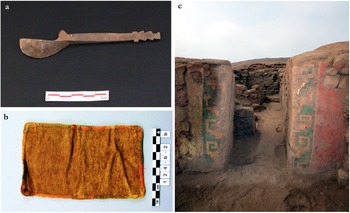
(a) Crafted wooden spoon; (b) intact miniature mantle (yacolla); (c) entrance walls of Room 2 in B15, Pachacamac, decorated with paintings (photo by Peter Eeckhout). (Color online)

Figure 8 Long description
Image A shows a crafted wooden spoon with a flat, elongated shape and a serrated handle. Below the spoon is a scale for measurement. Image B displays an intact miniature mantle with a solid color and bordered edges. A scale with labeled increments is placed beside the mantle. Image C depicts the entrance walls of Room 2 in B15, Pachacamac, featuring decorative paintings with geometric patterns. The walls are made of stone and show signs of wear and erosion.
The excavations conducted by Makowski and others (Reference Makowski, Vargas and Villavicencio2021) in the Tello Quadrangle encountered four contexts of offerings totaling 18 miniature figurines that can also be linked to the capacocha ceremony. Two of the pits were located on either side of the entrance at the front of the building and two others on the north side. Each of the four offerings is composed of a group of miniature elements made of different materials. In each offering, the central element is a male individual, accompanied or not by a series of camelids. The anthropomorphic figurines were made either in metal or Spondylus. Their garment consists of an unku and a chuspa, as well as a yacolla, tied with a cord (Makowski et al. Reference Makowski, Vargas and Villavicencio2021). The style and characteristics of these different elements are quite like those described in the mountainous capacocha contexts mentioned in the preceding text. It should also be noted that, just like the offerings from the Old Temple and the Painted Temple, those from the Tello Quadrangle constitute intrusions in relation to pre-Inca religious buildings and funerary structures of major importance, whose antiquity dates back several centuries or even a millennium (Eeckhout Reference Eeckhout2013). It is evidently because of this extreme sacredness that the Incas chose these specific places for their capacocha ceremonies.
The same pattern repeats in B15, a ritual-dedicated building excavated from 2014 to 2018 northeast of the Sacred Precinct, which was continuously used and modified from the Middle Horizon until the Spanish conquest, covering approximately 700 years (Eeckhout Reference Eeckhout and Eeckhout2020; Luján Dávila and Eeckhout Reference Eeckhout and Pérez2022). Phase 5, which interests us, corresponds to the transconquest period at the site (AD 1533–1561). It is marked by a large ceremony of voluntary abandonment during which many objects were intentionally broken, torn, and scattered throughout the rooms and corridors, while a young woman and a boy (E272) were buried in the central sanctuary (Eeckhout Reference Eeckhout and Eeckhout2020).Footnote 3 The lootings that quickly followed in the colonial period have compromised this context, but parts of the bones and the rich ritual furnishings were recovered during excavations (Eeckhout Reference Eeckhout and Pérez2022). This includes elite feather ornaments, fragments of gold and precious metal, and two objects of particular interest for the theme we are discussing here. These are an intact miniature yacolla (mantle) and a crafted wooden spoon, unfortunately fragmentary (Figure 8a and b).
These two artifacts are typical accessories of capacocha, as mentioned earlier, and the fact that they were associated with the trousseau of a richly dressed young woman reinforces the hypothesis that a ceremony of this kind could have been conducted in B15 at the very end of the Inca occupation. Again, the chosen location was not random. The entire building is dedicated to ritual activities, but room R2, where the young woman was placed, is the central point. It is a particularly reserved sanctuary whose entrance walls were decorated with paintings, with a fragment of human coxal bone embedded in the masonry (Figure 8c). This corresponds to the ultimate phase of occupation (Luján Dávila and Eeckhout Reference Luján Dávila, Eeckhout, Luján Dávila, Lane and Eeckhout2022).
Discussion: Uniqueness of Capacocha Ceremonies at Titicaca and Pachacamac
Capacocha-related offerings have been found at Lake Titicaca and Pachacamac. At Pachacamac, the offerings may include both standard and modified forms of the ritual because we have not identified formal sacrificial victims (e.g., E272) directly associated with these remains—a situation similar to many contexts in Cuzco, as we shall see. At Lake Titicaca, capacocha-related offerings likely reflect adaptations of the canonical imperial ceremony to the underwater context. This observation is reinforced by the study of the contexts from the Khoa reef. Indeed, out of the 1,223 bones discovered and collected at the submerged site between 1977 and 2013 (Capriles et al. Reference Capriles, Delaere, España, Elkin and Delaere2023), not a single bone fragment belongs to a human. Even though taphonomy plays a significant role, there should be at least some remnants of human sacrifices, just as there are numerous bones belonging to sacrificed juvenile camelids discovered at the site (Delaere Reference Delaere2017, Reference Delaere2020). We deduce that there was no human sacrifice in the lake and maybe not in Pachacamac, or at least not at the same location where the miniature figurines were found.
This observation contrasts with the high mountain contexts (Reinhard and Ceruti Reference Reinhard and Ceruti2010) but is similar to the context documented in the Tello Quadrangle (Makowski et al. Reference Makowski, Vargas and Villavicencio2021) and, to a greater extent, to other material correlates discovered elsewhere in the empire, such as on the Isla de la Plata in Ecuador (Dorsey Reference Dorsey1901) and the Temple of the Sacred Stone at Túcume, Peru (Narváez Reference Narváez, Heyerdahl, Sandweiss and Narváez1995). According to Rostworowski de Diez Canseco (Reference Rostworowski de Diez Canseco2003:97–123), there were two forms of the capacocha ceremony: the first involved sacrificing young and beautiful children, and the second involved transporting liquid blood in a vessel along a predetermined ritual path during a procession to the destination site.
At Lake Titicaca, Reinhard (Reference Reinhard and Saunders1992:445) considers the possibility that some stone boxes discovered underwater might have served as containers for human or animal blood. The seventeenth-century Augustinian Alonso Ramos Gavilán (Reference Ramos Gavilán, Berg and Eichmann2015 [1621]:252–257) reports in his extensive monograph on Inca rituals at Lake Titicaca that, near the island of Apingüela (also called Vilacota), the blood of children and animals was placed in stone boxes and lowered from rafts into the lake using ropes. The water of the lake turned red, as indicated by the term vilacota (from the Aymara language: wila, meaning red or blood, and quta, meaning lake). Some of these boxes have a side opening, which could facilitate both immersion and the drainage of sacrificial blood into the lake (Delaere Reference Delaere, Luján Dávila, Lane and Eeckhout2022).
At Pachacamac, human sacrifices are attested during the Late periods (Eeckhout and Owens Reference Peter and Owens2008), and the Cemetery of Sacrificed Women discovered at the Temple of the Sun has been frequently interpreted as evidence of capacochas that may have been carried out there (Tiballi Reference Tiballi2010:65; Uhle Reference Ühle1903:84–96).Footnote 4 Uhle (Reference Ühle1903) exhumed 46 victims from this graveyard and estimated that there must have originally been twice as many, but that looting had significantly impacted the site. The absence of precious figurines in the cemetery he excavated may be due to looting, but it could also be explained by different modalities of the imperial ceremony because figurines have been found elsewhere on the site, systematically in places of pre-Inca worship, as we have demonstrated. The sacrificial mode is also distinctive: the women in question were strangled with a garrote (Uhle Reference Ühle1903:85–87). This particular modality, in our view, reflects the same intention to preserve the physical perfection and integrity of the body as in high-mountain sacrifices. The sacrifice of young women at the (Inca) Temple of the Sun and the presence of imperial figurines at local sanctuaries on the same site could thus be part of a ritual and symbolic scheme linking the two, in line with the ideology of co-opting sacred entities, which was typical of Inca power in the provinces.
Recent research into the material expressions of Inca ritual practices has consistently emphasized the importance of landscape elements and their deliberate integration into the broader imperial framework (e.g., Bray Reference Bray2013; Chase Reference Chase and Bray2015; Hernández Garavito Reference Hernández Garavito2020; Leibowicz et al. Reference Leibowicz, Moyano, Ferrari, Acuto and Jacob2018). The adaptation of the great ritual, in both sites we investigated, likely reflects both the agency of the local pre-Inca clergy and the Inca desire to assert itself in the sacred sphere—an aspect inseparable from other domains of power. If Titicaca and Pachacamac show similar remains, what differentiates them from the capacocha identified elsewhere by archaeologists, besides the apparent absence of directly associated human sacrifice, is the multiple, perhaps repeated, nature of this ceremony at both sites. Indeed, it is not a single context corresponding to an isolated event, as is the case on most mountain summits where the practice has been archaeologically documented. There are more than 20 contexts at Titicaca and nearly 10 in total at Pachacamac, and of course this represents only the preserved portion of what might have existed, because of the looting and destruction that both sites have suffered since the sixteenth century. Repetitive rituals play a key role in the evolution of political complexity (Marcus and Flannery Reference Marcus and Flannery2004). The study of pre-Inca repetitive offerings and sacrifices at Lake Titicaca has shown that costly ritual behavior reinforces intragroup trust (Delaere et al. Reference Delaere, Capriles and Stanish2019). The co-optation of Pachacamac and Titicaca by the Incas, a few centuries later, illustrates a ritual mechanism that follows a similar logic, except that a costly and repetitive ritual could, in this case, effectively reinforce the integration and connection of populations under Inca rule by encouraging individuals to cooperate and adhere to new specific moral codes.
There is, in fact, only one other place in the Inca Empire where such numerous remains have been discovered: Cuzco. Here, too, metal figurines and similar offerings were buried in the sand of the great ceremonial plaza Haucaypata, as well as in the immediate surroundings of the Coricancha, the main temple of the capital (Farrington Reference Farrington2013:316–324, Table 11.3a) and in the Casa Concha palace (D’Altroy Reference D’Altroy2015:205, 266). The absence of sacrificed human or animal bodies in the ceremonial plaza is a common feature of Pachacamac and Titicaca, likely substituted by blood manipulations. Such a recurrence invites questioning the relationships between these three sites, closely linked in Inca mythology and cosmology (Curatola Reference Curatola Petrocchi and Pozzi-Escot2017; Figure 1).
Mythically, Lake Titicaca was the site of the Upper World’s creation (Hanan), where the god Viracocha created humanity, first in the form of giants, whom he then turned to stone, and then the first human couples, ancestors of all future peoples (Horta Tricallotis Reference Horta Tricallotis2023), whom he brought forth from their respective pacarinas (places of emergence) along a great journey that took him westward, where he disappeared into the ocean (Urton Reference Urton1999). Pachacamac was the Animator/Creator of the lowlands (Hurin), also at the origin of the world and humanity, through a series of successive creations and destructions (Eeckhout Reference Eeckhout2004b; Rostworowski de Diez Canseco Reference Rostworowski de Diez Canseco1992). The link between Pachacamac and Titicaca, as well as the symbolic importance these two sites held in Inca mythology and cosmology, also helps us understand how Cuzco, the third term in our equation, fits in. The etymology of “Cuzco,” still debated, refers to various meanings, the most relevant of which, in our view, is “in the middle of” (Beyerdoff cited in Bauer Reference Bauer2004:156), often translated as “the navel.” This translation makes sense because, on the one hand, the metaphorical conception of the empire as a human body with Cuzco as its center in Inca thought has been frequently noted (Classen Reference Classen1993). On the other hand, Father Francisco de Ávila reports that “the Incas believed that the limits of the earth were at Titicaca and, by the sea, in the lands of the Pachacamac” (Ávila Reference Ávila and Taylor1987 [1608?]:22:331).
The mythical discourse and emic vision of the Inca world we suggest here find material expression in ritual practices. Not only through the multiple capacocha ceremonies that took place at the three sites but also through the large-scale pilgrimages they attracted. Indeed, from the arrival of the Spaniards at Pachacamac in 1533 and at Titicaca in 1534, early European eyewitnesses described these two sanctuaries, along with the Coricancha in Cuzco, as the main destinations for pilgrims traveling by the thousands from across the empire (Bauer and Stanish Reference Stanish2001:8, 153; Eeckhout Reference Eeckhout, Petrocchi and Ziolkowski2008; Ramos Gavilán Reference Ramos Gavilán, Berg and Eichmann2015 [1621]:34).
Beyond the motivations that led the Incas to co-opt these ancient and prestigious sanctuaries of Pachacamac and Lake Titicaca, each co-option process is distinct. The differences may originate from the uniqueness of each co-opted sanctuary. These singularities influenced the appropriate arrangement: the route on the Island of the Sun is carefully marked with offering platforms along the way, ending at a promontory from which the Sacred Rock can only be observed from a distance; the North-South Street in Pachacamac was transformed into a long corridor bordered by high walls, intended to control the flow of pilgrims from outside the site to the plaza where they gathered, facing the temple accessible only—like at Titicaca—to specially dedicated priests and members of the high Inca elite. During the Inca period, the same type of access restrictions applied to them: ritual fasting, successive stages, and gradual approach—over a year—through increasingly restricted spaces, and prohibition for the common people to approach the sanctum sanctorum: the Idol of Pachacamac, the Sacred Rock (Titikala), or the interior of the imperial sanctuary Coricancha (Bauer and Stanish Reference Stanish2001:213–240; Eeckhout Reference Eeckhout2004b:497).
This co-optation also involved a form of appropriation, exclusivity, and a self-assigned role as privileged intermediaries on the part of the Incas. It is worth noting that the Incas relocated the entire population of the Island of the Sun to Yunguyo (Bauer and Stanish Reference Stanish2001). In the Andes, there is a fear of the potentially destructive power of the huaca and proximity to it. This is why, according to Acuto and Leibowicz (Reference Acuto and Leibowicz2020), many mountain summit sanctuaries have no Inca precedents. These apu were revered by locals, but only the Incas dared to make direct contact with them, establishing ritual platforms, depositing offerings, and digging graves for sacrificial victims during capacocha ceremonies. By doing so, they imposed themselves as direct intermediaries between humans and deities, thereby naturally consolidating their authority (Scott Reference Scott2009). They literally settled on the places from which, in mythical times, the ancestors of local peoples emerged. The three key locations in this regard are Titicaca, from where Viracocha began his creative journey; Pachacamac, who created the peoples of the western lowlands; and Cuzco, supposedly founded by the Inca dynasty in mythical times.
Conclusions: The Inca Co-optation of Andean Sanctuaries
Over millennia, Andean societies have created sanctuaries that share a common inability to survive the decline of the societies that created them (Makowski Reference Makowski, Silverman and Isbell2008). In this sense, the sanctuary of Pachacamac on the central coast of Peru and the Sacred Rock of Titicaca in the highlands are remarkable exceptions, as they show continuous activity and a smooth transition from at least the Middle Horizon, dominated by the Wari and Tiwanaku (AD 600–1100), up to the Spanish conquest in AD 1532. Furthermore, these two sanctuaries increased in prestige during the Inca period.
The process of co-opting ancient sanctuaries by the Incas includes both abandoned sites, as evidenced by the appropriation of the ruins of Tiwanaku by the Incas where the sacrifice of a child was notably found at Pumapunku, along with objects likely related to the capacocha ceremony (Yaeger and López Bejarano Reference Yaeger and María López Bejarano2004), and sites still active, such as Pachacamac and the Sacred Rock of Titicaca. Besides appropriating powerful sanctuaries and deities, their incorporation into the Inca cosmography likely also aimed to neutralize potential competitors to the new imperial cult, whose pantheon is dominated by Inti. The Ychsma deity was very powerful and its cult extremely popular. Therefore, the Incas had to include it in their pantheon while turning the cult to their advantage. It can be inferred that if these two sites are among the largest Inca sanctuaries, alongside the Coricancha, it is because they were not only active when the Inca state was still in its embryonic form around AD 1400 (Covey Reference Covey2018) but also because their very ancient cult, dating back to the Middle Horizon or even the Early Intermediate period (Delaere Reference Delaere2020; Eeckhout Reference Eeckhout2013:Table 1), offered unmatched prestige.
The capacocha rituals performed at these key locations of the empire and the Inca universe aimed to ensure the world’s balance (yanantin) by including the great creator deities (Pachacamac and Viracocha), each representing a facet of the creation and maintenance of the world, with Cuzco and Coricancha ontologically constituting the tinku, the “point of meeting and union of opposites” of this trilogy. As they did everywhere, the Incas ensured their domination by adapting their practices and their codes to local habitus, and by granting a place to the agency of the actors on-site. This is how capacocha-related offerings should be understood and how they most effectively contribute to imperial cosmopolitics.
Acknowledgments
We wish to express our deepest gratitude to the ancestral, municipal, and national authorities who enable us to conduct research on both the central coast of Peru and the highlands of Bolivia. We also thank all our partners and the members of our respective teams, particularly Milton Luján Dávila and Marcial Medina Huanca. We are very grateful to the colleagues who kindly allowed the reproduction of pictures of their finds, namely Régulo Franco Jordan and Johan Reinhard. We also thank María Constanza Ceruti and the anonymous reviewers for their valuable feedback, which helped us improve an earlier version of the manuscript, and to Céline Erauw and Amandine Flammang, for their help with bibliographical research.
Funding Statement
This research was funded by the Fonds National de la Recherche Scientifique (FNRS), the Université libre de Bruxelles (ULB), the Engie Foundation, ENABEL, and the ULB Foundation.
Data Availability Statement
All data are available from the Université libre de Bruxelles.
Competing Interests
The author declares no competing interests.
Supplementary Material
The supplementary material for this article can be found at https://doi.org/10.1017/laq.2025.10130.
Supplementary Material 1. Number of recurrences in the types of objects associated with capacocha sacrifice contexts (table).