Faith-based organizations (FBOs) and initiatives have made a significant impact on the health infrastructure of the US. Some of the largest and most well-respected hospital systems in the world have faith-based roots.Reference Uttley and Khaikin1 Furthermore, a large percentage of volunteer organizations active in disasters (VOADs) are faith-based initiatives.2 In this paper, we will explore the role and response of local FBOs, such as churches and congregations in southern Louisiana, in the aftermath of Hurricane Ida. These organizations, though primarily spiritual in nature, are often the central meeting place for local volunteers and parishioners to meet and organize when disaster strikes.
On August 29, 2021, coastal Louisiana was struck by Hurricane Ida. The storm was one of the strongest and costliest on record, with sustained winds of 150 miles per hour.Reference Vincent3,10 This catastrophic storm caused an estimated 55 billion dollars in damages.2 In addition to local and national government response, FBOs, such as local churches and congregations already present in the community, worked throughout coastal towns and cities. This study seeks to evaluate and explore FBO response to Hurricane Ida in the Bayou Region of Louisiana.
Sheikhi et al. suggested that there is great potential for FBO response due to their quick access to disaster areas and their ability to recognize the strengths and weaknesses of their community in responding to disasters.Reference Sheikhi, Seyedin and Qanizadeh4 They found that faith-based communities and organizations can function as a central point of contact during disaster response.Reference Sheikhi, Seyedin and Qanizadeh4 Research done after Hurricane Katrina shows a willingness on the part of FBOs to play an integral role in disaster response.Reference Pant, Kirsch and Subbarao5 Pant et al. found that 52% of all shelters lasting longer than 3 weeks after the storm were affiliated with FBOs. In addition, 88% of these organizations attempted to affiliate with the American Red Cross during their response.Reference Pant, Kirsch and Subbarao5 Lundgren et al. found that of the surveyed FBOs in their Swedish community, 84% desired to take an active role in helping the community regarding crises, accidental events, or disasters.6
This study contributes to the literature by extending the work by Mueller et al., who assessed the perceptions of faith-based organizations in southern Los Angeles concerning disaster preparedness and resiliency at the congregation level.Reference Muller, Burke and Berg7
Southern Louisiana provides a unique study population, as there are frequent hurricanes, floods, and other costal and weather-related disasters.8 This provides a rare opportunity to evaluate FBOs that potentially have more experience than most in hurricane response. The purpose of this study was to explore the role and response of local FBOs, such as churches and congregations, in Houma, Louisiana after Hurricane Ida, with a particular focus on storm response, coordination with other organizations, formal disaster training, impact of storm damage on response, and identifying and understanding applicable lessons learned for future response.
Methods
Study Design
This exploratory, cross-sectional study was conducted on a sample of participating FBOs that responded to Hurricane Ida in Houma, Louisiana in August 2021. These organizations are part of the “Bayou Responds” network. This network consists of 73 organizations, including faith-based and community groups in addition to government representatives, and was formed to organize and facilitate cooperative response among local faith-based organizations. The study and its questionnaire were approved by the BIDMC Institutional Review Board (IRB) #t 2023P000929.
Questionnaire
The survey instrument contained 24 questions designed to reflect the FBOs’ demographics, their response efforts, coordination with other organizations, formal disaster training, the impact of storm damage on ability to respond, and insights into future response. The questions were developed by experts in the field of disaster medicine, including fellows and faculty from the Beth Israel Deaconess Medical Center fellowship in Disaster Medicine. This questionnaire is unique to this study. As there is a paucity of research done in FBO disaster response, there are no comparable surveys. The web-based questionnaire was completed using REDCap, a secure web application for building and managing online surveys and databases. Consent to participate was obtained from participants prior to completion of the survey.
Data collection
Data was collected during the period from March 11, 2024 to April 5, 2024. Participants were voluntary recruited and provided consent to participate in the study. The questionnaire was sampled using REDCap forms web-based questionnaire, which was sent to eligible pastors and leaders of FBOs on an individual basis via email or text message. Confirmation of email receipt was obtained through telephone verification. As Bayou Responds primarily operates within a Christian framework, efforts were made to engage other faiths, such as the Islamic Center of Houma, for survey participation by direct phone call; however, they could not respond by the deadline. Similarly, attempts to contact the Chua Chan Nguyen Buddhist temple did not receive a response.
Data analysis
This exploratory cross-sectional descriptive study has examined the prevalence and percentage of various characteristics among faith-based organizations (FBOs) within the Bayou region. These characteristics encompassed factors such as religious affiliation, average member age, frequency of gatherings, community experience, staff composition (including both total and paid members), involvement in Hurricane Ida response, engagement in disaster relief efforts over the past 5 years, impact of personal property damage from Hurricane Ida on staff, collaboration with governmental entities in response efforts, post-hurricane durability measured in weeks or months, and interest in further training to bolster response capabilities. Analyzing these metrics provided insight into the prevalence and distribution of key attributes among FBOs, including their roles in disaster response and community resilience within the region.
The study also assessed the prevalence of aid types offered by organizations, the array of training programs they had undertaken before the storm, and their coordination with other relief initiatives. Response aid provided by organizations encompassed categories such as Food and Clothing, Shelter, Home Repair (including tarping), Health Care, Financial Resources, Spiritual or Psychological Aid, and other forms of assistance.
Formal training was assessed by self-reported training on the establishment of an incident command system; crisis leadership; emergency operations centers; coordination of multi-agency responses at local, state, and national levels; and scenario planning through table-top exercises and role-playing scenarios. In addition, respondents were also able to list other training they may have received.
We also assessed the FBO’s engagement in coordination efforts with local faith-based organizations, community organizations, national faith-based entities, local and state government bodies, the Federal Emergency Management Agency (FEMA), and other federal agencies, showcasing their collaborative endeavors in response and relief operations.
Results
Seventy-three organizations were listed in the Bayou Responds directory. Of these organizations, 8 were not traditional faith-based organizations or did not have functioning contact information and, thus, were not included in the study. Of the remaining 65 organizations, 30 respondents completed the study survey, leading to a 46% response rate. The survey consisted of various questions that evaluated 6 areas of interest: (1) demographics; (2) storm response; (3) coordination with other organizations; (4) formal disaster training; (5) direct impact of the storm on organizational response; and (6) insight into future disaster response.
Demographics
Of the organizations that completed the survey, a majority, 90% (27/30), were completed by pastors and priests in the area. The remaining surveys were completed by the leadership of Stormwise, a non-governmental organization (NGO) specializing in disaster training and response that frequently works with churches, and 2 former employees of Catholic Charities that have moved on to other disaster-related ventures in the time since Hurricane Ida. One of these organizations is Toolbank, which provides construction materials in areas of disaster, and the other now works for the Louisiana state government.
The included organizations have been present and working in the community for many years, indicating strong community ties in the area. It is noteworthy that of the 30 respondents, 27 of the organizations (90%) have been present in the community for longer than 20 years. Membership in the FBOs participating varies greatly. 70% of the participating organizations are attended 2-3 times weekly by members. Table 1 provides additional demographic characteristics.
Characteristics of Faith-based Organizations (FBOs)

Storm Response
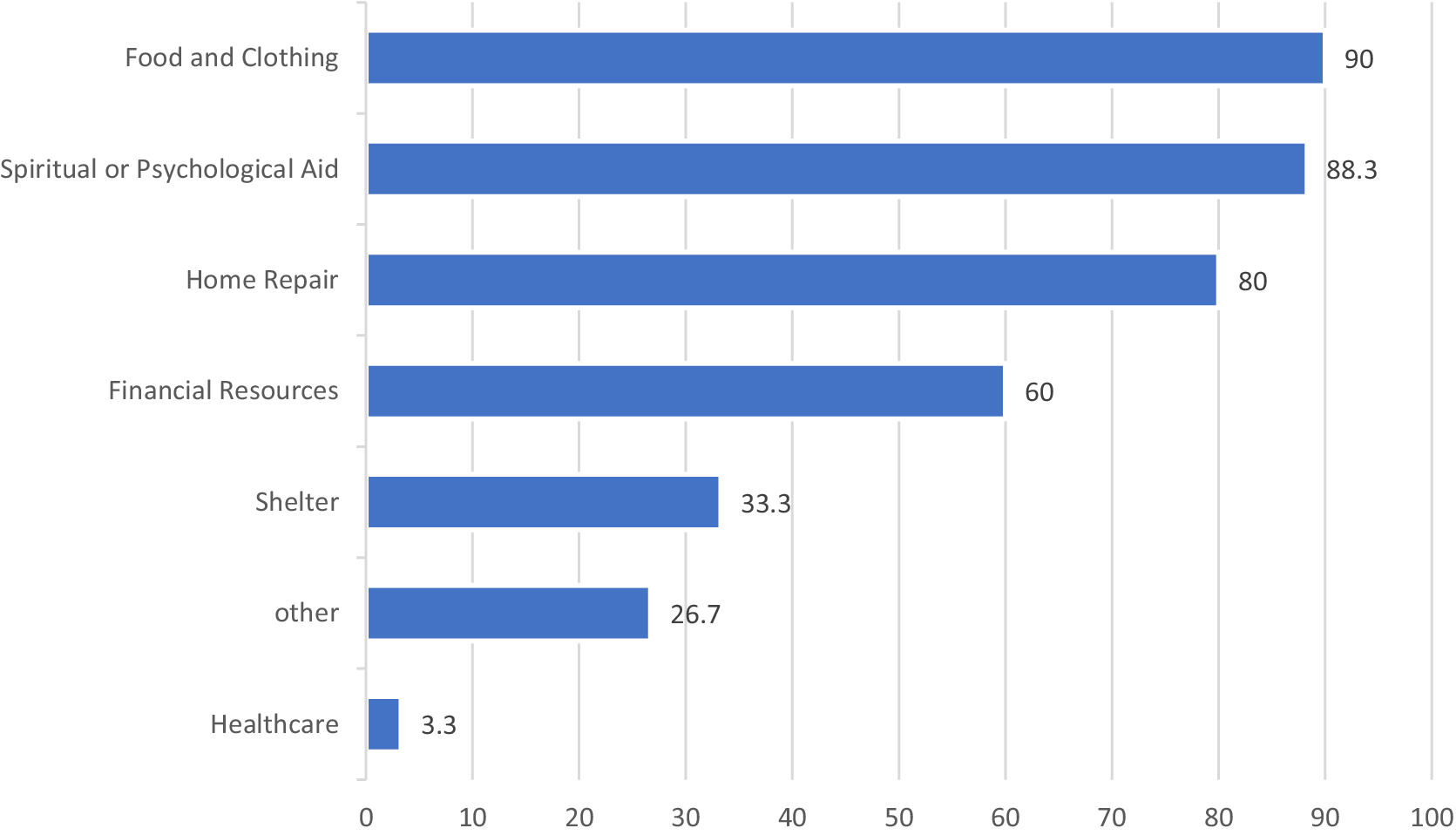
FBOs in the region were involved in a number of activities related to disaster response directly after the hurricane. Food and clothing were administered by 90% of organizations. 83.3% of the organizations provided spiritual or psychological care to those impacted by the storm. Home repair was key in response efforts, with 80% of participating organizations helping in this area. Financial resources were a significant portion of relief efforts by FBOs, with 60% giving financial aid to those in need. Other types of aid included tree removal; hosting response teams; stockpiling and distributing supplies, such as gas, generators, and cleaning supplies; and infant supplies. Response efforts varied by FBO in length. 13.3% were active from 2-4 weeks; 23.3% were active from 1-3 months; and 63.3% of the respondents had efforts that lasted longer than 3 months, with some reporting in the comments that their programs remain ongoing years after the storm (Figure 1).
Types of aid rendered in disaster response.
Food and Clothing (27, 90.0%), Spiritual or Psychological Aid (25, 83.3%), Home Repair (including tarping) (24, 80.0%), Financial Resources (18, 60.0%), Shelter (10, 33.3%), Health Care (1, 3.3%), Other, please explain (8, 26.7%), and “We did not work in disaster response” (0, 0.0%).

Coordination with other organizations
All organizations surveyed coordinated with either government or NGO agencies. 44.5% of the FBOs coordinated with local, state, or national governments. Those coordinating with the government did so to, “enhance our effectiveness and avoid duplication.” Others coordinated with the government as distribution points for city emergency response teams and staging areas for the National Guard or partnered with government officials to obtain and distribute aid throughout the community.
Though all included organizations partnered with other organizations, 65.5% chose not to partner with the government. The reasons for choosing not to coordinate with the government entities for response are varied. Some of the reasons mentioned included lack of availability or access to the necessary officials, a belief that the government programs were inefficient or unfair, or that the government response arrived too late. One insight noted is that if the relationships with government officials had not been previously established, there was no time to build them in the immediate aftermath of the storm.
90% of the organizations coordinated with local faith-based organizations and 66.67% coordinated with national faith-based organizations. When coordinating with these organizations, many of the FBOs surveyed utilized their buildings, facilities, and parking areas as staging areas for response. In addition, multiple organizations sent teams of workers to assist in relief efforts, construction, and clean-up. Local FBOs housed and hosted these aid workers. Many FBOs also assisted with receiving and distributing supplies throughout the community.
Disaster response training and preparedness
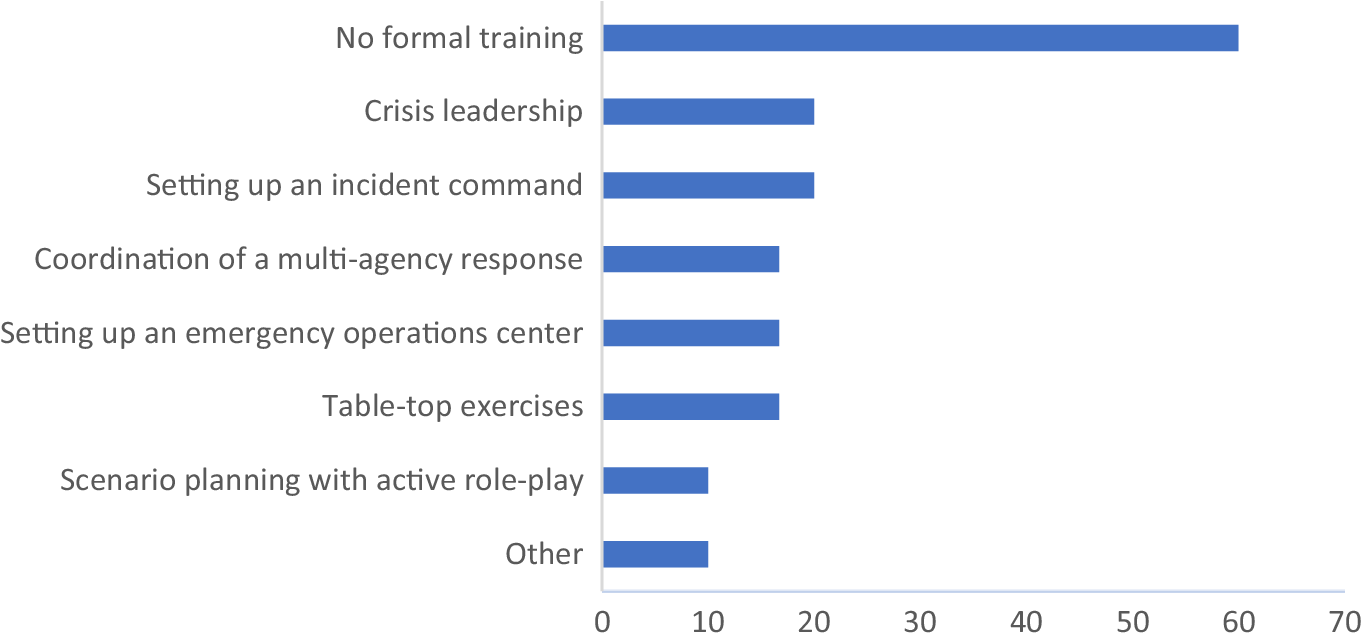
As faith-based organizations are not often primarily designed to be disaster response organizations, many of the leaders may find themselves responding to disasters without much formal training. Of the surveyed FBOs, 60% had no formal disaster training. However, one of the survey respondents specialized in teaching and instructing FBOs in disaster response. Another received specialized training as a disaster relief Chaplain. In addition, some of the responding FBOs coordinated with outside organizations that specialize in disaster response. 86.7% of FBOs are, at minimum, somewhat interested in receiving further education in disaster response, with 10% stating that they are very interested and 6.7% that they are likely to seek out education. Figure 2 provides an overview of the types of training FBOs received pertinent to disaster response.
Formal disaster training.
No formal training (60%), crisis leadership (20%), setting up an incident command (20%), coordination of a multi-agency response (16.7%), setting up an emergency operations center (16.7%), table-top exercises (16.7%), scenario planning with active role-play (10%), and other (10%).

Impact of disaster on local responses
When a disaster strikes, it first affects the communities and survivors that are local to the impacted area.Reference Kravitz, Mothershead and Ciottone11 FBOs are uniquely situated in the community and are poised to quickly respond to disasters.Reference Zhi, Merrill and Gershon12 However, the organizations and their members also must adjust and respond to both personal and organizational losses and destruction. In the aftermath of Hurricane Ida, the damage to FBO member homes was extensive.
Furthermore, both organizational leadership and structures are at risk for damage that may impact the FBOs ability to respond to the community’s needs during a disaster. 86.7% of survey respondents experienced personal damage to their homes during Ida. This damage led to 50% of respondents stating that the damage, in some way, impacted their ability to participate in storm response. 83.3% of respondents noted that there was damage to their organizational structures. 48% of these organizations were at least somewhat impacted in their ability to respond to the community due to this damage, with 12% severely limited due to the severity of damage to their organization.
Insights into future response
In the final section of the survey, participants were allowed to respond freely with insight gathered during storm response. Overwhelmingly, the themes of preparation, coordination, and communication were evident in the responses.
For example, one respondent writes:
“We would have liked to have worked a little closer with our local government. We have a large facility and we feel like we could have been even a greater help to the community had we coordinated our efforts more than we did. Communication with all entities is vital.”
In addition, the need for further education was also highlighted in the following response:
“Our organization (national FBO) provides disaster relief training, so for the future I am considering attending and/or sending people to the training. Since we have experienced a major impact in our community, we have learned how we can be more involved.”
These insights highlight the importance of coordination and education. The capacity of FBOs to reach communities quickly and to work as a vital part of the disaster response community necessitates further efforts by local, state, and national organizations to continue integrating FBO response into the overall framework of disaster management.
Discussion
According to the Center for Disaster Philanthropy (CDP), FBOs engage in disaster response across 4 key areas, the primary being meeting basic needs.Reference Entcheva13 Although FEMA acknowledges FBOs as vital yet under-researched components of the “whole community” response,Reference Elliott MS and Gary14 many FBOs already offer essential services like food and home/car maintenance assistance, supplementing local government programs even before disasters occur. Additionally, as local entities, FBOs are a vital source of immediate post-disaster volunteers.Reference Entcheva13 FBOs connected to larger networks can rapidly mobilize volunteers from unaffected areas to help locally.Reference Entcheva13 An essential part of their service is providing emotional care.Reference Scheffert and Ellor15 Research indicates that communities using local FBOs exhibit enhanced resilience in disaster recovery.Reference Scheffert and Ellor15 Disasters disproportionately affect lower-income and minority groups,Reference Entcheva13 and FBOs often serve as the primary service providers for these frequently neglected communities before, during, and after disasters.Reference Scheffert and Ellor15 Lastly, FBOs play a significant role in the long-term recovery of communities and groups.Reference Entcheva13 They often act as trusted anchor organizations within these communities, ensuring equitable distribution of assistance and ongoing care.Reference Scheffert and Ellor15 When federal, state, and, often, local support and funding conclude, these organizations step in to continue delivering critical services needed by the community.Reference Scheffert and Ellor15
Faith-based organizations demonstrate varying degrees of partnership with the government or other faith-based groups. In this study, many FBOs found collaborating with government entities to be beneficial, as evidenced by instances of coordination with local law enforcement; federal and state organizations; and the National Guard. These partnerships enhanced their operational effectiveness, provided necessary resources, and avoided duplication of efforts. These collaborations often arise from a practical need to leverage additional support, ensuring a more comprehensive response to disaster situations. This highlights the importance of FBO response and is a unique asset to overall management throughout the disaster cycle.
On the other hand, some study participants choose not to collaborate with government entities for a variety of reasons. For instance, logistical challenges, such as the absence of pre-established relationships with government officials, can impact the decision to collaborate.
A previous study of FBO participation performed post-Katrina by Devita et al. observed significant improvement in coordination with the federal government.Reference De Vita and Kramer16 They noted that 7% of faith-based community organizations coordinated with federal agencies, whereas we noted that 33.3% of the responding FBOs coordinated with FEMA.Reference De Vita and Kramer16 It is outside the scope of this study to determine if the government outreach program instituted post-Katrina contributed to improved collaboration but this does warrant future consideration.9
Seventeen of 30 responding organizations stated they had no formal disaster or crisis response training. Though many of the organizations lacked formal training, they were able to make a significant impact on the community after the storm. Nearly all organizations (n = 26, 86.7%) noted that they were at least slightly interested in formal disaster response training. Interestingly, one of the study participants is the CEO of Stormwise, an organization specializing in training community-based organizations to respond to disasters.17 In addition, Louisiana State and Federal training resources are available online free of charge, and registration does not require formal sponsorship.18-20 These programs provide valuable community-based training and further study on their use among FBOs is warranted.
Most survey respondents stated that Hurricane Ida had damaged personal property and organizational resources, highlighting the critical concept that many responding FBOs may have similar susceptibility to the population they serve. Community resources and community-based organizations, including FBOs, play an increasing role in disaster preparedness and response by serving as crucial links to services, as well as providing resources when larger systems and institutions are unable to do so.Reference Phillips, Jenkins, Kilmer, Gil-Rivas, Tedeschi and Calhoun21 Faith-based organizations assist in overall health care capacity building.Reference Owens and Anglin22, 23 The limitations for FBOs to respond secondary to sustained damage also highlight a continuing argument that local and more considerable regional government resources are not absolved of responsibility for disaster response in these events simply because of such organizations’ participation, and should be seen as partners in continuing relief efforts.Reference Cretney24 It is worth noting that in this study, 100% of participating organizations organized and carried out vital disaster response efforts in the wake of the storm even when many endured significant personal and professional impacts, further highlighting the resilience and the integral place that FBOs have in the disaster response and recovery team.
The FEMA viewpoint of “whole community” has expressed the importance of government agencies’ collaboration and communication with community-based institutions, such as religious organizations. This philosophy emphasizes the values of cooperation, empowering local people, and the collective community’s response to disasters.Reference Koch, Franco and O’Sullivan25 The systematic review by Sheikhi et al. cites several studies that found that communication and cooperation with institutions, whether religious or nonreligious and governmental or non-governmental, are vital parts of any operation plan.Reference Sheikhi, Seyedin and Qanizadeh4, Reference Abu-Ras, Gheith and Cournos26, Reference Dohaney, Brogt and Kennedy27, Reference Stajura, Glik and Eisenman28 Effective collaboration often depends on prior relationships and established lines of communication.Reference Rose29 A fundamental relationship between local government agencies and FBOs should be created to enable broader localized community oversight and networking.Reference Sheikhi, Seyedin and Qanizadeh4 Faith-based congregations are typically regarded as trustworthy in the communities they help and create a sense of social cohesion that enhances the sense of cooperation and assistance to communities.Reference Cheema30 This level of cooperation promotes social solidarity and long-term resilience that could benefit areas affected throughout the disaster cycle.
Limitations
There are some important limitations to this study. This exploratory study focused on the Bayou Responds network. Though this network of FBOs encompasses a large number of organizations, it may not be a truly representative sample of all FBOs in the region. It, thus, cannot be generalized to all FBOs. In addition, the organizations represented in the study are all Christian FBOs. Though attempts were made to include other faiths, there were no other faiths represented. Further study with groups of other religious backgrounds would allow for other perspectives in similar situations.
Conclusions
This study further highlights the importance of FBOs as part of the disaster response framework for a community throughout the disaster cycle.Reference Muller, Burke and Berg7 It is clear that FBOs provide an important part of disaster response by performing a variety of roles. Faith-based organizations are ready and present in the areas of impact, specifically in hurricane response. Though not all organizations are equipped with formal disaster response training, there is a desire to participate in training in the future. Moreover, even in the midst of organizational and personal damage, these groups respond quickly and effectively to serve their communities.
The responses clearly indicate that FBOs are an active and valuable part of the overall disaster response, which necessitates further study on their integration. Coordination with local faith-based organizations can improve storm response and should be included in future emergency planning at the local, state, and federal levels. This study highlights a need and desire for further disaster response training in local communities and faith-based organizations. Further study, as well as increased awareness of available current educational initiatives, is indicated. The resiliency of local FBOs is quite remarkable, considering that disaster response occurs in the midst of repairing their own facilities and homes. This model of coordination of response in the midst of disaster recovery would be an interesting area for further research.
Author contribution
Jacob Noel MD – Corresponding author, study design, writing, organization and editing; Attila J. Hertelendy PhD – Supervising, editing; Fadi Issa MD, MScDM, JBEM – Supervising, editing; Christina Woodward MD, FACEP – Supervising, editing; Abeer Santarisi MD, MSc – Data Analysis; Eric D. Miller BSN – Survey testing, writing, discussion; Timothy J. Curtis BSN – writing, discussion; Dana Mathew MD – Writing, discussion; Ryan Boasi PharmD – Writing, discussion; Van Kenyon MD – Writing, discussion; Eman AlShaikh MD, MPH -Editing; Amalia Voskanyan RN – Supervising, editing; Gregory R. Ciottone MD, FACEP, FFSEM – Supervising, editing