Implications
Scrapie in sheep is a transmissible spongiform encephalopathy present in most sheep-producing countries. Susceptibility of sheep to scrapie infections is known to be modulated by the prion protein gene (PrP) genotype of the animal. It means that certain sheep are more resistant than others to developing scrapie. Genotyping for the PrP gene at these codons is a key element of the Scrapie Eradication Program. This study is the largest study with regard to the structure of genotype profile of Turkish sheep breeds and it will contribute to design the National Scrapie Eradication Program.
Introduction
Prions are proteins that play a central role in transmissible spongiform encephalopathy (TSE) in a variety of mammals (Heaton et al., Reference Heaton, Leymaster, Freking, Hawk, Smith, Keele, Snelling, Fox, Chitko-McKown and Laegreid2003). Scrapie is a fatal, neurodegenerative disease that affects sheep and goats. It belongs to a group of disorders known as TSE, or prion disease. The primary cause of this disease is a post-translational change in the conformation of a host-encoded cellular prion protein (PrPC) to a protease-resistant isoform (PrPSc; Prusiner, Reference Prusiner1991).
In sheep, the prion protein gene (PrP) gene is located on chromosome 13 and consists of three exons of 52, 98 and 4028 base pairs (bp), separated by two introns of 2421 and 14 031 bp. Its open reading frame (ORF) is located on exon three, and the resulting protein is 256 amino acids long (Goldmann et al., Reference Goldmann, Hunter, Foster, Salbaum, Beyreuther and Hope1990; Lee et al., Reference Lee, Westaway, Smit, Wang, Seto, Chen, Acharya, Ankener, Baskin, Cooper, Yao, Prusiner and Hood1998; Tranulis, Reference Tranulis2002). Until now, several polymorphisms have been described in the sheep PrP gene (Goldmann et al., Reference Goldmann, Hunter, Foster, Salbaum, Beyreuther and Hope1990 and Reference Goldmann, Baylis, Chihota, Stevenson and Hunter2005; Gonzalez et al., Reference Gonzalez, Martin, Begara-McGorum, Hunter, Houston, Simmons and Jeffrey2002). In sheep, susceptibility to scrapie has been shown to be associated with five haplotype alleles (ARR, AHQ, ARH, ARQ and VRQ) of the PrP gene that result from polymorphisms at codon 136, 154 and 171 (Goldmann et al., Reference Goldmann, Hunter, Smith, Foster and Hope1994; Hunter et al., Reference Hunter, Foster, Goldmann, Stear, Hope and Bostock1996). Depending on the haplotype combinations of these three codons, a total of 15 allelic combinations associated with different levels of susceptibility to scrapie have been described. According to different levels of susceptibility to scrapie, the PrP genotypes were classified into five risk groups (R1 to R5). The R1 genotypes are associated with very low risks for scrapie, and the R5 genotypes are associated with high susceptibility to the disease (Dawson et al., Reference Dawson, Hoinville, Hosie and Hunter1998; Scrapie-Advisory notes, 2004). Studies of polymorphisms at codons 136, 154 and 171 for different breeds from a number of countries have shown that the ARR haplotype is associated with resistance to scrapie. However, the VRQ haplotype has been associated with higher susceptibility to scrapie (Belt et al., Reference Belt, Muileman, Schreuder, Bos-de Ruijter, Gielkens and Smits1995; Hunter et al., Reference Hunter, Foster, Goldmann, Stear, Hope and Bostock1996; Drögemüller et al., Reference Drögemüller, Leeb and Distl2001).
Turkey is a scrapie-free country and there have been no previous reported cases of scrapie. The aim of this study was to investigate variations of the PrP gene in healthy Turkish sheep breeds and contribute to the genetic scrapie risk assessment. From the frequency distribution of PrP genotypes, the risk of scrapie in Turkish sheep was estimated.
Material and methods
Sheep and DNA sources
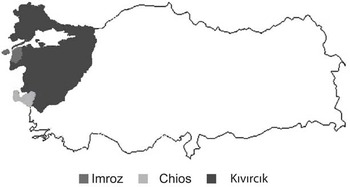
A total of 413 (Table 1) unrelated sheep from three native Turkish breeds were randomly sampled from their original region (Figure 1). From each animal, EDTA-treated blood (Venoject tubes, Terumo Europe, Leuven, Belgium) was collected for genotyping. No clinical signs of scrapie were ever observed in the animals of the examined flocks.
Sheep populations sampled in this study

Geographic distribution of sampled sheep breeds.

DNA extraction and amplification
Genomic DNA was isolated from the whole EDTA-treated blood (Venoject tubes, Terumo Europe) using a Genomic DNA Purification kit for mammalian blood (K0512, Fermentas, Vilnius, Lithuania) according to the manufacturer's protocols.
A 356-bp fragment of the ORF of the PrP gene including codons 136, 154 and 171 was amplified by PCR with forward (5′ TCA AGG TGG TAG CCA CAG TCA GT 3′) and reverse (5′ CCA CTC GCT CCA TTA TCT TGA TGT 3′) primers according to Gama et al. (Reference Gama, Carolino, Santos-Silva, Pimenta and Costa2006). The amplification reactions were carried out on a TechGene (Techne, Cambridge, UK) thermal cycler in 25 μl reactions containing 50 to 100 ng genomic DNA, 2X PCR Master Mix (Fermentas, Vilnius, Lithuania) and 0.5 mM of each of the primers. The temperature profile of the PCR was programmed for 35 cycles of 30 s at 95°C, 45 s at 59.3°C and 30 s at 72°C. Finally, an extension step of 30 min at 72°C was performed. The PCR products were visualized by staining with ethidium bromide after electrophoresis of 10 μl of the reaction mixture on a 2% agarose gel.
PCR cleanup and sequencing
DNA samples were sequenced with Applied Biosystems Taq Dyedeoxy Terminator cycle sequencing kits, which use the fluorescently labeled dideoxynucleotide chain termination method. After cycling and clean up, the DNA samples were then resolved by capillary electrophoresis on an ABI 3730XL DNA Analyzer, which translates the fluorescent signals into their corresponding nucleotide sequence. Before sequencing, the PCR products were purified using PCR Product Purification Kit (Roche, High Pure PCR Product Purification Kit). The forward PCR primer was used to sequence the PCR reaction.
Statistical analysis
Genotype, allele and haplotype frequencies for each population were calculated using the PopGene population genetic analysis software (Yeh et al., Reference Yeh, Yang and Boyle2000). This software program was also used to carry out a statistical test to determine possible deviations from the Hardy–Weinberg equilibrium.
Results
PrP allele distribution
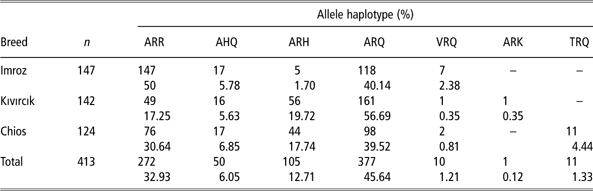
A total of 413 sheep belonging to three sheep breeds were studied with regard to PrP gene polymorphisms. PrP allele frequencies for each breed are shown in Table 2. The polymorphisms detected in the prion gene make up seven allelic variants (ARR, AHQ, ARH, ARQ, VRQ, ARK and TRQ). Some differences between breeds were observed. In addition to the five well-known alleles (ARR, AHQ, ARH, ARQ and VRQ), two rare alleles (ARK and TRQ) were found in sheep breeds investigated. ARQ, the allele associated with susceptibility to scrapie, was most frequent in the Kıvırcık sheep breed. The ARR allele, which is relatively resistant, was found at high frequency in Imroz sheep. The AHQ allele was found in all three breeds at a low frequency. The ARH allele was detected at a relatively high frequency in the Kıvırcık and Chios sheep breeds, but at a low frequency in the Imroz sheep. The VRQ allele, which is associated with the highest susceptibility to scrapie, was detected at low frequencies in all three breeds. The ARK allele was detected at low frequencies in only one Kıvırcık sheep in the heterozygous condition. The TRQ allele was found only in the Chios sheep breed. Overall, the more frequent alleles were ARQ (45.64%), followed by ARR (32.93%), ARH (12.71%), AHQ (6.05%) and VRQ (1.21%; Table 2).
Allele haplotype frequencies at the PrP locus studied sheep breeds
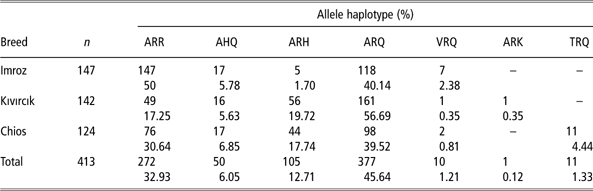
Prp = prion protein gene.
Other PrP polymorphisms
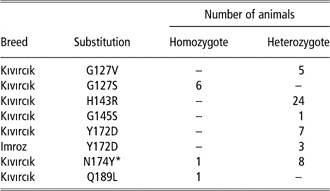
In the Turkish sheep breeds investigated, seven additional amino acid polymorphisms were found at codons G127S, G127V, H143R, G145S, Y172D, N174Y and Q189L (Table 3). Two additional polymorphisms have been detected at the first and second nucleotide of codon 127, leading to changes from glycine to serine and valine, respectively. The change in amino acid from histidine to arginine at codon 143 is the most common change among these additional substitutions. A new mutation at codon 145 was previously reported by Álvarez et al. (Reference Álvarez, Barra, Arranz and San Primitivo2007). However, polymorphisms at the second nucleotide position of the codon leads to changes from glycine to valine. We detected a novel base substitution at the first nucleotide (G→A) resulting in serine. The replacement of tyrosine (TAT) for aspartic acid (GAT) at codon 172 is the result of a T→G transversion at the first nucleotide position in the codon. In codon 174, a base substitution at the first nucleotide position caused by an A→T transversion resulted in a novel change from asparagine (AAC) to tyrosine (TAC). Although the polymorphism at codon 172 has also been detected in some Spanish breeds and in the Imroz sheep breed (Acín et al., Reference Acín, Martín-Burriel, Goldmann, Lyahyai, Monzón, Bolea, Smith, Rodellar, Badiola and Zaragoza2004; Un et al., Reference Un, Oztabak, Ozdemir, Akıs and Mengi2008), this is the first report of the polymorphism in codon 174 in Kıvırcık sheep. The last polymorphism we detected was the A→T substitution at the second nucleotide position of codon 189, which caused a change to leucine from glutamine.
Additional polymorphisms detected

*New polymorphism.
PrP genotype distribution
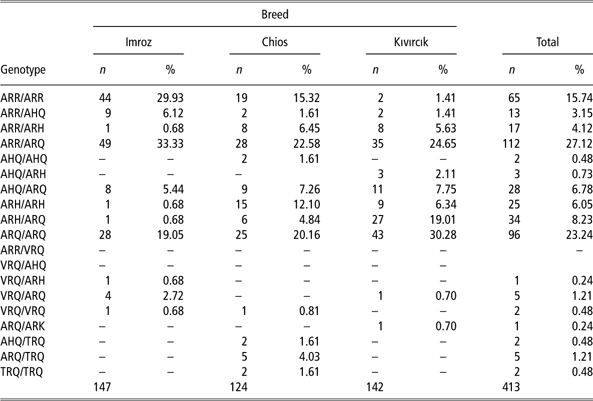
In total, 413 animals from three sheep breeds were genotyped at the PrP locus (Table 4). A total of 17 genotypes were found, and 13 of the 15 well-known genotypes associated with scrapie resistance were found in the sheep population investigated. Eleven well-known genotypes were identified in the Imroz breed. The most frequent genotypes were ARR/ARQ (33.33%), ARR/ARR (29.93%) and ARQ/ARQ (19.05%) in Imroz sheep breed. Similarly, ARR/ARQ (22.58%) was the most frequent genotype in the Chios sheep breed, followed by ARQ/ARQ (20.16%), ARR/ARR (15.32%) and ARH/ARH (12.10%). Overall, 13 genotypes were found in the Chios breed, of which 10 were associated with scrapie but three of them were not. There were a total of nine animals with these rare genotypes. Eleven genotypes were identified in the Kıvırcık breed and the most frequent genotypes were ARQ/ARQ (30.28%), ARR/ARQ (24.65%) and ARH/ARQ (19.01%). Only two animals (1.41%) had the most resistant ARR/ARR genotype from the Kıvırcık breed (Table 4).
The PrP genotype frequencies in sheep of this study
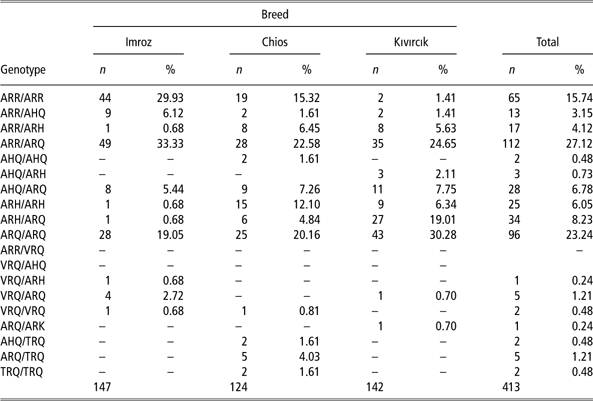
Prp = prion protein gene; n = number of animals.
Overall, the most frequent genotype was ARR/ARQ (27.12%), followed by ARQ/ARQ (23.24%) and ARR/ARR (15.74%). The ARR/ARQ genotype was predominant in Imroz and Chios sheep, and the ARQ/ARQ genotype was predominant in the Kıvırcık breed. The ARR/VRQ genotype was not found in any of the animals investigated. The VRQ/VRQ genotype, which is highly associated with susceptibility to scrapie, was found at very low frequencies; there were only two animals with this genotype from the Imroz and Chios sheep breeds. The distribution of genotypes differed from the Hardy–Weinberg equilibrium for all sheep breeds investigated.
Risk analysis for scrapie
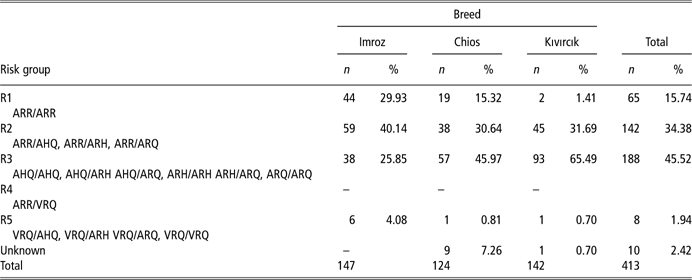
The sheep PrP genotypes were classified into five risk groups (R1 to R5) according to different levels of susceptibility to scrapie. Genotypes in group R1 were associated with very low risks of scrapie, and genotypes in group R5 were associated with a high susceptibility to the disease (Dawson et al., Reference Dawson, Hoinville, Hosie and Hunter1998; Scrapie-Advisory notes, 2004). For the overall population, the ARR/ARQ and ARQ/ARQ genotypes accounting for the highest frequency in investigated sheep breeds belonged to the R2 and R3 risk groups, respectively. The most resistant ARR/ARR genotype was present in 29.93% of Imroz sheep, 15.32% of Chios sheep and 1.41% of Kıvırcık sheep (Table 5). The high-risk groups of R4 and R5 are combined as VRQ-carrying genotypes appeared at very low frequencies (Table 5).
PrP genotypes of this study and distributions in the risk groups
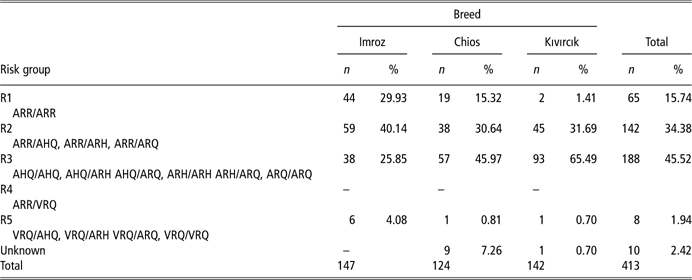
Prp = prion protein gene.
Discussion
Scrapie has never been detected in native Turkish sheep breeds. Although PrP polymorphisms associated with resistance or susceptibility to scrapie were investigated in many sheep breeds from all over the world, information on the presence or frequency of these polymorphisms in Turkish sheep breeds is very limited. In this study, resistance or susceptibility of three Turkish sheep breeds to scrapie has been investigated.
Although the ARR/VRQ genotype was not found in any of the breeds investigated in this study, Un et al. (Reference Un, Oztabak, Ozdemir, Akıs and Mengi2008) detected this genotype in the Kıvırcık and Chios breeds at low frequency. The susceptibility-associated VRQ/VRQ genotype was found at very low frequencies; there were only two animals from the Chios and Imroz breeds with this genotype. In contrast to our findings, Un et al. (Reference Un, Oztabak, Ozdemir, Akıs and Mengi2008) did not find any VRQ homozygote animals in these sheep breeds. In addition, Lühken et al. (Reference Lühken, Lipskyi, Christina and Erhardt2008) investigated four native Turkish sheep breeds for PrP gene polymorphisms, and also did not find any homozygote VRQ animals among these four breeds, although they found VRQ heterozygote animals at very low frequency in the Dağlıç sheep breed. These inconsistencies can be attributed to the limited number of animals used in previous studies.
In this study, alanine, valine and threonine alleles were found at codon 136. The alanine allele was the most common allele, and valine and threonine alleles were rare. Although the threonine allele was found only in the Chios breed in this study, Un et al. (Reference Un, Oztabak, Ozdemir, Akıs and Mengi2008) found the same allele in both Chios and Kıvırcık sheep in Turkey. There were only two alleles, arginine and histidine, at codon 154. At codon 171, there were glutamine, histidine, arginine and lysine alleles, and the lysine allele was found only in Kıvırcık sheep. The same allele was reported in Mongolian (Gombojav et al., Reference Gombojav, Ishiguto, Horiuchi, Serjmyadag, Byambaa and Shinagawa2003), Awassi (Gootwine et al., Reference Gootwine, Abdulkhaliq, Jawasreh and Valle Zárate2008), Greek (Billinis et al., Reference Billinis, Psychas, Leontides, Spyrou, Argyroudis, Vlemmas, Leontides, Sklaviadis and Papadopoulos2004) and Bergamasca sheep (Lühken et al., Reference Lühken, Lipskyi, Christina and Erhardt2008) at low frequencies. This study showed that all of the common alleles observed so far in the other sheep breeds were also found in the investigated Turkish sheep.
As a result of this study, five common previously reported haplotype alleles (ARR, AHQ, ARH, ARQ and VRQ) and two rare alleles (ARK and TRQ) were found in three native Turkish sheep breeds. Interestingly, the TRQ allele was observed only in Chios sheep, whereas the ARK allele was found in Kıvırcık sheep. Although this ARK rare haplotype allele was found together with the ARH allele by Acutis et al. (Reference Acutis, Martucci, Mazza, Peletto, Iulini, Corona, Bozzetta, Casalone and Caramelli2006) in one scrapie-positive sheep, in this study we found it together with ARQ, as was described by Portela et al. (Reference Portela, Bouzada, Prado, Areán, Fernández, López, Fernández and Viana2006). Gootwine et al. (Reference Gootwine, Abdulkhaliq, Jawasreh and Valle Zárate2008) also detected the ARK allele in the Awassi breed of sheep, but only as homozygotes. The frequency of the ARK allele was calculated as 0.04098 and 0.003 among Assaf and Awassi sheep breeds by Portela et al. (Reference Portela, Bouzada, Prado, Areán, Fernández, López, Fernández and Viana2006) and Gootwine et al. (Reference Gootwine, Abdulkhaliq, Jawasreh and Valle Zárate2008), respectively. The association with susceptibility to scrapie of this rare allele has not yet been clarified.
The other rare haplotype allele, TRQ, was found only in the Chios breed in this study, similar to what has been reported for the Chios breed reared in Greece (Billinis et al., Reference Billinis, Psychas, Leontides, Spyrou, Argyroudis, Vlemmas, Leontides, Sklaviadis and Papadopoulos2004). Un et al. (Reference Un, Oztabak, Ozdemir, Akıs and Mengi2008) also found this allele in the Chios breed, but they also found it in the Kıvırcık breed.
The ARR allele was observed in all breeds, but the frequencies were different, ranging from 17.25% in Kıvırcık sheep to 50% in Imroz sheep. In Chios sheep, the frequency of the ARR allele was 30.64%. The most frequent allele was ARQ (45.65%), and it is believed to be a wild-type allele. The genotypes with more than 15% frequency were ARR/ARQ, ARQ/ARQ and ARR/ARR (27.12%, 23.24% and 15.74%, respectively) in this study. The VRQ allele, which is known to be associated with high susceptibility to scrapie, was found in only one Kıvırcık sheep, two Chios sheep and seven Imroz sheep. The overall frequency of the VRQ allele was observed to be 1.21% in the investigated sheep. The frequency of the AHQ allele was 6.05%. These results are in accordance with several investigations, which found that the ARQ allele was the most frequent, followed by the ARR allele. These results were found in Austrian sheep (Sipos et al., Reference Sipos, Kraus, Schmool, Achmann and Baumgartner2002), Germen sheep (Lühken et al., Reference Lühken, Buschmann, Groschup and Erhardt2004), Spanish sheep (Acín et al., Reference Acín, Martín-Burriel, Goldmann, Lyahyai, Monzón, Bolea, Smith, Rodellar, Badiola and Zaragoza2004; Ponz et al., Reference Ponz, Tejedor, Monteagudo and Arruga2006), Portuguese sheep (Gama et al., Reference Gama, Carolino, Santos-Silva, Pimenta and Costa2006), Awassi and Assaf sheep in Israel (Gootwine et al., Reference Gootwine, Abdulkhaliq, Jawasreh and Valle Zárate2008), Turkish sheep breeds (Un et al., Reference Un, Oztabak, Ozdemir, Akıs and Mengi2008) and in Istrian and crossbred sheep (Cubric-Curic et al., Reference Cubric-Curic, Feligini, Ferencakovic, Dzidic, Salajpal, Ambriovic-Ristov, Cetkovic, Majhen and Curic2009).
In addition to the polymorphisms known to be related with classical scrapie, numerous new polymorphisms have been reported in different codons in our study, similar to the others (Thorgeisdottir et al., Reference Thorgeirsdottir, Sigurdarson, Thorisson, Georgsson and Palsdottir1999; Vaccari et al., Reference Vaccari, Petraroli, Agrimi, Eleni, Perfetti, Di Bari, Morelli, Ligios, Busani, Nonno and Di Guardo2001; Wang et al., Reference Wang, Qin, Qiao and Zhao2008). Most of the additional polymorphisms detected in Kıvırcık sheep are similar to those detected in the study carried out by Un et al. (Reference Un, Oztabak, Ozdemir, Akıs and Mengi2008). Despite this, these additional polymorphisms were detected at different loci. These findings support the hypothesis that among these three native Turkish sheep breeds, the Kıvırcık breed has the highest variability. This breed may be useful to research the relationships between new polymorphisms and susceptibility and resistance to different forms of scrapie that currently remain unknown.
The results showed that when classified into risk groups, the majority of the investigated sheep belonged to group R3 (45.52%), followed by R2 (34.38%) and R1 (15.74%). In all, eight animals of the 413 studied carried genotypes included in the R5 group that are associated with high susceptibility to scrapie. The majority of the animals investigated were grouped in R3 and R2. The R3 group should be examined when these animals are used in breeding programs. On the other hand, in order to avoid scrapie disease among sheep populations, genotyping these PrP gene codons should be included in breeding schemes. The data from our study may provide preliminary information for selecting scrapie-resistant sheep for breeding strategies.
Acknowledgements
This work was financially supported by The Scientific and Technological Research Council of Turkey (TUBITAK, Project number TOVAG 106 O 718) and the Scientific Research Council of Uludag University (Project number: Z-2007/7). This manuscript was edited by American Journal Experts (AJE).