INTRODUCTION
Following the discovery of aggregations of alvinocaridid shrimp at hydrothermal vents in the Pacific (Williams, Reference Williams1980; Williams & Chace, Reference Williams and Chace1982), and at cold seeps in the Gulf of Mexico (Williams, Reference Williams1988), a substantial research effort has addressed the taxonomy, phylogeny, ecology, physiology and distribution of caridean shrimp from chemosynthetic ecosystems in the deep sea (e.g. Van Dover et al., 1988, Reference Van Dover, Szuts, Chamberlain and Cann1989; Gebruk et al., Reference Gebruk, Pimenov and Savvichev1993; Segonzac et al., Reference Segonzac, de Saint Laurent and Casanova1993; Shank et al., Reference Shank, Lutz and Vrijenhoek1998, Reference Shank, Black, Halanych, Lutz and Vrijenhoek1999; Copley & Young, Reference Copley and Young2006; Komai et al., Reference Komai and Chan2010; Teixeira et al., Reference Teixeira, Cambon-Bonavita, Serrão, Desbruyères and Arnaud-Haond2010).
At least fifty species from nine caridean families have been recorded from deep-sea vents and seeps (Martin & Haney, Reference Martin and Haney2005; De Grave & Fransen, Reference De Grave and Fransen2011). Members of the family Alvinocarididae Christoffersen, Reference Christoffersen1986 appear to be endemic to deep-sea chemosynthetic environments, and form a dominant component of the biomass at several vent fields in the Atlantic and Indian Oceans (see Nye et al., Reference Nye, Copley and Plouviez2012 for recent review). In contrast, the presence of other caridean families at vents and seeps is considered to be opportunistic (e.g. Martin & Haney, Reference Martin and Haney2005; Desbruyères et al., Reference Desbruyères, Segonzac and Bright2006).
The genus Lebbeus White, Reference White1847, is composed of sixty species (Komai et al., Reference Komai, Tsuchida and Segonzac2012), and represents the most diverse genus within the Hippolytidae Spence-Bate, 1888. Species of Lebbeus are found from shallow to deep waters (e.g. Chang et al., Reference Chang, Komai and Chan2010). The genus exhibits a cosmopolitan distribution from the tropics to high latitudes, but its species generally have narrow geographical ranges (Komai et al., Reference Komai, Hayashi and Kohtsuka2004).
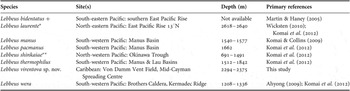
The majority of Lebbeus species are described from the western North Pacific (e.g. Komai & Takeda, Reference Komai and Takeda2004; Komai et al., Reference Komai, Hayashi and Kohtsuka2004; De Grave & Fransen, Reference De Grave and Fransen2011). Lebbeus is the only hippolytid recorded from deep-sea chemosynthetic environments, with several species documented from hydrothermal vents in the Pacific (see Table 1 and references therein).
Summary of geographical distribution and bathymetric range of Lebbeus species from hydrothermal vents.

+ , record unverified. Known also from its type location, off Chile at 1680 m depth (Zarenkov, Reference Zarenkov1976); *, a replacement name for L. carinatus De Saint Laurent, Reference De Saint Laurent1984, a junior homonym of L. carinatus Zarenkov, Reference Zarenkov1976; **, recorded as L. washingtonianus (Kikuchi & Ohta, Reference Kikuchi and Ohta1995; Martin & Haney, Reference Martin and Haney2005; Komai & Collins, Reference Komai and Collins2009) before being referred to L. shinkaiae Komai, Tsuchida & Segonzac, Reference Komai, Tsuchida and Segonzac2012.
Two high-temperature hydrothermal vent fields were discovered recently at the Mid-Cayman Spreading Centre (MCSC), Caribbean (Connelly et al., Reference Connelly, Copley, Murton, Stansfield, Tyler, German, Van Dover, Amon, Furlong, Grindlay, Hayman, Hühnerbach, Judge, Le Bas, McPhail, Meir, Nakamura, Nye, Pebody, Pedersen, Plouviez, Sands, Searle, Stevenson, Taws and Wilcox2012). The ultraslow-spreading MCSC is located in a deep trough, tectonically and geographically isolated from other mid-ocean ridges (Ballard et al., Reference Ballard, Bryan, Dick, Emery, Thompson, Uchupi, Davis, De Boer, Delong, Fox, Spydell, Stroup, Melson and Wright1979; German et al., Reference German, Bowen, Coleman, Honig, Huber, Jakuba, Kinsey, Kurz, Leroy, McDermott, Mercier de Lepinay, Nakamura, Seewald, Smith, Sylva, Van Dover, Whitcomb and Yoerger2010). The Von Damm Vent Field (VDVF) is located away from the axis of the spreading centre on the upper slopes of an oceanic core complex at ~2300 m water depth (Connelly et al., Reference Connelly, Copley, Murton, Stansfield, Tyler, German, Van Dover, Amon, Furlong, Grindlay, Hayman, Hühnerbach, Judge, Le Bas, McPhail, Meir, Nakamura, Nye, Pebody, Pedersen, Plouviez, Sands, Searle, Stevenson, Taws and Wilcox2012). The VDVF is a sulphide mound approximately 100 m in diameter and 30 m high, venting clear, buoyant, high-temperature fluids at its peak, visually dominated by swarming shrimp (Connelly et al., Reference Connelly, Copley, Murton, Stansfield, Tyler, German, Van Dover, Amon, Furlong, Grindlay, Hayman, Hühnerbach, Judge, Le Bas, McPhail, Meir, Nakamura, Nye, Pebody, Pedersen, Plouviez, Sands, Searle, Stevenson, Taws and Wilcox2012). Investigations of the fauna inhabiting vent fields on the MCSC have the potential to enhance current understanding of the dispersal and evolution of vent taxa, and vent biogeography of the region (Van Dover et al., Reference Van Dover, German, Speer, Parson and Vrijenhoek2002).
In this study, a new species of Lebbeus from the VDVF is described and illustrated. Lebbeus virentova sp. nov. belongs to the second family (Hippoloytidae) of caridean shrimp to be reported from the VDVF, the other being Alvinocarididae. In addition to enhancing existing knowledge about biodiversity in the deep sea, this appears to be the first record of a hippolytid shrimp from a vent field outside the Pacific Ocean.
MATERIALS AND METHODS
Specimens were collected from the VDVF (2294–2375 m) at the MCSC, Caribbean, during the 18th voyage of the RV ‘Atlantis’ (16th leg, January 2012). All specimens were collected using a suction sampler attached to the remotely operated vehicle (ROV) ‘Jason II’, together with still photographs and video recordings of them in situ. Material for morphological study was fixed immediately in 10% neutralized formalin and subsequently transferred to 75% industrial methylated spirits. Material for molecular analyses was immediately placed in 95% ethanol.
Measurements of specimens were taken to the nearest 0.1 mm using Vernier callipers. Postorbital carapace length (CL) was measured from the posterior margin of the orbit to the posterior margin of the carapace and is used herein as an indication of specimen size. Individuals were sexed under a dissecting microscope.
Illustrations were prepared with the aid of a camera lucida mounted onto a Leica MZ8 steromicroscope, scanned and inked digitally using a WACOM™ digitizer and Adobe® Illustrator® software, as described by Coleman (Reference Coleman2003, Reference Coleman2009). Specimens are deposited in the invertebrate collection at the Smithsonian Institution, National Museum of Natural History (USNM), Washington, DC. Morphological terminology generally follows Komai et al. (Reference Komai, Tsuchida and Segonzac2012).
Abdominal muscle for DNA extraction was cut from ethanol-preserved specimens and the carapace removed. Total genomic DNA was extracted using the CTAB (cetyltrimethyl ammonium bromide) procedure (Doyle & Dickson, Reference Doyle and Dickson1987). Regions of mitochondrial Cytochrome c Oxidase subunit I (COI) DNA and 16S ribosomal DNA were amplified by performing polymerase chain reactions (PCR).
The COI region was amplified with the universal primers LCO1490 and HCO2198 described by Folmer et al. (Reference Folmer, Black, Hoeh, Lutz and Vrijenhoek1994). The 20 µl amplification mixture contained 1X buffer reagent (200 mM Tris pH 8.8, 500 mM KCL, 0.1% Trixton X-100, 2 mg/ml bovine serum albumen), 2 mM MgCl2, 0.2 mM of each dNTP, 0.5 mM of each primer, 1 U Taq DNA polymerase (Bioline), 5 µl of template DNA and sterile H2O to final volume. The thermal cycling conditions were: 94°C/2 minutes; followed by 5 cycles at (94°C/35 seconds; 45°C/35 seconds; 72°C/1:20 minutes) and 35 cycles at (94°C/35 seconds; 50°C/35 seconds; 72°C/1:20 minutes) with a final extension of 72°C/10 minutes.
Amplifications of the 16S region were performed using the universal primers 16Sar and 16Sbr described by Palumbi (Reference Palumbi, Hillis, Moritz and Mable1996). The 20 µl amplification mixture contained: 1X reaction buffer (same as for COI), 2.5 mM MgCl2, 0.13 mM of each dNTP, 0.38 mM of each primer, 1 U Taq DNA polymerase (Bioline), 2.5 µl of template DNA and sterile H2O to final volume. The thermal cycling conditions were: 94°C/4 minutes; 30 cycles at (94°C/30 seconds; 52°C/1 minute; 72°C/2 minutes) and 72°C/5 minutes.
The PCR products were purified with the ExoAP treatment by adding the following ExoAP mixture to 15 µl PCR product: 0.2 µl 10X ExoAP buffer (50 mM Bis-Tris, 1mM MgCl2, 0.1 mM ZnSO4), 0.05 µl 5000 U/ml Antarctic Phosphatase (New England Biolabs: Ipswich, MA), 0.05 µl 20000 U/ml Exonuclease I, and 3.7 µl sterile H20) and thermal-cycler incubation (37°C/60 minutes; 85°C/15 minutes). Sequencing reactions were performed using BigDye Terminator Reactions following the manufacturer's protocol (Applied Biosystems: Foster, CA) with the primer sets used for amplifications. For COI, the thermal-cycler reaction was performed as: 94°C/30 seconds followed by 25 cycles (94°C/15 seconds; 50°C/15 seconds; 60°C/3 minutes). The PCR conditions for 16S were identical to those described for COI, but with the use of 52°C and 64°C annealing temperatures. The sequencing reaction products were purified with the AMPure magnetic bead system following the manufacturer's protocol (Agencourt: Morrisville, NC) and were subsequently run on an ABI 3730x1 DNA Analyzer (Applied Biosystems International).
The sequence strands for each gene were proofread and assembled with CodonCode Aligner, version 3.7.1 (CodonCode Corporation, Dedham, MA, USA), to produce a continuous fragment. Sequences were compared with those in GenBank using the nucleotide BLAST program (NCBI Basic Alignment Search Tool) and manually aligned in BioEdit (Hall, Reference Hall1999). Phylogenetic trees were constructed with MEGA5 (Tamura et al., Reference Tamura, Peterson, Peterson, Stecher, Nei and Kumar2011) using the neighbour-joining (NJ) (Saitou & Nei, Reference Saitou and Nei1987) and maximum-likelihood (ML) (Kimura, Reference Kimura1980) methods on a 588-base pair (bp) alignment for COI. The bootstrap values were calculated on 1000 re-sampling replicates.
GenBank accession numbers for partial sequences of the COI and 16S regions are JQ837265 and JQ837266 respectively.
RESULTS
SYSTEMATICS
Order DECAPODA Latreille, Reference Latreille1802
Infraorder CARIDEA Dana, Reference Dana1852
Superfamily ALPHEOIDEA Rafinesque, Reference Rafinesque1815
Family HIPPOLYTIDAE Spence Bate, Reference Spence Bate1888
Genus Lebbeus White, Reference White1847
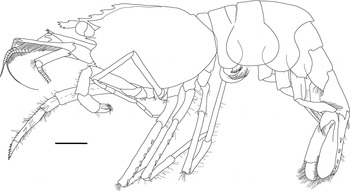
Lebbeus virentova sp. nov. (Figures 1–5)
Lebbeus virentova sp. nov., holotype, female (carapace length 15.4 mm), [USNM 1183692], from the Von Damm Vent Field, Mid-Cayman Spreading Centre: entire animal, lateral view. Scale bar = 5 mm.

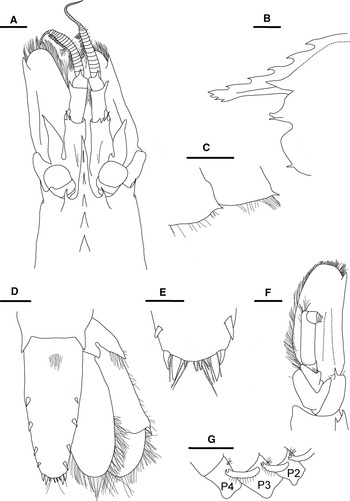
Lebbeus virentova sp. nov., holotype, female (carapace length 15.4 mm), [USNM 1183692], from the Von Damm Vent Field, Mid-Cayman Spreading Centre: (A) anterior part of carapace and cephalic appendages, dorsal view; (B) anterior part of carapace, lateral view; (C) posterolateral margins of left pleura of fourth and fifth abdominal somites, lateral view; (D) telson and right uropod, dorsal view; (E) posterior part of telson, dorsal view; (F) Left antennal peduncle and scale, ventral view; (G) coxae of right second to fourth pereopods, showing presence of epipod on third pereopod and corresponding setobranch on fourth pereopod, lateral view. Scale bars: A–D, G, H = 2 mm; E = 1 mm.

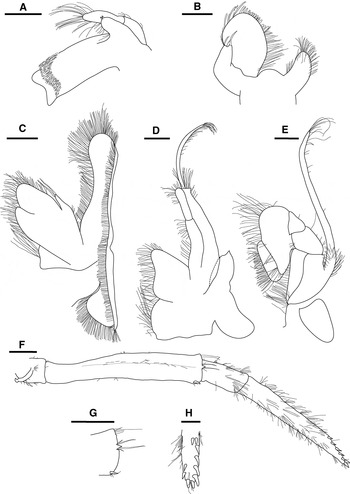
Lebbeus virentova sp. nov., holotype, female (carapace length 15.4 mm), [USNM 1183692], from the Von Damm Vent Field, Mid-Cayman Spreading Centre: (A) left mandible, ventral view; (B) left maxillule (first maxilla), dorsal view; (C) left maxilla (second maxilla), ventral view; (D) left first maxilliped, ventral view; (E) left second maxilliped, ventral view; (F) right third maxilliped, lateral view; (G) distal part of antepenultimate segment of right third maxilliped, dorsal (extensor) view; (H) distal part of ultimate segment of right third maxilliped, dorsal view. Scale bars: A–E, H = 1 mm; F, G = 2 mm.

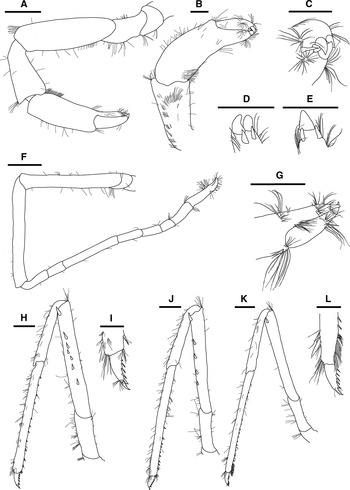
Lebbeus virentova sp. nov., holotype, female (carapace length 15.4 mm), [USNM 1183692], from the Von Damm Vent Field, Mid-Cayman Spreading Centre: (A) left first pereopod, lateral view; (B) chela and carpus of left first pereopod, mesial view; (C) distal part of chela of left first pereopod; (D) same, tip of dactylus, inner view; (E) tip of fixed finger, inner view; (F) left second pereopod, lateral view; (G) chela of left second pereopod, lateral view; (H) left third pereopod, lateral view; (I) same, dactlyus and distal part of propodus, lateral view; (J) left fourth pereopod, lateral view; (K) left fifth pereopod, lateral view; (L) same, dactlyus and distal part of propodus, lateral view. Scale bars: A, F, H, J, K = 2 mm; B–E, G, I, L = 1 mm.

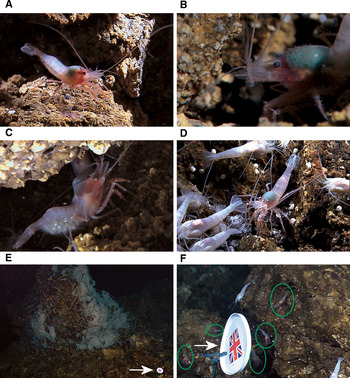
Lebbeus virentova sp. nov., live in situ, the Von Damm Vent Field, Mid-Cayman Spreading Centre, ~2300 m: (A, B) female with green eggs visible through carapace; (C) berried female; (D) L. virentova sp. nov. (centre) surrounded by specimens of the alvinocaridid shrimp Rimicaris hybisae Nye, Copley, Plouviez, Reference Nye, Copley and Plouviez2012 and skeneid gastropods; (E) base of the spire, arrow points to JC44 navigational marker; (F) base of the spire (close-up), arrow points to JC44 navigational marker, green ellipses highlight occurrences of L. virentova sp. nov. Images A–D courtesy of the NOAA Okeanos Explorer Program, MCR Expedition 2011.

MATERIAL EXAMINED
Holotype: female, CL 15.4 mm. VDVF, MCSC, Caribbean Sea; co-ordinates: 18°37.661′N 81°79.81′W; water depth: 2294 m [USNM 1183692]. Collected on the 18th voyage (16th leg) of RV ‘Atlantis’, on 19 January 2012.
Paratypes: six females, CL 11.12–15.6 mm [USNM 1183693–1183698]. Same data as holotype.
DESCRIPTION
Body moderately robust; integument glabrous.
Rostrum (Figures 1, 2A, B) straight, directed forward, 0.30–0.48 CL; reaching beyond mid-length but not to distal margin of first segment of antennular peduncle; laterally compressed, tapering to bifurcate apex; dorsal margin armed with 4–6 teeth (2–3 widely spaced teeth on rostrum proper; 2–3 larger, widely spaced postrostral teeth), posteriormost tooth arising at 0.16–0.26 CL; ventral margin armed with 2–4 teeth in distal 0.25, ventral lamina poorly developed. Carapace (Figures 1, 2A, B) with low but distinct median portrostral carina extending to posterior two-thirds of carapace; dorsal profile in lateral view gently convex. Supraorbital tooth strong, arising level with posterior margin of orbit, directed forward, reaching tip of suborbital lobe and antennal tooth; deep V-shaped notch inferior to base of supraorbital tooth. Orbital margin weakly concave; suborbital lobe bluntly triangular. Antennal tooth well-developed, acute, reaching tip of suborbital lobe. Pterygostomial tooth small, not reaching antennal tooth. Anterolateral margin between antennal tooth and pterygostomial tooth strongly sinuous with deep excavation below antennal tooth.
Abdomen (Figure 1) rounded dorsally. Second somite with transverse groove on tergum, bordered posteriorly by low ridge; posterodorsal margin of third somite produced; pleura of anterior three somites unarmed marginally, posteroventral margin rounded; fourth pleuron with posteroventral tooth (Figure 2C); fifth pleuron bearing moderately strong posteroventral tooth and numerous long setae on ventral margin (Figure 2C). Sixth somite 1.35–1.95 times longer than fifth somite; armed with small posteroventral tooth; posterolateral process terminating in acute tooth.
Telson (Figures 1, 2D, E) length 3.10–4.31 times anterior width, 1.25–1.48 times longer than sixth abdominal somite in dorsal midline; lateral margins parallel in anterior third, tapering posteriorly to convex posterior margin, bearing 3–6 (usually 4) dorsolateral spines on each side; posterior margin with 2 pairs of lateral spines (mesial pair longer), 4–6 median spiniform setulose setae and several longer thin plumose setae (Figure 2E).
Uropods (Figures 1, 2D) with broad rami exceeding distal margin of telson; exopod with distinct transverse suture and small spine at distolateral angle; endopod shorter and narrower than exopod; posterolateral projection of protopod triangular with acute tip.
Eyes (Figures 1, 2A) subpyriform with stalk narrowing proximally; cornea distinctly wider than stalk, its maximum width 0.13–0.15 times CL; ocellus absent.
Antennular peduncles (Figures 1, 2A) extending approximately to distal 0.2 of antennal scale. First segment as long or slightly longer than distal two segments combined, not quite reaching mid-length of antennal scale, dorsodistal margin armed with 2 or 3 (sometimes bifid) slender teeth; stylocerite reaching or slightly exceeding dorsodistal margin of first peduncular segment, terminating in acute point, mesial margin sinuous. Second segment approximately 0.4 length of first segment; bearing strong distolateral tooth. Third segment less than half as long as second; with small dorsodistal tooth. Lateral flagellum with thickened aesthetasc-bearing portion approximately 0.3 times CL.
Antenna (Figures 1, 2F) with bascicerite bearing small, acute ventrolateral tooth; carpocerite reaching to approximately distal 0.3–0.4 of antennal scale. Antennal scale 0.64 times CL, 3 times longer than wide; lateral margin straight; distolateral tooth nearly reaching rounded distal lamella of blade.
Mouthparts (Figure 3) similar to those of other species of the genus. Mandible (Figure 3A) composed of flattened incisor, stout molar and biarticulate palp; incisor process bearing 2 acute distal teeth and 2 fine setae on mesial margin; molar process subcylindrical with obliquely truncate grinding surface and area of dense setae distally; palp curved, basal article broad with few short setae, distal article bearing many long setae.
Maxillule (first maxilla) (Figure 3B) with well-developed endites; coxal endite bearing numerous long setae; basial endite with row of stiff setae and row of spines along the mesial margin; palp curved weakly, slightly bilobed, bearing several distal setae.
Maxilla (second maxilla) (Figure 3C) with bilobed upper endite, fringed with many setae and flanked by well-developed palp with two distal setae; lower endite reduced, bearing several long setae; scaphognathite well developed, with rounded posterior lobe fringed with numerous setae on all margins.
First maxilliped (Figure 3D) with well-developed endites fringed with setae; palp biarticulate; exopod with caridean lobe; epipod large, bilobed.
Second maxilliped (Figure 3E) with broad ultimate segment fringed with stiff setae; ischial segment with excavated mesial margin; exopod and epipod well-developed.
Third maxilliped (Figure 3F) exceeding antennal scale by half length of ultimate segment. Antepenultimate segment approximately 0.8 times as long as two distal segments combined; armed with a small tooth and two long spiniform setae on distolateral margin and a small spine at ventrodistal angle (Figure 3G); lateral surface bearing row of spiniform setae on blunt ridge parallel to dorsal margin. Ultimate segment approximately three times longer than penultimate segment, with dense tufts of setae; tapering distally, with short row of corneous spines distomesially and distolaterally (Figure 3H).
Strap-like, terminally hooked epipods present on third maxilliped to third pereopod; corresponding setobranchs on first to fourth pereopods (Figure 2G).
First pereopod (Figure 4A) moderately stout, extending to distal margin of antennal scale. Chela (Figure 4B–E) approximately 1.6 as long as carpus; dactylus approximately 0.6 times as long as palm, strongly curved distally, terminating in two corneous claws with two smaller corneous claws arising inferior to terminal claws; fixed finger terminating in one corneous claw flanked by two smaller corneous claws. Carpus bearing grooming apparatus (a feature widely spread in the Hippolytidae, e.g. Bauer, Reference Bauer1978), comprising a dense patch of serrate setae arising from a recessed area on mesial face.
Second pereopod (Figure 4F) distinctly more slender than first, overreaching antennal scale by approximately 0.33 length of carpus when extended. Chela (Figure 4G) small; dactlyus terminating in two corneous claws; fixed finger terminating in one corneous claw. Carpus divided into seven articles.
Third to fifth pereopods (Figure 4H–L) similar in structure, long and slender, normally folded at mero-carpal articulation, decreasing in length and stoutness posteriorly. Third pereopod (Figure 4H, I) overreaching antennal scale by approximately 0.9 length of propodus; dactylus 0.14 length propodus, terminating in acute unguis and armed with 5 or 6 accessory spinules on flexor margin, distalmost spinule distinctly larger than others, making dactylus tip appear biunguiculate; carpus approximately 0.6 as long as propodus; propodus with 2 rows of ventral accessory spinules; merus armed with 3–7 lateral spines.
Fourth pereopod (Figure 4J) overreaching antennal scale by approximately 0.6 length of propodus; dactlyus with 5 or 6 accessory spinules on flexor margin; propodus with two rows of ventral flexor spinules; merus armed with 3–5 lateral spines.
Fifth pereopod (Figure 4K) overreaching antennal scale by approximately 0.2 length of propodus; dactlyus with 5 or 6 accessory spinules on flexor margin (Figure 4L); propodus with two rows of ventral flexor spinules; merus armed with 1–2 lateral spines.
Female pleopods similar to those of other species of the genus, without distinctive feature.
COLORATION IN LIFE (FIGURE 5)
Carapace bright red anteriorly, becoming paler distally; gonad green and visible through carapace. Abdomen pale, scattered with red chromatophores, making abdomen appear pinkish red. Rostrum and cephalic appendages translucent. Cornea darkly pigmented. Third maxilliped red with darkly pigmented corneous pinules on ultimate article. Pereopods red with thin white bands at joints; chelae of first two pereopods terminating in darkly pigmented corneous claws; corneous spines and ungui on dactyli of third to fifth pereopods also darkly pigmented. Gills typically bright white and visible through carapace.
Eggs green.
COMPARATIVE REMARKS
Lebbeus virentova sp. nov. belongs within the group of Lebbeus species characterized by the presence of epipods on the anterior three pairs of pereopods and absence of armature on the anterior three abdominal pleura. It is closest in morphology to the following species: L. antarcticus (Hale, Reference Hale1941); L. carinatus Zarenkov, Reference Zarenkov1976; L. cristatus Ahyong, Reference Ahyong2010; L. formosanus Chang, Komai & Chan, Reference Komai and Chan2010; L. kuboi Hayashi, Reference Hayashi1992; L. microceros (Krøyer, Reference Krøyer1841); L. pacmanus Komai, Tsuchida & Segonzac, Reference Komai, Tsuchida and Segonzac2012; L. polyacanthus Komai, Hayashi & Kohtsuka, Reference Komai, Hayashi and Kohtsuka2004; L. shinkaiae Komai, Tsuchida & Segonzac, Reference Komai, Tsuchida and Segonzac2012; L. similior Komai & Komatsu, Reference Komai, Komatsu and Fujita2009; L. thermophilus Komai, Tsuchida & Segonzac, Reference Komai, Tsuchida and Segonzac2012; L. washingtonianus (Rathbun, Reference Rathbun1902); and L. wera Ahyong, Reference Ahyong2009 (see Komai et al., Reference Komai, Tsuchida and Segonzac2012 for updated distribution data on these species).
Characters shared between these species and Lebbeus virentova sp. nov. include: rostrum styliform, not reaching distal margin of second segment of antennular peduncle, armed with four or more dorsal teeth including postrostral teeth and more than one ventral tooth; distinct u- or v-shaped notch inferior to base of supraorbital tooth; sinuous anterolateral margin of carapace between antennal and pterygostomial teeth and deep excavation below antennal tooth; first segment of antennal peduncle bearing more than one tooth on dorsodistal margin; dactyli of posterior three pairs of pereopods distinctly biungulate.
Morphological differences between Lebbeus virentova sp. nov. and allied species are summarized below. The comparisons are limited to females because there is no information available on males of the new species.
Lebbeus virentova sp. nov. most closely resembles L. carinatus, L. cristatus, L. formosanus, L. kuboi, L. microceros and L. thermophilus in the stylocerite reaching or slightly overreaching the dorsodistal margin of the first segment of the antennular peduncle and having relatively few dorsal rostral teeth (six or less). Lebbeus virentova sp. nov. is separated from L. carinatus by the longer carpocerite (reaching to distal 0.3–0.4 of antennal scale versus reaching its mid-length), longer third maxilliped (overreaching antennal scale by half length of ultimate segment versus reaching just beyond it) and longer first perereopod (reaching distal margin of antennal scale versus falling short of it).
The new species is distinguished from Lebbeus cristatus, L. formosanus and L. kuboi by the longer antennular peduncle (reaching base of distolateral tooth of antennal scale versus not reaching it), the shorter distolateral tooth of the antennal scale (not reaching the lamella versus reaching it), and number of meral spines on the posterior three pairs of pereopods. It is differentiated further from L. cristatus and L. formosanus by the shorter third maxilliped (overreaching antennal scale by half length of ultimate segment versus overreaching it by two-thirds and one-third respectively) and the presence of a posteroventral tooth on the fourth abdominal pleuron (versus absent and variable), and from L. kuboi by the straight (versus curving dorsally) rostrum and greater number of dorsal teeth (4–6 versus 2–4).
Lebbeus virentova sp. nov. is distinguished easily from the Atlantic species L. microceros by the shorter stylocerite (not reaching or slightly overreaching dorsodistal margin of second segment of antennular peduncle), the longer antennular peduncles (reaching base of distolateral tooth of antennal scale versus not reaching it), longer carpocerite reaching to distal 0.3–0.4 of antennal scale versus reaching its midlength), small tooth (versus strong, curved tooth) on the distolateral margin of the antepenultimate article of the third maxilliped, and fewer meral spines on the fifth pereopod (1–2 versus 3). The new species differs from L. thermophilus by the presence of a posteroventral tooth on the fourth abdominal pleuron (versus variable), the longer antennular peduncles (reaching base of distolateral tooth of antennal scale versus far falling short of it), the longer first pereopod (reaching distal margin of antennal scale versus falling short of it), and the presence of plumose setae on the posterior margin of the telson.
Lebbeus virentova sp. nov. is separated from L. polyacanthus, L. shinkaiae and L. wera by fewer dorsal rostral teeth (4–6, including 2–3 postrostral versus 6 or more, including 3 or more postrostral), the presence of plumose setae on the posterior margin of the telson, and number of teeth on the meri of the posterior three pereopods.
The new species is differentiated from Lebbeus antarcticus, L. pacmanus, L. similior and L. washingtonianus by the longer stylocerite (reaching or slightly overreaching the dorsodistal margin of the first segment of the antennular peduncle versus not) and the presence of plumose setae on the posterior margin of the telson. In addition, the first pereopod of L. virentova sp. nov. is longer than that of L. pacmanus and L. similior, and shorter than that of L. antarcticus (reaching distal margin of antennal scale versus falling short of it, overreaching it by length of fingers). Furthermore, L. virentova sp. nov. has a longer carpocerite than L. antarcticus and L. similior, and shorter carpocerite than L. pacmanus and L. washingtonianus (reaching to distal 0.3–0.4 of antennal scale versus reaching its mid-length, reaching distal 0.2 of antennal scale).
DISTRIBUTION AND HABITAT
Presently known only from the type locality, the VDVF, MCSC, Caribbean Sea, in 2294–2375 m water depth. See Connelly et al. (Reference Connelly, Copley, Murton, Stansfield, Tyler, German, Van Dover, Amon, Furlong, Grindlay, Hayman, Hühnerbach, Judge, Le Bas, McPhail, Meir, Nakamura, Nye, Pebody, Pedersen, Plouviez, Sands, Searle, Stevenson, Taws and Wilcox2012) for a description of the geological, geochemical and biological setting of the VDVF.
Observed on the edifice spire in close proximity to actively venting orifices with high abundances of the alvinocaridid shrimp Rimicaris hybisae Nye, Copley & Plouviez, Reference Nye, Copley and Plouviez2012, and below the spire on the sulphide mound with R. hybisae, Alvinocaris sp., skeneid gastropods, zoarcid fish and siboglinid polychaetes.
ETYMOLOGY
The species name, virentova, is the combination of the Latin, vireo (= be green), and ova (= eggs), in reference to the green eggs of the new species.
MOLECULAR PHYLOGENY
Partial sequences of the COI (683 bp) and 16S (523 bp) regions of Lebbeus virentova sp. nov. were consistent amongst specimens. Fixed and unique mutations were evident in the partial sequences of the COI and 16S regions in comparison with all other species in the GenBank database. The only partial sequence of the 16S region for Lebbeus in GenBank is from L. virentova sp. nov. [JQ837266].
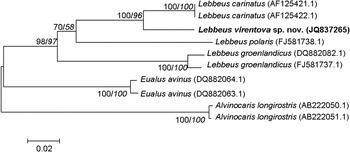
Based on NJ and ML phylogenetic analyses for COI sequences available in GenBank, Lebbeus virentova sp. nov. exhibits the smallest evolutionary distance (6.5% divergence) to the species recorded therein as ‘L. carinatus' from 13° North on the East Pacific Rise (EPR) [AF125421.1 and AF125422.1]. Lebbeus carinatus Zarenkov, Reference Zarenkov1976 was described from off Peru and has not been recorded from the EPR, whereas L. laurentae is known only from 13° North at the EPR. Lebbeus laurentae is a replacement name for L. carinatus de Saint Laurent, 1984 (a junior homonym of L. carinatus Zarenkov, Reference Zarenkov1976). It is apparent therefore that ‘L. carinatus' [AF125421.1 and AF125422.1] is L. laurentae. Based on a 588-bp alignment, NJ and ML methods produced identical topologies and place the new species in the same clade as L. laurentae (100% and 96% bootstrap support for NJ and ML methods respectively) (Figure 6).
Neighbour-joining tree of Lebbeus based on a 588-base pair alignment of partial nucleotide sequences from the mitochondrial COI DNA region with Eualus avinus (Rathburn, Reference Rathbun and Jordan1899) (Hippolytidae) and Alvinocaris longirostris Kikuchi & Ohta, Reference Kikuchi and Ohta1995 (Alvinocarididae) as outgroups. Evolutionary distance computed using the Jukes–Cantor method (Jukes & Cantor, Reference Jukes, Cantor and Munro1969) is represented by branch length; scale bar is proportional to inferred nucleotide divergence. Bootstrap support calculated on 1000 re-sampling replicates is shown by the numbers along the branches (neighbour-joining, roman text; maximum likelihood, italic text). GenBank accession numbers are given after species names.

DISCUSSION
Morphological analysis of this hippolytid shrimp reveals it to be a new species in the genus Lebbeus. Based on morphology, the new species belongs to the species group characterized by the presence of epipods on the anterior three pairs of pereopods, stylocerite reaching or slightly overreaching the dorsodistal margin of the first segment of the antennular peduncle, and six or fewer dorsal rostral teeth. It is distinguished from other species by a combination of morphological features (see above). Consistency in partial sequences of the COI mDNA and 16S rDNA genes between specimens from the VDVF confirms that they belong to a single species, and the presence of unique and fixed mutations in the sequences indicate that they are genetically distinct from all other species in the GenBank database.
Seven species of Lebbeus have been recorded previously from hydrothermal vents, six of which are only known from a vent environment (Table 1); they may be vent-endemic (Komai et al., Reference Komai, Tsuchida and Segonzac2012). These six species are from vent fields on the EPR and in western Pacific back-arc basins at 691–2640 m water depth (Table 1). The new species therefore appears to be the first hippolytid shrimp to be described from a vent field outside the Pacific Ocean, and may be the first record of the genus in the Caribbean.
The recent discovery of hydrothermal vents and chemosynthetic assemblages on the MCSC has provided an opportunity to enhance existing knowledge about biodiversity in the deep sea. Lebbeus virentova sp. nov. is the third taxon described from the VDVF, where it co-occurs with the alvinocaridids Rimicaris hybisae and Alvinocaris sp. Based on observations made from two research cruises to two vent fields of the MCSC, the new species is so far only known from the VDVF. In contrast, R. hybisae is present and abundant at the VDVF and the Beebe Vent Field (BVF). The BVF is only 30 km from the VDVF, but is 2660 m deeper and has different geological and geochemical settings (Connelly et al., Reference Connelly, Copley, Murton, Stansfield, Tyler, German, Van Dover, Amon, Furlong, Grindlay, Hayman, Hühnerbach, Judge, Le Bas, McPhail, Meir, Nakamura, Nye, Pebody, Pedersen, Plouviez, Sands, Searle, Stevenson, Taws and Wilcox2012).
The genus Rimicaris Williams & Rona, 1986 is a deep-water (1700–4960 m) genus known exclusively from hydrothermal vents (Nye et al., Reference Nye, Copley and Plouviez2012). The genus Lebbeus exhibits a shallower bathymetric range, from the littoral zone to at least 2640 m, and is not endemic to hydrothermal vents (e.g. Squires, Reference Squires1990; Hayashi, Reference Hayashi1992; De Grave & Fransen, Reference De Grave and Fransen2011). The presence of L. virentova sp. nov. at the VDVF, and its absence from the BVF, suggest that water depth and/or environmental conditions may determine its distribution among MCSC vent fields. Further characterization of the faunal composition of assemblages at the vent fields at the MCSC will elucidate the vent biogeography of this region.
Approximately half of all species of Lebbeus have been described from the north-west Pacific (De Grave & Fransen, Reference De Grave and Fransen2011), suggesting a possible centre of radiation for the genus in that region (e.g. Vavilov, Reference Vavilov1926). An extensive and comprehensive molecular phylogenetic analysis of the genus Lebbeus and higher taxa, requiring the collection and molecular analyses of further specimens, is a prerequisite for clarifying the phylogenetic relationships, evolutionary history and geographical distribution of this genus.
ACKNOWLEDGEMENTS
The authors thank the Master and ship's company of the RV ‘Atlantis’, the crew of the ROV ‘Jason II’ and fellow scientists on the 18th voyage (16th leg) of RV ‘Atlantis’; C. German, chief scientist. V. Nye was supported by a UK NERC award (NE/F017774/1) to J. Copley. NSF award OCE-1031050 to C.L. Van Dover and Cliff Cunningham and NASA ASTEP subcontract through WHOI (NNX09AB75G) to C. Van Dover supported the biological component of the ‘Atlantis’ Cayman cruise. The authors are grateful to T. Komai and one anonymous referee for reviewing the manuscript and for offering comments for improvements.