

1. Introduction
About half of the world population and roughly three billion people in low-income countries (up to 95 per cent of the population) still rely on solid fuels, including firewood and other biomass fuels, to meet basic energy needs such as cooking and heating (Smith et al., Reference Smith, Mehta, Maeusezahl-Feuz, Ezzati, Rodgers, Lopez and Murray2004; Dherani et al., Reference Dherani, Pope, Mascarenhas, Smith, Weber and Bruce2008; Duflo et al., Reference Duflo, Greenstone and Hanna2008; UNDP-WHO, 2009). The overall use of biomass to generate energy is expected to increase until 2030 (Bruce et al., Reference Bruce, Rehfuess, Mehta, Hutton, Smith, Jamison, Breman and Measham2006).
The smoke generated by burning biomass contains particulate matter (PM), carbon monoxide, nitrogen dioxide, sulfur oxides, formaldehyde, and carcinogens such as benzopyrene and benzene. The resulting exposures to indoor air pollution (IAP) are orders of magnitude higher than those recommended by international guidelines and higher than outdoor exposures even in highly polluted areas (Smith et al., Reference Smith, Mehta, Maeusezahl-Feuz, Ezzati, Rodgers, Lopez and Murray2004). For instance, the US Environmental Protection Agency's standards for average daily concentrations of PM10 and PM2.5 (particles less than 10 and 2.5 μm in diameter) are 150 μg/m3 and 35 μg/m3, respectively, and the World Health Organization's (WHO) guidelines for 24-hour mean concentrations of PM10 and PM2.5 are 50 μg/m3 and 25 μg/m3, respectively. Typical daily concentrations of PM10 in households that use biomass fuels range from 500 to 1, 000 μg/m3, with peak concentrations above 30,000 μg/m3 in the immediate vicinity of the fire (UNDP-WHO, 2009), whereas levels of PM2.5 have been measured at over 2, 000 μg/m3 (Naeher et al., Reference Naeher, Smith, Leaderer, Mage and Grajeda2000b; Fullerton et al., Reference Fullerton, Semple, Kalambo, Suseno, Malamba, Henderson, Ayres and Gordon2009). Estimates suggest that as much as 80 per cent of total global exposure to airborne PM takes place indoors in developing nations (Ezzati and Kammen, Reference Ezzati and Kammen2002).
The health consequences of IAP can be severe. Exposure increases the risk of chronic obstructive lung disease in adults and there is growing evidence of links with several other conditions, including tuberculosis, perinatal mortality, low birth weight, asthma and cataracts. IAP is responsible for almost two million deaths annually, of which over 99 per cent occur in developing countries. Additionally, it accounts for 41 million disability-adjusted life years (DALYs) worldwide, or roughly 4 per cent of the burden of disease (WHO, 2002; UNDP-WHO, 2009). IAP has particularly harmful effects on women who cook and the young children they care for, who are subject to higher exposures because of longer time periods spent indoors and close proximity to the fire. Children living in homes that burn biomass are two to three times more likely to contract acute respiratory infections (ARI) than those living in households that burn cleaner fuels (Barnes et al., Reference Barnes, Krutilla and Hyde2005; Khalequzzaman et al., Reference Khalequzzaman, Kamijima, Sakai, Chowdhury, Hamajima and Nakajima2007; Fullerton et al., Reference Fullerton, Semple, Kalambo, Suseno, Malamba, Henderson, Ayres and Gordon2009). Exposure to IAP also increases the risk of acute lower respiratory infections (ALRI), a more dangerous form of ARI that is the leading cause of mortality of children up to five years of age in developing countries. It is estimated that roughly 50 per cent of all deaths attributable to IAP are caused by ALRI among infants and children (WHO, 2002; Rinne et al., Reference Rinne, Rodas, Rinne, Simpson and Glickman2007; Torres-Duque et al., Reference Torres-Duque, Maldonado, Perez-Padilla, Ezzati and Viegi2008).
The severity of IAP health effects can be mitigated by targeting the source of emissions (mix of fuels and energy technology), modifying household behavior (avoiding exposure by children or changing the cooking location) or altering the living environment (ventilation and permeability of building materials). The energy ladder model of fuel use suggests that as income increases households will switch from traditional, dirtier fuels such as biomass to modern, cleaner fuels such as gas (LPG) and electricity (WHO, 2002; Barnes et al., Reference Barnes, Krutilla and Hyde2005). However, households commonly use combinations of fuels, such as firewood and LPG for cooking and kerosene or electricity for lighting. Hence, despite higher prices per unit of usable energy due to inefficient heat generation,Footnote 1 the use of biomass can remain high well into the advanced stages of the energy transition.
What explains this prolonged transition to cleaner fuels? First may be ignorance of the health costs borne directly by family members. Lack of information will play a role if households do not fully understand the link between fuel choices, cooking technology and health (WHO, 2002). Secondly, the adoption of modern fuels may be hindered by the high startup costs involved in acquiring gas or electric stoves. This problem is exacerbated by restricted access to credit, which is common in developing nations. Poor households may also be unable to purchase fuel in large enough quantities to benefit from lower per-unit prices. Finally, cultural factors and related practical limitations of modern fuels and stoves may render them less attractive; for instance, they may be inadequate for preparing traditional dishes, or people may find it difficult to adapt traditional cooking habits to new technology.
A number of policies are commonly suggested to speed up the transition to cleaner fuels, modify the mix of fuels used during the transition and otherwise lessen the negative health effects of cooking with firewood and other biomass. Cost-related obstacles to increased use of clean fuels may be partially overcome by improving access to credit and subsidizing stoves (Barnes et al., Reference Barnes, Krutilla and Hyde2005; Edwards and Langpap, Reference Edwards and Langpap2005). Lack of information and behavioral or cultural factors could be addressed by health education campaigns (Ahmed et al., Reference Ahmed, Yewand, Barnes, Cropper and Kojima2005). Finally, higher permeability of construction materials may reduce exposure to IAP (Dasgupta et al., Reference Dasgupta, Huq, Khalequzzaman, Pandey and Wheeler2004).
There is an extensive epidemiological literature, outlined in section 2, which has made substantial contributions to establishing a correlation between IAP and respiratory health. However, much of this literature is concerned with measuring pollutant concentration levels and estimating exposure–response relationships. By its nature, this research is generally based on relatively small samples collected from small geographic areas. Furthermore, a common shortcoming in many of these studies is that they often fail to adequately account for potential bias and endogeneity caused by unobserved confounders and joint determination of health and fuel choice (Bruce and Perez-Padilla, Reference Bruce and Perez-Padilla2000; Ahmed et al., Reference Ahmed, Yewand, Barnes, Cropper and Kojima2005; Duflo et al., Reference Duflo, Greenstone and Hanna2008). Even studies that address bias and confounders through randomization often do not provide information on determinants of exposure to IAP that could inform the design of policy (Ezzati and Kammen, Reference Ezzati and Kammen2002). Several studies have considered a policy intervention based on adoption of improved stoves, but most papers do not address other policies that could be targeted at behavioral determinants of exposure (Barnes et al., Reference Barnes, Mathee, Shafritz, Krieger and Zimicki2004). Ezzati and Kammen (Reference Ezzati and Kammen2002) argue that research to address these unanswered questions requires contributions from various disciplines, including the social sciences.
In this paper we address some of these criticisms and thereby seek to make a contribution from the perspective of economics. We use econometric methods to establish an empirical link between fuel choice, cooking practices and ARI. We rely on a large database from a national household survey to examine the effects of firewood consumption and other key determinants of IAP exposure, including cooking location, cooking while caring for children, and permeability of building materials, on the health of children in Guatemala.Footnote 2 We draw on a rich set of child-, parent- and household-level control variables, and use IV to address endogeneity concerns. We also conduct an extensive sensitivity analysis of our main results. Finally, we use our empirical results, sample data and population weights to rigorously assess the effectiveness of a number of potential policy interventions. We find that policies such as information or health awareness campaigns to dissuade mothers from cooking when children are present are more effective in reducing the respiratory health impacts of cooking with firewood than policies which target the use of wood or the adoption of gas stoves, such as increased access to credit in order to finance the purchase of a stove or subsidies for a gas stove. The results of this comprehensive and rigorous policy analysis can provide a starting point for discussions about the design of policies to mitigate the health impacts of IAP.
2. Background
2.1. Literature
There is a large epidemiological literature on the health effects of IAP, which has made a key contribution by establishing a positive correlation between solid fuel use, IAP and increased risk of respiratory health problems (for recent reviews see Dherani et al., Reference Dherani, Pope, Mascarenhas, Smith, Weber and Bruce2008; Fullerton et al., Reference Fullerton, Bruce and Gordon2008; Torres-Duque et al., Reference Torres-Duque, Maldonado, Perez-Padilla, Ezzati and Viegi2008; Perez-Padilla et al., Reference Perez-Padilla, Schilmann and Riojas-Rodriguez2010). Much of this literature focuses on small geographic regions and uses relatively small samples to measure concentrations of indoor air pollutants or estimate exposure–response relationships. For example, Ezzati and Kammen (Reference Ezzati and Kammen2001) conduct detailed real-time monitoring of IAP for residents of a ranch in Kenya, Rinne et al. (Reference Rinne, Rodas, Rinne, Simpson and Glickman2007) examine whether households that use more biomass to cook have a greater history of ARI symptoms among children in a small community in Ecuador, Fullerton et al. (Reference Fullerton, Semple, Kalambo, Suseno, Malamba, Henderson, Ayres and Gordon2009) measure concentrations of IAP in a rural village and an urban setting in southern Malawi, Dionisio et al. (Reference Dionisio, Howie, Fornace, Chimah, Adegbola and Ezzati2008) measure IAP concentrations and examine the risk of pneumonia for children in 13 households in the Gambia, and Rumchev et al. (Reference Rumchev, Spickett, Brown and Mkhweli2007) monitor levels of IAP in 48 households in a village in Zimbabwe.
Several studies focus specifically on particular communities or regions of Guatemala. For instance, Albalak et al. (Reference Albalak, Bruce, McCracken, Smith and DeGallardo2001) compare concentrations of IAP in households with different stove–fuel combinations in a single rural community, McCracken and Smith (Reference McCracken and Smith1998) and Smith-Sivertsen et al. (Reference Smith-Sivertsen, Diaz, Bruce, Diaz, Khalakdina, Schei, McCracken, Arana, Klein, Thompson and Smith2004) examine the IAP and health impacts of introducing an improved stove in a community in the highlands, Bruce et al. (Reference Bruce, Neufeld, Boy and West1998) compare the incidence of respiratory symptoms for households with and without improved stoves, and Bruce et al. (Reference Bruce, McCracken, Albalak, Schei, Smith, Lopez and West2004) study IAP and exposure of young children associated with different types of fuel and stoves.
A shortcoming of much of this literature is that it often fails to adequately account for potential bias and endogeneity caused by unobserved confounders and joint determination of health and fuel choice (Bruce et al., Reference Bruce, Neufeld, Boy and West1998; Bruce and Perez-Padilla, Reference Bruce and Perez-Padilla2000; Ahmed et al., Reference Ahmed, Yewand, Barnes, Cropper and Kojima2005; Dherani et al., Reference Dherani, Pope, Mascarenhas, Smith, Weber and Bruce2008; Duflo et al., Reference Duflo, Greenstone and Hanna2008; Torres-Duque et al., Reference Torres-Duque, Maldonado, Perez-Padilla, Ezzati and Viegi2008). Studies that account for potential confounders frequently are able to include only a limited list of control variables, or use statistical methods that are not designed to deal with complex identification problems such as endogeneity. Additionally, although several studies have examined the effects of introducing improved biomass stoves (e.g., Bruce et al., Reference Bruce, Neufeld, Boy and West1998, Reference Bruce, McCracken, Albalak, Schei, Smith, Lopez and West2004; McCracken and Smith, Reference McCracken and Smith1998; Albalak et al., Reference Albalak, Bruce, McCracken, Smith and DeGallardo2001; Smith-Sivertsen et al., Reference Smith-Sivertsen, Diaz, Bruce, Diaz, Khalakdina, Schei, McCracken, Arana, Klein, Thompson and Smith2004), not much emphasis has been placed on rigorous evaluation of other policy options. While a number of papers include some discussion of other types of interventions (Bruce and Perez-Padilla, Reference Bruce and Perez-Padilla2000; Ezzati and Kammen, Reference Ezzati and Kammen2001; Bruce et al., Reference Bruce, McCracken, Albalak, Schei, Smith, Lopez and West2004; Fullerton et al., Reference Fullerton, Bruce and Gordon2008, Reference Fullerton, Semple, Kalambo, Suseno, Malamba, Henderson, Ayres and Gordon2009; Torres-Duque et al., Reference Torres-Duque, Maldonado, Perez-Padilla, Ezzati and Viegi2008), they do not conduct a systematic, data-based analysis of policy options. This is a significant gap in the literature that needs to be addressed by more policy oriented studies (Ezzati and Kammen, Reference Ezzati and Kammen2002; Barnes et al., Reference Barnes, Mathee, Shafritz, Krieger and Zimicki2004).
The economics literature in health and development has devoted limited attention to IAP. An early paper by the Cebu Study Team (Reference Study Team1992) estimated diarrhea and respiratory health production functions, focusing on identifying individual, household and community factors that affect these health outcomes. Papineau et al. (Reference Papineau, Aunana and Berntsen2009) use county-level data from China to examine the relationship between socioeconomic variables and IAP resulting from household use of solid fuels. They find that income and education are robust determinants of IAP, and that the poorest counties bear a disproportionate amount of total indoor pollution. Pitt et al. (Reference Pitt, Rosenzweig and Hassan2010) examine respiratory health using data from Bangladesh and India, emphasizing the allocation of household responsibilities and the health effects of time spent cooking. They find that proximity to a stove has short- and long-term negative impacts on the respiratory health of both women and the young children they care for. Finally, Van der Klaauw and Wang (Reference Van der Klaauw and Wang2011) examine infant and child mortality in India and find that reducing IAP caused by dirty cooking fuels could contribute to reducing mortality.
There is also a substantial literature that examines the health impacts of outdoor air pollution. A detailed review is beyond the scope of this paper, but in general this literature finds that poor outdoor ambient air quality is associated with increased risk of mortality and respiratory morbidity (e.g., Harrison and Yin, Reference Harrison and Yin2000; McClellan, Reference McClellan2002; Cohen et al., Reference Cohen, Anderson, Ostra, Pandey, Krzyzanowski, Künzli, Gutschmidt, Pope, Romieu, Samet and Smith2005), and that the burden of disease is more severe in developing countries, where pollution is substantially higher than in high-income countries (e.g., Cohen et al., Reference Cohen, Anderson, Ostra, Pandey, Krzyzanowski, Künzli, Gutschmidt, Pope, Romieu, Samet, Smith, Ezzati, Lopez, Rodgers and Murray2004; Dionisio et al., Reference Dionisio, Rooney, Arku, Friedman, Hughes, Vallarino, Agyei-Mensah, Spengler and Ezzati2010). Much of the economics literature on the effects of outdoor air pollution has focused on developed countries, and has found that exposure to particulates appears to increase the risk of infant and child mortality and morbidity (e.g., Chay and Greenstone, Reference Chay and Greenstone2003; Neidell, Reference Neidell2004; Currie and Neidell, Reference Currie and Neidell2005; Currie et al., Reference Currie, Neidell and Schmieder2009). Economists have also recently studied the health effects of outdoor pollution created by forest fires (Frankenberg et al., Reference Frankenberg, McKee and Thomas2005; Jayachandran, Reference Jayachandran2009).
The choice of cooking fuels by households in developing countries and the transition from biomass to cleaner fuels has received more attention in the literature. Amacher et al. (Reference Amacher, Hyde and Kanel1996) use data from Nepal to estimate household firewood demand and supply functions and examine the use of improved stoves. Heltberg et al. (Reference Heltberg, Arndt and Sekhar2000) use data from India to analyze household substitution between forest and non-forest fuels, as well as household response to firewood collection time, common property management institutions and availability of improved stoves. Pfaff et al. (Reference Pfaff, Shubham and Nye2004) examine the relationship between income and fuel choice and establish conditions under which a U-shaped relationship between income and IAP may result. Heltberg (Reference Heltberg2005) uses data from Guatemala to assess the potential of policies that promote inter-fuel substitution. Edwards and Langpap (Reference Edwards and Langpap2005) examine how credit access affects stove ownership and firewood consumption in Guatemala. None of these papers, however, explores the health consequences of fuel choice.
This paper contributes to the literature by focusing on the effects of a household's fuel choice on children's health and by addressing some of the key limitations of the epidemiological literature. We use a large sample from a national household survey for econometric analysis, we draw on a rich set of control variables to minimize the incidence of unobserved confounders and the potential for bias and we use IV to address endogeneity concerns. Finally, we use the data and the estimates from our econometric model to conduct a rigorous quantitative analysis of potential policy interventions, focusing on key aspects of cooking behavior in addition to fuel choice and stove ownership.
2.2. Fuel choice, IAP and health in Guatemala
Biomass makes up 83 per cent of all primary energy consumption in Guatemala, of which 90 per cent is derived exclusively from wood (National Bank of Guatemala, 2009). Wood is the most commonly used cooking fuel (74 per cent of all households), followed by LPG (45 per cent of households).Footnote 3 The use of wood is widespread: practically all households at the bottom of the income distribution use it (99.5 and 98 per cent in the bottom two quintiles), as do most middle-income households (91 and 76 per cent, respectively, in the third and fourth quintiles) and a third of the wealthier households (34 per cent in the fifth quintile). It is not exclusively a rural phenomenon: although almost all rural households (96 per cent) cook with wood, almost half (46 per cent) of urban households do so as well (Heltberg, Reference Heltberg2005). Most households (55 per cent) combine fuels, using LPG or other clean fuels for quick cooking (such as heating up water) and wood for all other cooking (Ahmed et al., Reference Ahmed, Yewand, Barnes, Cropper and Kojima2005), but up to 88 per cent of households in rural areas cook exclusively with wood (Taylor et al., Reference Taylor, Moran-Taylor, Castellanos and Elias2011).
The use of firewood remains prevalent despite the general availability and comparable unit cost (adjusted for efficiency in energy generation) of LPG, a cleaner, faster and arguably more convenient fuel.Footnote 4 This may to a large extent reflect the high startup costs of LPG: our estimates indicate that the average price for a stove was 775 Quetzales (about US$ 100) in the year 2000, which represents 46 per cent of monthly household expenditures for households in the lowest quintile of the income distribution, 29 per cent for households in the second quintile and 20 per cent for the third quintile. Hence, purchasing a stove from current income may not be possible for a majority of households. At the same time, a significant number of households in Guatemala face credit restrictions (36 per cent of households in the 2000 National Living Conditions Survey sample), particularly in the rural sector (44 per cent), which means that financing the acquisition of a stove may not be an option for many households either.
Fuel consumption patterns may also be affected by other household characteristics, including cultural factors that can determine cooking habits, the number, age, employment and education level of household members, and the geographic or urban/rural location of the family. For instance, wood-baked tortillas, a staple of the indigenous Guatemalan diet, are said to taste differently when prepared with LPG. Additionally, older households may be more traditional, and thus less likely to adopt more ‘modern’ cooking technologies.
The use of wood as a cooking fuel and the resulting IAP may have a significant negative impact on household health. Daily concentrations of PM2.5 and PM10 in the Guatemalan highlands have been measured at 528–1,930 μg/m3 and 717–1,210 μg/m3, respectively (Smith et al., Reference Smith, Lui, Rivera, Boy, Leaderer, Johnston, Yanagisawa, Lee and Jaakkola1993; McCracken and Smith, Reference McCracken and Smith1998; Naeher et al., Reference Naeher, Leaderer and Smith2000a; Albalak et al., Reference Albalak, Bruce, McCracken, Smith and DeGallardo2001). ARI was the main cause of morbidity and mortality in Guatemala between 1997 and 2000, causing two to three times as many deaths as acute diarrhea, the second main cause of mortality. Furthermore, during this period the number of morbidity cases caused by ARI increased by an average of 31 per cent per year. ALRI, in the form of pneumonia, was the main cause of infant mortality, accounting for 36 per cent of all registered deaths in 2000 (Ahmed et al., Reference Ahmed, Yewand, Barnes, Cropper and Kojima2005).
3. Model and estimation
In this section we present a simple household model of children's health production.Footnote 5 The household derives utility from consumption of a market good, x, a household good such as food, z, produced using energy inputs, and the health of the household's n children, h=(h 1, …, h n):

where c is a vector of household characteristics that are not modeled explicitly but can affect the household's choices. The household good is produced using firewood, w, and an alternative modern form of energy such as LPG, e, so that

where s = 1 if the household owns a stove and s = 0 otherwise, g(e|1) > 0 and g(e|0) = 0. Hence, production using the modern fuel is conditional on the household owning a stove.
Health is a function of the amount of firewood used and household characteristics related to cooking habits or the living environment, l, such as the location of cooking or whether mothers cook with their children nearby:

The modern fuel/stove combination has no direct impact on health; it only has an indirect impact through its effect on wood consumption.
The household's budget constraint is determined by income, y, and the prices of the market good, p x, firewood, p w and LPG, p e:

The household chooses the amount of the market good, firewood, and modern energy to maximize utility (1) subject to the production functions (2) and (3), and the budget constraint (4). From the corresponding first-order conditions it is possible to derive demand functions for wood and LPG (for a more detailed derivation see Edwards and Langpap (Reference Edwards and Langpap2005)), as well as the corresponding health production functions.
Our objective in this paper is to estimate the parameters of the health production function. Hence, we focus on the corresponding empirical specification, given by

where h ij is a dichotomous indicator of respiratory infection symptoms for the i th child in household j, w j is household firewood consumption, m ij is an indicator variable for whether child i′s mother cooks while caring for children, the vector xij contains other variables that may influence respiratory health, and ɛij is a random error term.
Estimation of the health model in (5) requires that we account for the potential endogeneity of two key explanatory variables: whether a child's mother cooks while caring for children and household wood consumption. These variables are potentially endogenous if they are jointly determined with children's respiratory health. For instance, if children help with collection of wood, household use of firewood may decrease if children are sick. Similarly, a mother may spend less time cooking if children are sick. Additionally, there may be unobserved factors that affect both a household's wood consumption and the health of children in the home.
To address the potential endogeneity, we take an instrumental variables (IV) approach. We use the age of the mother to instrument for a child's mother cooking while caring for children. A mother's age may have an effect on allocation of chores within the household, including both cooking and caring for children. Because women in Guatemala are frequently not aware of the link between IAP and health (WHO, 2002; Ahmed et al., Reference Ahmed, Yewand, Barnes, Cropper and Kojima2005), younger women with young children, whose supervision requires the mother to be closer to the child, may be more likely to simultaneously cook and care for children. Hence, we expect the mother's age to be a significant determinant of whether she cooks while caring for children or not, but it should not have a direct effect on the child's respiratory health. We include several additional control variables to mitigate the effect of unobservable factors. Furthermore, we verified that mother's age is not correlated with other observed factors that might influence child health outcomes or be associated with unobserved variables that influence respiratory health. Specifically, we found no correlation between mother's age and incidence of diarrhea (correlation is −0.04) and other illnesses or health problems (−0.06), length of time a child was breastfed (0.03), age at which other foods were introduced (−0.05) and body-mass index (−0.05).
We instrument for the quantity of wood consumed by the household with an indicator of whether the household owns a gas stove. Ownership of a gas stove is highly correlated with wood consumption (Edwards and Langpap, Reference Edwards and Langpap2005), but should not have a direct effect on respiratory health (the correlation between the two variables is −0.045). A potential problem with this instrument is that if there are unobserved household characteristics that affect both the likelihood of gas stove ownership and children's respiratory health, the instrument may be correlated with the error term  . To minimize the potential bias, we control for a substantial number of household characteristics.
To implement the IV approach, we use IV probit and linear two-stage least squares (2SLS) to estimate the following models:Footnote 6



where ŵ j is instrumented household wood use obtained by estimating model (6),  is the instrumented indicator for whether mothers cook while caring for children obtained by estimating model (7), and the vector zij contains the two instruments, gas stove ownership and mother's age. The vector xij contains control variables. It includes child-specific indicators that may influence respiratory health: gender; ethnicity as a proxy for factors such as cultural practices, customs, cooking habits or diet, that could affect health; an indicator of whether the child has had any vaccinations; his or her parents' height and education level; and the child's age and squared age to allow for non-linear effects of age on health.Footnote 7 We also control for household-level variables that may impact health: indicators for whether cooking takes place indoors or outdoors and for the permeability of the walls and roof; the number of children in the house; and variables indicating whether the household is poor and whether it is rural.Footnote 8 Finally, we control for possible impacts of location and geography on health by including indicator variables for the district where the household is located. For these specifications, we estimate models (6) and (7) in the first stage, and model (8) in the second stage.
4. Data
The data we use to estimate the health production model come from a household survey, the ENCOVI 2000 – Encuesta Nacional de Condiciones de Vida (Living Standards Measurement Survey), which gathered information on a wide range of topics, including demographic characteristics, health, education, expenditures, savings and fuel use. The survey was conducted in Guatemala in the year 2000 by the Guatemalan National Institute for Statistics (INE, Instituto Nacional de Estadística) with funding and technical support from the World Bank. This is a stratified, random, national survey with rural and urban strata as well as six ethnic strata.Footnote 9 Information is available for 7,276 households, of which we selected the 5,816 that have children.
The dependent variable in our empirical model measures children's respiratory health by a dummy variable set equal to one if the child experienced symptoms of a respiratory infection, such as coughing, fever or trouble breathing in the month preceding the survey, and to zero otherwise. Information on respiratory infection was gathered only for children 5 years of age and younger. Wood consumption is measured as the logarithm of the quantity of wood used by the household in the previous month.Footnote 10
We rely on the time-allocation section of the survey to create a dummy variable that identifies women who cooked while they were taking care of children. The survey asks respondents whether the previous day they cooked or prepared any meals, as well as whether they cared for children (in addition to inquiring about several other activities). Respondents are also asked to identify which activities were carried out simultaneously.Footnote 11 We set the indicator variable for cooking while caring for children equal to one for those mothers who reported carrying out both activities simultaneously. We then link mothers to their children through an identification code created as part of the survey.
Households were also asked where cooking usually takes place. We use this information to construct a variable that indicates whether cooking takes place inside or outside of the home.Footnote 12 Finally, households were asked about the predominant material in the walls and the roof of their home. We use this information to construct indicators for permeability. The walls are considered permeable if they are made of metal sheets, wattle and daub or cane and sticks. The roof is considered permeable if it is made of metal sheets,Footnote 13 shingles, palm leaves or similar materials.
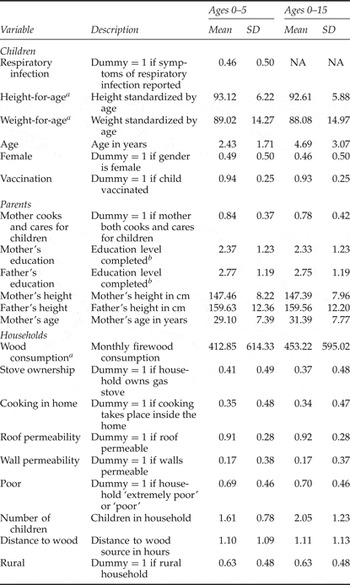
Characteristics of a child's parents include the highest education level they have achieved (elementary, middle or high school, some college, etc.) and their height. Additional child characteristics included are age, a dummy for female gender, five dummy variables describing ethnicity,Footnote 14 and a dummy variable indicating whether the child has had any of several possible vaccinations.Footnote 15 The poverty indicator is a dummy variable set equal to one if the household is classified as ‘extremely poor’ or ‘poor’ (as opposed to ‘not poor’), and the rural indicator is a dummy variable set equal to one if the household is located in a rural (as opposed to urban) area. We include 21 dummy variables to control for the district in which the household resides. Finally, as mentioned above, our instruments include the mother's age and a dummy variable indicating whether the household owns a gas stove. Descriptions and summary statistics for these variables are provided in table A1 in the Appendix.
5. Results
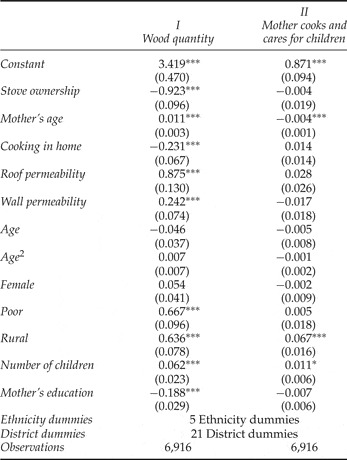
In this section, we present and discuss the estimation results for our econometric models. The results of the first stage models for wood consumption and whether a child's mother cooks while caring for children are presented in table 1. Both instruments are statistically significant in the regression for wood consumption (column I). As expected, gas stove ownership has a negative impact on the quantity of wood consumed. Additionally, households that are poor, live in rural areas and have more children consume more wood, whereas less wood is consumed when the mother has more education. The estimates in column II of table 1 suggest that mothers are more likely to cook while caring for children if the mothers are younger, if the household is in a rural area and if there are more children in the home.
First stage models for endogenous variables

Notes: *, **, ***indicate parameter significance at α = 10%, 5% and 1%, respectively.
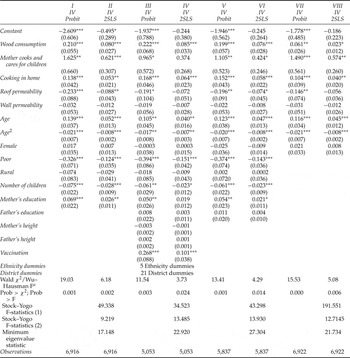
Table 2 shows the estimated coefficients and standard errors for several specifications of the respiratory health production function with different combinations of control variables. By including additional control variables we reduce the risk that our instruments are correlated with the error term. However, we also have a smaller number of observations available for estimation because fewer households provide information on some of the additional controls. We present results for IV probit models (columns I, III, V and VII) and 2SLS IV models (columns II, IV, VI and VIII). Table 2 also presents Wald tests (for probit) or Wu–Hausman F-tests (for 2SLS) of exogeneity of wood consumption and the indicator variable for whether a mother cooks and cares for children. Finally, to test for weak instruments, table 2 includes Stock–Yogo F-statistics on excluded instruments in the 2SLS regressions and the minimum eigenvalue of the matrix analog to the F-statistic for models with more than one endogenous regressor.
Children's respiratory health

Notes: *, **, ***indicate parameter significance at α = 10%, 5% and 1%, respectively.
aTest of exogeneity of Wood consumption and Mother cooks and cares for children.
The estimated coefficients indicate that wood consumption has a negative impact on children's respiratory health. The coefficients are positive and statistically significant in all specifications, suggesting that more use of firewood in the household raises the probability that a child has a respiratory infection. Similarly, all but one (column IV) of the estimated coefficients of the indicator variable for cooking while caring for children are positive and statistically significant, indicating that when mothers combine these two chores their children are more likely to have a respiratory infection.
The results in table 2 also provide evidence that cooking inside the home increases the probability of children having symptoms of a respiratory infection. The coefficients for this variable are all positive and statistically significant.Footnote 16 Additionally, the permeability of the home's roof decreases the probability of a respiratory infection. All the coefficients for this variable are negative, and all but two (columns IV and VIII) are statistically significant. On the other hand, we find no evidence that the permeability of the home's walls helps mitigate respiratory health impacts of firewood use. The coefficients for this variable are not statistically significant in any specification, possibly because most households in the sample have non-permeable walls. The number of children has a negative effect on ARI. This may indicate that in larger households it is more likely that small children are in the care of older siblings when cooking is taking place. The indicator for whether a household is poor has an unexpected negative impact on the probability of ARI. This could reflect underreporting of chronic symptoms due to lack of awareness during the recall period if the extent of underreporting tends to be greater in poorer households. However, as shown in columns VII and VIII, the key results are robust to dropping this variable.Footnote 17
The Wald chi-squared and Wu–Hausman F-tests of exogeneity of wood consumption and cooking while caring for children confirm the expectation that these variables are endogenous, as the null hypothesis of exogeneity is rejected in all models. Stock–Yogo F-statistics on excluded instruments in the 2SLS regressions range from 9.22 to 191.55, and are either close to or well above the commonly suggested critical value of 10.00 necessary to ensure that the bias from weak instruments in the 2SLS estimates is small. Additionally, we test for the possibility that weak instruments lead to size distortion of Wald tests of the parameters in finite samples. The Wald test is for joint significance of the endogenous regressors in the structural model at a 5 per cent confidence level (Stock and Yogo, Reference Stock, Yogo, Stock and Andrews2005). The critical value for tolerating a distortion so that the true size of the test can be at most 10 per cent is 7.03. All Stock–Yogo F-statistics and minimum eigenvalue statistics exceed this critical value, which allows us to reject the null hypothesis of weak instruments (Cameron and Trivedi, Reference Cameron and Trivedi2005).
6. Robustness
6.1. Weak instruments
Although our specification tests do not reveal evidence of weak instruments, we also estimated our preferred specifications using IV limited information maximum likelihood (LIML) instead of 2SLS. LIML estimators are asymptotically equivalent to 2SLS, but less biased in finite samples with weak instruments (Angrist and Pischke, Reference Angrist and Pischke2009). All results from this sensitivity experiment are very similar in sign, magnitude and significance to the results presented here.Footnote 18
6.2. Potential violations of exclusion restrictions
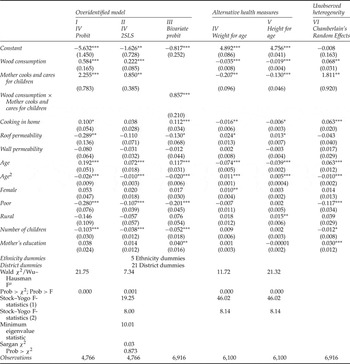
It is possible that the residuals from the health production functions and our instruments may be correlated, in which case exclusion restrictions are not met exactly, and our estimates could be biased. We address this concern in two ways. First, we estimate our model with an additional instrument for household wood consumption: the distance (in hours) between the home and the location where the firewood is obtained. We expect this variable to have an effect on the amount of wood consumed, but not directly impact respiratory health. In Guatemala, most households' choice of living location is limited, and in fact may largely be governed by predetermined ethnical and cultural factors.Footnote 19 Adding this instrument generates an overidentified model, which allows us to conduct a Sargan test of the overidentification restrictions.Footnote 20 Results of this and other robustness checks are presented in table 3 (columns I and II). The results are consistent with those presented in table 2, and based on the Sargan overidentification test of exclusion restrictions we fail to reject the null hypothesis of uncorrelated residuals and instruments. This provides some evidence that exclusion restrictions are adequately met.
Children's respiratory health – robustness checks

Notes: *, **, ***indicate parameter significance at α = 10%, 5% and 1%, respectively.
aTest of exogeneity of Wood consumption and Mother cooks and cares for children.
Additionally, as a second indirect test of the validity of our instruments, we estimate a bivariate probit model, which does not require excluded instruments for identification. Because we have two endogenous variables, in order to estimate a bivariate probit we use both regressors to construct a single endogenous interaction term, Wood Consumption* Mother Cooks and Cares for Children. The results are consistent with those estimated using an IV Probit and IV 2SLS: the interaction term has a positive, significant effect on the probability of respiratory infection (table 3, column III). This provides additional indirect evidence that any bias from imperfectly satisfied exclusion restrictions is likely to be small.
6.3. Alternative health measures
Next, we examine whether the health impacts of exposure to IAP are robust to using alternative, more general measures of health. Specifically, we use health indicators that measure a child's weight-for-age (WAM) and height-for-age (HAM) (Thomas et al., Reference Thomas, Strauss and Henriques1990; Alderman et al., Reference Alderman, Hoddinott and Kinsey2006). WAM and HAM measure weight and height as percentages of the median weight and height from a random sample of healthy infants and children. The measures were developed by the US National Center for Health Statistics and are widely used by the WHO, World Bank and others (Cogill, Reference Cogill2003). Estimates of the more general health effects are obtained by 2SLS regressions using the natural logarithm of WAM and HAM. The results are consistent with those found for ARI. The coefficients for wood consumption, cooking and caring for children, and for cooking inside the home are negative and statistically significant, which indicates that using firewood and cooking while caring for children and inside the home have negative impacts on WAM and HAM in young children (table 3, columns IV and V). These results corroborate our findings about the impacts of wood consumption on ARI, but they also suggest that these health effects may extend beyond specific symptoms of respiratory problems to more general measures of health. The implications of the potential relationship between wood consumption and broader health measures are interesting, but here we only explore them as a robustness test. More definite conclusions should only be drawn after further careful analysis.
6.4. Unobserved heterogeneity
Finally, our results may be biased if there is unobserved household-level heterogeneity. This could be addressed by estimating household fixed effects models. However, using a fixed effects model would sweep out the main variables of interest along with the unobserved household-level effects, because wood consumption and the indicators for cooking while caring for children and cooking inside the home are all measured at the household level. Instead, as a final robustness check we estimate household-level Chamberlain conditional random-effects (CRE) models. CREs achieve the same intuitive outcome as household-level fixed effects by conditioning on the sample averages of the variables of most theoretical relevance. We condition on wood quantity and cooking while caring for children.Footnote 21 The results (table 3, column VI) are consistent with the results in table 2.
7. Policy simulations
The effects of wood use on child respiratory health are statistically significant, but how large are they? By how much could child health be improved if wood burning behavior ended? In this section we use the estimated parameters from our preferred specification to simulate the impact of policies commonly proposed to mitigate the health effects of cooking with wood.
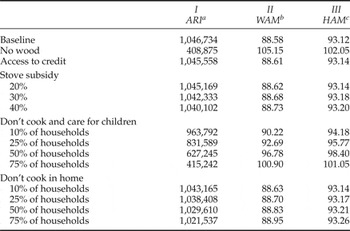
Simulation results are presented in table 4. We consider the effects of attempts to reduce wood consumption by promoting the adoption of gas stoves and contrast these outcomes with policies that focus on changing cooking practices so as to reduce the smoke exposure of young children.Footnote 22 In Guatemala there is a ‘dire shortage of information’ about health effects of IAP, and women are frequently not aware of the link between IAP and health (WHO, 2002; Ahmed et al., Reference Ahmed, Yewand, Barnes, Cropper and Kojima2005). Hence, changes in cooking practices could be achieved through outreach and health awareness campaigns.
Simulation results for children's health

Notes:
aNumber of children with ARI.
bWeight as percentage of median weight from a US CDC random sample of healthy infants and children.
cHeight as percentage of median weight from a US CDC random sample of healthy infants and children.
We start by using sample data to obtain baseline (fitted) values of all measures. Column I shows the predicted number of children with ARI symptoms, obtained using predicted probabilities of ARI and sample weights to project predicted sample effects to corresponding national amounts. In the baseline, our model predicts there are roughly 1.05 million children with ARI. As a robustness check, we also conduct simulations using the alternative measures of health, (WAM) (column II) and (HAM) (column III). WAM (HAM) measures weight (height) as a percentage of the median weight (height) from a US Center for Disease Control (CDC) random sample of healthy infants and children. Our model predicts that in the baseline the weight and height of the average child in our younger sub-sample will be 88.6 and 93.1 per cent of the CDC sample median, respectively.Footnote 23
To present a benchmark upper bound for the effectiveness of mitigation policies, we present a first simulation scenario in which we assume that households do not use wood at all (we set Wood consumption = 0). The results suggest that the health effects of eliminating wood use would be remarkable. The number of children with ARI symptoms would decrease by 61 per cent, WAM for the average young child would climb by almost 17 percentage points and HAM by almost 9 percentage points.
Complete elimination of the use of wood is, of course, not a realistic policy goal, at least in the short-term. Hence, we consider a number of alternative policies that either attempt to reduce the amount of wood used or to modify cooking habits to decrease exposure to IAP. We simulate the impact of granting universal access to credit for buying a gas stove, of price subsidies for gas stoves, and of a health awareness campaign that encourages mothers to avoid cooking while children are under their care or induces a change in cooking location to outside of the home.
To simulate the impact of improving access to credit to buy a gas stove, we use the results from Edwards and Langpap (Reference Edwards and Langpap2005), who find that universal access to credit increases stove ownership by 2.9 per cent in urban areas and 7.5 per cent in rural areas, which in turn leads to reductions in wood use of 2.4 and 0.6 per cent, respectively. We also rely on Edwards and Langpap (Reference Edwards and Langpap2005) to simulate subsidies of 20, 30 and 40 per cent of the price of a stove. They report that, for these subsidy levels, wood consumption decreases by 2.8, 4.4 and 6.1 per cent in urban households, and 2, 3.4 and 5.2 per cent in rural households, respectively.
To simulate the effects of a health awareness campaign that encourages mothers not to cook while caring for children, we assume a success rate of x per cent for the campaign (i.e., x per cent of households modify their cooking behavior). Then, we randomly draw x per cent of the observations in our sample for which mothers cook and care for children and set the indicator variable Mother Cooks and Cares for Children equal to zero. We conduct the simulation for success rates of x = 10, 25, 50, and 75 per cent. Finally, we use the same approach to simulate the effects of an awareness campaign that induces mothers to avoid cooking inside the home. That is, for x per cent of the observations for which cooking takes place inside, we set Cooking in Home equal to zero.
Simulation results indicate that improved access to credit and gas stove subsidies would make practically no difference in the number of ARI cases or in WAM and HAM measures. For instance, universal access to credit would result in a reduction of only 0.1 per cent in the number of ARI cases and negligible or no improvement in weight and height measures. Subsidizing stoves is modestly more successful. A 40 per cent subsidy reduces ARI cases by 0.6 per cent and yields slightly better results for WAM and HAM than access to credit, but the improvements, at less than 0.2 percentage points, remain small.
A health awareness campaign that reduces the number of women who cook with children present, in contrast, could have a considerably bigger impact. Even a modestly successful campaign that only changes behavior in 10 per cent of households is more effective than universal access to credit or a 40 per cent subsidy of gas stoves, reducing the number of ARI cases by almost 8 per cent and increasing WAM and HAM by 1.6 and 1.1 percentage points, respectively. A highly successful campaign that modifies behavior in 75 per cent of households would have impacts that are comparable to those of completely eliminating wood use. It would reduce ARI incidence by 60 per cent and increase WAM by 12 percentage points and HAM by 8 percentage points. Finally, a campaign that changes the location of cooking to outside of the home is much less effective. Its impact is very similar to those of a gas stove subsidy or improved access to credit, even if the program is highly effective and changes the behavior of 75 per cent of households.
Our results have direct policy implications. They suggest that if policies are aimed at reducing the direct respiratory health consequences or the broader impacts of exposure to IAP on preschoolers' health, then accelerating the adoption of a gas stove or otherwise seeking to reduce wood consumption may not be as effective as reducing smoke exposure by changing cooking behavior. In fact, a highly effective campaign promoting changes in cooking practices to discourage cooking while caring for children can be almost as effective as eliminating wood use entirely in preventing ARI and increasing preschoolers' measured health outcomes.Footnote 24
8. Summary and conclusions
IAP caused by firewood has significant health consequences in the developing world, particularly for young children who suffer high rates of exposure when their mothers cook while caring for them. Research to date has focused on ARIs. Several policy options have been proposed to mitigate this effect of IAP, including policies that attempt to speed up the transition to cleaner fuels such as LPG and policies aimed at reducing exposure rates by modifying cooking behavior. In this paper, we estimate econometric models to examine the impact of IAP on children's respiratory health in Guatemalan households.
Our results provide evidence that children living in households that use more wood, and where exposure to IAP is higher because the mother cooks while caring for children or because cooking takes place inside, are more likely to have symptoms of ARI. We also find evidence that more permeable roof materials may help mitigate the respiratory health impacts of IAP.
Our simulation results suggest that, despite existing evidence of their effectiveness at increasing gas stove ownership and decreasing wood consumption in Guatemala, policies that improve access to credit or subsidize the price of gas stoves would have small effects on children's health. Policies which focus on modifying cooking behavior, such as a health awareness campaign, can be more effective, particularly if they reduce the number of women who simultaneously cook and care for children.
Finally, we wish to address the nature of the data. This paper has demonstrated the usefulness of a standardized, general purpose LSMS-type survey in assessing one of the major developing country health issues. Most IAP studies have relied on special purpose surveys. These can be very effective, but the very fact that they are narrowly designed and targeted makes them costly to administer and typically limits data dissemination. Special purpose surveys are also subject to substantial variations in questionnaire design and sampling framework. These innovations can improve information quality, but they can also obfuscate the causes of new results and make it very difficult to compare results across countries or within countries over time. Standardization makes assessments of secular change and cross-country comparisons easier. Also, general purpose surveys are routinely collected for poverty assessments and a multitude of other issues, meaning that the ARI data cost is a marginal cost and that the data are widely disseminated. In fact, the collection and use of biomass fuel use is itself a multi-dimensional problem with ramifications that go well beyond the health of children in consuming families. These activities also involve externalities, including child labor, deforestation and loss of bio-diversity, soil erosion and concomitant loss of productivity, local air pollution, and climate impacts on a global scale. We would argue for the continued routine inclusion of biomass collection and burning data. The surveys currently treat this information as economic activity pertinent to labor, household production and consumption. They can be improved by explicitly recognizing these health and environmental dimensions, as well as by including additional questions that could help better analyze some of the other related externalities.
Appendix
Summary statistics

Notes:
aNatural logarithm of variable used for estimation.
b1 = none; 2 = pre-school; 3 = elementary; 4 = middle; 5 = high school; 6 = college; 7 = adult education.