Introduction
Rhinitis is a heterogeneous disorder characterized by one or more of the following nasal symptoms: sneezing, itching, rhinorrhea, and/or nasal congestion. Rhinitis frequently is accompanied by symptoms involving the eyes, ears, and throat, including postnasal drainage.Reference Skoner1 The head and neck are the most commonly affected target organs of the allergic reaction.
Allergic rhinitis may involve the inner ear. The scientific basis for this is poorly understood. However, the inner ear has been found to demonstrate both cellular and humoral immunity, and the seat of immuno-activity appears to reside in the endolymphatic sac and duct. Immunoglobulins G, M and A and secretory components have all been found in the endolymphatic sac, while plasma cells and macrophages have been found in the perisaccular connective tissue.Reference Altermatt, Gebbers and Mullar2 Mast cells have also been identified in the perisaccular connective tissue. Harris found evidence of local antibody production in the perilymphatic space, and suggested the existence of local humoral immunity within the inner ear.Reference Harris3–Reference Harris5 Brookes identified increased circulating immune complexes in 55 to 66 per cent of patients with Ménière's disease, and also an increased incidence of serum autoantibodies, compared with control subjects.Reference Brookes6
Aims
This study aimed to assess the otological and audiological status of patients with allergic rhinitis seen in the out-patient section of the otolaryngology department of the Post Graduate Institute of Medical Education and Research, Chandigarh, India, compared with a control group.
Methods and materials
Methodology
The study group consisted of 30 patients with allergic rhinitis, 14 men (46.7 per cent) and 16 women (53.3 per cent), with a mean age of 31 years (range 17–45 years). These patients were selected from those reporting to the out-patient department of the Post Graduate Institute of Medical Education and Research, Chandigarh, India, between January 2008 and June 2009.
All study group patients received a thorough ENT examination in the otolaryngology department, and also underwent audiological assessment in the speech and hearing unit attached to the department. No study group patient had any history of noise exposure, ototoxic medication, metabolic problems, neurological problems or other ENT problems; allergic rhinitis was their only condition. Allergic rhinitis was diagnosed based on the detailed clinical history and results of ENT examination.
No study group patient complained of hearing loss. Pure tone average hearing thresholds were calculated for each patient at 500, 1000 and 2000 Hz. Normal hearing sensitivity was defined as a hearing threshold of less than 25 dBHL at each frequency tested, within the range 0.25–8 kHz.Reference Silman, Silverman, Silman and Silverman7 An impedance audiometry type A response was defined as normal.Reference Jerger8
The control group comprised 20 healthy individuals, 12 men (60.0 per cent) and eight women (40.0 per cent), with a mean age of 27 years (range 21–42 years), who were age- and sex-matched to the study group. Control group subjects were selected from relatives and friends accompanying the study group patients; these control subjects had thus been exposed to a similar environment but did not suffer from allergic rhinitis or any systemic disease. Any control subjects found to have ENT problems or hearing loss (detected by ENT and audiological examination) were excluded from the study. We also excluded any control subjects with neurological disease, acoustic trauma, metabolic problems, past ototoxic drug exposure or middle-ear problems.
Apparatus and procedure
All study and control group subjects underwent a detailed physical examination, including a complete ENT examination. This was followed by audiological testing, which included pure tone audiometry with extended high frequencies (0.250–16 kHz), tympanometry, and otoacoustic emission (OAE) and auditory brainstem response (ABR) testing.
Audiological assessment was conducted in a sound-treated room which conformed to American National Standards Institute (ANSI) (1977) and International Organization for Standardization (ISO) standards for maximum permissible noise level.
Hearing thresholds were tested using a commercially available audiometer (Orbiter 922; Madsen, Taastrup, Denmark) with TDH39 headphones (Madsen Electronics, Taastrup, Denmark) for conventional audiometry and TDA 200 headphones for high frequency audiometry.
A Siemens SD 30 tympanometer (Siemens, Danplex A/s, Copenhagen, Denmark) was used for tympanometry and acoustic reflex testing. A 226 Hz probe tone was used for tympanometry, with pressure varied from +200 to −300 daPa.
Otoacoustic emission and ABR testing was carried out using systems developed by Intelligence Hearing System (Miami, Florida, USA).
Transient evoked OAE (TEOAE) testing was performed with a wide band click in continuous mode and with an intensity of 90 dB SPL. When measuring the Distortion product (DP) gram, the frequency separation of the primaries was f2/f1 = 1.22, with L1 and L2 set to 65 and 55 dB SPL, respectively. The parameter considered in TEOAE testing was a signal-to-noise ratio of more than 3 dB in at least three consecutive test frequencies (of 1, 1.5, 2, 3 and 4 kHz).
The parameters considered in distortion product OAE testing were (1) a signal-to-noise ratio of more than 3 dB in three consecutive test frequencies, and (2) the amplitude of the signal in the 90th percentile of the normal distribution for the frequencies tested (i.e. 357, 499, 704, 1003, 1409, 2000, 2822, 3991 and 5649 Hz).
Auditory evoked potentials were measured in all subjects in the supine position with eyes closed. Auditory brainstem responses were tested using the evoked potential system developed by Intelligence Hearing System. Insert earphone ER-3A transducers (Intelligence Hearing System) were used to present stimuli. Silver–silver chloride button electrodes were used.
The following parameters were selected for recording: (1) the filter bandwidth was adjusted to 100–3000 Hz; (2) the stimulus was clicks; (3) the stimulus rate was 19.3/second and its duration was 100 micro second/click; (4) a minimum of 1024 clicks was presented at each recording, increased to 2048 when the wave was suboptimal (responses were repeated at each intensity level to ensure reproducibility); (5) waveforms were recorded at a sound intensity of 70–90 dBnHL, in both ears separately.
The site of electrode placement was cleaned thoroughly with a spirit swab to reduce the skin–electrode impedance to less than 5 kΩ. The non-inverting electrode was placed at the vertex, the inverting electrode was placed on either mastoid, and the ground electrode was placed on the forehead, using conduction gel. The surface impedance was adjusted to below 5 kΩ to facilitate optimal recording.
The following parameters were studied: the absolute latencies of waves I, III and V, and the Interpeak latencies of waves I–III, III–V and I–V.
Statistical analysis
Statistical analysis was carried out using the Statistical Package for the Social Sciences version 13.0 software for Windows (SPSS Inc, Chicago, Illinois, USA). All quantitative variables were estimated using measures of central location (i.e. mean and median) and measures of dispersion (i.e. standard deviation (SD)).
Data normality was checked using the Kolmogorov–Smirnov tests of normality. For normally distributed data, means were compared using Student's t-test for two groups. The unpaired t-test was used to compare the ABR latencies and interpeak latencies, for the study versus control groups. For skewed data, the Mann–Whitney test was applied (i.e. for 2 kHz and 4 kHz TEOAE frequencies).
A p value of less than 0.05 was considered statistically significant.
Results
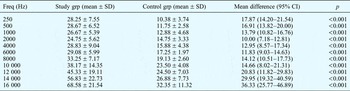
Table I gives mean hearing thresholds ± SDs (right and left ears) for the study and control groups, for 0.250 to 16 kHz. Mean air conduction thresholds ranged from 28.25 to 68.58 dB in the study group and 10.38 to 32.35 dB in the control group. All study group patients had sensorineural hearing loss that was worse in the high frequency region. None of the study group patients had conductive hearing loss. A statistically significant difference was found for air conduction thresholds across the frequencies 0.250 to 16 kHz, comparing the study and control groups (p < 0.05).
Hearing thresholds: study and control groups*

Data expressed in dB unless otherwise specified.
* Right and left ears. Freq = frequency; grp = group; SD = standard deviation; CI = confidence interval
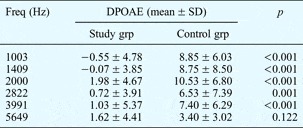
Table II shows mean ± SD absolute values for distortion product OAE (DPOAE) signal-to-noise ratios across the frequencies 1003 Hz to 5649 Hz. Of the 30 study group patients, 27 (90 per cent) had abnormal DPOAEs and three (10 per cent) had normal DPOAEs. We found a statistically significant difference for DPOAE signal-to-noise ratios, comparing the study and control groups, for all frequencies (p < 0.05) except 5649 Hz (p > 0.05).
Dpoae results: study and control groups

Data expressed in dBSPL unless otherwise specified. DPOAE = distortion product otoacoustic emission; freq = frequency; SD = standard deviation; grp = group
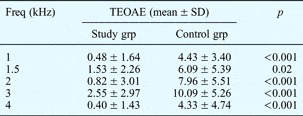
Table III shows mean ± SD absolute values for transient evoked OAE (TEOAE) signal-to-noise ratios across the frequencies 1 to 4 KHz. All study group patients had abnormal TEOAEs. We found a statistically significant difference for TEOAE signal-to-noise ratios, comparing the study and control groups, across all frequencies (p < 0.05).
Teoae results: study and control groups

Data expressed in dBSPL unless otherwise specified. TEOAE = transient evoked otoacoustic emission; freq = frequency; SD = standard deviation; grp = group
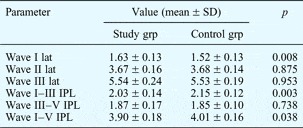
Table IV shows the mean ± SD absolute values for ABR wave I, III and V latencies and waves I–III, III–V and I–V interpeak latencies, for the study and control groups. A statistically significant prolongation of wave I latency was found in the study group, compared with the control group (p < 0.05). We also found statistically significant shortening of the wave I–III absolute interpeak latency (p < 0.05) and shortening of the wave I–V absolute interpeak latency (p < 0.05) in the study group, compared with the control group.
Abr parameters: study and control groups

Data expressed in millisecond unless otherwise specified. ABR = auditory brainstem response; SD = standard deviation; grp = group; lat = latency; IPL = interpeak latency
Discussion
This study identified a higher prevalence of inner ear symptoms in patients with allergic rhinitis, compared with control subjects.
We assessed the cochlear function of patients with allergic rhinitis using transient evoked OAE (TEOAE) and distortion product OAE (DPOAE) testing, because these are the most commonly used OAE tests in clinical practice. We excluded DPOAE results obtained at 357, 499 and 704 Hz because it is difficult for the middle ear to convey OAEs at such low frequencies, and also because of the high sensitivity to external noise in this frequency range. We were unable to identify any previous publications reporting TEOAE and DPOAE results in patients with allergic rhinitis.
We found abnormal TEOAE results in all 30 allergic rhinitis patients, and abnormal DPOAE results in 27 (90 per cent). These abnormal results suggest outer hair cell dysfunction.
We were also unable to locate any published data for ABR results in patients with allergic rhinitis. Our ABR findings showed a statistically significant difference in some ABR wave latencies and interpeak latencies; in the study group, we found prolongation of wave I latency and shortening of waves I–III and I–V interpeak latencies, although the wave V latency was normal. These findings also indicate cochlear involvement in patients with allergic rhinitis.
It has been proposed that the endolymphatic sac acts as a target organ during allergic reactions, and this suggests one possible mechanism for the inner ear changes seen in allergic rhinitis.Reference Derebery and Valenzuela9–Reference Uno, Miyamura and Kanzaki12 The endolymphatic sac has been shown to be capable of both processing antigen and producing its own local antibody response.Reference Harris4 It has a highly vascular subepithelial space containing numerous fenestrated blood vessels. Most immunologically competent cell types are found in the interosseous portion of the endolymphatic sac, because of its unique blood supply.Reference Wackym, Friberg and Linthicum13 The endolymphatic sac and duct are supplied by arteriolar branches of the posterior meningeal artery (itself supplied by the occipital branch of the external carotid).Reference Wackym, Friberg, Bagger-Sjonack and Rask-Ansersen14 The sac's peripheral and fenestrated blood vessels may allow entry of antigens, which could then stimulate mast cell degranulation in the perisaccular connective tissue.Reference Gibbs, Mabry and Roland11–Reference Wackym, Friberg and Linthicum13, Reference Derebery, Rao, Siglock, Linthicum and Nelson15 The resulting inflammatory mediators and accumulation of toxic metabolic products may interfere with hair cell function. In addition, the sac's fenestrated blood vessels are vulnerable to the effects of vasoactive mediators such as histamine, when released due to allergic reactions elsewhere in the body.
A second possible mechanism for the inner ear changes seen in allergic rhinitis involves the production of circulating immune complexes (e.g. involving food antigens) which are deposited in the endolymphatic sac, producing inflammation. Inflammation due to deposition of immune complexes along vascular basement membranes is the hallmark of immune complex disease. Antigen–antibody complexes localised in and around blood vessel walls induce an inflammatory reaction mediated by complement activation and by an influx of phagocytic cells. Immunoglobulin M and G antibodies in the immune complexes induce complement activation, resulting in the release of chemotactic factors that promote the migration of polymorphs and macrophages into the region. Although the binding of immune complexes to cell membranes facilitates phagocytosis of those cells, it also results in the release of tissue-damaging enzymes. An increased serum concentration of circulating immune complexes has been described in both Ménière's disease and allergic rhinitis.Reference Wackym, Friberg, Bagger-Sjonack and Rask-Ansersen14
• The scientific basis for involvement of the inner ear in allergy is poorly understood
• This study found a higher prevalence of hearing loss and otoacoustic emission abnormalities in patients with allergic rhinitis, compared with controls
Furthermore, the interaction between viral antigens and allergy mechanisms, and the deposition of circulating immune complexes in the stria, may both cause leakage of the blood–labyrinth barrier as a result of increased vascular permeability and disruption of ionic and fluid balance in the extracapillary spaces. This could facilitate the entry of autoantibodies into the inner ear.
Conclusion
This study demonstrated a higher prevalence of hearing loss and OAE abnormalities in patients with allergic rhinitis, compared with normal subjects, even in those patients with no complaints of hearing loss. This higher prevalence of hearing loss and OAE abnormalities is probably associated with allergic rhinitis, rather than other problems.
Additional research in this area is required, using a larger sample population, in order to determine the value of routine audiometric and OAE testing in patients with allergic rhinitis, and to assess the potential benefit of such testing on patients' clinical outcome.