Introduction
Recent examples highlight the risk of occurrence of a sanitary crisis, such as the coronavirus disease (COVID-19) pandemic. Climate change increases the risk of these crises, with emerging diseases associated with the warmer climate, which favors the transmission of pathogens and the multiplication of disasters, such as floods or heatwaves. Reference Bein, Karagiannidis and Quintel1 Our societies will likely face some sanitary crises in the coming years. The severity of a sanitary crisis depends not only on its intrinsic intensity, but also on the vulnerability of the exposed society. Reference Zaninetti2 To lessen the impact of these crises, organizational response is essential. Hospitals are a frontline service, the first refuge during sanitary crises. Reference Barbarin-Costes3 The processes to prepare and manage these crises require efficiency that depends not only on a protocol and its strict adherence, but also on the way in which it is implemented by professionals. Reference Combalbert4,5 For organizations and professionals, preparedness is essential to optimize the management of sanitary crisis.
Scientific literature has recently focused on assessing the preparedness of hospital workers for sanitary crises. Reference Gowing, Walker and Elmer6,Reference Labrague, Hammad and Gloe7 Research is mainly focused on declared preparedness. The psychosocial factors affecting preparedness are studied in the general population. Reference Mishra and Mazumdar8 There is a lack of information on the psychosocial evaluation of hospital workers’ preparedness for sanitary crises.
Factors Influencing Perceived Preparedness
According to the literature concerning the general public, many factors influence preparatory behaviors. Risk perception is a key precursor variable in the literature on public education on natural disaster risk. Reference Burns and Slovic9,Reference Espina and Teng-Calleja10 Risk perception can be defined as the assessment of a risk, its probability, and consequences. Reference Kouabenan, Cadet, Hermand and Kouabenan11 This assessment is a subjective construction of risk, influenced by psychosocial variables. Therefore, a subjective dimension of risk perception needs to be added. The 3 most important variables in risk perception are perceived severity, perceived frequency, and reported fear. Reference Peretti-Watel12
Age and gender have an effect on adopting preparatory behaviors in the general population. 13–Reference Mulilis and Duval15 The influence of perceived self-efficacy on adoption of protective behavior against natural disasters has been highlighted. Reference Mishra and Mazumdar8,Reference Lindell and Whitney16,Reference Paton17 Self-efficacy is defined by the belief that individuals can act in a variety of situations. Thus, it is not limited to the sum of the skills that individuals possess. Reference Bandura18
This study tends to highlight the effect of variables that have not been assessed in recent literature. This study suggests that personal and professional involvement influences preparedness. The concept of personal and professional involvement was proposed by Rouquette in 1997. Personal involvement refers to the relationship an individual has with an object of social representation. Reference Rouquette19 Social representations are defined as “a form of knowledge, socially developed and shared, having a practical aim and contributing to the construction of a reality common to a social whole." Reference Jodelet20 The relationships between an individual and an object are based on 3 dimensions: the identification of the object (“I feel concerned”), the evaluation of the object (the perceived importance), and the perceived capacity for action (believing that the individual himself/herself can act on this object). Reference Rouquette19 For collective risks, the perceived capacity for professional action is added (believing that the individual can act on this object as a professional). Reference Ernst-Vintila, Delouvée and Rouquette21 Diffusion of responsibility might influence the personal readiness perception. Diffusion of responsibility is a process of group influence: leading an individual to a loss of personal responsibility due to the social presence of others. It has been shown that, in an emergency, this process can influence individuals not to act. Reference Darley and Latane22 Finally, for hospital workers, the perceived colleague preparedness and perceived hospital preparedness might influence the concept of overall readiness perception.
Perception of Preparedness, Readiness Perception, and Declared Preparedness
A differentiation must be made between the perception of preparedness, the readiness perception, and the declared preparedness. The perception of preparedness refers to the feeling of being sufficiently prepared to manage a sanitary crisis. The readiness perception refers to the belief in the capacity to manage the sanitary crisis. Thus, people may believe that they can manage the crisis but, at the same time, think that they are not well-enough prepared. The contrary is also possible: One can feel sufficiently prepared but, nevertheless, not believe he/she can manage the crisis. These notions are linked, but they refer to different beliefs. Declared preparedness refers to declaring that one has had preparatory behavior. Individuals may report having participated in preparedness training, but they do not feel sufficiently prepared or ready to manage a crisis. These definitions have been set up from a previous study (unpublished) from 43 interviews conducted with hospital workers from all over France from January 2019 to July 2019 on sanitary crises preparedness.
Objectives
The aim of this study was to measure the hospital workers’ readiness perception and variables related to this perception. Answers to the following questions were sought in this study: Do hospital workers feel they are ready to manage sanitary crises in a pre-crisis context? What factors influence this readiness perception?
Given the exploratory nature of the study, the hypotheses are general:
-
1. Readiness perception is linked to perceived personal preparedness.
-
2. Readiness perception is linked to risk perception and personal involvement.
-
3. Readiness perception is linked to the perception of preparatory behavior.
-
4. Readiness perception is linked to the preparedness perception of colleagues and hospital.
Methods
Study Setting, Design, and Sample
This study was a cross-sectional study. Participant inclusion criterion was that the participants reside in France and practice their profession, whatever it may be, within a hospital. In France, 1.24 million employees were working in a hospital in 2015. Reference Holcman and Holcman23 Based on this figure, with a 5% margin of error and 95% confidence interval, the required sample size was 385 participants; 68 hospitals, 13 regional health agencies, and groups of caregivers on social networks were contacted. The distribution method called snowballing was used to circulate an online questionnaire carried out using the Qualtrics© (Provo, UT) online survey and analyses platform. For this method, participants share to new contacts and those share to new contacts, and so on. Reference Vogt and Johnson24 The software prevents participants from answering the questionnaire more than once using their IP address. After getting information about the study, all the participants gave their written declaration of consent before answering the questionnaire. The data were confidential and anonymous. Ethical approval was not deemed necessary since this was a voluntary survey without disclosure of any personal identifiable or protected health information. We have no agreement with the participants’ employers. This was made clear to the participants before starting the questionnaire. The questionnaire was released from March 14–20, 2020. The evolution of the COVID-19 crisis was uncertain, but the international context as well as forecasts suggested that hospital workers would have to manage a sanitary crisis. The questionnaire was sent before the overflow from the hospital.
Measurement Tools
To our knowledge, there is no validated questionnaire that could have been applied in this context. Therefore, the measurement tool is a developed one. The questionnaire was inspired by the results of interviews conducted previously and by literature on personal and professional involvement, Reference Ernst-Vintila, Delouvée and Rouquette21 risk perception, Reference Peretti-Watel12 the theory of planned behavior, Reference Francis, Eccles and Johnston25 and disaster preparedness. Reference Mishra and Mazumdar8 The questionnaire was pre-tested by 5 people to ensure that the items were well understood. The questionnaire contains 63 items, including 17 items concerning the characterization of the hospital population in the form of Boolean open-ended or multiple-choice questions. The variables are the experience of 1 or more sanitary crises, age, gender, profession, hospital department specialty, work experience, city, and department of the hospital. The questionnaire includes 46 items about the supposed predictors of readiness perception. These items are put forward in a linear numeric response format, with statements followed by response scales ranging from 0 (“I strongly disagree”) to 10 (“I strongly agree”). Some items with satisfactory Cronbach’s alpha scores are grouped into scales. These scores are presented in the following paragraph. The other variables mentioned are assessed by only 1 item. The variables are divided into 4 categories:
-
1. Personal preparedness: Perceived personal readiness (general perception of readiness, the perception of readiness for a sudden situation, and the perception of readiness for an anticipated situation [α = 0.91]), perceived personal preparedness (general perception of preparedness, knowledge, and skills [α = 0.83]), self-efficacy, and declared effective preparedness. For these last variables, Boolean questions (yes/no) are used: participation in simulation exercises, participation in specialized training, participation in feedback from previous sanitary crises, reading the emergency plan, and requesting information from sanitary crisis referents are tested.
-
2. Risk perception and personal involvement: Perceived likelihood of occurrence, perceived severity, perceived fear, identification and evaluation for the object, and perceived personal and professional capacity for action.
-
3. Perception of preparatory behavior: Effectiveness of individual preparedness, effectiveness of collective preparedness, effectiveness of procedures, behavioral control (perception of “can do” actions to prepare and perception to be able to prepare [α = 0.79]), injunctive norm from colleagues, injunctive norm from society, affective attitude (perception of preparedness as pleasurable and distracting [α = 0.82]), cognitive attitude (perception of preparedness as helpful and prudent [α = 0.92]), difficulty attitude (perception of preparedness as difficult and requiring effort [α = 0.78]), and behavioral intention (intention to prepare in the future and in the coming months [α = 0.79]).
-
4. Perception of the colleagues’ preparedness and the hospital’s preparedness: Perceived preparedness of colleagues (on hospital service and out of hospital service [α = 0.90]), perceived readiness of colleagues (on hospital service and out of hospital service [α = 0.93]), perceived hospital preparedness (material and human resources [α = 0.84]), and perceived hospital readiness and diffusion of responsibility.
Data Analyses
The data were analyzed using Statistical Package for the Social Sciences (SPSS©; IBM Corp, Armonk, NY) software. To determine the significance of the tests employed, we used the P-value. A test result with a P-value of less than 0.05 is considered significant. First, descriptive analyses allowed to observe the data were carried out. Then, analysis of variance (ANOVA) was conducted to explore the links between perceived readiness perception and categorial variables. Then, for variables with more than 2 categories, the differences in averages with each category pair were tested by applying the Bonferroni correction. Then, Pearson’s correlations between the variables according to the hypotheses and personal readiness perception were carried out. We then performed Pearson’s partial correlations to control the effect of variables on the simple correlations. According to Cohen, the strength of effect sizes of correlation coefficients of 0.10 are small, those of 0.30 are medium, and those of 0.50 are large. Reference Cohen26 Therefore, multiple linear regressions were conducted with variables having a correlation coefficient (r p ) greater than 0.30 and which retained a significant correlation (with a P-value lower than at least 0.05), despite the control of other variables to determine the strongest predictors in the quantitative variables.
Items about declared preparedness (previously cited) were added together to make a score ranging from 0 to 5. Concerning diffusion of responsibility, 4 items were put forward to estimate the importance of the role of 4 categories of professions (paramedical, health managers, physicians, and administrative). The average differences between the importance of the estimated role of their own category and the other categories were calculated.
Results
Participants
The sample included 408 hospital workers. This was appropriate for the sample size required by our method. The sample included 88.2% of women with an average age of 36.8 years (SD = 10.4). The sample is composed of 8 physicians, 38 health managers (a health manager is a hospital worker exercising in the paramedical field who supervises and manages a team), 344 paramedics, and 9 administrative and directing workers; 18.5% of the participants are undergraduates and 81.5% are postgraduates. Concerning experience, 35% of the participants have worked for less than 5 years, 22.3% have worked between 5 and 10 years, 13.5% have worked between 10 and 15 years, 29.2% have worked for more than 15 years, and 29.9% of the participants have a prior experience of sanitary crises.
Mean Readiness Perception
On a scale from 0 to 5, participants presented an average score of declared preparedness (Mean = 2.16; SD = 1.47). On a scale from 0 to 10, participants had a moderate score of readiness perception (Mean = 5.19; SD = 2.26) and preparedness perception to manage a sanitary crisis (Mean = 4.93; SD = 2.29). They had a medium score of perception of their knowledge as being sufficient (Mean = 5.08; SD = 2.71) such as their skills (Mean = 5.31; SD = 2.52). Participants had a high score of perception of their colleagues as being well-prepared (Mean = 7.48; SD = 2.18) and a lower score of perception of their readiness (Mean = 6.00; SD = 2.29). Participants had an average score of perception of hospital as being ready (Mean = 5.38; SD = 2.64), with a lower score of perception of human resources (Mean = 4.43; SD = 2.71) and materials resources as being sufficient (Mean = 3.74; SD = 2.50).
Variables Linked to the Readiness Perception
Analysis of Variance
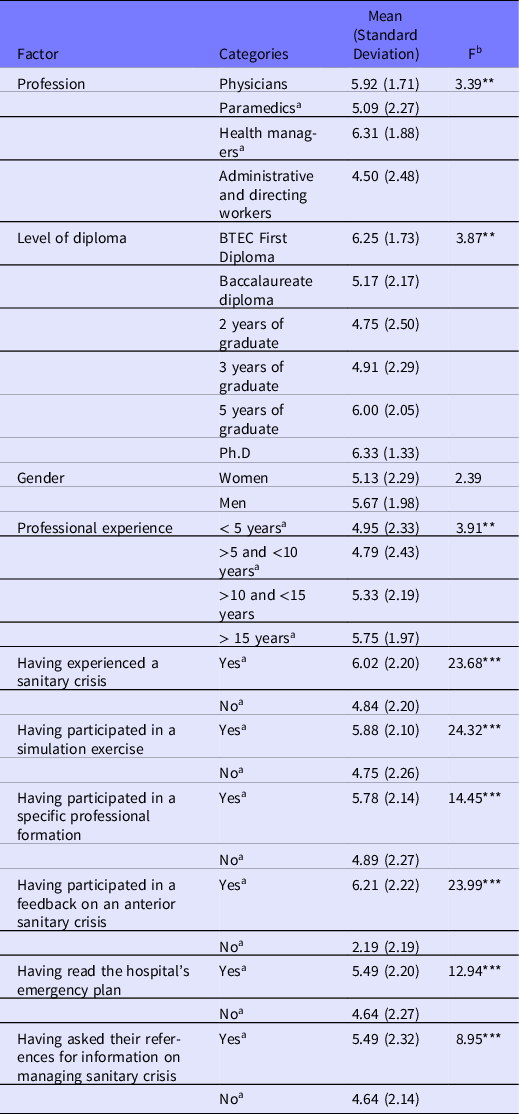
Differences of personal readiness perception according to sociodemographic and experience factors were tested with analysis of variance followed by the Bonferroni correction. Results are presented in Table 1.
Analysis of variance after Bonferroni correction with personal readiness perception according to sociodemographic and experience factors

*** = P < .001.
** = P < .01.
* = P < .05.
a Categories where the difference between the means is significant after Bonferroni correction.
b Coefficient of Levene’s test for equality of variances. If the test is significant then the differences are probably not due to chance.
There were no significant mean differences between the scores of personal readiness perception according to gender. However, the other differences in means according to other sociodemographic variables and experience were significant (see Table 1).
Correlations
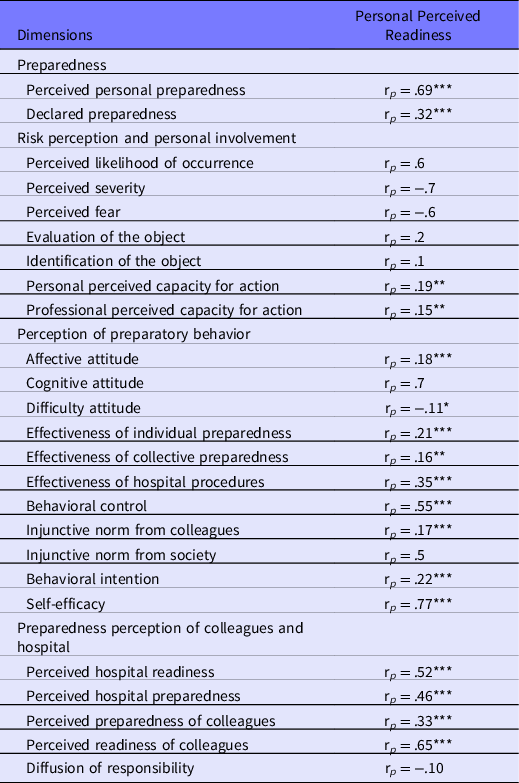
Correlations between the personal readiness perception and all the variables mentioned above were tested (Table 2).
Correlations between personal perceived readiness and tested variables, sorted by the four dimensions explored

*** = P < .001.
** = P < .01.
* = P < .05.
r p = Pearson correlation coefficient. It indicates the strength and direction of the relationship between the two variables tested.
Perceived personal readiness was positively correlated with perceived personal preparedness and declared preparedness. However, by controlling the effect of the perceived personal preparedness, Pearson’s partial correlations between declared preparedness and personal perceived readiness show that the correlation is no longer significant (the P value associated with the r p between perceived personal readiness and declared preparedness is no longer less than 0.05). Similarly, partial correlations between perceived personal preparedness and personal perceived readiness controlling the effect of self-efficacy and behavioral control show that the coefficient r decreases to 0.28, with a P-value inferior to 0.001 (see Table 2).
Perceived personal readiness is not significantly correlated with items about risk perception and only partly significantly correlated with items about personal involvement. Evaluation and identification of the object are not correlated with perceived personal readiness, unlike personal and professional perceived capacity, for actions which are significantly and positively correlated with perceived personal readiness (see Table 2).
Personal perceived readiness is significantly correlated with variables about perception of preparatory behavior, except for cognitive attitude and injunctive norm from society (see Table 2).
Personal perceived readiness is significantly and positively correlated with variables about preparedness perception of colleagues and hospital but not with diffusion of responsibility. However, once we make partial correlations between perceived hospital readiness and personal perceived readiness by controlling the effect of the perceived readiness of colleagues, then the correlation is no longer significant. Once we make partial correlations between perceived preparedness of colleagues and personal perceived readiness by controlling the effect of the perceived readiness of colleagues, then the correlation is no longer significant (see Table 2).
Multiple Linear Regression
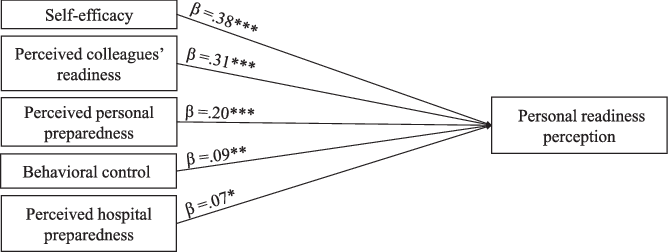
We carried out a multiple linear (stepwise) regression with variables having an r coefficient greater than 0.30, except for perceived hospital readiness, perceived colleagues’ preparedness and declared preparedness which is no longer correlated, once controlling the effect of other variables. Tested variables were: self-efficacy (r p = 0.77***), perceived personal preparedness (r p = 0.69***), perceived colleagues’ readiness (r p = 0.65***), behavioral control (r p = 0.55***), perceived hospital preparedness (r p = 0.45***), and effectiveness of hospital procedures (r p = 0.35***). The model explains significantly more variability than a model without predictors F = 187.81; P < 0.001. It has an R2 of 0.71. Self-efficacy is the most important variable (B = 0.39; β = 0.38; t = 8.71; P < 0.001) followed by the perceived colleagues’ readiness (B = 0.30; β = 0.31; t = 8.33; P < 0.001), perceived personal preparedness (B = 0.20; β = 0.20; t = 4.94; P < 0.001), behavioral control (B = 0.10; β = 0.09; t = 2.71; P < 0.01), and perceived hospital preparedness (B = 0.07; β = 0.07; t = 2.18; p < 0.05) (Figure 1).
Multiple linear regression model with perceived personal readiness as the dependent variable. The β coefficient indicates the change in standard deviation of the DV (personal readiness perception) for each increase of one standard deviation of the IV (the model variables: self efficacy, perceived colleagues’ readiness, perceived personal preparedness, behavioral control and perceived hospital preparedness). *** P < .001 ** P < .01 * P < .05.

Discussion
Results Summary
Results of this study show that years of work experience, profession, and previous experience of managing a sanitary crisis are related to the personal readiness perception: Health managers, participants with more than 15 years of experience, and those who have already experienced a sanitary crisis have a higher score of readiness perception than others. The readiness perception is linked to perceived personal preparedness but not with declared preparedness once we control the effect of perceived personal preparedness. The link between readiness perception and preparedness perception decreases because of the self-efficacy and behavioral control effect. Perceived personal readiness is not linked to risk perception items, identification, and personal involvement evaluation items. Professional capacity and personal capacity for action are linked to personal readiness perception. Personal perceived readiness is linked to perception of preparatory behavior, except for cognitive attitude and injunctive norm from society. Personal perceived readiness is linked to perception of readiness colleagues and perception of hospital preparedness but not with diffusion of responsibility. It is not linked to perceived hospital readiness and perceived preparedness of colleagues once we control the effect of the perceived readiness of colleagues. According to multiple linear regression, the variables most related to personal perceived readiness are self-efficacy, perceived colleague readiness, perceived personal preparedness, behavioral control, and perceived hospital preparedness.
Implications of the Results
Preparedness is Not Enough to Feel Ready
Results of this study confirm the hypothesis that actual preparedness is not sufficient to predict the perception of personal readiness. Once the controlling effect of perceived preparedness is carried out, declared preparedness is not related to personal readiness perception. The effect of perceived preparedness is not sufficient to predict the perception of personal readiness, while self-efficacy and behavioral control is linked to this effect. So, it is relevant to focus on the perception of being ready rather than on the perception of being prepared and the actual preparedness.
When addressing the perception of self-efficacy, the concept of “self” is composed of one’s direct experiences and evaluations formulated by people who are important to them. Reference Bandura18 This research reviewed the perception of their preparedness but not how skills resulting from preparedness are applied. According to the effect of self-efficacy, the perception of one’s capacity to apply skills is relevant. This concept deserves an evaluation with more precise and complex scales. This exploratory study shows that a more in-depth analysis of this theme is necessary. The psychological preparedness is relevant. For example, managing one’s emotions is a particularly interesting area to explore. Reference McLennan, Marques and Every27
The Collective Dimension
Results show that the collective dimension is an essential variable: The perception of colleagues as being ready is important in the model for predicting perceived personal. This latter result can also be put into perspective using the socio-cognitive theory and, more specifically, the collective self-efficacy theory. According to this theory, collective self-efficacy is defined as “the shared belief of a group in its joint capacities to organize and execute the actions necessary to produce given levels of achievement." Reference Bandura18 This concept consists of the social cohesion (ie, trust and solidarity) required for collective action and the belief in efficiency in relation to specific tasks that enable the conversion of social cohesion into collective action. Reference Babcicky and Seebauer28 Given the task studied here and the importance of personal self-efficacy and the collective aspect, studying collective self-efficacy would be extremely interesting to deepen the importance of the collective dimension.
Results show that health managers feel more ready than paramedics. We assume that health managers feel more responsible for dealing with health crises, which could explain this result. This result suggests that the participants’ place in the institution plays an important role in their personal perception of readiness. Research has shown that nurses are more inclined to mobilize during health crises when they trust their leaders and colleagues. The quality of leadership is also important for engagement during such crises. Reference Arbon, Ranse and Cusack29
These results indicate that the individual cannot feel ready alone, and thus the results can improve our understanding of the mechanisms involved through the concept of collective self-efficacy, leadership, or trust but not solely. It is important to conceptualize the collective both as internalization by the individual and as a socio-cognitive reconstruction. Reference Moscovici30 This study puts forward that the effect of the group is an encouraging avenue. More specifically, the concepts of professional representations, leadership, cohesion, and group membership are promising elements.
The Absence of Significant Correlations Between Readiness Perception, Risk Perception, and Involvement
Personal and professional involvement and the perception of risk are not significantly related to the perception of readiness. The professional involvement modeled by Mias in 1998 could be used to understand these results: Involvement is composed of 3 dimensions – the meaning that links the objects that individuals face in their professional context, the reference points as a shared system of representation, and the perception of control of their actions in a system of collective practices. Reference Lac, Mias, Labbé and Bataille31 According to an unpublished study by Lac and De Zotti in 1999, in an unusual situation, reference points and the perception of control are no longer operative, whereas meaning would be activated to compensate for the ineffectiveness of the other dimensions. Reference Lac, Mias, Labbé and Bataille31 Yet, the results show that the professional capacity for professional action is related to the perception of personal readiness. The perception of control of their actions in a system of collective practices is operating in this study. Further research needs to be carried out to understand why, in this context, this element may be operative. Regarding other measures used to assess professional involvement, it would be relevant to use the conceptualization of Mias to study its other components, such as the meaning and the reference point.
A study by Miceli in 2008 shows that the cognitive component of risk perception does not influence preparatory behavior, unlike its affective component. Reference Miceli, Sotgiu and Settanni32 The item concerning fear and gravity are probably not sufficient to assess the complex affective dimension of risk perception. A closer examination using the best psychometric tools deserves to be applied to compare these results.
The results show that perceiving preparatory behavior as distracting and pleasurable increases the perception of personal readiness. The results show that participants’ sense of control over their ability to prepare positively related to the perception of personal readiness. Perceived effectiveness of preparedness also has an important effect. Thus, it is not the perception of the situation that impacts the perception of personal readiness, but rather the perception of the preparatory behaviors, both in themselves (attitude) and in their accessibility. These variables are used in the socio-cognitive theory when applied to sanitary crisis preparedness. Reference Paton17 These results suggest that this model is relevant for understanding the perception of personal readiness.
Limitation
The sample size corresponds to the required sample size according to our calculations. However, the use of snowball sampling may have resulted in sampling bias. There may be a statistical margin of error in the results (95% confidence interval). Moreover, given the health context, few people are willing to respond, so the sample is not large enough to be considered representative of the population of hospital workers. Indeed, some hospital employers contacted said that they did not wish to send the questionnaire to their workers in order not to overload them as they were already busy. Respondents may have a different engagement profile with the topic than non-respondents. There may be response bias, such as social desirability. Participants may have overestimated their readiness. Finally, there may be measurement of error, especially because it is a developed tool. As this study has an exploratory objective, many variables have been studied but the measurement tools do not provide a detailed analysis of these concepts. The variables were not assessed by multiple items.
Conclusions
Perception of personal readiness is a complex process that deserves a psychosocial study combining individual and collective variables. Results disclose that the perception of personal readiness depends on individual variables, such as the perception of self-efficacy and on social variables, such as the perceived readiness of colleagues. Technically, these results confirm the value of relying on psychosocial variables during training. As results highlight self-efficacy and behavioral control, it would be interesting to propose empowerment in training courses to increase these perceptions. It also seems necessary to rely on crisis management capacity at different levels: institutional, collective, and individual. More specific research should be carried out to highlight the processes and their combinations that influence this perception. The sample in the study may not be representative of the population. These findings may need to be qualified. The exploratory dimension of this study does not allow for a detailed analysis of the psychosocial mechanisms related to the perception of personal readiness; however, it does provide a promising first step.