Introduction
Women’s profile in the world’s contemporary legal professions has undergone tremendous transformation (Schultz, Reference Schultz, Schultz and Shaw2003). Women’s representation in law far surpasses the token numbers of the 1970s, with women making inroads into all sectors of practice, elite law firm partnerships, the bench, and governance of the bar (Kay and Gorman, Reference Kay and Gorman2008). In several countries, women have attained a level of ‘critical mass’ and new questions are emerging. Have women achieved equality in the legal profession, shattering the ‘glass ceiling’? What barriers to gender equality persist within the profession? How has women’s presence and rising status in the profession encouraged restructuring and cultural change to either the substance of law or the activities of lawyers (Martin and Jurik, Reference Martin and Jurik1996; Menkel-Meadow, Reference Menkel-Meadow1989a; Shaw, Reference Shaw, Schultz and Shaw2003; Schultz, Reference Schultz, Schultz and Shaw2003)? The province of Québec, Canada, is a leading jurisdiction for women’s representation in law. Currently, nearly half of all legal professionals in the province are women (Barreau du Québec, 2008; Chambre des notaires du Québec, 2008b). The rate of women’s entry to law in Québec has outpaced all other Canadian provinces, the United States and many nations, both of civil and common law jurisdictions, over the last thirty years. The province provides an ideal opportunity to explore women’s entry and career advancement in the context of a rapidly changing profession.
Research on the legal professions internationally suggests gender inequities persist, despite women’s growing representation. Studies of lawyers’ earnings generally report that women earn substantially less than men. Women’s earnings are, on average, 52 to 64 percent of men’s earnings. The size of the earnings gap declines but persists as significant when law school status, academic performance, practice setting, specialization, hours worked, family situation and dimensions of social capital (e.g. family background and social networks) are taken into account (Dixon and Seron, Reference Dixon and Seron1995; Hagan, Reference Hagan1990; Hersch, Reference Hersch2003; Huang, Reference Huang1997; Kay and Hagan, Reference Kay and Hagan1995b; Laband and Lentz, Reference Laband and Lentz1993; Robson and Wallace, Reference Robson and Wallace2001; Wood, Corcoran and Courant, Reference Wood, Corcoran and Courant1993). Women are also dramatically underrepresented in partnership positions. In 2007, women represented 45 percent of associates but only 18 percent of partners in large US law firms (National Association for Law Placement (NALP), 2007). The experiences of practising law also appear to be highly gendered. An array of studies documents that many women lawyers face gender discrimination, including harassment, demeaning comments and a negative courtroom environment (Kay, Masuch and Curry, Reference Kay, Masuch and Curry2004; Rhode, Reference Rhode2001; Ross et al., Reference Ross, Shelley, Richardson, Coutts, Gordon, Macinnis, Wilson and Johnson1992; Wilder, Reference Wilder2007). Furthermore, women are overrepresented among lawyers leaving the profession (Hirsch, Reference Hirsch1989; Kay, Reference Kay1997; Menkel-Meadow, Reference Menkel-Meadow1989a; NALP, 2003; Otvos, Reference Otvos1992; Patton, Reference Patton2005; Spurr and Sueyoshi, Reference Spurr and Sueyoshi1994).
At the same time, studies of women in the legal profession also reveal more muted gender differences and suggest promising inroads to change. Women are entering law in higher numbers than ever, often at 50 percent of law school entrants (Kay and Gorman, Reference Kay and Gorman2008). Women perform well, often better than their male peers, in law school (Clydesdale, Reference Clydesdale2004; Garrison, Tomko and Yip, Reference Garrison, Tomko and Yip1996; Teitelbaum, Lopez and Jenkins, Reference Teitelbaum, Lopez and Jenkins1991). Recent cohorts of women are securing employment across a range of firm sizes and diversity of practice settings in equal proportions to men (Carson, Reference Carson2004; Gorman, Reference Gorman2005). And, while there is evidence of some gender imbalance across substantive practice areas, it has decreased with women’s growing representation in the profession (Jacobs, Reference Jacobs1989, pp. 160–162). Lingering imbalances are confined to certain specialties and exhibit no clear pattern of gender domination (Gorman, Reference Gorman2005; Hunter, Reference Hunter, Schultz and Shaw2005; Taber, Grant, Huser, Rise, Sutton and Wong, Reference Taber, Grant, Huser, Rise, Sutton and Wong1988; Teitelbaum et al., Reference Teitelbaum, Lopez and Jenkins1991). Women appear to be slipping through the ‘glass ceiling’, and by virtue of leadership roles within law firms and organisations, are developing new career models and innovative workplace policies (Menkel-Meadow, Reference Menkel-Meadow1994; Sommerlad, Reference Sommerlad, Schultz and Shaw2003; Webley and Duff, Reference Webley and Duff2007).
In this paper, I explore gender differences in the Québec legal profession with attention to four aspects of careers, including opportunities for remuneration, professional hierarchy, job satisfaction and anticipated job changes. This work extends research in three ways. First, the bulk of research on the legal profession has tended to focus heavily on lawyers working in law firms (Beckman and Phillips, Reference Beckman and Phillips2005; Galanter and Palay, Reference Galanter and Palay1991; Nelson, Reference Nelson1988) and primarily within common law jurisdictions (for exceptions, see Karpik, Reference Karpik and Scott1999; Friedman and Pérez-Perdomo, Reference Friedman and Pérez-Perdomo2003). My work broadens analyses to examine law practice in the context of civil lawFootnote 1 tradition across a breadth of practice settings. Second, a substantial body of work has explored the jurisdictional and political power struggles between the professions (e.g. Abel, Reference Abel2003; Halliday, Reference Halliday1987; Moorhead, Avrom and Paterson, Reference Moorhead, Avrom and Paterson2003), yet little research has examined jurisdictional disputes and careers within a divided profession. Such a divided legal profession exists in civil law jurisdictions such as Québec. Law practice in Québec consists of two professional groups, avocats and notaires, both fully-fledged members of the legal profession, yet often in conflict over jurisdictional terrain, governance and political influence. Third, I introduce a cultural capital perspective that highlights the import of symbolic and relational dynamics in the acquisition of career rewards for men and women within these contestant professional groups. As Davis (Reference Davis1982, p. 585) observes, ‘new theories, perhaps more cultural than structural, may be in order’ to explain gendered hierarchy and differentiation in legal careers.
Cultural capital theory
Pierre Bourdieu’s (Reference Bourdieu and Nice1984) cultural capital theory provides new insight to the career dynamics of men and women across these two streams of law practice. The theory is inviting for several reasons. First, cultural capital theory advances our understanding of both the social and symbolic resources that are amassed in successful legal careers. In addition, the approach emphasises the importance of systems of legal education and apprenticeship that inculcate understandings of what it means to be a legal professional in a civil law context. Finally, the theory outlines cultural repertoires of power mobilisation clearly in sync with the larger professional status and legal territory disputes between notaires and avocats.
Most salient to the careers of legal professionals are cultural symbolic and social capitals, coupled with a dispositional quality, termed ‘habitus’, that come together in fields, or social spaces, of power negotiations. Bourdieu’s original emphasis was on how children from higher social classes acquire cultural resources (that is, dispositions, behaviours, habits, good taste, savoir faire and attitudes) at home that facilitate academic achievement (Bourdieu, Reference Bourdieu1977; Bourdieu and Passeron, Reference Bourdieu, Passeron and Nice1979; Katsillis and Rubinson, Reference Katsillis and Rubinson1990). The educational system contributes to the reproduction of social structure through the sanctioning of hereditary transmission of cultural capital (Bourdieu, Reference Bourdieu and Richardson1986). Thus, cultural capital offers an understanding of the incorporation of symbolic and cognitive competences via implicit learning processes primarily through family socialisation and elite education (Joppke, Reference Joppke1986, p. 57). These acquired skills and facilities function as assets (and liabilities), similar to economic capital, that their possessors deploy in markets – investing, displaying, trading or otherwise using them to maintain or enhance professional positions (Berger, Reference Berger1986, p. 1446). Applied to the profession of law, this approach suggests outsiders to the profession (by virtue of social class, gender and ethnic/cultural backgrounds, for example) will be disadvantaged in their capital stocks and their strategic positioning to deploy these stocks toward career advancement and the marketplace for legal services, more generally.
In addition, Bourdieu pays particular attention to symbolic capital, a form of cultural capital that is perceived and acknowledged-as-legitimate by others. Examples include the prestige of a field of specialisation, the reputation of an individual lawyer or law firm, and the reputational ranking of the law school from which a lawyer graduated (Dezalay and Garth, Reference Dezalay and Garth1996, p. 18). Prestige is difficult to define because it ‘exists only, and through, the circular relations of reciprocal recognition among peers’ (Bourdieu, Reference Bourdieu1985, p. 19). As Jean-Paul Sartre (Reference Sartre and Mairet1948, p. 98) remarked, ‘There are qualities that we acquire uniquely through the judgement of others’. Symbolic capital is thus dependent on its affirmation by communicative practices (e.g. knowledge shared among members of the legal community), and in this regard cannot be objectified or institutionalised; it is merely a subjective reflection, mark of distinction and tacit acknowledgement of a worthy endowment of capitals (Bourdieu, Reference Bourdieu1985, p. 19; Joppke, Reference Joppke1986, p. 60). As such, symbolic capital exists only in the eyes of other legal professionals.
The idea of social capital is also considered by Bourdieu as among the forms of capital and key to the communication and invocation of cultural capital, though the concept is often treated as co-equal or distinct from cultural capital per se. Bourdieu defines social capital as:
‘the aggregate of the actual or potential resources which are linked to possession of a durable network of more or less institutionalized relationships of mutual acquaintance and recognition – in other words, membership in a group – which provides each of its members with the backing of the collectively-owned capital, a ‘credential’ which entitles them to credit, in the various senses of the word.’
(Bourdieu, Reference Bourdieu and Richardson1986, p. 248)In this regard, social capital is a network of social connections (Bourdieu, Reference Bourdieu and Richardson1986, p. 249) essential to attracting clientele in a law practice (Kay and Hagan, Reference Kay and Hagan1998) and impressing gatekeepers toward promotions and other career distinctions (Dinovitzer, Reference Dinovitzer2006; Kay and Hagan, Reference Kay and Hagan1995a; Sandefur and Laumann, Reference Sandefur and Laumann1998). Lawyers build reputations and status through a cultural process enacted in the course of exchanges in relatively diffuse social networks (Burt, Reference Burt1997; Lin, Reference Lin, Lin, Cook and Burt2001). The ability to participate in the prestigious status culture of a law firm, government department or corporation, for example, is a cultural resource that enables lawyers ‘to get ahead by managing impressions, developing positive local reputations, impressing gatekeepers, and constructing social networks that may be useful in’ advancing legal careers (DiMaggio and Mohr, Reference Dimaggio and Mohr1985, pp. 1235–1236).
Important to Bourdieu’s theory is the part of cultural capital that is incorporated in durable dispositions, which he terms habitus. Bourdieu and Passeron (Reference Bourdieu, Passeron and Nice1979) define this somewhat elusive concept as ‘a system of durable, transposable dispositions which functions as the generative basis of structured, objectively unified practices’ (p. vii). Habitus is therefore a system of dispositions or sensibilities which are created as objective structures (e.g. economic conditions) and personal biographies (e.g. family upbringing, educational opportunities) converge. Habitus inheres three dynamics. First, habitus is the result of an organising action. Second, it implies a way of being, a habitual state. Third, it expresses the idea of a tendency, propensity or inclination (Bourdieu, Reference Bourdieu1977). This acquired system of thought, the habitus, makes possible all thoughts, expressions, and actions – ‘whose limits are set by the historically and socially situated conditions of its production’ (Bourdieu, Reference Bourdieu1980, p. 55). These schemes of thought generate practices of an appropriate and effective kind (Nash, Reference Nash1990, p. 43). Bourdieu eloquently describes these cognitive and motivating structures as:
‘A system of lasting, transposable dispositions which, integrating past experiences, functions at every moment as a matrix of perceptions, appreciations, and actions and makes possible the achievement of infinitely diversified tasks, thanks to analogical transfers of schemes permitting the solution of similarly shaped problems.’
(Bourdieu, Reference Bourdieu and Young1971, p. 83)Thus, social origins and past experiences provide a platform for taken-for-granted perceptions of what is possible and the instinctive actions in response to career opportunities or obstacles (Harker, Mahar and Wilkes, Reference Harker, Mahar and Wilkes1990). Through legal education, articles and professional mentorship (and their own biographies), lawyers also acquire cultural repertoires that foster familiarity and skill in negotiating legal careers (Kennett, Reference Kennett1973, p. 242).
Bourdieu’s cultural capital theory comes together in his concept of fields. Bourdieu (Reference Bourdieu, Thompson, Raymond and Adamson1991) describes the social world in the form of intersecting fields. Individuals are ‘defined by their relative positions in this space’ (p. 230). The properties that construct the social space are the different kinds of capital relevant to a given field. Therefore, ‘the structure of the field, ie., the space of positions, is nothing other than the structure of the distribution of the capital or specific properties which governs success in the field and the winning of the external or specific profits. . .which are at stake in the field’ (Bourdieu, Reference Bourdieu1983, p. 312). Bourdieu uses the analogy of a card game to demonstrate investment of capital and returns through educational attainment. The trump cards are habitus (i.e. dispositions, ease of manners, sense of competence, etc.) and capitals (i.e. inherited assets of connections and reputation) (Bourdieu, Reference Bourdieu, Thompson, Raymond and Adamson1991, p. 230). These concepts of capital and habitus define for legal practitioners the possibilities inherent in the field. Cultural, social and symbolic capitals convene to construct a professional space, which integrates the spheres of culture and social relations into the hierarchy of a civil law practice.
Professional outcomes depend on the nature of the capital initially held as well as a knowledge for the ‘game’ and a degree of skill or strategy to profit from resources (Bourdieu, Reference Bourdieu, Foster, Ranum and Forster1976; Lamont and Lareau, Reference Lamont and Lareau1988). Individuals, directed in part by dispositions or habitus, invest and convert their cultural, social and economic capitals to maximise career mobility (Bourdieu, Reference Bourdieu and Nice1990). This approach has less in common, however, with rational choice theory than one might assume. Bourdieu (Reference Bourdieu and Nice1990) maintains that real life rarely affords conditions under which rational calculations may take place. Rather, individuals follow a ‘logic of practice’ which is rooted in enduring exposure to conditions into which individuals are born, educated and mentored professionally. Cultural capital theory’s gem lies in this understanding of the partly incorporated and partly institutionalised resources that legal professionals use to support their strategic positions in the struggle for wealth, status and professional power (Joppke, Reference Joppke1986, p. 58).
Cultural capital theory’s conceptual schema is highly relevant to the study of legal professionals’ mobilised resources and consequent career mobility in a civil law context. The theoretical architecture of Bourdieu’s work, articulating the connections between cultural capital and processes of social stratification, has been affirmed in studies of educational attainment (Sullivan, Reference Sullivan2001), social stratification (Dinovitzer and Garth, Reference Dinovitzer and Garth2007; Savage, Warde and Devine, Reference Savage, Warde and Devine2005) and mobility strategies (Devine, Reference Devine2004). However, the theory’s explanatory contribution toward gender inequalities is less transparent. While some feminist scholars such as Skeggs (Reference Skeggs1997) and Lawler (Reference Lawler2001) have employed Bourdieu’s concepts to elaborate the relationship between class and gender inequalities, considerable debate wages amongst feminists as to the value of Bourdieu’s thinking (see Adkins and Skeggs, Reference Adkins and Skeggs2005; Silva, Reference Silva2005). Yet feminist scholarship does not appear entirely at odds with Bourdieu. Rather, the objective is one of rethinking the roles of gender, home and family in the acquisition and transmission of cultural capital – that is, how the concept of cultural capital can be useful in terms of theorizing gender (Silva, Reference Silva2005, p. 85). This paper contributes to this endeavour through an analysis of the ways in which cultural and social processes contribute to gendered hierarchies within a divided legal profession.
The cultural and social context of law practice: Québec’s civil law system
Québec’s legal system consists of an unusual hybrid of sorts. The private law system of Québec operates under civil law originating with the French settlers in the 1600s. However, the public law system and court structures of Québec are based on a common law system that is shared with the rest of Canada (Gall, Reference Gall2004, p. 265). Laws in ‘English’ Canada, the provinces and territories outside of Québec, were established by subsequent British colonisation and thus developed as common law jurisdictions (Gall, Reference Gall2004; Howes, Reference Howes1987). The structure of the legal profession also varies across the legal jurisdictions of Canada. The legal profession in Québec is represented by two organisations: Le Barreau du Québec (BQ), representing the avocats and La Chambre des notaires du Québec (CNQ), representing the province’s notaires. Over the last 125 years the two arms of the profession have battled repeatedly to position themselves as ‘true defender’ of the Code Civil (Brierley and Macdonald, Reference Brierley and Macdonald1993), to shape curriculum within law schools (Thomasset, Reference Thomasset2000) and to promote divergent approaches to law reform (Brierley and Macdonald, Reference Brierley and Macdonald1993; Morin, Reference Morin1998). In English Canada, lawyers operate as ‘barristers and solicitors’, though lawyers may classify their work as primarily that of a solicitor or as a barrister or litigator. Notaries exist without the requirement of a law degree, and are largely limited to administering oaths and attesting documents (Brockman, Reference Brockman1997, Reference Brockman1999).Footnote 2
Therefore, it is critical to observe that the Québec notaire (Latin ‘notary’) is by no means equivalent to notaries in English Canada or the United States (notary public). The Québec legal system defines avocat(e)s and notaires as both members of la profession juridique (the legal profession). Both notaires and avocats are described as ‘lawyers’ (Lambert, Reference Lambert2008).Footnote 3 Both professional groups carry the title of Maître, denoting a member of the profession of law (for example, Me Chantal Boisvert, notaire or Me Michel Savard, avocat). I retain the original terms notaire and avocat because English translations are too easily confused with very different professional groups in common law jurisdictions.
The professional groupings of notaires and avocats share common professional roots through law school education and professional training. In the third year of law school, the two streams (notaires and avocats) specialise.Footnote 4 Notaire students then complete a diploma in notarial law (DDN) through a further year of university study,Footnote 5 followed by a thirty-two-week articling period (e.g. apprenticeship) under the supervision of La Chambre des notaires du Québec. There is then an evaluation, after which graduates are officially sworn in and admitted to the profession as notaires.Footnote 6 In contrast, after their third year of law school (completion of the bachelor’s degree), avocats complete a four-month course of study at l’École du Barreau, followed by the Bar admissions exam, and a six-month period of articles in law firms, private industry or government under the supervision of Le Barreau du Québec (CNQ, 1980, p. 226; Kay and Brockman, Reference Kay and Brockman2000, p. 170).Footnote 7
The two professional groupings differ in their legal jurisdictions and approach to law practice. By tradition, notaires are firmly established in civil law and serve as an accessible consultant to those seeking legal advice (Brierley and Macdonald, Reference Brierley and Macdonald1993, p. 62). As legal counsel, notaires may express opinions in all areas of law.Footnote 8 Unlike avocats, however, notaires are public officials, required to exercise neutrality and provide advice to all the parties involved (Brierley and Macdonald, Reference Brierley and Macdonald1993; CNQ, 1993; Kimmel, Reference Kimmel, Landry and Caparros1984). In contrast, litigation and advocacy fall within the domain of avocats and it is only avocats who can be appointed judges (Kay and Brockman, Reference Kay and Brockman2000, p. 50). Avocats represent clients in areas of law that typically involve court appearances (e.g. criminal cases, civil litigation, divorce). Although the Code Civil specifies some exclusive jurisdictions, the core distinction between the two professional groups is perhaps based less on substantive practice areas; rather, a more meaningful separation lies in the distinction between litigation versus advising and preparing legal documents (Kay, under review b).Footnote 9
This study examines the civil law legal professionals during an historic period of professional uncertainty and rapid change. The late 1990s was an era of struggle, sometimes referred to as a ‘période noire’, for the notariat profession in Québec (Kay, under review a). During the late 1990s the notaires appeared to be displaced to the margins of the legal profession’s status hierarchy, having lost substantial terrain in the realms of legal jurisdiction, law school curriculum, law reform and political power. By the late 1990s, the balance in numbers had tipped strongly in favour of the avocats. In 1999, notaires represented 15 percent, and avocats 85 percent, of the Québec legal profession.Footnote 10 Yet little is known about women’s entry and mobility within law practice and across this professional divide during an era of heated jurisdictional and governance conflict.
At the time of this study, women represented 43 percent of notaires and 40 percent of avocats, both figures far exceeding women’s representation in the legal profession elsewhere in Canada (women represented, for example, 30 percent of Ontario lawyers in 1999) (Kay and Brockman, Reference Kay and Brockman2000, p. 56). Women’s representation among Québec legal professionals would continue throughout the next ten years to outpace women’s entry to law elsewhere in Canada and the United States. Women’s growing representation in the Québec legal profession is a curiosity, particularly given that Québec was the last province to admit women to the profession (Mossman, Reference Mossman1988; Smith, Stephensen and Quijano, Reference Smith, Stephensen and Quijano1973). Their entry to law was perhaps spurred by the postwar boom, the feminist movement and Québec’s ‘Quiet Revolution’ of the 1970s (Hagan, Reference Hagan1990; Kay, Reference Kay2002; Kay and Brockman, Reference Kay and Brockman2000). The reforms of the Quiet Revolution stimulated a private sector among francophones that revitalized the Québec economy and introduced an emerging and influential new business class among francophones, creating new opportunities in law, particularly attractive to the rising aspirations of women (Behiels, Reference Behiels1985; Bélanger, Comeau and Métivier, Reference Bélanger, Comeau, Métivier, Bélanger, Comeau and Métivier2000; Desbarats, Reference Desbarats1965; Gagnon and Montcalm, Reference Gagnon and Montcalm1992; Sloan, Reference Sloan1965; Thomson, Reference Thomson1984).Footnote 11 New questions are emerging as women’s presence in Québec law practice has become established. To what extent have women been fully integrated into the legal profession of Québec? How have women fared across these two professional divides of notaires and avocats? Within these professional domains, are women represented across a diversity of practice settings and areas of law? Are women successfully reaching the upper echelons of power and earnings? What of women’s satisfaction with their law practice and their rates of retention within the profession?
Research design
Data
The data for this paper derive from two separate surveys of the legal professions that were conducted in the province of Québec. The first survey was mailed in November 1998 to a random sample of 1,000 notaires with the co-operation of La Chambre des notaires du Québec. A stratified simple random sample was selected using the membership records of La Chambre to obtain equal numbers of men and women notaires. The second survey was conducted in January 1999 with the co-operation of Le Barreau du Québec. Again, a stratified simple random sample was generated using the membership records, this time, of Le Barreau. The survey was mailed to 1,000 avocats, with equal numbers of women and men to facilitate gender comparisons.Footnote 12 Questionnaires were produced in French and were accompanied by letters of support and endorsement from Le Barreau du Québec and La Chambre des notaires du Québec. Avocats and notaires were sent an introductory letter and twenty-eight-page mail-back survey that included questions about respondents’ education and professional training, job satisfaction, aspirations, opportunities and conditions of work, professional work history, and family demographic information. After two weeks a postcard reminder was sent. A follow-up letter of encouragement together with a second questionnaire was sent to non-respondents after one month, and a follow-up postcard reminder after another two weeks. At the request of approximately thirty English-speaking avocats, questionnaires were translated into English and mailed to these avocats. These extensive follow-up efforts served to enhance the response rates, notoriously low among professionals (Cooper, Brockman and Hoffart, Reference Cooper, Brockman and Hoffart2004; Wallace, Reference Wallace1999).
In total, 608 usable surveys were returned in the survey of notaires, yielding a 61 percent response rate. A total of 580 surveys were returned in the survey of avocats, yielding a 58 percent response rate. Taking into account the number of legal professionals (notaires and avocats) who had departed from law practice and deceased members of the profession, the adjusted rate of response is 62 percent among notaires and 60 percent among avocats.
Measurement of dependent variables
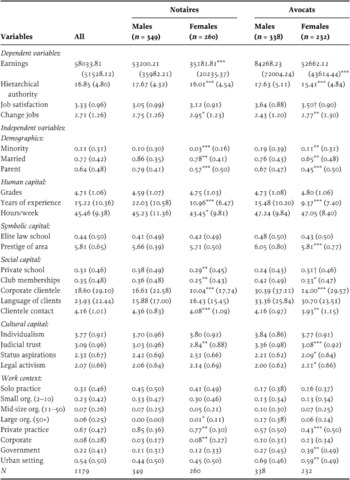
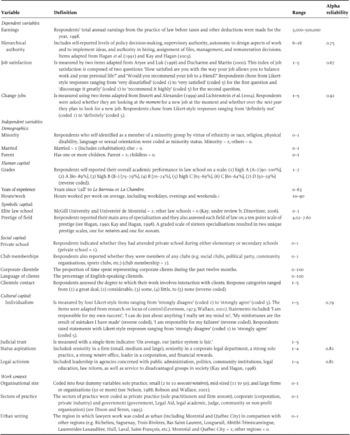
A core area in the study of gender inequities in the workplace centres on earnings gaps (Dixon and Seron, Reference Dixon and Seron1995; Huang, Reference Huang1997; Robson and Wallace, Reference Robson and Wallace2001). Yet earnings are not the only career dimension of importance to professionals. Legal professionals are also concerned with the degree of professional autonomy or authority their position affords, their level of job satisfaction, and concomitant, their intentions to forge on in the practice of law. I therefore examine four dimensions to lawyers’ careers: remuneration, authority, job satisfaction and intentions to stay or leave current job settings. The first two job outcomes are more tangible, extrinsic rewards, while the latter two job outcomes emphasise internal assessments and intrinsic dimensions to jobs (Dreher and Cox, Reference Dreher and Cox1996; Wallace, Reference Wallace and Van Hoy2001). The analysis focuses on gender comparisons within and across each of the two professional groups. Table 1 reports means and standard deviations for all lawyers in Québec, as well as for men and women across each of the professional groupings, notaires and avocats. I begin by discussing the measurement of the dependent variables and gender contrasts across the two professional groups.

Note:
Numbers in parentheses are standard deviations. All numbers are rounded to two decimal places.
† p < 0.10;
* p < 0.05;
** p < 0.01;
*** p < 0.001 (two-tailed tests)
Consistent with broader researcher on women in the legal profession (Hagan, Reference Hagan1990; Hersch, Reference Hersch2003; Huang, Reference Huang1997; Kay and Hagan, Reference Kay and Hagan1995b; Laband and Lentz, Reference Laband and Lentz1993; Robson and Wallace, Reference Robson and Wallace2001; Wood et al., Reference Wood, Corcoran and Courant1993), a sizeable gap in pay exists between women and men, both as notaires and as avocats. Clearly, notaires earn, on average, more than avocats. Notaires average just $45,502 compared with an average income of $71,409 among avocats (p < 0.001). While the earnings are, on average, much higher for avocats, the gender gap in earnings is also substantially greater among avocats. Among avocats, men earn, on average $84,268 while women earn, on average, just $52,662 (a gap of $31,606) (p < 0.001). Among notaires, men earn an average income of $53,200, while their female counterparts earn on average $35,182 (a gap of $18,018) (p < 0.001).
Men are also advantaged in terms of hierarchical authority in the legal workplace. Hierarchical authority was a measure designed to incorporate self-reported levels of policy decision-making, supervisory authority, autonomy to design aspects of work and to implement ideas, and authority in hiring, assignment of files, management, and remuneration decisions. This seven-item index of hierarchical authority builds on earlier efforts to assess power and control in the practice of law (see Hagan, Zatz, Arnold and Kay, Reference Hagan, Zatz, Arnold and Kay1991; Kay and Hagan, Reference Kay and Hagan2003; Robson and Wallace, Reference Robson and Wallace2001). The measure allows us to examine finer distinctions of authority and autonomy across practice settings than simpler distinctions between formal job titles or status distinctions (Halaby and Weakliem, Reference Halaby and Weakliem1989) and the index is applicable across work settings of both avocats and notaires. Notaires and avocats both averaged close to seventeen points on the hierarchy index, with no statistically significant difference. However, notable gender differences were apparent. In both professional groups, men held positions of higher authority and decision-making powers than their female colleagues in law (p < 0.001).
Job satisfaction was measured through an index using two items adapted from Aryee and Luk (Reference Aryee and Luk1996) and Ducharme and Martin (Reference Ducharme and Martin2000). The two questions asked: ‘How satisfied are you with the way your job allows you to balance work and your personal life?’ and ‘Would you recommend your job to a friend?’ Respondents chose from Likert-style responses ranging from ‘very dissatisfied’ (coded 1) to ‘very satisfied’ (coded 5) for the first question and ‘discourage it greatly’ (coded 1) to ‘recommend it highly’ (coded 5) for the second question. Job satisfaction was significantly higher among avocats than their notaire counterparts (p < 0.001). Significant gender differences in job satisfaction did not emerge, though male avocats were borderline more satisfied with their legal jobs than were their female counterparts (p < 0.05, one-tailed test).
I also examined lawyers’ intentions to stay with their current job or to make a move. Intentions to leave current job were measured using two items adapted from Jinnett and Alexander (Reference Jinnett and Alexander1999) and Lichtenstein, Alexander, McCarthy and Wells (Reference Lichtenstein, Alexander, Mccarthy and Wells2004). Respondents were asked whether they are looking at the moment for a new job and whether over the next year they plan to look for a new job. Respondents chose from Likert-style responses ranging from ‘definitely not’ (coded 1) to ‘definitely’ (coded 5). Notaries were more likely to express a desire to change jobs at this point in their legal career (p < 0.001). Among both notaires and avocats, women were more likely than their male colleagues to be actively seeking a new job (p < 0.05).
Results
Mean differences
I turn next to explore the gender differences across the explanatory variables. The measurement of these variables is detailed in Appendix A. Numerous gender differences are noteworthy. First, women are less likely to be minority group members (ethnic and racial communities) than their male counterparts, among both notaires (p < 0.01) and avocats (p < 0.001). Ten percent of male notaires identified as minority group members compared with only 3 percent of women notaires. Similarly, 19 percent of male avocats were minorities compared with 11 percent of women avocats. Women were also less likely to be married or cohabiting across both professional groups. In our sample 86 percent of male notaires and 78 percent of women notaires were married or cohabiting. Among avocats, 76 percent of men were married or cohabiting, compared with 65 percent of women (p < 0.01). Men, across both professional groups, were also more likely to be parents. Among notaires, 79 percent of men were parents compared with 57 percent of women. Among avocats, 67 percent of men were parents, while 45 percent of women were parents (p < 0.01).
We also consider individual investment and productivity characteristics (e.g. experience, academic performance) emphasised in the human capital perspective (see Becker, Reference Becker1994; Becker and Murphy, Reference Becker and Murphy2000; Brown and Jones, Reference Brown and Jones2004). Women had, on average, significantly fewer years of experience in the practice of law. Women notaires averaged 11 years, while men averaged 22 years. Among avocats, women averaged 9 years, while men averaged 15.5 years (p < 0.001). Interestingly, there was no statistically significant difference in the hours worked per week among male and female avocats (both averaging 47 hours/week), though among notaires, men worked longer hours (mean = 45.23) compared with their female counterparts (mean = 43.45, p < 0.05).
I use two measures of prestige and reputation to capture the symbolic capital that ‘tacitly privileges’ legal professionals: law school and field of law. Law schools have a less established hierarchy of status in Canada (Hagan, Reference Hagan1990; Stager and Arthurs, Reference Stager and Arthurs1990) than in the United States (Heinz and Laumann, Reference Heinz and Laumann1982; Heinz, Laumann, Nelson and Schnorr, Reference Heinz, Laumann, Nelson and ScHnorr1997; Nelson, Reference Nelson1994). Yet, distinctions exist. McGill University and Université de Montréal are defined as elite law schools in Québec.Footnote 13 There were no significant gender differences in elite law school graduation. Prestige of area of law is the second dimension of symbolic capital. Significant gender differences emerged in the areas of law practised by men and women avocats. Men, on average, practised in more prestigious areas than their female counterparts (p < 0.001), though there were no significant differences in the prestige of areas practised by male and female notaires.
In our analysis, social capital originates from two sources: connections derived through private schools, club membership and language acquisition, on the one hand; and contemporary clientele networks on the other. Male notaires were more likely to have attended private schools than their female counterparts (p < 0.01) and among both notaires and avocats men were more likely to hold club memberships than their female colleagues. In terms of the language spoken by clientele, there were no significant gender differences within either professional group. However, women across both professional groups spent less of their practice time in contact with clientele and women were less likely to serve corporate clientele. Among notaires, 17 percent of the clients served by men were corporate, compared with 10 percent of women’s clients. Among avocats, the gap is even more noticeable: 30 percent of men’s clients were corporate compared with only 14 percent of women’s clients (p < 0.001).
Finally, measures of cultural capital were included to reflect Bourdieu’s emphasis on habitus and dispositional inclinations. These dispositions are relevant to determining career outcomes because Bourdieu (Reference Bourdieu1980) suggests that dispositions produce strategies and actions in direct response to the daily challenges of careers and shifting legal markets. The measures used in this study tap three core dimensions: individualism, judicial trust and aspirations (traditional status or legal activist aspirations). Individualism denotes a sense of self-empowerment or internal locus of control (Rotter, Reference Rotter1966). Individuals who believe that outcomes are due to their own efforts have an ‘internal’ locus of control while individuals who believe that outcomes are due to luck have an ‘external’ locus of control (Coleman and DeLeire, Reference Coleman and Deleire2003; Maddux, Reference Maddux, Snyder and Lopez2002). Trust denotes a sense of confidence in others, and in the context of this study is tailored to reflect confidence in the legal system. Aspirations indicate motives reflected through intentions to succeed in various facets of law practice. There were no gender differences in terms of individualism among either notaires or avocats. However, male notaires (p < 0.01) and male avocats (p < 0.001) expressed greater trust in the judicial system than their female counterparts. There were no significant gender differences among notaires in terms of their aspirations (status or activist), though interesting gender contrasts surfaced among the avocats. Men were more likely to hold traditional status goals (p < 0.05), while women were more likely to hold legal activist goals (p < 0.01).
Men and women legal professionals varied in the organisational context of their work. Within private practice, male avocats were more likely than their female counterparts to work in large law firms (of over fifty lawyers): 17 percent of men worked in large law firms compared with only 6 percent of women (p < 0.001). Further gender differences emerge across sectors of practice and these differences vary across the two groups of legal professionals. Men were more likely than women to work in private practice and this was consistent across both professional groups. Eighty-five percent of male notaires worked in private practice, compared with 77 percent of women (p < 0.01). Similarly, among avocats 57 percent of men worked in private practice, compared with 43 percent of women (p < 0.001). In the corporate sector (e.g. ‘conseil juridique’ or in-house counsel) of law practice, women notaires are slightly more highly represented compared with men (8 percent compared with 3 percent of men, p < 0.01). In government service, the gender difference is among avocats, where 39 percent of women work compared with 27 percent of men (p < 0.01).
Finally, there is the regional setting of law practice. The majority of avocats work in urban settings, primarily Montréal and Québec City, while notaires are more dispersed geographically across the province of Québec. Men and women notaires were evenly represented in urban centres (about 45 percent), whereas male avocats were significantly more likely than their female counterparts to work in the province’s two largest cities. Sixty-nine percent of male avocats worked in Montréal or Québec City, compared with 59 percent of female avocats (p < 0.01).
Regression results
My estimation strategy is to regress the explanatory variables described above on the four job outcomes (e.g. earnings, hierarchical authority, job satisfaction and intention to change jobs) on a combined sample of notaires and avocats. Next, I examine the two professional groups separately to assess the specific contributions of human, social, symbolic and cultural capitals, while controlling for work context, within each of these practice domains of Québec civil law. Finally, I introduce a series of interaction tests to evaluate gender differences in the efficacy of capital resources across the careers of notaires and avocats.
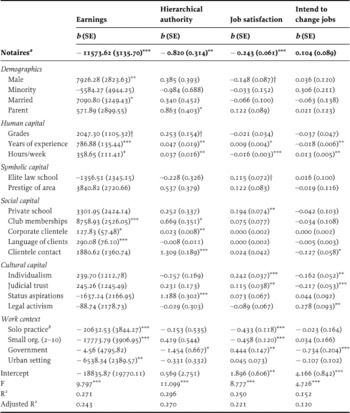
One of the most striking findings in Table 2 is that net of the explanatory variables in our full model, notaires earn less, on average, compared with avocats (approximately $11,574 less annually) (p < 0.001). Notaires also possess lower hierarchical authority than avocats in their workplaces (b = –0.820, p < 0.01) and are less satisfied in their jobs (b = –0.243 p < 0.001); though, net of other work-related factors, they appear no more inclined to change jobs (b = 0.104, n.s.). The reduced hierarchical authority may reflect, in part, notaires’ greater representation in solo and small-sized offices. These work contexts offer fewer opportunities to supervise others, hire articling students, assign files or make management decisions regarding the remuneration of others. The nature of notarial work translates into less hierarchical authority, but likely greater autonomy (through management decisions and the ability to design work and implement ideas independently). While reduced hierarchical authority (relative to avocats) may be explained, at least in part, by the context of notarial law practice, other professional differences – dampened earnings and lower job satisfaction – more likely reflect the dispiriting era of the late 1990s for notaires in Québec. With a difficult economic climate, declining real estate market and changing fee structure among notaires, the late 1990s represented a particularly bleak period for their law practices (Kay, under review a).

* p < 0.05;
** p < 0.01;
*** p < 0.001 (two-tailed tests);
† p < 0.05 (one-tailed tests).
a Notaires compared with avocats, full sample, saturated models regressed on each dependent variable.
b Reference category is private firms or offices of eleven to forty-nine legal professionals.
Job outcomes among notaires
Examining the regression models for notaires only (see Table 2), we see that the gender gap in earnings remains persistent. Men notaires garner an additional $8,296 annually, on average, compared with women notaires, controlling for work context, experience, hours worked and a host of capital resources (e.g. human, social, symbolic and cultural capitals). The gender gap in earnings among legal professionals is nothing new (Dixon and Seron, Reference Dixon and Seron1995; Hagan, Reference Hagan1990). More intriguing perhaps is the lack of significant gender differences across the job outcomes of hierarchical authority, job satisfaction and plans to change jobs. Certainly at the bivariate level, men appeared to hold positions of higher authority than women (b = 2.22, SE = 0.427, p < 0.001) and were less likely to plan on leaving their jobs (b = − 0.339, SE = 1.07, p < 0.01). In order to unpack the causal processes at play, I estimated a series of reduced equations, starting with demographic and human capital variables, then introducing symbolic, social and cultural capitals, and finally adding work context variables.Footnote 14 The gender gap in hierarchical authority remained with the inclusion of human capital variables (b = 1.276, SE = 0.442, p < 0.01), as did the gender gap in intentions to change jobs (b = − 0.232, SE = 112, p < 0.05). Social and cultural capitals played an important role in explaining the initial gender gap in authority. The amount of contact with clients, percentage of time spent with corporate clients and traditional status aspirations appeared to be the three factors most relevant to explaining men’s enhanced hierarchical authority (over and above the impact of years of experience). In contrast, gender differences in plans to leave jobs were explained largely by years of experience. It may be that job moves are more characteristic of early career phases and the majority of women notaires are still within their first decade of practice.
Other variables have impacts as predicted by theory. For example, years of experience in law practice enhanced earnings, authority and job satisfaction, while reducing intentions to change jobs. Working long hours in the practice of law augmented earnings and led to (or accompanied) positions of higher authority; though working long hours also undermined job satisfaction and stimulated interest to pursue alternative employment opportunities. In terms of social capital, club memberships offered sizeable income returns, and earnings were enhanced through corporate clients and English-speaking clientele. More time devoted to corporate clients and direct clientele contact also led to positions of higher authority. Cultural capital dimensions were less salient to earnings determination, though they influenced other job outcomes. For example, traditional status aspirations elevated hierarchical authority and individualism increased job satisfaction, while dampening inclinations to change jobs. Similarly high judicial trust enhanced job satisfaction, while reducing intentions to leave jobs. In contrast, legal activism, the goal to lead through legal education, law reform, politics and service to disadvantaged groups in society, encouraged notaires to pursue new job opportunities. Work context factors also had their predicted effects. Notaires in solo practice and those working in small offices (e.g. associations of ten or fewer notaires) suffered a sizeable earnings disadvantage compared to notaires working in larger offices. Solo notaires and notaires in small offices were also less satisfied than their colleagues in larger organisations. Finally, urban settings resulted in a sizeable earnings disadvantage to notaires of approximately $6,538 per year.
Job outcomes among avocats
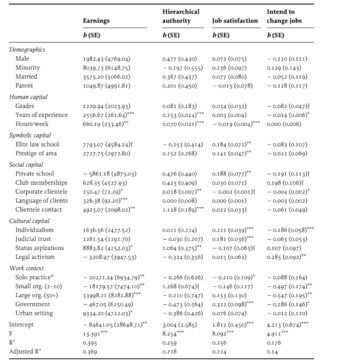
The story is quite different among avocats. Most notable is perhaps the lack of gender differences across extrinsic and intrinsic job outcomes. Bivariate analyses revealed significant gender differences, with men receiving a sizeable earnings advantage (b = $31,606, SE = $5,289, p < 0.001), greater hierarchical authority (b = 2.22, SE = 0.427, p < 0.001), and reduced intentions to leave jobs (b = − 0.339, SE = 0.107, p < 0.01). Parallel to the analysis of notaires’ earnings, I estimated a series of reduced equations, introducing conceptual blocks stage by stage (see Table 3).Footnote 15 The statistically significant gender differences persisted with the introduction of demographic and human capital variables. However, the earnings gap was rendered statistically insignificant with the introduction of social and symbolic capitals. Specifically, opportunities to work with corporate clients and English-speaking clients, as well as practising in prestigious areas of law, contributed significantly to explaining the gender gap in earnings (beyond the impact of human capital). Working with corporate clients and a greater percentage of time spent in contact with clients, as well as holding traditional status aspirations, reduced the gender gap in authority below significance (again, beyond the impact of human capital variables). Further, the gender differences in intentions to leave jobs fell below statistical significance with the inclusion of corporate clientele (social capital) and activist goals (cultural capital). Working with corporate clients reduced intentions to leave jobs, while activist goals elevated job change inclinations − women typically had far fewer corporate clients and held stronger legal activist goals.

* p < 0.05;
** p < 0.01;
*** p < 0.001 (two-tailed tests);
† p < 0.05 (one-tailed tests).
a Reference category is organisations of eleven to forty-nine legal professionals.
There are also effects that operate in tandem for both professional groups. As was the case with the analysis of notaires, avocats benefited with higher earnings from advanced years of experience, working longer hours per week, serving corporate clients and English-speaking clientele, and increased levels of client contact. Holding traditional status goals augmented earnings, as did working in large law firms (over fifty lawyers) and in urban settings (note that notaires incurred an earnings penalty for working in urban centres). The hierarchical authority experienced by avocats was enhanced through greater years of experience, working longer hours, serving corporate clients, spending greater time in contact with clients and holding true to traditional status goals. As was the case with notaires, some factors that enhanced extrinsic rewards (of earnings and authority) also were double-edged swords that undermined job satisfaction. For example, working long hours in the practice of law elevated earnings and hierarchical authority, but dampened job satisfaction. Traditional status goals also elevated earnings and hierarchical authority, while reducing job satisfaction. Furthermore, cultural capital was important to the intrinsic job outcomes of avocats, as it was for notaires. For instance, high individualism encouraged high job satisfaction and reduced inclinations to leave existing jobs. Similarly, increased judicial trust also enhanced job satisfaction, while declining intentions to quit existing jobs. Thus, trust in the justice system buoys the job satisfaction of avocats while securing their commitment to stay with the current employment setting. Somewhat surprising among avocats is that, despite large law firms offering superior pay, government lawyers exhibited significantly greater job satisfaction overall (p < 0.001). Compared with other sectors of practice, government lawyers were also less disposed to want to leave their job. Within private practice, sole practitioners were the least satisfied, though avocats in mid-sized firms (eleven to fifty lawyers) were more inclined than either sole practitioners or avocats in others sizes of firms (small or large) to be in the process of a job search.
The efficacy of capital resources on job outcomes
Although the main effects results reveal an absence of dramatic gender differences across these various job outcomes (with the exception of earnings among notaires), our cultural capital model hints that capital resources may play out differently for men and women in law practice. In order to examine whether capital resources operate differently among male and female legal professionals, I introduce a series of interaction effects. Interaction effects in regression produce large standard errors in the lower-order independent variables and multicollinearity between the interaction terms and the variables from which they are comprised, all of which can lead to computational problems (Aiken and West, Reference Aiken and West1991). This is remedied by standardising the lower order variables by transforming them into Z-scores (Aiken and West, Reference Aiken and West1991; Baron, Reference Baron2004). Therefore, variables were centred before the multiplicative terms were created (see Gorman, Reference Gorman2006, p. 876). The interaction terms are introduced singly into the equations and tested for their explanatory contribution (see Baron, Reference Baron2004; Cernovich, Giordano and Rudolph, Reference Cernovich, Giordano and Rudolph2000; Paternoster and Mazerolle, Reference Paternoster and Mazerolle1994). One-tailed tests of statistical significance are used where they are justified by theory; otherwise, two-tailed tests are employed (see Jang and Johnson, Reference Jang and Johnson2003).
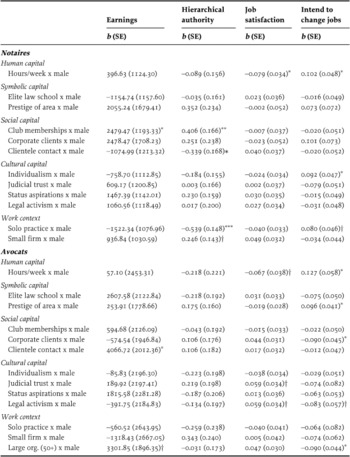
The upper half of Table 4 shows the results for notaires. In terms of social capital assets, men benefit more than women from their club memberships in generating elevated earnings (b = 2479.47, p < 0.05). These club memberships also afforded men greater opportunities for positions of hierarchical authority (b = 0.406, p < 0.01). Increased clientele contact appears important to women’s footing as they ascend the ladders of authority (b = 0.339, p < 0.05). Among the cultural capital resources, men possessing more individualistic dispositions were more likely to consider changing jobs than their female colleagues of similar dispositions (b = 0.092, p < 0.05). Work context also had gendered effects such that male solo notaires report having lower authority in their law practices (b = − 0.539, p < 0.001) and male solo notaires were also more likely to be actively seeking job changes (b = 0.080, p < 0.05, one-tailed). A surprising twist is to be found in the impact of human capital assets. Investment in long hours at the office is often highlighted in the literature on women and paid work as one the reasons for women’s job dissatisfaction (Brockman, Reference Brockman2001; Epstein, Seron, Oglensky and Sauté, Reference Epstein, Seron, Oglensky and Sauté1999; Kay and Bernard, Reference Kay, Bernard, Kay and Johnston2006; Leiper, Reference Leiper2006; Reichman and Sterling, Reference Reichman and Sterling2002). The results show that men were in fact more dissatisfied with working long hours (b = − 0.079, p < 0.05) and they were also more likely to intend to change jobs as a result of these long hours (b = 0.102, p < 0.05). It appears that despite a persistent gender gap in earnings and differential returns on social capital assets toward authority in the workplace, women may be entering le notariat and finding balance (through predictable hours), authority and independence in solo practice, and commitment to continue in their notarial practices.

* p < 0.05;
** p < 0.01;
*** p < 0.001 (two-tailed tests);
† p < 0.05 (one-tailed tests).
The gender dynamics among avocats (see lower half of Table 4) are equally provocative. In terms of earnings, men gain more than their female colleagues through interaction through regular and frequent contact with clients (b = 4066.72, p < 0.05). Larger organizations (of fifty or more lawyers) also reward men with higher salaries than women, controlling for a host of variables, including years of experience, areas of practice, corporate clientele responsibilities and hours worked (p < 0.05, one-tailed). The effects of judicial trust and legal activism on job satisfaction are both conditioned by gender. Men perceiving a sense of trust in the judicial system (b = 0.059, p < 0.05, one-tailed) and strong legal activist goals (b = 0.059, p < 0.05, one-tailed) exhibit greater job satisfaction than their female colleagues with similar ideals. Each of the four capital resources (e.g. human, symbolic, social and cultural) proved salient to the decision to change jobs. Men working longer hours (b = 0.127, p < 0.05) and in prestigious areas of law (b = 0.096, p < 0.05) were more inclined to change jobs than were their female colleagues. Yet serving corporate clients (b = −0.090, p < 0.05) and holding legal activist aspirations (b = − 0.083, p < 0.05) both interacted with gender to reduce men’s motivations to change jobs. Finally, the impact of working in large law firms (over fifty avocats) on plans to change jobs was conditioned by gender. Men working in large firms were significantly less likely than their female colleagues to consider leaving their jobs (b = −0.090, p < 0.05). The storyline among avocats thus contrasts with that of the notaires. A much clearer gender division exists, with men avocats receiving greater exchange on their investments in human, social and cultural capitals.
Discussion and conclusion
This study set out to investigate gender differences across a divided legal profession within Québec, a civil law jurisdiction of Canada. Attention focused on four aspects of careers, including opportunities for remuneration, professional hierarchy, job satisfaction and plans to change jobs. Sizeable gender differences appeared between men and women, with women earning significantly lower salaries, holding positions of reduced authority and being more inclined to leave their current jobs. However, with the exception of earnings inequities among notaires, these gender differences were explained by the integrated cultural capital resource model. The statistically significant gender gap in earnings was resilient but of a magnitude far below the sizeable earnings gap documented in common law jurisdictions of practice (Dixon and Seron, Reference Dixon and Seron1995; Hagan, Reference Hagan1990; Kay and Hagan, Reference Kay and Hagan1995b; Hersch, Reference Hersch2003; Huang, Reference Huang1997; Robson and Wallace, Reference Robson and Wallace2001). Is the Québec legal profession a more gender equitable profession than exists in neighbouring common law jurisdictions, for example, in English Canada and the United States?
The results show that the possibilities for accumulation and conversion of capitals available to each gender differ across professional boundaries. As a baseline for comparison, gender differences across an array of factors were noteworthy within each of the professional groups. Among notaires, men were more likely to hold club memberships, to serve corporate clientele and to spend more of their practice time in contact with clients. Men expressed greater trust in the judicial system than did their female colleagues. Men notaires were also more likely than women to work in private law practice, while women were slightly more highly represented among in-house counsel in the corporate sector.
Among avocats, men, on average, practised in more prestigious areas of law than their female counterparts. Men were also more likely to hold club memberships, to serve corporate clientele and to spend a greater proportion of their time in contact with clients. Men expressed greater trust in the judicial system than did their female colleagues. Men were also more likely to hold traditional status goals, while women were more likely to hold legal activist goals. Women were more likely than men to work in government service, while men were more likely to work in private law practice. Within private practice, men were more likely than women to work in large law firms. Finally, male avocats more often than their female colleagues were located in the province’s two largest cities.
Not only are men and women equipped with differential stocks of capitals, but the conversion rates also differed in important ways.Footnote 16 The defining characteristic of capital – whether financial, human, social or cultural – is its fungibility, the idea that it may be converted into something of value, such as earnings, professional status, prestige or power (Aguilera and Massey, Reference Aguilera and Massey2003; Harker, Mahar and Wilkes, Reference Harker, Mahar and Wilkes1990). The findings of this study clearly demonstrate the unique and profitable returns of investment in symbolic, social and cultural capitals, over and beyond investment in human capital and taking into account variation across work context. For example, among notaires, club memberships offered greater payoff in terms of earnings and hierarchical authority to men, though male solo notaires reported lower authority and greater inclination to leave their solo practices than their female colleagues. A twist in the capital resource story lies with human capital. Men were more dissatisfied with working longer hours than their female colleagues and they were more likely to change jobs as a result of these time commitments. Despite a resilient gender gap in earnings, women notaires, compared with their male colleagues, appear more satisfied with their level of authority and autonomy in solo practice, less aggravated with their hours of work and less likely to be actively seeking to change jobs.
Social capital among avocats was also conditioned by gender in important ways. Men gained more in earnings than their female colleagues through frequent contact with clients. Even when controlling for variation across the range of capital resources, women remained disadvantaged in larger firms (over fifty avocats) when it came to salaries. Dispositions toward legal activist goals and a sense of trust in the justice system also augmented men’s job satisfaction beyond that of women’s satisfaction in law practice. Furthermore, a host of capitals were conditioned by gender in the decision to seek out new jobs. Men working longer hours and in prestigious areas of law were more inclined to change jobs than were their female colleagues; though serving corporate clients and holding legal activist aspirations interacted with gender to retain men’s presence in existing jobs. Further, male avocats receive greater exchange on their investments in human and social capitals, and their cultivated habitus or dispositions also better enable men to negotiate legal careers.
Beyond these gender comparisons, our analysis revealed a bleak portrait of notarial law practice during the tumultuous 1990s. Notaires earned less, had fewer opportunities for positions of hierarchical authority, were less satisfied with their jobs and, though perhaps surprisingly considering these professional outcomes, were not more inclined than avocats to quit their legal jobs. This lack of intent to change jobs may reflect, at least in part, the fact that notaires generally work as independent practitioners, either as solo notaires or as notaires working in association with other notaires, sharing office space and staff personnel. The idea of changing jobs is perhaps not as simple as that of an avocat moving between law firms, but likely requires contemplating a full-out exit from the notariat profession. Interestingly, during the late 1990s, women’s representation was rising particularly rapidly among le notariat. Women represented 43 percent of notaires and 40 percent of avocats in the late 1990s.Footnote 17 Women entered in growing numbers a struggling notariat during a difficult economic era.Footnote 18 Yet, the attraction of notarial law for women law graduates and the subsequent career pathways of women who entered the Québec notariat at this time of professional uncertainty remain unanswered questions.
Cultural capital theory provides new insight to our understanding of what it means to be a legal professional in the context of a divided profession of notaires and avocats, each group seeking to define and dispense law within its respective civil law jurisdictions. At the same time, this perspective is attuned to the unique dispositional qualities cultivated through legal education, the social and symbolic resources that are amassed by legal professionals in the course of their careers, and the differential returns of such investments for women and men within a divided profession.
Future research will benefit by considering a number of conceptual elaborations. First, measures of habitus or dispositions explored in this study underscored three dimensions: individualistic drive, judicial trust and career goals. These dispositional qualities were of particular relevance to the job outcomes under study (e.g. earnings, hierarchical authority, job satisfaction and intent to change jobs). However, Bourdieu’s conception of dispositions is suggestive of aesthetic dispositions: manners, tastes, linguistic competence, erudition and manifest preferences linked to families of privilege and elite educational systems (Berger, Reference Berger1986; Bourdieu and Passeron, Reference Bourdieu, Passeron and Nice1979). Research needs to develop more precise measures of dispositions relevant to law practice, particularly dispositions that encourage adaptation to changing markets for legal services. Are markers of class origins as salient to law practice, particularly to a profession that has not greatly diversified in class composition (see Abel, Reference Abel2003)? In the context of Québec society with corporate ties to English Canada and the US, multilingual legal professionals may be at an advantage to recruit and manage elite corporate clients. Cultural capital, then, perhaps needs a more fluid grounding than social class hierarchy to incorporate aspects of elitism through linguistic facility, social closure by dominant cultural groups and ties to business relations beyond provincial borders. Bourdieu’s cultural capital theory was developed in the context of highly stratified and distinct French society. Québec, while historically a French colony, is characterised by its own dynamics of migration, multiculturalism (and interculturalism) and cultural distinction within Canadian society (Bouchard and Taylor, Reference Bouchard and Taylor2008). These unique characteristics stretch cultural capital theory’s conception of habitus in new and challenging ways.
Cultural capital theory faces an even more direct challenge through the incorporation of gender. As noted earlier, feminist scholars have critiqued Bourdieu’s theory of cultural capital, particularly his arguments regarding his thinking of a resilient traditional pattern of masculine domination (Reference Bourdieu2001, Reference Bourdieu2002) constitutive of Western gender habitus (see Adkins and Skeggs, Reference Adkins and Skeggs2005; Silva, Reference Silva2005). Further, feminist scholars have critiqued Bourdieusian thinking on gender relations as characterised by biological foundationalism, misconceiving capital as gender neutral and treating women as predominantly ‘aesthetic objects’ (Silva, Reference Silva2005). Yet, rather than dismiss cultural capital theory outright, feminist scholars have attempted to incorporate into a Bourdieusian framework implications of recent transformation in home family living, gender role transformations that are argued to have destabilised the gender order (Silva, Reference Silva2005). The task is one of integrating the roles of gender, home and family in the acquisition and transmission of cultural capital. Judith Butler (Reference Butler1997), for example, contends that gender itself can be a form of cultural capital. Other feminist scholars show that access to gender capital is not universal, but rather hidden and asymmetrical and only some individuals are able to convert gender into a resource (McCall, Reference Mccall1992; Skeggs, Reference Skeggs1997). Through analyses of gender, researchers can develop a more elaborate account of the accumulation and convertibility of capital in the careers of professionals (Savage, Warde and Devine, Reference Savage, Warde and Devine2005).
Finally, the concept of cultural capital offers a strategy for investigating the legitimising of social differences and highlights the importance of inherited social dispositions where the market for cultural competencies has been destabilized (Silva, Reference Silva2005, p. 99). Certainly in the late 1990s the legal profession of Québec entered an era of rapid transformation, changing demographic composition, destabilised markets for legal services and heated jurisdictional dispute between the professional domains of notaires and avocats. Women’s rising representation in the Québec legal profession, during a period of professional uncertainty and shifting markets, raises important questions about women’s integration, mobility and the ways in which cultural processes are implicated in the reproduction, generation and contestation of social division within law. Bourdieu’s ideas are also relevant to interpreting sociocultural change within the professions. For example, Bourdieu discusses how ‘new cultural intermediaries’ play a key role in cultural innovation (Reference Bourdieu and Nice1984) and these ideas have been seized upon by several scholars (Featherstone, Reference Featherstone1982; Warde, Reference Warde1997; Wynne, Reference Wynne1996). Bourdieu viewed these cultural intermediaries as the bearers of new forms of cultural capital, influential in reshaping class relations (Savage and Bennett, Reference Savage and Bennett2005, p. 3). To what extent have women played an active role as new cultural intermediaries, introducing different social and cultural capitals, or stimulating innovative cultural transitions within law practice?