It would be hard to exaggerate the importance of the manuscript Bibliothèque du musée du château de Chantilly, 564 (Ch), with its 100 chansonsFootnote 1 and thirteen motets of the late fourteenth and early fifteenth centuries, including dozens of unique works (about fifty per cent), many of them of the highest notational complexity, many of them attributed to otherwise unknown composers. Now available in a handsome facsimile and the subject of a series of recent studies, questions of date and provenance have been newly addressed in depth.Footnote 2 These will be briefly summarised before proceeding to the main purpose of this article, namely, an evaluation of the arguments that have sought to explain anomalies of foliation and indexing and the consequent proposal of an alternative hypothesis for the apparently missing first gathering.
The chronological range of the Ch repertory is wide, with concordances in manuscripts of the third quarter of the fourteenth century, including Trém, Ivrea, CaB and the Machaut manuscripts (including pieces older than the mid-1350s, in MachautC), as well as some repertory and composers datable to at least the first decade of the fifteenth century, and concordances with manuscripts completed up to c.1420, including ModA, SL2211, Bov, FP and PR.Footnote 3
Various proposals have been made about the origins of the repertory, its composers, and the manuscript's place and date of compilation. Most persistent was the hypothesis first put forward by Léopold Delisle that a French repertory had been recopied in Italy by an Italian scribe.Footnote 4 Gilbert Reaney reiterated this view, but thought that the exemplar might originate from the court of Gaston Fébus at Foix or that of King John I of Aragon.Footnote 5 Ursula Günther also thought that Ch was an Italian copy of a French original, working backwards from the first known Italian owner.Footnote 6 As biographical evidence associated more composers with Avignon, subsequent studies reinforced Willi Apel's proposal of an origin at that papal court on the basis that it employed the greatest concentration of Ch composers, and that Avignon formed a melting pot for musicians associated with secular rulers from both north and south and was therefore a likely centre of repertory formation.Footnote 7 Many works of the 1380s and 1390s are linked to the Valois princes Louis I d'Anjou and Jean de Berry,Footnote 8 who had strong connections not only with Paris but also with the south.
Following the long-standing recognition of a number of Visconti motifs in the repertory, Reinhard Strohm, John Nádas and Agostino Ziino argued that, especially under Giangaleazzo (1385–1402), the francophile Visconti court in Milan and Pavia was a centre of musical patronage and the context for much of the older repertory.Footnote 9 Because of the attribution of the balade En la saison to ‘Hymbert de Salinis’, who was apparently already in the service of Pietro Filargo at the time of his election as Alexander V in 1409, Plumley and Stone associate the later parts of the repertory with the circles around this pope; they suggest that the actual compilation may have started under his aegis and continued after his death, and that Ch was compiled between c.1409 and 1420.Footnote 10 Filargo was close to the Visconti court and had enjoyed Giangaleazzo's patronage, becoming Archbishop of Milan before his elevation as pope. The proposal that his circle had a role in the compilation is easily reconciled with a substantial Visconti ingredient in the older repertory formation, with their contiguous or overlapping locations, dates and personnel. Although claims can be made for all these places as sources of repertory, Plumley and Stone make the important distinction between those, and the place of compilation of the manuscript, judging that its particular Franco-Italian mix does seem to point to Milan-Pavia as the likeliest area for the compilation. If they are right, the accession of Alexander V in 1409 becomes the terminus post quem for Ch, though there is no evidence other than the Salinis balade to connect it directly with him. It is not clear who, after his brief papacy, would have taken over what seems to be a commissioned enterprise (comparable to that reported in note 5 for King John I of Aragon), or for how long the execution of the manuscript would have continued after his death. Whatever its precise patronage, I agree with Plumley and Stone that the main body of the manuscript was probably compiled in the 1410s, but will suggest that the period of compilation extended perhaps over only a few years within that decade.
An unresolved conundrum hinges on the interpretation of the original foliation and the folio numbers in the original index, both of which are in the same hand. Both begin at folio 13 (xiii), leading to the current presumption that a first gathering of six bifolios, fols. 1–12, was removed after the manuscript was foliated and before the index was compiled, as the index entries (starting with fol. 13) list nothing prior to the present contents of the main body of Ch.
The manuscript's current twelve preliminary folios were arranged prior to its 1880 binding for its nineteenth-century owner, the Duc d'Aumale, apparently to substitute for that presumed missing first sestern so that fol. 13 retains its position as such. Fols. 1–8 were new, on modern parchment, and include a description of the manuscript and a decorative frontispiece (fol. 8); fols. 9–12 are original. A modern Arabic foliation 1–12 was supplied; the two famous pictorial rondeaux by Baude Cordier occupy the inner faces of a composite bifolio preceding the first gathering, the heart-shaped Belle bonne (on what is now numbered fol. 11v) and the circular Tout par compas (on fol. 12r). These are in turn preceded by an intact bifolio whose centre, modern fols. 9v–10r, contains the index of compositions in manuscript order, but excluding the two Cordier songs; fol. 10v was unused. Plumley and Stone call fol. 9r a title page; a heavily scraped area is where a (non-decorative) title might have been, but only a letter L is still visible. What remains are some later annotations, including the important and only attestation of fifteenth-century ownership by Francesco di Altobianco degli Alberti, who passed it on to Tommaso Spinelli. The scraping may have occurred at this transfer.Footnote 11
The index begins at the top of a verso specially reserved for it; no part of the index is lost, for there is no place where earlier entries could have preceded the present listing. Its text incipits are in a French hand not found elsewhere and correspond to the present contents and order of the manuscript; the presumed lost contents (musical or otherwise) were not indexed, so the index is thought to post-date the loss.Footnote 12 But if a gathering was removed, what did it contain? At what stage did this happen, and why? Before the manuscript's decorative initials were supplied, as they never were? Was it a commission that remained incomplete?
A different and later Italian hand added the folio numbers in the space to the left of those index entries. These numbers were not assigned a separate column; they are in the same hand as the foliation of the manuscript itself and apparently in the same ink, which would suggest that they were done at the same time and in a coordinated operation. But this is incompatible with the existing theory of a temporal separation between the two numberings, namely, that the manuscript was foliated after copying, including the original fols. 1–12, that the first gathering was then removed and that finally the index of the remaining contents was prepared, but with its folio numbers added later than the incipits, albeit in a different hand, that of the manuscript's foliator. Plumley and Stone observe the following on the foliation and the index:Footnote 13
The foliation was completed when the manuscript still had its first gathering, since the current first page of the old corpus begins with f. 13. However, the index was apparently written after the loss of the first gathering and the folio numbers were added to the index probably as an afterthought, yet in the hand of the manuscript's foliator.
The folio numbers provided to the left of the incipits, and cued to them with freehand lines, were clearly not part of the original design of the index since they were not provided with a column when the page was prepared. They are written in an early fifteenth-century Italian hand, and they seem identical to the numbers written upon the folios of the manuscript itself.
They go on to speculate that, because of the time separation, the foliator of the index and of the manuscript must have had it in his possession both before and after the loss of the first gathering and during the making of the index, and that he may therefore have been an early owner. But no explanation has been proposed for why this owner would have discarded a first gathering, musical or otherwise, before the manuscript was even finished (the decorative capitals were never supplied) or for the timing of that supposed removal, nor how a temporal separation between the two foliation activities in the same hand could be reconciled with the time necessary for the provision and removal of a gathering.
If the index incipits (by a French scribe) were drawn up after the manuscript had been completed and foliated, and after the loss of a first gathering, why were the index folio numbers not supplied by the indexer from the already-foliated manuscript in the same operation as the incipits? Plumley and Stone rightly identify them as an afterthought. If a gathering had been removed after foliation and before the index, we might have expected the foliation to be revised to reflect this, but no such changes were made.Footnote 14
Thus instead of assuming that the manuscript's foliation was entered soon after copying when there was a now-lost first gathering, that the index incipits were listed after that loss and that the same folio numbers were added to it still later – a double time-lag which makes it hard to account for the folio numbers being in the same Italian hand – I now suggest that both foliations were entered after the contents of the manuscript had been copied, as part of the same operation, not separated by the provision and loss of a gathering, but that they anticipated the addition of a new sestern in front of the existing manuscript.Footnote 15
Foliation and indexing are often demonstrably closely related procedures, but here they are separate.Footnote 16 The writer of the index of incipits, starting at the top of the folio, assumed that this was the beginning of the musical collection, as it still is. Even the assumption that the contents of a missing gathering are absent from the index because they contained extraneous or even non-musical material would still leave an unexplained time gap between the musical incipits and the addition of folio numbers to them. While the incipits and the index folio numbers are clearly by different scribes, the ink of the folio numbers, while similar, is slightly paler, and certainly later.Footnote 17
In a study of the surviving index of the Trémoïlle manuscript, and in two more essays, I set out some distinctions between classified indexes, tables of contents, whether prescriptive or post factum, and between numbering systems that apply to folios, openings or pieces.Footnote 18 These distinctions led me to ask if the ‘index’ of the Chantilly manuscript could hold the answer to its mysteriously absent first gathering.
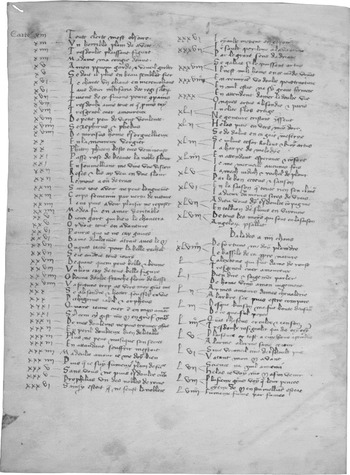
Let us look again at the nature of this ‘index’. Music indexes in this period were sometimes classified by genre, as appears to be the case here, or alphabetically, but never by composer. Nor are composer names provided here, although a majority are given in the body of the manuscript. The first column has no heading and contains mostly three-part balades, but also some rondeaux and virelais; ‘balades’ may here be used inclusively. New headings within the second and third columns announce respectively Balades a iiij chans and Motes. Some songs listed as four-part are only a3, and this section likewise contains a few rondeaux and virelais.Footnote 19 Was the indexer uncertain about the status of the versions or forms to which he would have access? Thus the classification is not quite consistent in relation to the copied versions, but the listing is in strict manuscript order throughout, appears to have been done at a single sitting and only seems to be a classified ‘index’ because it shares the relatively orderly genre arrangement of the manuscript. It should therefore more properly be classed as a table of contents, not as an index (which implies some form of classification as a finding mechanism different from the book's organisation). The fact that it is arranged in three sections simply reflects, or rather, anticipates, the organisation of the volume itself. Because the folio numbers in this table of contents were added later, in a different hand from the incipits but in the same hand as the manuscript foliation, the conclusion seems almost inescapable that the listing of pieces was written first (without folio numbers) as a prescriptive programme for the manuscript, and that both foliation entries were done later, at the same time.
Few cases of anticipatory tables of contents have been identified, and then usually when their order or contents differ somewhat from that of the finished manuscript. That is the case with MachautA (BnF 1584), whose original index is prefaced with a clear signal of its prescriptive status: ‘Vesci l'ordenance que G. de Machau wet qu'il ait en son livre’.Footnote 20 Some deviation from the table in the final ordering is also the case with the trouvère chansonnier du roi (BnF, fr. 844).Footnote 21 In the case of Ch, it is the later addition of folio numbers to the earlier-entered incipits that suggests a time separation between those entries in the index. Other instances of prescriptive tables or repertory listings, whether enacted or not, may have gone unrecognised as such because they lack markers of order or priority, or telling deviation. Some may not in fact be post factum indexes of lost collections, as has generally been assumed, but could be prescriptive listings that may or may not have been realised.Footnote 22
The Ch scribe is thought to have had access to multiple exemplars; but if the listing preceded the copying, these must have been gathered or known to be available before copying began, though not necessarily in the versions or number of voices specified. The slight infelicities of categorisation in the index, noted above, are perhaps a further symptom that the listing came first, indicating some discrepancy between expected and actual versions. This marks Ch as pre-planned, like the Old Hall and Squarcialupi manuscripts, a different kind of compilation from those which were growing anthologies, like Q15 and Ox, added to over time. For Ch, this implies a continuous copying operation, reflected in its consistent script, and probably confines the copying to only a few years within the overall period c.1410–20 proposed by Plumley and Stone.
The index is in a French hand, and its readings are generally better than those of the songs in the body of the manuscript. Ch was copied by an Italian scribe relatively unfamiliar with the repertory and the French language. As Plumley and Stone put it, the index incipit scribe ‘improves upon the French spelling of the main corpus of the manuscript; similarly, the scribe of the [index] initials correctly identifies every capital letter except one’.Footnote 23 But rather than assuming that the indexer improved on those poorer readings, I suggest it was the other way round; that the Italian scribe had been engaged for his musical competence, and that his poor knowledge of French led him to make verbal errors in implementing the list of incipits.
Plumley and Stone reproduce fol. 9v (the first page of the index), drawing in the vertical drypoint guidelines that subdivide the writing frame (Codex Chantilly, Fig. 1, p. 123). They also highlight a vertical line of prick marks whose normal purpose would be to guide horizontal drypoint lines, but no such lines are visible in the facsimile, and the alignment of the entries across the columns offers little encouragement to suppose that any are present. In any case, the dots are oddly placed, not near the edge of the page as would usually be the case. The ruling and pricking seem to have been tailored very specifically to the index and would not have suited music copying.Footnote 24 They argue that the initials of the index entries were not provided at the same time as the incipits, but were later supplied by an Italian humanist scribe. On the contrary, I find no reason to doubt that these capitals are by the French scribe of the incipits themselves, written at the same time and continuously, consistent and integral with their continuations; their style can be explained as a self-conscious mannerism of the same scribe.Footnote 25 I see no distinction of ink colour (though perhaps, in some cases, of intensity). Plumley and Stone interpret the unusually placed prick marks as intended for a horizontal setting-off of initials in the index. The line of prickings is more clearly visible on the nearly blank fol. 9 recto; some prickings are concealed by the capitals, thus not separating them from incipits. It seems more likely that they were intended to guide the vertical spacing of the index entries as the scribe worked freestyle. The only credible guide for the initials of the index incipits would be the vertical drypoint guidelines (drawn in in their Fig. 1), which are not observed by the indexer in a way consistent with the initials belonging to a separate operation. The incipits, including their capitals, start within a narrow double column. If the incipits had indeed been written without the capitals, one would expect them to follow the second of those vertical rules, leaving the column for the capitals, not to start within it as most of them do. If it was the purpose of the drypoint vertical lines to mark out a space for someone else to supply the initials, neither they nor the scribe of the incipits made a very good job of it. In addition, one would expect more errors in the choice of initials if they had been left, unsignalled, to a different and foreign scribe.
The table of contents of Bibliothèque du musée Condé du château de Chantilly, MS 564, fol. 9v. Reproduced with kind permission of the Musée Condé.

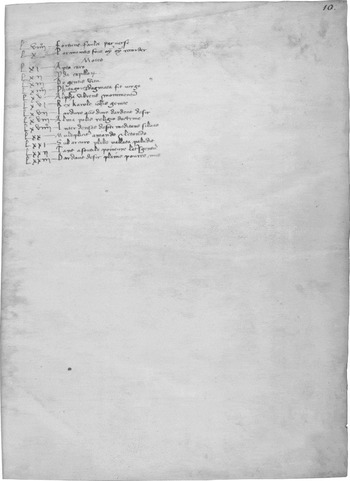
The table of contents of Bibliothèque du musée Condé du château de Chantilly, MS 564, fol. 10r. Reproduced with kind permission of the Musée Condé.

The notion that Ch was an Italian copy of a French original becomes increasingly unlikely as the multiple layers of activity unfold. A literal copy would fail to explain the timing of the foliations, and what would then be the anomaly that two different scribes are represented in the index; and it certainly does not help the hypothesis of a first gathering that was lost from the manuscript as we have it. If that manuscript was an Italian copy, and if the table of contents was post factum, why is it by a French scribe?
The assumption that a first gathering was lost before the manuscript was indexed derives entirely from the start of the foliation at 13, in both the manuscript and the table of contents. I propose that, as a prescriptive list without foliation, prior to copying, it did not include the contents of that first gathering because no such gathering was yet planned. As noted, the listing starts at the top of the page, presenting the beginning of the musical settings at the time it was made; folio numbers were added later. What we have of the manuscript's main body of music is what there was originally intended to be, minus the decorative capitals.
The prescriptive index bifolio would have been pricked and ruled, and the incipits entered. The fact that the contents were not listed by the scribe of the manuscript suggests that they were determined not by that scribe, but by or for the original owner or commissioner. All the music was then copied, following faithfully the prescribed order.Footnote 26 Imagine the body of the manuscript in its present form, but unfoliated, and with the table of contents containing incipits only, no numbers. The foliation chronology is resolved if the hypothesis stands that both foliations were added post factum in a single operation: not only was the body of the manuscript left incomplete by the failure to provide decorative initials, but the first gathering implied by the foliation was not lost; it never existed.
At that stage, or perhaps when the copying was well advanced, it occurred to the compiler, main copyist or owner that an entire gathering, perhaps containing newer repertory, and to include or show-case the Cordier songs, could be placed in front of the existing collection. Something similar happened in Ox, where the present gathering V was the original first gathering; gatherings V–VIII contain some of the oldest repertory, and the present gathering I was the last to be copied.Footnote 27 The plan could have been stimulated by the arrival of those songs, which were surely not available when the contents listing was drawn up. I suggest that the completed manuscript was foliated in the same operation as the addition of those folio numbers to the table of contents, but now allowing for the new gathering by starting the foliation of both manuscript and index at 13. The decision thus to allow for the new gathering could have been made by or for the foliator who, it has been suggested, may have been the owner at that time or his agent.
The Cordier songs are the only surviving contents perhaps destined for that prefatory sestern; the plan was never taken further. So rather than the Cordier pieces being added to compensate for a missing gathering, I suggest that they became part of an unrealised plan to add a gathering to the front of the existing collection, perhaps together with other virtuosic and visually arresting pieces by a newer generation of composers, and that the later-added foliation, both of the manuscript and of the table of contents, allowed for that new gathering. This would address the question raised by Plumley and Stone as to why a manuscript of the 1410s does not include some of the more modern compositions of the early fifteenth century: its revised form may have been intended to do so.Footnote 28
But if the interpretation of the index as a prior table of contents solves the conundrum of the foliations, it appears to create another, as to when the Cordier songs were copied. Plumley and Stone observe that
it has generally been felt that [the Cordier picture songs] issued from a considerably later, and geographically different, artistic milieu than the main Ch repertory. Certainly, their style and elements of their notation seem more ‘modern’ and closer to the song repertory of the early fifteenth century contained in [Ox], which, significantly, transmits the majority of Cordier's works.Footnote 29
When Ch was dated in the 1390s, it was rightly assumed that the Cordier picture-songs were considerably later, on grounds of script, notation and the other sources of Cordier's compositions dated in the 1420s and 1430s. But then Craig Wright proposed identifying Baude Cordier with Baude Fresnel, a harper who died in 1397–8, setting that as a terminal date for the original compilation.Footnote 30 Gordon Greene consequently proposed a date for the main compilation before 1395, with the ‘autograph’ Cordier songs added in Avignon in that year.Footnote 31 I join Plumley and Stone in rejecting the attractive but ultimately implausible Fresnel identity,Footnote 32 although it was accepted by Reinhard Strohm;Footnote 33 1398 is too early for a terminus ante quem for Cordier's works in relation to what we now know about the biographies of composers and the dating of early fifteenth-century manuscripts containing their works. The new later dating of the main body of Chantilly to the 1410s brings it towards the likely date of the Cordier copies.
Some earlier studies assumed that the Cordier songs were autograph because of their singular presentation, shaped respectively as a heart and a circle.Footnote 34 The composer is named in the residual text of Tout par compas as ‘Maistre baude cordier se nomme’; both the heart shape of Belle bonne and the heart within the text for the word ‘cuer’ probably constitute a deliberate pun on Cordier's name, which may or may not be a sobriquet. The songs indeed could be autograph without being by Fresnel; rejection of that identification does not mean rejection of autograph status; Plumley and Stone do not commit themselves on this point. Reaney's suggestion (following Delisle) that the Cordier scribe could be Cordier himself gains slightly more weight in the scenario here to be proposed.Footnote 35
That scribe also added three composer attributions to the body of the manuscript, indicating that he was ‘physically proximate to the codex and enjoyed direct access to it’. They affect Avignon-related composers, indicating (to Plumley and Stone) that their music was by no means for him an ‘outdated and unfamiliar repertory’.Footnote 36 These attributions are on fols. 34v (Hasprois), 35r (Matheus de Sancto Johanne) and 43v (Senleches). Of these, perhaps the most significant is his attribution of the canonic virelai La harpe de melodie to Senleches, notated straightforwardly in Ch, but in graphic form in the Newberry manuscript (Cn, fol. 10r), where the stave lines represent the strings of the harp, the intervening spaces being unused notationally. In order to attribute it, Cordier or his accomplished scribe must have known this piece from elsewhere, which raises the question whether he knew it in the form in which it is preserved in Cn (although it is there anonymous), and was influenced in his own compositions by its graphic presentation. Senleches's canonic instructions are there written as a rondeau wound round the forepillar; the additional text of Cordier's Tout par compas is written in roundels at the corners. In both cases the first-person text addresses the performer with instructions for its own performance. The possibility of emulation strengthens the speculation that Cordier himself was involved, and that he not only knew this repertory, but that his picture-songs may also have been inspired by the doubtless original pictorial form of Senleches's virelai, that other most famous example of graphic notation.Footnote 37 It thus slightly increases the likelihood that the Cordier pieces in Ch are autograph.
The bifolio now numbered fols. 11–12 contains the two pictorial songs on its inner faces. This must be a composite bifolio with an artificial join, and the outer pages are again blank. The different patterns of hair follicles on the two leaves argue strongly against them being a single skin; fol. 11v is much hairier, and the pattern does not continue across the join. Although the two leaves on which the songs are copied are now joined to form a composite bifolio, they could each originally have been one half of a separate bifolio intended for the new sestern; if so, the blank conjugates were later removed.
Plumley and Stone plausibly argue that the design and writing go so near to the page edges that these folios are likely to have been cut down from a larger format.Footnote 38 Furthermore, joining separate leaves as a composite bifolio could also account for the loss at the left-hand side of Tout par compas. It would have been nearly impossible to manage their complex layout and ruling on an already composite bifolio rather than on single sheets or bifolia. But the whole manuscript has undoubtedly been trimmed, as some truncated folio numbers and others very close to the edge attest. I see no reason to assume that the stock of parchment including the Cordier folios, though different in quality, was ever of larger format than the untrimmed body of the manuscript, and therefore do not accept Plumley and Stone's conclusion that they were not originally intended for it. If those leaves, written or not, lay beneath the index bifolio, they are unlikely to have been of significantly different size. How much trimming took place in the fifteenth century and how much, if any, in the nineteenth century has not been determined. It is not clear when the Cordier leaves were united, but it cannot be ruled out that they were joined as a bifolio in the nineteenth century.Footnote 39 Nothing is known of the previous binding, and without disbinding there is no access to the spine and sewing holes.
In their analysis of the ruling and pricking of the index bifolio, Plumley and Stone made the important new observation that the distinctive line of prickings on fol. 10, the index recto, penetrates both Cordier folios, which therefore lay beneath the index bifolio before the index was written and served as a ‘pincushion’ for the index pricking. This led them to counter the prevailing view that the Cordier rondeaux were added at a later stage, after the index.Footnote 40
They report:
Since the prick marks that penetrated from the index's recto line up on the two folios of the Cordier bifolio, we must assume that the Cordier pages were already trimmed to their current dimensions and fashioned into a bifolio at the time the index was copied.Footnote 41
Their codicological examination revealed no evidence of priority between the prick marks and the Cordier copies, but they go on to conclude on balance ‘that the Cordier songs were already copied when the scribe made the index; their absence from the index may be explained if they were intended as a kind of frontispiece for the manuscript’,Footnote 42 suggesting that they may have been added in compensation for the lost gathering. But they reached this conclusion because they assumed that the index post-dated the Cordier copies, not on codicological evidence of priority.
They imply that the prick marks that penetrate these folios are aligned. It is indeed clear from the facsimile that their relative placing corresponds; they must have been aligned when pricked. But did that alignment precede or post-date the copying of the Cordier songs? If the prick marks are still exactly aligned between both Cordier folios, we would have to infer that the composite bifolio was already joined and trimmed to its present size before the index bifolio was prepared with its purpose-made prickings, inviting the inference that it already contained the Cordier songs. Plumley and Stone are surely right to conclude that the bifolio was joined only after the songs were copied on separate folios or bifolia. But if the holes are even very slightly out of alignment, that parchment could still have been blank and the folios separate when the index bifolio was pricked, and the songs copied later; it is unlikely that an exact alignment of the prick marks would have been maintained between their separate and joined states as fols. 11–12. One of the prick marks penetrated only the first but not the second Cordier folio, possibly suggesting that the two folios were not yet joined. Whether the pricking preceded or followed that join, and therefore when the Cordier songs were copied in relation to the index, remains to be determined from an examination of the precise alignment of prickings between fols. 11 and 12.Footnote 43
I would expect the conclusion to be that the songs were copied later. If indeed the index preceded the body of the manuscript, it seems very unlikely that the Cordier songs were already in place when that bifolio was pricked. Why then would they not have been included in the main compilation? But if the leaves on which they were eventually copied were still blank when the prescriptive list of contents was pricked and prepared (blank parchment would make a likelier pincushion, given the special nature of the Cordier copies), we could then posit that the Cordier scribe arrived at a late stage during the compilation of the manuscript, contributed the three composer names and copied the picture songs in situ on available blank parchment that happened to bear the imprint of the index prickings. This makes an autograph contribution even more likely and supports the hypothesis that it was the arrival of ‘Cordier’ and his music that prompted the decision to add a sestern at the beginning, and hence to start the foliation at 13.
When Ch was dated before 1400, it would have been problematic, pace the Fresnel identification, to date the Cordier songs so early. However, given the most recent dating of Chantilly in the 1410s, to place the Cordier copies in that decade would make them not only more nearly contemporary with the body of the manuscript but also with the presumed period of activity of Cordier and comfortably closer to the composition of his songs in Ox, some of which also use numerical proportions.Footnote 44 The manuscript FP includes as later additions many French songs with Ch concordances; these are included in FP’s post factum index. The FP versions are judged to be stemmatically dependent on those of Ch, and possibly direct copies. John Nádas identified the scribe of the index as his hand D, which would give these songs a terminal copying date of c.1400;Footnote 45 Stefano Campagnolo disagrees, as do Plumley and Stone,Footnote 46 leaving open the likelihood that the French songs could have been added well after 1400. A later date for the FP songs removes one obstacle to a later dating of Ch.
Plumley and Stone have compellingly narrowed the time gap between works by the same composers in Ch on the one hand, and in Q15 and Ox on the other, manuscripts whose older layers are now dated respectively in the 1420s and 1430s and with which Ch shares some composers; though the only actual concordance with those manuscripts is for the motet Sub Arturo plebs in Q15.Footnote 47 Their detailed stylistic examination has greatly reduced the earlier time gap posited between the main body of Ch and the Cordier songs. Paula Higgins has shown that one Ch composer (Cesaris) and some in the older layers of Ox were documented at the Sainte-Chapelle of Jean, Duc de Berry, at Bourges in 1405–6.Footnote 48 Works by Hasprois, Cesaris and Salinis are found in Ch, and by the same composers in Ox and Q15. Cordier's compositions are in the older gatherings of Ox and Q15.Footnote 49 These datings make it possible that the Cordier songs added to Ch may be only slightly later than the main compilation of Ch, thought to have been copied in the 1410s, despite their more ‘advanced’ style and its more retrospective repertory.Footnote 50 This might suggest a different understanding of the wide date range of the Ch repertory, namely that it is more like the Trecento anthologies in being a retrospective collection, as prescribed by its table of contents.
In summary: starting from the premise that the foliation scripts in the index and in the manuscript were added in a related operation, thus removing an implausible time gap, I have concluded that the ‘index’ was a prescriptive table of contents. I have then attempted to explain, at least in part, the relationship of Cordier and his songs to unrealised plans for a prefatory gathering. If this double hypothesis holds, the order of events would have been as follows. A bifolio of the same dimensions as the eventual manuscript was purpose-ruled to contain that table of contents. It was pricked on top of the (probably blank) folios that later contained the Cordier songs. The index incipits were then entered by a French scribe in the classified groups and order intended for the manuscript, but without foliation. The musical contents of the manuscript were copied by an Italian scribe, strictly following that order (therefore exemplars must have already been available), but with some corruption of the French incipits (rather than that a later indexer improved them). A decision was then taken to add a new sestern at the beginning of the manuscript, perhaps prompted by the arrival of the Cordier scribe, perhaps Cordier himself, perhaps bearing more music. That person copied his songs in situ on the blank parchment that had served as a pincushion for the index bifolio (i.e. he did not bring these physical copies with him) and added three attributions within the manuscript. Whether the song copies and the attributions were done close together in time, or whether that scribe had sustained access to the manuscript over a longer period, cannot be determined. The manuscript and index were then foliated in expectation of a new initial gathering. To have created a prescriptive list of contents of such scope required knowledge of repertory; to create the manuscript successfully in the same order had required reliable access to that repertory. But at the point it was decided to add further, newer, music, the supply of exemplars beyond the Cordier songs dried up. The planned sestern was not completed, perhaps because Cordier or his agent departed; nor were the decorative capitals supplied. Was there a change of ownership? At some point, whether for binding in the fifteenth century or the nineteenth, the whole manuscript including the conjoined Cordier folios was trimmed to its present dimensions. While it remains for others to test these hypotheses codicologically, they could point to a pivotal role for Cordier himself in the state in which the manuscript has come down to us.
Manuscripts referred to:
- Bov
-
Turin, Biblioteca Nazionale Universitaria MS T.III.2.
- CaB
-
Cambrai, Mediathèque Municipale, MS 1328
- Ch
-
Chantilly, Bibliothèque du château de Chantilly, MS 564
- Cn
-
Chicago, Newberry Library, MS 54.1, f. 10r
- FP
-
Florence, Biblioteca nazionale centrale, MS Panciatichiano 26
- Ivrea
-
Ivrea, Biblioteca capitolare, MS 115
- MachautA
-
Paris, Bibliothèque nationale de France, MS fr. 1584
- MachautC
-
Paris, Bibliothèque nationale de France, MS fr. 1586
- ModA
-
Modena, Biblioteca Estense, MS α.M. 5, 24
- ModB
-
Modena, Biblioteca Estense e Universitaria, MS α.X.I.11
- Ox
-
Oxford, Bodleian Library, MS Canon. misc. 213
- Pit
-
Paris, Bibliothèque nationale de France, MS ital. 568
- PR
-
Paris, Bibliothèque nationale de France, MS n.a.f. 6771 (Reina)
- Q15
-
Bologna, Museo Internazionale e Biblioteca della Musica di Bologna, MS Q.15
- SL2211
-
Florence, Archivio capitolare di San Lorenzo, MS 2211
- Str
-
Strasbourg, Bibliothèque Municipale, MS 222 C.22 (destroyed by fire)
- Trém
-
Paris, Bibliothèque nationale de France, n.a.f. 23190