


China's Great Leap Famine—the worst manmade famine in history—occurred under a totalitarian regime. As many as 30 million people are estimated to have died in excess of the normal mortality rate.Footnote 1 The famine was so named because this calamity has been linked to, perhaps directly resulted from, a host of extraordinary policies implemented during the Great Leap Forward—an unorthodox development campaign whose aim was to speed up the process of industrialization by “squeezing” the agricultural sector. An overriding goal of the Great Leap was to increase both agricultural and industrial output manyfold and very quickly (Kung and Lin Reference Kung and Lin2003; Perkins Reference Perkins1966).
An interesting feature of this calamity was its sharply varying severity across provinces. Mortality rates were apparently almost unaffected in some provinces (e.g., Liaoning, a province earmarked for the development of heavy industry), but were distinctly higher in others (e.g., Anhui and Sichuan, China's two major grain producers). Moreover, the varying severity followed closely the rate of state-procured grain intended to fuel industrialization (Kung and Lin Reference Kung and Lin2003).Footnote 2 Given that grain procurement—one of the more salient manifestations of “political radicalism”Footnote 3—had a significant effect on the death rate, our key concern is what determined how much grain was procured in a province or, specifically, the provincial variations in (excessive) grain procurement.
In totalitarian regimes such as China's under Mao, the source of radicalism is often assumed to be ideology or the personal characteristics of the leaders (Dernberger Reference Dernberger1972; Gregor Reference Gregor1974, Reference Gregor1995, Reference Gregor2000; Liu Reference Liu1980; Todd Reference Todd2002; Yang Reference Yang1996).Footnote 4 Focusing merely on the idiosyncrasies of provincial leaders or ideology, however, fails to account for what may systematically have given rise to radical behavior. With a goal of a more generalizable account, we seek clues from a literature that emphasizes the importance of cadre incentives in shaping China's reform process (Bo Reference Bo1996; Edin Reference Edin2003; Guo Reference Guo2009; Landry Reference Landry2008; Li and Walder Reference Li and Walder2001; Li and Zhou Reference Li and Zhou2005; Manion Reference Manion1985; Oi Reference Oi1992; Xu n.d.; Walder Reference Walder1995). For example, Li and Zhou (Reference Li and Zhou2005) show that where the performance of individual provincial government officials can be distinguished, they can—just like middle managers in Western corporations—be motivated by the desire for promotion to achieve the targets set by the central government. In particular, promotion prospects may have powerfully motivated provincial leaders to maximize gross domestic product (GDP) growth and other indicators of local economic performance since China began reforming its economy. Given that provincial leaders in the 1950s were more “locked in” within the internal political labor market than were their reforming counterparts in the 1980s and 1990s, and given that their progress in maximizing grain procurement was even more measurable than the maximization of GDP growth, we conjectured that political radicalism—a distinct hallmark of the Great Leap—was also induced by the political career incentives of Communist Party officials. To see whether provincial leaders during China's Great Leap may have been similarly responding to their career concerns, we look to the incentive properties embedded in China's nomenklatura for a possible answer.
In China, the provinces were governed by the first party secretaries (FPSs), who were either the full members of China's highest congressional body—the Central Committee of China's Communist Party (CC-CCP)—or alternate members, who were recruited primarily as reserves to replace full members on their retirement or expulsion.Footnote 5 However, vast differences existed in political power, status, and other privileges between these two classes of membership in the CC-CCP,Footnote 6 and the Great Leap provided an extraordinary opportunity for the aspiring alternate members of the CC-CCP to climb the career ladder; all they needed was to pursue the Great Leap's policies in a radical fashion, as Mao preferred.
Indeed, our empirical analysis finds that the provincial variations in excessive grain procurement—our outcome variable—is correlated with the differences in party rank among provincial leaders—that is, whether they were full or alternate members. Our results remain robust after controlling for the identity of the provincial leaders or ideology and a number of additional variables that may bear on political radicalism. Specifically, the excess procurement ratio of provinces governed by alternate members of the CC-CCP was about 3% higher than those governed by full members. This translates into 17.62 kilograms of grain procured per person (equal to almost one month's per person consumption at the time), or an approximate 1.11‰ increase in the excess death rate. Given the mean excess death rate of 6.59‰ during the Great Leap, political rank alone can explain up to 16.83% of the excess death rate, which is a huge result.
Our argument that variations in political radicalism were related to officials’ career incentives is further bolstered by the provocatively counterintuitive finding that radicalism declined once bureaucrats reached the highest levels of their career ladders—where they perhaps became satisfied careerists rather than zealots. That this was the case is supported by the evidence of significant “entry barriers” to China's ultimate elitist political body—the Politburo (which enjoys an even higher political status than the Central Committee)—whose membership in the 1950s required certain well-defined “revolutionary credentials” earned before the 1949 founding of the People's Republic, rather than the mere demonstration of “political loyalty” afterward. Seen in this light, full membership in the Central Committee represented the limits to most people's political careers within the Chinese nomenklatura.
Even though this study focused on one historical period in only one country, the results contribute something of general importance to the understanding of politics. Relative to the study of democracies since the seminal work by Downs (Reference Downs1957), little progress has been made toward understanding the institutional structure and dynamics of totalitarian regimes (Debs Reference Debs2010; Gandhi and Przeworski Reference Gandhi and Przeworski2007), despite the fact that dictators still rule almost half of the world's population (Egorov and Sonin n.d.). By showing that at least part of the radicalism practiced during the Great Leap can be accounted for by officials’ self-interested attempts at career advancement, our empirical discovery substantially moderates the assumption that ideology is the main source of radicalism under totalitarian regimes. Indeed, history is replete with similar effects of career incentives. Adolf Eichmann, for instance, allegedly sent two million Jews to execution not because of anti-Semitism or because he was a Nazi, but quite simply he was seen as having “an extraordinarily diligence in looking for his personal advancement” (Arendt Reference Arendt1963, 287).Footnote 7 Our study of the possible consequences of the incentive properties embedded in the nomenklatura thus makes a fresh contribution toward understanding the institutional dynamics of totalitarian regimes and the rational foundations of the human misery these regimes promote.
In addition, our study should also interest those concerned with comparing the economic efficiency between dictatorship with democracy (e.g., Barro Reference Barro1996; Becker 1983; Olson Reference Olson1982; Peltzman Reference Peltzman1976; Stigler Reference Stigler1971; Wintrobe Reference Wintrobe1990, Reference Wintrobe1998a, Reference Wintrobe, Borner and Paldam1998b). Our evidence, based on the Great Leap Famine, suggests that even if growth rates are higher under dictatorship in some instances, that seeming efficiency is outweighed by a fundamental shortcoming inherent in totalitarian regimes—namely, bad policies favored by the dictator seldom get corrected.Footnote 8 Indeed, by refocusing attention on the policy implications of the career incentives offered to the nomenklatura with insufficient political checks and balances, this study reveals how the importance of the median voter in democracies is diminished in autocracies, with grave implications (e.g., Congleton Reference Congleton, Rowley and Friedrich2003; Henisz Reference Henisz2004; Knack and Keefer Reference Knack and Keefer1995; Mueller Reference Mueller1989; Quinn and Woolley Reference Quinn and Woolley2001).Footnote 9
The remainder of this article is organized as follows. To motivate our hypothesis, the second section provides the historical background necessary for understanding the nature of career incentives within China's nomenklatura system. In the third section, we introduce our variables and data sources and explain the rationale for our model. The empirical results are presented in the fourth section, in which we resolve the estimation problem of omitted variable bias by controlling for the “personalities” or idiosyncrasies of the provincial leaders. We extend our analysis in the fifth section by empirically testing the necessity of “prerevolutionary credentials” for entry into the Politburo and the CC-CCP, whereas, in the sixth section, we explore the possibility of Mao wittingly appointing the more radical leaders (revealed only ex post) to provinces where seemingly more radical policies were implemented. Then we provide a conclusion.
VARIATIONS IN POLITICAL RADICALISM DURING CHINA'S GREAT LEAP FORWARD: “CAREER INCENTIVES” EMBEDDED IN CHINA'S NOMENKLATURA
Although political radicalism was a hallmark of the Great Leap, it was not enforced with equal vigor across China's provinces. Why did provincial officials respond to Mao's call to adopt the Great Leap's policies with varying degrees of political fervor? The idiosyncrasies of provincial leaders were obviously involved (Teiwes and Sun Reference Teiwes and Sun1998; Yang Reference Yang1996). Li Jingquan of Sichuan Province, the local leader who aggressively transferred grain away from Sichuan to the center even before the Great Leap's onslaught (Walker Reference Walker and Ash1998) and who insisted on brigade-level accounting and retention of communal mess halls even when it was no longer a mandate, remains a household name as a representative of the Great Leap's radicalism (Yang Reference Yang1996). The same applies to Wu Zhipu, the Henan provincial governor who became the FPS by accusing his predecessor of not responding to the chairman's call with sufficient zeal.Footnote 10 Suggesting that personal idiosyncrasies account for the differences in radical behaviors among the provincial leaders, however, overlooks the role played by incentives embedded within the structure of the nomenklatura, an issue to which we now turn.
The nomenklatura is a system of personnel control commonly adopted in Communist countries, including the former Soviet Union and the Eastern Bloc countries, as well as today's China (Manion Reference Manion1985). With a small nucleus of political elites holding a disproportionate number of key administrative positions in virtually all spheres of political activities, the nomenklatura system is hierarchical in structure and bureaucratic in procedure (Harasymiw Reference Harasymiw1969). In the Chinese context, according to the Party's Constitution, the Central Committee, which is elected by the National Party Congress, assumes the highest authority. The extent to which political resources are concentrated in a chosen few is amply demonstrated by the fact that 141 full and alternative members of the first Plenary Session of the Eighth National Congress of the Communist Party of China (hereafter, NCCCP) held a total of 513 official positions in the party, the military, and various branches of government and mass organizations.Footnote 11
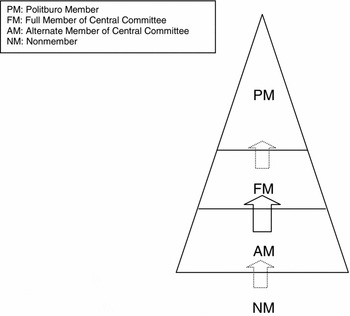
The pertinent question is who among these political elites had greater propensity to act radically during the Great Leap. Figure 1, which shows the distribution of the three bureaucratic ranks of the central committee [they are, from top to bottom, Politburo member (PM), full member (FM), alternate member (AM)], provides some useful clues. Although the Politburo was clearly the pinnacle of China's political power, with its exceedingly small membership (usually consisting of about 20 in the 1950s), it was not within reach for most, including the very elite.
Party Ranks in Central Committee of Chinese Communist Party

A question may be raised on whether advancement to the Politburo provided the only career opportunity for these CC-CCP members. For instance, might there be positions in the central government, the National People's Congress (NPC) and other departments of the Central Party for these full members to advance and fill? To the extent that appointments in the government and the NPC were still firmly under the supervision of the Politburo (Party Constitution of the Eighth Plenary Session 1956), they could hardly qualify as likely positions for career mobility. With regard to appointments in the Central Party, the two options available for a full member were either a position in the Central Secretariat or in the Military Affairs Committee (see supplementary online Appendix 1, available at http://www.journals.cambridge.org/psr2011004).Footnote 12 Both were essentially “subunit[s] of the Central Committee of the CCP (that) report directly to the Politburo and its Standing Committee” (Wang Reference Wang2001, 76; see also Lieberthal Reference Lieberthal1995, 159), not to mention the fact that the number of positions available in these units was small in relation to those who were eligible.Footnote 13 Hence, even for the most ambitious party officials in Communist China, full membership in the Central Committee was likely the highest position attainable.
Three important aspects distinguished a full member from an alternate member. First, full members held more official positions in the party, the military, and the government than did alternate members. As Table 1 shows, of the 513 official positions held by the 141 Central Committee members, 299 positions (58.3%) were held by the 69 full members, averaging 4.3 per person, whereas 72 alternate members held only 214 positions (41.7%) or 2.97 per person. More important, full members disproportionately occupied the more strategic positions. Full members were overwhelmingly represented in the party at the central level (78.9 %), the central government (67.6%), and the military (70.9%); positions assumed by alternate members were confined primarily to those at the local-provincial level. The difference was most striking in the case of the military, in which even appointments at the local level were predominantly occupied by full members. Moreover, the positions of a great many alternate members were confined to appointments of lesser political significance, such as those in mass organizations, including the All China Women's Federation and the Chinese People's Association for Friendship with Foreign Countries. Finally, alternate members were lower in rank and status and, accordingly, enjoyed distinctly fewer rights and privileges. For instance, although allowed to express their opinions at plenary meetings, alternate members were ineligible to vote on resolutions (a fact that remains true today) (Sheng Reference Sheng2005). Their role in party leadership was strictly limited to one of “consultation” (Houn Reference Houn1957; Klein Reference Klein and MacFarquhar1966). These differences must have provided strong incentives for alternate members to want to become full members; the remaining question is whether mechanism(s) existed within the nomenklatura to allow for this upward career mobility.Footnote 14
Distribution of Official Positions in the Party, the Military, and the Government, by Party Rank (First Plenary Session of the Eighth National Congress of the Communist Party of China)

Source: Organization Department of the Central Committee of the Communist Party of China. 2004. Zhongguogongchandang Lijie Zhongyangweiyuan Dacidian, 1921–2003 (A Compendium of Central Committee Members of Various Plenums, 1921–2003). Beijing: Chinese Communist Party History Press.
Because key appointments of both party and government officials were highly controlled by the uppermost level of the power pyramid, a “patron−client” relationship existed between the top leaders and alternate members (Nathan Reference Nathan2003) (Figure 1); this allowed alternate members (as clients) to signal their loyalty toward their patrons in exchange for prospects of promotion. Rigby (Reference Rigby1968) illustrates this logic most succinctly:
Because of the nomenklatura system, one of the resources—and surely the most valuable one—subject to administrative decision and, therefore, forming part of the stock of reciprocal favor, is position itself . . . (6; emphasis added)Footnote 15
In a similar vein, John Burns (Reference Burns1989) succinctly elucidates the inherent desire of China's officials to move up the career ladder of the nomenklatura within the “patron–client” context:
In general, wealth, power, and status in China go to those who can climb the ladder of official position. Because there is no real alternative to employment outside of the “mono-organizational” cadre hierarchy, and because officials are almost completely dependent on their official sinecures for their livelihood, they need patrons at higher levels of the bureaucracy, particularly those who are well connected to party committees and core groups, to further their careers. (xxxii)Footnote 16
Summing up, in light of the vast differences in political status (reflected primarily in official appointments), power (in voting), and other privileges (pecuniary benefits) between the two classes of membership of the Central Committee, as well as the significantly greater probability of becoming a full member of the Central Committee rather than acquiring a position in the Politburo, the incentives for alternate members to signal loyalty to their patrons during the Great Leap were most likely substantially greater than those for full members. Mao's upper hand over his political opponents in the lead up to the Great Leap and his clear preference for a distinctly rapid economic transformation provided the stimulus and legitimacy for radical behavior. We cast our hypothesis specifically as followsFootnote 17:
Hypothesis: Variations in political radicalism across China's provinces during the Great Leap were determined largely by a leader's party rank in the nomenklatura and the differences in political privileges and benefits conferred by the different ranks. The distinct political privileges and status enjoyed by full members of the Central Committee provided inherently strong incentives for alternate members to move up the “career ladder” within China's nomenklatura, and the Great Leap provided them with an extraordinary opportunity to realize this career goal.
EMPIRICAL STRATEGY
Variables
Dependent Variable. Our dependent variable is excessive grain procurement, measured as the difference between normal levels of procurement (during both 1955 and 1957) and actual procurement levels during the Great Leap (1958–61).Footnote 18 We choose grain procurement because it signaled commitment to the Great Leap, and, more important, its variations across provinces significantly affected death tolls (Kung and Lin Reference Kung and Lin2003). We choose to perform our analysis at the provincial level because it is at this particular level that deviations from the normal level of grain output and procurement were likely most acute.Footnote 19
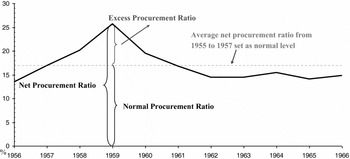
Expressed as a ratio of grain output, the overriding goal of grain procurement was to serve industrialization. There was thus, in China, a monopsony of grain (and other farm products) trade imposed unilaterally by the party to transfer the agricultural surplus from the farm sector to the urban-industrial sector at below-market prices. Dubbed “unified purchase and sale” (Tonggou tongxiao), a euphemism for compulsory purchase and sale, grain procurement was introduced in China in late 1953 (Bernstein Reference Bernstein1984). Compared with gross procurement, net procurement, which deducts from overall procurement that portion of grain a provincial government redistributed back to the affected areas in its own province in the form of resold grain or disaster relief, provides a more accurate estimate of the actual amount being taken away (Kung and Lin Reference Kung and Lin2003).Footnote 20 For this reason, our dependent variable, the excessive procurement ratio, is constructed based on net procurement. As shown in Figure 2, we take the average net procurement of 1955–57 to represent a normal level of procurement (depicted by the horizontal dotted line) and plot it against the net procurement ratio (depicted by the triangular-shaped, thick black line).Footnote 21 The difference between them captures the excess procurement ratio, which began to turn (slightly) positive between 1957 and 1958, but increased more drastically after 1958 and peaked in 1959, after which it declined and even turned negative after 1961, when the famine ended.
Excessive Grain Procurement

To ensure that excessive grain procurement is a reasonably good proxy for political radicalism, we perform a few simple tests.Footnote 22 First, we cross-tabulate a number of radical measures against political rank to determine whether the degree of radicalism was indeed higher among provinces governed by the alternate members. The measures include a proxy for the claims by a locality of having achieved a significant breakthrough in crop yields,Footnote 23 the extent of communal mess hall dining, the pace of agricultural collectivization,Footnote 24 and the number of nonparty intellectuals being persecuted during the “anti-rightist” campaign that occurred shortly before the Great Leap.Footnote 25 The results reported in section A of supplementary online Appendix 3 (http://www.journals.cambridge.org/psr2011004) confirm that the provinces in which the FPS was an AM invariably scored highest on virtually all indicators of radicalism.
Second, we then test whether excessive grain procurement is significantly correlated with the various alternative measures of political radicalism. Reported in section B of online Appendix 3, the results are consistent with the previous finding. The pertinent correlation coefficients are all significant at the conventionally accepted level of statistical significance.Footnote 26 In light of these results, we are confident that excessive procurement is a reliable proxy for political radicalism.
Key Independent Variables. To test our hypothesis, namely, that alternate members (AMs) of the Central Committee behaved more radically than did full members (FMs), our key explanatory variable is the provincial leader's party rank in the Central Committee. Because there were a few nonmembers (NMs) in our sample, we code these different ranks as a categorical variable with a value that equals zero if a provincial FPS was a nonmember of the Central Committee in any given year, 1 if he was an alternate member, and 2 if he was a full member.Footnote 27 Our aim is to match the FPSs with their party ranks and their corresponding length of tenure in a given province (i.e., rank*province*year); therefore, our specification allows us to go beyond mere individual characteristics or idiosyncrasies to test the logic of career incentives underlying promotion within the nomenklatura as a result of the exogenous shock of the Great Leap.
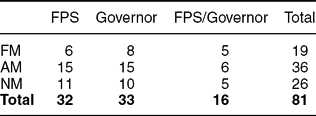
Altogether 81 individuals are enumerated. Their distribution between the two party ranks of the Central Committee across China for the period 1956−66 is shown in Table 2. With 44% of these individuals belonging to AM (n = 36) and 56% to the other two categories—FM (19) and NM (26)—it is unlikely that our estimation is biased by having a disproportionate percentage of our sample in the AM category.Footnote 28 Of these 81 individuals, 48 were FPSs and 33 were governors.Footnote 29 These 48 FPSs were distributed across the 24 Chinese provinces in our sample over the 11-year period from 1956 to 1966, the majority of whom had different lengths of tenure. In fact, with the exception of five provinces (Fujian, Jiangsu, Jiangxi, Zhejiang, and Inner Mongolia), the remaining 19 provinces had all experienced a change in FPS leadership (more on this in what follows).
Distribution of Provincial First Party Secretaries and Governors by Party Rank, 1956–66

Notes: AM, alternate member; FM, full member; FPS, first party secretary; NM, nonmember.
Source: Organization Department of the Central Committee of the Communist Party of China. 2004. Zhongguogongchandang Lijie Zhongyangweiyuan Dacidian, 1921–2003 (A Compendium of Central Committee Members of Various Plenums, 1921–2003). Beijing: Chinese Communist Party History Press.
Control Variables. The provincial governor was AM/FM. According to a party document issued shortly prior to the Great Leap Forward,Footnote 30 the division of labor between the party and the government was such that “the [p]arty was supposed to be responsible only for broad policy direction (dati fangjen), whereas detailed policy execution should be the responsibility of the government and its attendant organizations” (Mao Reference Mao1992, 268–69). What this implies, insofar as grain procurement is concerned, is that, although it was the party that formulated the procurement policy, specifically how much grain was to be procured each year should be the job of the government bureaucrats (or economic planners) (Bo Reference Bo1993). But Mao's disproportionate reliance on party officials at the provincial level and below to implement the Great Leap's radical policies inadvertently relegated the provincial governors to secondary importance.Footnote 31 In her excellent analysis of grain procurement during the Great Leap Forward, Oi (Reference Oi1989) indeed finds that it was “the provincial party secretary (who) divided the provincial target among the different prefectures (diqu)” (58). The same is observed to be the case for communal dining. Although it was the governor of Jiangxi Province, Shao Shiping, who had openly professed his “strong disgust for the mess hall system,” it was Yang Shangkui, the FPS, who was “the more important person” in preventing communal dining practices in that province from developing (Chen n.d., 281, 304). In light of this evidence, the dummy variable indicating that a governor was a member of the Central Committee should thus be insignificant in our estimations.
Differences in Grain Output. It is possible that the level of grain procurement was determined in part by the differences in factor endowments or specifically how much grain a province was able to produce, in which case it is important to control for such variations. Following Sen (Reference Sen1981), we employ a two-year moving average of per capita grain output (MAG) in each province to control for the differences in resource endowments. Expressed in logarithmic terms, the pertinent variable is lagged by one year (see Online Appendix 4).
Effect of Natural Calamities. We need to control for the varying effect of natural calamities on grain procurement because provincial leaders may consider the magnitude of crop damage when deciding how much grain to take away. We define adverse weather as “the area covered by natural disasters in each province” (shouzai mianji), which includes drought, flood, gale and hailstorm, and frost and cold. By summing up the total area affected by these four different types of natural disasters, we construct a natural disaster index for 24 Chinese provinces for the pertinent period of 1956–66. Intuitively, smaller indexes reflect less adverse weather conditions. For instance, compared with 12.53% of the area affected by natural disasters during the three years prior to the Great Leap, the corresponding figure during the Great Leap was approximately 22%, implying that the weather was poor in the latter period.
Local Variations. We have seen that substantial pressures were brought to bear within the hierarchy of the party at all levels to ensure that grain procurement targets were met. Although variations at the grassroots levels were unlikely to have affected procurement at the provincial level due to their zero-sum nature (Oi Reference Oi1989), insofar as grain procurement relied disproportionately on the use of political coercion rather than economic incentives, the state faced an “agency problem” at the grassroots—subcommune—levels. Ethnographic studies have indeed revealed that during the Great Leap and beyond, peasants had engaged in a variety of “resistance” behavior ranging from eating up crops in the fields to secretly dividing part of the harvest among themselves (Becker Reference Becker1998; Gao Reference Gao2006; Thaxton Reference Thaxton2008). To the extent that such behaviors were sanctioned in some instances but not in others, they may duly affect the efficacy of procurement. For this reason, we control for these possible local variations.
Such local accounts help enrich our understanding of the possible variations in the behavior of peasants and cadres at the village level, but more systematic data are needed for multivariate analysis. It is fortunate that there are two pertinent proxies for local variations that we are able to employ. The first pertains to “the winds of exaggeration”—where officials at all levels below the provincial level were under tremendous pressure to exaggerate grain output. This laid the basis for ongoing excessive grain procurement (Ashton et al. Reference Ashton, Hill, Piazza and Zeitz1984; Bernstein Reference Bernstein1984). In particular, it is likely that grain output was exaggerated the most when a locality was identified as having “launched a high-yield agricultural satellite.” Hence, the number of such satellite launches should be a good measure of the (varying) degrees of radicalism at the subprovincial levels. Altogether a total of 658 of such reports were filed to the People's Daily between August 1958 and February 1962.Footnote 32
Variations in the radical behavior of cadres at the subprovincial levels can also be measured by what Dali Yang (Reference Yang1996) calls “party membership density” (PMD), which is our second pertinent proxy for local variations. Defined as the ratio of party members in a given population (e.g., number per 10,000) in a province, the underlying idea is essentially that cadres who were yet to become party members had greater proclivities to behave more radically in order to advance their careers within the system of the nomenklatura. Following this line of reasoning, we modify PMD as the ratio of party members to the overall cadre population in a province as a measure of subprovincial political radicalism. But our reasoning remains the same: political behavior in provinces with a lower ratio of party members for a given cadre population would likely be more radical.
Gross Domestic Product and the Relative Importance of Agriculture in a Province
The last set of control variables pertains to the levels of economic development and the relative importance of agriculture in a given province. In principle, the richer a province, the larger the procurement contributions it could make. But Yang (Reference Yang1996) suggests that, in order to “leapfrog” their wealthier counterparts, poorer provinces tended to adopt more radical policies as a signal of their political loyalty. He thus hypothesized an inverse relationship between a province's level of development and its political radicalism. We employ provincial GDP per capita in a logarithmic form to proxy for this possible effect.
The other time-varying, province-specific variable is the relative importance of agriculture in a province. Lin and Yang (Reference Lin and Yang2000) argue that the priorities China accorded to the development of heavy industry in the 1950s resulted in an “urban bias” by which urban industrial workers of the state sector were guaranteed minimum “entitlement” or consumption rights, leaving only the “residual” (i.e., after procurement) to the villagers. If the urban residents’ rights to grain consumption were indeed better protected, then proportionately more grain would be procured in the predominantly agricultural provinces. We use the share of agricultural income to proxy for this possible effect.
Data Sources
We rely on as many as five data series to test our hypothesis. First, data on grain output and procurement are calculated from Materials on the Agricultural Economy, 1949–1983 (Nongye Jingji Ziliao, 1949–1983), compiled by the Planning Office of the Ministry of Agriculture, Livestock, and Fisheries in 1983 (see Walker Reference Walker and Ash1998).Footnote 33 Detailed information on party officials is obtained from A Compendium of Central Committee Members of Various Plenums, 1921–2003 (Zhongguo gongchandang lijie zhongyang weiyuan da cidian). Third, data on climate are drawn from Report on China's Natural Disasters (Zhongguo ziran zaihai baogao), and Forty Years of Achievements in Irrigation Construction (Sishinian shuili jianshe chengjiu, shuili bu jihuasi). Finally, data pertaining to the list of control variables are obtained from Statistical Compendium on Fifty-five Years of New China, 1949–2004 (Xinzhongguo wushiwu zhounian tongji ziliao huibian), Statistical Materials on 50 Years of New China's Agriculture (Xinzhongguo wushinian nongye tongjiziliao), and Materials on the Organizational History of China's Central Communist Party (Zhonggong zhongyang zuzhi shi ziliao). For easy referencing, we summarize these various sources in Online Appendix 5 (http://www.journals.cambridge.org/psr2011004).
Estimation Strategy
We employ a two-way, fixed-effect model to investigate, at the province level, the causal relationship between party rank in the nomenklatura and political radicalism, using excessive grain procurement as the pertinent proxy. The functional form of our estimation is specified as follows:

where EPR stands for the excessive procurement ratio and Rank is a dummy variable that indexes NM (nonmember), AM (alternate member), and FM (full member). The vector X includes two key control variables, per capita grain output and natural calamities, whereas Y represents the two time-varying, province-specific variables of GDP per capita and the proportion of agricultural income. The vector Z captures the personal characteristics of provincial leaders. These include the leaders’ ages and the number of years of party membership. As befits a two-way, fixed-effects model, μi captures the time-invariant and province-specific effects for province i, whereas νt stands for the province-invariant and time-specific effects for year t. ϵit is the disturbance term that absorbs the effects of other random sources of differences in the dependent variable.
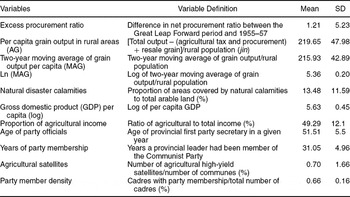
Given that the Eighth Party Central Committee commenced in 1956 (and ended in 1968), our empirical analysis, which is conducted at the provincial level, covers the period from 1956 to 1966. We exclude the last two plenary sessions (1967–68) in our analysis because we do not want our estimations to be contaminated by the political disruptions caused by the Cultural Revolution (1966–76). As with other studies of the Great Leap Famine, we omit the municipalities of Shanghai, Beijing, Tianjin, and the two ethnic autonomous regions of Tibet and Xinjiang, from our analysis. We are left with 24 provinces, and, with each province having 11 time points (1956–66), we have a total of 264 observations available for the empirical analysis. The summary statistics of the variables employed in the estimations are presented in Table 3.
Descriptive Statistics of Variables Employed in Regression Analysis

Source: See Online Appendix 5.
EMPIRICAL RESULTS
Baseline Results
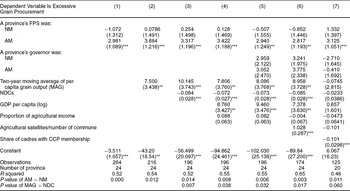
The baseline estimates of the determinants of political radicalism are presented in Table 4. Provinces governed by full members of the Central Committee are employed as the reference group and are thus not shown. Altogether, we ran six regressions. To ensure that our results are not contaminated by problems of multicollinearity and measurement error, model 1, which presents the results of the baseline estimates, includes only the key variable of interest. In model 2, we add the control variable of grain output, whereas in model 3, we control for both grain output and natural calamities. In models 4 and 5, we include GDP per capita and the proportion of agricultural income to control for province-specific effects, whereas models 6 and 7 take into account the possible effects of local variations on political radicalism.Footnote 34
Two-way, Fixed-effects Model: Political Rank and Excessive Grain Procurement

Notes: Reference group is full member (FM) of the Central Committee. Standard errors in parentheses. AM, alternate member; CCP, China's Communist Party; FPS, first part secretary; GDP, gross domestic product; NDC, natural disaster calamity; NM, nonmember.
*Significant at 10%; **significant at 5%; ***significant at 1%.
Our baseline regression results confirm our hypothesis. Compared with the full member (FM), only the alternate member (AM) variable is highly significant (at the .01 level of significance); its positive sign (vis-à-vis that of the FM) suggests that the alternate members were indeed more radical in procuring grain.Footnote 35 There is virtually no statistical difference between the FM and the NM, suggesting that nonmembers, too, were not as radical as their AM counterparts. In fact, the AM variable is significant across all seven estimations, suggesting that even with the inclusion of a number of control variables, the results are highly robust.Footnote 36 The size of the AM coefficient—which ranges between 2.86 to 3.88—suggests that the excess procurement ratio of provinces governed by AMs is more than 3% higher than in provinces governed by FMs. Evaluated at the mean of the excess procurement ratio, this translates into 17.62 kilograms of grain procured per person (equal to almost one month's per person consumption at the time) or about a 1.11‰ increase in the excess death rate, based upon Kung and Lin's (2003) estimation.Footnote 37 Evaluated against the national average excess death rate of 6.59‰ during 1959–61, political rank alone can explain 16.83% (1.11‰/6.59‰) of the excess death rate. This is a huge result.
The effects of grain output, a proxy for the provincial differences in factor endowments (model 2),Footnote 38 and natural calamities (model 3) are both highly significant, suggesting that procurement decisions were not completely independent of these considerations. Closer inspection, however, reveals that the marginal effects of these two variables varied considerably. Whereas a 1% increase in per capita grain output (MAG) yielded a 7% to 10% increase in grain procurement, which is large, a similar increase in natural disaster calamities (NDCs) reduced the magnitude of the dependent variable by less than 1%.Footnote 39 These results suggest, first, that provincial leaders were likely impervious to the potential sufferings that poor weather might inflict on the rural population and, second, that those in charge of the better-endowed provinces indeed taxed their own subjects more.Footnote 40 These findings help explain why China was unable to avert this great famine, as the provincial leaders expended little effort in reducing the transfer of grain out of their provinces, even when hit by poor weather.Footnote 41
Turning to model 5, the party rank of provincial governors is not significant in explaining variations in the excess procurement ratio, which suggests that a province's enforcement of the Great Leap's policy was largely in the hands of the FPS.Footnote 42 This finding also helps make sense of the actions of Wu Zhipu, an unusually radical governor of Henan Province, who, in order to become the FPS of the province, launched a series of political accusations against the incumbent FPS, Pan Fusheng, for having failed to adhere closely to Mao's line.Footnote 43
In contrast to what Yang (Reference Yang1996) postulates, per capita GDP has a positive rather than a negative sign in relation to the excessive procurement ratio, which augurs well for the argument that the better-endowed provinces contributed proportionately more to rapid industrialization. The extent to which a province was more or less agricultural, however, had no seeming effect on the radical behaviors of its leader.
Models 6 and 7, which control for the effect of local variations in radicalism, do not fundamentally alter our key results. The key explanatory variable of political rank remains highly significant (at the 5% and 1% levels of significance, respectively). The signs are also consistent with our expectations. The marginal effect of the satellite variable suggests that a 1% increase in this respect of radicalism increases procurement by an almost identical proportion (1.02%), whereas a 1% increase in party membership density has the expected effect of decreasing procurement, albeit by the much smaller magnitude of 0.10%.
“Personality” versus Party Rank
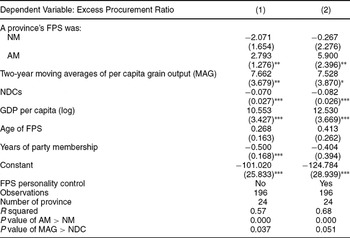
Our estimations thus far have suffered from an omitted variable bias because we have not controlled for the identities of the FPSs and the corresponding tenure of their terms.Footnote 44 Indeed, conventional wisdom, which attributes the exceptionally radical behavior exhibited by such provincial leaders as Li Jingquan (of Sichuan), Wu Zhipu (of Henan), Zeng Xisheng (of Anhui), and Tao Zhu (of Guangdong)—to name the better known ones—to their “personality,” presents a challenge to our hypothesis.Footnote 45 To correct for this possible bias, we need to control who these provincial leaders were (“personality”), where they served (province), and the length of their corresponding terms. Five provinces had the same FPS from 1956 to 1966 (Fujian, Jiangsu, Jiangxi, Inner Mongolia, and Zhejiang). Most had two FPSs, but some had three (Guangxi, Guizhou, Henan, Ningxia, Qinghai, and Shandong). Complete information on these assignments is readily available, so with a total of 48 FPSs (including both Central Committee members and nonmembers) during the period under analysis, we are able to generate 47 dummy variables representing these individuals to control for such effects.Footnote 46 Each dummy indicates who the FPS of a given province was for the period under analysis, with each individual assigned a value of 1 for a year in which he was the FPS, and 0 otherwise. The 196 observations in the sample provide enough degrees of freedom for the analysis. In addition to controlling for who the provincial leaders were, we control also for their individual characteristics—specifically, their ages and the lengths of their tenure in the party—to gauge whether variations in these characteristics might also bear on political radicalism.
The effect of the individual characteristics of provincial leaders on procurement is reported in model 1 of Table 5, whereas we defer the results of controlling for “personality” to model 2. The results in model 1 show that party rank (AM) remains significant at the 5% level with the inclusion of age and tenure of party membership, and that its magnitude is similar to those in the previous baseline estimations (in particular, models 1, 3, 5, and 6 of Table 4). To the extent that the years of party membership are positively correlated with party rank, it is reasonable to expect that the less experienced tended to be more radical. Age, however, is not significant.
Two-way, Fixed-effects Model: Controlling for Personality and Individual Characteristics

Notes: Reference group is full member (FM) of the Central Committee. Standard errors in parentheses. AM, alternate member; FPS, first part secretary; GDP, gross domestic product; NDC, natural disaster calamity; NM, nonmember.
*Significant at 10%; **significant at 5%; ***significant at 1%.
We found, in model 2, that not only does the rank variable (AM) remain significant at the 5% level, but also the size of its effect becomes larger (5.9) than in the previous estimations. This result robustly reaffirms our hypothesis that, even after controlling for the “personality” of the leader, political radicalism varied systematically according to the strengths of career incentives between the two ranks of Central Committee membership embedded in China's nomenklatura.Footnote 47 The years of party membership, which is significant in model 1, becomes insignificant after controlling for “personality” in model 2.
EXTENSION OF THE ANALYSIS
A puzzle remains, nonetheless—and that is, why were full members not equally motivated to move up the career ladder, given the extraordinary prestige and power conferred by a position in the Politburo? Similarly, might the nonmembers be equally tempted to enter the Central Committee? An intuitive answer is simply that entry into either the Central Committee or Politburo was not only exceedingly rare, but, more important, it also depended primarily on “prerevolutionary credentials,” which could not be earned through radical behavior. According to Houn (Reference Houn1957), members of the Central Committee shared the following characteristics (see also Bo Reference Bo2004; Houn Reference Houn1967). First, a great majority had experienced the Chinese Red Army's Long March in its revolutionary expedition across China; second, they had fought in guerilla warfare; third, they had frequently been elected to the first plenary sessions of the first seven NCCCPs (1921–45); and, fourth, they had long tenures of CCP membership by the time communist China was founded in 1949. Of these four attributes, clearly the first two are of fundamental importance because they determined, in a concrete fashion, whether one had contributed to the revolutionary cause of the CCP. In other words, these credentials could be earned before the founding of the “New China” but not afterward, even during the Great Leap.
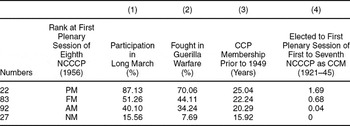
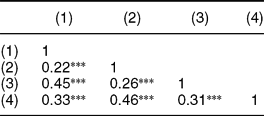
The distribution of these credentials among the four party ranks of the nomenklatura (including those PFS who were not members of the CC-CCP) is summarized in Table 6a. The pattern reveals a positive, linear relationship between party rank and the various credentials. For instance, whereas only 15% of the NMs and 40% of the AMs had joined the Long March, more than half of the FMs (51%) and a substantial 87% of the PMs had had this unique “prerevolutionary experience” (column 1). A similar pattern can be found for guerilla warfare (column 2). Similar patterns are shown for the other two attributes, namely, the length of CCP membership before 1949 and the frequency of being elected to the first plenary session of the first seven NCCCPs (columns 3 and 4). Moreover, the four credentials are highly correlated with each other at the 1% level of statistical significance (Table 6b).
“Prerevolutionary Credentials” Distribution among Different Ranks

Notes: Total number is 224, including 197 CCM of the First Plenary Session of the Eighth NCCCP and 27 FPS who were not CCM (NM) in 1956. AM, alternate member; CCM, Central Committee Member; CCP, China's Communist Party; FM, full member; NCCCP, National Congress of the Communist Party of China; NM, nonmember; PM, Politburo member.
Correlation Coefficient Matrix of “Prerevolutionary Credentials”

Source: Organization Department of the Central Committee of the Communist Party of China. 2004. Zhongguogongchandang Lijie Zhongyangweiyuan Dacidian, 1921–2003 (A Compendium of Central Committee Members of Various Plenums, 1921–2003). Beijing: Chinese Communist Party History Press.
***Significant at .01 level.
The vast differences in the distribution of these credentials among the various party ranks suggest that mere political loyalty was unlikely a sufficient condition for entry to either the Central Committee (for nonmembers) or the Politburo (in the instance of full members). In the case of the Politburo, members of this supreme political body were required to possess the necessary credentials that bore on one's contributions to the CCP (within the revolutionary context of the Chinese Red Army) and to Mao's political ascendancy within the CCP (Houn Reference Houn1967; Wang Reference Wang2001).Footnote 48 Indeed, students of Communist China regard the Long March as the only “credential” that qualified as a “revolutionary” contribution (Houn Reference Houn1957; Mao Reference Mao1991; J. Wang Reference Wang1979; Xu Reference Xu2006; Yang Reference Yang1990). If that was indeed the case, then there existed significant “entry barriers” to the Politburo; in other words, except for the most elitist of party officials, full membership in the Central Committee was conceivably the highest attainable position.
The same applies to entry into the Central Committee, where membership required credentials that were firmly connected to the founding of the “New China.” One such credential, according to Houn (Reference Houn1957), was guerilla warfare. As Table 6a shows, compared with their AM (32.4%) and FM (44.11%) counterparts, only a mere 7.6% of NMs had such experiences. This suggests that there were significant barriers for those seeking entry into the Central Committee after 1949.
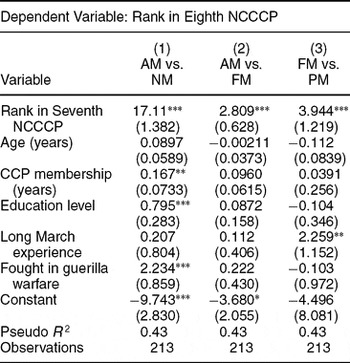
To test the idea that certain “prerevolutionary credentials” were associated with membership in the Politburo and the Central Committee, we perform a multinomial regression using a sample that includes both members (n = 197) and nonmembers (n = 27) of the Central Committee at the First Plenary Session of the Eighth NCCCP. In this exercise, the dependent variable is political rank arranged in an ascending order from the lowest to the highest, including the NM (i.e., NM, AM, FM, and PM), and the explanatory variables include the two key “prerevolutionary credentials” henceforth discussed (Long March and guerilla warfare), the individual characteristics of age, education, and tenure of party membership. To control for the effect that one's initial rank may have on current rank, we control for the rank at the Seventh Party Congress.
Reported in Table 7, the guerilla warfare variable significantly distinguishes the political rank of AM from that of NM at the 1% level of significance. The magnitude of this effect suggests that, compared with the NMs, the odds of AM having this particular credential are 9.34 (e 2.23) times greater. Similar results are found in the case of the Politburo. Compared with the FMs, the odds of PMs having the unique experience of the Long March are 9.58 (e 2.26) times greater (model 3). The robustness of our results is bolstered by the finding that guerilla warfare experiences are not significant (required) for Politburo membership. An even more important finding is that the difference between AM and FM in terms of these two credentials is statistically insignificant (model 2). What this suggests is that an AM who wants to acquire the political status of an FM may feasibly achieve that by demonstrating his loyalty to Mao and his patrons. Whether political ranks were determined by “prerevolutionary credentials” is an empirical issue to which we now turn, using an ordered probit model such as the one in Equation (2).

Multinominal Logistic Model of Determinants of Rank in the First Plenary Session of Eighth National Congress of the Communist Party of China

Note: Robust standard errors in parentheses. AM, alternate member; FM, full member; CCP, China's Communist Party; NCCCP, National Congress of the Communist Party of China; NM, nonmember; PM, Politburo member.
***p < .01; **p < .05; *p < .1.
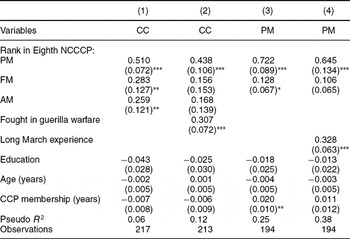
In Equation (2), yi is a dummy variable that equals 1 if an individual was either a member of the Politburo or the Central Committee between 1958 and 1977 (the Maoist era), and 0 otherwise. The independent variable R 1956 is a dummy variable that indicates one's party rank at the commencement of the Eighth Central Committee in 1956. x 1 denotes the two “prerevolutionary credentials” of the Long March and guerilla warfare. x 2 is a measure of human capital (using the years of education as a proxy), whereas X 3 is a vector that denotes the tenure of party membership and age. α and β are a set of coefficients, and the standard error term ϵ is assumed to follow a standard normal distribution.
Table 8 reports our maximum likelihood estimation results. To allow for heterogeneity among individuals, we estimate the model with robust standard errors. In models 1 and 2, we examine the determinants of Central Committee membership, whereas in models 3 and 4, we examine those of Politburo membership. In model 1, we regress the dependent variable of whether an individual was a member of the Central Committee after 1958 on his or her party rank in 1956, controlling for the years of education, age, and years serving as a CCP member, while omitting the “prerevolutionary credentials.” The results show that, compared with NMs, the probability of entering the Central Committee after 1958 increased with the level of party rank in 1956. In particular, PM is highly significant (at the 1% level) and has the largest coefficient; although both AM and FM are also significant, they are significant only at the 5% level. In model 2, we include the credential variable. Specifically, we use guerilla warfare to proxy for the credential variable required for membership in the Central Committee, with NM serving as the reference group.Footnote 49 Although PM remains significant, its coefficient becomes smaller, with FM and AM simply dropping their significance. In line with our expectations, guerilla warfare is highly significant (at the 1% level). What is more important to note, in this connection, is that compared to someone without guerilla warfare experiences, those with such experiences enjoy a substantially higher chance—30.7%—of being a member of the Central Committee. It is this large order of magnitude that lends credence to our conjecture that mere political loyalty was not sufficient for entry into the Central Committee during the Great Leap.
Ordered-probit Analysis of Determinants of Politburo and Central Committee Membership

Notes: The reference group in models 1 and 2 is NM, whereas the reference group in models 3 and 4 is AM. Robust standard errors in parentheses. AM, alternate member; CC, Central Committee; FM, full member; CCP, China's Communist Party; NCCCP, National Congress of the Communist Party of China; PM, Politburo member.
***p < .01; **p < .05; *p < .1.
We replicate in models 3 and 4 what is essentially the same exercise in the previous two models, only this time we replace guerilla warfare with Long March as the prerequisite for entry to the Politburo and use AM as the reference group. The results are strikingly similar to those for models 1 and 2. As a proxy for “prerevolutionary credentials,” the Long March variable is highly significant (at the 1% level) and of a magnitude that is much larger than that of guerilla warfare. In particular, those who had embarked on the Long March were 32.8% more likely to become members of the Politburo. More important, we should also note that once we control for the Long March, FM, which is significant in model 3, drops its significance altogether, suggesting that the promotion of FM to the Politburo is not merely a function of time—it had to be earned in the course of the revolution (before 1949)—not after it.
The other variable of interest is education, which exhibits no relationship with the dependent variable. We do not believe that education actually impeded one's entry into the Politburo or the Central Committee; rather, the most senior officials were older and hence had received less education during wartime than their younger counterparts had (a “cohort” effect).
A REMAINING ESTIMATION ISSUE
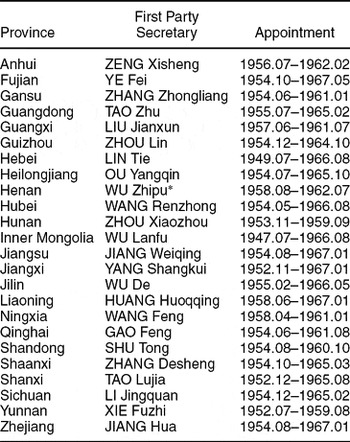
In estimating the effect of party rank on provincial radicalism, we have avoided the omitted variable bias by controlling for the identity of the FPSs during the Great Leap. The remaining estimation issue is whether the more radical provincial leaders were appointed to their positions by Mao in advance in anticipation of the launching of the Great Leap, in which case the causality of our argument would be reversed and our estimation biased (Angrist, Graddy, and Imbens Reference Angrist, Graddy and Imbens2000; Fisher and Nagin Reference Fisher, Nagin, Blumstein, Nagin and Cohen1978).Footnote 50 To ensure that our estimations do not suffer from the bias of reverse causality, we examine the dates on which the various FPSs who had served on the Eighth Central Committee were appointed (Table 9).
Appointment Dates of Provincial First Party Secretaries Ranked

*WU Zhipu severed as governor of Henan Province from May 1949 onward.
Source: Organization Department of the Central Committee of the Communist Party of China. 2004. Zhongguogongchandang Lijie Zhongyangweiyuan Dacidian, 1921–2003 (A Compendium of Central Committee Members of Various Plenums, 1921–2003). Beijing: Chinese Communist Party History Press.
Except for the FPSs of Ningxia and Liaoning provinces, who were appointed in 1958 (shortly before the Great Leap), the majority of FPSs assumed their current positions (as members of the Central Committee) in 1954 (the mean), with a few as early as 1952. With the exception of Zeng Xisheng (Anhui) and Liu Jianxun (Guangxi), the remaining 8 of the 10 FPSs in the most severe famine-stricken provinces were all appointed long before the Leap.Footnote 51 Although Wu Zhipu did not become Henan's FPS until 1958, he had started serving as the provincial governor in the same province in early (February) 1955. With regard to the two appointees in 1958 (in Ningxia and Liaoning), the famine in these two provinces—ranked 17th and 20th, respectively—was among the least severe. Moreover, additional evidence suggests that their predecessors were not persecuted for having failed to toe Mao's radical line.Footnote 52 Summing up, we find no persuasive evidence to suggest that Mao had placed his loyal followers in the position shortly before the Great Leap in order to vigorously implement his radical policies. That some of the provincial leaders behaved more radically must therefore be seen as the result of the incentive properties embedded in China's nomenklatura.
CONCLUSION
Premised on the reasoning that excessive grain procurement was likely the major culprit of excess deaths during China's Great Leap Famine, we examine, in this study, the spatial variations in political radicalism, measured specifically by the excess grain procurement ratio. It has long been assumed that in totalitarian regimes, such as China's under Mao, the source of radicalism is often deeply embedded in ideology or associated with the idiosyncrasies of individual provincial leaders. In other words, higher death tolls were assumed to be correlated closely with who the leaders were. By comparing and contrasting the vast differences in appointments, as well as political and other privileges between members of different political ranks in the CC-CCP, and by assuming that party officials responded to incentives, we tested, with data, the proposition that alternate members of the CC-CCP had stronger incentives than both full members and nonmembers to climb the career ladder of the nomenklatura. The Great Leap provided these party officials with a rare, extraordinary opportunity to respond to Mao's unambiguous signal that radical behavior would be duly rewarded. The evidence clearly shows that even after controlling for the idiosyncrasies of individual provincial leaders and variations in local conditions, the alternate members were, as a group, indeed more likely to act radically. Our findings thus substantially challenge the reigning assumption that ideology is the main source of bureaucratic radicalism in totalitarian regimes.
The idea that career incentives matter is further bolstered by the provocatively counterintuitive finding that radicalism declined among those bureaucrats who, although still having room to move further up the career ladder, nonetheless lacked the necessary “prerevolutionary credentials” to do so, at which point most apparently became satisfied careerists rather than revolutionary zealots. Thus, even though this study only focuses on one historical period in one country, there are important general political lessons to be learned. In particular, in the absence of political checks and balances on the dictator, he can easily misuse the same career incentives that have been employed to promote economic growth under the same conditions of centralized personnel control by the nomenklatura and economic decentralization, leading in this case to economic disaster.





Comments
No Comments have been published for this article.