The 1965 Voting Rights Act is set to expire in 2007, but Congress may consider renewing it. Lavishly praised for its effectiveness in extending the franchise to blacks (Alt 1994), the Voting Rights Act nevertheless has become mired in controversy. Congress's 1982 amendment of Section 2 of the Act explicitly prohibited voting procedures that would afford blacks and certain language minorities “less opportunity than other members of the electorate to participate in the political process and to elect representatives of their choice” (Davidson and Grofman 1994). On the basis of this provision the U.S. Justice Department has denied preclearance to states covered under the Act whose redistricting plans do not include a sufficient number of minority-majority districts.
Researchers have devoted considerable attention to trying to clarify the costs and benefits of minority-majority districts to blacks, Latinos, and non-Latino whites. Some contend that these districts have made Congress less responsive to the interests of minorities (Cameron, Epstein, and O'Halloran 1997; Lublin 1997; Swain 1993). Others argue that minority-majority districts are the principal means through which minority interests are truly articulated and represented (Canon 1999; Grofman and Davidson 1992; Grofman, Handley, and Niemi 1992; Kousser 1999; Lublin 1997; Whitby 1998). Research conducted thus far indicates that, all things being equal, blacks prefer to be represented by blacks in Congress (Tate 2001, 2003).
Where do blacks line up in the clash of moral arguments pertaining to the legitimacy of the Act such as those advanced by Thernstrom (1987), Parker (1990), and Guinier (1994), among others? Thernstrom argues that by forcing states to create minority-majority districts, the Act violates the principle of color blindness and fairness. Associate Supreme Court Justice Sandra Day O'Connor took this position in 1993 in invalidating a North Carolina plan that had sent that state's first two blacks since Reconstruction to Congress in Shaw v. Reno. Supporters counter by applying the same logic of racial fairness, arguing that, without the Act, blacks and Hispanics would never have won southern Congressional seats in the first place. Voting rights activists such as Parker (1990) point out the inherent racial bias of a system that perpetuates white political domination and the necessity of drawing minority-majority districts to overcome that racial bias. Still others, such as Guinier (1994), reject minority-majority districts as a short-term fix, supporting instead the more radical solution of moving from a single-member plurality system to proportional representation.
Black opinion on the legitimacy of racial-conscious redistricting will weigh heavily on Congress's and the President's decisions of whether to renew the 1965 Voting Rights Act in 2007. In this article I address the controversy from the perspective of blacks, utilizing the 1996 National Black Election Study (NBES). To my knowledge, the 1996 NBES is the only large-scale survey of blacks in which blacks have been queried about the legitimacy of racial redistricting and minority-majority districts. Do blacks endorse race-conscious means to advance the descriptive representation of minorities? Among blacks, who favors minority-majority districts and why? And are the opinions of ordinary blacks consistent with the position most black leaders take in this debate?
There are important theoretical and political implications in the answers to these questions. One would expect that rank-and-file blacks strongly favor minority-majority districts, as do the vast majority of members of the black political elite. However, opinion congruency between the black masses and the elite is not always the case. Black public opinion has diverged significantly from that of their leaders, including in the matter of Clarence Thomas's confirmation to the Supreme Court by the U.S. Supreme Court in 1991 (Mansbridge and Tate 1992). Most recently, the vast majority of black legislators in the House of Representatives voted against the Personal Responsibility and Work Opportunity Reconciliation Act of 1996. However, a full 60% of blacks surveyed in the 1996 NBES favored a five-year lifetime limit for welfare—the centerpiece of the welfare reform legislation (Barker, Jones, and Tate 1998).
Public opinion analysts have grappled with the debate over the role of political elites in opinion formation for decades (Lee 2002; Page and Shapiro 1992; Zaller 1992). Answering the question of why black mass opinion can diverge from that of members of the political elite is critical to achieving a better understanding of the nature of U.S. citizen opinion. Public opinion analysts have traditionally interpreted the mismatch between mass and elite opinion as rooted in the informational disadvantages suffered by the masses (Converse 1964). Specifically, having relatively little solid information on which to base their policy stands compared to political leaders, members of the mass public, understandably, lack genuine, stable opinions on issues except for those most salient to them (Krosnick 1989, 1991). Revisionists, however, argue that the mass public's attitudes are more stable and coherent than portrayed in early survey work (Kinder 1983; Page and Shapiro 1992). Recently, Lacy (2001) has argued that opinion instability instead reflects “nonseparable preferences,” or highly interdependent policy positions, and has uncovered evidence in support of this interpretation, in the form of question order effects: People support raising federal spending on social services prior to being asked about spending on the nation's defense. Additionally, Lacy speculates that instability in citizens' opinions may also arise from exposure to new information. Inconsistency in policy opinions, therefore, is not necessarily a reflection of having no opinion but may be triggered by the respondent's changing set of priorities and calculations, brought about by exposure to new information.
In this study, an experimental counterargument technique developed by Sniderman and Piazza (1993) was employed in the survey instrument to determine how mass opinion is formed. Blacks who took a position in this debate were then given a counterargument and asked whether they would change their position. The counterargument technique makes salient information that respondents had either considered or not. Thus, the counterargument for some respondents may be “new information,” prompting them to switch sides in the debate. Having exposure to the full contours of the debate, respondents strive to balance the array of clashing core values and conflicting interests behind the public policy stands that they take. Some may stick with their original stand, but others may switch sides. Balancing values and interests is a difficult act in public policy debates, in which citizens may be unable to retain highly stable opinion. Depending on how issues are framed—how much information is presented in the debate—people can rationally fluctuate between polarized positions.
The problem of clashing values is made more complicated by research revealing that the universe of black political thought reflects both widely disseminated and shared American values and ideologies that are uniquely rooted in the black experience in America (Dawson 2001). Historically, blacks have voiced dissent to mainstream conservative, free-market ideologies as well as liberal, Lockean doctrines because of American slavery and discrimination. Blacks also have their own alternative source of political information, which Michael C. Dawson (2001) labels a “black counterpublic,” that both affirms and challenges the dominant body of knowledge produced and circulated by the overwhelmingly white members of the political elite. In this study, African Americans were asked to endorse race-neutral redistricting practices versus the goal of advancing minority numerical representation. Their position in this debate will inevitably reflect ideologies based on their own experiences as blacks. Thus, blacks may change positions in response to a changing set of calculations and priorities that encompass both mainstream American values and their own group-based ideologies, including radical egalitarianism and black nationalism.
The counterargument technique exposes the real trade-offs involved in creating minority-majority districts, i.e., the costs to Democratic seats versus minority seats in Congress. It reveals which goal or value respondents would advance over the other, such as color blindness or increasing minority officeholding. Finally, the technique can establish which ideological group—blacks taking the color-blind or minority representation position—is more likely to be influenced by counterarguments and change positions. As Sniderman and Piazza (1993) show in their research on affirmative action, the rate of change among the two ideological groups has important political as well as theoretical implications.
MEASURING BLACK OPINION ON MINORITY-MAJORITY DISTRICTS AND RACIAL REDISTRICTING
The 1996 NBES1
The 1996 NBES is a national random-digit-dial telephone survey of African Americans during the 1996 elections (Tate 1998). It contains both pre- and postelection components. A total of 1,216 respondents completed interviews during the preelection component, 854 of whom were reinterviewed for the postelection component. Respondents were drawn disproportionately from four geographic strata, and thus the sample requires weighting. The data set is available to the academic community through the Inter-university Consortium for Political and Social Research at the University of Michigan.
carried three items that measured black attitudes toward minority-majority districts and racial redistricting. Several measures were developed, as opposed to one, because multiple measures can reveal the degree to which black opinion may be sensitive to question wording or issue framing. Before being asked their opinions, respondents were supplied the following background information:
Congressional districts are redrawn every ten years by state legislatures, but how they should be drawn has become very controversial. Please tell me, if you were choosing, which type of district do you think is best?
To simplify the task before the survey respondent, a two-category response format was used in which respondents were asked to choose one side or the other in each question. Arguing that people tend to think in bipolar terms, some have advised survey researchers to reconsider their heavy reliance on continuous rating scales (
Ostrom 1987).
Sniderman (2000) has argued that citizens exist in a political world that systematically “simplifies” complex public policy issues. “Issue alternatives,” he contends, “are organized in advance, typically binary, mutually exclusive, and characteristically exhaustive” (81). The forced-choice bipolar format of the three NBES items is consistent with this viewpoint.
The order of the three questions in the survey was randomized to minimize question order effects. Each question highlighted a different aspect of the debate over minority-majority districts. At the core of the first question is acceptance or rejection of color-conscious policies. In Whose Votes Counts? Thernstrom (1987) denounces the extended use of the Voting Rights Act as the basis for creating minority-majority districts because it violates the American constitutional ideal of “color blindness.” The law is, in her opinion, affirmative action applied to the political arena. Supporters of the Voting Rights Act argue that color-conscious redistricting is the only way in which blacks and Latinos can win election. The first question explicitly raises the “color consciousness” issue by asking whether districts should be drawn “without regard to race”:
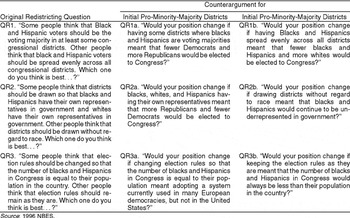
Some people think that districts should be drawn so that blacks and Hispanics have their own representatives in government and whites have their own representatives in government. Other people think that districts should be drawn without regard to race. Which one do you think is best—districts drawn so that blacks, Hispanics, and whites all have their own representatives in government, or districts should be drawn without regard to race?
The second question does not explicitly draw attention to the race-conscious means of creating minority-majority districts. It asks instead whether blacks and Hispanics should be voting majorities within districts or should be spread evenly across districts:
Some people think that black and Hispanic voters should be the voting majority in at least some congressional districts. Other people think that black and Hispanic voters should be spread evenly across all congressional districts. Which do you think is best—blacks and Hispanics should represent majorities in some congressional districts, or blacks and Hispanics should be spread evenly across all congressional districts?
It is widely believed that the numerical representation of blacks and Hispanics would be enhanced if the United States switched to a proportional representation system (Amy 1993; Guinier 1994). A proportional representation system would have the advantage of being race-neutral while still advancing the cause of increasing the numerical representation of minorities. Thus, a third consideration is whether one is wedded to the current electoral system or is willing to cast it aside for a system intended to enhance minority descriptive representation:
Some people think that election rules should be changed so that the number of blacks and Hispanics in Congress is equal to their population in the country. Other people think that election rules should remain as they are. Which one do you think is best—election rules should be changed so that the number of blacks and Hispanics in Congress is equal to their population in the country, or that election rules should remain as they are?
Employing the “counterargument” technique developed by Sniderman and Piazza (1993), the survey contained questions designed to test the pliability of opinion on this controversial issue. After stating their position on the three aspects of racial redistricting and minority-majority districts, respondents were read a rejoinder and were asked whether their position would change. The counterargument for blacks who initially favored minority-majority districts was whether they would switch sides if having minority-majority districts meant that fewer Democrats and more Republicans would be elected to Congress. Conversely, interviewers asked blacks who initially opposed minority-majority districts whether their position would change if that meant that fewer blacks and Hispanics would be sent to Congress. For example, respondents who told the interviewer that blacks and Hispanics should be “spread evenly” across Congressional districts were then asked:
Would your position change if having blacks and Hispanics spread evenly across all districts meant that fewer blacks and Hispanics and more whites would be elected to Congress?
displays the exact wording of each counterargument.
The introduction of “argument and countervailing considerations,” as Sniderman and Piazza (1993) explain, accomplishes two purposes. First, the ease with which one is “talked out” of a position indicates the degree to which the subject has previously thought about the subject matter. Converse (1964) argued that “large portions of [the] electorate do not have meaningful beliefs,” and researchers remain very concerned about the problem of “nonattitudes” in survey research. The degree to which attitudes are subject to change in response to a counterargument may indicate that some respondents had no real opinion on the issue. They may have given a response because they were too embarrassed to tell the interviewer in the context of a survey that they had not thought much about the matter and did not have an opinion. In addition, the interviewer's task is to get respondents to state their opinions on issues about which many have given little thought (Converse and Schuman 1974). In the case of the racial redistricting items, telephone interviewers were explicitly instructed to probe for a response after an initial “don't know” on these items. In addition to revealing the extent of nonattitudes, changing one's position in response to a counterargument indicates lack of emotional or intellectual attachment to one's position. People with strong opinions on the matter will remain unpersuaded by counterarguments. The rates of change to the counterarguments thus indicate at once the extent to which respondents have a real opinion on this matter and their commitment to their position on that issue. In the survey-based thought experiment, many blacks may initially reject minority-majority Congressional districts because of the overtly racial manner in which they are constructed. They may also then shift positions meaningfully and rationally in response to the counterargument to support mechanisms that send more minorities to Congress.
Second, Sniderman and Piazza (1993) argue that one's susceptibility to a counterargument can reveal the reasons why opinion can change. In their study of whites' attitudes on affirmative action policies, determining which group—proponents or opponents—can be talked out of their original position was key. They found that white liberals were less committed to their advocacy of affirmative action than were white conservatives once exposed to arguments against it. For Sniderman and Piazza (1993) this asymmetry suggested that the ideological underpinnings for white opposition to affirmative action programs are clearer and stronger than the ideological justification whites employ on behalf of such policies. It appears that a great deal of the opposition to minority-majority districts is based on the American public's aversion to color-conscious practices. The key question, then, is whether color blindness or equality under the law is also a strong and overarching principle that can explain blacks' opposition to minority-majority districts. Furthermore, are the blacks who oppose minority-majority districts less likely than their proponents to switch sides in response to counterarguments?
FINDINGS
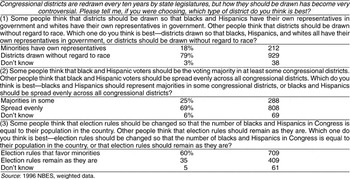
Until very recently the vast majority of blacks supported affirmative action policies in employment and education (Schuman et al. 1998; Tate and Hampton 2000). In contrast, respondents in the 1996 NBES emphatically rejected a race-conscious redistricting process. As shown in Table 2, 79% of blacks voiced initial opposition to the idea that some districts should be drawn to enhance the election of blacks and Hispanics, instead endorsing the view that districts should be “drawn without regard to race.” Moreover, 69% thought that minorities should be spread evenly across Congressional districts instead of concentrated in some districts. Only on the item that asked whether election rules should be changed to favor the election of minorities did a majority (60%) endorse change.2
Only 6% or fewer expressed no opinion on these measures, suggesting that most people could answer the questions and were not confused. Interviewers, however, were instructed to “probe” or repeat the question if respondents initially had no opinion (Converse and Schuman 1974).
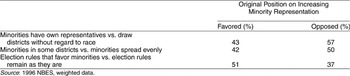
The thought experiment embedded in these three items reveals a very high degree of subject pliability. Depending on the position initially taken, about 37% to 57% of the respondents said that they would change their position in light of the counterargument (see Table 3). In comparison, in the Sniderman and Piazza (1993) thought experiments, about half of the whites surveyed said that they would change positions on federal aid to blacks, but only about 20% changed positions in response to the counterarguments when the issue was affirmative action.
Table 3 reveals an asymmetry among blacks. Whereas Sniderman and Piazza found that it was harder to talk whites out of their opposition to affirmative action, it was harder to talk blacks out of their support for minority-majority districts. Whereas 43% of those favoring minority-majority districts became opponents in response to the counterargument, 57% of those who initially opposed them became proponents. The asymmetry, however, was reversed in the case of changing election laws to advance minority representation. On this issue, 37% of those who felt that current election rules should be retained switched to support change, as opposed to 51% who switched in the opposite direction.
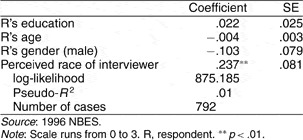
Could the high degree of pliability on these items have been a function of nonattitudes, or lack of conviction? Based on these responses I created a score for each respondent by summing the number of times that he or she changed positions. A quarter of the respondents stuck with their original position all three times, and another quarter changed positions on all three items. The rest of the sample fell between these two extremes. Previous studies have concluded that education is strongly related to opinionation (Schuman and Presser 1981; Sudman and Bradburn 1974), and political knowledge may also be related to holding to one's position in a policy. Similarly, older people may also have more fixed positions because of their longer exposure to the issues in question. In addition, previous work has found that attitudes on racial topics are sensitive to the race of the interviewer (Bradburn 1983; Sudman and Bradburn 1974), even in telephone surveys (Gurin, Hatchett, and Jackson 1989; Tate 1994). Accordingly, I used each respondent's level of education, knowledge of politics, and age, along with the perceived race of the interviewer and gender (which I included as an additional control), as predictors of the propensity to switch sides in response to counterarguments. These measures are described in the Appendix. Coefficients were estimated using the ordered-probit procedure in Stata (version 6.0).
Only the perceived race of the interviewer was significantly related to the propensity to switch sides in response to counterarguments. Blacks who believed their interviewer to be black were significantly more likely to switch sides, suggesting a sensitivity to group pressure to support group norms. The failure to find education, political knowledge, and age significantly related to the propensity to change positions suggests that the high degree of pliability on these items is not evidence that respondents lacked real opinions about racial redistricting and minority-majority districts. Rather, those who switched sides may not have considered all the issues on this matter initially.
Thus, one can interpret the responses to the counterargument items as an indication of the strength of the respondent's original position. Those willing to change positions in light of new information may be blacks whose attitudes on this matter were not fully crystallized or whose positions were soft. I created scores combining the racial redistricting measures and counterargument response for each respondent. Respondents who changed sides were considered “softly” in favor of or opposed to advancing minority representation through redistricting means or rule change. Respondents who did not change sides were labeled “hard” proponents or opponents.3
Treating these four response categories as ordinal and, notably, coding the response categories as “2” and “3” were justified by the preliminary results of a multinomial logit analysis that assumes no order in the outcomes. Finally, α scores were calculated to determine the feasibility of forming a single scale from these items. Cronbach's α score was for all .45 three items and .49 for the first two alone. These scores are not high enough to justify creating a single index, and scales are analyzed separately here.
The distributions are shown in
Table 4. Having been exposed to critical contours of the debate, approximately one-third to one-quarter of African Americans can be described as “hard opponents” of minority–majority districts and election rule change. A plurality of blacks, from 47% to 37%, can be described as “soft opponents” of minority-majority districts. While only about 20% of blacks favored the creation of minority-majority districts, a majority supported changing election rules to advance minority officeholding.
WHO OPPOSES RACIAL REDISTRICTING AND MINORITY-MAJORITY DISTRICTS AND WHY?
The analytic strength of the counterargument technique is that it provides a basis for understanding why respondents take the position that they do. The initial questions referenced the principle of color blindness as well as minority officeholding, while the consequences or costs were referenced in the counterarguments. The next step is to determine which blacks, when fully exposed to the key arguments and counterarguments present in the debate, line up consistently for or against minority-majority districts. Race consciousness, ideology, education, political knowledge, and party affiliation are all expected to have an effect on where blacks stand in the debate over racial redistricting.
Ample research on blacks has established that having a strong racial identity, measured as the perception that one's fate is tied to the fate of the race, corresponds to liberal policy positions (Dawson 1994; Gurin, Hatchett, and Jackson 1989; Tate 1994). If the numerical presence of minorities is seen as vital to protecting minority interests (and, indeed, most minority officeholders do present themselves as defending minority interests), then race-identified blacks should be most likely to support race-conscious remedies to advance their representation in Congress and to stick with this position even after exposure to the counterargument. Strongly race-conscious blacks taking the opposition side in this debate initially should also be more likely to switch sides, once it is suggested by the counterarguments that fewer minorities would be elected to Congress.
Next, ideology should be tied to black opinion on this matter, as it likely is for whites. Much white opposition to affirmative action policies is rooted in a political conservatism (e.g., Kuklinski and Parent 1981, Margolis and Hague 1981, and Sniderman et al. 1991). Not only do conservatives think that government should play a limited role in society, but also they increasingly base their opposition to affirmative action on the principle of color blindness. Blacks who are self-declared political conservatives have become visibly active in the drive to eliminate government affirmative action programs. Therefore, ideological identification should exert a strong influence on blacks' position on this hot-button issue.
The degree to which blacks favor affirmative action is based not only on their perceived connection to their racial group, but also on the degree to which they see society as being harmed by racial discrimination. An obvious motivation for supporting minority-majority districts is the sense that blacks are un- or underrepresented in Congress. Included in the 1996 NBES is the question what percentage of representatives in Congress respondents think is black: The mean response to this question was 12%. This figure is somewhat higher than the actual 7% (based on both Houses), but it corresponds with the Census Bureau's estimate of the U.S. black population. Many blacks, however, guessed very badly: The standard deviation for the 12% estimate is 13%, so most blacks would put the percentage of blacks in Congress somewhere between 0% and 25%. Nonetheless, this item can measure to what degree blacks feel numerically present in Congress. Those who believe that Congress consists of a large percentage of blacks would probably not be as supportive of race-conscious remedies to increase their numbers. Also included in this model is an indication of whether or not the respondent is represented by an African American. Other things being equal, the one black in three who already has a black representative in Congress may be less supportive of minority-majority districts.
In addition, a political knowledge measure is included in the model. Blacks having a high degree of political knowledge, as evidenced by their ability to name their representatives in Washington, for example, may be more cognizant of the fact that the vast majority of blacks have won national office only through majority-black districts.4
Political knowledge is an additive index of four items, ranging from zero to four. All of these knowledge items pertain to questions regarding their representative in the U.S. House of Representatives. First, respondents were asked to name their elected representative in the House. Correct answers were coded “1,” and incorrect responses were coded “0.” Approximately 14% of the sample correctly identified their House representative by name. Second, in the battery of feeling thermometer measures, respondents were asked to rate their House representative on a scale from zero to 100. Responses that indicated that, even given the name of their representative, respondents did not recognize the name or still could not rate the legislator were coded “0,” while responses showing the ability to rate the legislator were coded “1.” Nearly three-quarters of the sample (73%) were able to rate their legislator.
Third, respondents were asked the political party of their House legislator. Correct answers were coded “1,” while incorrect responses were coded “0.” About 42% of the respondents correctly identified the political party of their legislator. Finally, after these and other questions, interviewers were asked if respondents had any knowledge of their House representative before moving on to a battery of questions specific to that legislator. If interviewers felt that the respondent had “no knowledge of his or her House representative,” could not “recognize him or her,” or could not “identify” the political party or race of that legislator, this question was coded “0,” and the respondent was skipped from the next set of questions about the legislator. If the respondent had some knowledge of his or her House representative, the item was coded “1.” NBES interviewers felt that approximately 55% of the respondents had some knowledge of their House representative and could continue with the battery of questions pertaining to their representative. The political knowledge scale has a mean score of 1.3, with a standard deviation of ±1.8.
As in the case of political knowledge, high-income and well-educated blacks might have stronger, more fixed liberal positions on this debate. Highly educated blacks are likely to be aware of the likely cost of drawing districts “without regard to race” to minority seats in Congress and, therefore, to oppose race-neutral practices. Also, once exposed to the counterarguments against “color-blind” districts, college-educated blacks are more likely to switch sides in favor of race-conscious redistricting practices. Education is expected to increase support for minority officeholding among blacks because college-educated blacks are more likely to understand the past difficulties of winning elective office for members of minority groups in majority-white districts.
Although Republicans might prefer minority-majority districts because of the electoral advantage they afford the party, they are expected to oppose race-conscious policies on ideological grounds. Party identification was included in the analysis. Self-declared independents were grouped together with Republicans in the dummy measure for partisanship. Gender and age were also introduced as control variables, as was the “perceived” race of the interviewer.
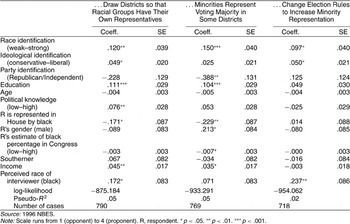
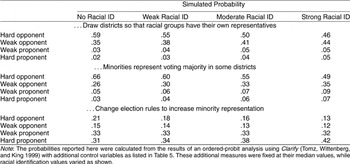
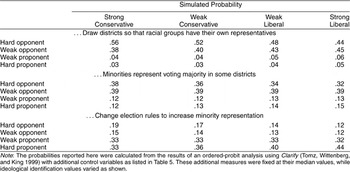
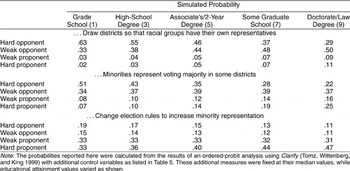
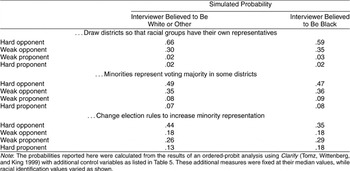
Table 5 displays the estimates for the ordered-probit coefficients using Stata (version 6.0), while Tables 6 through 9 report the changes in probabilities for each dependent measure across the respondent's strength of race identification, ideological identification, level of education, and perceived race of interviewer, holding everything else constant at the median value.
Across the three items, racial identification exerted the most consistent effect. As hypothesized, strong race identifiers were the most likely to support racial redistricting and minority-majority districts. The magnitude of the effect of race identification on support for minority districts and for increasing minority representation in Congress, while statistically significant; was moderate. As shown in Table 6, 60% of African Americans lacking an identity with their race strongly opposed minority-majority districts, in comparison to 46% of strong racial identifiers. Similarly, 18% of weak race identifiers were hard opponents of changing election rules to increase minority representation in Congress, as opposed to 13% of strong race identifiers.
Ideology played a role as well, but for only two of the three measures. Self-declared strong political conservatives were most opposed to drawing districts so that blacks, Hispanics, and whites all had their “own representatives,”
as well as changing the election rules to increase the numerical representation of blacks and Hispanics. As shown in Table 7, ideology had a limited effect on
support for minority-majority districts. A scant 3% of strong conservatives favored minority districts. Among self-described strong liberals, only 5% favored creating districts having their “own representatives” for minority groups. Similarly, 44% of strong liberals who strongly favored changing election rules to increase minority representation, only about 10% more than among strong conservatives.
Education increased support for minority districts and for racial redistricting practices, and its effect was quite strong (see Table 8). For example, 63% of blacks having only a grade-school education, but only 29% with advanced degrees, firmly opposed creating districts with black and Latino majorities. It may be that high-status blacks, notably college-educated and working professionals, who are also more likely to be politically active, better understand the chances for blacks and Hispanics to win in districts where they are not in the voting majority. Recognizing that historically few blacks have won in majority-white districts, higher-status blacks are more likely to favor the creation of minority-majority districts. Income also significantly affected black attitudes on minority-majority districts, but its effect, in contrast to that of education, was relatively weak.
The remaining variables had more circumscribed effects on attitudes toward racial redistricting and minority officeholding. Political knowledge, as hypothesized, increased support for minority numerical representation, but only for one of the three measures. Blacks who knew which party controlled the Senate and the name of their representative in the House were more likely to be proponents of drawing districts to increase minority representation. Black men were also more likely to be proponents of racial redistricting than were black women. Similarly, the extent to which blacks saw themselves as underrepresented in Congress influenced black attitudes on only one of the three items. Those who believed that blacks held a large percentage of seats in Congress were more likely to oppose minority redistricting. Because many black respondents overestimated the percentage of members of Congress who are black, this relationship might also indicate a lack of substantive political information about Congress. Finally, as hypothesized, blacks represented in the House by a black member were also less supportive of having districts created where minorities represent majorities. Taken together, lacking a clear understanding of the paucity of black representation in Washington strongly affected attitudes toward minority districts. Those whose knowledge of politics was limited and those who mistakenly believed the numbers of blacks serving in Washington to be high generally opposed efforts to increase minority officeholding through redistricting or election reform.
Table 9 reports the probabilities of voting rights items as a function of whether or not respondents believed their interviewers to be black. Blacks were less likely to be hard opponents of minority-majority districts and changing election rules when they believed the interviewer to be black, but this effect was modest. Overall, the perceived-race-of-interviewer effect reduced somewhat the percentage of hard opponents among blacks. These race-of-interviewer effects reveal the manner in which respondents adopt more “mainstream” political stands when engaged in an interracial setting, and especially so, as Dawson (2001, 30) points out, “when blacks and whites are directly debating politics.”
In summary, black opinion on racial redistricting and minority-majority districts varied according to education, race identification, ideology, and perceived race of the interviewer. Blacks whose politics reflected concern for fellow blacks (strong race identifiers) and those who had some college education were likely to be the strongest advocates for increasing the numerical representation of minorities. Self-identified conservatives were generally those most opposed to changing election rules and creating minority-majority districts to increase minority officeholding. Blacks who believed that their interviewers were white were less likely to favor increasing the numerical representation of minorities in Congress.
THEORETICAL AND POLITICAL IMPLICATIONS OF THE VOTING RIGHTS ACT'S EXTENSION IN 2007
Politics in America has been characterized as the product of a dynamic clashing of values. The core premise of this paper is that this clash occurs at the level of the individual as well, as public opinion is based on a conflicting set of values and interests. Opinion instability, therefore, reflects less the paucity of political information among members of the mass public than this competition of values and interests. In this study, minority-group interests were directly juxtaposed against the principle of color blindness and the status quo. The vast majority of African Americans initially supported the principle of “color blindness” and the status quo. However, when subjected to a counterargument, most blacks shifted positions to support minority representation over color blindness. This asymetrical shift reveals the broad contours of black political thought that embraces mainstream American principles as well as black political ideologies, including black self-determination and autonomy. As Dawson (2001) argues, black liberals believe that equality serves as the cornerstone of a democratic state, but equality to blacks represents not only equality of treatment but real equality as promoted by state policies. When exposed to the counterarguments, race-conscious and highly educated blacks moved to positions where group equality was favored over individual equality under the law. These results reveal that black public opinion strongly favors the classical liberal form of individual rights but that blacks' policy positions can quickly shift in favor of the more radical liberalism of equality, including group rights. These results also support the revisionist perspective that rational, thinking individuals may well hold wavering opinions and express seemingly contradictory points of view.
The Voting Rights Act will expire in 2007, unless renewed. Groups opposed to its renewal will seek black support by emphasizing the standard of color blindness, which blacks strongly embrace. Opponents will also emphasize recent gains in black political officeholding. In 1987, when Abigail Thernstrom first published her stringent attack on the Voting Rights Act no black had won election to the House since Reconstruction in five southern states with sizable black populations: Alabama, Florida, North Carolina, South Carolina, and Virginia. Because of the new black- and minority-majority districts created in the 1990 round of redistricting, 13 more blacks were added to the House. In fact, in the aftermath of the 1990 round, some believed that any possibilities for additional majority-black districts had been exhausted. The Shaw v. Reno and Miller v. Johnson decisions declared some of the new majority-black districts unconstitutional even under the 1982-amended Voting Rights Act. States such as North Carolina and Georgia were forced to redraw their Congressional districts. In Georgia, the two new majority-black districts that had elected blacks were redrawn with small white majorities. These majority-white districts, however, have continued to elect blacks.
Some scholars contend that whites still remain racially biased against black candidates (Reeves 1997). Furthermore, election data show quite plainly and emphatically that the vast majority of blacks have won only in districts where blacks are the majority (Lublin 1997). Nonetheless, critics will still argue that the Act has outlived its usefulness. Blacks could very well join the conservative side on this basis.
Black elected officials and civil rights leaders are most likely to push for renewing the Voting Rights Act and, as such, will be alarmed to learn that support in the black community for racial redistricting and minority-majority districts is currently weak. Those who favor the Act's renewal, however, have an advantage over their rivals insofar as black support is concerned, for it is stronger and more certain than is black opposition. Blacks opposed to racial redistricting practices and minority-majority districts, after all, were found to be more susceptible to the counterarguments than were those who favored such practices on two of the three measures. Another advantage they have over opponents is the role that racial identification plays in support for racial redistricting and minority-majority districts. Making renewal a civil rights cause will clearly boost support for it within the black community.
It is expected that the Congressional Black Caucus (CBC) will aggressively push for the Act's renewal in 2007. Their role in the legislative process will depend on a number of factors, including partisan control of the House. Furthermore, because of the growth in the number of Hispanic members of Congress, Latino political organizations will presumably join with the CBC and voting rights groups to push for its extension. Key to their efforts will be public education efforts designed to convey the likely consequences of drawing districts “without regard to race.”
Leaders can exert a large influence on public opinion. The President's position on renewing the Voting Rights Act will be pivotal. Opposition by a Republican president could help mobilize blacks politically in favor of its extension, since blacks remain staunchly loyal to the Democratic party, and debate would become highly partisan. Opposition by a Democratic president, at the same time, might disarm many blacks in a manner not unlike the debate over welfare reform. Had a Republican president sought a similar reform of the welfare program, his or her legislation would likely have met with deep skepticism and serious opposition by blacks.
Finally, if anything, this examination of black opinion on the voting rights controversy underscores the need for the application of more innovative methods in survey design. Opinion instability and inconsistency should no longer be interpreted as reflecting the absence of opinion on topical matters. Instability, instead, may reveal the complexity of mass attitudes and the reasoning process. People rationally switch sides in a given debate as they wade through the complicated nest of benefits and costs to themselves, to their interests, and to other political objectives. The framing of a political issue, therefore, draws its power not simply from the fact that people have yet to form an opinion. Rather, as many political opinions rest, perhaps uncomfortably, on a set of conflicting values and interests, they meaningfully fluctuate upon questioning.







Comments
No Comments have been published for this article.