




No CrossRef data available.
Article contents
The prompt hypothesis: Clarification requests as corrective input for grammatical errors
Published online by Cambridge University Press: 19 July 2005
Abstract
The potential of clarification questions (CQs) to act as a form of corrective input for young children's grammatical errors was examined. Corrective responses were operationalized as those occasions when child speech shifted from erroneous to correct (E→C) contingent on a clarification question. It was predicted that E→C sequences would prevail over shifts in the opposite direction (C→E), as can occur in the case of nonerror-contingent CQs. This prediction was tested via a standard intervention paradigm, whereby every 60 s a sequence of two clarification requests (either specific or general) was introduced into conversation with a total of 45 2- and 4-year-old children. For 10 categories of grammatical structure, E→C sequences predominated over their C→E counterparts, with levels of E→C shifts increasing after two clarification questions. Children were also more reluctant to repeat erroneous forms than their correct counterparts, following the intervention of CQs. The findings provide support for Saxton's prompt hypothesis, which predicts that error-contingent CQs bear the potential to cue recall of previously acquired grammatical forms.
Information
- Type
- Articles
- Information
- Copyright
- © 2005 Cambridge University Press
In the course of conversation, the linguistic traffic between speaker and listener does not always flow smoothly. Breakdowns are not infrequent, typically occurring when the listener encounters difficulty with the speaker's utterance. On such occasions, listeners are liable to request clarification as in Example 1.

The act of requesting clarification fulfills two functions. It signals to the speaker that his or her utterance has been misapprehended or is in some way inappropriate, and it simultaneously lodges a plea for the speaker to return to the utterance and effect a repair.
Of the many kinds of repair that could be made, the focus here is on repairs to grammatical form. In particular, this article explores the potential of clarification requests, also termed clarification questions (CQs), to function as a form of corrective input for young children's grammatical errors. The aim is to provide an empirical test of the prompt hypothesis (Saxton, 2000; see also below). In so doing, the focus of this study departs quite markedly from much prior research on clarification requests. The overwhelming emphasis has been on the communicative function of CQs. An underpinning assumption has been that CQs, and the repairs they inspire, are produced in a spirit of maintaining the flow of conversation when communication is ruptured in any way (e.g., Gallagher, 1977; Jeanes, Nienhuys, & Rickards, 2000; Most, 2002). We do not disagree that this communicative function often takes priority, at least when it comes to the justifications that speakers and listeners can supply concerning the functions of CQs and how they respond to them. However, we also predict that the successful exchange of meanings is not the only function that CQs can fulfill, particularly for the language-learning child. The grammar-correcting potential, explored here, is but one of several possible functions for clarification requests. It is important to bear in mind that the range of possible functions do not coexist in any orthogonal relationship. Multiple functions are possible, even on the same occasion of utterance.
Following numerous prior studies, an experimental approach was adopted, in which clarification requests are injected into the conversation in order to monitor participants' responses (Abbeduto, Short–Meyerson, Benson, & Dolish, 1997; Blaylock, Scudder, & Wynne, 1995; Brinton & Fujiki, 1996; Brinton, Fujiki, Loeb, & Winkler, 1986; Brinton, Fujiki, & Sonneberg, 1988; Brinton, Fujiki, Winkler, & Loeb, 1986; Gallagher, 1977, 1981; Gallagher & Darnton, 1978; Givens & Greenfield, 1982; Hughes & James, 1985; Marcos & Bernicot, 1997; Most, 2002; Scudder & Tremain, 1992; Tomasello, Farrar, & Dines, 1984). The aim here was to gauge the extent to which young children modify the grammatical form of their speech contingent on clarification requests. In this regard, the study reported below examines the effects of CQs in greater detail than much previous research.
Clarification requests have been the subject of numerous studies over the past 25 years or so. The range of populations featuring in these studies is diverse, and includes a number of distinct groups of first language learners. Given this diversity, it is important to establish that the grammar-correcting function predicted here does not clash with what is already known about clarification requests. To summarize, the role of clarification requests in language development has been studied in typically developing children, both in Western cultures (Cicognani & Zani, 1988; Gallagher, 1977; Marcos & Bernicot, 1994; Yont, Hewitt, & Miccio, 2000), and non-Western cultures (Hamasaki & Shirai, 2000; Marcos & Verba, 1997); children with specific language impairment (SLI; Brinton & Fujiki, 1982; Brinton et al., 1988; Brinton, Fujiki, Winkler, & Loeb, 1986; Gallagher & Darnton, 1978; Hargrove, Straka, & Medders, 1988; McCartney, 1981; Porter & Conti–Ramsden, 1987; Prather, Cromwell, & Kenney, 1989); children with pragmatic impairment (Leinonen & Letts, 1997); children with hearing impairments (Blaylock et al., 1995; Ciocci & Baran, 1998; Elfenbein, 1992; Givens & Greenfield, 1982; Hughes & James, 1985; Jeanes et al., 2000; Most, 2002); children with learning disabilities (Abbeduto, Davies, Solesby & Furman, 1991; Abbeduto et al., 1997; Donahue, 1984; Donahue, Pearl, & Bryan, 1980; Ezell & Goldstein, 1991; Lamb, Bibby, & Wood, 1997; Rasku–Puttonen, Lyytinen, Poikkeus, Laakso, & Ahonen, 1994; Scudder & Tremain, 1992; Smith & Durkin, 1986; Yoder, Davies, & Bishop, 1994); and children with Down syndrome (Coggins & Stoel–Gammon, 1982; Huang & Oi, 2001a, 2001b). Beyond language acquisition, clarification requests have also been studied by researchers interested in communication among various adult populations. These include deaf adults (Caissie, Dawe, Donovan, Brooks, & MacDonald, 1998; Gagné, Stelmacovich, & Yovetich, 1991), adults with mental retardation (Brinton & Fujiki, 1993, 1996; Fujiki & Brinton, 1993), the elderly (Caissie & Rockwell, 1994), and normal adults (Garvey & BenDebba, 1978).
The picture that emerges from this wide spectrum of research is both clear and consistent. First, clarification requests figure as a pragmatic tool for facilitating communication throughout the lifespan. Thus, Cicognani and Zani (1988) describe children as young as 10 months old responding to clarification requests, whereas Caissie and Rockwell (1994) report a hearing-impaired 97-year-old both producing and responding to clarification requests in conversation with care workers. A second fundamental finding is that even very young children can respond appropriately to CQs on the large majority of occasions (Gallagher, 1977). The ability to respond to CQs emerges very early in life and is not confined to normally developing children and adults. For example, the Down syndrome children studied by Coggins and Stoel–Gammon (1982) produced appropriate responses to all CQs provided, whereas Jeanes et al. (2000) reported 96% appropriate responses for deaf children. Other authors have reported lower levels of appropriate responding for abnormal versus normal populations, as with the language-impaired children observed by Brinton et al. (1988). In all cases, however, the ability to respond appropriately does not seem to be impaired in special populations, whether the cause of abnormal development is nonlinguistic, as in Down syndrome and general learning disability, or language related, as in deafness and SLI. Moreover, levels of appropriate responding are generally very high, even if some groups exhibit somewhat lower levels than others.
Inappropriate responding aside, CQs elicit a range of responses that can be categorized very broadly under the headings of repetition and revision. Under the umbrella of these two general categories, numerous subcategories have been identified and investigated. For example, Gallagher (1977) identifies four subtypes of revision: phonetic change, reduction, substitution, and elaboration. The latter three involve changes to lexical or grammatical form. Other authors have introduced the notion of cuing, whereby the child responds by defining a term in the original utterance or engages in talk about the actual repair he or she undertakes (e.g., Brinton et al., 1988; Ciocci & Baran, 1998; Most, 2002). In reviewing the literature on child responses to CQs, it emerges that almost every new author introduces his or her own range of response categories and definitions. Sometimes the differences from one study to another are quite subtle. For example, both Gallagher (1977) and Most (2002) count changes to lexical or grammatical form as revisions. However, Most (2002) additionally identifies the category of expansion, whereby the child expands the original utterance into two sentences. The original utterance has therefore been revised, construed in the broadest terms, leading one to assume that, for Most (2002), this kind of response would qualify as an expansion, for Gallagher (1977) it would count as an elaboration revision. The differences between other studies, in terms of the response categories they identify, are more obvious (cf. Prather et al., 1989; Scudder & Tremain, 1992). The wide range of coding schemes can make comparisons across different studies difficult to make. This complexity is compounded by the fact that, in some cases, coding categories are generated that are subsequently omitted from discussion of the findings. For example, Most (2002) analyzes data from deaf children using nine response categories, but does not mention all of these in interpreting the findings. Marcos and Bernicot (1997) provide another example of this tendency.
The response categories employed in the present study are theoretically motivated by the prompt hypothesis (Saxton, 2000; see below), which predicts a grammar-correcting function for clarification requests. The aim is to examine just those responses that have a direct bearing on testing this hypothesis. When the grammar-correcting potential of CQs is considered, the panoply of categorical distinctions, considered above, diminishes in significance. Of abiding importance, though, is the fundamental distinction, alluded to above and accepted by the vast majority of studies, between repetition and revision. One might consider that a verbatim repetition could not help clarify any message, but in many cases the speaker assumes that the listener has simply misheard him or her. A repetition by the speaker is therefore entirely appropriate. One might also point to the fact that a repetition of one's original message requires the least effort. For this reason alone, then, one might predict significant numbers of repetitions, and this is indeed what has been reported. Thus, Gallagher (1977) found that 23% of responses were repetitions, whereas Tomasello et al. (1984) report a frequency of around 33%. Levels of repetitions do vary quite considerably, though. In particular, repetitions are more frequent in abnormal populations. Thus, Most (2002) and Brinton, Fujiki, Winkler, and Loeb (1986) report a predominance of repetitions for children with hearing and language impairments, respectively.
With respect to the grammar-correcting function predicted here, high levels of repetitions could be problematic. A child who repeats an ungrammatical utterance verbatim could not easily be construed as sensitive to correction. Instead, one must turn to the fact that children also revise their initial utterances on many occasions. Thus, Golinkoff (1986) reports 88% revisions for normal children, and Hughes and James (1985) report 73% revisions in deaf children. Prather et al. (1989) also found that revisions were by far the most common response for children with SLI. This ability to revise an initial utterance, given the intervention of a clarification request, is consistent with the grammar-correcting potential envisaged here. Also commensurate with this view is the fact that most child revisions are successful (64% in one study: Shatz & O'Reilly, 1990). However, levels of revision vary quite considerably, and a number of factors have been found to influence the occurrence of revisions rather than repetitions. In the first context, revisions are more likely following specific, rather than general, clarification requests (Brinton & Fujiki, 1996; Tomasello et al., 1984). These two types of CQ are illustrated in Examples 2 and 3.

As can be seen, general CQs apply, blanket fashion, to the entire utterance, whereas specific CQs are distinguished by their focus on a particular aspect of the speaker's utterance. Given their ability to isolate part of the preceding utterance, it is not surprising that specific clarification requests elicit higher levels of revisions, because a target for repair is highlighted for the speaker. For this reason, perhaps some observers recommend the deliberate use of specific CQs with deaf children, in order to encourage higher levels of revisions (Lloyd, 1999).
A second context in which revisions increase is during the course of a so-called looped sequence (e.g., Brinton, Fujiki, Loeb, & Winkler, 1986). These occur where the response to an initial CQ is met with a second, and possibly even a third, request for clarification. In principle, the listener could continue to seek clarification ad nauseum or until satisfied with the speaker's response. Despite the seemingly grave disruption to the flow of conversation entailed by a looped sequence, they are in fact quite common (Scudder & Tremain, 1992). As noted above, as a looped sequence progresses, the likelihood of the speaker revising, rather than repeating, the initial utterance increases (Brinton, Fujiki, Loeb, & Winkler, 1986; Brinton, Fujiki, Winkler, & Loeb, 1986; Most, 2002). A third point to note is that levels of revisions are generally higher for typically developing, rather than atypically developing, children (Brinton & Fujiki, 1996). In the fourth context, revisions are more frequent in older children (Givens & Greenfield, 1982; Prather et al., 1989), and in the fifth, revisions are more frequent when the wh-question is produced with falling, rather than rising, intonation (Garvey & BenDebba, 1978).
In reviewing the findings on revisions following CQs, it is natural to ask what specific kinds of changes children make to their initial utterance. However, the literature is remarkably vague on this point. In reporting their findings, very few studies even distinguish between the various levels of language (phonological, lexical, syntactic, and so on). Even studies where these distinctions are alluded to typically fail to give a detailed breakdown of the range and kinds of revisions observed. Thus, Prather et al. (1989) identify a category of “correction with elaboration,” but fail to specify different levels of language, or different kinds of correction, within this category. There is a suggestion, though, that revisions can include some form of repair to the initial utterance, a suggestion endorsed by Brinton, Fujiki, Loeb, and Winkler (1986). These findings are important for the syntax-correcting function predicted for CQs. More direct evidence comes from a single-case study by Saxton (2000), who examined the longitudinal data on Eve from the Brown (1973) corpus. Saxton (2000) found that Eve eschewed ungrammatical forms, in favor of their grammatical counterparts, on 17% of occasions, following the intercession of a clarification question. This study examined 11 different categories of grammatical error and also compared the effects of CQs against two noncorrective forms of input. It was found that CQs elicited significantly higher levels of repair than either of the noncorrective response types. It was also reported that CQs were associated with shifts from ungrammatical to grammatical forms, but not the reverse (see below). One aim of the present study is to determine if these findings can be generalized beyond a single case study to a larger population of children.
Although the findings on revisions are encouraging, if clarification requests are to be considered as a form of corrective input, a number of general conditions must be met. First, the child must be able to identify the clarification request qua clarification request from a very young age. Second, clarification requests must have the power to focus the child's attention on the grammatical form of his or her speech. Third, clarification requests should be associated with revisions in the direction of more grammatical speech. Fourth, they should not be associated with revision behaviors in the opposite direction, that is, with the move from grammatical to ungrammatical speech. Each of these four conditions is considered in turn below.
The first condition states that clarification requests should be identifiable as a distinct discourse signal from a very early age. This stipulation follows from the fact that grammatical errors are most frequent in the early stages of language development. More specifically, the onset of multiword speech at around 18– 24 months is exemplified by numerous morphological and grammatical errors, of both commission and omission (Marcus et al., 1992). Hence, if clarification requests play a role in the development of grammar, they must be available in the input to the child at this time. Moreover, the child should be able to identify and respond appropriately when CQs occur. In fact, clarification requests emerge as part of the conversational repertoire prior to this stage. Thus, Golinkoff (1986) showed that 12-month-old infants can respond appropriately to clarification requests and Gallagher (1981) reports active production of CQs in children as young as 1 year, 11 months (1;11). In addition, there is ample evidence that clarification questions feature in the input to children of this age (e.g., Bohannon & Stanowicz, 1988; Demetras, Post, & Snow, 1986; Saxton, 2000). These findings strongly suggest that the first condition is met: children are conversant with CQs at an age when they might need them for correcting grammatical errors.
The second condition states that clarification requests must be able to focus the child's attention on the grammatical form of their utterances. However, an immediate problem in this regard is the all-embracing nature of CQs. As mentioned above, their motivation is not necessarily linguistic, let alone grammatical. Instead, the listener may not have heard the speaker clearly, or he or she may be signaling that the speaker's utterance was in some way surprising or humorous. When the breakdown is prompted by linguistic failure, one is again confronted with the overarching applicability of CQs, because they can pertain to any level of language from phonology through to syntax. The grammatical structure of the speaker's utterance is but one of many different sources of breakdown in conversation. At this stage, we seek only to identify if grammatical form is sometimes a target for child repairs.
To be considered as a potential form of corrective input, it is necessary only to demonstrate that, on occasion, clarification requests draw the child's attention to ungrammatical aspects of their utterances. Early evidence in support of this maxim is reported by Gallagher (1977). In this study, normal children responded to the kind of intervention described above (and implemented in the current study), whereby CQs are introduced at regular intervals into the adult–child discourse. Gallagher (1977) did not specifically catalogue her findings with regard to improvements in grammaticality. However, she does observe that, in response to CQs, children often added a major grammatical constituent to their utterances (subject, verb, or object). Children in Brown's (1973) Stage I made such revisions on 35% of occasions, rising to 60% for children at Stages II and III. There is some evidence, therefore, that grammatical form can sometimes be the focus of the child's revisions.
The third stipulation, in assessing the corrective potential of CQs, asserts that some revisions at least should embody changes from ungrammatical to grammatical forms. As mentioned, Saxton (2000) provides initial data in support of this observation and also supplies evidence in favor of the fourth condition, namely, that the child should not make revisions in the opposite direction, that is, from grammatical to ungrammatical.

Examples 4 and 5 both constitute examples of revisions, and in principle, both scenarios are perfectly feasible. However, only if E→C switches prevail over their C→E counterparts could one impute a corrective function to clarification questions. A further prediction is that C→C sequences will outnumber E→E sequences. If the child is confident in his or her knowledge about the grammaticality of a particular structure, then a clarification request should not shake him or her out of it. The child should instead be relatively willing to repeat a structure (C→C), if he or she makes subsequent use of it. Thus, CQs should not occasion the revision of stable aspects of the child's grammar. In contrast, E→E sequences should be less frequent, because ungrammatical aspects of the child utterance should be less stable, and hence more likely to present themselves as a target for revision, rather than repetition. With respect to these two predictions, Saxton (2000) found that switches from erroneous to correct in child speech were far more frequent than in the reverse direction. In addition, C→C sequences were more prevalent than their E→E counterparts. Thus, for one child at least, CQs do not occasion random alternation between erroneous and correct forms. Instead, the pressure seems to be in the direction of encouraging more grammatical speech.
The findings on CQs are consistent with the so-called prompt hypothesis, advanced by Saxton (2000). This hypothesis is predicated on the assumption that specifically error-contingent CQs can be interpreted by the child as a form of negative feedback for grammatical errors. The prompt hypothesis predicts that negative feedback can occasionally focus the child's attention on ungrammatical aspects of his or her speech, but only in cases where the child has prior knowledge of the correct grammatical form. The idea is that error-contingent CQs can function as a prompt, or reminder, to the child, cuing recall of a previously learned grammatical form. Prior knowledge of the correct form must be assumed, because there is nothing in a clarification request per se that conveys what the correct form is. For this reason, clarification requests are predicted to prompt, rather than teach, the child about preferred grammatical forms. Hence, clarification requests can be seen as a special form of cue for aiding retrieval of linguistic forms from memory.
Saxton (1997, 2000) identifies a second, more powerful form of corrective input, distinguished from negative feedback by the term negative evidence. Negative evidence is characterized by the provision of a grammatical adult model directly contingent on a child error, as in Example 6.

The contrast in usage between child and adult forms is held to assert two pieces of information, vital in the retreat from error: the grammaticality of the adult form and the ungrammaticality of the child form.
The direct contrast hypothesis predicts how children might exploit the corrective potential of such exchanges (Saxton, 1997). This theory attempts to explain how children might identify an error qua error in the first place. As shown in Example 6, it is only in cases where the adult model occurs directly contingent on a child error that the difference between the two is thrown into sharp relief. The adult's preference for women is especially salient and serves to repudiate the child's selection of woman. Direct contrasts of this kind offer the child two critical pieces of information. First, they inform the child what is grammatical, and, second, they reveal to the child that his or her own selection is ungrammatical. Without this second injunction, one is left with the fundamental problem of explaining how the child ever manages to retreat from error.
A number of studies provide empirical evidence in support of the direct contrast hypothesis (e.g., Farrar, 1992; Saxton, 1997, 2000; Saxton, Backley, & Gallaway, in press; Saxton, Kulcsar, Rupra, & Marshall, 1998; Strapp, 1999; Strapp & Federico, 2000; Otomo, 2001; Chouinard & Clark, 2003). In particular, four key findings have emerged. First, error-contingent adult models (negative evidence) are especially effective in improving the grammaticality of child speech. This finding supports the argument that well-formed adult models differ in the quality of information they yield for the child, according to their place in the discourse. When error contingent, adult models can fulfill a corrective function, whereas nonerror-contingent models are characterized as a kind of positive input, informing the child only about what is acceptable. Second, a key finding from recent research is that the effects of corrective input can be discerned both in the child's immediate speech output and over longer periods of time (e.g., 5 weeks in Saxton et al., 1998, and 12 weeks in Saxton et al., in press). Third, the effects of corrective input have been observed in naturalistic adult–child discourse for a wide range of different grammatical categories. Fourth, the effects of negative evidence can be isolated using an experimental methodology based on the use of novel verbs (Saxton, 1997).
According to Saxton (2000), negative evidence and negative feedback differ with regard to the quality of corrective information they afford the child. On the one hand, negative evidence can help the child identify particular linguistic forms as erroneous, and moreover, supply a correct alternative. On the other hand, negative feedback (error-contingent CQs) can do no more than alert the child to the occurrence of an error that must already be known as such {a priori}. The difference between the two can be elucidated by reference to Chomsky's distinction between “competence (the speaker–hearer's knowledge of his language) and performance (the actual use of language in concrete situations)” (1965, p. 4). Whereas negative evidence, in Saxton's (2000) definition, bears the potential to alter the child's linguistic competence, negative feedback can do no more than contribute to improvements in the child's performance. However, the value of facilitating and improving performance should not be underestimated. In the field of speech–language therapy in particular, explicit attention is often paid to the aim of improving speech production. Moreover, targets for improvement in performance are not confined to pronunciation, but extend to production of lexical and grammatical forms also (e.g., Fey, Long, & Finestack, 2003).
The present study seeks to expand on initial findings, mentioned above, that suggest a potential grammar-correcting function for clarification requests. Accordingly, two groups of normally developing children were recruited and child responses to clarification requests were examined with respect to 10 separate grammatical categories. Moreover, some of the circumstances that encourage higher levels of revision were examined, to discover if increases in revisions go hand in hand with increases in repairs to grammar. For this reason, two age groups were examined: 2- and 4-year olds. In addition, repair behaviors following looped sequences, and general versus specific CQs, were also investigated. More generally, the current study tests the prompt hypothesis formulated by Saxton (1995, 2000) to predict how clarification requests might exert a corrective influence on the child.
METHOD
Participants
Fifty-four 2- and 4-year-old children were drawn from five nurseries in the United Kingdom. The children were mostly of white, middle class origin but a small number (4) came from Asian backgrounds. English was the first language for all of the children, and it was spoken both at home and in the nursery. Children were not formally screened for any form of cognitive impairments or disabilities. However, there was no indication from teachers, parents, or the researchers implementing the intervention that any of the participants suffered from hearing impairments, subnormal IQ, or speech and language impairments, nor were any of the children identified as recipients of Special Needs Individual Education Plans (UK). Of this initial sample, 45 children provided sufficient data for analyses. In the final sample, there were 23 2-year-old children (13 boys, 10 girls), with a mean age of 2;10 (range=2;6–3;2). These were divided into two groups, 12 in the specific CQ group (6 boys, 6 girls, mean age=2;10, range=2;6–3;1) and 11 in the general CQ group (7 boys, 4 girls, mean age=2;10, range=2;8–3;2). The final sample also included 22 4-year-olds (13 boys, 9 girls), with a mean age of 4;0 (range=3;6–4;6). These children were allocated to two test groups, 12 in the specific CQ group (6 boys, 6 girls, mean age=4;0, range=3;6–4;6) and 10 in the general CQ group (7 boys, 3 girls, mean age=3;11, range=3;8–4;3).
Procedure
Participants were tested individually on three separate occasions at their nursery. Two examiners gathered the data, having become familiar to the children through voluntary participation in nursery activities prior to actual testing. An experimenter engaged each child in conversation, in a quiet area, using familiar toys, jigsaw puzzles, and books. Approximately every 60 s, the experimenter produced a looped sequence of two successive clarification questions, but did not otherwise interrupt the flow of conversation. This technique has been widely used in research on clarification questions (e.g., Blaylock et al., 1995; Brinton et al., 1988; Scudder & Tremain, 1992). A stopwatch was used to observe the timings, and a tape recorder was discretely switched on and off, just prior to and just after each looped sequence. Interaction between experimenter and child was kept as naturalistic as possible, being guided by the child's interests and motivations. Although the occurrence of CQs every 60 s is more frequent than in most adult–child conversations, the vast majority of children did not give any indication that there was anything unusual or unnatural in the quality of interaction. No attempt was made to select specific child utterances for CQ provision. This practice did not cause problems because an interlocutor is free to query any utterance at any point in a conversation. Given the broad range of basic morphemes being examined, no child utterances selected for CQ provision were entirely devoid of target structures.
Children in the Specific CQ groups heard only specific clarification questions, whereas children in the General CQ groups were exposed to general clarification questions only. Each of the three sessions lasted about 10–15 min, so that across all three sessions a maximum of 30 looped sequences were supplied to each child. The data were transcribed and child utterances were coded for 10 grammatical categories: prepositions, plural, irregular past tense, auxiliary verbs, possessive-s, noun phrase specifier, third person singular-s, copula, subject, and object. Utterances containing unintelligible portions were omitted from analyses. Examples of child errors from the transcripts are shown in Table 1. Note that a single child utterance may exemplify more than one category of error. Note also that the category of possessive is absent from Table 1 because no errors were recorded. Many of the child errors comprised errors of omission, where obligatory morphemes were absent, or, in the case of the purely syntactic categories, obligatory subjects or objects were missing. Child utterances were coded for both grammatical and ungrammatical uses of the target structures. It is often the case that a single utterance simultaneously exemplifies grammatical usage of some structures and ungrammatical usage of others. Thus, in the child utterance I having a biscuit, the child produces both a grammatical sentential subject (I) and object (biscuit), in addition to using the NP Specifier (a) correctly. At the same time, this utterance would be scored for the omission of the auxiliary verb (am). Initially, the data were transcribed and coded by the second and third authors. Two further examiners then checked the resultant transcripts for accuracy, using the audiotapes. Disagreements were noted and where possible resolved by mutual agreement among examiners (cf. Proctor–Williams, Fey, & Loeb, 2001). Outstanding disagreements were marked as untranscribable and omitted from analyses. To assess the reliability of input coding, the data were recoded by a second coder. Separate estimates were made for grammatical and ungrammatical instances of the target structures. Following Fey, Krulik, Loeb, and Proctor–Williams (1999), reliability was assessed by calculating the number of agreements between the two coders divided by the total number of coding judgments made. For grammatical uses there was 96.5% agreement (3791/3930), and for ungrammatical uses there was 94.2% agreement (423/449).

RESULTS
For some of the children, it was not possible to record the desired 30 looped sequences. As noted, data on 9 children (7 2-year-olds and 2 4-year-olds) were omitted, because insufficient responses were recorded. Reasons included boredom or unwillingness to participate on the part of the child, or absenteeism on one or more days of testing. For 10 further children, the total number of sequences fell short of 30, but their data were included in analyses, because at least 25 usable sequences were recorded. The frequency of grammatical and ungrammatical instances of each target structure is shown in Table 2. It should be noted that the figures in Table 2 do not refer to grammatical versus ungrammatical child sentences. Instead, grammaticality was judged for use of each target structure, regardless of overall sentence grammaticality. Thus, the child utterance These spiders was coded as correct with regard to the plural (spiders), but erroneous with respect to the copula (are), because this latter feature was omitted. This example also reveals the need to interpret the context of utterance when coding, given that These spiders could be interpreted as a grammatical noun phrase when taken out of context. Table 2 shows that the percentage frequency of grammatical speech rises from 86.2% for the 2-year-olds to 93.1% for the 4-year-olds, a fact that reflects the more mature language of the older children. As can also be seen, some structures are less well represented than others, presumably because of their differing frequencies in normal conversation. In addition, not all children produced examples of both grammatical and ungrammatical forms of all target structures. For this reason, the data were conflated across target structures in the analyses that follow.
Child responses following each clarification request were initially categorized, with respect to the target structures, in one of three ways: correct (C), erroneous (E), or move-on (MO). Move-ons comprised those occasions when the child did not make further use of the target structure. When the child's initial use of the target structure was erroneous, the following three discourse patterns were possible: E→C, E→E, and E→MO. Conversely, when the child's initial usage was correct, the three possible discourse patterns were C→C, C→E, and C→MO. In the first set of analyses, the dependent variable was the percentage frequency of occasions when the grammaticality of child speech shifted (E→C or C→E), calculated according to the following formulae:

For the percentage of E→C, therefore, the denominator comprises the total number of errors produced in initial child utterances (for the 10 target structures); but for the percentage of C→E, the denominator comprises the total number of initially correct uses.

With regard to number of CQs, it will be recalled that the child was supplied with a looped sequence of two CQs every 60 s. Child responses for both the first and second CQs were scored with respect to the child's initial usage of the target structure (E or C). For example, in one possible sequence, the child might initially produce an error (E), followed by no use of the target structure (MO) after the first CQ, ending with a correct form (C) after the second CQ. This pattern would be scored as an E→MO sequence for the first CQ and an E→C sequence for the second CQ. The aim, then, was to compare the child's responding after one versus two CQs in order to provide a further index of the child's tendency to vacillate between grammatical and ungrammatical forms, contingent on the provision of CQs. Table 3 shows the percentage of frequencies of discourse patterns relevant to the present study (E→C, C→E, C→C, and E→E). Observe that the figures do not add up to 100% because data on MO responses have been omitted for the sake of clarity and they are not the focus of interest. Numbers of MO responses can be inferred by comparing data from appropriate columns. For example, 2-year-olds, responding after the first specific CQ, and whose initial usage was erroneous (E), produced 16.1% E→C responses (first column) and 39.7% E→E responses (fifth column). Therefore, one can infer, that, in this condition, children produced 44.2% E→MO responses (100- 16.1- 39.7).
Inspection of Table 3 reveals that shifts from erroneous to correct greatly outnumbered shifts in the reverse direction. Variance within conditions was stabilized by adding 1 to each score (to accommodate scores of 0) before performing a log transformation. Analysis of variance was then conducted on the transformed data in which the dependent variable was percentage shift in grammaticality as described above. Type of clarification question (specific versus general), age (2 years vs. 4 years), and gender were entered as between-subjects independent variables, and number of CQs (1 vs. 2) and type of shift (E→C vs. C→E) were entered as within-subjects independent variables. A main effect for type of shift was found (F1,37=159.77, p=.0005), whereby E→C shifts were more frequent than their C→E counterparts. There were no main effects for age (F1,37=.40, ns), gender (F1,37=.50, ns), CQ type (F1,37=.85, ns), or number of CQs (F1,37=.99, ns). However, two significant interactions were found. The first was a two-way interaction between type of shift and number of CQs (F1,37=7.94, p=.008), such that levels of E→C shifts increased after two clarification questions, whereas levels of C→E shifts did not. A three-way interaction between age, gender, and type of clarification request also reached significance, albeit marginally (F1,37=4.09, p=.05). It emerged that 2-year-old girls produced especially high levels of E→C responses following general clarification questions.

In the next set of analyses, the child's propensity to repeat his or her initial response was examined. The dependent variable of interest was the percentage frequency of occasions that the child maintained the original response following CQs (C→C or E→E). These frequencies were calculated according to the formulae below. Observe that these figures are independent of the E→C and C→E shifts reported above. Variance within conditions was once again stabilized by adding 1 to each score before producing a log transformation.

An analysis of variance was conducted with type of clarification question (specific vs. general), age (2 vs. 4 years), and gender being entered as between-subjects independent variables. Number of CQs (1 vs. 2) and type of repetition (C→C or E→E) were entered as within-subjects independent variables. As above, variance within conditions was stabilized by adding 1 to each score before producing a log transformation. A main effect for type of repetition was found (F1,37=40.30, p=.0005), whereby children were more likely to repeat an initial correct form (C→C) than an error (E→E). A main effect was also found for number of CQs (F1,37=31.26, p=.0005), such that repetitions of any kind were less likely after two CQs. A further main effect for type of CQ was also found (F1,37=13.86, p=.001), whereby repetitions of any kind were more likely after general CQs. A three-way interaction was found between repetition, type of CQ, and number of CQs (F1,37=4.82, p=.035) to the effect that E→E repetitions were especially infrequent after two specific clarification questions. A two-way interaction between repetition and type of CQ confirmed that E→E repetitions were infrequent after specific CQs (F1,37=9.84, p=.003), and a two-way interaction between repetition and number of CQs further confirmed that E→E repetitions were infrequent after two CQs (F1,37=23.85, p=.0005). No other significant simple effects or interactions were found. Thus, overall, a clear pattern emerged, whereby clarification questions are associated with revisions in child speech from ungrammatical to grammatical across a looped sequence. The opposite pattern (C→E) occurs substantially less often. It was also found that clarification questions were associated with far more repetitions of initially grammatical versus ungrammatical forms (C→C vs. E→E, respectively). Thus, clarification questions do not prompt the child to abandon grammatical forms.
DISCUSSION
The findings reported here provide support for the prompt hypothesis (Saxton, 2000). It was predicted that error-contingent clarification questions (negative feedback) could function as a form of corrective input for grammatical errors. Negative feedback applies in cases where the child's grammatical competence is essentially adultlike but where errors in performance continue to feature in the child's speech output. When errors do occur, it is predicted that clarification requests can function as a prompt, aiding both recall of the correct form and rejection of the child's own erroneous form. Child responses to negative feedback, as supplied here in conversation with an experimenter, conform to this pattern. In response to error-contingent CQs, children eschewed an erroneous form in favor of the correct adult alternative on approximately 16–49% of occasions. This compares with the level of 17% reported by Saxton (2000) for children aged 1;6–2;3, somewhat younger than the children studied here. The prompt hypothesis was further supported here by the findings on looped sequences. Evidently, E→C shifts are even more frequent after a second clarification question.
This study provides a rare insight into the specific kinds of revisions associated with clarification requests. The revision behaviors of interest consistent with the prompt hypothesis are shifts in grammaticality from erroneous to correct (E→C). However, these are not the only revision options open to the child. The move-ons reported here would also qualify as revisions in many previous studies (e.g., Prather et al., 1989; Scudder & Tremain, 1992). Move-ons were coded here when the child used one of the target structures initially (either grammatically or ungrammatically), but then failed to use it in any form following the intervention of a clarification question. The child therefore altered, or revised, the initial utterance by going from use to nonuse of the target structure. In addition to revisions of this kind, the child may simultaneously make other alterations, both to grammatical form and to other aspects of linguistic form. However, many such revisions, including the move-ons coded here, could not easily be interpreted as fulfilling a corrective function for the child. In the event, such revisions were rare, occurring on only 1–2% of occasions. However, the fact that such shifts can occur at all illustrates that revisions {per se} are not necessarily beneficial for the language-learning child. Arguably, the focus of research should instead be on repairs to the initial utterance, where repairs constitute a subset only of revision behaviors. Very few studies make this critical distinction. A notable exception is provided by Brinton, Fujiki, Loeb, and Winkler (1986) who observe that children sometimes made repairs to both the syntactic and lexical form of their initial utterance. They do not, however, provide data on the incidence of such repairs.
The present study provides data on repair behaviors for 10 grammatical structures. It emerged that the incidence of corrective repairs (E→C) is significantly higher than revisions in the opposite direction (C→E). This pattern of findings is consistent with the prompt hypothesis. On those occasions when the child elects to focus on grammatical form, it is reasonable to assume that targets for revision are more likely to be those aspects of grammar that are not yet stable in the child's nascent grammar. In other words, the purported prompting function of clarification requests is likely to apply to errors. However, forms that are well entrenched in the child's grammar (correct forms) are unlikely to present themselves as targets for revision. Consistent with this view is the finding that children frequently repeated correct forms (C→C) on approximately 56–70% of possible occasions. The vast majority of remaining responses were move-ons, where the child makes no further use of the target structure. Thus, only very rarely does the child make revisions in the direction of ungrammaticality (1–2% of occasions). Overall, it is apparent that clarification requests do not occasion random vacillation between grammatical and ungrammatical forms. Errors are sometimes repaired, whereas correct forms are unlikely to be abandoned.
It emerges, then, that it is the overall pattern of child responses that lends support to the Prompt hypothesis. Relatively high levels of E→C and C→C sequences co-occur with relatively low levels of C→E and E→E sequences. Taken together, CQs can be seen to exert a pressure in the direction of more grammatical speech. If one were to take one of these discourse patterns in isolation, then frequency of occurrence would not be terribly informative. In addition, one could argue more strongly that switches to correct forms might well be motivated by factors other than a grammar-correcting function. After all, children effect many kinds of revisions and repairs to their utterances, following the intervention of a clarification request. On occasion, repairs to grammatical form may well be a by-product only of repairs to other aspects of the utterance. Hence, it is important to examine the full range of discourse patterns open to the child and compare relative frequencies, in order to gauge the extent to which the child's behavior can be interpreted as corrective with respect to grammatical form.
Further support for this conclusion comes from the data on looped sequences. If clarification requests provoked revisions of any kind whatsoever, then the incidence of E→C sequences after the first CQ might well be undermined by the immediate provision of a second CQ. In other words, the child might take the second CQ as a signal that the initial repair (producing the correct form) was unsuccessful, and hence revert back to the initial form (the error). However, it was found that E→C shifts were more frequent after two CQs. Moreover, repetitions of an initial child form were less likely after two CQs. Thus, the continued supply of clarification requests seems to exert an increasing pressure to revise an initial erroneous form.
As noted in the introductory section, past research has found that revision behaviors tend to increase with age (Givens & Greenfield, 1982). By contrast, age effects were not found in the present study. This finding may well reflect the greater need of younger children to have a target for repair highlighted for them. When examining age effects, it should be noted that direct comparisons with other studies are problematic. The very broad definitions of revision generally adopted must be set against the narrow scope adopted here, where revisions for just 10 aspects of grammatical form were scrutinized. Such comparisons aside, though, age effects might nevertheless have been expected here, because one might predict that 4-year-olds would be more sensitive, through practice and experience, to the prompting influence of CQs. This factor requires further investigation, but it should be borne in mind that, for 4-year-olds, ceiling effects are more likely, because their speech is less error prone than that of 2-year-olds. Thus, there are fewer errors in need of repair in the first place. In addition, it should be noted that the sample size adopted in the current study was not especially large. Moreover, although reasonable assumptions were made about the typicality of the population investigated, formal testing of IQ and language level in advance might be advisable in future research.
Clarification requests do not always prompt the repair of erroneous forms, and E→E patterns are also observed in the data. In particular, it was found here that repetitions are more frequent following general rather than specific CQs, a finding that confirms previous studies (e.g., Brinton, Fujiki, Loeb, & Winkler, 1986; Garvey & BenDebba, 1978). Thus, corrective responses from the child are not inevitable. The hypothesis here is simply that if the child elects to focus on grammatical form as a candidate for revision, then unstable aspects of grammar are more likely to be repaired. Moreover, this observation only applies to aspects of grammar where the child error is known to the child qua error from previous experience. In the early stages of language acquisition, errors may not be recognized as such by the child and may instead be accepted as part of the child's emerging linguistic system. In such cases, clarification requests could not possibly have a prompting influence on the child. Given that such forms are, from the child's point of view, grammatical, child responses should be more akin to those reported for grammatical forms here. One can predict, therefore, that errors with this status in the child's grammar would either be repeated (E→E) or not used further. Error-contingent clarification requests (negative feedback) are thus restricted in scope, since they cannot fulfill a corrective function for all child errors. Moreover, they can only fulfill a corrective (or rather, prompting) function in cases where the child has prior knowledge of the grammaticality of a given form. This pattern of responding is consistent with the view of CQs as a cue for memory retrieval, since recall improves with repetition of the cue, or prompt. In consequence, negative feedback can be described as a weak form of corrective input.
The repair behaviors observed in response to CQs have a potential impact on findings reported previously for error-contingent adult models of grammatical forms that is, negative evidence (Saxton, 1997). Previous studies have shown that negative evidence also prompts syntactical repair behaviors, whereby the child switches from erroneous to correct forms in their immediate speech output (e.g., Saxton, 1997, Saxton, 2000). One must consider, therefore, the possibility that both negative feedback and negative evidence, as described within the contrast theory, are both confined to affecting no more than the child's linguistic performance. However, two key findings militate against accepting this more restricted role for negative evidence. First, it has been found that negative evidence has a long-term impact on the grammaticality of child speech (Saxton, Kulcsar, Marshall, & Rupra, 1998; Saxton et al., in press). Hence, the effects of negative evidence are not merely confined to the child's immediate speech output. Second, Saxton et al. (1998) report grammaticality judgment data showing that children's intuitions conformed more closely to adult norms following 5 weeks of exposure to negative evidence, when compared with positive input (nonerror-contingent adult models). There is evidence, then, that children's linguistic competence can be influenced by negative evidence. At the same time, the possibility is raised that negative evidence might fulfill a dual function for the child. In addition to revealing sources of error (and correct alternatives), negative evidence may well also fulfill the prompting function envisaged for error-contingent clarification questions in the current study. Thus, an error-contingent adult model may also provide a prompt in cases where the child has already been made aware that a given form is ungrammatical. This possibility presents an intriguing challenge for future empirical enquiry.
The particular kind of corrective input under investigation here (negative feedback) could never be a necessary component of language acquisition. Instead, its role must be confined to facilitating language acquisition. The reason is that negative feedback, as defined here, is restricted to prompting the child about previously learned grammatical forms. It bears no information, in itself, about the precise source of ungrammaticality in a child utterance, nor does it offer grammatical alternatives to the child. Negative evidence is potentially more informative, because child error and correct adult alternative contrast with one another in the discourse. There is evidence that such contrastive modeling not only occurs in the input to young children, but also is associated with improvements in the grammaticality of child speech (e.g., Farrar, 1992; Saxton, 1997, 2000; Saxton et al., 1998; Strapp, 1999; Strapp & Federico, 2000). The issue of whether negative evidence (error-contingent modeling) is a necessary component of language acquisition remains a moot point (for discussion, see Saxton, 2000). In contrast, negative feedback (error-contingent CQs) cannot be essential to the growth of language in the child. However, negative feedback may well play a facilitative role in language development. The empirical evidence reported here is consistent with this view.
Clarification requests are sometimes recommended as a feature of intervention therapies for children and adults with speech and language problems (e.g., Elfenbein, 1992; Lamb et al., 1997). In such cases, however, the use of CQs tends not to be specifically directed at particular aspects of language in need of improvement. Instead, the emphasis tends to be placed on the role of CQs as an all-purpose communication tool, one that can be resorted to for negotiating meaning when the conversation breaks down (e.g., Jeanes et al., 2000). With typically developing children, at least, this study demonstrates that CQs might help the child curtail an overgeneralized grammar and consolidate the distinction between what is grammatical and what is ungrammatical. It could well be beneficial, therefore to take the potentially corrective function of clarification requests into account in the development of interventions for children with speech and language difficulties (c.f., Lloyd, 1999).
The current study and the numerous studies cited demonstrate that clarification requests can be introduced into conversation with a child quite naturally without corrupting the natural flow of interaction. Although they may appear to be a disruptive feature of conversation, there is ample evidence that children and adults from both normal and abnormal populations accept them as a quotidian aspect of interaction. In the development of therapeutic programs, therefore, one could easily adhere to the growing trend to base interventions on naturalistic conversational interactions (e.g., Fey et al., 2003).
At present, these remarks on the therapeutic potential of CQs are speculative. And a note of caution needs to be sounded with regard to looped sequences of CQs. There is evidence that, for children with language impairments, inappropriate responses increase as the looped sequence progresses through repeated clarification requests (Brinton, Fujiki, Loeb, & Winkler, 1986; Brinton et al., 1988). Although appropriate responses still occur with some frequency (e.g., between 51 and 87% in Brinton, Fujiki, Loeb, & Winkler, 1986), future research on this issue should take the effects of looped sequences into account. It may well turn out that children with language impairments respond better to single requests for clarification, rather than to looped sequences.
More generally, the current study underscores the need to consider carefully the specific kinds of revisions that clarification requests inspire. For this reason, it is careful to distinguish between revisions and repairs. As noted above, repairs constitute a subset only of possible revisions to an utterance. Given the multiplicity of functions that clarification requests can and do fulfill, it is important to identify the specific kinds of revisions relevant to a particular topic of enquiry. In the current case, the revisions of interest were repairs to grammatical form. The findings on these repairs provide support for the prompt hypothesis and emphasize its value for guiding research on how error-contingent clarification questions can fulfill a corrective function for the language-learning child.
ACKNOWLEDGMENTS
We thank Tarick Ali for valuable assistance with reliability checks. We also thank Mark Gardner and Lisa Thorn for useful discussion and two anonymous reviewers for their helpful comments.
References
Abbeduto L.,
Davies B.,
Solesby S., &
Furman L.
1991.
Identifying the referents of spoken messages: Use of context and clarification requests by children with and without mental retardation.
American Journal on Mental Retardation,
95,
551–
562.Google Scholar
Abbeduto L.,
Short–Meyerson K.,
Benson G., &
Dolish J.
1997.
Signaling of noncomprehension by children and adolescents with mental retardation: Effects of problem type and speaker identity.
Journal of Speech, Language, and Hearing Research,
40,
20–
32.Google Scholar
Blaylock R. L.,
Scudder R. R., &
Wynne M. K.
1995.
Repair behaviors used by children with hearing loss.
Language, Speech, and Hearing Services in Schools,
26,
278–
285.Google Scholar
Bohannon J. N., &
Stanowicz L.
1988.
The issue of negative evidence: Adult responses to children's language errors.
Developmental Psychology,
24,
684–
689.Google Scholar
Brinton B., &
Fujiki F.
1982.
A comparison or request–response sequences in the discourse of normal and language-disordered children.
Journal of Speech and Hearing Disorders,
47,
57–
62.Google Scholar
Brinton B., &
Fujiki F.
1993.
Communication skills and community integration in adults with mild to moderate retardation.
Topics in Language Disorders,
13,
9–
19.Google Scholar
Brinton B., &
Fujiki F.
1996.
Responses to requests for clarification by older and young adults with mental retardation.
Research in Developmental Disabilities,
17,
335–
347.Google Scholar
Brinton B.,
Fujiki F.,
Loeb D. F., &
Winkler E.
1986.
Development of conversational repair strategies in response to requests for clarification.
Journal of Speech and Hearing Research,
29,
75–
81.Google Scholar
Brinton B.,
Fujiki M., &
Sonneberg E. A.
1988.
Responses to requests for clarification by linguistically normal and language-impaired children in conversation.
Journal of Speech and Hearing Disorders,
53,
383–
391.Google Scholar
Brinton B.,
Fujiki F.,
Winkler E., &
Loeb D. F.
1986.
Responses to requests for clarification in linguistically normal and language-impaired children.
Journal of Speech and Hearing Disorders,
51,
370–
378.Google Scholar
Brown R.
1973.
A first language.
London:
George Allen & Unwin.
Caissie R.,
Dawe A. L.,
Donovan C.,
Brooks H., &
MacDonald S. M.
1998.
Conversational performance of adults with a hearing loss.
Journal of the Academy of Rehabilitative Audiology,
31,
45–
67.Google Scholar
Caissie R., &
Rockwell E.
1994.
Communication difficulties experienced by nursing home residents with a hearing loss during conversation with staff members.
Journal of Speech–Language Pathology and Audiology,
18,
127–
134.Google Scholar
Chomsky N.
1965.
Aspects of the theory of syntax.
Cambridge, MA:
MIT Press.
Chouinard M. M., &
Clark E. V.
2003.
Adult reformulations of child errors as negative evidence.
Journal of Child Language,
30,
637–
669.Google Scholar
Cicognani E., &
Zani B.
1988.
The clarification request in teacher–child conversation.
European Journal of Psychology of Education,
3,
303–
315.Google Scholar
Ciocci S. R., &
Baran J. A.
1998.
The use of conversational repair strategies by children who are deaf.
American Annals of the Deaf,
143,
235–
245.Google Scholar
Coggins T. E., &
Stoel–Gammon C.
1982.
Clarification strategies used by four Down's syndrome children for maintaining normal conversational interaction.
Education and Training of the Mentally Retarded,
17,
65–
67.Google Scholar
Demetras M. J.,
Post K. N., &
Snow C. E.
1986.
Feedback to first language learners: the role of repetitions and clarification questions.
Journal of Child Language,
13,
275–
292.Google Scholar
Donahue M.,
Pearl R., &
Bryan T. H.
1980.
Learning disabled children's conversational competence: Responses to inadequate messages.
Applied Psycholinguistics,
1,
387–
403.Google Scholar
Donahue M. L.
1984.
Learning disabled children's conversational competence: An attempt to activate the inactive listener.
Applied Psycholinguistics,
5,
21–
35.Google Scholar
Elfenbein J. L.
1992.
Coping with communication breakdown: A program of strategy development for children who have hearing losses.
American Journal of Audiology,
1,
25–
29.Google Scholar
Ezell H. K., &
Goldstein H.
1991.
Observational learning of comprehension monitoring skills in children who exhibit mental retardation.
Journal of Speech and Hearing Research,
34,
141–
154.Google Scholar
Farrar M. J.
1992.
Negative evidence and grammatical morpheme acquisition.
Developmental Psychology,
28,
90–
98.Google Scholar
Fey M. E.,
Krulik T. E.,
Loeb D. F., &
Proctor–Williams K.
1999.
Sentence recast use by parents of children with typical language and children with specific language impairment.
American Journal of Speech–Language Pathology,
8,
273–
286.Google Scholar
Fey M. E.,
Long S. H., &
Finestack L. H.
2003.
Ten principles of grammar facilitation for children with specific language impairments.
American Journal of Speech–Language Pathology,
12,
3–
15.Google Scholar
Fujiki F., &
Brinton B.
1993.
Comprehension monitoring skills of adults with mental retardation.
Research in Developmental Disabilities,
14,
409–
421.Google Scholar
Gagné J.-P.,
Stelmacovich P., &
Yovetich W.
1991.
Reactions to requests for clarification used by hearing-impaired individuals.
Volta Review,
93,
129–
143.Google Scholar
Gallagher T. M.
1977.
Revision behaviors in the speech of normal children developing language.
Journal of Speech and Hearing Research,
20,
303–
318.Google Scholar
Gallagher T. M.
1981.
Contingent query sequences within adult–child discourse.
Journal of Child Language,
8,
51–
62.Google Scholar
Gallagher T., &
Darnton B. A.
1978.
Conversational aspects of the speech of language-disordered children: Revision behaviors.
Journal of Speech and Hearing Research,
21,
118–
135.Google Scholar
Garvey C., &
BenDebba M.
1978.
An experimental investigation of contingent query sequences.
Discourse Processes,
1,
36–
50.Google Scholar
Givens G. D., &
Greenfield D.
1982.
Revision behaviors of normal and hearing-impaired children.
Ear and Hearing,
3,
274–
279.Google Scholar
Golinkoff R.
1986.
“I beg your pardon?”: The preverbal negotiation of failed messages.
Journal of Child Language,
13,
45–
47.Google Scholar
Hamasaki N., &
Shirai H.
2000.
A contextual analysis of a Japanese two-year-old's clarification requests.
In E. V. Clark (Ed.),
The Proceedings of the Thirtieth Annual Child Language Research Forum.
Stanford University, CA:
Center for the Study of Language and Information.
Hargrove P. M.,
Straka E. M., &
Medders E. G.
1988.
Clarification requests of normal and language-impaired children.
British Journal of Disorders of Communication,
23,
51–
61.Google Scholar
Huang S.-F., &
Oi M.
2001a.
Maternal question-asking of Japanese children with Down syndrome and with no disability.
Psychological Reports,
88,
1096–
1098.Google Scholar
Huang S.-F., &
Oi M.
2001b.
Maternal question-asking behavior to Taiwanese children with Down syndrome and with no disability.
Psychological Reports,
88,
501–
504.Google Scholar
Hughes M. C., &
James S. L.
1985.
Deaf children's revision behaviors in conversations.
Journal of Communication Disorders,
18,
227–
243.Google Scholar
Jeanes R. C.,
Nienhuys T. G. W., &
Rickards F. W.
2000.
The pragmatic skills of profoundly deaf children.
Journal of Deaf Studies and Deaf Education,
5,
237–
247.Google Scholar
Lamb S. J.,
Bibby P. A., &
Wood D. J.
1997.
Promoting the communication skills of children with moderate learning difficulties.
Child Language Teaching and Therapy,
13,
261–
278.Google Scholar
Leinonen E., &
Letts C.
1997.
Referential communication tasks: Performance by normal and pragmatically-impaired children.
European Journal of Disorders of Communication,
32,
53–
65.Google Scholar
Lloyd J.
1999.
Hearing-impaired children's strategies for managing communication breakdowns.
Deafness and Education International,
1,
188–
199.Google Scholar
Marcos H., &
Bernicot J.
1994.
Addressee co-operation and request reformulation in young children.
Journal of Child Language,
21,
677–
692.Google Scholar
Marcos H., &
Bernicot J.
1997.
How do young children reformulate assertions? A comparison with requests.
Journal of Pragmatics,
27,
781–
798.Google Scholar
Marcos H., &
Verba M.
1997.
The influence of social context on requests in young Iranian children.
International Journal of Psychology,
32,
209–
219.Google Scholar
Marcus G. F.,
Pinker S.,
Ullman M.,
Hollander M.,
Rosen T. J., &
Xu F.
1992.
Overregularization in language acquisition.
Monographs of the Society for Research in Child Development,
Serial No. 228.Google Scholar
McCartney E.
1981.
Constructive communication failure: The response of speech disordered children to requests for clarification.
British Journal of Disorders of Communication,
16,
147–
157.Google Scholar
Most T.
2002.
The use of repair strategies by children with and without hearing impairment.
Language, Speech and Hearing Services in Schools,
33,
112–
123.Google Scholar
Otomo K.
2001.
Maternal responses to word approximations in Japanese children's transition to language.
Journal of Child Language,
28,
29–
57.Google Scholar
Porter R., &
Conti–Ramsden G.
1987.
Clarification requests and the language-impaired child.
Child Language Teaching and Therapy,
3,
133–
150.Google Scholar
Prather E.,
Cromwell K., &
Kenney K.
1989.
Types of repairs used by normally developing and language-impaired preschool children in response to clarification requests.
Journal of Communication Disorders,
22,
49–
64.Google Scholar
Proctor–Williams K.,
Fey M. E., &
Loeb D. F.
2001.
Parental recasts and production of copulas and articles by children with specific language impairment and typical language.
American Journal of Speech–Language Pathology,
10,
155–
168.Google Scholar
Rasku–Puttonen H.,
Lyytinen P.,
Poikkeus A.-M.,
Laakso M.-J., &
Ahonen T.
1994.
Communication deviances and clarity among the mothers of normally achieving and learning-disabled boys.
Family Process,
33,
71–
80.Google Scholar
Saxton M.
1995.
Negative evidence versus negative feedback: A study of corrective input in child language acquisition.
Unpublished doctoral dissertation,
University of Oxford.
Saxton M.
1997.
The contrast theory of negative input.
Journal of Child Language,
24,
139–
161.Google Scholar
Saxton M.
2000.
Negative evidence and negative feedback: Immediate effects on the grammaticality of child speech.
First Language,
20,
221–
252.Google Scholar
Saxton M.,
Backley P., &
Gallaway C. (in press).
Negative input for grammatical errors: Effects after a lag of 12 weeks.
Journal of Child Language.
Saxton M.,
Kulcsar B.,
Marshall G., &
Rupra M.
1998.
The longer-term effects of corrective input: An experimental approach.
Journal of Child Language,
25,
701–
721.Google Scholar
Scudder R. R., &
Tremain D. H.
1992.
Repair behaviors of children with and without mental retardation.
Mental Retardation,
30,
277–
282.Google Scholar
Shatz M., &
O'Reilly A. W.
1990.
Conversational or communicative skill? A reassessment of two-year-olds' behaviour in miscommunication episodes.
Journal of Child Language,
17,
131–
146.Google Scholar
Smith L., &
Durkin K.
1986.
Picture-book reading with a child with severe learning disability: A case study.
Child Language Teaching and Therapy,
2,
301–
318.Google Scholar
Strapp C. M.
1999.
Mothers', fathers', and siblings' responses to children's language errors: Comparing sources of negative evidence.
Journal of Child Language,
26,
373–
391.Google Scholar
Strapp C. M., &
Federico A.
2000.
Imitations and repetitions: What do children say following recasts?
First Language,
20,
273–
290.Google Scholar
Tomasello M.,
Farrar M. J., &
Dines J.
1984.
Children's speech revisions for a familiar and an unfamiliar adult.
Journal of Speech and Hearing Research,
27,
359–
363.Google Scholar
Yoder P. J.,
Davies B., &
Bishop K.
1994.
Adult interaction style effects on the language sampling and transcription process with children who have developmental disabilities.
American Journal on Mental Retardation,
99,
270–
282.Google Scholar
Yont K. M.,
Hewitt L. E., &
Miccio A. W.
2000.
A coding system for describing conversational breakdowns in preschool children.
American Journal of Speech–Language Pathology,
9,
300–
309.Google Scholar
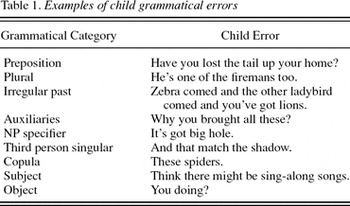
Examples of child grammatical errors
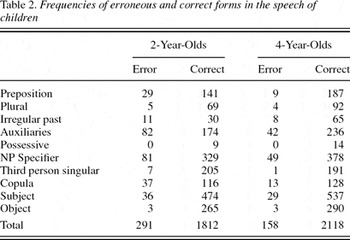
Frequencies of erroneous and correct forms in the speech of children
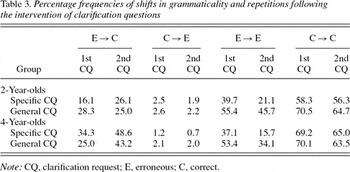
Percentage frequencies of shifts in grammaticality and repetitions following the intervention of clarification questions
 You have
Access
- 17
- Cited by