INTRODUCTION
Indicators show that cancer is a global public health problem. According to data provided by the Informatics Department of the Unified Health System, approximately 155,706 people died of cancer during 2010 in Brazil, most likely after having experienced intense suffering (DataSUS, 2013). According to some estimates, by 2010 approximately 17,000,000 worldwide will experience some type of cancer, and more than 10,000,000 will die from consequences of the disease (International Agency for Research on Cancer, 2008).
Within this context, terminal cancer has deep implications that affect all aspects of a patient's life (Kennett & Payne, Reference Kennett and Payne2005). Despite efforts to promote and improve the quality of life (QoL) for cancer patients, and although the treatments available for the more advanced stages of cancer are less aggressive, the progression of the disease itself produces symptoms that can contribute to a patient's stress and impair their quality of life (Oerlemans et al., Reference Oerlemans, Husson and Mols2012). Such symptoms as thoughts and expressions of hopelessness and high levels of anxiety and depression are highly prevalent in patients with advanced cancer and must be taken into account in their treatment (Mann & Currier, Reference Mann, Currier, Fatemi and Clayton2008). One study that included 12 cancer treatment centers in the United States indicated that the prevalence of psychological stress is higher during the terminal stage of disease, but it did not exhibit remarkable variation throughout the course of antineoplastic treatment (Zabora & Loscalzo, Reference Zabora, Loscalzo and Berger2002). Some authors found evidence that mental disorders, though common, are still underdiagnosed in the field of palliative care (Zabora & Loscalzo, Reference Zabora, Loscalzo and Berger2002; Mann & Currier, Reference Mann, Currier, Fatemi and Clayton2008; Mystakidou et al., Reference Mystakidou, Tsilika and Prapa2008; Saporetti et al., Reference Saporetti, Andrade and Sachs2012); for that reason, they are not treated appropriately, thus causing substantial suffering for patients and their caregivers (Thompson et al., Reference Thompson, Walker and Obolensky2010).
Introduction of the hospice model of treatment occurred in conjunction with a shift in the abovementioned profile. For instance, Yennurajalingam et al. (Reference Yennurajalingam, Atkinson and Masterson2012) found that approximately 70% of the physical and psychological symptoms (nausea, depression, pain, fatigue, and appetite loss, among others) exhibited significant improvement in an outpatient sample receiving palliative care. Similar findings were reported by Temel et al. (Reference Temel, Greer and Muzikansky2010), where study patients with lung cancer who were assisted by clinical oncologists and palliative care staff exhibited better quality of life and longer survival compared with patients assisted by oncologists alone. In addition, other studies conducted among patients with advanced cancer reported improvement of physical symptoms, even under conditions in which the disease seemed to pose an imminent threat (Morita et al., Reference Morita, Akechi and Ikenaga2005; Temel et al., Reference Temel, Greer and Muzikansky2010). All of these data show that patients' quality of life improves after the onset of palliative care and thus contradict the usual stereotypes about this therapeutic approach, related to suffering, pain, and death.
Nevertheless, in spite of the above findings showing the positive impact of palliative care, it is important to remember that the diagnosis of advanced cancer is experienced as a moment of crisis by many patients. It is assumed that most patients will adapt gradually to their diagnosis, and others will have difficulty in adjusting.
Psychosocial adaptation or adjustment to cancer is the process through which each individual seeks to manage his or her suffering, solve specific problems, and obtain some control over the events triggered by the disease. Efficient adaptation is achieved when the individual, by means of his or her thoughts and behaviors, succeeds in minimizing problems in functioning in everyday life, regulating emotional distress, and remaining active and participating in personally significant activities (Stanton et al., Reference Stanton, Revenson and Tennen2007; National Cancer Institute, 2008).
Therefore, another significant feature of palliative care concerns coping mechanisms because patients need to mobilize psychosocial resources in their effort to address the stress associated with the terminal stage of cancer. According to Lazarus (Reference Lazarus1966), coping mechanisms are strategies used to address an imminent threat. Such strategies are considered effective when they attenuate the uncomfortable and unpleasant feelings associated with threats or losses. They are considered dysfunctional when they are ineffective; when they do not ensure satisfactory quality of life or the physical, emotional, and social well-being of patients; or when they affect a patient's psychoneuroendocrine balance (Peçanha, Reference Peçanha and Carvalho2008).
Chapman and Pepler (Reference Chapman and Pepler1998) investigated the associations among coping strategies, hope, and anticipatory grief in palliative care patients and found that the former two factors are inversely correlated with the latter. Similarly, Soares et al. (Reference Soares, Moura and Carvalho2000) investigated the associations between emotional adjustment, coping strategies, affectivity, and perceptions of disease in patients with advanced cancer and found correlations among all of these variables. The authors also emphasized the relevance of the psychological factors in adjusting to cancer.
From a broader perspective, Stanton et al. (Reference Stanton, Revenson and Tennen2007) performed a review of the literature on psychological adjustment to chronic diseases and identified a series of quite interesting facts: (a) although the use of avoidance strategies is associated with high levels of stress and predicts long-term maladjustment, it might be efficacious, which points to the need to assess its function better within the context of the demands of the disease; (b) the strategies aimed at minimizing threats might be useful for reducing stress during the critical stages of disease; (c) problem-focused strategies are strongly correlated with positive adjustment indicators; (d) interventions that encourage the use of approach strategies, such as problem solving, are useful for promoting adaptation; and (e) the combination of avoidance strategies with poor availability of social support represents a risk factor for stress (Beck et al., Reference Beck, Steer and Beck1993). These findings indicate that adaptive or maladaptive outcomes are related to the type of strategies employed.
Therefore, the aim of the present study was to assess the levels of hopelessness, anxiety, depression, and quality of life in cancer patients receiving palliative care and to assess their correlations with the use of various coping strategies by comparing measures taken at the onset of palliative treatment to ones taken one month later. Knowledge of these parameters is relevant for the development of specific therapies aimed at reducing the impact of disease on the everyday life of patients subjected to palliative care.
METHODS
Participants
Conducted at a palliative care unit (PCU) specifically for cancer patients, the present study is a prospective cohort study that analyzed a convenience sample selected according to the following criteria: (a) inclusion: patients of both genders diagnosed with advanced cancer, who did not have curative therapeutic options, who were aged 18 years or older, and who were making their first visit to the PCU as outpatients; and (b) exclusion: patients with severe impairment of cognitive ability, illiteracy, clinical conditions that prevented application of study instruments, a hospital admission between the two timepoints of data collection, patients who did not participate in the second data collection session, and patients with incomplete/incorrect responses to the instruments.
Instruments
The following instruments were utilized for data collection: (a) the Beck Hopelessness Scale (BHS), a self-administered, dichotomous scale (yes/no), translated and adapted for Brazil by Cunha (Cunha, Reference Cunha2001) that consists of 20 items with statements related to the cognitive features of hopelessness; (b) the European Organization for the Research and Treatment of Cancer Quality of Life Core Questionnaire–Cancer 30 (EORTC QLQ–C30) (Aaronson et al., Reference Aaronson, Kaasa and Ahmedzai1993), a self-administered instrument adapted and validated in the Brazilian Portuguese language in two separate studies, combined with the specific module for patients with lung cancer (EORTC LC-13) (Brabo et al., Reference Brabo, Paschoal and Biasoli2006; Franceschini et al., Reference Franceschini, Jardim and Fernandes2010); the EORTC QLQ–C30 comprises 30 questions scored in multiple-item scales and single-item measures distributed over five functional scales, three symptom scales, one quality of life and global health scale, and one scale assessing the financial impact of disease and treatment, in addition to six individual items assessing the symptoms commonly reported by cancer patients (Aaronson et al., Reference Aaronson, Kaasa and Ahmedzai1993; Brabo et al., Reference Brabo, Paschoal and Biasoli2006); (c) the Hospital Anxiety and Depression Scale (HADS) (Zigmond & Snaith, Reference Zigmond and Snaith1983), a self-administered scale validated for Brazil by Botega et al. (Reference Botega, Pondé and Medeiros1998) that comprises 14 items, seven that assess anxiety (HADS–A) and seven that assess depression (HADS–D); (d) the Coping Strategies Inventory by Folkman and Lazarus (Reference Folkman and Lazarus1980), a self-administered instrument validated for Brazil by Savóia et al. (Reference Savóia, Santana and Mejias1996) that comprises 66 items scored on a 4-point Likert-type scale; and (e) the Structured Interview for Sociodemographic and Clinical Characterization, which was specifically adapted to include the sociodemographic and clinical data of interest for the present study.
The study was approved by the local ethics committee (ruling no. 208/2009) in accordance with Resolution 196/96 (Ministério da Saúde, 1996) on research involving human beings, and the volunteers were required to sign an informed consent form in order to be included in the study.
Data Collection
Data were collected on an individual basis at two different timepoints. Initially (T1), patients were recruited upon visiting the palliative care outpatient clinic (PCOC) for the first time before their appointments with doctors and other professionals. The second session (T2) was performed as soon as the patients arrived at the PCOC for their first medical follow-up visit (approximately 30 days after the first one), when all of the abovementioned instruments were administered again.
Data Analysis
The data were entered into a database and analyzed using SPSS statistical software. The following statistical techniques were applied: (a) descriptive statistics were employed to assess the sociodemographic and clinical characteristics of the sample; (b) the Wilcoxon test was employed to compare the variables at T1 and T2; and (c) Spearman's correlation test was utilized to investigate correlations between variables. The significance level was established as p < 0.05.
RESULTS
A total of 103 volunteers completed the first assessment. Of these, 85 also completed the second one, and these 85 individuals comprised the final sample. Of these participants, 18 were excluded for the following reasons: death (n = 3), loss to follow-up (n = 7), hospital admission (n = 6), and dropout (n = 2).
Females represented slightly more than half of the sample (56.5%). The average age was 50.91 years (standard deviation [SD], 12.51); 68 (80.0%) volunteers had children, and 37 (43.5%) had completed elementary education or were literate. More than 87% of volunteers (n = 74) participated in religious activities; the large majority of them were Catholic (65.9%), and 44.7% sought religious assistance following the diagnosis of cancer.
With regard to clinical characteristics, only 9.4% of volunteers had received previous psychiatric treatment, and 5.9% were currently undergoing such treatment. Slightly more than 10.5% of the sample used psychiatric medication at the time of data collection. Most participants had received chemotherapy (341.8%) or a combination of two or more antineoplastic treatments (40%) in the past. At the time of data collection, 47 (55.3%) and 73 (85.9%) volunteers were no longer using chemotherapy and radiotherapy, respectively. Pain was reported by 45 (52.9%) volunteers, and 74 (87.1%) did not use any alternative treatment in combination with conventional treatment.
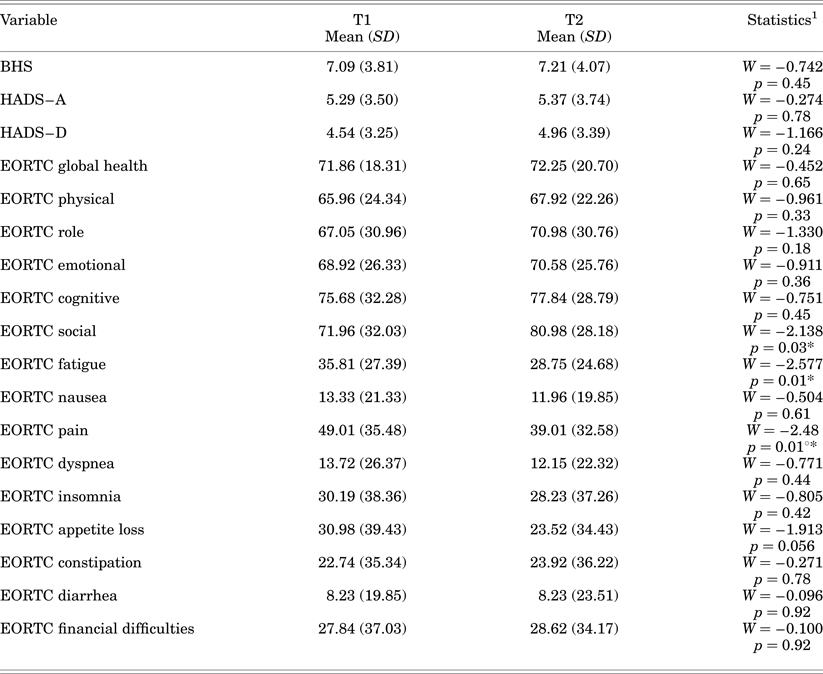
Table 1 shows the indicators of hopelessness, anxiety, depression, and QoL before and 30 days after the onset of palliative treatment. As can be seen, the hopelessness scores were below the normative average at the first assessment (mean = 9.20, SD = 4.72) (Cunha, Reference Cunha2001) and remained quite stable throughout the first month of palliative care. There was no significant difference between the scores from the first and second assessments. The indicators of psychopathology were similar: the anxious and depressive symptom scores were well below the normative mean (mean = 12.36, SD = 5.14) at the first assessment and remained virtually unchanged at the second (Botega et al., Reference Botega, Pondé and Medeiros1998).
Means and standard deviations of scores for hopelessness, anxiety, depression, and quality of life at the onset of palliative treatment (T1) and 30 days later (T2)

1 Wilcoxon test; *statistical significance; SD = standard deviation; BHS = hopelessness; HADS–A = anxiety; HADS–D = depression; EORTC = quality of life.
Few significant changes occurred in the variables related to quality of life, with the exceptions of the fatigue and pain scores, which decreased (p = 0.01), and the social impairment scores, which increased (p = 0.03). With regard to the remainder of the variables, the average scores in the physical domains were low compared with the instrument standards before the onset of palliative treatment. Nevertheless, it is worth noting the reduction, albeit statistically nonsignificant, in average scores after 30 days of treatment (except for diarrhea and constipation, which remained stable and increased, respectively). Although the scores in the emotional, cognitive, and social domains were high before the onset of palliative treatment, they exhibited a slight increase, also statistically nonsignificant, thus indicating a satisfactory level of quality of life in these domains.
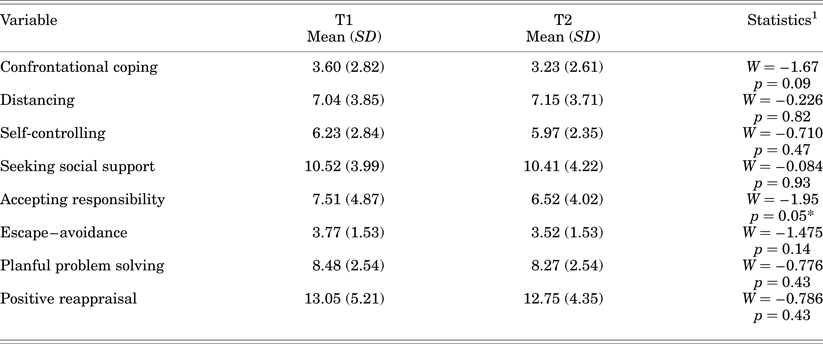
In the comparison of coping strategies (Table 2), the single statistically significant change between assessments was observed for “accepting responsibility,” which increased slightly (p = 0.05). The following strategies were employed more frequently: positive reappraisal, seeking social support, accepting responsibility, and planful problem solving. Distancing and escape–avoidance were the strategies used least often.
Means and standard deviations of the scores for coping mechanisms used by participants at the onset of palliative treatment (T1) and 30 days later (T2)

1Wilcoxon test; SD = standard deviation; *statistical significance.
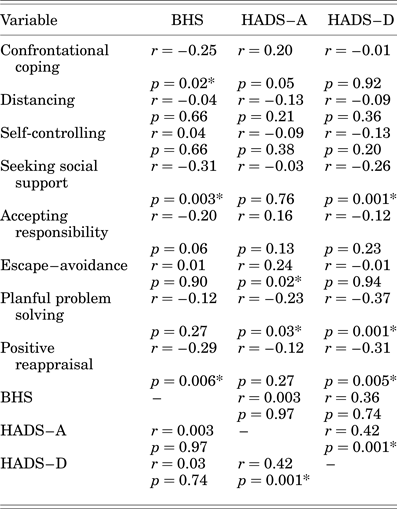
The correlations between coping mechanisms used after the onset of palliative care and the indicators of hopelessness, anxiety, and depression one month later (T2) showed that some correlations were moderately strong, as presented in Table 3.
Main correlations between the coping mechanisms used and the indicators of hopelessness, anxiety, and depression

*statistical significance; BHS = hopelessness; HADS–A = anxiety; HADS–D = depression; r = Pearson's correlation coefficient.
As can be seen from Table 3, confrontational coping, seeking social support, and positive reappraisal strategies were inversely correlated with hopelessness (mild/moderate degree). In other words, the increased use of those mechanisms reduced the experiences of hopelessness. Seeking social support, planful problem solving, and positive reappraisal were negatively correlated with the indicators of depression. In contrast, increased use of the escape–avoidance strategy and reduced use of the planful problem-solving strategy were correlated with increased anxiety. A moderate correlation was also observed between anxiety and depression (p = 0.001).
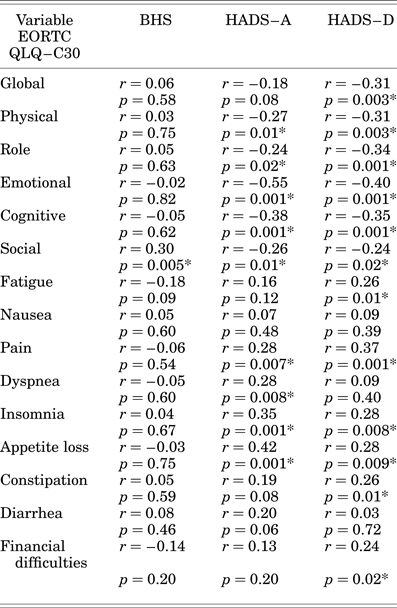
The main associations found between the QoL scores and the indicators of hopelessness, anxiety, and depression are given in Table 4, which shows that social impairment was the only quality-of-life domain that exhibited a correlation with the indicators of hopelessness, a correlation that was direct and moderate. The various domains of QoL exhibited direct correlations with anxiety and depression, which suggests that changes in QoL have a negative impact on those indicators of psychopathology. It is noteworthy that most of the physical symptoms assessed exhibited direct correlations with the indicators of anxiety and depression, thus denoting a negative impact.
Main correlations between quality of life and the indicators of hopelessness, anxiety, and depression

r = Pearson's correlation coefficient; *statistical significance; BHS = hopelessness; HADS–A = anxiety; HADS–D = depression.
Investigation of the associations between the various coping strategies and the quality-of-life domains showed that few correlations reached statistical significance and that they were weak. Accepting responsibility and positive reappraisal exhibited a positive correlation with the physical domain of QoL. Positive reappraisal exhibited a positive impact on the cognitive domain but a negative impact on fatigue. The use of confrontational coping and escape–avoidance exhibited a negative correlation with the emotional domain, suggesting that such extreme strategies have a negative impact on emotional behavior. Finally, reductions in the self-controlling, planful problem solving, and positive reappraisal strategies were associated with increased financial difficulties.
DISCUSSION
The present study, which was conducted in a palliative care unit, found that volunteers' levels of hopelessness were not high and did not increase after the onset of treatment. This finding deserves attention because it conflicts with reports in the literature that hopelessness is a common (though undesirable) occurrence, particularly throughout the course of treatment, and that some patients experience strong feelings of hopelessness (Matsumoto, Reference Matsumoto2012). Some studies conducted with patients undergoing palliative care showed that the risk of hope reduction was greater compared with the overall population (Breitbart et al., Reference Breitbart, Rosenfeld and Pessin2000), which was not found in the present study. Conversely, the results of our study indicate that palliative treatment is likely to have a positive influence. The treatment provided at the institution that assisted the investigated population, based on the hospice model, is particularly likely to be effective and might have represented a differential factor that exerted a positive influence on the maintenance of hope.
In the present study, the indicators of psychopathology were assessed with the HADS and did not increase with the onset of palliative treatment. This result also conflicts with the literature, which reports a strong association between anxiety and depression and advanced cancer (McClain et al., Reference McClain, Rosenfeld and Breitbart2003; Miovic & Block, Reference Miovic and Block2007; Lichtenthal et al., Reference Lichtenthal, Nilsson and Zhang2009). However, more recent studies have reported findings about anxiety that were similar to the findings of our study, indicating that anxiety does not systematically exhibit a proportional correlation with the severity of clinical diseases and the approach of death (Lichtenthal et al., Reference Lichtenthal, Nilsson and Zhang2009; Kolva et al., Reference Kolva, Rosenfeld and Pessin2011).
Two factors might account for the low levels of psychopathological symptoms that we observed. First, the differentiated and humanized treatment provided by the institution is based on a hospice model and thus seeks to afford a pleasant and humanized environment in addition to providing a full interdisciplinary staff specializing in this type of care. That model of care and particular physical structure foster an environment that enables wishes, farewells, and the attribution of novel meaning to one's experience; it also strengthens the care provided to each patient, taking his or her individuality into account and extending care to their relatives. Second, with regard to the past psychological/psychiatric history of the volunteers, only a small fraction of them had exhibited disorders or used psychoactive drugs. Thus, the sample was previously healthy, which favors the maintenance of psychiatric health.
With regard to the physical and clinical conditions of cancer patients, terminal cases in particular, reports in the literature indicate that an exacerbation of physical symptoms and clinical disorders is correlated with increased stress and worsening of patients' mental health (Pereira et al., Reference Pereira, Benarroz and Silva2010). The results for the various EORTC domains in the present study corroborate that association. However, it is noteworthy that the intensity of such symptoms decreased throughout the course of palliative treatment, which favored improvement of patients' quality of life and emotional condition, and thus contradicts the stereotypes associated with palliative care. Instead, this result adds further evidence that palliative care contributes to the physical and emotional well-being of patients.
From a psychological perspective, the assessment of coping resources one month after the onset of palliative treatment showed that the strategies most frequently used by volunteers were positive/adaptive and that reassessment of the experienced situation and active coping with the problem were the predominant strategies. Distancing and escape–avoidance were seldom used as coping strategies after the onset of treatment. Similar results were found in a study conducted among young patients with advanced cancer: the positive correlations involved proactive coping with the experienced situation (i.e., dealing with it in an active manner) by acting and intervening directly on the stressors related to advanced cancer. However, the use of distancing and detachment strategies (i.e., patients sought to avoid having to cope with the experience of cancer) favored potentially contradictory and negative responses (Pacheco, Reference Pacheco2004). Coping has also been investigated in other clinical diseases other than cancer (Trevino et al., Reference Trevino, Maciejewski and Fasciano2012), and our findings agree with that literature, which states that some coping strategies might help patients address negative events and lessen suffering and more efficiency (Miyazaki et al., Reference Miyazaki, Domingos and Valério2005; Straub, Reference Straub2005).
Analysis of the correlations between coping resources and quality of life showed that improvement of the latter was associated with greater use of adaptive strategies. These findings agree with the results found by Gibson et al. (Reference Gibson, Rueda and Rourke2011), who studied patients with chronic diseases and found an association between the use of adaptive strategies and improvement in the QoL as well as between reduced use of escape–avoidance and increased psychological suffering in patients infected with the human immunodeficiency virus (HIV) (Penedo et al., Reference Penedo, Gonzalez and Davis2003; Weaver et al., Reference Weaver, Antoni and Lechner2004). In that study, denial was considered to be a coping strategy associated with poorer mental health and QoL (Weaver et al., Reference Weaver, Antoni and Lechner2004) as well as with poorer physical and social functioning (Penedo et al., Reference Penedo, Gonzalez and Davis2003). Therefore, there is a direct positive correlation among coping resources and mental health and QoL, which suggests that the individuals who feel able to manage the challenges in life and maintain a sense of personal control enjoy better mental health (Lien et al., Reference Lien, Lin and Kuo2009).
CONCLUSIONS
Enrollment in palliative treatment had no negative impact on the level of trust of patients and, to the contrary, favored improvement in clinical conditions. The use of problem-focused coping strategies exhibited a positive impact on the end-of-life process, giving new meaning to and making the most of the last moments of their lives.
ACKNOWLEDGMENTS
To the Researcher Support Center (Núcleo de Apoio ao Pesquisador–NAP), Barretos Cancer Hospital, Pius XII Foundation (Hospital de Câncer de Barretos, Fundação Pio XII), for their crucial assistance in data collection, database construction, and statistical analysis.