Introduction
Paranoia has been defined as ‘a disordered mode of thought that is dominated by an intense, irrational, but persistent mistrust or suspicion of people and a corresponding tendency to interpret the actions of others as deliberately threatening or demeaning’ (Fenigstein, Reference Fenigstein1984). It is a common experience which, in its most severe form, is expressed as persecutory delusions in people with psychotic diagnoses such as schizophrenia (Moutoussis et al. Reference Moutoussis, Williams, Dayan and Bentall2007), affective psychosis (Lattuada et al. Reference Lattuada, Serretti, Cusin, Gasperini and Smeraldi1999) or related conditions, but which is found in less severe forms in healthy populations (Freeman et al. Reference Freeman, Garety, Bebbington, Smith, Rollinson, Fowler, Kuipers, Ray and Dunn2005). This latter finding forms part of the evidence base suggesting that psychotic-like phenomena in general can be detected within the general population (Hanssen et al. Reference Hanssen, Bak, Bijl, Vollebergh and van Os2005; van Os et al. Reference van Os, Linscott, Myin-Germeys, Delespaul and Krabbendam2009). Recent studies have proposed that there may be two subtypes of paranoia: ‘poor-me’ paranoia (in which persecution is believed to be undeserved) and ‘bad-me’, in which persecution is believed to be deserved and ego-syntonic (Trower & Chadwick, Reference Trower and Chadwick1995). It has been reported that bad-me paranoia is rare in acutely psychotic patients (Fornells-Ambrojo & Garety, Reference Fornells-Ambrojo and Garety2005), although some studies have shown that some patients cycle between poor-me and bad-me beliefs (Melo et al. Reference Melo, Taylor and Bentall2006). Several psychological models have been developed, which have implicated cognitive, meta-cognitive and affective processes in paranoia, particularly processes linked to negative emotion (Bentall et al. Reference Bentall, Corcoran, Howard, Blackwood and Kinderman2001; Garety et al. Reference Garety, Kuipers, Fowler, Freeman and Bebbington2001; Morrison, Reference Morrison2001; Freeman et al. Reference Freeman, Garety, Kuipers, Fowler and Bebbington2002; Morrison et al. Reference Morrison, Gumley, Ashcroft, Manousos, White, Gillan, Wells and Kingdon2011).
The natural fluctuation of psychotic experiences and co-occurring affective symptoms within adolescence (Loewy et al. Reference Loewy, Johnson and Cannon2007; van Os et al. Reference van Os, Linscott, Myin-Germeys, Delespaul and Krabbendam2009), as well as findings that psychotic experiences are often reported by patients with both affective and anxiety disorders (Varghese et al. Reference Varghese, Scott, Welham, Bor, Najman, O'Callaghan, Williams and McGrath2011) and that the persistence of psychotic experiences is linked with increased levels of affective symptoms (van Rossum et al. Reference van Rossum, Dominguez, Lieb, Wittchen and van Os2011), have led to suggestions that depression and anxiety should be considered as necessary conditions for the onset of psychosis in general (Dominguez et al. Reference Dominguez, Wichers, Lieb, Wittchen and van Os2011). Negative emotions (anxiety and depression) have also been shown to be associated with dimensions of paranoia in clinical and non-clinical populations (Freeman et al. Reference Freeman, Garety, Bebbington, Smith, Rollinson, Fowler, Kuipers, Ray and Dunn2005, Reference Freeman, Pugh, Antley, Slater, Bebbington, Gittins, Dunn, Kuipers, Fowler and Garety2008), and there is strong evidence from large clinical cohort studies that they are specifically implicated in the development and maintenance of persecutory delusions (Bentall et al. Reference Bentall, Rowse, Shryane, Kinderman, Howard, Blackwood, Moore and Corcoran2009; Fowler et al. Reference Fowler, Hodgekins, Garety, Freeman, Kuipers, Dunn, Smith and Bebbington2012). Such affective dysregulation has been suggested to be an aetiological pathway to psychosis (van Os & Kapur, Reference van Os and Kapur2009).
Several studies have implicated low self-esteem in the genesis of paranoid thinking in both non-clinical and clinical populations (Bentall & Kaney, Reference Bentall and Kaney1996; Bentall et al. Reference Bentall, Rowse, Shryane, Kinderman, Howard, Blackwood, Moore and Corcoran2009), and studies have also shown that paranoia is associated with self-esteem that is highly unstable over time (Thewissen et al. Reference Thewissen, Bentall, Lecomte, van Os and Myin-Germeys2008). There is also evidence to suggest that negative beliefs or schemas about both self and others are a pathway to the development of paranoia (Smith et al. Reference Smith, Fowler, Freeman, Bebbington, Bashforth, Garety, Kuipers and Dunn2006; Fowler et al. Reference Fowler, Hodgekins, Garety, Freeman, Kuipers, Dunn, Smith and Bebbington2012). Patients with poor-me paranoia tend to have higher self-esteem than those with bad-me paranoia (Chadwick et al. Reference Chadwick, Trower, Juusti-Butler and Maguire2005), although self-esteem is still impaired compared with non-patient controls (Melo et al. Reference Melo, Taylor and Bentall2006).
The self-regulatory executive functioning (S-REF) model of psychological dysfunction (Wells & Matthews, Reference Wells and Matthews1994) suggests that metacognitive beliefs about mental experiences are associated with vulnerability to psychological disorder. In particular, it predicts that positive beliefs about mental events will lead to an increase in the frequency of symptoms, whereas negative beliefs about such experiences (for example, beliefs about uncontrollability of and danger associated with certain thoughts) will lead to distress and disability. Consistent with this model, there is evidence that these beliefs are involved in the development and maintenance of paranoia across the continuum of psychosis (Freeman & Garety, Reference Freeman and Garety1999; Morrison & Wells, Reference Morrison and Wells2007). For example, generic metacognitive beliefs about the management of unwanted thoughts have been associated with delusional and/or paranoid ideation in both clinical (Morrison & Wells, Reference Morrison and Wells2003) and non-clinical populations (Laroi & van der Linden, Reference Laroi and van der Linden2005). Studies have also shown that specific negative (e.g. paranoia is uncontrollable) and positive (survival) beliefs about paranoia (e.g. being paranoid keeps me safe) are associated with dimensions of paranoid ideation in both clinical (Morrison et al. Reference Morrison, Gumley, Ashcroft, Manousos, White, Gillan, Wells and Kingdon2011) and non-clinical populations in the predicted manner (Morrison et al. Reference Morrison, Gumley, Schwannauer, Campbell, Gleeson, Griffin and Gillan2005; Gumley et al. Reference Gumley, Gillan, Morrison and Schwannauer2010). These findings are consistent with suggestions that paranoia is employed as a strategy for managing interpersonal threat (Morrison et al. Reference Morrison, Gumley, Ashcroft, Manousos, White, Gillan, Wells and Kingdon2011), in a similar manner to the use of worry as a strategy dealing with more general threats (Wells & Matthews, Reference Wells and Matthews1994).
Reliable and valid criteria are now available to identify help-seeking individuals who are at high risk of imminently developing schizophrenia and related psychoses. Yung et al. (Reference Yung, McGorry, McFarlane, Jackson, Patton and Rakkar1996) developed operational criteria to identify young people possessing an ‘at risk mental state’ (ARMS) who are at ultra-high risk of developing psychosis within 12 months; most of these patients are identified on the basis of attenuated (subclinical) psychotic symptoms. Such a population, arguably midway along the continuum of psychosis (exhibiting subthreshold psychotic experiences, experiencing significant emotional distress and engaging in help-seeking behaviour), represents a unique opportunity to investigate the differential predictors of cognitive and affective dimensions of paranoid ideation. Therefore, we aimed to investigate factors associated with dimensions of paranoia in an ARMS sample.
On the basis of the models outlined above, we were able to derive specific hypotheses that could be tested in our data. First, as already noted, paranoia in acutely ill patients is generally characterized by low deservedness (Fornells-Ambrojo & Garety, Reference Fornells-Ambrojo and Garety2005) whereas, in non-clinical populations, it is usually associated with high levels of deservedness and very low self-esteem (Melo et al. Reference Melo, Corcoran, Shryane and Bentall2009). An implication of these observations is that deservedness judgments change during the development of psychosis and that individuals who fall in the high-risk group and who have emerging paranoid symptoms should exhibit lower levels of paranoia but higher levels of deservedness than patients with established psychosis, but higher levels of paranoia and lower levels of deservedness than individuals not suffering from mental illness (Bentall & Kinderman, Reference Bentall, Kinderman, Freeman, Bentall and Garety2008). We aimed to test these predictions by comparing the data from our ARMS patients with data previously obtained by Melo et al. (Reference Melo, Corcoran, Shryane and Bentall2009) from psychiatric in-patients suffering from persecutory delusions and healthy controls.
Second, existing theories of paranoia converge on predicting that the following variables will be associated with paranoid ideation: anxiety (Garety et al. Reference Garety, Kuipers, Fowler, Freeman and Bebbington2001; Morrison, Reference Morrison2001; Freeman et al. Reference Freeman, Garety, Kuipers, Fowler and Bebbington2002; Morrison et al. Reference Morrison, Gumley, Ashcroft, Manousos, White, Gillan, Wells and Kingdon2011), depression (Bentall et al. Reference Bentall, Corcoran, Howard, Blackwood and Kinderman2001; Garety et al. Reference Garety, Kuipers, Fowler, Freeman and Bebbington2001; Freeman et al. Reference Freeman, Garety, Kuipers, Fowler and Bebbington2002), negative beliefs about self (Garety et al. Reference Garety, Kuipers, Fowler, Freeman and Bebbington2001; Morrison, Reference Morrison2001; Freeman et al. Reference Freeman, Garety, Kuipers, Fowler and Bebbington2002) and negative beliefs about others (Bentall et al. Reference Bentall, Corcoran, Howard, Blackwood and Kinderman2001; Garety et al. Reference Garety, Kuipers, Fowler, Freeman and Bebbington2001; Morrison, Reference Morrison2001; Freeman et al. Reference Freeman, Garety, Kuipers, Fowler and Bebbington2002; Morrison et al. Reference Morrison, Gumley, Ashcroft, Manousos, White, Gillan, Wells and Kingdon2011). Moreover, the S-REF model predicts that specific metacognitive beliefs will also be associated with paranoia, especially positive (survival) beliefs (Morrison, Reference Morrison2001; Morrison et al. Reference Morrison, Gumley, Ashcroft, Manousos, White, Gillan, Wells and Kingdon2011).
Finally, we aimed to test the prediction that deservedness of paranoia is associated with depression (Trower & Chadwick, Reference Trower and Chadwick1995; Melo et al. Reference Melo, Corcoran, Shryane and Bentall2009) and negative beliefs about self (Trower & Chadwick, Reference Trower and Chadwick1995; Melo et al. Reference Melo, Corcoran, Shryane and Bentall2009).
Method
Participants
All participants were recruited via a clinical trial, the Early Detection and Intervention Evaluation for people at risk of psychosis (the EDIE-2 trial) (Morrison et al. Reference Morrison, French, Stewart, Birchwood, Fowler, Gumley, Jones, Bentall, Lewis, Murray, Patterson, Brunet, Conroy, Parker, Reilly, Byrne, Davies and Dunn2012). Inclusion criteria were assessed using the Comprehensive Assessment for At Risk Mental States (CAARMS; Yung et al. Reference Yung, Yuen, McGorry, Phillips, Kelly, Dell'Olio, Francey, Cosgrave, Killackey, Stanford, Godfrey and Buckby2005). All were aged between 14 and 35 years and seeking help for symptoms. Participants were predominantly identified by health professionals working within diverse agencies within primary- and secondary-care settings. We obtained data on paranoia and psychological factors from 117 of the 288 trial participants. [This was because recruitment sites made different choices about subsidiary, non-trial measures, so the Persecution and Deservedness Scale (PaDS) was only administered at some sites.] The sample was 60.8% male, 88.9% white ethnicity, had an average age of 20.3 years and had completed an average of 13.3 years of formal education.
For the purposes of testing our hypotheses about differences between ARMS and actively psychotic and healthy comparisons, we used data previously reported by Melo et al. (Reference Melo, Corcoran, Shryane and Bentall2009), who administered our paranoia measure to 45 psychiatric in-patients diagnosed with schizophrenia spectrum disorders suffering from paranoid delusions (31 male, 14 female; mean age = 37.44 years, s.d. = 9.74) and 318 (99 male, 219 female; mean age = 21.50 years, s.d. = 4.04) UK university students.
Measures
CAARMS
The CAARMS (Yung et al. Reference Yung, Yuen, McGorry, Phillips, Kelly, Dell'Olio, Francey, Cosgrave, Killackey, Stanford, Godfrey and Buckby2005) is a standardized clinical interview, which has been developed to determine if an individual meets criteria for an ARMS and to assess psychopathology thought to indicate imminent development of psychotic disorder. The CAARMS has good to excellent inter-rater reliability (Yung et al. Reference Yung, Yuen, McGorry, Phillips, Kelly, Dell'Olio, Francey, Cosgrave, Killackey, Stanford, Godfrey and Buckby2005) and was used to assess our entry criteria.
The Beck Depression Inventory for Primary Care (BDI-PC)
The BDI-PC (Winter et al. Reference Winter, Steer, Jones-Hicks and Beck1999) is a brief self-report assessment of depression. Each of seven items are rated on a four-point scale (0–3), giving a range of 0–21.
Social Interaction Anxiety Scale (SIAS)
The SIAS (Mattick & Clarke, Reference Mattick and Clarke1998) is a 20-item, self-report assessment that measures levels of fear in social interaction situations. Items are scored on a five-point Likert scale (0–4).
Beliefs About Paranoia Scale (BAPS)
The BAPS (Gumley et al. Reference Gumley, Gillan, Morrison and Schwannauer2010) is an 18-item self-report assessment used to measure specific metacognitive beliefs about paranoia. The questionnaire generates scores for the following three subscales: negative beliefs about paranoia (e.g. paranoia is uncontrollable), beliefs about paranoia as a survival strategy (e.g. being paranoid keeps me safe) and normalizing beliefs about paranoia (e.g. everyone is paranoid sometimes). Items are scored from 1 to 4.
Brief Core Schema Scale (BCSS)
The BCSS (Fowler et al. Reference Fowler, Freeman, Smith, Kuipers, Bebbington, Bashforth, Coker, Hodgkins, Gracie, Dunn and Garety2006) is a 24-item, self-report assessment that aims to measure beliefs about the self and others in people with psychosis. Items are rated on a five-point rating scale (0–4). Four scores, each with six items, are obtained: negative-self, positive-self, negative-other and positive-other.
Metacognitions Questionnaire-Revised (MCQ-30)
The MCQ-30 (Cartwright-Hatton & Wells, Reference Cartwright-Hatton and Wells2004) is a 30-item questionnaire that assesses metacognitive beliefs. The items (scored 1–4) generate subscales including cognitive confidence, positive beliefs about unwanted thoughts, negative beliefs about the uncontrollability of thoughts (MCQ-NT), negative beliefs about the need to control thoughts (MCQ-NC) and cognitive self-consciousness (MCQ-CSC). Because the need to limit the number of parameters in our model, and because the S-REF model emphasizes the role of self-focused attention in maintaining symptoms and negative beliefs about symptoms in their distress, we included only the subscales MCQ-CSC (e.g. ‘I am constantly aware of my thinking’), MCQ-NT (e.g. ‘My worrying thoughts persist, no matter how I try to stop them) and MCQ-NC (e.g. ‘If I could not control my thoughts, I would not be able to function’) in our modelling.
PaDS
The PaDS contains two 10-item subscales assessing beliefs about persecution and the deservedness of this persecution. The persecution subscale (PaDS-P) contains items that explicitly state or imply that the individual is at risk as a consequence of the untrustworthiness and malevolence of others (see Melo et al. Reference Melo, Corcoran, Shryane and Bentall2009). Each item is rated on a five-point scale (0–4). Each persecution item was followed by a corresponding deservedness item, which together comprised the deservedness subscale (PaDS-D). Participants were instructed to complete each item only if they had rated the associated persecutory item as being ‘unsure’, ‘possibly true’ or ‘certainly true’. Each deservedness item enquires whether the respondent feels that he or she deserves the type of persecution described, and is rated on a five-point scale (0–4).
Statistical analysis
Multilevel model of PaDS
The PaDS item responses were treated as repeated, dependent measures in a multilevel linear regression model. Multilevel models account for the non-independence of responses when the data have a nested, hierarchical structure, such as pupils nested within schools (Snijders & Bosker, Reference Snijders and Bosker1999). Here, the PaDS item scores (level 1) were nested within individuals (level 2). The multilevel model allows for this structure by including a random intercept for individuals, in effect a person-level residual term, to add to the response-level residual term that is included by default in single-level regression models. Item responses were used as the dependent variables rather than the more familiar approach of taking subscales scores produced by summing or averaging item responses. This was done to account for the inherently item-level dependency between responses to the persecution and deservedness items. For purely logical reasons, deservedness item responses are elicited only when the associated persecutory response is non-zero and are missing otherwise. Non-zero responses are not equally likely among the persecution items, however. Some items reflect higher levels of ‘trait’ persecution, e.g. ‘I believe that some people want to hurt me deliberately’, and others lower levels, e.g. ‘Sometimes, I just know that people are talking critically about me’. The higher trait persecution items are positively endorsed less frequently and therefore have greater rates of missing responses for their associated deservedness items than the lower trait persecution items. Therefore, missing responses to the deservedness items cannot plausibly satisfy the ‘missing completely at random’ (MCAR) condition, which would guarantee unbiased parameter estimates even in the face of missing responses (Little & Rubin, Reference Little and Rubin2002). Rather than being MCAR, the deservedness responses are by design dependent on the persecution item responses. Including both the individual persecution and deservedness items as dependent variables means that missingness on the deservedness items is then rendered plausibly ‘missing at random’, i.e. missing at random conditional on the persecution scores (Little & Rubin, Reference Little and Rubin2002).
The model therefore consisted of up to 20 item responses per person as dependent variables at level 1. Item-specific intercept parameters were also included at level 1, to account for the differing mean scores across items (as mentioned above). In addition to the random intercept term, the level-2 predictors were scores on the BCSS, MCQ and BAPS, as well as age, gender (dummy variable for male) and ethnicity (dummy variable for non-white British).
Model estimation
The model was fitted using the GLLAMM procedure (Rabe-Hesketh et al. Reference Rabe-Hesketh, Skrondal and Pickles2002) of the Stata 11SE statistical package (StataCorp, 2009), estimated with a ‘full information’ maximum likelihood estimator. Rather than rely upon ‘asymptotic’ standard errors (the default with maximum likelihood and ordinary least squares estimation), we fitted the model with Huber–White standard errors (Huber, Reference Huber1967; White, Reference White1980), which are ‘robust’ to violations of the assumptions of normality and heteroscedasticity of the residuals. This was because there were a relatively small number of response options on the five-point responses scales and several of the items exhibited marked skew. Robust standard errors compensate for the potential bias of these effects, and have been shown to be particularly effective in reducing bias in fixed and random effects at level 2 in multilevel models estimated by maximum likelihood (Maas & Hox, Reference Maas and Hox2004).
Planned comparisons
Finally, post-hoc planned comparisons were conducted. These were simple Wald tests of the equality of the parameter estimates for the level-2 predictors on the paranoia versus deservedness items. These comparisons would test whether the person-level predictor variables were associated differentially with the reporting of paranoia or with deservedness. For tests of significance, α was set at 0.05 and all tests were two-tailed.
Results
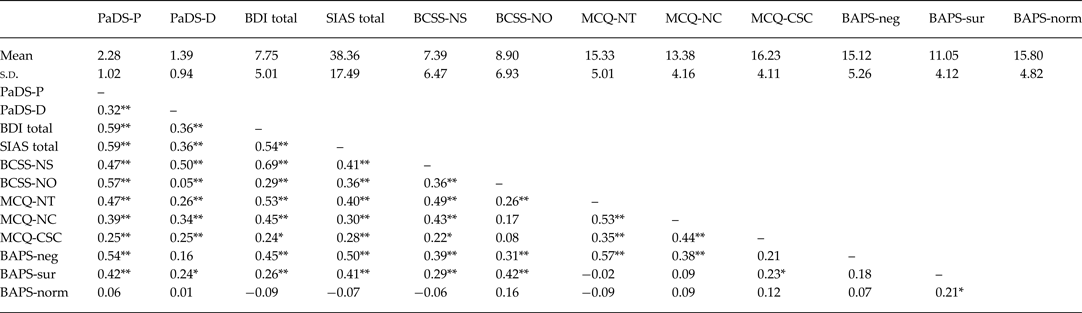
Summary data for the measures are shown in Table 1. There were no significant associations between any of the symptom or psychological measures with age; the only significant difference for gender was for the BAPS normalizing scale, which was higher in females (p < 0.05).
Correlation matrix for PaDS, cognitive, metacognitive and affective variables

PaDS, Persecution and Deservedness Scale; PaDS-P, PaDS paranoia; PaDS-D, PaDS deservedness; BDI, Beck Depression Inventory; SIAS, Social Interaction Anxiety Scale; BCSS-NS, Brief Core Schema Scale negative self; BCSS-NO, BCSS negative others; MCQ-NT; Metacognitions Questionnaire negative thoughts; MCQ-NC, MCQ need to control; MCQ-CSC; MCQ cognitive self-consciousness; BAPS-neg; Beliefs About Paranoia Scale negative; BAPS-sur, BAPS survival; BAPS-norm; BAPS normalizing; s.d., standard deviation.
* p < 0.05, ** p < 0.01.
The mean persecution score of our ARMS sample was 2.28 (s.d. = 1.02; median = 2.60) out of a maximum score of 4. This score is significantly lower than the 2.82 (s.d. = 0.69) mean score reported by Melo et al. (Reference Melo, Corcoran, Shryane and Bentall2009) for 45 psychiatric in-patients (t 160 = 3.27, p < 0.001, d = 0.57). However, it is higher than the average paranoia score of 1.18 (s.d. = 0.78) for the sample of UK university students reported by Melo et al. (Reference Melo, Corcoran, Shryane and Bentall2009) (t 433 = 11.95, p < 0.0001). If we take a score of 2.74, 2 s.d.s above their student mean, as an arbitrary cut-off for high levels of paranoia, then 44% of the current sample are above this level.
The mean deservedness score of our ARMS population was 1.39 out of 4 (s.d. = 0.94; median = 1.2). Compared with the student sample deservedness mean of 1.14 (s.d. = 0.87), our sample reported significantly greater deservedness (t 348 = 2.48, p = 0.014, d = 0.28). In order to test the specific prediction that ARMS patients would score higher on deservedness than patients with established psychosis, we compared them with the patient sample reported by Melo et al. (Reference Melo, Corcoran, Shryane and Bentall2009) (mean = 0.56, s.d. = 0.83); we found that the difference was highly significant (t 155 = 5.17, p < 0.001, d = 0.91).
Overall, on the basis of the above comparisons, our sample appears closer to the students than to the in-patients in terms of deservedness. The patient sample (Melo et al. Reference Melo, Corcoran, Shryane and Bentall2009) had a highly truncated deservedness distribution, with a significant number of patients giving entirely ‘poor-me’ responses to all questions, i.e. a score of exactly zero. In our sample, only 13 participants (11.6%) had this pattern of extreme responding, and overall skew was modest (0.44).
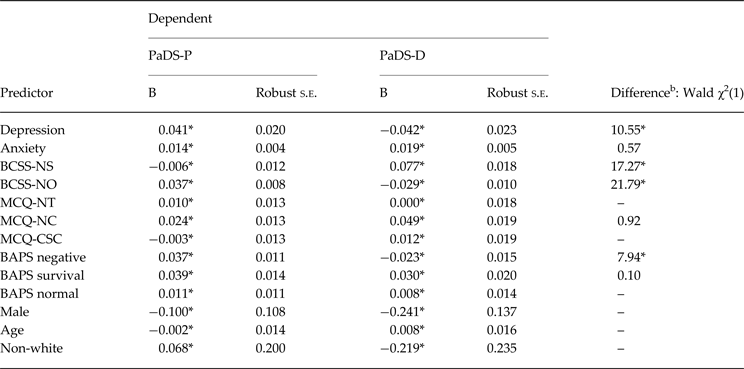
Zero-order correlations between variables are also shown in Table 1. Paranoia and deservedness had a significant, positive correlation of moderate size (r = 0.33, p < 0.001; Spearman's r = 0.31). This was identical to that found by Melo et al. (Reference Melo, Corcoran, Shryane and Bentall2009) in their student sample (Spearman’s r = 0.31), but much higher than that in their patient sample, where there was essentially no relationship between paranoia and deservedness (Spearman’s r = 0.02). It can be seen that most of the expected associations between the psychological variables and paranoia and deservedness were significant. Paranoia scores correlated with depression, anxiety, negative beliefs about the self and about others, abnormal metacognitive beliefs, negative beliefs about paranoia and paranoia as a survival strategy; the same variables were associated with deservedness with the exception of negative beliefs about paranoia. Inspection of variance inflation factors suggested that collinearity between variables was not problematic. Parameter estimates for a multilevel model of 1182 persecution and 823 deservedness item responses from 117 participants are shown in Table 2, which indicates the relationship between the various psychological measures and paranoia and deservedness when considered in the same model. The right-most column of the table indicates whether a psychological variable differs significantly in its relationship with the two dependent measures.
Predictors of persecution (PaDS-P) and deservedness (PaDS-D) beliefs and their difference a

PaDS-P, Persecution and Deservedness Scale paranoia; PaDS-D, PaDS deservedness; s.e., standard error; BCSS-NS, Brief Core Schema Scale negative self; BCSS-NO, BCSS negative others; MCQ-NT; Metacognitions Questionnaire negative thoughts; MCQ-NC, MCQ need to control; MCQ-CSC; MCQ cognitive self-consciousness; BAPS, Beliefs About Paranoia Scale.
a Item intercept parameters are not shown. Intraclass correlation coefficient = 0.19, i.e. 19% of the residual variance in responses was between persons (level 2); the level-2 ‘proportional reduction in error’ (equivalent to R 2 in single-level models) versus a model including item intercepts only was 0.28, i.e. the predictors in this model reduced the level-2 variance by 28%.
b Difference tests were carried out only where at least one of the B coefficients for PaDS-P or PaDS-D was significantly different from zero.
In this model, paranoia was associated with negative mood (both depression and anxiety), negative beliefs about others and both negative beliefs about paranoia and paranoia survival beliefs; surprisingly there was no association with negative beliefs about the self. Deservedness, on the other hand, was associated with both negative beliefs about the self and (negatively) with negative beliefs about others, as well as anxiety and meta-cognitive beliefs about the need to control thoughts.
When the differences between the associations with the two paranoia-related measures are considered, depression, negative beliefs about others and negative beliefs about the need to control thoughts are more associated with the severity of paranoia than with deservedness, whereas negative beliefs about the self are more associated with deservedness.
Discussion
Our sample of help-seeking participants was nearly as highly paranoid, but reported higher levels of ‘bad-me’ deservedness, as a sample of psychiatric in-patients reported elsewhere (Melo et al. Reference Melo, Corcoran, Shryane and Bentall2009). With regard to deservedness, our sample was actually more like the student sample reported elsewhere, both in terms of overall level and in the tendency for higher paranoia to be associated with higher deservedness. This finding is consistent with the prediction that the progression from subclinical to clinical paranoia is associated with decreasing deservedness (Bentall & Kinderman, Reference Bentall, Kinderman, Freeman, Bentall and Garety2008). However, it is also possible that those who are more poor-me in the ARMS sample are the most likely to transition to full psychosis. Further longitudinal research will be required to resolve these possibilities.
Affect (anxiety and depression) was associated with dimensions of paranoia, with depression specifically related to paranoid conviction but not deservedness. Negative beliefs about self were related to deservedness but not paranoia. Negative beliefs about others were positively related to paranoid conviction but negatively with deservedness. MCQ-NC was positively associated with deservedness. Finally, negative beliefs about paranoia itself were related positively with paranoid ideation but not with deservedness, and survival beliefs about paranoia were also associated with paranoia. Thus, we found several predictors of paranoia and deservedness, but only four predictors had relationships that differed significantly between the two paranoia-related measures.
It is clear that anxiety is implicated across both cognitive and affective dimensions of paranoia, which is consistent with predictions of several cognitive models (Garety et al. Reference Garety, Kuipers, Fowler, Freeman and Bebbington2001; Morrison, Reference Morrison2001; Freeman et al. Reference Freeman, Garety, Kuipers, Fowler and Bebbington2002; Morrison et al. Reference Morrison, Gumley, Ashcroft, Manousos, White, Gillan, Wells and Kingdon2011). Depression would be expected to be associated with paranoid conviction on the basis of several theories (Bentall et al. Reference Bentall, Corcoran, Howard, Blackwood and Kinderman2001; Garety et al. Reference Garety, Kuipers, Fowler, Freeman and Bebbington2001; Morrison, Reference Morrison2001; Freeman et al. Reference Freeman, Garety, Kuipers, Fowler and Bebbington2002), while depressed mood would be expected to be associated with deservedness according to other predictions (Trower & Chadwick, Reference Trower and Chadwick1995; Melo et al. Reference Melo, Corcoran, Shryane and Bentall2009); we found clear support for the former hypothesis and not the latter. However, the relationship between negative beliefs about self and our dimensions of paranoia was the opposite, showing a differential relationship with deservedness and not paranoid ideation. This finding is consistent with specific predictions about deservedness (Trower & Chadwick, Reference Trower and Chadwick1995; Melo et al. Reference Melo, Corcoran, Shryane and Bentall2009) but the lack of association with paranoid conviction is inconsistent with some models of paranoia (Bentall et al. Reference Bentall, Corcoran, Howard, Blackwood and Kinderman2001; Garety et al. Reference Garety, Kuipers, Fowler, Freeman and Bebbington2001; Morrison, Reference Morrison2001; Freeman et al. Reference Freeman, Garety, Kuipers, Fowler and Bebbington2002) and with previous findings from patients with long-standing psychosis (Fowler et al. Reference Fowler, Freeman, Smith, Kuipers, Bebbington, Bashforth, Coker, Hodgkins, Gracie, Dunn and Garety2006, Reference Fowler, Hodgekins, Garety, Freeman, Kuipers, Dunn, Smith and Bebbington2012; Bentall et al. Reference Bentall, Rowse, Shryane, Kinderman, Howard, Blackwood, Moore and Corcoran2009), although previous studies have not generally considered paranoia and deservedness separately. The most likely explanation for the discrepancies between the findings is that the relationship between paranoia, feelings of deservedness and self-esteem are dynamic and vary during the progression of a psychotic illness. Indeed, all three have been shown to fluctuate over the short term in patient samples (Thewissen et al. Reference Thewissen, Bentall, Lecomte, van Os and Myin-Germeys2008; Udachina et al. Reference Udachina, Varese, Oorschot, Myin-Germeys and Bentall2012).
The specific relationship observed between both positive and negative beliefs about paranoia are consistent with predictions derived from the general S-REF model (Wells & Matthews, Reference Wells and Matthews1994), as well as specific metacognitive models of psychosis (Morrison, Reference Morrison2001) and paranoia (Morrison et al. Reference Morrison, Gumley, Ashcroft, Manousos, White, Gillan, Wells and Kingdon2011). All of the current psychological models of paranoia would predict a relationship between persecutory ideation and negative beliefs about others, which is unsurprising given the definition of paranoia as a persistent mistrust of others and a corresponding tendency to interpret their actions as threatening; this predicted relationship was confirmed within our sample. Thus, the predictions of the specific models were generally supported, with the main area of discrepancy being in relation to the specific role of depressed mood and negative thinking about the self (or low self-esteem) in relation to cognitive and affective dimensions of persecutory ideation.
Our study has several methodological limitations that need to be considered. Our measure of paranoia is a self-report rating scale designed to assess persecutory ideas and associated deservedness across the continuum. Our study is cross-sectional, which limits any inferences we can make about causality and our ability to test theories that postulate dynamic relationships. We did not recruit a control group for our ARMS group and, therefore, comparisons had to be made with data from a previously published study. Our ARMS population provided an opportunity to explore the dimensions of paranoia in a sample with high levels of emotional dysfunction but lower levels of psychotic experiences, which enables us to hypothesize about the involvement of negative emotion, cognition and metacognition in the development of psychosis; however, the generalizability of our findings to people with established psychosis is questionable.
Our study has several implications for clinical practice (certainly for people experiencing paranoia who meet criteria for ARMS, and possibly for those with established psychosis). First, our findings suggest that cognitive behavioural assessments should include an examination of anxiety, depression, negative beliefs about self and others and metacognitive beliefs about paranoia. Given the associations we observed between negative emotions and paranoia, treatment of anxiety and depression within their own right (using strategies such as worry reduction and behavioural activation) may have beneficial effects on paranoid conviction; the first of these strategies has already been shown to be successful in patients with persecutory delusions (Foster et al. Reference Foster, Startup, Potts and Freeman2010; Freeman et al. Reference Freeman, Dunn, Startup, Pugh, Cordwell, Mander, Černis, Wingham, Shirvell and Kingdon2015). Interventions aimed at improving self-esteem have been shown to be applicable to people with psychosis (Hall & Tarrier, Reference Hall and Tarrier2003; Freeman et al. Reference Freeman, Pugh, Dunn, Evans, Sheaves, Waite, Černis, Lister and Fowler2014), and such approaches may well have an effect on affective dimensions of paranoia such as deservedness. However, given that negative beliefs about the self were not implicated in paranoid conviction in the present sample, it might be argued that they should not be the first target of intervention. A complication, already noted, is that self-esteem may fluctuate rapidly in paranoid patients (Thewissen et al. Reference Thewissen, Bentall, Lecomte, van Os and Myin-Germeys2008; Udachina et al. Reference Udachina, Varese, Oorschot, Myin-Germeys and Bentall2012) and it has also been noted that implicit self-esteem may be affected in paranoid patients even when explicit self-esteem (as measured by questionnaire) is not (Valiente et al. Reference Valiente, Prados, Gómez and Fuentenebro2012).
We found support for the S-REF model and, in particular, the involvement of survival beliefs in paranoia (the belief that suspiciousness is beneficial and self-protective). Hence cognitive–behaviour therapy interventions might be enhanced by addressing these beliefs. One approach might be to provide patients with an alternative strategy that serves the same function (perception of safety) prior to any attempts to modify their beliefs. Survival beliefs might also be addressed during the process of building a formulation, during which a shared view should be formed regarding the true likelihood of anticipated threats in terms of the current and historical context. The provision of normalizing information about the common nature of paranoid beliefs (Freeman et al. Reference Freeman, Freeman and Garety2006) may help patients to re-evaluate their negative beliefs about their paranoid thoughts being uncontrollable and dangerous. Similarly, it is possible that metacognitive therapies based on the S-REF model may be helpful for people with psychosis and those at high risk, and there is preliminary evidence to support this suggestion (Morrison et al. Reference Morrison, Pyle, Chapman, French, Parker and Wells2014).
Acknowledgements
This research was supported by funding from the Medical Research Council (G0500264). We thank the Mental Health Research Network and the Scottish Mental Health Research Network for their support and assistance. We also wish to thank the wider EDIE-2 trial team.
Declaration of Interest
None.