The woman was enchanting. Her uncle, Colonel Ragani, a tyrant. Every night he forced her out on stage to sing for unappreciative fools. She suffered under the scrutiny of the public, and yearned for a day when someone would rescue her from the Colonel, and release her from the misery of parading before dilettantes, prostituting her voice and her art. If only someone would see her perform and understand what lay beneath: a soul driven by music, but pining for love.
This, at least, was something like the story that Olivier Dupuget seems to have told himself about Giulia Grisi.Footnote 1 On the evening of 1 February 1836, he made his rescue attempt. After the second act of Donizetti’s Marino Faliero, he sneaked through the fireman’s door connecting the front of the house with the backstage of the Théâtre Italien. Carrying two pistols concealed on his person, he found his way into the mad rush of stagehands moving scenery and choristers milling about dressed as knights and fishermen. Trying to look like he belonged, he walked casually through the bustling area near the stage. Finally, his goal appeared: the staircase to Grisi’s dressing room. Cane and letter in hand, he advanced to introduce himself to the singer and to propose himself as her champion.
Suddenly he heard a noise. She was there, behind him! She swept through the backstage scrum, guarded by Carlo Severini, the director of the theatre. Though onstage she was the adulterous wife of Marino Faliero, now she was just a woman in need of protection. Dupuget stepped forward out of the shadows to offer his services, but his sudden appearance must have startled her, because she let out a scream and rushed past him up the stairs to her dressing room. He turned to follow, but was thwarted by Severini, who stopped him and demanded to know how he had gained admittance to the private sanctuary of the artists. Dupuget insisted that he must ascend the staircase after Grisi to deliver his note, but Severini ordered him to leave. Édouard Robert, the co-director of the opera house, joined in at this moment to help Severini eject the resistant Dupuget from the theatre.
The entrance of Colonel Ragani threw the scene into even greater confusion. Ragani had come backstage to visit his niece and found her terrified and hysterical in her dressing room. Ragani met the three men as they approached an exit and recognised Dupuget as the man who had attempted to sneak into Grisi’s house under false pretences three times over as many years. As the men advanced toward the exit, Dupuget suddenly climbed some stairs and drew a sword from his cane. Looming over Ragani from his newly advantageous height, Dupuget slashed wildly at the Colonel. The Colonel blocked the blow with his right arm and tried to disarm the madman, but Dupuget instead struck the Colonel’s right hand and left ring finger. Robert, standing behind Ragani, took a hit to the right ear. Drawn by the shouting, two firemen stepped forward to subdue Dupuget. On searching the prisoner, they found his two loaded pistols and immediately transferred him to the custody of the police. Two weeks later, the courts found him guilty and sentenced him to a month’s imprisonment.
The incident brought flocks of admirers to the theatre in the days that followed, as they congratulated Robert on his narrow escape and confirmed that their diva was unharmed. After the incident, Grisi received permission to carry a firearm and practised with it until, one newspaper ironically proclaimed, she was ‘almost certain of not missing [the bass Luigi] La Blache [sic] at four paces distance!’Footnote 2 Since Lablache’s girth was well known, and four paces is not so far, it seems likely that more reliance was placed on the personal guards who flanked her (disguised as dilettantes) whenever she left the house.Footnote 3
Newspaper accounts of the incident spread round Europe, with added embellishments varying by location. In England, for instance, where Grisi had made her debut in 1834, a version of the story designed principally for the male readers of The Examiner focused on Dupuget’s defence that he was driven mad by Grisi’s beauty and voice, while The Lady’s Magazine emphasised the real danger that Grisi had faced from Dupuget.Footnote 4 The Lady’s Magazine also dramatically revealed that Dupuget intended the two loaded pistols for Grisi and for himself, and that he had ‘a paper containing an exact account of Grisi’s daily employments’.Footnote 5 Though no English papers reported Grisi’s words directly, this account showed Grisi’s emotions through her actions. Her insistence on learning to shoot a pistol and her desire to have bodyguards accompany her in public, meanwhile, was interpreted as demonstrating both her fear and her courage, while also allowing the public a glimpse into her daily routines. Such details thereby offered particular insights into the private lives of public figures: the notorious would-be assassin, driven to extreme lengths by his desire to approach his idol, and the celebrated singer, who, though she resisted Dupuget’s inappropriate advances, remained available to her public in so many other ways. Creative approaches to reporting set up each periodical as a contributor to the cluster of information surrounding the trial, while also shaping the wider context for Grisi’s English reception.Footnote 6
Speculation about the private lives of singers was nothing new, of course, but the forms this interest took in England during the 1830s differed from those of the previous century. Eighteenth-century periodicals, pamphlets and press dealt with large events and overall reputations, rather than with the minutiae of everyday life. In the case of Susanna Cibber, star of the London stage and a favourite of Handel’s, a pamphlet and newspaper war in 1736 debated whether she or her rival, Kitty Clive, should appear in the role of Polly in Gay’s Beggar’s Opera.Footnote 7 This war brought negotiations with theatrical management to light and dealt with the singers’ personae as evidenced by their theatrical parts and their personal conduct. Cibber’s subsequent scandal, involving a 1738 trial for adultery, was published in two anonymous pamphlets. Similarly, in the late eighteenth century, James Ridgway published a scandalous (and scurrilous) ‘memoir’ about Elizabeth Billington, claiming, among other things, that Billington was illegitimate and had had several affairs.Footnote 8 Though part of the apparatus of fame, these larger-scale incidents and publications stopped short of revealing the quotidian details of the singer’s ‘private’ life to the extent that nineteenth-century celebrity publications would. The spread of the popular press and an obsession with discovering the particularities of private life gave rise to a plethora of details about celebrities that made them accessible in new ways to their public.
Stories such as those about Grisi’s difficulties with Dupuget, for instance, let readers feel as if they knew her personally. And while Dupuget’s attempt to reach Grisi also made him famous for a month or two, the incident would form only one small part of Grisi’s celebrity in the 1830s.Footnote 9 In the case of Dupuget, newspapers had to explain to their readers that he was the author of two books, but Grisi needed no such introduction.Footnote 10 His fame, in other words, extended only as far as his actions (after his imprisonment, he faded from public interest); speculation about Grisi’s role in and reaction to the incident, however, formed part of a much larger interest in the inner workings of the diva’s emotional and personal life.
While most people agreed that stalking a singer was inappropriate, the boundaries, real and imagined, of a proper relationship with a famous performer varied according to class and station. The ways in which Dupuget’s case was embellished and elaborated anecdotally, in particular, might be said to reveal new kinds of infatuation and new ways to take possession of a celebrity singer. New markets for intimate detail, indeed, brought with them new dangers, as these anecdotes of stalkers, popular delusion and misplaced heroism proved. In what follows, I examine Grisi not to recover a single idea of her as a performer or as a woman, but to assess the many ways in which she could be a celebrity depending on the identity of the audience and their attention to gossip, souvenirs or sheet music. With her followers in France, England and Italy, all of whom devoured information about her background, tribulations and successes, Grisi can best be considered as part of a nascent celebrity culture in the 1830s that grew with mass consumption of print culture and commodities.Footnote 11 Grisi was available to her audiences both directly and indirectly; she mingled with society and relied on the support of patrons for defence and employment, but was also accessible to a wider crowd through press reports that disseminated details about her marriage, divorce and the duel fought over her, about her performances in operatic roles and at private concerts, and about her dress and hairstyle when she attended the opera.
At the same time, these tales of familiarity and personal intrigue joined a constellation of physical and textual objects that also helped create the opera singer’s celebrity. This article therefore approaches Grisi’s London audiences through their patterns of consumption, as these patterns reveal the multiplicity of ways in which she interacted with and intersected with her audience. For each type of evidence, I ask what sort of work it did to bring the singer closer to her fans and how it, at the same time, cemented her fame. Each manifestation of celebrity yields slightly different answers to these questions; the fluid relationship between the diva and her audience offered a locus for expressing and negotiating social relations in London during a period of changing class and national definitions. Material objects, sheet music and gossip created and defined communities, both as they were imagined and as they were experienced.
An invitation to dine
Audiences in London, whether of the middling classes or the elite, faced something of an identity crisis in the period surrounding the Reform Act of 1832. While the landed elite made up the majority both of parliament and of opera audiences even after the Reform Act, their degree of influence changed: parties, rather than patrons, determined elections beginning in the 1830s, while patrons of the opera no longer took as large a formal role in its management.Footnote 12 The Reform Act extended suffrage, eliminated pocket boroughs, and reweighted the electorate system so that it was more geographically balanced. The Whigs who passed the Act thought of it as a way to bring in disgruntled middling classes and to detach them from the unruly mob. Tories objected, however, that passing the act would reward protesters and would divide votes along rural and industrial lines.Footnote 13 These divisions between country and city were already felt, however, as Whigs had a (well-earned) reputation for cosmopolitanism, and conservative Tories in the 1830s tended to object to urban pursuits such as gambling and duelling. Both parties were made of fluid alliances and struggled to define the extent of parliamentary power and to contend with the idea of increasingly powerful and demanding middle classes.Footnote 14
The Italian Opera, a playground of the elite in the 1820s, transitioned during the following decade to include a more commercially driven and less cohesive audience.Footnote 15 Rather than filling boxes with subscribers who attended year after year, a new reliance on ticket-sellers made places available to the nouveau riche and patrons with professions. Businessmen brought their morally upright families to the opera to demonstrate that though they were newcomers to the haut monde, they were cultured.Footnote 16 Upper classes who had previously filled the halls with gossip and scandal now felt the need to prove their social value and to defend their position at the top of the cultural hierarchy by listening attentively.Footnote 17 Sophistication and gossip still remained alluring, however, and for a singer to appeal to both the morals and the interests of the new ‘domestic’ class and of aristocrats, he or she needed to engage with audiences flexibly and through diverse means.
Grisi was well known to British audiences through the second half of the 1830s. She had arrived in London in 1834, and participated in an exchange between the Théâtre Italien and His/Her Majesty’s Theatre from 1835 to 1841. Each year, Grisi and her fellow Italian opera stars sang first in the Paris season from October to March, then crossed the Channel to sing in London from April until June. The following months were filled with tours in the English and Scottish countryside. As a result of her widespread fame, Grisi was depicted as variously jealous, gracious, bubbling over with genius, unoriginal, devotedly hard working, lazy and capricious, as well as at once natural, foreign and slightly scandalous.Footnote 18 The fluidity of her image therefore allowed her to appeal to many different audiences in different ways. Singers like Grisi and her co-stars at His Majesty’s Theatre gave lessons and private concerts, were welcomed to upper-class suppers (though occasionally at arm’s length), their clothing and activities were reported alongside those of aristocrats and their images were available for easy purchase. Their celebrity was fungible and fulfilled a desire for novelties that fit comfortably into cycles of repetition, and their relationship with audiences depended on relations both social and ‘parasocial’, according to the status of their fans.Footnote 19 Concert programmes, portraits, poetry and sheet music speak to the importance of the singers; people who could not possibly have known the singers directly commemorated them by collecting memorabilia and making the singers part of their daily lives.
One story in particular can illustrate the difficulty that society members had in negotiating the boundary between professional and personal relationships with singers. In July 1837, Nathaniel Willis regaled readers of The Mirror with the story of a private concert at which the stars of the Italian opera house performed.Footnote 20 Grisi, Giovanni Battista Rubini, Antonio Tamburini and Luigi Lablache arrived accompanied by a friend, a foreign princess, and sang popular arias to overwhelming applause, before basking in the glow of success as dignitaries and attachés clustered around them. This bliss was not long lasting, however. When supper was announced and the throng rose to go in, a ‘powdered menial’ informed Grisi that a separate supper had been prepared for the singers. The outrage of Grisi, her fellow artists and their friends was immediate, but quickly dispelled by the princess, who suggested that friends join the singers. The artists and their sophisticated friends trooped down to the housekeeper’s parlour, and enjoyed a raucous dinner that lasted until sunrise the next morning, while the hostess and her other guests dined formally upstairs.
The story clearly demonstrates the difficulty of having commercial entertainers who mixed socially with princesses and dignitaries. Famous artists moved in the haut monde, but were not an established part of it because they were also paid for their services. Singers could, and did, marry into the aristocracy (though generally non-English aristocrats).Footnote 21 Patronage, however, remained an influential support system for singers, and singers’ status as not-quite servants and as celebrities not-quite inside aristocratic society led to confusion about their place.
Most telling, perhaps, in terms of the dinner anecdote is the anger expressed by Grisi and her fellow singers, who felt that they belonged with the rest of the guests and were insulted to be shunted off into an inferior room. When Grisi learnt of the separate supper, Willis reported in The Mirror, her countenance shifted rapidly:
Medea, in her most tragic hour, never stood so absolutely the picture of hate as did Grisi for a single instant, in the centre of that aristocratic crowd. Her chest swelled and rose, her lips closed over her snowy teeth, and compressed till the blood left them … I knew, then, that there was more than fancy – there was nature and capability of the real – in the imaginary passions she plays so powerfully. A laugh of extreme amusement at the scene came from the high-born woman who had accompanied her, suddenly turned her humour, and she stopped in the midst of a muttering of Italian in which I could distinguish only the terminations, and with a sort of theatrical quickness of transition, joined heartily in her mirth. It was immediately proposed by this lady, however, that herself and their particular circle should join the insulted prima donna at the lower table, and they succeeded by this manoeuvre in retaining Rubini and the others, who were leaving the house in a most unequivocal Italian fury.Footnote 22
All the Italians were temperamental and hot-blooded, the author seems to assume, but Grisi’s display of emotion, and her rapid transitions, lent credibility to her theatrical performance. Willis draws an explicit connection between the details of a private party that he makes available to the public, and performances that the public could witness themselves. Emotions possessed and transformed Grisi, both in real life and on stage.
Willis equates these displays of emotion with natural and unrestrained behaviour. Once the group reached the housekeeper’s parlour, they dismissed all the servants and locked the doors. The singers put on cloaks and tattered opera hats because it was chilly, then apparently applied themselves to the meal with great enthusiasm and informality, helping themselves to the truffle pies and bumpers of champagne. Rubini still felt slighted, however, and ‘continually reminded Grisi, who by this time had quite recovered her good humour, that, the night before, supping at Devonshire-house, the Duke of Wellington had held her gloves on one side, while his grace, their host, attended to her on the other’.Footnote 23 Willis describes the singers at their most natural, when they have ‘throw[n] aside rank and distinction, (yet without forgetting it)’.Footnote 24 This description, however, highlights their balancing act; they can partake of yet never fully belong to their circle of patrons. When the supper and the stories were exhausted, the revellers took their carriages and the author strolled off into the early morning sunshine, ‘balancing the silent rebuke of the healthy countenances of early labourers going to their toil, against the effervescence of a champagne hour, which, since such comes so rarely, may come, for me, with what untimeliness they please’.Footnote 25 The story that follows this account contributes to this contrast: a report on a new Scottish recipe for feeding cattle frugally.
What did it mean to highlight the contrast between foreign luxury, sophisticated audiences, and down-to-earth labourers and cow farmers? Shorn of this wider context, the story was then republished in 1840, in Willis’s three-volume Loiterings of Travel, and newspapers continued to reprint it for the next few years, along with reviews and advertisements for the book.Footnote 26 Willis’s vignette made the snobbery of a society hostess ridiculous in the eyes of a wide public, and provided an intimate view into the world of Grisi while highlighting her precarious position between high society and paid servant. The story was pitched to cosmopolitan society members, who laughed at the silliness of a hostess who separated the singers from the guests, and to those who aspired to belong to that sophisticated haut monde.
The themes of Willis’s supper story can also be found differently inflected in other anecdotes. Newspaper descriptions of Grisi and her fellow singers in London emphasised their unique and foreign participation in aristocratic English pastimes such as the Epsom races while contrasting their behaviour with British social expectations.Footnote 27 The Literary Gazette reported that on Epsom Grand Day, 25 May 1837, La Cenerentola had to be substituted for Don Giovanni because Grisi was so ill ‘of Epsom (quoere: salts?)’ that she couldn’t appear.Footnote 28 A year later, The Monthly Chronicle provided further details: ‘the public were kept waiting at the doors till nine o’clock, and even then only got such music as a coach full of half incapable opera singers, headed by a manager in no better plight, were able to afford. Ivanoff, having a Russian head, made an effort to pacify the audience by a song, while his companions were endeavouring to recover from the flush of the champagne.’Footnote 29 The Monthly Chronicle frames its story as a complaint against the management of the theatre and as a demonstration of the generous behaviour of the English people. The Italians enjoy entertainment too much and cannot hold their drink well enough to behave suitably, while the Russian Ivanoff has a natural ability to perform even while sauced. The English, however, are shown to have a natural inclination for forbearance, and even though the Italians and their manager got drunk and delayed the performance, the public tolerated their bad behaviour.
English virtue and the failure of the Italian singers to fit in completely while participating in society came to the surface again a month later, when The Monthly Chronicle criticised the Evening Standard’s coverage of the duel between Grisi’s soon-to-be-former husband, Gérard de Melcy, and Lord Castlereagh. The Monthly Chronicle points out that a certain spiteful (and Tory) newspaper wished that Grisi’s mastery of ‘delicious difficulties’ and the Epsom winner Amato’s speed had never been attempted. They then let the Standard speak, damning in its disdain:
There is, it seems, a singing-woman, named Grisi, a foreigner, at some of the theatres; with this person Lord Castlereagh thought proper to become enamoured, and either not knowing, or knowing, her to be married, addressed to her a love-letter.Footnote 30
The Standard tells the story of the letter’s interception and the subsequent duel in scathingly polite terms, and finishes with a moral worthy of John Bull:
When will our nobility and gentry learn that horse-racing and the singing taste are the cancer of their order? Why not let Mrs. Grisi stay at home, and her amiable consort with her; and leave Mr. Gully to his pot-house in Carey-street?Footnote 31
The cattiness of the Standard places it firmly in the moral and anti-Italian camp, while the Monthly Chronicle’s ironic inclusion of the Standard’s criticism proclaims their support of cosmopolitanism.Footnote 32
The Standard’s Tory opposition to the frivolity of opera and popular spectacles of horseracing at Epsom, and their concern for the social effects of these cosmopolitan entertainments highlight some of the political and class tensions felt in England during the 1830s. The Whigs had come back into power in 1830 for the first time since the 1780s. Many members of their leading families had spent time on the continent during the intervening years, and they brought back enthusiasms for opera and other urban luxuries that unnerved resolutely country-based Tories.Footnote 33 Conservative families saw the Whigs’ delight in fashionable activities, along with their policies that extended suffrage and threatened reform, as attacks on the standards that had become comfortably entrenched during their fifty years in power, and as catering to the mob.Footnote 34 Cosmopolitanism, as represented by the visible and active expatriate communities in London, threatened a settled way of life.
From a conservative perspective, performers such as Grisi and her co-stars, Lablache, Tamburini and Rubini, were frivolity and dangerous cosmopolitanism made flesh. They sang trivial songs (that is, non-instrumental, non-intellectual) and moved freely between Paris and London. In each place, they belonged to a larger community of Italian exiles and refugees, many of whom were artists, and most of whom were involved in Giuseppe Mazzini’s revolutionary society, ‘Giovine Italia’, a group that Tories tended to fear. Though Tories disliked the influx of revolutionary and democratic Italians, exiled poet Ugo Foscolo and other liberal moderates were welcomed by more liberal Whigs throughout the 1820s. Italian refugees were invited to Holland House and by Lord Lansdowne to Bowood, where elite intelligentsia gathered. When Mazzini arrived in London in 1837, his republicanism made him more attractive to liberal reformers, as he thought the English party system an ineffective tool for political change and believed parliament was too far removed from the needs of the people.Footnote 35 Middle-class reformers with liberal political leanings tended to support Italian exiles in their fight against foreign oppression.Footnote 36
Grisi’s mixed welcome in London can therefore inform our understanding not only of celebrity, but also of questions about contemporary social and political changes. The Italians described by the Morning Post and the Daily Mirror are convivial and social (but do not fit into conventional society), as displayed by their behaviour at the separate supper party and at Epsom.Footnote 37 And while gossip about dinners and duels quickly becomes repetitive, with any real substance usually papered over with anecdote, gossip is nevertheless crucial to understanding how artists and the whole enterprise of Italian opera fit into Victorian society, and how Victorian society reacted to these cosmopolitan singers. Many gossip items from the 1830s are almost incomprehensible now, such as lists of guests at supper parties or soirées. These articles generally describe the venue, the food and the approximate number of guests, then list the notable invitees. Whether or not Lord Cavendish actually accepted the invitation, and whether or not he interacted with the Misses Hardy (there were three) can only be found in romance novels that imagine the social scene.Footnote 38 Patricia Meyer Spacks argues that gossip in nineteenth-century novels is important not for the events and intrigues narrated, however, but rather because it can reveal something about the character of the gossipers through their choices of subject matter and of phrasing.Footnote 39 Gossip published in newspapers encourages readers (both then and now) to imagine the interiority of the subject and, more importantly, gives insight into the gossip’s audience. Journalistic reporting on Grisi’s behaviour at Epsom or the dress she wore to the opera allowed readers in the 1830s to feel that they knew Grisi more intimately and to solidify their own social groupings while judging her. Celebrity gossip functions similarly to gossip in fiction: Kent Puckett proposes that the careful deployment of minor social errors in fiction renders characters more approachable and easier to identify with, and gives the impression of interiority.Footnote 40 Though Grisi is depicted as unabashedly different from proper society, her embarrassment and rage at not being invited in to dine strikes a chord with all those who have, at one time or another, been excluded. The organisation of social missteps and criticisms into a generally accepted code of conduct – also known as etiquette – can be read as a manifestation of hierarchy.
Performance and print
Predictable and opaque gossip and repetitive opera criticism challenge the historian determined to extract information about social structures and meaning from the reception of Italian opera. Generic enthusiasm and rhapsodic exclamations are provoking, both of thought and of irritation.Footnote 41 What, for example, can the careful historian do with evidence such as the enthusiastic prose we find in the diaries of Princess Victoria?Footnote 42 Victoria loved the sound of Giulia Grisi’s voice, but said so in terms that generally communicate even less than obsessively retold (and possibly fictional) anecdotes in newspapers. The words opera fans use to capture the ecstasy and transport they experience while listening to a favourite singer arguably change far less across the decades than either the style of the music sung or the bodily mechanisms and techniques that produce those voices.Footnote 43 And yet it is not an option to ignore the testimony of a listener as prominent or prolific as the princess.
Consider, for example, Princess Victoria’s account of the performance by Grisi and Maria Malibran that she heard at Mrs Anderson’s concert in 1835:
Grisi then sang ‘Stanca di più combattere’ most exquisitely! I do not think that Malibran is to be compared to Grisi. Grisi’s high notes are so soft, so round and so sweet. Her voice is so very feeling too, and her execution is so exquisite!Footnote 44
In emphatically preferring Grisi to Malibran, Victoria went against common opinion, both then and now. Malibran was generally considered more intense, more glamorous, far more dramatically adventurous and more versatile in the styles and gestures she commanded. Her vivid and tragic personal history of unhappy relationships with both her father and her first husband combined with her predilection for passionate roles to create a star persona that embodied the intensity and savagery that were often part of the Italian operas in which she appeared.Footnote 45 Victoria’s strong preference for Grisi indicates a proclivity for the gentle, the domestic, the sweet and the conventionally bounded feminine that is not altogether surprising in the future monarch.Footnote 46
Yet although Princess Victoria’s remarks in themselves mostly stop at the kind of generic enthusiasm that offers very limited insight into the vocal and performative realities of her historical moment, the aria that she says Grisi sang so ‘exquisitely’ is in this context a rich piece of evidence that preserves in amber (so to speak) information about the soprano’s vocal abilities, aesthetic tastes and the dramatic profile she wished to project across the footlights. That aria, ‘Stanca di più combattere’, does not come from any complete opera, but was composed to order for Grisi by her friend and vocal coach Marco Aurelio Marliani. She sang it frequently and made it her signature as a substitute for arias that she found unimpressive or unflattering. In Paris, Grisi sang ‘Stanca di più combattere’ as an insertion in Bellini’s I Capuleti ed i Montecchi (substituting for Giulietta’s ‘O quante volte’); in London, she inserted it into the first act of Rossini’s Otello in 1835.Footnote 47
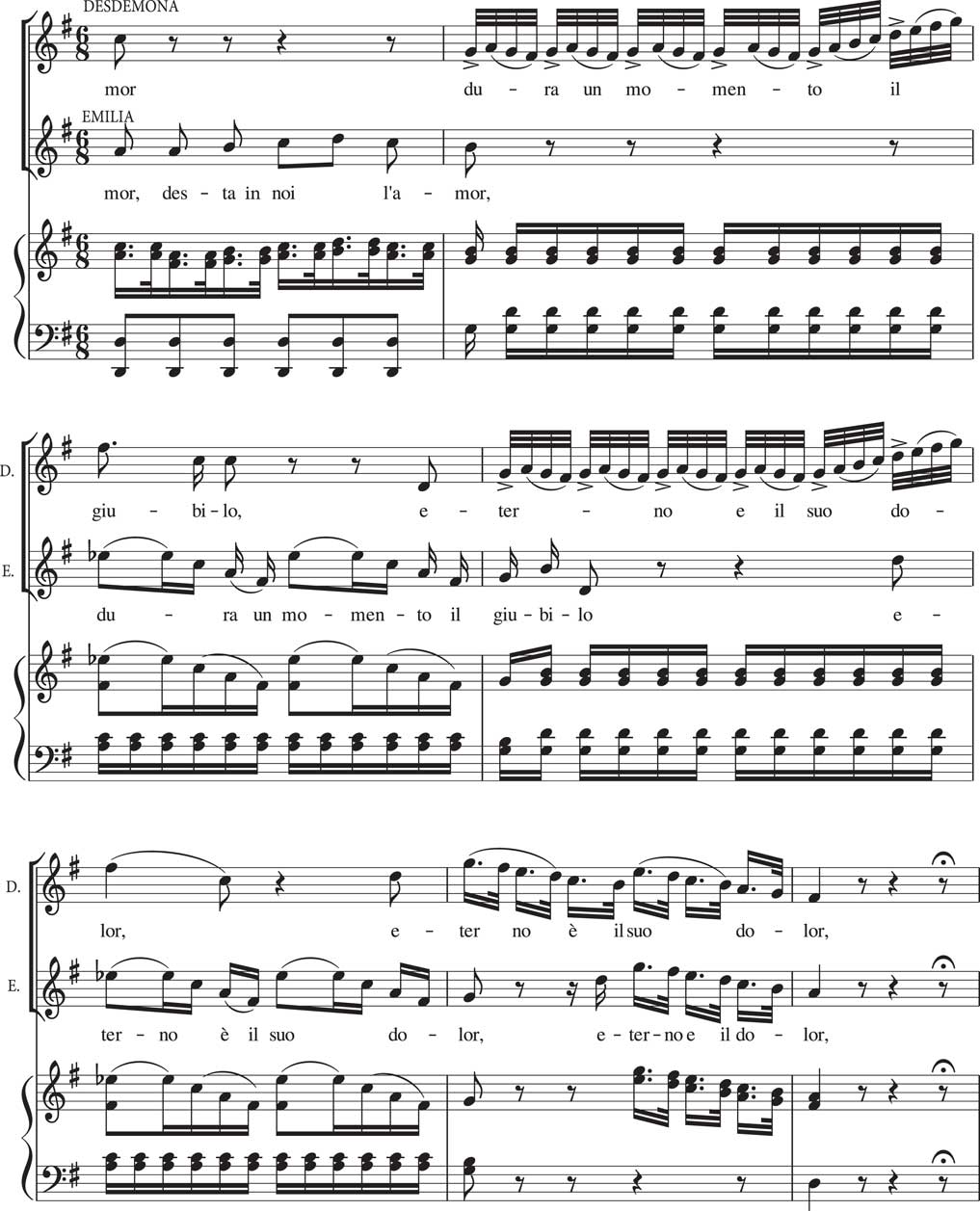
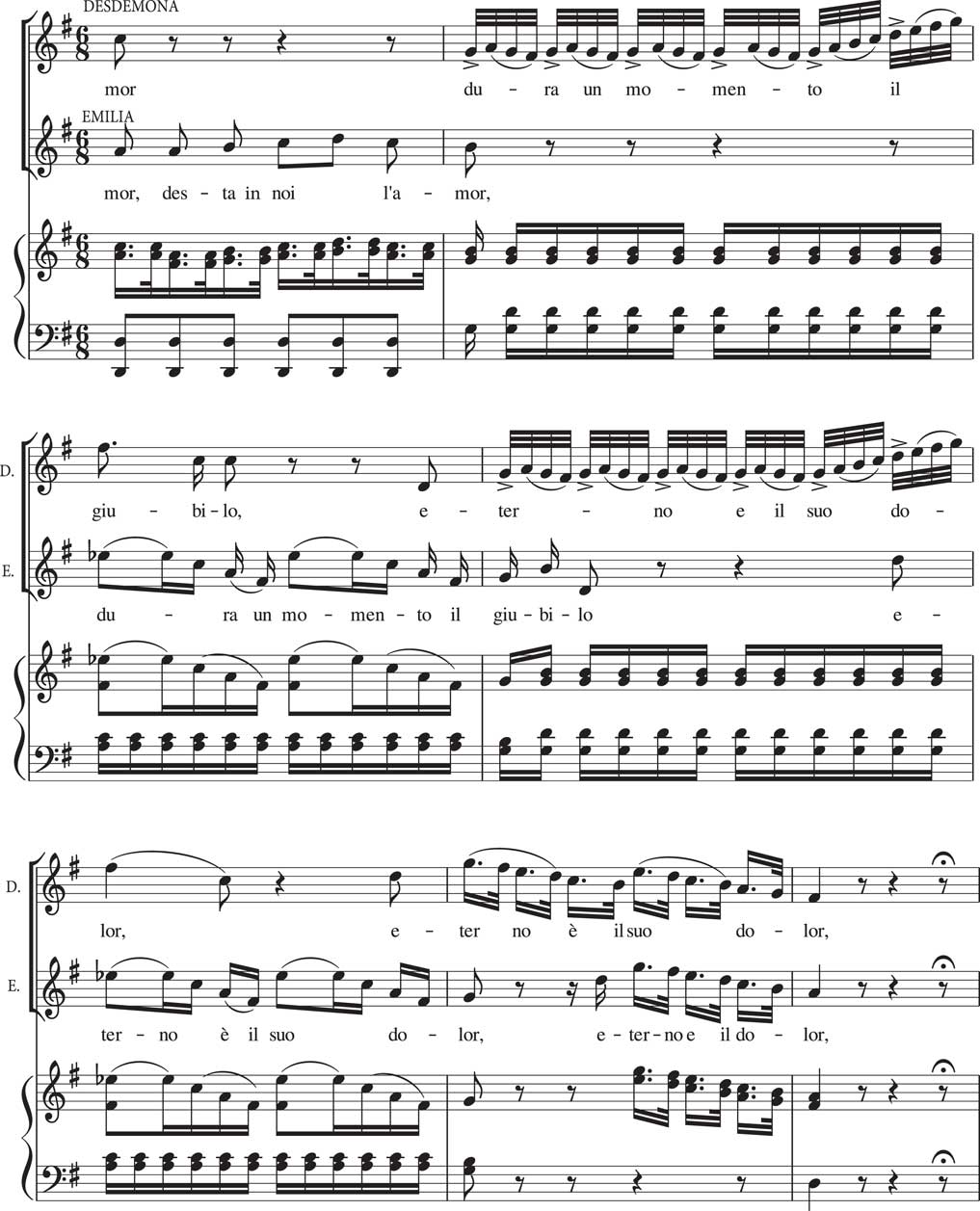
The first act of Otello presented a challenge to the singers: Desdemona famously enters not with a grand aria announcing a diva’s presence, but with a duettino between Desdemona and Emilia, her maid. This duet captures the sweet simplicity of Desdemona’s character, but does not provide many opportunities for displaying the voice. Its most showy passages consist of repeated turns for Desdemona, while all other passages are easily doubled by Emilia. The results are delightful to listen to, but express sympathetic commiseration more than heated passion (see Ex. 1). In lieu of this simple duet, most prime donne decided instead to first enter with an aria of their own choosing and then sing the duettino once their presence had been established. While Pasta sang another scena and cavatina by Rossini, Adelaide Tosi performed a slow movement by Meyerbeer and a cabaletta by Nicolini, and Grisi used ‘Stanca di più combattere’.Footnote 48
Gioachino Rossini, Otello, Act I, No. 4, Duetto, bb. 38–44.
Since such ‘insertion arias’ were generally chosen by the singer as a means for displaying his or her voice, even those not written to order for a particular voice can reveal much not only about a singer’s vocal strengths and weaknesses, but also about the ways she would like to be seen and the kind of dramatic personae she might wish to convey or embrace. ‘Stanca di più combattere’, designed for Grisi by a composer who knew her voice better than anyone, and a piece that she then carried around from city to city, and from opera to opera, therefore offers an even richer source of insight.Footnote 49 The aria, which was performed in various recital and operatic contexts and also published as sheet music for fans to sing at home, bears a strong imprint of Grisi’s personality and ownership. In its material form, as sheet music, the aria is almost analogous to the other physical souvenirs of singers popular in the 1830s such as engraved portraits and commemorative poems, and made its way into the homes of London patrons both as a memory of a performance and as a printed souvenir to be bought and possessed.Footnote 50
Marliani’s knowledge of Grisi’s voice makes it likely that when writing an aria specifically for her, he would include melodic patterns and opportunities for ornamentation that would display her voice to advantage. Commercial prints of the aria, therefore, could give amateurs who had not heard Grisi (but still wanted to participate in the general enthusiasm for her) an impression of her capabilities and of her voice. The sheet music could evoke Grisi’s live performances; but at the same time its connection to past performances lingering only in memory might serve to remind the amateurs who bought this music of the ephemerality of those performances. Amateurs could dress up as their diva by singing her aria, but could never achieve her timbre or emotional performance.
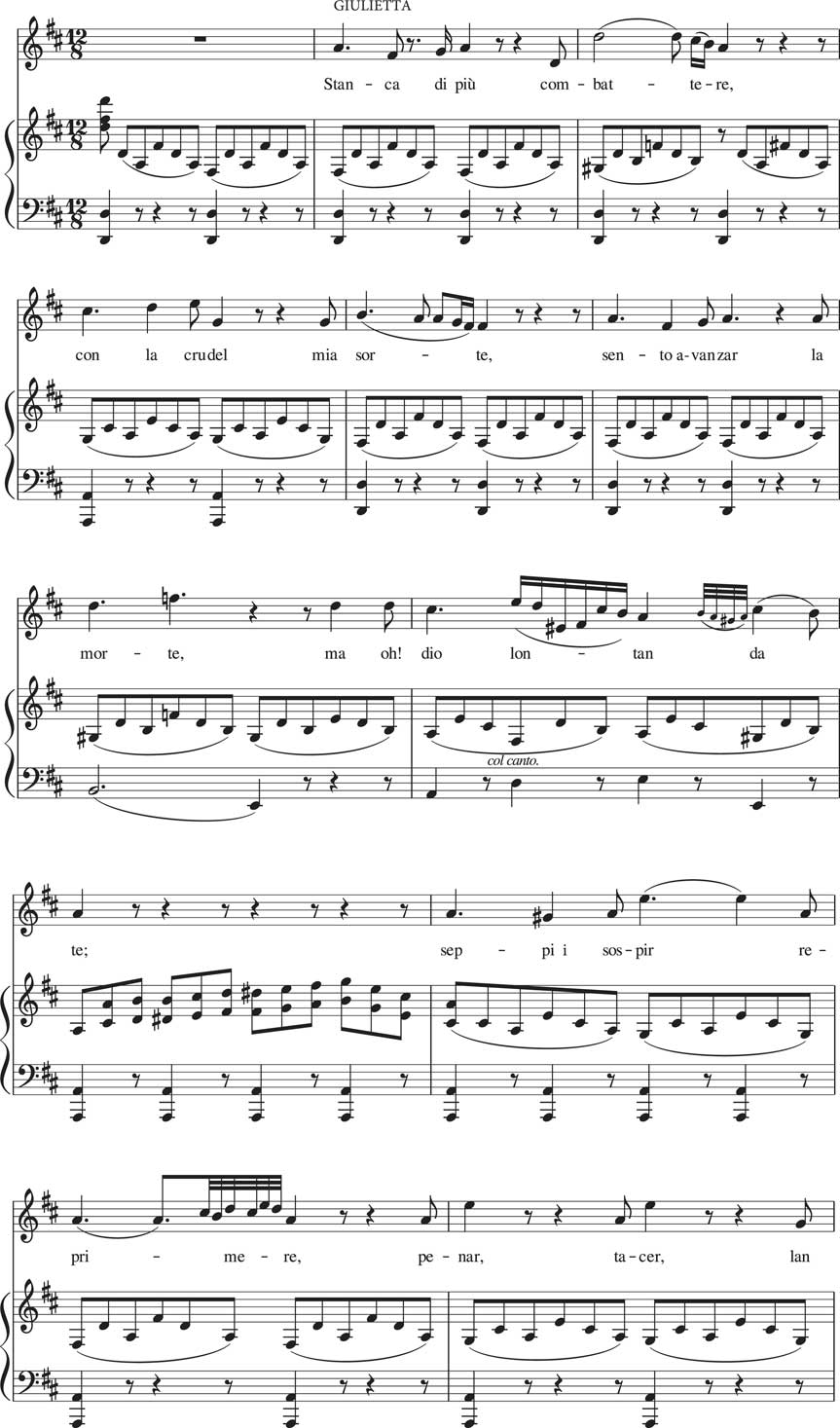
The aria begins with a straightforwardly simple melodic statement: amateurs could pick out the opening phrases, which are diatonic and squarely emphasise the beat (see Ex. 2).
Marco Aureliano Marliani, ‘Stanca di più combattere’, bb. 4–15.
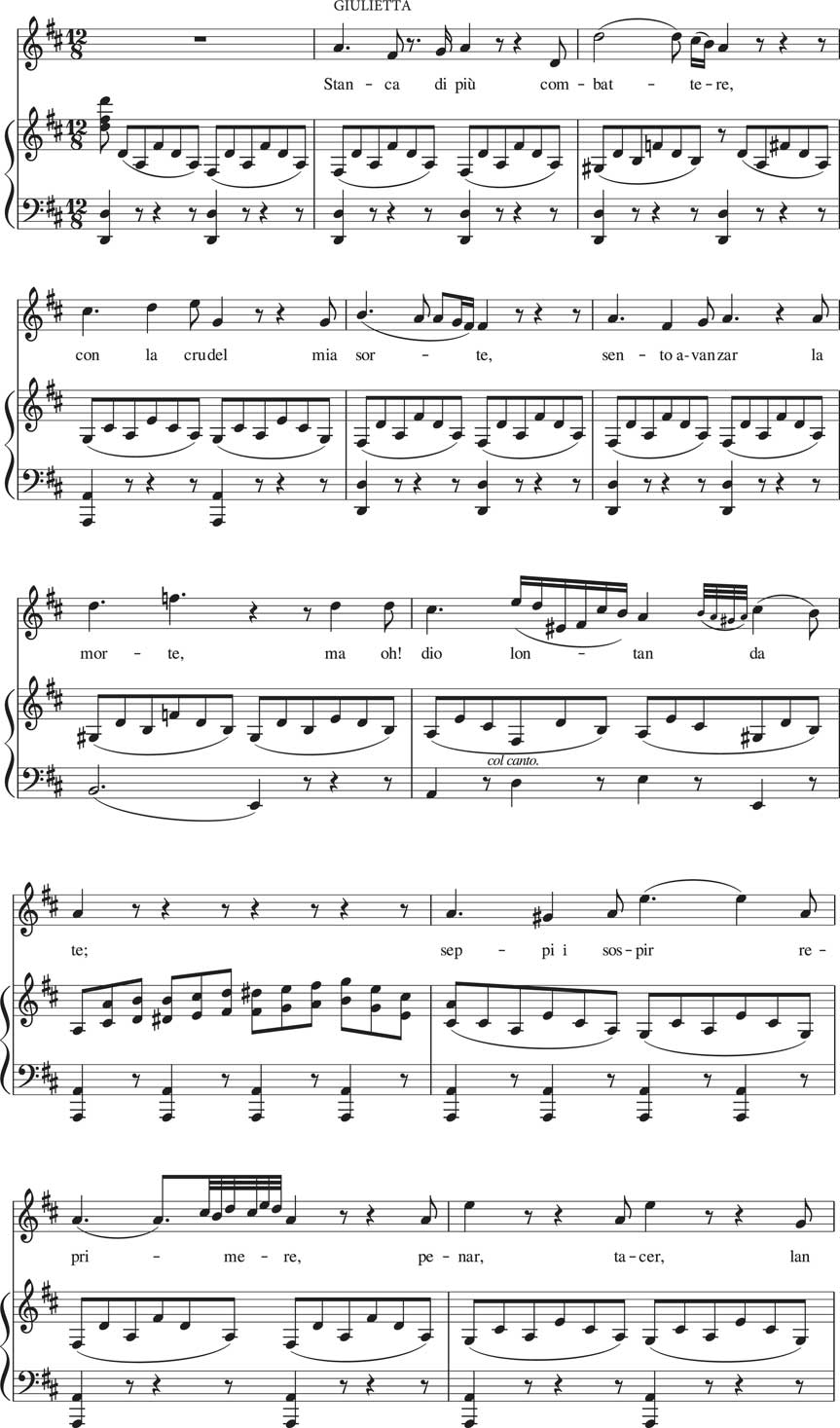
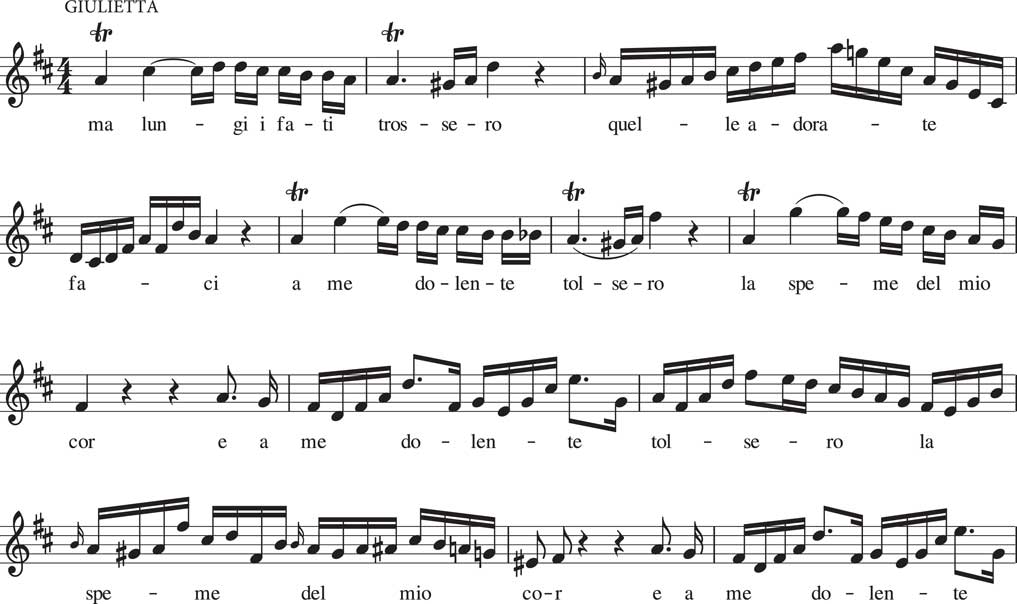
Leaps in bars 10, 13 and 15 all are well supported by the accompaniment, and a beginner could easily cut out the minimal ornamentation in bars 11 and 14. Though it begins simply, it later includes passages that are pleasurably beyond the skills of an amateur, such as the rapid runs in bars 65–6 and the arpeggios in bars 71–5 that capture a sense of what only Grisi could do. Though the final section of the cabaletta exceeds the limits of an amateur performer, it still retains a sense of delicacy and careful articulation (see Ex. 3). In his story about Grisi at the supper party, Willis describes an impromptu performance in which she imitated a pet mockingbird. His account of the performance gives an idea of the agility of her voice, and of the various tones she could deploy:
How much embellishment there was in her imitations of her treasure I do not know; but certainly the whole power of her wondrous voice, passion, and knowledge of music seemed drunk up at once in the wild, various, difficult, and rapid mixture of the capricious melody she undertook. First came, without the passage which it usually terminates, the long, throat-down, gurgling, water-toned trill, in which Rubini (but for the bird and its mistress, it seemed to me) would have been inimitable: then, right upon it, as if it were the beginning of a bar, and in the most unbreathing continuity, followed a brilliant passage from the Barber of Seville, run into the passionate prayer of Anna Bolena in her madness, and followed by the air of ‘Suoni la tromba intrepida’, the tremendous duet in the Puritani, between Tamburini and Lablache. Up to the sky and down to the earth again – away with a note of the wildest gladness, and back upon a note of the most touching melancholy – if the bird but half equals the imitation of his mistress, he were worth the jewel in a Sultan’s turban.Footnote 51
Marco Aureliano Marliani, ‘Stanca di più combattere’, bb. 63–75.
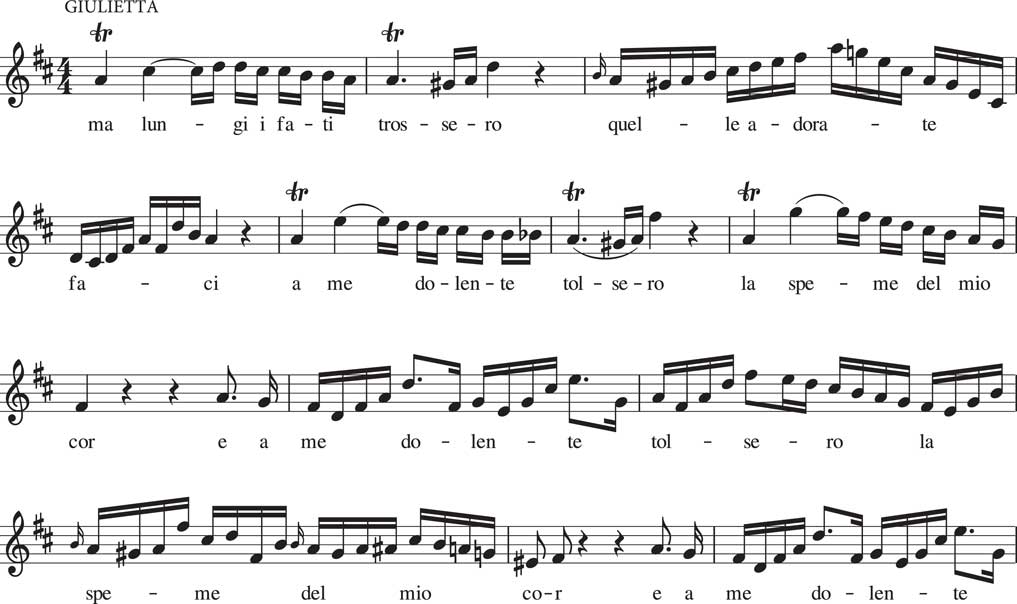
Grisi’s agility, her range of pitch and emotion, and her continuity of breath are certainly suggested by the runs and arpeggios at the end of ‘Stanca di più’, and this idea of her voice is supported by another piece written expressly for Grisi, ‘Son vergin vezzosa’: the showpiece for the role of Elvira in Bellini’s I Puritani.
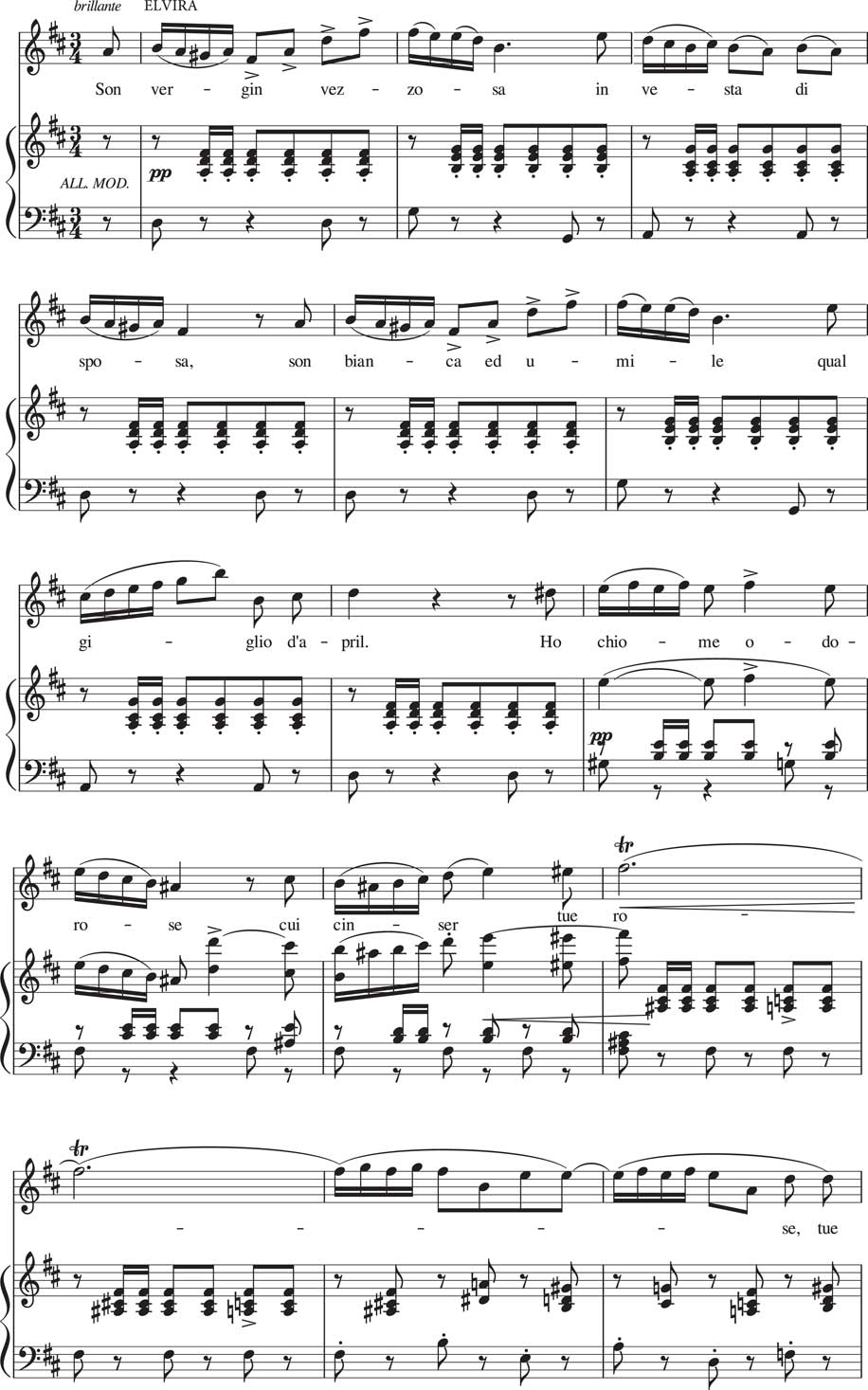
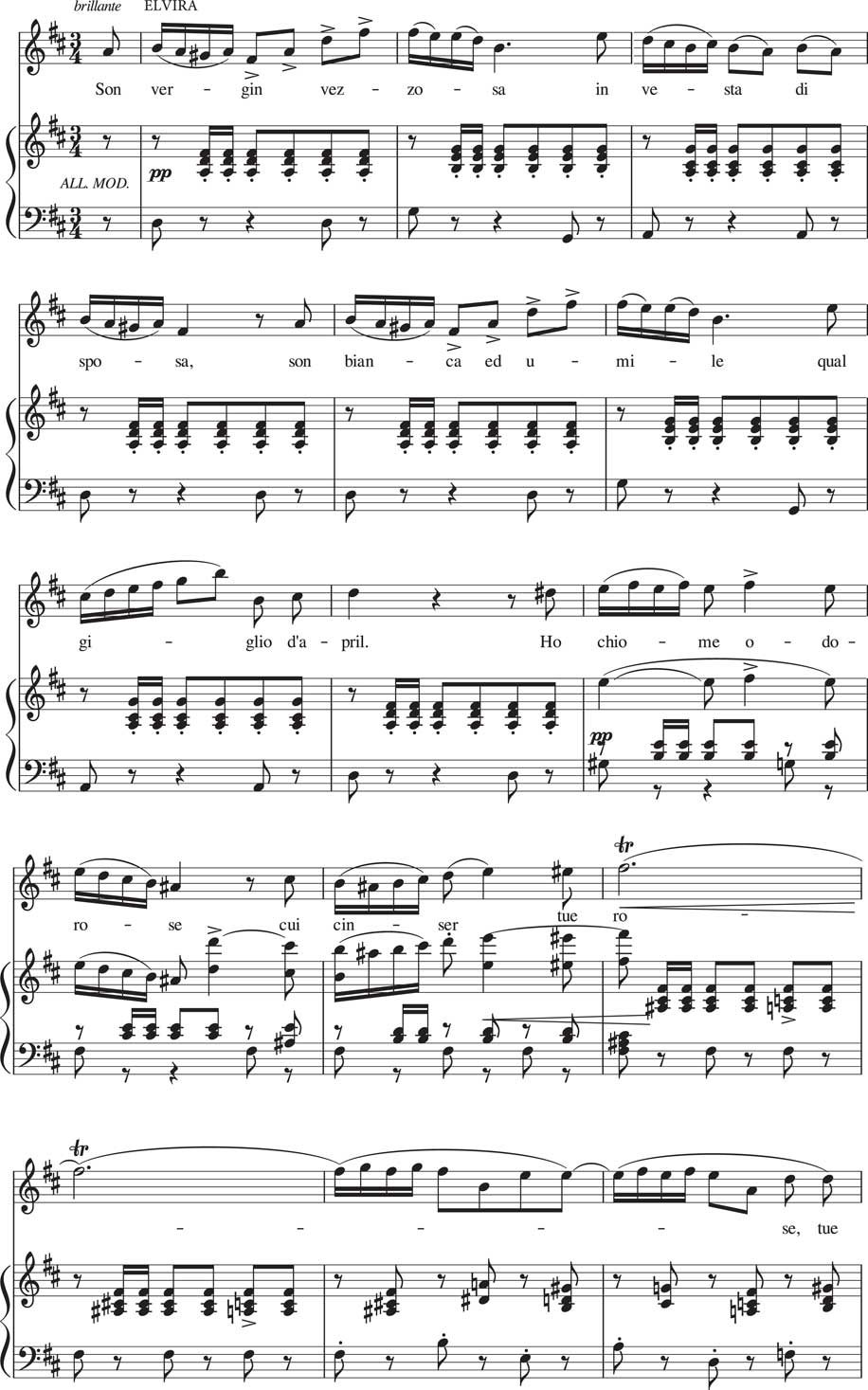
Like ‘Stanca di più’, ‘Son vergin vezzosa’ requires careful articulation of repeated notes (see Ex. 4). The articulation marks in bar 1 specify that the arpeggio should be separated, and the slurs in bar 2 demarcate the repeated Es. The extended trill on F sharp in bars 12–13 slows down into a semiquaver trill in bar 14, followed by another repeated E requiring careful articulation and giving the impression of throbbing as the gesture is repeated again in bar 15. Similarly, in ‘Stanca di più’, the descending passages require careful control of breath to articulate and emphasise each note, while the chromatic passage in bars 73–4 highlights Grisi’s control and delicacy. While Rossini’s opening duettino provided occasions for displaying articulation and trills, and Malibran’s choice emphasised her dramatic capabilities, Marliani’s aria emphasised the timbre of Grisi’s voice along with her breath control and subtle shading of pitch.
Vincenzo Bellini, I Puritani, Act I scene 3, Polacca, bb. 1–15.
Though highly evocative of the specificities of Grisi’s voice, the sheet music does not of course preserve or evoke all aspects of her performance. How did she look? What gestures did she make? When did she breathe? Did she play with tempo? How many ornaments did she put in, and where? Instead of preserving Grisi’s performance, owning and playing the sheet music reinforces the singularity of Grisi’s performance at the theatre as something distinct from amateur performance and the sheet music. Though the print was reproducible, Grisi’s performance, whether as a singular event or as a collective idea of multiple occasions, was not.
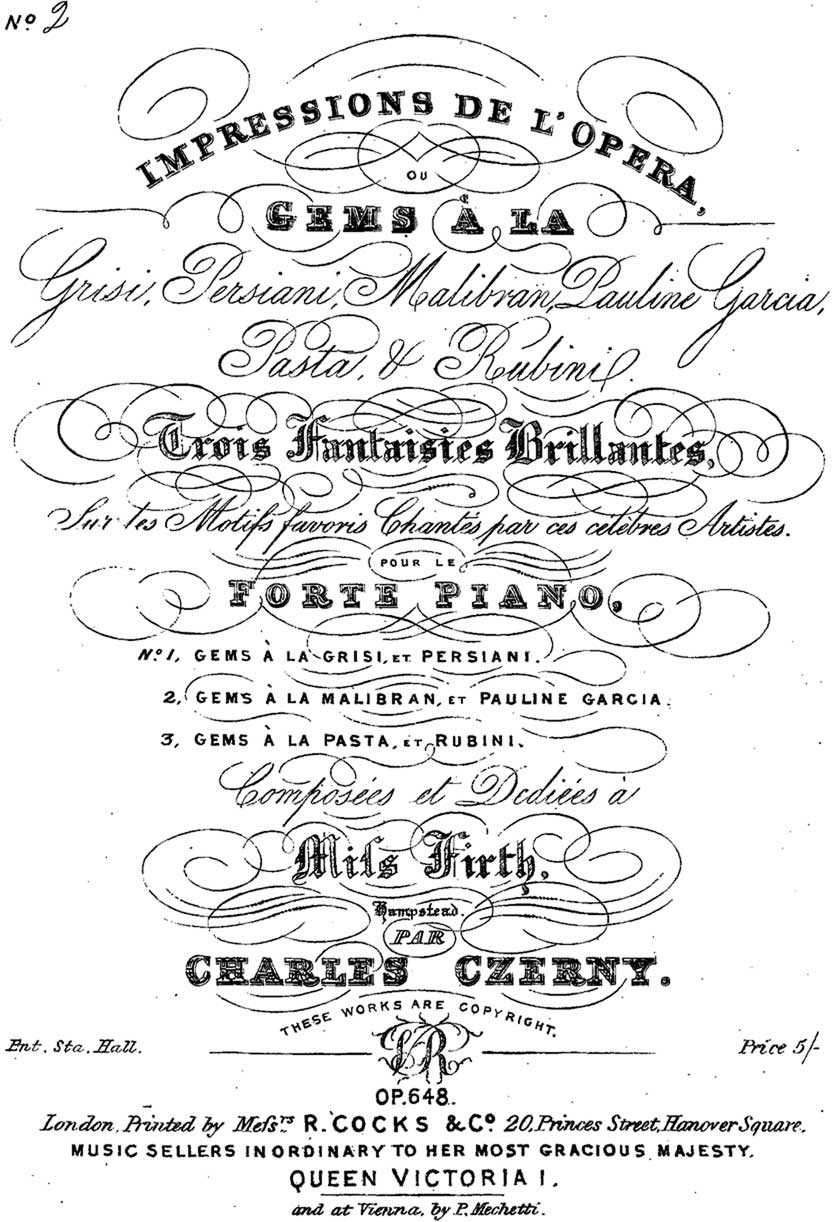
The specificity of Grisi lost importance, however, when her celebrity was used to promote sales. For the crowd buying music for three shillings, collective fame mattered more than precision or accuracy, and publishers used singers and operas interchangeably to advertise sheet music. At least two arrangements of ‘Stanca di più combattere’ advertise themselves ‘as sung by Giulietta Grisi in Otello’.Footnote 52 However, Czerny’s arrangement of the same aria places it in his collection ‘Gems à la Malibran et Pauline Garcia’ rather than in the collection, ‘Gems à la Grisi et Persiani’ (for the title page, listing all three collections, see Fig. 1). Grisi is not the only star who suffered from this lack of specificity; Bochsa’s ‘Gems de l’Opéra’ includes Bellini’s ‘Deh! Non ferir, deh sentimi’, sung by ‘Mesdames Pasta, Malibran, & de Meric’.Footnote 53 The options do not stop there; the piece is arranged for either harp or piano, and includes optional flute or cello accompaniments. Similarly, Bochsa’s La Loge à l’Opéra Italien includes the number ‘L’amo, ah l’amo’ or ‘Bellini’s favourite cavatina, as sung in his operas Capuleti, Sonnambula, & Puritani’.Footnote 54 The reuse of arias by composers was not unusual, of course, nor was the arrangement of a piece for various instruments or the sharing of arias between singers. Yet, the interchangeability of singers demonstrated by the list of Pasta, Malibran, and Henriette Méric Lalande (as de Meric) or ‘Stanca di più’ being credited to Grisi, Malibran and Viardot contrasts with how carefully reviewers and dilettantes scrutinised singers and compared them to each other. The performances mattered as singular events, but once transformed into commercial objects for reproduction such as sheet music, celebrities potentially became more interchangeable to this new type of consumer.
Title page of Carl Czerny, Impressions de l’Opéra: Gems à la Malibran et Pauline Garcia (London: R. Cocks & Co, [1841]).

Memories of Grisi’s performance, and the comparison between home performance and that of the star, however, were fashionable trading cards, held only by those who went to the opera. Grisi’s performances, captured in print, could appeal both to those who valued the sheet music as a way of consuming interchangeable celebrities and to those who valued it for its reinforcement of the specificity of Grisi’s performance as witnessed personally. Sheet music such as ‘Stanca di più’ allowed the daughters of aspiring businessmen to partake in the activities of the elite. Prints of music ‘as sung by’ Grisi, though commercial, however, still allowed elitism to reign. True possession of the sheet music lay not in the amateur’s performance of it, but in the inevitable failure of that performance to live up to the memory of Grisi performing it herself, a comparison only accessible to those who had seen Grisi perform in person.
You can take it with you
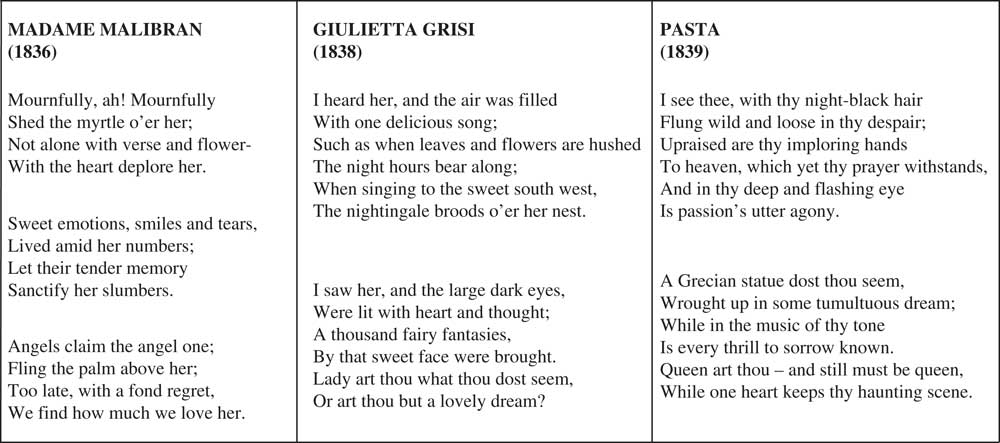
While memories were valuable, tangible items were easier to display, particularly if they served as small tokens of friendship. In December 1835, the Literary Gazette announced the publication of a Lilliputian gem to commemorate the New Year.Footnote 55 For several years, a miniature almanac summarising and celebrating the passing year had been published in Germany, and in its usual fashion (according to the Gazette), England had not only contributed to the genre, but had also surpassed the original.Footnote 56 Schloss’s English Bijou Almanac for 1836 was the first in a series that lasted eight years. Each volume was as big as a lady’s thumbnail and included a calendar, a listing of the royal family and ministers, and poems celebrating six notable personages, with a portrait of each dedicatee. The miniature book provided a lasting memory of a fleeting moment: each volume spanned a year, informing people of the dates of holidays and capturing famous personalities, but the book was designed to be reread later, in reminiscence and wonder. Each year’s almanac, however, no matter how marvellous or sentimental, would be superseded the following January by another volume. The poems speak to this double purpose of capturing and preserving passing fashions.Footnote 57 Most of the poems, even those celebrating the living, focus on the endurance of the subject’s fame into the future. Authors and composers such as Goethe, Mozart and Beethoven are claimed as universal, as figures whose work will endure into perpetuity in the hearts of their admirers.Footnote 58 At least one poem per year was devoted to a member of the royal household, and the other poems praised authors, poets, painters and singers. While many of these poems were in memoriam, such as those for William IV and Maria Malibran, others addressed current events and fashions: births and marriages of royalty, publication of popular books and success at the theatre. Malibran, Grisi and Pasta are celebrated for radiant moments of performance and for the lasting memories of these moments (see Fig. 2).Footnote 59
Letitia Elizabeth Landon, ‘Madame Malibran’, in The English Bijou Almanac (London: Schloss, 1836); Letitia Elizabeth Landon, ‘Giulietta Grisi’, in The English Bijou Almanac (London: Schloss, 1838); S. Lover, ‘Pasta’, in The English Bijou Almanac (London: Schloss, 1839).
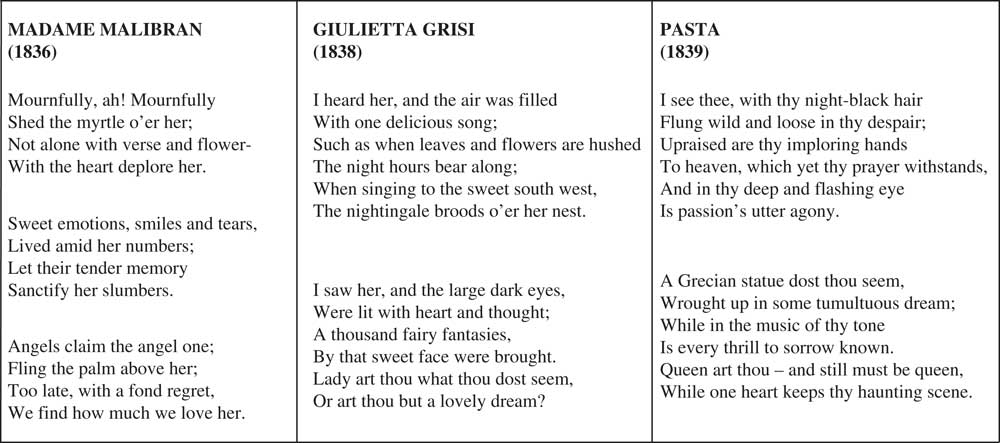
The content of the poems dedicated to divas and the size and function of the Bijou Almanac foreground the fundamental paradox of celebrities simultaneously being both replaceable commodities and universal figures whose influence will endure forever. This sort of engagement is encouraged by the poems, which depict the singers as simultaneously specific and detailed, but also out of reach. Each diva is celebrated for her own unique character and circumstance; in death, Malibran is sanctified and made saccharine; Grisi, at the height of her fame, is a vision of peaceful nature; while Pasta, though retired, is vibrantly alive. Though reviews of Malibran’s performances written while she was performing stressed her passionate nature and complete immersion in her characters (most notably Desdemona), posthumously the poem depicts milder emotions. The moment of performance is reduced to the ‘sweet emotions, smiles and tears’ that she expressed (and that her audience shared). Pasta, on the other hand, is unrestrained. The poem catches her in motion, hands, hair and eyes all joining to express her passion. Like a statue caught in the middle of passion or action, the poem captures Pasta in her most tormented display. Pasta retired in 1835 (and had her last appearance in London in 1837), but her fervent performances as Norma and Medea remained clear in the memories of critics through the 1840s and new performances by rising stars would inevitably be compared against Pasta’s passion.Footnote 60 Like Malibran and Pasta, Grisi captivates the senses, but she does so in a much calmer manner.Footnote 61 Grisi is one with nightingales, fairies and peaceful evening reveries. Each stanza of the poem flows with comparisons to nature and the imagination, which are the only things capable of conveying the sound and sight of Grisi. She is too marvellous to be real, and the author addresses her in the final couplet, asking if she is only a dream.
The rhetorical strategy of these poems involves pulling each singer closer for inspection before relegating her to the foggy space of dreams or memory. Recollections of Malibran touch listeners who discovered their love for her only too late; the retired Pasta reigns on in memory; Grisi is a gauzy dream. These appeals to imagination are intensified by the almanac’s miniature format. From the outside, a book is a closed object that a person can know completely; but once open, the text is no longer contained and its potential meanings and associations stretch to infinity. Miniature books exacerbate this tension because they are so obviously objects: they can be passed from hand to hand or cradled in a velvet box like a jewel. Susan Stewart has suggested that almanacs were particularly suited to the process of miniaturisation and to the concomitant expansion of interior worlds via the imagination.Footnote 62 Opening the book to the almost miraculously miniscule writing can also prompt a tug in the opposite direction, however: while the world is reduced to fit within the covers, the tiny writing threatens to disappear into infinity and to magnify the world. The divergence between material and meaning produces the possibility of infinite containment and expansion; if a book the size of a thumbnail can contain the world and a year, what else might it hold? And, moreover, what secrets were hidden inside other exteriors? The reduction of fashionable London to a tiny book encourages the discovery of microcosms in all spaces and opens up the imagination of the reader to alternative interiorities, such as memories and make-believe.Footnote 63
Fantasy and the imagination were (and are) crucial to celebrity culture. Participation required memories and mental connections between the buyer and the star. The poems emphasise the imaginative aspect of celebrity and posterity by elaborating on the emotional and fantastic transformations of singers and audiences. The interplay between memories and tangible objects, such as the almanac, parallels the interplay between the aura of a celebrity and their physical instantiation and performances. This tension between a general imagining of the artist and a specific performative moment speaks to the tension in the process of celebrity: celebrities were prized for their unique personalities and performances, but they were also rapidly replaced, only available through the imagination and part of a fashionable cycle. The inclusion of singers in the Bijou Almanac illuminates all these contexts: the singers’ poems can be read as celebrations of specific talents (Malibran is the subject of tragedy, Pasta of passion and Grisi of fantasy) and as a commercial enterprise of nostalgia.
The almanac could be bought at a range of prices, so was accessible to a variety of patrons. For as little as a shilling and sixpence, the album could be ‘beautifully bound, [with] gilt edges, in a highly embellished case’, or one could purchase additional embellishments. The sum of the most expensive options would be twelve shillings, to have an almanac ‘elegantly bound in extra illuminated morocco or vellum’, an ‘elegantly illuminated and beautifully gilt morocco case, with spring fastenings’ and the ‘powerful microscopic eye-glass (of half an inch focus) in tortoiseshell’ folded into its own little tortoiseshell case.Footnote 64 In the 1840 edition, Schloss proudly proclaimed that the almanac was ‘Patronised by Her Majesty the Queen, and all the Royal Family’, while personalised copies of the 1841 edition were presented to the members of the Royal Family.Footnote 65 Those aspiring to elegance could not go wrong with the uncontroversial little book as a gift or souvenir.
For those who gave the bijou as a gift, it acted as a token of friendship and reminder of the giver, both for the recipient and for their other friends.Footnote 66 The almanac was designed for display: The Mirror claimed that ‘For our part, we have not seen so pretty and useful a little trifle to lie upon a boudoir-table, pier-slab, or encognure, as is the English Bijou.’Footnote 67 The Literary Gazette also imagines the little book in a lady’s home, but draws attention to its perfection as a gift:
So pretty, so fit for presents, so convenient to send, and so easy to keep; so curious on the boudoir toilette, so amusing on the drawing room table … Instead of petty larceny, it is downright robbery, to tempt us to possess a bijou for each of the dozen or two of friends, &c., whom we cannot help remembering and loving, and wishing to remember and love us at Christmas.Footnote 68
The Gazette defined the perfect gift as something convenient to both the giver and the recipient, which would remind the recipient of the giver’s affection and inspire the same affection in them. The gift, in other words, was part of a transaction of remembrance between friends.Footnote 69 The Bijou Almanac reified memories of celebrities and of a specific historical moment, and also memories of friendship. Depending on the owner, the specificity of a singer or their general celebrity status could take precedence, but most importantly, the Bijou Almanac allowed the owner to enjoy both possessing a singer and possessing a fashionable object.
Conclusion
Possessing a singer could be as simple as buying a poem or as complicated as stalking Grisi in her dressing room. While the second of these reactions is threatening, violent and inappropriate, it is not too difficult to believe that Dupuget’s obsession with Grisi was nurtured by some of the same mechanisms of marketing and mediation that also generated the delicate little almanac and its sappy commemorative poems. Somehow female opera singers – even more than other celebrities, I would argue – inspire the impulse to draw near, to know intimately and even in some way to ‘own’ the prima donna. The heady combination of performed role and public persona encouraged nineteenth-century audience members to identify with and occasionally impersonate the singer and contributed to an appearance of intimacy. Grisi was obviously a performer when she stepped onstage as Elvira in I Puritani or Desdemona in Otello, but this clear role-playing paradoxically rendered her off-stage persona even more personal. Objects and texts, such as miniatures, scores, portraits and stories in gossip magazines, encouraged their owners to connect and identify with Grisi’s public persona and its illusion of authenticity.
Access and intimacy were both desirable to Grisi’s audiences in the 1830s and crucial elements in defining and creating her as a celebrity. Material and textual objects that drew on and inspired the imagination in different ways allowed opera-goers and fans to develop a satisfying relationship with star performers. This not only allowed Grisi to reach different audiences through distinct media channels – think of the different desires of young women performing in parlours, of society grand-dames and of prospective suitors – but also sustained the illusion of depth. A composite image of a celebrity, conjured by a proliferation of materials with the active encouragement of imagination and memory, gives the distant subject the texture of reality and permits a kind of intimacy that is no less important because entirely imagined.
London opera-goers needed their imaginations (and preferably also memories of a performance) to make a score sing or a souvenir almanac attain its full meaning. Their particular memories are inevitably lost to us in the twenty-first century; but the physical and textual sources that inspired them can, in turn, stimulate our own imaginations as historians and opera lovers. The material specificity of these souvenirs, manufactured to order for a precise place, time and cultural mood, make them especially rich sources for historians. Encountering a volume like the Bijou Almanac sparks especially vivid fantasies – and insights too – into the singer and the audience members who loved her.