Introduction
Recent work suggests that stress-sensitivity, operationalized as negative affect (NA) reactivity towards small daily life stressors in the flow of daily life, may represent the behavioural expression of liability to develop a major depressive disorder (Wichers et al. Reference Wichers, Myin-Germeys, Jacobs, Peeters, Kenis, Derom, Vlietinck, Delespaul and Van Os2007). However, it is not known how the phenotype of stress-sensitivity develops over time and what factors impact on its developmental course. Although genes may contribute to variation in stress-sensitivity (Wichers et al. Reference Wichers, Myin-Germeys, Jacobs, Peeters, Kenis, Derom, Vlietinck, Delespaul and Van Os2007), it is likely that both genetic and environmental factors influence its development. A factor of interest in this regard is exposure to trauma and stress over the life course. Thus, stressful events in the prenatal period (reflected in lower birthweight relative to gestational age) (Thompson et al. Reference Thompson, Syddall, Rodin, Osmond and Barker2001; van Os et al. Reference van Os, Wichers, Danckaerts, Van Gestel, Derom and Vlietinck2001; Gale & Martyn, Reference Gale and Martyn2004), childhood (Weil et al. Reference Weil, Florenzano, Vitriol, Cruz, Carvajal, Fullerton and Muniz2004) and adulthood (Friis et al. Reference Friis, Wittchen, Pfister and Lieb2002), directly or in interaction with genetic factors, all increase the risk for depression and related disorders (Van Praag et al. Reference Van Praag, De Kloet, Van Os, Van Praag, De Kloet and Van Os2004).
To explain the long-term effects of early stress on later adult vulnerability, it has been suggested (Post, Reference Post1992; Monroe & Harkness, Reference Monroe and Harkness2005), on the basis of animal laboratory studies, that a process of ‘sensitization’ to stressors occurs over the course of development in some individuals. Early stress may cause structural changes due to the induction of gene-transcription factors such as c-fos, that are likely to result in long-term changes in the expression of neurotransmitters, receptors and neuropeptides. It is hypothesized that these changes induce sensitization, or progressively lower thresholds to stress (Post, Reference Post1992; Monroe & Harkness, Reference Monroe and Harkness2005), so that with each further exposure less stress is required for similar behavioural (and biological) responses (van Dijken et al. Reference van Dijken, Van der Heyden, Mos and Tilders1992, Reference van Dijken, de Goeij, Sutanto, Mos, de Kloet and Tilders1993). Findings concerning stress and depression in the literature, for example the fact that recurrences of depression become increasingly independent of major life stressors as more episodes are experienced and eventually can be triggered even by minor events (Kendler et al. Reference Kendler, Thornton and Gardner2001; Monroe & Harkness, Reference Monroe and Harkness2005), support the notion that a process of sensitization may be involved.
In the light of this sensitization theory and evidence for the role of early stress and later depression, there is face validity to the hypothesis that past stress exposures may contribute to current daily life stress-sensitivity by increasing the negative affective responses to small daily life stressors. One previous study has found evidence for effects of childhood adversity on daily life stress-sensitivity (Glaser et al. Reference Glaser, van Os, Portegijs and Myin-Germeys2006). As sensitization continues and stress-sensitivity increases, small daily life stressors may generate progressively higher levels of NA, eventually culminating in a clinical depressive state.
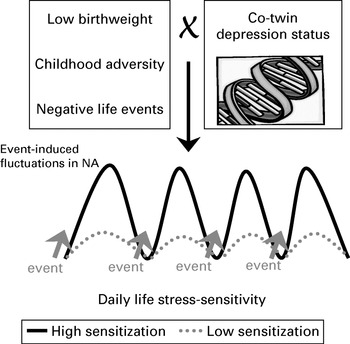
In this study, we hypothesized that the mechanism underlying vulnerability for depression – NA reactivity to daily life stressors – involves a process of sensitization, the origin of which can be traced to major stress exposures during development (Fig. 1). Furthermore, because (i) NA reactivity to daily life stressors has a genetic component (Wichers et al. Reference Wichers, Myin-Germeys, Jacobs, Peeters, Kenis, Derom, Vlietinck, Delespaul and Van Os2007) and (ii) moderating effects of genes on the association between stress exposure and depression exist (Caspi et al. Reference Caspi, Sugden, Moffitt, Taylor, Craig, Harrington, McClay, Mill, Martin, Braithwaite and Poulton2003; Kaufman et al. Reference Kaufman, Yang, Douglas-Palumberi, Grasso, Lipschitz, Houshyar, Krystal and Gelernter2006; Kim-Cohen et al. Reference Kim-Cohen, Caspi, Taylor, Williams, Newcombe, Craig and Moffitt2006; Rice et al. Reference Rice, Harold and Thapar2006), we hypothesized that the impact of developmental stressors on adult daily life stress-sensitivity is dependent on genetic factors (Fig. 1). The current study examined the effects of stress exposures at several points during development (prenatal period, childhood and adulthood) on daily life stress-sensitivity, and also the extent to which the effects of early life stress might be moderated by genetic vulnerability to depression.
We hypothesized that stress exposures over the course of development increase daily life stress-sensitivity through a process of sensitization. Genetic factors may impact on sensitization by increasing the effects of stressors on the sensitization process.

A large female twin sample, in whom prospectively collected perinatal data and data on developmental trauma were available, participated in a momentary assessment procedure referred to as the Experience Sampling Method (ESM), which prospectively measures daily life occurrences, affect and stress appraisals.
Method
Sample
The study sample consisted of 621 subjects. These subjects were general population twins (part of 292 female pairs) and non-twin sisters (n=46) aged between 18 and 46 years from Flanders, Belgium. The twins were recruited from the East Flanders Prospective Twin Survey (EFPTS) (218 pairs) and from birth registers of Flemish municipalities in Belgium. This population-based survey has prospectively recorded all multiple births in the province of East Flanders since 1964 (Loos et al. Reference Loos, Derom, Vlietinck and Derom1998; Derom et al. Reference Derom, Vlietinck, Thiery, Leroy, Fryns and Derom2006). The project was approved by the local ethics committee and all participants gave written informed consent. The sample was female only, given evidence for sex-specific differences in response to stress (Pohl et al. Reference Pohl, Olmstead, Wynne-Edwards, Harkness and Menard2007; Weekes et al. Reference Weekes, Lewis, Goto, Garrison-Jakel, Patel and Lupien2008).
The ESM
The ESM is a structured diary technique for assessing subjects in their daily living environment, and has been validated for use in studying the immediate effects of stressors on mood (Csikszentmihalyi & Larson, Reference Csikszentmihalyi and Larson1987; DeVries, Reference DeVries1992; Delespaul, Reference Delespaul1995; Myin-Germeys et al. Reference Myin-Germeys, van Os, Schwartz, Stone and Delespaul2001). Subjects received a digital wristwatch and a set of ESM self-assessment forms collated in a booklet for each day. The wristwatch was programmed to emit a signal (‘beep’) at an unpredictable moment in each of ten 90-min time blocks between 07:30 and 22:30 hours on five consecutive days. After each beep, subjects were asked to stop their activity and to fill out the ESM self-assessment forms previously handed to them, collecting reports of thoughts, current context (activity, persons present, and location) and appraisals of current situation and mood. All self-assessments were rated on seven-point Likert scales. Quality-control procedures were carried out as described elsewhere (Wichers et al. Reference Wichers, Myin-Germeys, Jacobs, Peeters, Kenis, Derom, Vlietinck, Delespaul and Van Os2007). Subjects were instructed to complete their reports immediately after the beep, thus minimizing memory distortion, and to record the time at which they completed the form. To determine whether the subjects had completed the form within 15 min of the beep, the time at which subjects indicated they completed the report was compared to the actual time of the beep. All reports not filled in within 15 min of the beep were excluded from the analysis because previous work (Delespaul, Reference Delespaul1995) has shown that reports completed after this interval are less reliable and consequently less valid. In addition, previous work has shown that subjects who have valid reports for at least one-third of all measurements can be included because their missing data do not distort the results whereas measures of individuals with <30% of valid reports are less reliable (Delespaul, Reference Delespaul1995). Therefore, subjects with <17 valid reports (out of 50) were excluded from the analysis.
Measurements
Birthweight and gestational age
Prenatal stress was estimated by the measurement of birthweight (in kg), controlled for gestational age, resulting in an estimate reflecting ‘small for gestational age’ (SGA). For the twins recruited from the EFPTS, perinatal data were registered prospectively at birth as recorded in the obstetric records. Gestational age was reported by the obstetrician at time of birth and was calculated as the number of completed weeks of pregnancy, based on the last menstrual period.
Childhood adversity
Childhood adversity was measured using the shortened version (Bernstein et al. Reference Bernstein, Ahluvalia, Pogge and Handelsman1997) of the 70-item Childhood Trauma Questionnaire (CTQ; Bernstein et al. Reference Bernstein, Fink, Handelsman, Foote, Lovejoy, Wenzel, Sapareto and Ruggiero1994; Arntz & Wessel, Reference Arntz and Wessel1996). At the request of the Twin Registry, the most explicit items concerning sexual and physical abuse were omitted; less explicit items were retained. The questionnaire thus consisted of 21 items with statements concerning early life experiences, such as ‘I was abused’, ‘There was not enough food’ and ‘I was neglected’. Items were scored on a scale of 1 (never true) to 5 (very often true). Cronbach's α for this 21-item questionnaire was 0.93.
Adult exposure to negative life events (NLEs)
An inventory of recent life events was made based on the event list of the Interview for Recent Life Events (Paykel, Reference Paykel1997). Participants reported whether any of 61 events occurred in the past 6 months and the extent to which these were experienced as unpleasant (from 1=very pleasant to 5=very unpleasant). These recent life events all represented datable occurrences involving changes in the external social environment. Events rated as unpleasant (i.e. a score of 4 indicating unpleasant or a score of 5 very unpleasant) were included in the analysis, and a continuous variable was constructed representing the number of such unpleasant events that occurred in the past 6 months (for details, see Jacobs et al. Reference Jacobs, Kenis, Peeters, Derom, Vlietinck and van Os2006).
Daily life NA and stress appraisal
Measures of daily life stress and NA were collected at each beep within the ESM framework. To measure ESM event-related stress, participants were asked to report the most important event that occurred between the current and the previous beep. This event was subsequently rated on a seven-point bipolar scale (−3=very unpleasant, 0=neutral, 3=very pleasant). Responses were recoded to allow high scores to reflect stress (−3=very pleasant, 0=neutral, 3=very unpleasant).
ESM NA was assessed at each beep with six mood adjectives (I feel ‘insecure’, ‘lonely’, ‘anxious’, ‘low’, ‘guilty’ and ‘suspicious’) rated on seven-point Likert scales. The mean of the six items forms the NA scale (Cronbach's α=0.76 over the subject mean).
Diagnosis of depression and depressive symptoms
The Structured Clinical Interview for DSM-IV Axis I disorders (SCID) was administered by trained psychologists to obtain current and lifetime diagnoses of major depressive disorder. The variable ‘co-twin lifetime depression’ was constructed, representing the lifetime depression history status of the proband's co-twin. Subjects also filled in the Symptom Checklist (SCL-90R) to obtain a continuous measure of depressive symptoms. The SCL-90R depression score was log-transformed to improve normality.
Analyses
ESM data have a hierarchical structure. In this study, multiple observations (level 1) were clustered within subjects (level 2), who were part of twin pairs (level 3). Multilevel analysis takes the variability associated with each level of nesting into account (Snijders & Bosker, Reference Snijders and Bosker1999). Multilevel linear regression analyses, using the xtmixed command in Stata version 10 (Stata Corporation, College Station, TX, USA), were applied to the data.
NA reactivity to daily life stressors (hereafter: ‘daily life stress-sensitivity’) was conceptualized as the effect of ESM event-related stress (hereafter: ‘daily stress’) on ESM NA. For the three continuous developmental stress exposures (birthweight, childhood adversity and adult life events), the effect on daily life stress-sensitivity was examined by regressing NA on the interaction between the developmental stress exposure and daily stress. For significant findings, dose–response associations were examined by creating, for each stress exposure, three groups with similar numbers of observations by dividing the distribution of developmental stress exposure values by their tertiles using the Stata xtile command. In addition, interactions between daily stress and all three stress exposures were entered simultaneously in the model to investigate whether their effects were independent from each other.
To examine whether the effect of developmental stress exposures on current daily life stress-sensitivity was moderated by genetic vulnerability to depression, a variable was constructed that represented the individual's genetic vulnerability to depression. This variable was coded 0 in case of no genetic vulnerability (a twin sister without lifetime depression), 1 for having a dizygotic (DZ) sister with lifetime depression and 2 for a monozygotic (MZ) sister with lifetime depression (Kendler et al. Reference Kendler, Kessler, Walters, MacLean, Neale, Heath and Eaves1995). NA was thus regressed on the three-way interaction between genetic vulnerability, developmental stress exposure and daily stress. Interactions between genetic vulnerability, daily stress and developmental stress exposure were first entered separately in the model, and later simultaneously to examine whether their effects were independent from each other.
All analyses were controlled for number of depressive symptoms as measured by the SCL-90R to ensure that associations between developmental stress exposures and daily life stress-sensitivity were not confounded by the proband's level of depressive symptoms. In addition, in the analyses including co-twin lifetime depression, subjects with a current diagnosis of major depression themselves were excluded to prevent confounding of the interaction between genetic vulnerability and stress exposure on daily life stress-sensitivity by proband diagnostic status of depression. In all analyses including birthweight, gestational age was entered in the regression model. All variables included in the analyses were standardized (by dividing the variables by their between-subject standard deviation), yielding standardized effect sizes.
Results
Subject characteristics
The total sample consisted of 621 white subjects, of whom 610 participated in the ESM procedure. Thirty-one subjects were excluded because they had missing or <17 valid ESM self-reports. Another 15 subjects were excluded because of missing data. This resulted in a dataset of 564 subjects who were part of 274 different twin pairs (166 were MZ, 107 were DZ and one pair was of unknown zygosity) and that included 45 non-twin sisters. Of this group, five subjects had missing data on childhood adversity, leaving 559 subjects in that specific analysis. The mean age was 28 years (s.d.=7.9, range 18–61). Sixty-three per cent had a college or university degree, 35% had completed secondary education and 2% had primary education only. The majority were currently employed (64% employed, 30% students, 2.7% unemployed, 2.7% homemakers and 0.4% on sick leave).
As birthweight and gestational age had been measured prospectively only in the EFPTS sample, only 357 subjects were included in the analysis including birthweight. In addition, non-twin sister subjects were excluded from the analyses including interactions with co-twin lifetime depression.
Eighty-eight probands (17.4%) had a co-twin with a lifetime diagnosis of depression. The mean score on daily stress was −1.00 (s.d.=0.64) and the mean score on NA was 1.26 (s.d.=0.33) for subjects with co-twin lifetime depression and −1.14 (s.d.=0.75) and 1.27 (s.d.=0.35) respectively for those without. The average birthweight was 2.510 kg (s.d.=456 g), the average childhood adversity score was 1.65 (s.d.=0.58) and the average number of NLEs 2.1 (s.d.=2.36). Analyses were also conducted to establish whether the variables making up the interaction terms met the requirement of mutual independence. Multilevel analysis showed no significant association between proband daily stress and co-twin lifetime depression. Similarly, no association was apparent between birthweight, childhood adversity or NLEs on the one hand and co-twin lifetime depression on the other. There was a significant association between daily stress and both childhood adversity (χ2=6.8, df=1, p=0.009) and NLEs (χ2=6.0, df=1, p=0.014). Childhood adversity was significantly associated with later experience of NLEs (χ2=46.4, df=1, p<0.001). Birthweight was not associated with either daily life stress-sensitivity or childhood adversity or NLEs.
Associations between developmental stress exposures and current daily life stress-sensitivity
SGA
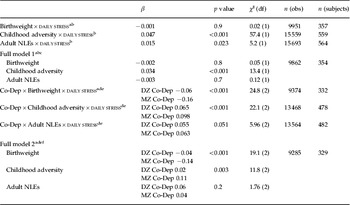
Daily life stress-sensitivity was not associated with being SGA, as in the model of NA the two-way interaction between birthweight and daily stress, controlled for gestational age, was neither large nor significant (χ2=0.02; df=1, β=−0.001, p=0.9) (for an overview of all analyses, see Table 1).
Overview of all models with β coefficient, p value, χ2 and numbers of observations and subjects for each separate analysis, with negative affect (NA) as the dependent variable

NLE, Negative life event; Co-Dep, co-twin lifetime depression diagnosis; β, standardized β coefficient; n (obs), number of observations included in the analysis; n (subjects), number of subjects included in the analysis; DZ, dizygotic; MZ, monozygotic.
All analyses are corrected for the Symptom Checklist (SCL-90R) depression score. Without addition of this covariate, effect sizes and significance remained similar.
a Corrected for gestational age.
b Regression model includes all main effects.
c Full model 1 includes all three two-way interactions (Birthweight×daily stress, Childhood adversity×daily stress and Adult NLEs×daily stress).
d Regression model includes all lower two-way interactions and all main effects.
e Exclusion of current diagnosis of major depression and data for non-twin sisters.
f Full model 2 includes all three three-way interactions (Co-Dep×Birthweight×daily stress, Co-Dep×Childhood adversity×daily stress and Co-Dep×Adult NLEs×daily stress).
Childhood adversity
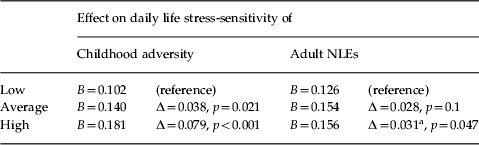
Childhood adversity was associated with daily life stress-sensitivity: the two-way interaction between childhood adversity and daily stress on NA was significant (χ2=57.4, df=1, β=0.047, p<0.001). In addition, a dose–response association was apparent. Average compared to low childhood adversity was associated with increased daily life stress-sensitivity (β=0.038, p=0.021) and high compared to low childhood adversity showed a correspondingly even larger increase in daily life stress-sensitivity (β=0.079, p<0.001) (Table 2).
Dose–response associations between childhood adversity and adult negative life events (NLEs) on the one hand, and daily life stress-sensitivity on the other

B, Standardized effect size; Δ, difference in effect size with regard to the reference category.
a Stata indicated 0.031, although in this table the difference is 0.030; this is due to rounding.
Adult exposure to NLEs
Adult experience of recent NLEs was similarly associated with current daily life stress-sensitivity (χ2=5.2, df=1, β=0.015, p=0.023). The effect size of average compared to low number of NLEs was 0.028 (p=0.1) and that of high compared to low number of NLEs was 0.031 (p=0.047) (Table 2).
Independence of effects
To examine whether the effects of all developmental stress×daily stress interactions were independent from each other, a model was fitted including all three interactions. When entered simultaneously in the model, the effect of NLEs on daily life stress-sensitivity disappeared (χ2=0.12, df=1, β=−0.003, p=0.7). The effects of SGA (χ2=0.05, df=1, β=−0.002, p=0.8) and childhood adversity (χ2=13.4, df=1, β=0.035, p<0.001) on daily life stress-sensitivity remained similar.
Interactions between developmental stress exposures and genetic vulnerability
SGA
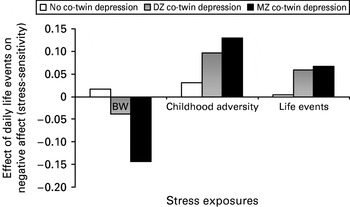
Co-twin lifetime depression significantly moderated the effect of being SGA on current daily life stress-sensitivity (χ2=24.8, df=2, p<0.001). High genetic risk for depression was associated with a stronger and statistically significant negative association between birthweight and adult daily life stress-sensitivity (DZ co-twin lifetime depression compared to no co-twin lifetime depression: β=−0.06, p=0.3; MZ co-twin lifetime depression compared to no co-twin lifetime depression: β=−0.16, p<0.001) (see Fig. 2).
Effect sizes of previous stress exposure on daily life stress-sensitivity stratified by level of genetic vulnerability to depression. BW, Birthweight; DZ, dizygotic; MZ, monozygotic.

Childhood adversity
The association between childhood adversity and current daily life stress-sensitivity was also moderated by co-twin lifetime depression (χ2=22.1, df=2, p<0.001). Thus, DZ co-twin lifetime depression, compared to no co-twin depression, significantly increased the effect of childhood adversity on adult daily stress-sensitivity (β=0.065, p=0.002) and MZ co-twin lifetime depression increased the impact of childhood adversity even more (β=0.098, p<0.001) (see Fig. 2).
Adult exposure to NLEs
The effect of adult NLEs on daily life stress-sensitivity was also moderated by co-twin lifetime depression (χ2=5.96, df=2, p=0.051). However, the effect of adult life events for DZ co-twin lifetime depression (β=0.055, p=0.1) was only slightly lower than that for MZ co-twin lifetime depression compared to no co-twin depression (β=0.063, p=0.047) (see Fig. 2).
Independence of effects
When all three-way interactions were entered simultaneously in the model of NA, the interaction between genetic vulnerability, daily stress and adult NLEs was no longer significant (χ2=1.76, df=2, p=0.2). For DZ co-twin depression relative to no co-twin lifetime depression, the effect of NLEs on daily life stress-sensitivity was β=0.06, p=0.3 and the corresponding effect for MZ co-twin depression was β=0.04, p=0.3. The three-way interaction with respect to SGA remained similar (effect of SGA on daily life stress-sensitivity for DZ co-twin depression relative to no co-twin depression: β=−0.04, p=0.5; effect for MZ co-twin depression: β=−0.14, p<0.001). Similarly, the effect of childhood adversity on daily life stress-sensitivity for DZ co-twin depression relative to no co-twin depression was β=0.02, p=0.7 and the corresponding effect for MZ co-twin depression was β=0.11, p=0.001.
Discussion
Findings
Post-natal stress exposures (childhood adversity and adult recent NLEs) increased NA reactivity to small stressors in the flow of daily life in a dose–response fashion. In addition, genetic vulnerability to depression interacted with both prenatal (birthweight) and postnatal stress exposures in the development of daily life stress-sensitivity; subjects at high genetic risk developed higher levels of daily life stress-sensitivity after exposure to developmental stress exposures than those at low genetic risk. However, for both analyses, the effect of adult NLEs was reducible to the other developmental stressors. Findings were not due to depression in the proband because those with a current depressive disorder were excluded and analyses were sensitively corrected for depressive symptoms using a continuous measure of depressive symptoms.
Pathways to stress-sensitivity
Experiencing childhood adversity increased the likelihood of adult NLE exposure. Moreover, the effects of adult life event exposure on stress-sensitivity appeared to be reducible to the effects of childhood adversity because the effects of NLEs disappeared when all interactions were entered simultaneously into the model (and in a post-hoc test, addition of childhood adversity appeared crucial for the changes in effect sizes of life events). The effect of NLEs on stress-sensitivity can thus be explained, at least in part, by previous childhood adversity; the latter may increase vulnerability not only directly but also indirectly by increasing the occurrence of later NLEs. Effects of SGA and childhood adversity, however, were independent.
Stress-sensitization
The findings are consistent with the hypothesis that adult daily life stress-sensitivity is the result of sensitization processes initiated by previous exposure to stressors. The theory would predict that progressively larger NA responses are induced by stressors of similar magnitude over the course of stress-sensitization (Post, Reference Post1992; Monroe & Harkness, Reference Monroe and Harkness2005). The development of stress-sensitization may have clinical relevance in that there is face validity to the suggestion that eventually even small daily life stressors induce periods of NA at such intensity that episodes of depression ensue. In a previous report, a genetic contribution to the phenotype of daily life stress-sensitivity was identified (Wichers et al. Reference Wichers, Myin-Germeys, Jacobs, Peeters, Kenis, Derom, Vlietinck, Delespaul and Van Os2007). The current report may shed light on the mechanism by which genes exert their effects, in that the genetic contribution found in the previous report may in fact have been the result of gene–environment interaction effects on the development of daily life stress-sensitivity. The current results showed that increased genetic risk for depression was associated with higher levels of daily life stress-sensitivity, particularly after exposure to stress during the prenatal, childhood developmental and adult periods. Genes associated with depression thus may act by accelerating the process of stress-sensitization following stress exposure over the life course.
These findings are in accordance with another study (Glaser et al. Reference Glaser, van Os, Portegijs and Myin-Germeys2006) that reported an effect of childhood adversity on adult daily life stress-sensitivity. Moreover, the effect was most pronounced in subjects who experienced adversity early in life. The contribution of the early environment to adult vulnerability, relative to environmental circumstances later in life, can also be inferred from the current study. In particular, prenatal stress (albeit only in interaction with genetic vulnerability) and childhood adverse events were associated with large increases in adult daily life stress-sensitivity, whereas exposure to recent life events had a smaller effect and seemed to be reducible to the effects of associated childhood adversity. Environmental induction of liability for progressive stress-sensitization thus may be dependent on developmental stage, starting as early as the prenatal period. Other studies, both animal and human, show that prenatal stress, expressed in the final common pathway of lower birthweight relative to gestational age, is associated with heightened adult behavioural and biological responses to stress (Wust et al. Reference Wust, Entringer, Federenko, Schlotz and Hellhammer2005; Phillips & Jones, Reference Phillips and Jones2006). It can be postulated that altered prenatal programming may be involved, affecting the set point of systems regulating stress. The hypothalamic–pituitary–adrenal (HPA) axis is sensitive to early life programming and it has been shown that exposure to prenatal stress may permanently alter the activity of this system (Welberg & Seckl, Reference Welberg and Seckl2001; Viltart et al. Reference Viltart, Mairesse, Darnaudery, Louvart, Vanbesien-Mailliot, Catalani and Maccari2006). The current study found evidence for prenatal stress-sensitization only in individuals with increased genetic risk for depression.
Kendler et al. (Reference Kendler, Thornton and Gardner2001) describe two different models of how sensitization, or kindling, evolves, depending on the genetic risk of subjects: ‘the speed of kindling’ and the ‘prekindling’ model. The speed of kindling model assumes that subjects genetically at risk are initially the same as those not at risk, but are more sensitive to kindling and thus will have a more rapid sensitization process, whereas the prekindling model assumes that those genetically at risk begin life ‘prekindled’, and are thus already sensitized to a degree. In their study, Kendler et al. found evidence for the prekindling model, whereas the findings from the current study are more supportive of the speed of kindling model. However, Kendler et al. sampled adult subjects and examined the association between the kindling effect and the number of previous depressive episodes. They found that subjects at high genetic risk are already more sensitized at their first depressive episode than those with low risk. However, as the main part of sensitization presumably takes place early in life, subjects at their first depressive episode who are genetically at risk may well have been ‘prekindled’ because they have already gone through a process of more rapid sensitization earlier in life, resulting in increased daily life stress-sensitivity; increased stress-sensitivity may have contributed to the development of later depression in these subjects. Thus, the apparent support for the speed of kindling model in the current study and that for the prekindling model in the report by Kendler et al. may not represent a contradiction but may instead be interpreted as complementary knowledge.
Clinical significance
Stress exposures alone, and in interaction with genetic vulnerability, showed statistically significant associations with daily life stress-sensitivity. However, the question arises to what extent these effects represent clinically meaningful findings. In general, effect sizes of around 0.2 are considered relevant but low, and those around 0.8 high (Cohen, Reference Cohen1988). In the current study, the effect sizes vary but are generally low (slightly <0.2) according to Cohen (Reference Cohen1988). However, the results of the current study were derived from data reflecting daily life context of repetitive events (unlike effects reported in most unilevel studies). For example, the findings indicate that previously experienced trauma will result in a repetitively altered way of responding to occurrences every single day as the effect of a previously experienced trauma is not present only once in a single event but impacts repeatedly in daily life person–context interactions. Therefore, effect sizes reported in the current study, although below the limit of 0.2, cumulatively may well be clinically significant.
Limitations
Childhood adversity and recent NLEs were measured using self-report and retrospectively. In the case of the latter measure, only objectively identifiable events were scored. In the case of childhood adversity, it is possible that the score was influenced by mood state. However, this study not only examined direct effects on stress-sensitivity but also used cross-twin cross-trait analyses to examine the interaction with co-twin lifetime depression. This analysis, which is free from confounding by mental state as it uses measures from two separate individuals (Wichers et al. Reference Wichers, Myin-Germeys, Jacobs, Peeters, Kenis, Derom, Vlietinck, Delespaul and Van Os2007), yielded significant effects. Furthermore, all analyses were controlled for depression score as measured with the SCL-90R and those with current depression were excluded. Therefore, it is not likely that the results in the current study are a consequence of confounding by mood state.
In addition, because our subjects were female with a high mean educational level, the results of this study may not be generalizable to men and those with lower educational level.
Finally, both childhood adversity and recent NLEs showed significant associations with daily stress. Therefore, we cannot exclude the possibility that the effect of past stress exposure on stress-sensitivity concerned, in part, alterations in stress appraisal and consequently higher rates of NA rather than increased NA reactivity to similar stress appraisals. It is likely that both processes contribute to the effect and either explanation bears clinical relevance.
Acknowledgements
This research was supported by the Netherlands Organization for Scientific Research; the Fund for Scientific Research, Flanders; and Twins, a non-profit association for scientific research in multiple births (Belgium) (to the East Flanders Prospective Survey); and the EU Framework 6 Integrated Project NewMood (LSHMCT-2004-503474) (to Dr Kenis). We thank all twins for their cooperation. Dr M. C. Wichers was supported by the Dutch Medical Council (VENI grant no. 916.76.147).
Declaration of Interest
None.