



1 Introduction
Throughout this article, by a “ring,” we will mean a commutative ring with identity and by an “algebra,” we will mean a commutative algebra.
Let R be a ring. The notation
 $R^{[n]}$
denotes a polynomial ring in n variables over R. Let A be an R-algebra. For
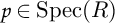 ,
 denotes the residue field
 , and
 denotes the ring
 $S^{-1}A$
, where
 . As in [Reference Sathaye11], we shall call a finitely generated flat R-algebra A to be an
 $\mathbb {A}^n$
-fibration if
 for every
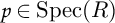 . A well-known problem of Dolgačev–Veı̌sfeı̌ler [Reference Veǐsfeǐler and Dolgačev13] asks.
Question 1. Is every
 $\mathbb A^n$
-fibration over a regular local ring R necessarily a polynomial ring over R?
Now let
 $(R, \pi )$
be a discrete valuation ring (DVR) with residue field
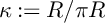 $\kappa := R/\pi R$
and field of fractions
 $K:= R[1/\pi ]$
. Suppose that A is an R-algebra such that:
-
(i) A is R flat;
-
(ii)
 $A[1/\pi ]\cong K^{[2]}$
; and
-
(iii)
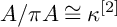
$A/\pi A \cong \kappa ^{[2]}$
.
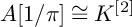
By a result of T. Asanuma [Reference Asanuma2, Theorem 3.1], it follows that A is a finitely generated R-algebra, and hence, A is an
 $\mathbb A^2$
-fibration. Then, Question 1 asks whether
 $A\cong R^{[2]}$
. This was answered affirmatively by A. Sathaye in [Reference Sathaye11] under the assumption that R contains the field of rational numbers
 $\mathbb Q$
.
On the other hand, T. Asanuma constructed an example of an algebra A over a DVR R which does not contain
 $\mathbb Q$
, satisfies (i)–(iii) but is not isomorphic
 $R^{[2]}$
[Reference Asanuma2, Theorem 5.1]. Therefore, it is natural to ask the following question.
Question 2. Let
 $(R,\pi )$
be a DVR not containing
 $\mathbb Q$
and let A be an
 $\mathbb {A}^2$
-fibration over R. What additional condition will ensure that
 $A\cong R^{[2]}$
?
In this article, we prove the following result (2.5).
Theorem A. Let
 $(R,\pi )$
be a DVR and let A be an
 $\mathbb {A}^2$
-fibration over R. Let
 $K:=R[\frac {1}{\pi }]$
and let L be a finite field extension of K. Let
 $\tilde {R}$
be the integral closure of R in L. Suppose that
 $A \otimes _R \tilde {R} \cong \tilde {R}^{[2]}$
. Then,
 $A\cong R^{[2]}$
.
We have given another important criterion for an
 $\mathbb {A}^2$
-fibration over a DVR to be trivial. Before stating the result, we discuss the concept of
 $\mathbb {A}^n$
-form over a ring.
Let B be a ring containing a field k and A be a B-algebra. We say that A is an
 $\mathbb {A}^n$
-form over B with respect to k, if
 $A\otimes _k F\cong (B\otimes _k F)^{[n]}$
, for some field extension F of k. If, in addition, F is a separable field extension of k, then we call A a separable
 $\mathbb {A}^n$
-form over B with respect to k.
When
 $B=k$
, then it is well known that separable
 $\mathbb A^1$
-forms over k are necessarily polynomial rings (see [Reference Dutta6, Lemma 5]). Further, T. Kambayashi has shown the following [Reference Kambayashi9, Theorem 3].
Theorem I. Let k be a field and A be a separable
 $\mathbb A^2$
-form over k. Then,
 $A\cong k^{[2]}$
.
However, there are plenty of examples of non-trivial
 $\mathbb A^1$
-forms (i.e.,
 $\mathbb A^1$
-forms which are not polynomial rings) over non-perfect fields [Reference Asanuma3]. Dutta[Reference Dutta6], proved the following result.
Theorem II. Let k be a field of characteristic zero, and let R be a principal ideal domain (PID) containing k. Suppose that A is an
 $\mathbb A^2$
-form over R with respect to k. Then,
 $A\cong R^{[2]}$
.
However, if k is a non-perfect field, then using non-trivial
 $\mathbb {A}^1$
-forms over k, we can construct examples of non-trivial
 $\mathbb {A}^2$
-forms over PIDs. Therefore, we ask the following question.
Question 3. Let R be a PID containing a field k of arbitrary characteristic and A be an
 $\mathbb {A}^2$
-form over R with respect to k. What additional condition will ensure
 $A\cong R^{[2]}$
?
We prove two more results (Theorems 2.8 and 2.9) addressing the above question. Note that the following result addresses both Questions 2 and 3.
Theorem B. Let k be a field and R be a PID which contains k. Suppose that A is an
 $\mathbb {A}^{2}$
-fibration over R as well as an
 $\mathbb {A}^2$
-form over R with respect to k. Then,
 $A\cong R^{[2]}$
.
Theorem C. Let k be a field and R be a PID containing k. Suppose that A is a separable
 $\mathbb {A}^2$
-form over R with respect to k. Then,
 $A\cong R^{[2]}$
.
Note that Theorem C extends Theorems I and II to any PID containing an arbitrary field. In our forthcoming paper [Reference Ghosh, Gupta and Pal7], we study embeddings of certain linear hyperplanes in
 $\mathbb A^4$
, where Theorem B plays a crucial role to detect rectifiability of these embeddings (cf. [Reference Ghosh, Gupta and Pal7, Lemma 4.4, Theorems 4.6 and 4.8]).
2 Main theorems
We first state some results which will be used in this article. The following is a well known result [Reference Abhyankar, Eakin and Heinzer1, 2.11].
Theorem 2.1. Let k be a field and R be a normal domain such that
 $k \subset R \subset k^{[n]}$
. If
 $\operatorname {tr.deg}_{k} R=1$
, then
 $R \cong k^{[1]}$
.
Proof. By [Reference Matsumura10, Theorem 15.5], we have
 $\dim R \leqslant \operatorname {tr.deg}_kR=1$
. As R is a subring of
 $k^{[n]}$
and
 $\operatorname {tr.deg}_kR=1$
, it follows that
 $\dim R=1$
. Now the result follows from [Reference Abhyankar, Eakin and Heinzer1, 2.11].
The following theorem was proved by Bass, Connell, and Wright in [Reference Bass, Connell and Wright4], and independently by Suslin in [Reference Suslin12].
Theorem 2.2. Let A be a ring and B be a finitely presented A-algebra. Suppose that there exists
 $n \in \mathbb {N}$
such that
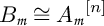 for every maximal ideal
 of A. Then,
 $B \cong \mathrm {Sym}_{A}(M)$
for some finitely generated projective A-module M of rank n.
The next result is due to Asanuma [Reference Asanuma2, Corollary 4.9]. The following version can be found in [Reference Bhatwadekar and Dutta5, Theorem 2.7].
Theorem 2.3. Let B be a DVR with regular parameter t. Let
 $\kappa =B/t B$
be the residue field of B and let
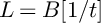 $L=B[1/t]$
be a field of fractions of B. Let
 $X_1,Y_1 \in B[U,V] (\cong B^{[2]})$
and let
 $\overline {X_1}$
,
 $\overline {Y_1}$
denote the images of
 $X_1,Y_1$
in
 $\kappa [U,V]$
. Suppose that
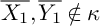 $\overline {X_1},\overline {Y_1} \notin \kappa $
and
 $L[X_1,Y_1]=L[U,V]$
. Then, either
 $\deg \overline {X_1} \mid \deg \overline {Y_1}$
or
 $\deg \overline {Y_1} \mid \deg \overline {X_1}$
, where
 $\deg $
means the total degree in
 $U,V$
.
We note below an elementary lemma.
Lemma 2.4. Let
 $C \subseteq D$
be integral domains and
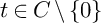 $t \in C\setminus \{0\}$
be such that
 $D[1/t]=C[1/t]$
and
 $tD \cap C= tC$
. Then,
 $C=D$
.
We now prove Theorem A.
Theorem 2.5. Let
 $(R,\pi )$
be a DVR and let A be an
 $\mathbb {A}^2$
-fibration over R. Let
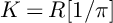 $K=R[1/\pi ]$
be the field of fractions of R and
 $\kappa =\frac {R}{\pi R}$
be the residue field of R. Let L be a finite field extension of K and let
 $\tilde {R}$
be the integral closure of R in L. Suppose that
 $A \otimes _R \tilde {R} \cong \tilde {R}^{[2]}$
. Then,
 $A\cong R^{[2]}$
.
Proof. For any
 $a \in A$
, let
 $\overline {a}$
denote the image of a in
 $\frac {A}{\pi A}$
. Since A is an
 $\mathbb {A}^2$
-fibration over R, there exist
 $X_1,Y_1,X_0,Y_0 \in A$
such that
 $$ \begin{align} A[1/\pi] = K[X_1,Y_1] \end{align} $$
and
 $$ \begin{align} \frac{A}{\pi A} = (R/\pi R)[\overline{X_0},\overline{Y_0}]=\kappa[\overline{X_0},\overline{Y_0}]. \end{align} $$
Let
 $A=R[t_1,\ldots ,t_m]$
. Since
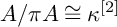 $A/\pi A\cong \kappa ^{[2]}$
, we can assume that
 $t_i\notin \pi A$
for each i,
 $1\leqslant i\leqslant m$
. By (2.1),
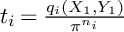 $t_i=\frac {q_i(X_1,Y_1)}{\pi ^{n_i}}$
for every i,
 $1 \leqslant i \leqslant m$
,
 $n_i \geqslant 0$
and
 $q_i \in R^{[2]}$
with
 $q_i(X_1,Y_1) \notin \pi R[X_1, Y_1]$
. Let
 $N_{X_1,Y_1} :=\sum _{i=1}^{m}{n_i}$
. Note that if
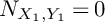 $N_{X_1,Y_1}=0$
, then
 $A=R[X_1,Y_1]$
.
We show that for every pair of elements
 $X,Y \in A$
such that
 $A[1/\pi ]=K[X,Y]$
with
 $N_{X,Y}>0$
, there exists a modified pair
 $\tilde {X}, \tilde {Y} \in A$
such that
 $A[1/\pi ]=K[\tilde {X},\tilde {Y}]$
with
 ${N_{\tilde {X}, \tilde {Y}} < N_{X,Y}}$
. Then, by induction on
 $N_{X,Y}$
, we see that
 $A\cong R^{[2]}$
.
If
 $\operatorname {tr.deg}_{\kappa } (\kappa [\overline {X_1}, \overline {Y_1}])=2$
, then
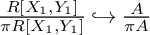 $\frac {R[X_1,Y_1]}{\pi R[X_1,Y_1]} \hookrightarrow \frac {A}{\pi A}$
. Now, since
 $A[\frac {1}{\pi }]=R[\frac {1}{\pi }][X_1,Y_1]$
, it follows that
 $A=R[X_1,Y_1]$
by 2.4. Clearly, in this case,
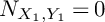 $N_{X_1, Y_1}=0$
.
We now show that if
 $\operatorname {tr.deg}_{\kappa } (\kappa [\overline {X_1}, \overline {Y_1}])$
is zero or one, then there exist
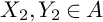 $X_2,Y_2 \in A$
with
 $N_{X_2,Y_2}< N_{X_1,Y_1}$
. For the sake of completeness, we repeat a few arguments from [Reference Sathaye11, Theorem 1].
Case 1: Suppose that
 $\operatorname {tr.deg}_{\kappa } (\kappa [\overline {X_1}, \overline {Y_1}])=0$
. As
 $\kappa $
is algebraically closed in
 $\frac {A}{\pi A}\cong \kappa ^{[2]}$
, we have
 $X_1-\lambda , Y_1-\mu \in \pi A$
, for some
 $\lambda , \mu \in R$
. Let
 $X_2:= \frac {X_1-\lambda }{\pi }\in A$
and
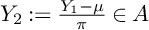 $Y_2:= \frac {Y_1-\mu }{\pi }\in A$
. As
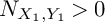 $N_{X_1, Y_1}>0$
, there exists i,
 $1 \leqslant i \leqslant m$
, such that
 $n_i>0$
. Then,
 $$ \begin{align*}t_i=\frac{q_i(X_1,Y_1)}{\pi^{n_i}}=\frac{q_i(\lambda+\pi X_2,\mu +\pi Y_2)}{\pi^{n_i}} =\frac{q_i(\lambda,\mu)}{\pi^{n_i}}+\frac{q_i^{\prime}(X_2,Y_2)}{\pi^{n_i-1}}, \end{align*} $$
for some
 $q_i^{\prime }(X_2,Y_2)\in R[X_2, Y_2]\subseteq A$
. Then,
 $\pi ^{n_i-1}t_i -q_i^{\prime }(X_2,Y_2)=\frac {q_i(\lambda ,\mu )}{\pi } \in A \cap K$
. As
 $\kappa $
is contained in
 $A/\pi A$
, we have
 $\frac {q_i(\lambda ,\mu )}{\pi } \in R$
. Therefore,
 $\pi ^{n_i-1}t_i \in R[X_2, Y_2]$
and hence
 $N_{X_2,Y_2}<N_{X_1,Y_1}$
.
Case 2: Suppose that
 $\operatorname {tr.deg}_{\kappa } (\kappa [\overline {X_1}, \overline {Y_1}])=1$
. Then, by 2.1, the normalization of
 $\kappa [\overline {X_1}, \overline {Y_1}]$
in
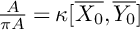 $\frac {A}{\pi A}=\kappa [\overline {X_0}, \overline {Y_0}]$
is isomorphic to
 $\kappa ^{[1]}$
. Hence,
 $$ \begin{align} \kappa[\overline{X_1}, \overline{Y_1}] \hookrightarrow \kappa[W] \hookrightarrow \frac{A}{\pi A}=\kappa[\overline{X_0}, \overline{Y_0}] \end{align} $$
for some
 $W \in \frac {A}{\pi A}$
. Let
 $d_{X_1}:= \deg _{W} \overline {X_1}$
and
 $d_{Y_1}:= \deg _{W} \overline {Y_1}$
. From the Krull–Akizuki Theorem [Reference Matsumura10, Theorem 11.7], it follows that
 $\tilde {R}$
is a Dedekind domain. Let
 be a maximal ideal of
 $\tilde {R}$
. Since
 $A \otimes _R \tilde {R} \cong \tilde {R}^{[2]}$
, we have
 for some
 . Let
 . For any
 , let
 $\hat {a}$
denote its image in
 . Note that
 $\kappa \subseteq \tilde {\kappa }_i$
and

Therefore, using  , we have

Now, from (2.3), we have
 $$ \begin{align*}\tilde{\kappa}_i[\hat{X_1},\hat{Y_1}] \hookrightarrow \tilde{\kappa}_i[\hat{W}] \hookrightarrow \tilde{\kappa}_i[\hat{X_0},\hat{Y_0}]=\tilde{\kappa}_i[\hat{u},\hat{v}], \end{align*} $$
and hence
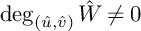
 $$ \begin{align} \deg_{(\hat{u},\hat{v})} \hat{X_1}=\deg_{(\hat{u},\hat{v})} \hat{W}.d_{X_1} \text{ and }\deg_{(\hat{u},\hat{v})} \hat{Y_1}= \deg_{(\hat{u},\hat{v})} \hat{W}.d_{Y_1}. \end{align} $$
We note that
 $\hat {W}$
is transcendental over
 $\tilde {\kappa }_i$
. Further, if
 for some
 , then
 and we have

Hence, by using 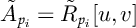 , we have

Now, suppose that neither
 $d_{X_1}=0$
nor
 $d_{Y_1}=0$
, that is, neither
 $\hat {X_1}$
nor
 $\hat {Y_1}$
is in
 $\tilde {\kappa }_i$
. This equivalence follows from the fact that
 $\tilde {\kappa }_i$
is algebraic over
 $\kappa $
and
 $\kappa $
is algebraically closed in
 $A/\pi A$
. Then, by (2.6) and 2.3,
 $$ \begin{align*}\text{either } \deg_{(\hat{u},\hat{v})} \hat{X_1}\mid \deg_{(\hat{u},\hat{v})} \hat{Y_1} \text{ or } \deg_{(\hat{u},\hat{v})} \hat{Y_1}\mid \deg_{(\hat{u},\hat{v})} \hat{X_1}. \end{align*} $$
Now, using (2.5), it follows that either
 $d_{X_1} \mid d_{Y_1}$
or
 $d_{Y_1} \mid d_{X_1}$
as
 $\deg _{(\hat {u},\hat {v})} \hat {W} \neq 0$
.
Without loss of generality, suppose that
 $d_{X_1} \mid d_{Y_1}$
. Let
 $\ell := d_{X_1}$
,
 $s:=d_{Y_1}$
and let
 $s=\ell r$
for some
 $r\ge 1$
.
Let
 $\overline {X_1}= \sum _{i=0}^{\ell }a_iW^i\in \kappa [W]$
and
 $\overline {Y_1}=\sum _{i=0}^{s}b_iW^i\in \kappa [W]$
. Let
 $a, b \in R$
be such that
 $\bar {a}=a_{\ell }$
and
 $\bar {b}=b_{s}$
. Clearly, a and b are units in R. Let
 $Y_2:= Y_1-b a^{-r}{X_1}^{r}\in A$
. Then,
 $R[X_1, Y_1]=R[X_1, Y_2]$
, and so
 $\operatorname {tr.deg}_{\kappa } (\kappa [\overline {X_1}, \overline {Y_1}])=\operatorname {tr.deg}_{\kappa } (\kappa [\overline {X_1}, \overline {Y_2}])=1$
. Further,
 $\deg _{W} \overline {Y_2}<\deg _{W} \overline {Y_1}$
. Now replacing
 $X_1$
and
 $Y_1$
with
 $X_1$
and
 $Y_2$
, we can assume that after finitely many steps, either
 $d_{X_1}= \deg _{W} \overline {X_1}=0$
or
 $d_{Y_1}=\deg _{W} \overline {Y_1}=0$
.
Now, suppose that
 $d_{X_1}=0$
. Then,
 $\overline {X_1}\in \kappa $
and there exists
 $\lambda \in R$
such that
 $X_1-\lambda \in \pi A$
. Let
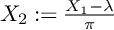 $X_2:= \frac {X_1-\lambda }{\pi }$
. As
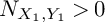 $N_{X_1, Y_1}>0$
, there exists i,
 $1 \leqslant i \leqslant m$
, such that
 $n_i>0$
. Then,
 $$ \begin{align*}t_i=\frac{q_i(X_1,Y_1)}{\pi^{n_i}}=\frac{q_i(\lambda+\pi X_2,Y_1)}{\pi^{n_i}} =\frac{q_i(\lambda,Y_1)}{\pi^{n_i}}+\frac{q_i^{\prime}(X_2,Y_1)}{\pi^{n_i-1}}, \end{align*} $$
for some
 $q_i^{\prime }(X_2,Y_1)\in R[X_2, Y_1]\subseteq A$
. Now,
 $\pi ^{n_i-1}t_i -q_i^{\prime }(X_2,Y_1)=\frac {q_i(\lambda ,Y_1)}{\pi } \in A \cap K[Y_1]$
. As
 $\operatorname {tr.deg}_{\kappa } (\kappa [\overline {X_1}, \overline {Y_1}])=1$
with
 $\overline {X_1}\in \kappa $
, it follows that
 $\overline {Y_1}$
is transcendental over
 $\kappa $
and hence
 $A \cap K[Y_1]=R[Y_1]$
. Therefore,
 $\pi ^{n_i-1}t_i\in R[X_2, Y_1]$
and hence
 $N_{X_2,Y_1}<N_{X_1,Y_1}$
.
Similarly, if
 $d_{Y_1}=0$
, then we repeat the arguments as above.
Hence, the desired result follows by induction on
 $N_{X_1,Y_1}$
.
The following remark will be useful for proving the results in the rest of this section.
Remark 2.6. Let R be a ring containing a field k and A be an R-algebra. Suppose that
 $A\otimes _k L \cong (R \otimes _k L)^{[n]}$
for some field extension L of k. Then, by faithfully flat descent argument (see [Reference Dutta6, Lemma 1] or [14, Lemma 041T]), it follows that A is a finitely generated R-algebra, and hence by [Reference Dutta6, Lemma 3], we have a finitely generated field extension
 $\tilde {L}$
of k contained in L such that
 $A\otimes _k \tilde {L} \cong (R \otimes _k \tilde {L})^{[n]}$
.
The next result is the main step for proving Theorem B.
Proposition 2.7. Let k be a field and L be a field extension of k. Let R be a DVR which contains k and let A be an
 $\mathbb {A}^{2}$
-fibration over R. Suppose that
 $A \otimes _k L \cong (R \otimes _k L)^{[2]}$
. Then,
 $A\cong R^{[2]}$
.
Proof. By 2.6, we can assume that L is a finitely generated field extension of k.
Case 1: Suppose that L is algebraic over k. We have
 $$ \begin{align} A \otimes_R (R \otimes_k L) \cong (R \otimes_k L)^{[2]}. \end{align} $$
Since
 $R \subseteq R \otimes _k L$
is an integral extension, there exists a prime ideal P of
 $R \otimes _k L$
such that
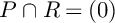 $P \, \cap \, R= (0)$
. Therefore,
 $R \subseteq \frac {R \otimes _k L}{P}$
is a module-finite extension of integral domains. Let
 $K_1$
and
 $K_2$
denote the field of fractions of R and
 $ \frac {R \otimes _k L}{P}$
, respectively. Since
 $ \frac {R \otimes _k L}{P}$
is a finite R-module,
 $ K_2$
is a finite field extension of
 $K_1$
. Now, let
 $\tilde {R}$
be the integral closure of R in
 $K_2$
. Since
 $\frac {R \otimes _k L}{P} \subseteq \tilde {R}$
, from (2.7), it follows that
 $A \otimes _R \tilde {R} \cong \tilde {R}^{[2]}$
as A is flat R-module. Now, by 2.5, we get the desired result.
Case 2: Suppose that L is not algebraic over k. Now, L is a function field of a integral k-scheme of finite type, by spreading out and specializing at a closed point, we get a finite algebraic extension
 $k'$
over k such that
 $A \otimes _k {k'} \cong (R \otimes _k {k'})^{[2]}$
. Therefore, the result follows by Case 1.
We now deduce Theorem B.
Theorem 2.8. Let k be a field and R be a Dedekind domain containing k. If A is an
 $\mathbb A^2$
-fibration over R which is also an
 $\mathbb A^2$
-form over R with respect to k, then
 $A\cong (\mathrm {{Sym}}_R(I))^{[1]}$
, where I is an invertible ideal of R. In particular, if R is a PID, then
 $A\cong R^{[2]}$
.
Proof. Let
 $P\in \operatorname {Spec}(R)$
. Since A is an
 $\mathbb A^2$
-fibration and
 $\mathbb A^2$
-form over R with respect to k, it follows that
 $A_{P}:=A \otimes _R R_{P}$
is an
 $\mathbb A^2$
-fibration over
 $R_{P}$
and
 $\mathbb A^2$
-form over
 $R_{P}$
with respect to k. Since
 $R_{P}$
is a DVR, by 2.7, we have
 $A_{P}\cong R_{P}^{[2]}$
. Therefore, by 2.2,
 $A\cong \mathrm {{Sym}}_R(Q)$
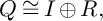
for some finitely generated projective R-module Q of rank 2. Now,
 $Q\cong I \oplus R,$
where I is an invertible ideal of R (cf. [Reference Ischebeck and Rao8, Theorem 7.1.8]). Therefore,
 $A\cong (\mathrm {{Sym}}_R(I))^{[1]}$
.
If R is PID, then Q is free, and hence
 $A\cong R^{[2]}$
.
We now prove Theorem C. Recall that a field extension L over a field k is said to be separable if, for every field extension
 $k^{\prime }$
of k, the ring
 $L \otimes _k k^{\prime }$
is reduced.
Theorem 2.9. Let k be a field and let R be a Dedekind domain containing k. Let A be an R-algebra. Suppose that there exists a separable field extension L of k such that
 $A \otimes _k L\cong (R \otimes _k L)^{[2]}$
. Then,
 $A\cong (\mathrm {{Sym}}_R(I))^{[1]}$
, where I is an invertible ideal of R. In particular, if R is a PID, then
 $A\cong R^{[2]}$
.
Proof. By 2.6 and the fact that any subfield of a separable extension is separable, we can assume that L is a finitely generated separable field extension of k.
Case 1: We first assume that L is an algebraic extension of k. Since
 $$ \begin{align} A \otimes_k L\cong (R \otimes_k L)^{[2]}, \end{align} $$
we have

for every 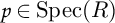 . As L is a finite separable field extension of k,
 , where
 $L_i$
is a finite separable field extension of
 . Therefore, from (2.9),

and hence, by Kambayashi’s Theorem (Theorem I), it follows that  . As A is an
 $\mathbb A^2$
-form over R and hence A is flat over R. Thus, A is an
 $\mathbb {A}^2$
-fibration over R. Now, the assertion follows by 2.8.
Case 2: Now, suppose that L is not algebraic over k. As L is a finitely generated separable extension over k, so it is a function field of a smooth, integral k-scheme of finite type, and since separable k-points are dense in nonempty, smooth k-schemes, so by spreading out and specializing at a separable point, we can find a finite separable extension
 $k'$
of k such that
 $A \otimes _k k'\cong (R \otimes _k k')^{[2]}$
. Hence, the result follows by Case 1.
Acknowledgements
The authors thank Professor Amartya K. Dutta and the referees giving valuable suggestions on earlier drafts. The second author acknowledges Department of Science and Technology (DST), India for their INDO-RUSS project (DST/INT/RUS/RSF/P-48/2021).



