The production and exchange of prestige items has long been considered a key factor in the creation and maintenance of social differentiation in Mesoamerican political economy (Blanton et al. Reference Blanton, Feinman, Kowaleswski and Peregrine1996). Recently, however, the consideration of the multicentric aspect of power has shown that this notion of prestige goods itself is rather questionable (Schortman and Urban Reference Schortman and Urban2004; Wells Reference Wells2006:285–286), and that socially valorized objects should probably be considered in a more dynamic way in order to understand the way prestige was produced at different scales of society for different levels of “eliteness” (Schortman and Urban Reference Schortman and Urban2004:210). Since a single item can have different functions, acquire different meanings, and often change status during its “life” (Appadurai Reference Appadurai and Appadurai1986; Kopitoff Reference Kopitoff and Appadurai1986), new approaches to socially valued objects should focus on the processes by which these objects encoded different social or economic messages (Helms Reference Helms2013; Wells Reference Wells2006) depending on the exchange sphere in which they were manipulated or exchanged.
The case of Maya jade offers an excellent case study for this approach because certain jadeite ornaments provide the distinctive traits of royalty in Maya art (Durán Reference Durán1984; Freidel Reference Freidel and Lange1993; Taube Reference Taube2005), which conveyed and justified the power of their holders (Demarest Reference Demarest, Demarest and Conrad1992; Helms Reference Helms2013; Inomata Reference Inomata2001). Not all jade material, however, was the focus of equal social investment (Andrieu et al. Reference Andrieu, Forné, Demarest, Wiesheu and Guzzy2012; Garber et al. Reference Garber, Grove, Hirth, Hoopes and Lange1993). An initial bibliographical overview of the context of different jade artifacts in the Maya area shows that greenstone ornaments are not always found in the most important burials (Andrieu et al. Reference Andrieu, Forné, Demarest, Wiesheu and Guzzy2012; Masson and Freidel Reference Masson, Freidel, Hirth and Pillsbury2013; Welsh Reference Welsh1988). Small beads in particular present a relatively broad distribution in contrast with certain large earflares and pendants, which seem to have been restricted more to high elite contexts (Masson and Freidel Reference Masson, Freidel, Hirth and Pillsbury2013; Welsh Reference Welsh1988). This distinction recalls the colonial chroniclers' description of the Aztecs, which specified that only nobles were allowed to wear certain jade earflares and necklaces (Olko Reference Olko2005:176; Sahagún Reference Sahagún1975[1830]:11:1119), although small beads were generally permitted to the population (Thouvenot Reference Thouvenot1982:183). These few elements open the possibility that different types of jade ornaments held different values and that social investment could correspond to different modes of production and exchange.
Importantly, the “jade” category itself needs to be defined. The definition of this material is geological and relies on the percentage of jadeite present in rock (Bishop et al. Reference Bishop, Sayre, Mishara and Lange1993; Forshag Reference Foshag1957; Harlow Reference Harlow and Lange1993). Of course, Mesoamerican people did not employ the same criteria: linguistic work on colonial Nahuatl texts reveals the use of at least four different words to designate what we would call jade today, showing that emic and geological criteria do not, of course, correspond (Thouvenot Reference Thouvenot1982:180–183) and that not all the stone geologically considered jadeite was socially valorized during the Classic period. In fact, an important element that may have entered into the valorization of certain types of rock for Mesoamerican people is color. Jadeite from the highlands of Guatemala comes in a great variety of colors—from blue to white, black, or purple—but during the Classic period, the Maya exclusively exploited the green colored stones. This cultural choice can be explained by the importance of the color “Yax,” which designates both blue and green and is associated with the center of the world, fertility, and corn (McAnany Reference McAnany2010:298; Taube Reference Taube2005). The intensity of the color could also have played an important role for the Maya, as was the case for the Aztecs who distinguished between chalchihuites, the most common jade; quetzalitztli, of a more intense green; and chalchihuites fingidos, a false jade described by the chroniclers as worn by those who were not allowed to wear real jade (Sahagún Reference Sahagún1975[1830]:11:1119). This distinction indicates a range of values that should also be taken into account for understanding the Maya organization of production and exchange.
This paper focuses on the “gradations of value” (Lesure Reference Lesure and Robb1999) of jade items and the corresponding variety of contexts of production and exchange by reanalyzing jade production from Cancuen, a Late Classic production site. We demonstrate that the quality and color of the raw material corresponded to very different production processes, values, and distribution within the site. We suggest that most of Cancuen's jade production was exported to recipient sites as preforms—that is, partly processed objects that were not as meaningful as the finished objects and did not require the same obligation between the actors in the exchange. These blanks were probably transformed into meaningful objects at the recipient sites where they changed status and were probably then gifted between elites. Nevertheless, the fact that jade blanks were not accessible to most of the inhabitants of the site, along with the existence of strict rules regarding the distribution of the color and type of jade raw material in Cancuen, suggests that production and exchange were probably state-controlled. We have also argued elsewhere (Demarest et al. Reference Demarest, Andrieu, Torres, Forné, Barrientos and Wolf2014) that the location of structures, imports, and so on, may suggest a significant role for nobles in the supervision of the workshop and/or long-distance exchange of the products.
We have opted to use the word “jade” when discussing the greenstone rocks that were worked by the Maya. We have reserved the word “jadeite” for the rocks for which chemical analysis is available to confirm its geological composition.
JADE PRODUCTION AND EXCHANGE CONTEXTS
Little is still known about the social and political contexts of jade artifact production in the Maya area. The few elements available indicate an important variety of different social contexts. In the highlands of Guatemala, near the jadeite sources of the Motagua (Hammond et al. Reference Hammond, Aspinall, Feather, Hazelden, Gazard, Agrell, Earle and Ericson1977), recent research shows that beads and earflares were produced by independent craftspersons (Rochette Reference Rochette2006, Reference Rochette and Hirth2009). In the lowlands, debitage is extremely rare, indicating that most jade artifacts were probably gifted or exchanged as finished artifacts (McAnany Reference McAnany2010:298–299). When jade production waste is found in the lowlands, at Waka-El Peru (Escobedo and Meléndez Reference Escobedo, Meléndez, Escobedo and Freidel2007; Lee Reference Lee, Escobedo and Freidel2005), Tikal (Moholy-Nagy Reference Moholy-Nagy2008), and Palenque (Melgar et al. Reference Tísoc, Ricardo, Ciriaco and Licón2011), for example, it is mostly in contexts such as caches in civic ceremonial buildings, and elite burials or offerings that indicate production was probably elite-controlled. At Cancuen, a site on the border between the Guatemala highlands and lowlands, however, a jade workshop was found in a relatively modest residential group. This is in a context within Operation CAN 24 (in aggregated cluster M9/M10), which is surrounded by many structures of different types and adjacent to a major port (see Demarest et al. Reference Demarest, Andrieu, Torres, Forné, Barrientos and Wolf2014 Figure 10), suggesting elite supervision. The variety of contexts for jade debitage raises many questions about the possibility of a diversity of jade values depending on what the production was used for, the type of exchanges involved, and the quality of the raw material. These different values likely correspond to different exchange networks.
THE CANCUEN WORKSHOP
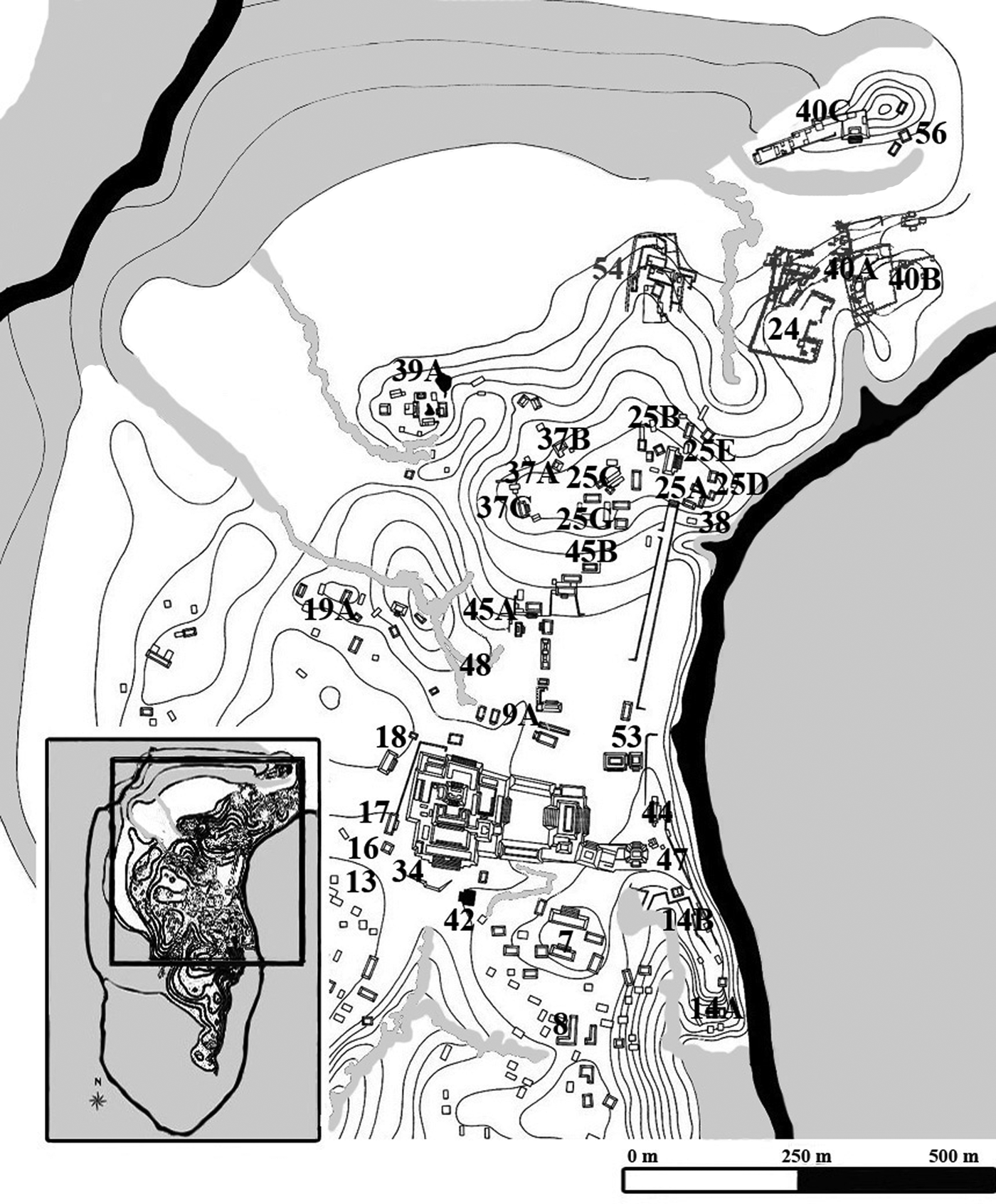
Cancuen is a Late Classic Maya site situated between the Guatemalan highlands and lowlands (Barrientos et al. Reference Barrientos, Demarest, Luin, Quintanilla and Mencos2006; Barrientos and Demarest Reference Barrientos, Demarest, Laporte, Arroyo and Mejía2007; Demarest Reference Demarest, Arroyo, Aragon and Mejía2012, Reference Demarest2013; Demarest and Barrientos Reference Demarest, Barrientos, Demarest, Barrientos, Kovacevich, Callaghan and Luin2003, Reference Demarest, Barrientos, Demarest, Barrientos, Kovacevich, Callaghan, Woodfill and Luin2004; Demarest et al. Reference Demarest, Martínez, Wolf, Torres, Belches, Andrieu, Luin, O'Mansky, Quintanilla, Arroyo and Mejía2009). The jade workshop was found in the northern part of the epicenter (Figure 1) and was excavated in 2001 and 2002 by the Cancuen Regional Archeological Project (Demarest and Barrientos Reference Demarest and Barrientos2002; Kovacevich and Pereira Reference Kovacevich, Pereira, Demarest and Barrientos2002, Reference Kovacevich, Pereira, Demarest, Barrientos, Kovacevich, Callaghan and Luin2003a), and first analyzed by Kovacevich in her doctoral dissertation on lithic production and exchanges at Cancuen (Kovacevich Reference Kovacevich2006). The debitage was found primarily in the exterior space of three residential structures made from earth with paving stone patios in front of each one, set at the base of a hill with many other residential and, possibly, administrative complexes. The largest quantities of jade debitage were found in trash pits at the extremity of these patios, together with chert, obsidian tools, domestic sherds, and animal bones (Kovacevich and Pereira Reference Kovacevich, Pereira, Demarest, Barrientos, Kovacevich, Callaghan and Luin2003a:281). Six burials were found within these residential structures and one in the patio. The whole complex has been excavated in units of different sizes, varying from 2 × 2 m to 3 × 1 m and 2 × 1 m (Kovacevich and Pereira Reference Kovacevich, Pereira, Demarest, Barrientos, Kovacevich, Callaghan and Luin2003a).
Map of Cancuen indicating the different areas mentioned in the text. Prepared by Marc Wolf.

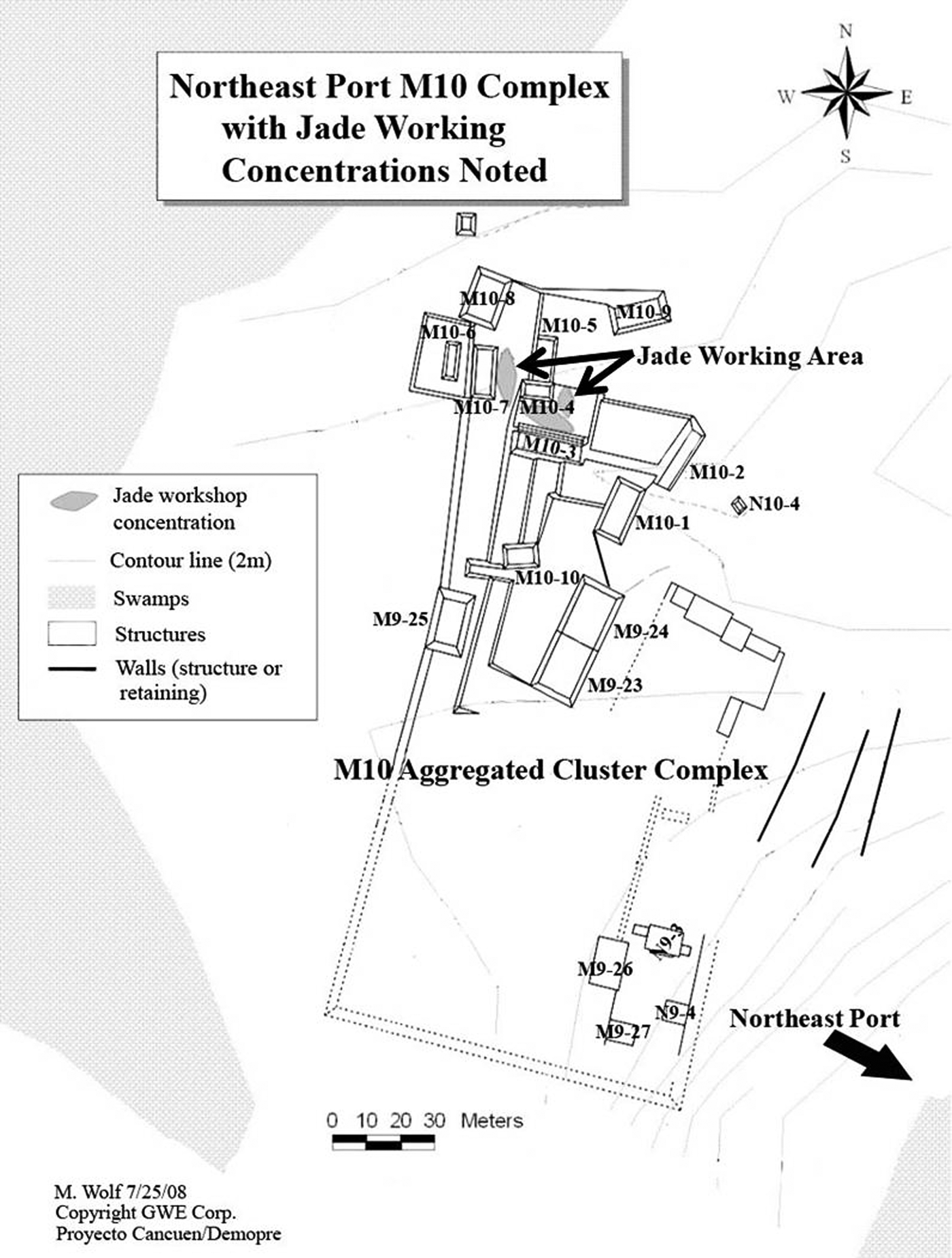
The presence of vast quantities of debitage in a residential compound indicates that the place was a workshop, in the sense of a location where production took place for the purpose of exchange (Clark Reference Clark and Isaac1986; Costin Reference Costin, Hruby and Flad2007). A previous study has shown that the patio in front of Structure M10-4 (Figure 2) had significant gold enrichment that derives from the sand employed as an abrasive, indicating that this location was used as a work place for crafting jade (Kovacevich et al. Reference Kovacevich, Bishop, Neff, Pereira, Laporte, Arroyo, Escobedo and Mejía2003:148–149).
Map of the workshop area. Prepared by Marc Wolf.
In archaeology we rarely have access to the exact place where the knappers sat and worked, and what is called a workshop in Mesoamerica is often a refuse area; that is to say, a place where the artisans gathered the waste of their work and disposed of it (Healan Reference Healan1992; Hester and Shafer Reference Hester and Shafer1992). Because of their location on the edge of the patios, these trash pits could correspond to such rejection areas. These contexts, however, raise many questions about taphonomy, chronology, time of use, and organization of work within the residential compound.
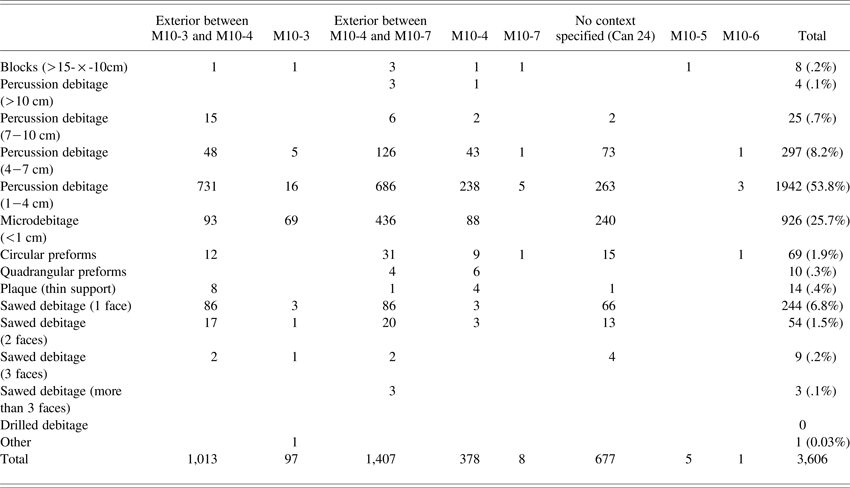
To address these questions, we attempted to reconstruct the distribution of debitage a posteriori, on the basis of the excavation lot numbers. Each fragment of debitage was recorded in an Excel database and compared with the original Cancuen field excavation notes in order to determine their spatial distribution (Figure 2; Table 1). In all, we counted 3,606 pieces associated with the workshop (only slightly more than the previous analysis [Kovacevich Reference Kovacevich2006], and the differences are likely due to the attention that was paid to microdebitage, as well as possible post-excavation fragmentation in storage and analysis). This represents 60 kg of material excavated from 108 excavation units. This exercise showed that jade debitage is scattered around all the exterior space in front of each house. Three loci, however, presented a higher density of jade material than the others and concentrated about 40% of the jade found in the entire group over 11% of the excavation lots (Figure 2). The rest was scattered over the exterior structures, and some was embedded in the floor or could have been swept from the trash pits.
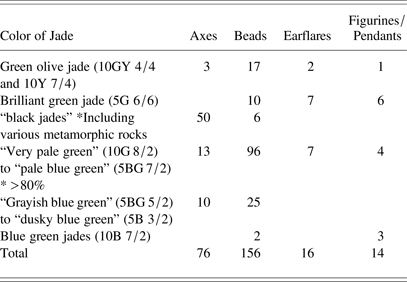
Classification of the major variety of colors for each category of finished objects
Once these three major concentrations were defined, we tried to determine how they were related to one another. We were able to establish that they were strictly contemporaneous, as two fragment of jade as well as numerous ceramic sherds could be fixed between these different excavation lots. Finally, no difference in the type of the material could be observed from one trash pit to another since they all presented a large majority of debitage related to percussion and very small quantities of sawing debitage. On that basis, we therefore cannot consider that any form of division of labor occurred between different locations.
Analysis of the ceramic materials from the workshop indicated a date between a.d. 790 and 800, and the associated burials all appear to be contemporaneous (Torres et al. Reference Torres, Saravia, Saravia, Tuyuc, Demarest and Martínez2013). Altogether 3,725 fragments of jade debitage and 262 jade finish artifacts were found in Cancuen; of these, 97% of the debitage and only 8% of the finish objects were found in this workshop.
Previous Studies of Cancuen's Jade Workshop
Kovacevich (Reference Kovacevich2006:173–174, 177) first analyzed the material from that context and classified the debitage into four categories: macrodebitage, microdebitage, raw nodules, and large worked nodules. She also distinguished the material, a total of 3,259 debitage pieces, on the basis of technological categories and counted it according to the technique used: percussion, sawing, drilling, polishing, abrading, incising, or tubular drilling (Kovacevich Reference Kovacevich2006:224). The lack of incised artifacts in the workshops and the discovery of two polishers in elite structures led her to suggest that there was a division of work on the site:
Non-elite specialists may have been involved with only the early stages of production of jade and pyrite artefacts, such as percussion, sawing and drilling, while the more intricate final stages such as incising may have been carried out by elites who may have been able to alienate the producer from the product through a monopoly on ritual and esoteric knowledge or sumptuary laws (Kovacevich Reference Kovacevich2006:489).
She suggests that the last stages in the manufacture of jade artifacts were carried out by the elite themselves, which enabled them to control production. The presence of more debitage in non-elite than in elite structures leads her to further suggest that the raw material was not centralized and that the producers could have negotiated their status through “the independent production of goods for exchange locally or regionally in an informal market” (Kovacevich Reference Kovacevich, Wells and Davis-Salazar2007:91).
GOALS OF THE PRESENT STUDY
Despite the fact that this earlier study does consider the existence of two levels, or forms, of jade production and exchange in Cancuen (Kovacevich Reference Kovacevich2006:186–188, Reference Kovacevich, Wells and Davis-Salazar2007:82, Reference Kovacevich, Hruby, Braswell and Mazariegos2011), it does not correlate the workshop to the different artifacts found in the site and therefore implicitly considers that all jade products found at this site were produced locally. Close inspection of the greenstone material from Cancuen shows that greenstone artifacts are very diverse and correspond to very different levels of skill and production processes. Other distinctions can also be made on the basis of color and the quality of the work. These distinctions are essential if we want to understand the relationship between the value of the products and their production and exchange context, and describing the technique is not enough to relate the debitage and the production waste at the site to a specific production process.
Finally, even if we accept the hypothesis of a division of labor between the elite and nonelite at Cancuen, we still need to understand what proportion of the jade production was made for the site's consumption and what proportion was meant to be exchanged, if indeed it was. Kovacevich's (Reference Kovacevich2006, Reference Kovacevich, Wells and Davis-Salazar2007:75–76) study, however, had a more general focus on the production and distribution of lithic material at the site and did not use full distributional analyses but combined material study by type of structure with structures scattered across the site. The problem with this method is that it does not allow us to understand the concentration or dispersion of the raw material, which is vital in order to understand the way it was managed. Therefore, the present study is based on more specific distributional evidence by excavation unit.
Overall, the way Cancuen was integrated into the jade exchange system remains unclear. How did the raw material arrive at the site? Was everything worked at Cancuen, or were there other distribution systems for finished objects? Did Cancuen export the jade artifacts and, if so, in what proportions and in what form? In what form did the material leave the workshop, and how was it worked by the other participants?
Such questions required a new analysis of this unique context in the Maya lowlands. We therefore decided to look at the totality of the jade workshops again and include the 2004–2011 collections.
METHODOLOGY: THE TECHNOLOGICAL ANALYSIS
The difficulty working with this sample was that most of the Cancuen workshop material relates to percussion work (Andrieu et al. Reference Andrieu, Jaime-Riverón, Tenorio, Calligaro, Ocampo, Jiménez, Ostrooumov, Arroyo, Palma and Aragon2011; Kovacevich Reference Kovacevich2006) and is therefore particularly difficult to read technically. Jade is such a hard material that it can cannot be worked by percussion except in the initial production stages because, unlike obsidian or flint, it is a heterogeneous rock that does not create conchoidal fractures. Therefore, percussion fractures are irregular, hard to control, and consequently hard to read. Most of the thin jade working is therefore processed by sawing and polishing (Rands Reference Rands and Willey1965). We decided to follow another procedure to determine the exact productions in which this workshop was involved. First, we decided to carefully analyze the finished objects at the site to reconstruct their production process and determine from there what kind of debitage should be found in the workshop if they had been produced locally.
We used discrete features such as the shape or standardization of the products. For instance, the regularity of the rounded shapes could indicate whether or not the circular forms were entirely made through motion on a circular polisher. If beads or earflares were entirely shaped by polishing, they should be of a very similar form and be superimposable. Conversely, if they were first cut and only polished at the end to even out the object's form, then we should observe a degree of variability among different earflares, and they should not be exactly circular, normalized objects.
Color seems to have been an important criterion (Jaime-Riverón Reference Jaime-Riverón2010; Taube Reference Taube2005). We therefore considered that parameter to be another important element in our analysis and used the table of colors of the rocks (Geological Society of America and Munsell Color 1995) to describe each variation of shade as precisely as possible. This criterion was also used for some finished products to the workshops. If some productions presented a unique color that was not represented in the jade debitage from the workshop it could indicate that these had been imported from another source than the one primarily worked by the workshop's craftsmen.
CANCUEN'S GREENSTONE RAW MATERIAL
Kovacevich, Neff, and Bishop analyzed 24 fragments from this workshop context by Laser Ablation Inductively Coupled Plasma Mass Spectrometry (LA-ICP-MS) (Kovacevich et al. Reference Kovacevich, Neff, Bishop, Speakman and Neff2005). They distinguished two visual categories they call “light green” and “dark green” and compared jade samples from other lowland and highland sites. This work showed that the jade worked in this workshop is jadeite that comes from a single, currently unidentifiable source. Recent analysis of another sample of 30 fragments of the workshop debitage at the Musée du Louvre in Paris (C2RMF) also confirmed that this material was all jadeite and that it probably came from a unique source, most likely in the Verapaz highland region or adjacent Quiche area (Andrieu et al. Reference Andrieu, Jaime-Riverón, Tenorio, Calligaro, Ocampo, Jiménez, Ostrooumov, Arroyo, Palma and Aragon2011).
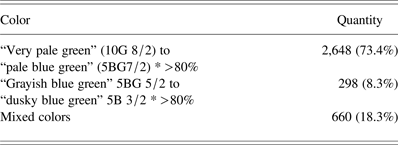
For the reanalysis, we decided to classify the workshop's debitage into three visual categories. First, the light green one, which varies from “very pale green” (10G 8/2) to “pale blue green” (5BG 7/2). Second, the dark green one, which varies from “grayish blue green” (5BG 5/2) to “dusky blue green” (5B 3/2B). These differences in color correspond to the same raw material, as all four nuances may be found on a single block (Figure 3). Another color also appears in these blocks, in the form of very thin veins of “brilliant green” color (5G 6/6). Veins of albite (Andrieu et al. Reference Andrieu, Jaime-Riverón, Tenorio, Calligaro, Ocampo, Jiménez, Ostrooumov, Arroyo, Palma and Aragon2011) are also present in most blocks; they are recognizable because of their white color and because they introduce fragility to the raw material.
Picture of a jadeite block from Cancuen with all the nuances of colors of the jadeite worked in the workshop. Photo courtesy of Erin Sears.
The finished objects from the site had a greater variety of colors than the workshop material. We classified them into six visual categories: light green, dark green, and brilliant green (that we had recognized in the workshop's debitage), as well as “green olive” (from 10GY 4/4 to 10Y 7/4), “blue green” jades (10B 7/2), and black.
CANCUEN'S JADE ARTIFACTS
In 11 years of excavation (1999–2011), 262 greenstone artifacts have been found at the site. These can be divided into five major categories: beads, earflares, axes, pendants, and figurines, all corresponding to different production processes.
Axes
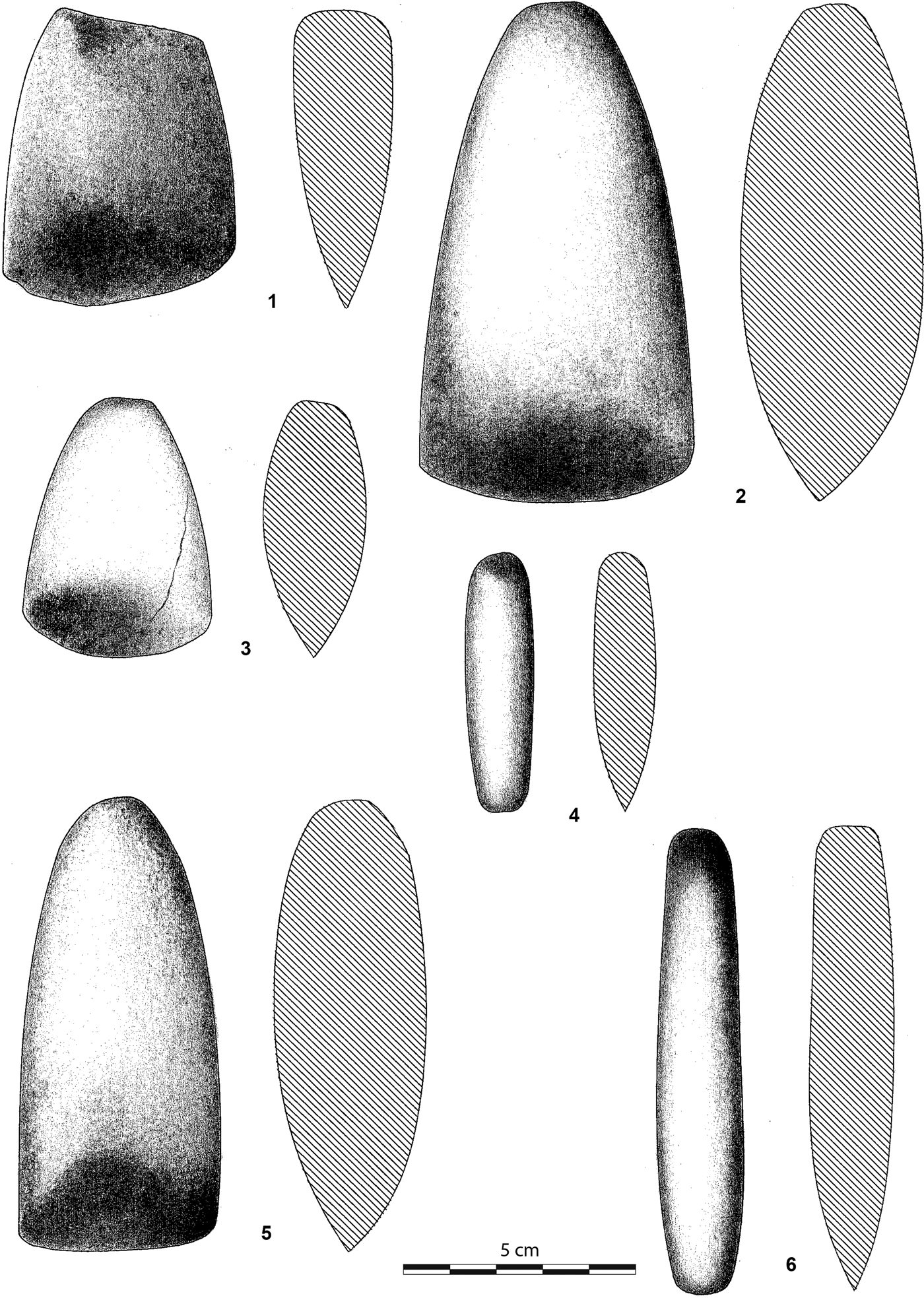
This category of object represents great variety in terms of shapes and forms (Figure 4), as well as the color of the raw material. These artifacts are all polished on both sides and have an elliptic cross-section and triangular profile. Despite this general description, axes present a very high degree of variability with regard to the width and length, as well as in color and raw material (Table 1). By measuring the width of the complete objects every three centimeters along their length, we distinguished six categories of implement (Figure 4). Interestingly, the variety of shapes corresponds to the variety of colors: the thickest and biggest axes seem to have been mostly made out black or gray material, whereas the small thin ones tend to be produced out of dark or light green material. This might indicate that they came from different sources or different workshops.
Variety of Cancuen's axes. Drawing by Luis Luin.
Despite these differences in the final shape, however, the production process of these axes is always quite similar: a flat, elongated blank is produced by percussion and is smoothed on the edges in order to produce an elliptic section. This stage of production produces large and thin flakes that are recognizable because of their extended shape (Pétrequin et al. Reference Pétrequin, Bontemps, Buthod-Ruffier, Le Maux, Pétrequin, Cassen, Errera, Klassen, Sheridan and Pétrequin2013:270; Taube et al. Reference Taube, Hruby and Romero2005). Finally, the axes are totally polished. Axe polishers are recognizable by the numerous striated lines that result from polishing tool edges.
Beads
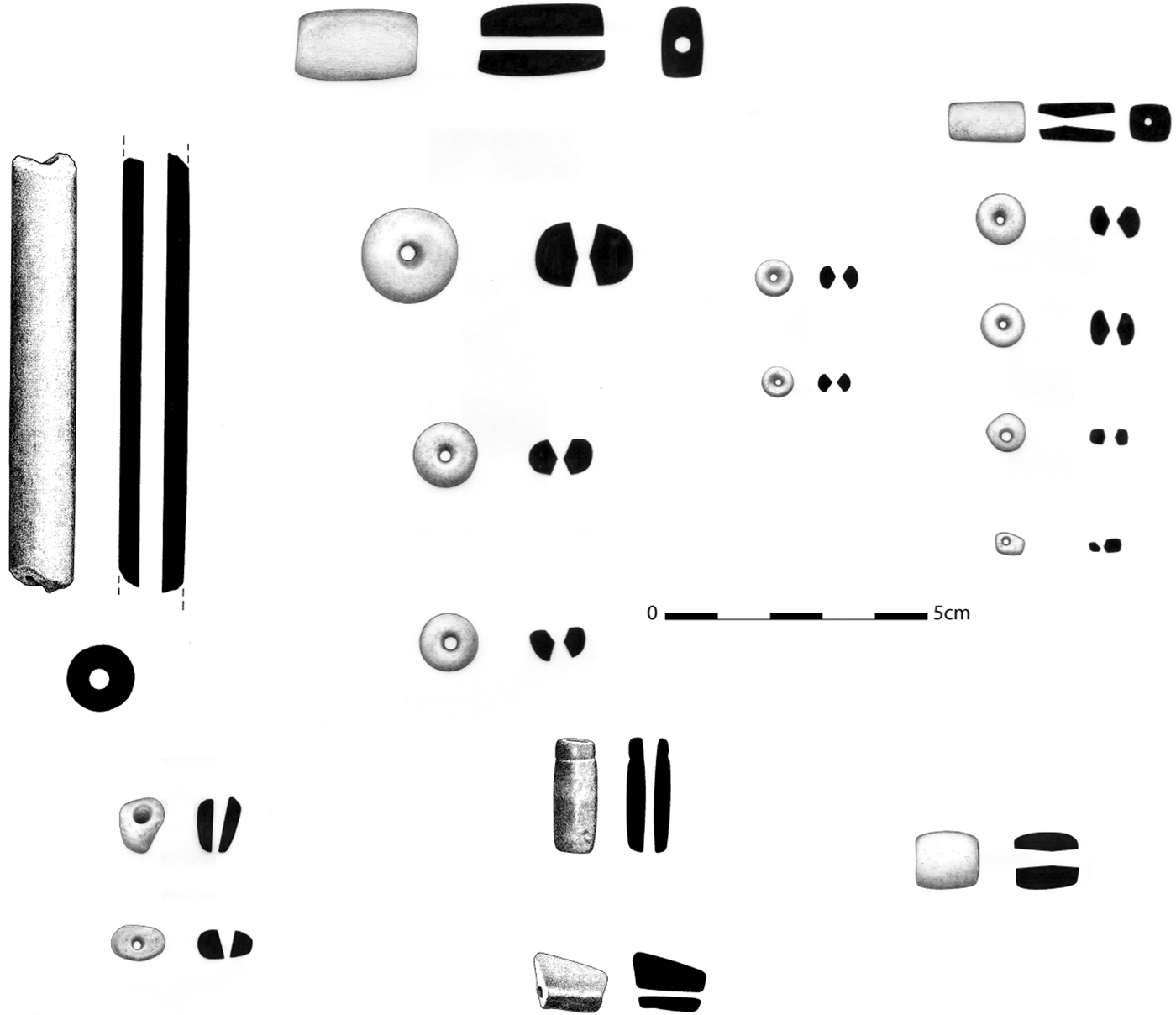
Beads also demonstrate great variety in their shapes and colors. We distinguished four morphological categories of beads: small rounded, large rounded, quadrangular, and tubular (Figure 5). Their production processes varied according to their shape and size. The small round ones were the result of a rather simple production process since they could have been entirely produced through percussion forming of small blanks that were then drilled and polished (Hirth et al. Reference Hirth, Puche, Arce, De León and Hirth2009; Rochette Reference Rochette and Hirth2009). The large rounded and quadrangular examples probably took longer to form, with a rounded preform first made by pecking and then smoothed through polishing and finally drilling. The size of the hole, as well as the micro traces inside the hole, indicate that it was probably carved out with a hollow stick, for instance (Thouvenot Reference Thouvenot1982). Such a production stage creates small tubular byproducts that could have been used in the production of elongated beads.
Variety of Cancuen's bead shapes. Drawing by Luis Luin.
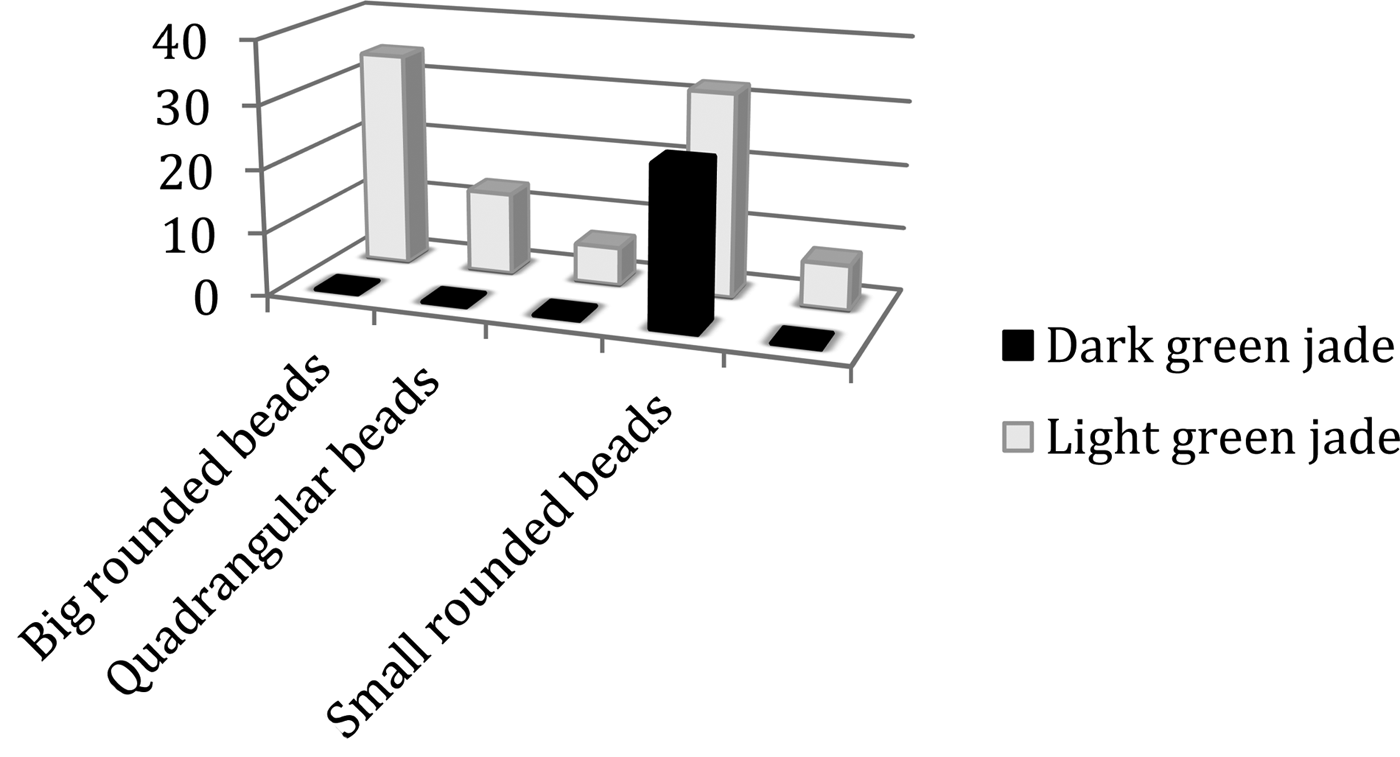
These beads also present different qualities of color and raw material, which could also indicate that they came from different production networks. The large beads are made of light green jade, and the rectangular ones are mostly of yellowish jade that does not appear in the workshops. Finally, the very small rounded beads are mostly made either of very dark jade or veins of albite that break easily.
Earflares and Tubular Beads
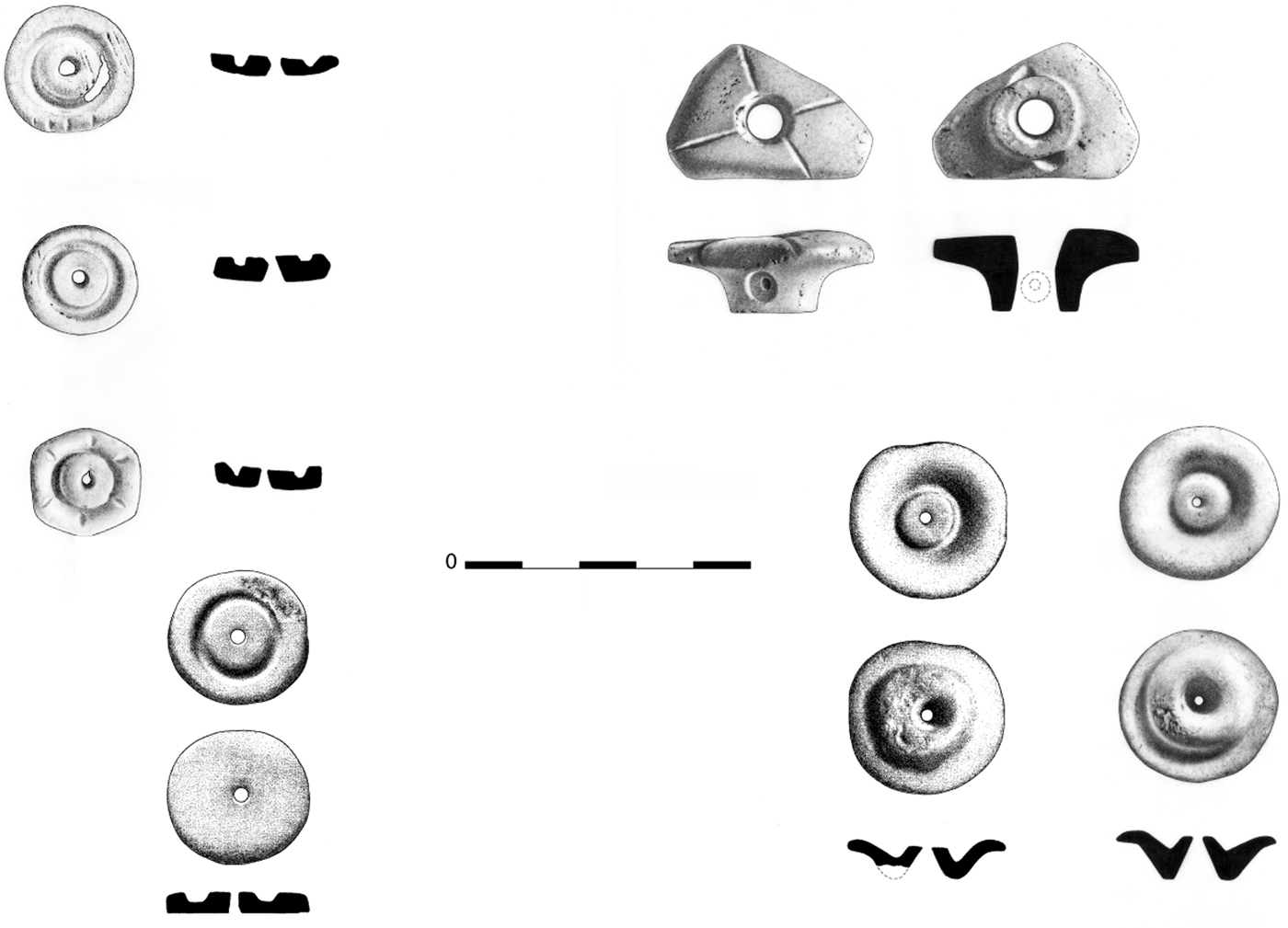
Earflares are relatively scarce. Sixteen were found at the site, of which only seven were complete. We distinguished four types in our analysis: flat rounded; small rounded; a unique, particularly large piece that was found in a cache in the palace; and another triangular one (Figure 6). Most of them were made of blue green or brilliant green jade (Table 1).
Variety of Cancuen's earflares. Drawing by Luis Luin.
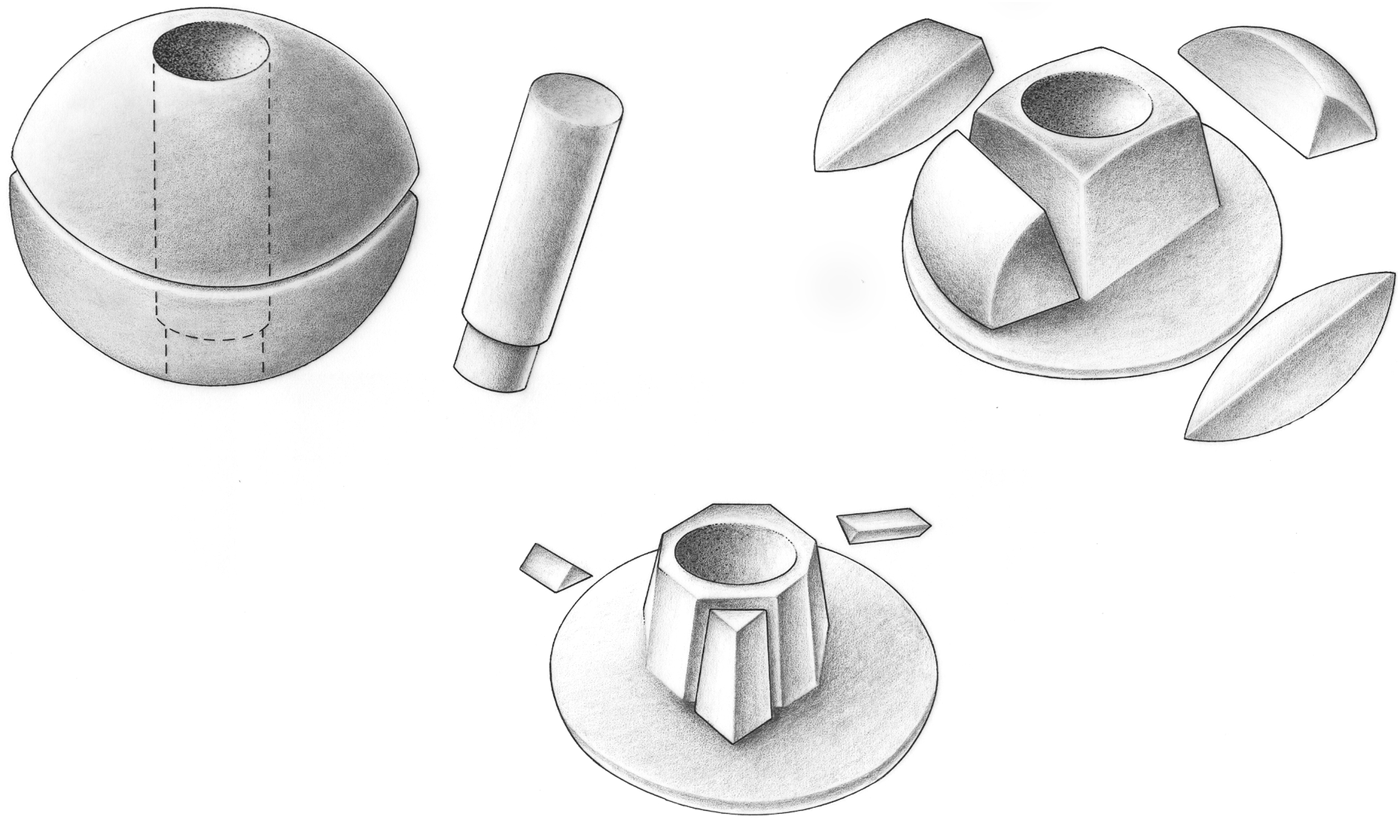
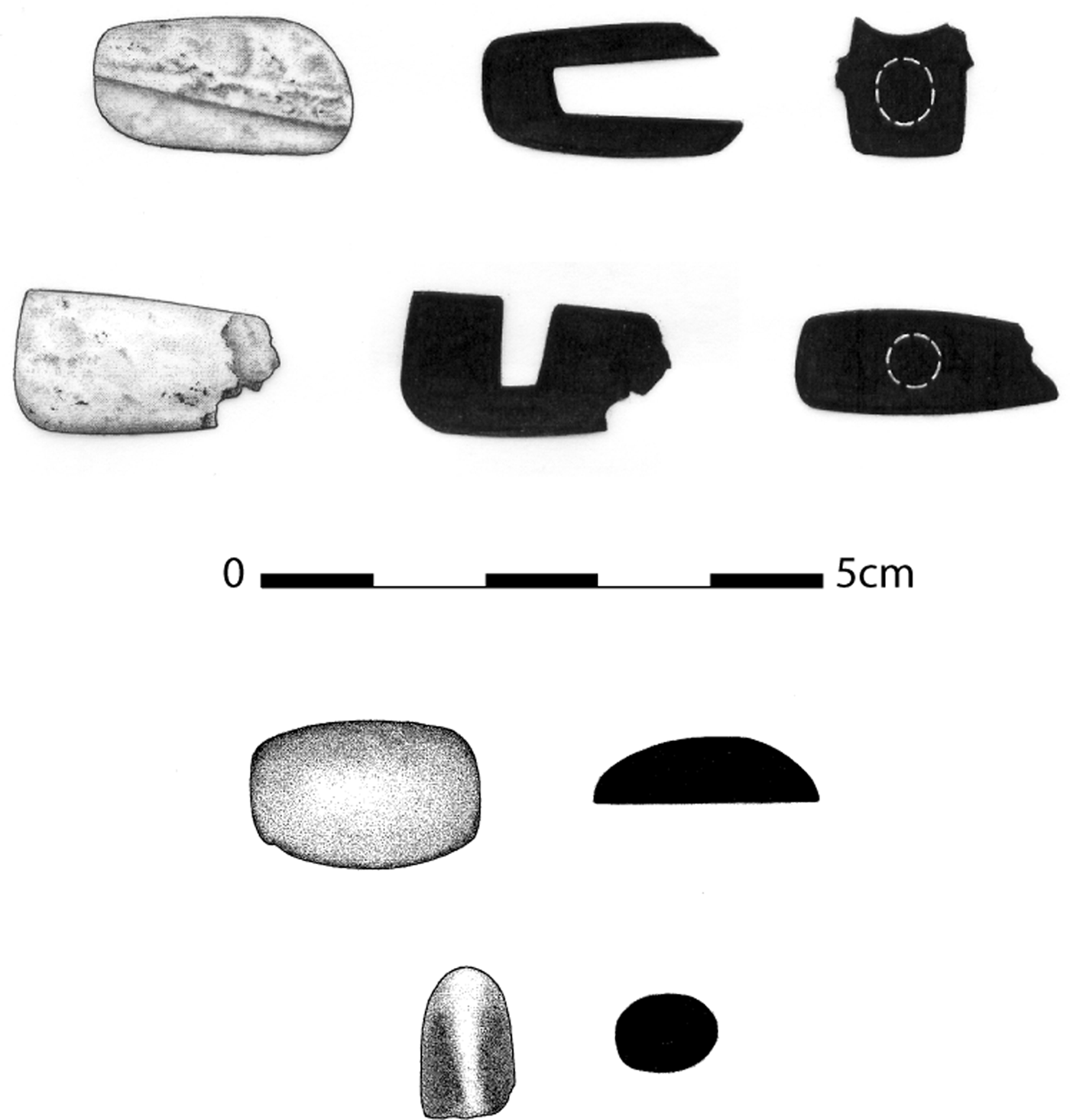
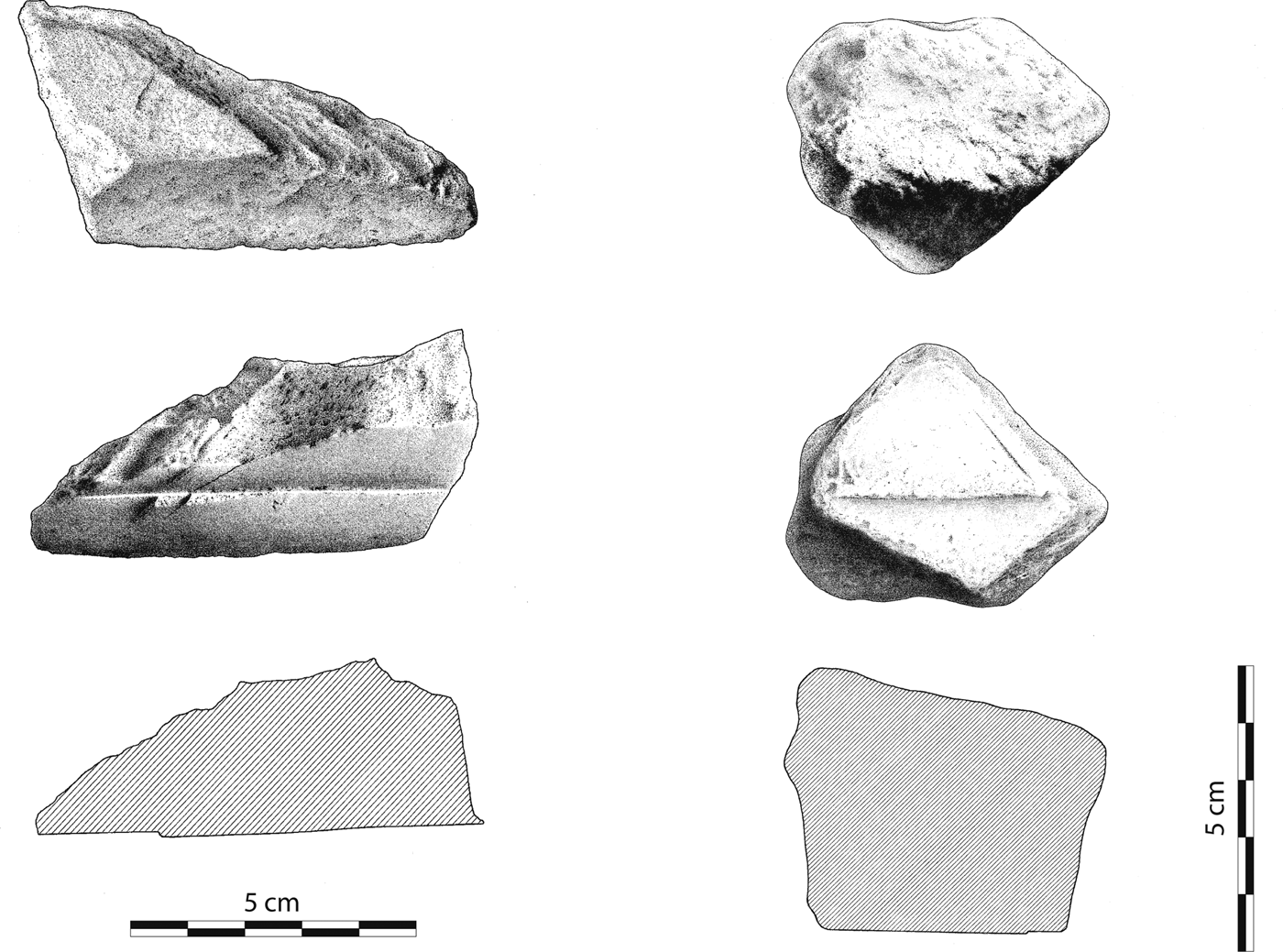
The production process for the small rounded ones was probably quite simple. The support is a plaque that was carved by motion on a circular polisher, as demonstrated by the fact that they could be superposed exactly, and are of a perfect circular shape (Figure 6). The larger round or quadrangular earflares were the result of a more complicated production process and required a preform to be cut in order to produce the salient part (Figure 7). The distal portion was left without polishing and shows the shape of the preform. These were formed by carving and not solely through polishing, as confirmed by the fact that their shape was not perfectly circular, which would have been the case if produced by motion. The production of these artifacts should have resulted in small byproducts, cut on different sides.
Production process of the large round earflares. Drawing by Luis Luin.
Problematic Polishers
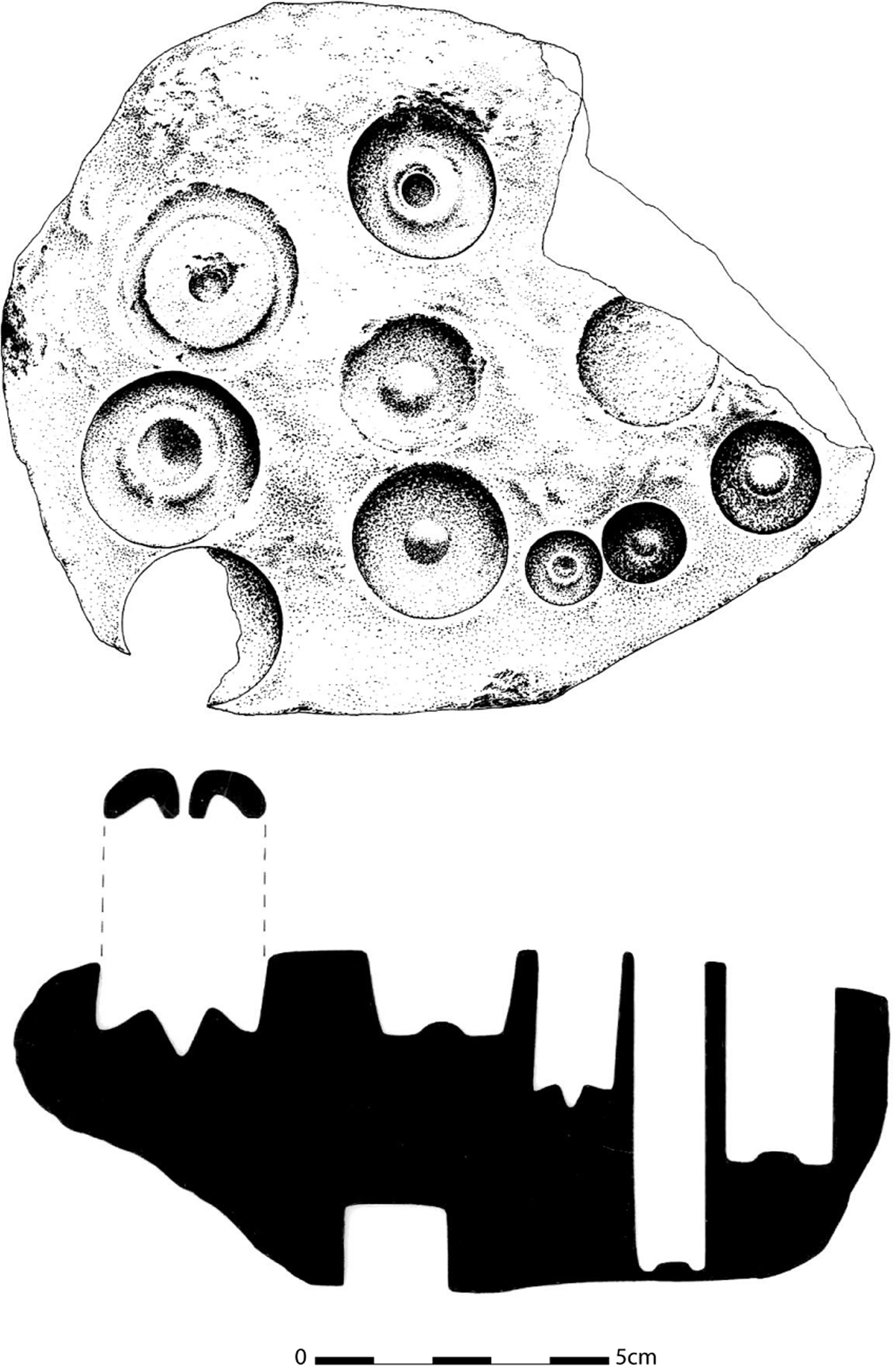
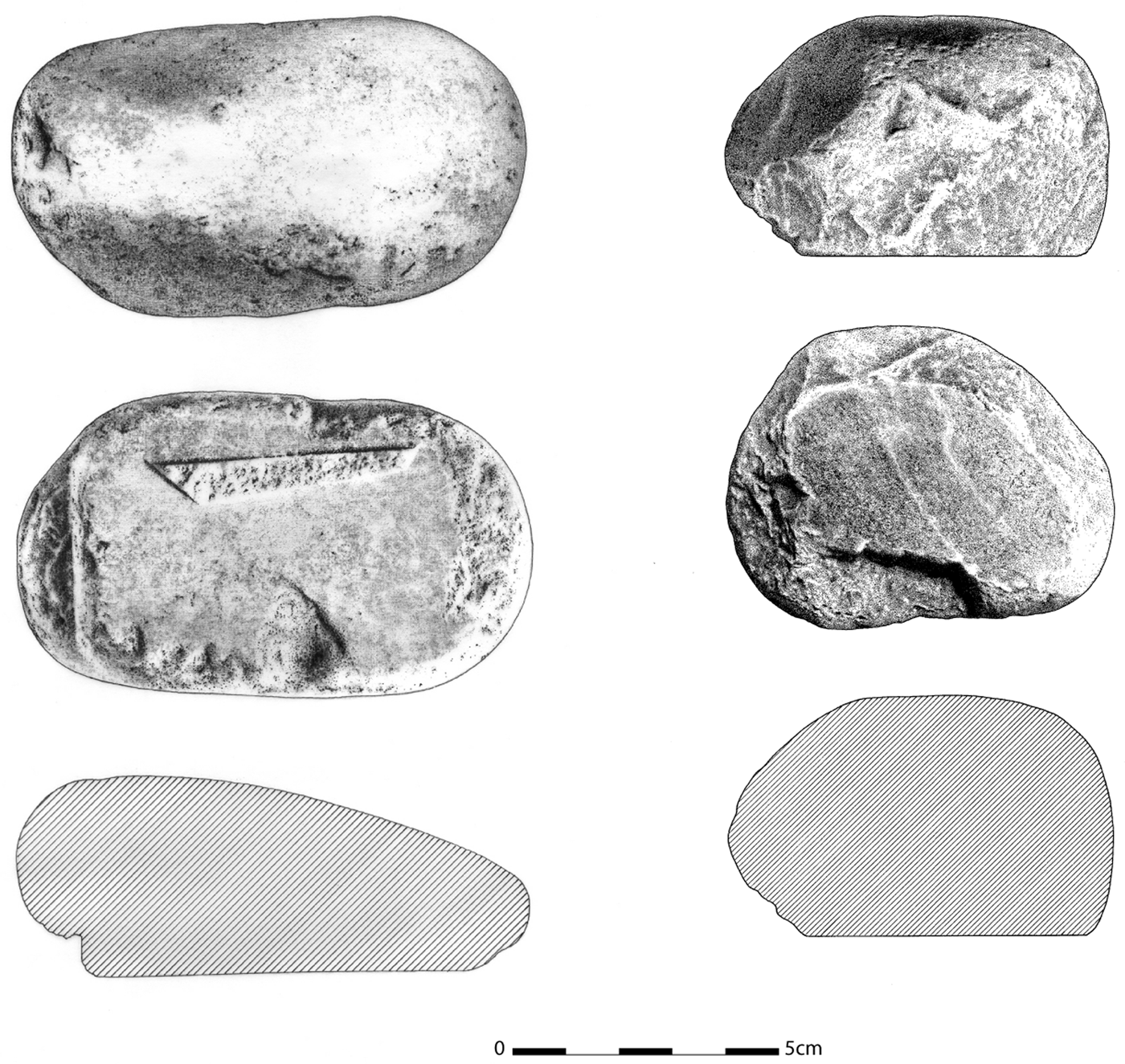
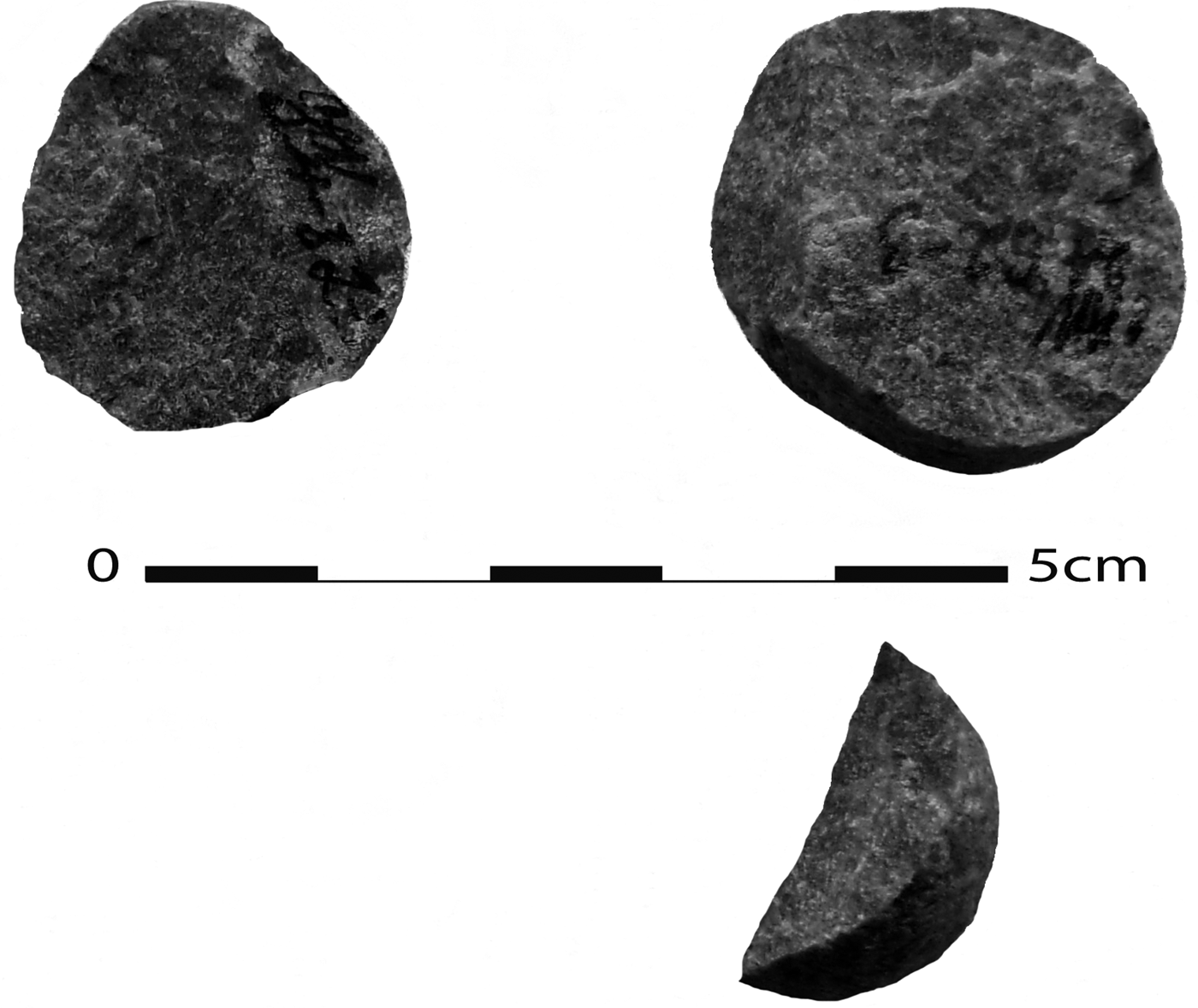
The three limestone polishers found at Cancuen (Figure 8) all have circular negatives of different sizes and depths. Their shape corresponds to the production of circular earflares, either the flat small ones or the larger rounded ones. The negative shape on both of these objects indicates that they were able to polish both the ventral and the dorsal surface of these artifacts. They also have longer negative marks and more simple rounded negative impressions that correspond to the shape of the tubular and the thick rounded beads. Unlike the polishers found at Kaminaljuyu, for instance (Kidder et al. Reference Kidder, Jennings and Shook1946), these artifacts were made of soft limestone, which indicates that they were not solely used to shape the earflares or the beads but were probably also used with an abrasive to give final polish, or shine, to the objects.
Cancuen's limestone polisher. Drawing by Luis Luin.
Figurines and Pendants
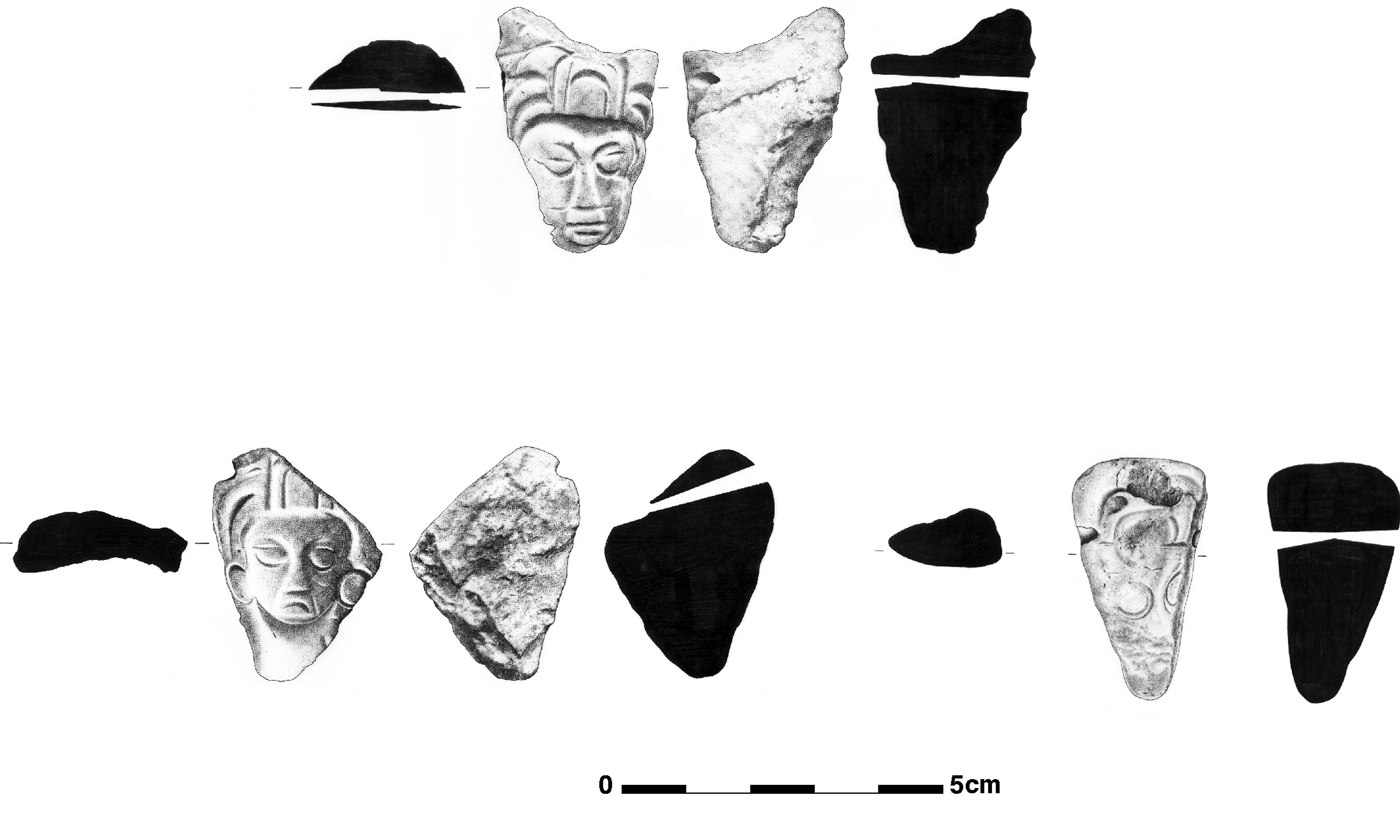
These artifacts (n = 14) were much more elaborate than the others; they also present greater variability in shapes and types, with no standardization at all observed from one piece to another (Figure 9). Their production implies a higher degree of skill and a longer production time. Interestingly, the quality of the work was also highly variable from one piece to another. A few pieces of blue green jade were very well crafted, whereas some others in intense green jade were much rougher. The iconographic style is also quite different: whereas most of the artifacts were very geometric in form and style, others showed greater fluidity. In most cases, the original form of the blocks remains visible and the distal part of these artifacts is left almost unworked, enabling us to see that the support for this work was a preform of ovaloid shape that had been smoothed and worked on a single side. At least two fine diadem pieces, found in a royal burial (K7-3 burial), clearly predates the workshop (Demarest et al. Reference Demarest, Andrieu, Torres, Forné, Barrientos and Wolf2014).
Cancuen's figurines and pendants. Drawing by Luis Luin.
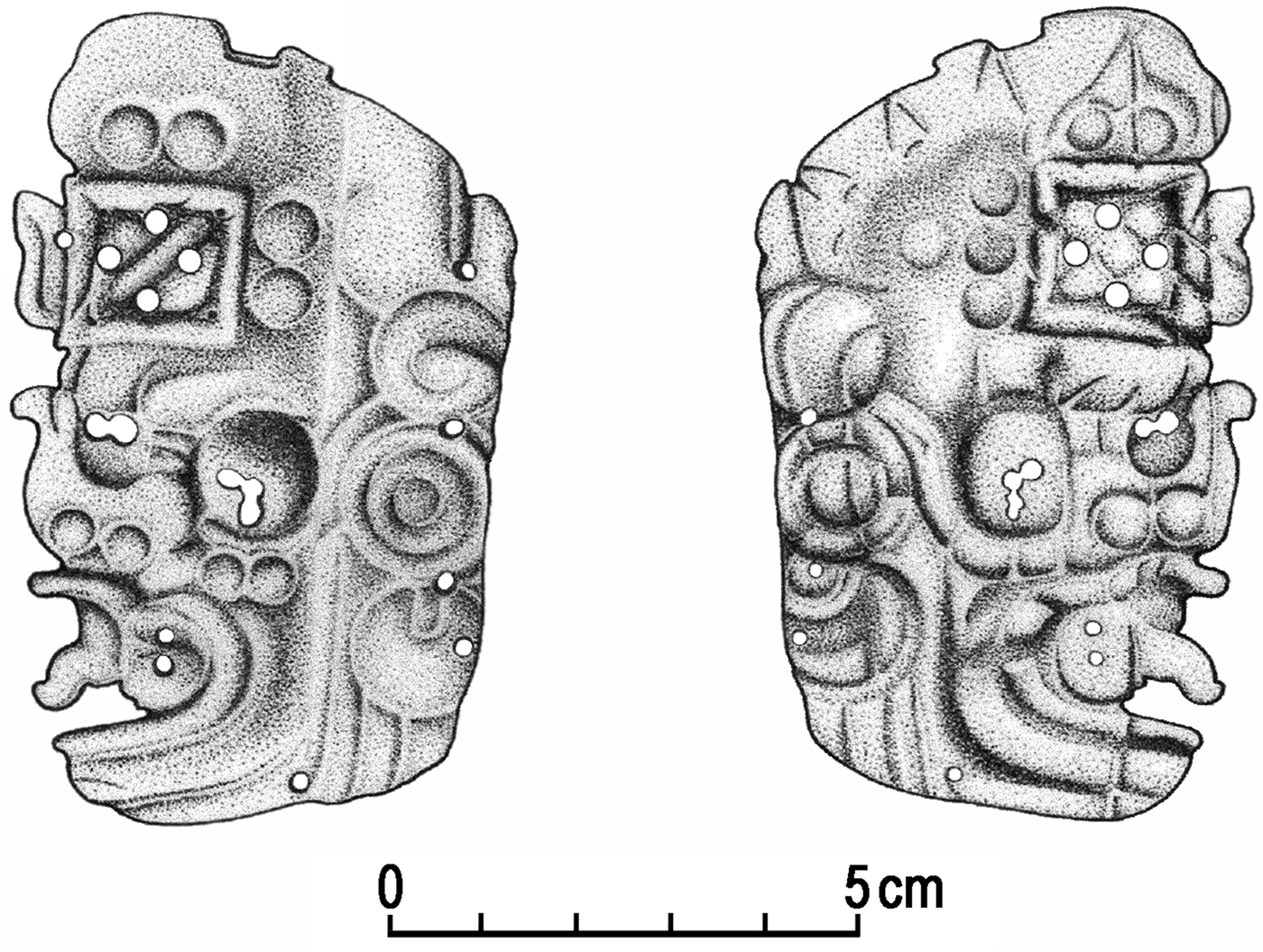
One item is a piece of excised work, which was found in a cache in the palace. It is far more elaborate than the others and closely resembles examples found in Waka-El Peru (Lee Reference Lee, Escobedo and Freidel2005) and Aguateca, though the latter was made of alabaster (Eberl and Inomata Reference Eberl and Inomata2001). This piece was incised but also worked by pressure, with the different holes being made by small knots (Figure 10). Iconographic, stylistic, and technique similarities may suggest that these objects all date to the Late Classic period and came from a similar production center, which is still unknown.
Late Classic jade “Jester God” found in the Cancuen palace. Drawing by Luis Luin.
Figurines and pendants were made of three different types of stones: light green (10G8/2; n = 4), brilliant green (5G 6/6; n = 6), and blue-green (10B 7/2; n = 2) jades. Chemical analyses were carried out on the two blue-green pendants that showed they were not made out of jadeite but, rather, of another material (Andrieu et al. Reference Andrieu, Jaime-Riverón, Tenorio, Calligaro, Ocampo, Jiménez, Ostrooumov, Arroyo, Palma and Aragon2011). The variety in style, raw material, color, shape, and technique indicates that these artifacts probably come from different producers and perhaps were imported from different workshops.
VARIABLES IN THE STUDY OF THE JADE DEBITAGE
This review of jade artifacts found at Cancuen has given us a clearer idea of the types of jade debitage that we might have expected to find at the site, had all the discussed objects been locally made. Axe production flakes are highly recognizable as they tend to be flat and extended, while axe polishers are also easily recognizable with their numerous ridges for polishing the edges (Pétrequin et al. Reference Pétrequin, Bontemps, Buthod-Ruffier, Le Maux, Pétrequin, Cassen, Errera, Klassen, Sheridan and Pétrequin2013; Taube et al. Reference Taube, Hruby and Romero2005).
The production of small rounded beads should be recognized by the presence of rounded or quadrangular preforms (Hirth et al. Reference Hirth, Puche, Arce, De León and Hirth2009), as well as a certain amount of undrilled beads or beads that were broken in the process of drilling (Figure 11). In other workshops where these types of objects have been produced, the number of broken beads are generally quite high (Hirth et al. Reference Hirth, Puche, Arce, De León and Hirth2009; Rochette Reference Rochette and Hirth2009).
Undrilled beads. Drawing by Luis Luin.
The large rounded beads and the earflares were formed by incision, which typically leaves small fragments from the cuts on various faces (Figure 7). Therefore the presence of small fragments cut on various faces would be a good diagnostic of the production stage involved, while the number of sawed faces on each block could be a good indicator of the degree of advancement of the production process.
Given these observations, we consider the relevant parameters for studying the jade debitage from the workshop to be the color, the presence of sawing, the number of faces that were sawed, their dimension, the number of percussion marks, the size, the weight of each fragment, the presence of polishing, glossiness, drilling, pecking, and the quality of the raw material. These were all taken into account, as was the presence of irregularities in the blocks and the presence of albite or different qualities of jade.
REANALYSIS OF THE WORKSHOP DEBITAGE
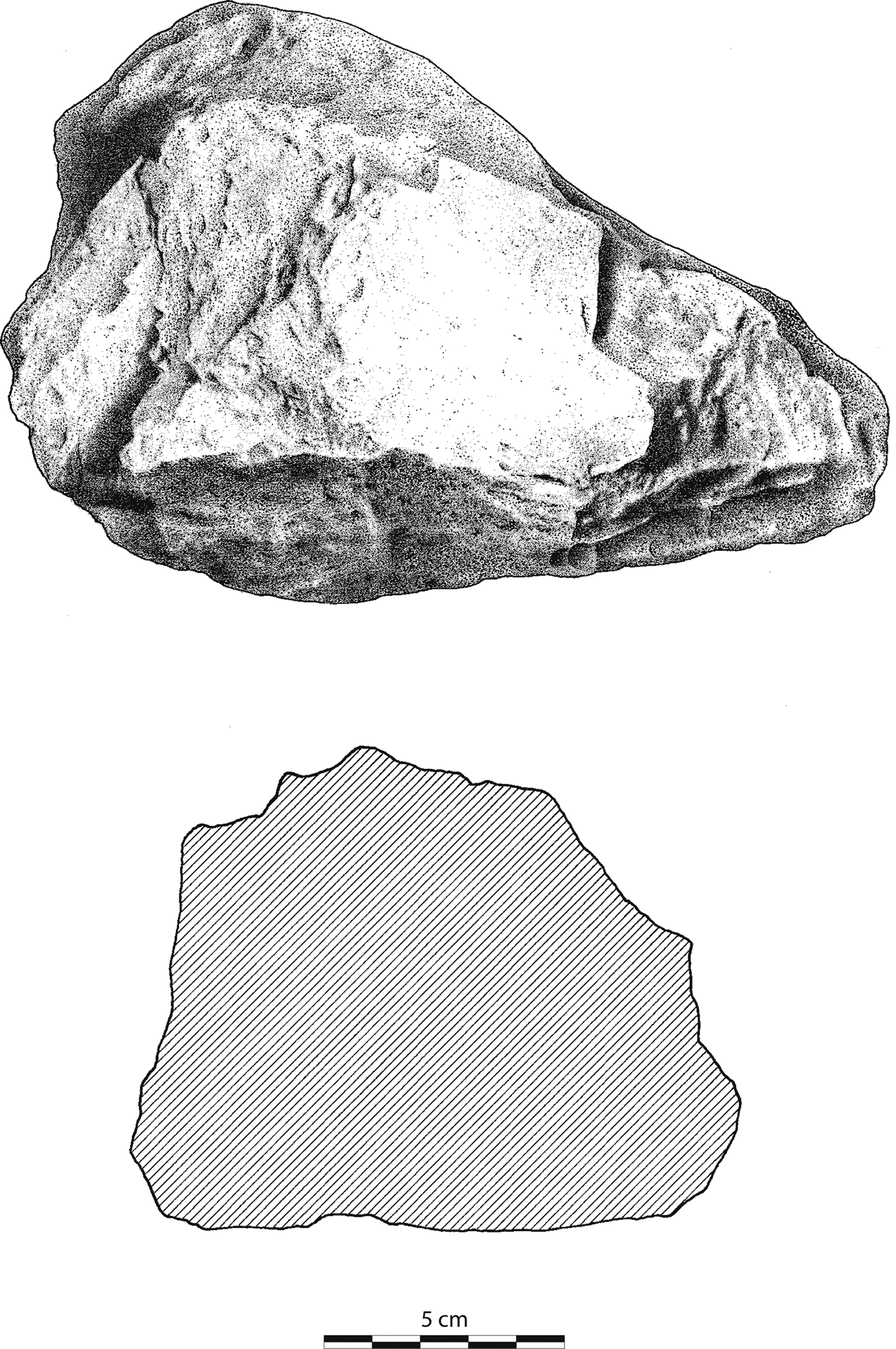
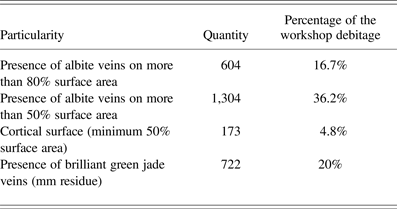
Surprisingly, the jadeite blocks in the workshop were relatively big. Most of the material measured between 1 to 4 cm (Table 2), but some blocks measured more than 15 cm wide and 10 cm long (Figure 12). Only 173 fragments presented cortical residue, indicating that the raw material was probably partially worked at the sources. Yet, 63% of the material presents albite veins on more than 50% of a surface, showing that no real selection work regarding the quality of the jade had been done at these sources (Table 3). Instead, it appears that selection was carried out in the workshop itself and, indeed, all the blocks were systematically worked in line with the veins, probably in order to remove them. This percussion work was conducted with jade percutors, recognizable because of their size, weight, and shapes (Figure 13).
Jadeite block from the workshop. Drawing by Luis Luin.
Jadeite percutors from the workshop. Drawing by Luis Luin.
Composition of the workshop's raw material
Quality of the workshop's jade debitage
Despite the fact that no block was entirely brilliant green, more than 20% of them presented small residual veins of this very green color (Table 4). The fact that it only appears as very small residual fragments in the workshop, whereas many finished artifacts in the site presented that color (Table 1), would therefore indicate that these veins were probably systematically taken off and worked and exchanged outside the workshop. Extraction of veins of fine jade may have been a major function of the workshop, as opposed to artifact manufacture.
Color of the workshop's jade debitage
Certain blocks were sawed. This is a very long process, and experiments have shown that it takes more than 40 hours to saw a block of 20 × 9 × 9 cm, depending on the type of abrasive used (Pétrequin et al. Reference Pétrequin, Bontemps, Buthod-Ruffier, Le Maux, Pétrequin, Cassen, Errera, Klassen, Sheridan and Pétrequin2013:274–275), and this was therefore only done on homogenous parts of the blocks. All sawing was carried out with a string or a soft material ligament. The use of a string for the cutting part is obvious from the ellipsoid shape (Figure 14) left by the string on the center of the cut part of the blocks (Rands Reference Rands and Willey1965:573). The choice of the parts to be sawed depended on the color: the sawed blocks were light green, and it seems that the dark green ones were never selected. The sawing of these blocks could not be related to a specific production process. Most of the fragments prepared this way were only sawed on one face, on the brightest part of the block. It is therefore possible that the artisans were cutting off certain parts of the raw material to be worked in other workshops in or outside the site.
String-cut jadeite blocks from the workshop. Drawing by Luis Luin.
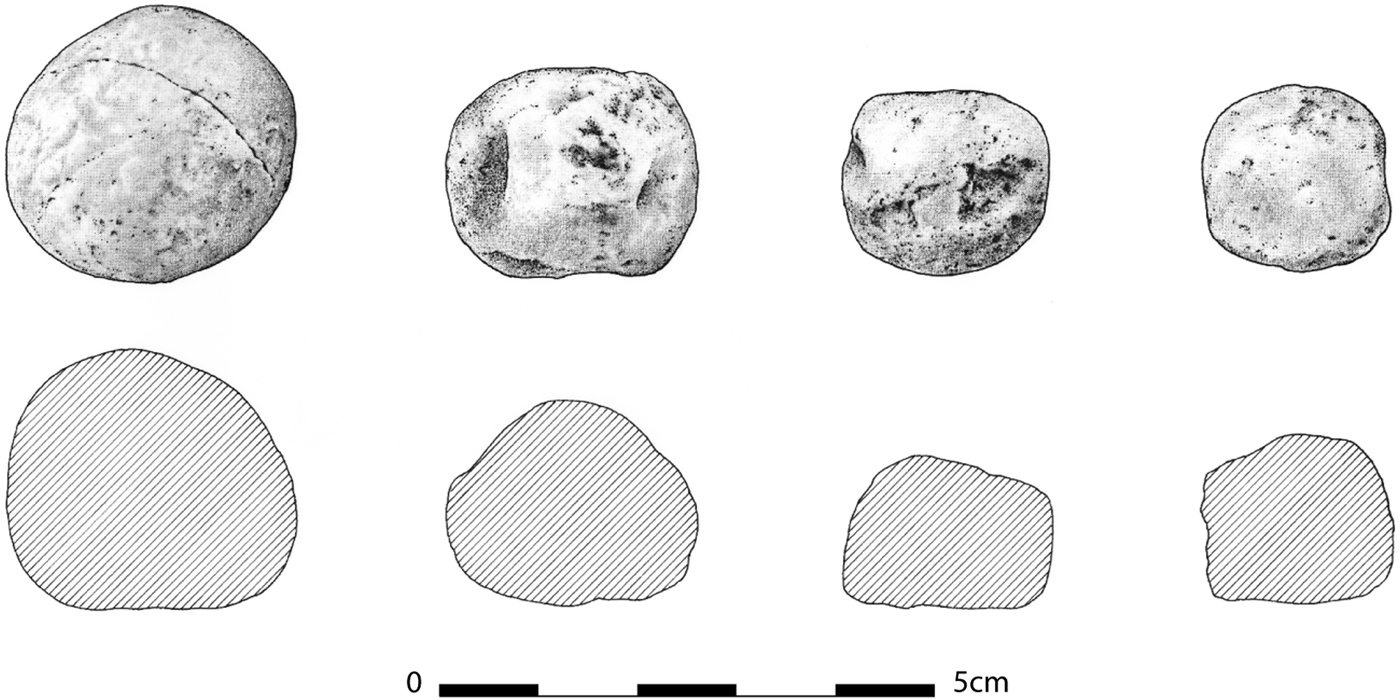
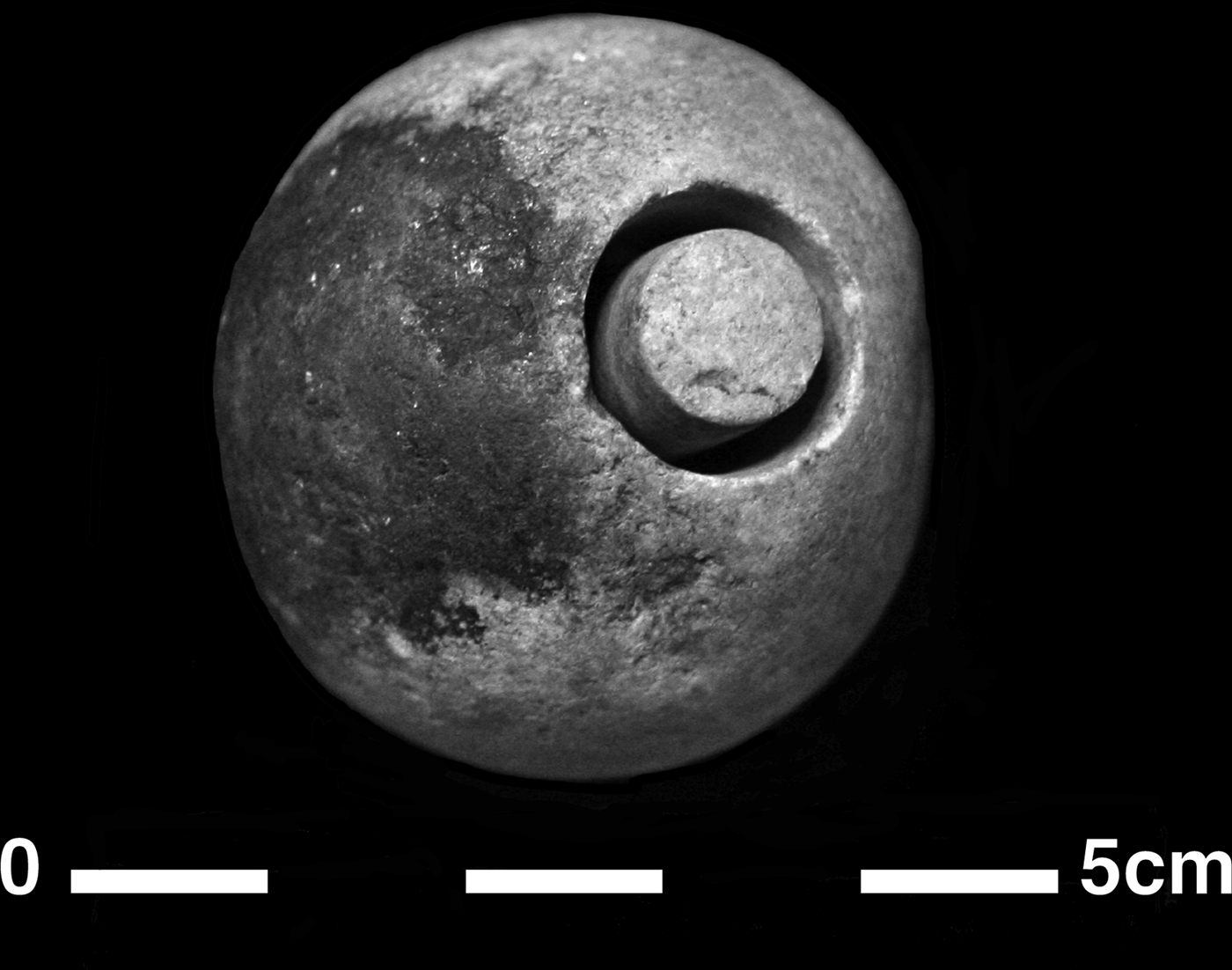
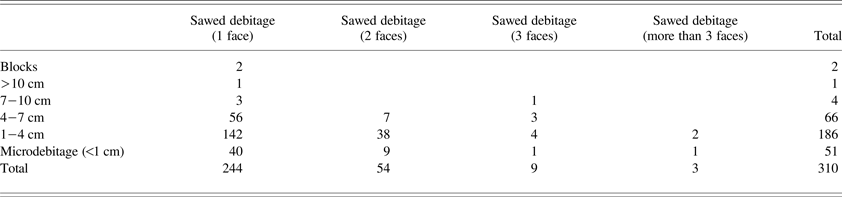
Finally, certain fragments were broken into smaller pieces that were then pecked into a circular shape. We counted 69 of these possible preforms (Figure 15), where size corresponds either to the large rounded beads or to the large rounded earflares (ranging 1–4 cm in size). These pieces were too small to be hammerstones, and were pecked over their entire surface. In order to be worked into finished artifacts, however, these blanks required considerable work and had to be cut on various faces to become earflares (Figure 7), or drilled to form large rounded beads. But, the debitage corresponding to these latter stages is clearly lacking: only six fragments possibly corresponding to the cutting of the earflares (Figure 16) were found, and only 12 fragments cut on three or more faces, representing less than .3% of the workshop's material. Only one large partially drilled blank was found (Figure 17), and no undrilled or partially drilled bead was found in the entire workshop's collection.
Workshop circular preforms. Drawing by Luis Luin.
Possible diagnostic fragments of the cutting the large rounded earflares. Photo by Chloé Andrieu.
Picture of a unique large partially drilled bead from the workshop. Photo by Chloé Andrieu.
Interestingly, only the light green material was used for the preforms. The dark green and the albite fragments were not used but were perhaps reserved for other purposes.
ELEMENTS MISSING FROM THE CANCUEN JADE WORKSHOP
The small and medium blanks indicate that the workshop craftsmen were producing beads and earflare preforms. By definition, final products should be much scarcer than production byproducts in a workshop (Clark Reference Clark and Isaac1986, Reference Clark1997), so the lack of finished beads and earflares in these mounds is not surprising. In both cases, however, important stages corresponding to these two productions were clearly lacking, and unperforated beads or beads broken in the course of their fabrication process were absent, as was the debitage corresponding to the third stage of earflare production—that is to say, small string-cut fragments cut on more than two faces (Table 5). It therefore seems clear that this workshop was only involved in the production of beads and earflare preforms and that these blanks would have required much work to be made into finished artifacts.
Dimensions of the workshop's sawed debitage
The lack of any debitage related to the production of axes indicates that this workshop was probably not involved in their fabrication at all.Footnote 1 In fact, the color of the axes indicates that they were mostly made of different raw materials than the ones worked in the workshop (Table 1 and 4). The lack of black and green olive raw materials in the workshop would therefore confirm this technological observation and would indicate that these tools were probably not produced at the site but, rather, acquired through exchanges with other production centers. Finally, the diversity in style and color as well as the lack of flat elongated preforms in the workshop would indicate that figurines and pendants were not produced there either.
The study of the different qualities of jade worked in the workshop also shows that the artisans had systematically removed the greenest parts of the blocks and separated different qualities of raw material. The greenest veins could have been worked elsewhere in the site, as 8% of the finished artifacts were in that color (Table 1), whereas that color was only present in the workshop as residual parts of less than 1 cm. The dark green jade seems to have been left as secondary quality material. Only the light green jade was directly worked in the workshop and used to prepare circular preforms by pecking, serving as the basis for the fabrication of the large rounded beads and the earflares.
Therefore, by reanalyzing this material, we were able to show that the workshop was not only involved in a preliminary stage of production (Kovacevich Reference Kovacevich2006; Reference Kovacevich, Wells and Davis-Salazar2007), we were also able to specify exactly what those productions were and how preliminary the work actually was. These conclusions confirm that there was a spatial division of labor (Kovacevich Reference Kovacevich2006, Reference Kovacevich, Wells and Davis-Salazar2007); however, they enabled us to fine-tune that conclusion by showing that this workshop was carefully separating different qualities of raw material and working earflare and bead preforms. Additionally, this study showed that the blanks still required considerable cutting work before being finished. The question, therefore, is, who carried out the remainder of the production process?
THE POLISHER PROBLEM
The three earflare and bead polishers were not associated with the workshops but were found in the fill of elite constructions (M9-1, L7-9 and L8-9) (Barrientos et al. Reference Barrientos, Larios, Luin, Demarest, Barrientos, Callaghan, Kovacevich and Woodfill2004; Jackson Reference Jackson, Demarest, Barrientos, Kovacevich, Callaghan and Luin2003; Kovacevich Reference Kovacevich2006, Reference Kovacevich, Wells and Davis-Salazar2007). The first was from the humic layer of a secondary elite structure, the second was in the massive construction fill that covered a part of the palace for the purpose of expanding it—a process that was never completed (Barrientos et al. Reference Barrientos, Larios, Luin, Demarest, Barrientos, Callaghan, Kovacevich and Woodfill2004). The third was in the fill of the palace (Claudia Quintanilla, personal communication 2012). Therefore none of these objects came from primary contexts. In all cases, their presence in fill is interesting, as is their distribution. Their presence implies that the last stage in the production of these earflares may have taken place somewhere on the site, but probably not in the workshop itself. The problem is that none of the missing type of jade debitage was found associated to these polishers, so if the final shine of the beads and earflares was carried out somewhere other than in the workshop, we are still missing a stage in their production process.
OTHER CONTEXTS OF JADE PRODUCTION WASTE IN THE SITE
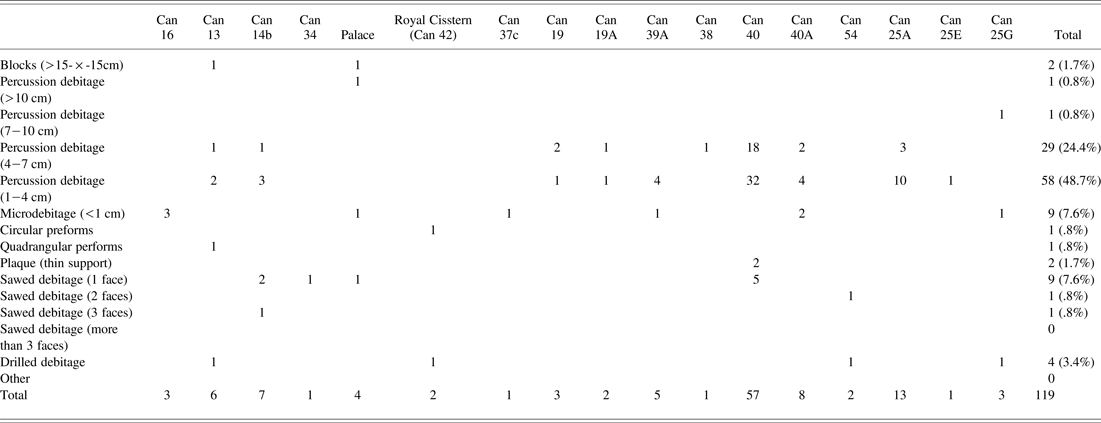
Of the 3,725 fragments of jade debitage found in Cancuen, 97% were concentrated in the workshop, but 119 fragments and blocks of the same material as that found in the workshop were also found elsewhere on the site. Interestingly, these fragments were found scattered in a large variety of different contexts, and always in relatively small quantities (Table 6) within structures of different architectural quality. A single concentration was found in the northern part of the site, with 57 fragments of jade deposited on the stairs of an elite structure that probably correspond to a form of ritual deposit (Kovacevich Reference Kovacevich, Pereira, Demarest, Barrientos, Kovacevich, Callaghan and Luin2003b). Apart from that context, no more than 13 pieces of jade debitage were found concentrated together in any area outside the workshop.
Jade debitage found throughout the rest of the site
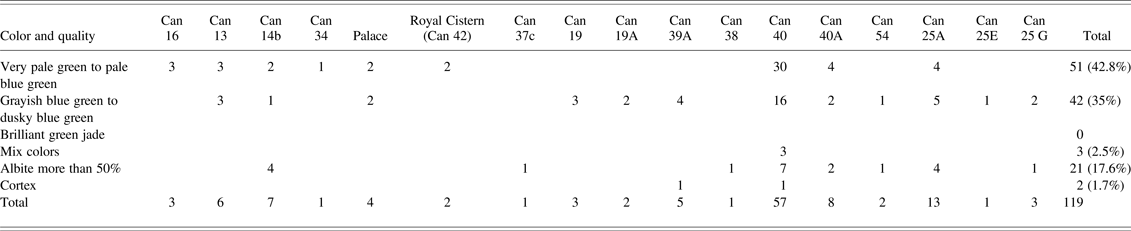
This debitage does not correspond to a further stage of production than that found in the workshop (Table 6). In fact, 84% of the debitage from outside the workshop is percussion waste, so on that basis we cannot suggest that the inhabitants of these other structures were involved in a later stage of the bead and earflare production process that would have been complementary to production acitivites in the workshop. The quality of the jade debitage and blocks found outside the workshop is also interesting. More than 17% of the material is of secondary quality, with many albite inclusions (Table 7). An additional 35% of this material is of dark green jade, a color that represents only 8.3% of the workshop debitage (Table 5), which was exclusively used for the production of very small beads (Figure 18) and never for the fabrication of any other beads, earflares, or pendants. This could indicate that this color was not highly prized. The fact that it is proportionally represented outside the workshop far more than inside of it, could mean that only secondary quality material was available to the inhabitants of the other structures. With the exception of two very large blocks, most of this debitage is relatively small, with 56% of the fragments measuring less than 4 × 3 cm.
Differential use of the two main colors worked in the workshop.
Color and quality of the jade debitage found in the rest of the site
DIFFERENT QUALITIES AND VALUES OF CANCUEN JADE
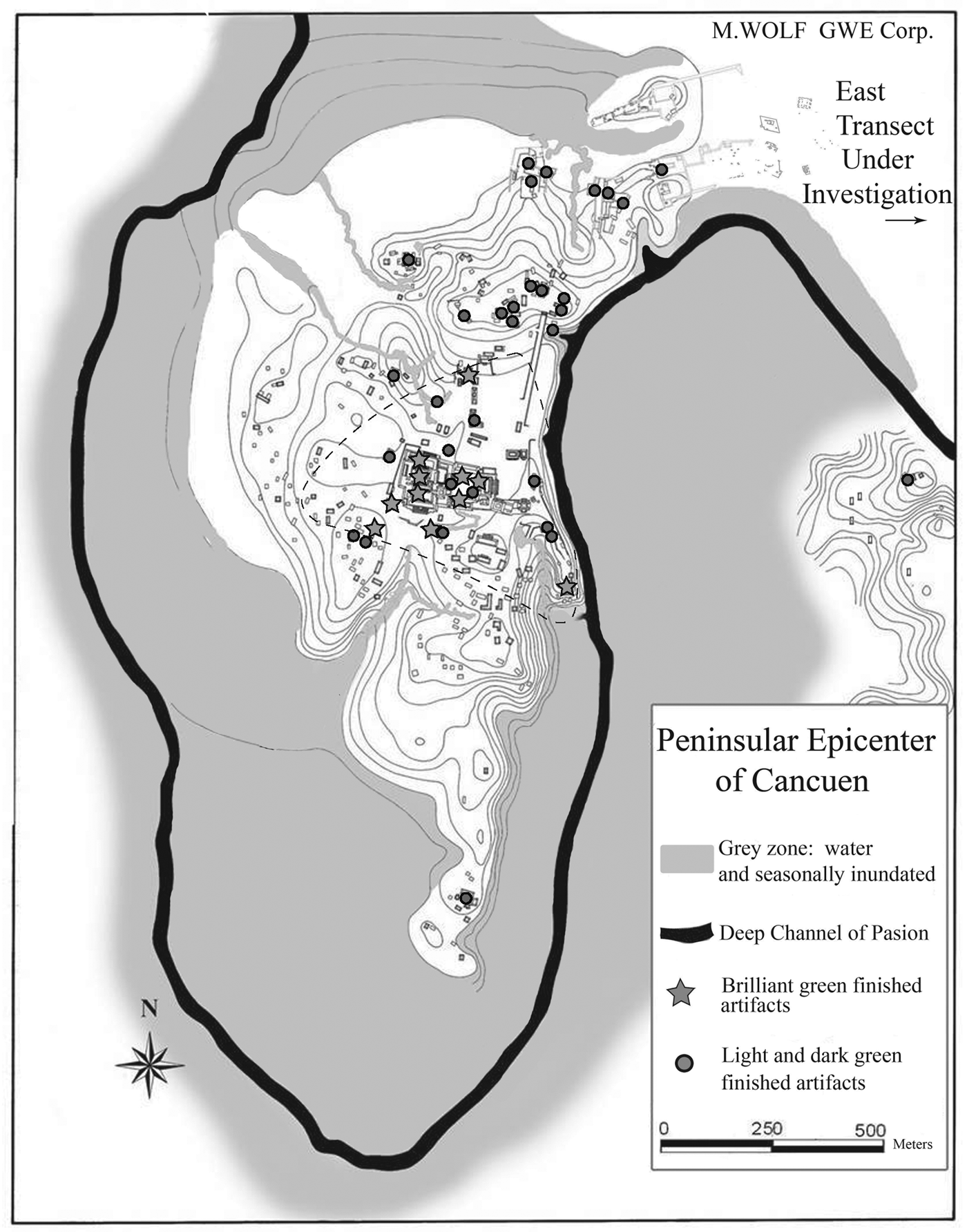
The distribution of jade debitage at the site is problematic, but the key to understanding this pattern probably lies in the quality and the colors of the raw material. The craftspersons in the workshop were paying considerable attention to separating the dark green veins from the light green ones, and both from ones with albite inclusions, showing that a distinction was made between the different colors while also distinguishing between the physical properties of the stone itself. Such a distinction seems coherent with the different levels of production and their distribution (Figure 19). In fact, it is clearly evident that the brilliant green jades were mostly found in the palace or in the immediate vicinity of the palace, whereas the light and the dark green ones were more broadly distributed. The type of artifact is also an important parameter. While the rounded light green jade earflares were systematically found in elite contexts, the smaller ones were distributed more broadly, and some were even found in the trash pits of simply built structures. The dark green jade veins were used only to produce small beads, which were easier to make than the large ones, so perhaps they were not considered to be real jade and were available to many different structures, whereas the brilliant green material seems to have been exclusively designated for the members of the palace. This enables us to consider that different categories of jade existed and that each of them corresponded to different levels of exchange. This pattern therefore seems to confirm the idea that the visual aspect and the color of the jade were central elements in the Maya social valorization system, but it also implies that strict rules determined the distribution of the different qualities of this material.
Distribution of the different colors of jade at the site.
CONTROL OVER RAW MATERIALS, PRODUCER STATUS, CONSUMER STATUS: NEW CONCLUSIONS
Since the differences in the color and quality of the jade appear to correspond to different social investments in the site, it seems clear that taboos or restrictions prevailed in its distribution. This raises questions about the degree of control exerted by the producers over the fruits of their labor or the raw material they were working (Costin Reference Costin and Schiffer1991, Reference Costin, Feinman and Price2001, Reference Costin, Hruby and Flad2007). The fact that a part of the jade artifact assemblage is strictly limited to the palace area whereas the large majority of the debitage is found in the workshop could indicate a form of attached work; that is to say, a type of work where the craftperson did not control all the decisions concerning the means of production, quality, organization of the work, or the distribution of their production (Costin Reference Costin, Feinman and Price2001:298). There is an enormous variety of degrees and modalities of attached work (Flad Reference Flad, Hruby and Flad2007:111) and different means of controlling a production (Costin Reference Costin, Hruby and Flad2007) that leave different archaeological traces. The commonly used criterion for determining some forms of attached work is the proximity of a workshop to an elite structure pattern (Clark and Parry Reference Clark and Parry1990), with the idea that it could imply elite supervision of the work. This is not an ideal criterion, however, because there is no need to supervise work physically in order to control it (Costin Reference Costin, Feinman and Price2001:299; Clark Reference Clark and Hirth2003:53). The concentration of certain production waste in elite context could also indicate elite supervision of work, but it could as well be the hint of some form of embedded production (Costin Reference Costin, Feinman and Price2001; Inomata Reference Inomata2001). Restraining access to the raw material could be another way of ensuring a form of control over certain production, especially in the case of rare materials or those imported over long distances (Costin Reference Costin, Feinman and Price2001:298; Schortman and Urban Reference Schortman and Urban2004). Archaeologically, such material will be circumscribed to the place where it was worked and to elite contexts (if they are different). Control over a technique is another possible way of restricting access to certain production, especially in the case of complex production processes that are very difficult to reproduce and therefore will have the effect of limiting the numbers of craftspersons able to create certain objects (Costin Reference Costin, Feinman and Price2001:291–292). The presence of complex production processes, however, is certainly not enough to consider that a form of production was controlled. Finally, control can also be exerted on the distribution of the artifacts (Aoyama Reference Aoyama2001). The existence of strict distribution rules governing the quality and value of the raw material could imply sumptuary laws and, hence, a form of control over the distribution, too.
Yet, if all these different means of control can leave light archaeological hints, none of them is a bona fide index of attached production (Clark Reference Clark and Hirth2003). The best way to determine the degree of control a craftsperson had over his/her work is by determining whether or not they were excluded from the artifacts they produced. If we can determine that they did not have access to what they were crafting, we can consider that they were working for somebody else and would therefore be considered as attached artisans. This criterion is usually difficult to assess because, by definition, final products should be relatively scarce in a workshop, and it is particularly difficult to determine “who was producing in a particular location” (Costin Reference Costin, Feinman and Price2001:299). In the specific case of the Cancuen jade workshop, however, the presence of seven burials contemporary with the workshop is an important source of information. If we accept that these burials probably correspond to the craftspersons living and working in that residential compound, the type of objects found in these burials and their relationship to the workshop can help determine the access the craftspersons had to the jade they were working.
The Status of the Producers
Despite the fact that it is very difficult to associate the different types of constructions found in the epicenter with various social strata (Demarest et al. Reference Demarest, Andrieu, Torres, Forné, Barrientos and Wolf2014), the lack of polychrome pottery in Can 24 (Andrieu et al. Reference Andrieu, Forné, Demarest, Wiesheu and Guzzy2012), and the fact that the houses were of crude architecture, clearly indicates that their inhabitants were not members of the elite. But the inhabitants of Can 24 were only involved in a very preliminary stage of the earflare and bead production process, and the identity of the artisans involved in the remaining stages is still unknown.
Kovacevich (Reference Kovacevich2006, Reference Kovacevich, Wells and Davis-Salazar2007) suggests that the elite themselves were finishing these artifacts and that they controlled part of this production through the esoteric knowledge required for finishing these artifacts, which they possessed, unlike the jade workers. By esoteric knowledge, we usually mean writing, ritual, or iconographic knowledge (Inomata Reference Inomata2001, Reference Inomata, Hruby and Flad2007; Kovacevich Reference Kovacevich, Hruby, Braswell and Mazariegos2011; Reents-Budet Reference Reents-Budet, Costin and Wright1998; Widmer Reference Widmer and Hirth2009) that constitutes a cultural capital (Bourdieu Reference Bourdieu1979) that was transmitted and maintained from generation to generation as a strategy for power. Of course, esoteric knowledge can include all sorts of knowledge and is not necessarily restricted to complex codes, but we can stress that none of the jade artifacts in Cancuen have any writing or any other kind of special iconography on them, apart from a few pendants, which, given their different colors, variety of styles, and raw materials, were probably not produced at the site. The production that could have been carried out locally is very standardized and does not present any form of iconography, being very similar in this respect to the material that was produced in highland workshops, such as at Guaytan (Rochette Reference Rochette and Hirth2009).
Further, the missing stages of production are very laborious, implying repetitive and heavy work. While Mesoamerican elites were often involved in artistic work (Inomata Reference Inomata2001; Reents Budet Reference Reents-Budet, Costin and Wright1998), there is no suggestion that they practiced any form of laborious activity or that their power derived from such activities (McAnany Reference McAnany, Sabbloff and Henderson1993:69–70, Reference McAnany1995). In that respect, it is notable that elsewhere in Mesoamerica ethnohistoric accounts show that lapidaries were not commoners, nor were they considered nobility (Berdan and Anawalt Reference Berdan and Anawalt1997:230; Brumfiel Reference Brumfiel, Costin and Wright2008). Despite the fact that many stages of bead and earflare production were clearly lacking in the Cancuen workshop, which indicates a spatial division of work, an important stage in the fabrication process is still missing (the cutting of the earflares and the drilling of the beads), and we cannot say who was involved in that part of the production until we find the corresponding waste. In all cases, however, the fact that the producers from Can 24 were not finishing the artifacts implies that they did not have immediate access to the final products.
Control over the Raw Material?
With the exception of two possible dental inlays, none of the burials associated with these structures presented any jade artifacts (Kovacevich Reference Kovacevich, Wells and Davis-Salazar2007; Kovacevich et al. Reference Kovacevich, Neff, Bishop, Speakman and Neff2005:42). There was a very clear opposition between the quantities worked and the lack of access to the final jade objects, implying that the craftspersons were not the owners of the material they were working. Despite the fact that they worked most of the jade found in Cancuen, they did not have access to these objects. Such data clearly confirm that they were working for someone else who enforced the sumptuary laws that guided these different productions and exchanges. If the craftsworkers did not control the distribution of the finished artifacts, we can also ask ourselves, how did they access the raw material? Importing jade from the highlands implies diplomatic relations with other highland groups over long distances, which could be managed only through elite connections (Hirth Reference Hirth, Chase and Chase1992; Tourtellot and Sabloff Reference Tourtellot and Sabloff1972). The fact that no highland ceramic vessel has been found in the workshop (Andrieu et al. Reference Andrieu, Forné, Demarest, Wiesheu and Guzzy2012), whereas a highland-style vase was found in a royal burial dated from a.d. 800 (Barrientos et al. Reference Barrientos, Demarest, Luin, Quintanilla and Mencos2006), would confirm that the inhabitants of the workshop did not have direct relations with the highland intermediaries and that the long-distance exchanges and diplomatic relations required for obtaining the raw material were probably state managed. The presence of a huge jade block in a cache under the throne in the palace (Barrientos et al. Reference Barrientos, Larios, Luin, Demarest, Barrientos, Callaghan, Kovacevich and Woodfill2004) could also be interpreted as a confirmation of the fact that the jade raw material exchange was supervised by the state. This suggests that the Can 24 inhabitants obtained the raw material through the central power and returned preforms to another workshop or to the state, implying that the control those craftsworkers had over the work and the raw material was actually rather limited. The presence of eight small beads scattered in the workshop debris has been interpreted as a hint that they were allowed to produce these small beads as a form of compensation (Kovacevich Reference Kovacevich, Hirth and Pillsbury2013). The abundance of the waste found in the workshop, and the fact that quality and color of the raw material were privileged over production quantity, however, are not very consistent with a commercial-oriented production (Carballo Reference Carballo, Hirth and Pillsbury2013). So, even if the craftworkers were allowed to produce some small beads in the darkest jade, it was probably in very limited quantities only.
With the notable exception of one large block found in a group near the palace, Can 13, it is clear that most of the Cancuen population was not allowed to use or have that raw material, or if access was available, then it was principally to inferior qualities in smaller amounts. Therefore, the very strict distribution of the different qualities of raw material in the site and the fact that the craftworkers did not have any jade in their burials—as well as the very restricted distribution of the finished artifacts with regard to quality and certain colors—indicates that the elite had some kind of control over the jade production at the site and that control was probably exerted by supervising the importation of the raw material itself, its quality (color), and its distribution.
THE PAUCITY OF JADE ARTIFACTS AND ARGUMENTS FOR A PREFORM EXPORT ECONOMY
With more than 60 kg of jadeite blocks and debitage,Footnote 2 Cancuen appears to have had very easy access to that raw material. Despite that abundance of workshop jade and the fact that 117 burials have been excavated—in addition to two mass deposits of sacrificed nobles with artifacts (Suasnavar et al. Reference Suasnávar, Robinson, Quezada, Ixpatá, Vásquez and Ixcot2007)—there is a large discrepancy between the quantities of jade debitage found in the site and the number of finished objects. Only 262 greenstone artifacts were found during the 1999–2011 field seasons. If we consider that the axes were probably not produced locally, that leaves only 184 jadeite artifacts from the workshop production, representing 4 kg of material. That is an extremely low figure in relation to the abundance of raw material found in the workshop. The polishers also present a problem, as there are more earflare negatives than earflares across the entire site. They also present a broader variety of sizes than the finished artifacts (Figure 8), which indicates that various earflares are probably missing. The discrepancy between the quantities of raw materials and the finished objects probably indicates that most of these productions were meant to be exchanged outside the site. The lack of unperforated beads (n = 5) and the lack of string-cut fragments corresponding to the production of earflares at the site could indicate that the majority of the exchanged material was actually composed of preforms and blanks rather than finished artifacts.
This hypothesis is also corroborated by the fact that the jade debitage found in other lowland sites seems to correspond to sawing activity (Aldenderfer Reference Aldenderfer1991; Melgar et al. Reference Tísoc, Ricardo, Ciriaco and Licón2011), which is exactly the stage of production lacking at Cancuen. This is the case at Waka-El Peru, where a first analysis of the material found in the Late Classic period Burial 8 at the Archaeological Museum of Guatemala (MUNAE) enabled us to observe the presence of many small sawed fragments of debitage corresponding to the stage of earflare production that is missing in Cancuen. That was also observed at Palenque, where the totality of the debitage deposited above Pakal's burial corresponds to sawing production waste (Emiliano Melgar, personal communication 2012; Melgar et al. Reference Tísoc, Ricardo, Ciriaco and Licón2011).
The last stage of production would therefore have been performed at the consumers' site by palace artisans, for instance, who were probably attached specialists (Costin Reference Costin and Schiffer1991, Reference Costin, Feinman and Price2001), as suggested by the very restricted context of most of the jade debitage in these sites (Dominguez Carrasco et al. Reference Carrasco, del Rosario, Folan, Laporte and Escobedo1999; Escobedo and Melendez Reference Escobedo, Meléndez, Escobedo and Freidel2007; Melgar et al. Reference Escobedo, Meléndez, Escobedo and Freidel2011; Moholy-Nagy Reference Moholy-Nagy2008; Widmer Reference Widmer and Hirth2009). This could indicate a system in which consumer sites had their own palace artisans who acquired jade preforms from producer sites, such as Cancuen or highland sites, and worked them locally. This system is fairly similar to the one that was in use in the Aztec empire during the Postclassic period. We know that Aztec jade specialists (Brumfiel Reference Brumfiel, Brumfiel and Earle1987, Reference Brumfiel, Costin and Wright2008; Olko Reference Olko2005) benefited from a higher status but were not allowed to wear jade themselves (for example, see the Florentine Codex IX:5:24, in Thouvenot [1982:220]). They worked the jade they bought in the market at Tlatelolco (Florentine Codex X:16:60–61, in Thouvenot [1982:182]) or that was given to them by nobles who received it in tribute (Florentine Codex VIII:20:73–74, in Thouvenot [1982:182]). Interestingly, the Nahuatl text of the Florentine Codex describes the different types of jade that could be bought on the market by its shape: “big rounded jades, very green like tomatoes, jade like reeds, thinned jades like quetzalchachihuitl very colorful” (Florentine Codex IX:4:18–19, in Thouvenot [1982:178]; translated by the authors). The same designations appears in the Matricula de Tributos, the list of tributes that enumerated what was due to Tenochtitlan from each tributary city: the Chalchihuitl also described three different types of rocks: “redondas, largas y ellipticas” (Berdan and Rieff Anawalt Reference Berdan and Anawalt1997; Thouvenot Reference Thouvenot1982:177).
These three shapes could not correspond to the shape of the beads or the earflares; otherwise, the Aztec lapidaries would not have anything to do other than to sell them again.That implies that jade was acquired by the Aztec lapidaries as shaped blanks, which they then polished and cut (Thouvenot Reference Thouvenot1982:177). In the same vein, Thouvenot (Reference Thouvenot1982:193–194) sensed the different verbs associated with the working of jade in all the Nahuatl texts mentioning jade work and showed that, out of the 100 occurrences of the 34 verbs related to the crafting of that material, there were only five mentions of the action of breaking (percussion). He therefore concluded that Aztec jade lapidary work was mostly associated with the action of sawing and polishing (Thouvenot Reference Thouvenot1982:194), meaning that the craftsmen bought pre-prepared preforms, which they then worked in their workshops.
This model matches the data from Cancuen very well, with an exportation of beads and earflares blanks to consumer sites that carried out their own final work on each piece. Regarding the value of the exchange, it is important to note that exchanging preforms or blanks certainly did not have the same implications as the exchange of finely crafted finished objects. While these objects could have been exchanged through gifting obligations (Godelier Reference Godelier1996; Mauss Reference Mauss2007[1924]), blanks, on the other hand, are more easily commoditized (Kopitoff Reference Kopitoff and Appadurai1986), especially since they are easily standardized and could have been exchanged in a more mundane way. The crafting of blanks probably conveyed less meaning than the carving of finished artifacts.
This does not mean that all jade exchanges were handled this way during the Classic period. Jade debitage or dust is very scarce in the lowlands, meaning that few cities had their own jade artisans. The majority of the lowland sites probably acquired these jade ornaments by gifting with other elites. The sites with a lapidary tradition were able to produce sumptuary goods out of blanks and used these goods to reinforce their patronage network composed of lesser Maya ajaws who would have depended on them for a central symbol of rulership (McAnany Reference McAnany, Hirth and Pillsbury2013).
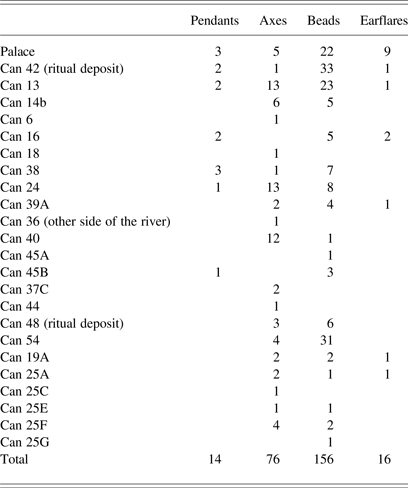
As at Cancuen, however, other networks involving finished products probably also took place, doubtless also depending on the different qualities and types of artifacts involved. Axes and small beads probably corresponded to different distribution networks at Cancuen (Table 8), as well as in the rest of the lowland sites where they tend to be more broadly distributed than the earflares and pendants (Masson and Freidel Reference Masson, Freidel, Hirth and Pillsbury2013).
Distribution of the finished artifacts in the site
CONCLUSION
This study shows that jade working is not a unitary economic phenomenon (Andrieu et al. Reference Andrieu, Jaime-Riverón, Tenorio, Calligaro, Ocampo, Jiménez, Ostrooumov, Arroyo, Palma and Aragon2011, Reference Andrieu, Forné, Demarest, Wiesheu and Guzzy2012). This reanalysis of the Cancuen workshop shows at least four different production levels; the different qualities of raw material were separated in the workshop and associated with different production objectives.
The fact that the artisans were excluded from the material they worked shows that strict rules existed concerning its use. The distinction in quality and the very strict association of certain qualities of material with royal contexts indicate attached production (Costin Reference Costin and Schiffer1991; Hirth Reference Hirth1996) and that raw jade material was probably elite-managed at Cancuen, unlike the situation in the highlands (Rochette Reference Rochette and Hirth2009). This difference in elite involvement in jade exchange between highland workshops and Cancuen was likely due to distance from the sources: at Guaytan, the raw material was immediately available in the rivers adjacent to the site, whereas it was more than 100 km away from Cancuen.
The Cancuen workshop probably exported shaped preforms to consumer sites, which then worked them the way they wanted, according to their own lapidary traditions. These productions probably correspond to very different contexts of exchange, and each object type likely had different values. Exchanging a finished object, a block of raw material, or a preform did not imply the same obligations between the actors of the exchange as the gifting of a pendant, for instance. Such differences illustrate the complexity of wealth exchange systems (Graham Reference Graham, Masson and Freidel2002:414) and the need to clearly distinguish and study each different network and production system in order to elucidate the nature of the production and exchange of socially valorized goods in the ancient Maya world.
RESUMEN
El valor y significado simbólico del jade en Mesoamérica así como su papel central en la política y el ritual ha sido el enfoque de muchos estudios. El descubrimiento del primer taller de jade encontrado en las tierras bajas mayas en Cancuen, junto con el análisis de las canteras y de los talleres localizados cerca de las fuentes del Río Motagua, puede señalar el comienzo de una nueva etapa en el estudio de la tecnología, la producción y de los intercambios de objetos de jade.
En este artículo, a través de la evidencia del taller de jade Cancuen, discutimos la variabilidad de estatus asociados a esta materia así como su producción y intercambio. El reanalisis tecnologico del material del taller muestra que los artesanos de Cancuen no producían objetos terminados ni semi-terminados, sino que sólo se encargaban de las primeras etapas de producción: la selección de las mejores partes de los bloques y, en menor proporción, la fabricación de unas preformas de forma circular. Pero este trabajo permite decir que estas preformas no estaban listas para ser pulidas y los desechos correspondientes a estas etapas están ausentes en el resto del sitio. La comparación entre el material del taller y el del resto del sitio permite mostrar que Cancuen exportaba estas preformas hacia otros sitios. Este trabajo enseña también que coexistían en Cancuen una gran diversidad de producciones de jade, con inversiones sociales, colores y técnicas muy distintas. Esta variabilidad aparece también en los contextos de descubrimiento de los artefactos: unos están claramente asociados a contextos reales, mientras que otros presentan una distribución social mucho mas larga. Este dato indica la posibilidad de una gama de valores y de inversiones sociales distintas en función de los tipos de jades y nos lleva a preguntar si estas categorías corresponden a distintos contextos de producción y de intercambios.
El estudio comparativo del material de jade del sitio con el material del taller así como una consideración de la diversidad de calidades del jade dentro del sitio en comparación con la variedad de objetos permite inferir una organización mucho más compleja de las producciones e intercambios de jade en Cancuen.
ACKNOWLEDGMENTS
We would like to thank Arthur Demarest, Vilma Demarest, all members of the Cancuen Project (Universidad San Carlos; Vanderbilt University; Ministerio de Cultura de Guatemala), the French Nacional Centre for Scientific Research (CNRS), Olaf Jaime-Riverón, Juan Carlos Melendez, Douglas Quiñonez, and the anonymous reviewers whose comments helped to improve this paper.