The 2015 refugee crisis was one of the most significant political events in recent years. Thousands died on their journey to Europe. The EU spent billions of dollars on humanitarian aid, infrastructure building, border controls, and international agreements designed to counter human trafficking.Footnote 1 The anti-immigrant backlash quickly followed the growing numbers of asylum seekers. Exposure to the refugee crisis energized public hostilityFootnote 2 and violent attacks against immigrants,Footnote 3 and dramatically increased electoral support for radical right and populist parties in Europe.Footnote 4 Accordingly, democratic erosion and the rise of populism are widely recognized as the fundamental processes that define the political landscape of the present age.Footnote 5
International commitments and humanitarian values oblige leaders to accept the flows of asylum seekers. Even for governments who view it as a morally legitimate option, keeping migrants completely out is not a realistic option. Since the influx of asylum seekers to the West is rooted in humanitarian crises far away from the destination countries, policymakers and political leaders are limited in their ability to decrease the flows. What can be done then to minimize public backlash while sharing responsibility and admitting refugees in times of crisis? Is there a set of policies that can mitigate political instability while maintaining refugee admission simultaneously?
Despite a growing literature on public attitudes toward immigration, we lack the evidence to answer this question. Most of the recent literature focuses on how immigrant flows trigger public backlash, rather than what might mitigate it.Footnote 6 Other work explores how immigrant and refugee attributes affect public opinion.Footnote 7 Although this set of findings is useful for theoretical inferences, it is empirically less relevant to asylum policy design aiming to counter public backlash—especially in the short term—where the immigrant population has a given set of attributes.
This is not to say that governments cannot influence the electorate through policy design. On the demand side, communities that experience higher levels of immigration policy enforcement and local government efficiency exhibit more political efficacy and trust in government, and lower levels of anti-immigrant violence.Footnote 8 On the supply side, when establishment parties promote restrictive immigration policies, they can win back support from far-right voters. Evidence from a conjoint experiment in Germany showed that when other parties promote an upper-limit policy on the number of refugees allowed annually, up to half of (previous) AfD voters abandon the party.Footnote 9 Similarly, the United Kingdom Independence Party (UKIP) lost much of its electoral support following the Brexit referendum, a major policy change directly related to free-movement regulations.
It seems, however, that some policies can change public opinion without the selection of immigrant attributes or the limitation of immigration flows. Most Europeans, for example, are willing to accept more refugees if burden sharing between countries was enhanced by proportional allocation policies.Footnote 10 Yet there are notable concerns regarding the extent to which these experimental findings, which refer to a policy proposal that has not yet been implemented, are externally valid to real-world settings.
An alternative strategy is to examine the implications of real-world policy changes. In this study, I examine the political impact of significant and rapid policy responses to the refugee crisis in two separate cases: Sweden's public reaction to border controls implemented in November 2015, and Germany's public reaction to the March 2016 EU–Turkey agreement.Footnote 11 These policy measures represent some of the most significant tools governments used during the refugee crisis. They were also heavily covered by the media and publicly discussed, considerably more than immigration policy reforms in regular times.
It is unclear ex ante whether and how border-control policies affect public opinion. On the one hand, the implementation of border controls could frame incoming asylum seekers as illegal migrants and trigger the public's threat perceptions, which might make natives more hostile. On the other hand, I argue that border controls could reduce political distrust and public concerns regarding losing control over the situation. If so, natives might become more welcoming toward immigration and less inclined to vote for anti-immigration parties.
Yet identifying the causal effect of policy responses implemented in times of crisis is challenging, since such policies are only one potentially influential event out of many others taking place over a certain number of weeks or even days. Utilizing separate waves of public opinion surveys to measure attitudinal change following the policy is also likely to be exposed to nonrandom selection biases created by systematically different questionnaires, interview protocols, or other unique characteristics of each wave. To address these limitations, I exploit population-based surveys that by coincidence happened to sample subjects right before and immediately after the policy change. This produced a quasi-random assignment of the policy treatment to survey respondents. I estimate the effect of such policy changes by employing a local randomization strategy with a Regression Discontinuity (RD) design within a small window of time. The attitudinal change following policy responses can, therefore, be interpreted as the short-term causal effect of the policy.
The findings demonstrate that both policy responses—border controls in Sweden and the EU–Turkey agreement in Germany—significantly reduced opposition to immigration. In Germany, the EU-Turkey agreement even had a sizable effect of reducing support for the far-right AfD party. These effects gradually weakened, but they persisted for at least one to two weeks. Although the empirical strategy does not allow for a causal identification of longer-term effects, a descriptive analysis I conduct provides mixed evidence. In Sweden, public opposition to immigration returned to its baseline levels in the following measurement, six months after the policy implementation. In Germany, however, opposition to refugee admission remained more than 10 percent lower for over a year following policy implementation.
Exploring the mechanisms underlying these effects, I find that policy effects are not conditioned by living in near-border regions. This suggests that they are not driven by local conditions and more direct exposure to immigrant inflows. Furthermore, policy responses affect the public at the point of policy announcement, before policy implementation, and before the resulting reduction in migrant flow. And despite their expected effect on immigration levels in neighboring countries, border controls increase political trust and mitigate public opposition to immigration only in the country that initiated the policy. Beyond real or expected changes in crisis conditions, therefore, policy effects seem to be driven by changes in people's sense of social order, political trust, and perception of national competence in dealing with the crisis.
Theoretical Background
By their very definition, refugee crises can be divided into two key components. The first is the sharp and sudden rise in movement of refugees toward destination countries. A second component, considerably less explored by the literature, is the chaotic nature of the situation, or its state of emergency and crisis of political leadership. Accordingly, I contend that countercrisis policies could reduce public opposition to immigration and political radicalization through these two key channels, defined here as the immigration-level mechanism and the immigration-controllability mechanism.
Public backlash is likely to be driven by the immigration-level mechanism for several reasons. The number of asylum seekers arriving in the host country might trigger both ethnocentric concerns about the declining share of the white majority,Footnote 12 and sociotropic concerns regarding the socioeconomic burden of integrating refugees.Footnote 13 Furthermore, according to the realistic group conflict theory, people are threatened by the presence of outgroups in significant numbers because of competition over scarce resources.Footnote 14 The larger the outgroup, therefore, the more hostile natives would become, and compared to the stock of migrants already residing in the country, natives exhibit stronger opposition to immigration flows.Footnote 15 Thus, natives’ attitudes toward immigrants would be conditional on the level of immigrant flows—an expected decrease of flows might attenuate public hostility toward the immigrant stock, but should not make natives more willing to admit larger amounts of migrants. Likewise, under the immigration-level mechanism, the attitudes of those who more strongly experience the arrival of immigration flows near the border should also be more sensitive to countercrisis policies. Ultimately, this mechanism predicts that policy responses matter to public opinion only when they change the real or expected level of immigration into the country.
The second approach centers on another form of influence. Rather than the properties of immigrant groups, including their size, this approach holds citizens’ sense of having immigration under control as a key influence on their attitudes toward immigrants. For example, direct exposure to the refugee crisis substantially increases public hostility toward refugees and support for the far right, even when refugees are only passing through the country.Footnote 16 In these cases, competition over scarce resources, integration burdens, and demographic threats are either minimal or absent. However, flows of transient refugees generate chaotic scenes, disrupt public order, and highlight the authorities’ incompetence in dealing with the situation,Footnote 17 which could lead to a loss of confidence in political leaders. Similarly, compared to authorized immigrants, unauthorized immigrants trigger categorical native opposition, unrelated to the specific attributes that characterize these immigrant groups.Footnote 18
More than quantitative features of immigration, this evidence points to qualitative properties that matter to public opinion. When immigration seems out of control, natives get hostile. Increasing numbers of asylum seekers clearly add to the perception of losing control, but this perception could also emerge with no change in the level of immigration, for example, when people think that immigration is unregulated (i.e., the government does not monitor the numbers or check the identity of those arriving in the country) or unauthorized (i.e., the government tries to regulate, but fails to do so). The immigration-controllability hypothesis contends that such leadership failures and perceived loss of control are key factors in explaining both the rise of public backlash in times of crisis, and its fall once countercrisis policies are implemented.
Indeed, previous work showed that perceived leadership failure creates a threatening environment that evokes otherwise latent intolerance, while re-emerging confidence in political leaders counters intolerance.Footnote 19 Thus, countercrisis policies might mitigate political tensions by providing a sense of regained control over the situation. The policy change highlights an active intervention taken by political leadership, which signals competence, trustworthiness, social order, and security to the public. This less threatening environment is less likely to activate hostility toward outgroup members,Footnote 20 and rising levels of political trust increase public support for immigration.Footnote 21
Imposing border controls, for example, could potentially reduce the flow of refugees into the country, though it could also maintain the flow while providing to the public a sense of order and control over the situation. Once the state of emergency is attenuated and political trust is restored, public opinion on immigration could become more positive, despite no change in the presence of asylum seekers.
Put differently, holding immigration levels constant, border controls could change the way voters evaluate and trust their government—not only the government's intentions to control immigration, but also its ability to do so by tighter regulation on the border. As recent work shows, immigration attitudes are not driven solely by feelings about immigrant groups, partisanship, or core political values. They are also shaped by trust in the actor most responsible for managing immigration policy—their government.Footnote 22
Since the immigration-controllability mechanism goes through public confidence in the ability of political leadership to manage immigration, local conditions should not change the policy impact. To put this point in the relevant context, consider the two cases I examine here. The national-level border controls in southern Sweden, which increased the presence of police in near-border locations, had more direct and immediate consequences on the everyday life of residents of southern Sweden than on their northern counterparts. Differently, the deal with Turkey was a European-level effort to effectively close Europe's external border at the Aegean Sea and return refugees arriving in Greece from Turkey. The immediate effect on the ground was primarily detectable in Greece and its closest neighbors rather than in Germany. Nonetheless, both of these major policy changes were immediately communicated to citizens across the country through the media, portraying policymakers as more active and competent to deal with the crisis. Regained confidence in political leadership should therefore reduce public opposition to immigration across the country in both cases.
The immigration-controllability mechanism thus generates four key predictions. First, countercrisis policies would reduce public opposition to immigration and support for anti-immigration parties. Second, the policy impact would be significant on both those who were directly and indirectly exposed to refugee arrivals. A third prediction is that countercrisis policies would affect public opinion once such policies are announced, even before implementation. Finally, policy effects on public opinion should be present only in the country or countries that initiated the policy. Such effects should be absent in secondary countries that are likely to be affected by the new policy, so long as the political leadership in secondary countries remains passive in terms of policy.
Returning to the cases examined here, border controls in Sweden were implemented by the Swedish government on its mutual border with Denmark. This policy measure could potentially alter the flow of people from Denmark to Sweden and affect public opinion in both countries through the immigration-level mechanism, while it is likely to affect government evaluations only in Sweden where the government changed its conduct in response to the situation. Similarly, although the EU–Turkey agreement primarily relieved the burden that was imposed on Greece as a front-line country that most refugee arrivals came from, the new policy was a European collaboration, strongly promoted by German Chancellor Angela Merkel.Footnote 23 Thus, if the policy measure reduces threat perceptions through regained trust in political leadership, we should expect attitudinal shifts in Germany as well.
Notably, there are good reasons to believe that a restrictive policy change would actually increase public opposition to immigration. According to the social identity theory, salient social group categorization may make individuals adopt discriminatory behavior.Footnote 24 Thus, if the new policy frames and highlights migrants as a social problem, a significant burden, or as a foreign outgroup, citizens may adopt this attitude and become more hostile. Conversely, such a stance taken by the state could generate a policy backlash—progressive voters who think that the policy change is too restrictive and in violation of human rights may adopt an even stronger pro-immigrant stance. If so, policy effects should be significantly larger among progressive voters who tend to be more tolerant and inclusive toward migrants. Indeed, both national-level border controls and the European deal with Turkey were criticized in the media for being cruel and inhumane.Footnote 25 It is therefore unclear, ex ante, whether a restrictive policy change such as border controls should reduce or increase public opposition to immigration.
Empirical Strategy
To estimate their causal effect, I exploit the abrupt occurrence of countercrisis policies at the time public opinion surveys were fielded. The timing of the policy response, which was not foreseeable by the general public, divides the sample into a control group—subjects who were interviewed before the policy response—and a treatment group—those who were interviewed after the policy response. A fundamental assumption underlying this identification strategy is temporal ignorability, where the interview time is independent of respondents’ potential outcomes.Footnote 26 If so, the occurrence of the policy response assigns survey respondents into treatment and control groups as good as randomly, and could be analyzed as a natural experiment.
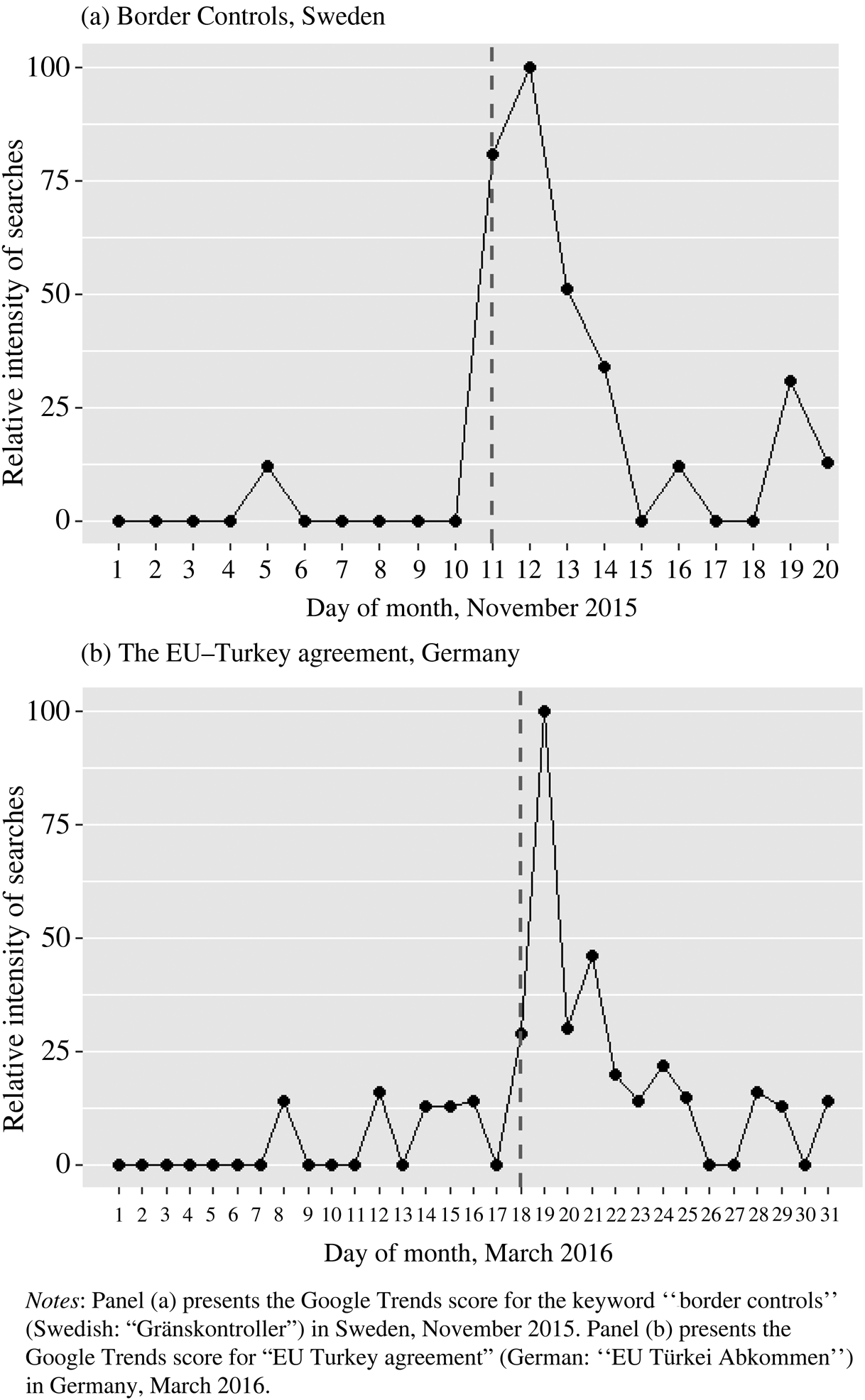
This empirical strategy has been used before to identify the causal effect of terror attacks on public opinion.Footnote 27 The main advantage of employing this design for analyzing countercrisis policies is that the policy response is highly unlikely to affect interview times and self-selection into the treatment group. While the countercrisis policies analyzed here were highly salient in public discourse, they did not change the material conditions in the country to an extent that should determine people's willingness to participate in public opinion surveys, especially in the short term. On the other hand, some countercrisis policies might be publicly discussed before formally announced or implemented. This would make the policy response a foreseeable event, rather than unexpected. Beyond the fact that unlike immigration policy reforms in regular times, countercrisis policies are swiftly designed and implemented to deal with sudden flows of refugees, I address this issue by showing that both of the policies I analyze here took little public and media attention before they were formally announced.Footnote 28 Figure 1 illustrates that Google searches for each of the policies were almost non-existent prior to the policy change. Once the policy response was announced by the authorities and covered by the media, however, public interest in the policy increased sharply and substantially.
Online searches on immigration-related policy, Sweden and Germany

To further address the ignorability assumption, I provide (1) an extensive description of the sampling procedures; (2) balance tests on pretreatment characteristics of the control and treatment groups; (3) estimations of treatment effects controlling for covariates (i.e., relaxing the ignorability assumption and relying on a more plausible, conditional ignorability assumption); and (4) narrower time windows around the cutoff that take the minimal number of one day before and one day after the policy response. Since the interview time could be affected by respondents’ reachability even when random sampling procedures are employed, the latter strategy attenuates concerns regarding substantive differences between the control and treatment groups and considerably enhances the validity of the ignorability assumption.
Another key assumption for a valid causal interpretation of the results is treatment excludability, where no other event but the countercrisis policy affects public opinion. Although the real-world setting of the treatment enhances external validity significantly, both treatment noncompliance and confounding events threaten the internal validity of the results. And while noncompliance would suggest that the treatment effects I present are conservative estimates for the real policy impact, confounding events might indicate that treatment effects are not driven by the policy response. Policy effects might stem, for example, from collateral events (subsequent events caused by the policy response), simultaneous events (unrelated events taking place in parallel to the policy response), or unrelated time trends (an overall pattern over time consistent with the expected treatment effect).Footnote 29 To address these concerns, I review the chain of events around the policy responses. Crucially, I provide consistent evidence from two different cases—border controls in Sweden and the EU–Turkey agreement effect in Germany. Since the countercrisis policy in each case is different in many ways and takes place in different countries and times, these concerns are significantly reduced. Furthermore, narrowing the time window around the policy change lends considerable credibility to the treatment-excludability assumption, since there is less room for collateral or simultaneous events. Together, these empirical strategies allow for a causal interpretation of the results.
Nonetheless, since all citizens are potentially exposed to the treatment in the postpolicy period, causal identification is limited to the final day of the fieldwork. To get a sense of the long-term public opinion trends following the policy, I present descriptive evidence from additional surveys that were fielded several months after the policy change.
Empirical Analysis
I examine the political impact of two countercrisis policies on public opinion—the implementation of border controls in Sweden and the EU–Turkey agreement. Each case is analyzed separately, but similarly: (1) describing the chain of events around the policy response; (2) describing the relevant data and sampling methods; and (3) analyzing the results.
Border Controls in Sweden
During the refugee crisis, Sweden bore larger shares of responsibility and burdens than most of its European counterparts. With a population of approximately ten million, Sweden was second to only Germany in the absolute number of refugees it received by mid-2016, and the European country with the highest ratio of refugees per capita—about nineteen refugees per one thousand inhabitants—over the same period.Footnote 30
While Sweden experienced high levels of refugee inflows at the beginning of 2015, there was a substantial increase in the final third of the year. As Appendix Figure S2.2 shows, the number of asylum applications rose from 7,515 in July to approximately 38,500 and 36,000 in October and November, respectively. According to a European Migration Network report,Footnote 31 this stretched the Swedish asylum system to its limits: although asylum-registration units worked around the clock, thousands of asylum seekers were unable to register; when accommodation centers were in full capacity, Swedish counties used temporary reception places such as evacuation shelters and tents to accommodate asylum seekers.
In response to this irregular situation that, according to Swedish authorities, posed a risk to public order and internal security, the Moderate Party proposed imposing border controls on 9 November. Although Swedish Prime Minister Stefan Löfven dismissed the proposal in an interview the following day, in the early morning of 11 November the Swedish media reported that Löfven “does not reject the Moderates’ proposal.”Footnote 32 Later that day, the government announced it would impose border controls at its southern border with Denmark (Oresund bridge and ferry terminals) the following day, 12 November. Both the Swedish and Danish media heavily covered the story, with front-page articles on the new policy in multiple newspapers.Footnote 33
Initially, border controls were supposed to be temporary, for a period of ten days, and could be extended by twenty-day periods. Eventually, though, Sweden extended them repeatedly until May 2021.Footnote 34 The announcement was released while Prime Minister Stefan Löfven participated in the Valletta Summit on Migration together with many other European and African leaders.Footnote 35 Both Löfven and Interior Minister Anders Ygeman claimed that the policy measure was implemented not to limit the number of asylum seekers, but rather to obtain security and stability. Asylum seekers could apply for asylum at the border despite new regulations. This meant that the policy change could actually increase the number of people seeking asylum in Sweden, since asylum seekers who otherwise wished to apply for asylum in Finland or Norway now had to apply for asylum in Sweden to enter the country.Footnote 36 Two front-page articles in leading Swedish newspapers (and many online articles) highlighted this scenario on 12 November, stating in their headlines that border controls could lead to more asylum seekers in Sweden.Footnote 37
It is unclear whether border controls decreased refugee flows into Sweden. On the one hand, refugee levels in November remained substantively similar to those in October. On the other hand, the previous upward trend was stabilized, and there was a significant decrease in December. Thus, if we focus on the first couple of weeks after the policy response, it seems that there was no detectable change in the level of refugee flows to Sweden. Importantly, this upward trend would suggest rising public opposition to refugees over the policy change period, which eases concerns regarding unrelated time trends correlated with the expected public reaction to the policy change.
Data: The Eurobarometer
To examine the political impact of border checks in Sweden, I exploit their coinciding occurrence with the fieldwork of wave 84.3 of the Eurobarometer.Footnote 38 The fieldwork was conducted between 7 and 17 November 2015, while the policy response was announced on 11 November and implemented the following day. The short sampling period of the Eurobarometer is ideal for the empirical strategy employed in this study since it ensures a large number of observations in each day around the cutoff.
The sampling design in all EU member states is a multistage, random sample. After stratification by the distribution of the national population across regional (NUTS-2) units, primary sampling units (PSU) are randomly selected. PSUs therefore represent the whole territory of each member state. The sampling procedure randomly draws a starting address in each sampling point. Random route procedures were used to sample further addresses. One respondent was randomly chosen in each selected household. All interviews were conducted in respondents’ homes, face-to-face with an interviewer who speaks the national language. Interviewers used Computer Assisted Personal Interview (CAPI) systems for data collection. In all countries, the demographic characteristics that were employed to ensure a national representative sample—using marginal and intercellular weighting matched to Eurostat population data—were gender, age, region, and size of locality.
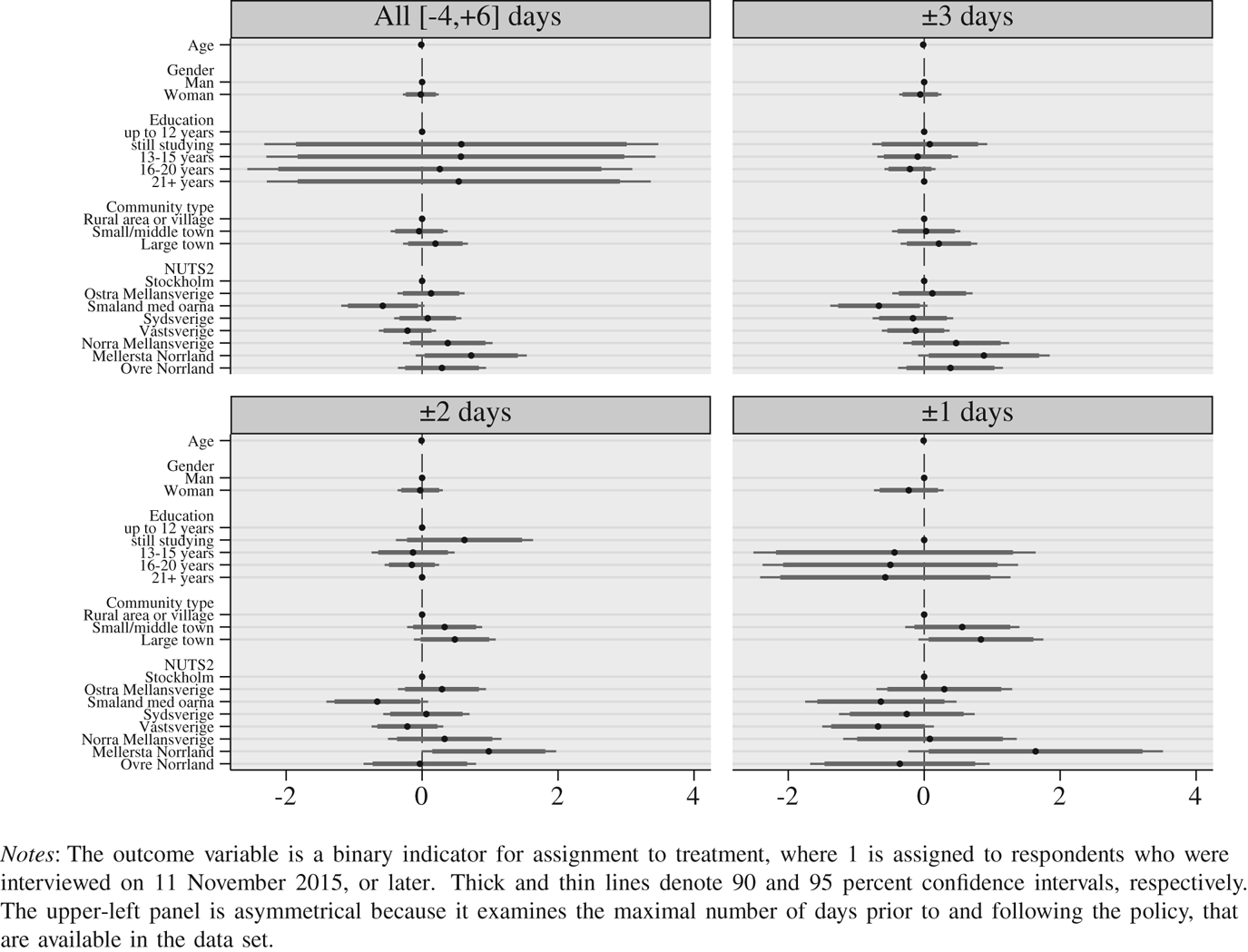
Figure 2 presents a covariates’ balance test between the control and treatment group across four different time windows.Footnote 39 The outcome variable is a binary indicator for assignment to treatment, where 1 is assigned to respondents who were interviewed on 11 November or later. Dots and lines represent point estimates and 95 percent confidence intervals drawn from a Logit regression. In line with the ignorability assumption, both groups are similar across age, gender, education levels, community size, and regions of residence, and the groups are fairly balanced across all different windows. Although age and region of residence differences between the groups are minor, the figure indicates that they should be controlled when using the widest time window. Importantly, respondents from the southern region in Sweden (Sydsverige) are equally likely to be assigned to the treatment group across all time windows. This suggests that border checks imposed in the southern region did not affect the interview timing and self-selection to the treatment.
Balance test for covariates on assignment to treatment, Sweden

The November 2015 Wave of the Eurobarometer collected attitudes toward immigrants and refugees. Respondents were asked whether the statement “immigration of people from outside the EU” evokes a very positive, fairly positive, fairly negative, or very negative feelings for them (from 1 to 4). The same was asked for the statement “immigration of people from other EU Member States.” Subjects were also asked to what extent they agree or disagree (1–4) with the statements “immigrants contribute a lot to [our country],” and “[our country] should help refugees.”Footnote 40 To get a sense of people's perceived control and confidence in their political leadership, I use survey items that measure levels of political trust and satisfaction with democracy. Subjects were asked how much trust they have in several political institutions (answer categories were “tend to trust,” “tend not to trust,” and “don't know”). Finally, subjects were asked to what extent they were satisfied with the way democracy works in their country (1–4). Appendix S4 presents the full wording of the questions and answer categories.
Results
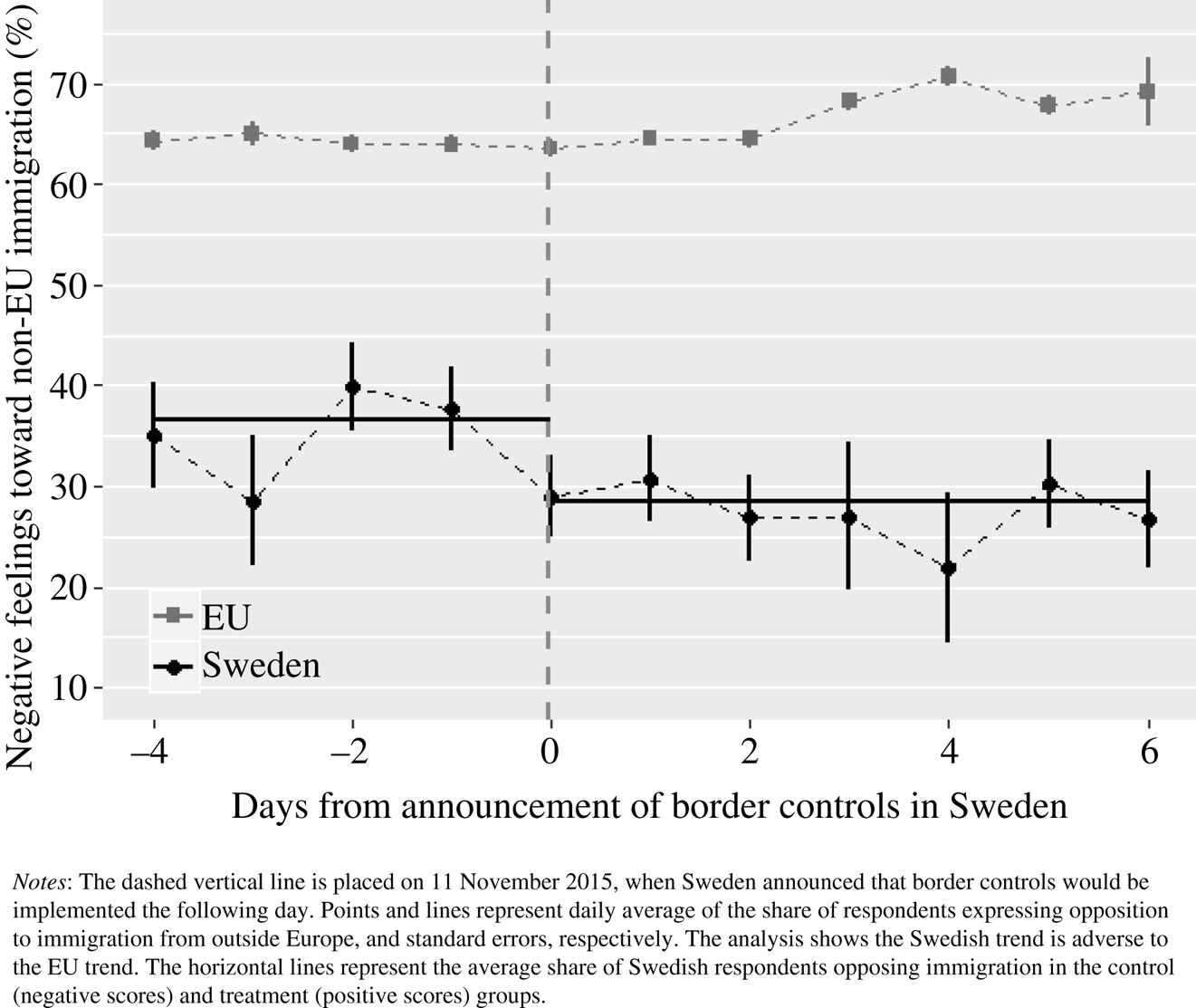
Figure 3 shows the daily average share of respondents holding negative feelings toward non-EU immigration in Sweden and in all other EU countries. While public opposition to immigration dropped sharply in Sweden following border controls, from 36.6 to 28.3 percent, it remained stable in Europe and even rose during the postpolicy period. Notably, the policy effect is discernible during the whole postpolicy period—up to six days after the policy change—and the drop in public opposition to immigration is at odds with the general European trend.
Anti-immigrant attitudes and Swedish border controls, Sweden and other EU countries

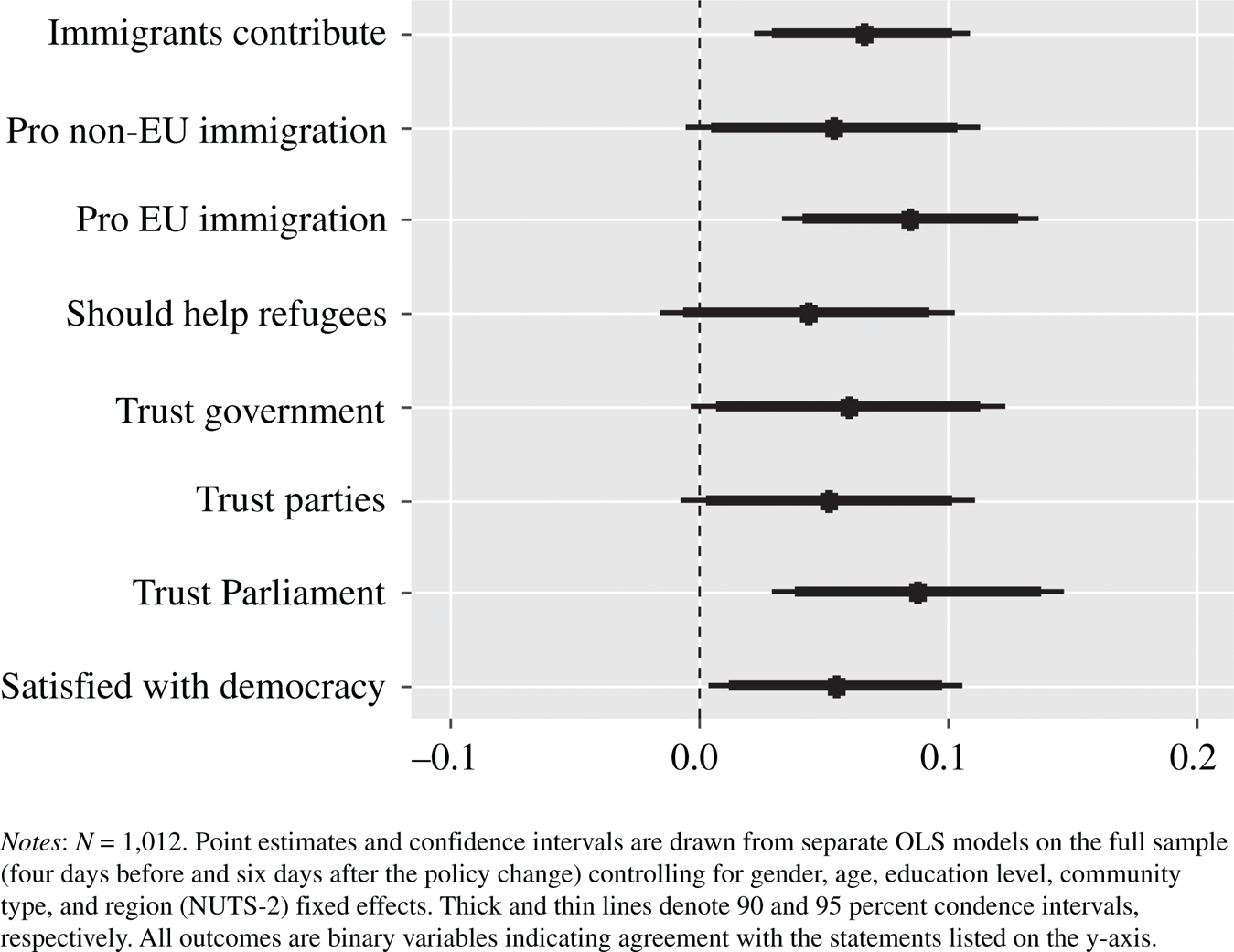
Figure 4 presents the impact of border controls on public attitudes in Sweden (the entire Swedish subsample). The findings show that border controls had a sizable and statistically significant impact on anti-immigration and populist sentiments. Respondents in the treatment group were six percentage points more likely to believe that immigrants contribute to Sweden (p = 0.003), and five to eight points more likely to hold positive feelings toward immigration from outside the EU (p = 0.072) and from the EU (p = 0.001), respectively. The four-points increase in support for helping refugees, however, does not pass conventional levels of statistical significance (p = 0.146). One reason for this null result might be a ceiling effect. The framing of the statement, “Sweden should help refugees,” which refers to people who escape from persecution or war zones, could minimize attitudinal variation and increase public consensus in famously humanitarian Sweden. Indeed, only 6 percent of the Swedish sample disagreed with the statement. Overall, the treatment effects on immigration attitudes are consistent with previous work showing that attitudinal changes driven by the refugee crisis are not limited to asylum seekers, but also target various immigrant and minority groups.Footnote 41
Border controls effects, full sample

Does the policy change affect voting preferences? Unfortunately, the survey did not collect electoral preferences. Nevertheless, in addition to anti-immigration sentiments, some political variables that were measured in the survey are strong predictors of support for populist and far-right parties: trust in political institutions and satisfaction from democracy.Footnote 42 Figure 4 shows that border controls had a significant, positive impact on political trust and satisfaction with democracy. The countercrisis policy increased voters’ satisfaction with Swedish democracy and its institutions by five to eight percentage points.
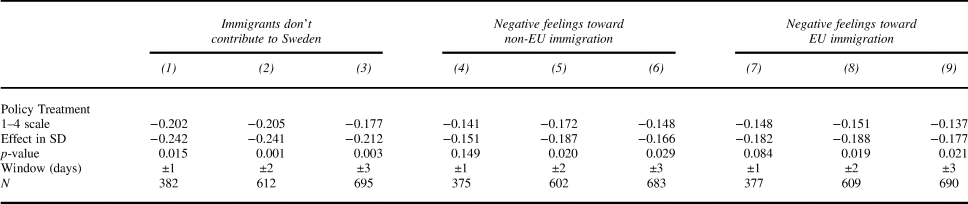
The causal interpretation of the results relies on the treatment ignorability and excludability assumptions. The smaller the time window around the policy change, the more likely that these assumptions would be valid. On the other hand, a smaller time window also drops statistical power and increases the probability of not rejecting a false null hypothesis. Table 1 presents policy effects on anti-immigration attitudes using one-, two-, and three-day windows around the cutoff. I find that policy effects remain substantively similar—border controls reduced public opposition to immigration in Sweden, and this effect is detectable immediately after border controls were announced and implemented. Most models, remarkably, yield higher levels of statistical significance than those achieved using the full Swedish sample, despite fewer observations. In this short-term analysis, policy effects also remain quite stable over time in terms of their substantive size.
Border controls' effects on public opposition to immigration

Notes: RD estimates, one to three days on each side of the policy cutoff. Outcomes are the level of agreement with the statement (1 = strong disagreement/very positive; 2 = disagreement/fairly positive; 3 = agreement/fairly negative; 4 = strong agreement/very negative). Effects in SD terms are the treatment effect divided by the standard deviation of the outcome in the control group.
Could these effects be a result of another concurrent event to the implementation of border controls? As I mentioned before, one related and simultaneous event was the Valletta Summit on Migration, in which European and African leaders participated. The summit may have highlighted successful European coordination, which could signal to the European public that the authorities are capable of dealing with the crisis. Conversely, if Swedish border checks caused the effects, rather than the Valletta Summit or any other simultaneous event, there should not be any parallel effects on public opinion in other European countries. Table S3.2 tests this by using “placebo subsamples.” The findings show that there is no significant and stable reduction in public opposition to immigration, either in the EU or in specific European countries. A second robustness check I conduct examines treatment effects on placebo outcomes, that is, attitudes that should not be affected by the countercrisis policy. Significant differences in placebo outcomes would suggest that the treatment-ignorability assumption does not hold, and that treatment effects on anti-immigration attitudes might be a result of selection biases. Table S3.3 shows, however, that the policy response is not associated with unrelated attitudes or values held by the survey respondents. No effect was detected, for example, on people's beliefs about the extent to which sports or science create a feeling of community among EU citizens.
As a final robustness check, I examine whether treatment effects are detected when placebo cutoffs are used. If the reported effects are driven by border controls and not a result of unrelated time trends in public opinion, choosing other cutoff points will yield null results. Indeed, as Table S3.4 shows, treatment effects are sizable and statistically significant only when using cutoffs that divide the sample into real control and treatment groups.
Taken together, the findings suggest that border controls mitigated the public backlash against the refugee crisis. The political impact emerges following the announcement on the policy response, even before implementation and potential changes in material conditions and exposure to refugees, as Figure 3 illustrates. This supports the immigration-controllability mechanism, in which public backlash is moderated by an active and salient measure taken by the authorities to restore social order—although no change occurred in exposure to refugees. The increases in political trust and satisfaction from democracy are also consistent with this explanation.
The Impact of the EU-Turkey Agreement in Germany
The second case I study is the EU–Turkey agreement, declared by the two parties in March 2016 following several months of negotiations, in which German Chancellor Angela Merkel took a leading role.Footnote 43 In October 2015, the EU and Turkey announced a joint action plan that reflected their mutual understandings regarding the future agreement. The leaders of both parties met in Brussels on 29 November and agreed to have regular summits twice a year to increase their political and financial cooperation substantially and to re-energize Turkey's accession process to the European Union.
Key progress was made in the second stage of the process that took place at the Brussels EU–Turkey summit on 7–8 March 2016. At this point, Turkey and the EU agreed on most of the cooperation principles, which they mentioned in a statement they released to the press. However, the implementation date for the agreement was yet to be decided, and the parties agreed to further the talks ten days later, at their meeting on 18 March. It was only then that the two parties declared that as of 20 March 2016, all new irregular migrants crossing from Turkey into Greek islands would be returned to Turkey, which was a significant game changer in the refugee crisis. Other fundamental principles in the agreement were a “one-for-one” scheme, in which for every Syrian being returned to Turkey from Greek islands, another Syrian would be resettled from Turkey to the EU; and EU financial support—initially three billion Euros allocated for refugee resettlement in Turkey. The first EU press release on the terms of the agreement was published in the afternoon of 18 March, and a second press release was published the following morning.
The decrease in refugee flows from Turkey to Greece was substantial and came quickly. In the short term, however, there was no similar impact on refugee flows into Germany (see Figure S2.1). Therefore, although the agreement was a significant event in all European countries, and particularly in the countries that were most affected by the crisis, such as Germany, there were no changes in any materialistic conditions that were likely to interrupt the fieldwork of surveys in Germany.
Data: The German Internet Panel
Testing the influence of the EU–Turkey agreement on public opinion in all EU member states and Turkey would have been ideal. Unfortunately, public opinion surveys interviewing multiple European countries, such as the European Social Survey, Eurobarometer, or the International Social Survey Programme, did not conduct fieldwork on the relevant dates. To my knowledge, the only available survey that conducted fieldwork around the agreement is the German Internet Panel (GIP).
The GIP is an online panel that is based on a three-stage probability sample of the general German population.Footnote 44 An essential feature in the panel that enhances its representativeness is the inclusion of individuals who previously had no or limited access to the Internet.Footnote 45 Interviewees receive financial incentives to participate in the surveys.Footnote 46 The GIP waves are fielded regularly every two months. Each first day of an uneven month, a new questionnaire is made available to all panel members, who can take it via the GIP website. The GIP first sends an e-mail invitation to panel members once the questionnaire is available, a first reminder e-mail after approximately one week, and a second reminder e-mail after the second week. A contact attempt by phone is made in the fourth week only if the panel member missed two consecutive waves.
Not every GIP wave includes questions about attitudes toward immigration. Fortunately, the twenty-second wave,Footnote 47 conducted between 1 March and 1 April 2016, included several questions that focused on the refugee crisis and attitudes toward asylum seekers (see full wording in Appendix S4). First, subjects were asked how they think politicians should deal with a potential dilemma of helping refugees from war zones versus ensuring security in German society. Answer categories ranged from completely or somewhat prioritizing German security, equal prioritization (or “there is no dilemma”), to completely or somewhat prioritizing helping refugees. The survey also asked respondents, on a 1 (“strongly disagree”) to 5 (“strongly agree”) scale, if they think that Germany can overcome the challenges posed by the influx of refugees. In another question, respondents were asked if Germany should maintain its policy of accepting refugees from war zones (1–5). The twenty-second wave also collected electoral preferences by using a survey item that was similarly included in additional waves before and after March 2016. The panel data therefore allow for a difference-in-differences (DID) estimation of the policy change on voting preferences. This item asked respondents which party they would vote for if elections were taking place next Sunday.
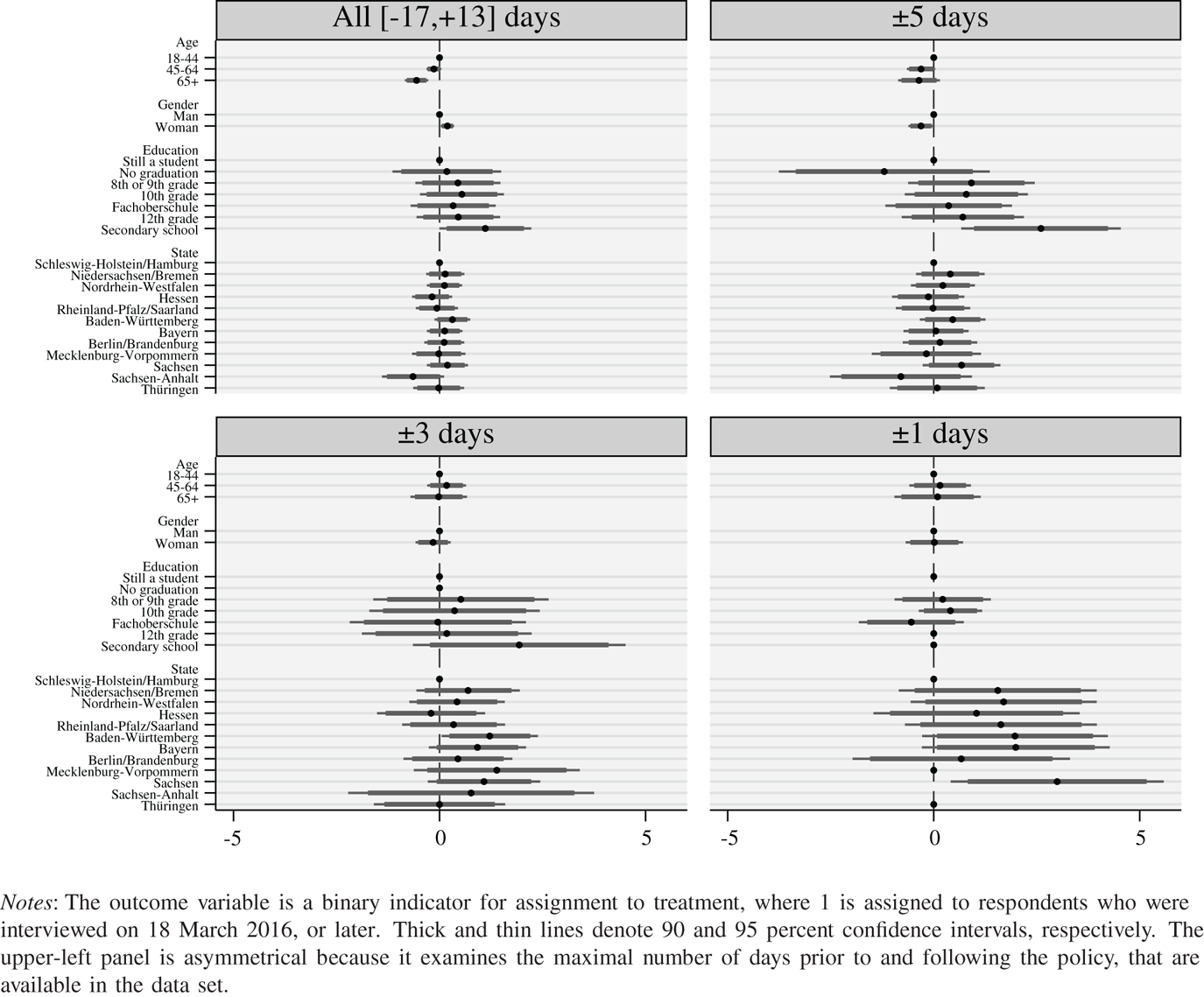
Notably, several features of the GIP raise concerns about causal identification. First, since all panel members received an invitation to answer the survey immediately once the questionnaire was available on 1 March, assignment to the treatment should be a function of respondents’ reachability and availability much more than it is in random samples. Second, unlike the Eurobarometer, the fieldwork was conducted over a more extended period of thirty-one days. This larger time window allows for other political trends or events to take place and confound the relationship between the EU–Turkey agreement and public opinion. For both reasons, using a small time window around the cutoff is crucial. The large sample size (N = 3,142) allows for doing so while maintaining sufficient statistical power to reject false null hypotheses. Figure 5 presents a balance test of key covariates over four different time windows around the cutoff.Footnote 48 Using the entire sample, younger respondents, women, and more highly educated respondents are more likely to be assigned to receive the treatment. However, narrowing the time window to three days before and three days after the policy change shows that the control and treatment groups are similar in terms of gender, age, unemployment, and education levels. In other words, there is no evidence for self-selection into the treatment group within this time window.Footnote 49
Balance test for covariates on assignment to treatment, Germany

Results
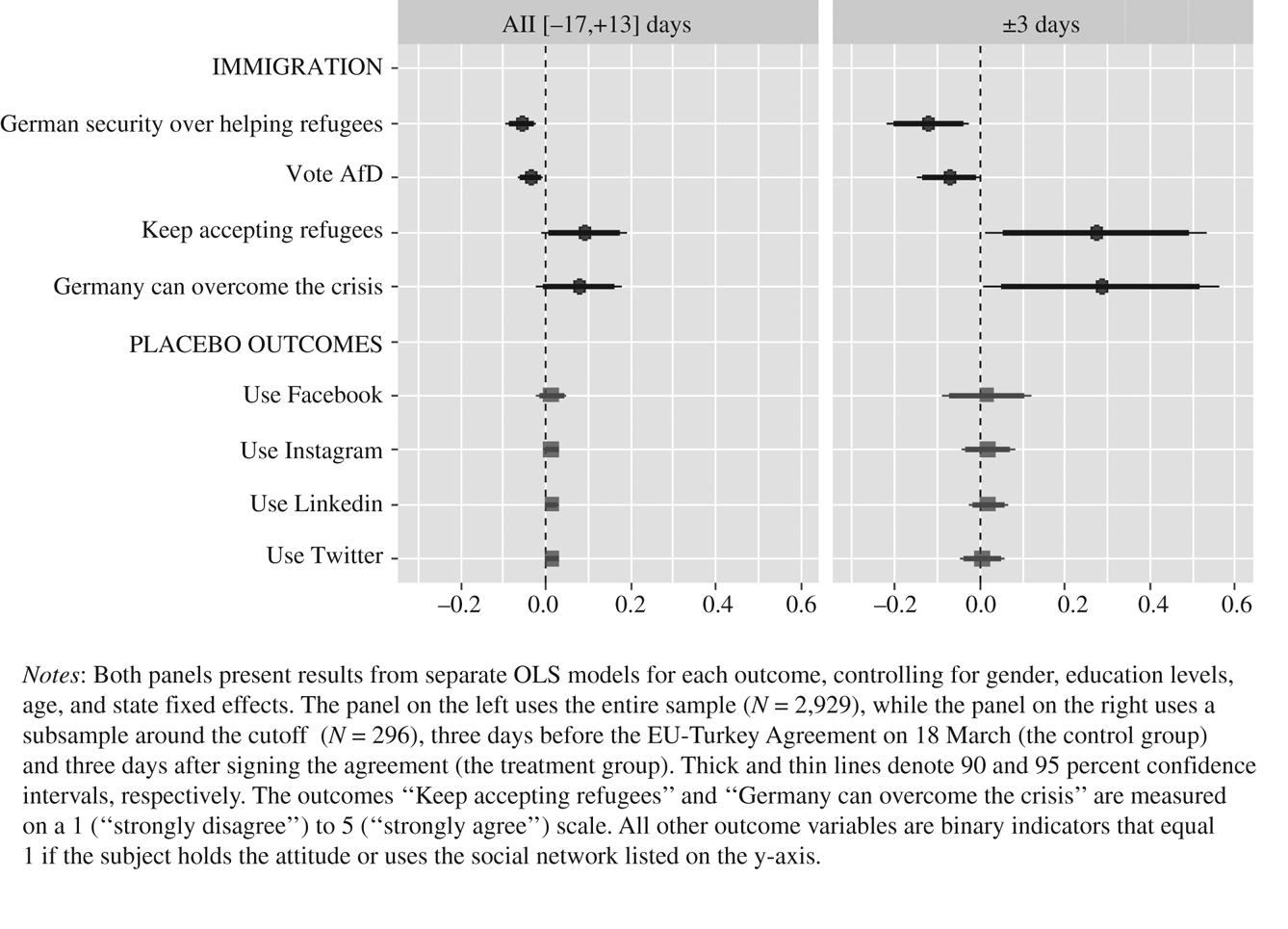
Figure 6 presents the effects of the EU–Turkey agreement on attitudes toward refugees and the refugee crisis, support for the AfD party, and placebo outcomes. Both panels present only the treatment effect for each outcome variable drawn from separate OLS models that also control for gender, education levels, age, and state fixed effects. In the full-period panel on the left, respondents who were interviewed after the agreement were more supportive of refugee admission and helping refugees, more confident in their country's ability to overcome the crisis, and less supportive of the AfD party. However, treatment effects are also associated with placebo outcomes—respondents in the treatment group were 1.5 and 1.6 percentage points more likely to use Linkedin (p = 0.082) and Twitter (p = 0.066), respectively. Although these are small differences, they suggest a certain extent of self-selection into the treatment group when using the entire sample—as was indicated by the balance test in Figure 5—since the EU–Turkey agreement is not likely to affect social network usage in the public at large.
Effects of the EU–Turkey agreement on public attitudes and placebo outcomes, Germany

The panel on the right uses the balanced control and treatment groups, limiting the sample to three days on each side around the cutoff date of 18 March. Despite the smaller sample size and larger confidence intervals, treatment effects are statistically significant and substantively large. Treated subjects are twelve percentage points (p = 0.016) less likely to favor German security over helping refugees or promoting both goals, and seven points (p = 0.070) less likely to support the AfD party. In line with the immigration-controllability mechanism, the agreement increased people's sense of capability to overcome the crisis (0.23 SD, p = 0.046), and even support for keeping refugee admission in Germany (0.23 SD, p = 0.038). Importantly, the associations between the treatment and placebo outcomes are statistically indistinguishable from zero at any conventional level in the narrow time window.Footnote 50
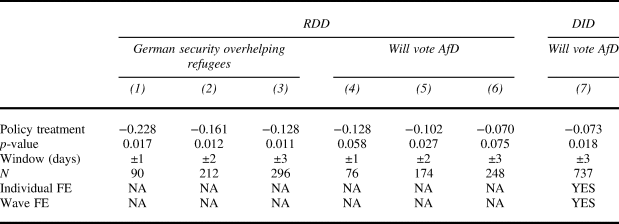
To further examine the robustness of the results, Table 2 presents RD estimates for the treatment effects in narrower time windows around the cutoff. Despite smaller sample sizes, estimates for the treatment effect remain precisely estimated when using the minimal time window of one day on each side of the cutoff. Similar to the case of border controls in Sweden, the EU–Turkey agreement reduced anti-immigrant backlash in Germany soon after its announcement and before its implementation.
Political effects of the EU–Turkey agreement

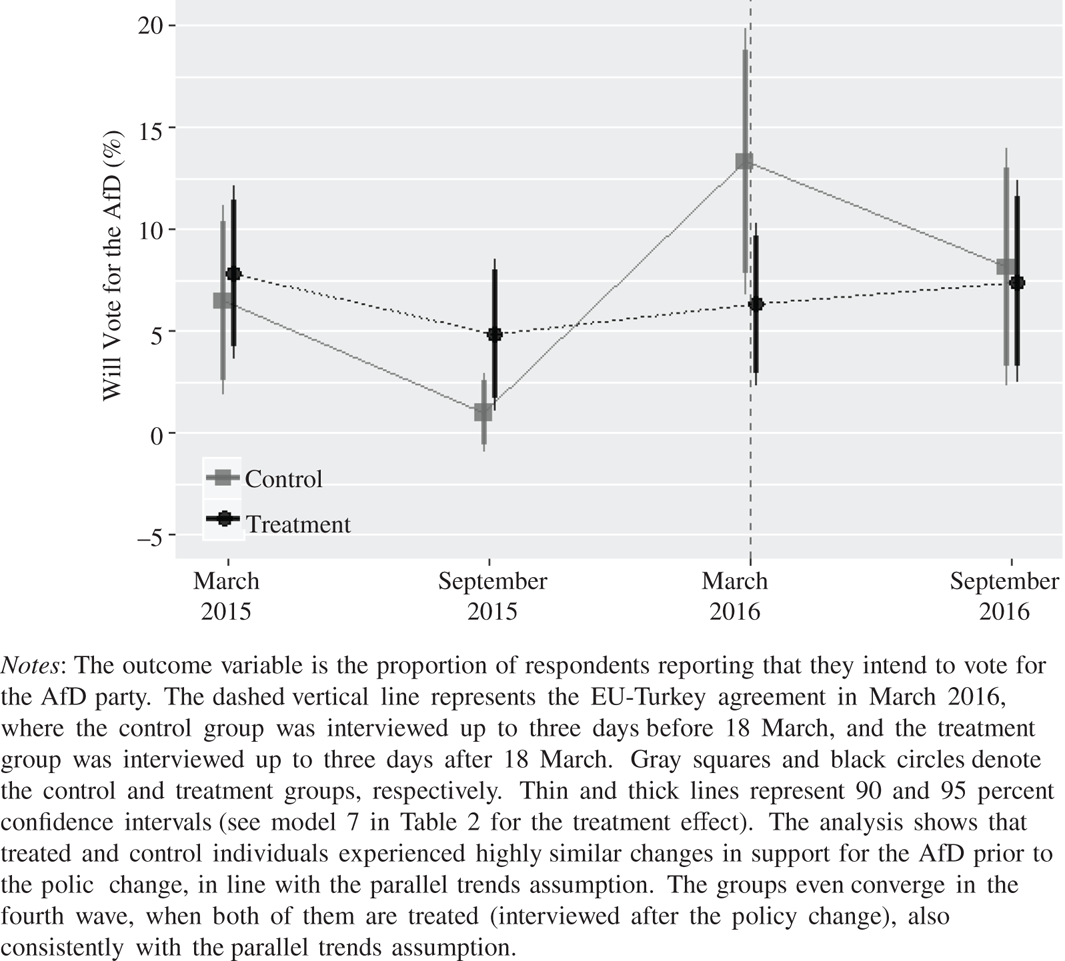
Notes: The “Window” row accounts for the number of days around the EU–Turkey agreement, 18 March 2016. Models 1 to 6 are RD estimates for the relevant wave of March 2016. The first outcome is a binary variable, where 1 indicates the proportion of respondents who hold negative attitudes toward immigration. Values represent the proportion of people preferring to ensure German security over helping refugees. Other options in this survey item were (1) help refugees over German security; (2) do both / there is no dilemma. The second outcome is a binary variable that indicates voting for the AfD party if elections were to be held at the day of the survey. Model 7 presents a difference-in-difference estimation, where control and treated respondents are observed in two additional waves before the policy change (March and September 2015—the closest waves wherein the survey item on voting was included). See Figure 7 for a graphic illustration of the latter results.
Parallel trends and the impact of the EU–Turkey agreement

The seven-percentage-points decrease in the AfD vote represents a 47 percent drop under the baseline rate of the control group. Is this substantial effect driven by self-selection into the treatment? First, the effect size is, strikingly, almost identical to previous experimental results demonstrating that establishment parties adopting more restrictive immigration policies reduce the share of AfD voters.Footnote 51 Second, the GIP allows us to examine both of the groups over time. As Figure 7 illustrates, the share of AfD supporters in both groups was highly similar in the previous waves of March and September 2015, in line with the parallel-trend assumption. If anything, the treatment group presented a slightly stronger tendency to support the AfD. Yet in March 2016, when the EU–Turkey agreement was implemented, the treatment group was seven points less likely to support the AfD party. Model 7 in Table 2 presents the DID estimate for the treatment effect (using the three waves), which is almost identical to the RD estimation of the effect. Unlike conventional DID designs, the fourth wave of the GIP cannot be used to causally identify whether the treatment effect is long lasting or not, since all subjects are exposed to the treatment by then. However, it is worth noting that the AfD support in September 2016 is very similar to the level of support that was detected in the treatment group right after the policy change, which is more consistent with what we would have expected of a long-lasting effect.
Effect Mechanisms
Having demonstrated that the countercrisis policies examined here bring about a substantial reduction in public backlash against immigration, I now explore the mechanism underlying this effect. While untangling the exact mechanism underlying the policy effects is beyond the scope of this paper, it is worth exploring which explanation is consistent with the empirical evidence.
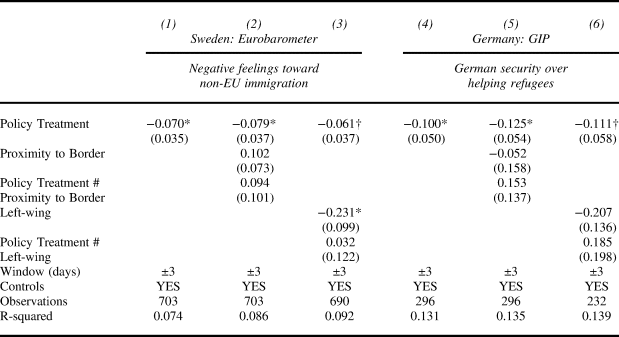
One potential explanation for the policy effect is that it is driven by local conditions and direct exposure to the refugee crisis. If public backlash is attenuated following people's expectations that their personal or local living conditions would change as a result, then living in proximity to the border should condition the policy effect. An alternative explanation suggests that the policy effect stems from a pro-immigration backlash against the policy itself. If so, the policy does not mitigate anti-immigrant backlash. Namely, it creates a stronger opposite backlash among those who are already very supportive of immigration. To examine these theoretical accounts, Table 3 interacts each of the policies with NUTS2- or state-level proximity to the southern border (through which most of the immigrant flows arrived both in Sweden and in Germany) and with a left-wing ideology.Footnote 52 The treatment effect is not conditioned by proximity to the border—both people residing in the state or region nearest to their country's southern border and their counterparts were similarly affected by the policy change.Footnote 53 Treatment effects are also not driven by a left-wing backlash, where left-wing voters turn more supportive of immigration as a protest against the rightward policy shift.Footnote 54
Border controls effect on opposition to immigration by proximity to the border and political ideology

Notes: Models 1 to 3 control for gender, age, education, and community type. The outcome variable in models 1 to 3 is a binary indicator of negative feelings toward non-EU immigration. Models 4 to 6 control for gender, age, education, and state fixed effects. The outcome variable in models 4 to 6 is a binary indicator of prioritizing German security over helping refugees or promoting both goals. Proximity to the border is measured by residency in Southern Sweden or in the State of Bavaria in Germany. In Sweden, left-wing dispositions is a binary variable indicating a 1 score on a 1–5 scale from left to right. In Germany, the binary variable is equal to 1 if respondents self-placed themselves (in an earlier wave that was fielded in September 2015) at scores 1 or 2 on a 1 to 11 scale from left to right. The results remain substantively similar when using a more moderate left-wing indicator (a 1–3 scale from left to right). Standard errors in parentheses; †p < .10; * p < .05; ** p < .01; *** p < .001.
An open question remains why countercrisis policies mitigate public opposition to immigration independently of political ideology and geographical location. Some evidence already indicated that a sense of regaining control over the refugee crisis and increasing confidence in political leadership drive the policy effects. First, people react to the policy change quickly, even when there is no detectable difference in immigration flows. Second, the new policy increases public trust in political leadership and confidence in the country's ability to overcome the crisis. Third, treated individuals are more willing to accept higher levels of immigration. Moreover, a qualitative examination of Swedish news articles covering border controls reveals that political leaders highlighted that the policy does not aim to reject asylum applications and reduce immigration flows. If anything, there were salient predictions regarding an increase in the number of asylum applications, since people who otherwise wanted to apply for asylum in Finland or Norway now had to apply in Sweden if they wanted to cross the Swedish border from Denmark.Footnote 55 However, it might still be the case that these findings are a result of a change in public expectations about the level of immigration. Namely, perhaps people ignore expert predictions and automatically expect that border controls would decrease the future flow of migrants into their country even when told by leading media outlets that it would have no, or an opposite, effect on asylum immigration levels.
The key problem of identification here is the observable equivalence of both mechanisms when analyzing the policy effect on public attitudes toward immigration. Border controls implemented by the Swedish government could signal to Swedish citizens that their government regains control over the situation, but it could also just update their expectations regarding the incoming flow of migrants. Both mechanisms predict a subsequent reduction in public hostility toward immigration in Sweden. However, each mechanism has a different observable implication in the case of Sweden's southern neighbor, Denmark. The vast majority of people seeking asylum in Sweden came from the south, passing through Danish territory. If Swedish citizens expected a decrease in immigration levels following border controls at the Swedish-Danish border, Danish citizens expected an increase. And if the level of immigration flows is key for explaining the observed policy effect, then public opinion in Denmark should turn more hostile following Swedish border controls. Alternatively, the immigration-controllability mechanism predicts no change in Danish public opinion. Since the government in Sweden took the policy measure while the Danish government remained as passive as it was prior to the policy, confidence in political leaders and a subsequent reduction of perceived threats should change only in Sweden.
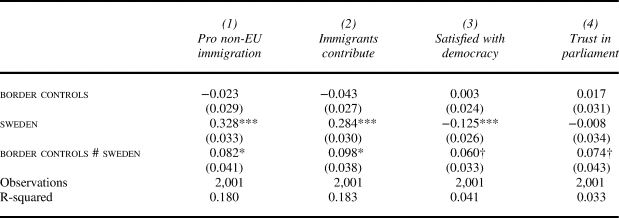
Fortunately, the crossnational Eurobarometer can be used to test these predictions empirically. Figure S1.2 in the appendix shows that in Denmark, as in Sweden, border controls were a highly salient phenomenon that caught much public attention.Footnote 56 Yet as predicted by the immigration-controllability mechanism, there was no attitudinal change in Denmark following the Swedish policy. Table 4 presents OLS estimates for the policy effect in Sweden and Denmark. While the policy effects on immigration attitudes, political trust, and satisfaction from democracy are significant and substantively large in Sweden, they are statistically indistinguishable from zero in Denmark. The fact that only those who live under the government that implements the new policy are affected by it suggests that the policy effects are mainly driven by a sense of competent political leadership regaining control over the situation, rather than by a change in expectations regarding future immigration flows, which should have been present over both sides of the border. Note that this interpretation is also consistent with the lack of effect heterogeneity over proximity to the border, since the immigration-level mechanism predicts that the effect of border controls would be stronger in areas in which a drop in immigration levels would be steeper. In the online appendix I present a causal mediation analysis that also supports the regained-control mechanism mechanism.Footnote 57 Importantly, this is not to say that immigration levels do not matter to public attitudes toward immigration and electoral outcomes more broadly—past research convincingly demonstrated they doFootnote 58—only that there is another mechanism underlying the short-term political impact of the policy response examined here.
The impact of Swedish border controls on public opinion in Sweden and Denmark

Notes: All models include respondents from Sweden and Denmark, controlling for respondents’ age, gender, education, and community type. Outcome variables are binary indicators (1 denoted by the column's title, 0 otherwise). Standard errors in parentheses; †p < 0.10; * p < 0.05; ** p < 0.01; *** p < .001.
Do the Policy Effects Persist?
Another important question is whether the policy effects persist over time. Narrowing the time window around the policy change provides mixed evidence on this question. In Sweden, the effects are stable over time (see Table 1), while they weaken over time in the case of Germany (see Table 2). Yet both in Sweden and in Germany, the policy effects remain significant using the full samples, that is, for six days in Sweden and for thirteen days in Germany.
The empirical strategy I utilize in this study allows only for this short-term identification. For long-term causal identification, spatial variation in the treatment assignment is needed in addition to the temporal variation analyzed here. Namely, alongside treated observations, it requires that we follow up nontreated observations. This cannot be tested convincingly with the data I use here.
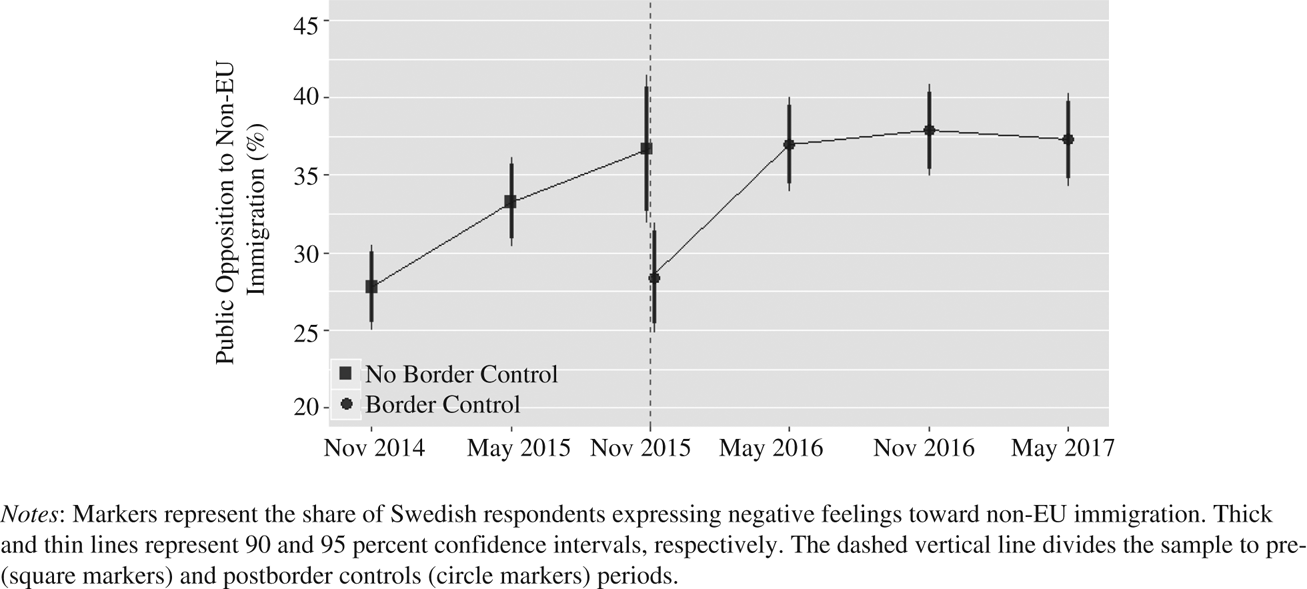
Nonetheless, to get a sense of the longer-term trends, I utilize additional survey waves that were fielded long after the policy changes. Figure 8 presents the share of Swedish people holding negative feelings toward non-EU immigration between November 2014 and May 2017, using all the Eurobarometer waves that included this survey item during the period. The figure demonstrates that, in the peak of the crisis, with a record number of refugee arrivals, border controls reduced public opposition to immigration down to the pre-crisis level of November 2014. About six months after the policy implementation, however, public opposition returned to the level of the control group in November 2015.Footnote 59
Border controls and immigration attitudes in Sweden over time

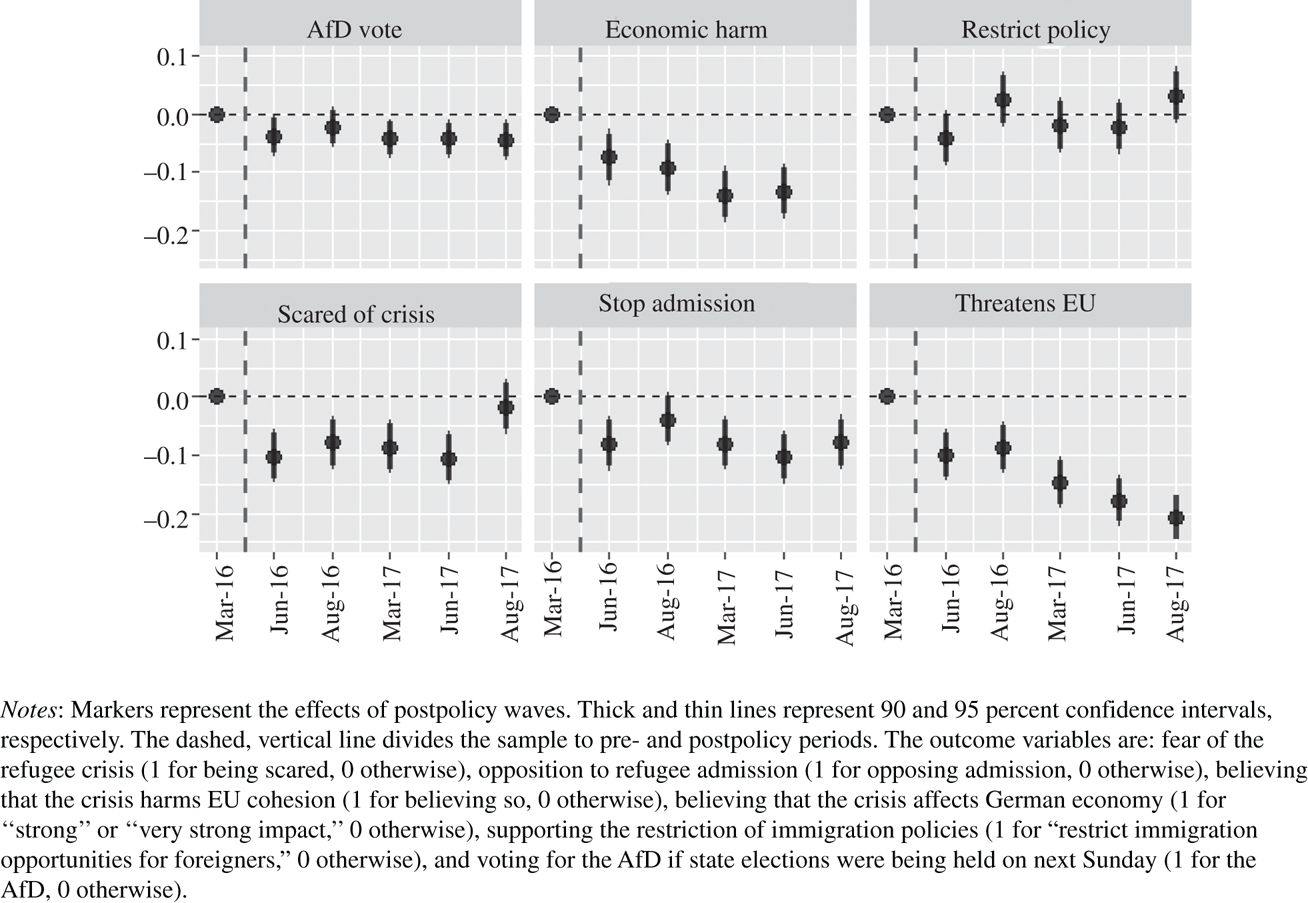
For the German case, I utilize data from the German Longitudinal Election Study (GLES).Footnote 60 The GLES sampled the German population between 26 February and 11 March, one week before the EU–Turkey agreement, and again, roughly every three months. Each wave collected attitudes toward the refugee crisis and its impact on Germany and Europe, and vote intentions if elections were being held next Sunday. To assess the over-time policy effects, I use OLS regressions with postpolicy wave indicators, controlling for respondents’ age, gender, education level, and election district. Figure 9 presents the results. Following the cooperation of European countries in the EU–Turkey agreement, German citizens were ten percentage points less likely to believe that the refugee crisis threatens EU cohesion, and this trend persisted for over a year. Germans interviewed after the policy change were also less likely to express fear over the crisis, and negative economic evaluations of the situation, but more likely to support refugee admission. Intention to vote for the AfD party was reduced by three percentage points. While statistically significant, this estimate is considerably smaller than the shorter-term effect. Finally, the policy change did not change preferences over immigration restrictions in the long term. Although willingness to admit refugees grew in the postpolicy period, German voters were not more willing to liberalize immigrant admission policies. However, across all outcomes, with the exception of restricting immigration policy, public opinion in postpolicy waves is significantly less threatened by, and hostile to, immigration.
The EU–Turkey agreement and immigration attitudes in Germany over time

Taking the Swedish and German cases together, the findings indicate that policy effects endure over a period of one to two weeks. Beyond this relatively short period of time, the durability of the effects varies over different contexts. More research is needed to fully explain the factors that determine whether policy effects persist over time. I suggest two potential empirical strategies to study the long-term effects of immigration and border control policies.
Discussion
This study examined the political impact of border control policies on public opinion by exploiting two natural experiments in Europe. Utilizing the coincidental and independent occurrence of significant policy responses to the crisis during the fieldwork on public opinion surveys, I find that countercrisis policies significantly reduced anti-immigrant public backlash. The causal interpretation of these findings is further enhanced by their consistency in both case studies—border controls in Sweden and the EU–Turkey agreement in Germany—and in very narrow time windows around the policy responses.
The policy effects are most consistent with what I defined here as an “immigration controllability” mechanism. Both in Sweden and Germany, the attitudinal change is detected quickly after announcing the policy response and before its implementation. Remarkably, the findings are inconsistent with the notion that such policies matter to public opinion only because of their (detected or expected) impact on immigration flows. This suggests that in and of themselves, policy responses in times of crisis are critical to public reactions and electoral developments. Beyond their role in shaping the magnitude of asylum immigration into the country, policy responses can determine the public sense of crisis and confidence in political leadership's ability to overcome it, which in turn mitigates anti-immigrant backlash.
Several noteworthy implications can be drawn from the results. Previous work on public attitudes toward immigration and refugees has been much more focused on what triggers opposition to, or prejudice against, immigrants, whereas the factors that might reduce such opposition or prejudice were very scarcely examined. Those studies that did focus on opposition or prejudice reduction produced mixed results.Footnote 61 The findings presented here contribute to this developing strand of research. Importantly, this group of studies employed various information treatments embedded in public opinion surveys, which raises some concerns regarding their external validity to real-world settings and the extent to which they can be used for policy design that aims to reduce anti-immigrant backlash. My findings therefore provide valid evidence to policymakers who take into account public backlash when designing immigration and immigrant policies.
Several limitations are also worthy of further discussion and future investigation. The empirical strategy I used in this study allowed me to identify the short-term causal effect of two specific policy responses.Footnote 62 This short term of at least one to two weeks following the policy change may buy substantively meaningful time of political stability for governments that deal with rapidly evolving challenges in times of refugee crises. But do voters remember policy shifts, or come back to their pre-policy state of mind? At this point, I can only speculate about the long-term impact of countercrisis policies on public backlash against immigration. Although some suggestive evidence implies that the EU–Turkey agreement had long-term effects, the causal findings cannot be extrapolated to more extended periods because many other events intervene and are likely to shape public opinion. Further research is clearly needed to better understand the durability of the policy effect. Yet to advance this undertaking, I wish to briefly outline two empirical strategies. One strategy can utilize observational data with spatial variation in policy shifts, in addition to temporal variation. This would produce a control group that resembles the treatment group in a variety of properties but remains unexposed to the treatment over time. Most likely examples are subnational policy shifts, in which many subnational units could be taken as reasonable counterfactuals. The policy effect could then be estimated using a standard difference-in-differences design.
Another strategy relies on individual-level treatment compliance. Since some survey respondents probably remain unexposed to the policy treatment, comparing over-time differences between the unexposed and the exposed groups could shed light on the effects’ durability. Although there are various indicators, such as news consumption or political knowledge, that could be used as proxies of treatment compliance, people who score differently on these measures are likely to differ in many unobserved ways. However, an experimental intervention that determines people's probability to comply with the treatment could be used to generate comparable groups of individuals who are more and less likely to receive the treatment. An encouragement design, in which there are randomly assigned encouragements of survey respondents to consume news about a policy, could achieve this goal.Footnote 63
When weighing the evidence and their implications on policy design, it is also vital to take ethical considerations into account. Both border controls and the EU–Turkey agreement were publicly criticized as measures that breach international commitments and humanitarian values. Others have argued that these were necessary measures that had to be taken to maintain the admission and integration of refugees in European countries. This debate might shed light on one of the key takeaways from this study. Karl Polanyi famously argued that the sustainability of capitalist markets is dependent on a “Double Movement” in which the expansion of markets must include (seemingly paradoxical) social protection for those who are less likely to adjust to international economic competition.Footnote 64 The evidence presented here suggests a similar dialectical process concerning immigration—certain types of restrictive modifications in immigration and asylum policies make refugee admission and protection more sustainable. Overlooking public backlash in times of massive refugee flows might give rise to populist and radical right movements that could, eventually, collapse the humanitarian system of this era.
Data Availability Statement
Replication files for this article may be found at <https://doi.org/10.7910/DVN/SJ4IMB>.
Supplementary Material
Supplementary material for this article is available at <https://doi.org/10.1017/S0020818321000060>.
Acknowledgments
For valuable comments and suggestions I thank Yotam Margalit, Yael Shomer, Dominik Hangartner, Shir Raviv, Alon Yakter, and the editors and reviewers at IO. I am also grateful to The Colton Foundation for supporting this research. Any errors remain my own.
Funding
This paper uses data from the German Internet Panel. The German Internet Panel is funded by the German Research Foundation through the Collaborative Research Center 884 “Political Economy of Reforms” (SFB 884).