Introduction
India is regarded as a country where the Green Revolution, represented by the introduction of chemical fertilizers and pesticides, HYV (high-yielding varieties), agricultural machinery and irrigation technology, successfully contributed to the modernization of agriculture (Singh, Reference Singh2000) and to increasing productivity since the late 1960s (Ray and Ghose, Reference Ray and Ghose2014). Although India has improved food self-sufficiency (Singh, Reference Singh2000), food insecurity and malnutrition on a household level remain problematic (Gandhi and Zhou, Reference Gandhi and Zhou2014). Furthermore, high input agriculture has led to undesired, long-term effects (Panneerselvam et al., Reference Panneerselvam, Halberg, Vaarst and Hermansen2012), such as environmental degradation (Matson et al., Reference Matson, Parton, Power and Swift1997; Singh, Reference Singh2000) and increasing input costs (Eyhorn et al., Reference Eyhorn, Ramakrishnan and Mader2007). This undermines development efforts aimed at improving the livelihood of rural households.
This is also true for cotton production, which provides a livelihood and income for around 10 million rural households, made up primarily of smallholder farmers (Baffes, Reference Baffes2004; Eyhorn et al., Reference Eyhorn, Ramakrishnan and Mader2007; Sharma and Bugalya, Reference Sharma and Bugalya2014). India is the second largest producer of cotton in the world after China, accounting for 18% of the world's cotton production (The Cotton Corporation of India, 2011) harvested on approximately 13 million ha (USDA, 2016). Although cotton yields have increased over the last decades (Sharma and Bugalya, Reference Sharma and Bugalya2014), India's average yield per hectare of 500 kg/ha in 2014/2015, still lags behind other major cotton-growing countries such as |China (1484 kg/ha), the USA (939 kg/ha), Pakistan (782 kg/ha), and the world average of 782 kg/ha (USDA, 2016). In India, around 92% of the total cotton production area is cultivated with Bt cotton (Branson and Sood, Reference Branson and Sood2015), a transgenic technology where ‘Bt’ expresses an insecticide from the bacterium Bacillus thuringiensis (Subramanian and Qaim, Reference Subramanian and Qaim2009). Bt, although itself an organic pesticide, still leaves the crops vulnerable to some pests and the widespread application of pesticides and herbicides is necessary (Pemsl et al., Reference Pemsl, Waibel and Gutierrez2005; Hofs et al, Reference Hofs, Fok and Vaissayre2006). In the debate on the effects of Bt technology, several authors (Monga, Reference Monga2008; Gaurav and Mishra, Reference Gaurav and Mishra2012; Stone, Reference Stone2012) are questioning the overall sustainability of the Bt cotton production system. Specific points of discussion on the consequences of Bt cotton cultivation are the loss of biodiversity and pests’ increasing resistance to pesticides. Increasing resistance to pesticides was recently verified by a study conducted in three Indian states (Mohan et al., Reference Mohan, Ravi, Suresh, Sumerford and Head2015).
The intensive use of pesticides in cotton cultivation remains a problem. Fifty-four percent of all pesticides used in India are applied to cotton fields, which cover only around 5% of the total cultivated area (Rajendran, Reference Rajendran2004). Half of the pesticides used are categorized as hazardous to human health by the WHO (World Health Organization), leading to negative environmental effects and acute and chronic health problems for farming families (Makita, Reference Makita2012; Panneerselvam et al., Reference Panneerselvam, Halberg, Vaarst and Hermansen2012). In addition, farming families are facing financial risks due to high input costs (Eyhorn et al., Reference Eyhorn, Ramakrishnan and Mader2007) and market conditions, with a lack of reliable purchasers and volatile and uncertain prices for cotton (Eyhorn et al., Reference Eyhorn, Mäder and Ramakrishnan2005a).
It is argued that, based on the principles of health, ecology, fairness, and care (IFOAM, 2014) organic agriculture can help improve the livelihood of smallholder cotton farmers in developing countries (Altieri, Reference Altieri2002; Walaga and Hauser, Reference Walaga and Hauser2005; Lyons and Burch, Reference Lyons and Burch2007; Scialabba, Reference Scialabba2007; Willer et al., Reference Willer, Yussefi-Menzler and Sorensen2008). Organic agriculture prohibits the use of synthetic inputs such as chemical fertilizers, herbicides, pesticides, defoliants, genetically modified organisms (GMOs) and chemically treated seeds in farming. These inputs are substituted with different agricultural practices, such as intercropping, crop rotation, use of compost and FYM (farmyard manure) (Jawtusch et al., Reference Jawtusch, Oehen, Niggli, Willer and Kilcher2011). Following this reasoning, several NGOs have been promoting organic cotton production in developing countries since the late 1980s (Eyhorn, Reference Eyhorn2007; Bachmann, Reference Bachmann2012). According to Textile Exchange (2016), in 2014/2015, organic cotton was grown in approximately 20 different countries, but still accounted for only around 0.45% of global cotton production. India was the largest producer of organic cotton (see Table 1), grown by around 157,700 certified organic farmers, producing 75,200 t organic cotton fiber, accounting for 67% of the world's total organic cotton (Textile Exchange, 2016). Although India is the largest organic cotton producer worldwide, on the national level, only around 276,700 ha out of a total of 12,850,000 ha of harvested cotton fields were under organic cultivation in 2014/2015 (USDA, 2016, Textile Exchange, 2016).

In India, several research studies on organic cotton revealed lower production costs and higher gross margins (Eyhorn et al., Reference Eyhorn, Mäder and Ramakrishnan2005a, Reference Eyhorn, Ramakrishnan and Mader2007), decreasing yields during the transition period from conventional to organic cultivation (Eyhorn et al., Reference Eyhorn, Ramakrishnan and Mader2007; Panneerselvam et al., Reference Panneerselvam, Halberg, Vaarst and Hermansen2012), and increasing workloads for the farmers (Bachmann, Reference Bachmann2012). So far, the scientific research on the impacts of organic cotton production has not been placed in a broader context, including the social dimension and the farmers’ perspective, as well as economic and environmental perspectives. This study aims to answer the following research questions: What impacts does conversion to organic cotton production have on the livelihood of smallholder farmers and their families? From the perspective of the farming families, what improvements come from organic cotton production and what are the challenges for the future? In order to answer these questions a case study was conducted in Odisha, India.
Agricultural Characteristics and Organic Cotton Production in Odisha, India
Agriculture is the basis of the livelihood for 65–70% of the population in Odisha (Upadhyay, Reference Upadhyay2013), and is dominated by small and marginal farms: 80% of these farms are 1–2 ha in size, 13% are 2–6 ha, and only 7% are more than 6 ha (Upadhyay, Reference Upadhyay2013). Land cultivation is mainly done by hand with hand hoes or supported by animal traction. The conditions for farming families are often determined by limited availability of land, low agricultural productivity and, as in other developing countries (Jabbar et al., Reference Jabbar, Ehui and Von Kaufmann2002; Khandker and Faruqee, Reference Khandker and Faruqee2003; Giné, Reference Giné2011), the limited access to loans, often connected to high-interest rates and financial problems of farming households (NSSO, 2014). Farming families in Odisha are additionally socio-economically disadvantaged because they belong to social groups with low status in the Indian cast system. Most of them either belong to tribal groups (‘Adivasis’), classified by the government as ‘Scheduled Tribes’ (ST), ‘Scheduled Castes’ (SC), also known as ‘untouchables’ or ‘Dalits’ (Government of Odisha, 2011; Lakerveld et al., Reference Lakerveld, Lele, Crane, Fortuin and Springate-Baginski2015), or ‘Other Backward Classes’ (OBC) (Balarajan et al., Reference Balarajan, Selvaraj and Subramanian2011). All the interviews in the study region were carried out with farmers from these three disadvantaged ethnic groups. Although men and women have had equal rights regarding property since 1992, land is still overwhelmingly owned by men (Mohanty, Reference Mohanty2001; Kumar et al., Reference Kumar, Choudhary, Sarangi, Mishra and Behera2005), which leads to differences in status among the members of the farming families. Women are also disadvantaged with respect to education [in Odisha, the literacy rate of women is 64% compared with 82% for men (Ministry of Home Affairs, 2011)], the burden of work, and participation in household and community decision-making. The discrimination against women is present across the entire social hierarchy (Das and Tarai, Reference Das and Tarai2011).
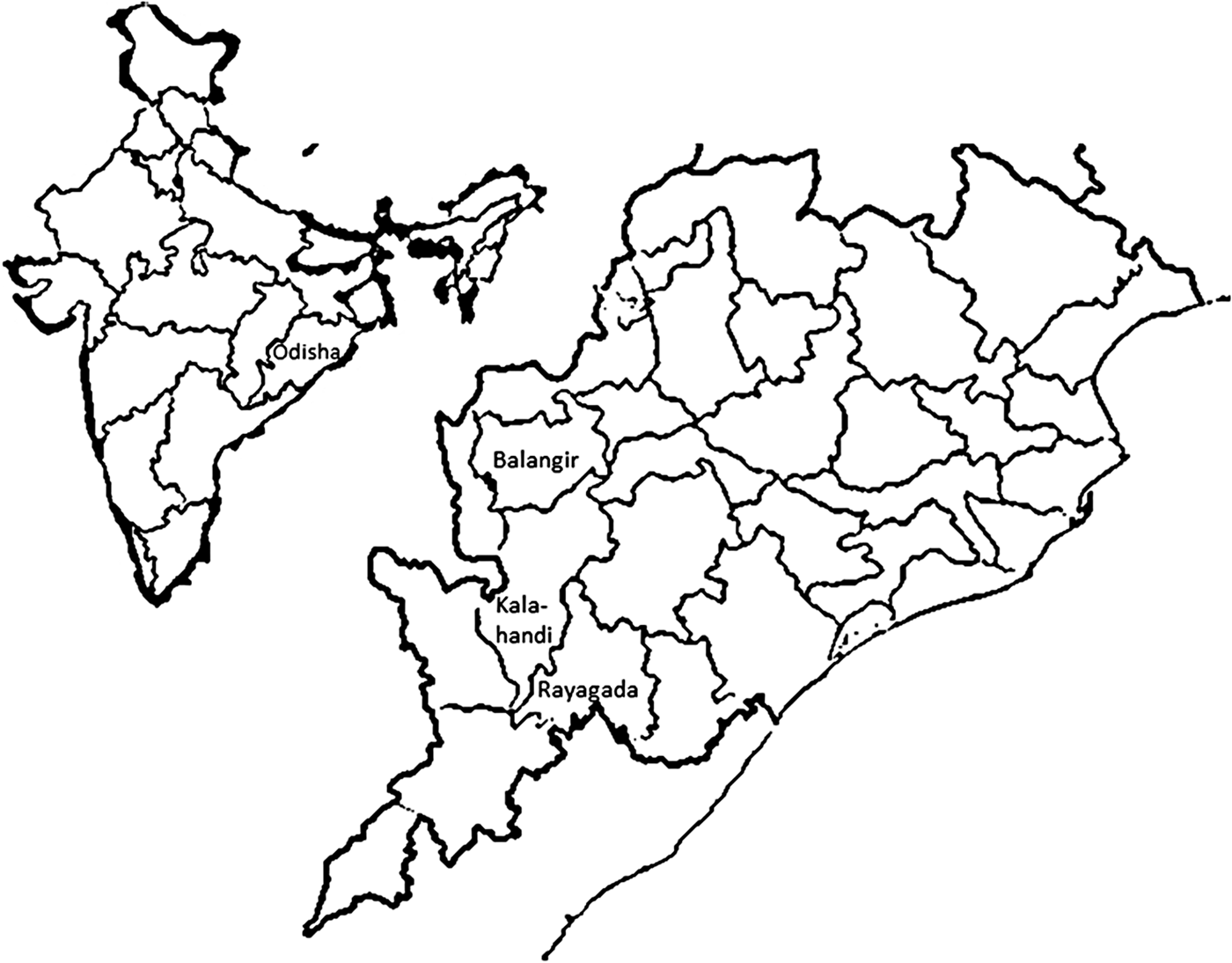
Cotton is not a traditional crop in Odisha, but has gained importance over the last 20 years, mainly in the southern and western part of the state. In 2011, the government of India declared Odisha one of the major cotton-growing states of India. In 2013/2014, cotton was produced by around 85,000 farming families distributed in the districts of Kalahandi (43,000 ha), Balangir (40,000 ha), and Rayagada (27,000 ha) (Directorate of Agriculture and Food production Odisha, 2013). The empirical research for this study was conducted in these three districts of Odisha (see Fig. 1).
Study area—Kalahandi, Balangir & Rayagada districts in Odisha, India.

Most farmers in the region are cultivating under rain-fed conditions, as they do not have irrigation facilities (Upadhyay, Reference Upadhyay2013). The average annual precipitation is between 1200 and 1500 mm, and the region is prone to droughts. Although the government of Odisha does not promote the cultivation of Bt cotton, it has spread in Odisha through private companies since 2010. Today, nearly all available cotton seeds available are Bt seeds (Upadhyay, Reference Upadhyay2013). Pesticides, banned in other countries due to their toxicity (Rajendran, Reference Rajendran2004), are often heavily applied in cotton cultivation in Odisha, as well as other states in India. To ensure a certain level of cotton prices, every season the government of India announces a MSP (Minimum Support Price), marking a minimum limit, which traders have to pay to farmers for their cotton (Upadhyay, Reference Upadhyay2013).
Certified organic cotton production in the state of Odisha started in 2006, promoted by the organic cotton initiative Chetna Organic. Chetna (Hindi word for awake) Organic India was established in 2004 and currently works with approximately 25,000 farmers in the three Indian states of Maharashtra, Telangana, and Odisha. Chetna aims to facilitate the cultivation of organic cotton by providing access to certification and training, access to seeds, and group formation, among other support provided.
In Odisha, Chetna Organic is working with around 7200 farmers. More than half of these farmers belong to ‘ST’; the rest belong to ‘SC’ and ‘OBC’. Chetna farmers in Odisha are organized in 536 self-help groups (SHGs) (286 certified and 250 non-certified), which in turn are clustered into five cooperatives (including the Mahila Kisan Sashaktikaran Pariyojana (MKSP)-Female Farmer Group), that are incorporated in the nation-wide organizations Chetna Organic Farmers Association (COFA) and Chetna Organic Agriculture Producer Company Ltd (COAPCL). COFA is a farmer owned, non-profit organization, which promotes capacity building, extension activities, the formation of SHGs and cooperatives, as well as advocating for its members. COAPCL is a commodity-trading company, also owned by farmers, with the aim to improve the marketing of the farmers’ products.
The SHGs are made up of 10–19 members. There are SHGs of certified organic producers and SHGs of non-certified producers. As land ownership is a precondition for certification, the SHGs of certified organic producers consist mainly of male members. SHGs of non-certified producers primarily consist of wives of certified farmers and other female farmers. Within these certified and non-certified SHGs, members have different positions, such as president and secretary of the SHG. SHGs regularly hold meetings and trainings. Certified SHGs are formed to organize marketing activities, technical trainings, and certification. Several certified SHGs hold group certifications, compliant with the US Department of Agriculture's National Organic Program (NOP) and India's National Standards for Organic Production (NSOP), derived from the National Program for Organic Production (NPOP) which is equivalent to the EU Standard (EU-regulation 834/2007). To maintain these group certifications, which cover 500 farmers each, they operate an internal control system (ICS). Additionally, external certification bodies (CUC: www.controlunion.com and Aditi: www.aditicert.net) carry out independent inspections to verify the ICS. Chetna Organic covers all certification costs. Non-certified SHGs enable the organization of additional activities for women (e.g., tailoring classes etc.). A village-level meeting, which includes all established SHGs (certified and non-certified) in the respective village, is usually held once a month. Beyond villages, farmer cooperatives are formed in each district by certified SHGs (non-certified SHGs are not directly involved). Farmers in higher positions within certified farmer groups, which are mostly male farmers, also have access to direct training and make visits to other districts and states.
Methods and Interviewee Characteristics
In the cotton-growing region of Odisha, in the districts of Kalahandi, Balangir, and Rayagada, a field study was conducted from June to August 2014. A qualitative approach was chosen for two reasons. First, the experiences and subjective priorities of farmers producing organic cotton are the focus of the study. Secondly, it was expected that farmers could describe and evaluate the impacts of organic cotton production on their livelihood, even though they did not keep verifiable records on production, income, or spending. In order to gather comprehensive results on the experiences of the farmers and the context, the empirical work was done with a mix of methods, combining interviews with cotton farmers and experts engaged in organic farming, with participant observations. Participant observations were undertaken during the entire research period, including at different workshops of Chetna Organic, gatherings, and in informal conversations. The observations were documented in field notes (Bernard, Reference Bernard2002).
To develop a full understanding of the processes and activities regarding cotton, five expert interviews (Gläser and Laudel, Reference Gläser and Laudel2009) with staff of Chetna Organic, SMS Cotton (Subject Matter Specialist Cotton), AI CCIP (All India Coordinated Cotton Improvement Project) and Trade-Craft UK were conducted. To gain insights into farmers’ livelihoods, 30 interviews with organic farmers were carried out. The selection of farmers was done using a purposive sampling approach (Silverman, Reference Silverman2001; Tongco, Reference Tongco2007), a non-random technique where researchers select the interviewees based on the research questions, the qualities of informants, and their willingness to share (Tongco, Reference Tongco2007) regarding the four factors: caste affiliation, gender, location, and membership (or non-membership) in SHGs. This purposive sampling does not ensure representativeness for the whole group or other groups of farmers. On the contrary, the selection procedure was chosen to aim at theoretical saturation, which means it was continued until no new information on the research questions could be gathered (Flick, Reference Flick2009).
The interviews were based on a semi-structured interview guide (Bernard, Reference Bernard2002), focused on the experiences of farmers. Data on the interviewee characteristics were also collected in a short standardized questionnaire (Atteslander, Reference Atteslander2003). Translators, who translated to English, were used to communicate during the interviews. The transcripts of the interviews included the English spoken question of the interviewer and the English translation of the farmer's answers. According to qualitative content analysis approach (Lamnek, Reference Lamnek2005; Kuckartz, Reference Kuckartz2007), the interviews and field notes were structured systematically by codes in order to understand the effects of organic farming and interactions between different decisive factors influencing people's livelihoods. Both deductive and inductive coding were applied to build thematic categories in code families (Kuckartz, Reference Kuckartz2007; Flick, Reference Flick2009). Initially, codes based on the employed interview guide were assigned to relevant text passages (top-down approach) with the software Atlas.ti. During this process, additional codes were added for emerging issues (bottom-up approach).
Characteristics of interviewed farmers
In total, 16 male and 14 female farmers were interviewed. These included 22 farmers in the Kalahandi district (specifically, 11 farmers in Bhawanipatna; 6 in Golamunda; 5 in Lanjigarh), three in the Balangir district and five in the Rayagada district. Farmers from different castes were interviewed to get a broad view, including 12 farmers from ST, six from SC, and 12 from OBC. All male farmers interviewed were members of certified SHGs except one, a husband of a female member of a non-certified SHG. One woman interviewed was a member of a certified SHG, eight women interviewed were members of non-certified SHGs, and five female farmers interviewed were not members of a SHG, but wives of certified organic farmers. The average age of the interviewees was 43 years. The interviewed male farmers had, on average, been to school for eight years. Half of the female farmers interviewed never went to school, while those who had an education spent, on average, 5 years in school. The average household size was six family members, with an average of three children per household. On average, the cultivated area of the interviewed farmers was 2 ha, with nearly half (48%) used for cotton cultivation. The farmers interviewed joined Chetna Organic between 1 and 8 years ago.
Results and Discussion
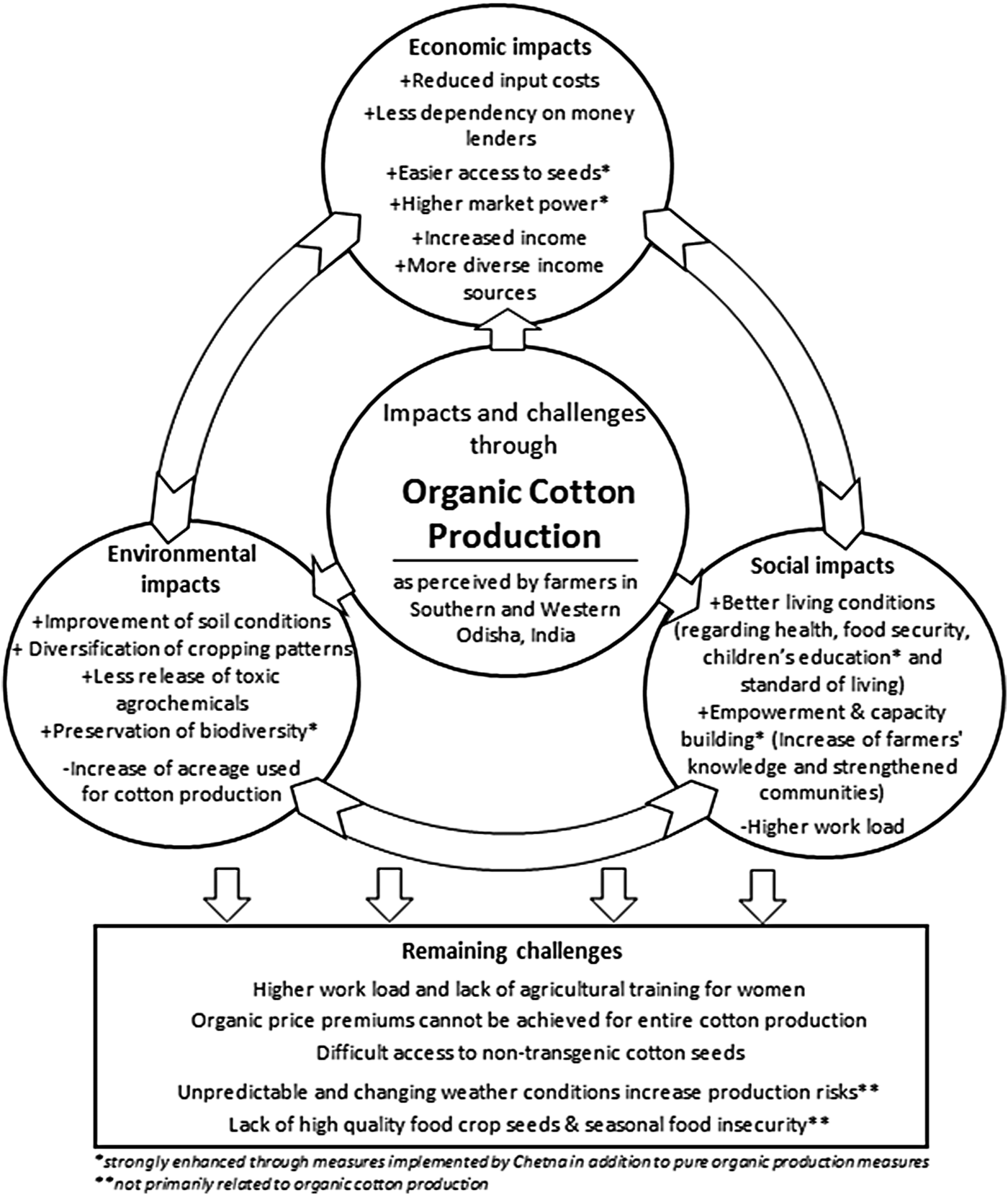
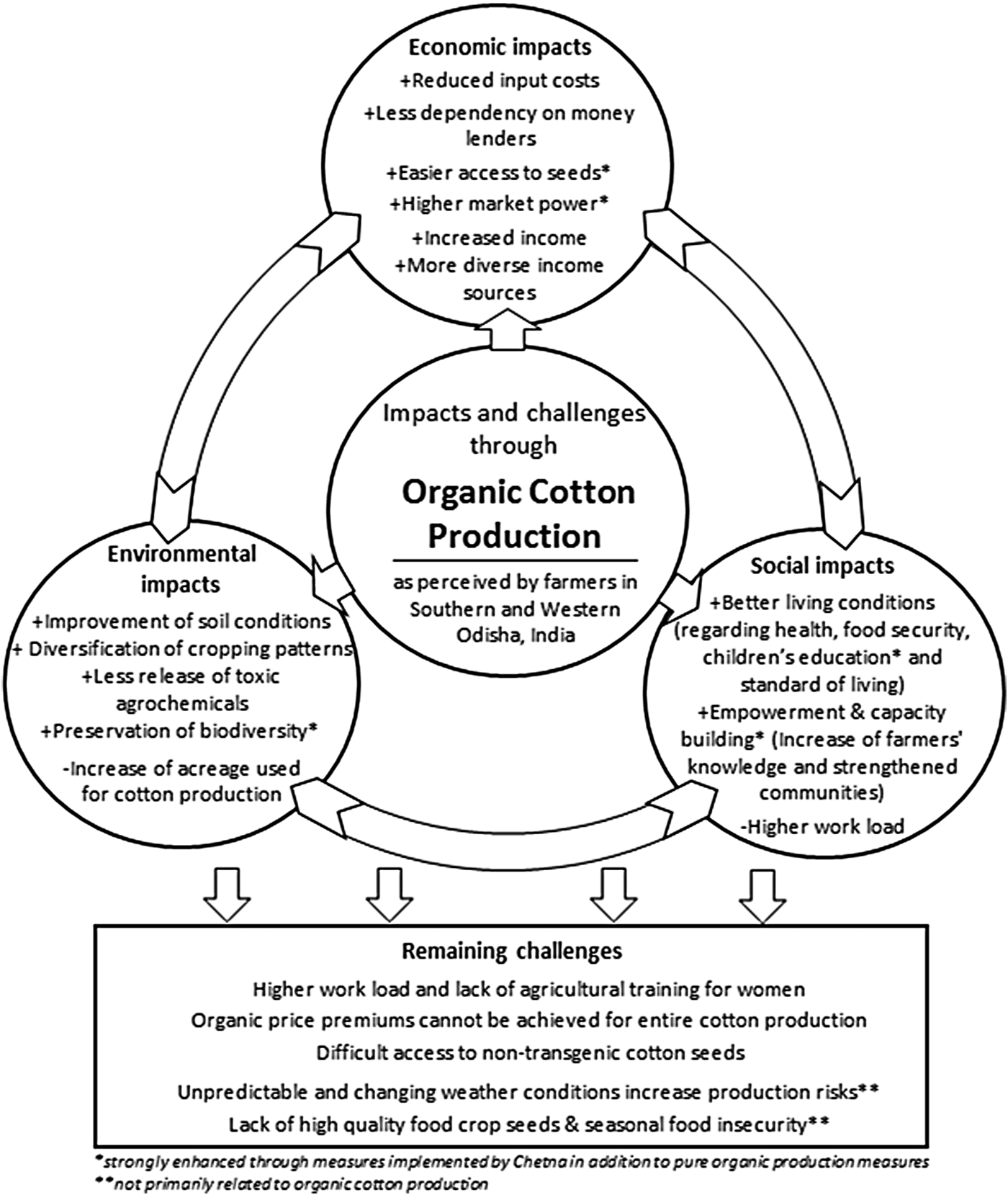
In this section, the key impacts on farmers’ livelihood due to the conversion to organic cotton production, as well as the remaining challenges, as perceived by farmers, are described. The impacts have been grouped according to environmental, economic, and social dimensions (Fig. 2).
Organic cotton production in Southern and Western Odisha—impacts and remaining challenges as perceived by smallholder farmers.
Environmental impacts
According to the interviews and participatory observation, the main environmental impacts were the improvement of soil conditions, diversification of cropping patterns, reduced release of toxic agrochemicals to the environment, and preservation of biodiversity. Acreage used for cotton production had also increased, although it is questionable whether this has had positive or negative impacts.
Improved soil conditions and diversified cropping patterns were important changes reported by farmers. According to farmers’ observations, soil conditions on fields improved through organic cultivation. Some described a change of their fields’ soil structure. According to farmers, these effects were due to changes in their farming practices, such as the use of compost or liquid manure, green manure, intercropping, and crop rotation. These observations are supported by previous studies which documented improved soil quality (e.g., higher soil organic matter content, increased population of soil organisms, enhanced microbial activity) from proper organic management (Eyhorn et al., Reference Eyhorn, Ratter and Ramakrishnan2005b), reported in various studies in different regional contexts (Oberson et al., Reference Oberson, Besson, Maire and Sticher1996; Mäder et al., Reference Mäder, Fliessbach, Dubois, Gunst, Fried and Niggli2002; Oehl et al., Reference Oehl, Sieverding, Ineichen, Mäder, Boller and Wiemken2003; Ferringo et al., Reference Ferringo, Ratter, Ton, Vodouhe, Williamson and Wilson2005; IFAD, 2005; Eyhorn, Reference Eyhorn2007). In India, in a study in Madhya Pradesh, organic farmers also reported better soils, although this could not be verified by measurable soil parameters (Eyhorn et al., Reference Eyhorn, Mäder and Ramakrishnan2005a). In Karnataka, lower nitrogen losses in organic farming were measured and reported together with a lower impact on the environment in organic farming (Patil et al., Reference Patil, Reidsma, Shah, Purushothaman and Wolf2014).
Due to different activities by the organic initiative Chetna and the organic farming methods used, diversification of cropping patterns increased. ‘Just we are doing organic cultivation. So we are doing all types of crops varieties; food crops and other cash crop. So a lot of mixing is there.’ Man ST (14). As confirmed by other studies (Eyhorn et al., Reference Eyhorn, Ramakrishnan and Mader2007; Panneerselvam et al., Reference Panneerselvam, Halberg, Vaarst and Hermansen2012), the introduction of farming practices such as intercropping and crop rotation encourages farmers to plant a greater selection of crops beside cotton.
Reduced release of toxic agrochemicals and preservation of biodiversity are additional impacts reported by farmers. Most of the interviewed farmers had previously used high quantities of chemical pesticides. For example, to combat sucking pests, farmers used Monocrotophos, which is highly toxic, especially for birds and bees. To combat leaf feeders, farmers applied Chlorpyrifos, which affects the nervous system of humans and animals in the same way it affects targeted pests. Most farmers experienced negative effects on their environment when using the chemical pesticides: ‘When we were spraying, when we were washing the spraying machine, at that time, also some animals died like pigs, goats and sheep.’ Man ST (14). Farmers also reported on the necessity to increase the quantity of chemical pesticides year by year, as pests built resistances; this has been confirmed by a recent case study on Bt cotton in three different Indian states (Mohan et al., Reference Mohan, Ravi, Suresh, Sumerford and Head2015).
After conversion, farmers use self-made bio-pesticides, such as extracts made from chili–garlic or from neem tree leaves (Azadirachta indica). The release of toxic agrochemicals to the environment is avoided, which has positive impacts on the environment, on beneficial insects and other organisms. Many farmers also described a lower density of pests in their fields. ‘Before so many pests were there. If you use the chemical pesticides, so many pests died, but also the beneficial insects. So there was an imbalance and more pests were coming to attack the crops. Then after slowly reduced the chemical pesticides, then the beneficial insects also increased.’ Man OBC (9). This has also been confirmed by a study carried out in Madhya Pradesh, where farmers report a higher number of worms and butterflies after conversion to organic cotton production (Panneerselvam et al., Reference Panneerselvam, Halberg, Vaarst and Hermansen2012).
Moreover, the preservation of biodiversity in the region is supported by additional measures undertaken by Chetna. The initiative provides training for farmers, especially for women, on how to preserve and multiply seeds and has set up seed banks in some villages, where farmers conserve seeds of different food crop varieties. This promotes biodiversity, as farmers plant and multiply locally adapted varieties and exchange seeds with each other.
An increase of acreage used for cotton production through the introduction of organic farming was also revealed through farmer interviews. More than half of the farmers interviewed indicated they now use more land to grow cotton, with most reporting a 10% increase in the land area under cotton cultivation. Around one-third had not grown cotton at all before the intervention of Chetna or had stopped due to problems in crop management. The increase in acreage for cotton triggers a land-use change. Land that was often used for grazing, in upland fields and remote uphill areas, is now cultivated with cotton. This increases the competition for land and resources with respect to food crop production. Enhanced cultivation of cotton can therefore shift resource use away from food crop to cash crop cultivation, which has to be observed critically since in Odisha, and especially in the study region, food insecurity still remains problematic (World Food Program and Indian Institute of Human Development, 2008).
Economic impacts
The main economic impacts observed and described by farmers due to conversion to organic production were reduced input costs, less dependency on money lenders, easier access to seeds and higher market power, as well as increased income from more diverse income sources. The easier access to seeds and higher market power are not direct results of a conversion to organic farming, but of the additional measures undertaken by Chetna.
Reduced input costs and less dependency on money lenders were crucial economic impacts for farmers due to the conversion to organic. Most interviewed farmers mentioned lower input costs. Organic farming reduced the production costs for these farmers, often substantially, as chemical inputs were replaced by self-made organic fertilizers and bio-pesticides, and seeds were now available through cooperatives and self-supply (see more below). ‘Initially before that we were using more chemical fertilizer and pesticides, so that we spent more money for agriculture. For that we also depended on money lender and other person to take loan to take fertilizer, but now there are less expenditure for organic agriculture. So everything we make at home and we use our land; so these expenditures are less in organic agriculture.’ Man OBC (7). The reduction of production costs was also observed in previous studies on the introduction of organic farming practices in cotton production in India (Eyhorn et al., Reference Eyhorn, Mäder and Ramakrishnan2005a; Panneerselvam et al., Reference Panneerselvam, Halberg, Vaarst and Hermansen2012) and other world regions (Bachmann, Reference Bachmann2012; Altenbuchner et al., Reference Altenbuchner, Larcher and Vogel2014).
When farmers practiced conventional farming, they often could not afford expensive external inputs or relied on loans from outside for these purchases. According to the National Sample Survey, around 46% of all farming households in India are indebted. In Odisha, around 40% are affected (NSSO, 2014). Thus, around half of the farmers interviewed in the study region depended on external financial resources and had taken a loan in the past. Due to illiteracy, as well as limited information, collateral and credit history, farmers did not meet diligence requirements and could not receive loans from banks with moderate interest rates. This led to farmers being dependent on lending from middlemen and other money lenders, claiming relatively high-interest rates. After receiving a loan, farmers often had to sell their harvest to the middlemen, resulting in very little or no payment and increasing farmers’ financial hardship and indebtedness. ‘… lastly we sold our product to a pre-agreed price, which has been fixed by the middlemen for giving us fertilizers, seeds and pesticides. And after harvesting we sold it to them below the minimum support price.’ Woman ST (2). The adoption of organic farming practices with its lower input costs (process and material) has led to an improved financial situation, but more importantly, to less dependency on middlemen and more financial freedom. To provide better access to loans, Chetna initiated the program saving & credit in SHGs, where members pool savings together and provide loans within the group. Further, administrative support is now provided when farmer groups apply for bank loans.
Easier access to seeds and higher market power are not direct results of conversion to organic farming, but have been mainly facilitated by additional measures set by Chetna. Prior to the intervention, farmers indicated they had problems with seeds, such as their high prices, the low quality of seeds, and the long distances to seed markets. Through seed banks and cooperatives, farmers have better access to food crop and cotton seeds. This ensures seed sovereignty for farmers and a lower dependency on markets and expensive hybrid seeds.
Common commercialization in cooperatives was another economically influential change, brought about by the intervention of Chetna. Before the intervention, farmers were selling their cotton individually and depended on local buyers and middlemen. If paid at all, prices were low and farmers had to accept the offered price, as they had no information on actual market prices. The middlemen often employed practices to exploit farmers: ‘In this area so many outside buyer, middleman exploited us, before Chetna was coming. They purchased all the things, but did not give payment. They took the cotton and went away without payment.’ Man OBC (9). The formation of farmer groups and association in cooperatives increased the market power of farmers. At the time of the interviews, farming households involved in Chetna sold their cotton together through cooperatives. They sold around 45% of their cotton production with an organic price premium of around 5%. The remaining 55% had to be sold to the conventional sector without an organic price premium, due to a lack of demand for organic cotton. Nevertheless, farmers strengthened their position by selling cotton to local buyers jointly, through their cooperatives. Additionally, farmers increased their level of information and knowledge on actual market prices.
Increased income and more diverse income sources are additional economic impacts described by farmers, and were enhanced by the measures undertaken by Chetna. Nearly all farmers indicated an increase in their income. Many described a higher profit margin and a better financial situation through organic farming. This was due to different reasons, such as lower input costs, slightly higher prices due to the organic price premium (of around 5%), more area under cotton cultivation, additional revenues from diversified food crop production, and increased or stabilized cotton production. This is in line with other studies showing higher incomes in organic cotton farming in other world regions (Bachmann, Reference Bachmann2012; Altenbuchner et al., Reference Altenbuchner, Larcher and Vogel2014). However, another study conducted in India (Panneerselvam et al., Reference Panneerselvam, Halberg, Vaarst and Hermansen2012) does not confirm this.
One important influencing factor with respect to increased income is yield development. When comparing yields in organic and conventional cotton farming, previous studies on cotton production in India (Eyhorn et al., Reference Eyhorn, Mäder and Ramakrishnan2005a; Panneerselvam et al., Reference Panneerselvam, Halberg, Vaarst and Hermansen2012) and other world regions (Adanacioglu and Olgun, Reference Adanacioglu and Olgun2012; Bachmann, Reference Bachmann2012) showed differing results, with income changes highly dependent on the natural conditions and the cultivation practices beforehand. In the case study region, more than half of the interviewed farmers indicated an increased yield compared with previous production levels. Around one-third of the interviewed farmers stated their yield remained the same, while only a few reported continuing yield productivity losses, even after the initial conversion period.
In the study region, some interviewed farmers were able to diversify the sources of their income due to the intervention of Chetna. This was due to different measures, such as joint investments in cooperatives (e.g., pulse mills), training on different economic activities (e.g., tailoring classes or training on fishery and livestock keeping activities), selling self-produced organic inputs (e.g., compost and seeds), and selling additional food crop production (due to the introduction of intercropping and seed banks). ‘Organic farmers are doing so many crops in their cotton field. So we get income from other crops also, like red gram, so this is a benefit for us.’ Man OBC (6).
Finally, gender issues continue to play a crucial role, as male dominated decision-making patterns, to a certain degree, define the extent to which female farmers can directly profit from increased income. Female farmers therefore often benefit less and only indirectly through any increase in income from organic farming. Attention has to be placed on intra-household distribution of wealth to draw conclusions about economic impacts on female farmers (see more below).
Social impacts
The social impacts due to organic cultivation, according to farmers’ experiences, include better living conditions, health improvements, increased food security, investments in children's education and improved standard of living. Other impacts, based on participatory observations and farmers’ interviews, include empowerment and capacity building through training and institution building, including an increase in farmers’ knowledge and strengthened communities. As one negative social impact, a higher workload was observed.
Better living conditions resulted from the introduction of organic cotton farming in general. Health improvements were described by farmers to be one of the major changes of conversion to organic cotton production. This corresponds to results from studies on organic cotton farming in India (Panneerselvam et al., Reference Panneerselvam, Halberg, Vaarst and Hermansen2012) and other world regions (Bachmann, Reference Bachmann2012; Altenbuchner et al., Reference Altenbuchner, Larcher and Vogel2014), where farmers indicated significant health improvements through organic cotton farming. As indicated in the interviews, it was most commonly the men who had been spraying agrochemicals in the fields. In the majority of cases, they had not used any protective gear or only textiles to cover their faces during the application of agrochemicals, which meant that they were often in direct contact with toxic substances. Many farmers interviewed described adverse health effects, from headaches, irritation, and itching of skin, to temporary blindness after application of highly toxic agrochemicals: ‘Pesticides were sprayed by my husband. … At that time, my husband faced a lot of problems. Headache and there is also the problem with the blindness. At that time he could not see anything… Till today there is a problem. He is not total blind, but he still cannot see properly.’ Woman SC (28). But also family members, not spraying in fields, were indirectly affected and, according to farmers, high health expenditures occurred regularly. As agrochemicals are banned in organic farming, this had positive social and, through reduced health expenditure, economic implications for these households.
Through organic production, many interviewed farmers also mentioned an improved food security situation in their households. Availability of food increased, as organic farming practices encourage food crop cultivation (e.g., due to intercropping and crop rotation) and through higher food crop yields due to better farming methods. Access to food improved as the higher income due to organic farming enabled farmers to purchase food. ‘Before our standard of living was not good and we were facing food insecurity. And maintaining our family was very difficult. … but after intervention of Chetna, through cotton I was earning more. We are maintaining now the family smoothly.’ Woman OBC (4). Utilization of food expanded due to seed bank activities, through which farmers now grow more diverse food crops and distribute local seed varieties. Nevertheless, crucial challenges regarding the food security situation of farming households in the study area persist.
Farmers use a high share of their additional earnings for the education of their children. They invest in school uniforms, books and other supplies, or finance a higher education for their children. ‘The standard of living changed, due to the increased income. …We can make expenses for the children education, better than before. … there was the problem to send the children to buy even a pen or a book.’ Woman SC (28). The education of farmers’ children is additionally supported in different ways through Chetna, by providing para-teachers in schools and scholarships for farmers’ children.
Other secondary changes in the standard of living of organic farmers and their families were identified. Beyond education, and health and food expenses, farmers primarily use additional income to improve their housing situation (e.g., better sanitation facilities, installation of electricity, community water wells), their mobility (e.g., motorbikes, bicycles) and for information and communication purposes (e.g., televisions, mobile phones).Determined by the cultural context, farmers also use a high share of their assets for marriage purposes. Farmers also save up a certain amount of their income, often doing so within farmer groups (saving & credit).
Empowerment and capacity building were other social impacts resulting from the introduction of organic farming, strongly enhanced through additional measures taken by Chetna, such as extensive training and group formation. As organic agriculture is rather knowledge intensive (Giovannucci, Reference Giovannucci2005), a high level of information is required (Padel, Reference Padel2001) and the farmers especially valued the increased agricultural knowledge. Before Chetna, the only source of information about agriculture, apart from general information on the radio or television, was from governmental extension workers, who are rarely available for farmers due to understaffing. Studies of adaptation to organic production in India (Panneerselvam et al., Reference Panneerselvam, Halberg, Vaarst and Hermansen2012) and other world regions (Bello, Reference Bello2008; Soltani et al., Reference Soltani, Azadi, Mahmoudi and Witlox2014) have shown that farmers greatly profit from training and advisory support. Without this support, it can be difficult for farmers to overcome the initial challenges of transitioning, such as decreasing yields.
Based on the farmer interviews, farmers benefitted through the building of institutions and the provision of training on the community level. For example, SHGs and cooperatives are platforms where farmers can participate in decisions making, and exchange experiences and knowledge. The increased cooperation and the assignment of duties to members within these groups further enhanced capacity building. Through working in groups for organic certification, farmers increased cooperation and joint problem solving, and farmers trained by Chetna share knowledge with neighboring conventional farmers.
The study's marginalized communities (ST, SC and OBC) are socially disadvantaged regarding access to education and health care, as well as being economically disadvantaged (Government of Odisha, 2013). Thus, organic farming can be an important way for these farmers to obtain access to knowledge and agricultural inputs, as well as improve health, without intensive capital investments. Some, mostly remote, farmers interviewed had not used agrochemicals before conversion to organic farming because of a lack of money, great distances to markets, and/or a historic refusal to use agrochemicals. ‘So before Chetna I was also talking to my neighbors. In this area fertilizer came in 2004 and at time I was also convincing to other farmers; don't use this type of pesticides and fertilizer. Your soil will be killed and that it is expensive … Nowadays all of the farmers understand … So all of the farmers are moving to organic farming.’ Men OBC (4). According to their statements, these farmers are now able to practice organic farming with a higher level of knowledge and apply advanced organic farming methods. However, the system of direct trainings, which are made available only for certain farmers (others are trained by these farmers), may further disadvantage farmers that are already less ‘privileged’ and women within communities.
A higher workload in organic cotton farming was another social impact described by the interviewed farmers. Specifically asked about changes in the workload, nearly all farmers indicated an increase of the workload within the farming household. Making compost, the preparation of liquid manure, treatment of seeds and preparing bio-pesticides are necessary farming practices in organic agriculture. These farming practices entail an increased workload for farmers, which has been confirmed in other regions of India (Eyhorn et al., Reference Eyhorn, Ramakrishnan and Mader2007), as well as other countries (Bachmann, Reference Bachmann2012; Gould et al., Reference Gould, Amasino, Brossard, Buell, Dixon, Falck-Zepeda, Gallo, Giller, Glenna, Griffin, Hamaker, Kareiva, Magraw, Mallory-Smith, Pixley, Ransom, Rodemeyer, Stelly, Stewart and Whitaker2016). Nevertheless, many farmers indicated that avoiding expensive agrochemicals and the possibility of an independent supply of manure and bio-pesticide outweighed the higher workload. To manage the increased workload, farmers exchange their labor and support each other during fieldwork, mainly within farmer groups.
Remaining challenges
Various positive environmental, economic, and social impacts following a conversion to organic farming have been identified in this study. Nevertheless, the conversion to organic cotton farming has not tackled all the problems confronting farmers. When interviewed, farmers reported that they still face challenges such as a higher workload, a lack of agricultural training for women, and obtaining organic price premiums for only part of their organic cotton production. The key remaining challenge for the initiative, derived from expert interviews, was access to non-treated and non-transgenic cotton seeds. Additionally, farmers reported challenges not specifically related to cotton production, including unpredictable and changing weather conditions, lack of high-quality food crop seeds, and seasonal food insecurity.
Higher workload and limited access to training is especially problematic for women. The majority of female farmers interviewed mentioned the additional workload in organic farming as challenging. Women generally carry a higher share of work in the families: many female and male farmers interviewed indicated a (man:woman) work ratio of 40:60, while some indicated a work-ratio of 30:70 or 20:80. With organic farming, there is a partial shift of tasks from men (e.g., purchasing and applying chemicals) to women (e.g., preparing and applying compost and bio-pesticides). ‘Before when we did chemical cultivation, we had readymade purchase from outside and directly applying in the field. But now we are preparing more compost and bio-pesticides by ourselves manually. So that is a challenge for us.’ Woman SC (30). On a community level, because most female farmers are not certified and thus not involved in cooperatives, there is less training available for them. Women gain knowledge on organic farming practices mainly through participation in village meetings or through their husbands. In some cases, this increases existing dependencies. Thus, Chetna's organic intervention, except in one district where specific Women SHGs have been set up, reinforces existing gender patterns and, in certain aspects, even deepens inequalities.
Difficulties in marketing the entire organic cotton production as certified organic in the case study region were described in the farmer interviews. As a result, some cooperatives sell portions of their organic cotton production on local markets without receiving an organic price premium. Although there is an increasing awareness, consumer demand for organic clothes dramatically dropped through the economic crisis in 2009 (Textile Exchange, 2013). There has been a recovery (Textile Exchange, 2013), but cotton markets still fluctuate depending on such issues as stocking (Rieple and Singh, Reference Rieple and Singh2010), miss-match between supply and demand, and competition, such as new sustainable cotton labels (Textile Exchange, 2013). The development and fluctuation of cotton demand greatly influences farmers’ revenues and is one of the major problems for farmers (Rieple and Singh, Reference Rieple and Singh2010).
Limited availability of non-treated and non-Bt cotton seeds is one of the core constraints for organic cotton production in India (Textile Exchange, 2013). As revealed through expert interviews, Chetna also faces this challenge. Because of this, the initiative runs trials with locally adapted cotton varieties to reach cotton seed self-supply, which in 2014 was at around 30%. Limited information about Bt-cotton (only a few farmers in higher positions had heard about Bt technology) and the coexistence of organic and Bt-cotton are also challenging: Although GMO seeds were not promoted by the government of Odisha at the time of this research, only Bt seeds were available on local markets. The coexistence of organic and Bt cotton cultivation can lead to a loss of certification when organic standards, such as ensuring a minimum distance of 200 m between organic and Bt cotton fields, cannot be fulfilled. This requirement is especially difficult to fulfil due to the proximity of farms in the region.
Unpredictable and changing weather conditions increases production risks for interviewed farmers. These risks cannot be abated by a conversion to organic farming. Farmers in the study area cultivate in rain-fed conditions, have no irrigation systems, and fully depend on natural irrigation through rainfall for their agricultural production. Although organic farming can be an effective risk management tool, as it reduces input costs and diversifies production (Giovannucci, Reference Giovannucci2005), the farmers interviewed were still exposed to certain production risks, such as the late monsoon in 2014 with extended drought followed by heavy rainfall.
Lack of high-quality food crop seeds and seasonal food insecurity, as well as other constraints on farmers’ well-being, were also revealed in the interviews. The limited access to high-quality seeds remains challenging for smallholder farmers all over the world, especially as seed distribution and research does not take into account cultural and environmental aspects (Gould et al., Reference Gould, Amasino, Brossard, Buell, Dixon, Falck-Zepeda, Gallo, Giller, Glenna, Griffin, Hamaker, Kareiva, Magraw, Mallory-Smith, Pixley, Ransom, Rodemeyer, Stelly, Stewart and Whitaker2016). Despite better access to food crop seeds through the organic intervention, some difficulties still persist. In villages where seed banks had not been established, the farmers still depend on their local market to purchase food crop seeds. They indicated several challenges associated with this, such as the low quality of seeds, high costs, and long distances to markets. Even though Chetna has implemented measures to improve food security, some farmers still experience times of food shortages, especially between August and September when previous harvests are finished and cash has been invested into agriculture.
Although progress has been made in part, ST, SC and OBC continue to be socio-economically disadvantaged groups in Odisha, especially as it relates to health care [people from the study region and neighboring districts still have significant lower health indicators than other regions in Odisha (Thomas et al., Reference Thomas, Sarangi, Garg, Ahuja, Meherda, Karthikeyan, Joddar, Kar, Pattnaik, Druvasula and Dembo Rath2015)], education [with 72%, the literacy rate in the state of Odisha still lags behind other states (Ministry of Home Affairs, 2011)], the standard of living (which is still low, especially regarding the availability of safe drinking water and sanitation, as both water wells and sanitation facilities in villages are rare), and the overall poverty rate [32.6% in Odisha (Planning Commission of India, 2013)].
Conclusion
Certified organic cotton production was introduced to the region of Odisha by Chetna Organic in 2006. In Odisha, there are favorable natural conditions for the proliferation of organic farming methods, such as the availability of the neem tree (A. indica) for the preparation of bio-pesticides, and suitable nutritional habits such as the regular consumption of intercrops, e.g., red (Cajanus cajan) and green gram (Vigna radiata). Farmers who converted to organic cotton production experienced positive impacts on their livelihood. On the household level, the most important improvements were in soil fertility, reduced input costs, access to seeds, higher incomes, access to knowledge, and improved health for farming families. On the community level, the most crucial impact was the increased cooperation among farmers, and enhanced empowerment and capacity building. This supports other studies on organic cotton production in India (Panneerselvam et al., Reference Panneerselvam, Halberg, Vaarst and Hermansen2012), as well as in other parts of the world, including Central Asia (Bachmann, Reference Bachmann2012) and Africa (Altenbuchner et al., Reference Altenbuchner, Larcher and Vogel2014), where soil health and social aspects (e.g., access to knowledge and health benefits) are ranked by organic cotton farmers as the most important livelihood impacts. In these studies, increased cooperation of farmers leads to greater empowerment (Altenbuchner et al., Reference Altenbuchner, Larcher and Vogel2014).
The interviewed farmers greatly profited from the introduction of organic agriculture by Chetna through four main interdependent factors. These are (1) the elimination of agrochemicals, (2) the provision and application of knowledge, (3) the cooperation in groups, and (4) the provision of seeds and other input support. These factors are partly needed to maintain organic farming (1 and 2), partly specific to obtaining certification in developing countries (3), as well as additional measures initiated by Chetna (4).
This study supports findings of other case studies on the impacts of organic cotton farming in India (Eyhorn et al., Reference Eyhorn, Mäder and Ramakrishnan2005a; Panneerselvam et al., Reference Panneerselvam, Halberg, Vaarst and Hermansen2012) and other parts of the world (Bachmann, Reference Bachmann2012; Altenbuchner et al., Reference Altenbuchner, Larcher and Vogel2014). In Odisha, organic cotton production additionally leads to a stronger empowerment of farmers and capacity building. This is likely due to the fact that measures undertaken by Chetna go beyond the pure organization and management of organic cotton growing, and reach into broad social development through extensive institution building. In particular, the creation of cooperatives, with the assignment of duties to farmers, and their self-organization regarding seed distribution and organic cotton marketing, was important. These measures have broader effects on the agricultural structure in the region, creating additional employment and training opportunities for farming families. However, the resulting dependency of the interviewed farmers on Chetna, regarding training, certification, and access to organic cotton seeds, creates a responsibility for the initiative to continue its supporting activities.
When evaluating the impacts of organic cotton cultivation in the study region, the following trade-offs must also be considered. Cotton production in drought-prone, food insecurity regions such as Odisha, competes for resources with food crops and the increased acreage under cotton cultivation due to organic farming may become problematic over the long term. In addition, although interviewed farmers could improve their knowledge, reduce their health risks and lower their dependency on external funding, the application of organic farming methods often resulted in a higher workload, especially for women. This confirms studies on organic farming in Karnataka, India (Patil et al., Reference Patil, Reidsma, Shah, Purushothaman and Wolf2014), as well as in other parts of the world (Bachmann, Reference Bachmann2012; Gould et al., Reference Gould, Amasino, Brossard, Buell, Dixon, Falck-Zepeda, Gallo, Giller, Glenna, Griffin, Hamaker, Kareiva, Magraw, Mallory-Smith, Pixley, Ransom, Rodemeyer, Stelly, Stewart and Whitaker2016).
Although women also benefitted from organic farming, due to better health and higher food security, existing disadvantages persisted for them and certain inequalities were amplified, especially through increased workloads and limited access to training. This is not unique to this region, but has been found in studies on the livelihood situation of smallholder farmers for other regions and other products (Westermann et al., Reference Westermann, Ashby and Pretty2005; Farnworth and Hutchings, Reference Farnworth and Hutchings2009). Institution building and collective action have not changed the male-dominated power structures, but at times reinforced the inequalities of the traditional gender norms. Furthermore, the access to organic cotton seeds, highly relevant in the Indian context due to the widespread use of Bt cotton (Textile Exchange, 2013), still remains challenging for farmers as it affects all dimensions of sustainability (Gould et al., Reference Gould, Amasino, Brossard, Buell, Dixon, Falck-Zepeda, Gallo, Giller, Glenna, Griffin, Hamaker, Kareiva, Magraw, Mallory-Smith, Pixley, Ransom, Rodemeyer, Stelly, Stewart and Whitaker2016).
The case study of Chetna Organic shows that, provided there is knowledge-transfer and institution building, organic cotton production has the potential to improve the livelihood of resource-poor smallholder farming households in rural India. However, the education and the potential of female farmers is an untapped resource in India (Mohanty, Reference Mohanty2001; Mitra, Reference Mitra2008; Das and Tarai, Reference Das and Tarai2011), and more training and efforts to strengthen female farmers in decision-making and participation within the initiative are necessary.
Acknowledgements
The authors convey their special thanks to all the farmers interviewed and their families for their time, warm welcome and for sharing their experiences. They thank the Austrian Agency for International Cooperation in Education and Research (OeAD) for financial support as well as to Florian Krautzer from Vienna University of Technology for review comments and to Cheryl Palm and Pedro A. Sanchez from Columbia University New York for guidance.