



1. Introduction
The coupling effects of rotation, shear and stratification constitute a core physical problem in wall-bounded turbulence, with relevance to atmospheric science, astrophysics and turbomachinery (Deardorff Reference Deardorff1972; Wyngaard Reference Wyngaard1992; Hartmann et al. Reference Hartmann, Moy and Fu2001; Young & Read Reference Young and Read2017; Feng et al. Reference Feng, Liu, Köhl and Wang2022). Buoyancy-driven Rayleigh–Bénard convection (RBC) and rotation-driven Taylor–Couette flow (TCF) serve as classical paradigms for studying heat and momentum transport, respectively. In RBC, the fluid motion is driven by buoyancy. Its flow stability and scalar transport (
 $ \textit{Nu}$
) are primarily influenced by the Rayleigh number (
 $Ra$
) and the Prandtl number (
 $ \textit{Pr}$
), leading to the relevant scaling laws relating
 $ \textit{Nu}$
,
 $ \textit{Pr}$
and
 $Ra$
(Grossmann & Lohse Reference Grossmann and Lohse2001; Ahlers et al. Reference Ahlers, Grossmann and Lohse2009). Conversely, in TCF, the shear-driven turbulence generated by the rotation of the inner and outer cylinders has its stability and momentum transport influenced by the rotation number and geometric factors (Yoshikawa et al. Reference Yoshikawa, Nagata and Mutabazi2013; Grossmann et al. Reference Grossmann, Lohse and Sun2016; Zhong et al. Reference Zhong, Wang and Sun2023, Reference Zhong, Li and Sun2024). Current research findings, particularly theoretical work based on the framework of Grossmann & Lohse (Reference Grossmann and Lohse2001, Reference Grossmann and Lohse2002), have revealed profound physical similarities in the transport scaling laws of these two systems (Grossmann et al. Reference Grossmann, Lohse and Sun2016). Busse (Reference Busse2012) astutely pointed out that this similarity constitutes the theoretical cornerstone for studying rotation and stratification effects.
This physical similarity facilitated the proposal of the twin-force analogy theory, which reveals a profound intrinsic similarity between the Coriolis force generated by rotation and the buoyancy force generated by density stratification, providing a novel theoretical perspective for the unified analysis of turbulence under these coupled multiphysics fields (Busse Reference Busse2012; Zhang & Sun Reference Zhang and Sun2024). For instance, by establishing a strict mathematical analogy between two-dimensional–three-component rotating shear flow and thermal convection problems, the theoretical analysis of flow instability can be significantly simplified, leading to the derivation of generalised solutions (Zhang et al. Reference Zhang, Xia, Shi and Chen2019). An ideal platform for validating this analogy is the spanwise rotating stratified plane Couette flow (RSPCF). As a classical model for studying the coupling of shear, rotation and stratification, it possesses unique realistic significance in geophysical contexts. Given that the planetary boundary layer is locally best approximated as a planar system, RSPCF provides an ideal planar physical framework for capturing atmospheric ‘cloud streets’. As pointed out by Etling & Brown (Reference Etling and Brown1993), cloud streets originate from the combined effects of dynamic and thermal instabilities, which is precisely the core dynamic mechanism in RSPCF that organises turbulence into quasi-two-dimensional large-scale structures. From the perspective of theoretical limits, RSPCF is also regarded as the theoretical limit of sheared annular centrifugal RBC (ACRBC) as the curvature approaches zero (Faisst & Eckhardt Reference Faisst and Eckhardt2000; Dou et al. Reference Dou, Khoo and Yeo2008; Brauckmann et al. Reference Brauckmann, Salewski and Eckhardt2016, Reference Brauckmann, Eckhardt and Schumacher2017; Kang et al. Reference Kang, Meyer, Yoshikawa and Mutabazi2019; Eckhardt et al. Reference Eckhardt, Doering and Whitehead2020; Zhong et al. Reference Zhong, Li and Sun2024). This is crucial for validating the twin-force analogy in rotating systems, because the presence of curvature in ACRBC can obscure the effects of the Coriolis force, whereas in RSPCF, we can strictly isolate the Coriolis force and draw a corresponding mathematical analogy with buoyancy effects. Furthermore, Zhang & Sun (Reference Zhang and Sun2024) found that at
 $ \textit{Pr}=1$
under pure system rotation, RSPCF induces large-scale flow structures similar to those driven by pure stratification; this structural similarity serves as the physical basis for the analogy study. Notably, in ACRBC, the imposition of shear can completely stabilise the flow, a phenomenon that does not occur in classical three-dimensional wall-sheared RBC. This highlights the decisive role of rotation (Coriolis force): it effectively suppresses the spanwise instability that dominates in planar geometries (Zhong et al. Reference Zhong, Wang and Sun2023).
Therefore, one of the primary objectives of this paper is to quantitatively verify the theoretical connection between ACRBC and RSPCF over a more comprehensive parameter range via linear stability analysis (LSA), thereby providing a solid theoretical basis for generalising planar flow theories, such as the twin-force analogy, to more complex curved systems. Establishing this geometric representativeness is a prerequisite for generalisability: only by confirming the representativeness of RSPCF geometrically can the mechanism of analogy breakdown found in RSPCF be confidently extrapolated to practical curved flows such as ACRBC. Previous studies have provided key insights into the flow structure and transport mechanisms of RSPCF, but have also revealed a fundamental paradox. On the one hand, as mentioned above, the large-scale streamwise roll structures are topologically similar to thermal convection rolls, constituting the physical cornerstone of the ‘twin-force analogy’ at
 $ \textit{Pr}=1$
(Zhang & Sun Reference Zhang and Sun2024). However, on the other hand, this structural similarity does not guarantee transport similarity. Brethouwer (Reference Brethouwer2021) showed that rotation can cause heat/mass transport to become much faster than conventional momentum transport in Couette flows. This decoupling of transport mechanisms leads to the failure of the classical Reynolds analogy (Brethouwer Reference Brethouwer2018, Reference Brethouwer2021, Reference Brethouwer2023). Zhang & Sun (Reference Zhang and Sun2024) proposed a modified inertial-frame Reynolds analogy, and preliminarily verified its applicability at
 $ \textit{Pr}=1$
and for some parameters where
 $ \textit{Pr}\neq 1$
.
Consequently, the second primary objective of this paper is to build upon this foundation by extending the validation of this inertial-frame Reynolds analogy to a broader parameter space using direct numerical simulations (DNS), with a specific focus on the physical mechanisms underlying its breakdown. We will reveal that the fundamental differences between the twin forces – buoyancy and the Coriolis force regarding vorticity generation and the sustenance of turbulent modes in three-dimensional space – are the core reasons leading to the systematic breakdown of this analogy when
 $ \textit{Pr}\neq 1$
. The present work builds on Zhang & Sun (Reference Zhang and Sun2024), which established the twin-force framework mainly in planar Couette turbulence, and focused on the approximate similarity of turbulent transport. The present study extends this framework in two directions. First, we use LSA to quantify the asymptotic connection between ACRBC and RSPCF as the curvature decreases, including the
 $(1-\eta )$
scaling of the critical parameters (where
 $\eta$
denotes the radius ratio), and how the stability boundary is determined by the competition between different two-dimensional flow modes. Second, we use DNS to examine the limitations and breakdown mechanisms of the analogy through global Richardson number
 $Ri_\chi =0$
cases, different values of
 $ \textit{Pr}$
, and energy/enstrophy and spectral analyses. Thus the present study not only connects the planar twin-force framework to a curved annular system, but also clarifies why the analogy can fail in nonlinear turbulent transport.
The remainder of this paper is organised as follows. Section 2 introduces the governing equations, physical models and numerical methods. Section 3 presents the LSA and establishes the asymptotic connection between ACRBC and RSPCF. Section 4 then examines nonlinear turbulent transport and flow structures in RSPCF using DNS. Finally, conclusions are given in § 5.
(a) Sketch of spanwise RSPCF. (b) Sketch of sheared ACRBC at large radius ratio.

Figure 1. Long description
Panel A: A sketch of spanwise rotating shear flow with plane parallel to the streamwise direction. The diagram includes a coordinate system with axes labeled x, y, and z. The fluid layers are depicted with different colors, indicating varying velocities and temperatures. The rotation is indicated by an arrow around the z-axis. Panel B: A sketch of sheared annular Couette-Raleigh-Benard convection at a large radius ratio. The diagram shows the inner and outer cylinders with different rotation speeds, labeled as Ωi and Ωo respectively. The fluid flow is depicted with arrows indicating the direction of motion. The radius ratio is represented by ri and ro, and the length of the system is labeled as L. The angle φ is shown to represent the position along the annular gap.
2. Physical model and numerical methods
2.1. Governing equations and system definition
This study investigates two typical wall-bounded turbulent systems: sheared ACRBC and spanwise RSPCF. In the RSPCF system, as shown in figure 1(a), the fluid is confined between two infinite parallel plates separated by a gap width
 $ L$
. The unit vectors of the
 $x$
-,
 $y$
- and
 $z$
-axes are denoted by
 $ \hat {\boldsymbol{x}}$
,
 $ \hat {\boldsymbol{y}}$
and
 $ \hat {\boldsymbol{z}}$
, respectively. The top and bottom walls move with equal and opposite velocities, creating a background shear with streamwise velocity difference
 $ [U]$
. The entire system rotates about the spanwise
 $z$
-axis with angular velocity
 $ \varOmega$
, and is subject to gravitational acceleration
 $ - g\hat {\boldsymbol{y}}$
acting in the negative
 $y$
-direction. A temperature difference
 $ [T]$
is maintained between the top and bottom walls. The velocity difference is adopted as the velocity reference scale. The non-dimensionalised governing equations are
 \begin{align}\boldsymbol{\nabla }\boldsymbol{\cdot }\boldsymbol{u} = 0, \\[-28pt] \nonumber \end{align}
 \begin{align} \frac {\partial \boldsymbol{u}}{\partial t} + \boldsymbol{u} \boldsymbol{\cdot } \boldsymbol{\nabla }\boldsymbol{u} = -\boldsymbol{\nabla }p + \frac {1}{Re} {\nabla} ^2 \boldsymbol{u} + R_{\varOmega }\boldsymbol{u} \times \hat {\boldsymbol{z}} + \frac {Ra}{Re^2 \textit{Pr}} T\kern-0.5pt\hat {\boldsymbol{y}}, \\[-28pt] \nonumber \end{align}
 \begin{align} \frac {\partial T}{\partial t} + \boldsymbol{u} \boldsymbol{\cdot } \boldsymbol{\nabla }T = \frac {1}{\textit{Re} \textit{Pr}} {\nabla} ^2 T. \\[0pt] \nonumber \end{align}
Here, the boundary conditions are
 $ \boldsymbol{u}|_{y=\pm 0.5} = \pm 0.5 \hat {\boldsymbol{x}}$
and
 $ T|_{y=\pm 0.5} = \mp 0.5$
, with periodic boundary conditions applied in both the
 $x$
- and
 $z$
-directions.
For the ACRBC system, illustrated in figure 1(b), the unit vectors for
 $ r, \varphi , z$
are
 $ \hat {\boldsymbol{r}}, \hat {\boldsymbol{\varphi }}, \hat {\boldsymbol{z}}$
, respectively. An incompressible fluid is confined between two independently rotating coaxial cylinders with inner and outer radii
 $ r_i$
and
 $ r_o$
, respectively. The angular velocities of the inner and outer cylinders are
 $ \varOmega _i \hat {\boldsymbol{z}}$
and
 $ \varOmega _o \hat {\boldsymbol{z}}$
, respectively. The mean angular velocity is defined as
 $ \varOmega = (\varOmega _i + \varOmega _o)/2$
, and the radius ratio is
 $ \eta = r_i/r_o$
. The inner and outer cylinder walls are maintained at constant temperatures
 $ T_i$
and
 $ T_o$
, respectively, with temperature difference
 $[T] = T_o - T_i$
. In this system, the centrifugal force field generated by the mean rotation provides an equivalent radial gravity. The linear velocity difference between the inner and outer cylinders,
 $ [U]$
, serves as the velocity reference scale, and
 $ L = r_o - r_i$
is the gap width. As indicated by Zhang et al. (Reference Zhang, Xia and Chen2022), the buoyancy effect caused by the inertial term
 $\boldsymbol{u}\boldsymbol{\cdot }\boldsymbol{\nabla }\boldsymbol{u}$
cannot be approximated by an explicit momentum source term with
 $O(\alpha _T [T])$
relative error. Therefore, for simplicity, a valid buoyancy correction is not included in this work. The non-dimensionalised momentum equation for the ACRBC system is
 \begin{align} \frac {\partial \boldsymbol{u}}{\partial t} + \boldsymbol{u} \boldsymbol{\cdot }\boldsymbol {\nabla }\boldsymbol{u} = -\boldsymbol {\nabla }p + \frac {1}{Re} {\nabla} ^2 \boldsymbol{u} + R_{\varOmega }\boldsymbol{u} \times \hat {\boldsymbol{z}} - T \frac {Ra}{Re^2 \textit{Pr}} \frac {2(1-\eta )}{1+\eta } \hat {\boldsymbol{r}}. \end{align}
Here, the velocity vector is
 $ \boldsymbol{u}=(u_r,u_\varphi ,u_z)$
. The no-slip and isothermal boundary conditions are given by:
 \begin{align} & \text{for }\,r = r_i = \frac {\eta }{1-\eta }, \quad \boldsymbol{u} = \left (0, \frac {r_i}{r_o+r_i}, 0\right )\!, \quad T = -0.5; \\[-12pt] \nonumber \end{align}
 \begin{align} & \text{for }\,r = r_o = \frac {1}{1-\eta }, \quad \boldsymbol{u} = \left (0, \frac {-r_o}{r_o+r_i}, 0\right )\!, \quad T = 0.5. \\[10pt] \nonumber \end{align}
Here, the domain is infinite in the axial direction.
The two systems share some common definitions of non-dimensional parameters, involving the kinematic viscosity
 $\nu$
, thermal diffusivity
 $\kappa$
, and thermal expansion coefficient
 $ \alpha _T$
of the fluid. The primary independent control parameters are defined as follows: Reynolds number
 $ \textit{Re}=[U]L/\nu$
, rotation number
 $R_\varOmega = 2 \varOmega L/[U]$
, Rayleigh number
 $Ra=g\alpha _T [T] L^3/(\nu \kappa )$
, and Prandtl number
 $ \textit{Pr}=\nu /\kappa$
. Correspondingly for RSPCF, the thermal Nusselt number and the rotating-frame momentum Nusselt number are defined as
 $ \textit{Nu}_T = - {\rm d}\langle T \rangle / {\rm d}y \big |_{\pm 0.5}$
and
 $ \textit{Nu}_U = {\rm d}\langle U \rangle / {\rm d}y \big |_{\pm 0.5}$
, respectively, where
 $\langle {\cdot }\rangle$
denotes averaging over time and the horizontal plane.
2.2. Twin-force analogy and inertial-frame Reynolds analogy
To unify the analysis and quantitative description of the coupling effects of rotation (Coriolis force) and stratification (buoyancy) in wall-bounded turbulence, we draw upon and extend the theoretical framework proposed by Zhang & Sun (Reference Zhang and Sun2024). The core of this framework lies in revealing the profound similarity between Coriolis and buoyancy effects, and systematically describing their coupling through two central concepts: the twin-force analogy and the inertial-frame Reynolds analogy. This framework introduces a variable transformation
 $\theta =(R_{\varOmega } y - u)/(1-R_{\varOmega })$
, and defines the inertial-frame momentum Nusselt number as
 $ \textit{Nu}_\theta = - {\rm d}\langle \theta \rangle / {\rm d}y \big |_{\pm 0.5}$
, thereby absorbing the influence of rotation. Hereafter, the classical Reynolds analogy refers to the similarity between
 $ \textit{Nu}_U$
and
 $ \textit{Nu}_T$
, whereas the inertial-frame Reynolds analogy refers to that between
 $ \textit{Nu}_\theta$
and
 $ \textit{Nu}_T$
. Consequently, the streamwise momentum equation can be rewritten in a form similar to the temperature transport equation; this transformation reveals that the action of the Coriolis force on the wall-normal velocity is analogous to a buoyancy effect, thus mathematically establishing the connection between these two forces. On this basis, to unify the quantification of rotation and stratification effects, the following non-dimensional parameters are introduced: the Coriolis Richardson number
 $Ri_\theta =R_{\varOmega }(1-R_{\varOmega })$
, and the Coriolis Rayleigh number
 $Ra_\theta =Re^2 Ri_\theta$
, where, under the present sign convention, positive
 $Ra_\theta$
corresponds to destabilising rotation, and negative
 $Ra_\theta$
corresponds to stabilising rotation. The relationship between the rotation number
 $R_{\varOmega }$
and the Coriolis Rayleigh number is given by
 \begin{align} R_{\varOmega } = \frac {1}{2} \pm \sqrt {\frac {1}{4} - \frac {\textit{Ra}_{\theta }}{\textit{Re}^2}}, \end{align}
where the solutions correspond to the strong and weak rotation regimes, respectively. The buoyancy Richardson number is defined as
 $Ri_T=Ra/Re^2$
for
 $ \textit{Pr} \leqslant 1$
, and
 $Ri_T=Ra\, Pr/Re^2$
for
 $ \textit{Pr} \gt 1$
, and the global Richardson number is
 $ Ri_\chi = Ri_\theta + Ri_T$
. In the Rayleigh number formulation used for the LSA, the global Rayleigh number is defined as
 $ \textit{Ra}_\chi = Ra_\theta + Ra$
without
 $ \textit{Pr}$
correction. Two relative strength parameters,
 $ \gamma = (Ri_T - Ri_\theta )/(Ri_T + Ri_\theta )$
and
 $ \lambda = (Ra - Ra_\theta )/(Ra + Ra_\theta )$
, are used to describe the relative contributions of buoyancy and the Coriolis force in Richardson number and Rayleigh number forms, respectively. Here,
 $ \gamma = -1$
and
 $ \lambda = -1$
represent pure rotation, whereas
 $\gamma =1$
and
 $\lambda =1$
represent pure stratification. Correspondingly, a global Nusselt number
 $ \textit{Nu}_\chi$
is defined as the weighted average of the heat and inertial-frame momentum transport coefficients:
 \begin{align} \textit{Nu}_\chi = \frac {1+\lambda }{2}\textit{Nu}_T + \frac {1-\lambda }{2}\textit{Nu}_\theta, \end{align}
which is consistent with the calculated data in Zhang & Sun (Reference Zhang and Sun2024). Based on this, the core idea of the twin-force analogy is proposed: buoyancy and the Coriolis force act as ‘twin forces’, whose effects on the flow field can be linearly superimposed or counteracted. Therefore, the overall transport efficiency of the system,
 $ \textit{Nu}_\chi$
, is primarily determined by the Reynolds number
 $ Re$
and the global Richardson number
 $ Ri_\chi$
, showing weak dependence on the relative strength of the two effects. In previous studies at
 $ \textit{Pr}=1$
, the similarity between TCF and RBC in two dimensions was strictly proven through reasonable mathematical transformations (Tanaka et al. Reference Tanaka, Kida, Yanase and Kawahara2000; Zhang et al. Reference Zhang, Xia, Shi and Chen2019). Although explicit correspondence based on the original variables is incomplete in three-dimensional flows (Jeganathan et al. Reference Jeganathan, Alba and Ostilla-Mónico2023), the inertial-frame Reynolds analogy based on the
 $\theta$
transformation has been verified for specific
 $\gamma$
at
 $ \textit{Pr}=1$
. However, the combined effects of buoyancy and the Coriolis force on the flow still require verification for cases with
 $ \textit{Pr}=1$
(specifically
 $ Ri_\chi =0$
) and
 $ \textit{Pr} \neq 1$
. Therefore, this study will systematically investigate these key parameter ranges via DNS to reveal the core laws that characterise the coupling of multiphysics involving rotation, stratification and shear.
2.3. The LSA
We employ LSA to quantitatively establish the theoretical connection between ACRBC and RSPCF at the critical point of instability. The relevant physical quantity
 $ \tilde {\psi }$
is decomposed into the sum of a steady base flow
 $ \varPsi _0$
and an infinitesimal perturbation
 $ \hat {\psi }$
. For the ACRBC system, we adopt the LSA framework detailed in Zhong et al. (Reference Zhong, Wang and Sun2023). For the RSPCF system, perturbations are imposed on the linear base flow
 $ U_0(y) = y$
and
 $ T_0(y) = -y$
. Its governing equations can be simplified by introducing the wall-normal vorticity
 $ \varpi = \partial u/ \partial z - \partial w/ \partial x$
, yielding the following system of equations (Wallin et al. Reference Wallin, Grundestam and Johansson2013):
 \begin{align} s\varpi = - {\rm i}\alpha U_0 \varpi + \frac {1}{\textit{Re}} \big({\rm D}^2 - k^2 \big)\varpi - {\rm i}\beta \big(U'_0 - R_{\varOmega } \big)v, \\[-28pt] \nonumber \end{align}
 \begin{align} s \big({\rm D}^2 - k^2 \big)v = - {\rm i}\alpha U_0 \big({\rm D}^2 - k^2 \big)v + \frac {1}{Re} \big({\rm D}^2 - k^2 \big)^2 v - {\rm i}\beta R_{\varOmega }\varpi - \frac {Ra}{Re^2 \textit{Pr}}k^2 T, \\[-28pt] \nonumber \end{align}
 \begin{align} sT = \left (-{\rm i}\alpha U_0 + \frac {{\rm D}^2-k^2}{\textit{Re}\, \textit{Pr}}\right )T - v{\rm D}T_0. \\[0pt] \nonumber \end{align}
The boundary conditions are
 $ y=\pm 0.5$
,
 $ v = {\partial v}/{\partial y} = \varpi = 0$
. Here,
 $ {\rm D} = {\rm d}/{\rm d}y$
, and
 $ k^2 = \alpha ^2 + \beta ^2$
, with
 $ \hat {\psi } = \psi (y)\,{\rm e}^{st+{\rm i}(\alpha x+\beta z)}$
, where
 $ \alpha$
and
 $ \beta$
are the streamwise and spanwise wavenumbers, respectively, and
 $ s$
is the complex growth rate. The governing equations of both systems constitute a generalised eigenvalue problem. We solve them numerically using the Chebyshev spectral collocation method.
2.4. Numerical methodology
To quantitatively validate our hypothesis under more complex conditions, DNS were performed using the open-source spectral element code NEK5000. The computational configuration largely follows Zhang & Sun (Reference Zhang and Sun2024), with the parameters selected as
 $ Re \in \{5000, 10\,000\}$
,
 $ \textit{Pr} \in \{1, 4,0.25\}$
,
 $ Ri_{\chi } \in \{0, 0.16\}$
and
 $ \gamma \in \{0, \pm 1, \pm 2\}$
. Notably, we have supplemented the study with a series of specific cases at
 $Ri_\chi = 0$
, where the Coriolis and buoyancy forces exhibit identical magnitudes but act with opposing physical effects. These cases provide a crucial baseline for a detailed analysis of the superposition and cancellation mechanisms between the two forces. The computational domain has dimensions
 $L_x \times L_y \times L_z = 9\pi \times 1 \times 4\pi$
, and the spectral element mesh consists of
 $N_x \times N_y \times N_z = 81 \times 10 \times 72$
elements. The polynomial order of the spectral elements was
 $N=7$
, corresponding to
 $N+1=8$
Gauss–Lobatto–Legendre points in each spatial direction within each element.
Consistent with the LSA, the DNS employ no-slip isothermal walls and periodic boundary conditions in the horizontal directions. The grid resolution strictly follows the standards validated in Zhang & Sun (Reference Zhang and Sun2024), ensuring sufficient accuracy for the current parameter space.
3. Linear stability: asymptotic connection between ACRBC and RSPCF
As demonstrated by the numerical verification of rotating shear flow in Brauckmann et al. (Reference Brauckmann, Salewski and Eckhardt2016), plane Couette flow serves as the theoretical limit of TCF as the curvature vanishes. This study extends this concept to the ACRBC system by incorporating buoyancy effects, providing a critical pathway for generalising theories established in planar geometries – such as the twin-force analogy in spanwise RSPCF – to more universal curved geometric systems.
We begin with the LSA equation system (2.6) to derive two physically significant critical instability modes: stationary (
 $ \mathrm{Im}[s]=0$
) and oscillatory (
 $ \mathrm{Im}[s] \neq 0$
). The governing equations for oscillatory and streamwise inhomogeneous conditions are presented in (3.1) below. Equation (3.1) is obtained by expressing
 $T$
and
 $\varpi$
in terms of
 $v$
from (2.6a
) and (2.6c
), respectively, and substituting the resulting expressions into (2.6b
). In the limit of streamwise homogeneity
 $\alpha =0$
, the equations corresponding to oscillatory and stationary modes reduce to (3.2a
) and (3.2b
), respectively (see below). It is observed that
 $ \textit{Pr}$
continues to influence the critical parameters for oscillatory modes (3.2a
). In contrast,when the instability is dominated by streamwise-uniform stationary rolls, the Prandtl number vanishes from the stability criterion (3.2b
). Consequently, for stationary and streamwise-uniform conditions
 $s=0,\ \alpha =0$
, the flow stability is independent of
 $ \textit{Pr}$
. In this LSA section, the relative weighting between buoyancy and Coriolis branches is described by the Rayleigh-based parameter
 $\lambda$
, whereas
 $\gamma$
is reserved for the Richardson-based framework used in the nonlinear DNS discussion. This theoretical deduction aligns well with current numerical findings: the critical global Rayleigh number
 $ \textit{Ra}_{\chi ,c}$
in the RSPCF system remains invariant across different
 $ \textit{Pr}$
values. We have
 \begin{align} 0 & = \left ( {\left ( {\alpha {U_0} - {\rm i}s} \right )\big ( {{{\rm D}^2} - {k^2}} \big ) + \frac {{\rm i}}{{Re}}{{\big ( {{{\rm D}^2} - {k^2}} \big )}^2}} \right )v \nonumber \\& \quad - {\beta ^2}\frac {{1 - \lambda }}{2}\frac {Ra_\chi }{Re^2}{\left ( {\alpha {U_0} - {\rm i}s + \frac {{\rm i}}{{Re}}\big ( {{{\rm D}^2} - {k^2}} \big )} \right )^{ - 1}}v \nonumber\\& \quad - {k^2}\frac {{1 + \lambda }}{2}\frac {Ra_\chi }{Re^2 \textit{Pr}}{\left ( {\alpha {U_0} - {\rm i}s + \frac {{\rm i}}{{{Re \textit{Pr}}}}\big ( {{{\rm D}^2} - {k^2}} \big )} \right )^{ - 1}}v, \\[-28pt] \nonumber \end{align}
 \begin{align} Ra_\chi\, \beta ^2 v = \left ( - \frac {1-\lambda }{2} \frac {1}{Re^2} A - \frac {1+\lambda }{2} \frac {1}{Re^2 \textit{Pr}} B \right )^{-1} \left ( s \big({\rm D}^2 - \beta ^2 \big) - \frac {1}{Re} \big({\rm D}^2 - \beta ^2 \big)^2 \right )v, \\[-28pt] \nonumber \end{align}
 \begin{align} 0 = {\rm i}({\rm D}^2 - \beta ^2)^2 v + {\rm i}\beta ^2\, Ra_\chi\, \big({\rm D}^2 - \beta ^2 \big)^{-1}v, \\[0pt] \nonumber \end{align}
where
 ${A} = [ s - ({\rm D}^2 - \beta ^2)/Re ]^{-1}$
and
 ${B} = [ s - ({\rm D}^2 - \beta ^2)/(\textit{Re Pr}) ]^{-1}$
.
Convergence analysis and scaling law verification of instability parameters for ACRBC and RSPCF systems. (a) Variation of the relative difference of growth rates between ACRBC and RSPCF with (
 $ 1-\eta$
) under different parameters at
 $ \textit{Ra}=10^5$
. (b,c) The relative difference of
 $ \textit{Ra}_{\chi ,c}$
between the two systems versus (
 $ 1-\eta$
) under mixed stratification and rotation at
 $ \textit{Re}=200$
for
 $ \textit{Pr}=1$
and
 $ \textit{Pr}=0.5, 2$
, respectively, where the results for
 $R_\varOmega \lt 0.5$
in (b) and
 $ \textit{Pr}=2$
in (c) are shifted upwards by 10 units.

Multiplying (3.2b
) by
 $({\rm D}^2-\beta ^2)/{\rm i}$
gives
 \begin{align} \big({\rm D}^2-\beta ^2 \big)^3v+\beta ^2Ra_\chi\, v=0. \end{align}
Under the same no-slip and isothermal boundary conditions, this is identical to the classical stationary Rayleigh–Bénard stability equation (Chandrasekhar Reference Chandrasekhar1961). Hence for the stationary streamwise-uniform branch,
 $Ra_{\chi ,c}$
equals the critical
 $Ra$
for RBC, and the critical wavenumber and eigenfunction are identical to those of classical RBC. Since
 $\lambda$
,
 $ \textit{Pr}$
and
 $ \textit{Re}$
do not appear in this eigenvalue problem,
 $Ra_{\chi ,c}$
is independent of these parameters. Next, to systematically verify the convergence of ACRBC to RSPCF as the radius ratio
 $ \eta$
tends to 1, we investigated a wide range of parameters. Here, the comparison of growth rates is used only as an auxiliary diagnostic of the linear-response convergence at a fixed
 $Ra$
under the corresponding parameter and wavenumber mappings. The primary stability comparison is based on the critical Rayleigh number, whereas the growth-rate comparison further tests whether ACRBC and RSPCF exhibit consistent disturbance-amplification rates under the same supercritical forcing. The relative strength of rotation and stratification is quantified by the parameter
 $ \lambda$
. Figure 2(a) shows the relationship between
 $ (1-\eta)$
and the relative difference of the growth rates
 $ S=\mathrm{Re}[s]$
of the two systems under identical control parameters. Here,
 $ k_\varphi$
and
 $ k_z$
denote the azimuthal and spanwise wavenumbers of the ACRBC system, respectively. The relationship between
 $ k_\varphi$
and the streamwise wavenumber of the RSPCF system is given by
 $ \alpha = k_\varphi / ((r_o + r_i)/2)$
. Under this parameter mapping, the relative difference exhibits a linear scaling in the small curvature limit:
 \begin{align} \frac {|S_r^{\textit{ACRBC}} - S_r^{\textit{RSPCF}}|}{S_r^{\textit{RSPCF}}} \propto (1-\eta ). \end{align}
This indicates that under various variations of control parameters, the ACRBC system gradually approaches the RSPCF system as
 $ \eta$
increases. Moreover, it can be seen from figure 2(a) that at high rotation numbers, the effect of geometric curvature is weakened, leading to behaviour closer to RSPCF (Brauckmann et al. Reference Brauckmann, Salewski and Eckhardt2016). Meanwhile, the linear stability results also reveal another universal quadratic scaling law. At
 $ \textit{Pr}=1$
, as shown in figure 2(b), under various combinations of rotation and stratification intensities, the relative difference of the critical global Rayleigh number
 $ \textit{Ra}_{\chi ,c}$
between the two systems follows
 \begin{align} \frac {|Ra_{\chi ,c}^{\textit{ACRBC}} - Ra_{\chi ,c}^{\textit{RSPCF}}|}{Ra_{\chi ,c}^{\textit{RSPCF}}} \propto (1 - \eta )^2. \end{align}
The universality of this scaling law is manifested in several aspects. First, the relationship holds for different relative strengths of rotation and stratification effects, and the curves for different
 $ \lambda$
nearly coincide, although the finite-curvature corrections may retain some dependence on
 $\lambda$
. Second, considering the significant dynamical differences between the strong- and weak-rotation branches, with
 $R_\varOmega \gt 0.5$
and
 $R_\varOmega \lt 0.5$
, respectively, we verified these two conditions separately under the same restrictive conditions. Here, the weak/strong rotation distinction refers to the two branches of
 $Ri_\theta =R_\varOmega (1-R_\varOmega )$
, not to a restriction to positive
 $R_\varOmega$
. Therefore, the parameter space considered here includes both positive and negative
 $R_\varOmega$
, although the present study does not aim to construct a separate cyclonic/anticyclonic regime map. The results show that this scaling law holds in both physical states (figure 2
b). The discovery of the scaling law related to
 $ (1 - \eta )$
not only echoes that RSPCF is the asymptotic limit of ACRBC as
 $ \eta$
approaches 1, but also quantitatively describes how the influence of curvature, as a perturbation term, on system stability vanishes as
 $ (1 - \eta )$
decreases. Moreover, our numerical results indicate that
 $Ra_{\chi ,c}$
for the RSPCF is independent of
 $\lambda$
, which confirms the validity of the twin-force analogy. Therefore, we verified the universality of the twin-force analogy.
Zhang & Sun (Reference Zhang and Sun2024) found that in the nonlinear regime with
 $ \textit{Pr} \neq 1$
, the twin-force analogy is satisfied under certain
 $ \gamma$
. Since
 $ \textit{Pr}$
has a significant influence on heat and momentum transport, we extend the analysis to
 $ \textit{Pr} \neq 1$
to observe its effect on linear stability. We calculated the variation of the relative difference of
 $ \textit{Ra}_{\chi ,c}$
between the two systems with
 $ \lambda$
at
 $ \textit{Pr}$
equal to 0.5 and 2, and found that in the linear stability region of different
 $ \textit{Pr}$
,
 $ \textit{Ra}_{\chi ,c}$
of RSPCF is independent of
 $ \textit{Pr}$
and
 $ \lambda$
, and is equal to the critical value
 $Ra_{c,0}$
, the critical Rayleigh number for the classical non-rotating RBC, thereby validating the twin-force analogy. This numerical result finds theoretical support from (3.2). When
 $ \mathrm{Im}[s]=0,\ \alpha =0$
,
 $ \textit{Pr}$
has no effect on the flow. Under the same conditions, the ACRBC system exhibits stability similar to RSPCF only when the radius ratio
 $ \eta$
approaches 1 (figures 2
b,c), with the lowest relative difference of the critical parameters currently calculated reaching
 $ {O}(10^{-4})$
. When
 $ \eta$
is small, its critical value varies significantly with
 $ \lambda$
. These results effectively broaden the applicable range of the twin-force analogy, enabling more efficient prediction of critical parameters under different fluid properties.
Different rotation and shear intensities have a significant impact on the flow state. With increasing shear, wall-sheared RBC is divided into buoyancy-dominated, transition and shear-dominated regimes (Hathaway & Somerville Reference Hathaway and Somerville1986; Blass et al. Reference Blass, Zhu, Verzicco, Lohse and Stevens2020). To comprehensively understand the coupling of shear, rotation and stratification in RSPCF, we examined two idealised two-dimensional flow limits separately, and linked them to the full three-dimensional instability characteristics. Figure 3 reveals that the stability boundary of the three-dimensional system is determined by the competition between two distinct two-dimensional physical mechanisms in parameter space.
The transition between the two two-dimensional modes can be systematically studied by increasing the shear Reynolds number
 $ \textit{Re}$
at fixed values of the Coriolis contribution,
 $Ra_\theta =-10^1$
,
 $-10^3$
and
 $-10^5$
. Figure 3(a) can be interpreted as the competition between two critical thresholds. The
 $x$
–
 $y$
branch with
 $\beta \approx 0$
is insensitive to
 $Ra_\theta$
, because the Coriolis-force term vanishes for this mode, but it is stabilised by the background shear as
 $ \textit{Re}$
increases. In contrast, the
 $y$
–
 $z$
branch with
 $\alpha \approx 0$
is almost insensitive to
 $ \textit{Re}$
, but its threshold is determined by the stabilising Coriolis contribution associated with negative
 $Ra_\theta$
, because buoyancy must compensate for the stabilising Coriolis contribution.
In the low-
 $ Re$
region, the
 $x$
–
 $y$
branch has a lower critical threshold than the competing
 $y$
–
 $z$
branch. This is because the shear stabilisation of the
 $x$
–
 $y$
branch is still relatively weak, whereas negative
 $Ra_\theta$
shifts the threshold of the competing
 $y$
–
 $z$
branch upwards. Consequently, the primary instability mode manifests as spanwise vortices (
 $ \beta \approx 0$
) (as shown in figure 3
b). Under this mechanism, background shear exerts a stabilising effect on the flow. As shown in figure 3(a), in the logarithmic plot, the increment of the critical Rayleigh number clearly exhibits a first linear region, with a slope corresponding to a quadratic scaling law:
 \begin{align} Ra_c - Ra_{c,0} \propto Re^2. \end{align}
It is worth noting that for this pure spanwise vortex mode with
 $ \beta =0$
, the Coriolis force term plays no role in the linear stability equations; therefore, the critical curves under different background rotation intensities coincide completely with the results of the two-dimensional
 $x$
–
 $y$
plane in this linear interval. The physical mechanism can be attributed to the background shear stretching the convective vortex structures in the streamwise direction, thereby inhibiting vertical heat transport (Goluskin et al. Reference Goluskin, Johnston, Flierl and Spiegel2014; Blass et al. Reference Blass, Zhu, Verzicco, Lohse and Stevens2020). However, the shear stabilisation raises the threshold of the
 $x$
–
 $y$
branch, and the instability mode shifts to be dominated by streamwise vortices (
 $ \alpha \approx 0$
) (as shown in figure 3
b). For this mode, background shear has almost no effect. Consequently, in figure 3(a), the critical curve enters a second linear region, indicating that the critical parameter
 $ \textit{Ra}_c - Ra_{c,0}$
asymptotically approaches a constant independent of
 $ Re$
, with a value equal to
 $ -Ra_\theta$
.
In summary, the selection between the spanwise- and streamwise-vortex modes is governed by the competition between the shear-stabilised
 $x$
–
 $y$
branch and the
 $y$
–
 $z$
branch whose threshold is modified by the Coriolis contribution. The
 $x$
–
 $y$
branch is mainly controlled by
 $ \textit{Re}$
and is insensitive to
 $Ra_\theta$
, whereas the
 $y$
–
 $z$
branch is controlled by
 $Ra_\theta$
and is almost insensitive to
 $ \textit{Re}$
. This indicates that the stability boundary of the three-dimensional system is determined by the competition between two distinct two-dimensional physical mechanisms in parameter space. Combining the two intervals yields the equation system
 \begin{align} Ra_{c,3\text{-}D}(Ra_\theta , Re) = \begin{cases} Ra_{c,xy} \approx Ra_{c,0} + C_1 Re^2, & Re \lt Re_c, \\[4pt]Ra_{c,yz} = Ra_{c,0} - Ra_\theta , & Re \geqslant Re_c, \end{cases} \end{align}
where
 $ Re_c \approx \sqrt {-Ra_\theta /C_1}$
, and
 $ C_1=0.6$
. The expression for
 $ \textit{Re}_c$
shows that the transition between the two branches is governed jointly by
 $ \textit{Re}$
and
 $Ra_\theta$
. Therefore, combining equation system (3.7) and figure 3(a) allows for effective prediction of whether the ACRBC system is in a stable state at large radius ratios under the current parameters
 $ (Re, Ra_\theta , Ra)$
.
Influence of different rotation and shear intensities on wavenumbers. (a) Effect of shear on critical
 $Ra$
. (b) Variation of streamwise wavenumber (
 $\alpha$
) and spanwise wavenumber (
 $\beta$
) with different shear intensities.

Figure 3. Long description
Two line graphs depict the influence of different rotation and shear intensities on wavenumbers. Panel A: A line graph shows the effect of shear on critical Ra. The x-axis represents Re with a logarithmic scale ranging from 10^0 to 10^4, and the y-axis represents Ra - Ra_c,0 with a logarithmic scale ranging from 10^0 to 10^10. Different lines represent various Ra_the values: -10^1 (blue triangles), -10^3 (black triangles), -10^5 (red squares), and 2-D x-y plane (magenta circles). The graph shows that as Re increases, Ra - Ra_c,0 also increases, with different slopes for each Ra_the value. Panel B: A line graph shows the variation of streamwise wavenumber (alpha) and spanwise wavenumber (beta) with different shear intensities. The x-axis represents Re with a logarithmic scale ranging from 10^0 to 10^4, and the y-axis represents wave numbers ranging from 0 to 3.5. Different lines represent various Ra_the values: -10^1 (blue triangles for beta and blue circles for alpha), -10^3 (red triangles for beta and red circles for alpha), and -10^5 (red crosses for beta and red x’s for alpha). The graph shows that wave numbers initially increase with Re and then plateau at different values for each Ra_the.
4. Turbulent transport and flow structures in RSPCF
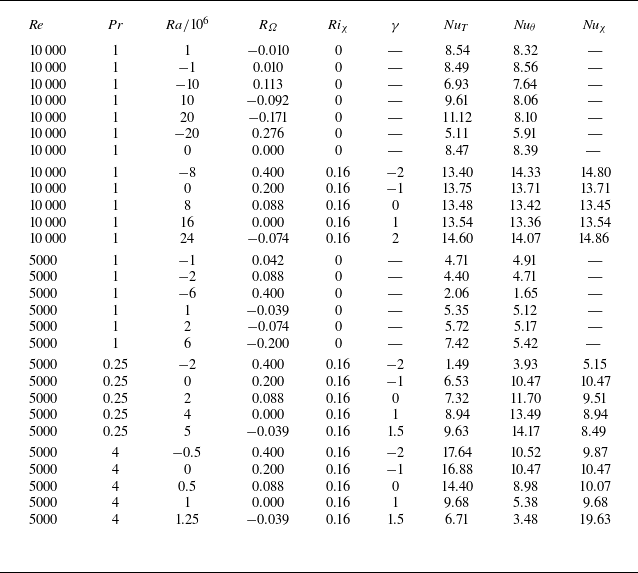
Having established the asymptotic connection between ACRBC and RSPCF through LSA, we now use RSPCF as the corresponding planar limiting system to investigate nonlinear turbulent transport. This section employs DNS to examine the nonlinear dynamical behaviour of the system in the turbulent regime, far from the critical point of instability. Our core objective is to test the universality of the twin-force analogy and the inertial-frame Reynolds analogy in complex turbulent environments, and to reveal the underlying physical mechanisms. The calculation results are presented in table 1. The discrepancies with Zhang & Sun (Reference Zhang and Sun2024) arise from the non-uniqueness of the flow state. Specifically, variations in flow topology – manifested as differences in the number of dominant vortices – directly affect transport efficiency, which explains the relative deviations of approximately
 ${O}(5\,\%)$
in the reported statistics.
Summary of simulation parameters and results.

Table 1. Long description
A table with 20 rows and 10 columns summarizing simulation parameters and results. The columns are labeled Re, Pr, Ra/10^6, R_Ω, Ri_f, γ, Nu_T, Nu_0, and Nu_X. The table presents various values for these parameters. For example, Row 1: Re 10000, Pr 1, Ra/10^6 1, R_Ω -0.010, Ri_f 0, γ 8.54, Nu_T 8.32, Nu_0, Nu_X. Row 2: Re 10000, Pr 1, Ra/10^6 -1, R_Ω 0.010, Ri_f 0, γ 8.49, Nu_T 8.56, Nu_0, Nu_X. The table continues with similar detailed values for each row.
4.1. Validation and breakdown of analogies at
 $ \textit{Pr}=1$

We first consider the most ideal case,
 $ \textit{Pr}=1$
. According to the prediction of the twin-force analogy, the overall transport efficiency of the system is primarily determined by the global Richardson number
 $ Ri_\chi$
, and is independent of the specific ratio of rotation to stratification (Zhang & Sun Reference Zhang and Sun2024). A direct corollary is that when
 $ Ri_\chi =0$
, regardless of the specific combination of the Coriolis force and buoyancy, the flow state should degenerate into ordinary plane Couette flow driven by shear. However, our DNS results reveal significant deviations from this prediction. As shown in figure 4, with fixed
 $ Re=10\,000$
,
 $ \textit{Pr}=1$
,
 $ Ri_\chi =0$
and
 $Ra/10^6 = 0, 1, -1, -10, 10, -20, 20$
, different combinations of rotation and stratification lead to distinct flow structures. When rotation acts to destabilise the flow (figure 4
a), the flow evolves into ordered, nearly streamwise-homogeneous longitudinal vortices dominated by spanwise wavenumbers. It should be emphasised that the spanwise vortices identified in the preceding LSA and the streamwise-aligned longitudinal vortices observed here in the DNS correspond to different parameter regimes and are governed by different dominant mechanisms. Conversely, when buoyancy acts as the destabilising agent (figure 4
b), the vortex structures are more chaotic, exhibiting small-scale features in both streamwise and spanwise directions.The differences in transport characteristics are equally significant; as shown in figure 4(c), when buoyancy effects are weak (
 $ \textit{Ra} \leqslant 10^6$
),
 $ \textit{Nu}_T$
and
 $ \textit{Nu}_U$
are nearly identical, consistent with the classical Reynolds analogy, but differ slightly more from
 $ \textit{Nu}_\theta$
. However, in the strong destabilising buoyancy regime (
 $ \textit{Ra} \gt 10^6$
), the thermal Nusselt number increases significantly with
 $ \textit{Ra}$
, whereas the two momentum Nusselt numbers (influenced by the stabilising Coriolis force) show smaller variations, leading to the complete breakdown of both the classical Reynolds analogy and the inertial-frame Reynolds analogy.
Results for
 $ \textit{Re}=10\,000$
,
 $ \textit{Pr}=1$
under different rotation and stratification intensities with
 $Ra_\chi =0$
. (a,b) Temperature contours in the
 $x{-}z$
plane at
 $y=0$
for
 $Ra/10^6 = -1$
and
 $20$
, respectively. (c) Corresponding Nusselt number results. (d) Energy fraction of the modes with
 $|\beta /\alpha | \gt 8$
for
 $Ra_\chi =0$
,
 $ \textit{Re}=5000$
and
 $10\,000$
under different rotation and stratification intensities. The red dashed line marks the
 $25\,\%$
threshold.

Spectral characteristics at
 $y=0$
after virtually introducing buoyancy and rotation contributions to vorticity of plane Couette flow at
 $ \textit{Re}=10\,000$
: (a) rotation contribution; (b) buoyancy contribution.

Quantitative analysis of energy spectra (figure 4
d) further confirms that the validity of the classical Reynolds analogy is closely related to the ‘two-dimensionality’ of the flow. We also verified six cases with
 $ Re=5000,\ Ra/10^6=1, -1, 2, -2, 6, -6$
, and found that
 $ \textit{Nu}_T$
and
 $ \textit{Nu}_U$
exhibit similarity only when the energy fraction of structures characterised by a wavenumber ratio
 $ |\beta /\alpha | \gt 8$
(explicitly including the
 $ \alpha =0$
mode) is relatively high – specifically, exceeding approximately 25 % (the red dashed line in figure 4
d) in the present parameter space. The physical mechanism is that the flow field exhibits significant quasi-two-dimensional characteristics. This streamwise homogeneity suppresses the three-dimensional effects that cause the discrepancy between momentum and scalar transport, thereby aligning their transport mechanisms. To analyse the effects of body forces on different modes, we define the buoyancy characteristic spectrum
 $ \chi _b$
and the Coriolis force characteristic spectrum
 $ \chi _c$
as follows:
 \begin{align} \chi _b = (\alpha ^2 + \beta ^2) E_T, \quad \chi _c = \beta ^2 E_k, \end{align}
where
 $ E_T$
and
 $ E_k$
are the squared moduli of the spectral coefficients for temperature and velocity, respectively. These definitions are based on the terms on the right-hand side of the vorticity equation derived by Zhang & Sun (Reference Zhang and Sun2024). Figures 5(a,b) present the spectral signatures of vorticity contributions resulting from the virtual imposition of rotation and buoyancy effects upon a pure shear flow. The rotation-dominated case (refer to figure 4
a) manifests strong anisotropy, with energy confined to a narrow band near
 $ \alpha \approx 0$
, and elongated along
 $ \beta$
, consistent with the potential spectral characteristics of the Coriolis force (figure 5
a). In contrast, the flow field in the buoyancy-dominated regime (figure 4
b) mirrors the buoyancy spectrum in figure 5(b), characterised by energy diffusion around the origin, and a broad distribution in both
 $ \alpha$
and
 $ \beta$
directions. This suggests that thermal plume instability triggers complex three-dimensional, multi-scale motions. Consequently, unstable buoyancy promotes structural complexity, whereas the Coriolis force acts to organise the flow into coherent, anisotropic structures.
To fundamentally explain the impact of different driving forces on flow structure, we examined the budgets of the individual velocity-component contributions to turbulent kinetic energy (TKE) and enstrophy. The equation for the contribution of the
 $i$
th velocity component to TKE is
 \begin{align} \frac {\partial \langle k_{u_i} \rangle }{\partial t} + \langle u_{\kern-1pt j} \rangle \frac {\partial \langle k_{u_i} \rangle }{\partial x_{\kern-1pt j}} & = - \langle u'_i u'_{\kern-1pt j} \rangle \frac {\partial \langle u_i \rangle }{\partial x_{\kern-1pt j}} - \frac {1}{Re} \left \langle \frac {\partial u'_i}{\partial x_{\kern-1pt j}} \frac {\partial u'_i}{\partial x_{\kern-1pt j}} \right \rangle \nonumber \\& \quad + \frac {\partial }{\partial x_{\kern-1pt j}} \left ( \langle p' u'_i \rangle \delta _{\textit{ij}} + \langle k_{u_i} u'_{\kern-1pt j} \rangle + \frac {1}{Re} \frac {\partial \langle k_{u_i} \rangle }{\partial x_{\kern-1pt j}} \right ) + W_{C, u_i} + W_{B, u_i}, \end{align}
without summation over
 $i$
, where
 $\phi '=\phi -\langle \phi \rangle$
denotes the fluctuating component of the variable
 $\phi$
. Here,
 $k_{u_i} = {u'_i}{u'_i}/2$
(no summation) represents the instantaneous contribution of the
 $i$
th velocity component to the TKE;
 $\langle u_i'u_i'\rangle$
denotes the
 $i$
th normal Reynolds stress component. The Coriolis force contribution is
 $ W_{C, u_i}$
, and the buoyancy contribution is
 $ W_{B, u_i}$
. The only non-zero terms of
 $ W_{B, u_i}$
and
 $ W_{C, u_i}$
are
 $W_{B, v} = (Ra/(Re^2 Pr)) \langle v' T' \rangle$
and
 $ W_{C, v} = -W_{C, u} = -R_\varOmega \langle v' u' \rangle = Ri_\theta \langle v'\theta '\rangle$
.
The work done by the Coriolis force appears only in the wall-normal and streamwise TKE equations, and since the Coriolis force does no net work, it serves only to transfer energy. As neither the Coriolis force nor buoyancy acts directly on the velocity field – requiring pressure projection to eliminate the longitudinal component (Zhang et al. Reference Zhang, Xia, Zhou and Chen2020) – their forms in the vorticity equation are more fundamental. Therefore, one of the crucial tools for analysing the twin-force analogy is the enstrophy equation:
 \begin{align} \frac {\partial \langle E'_\omega \rangle }{\partial t} + \langle u_{\kern-1pt j} \rangle \frac {\partial \langle E'_\omega \rangle }{\partial x_{\kern-1pt j}} + \frac {\partial \langle u'_{\kern-1pt j} E'_\omega \rangle }{\partial x_{\kern-1pt j}} & = - \big \langle u'_{\kern-1pt j} \omega '_i \big \rangle \frac {\partial \langle \omega _i \rangle }{\partial x_{\kern-1pt j}} + \langle \omega _{\kern-1pt j} \rangle \left \langle \omega '_i \frac {\partial u'_i}{\partial x_{\kern-1pt j}} \right \rangle + \big\langle \omega '_i \omega '_{\kern-1pt j} \big\rangle \frac {\partial \langle u_i \rangle }{\partial x_{\kern-1pt j}} \nonumber\\& \quad + \left \langle \omega '_i \omega '_{\kern-1pt j} \frac {\partial u'_i}{\partial x_{\kern-1pt j}} \right \rangle + \frac {1}{Re} \frac {\partial ^2 \langle E'_\omega \rangle }{\partial x_{\kern-1pt j}^2} - \frac {1}{Re} \left \langle \frac {\partial \omega '_i}{\partial x_{\kern-1pt j}} \frac {\partial \omega '_i}{\partial x_{\kern-1pt j}} \right \rangle \nonumber\\& \quad + E_B + E_C, \end{align}
where
 $\boldsymbol{\omega }$
represents the vorticity,
 $ E'_\omega = \omega '_i \omega '_i /2$
is enstrophy,
 $E_B = -(Ra/(Re^2 Pr)) \langle \omega '_x\, \partial T'/ \partial z \rangle + (Ra/(Re^2 Pr)) \langle \omega '_z\, \partial T'/ \partial x \rangle$
is the buoyancy contribution, and
 $ E_C = R_{\varOmega } \langle \omega '_x\, \partial u'/ \partial z \rangle + R_{\varOmega } \langle \omega '_y\, \partial v'/ \partial z \rangle + R_{\varOmega } \langle \omega '_z\, \partial w'/ \partial z \rangle$
is the Coriolis force contribution. Vorticity is the curl of the velocity field; when a material line element aligned with vorticity is stretched by velocity gradients, the magnitude of vorticity increases correspondingly due to the conservation of angular momentum, a process known as vortex stretching. The distinction between three-dimensional and two-dimensional flows is that the vortex stretching term is zero in two-dimensional flows. Notably, the formal similarity between the Coriolis force term and the vortex stretching term reveals the core mechanism by which system rotation affects vorticity dynamics.
To fundamentally reveal the physical mechanism underlying the breakdown of this analogy, we analysed the budgets of wall-normal TKE and enstrophy. Here, the enstrophy budget is used not as a direct measure of
 $ \textit{Nu}_U$
,
 $ \textit{Nu}_\theta$
or
 $ \textit{Nu}_T$
, but as a diagnostic of how buoyancy and Coriolis forces generate or maintain vortical structures that subsequently influence the associated turbulent fluxes. We first examine the case
 $ \textit{Pr}=1$
, systematically varying the relative strength of rotation and stratification under the condition that
 $Ri_\chi$
is non-zero. The energy budget analysis ultimately clarifies the root cause of the analogy’s breakdown. In the wall-normal TKE equation, the two forces exhibit a misleading similarity: as shown by the solid lines in figure 6(a), when the contributions of buoyancy and the Coriolis force are consistent (
 $ \gamma =0$
), their contribution profiles almost completely overlap. This overlap arises because at
 $ \textit{Pr}=1$
and
 $\gamma =0$
,
 $Ri_\theta =Ri_T$
and the profiles of
 $\langle v'\theta '\rangle$
and
 $\langle v'T'\rangle$
are nearly identical. This explains why the two forces are analogous at the level of overall energy injection, leading to similarities in global transport coefficients. However, fundamental differences exist in the physical mechanisms of the two forces, which are vividly reflected in the enstrophy equation. In an ideal two-dimensional streamwise-homogeneous flow, the contribution terms of the Coriolis force and buoyancy to enstrophy are strictly symmetric in mathematical form, which would lead to a perfect inertial-frame Reynolds analogy. But in three-dimensional flow, this symmetry is broken: additional, asymmetric partial derivative terms appear in the buoyancy and Coriolis force contribution terms. This mathematical difference under three-dimensional effects leads to distinct spatial actions of the two forces (as shown by the dashed lines in figure 6
a). The contribution of the Coriolis force to enstrophy is strictly concentrated in the near-wall region, whereas the contribution of buoyancy is distributed throughout the core region of the flow. Furthermore, as
 $ \textit{Ra}$
increases (figure 6
b), the vorticity generation mechanism dominated by buoyancy and acting in the flow core becomes increasingly important, causing the flow structure to further diverge from that under pure rotation, thereby exacerbating the deviation of transport coefficients.
Contributions of buoyancy and Coriolis force in the enstrophy equation and wall-normal TKE equation for (a)
 $ \gamma =0$
and (b)
 $ \gamma =2$
, respectively, at
 $ \textit{Pr}=1$
,
 $ Re=10\,000$
,
 $ \textit{Ra}_\chi = 16 \times 10^6$
. Red denotes buoyancy contribution, blue denotes Coriolis force contribution, and magenta denotes the net contribution between buoyancy and Coriolis force. Black is the reference line for zero. Solid lines represent contributions in wall-normal TKE, and dashed lines represent contributions in enstrophy.

Figure 6. Long description
Two line graphs depict contributions of buoyancy and Coriolis force in enstrophy and wall-normal TKE equations. Panel A: The line graph shows the contributions of buoyancy and Coriolis force in the wall-normal TKE equation. The x-axis is labeled 'y' with a range from -0.50 to 0.50. The left y-axis is labeled 'TKE contribution' with a range from -2 x 10^-4 to 2 x 10^-4, and the right y-axis is labeled 'Enstrophy contribution' with a range from -0.2 to 0.2. The red line represents buoyancy contribution, the blue line represents Coriolis contribution, and the magenta line represents the total contribution. Solid lines indicate TKE contributions, while dashed lines indicate enstrophy contributions. Panel B: The line graph shows the contributions of buoyancy and Coriolis force in the enstrophy equation. The x-axis is labeled 'y' with a range from -0.50 to 0.50. The left y-axis is labeled 'TKE contribution' with a range from -2 x 10^-4 to 2 x 10^-4, and the right y-axis is labeled 'Enstrophy contribution' with a range from -0.2 to 0.2. The red line represents buoyancy contribution, the blue line represents Coriolis contribution, and the magenta line represents the total contribution. Solid lines indicate TKE contributions, while dashed lines indicate enstrophy contributions.
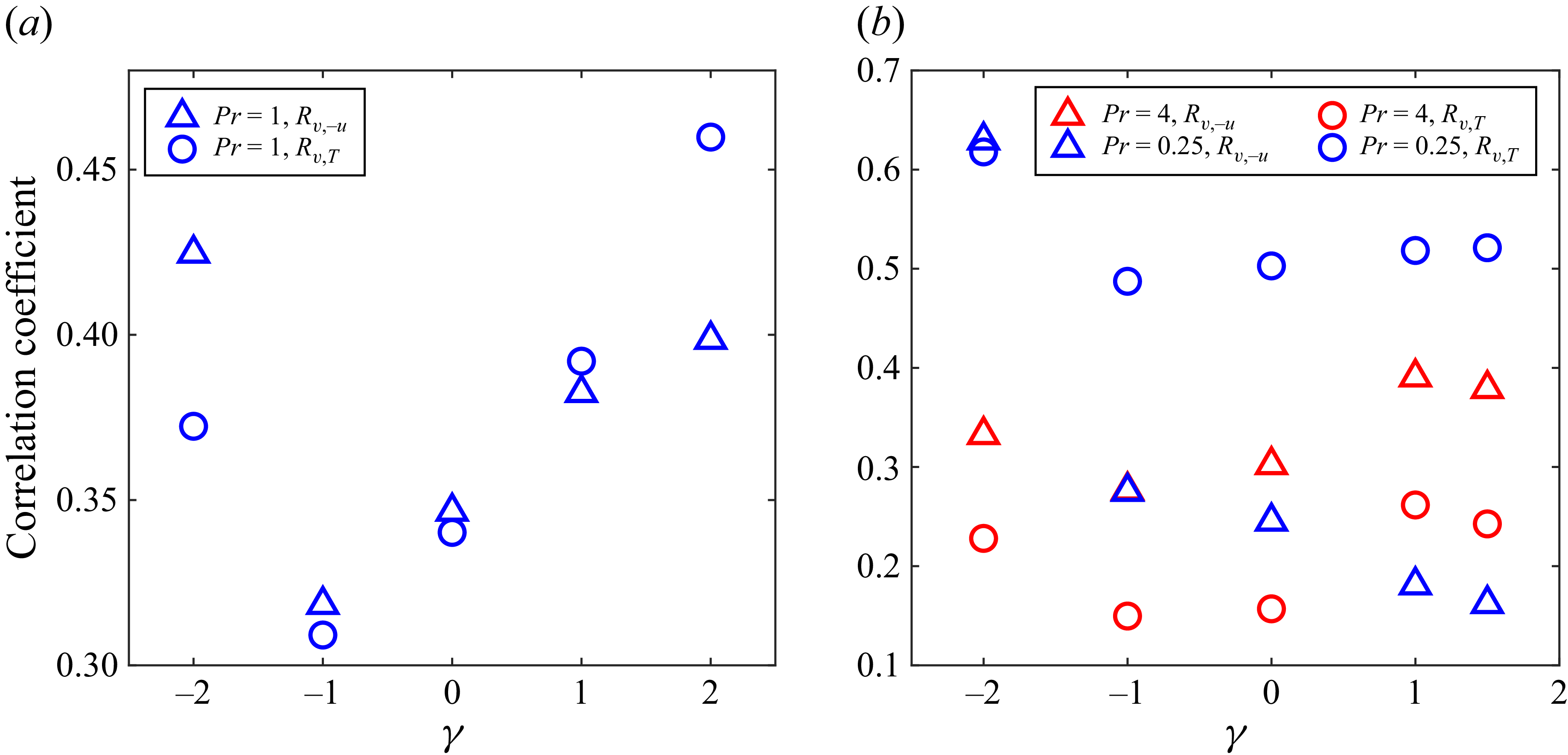
Differences in flow structure directly affect the coherence of transport, leading to the breakdown of the inertial-frame Reynolds analogy. The root cause lies in the different ways in which buoyancy and the Coriolis force influence vorticity generation in three-dimensional space. The Coriolis force acts primarily in the spanwise direction, tending to generate longitudinal vortices aligned with the flow, lacking the modes dominated by streamwise wavenumbers found in buoyancy-driven convection. Such highly ordered vortex structures induced by the Coriolis force can bring about stronger ejection and sweep events, thereby generating Reynolds stresses more efficiently. This ultimately leads to an asymmetry between momentum transport correlation (
 $ R_{v,-u}$
) and heat transport correlation (
 $ R_{v,T}$
). Here, the correlation coefficient is defined as
 \begin{align} R_{\xi _1,\xi _2} = \frac { \displaystyle \int _{-1/2}^{1/2} \big\langle \xi _1'\xi _2' \big\rangle \,\mathrm{d}y }{ \sqrt { \displaystyle \int _{-1/2}^{1/2} \big\langle \xi _1'^2 \big\rangle \,\mathrm{d}y \,\displaystyle \int _{-1/2}^{1/2} \big\langle \xi _2'^2 \big\rangle \,\mathrm{d}y } }. \end{align}
These correlation coefficients complement the Nusselt numbers by distinguishing changes in fluctuation amplitudes from changes in the correlation between the fluctuating fields. As shown in figure 7(a), in the Coriolis-dominated regime (
 $\gamma \lt 0$
), the correlation coefficient
 $R_{v,-u}$
is enhanced. Conversely, in the buoyancy-dominated regime (
 $\gamma \gt 0$
),
 $R_{v,T}$
becomes more prominent; this is because in an idealised state, the horizontally isotropic plume distribution statistically provides no net contribution to
 $ \langle u'v' \rangle$
.
Comparison of correlation coefficients
 $ R_{v,-u}$
and
 $ R_{v,T}$
: (a)
 $ \textit{Pr}=1,\ Re=10\,000$
; (b)
 $ \textit{Pr}=0.25,4$
and
 $ \textit{Re}=5000$
. Both cases have fixed
 $ Ri_\chi = 0.16$
.

This mechanism fundamentally elucidates the results reported by Zhang & Sun (Reference Zhang and Sun2024): specifically, under the condition
 $ \textit{Pr}=1$
, inertial-frame momentum transport is larger at
 $ \gamma = -2$
, while heat transport is larger at
 $ \gamma = 2$
.
4.2. Extended analogy at different Prandtl numbers: symmetry breaking and transport dissimilarity
When
 $ \textit{Pr} \neq 1$
, the mismatch between heat and momentum diffusion rates leads to corrections to the perfect analogy observed at
 $ \textit{Pr}=1$
.
Various DNS results indicate that the transport properties systematically depend on
 $ \textit{Pr}$
(Blass et al. Reference Blass, Tabak, Verzicco, Stevens and Lohse2021; Zhang & Sun Reference Zhang and Sun2024). For
 $ \textit{Pr} \gt 1$
, the momentum boundary layer is thicker than the thermal boundary layer, making the flow more sensitive to the dynamical effects of rotation; consequently, both heat and momentum transport are enhanced as unstable rotation strengthens (decreasing
 $ \gamma$
). Conversely, for
 $ \textit{Pr} \lt 1$
, the thermal boundary layer is thicker, rendering the flow more sensitive to the thermodynamic effects of buoyancy; thus transport efficiency increases with strengthening unstable stratification (increasing
 $ \gamma$
). Although the individual transport coefficients diverge, the modified global Nusselt number
 $ \textit{Nu}_\chi$
still exhibits a weak dependence within a certain range of
 $ \gamma$
. This symmetry breaking originates from the mismatch between the thermal and momentum boundary layer thicknesses at different
 $ \textit{Pr}$
, which dictates the dominant spatial extent of buoyancy and Coriolis forces, respectively.
To quantitatively elucidate the turbulence structures and the underlying dynamic mechanisms, we combine quadrant analysis of the Reynolds stress-weighted joint probability density functions (at
 $y=-0.4$
) with energy budget analysis. At
 $ \textit{Pr}=0.25$
, the energy budget analysis (figure 8) reveals that buoyancy makes significant contributions to both wall-normal TKE and enstrophy throughout the channel, whereas rotational effects are largely confined to the near-wall momentum boundary layer. This buoyancy-dominated driving force, acting over a broader spatial range, results in a more complex flow structure. The Reynolds stress quadrant analysis (Wallace Reference Wallace2016) (figure 9) provides direct evidence for this: for instance, under stable rotation (
 $ \gamma =1.5$
; figure 9
b), the negative contributions of inward/outward interaction events (Q1, Q3) to the Reynolds stress are significantly enhanced. This disrupts the coherence of momentum transport, leading to a reduction in
 $ R_{v,-u}$
(figure 7
b). In contrast, at
 $ \gamma =-2$
(figure 8
a), where the system is in the regime of unstable rotation and stable stratification, the thermal boundary layer is significantly thicker than the momentum boundary layer; consequently, the net contribution to enstrophy is negative, which also suppresses transport. The relatively high normalised correlations at
 $\gamma =-2$
do not contradict this suppression, because the turbulent fluxes also depend on the corresponding fluctuation amplitudes.
Contributions of buoyancy and Coriolis forces to the budgets of enstrophy and wall-normal TKE, for (a,b)
 $ \textit{Pr}=0.25$
and (c,d)
 $ \textit{Pr}=4$
. The rotation ratios are (a,c)
 $ \gamma = -2$
and (b,d)
 $ \gamma = 1.5$
. Red and blue lines denote the buoyancy and Coriolis force contributions, respectively. Solid and dashed lines represent contributions in wall-normal TKE and enstrophy, respectively.

Reynolds-stress-weighted joint probability density functions
 $ u' v'\, P(u', v')$
at
 $y=-0.4$
, where
 $P(u',v')$
denotes the joint probability density function of the streamwise and wall-normal velocity fluctuations
 $u'$
and
 $v'$
, respectively. The plotted variables are normalised by their respective root mean square (rms) values, for (a,b)
 $ \textit{Pr}=0.25$
and (c,d)
 $ \textit{Pr}=4$
. The relative strength parameter is (a,c)
 $ \gamma = -2$
and (b,d)
 $ \gamma = 1.5$
.

Figure 9. Long description
Panel A: A heat map showing the joint probability density function of streamwise and wall-normal velocity fluctuations normalized by their root mean square values. The x-axis represents the streamwise velocity fluctuation normalized by its root mean square value, ranging from -3.0 to 3.0. The y-axis represents the wall-normal velocity fluctuation normalized by its root mean square value, also ranging from -3.0 to 3.0. The color scale ranges from -0.35 to 0.35, with blue indicating lower values and red indicating higher values. The heat map shows two prominent blue regions diagonally opposite each other and two smaller red regions. Panel B: A heat map similar to Panel A but with a different relative strength parameter. The color scale ranges from -0.08 to 0.08. The heat map shows four distinct regions, two blue and two red, arranged in a symmetric pattern. Panel C: A heat map similar to Panel A but with a different relative strength parameter. The color scale ranges from -0.14 to 0.14. The heat map shows two prominent blue regions diagonally opposite each other and two smaller red regions. Panel D: A heat map similar to Panel B but with a different relative strength parameter. The color scale ranges from -0.09 to 0.09. The heat map shows four distinct regions, two blue and two red, arranged in a symmetric pattern.
Conversely, at
 $ \textit{Pr}=4$
, the momentum boundary layer is thicker than the thermal one. At
 $\gamma =1.5$
(figure 8
d), energy budget analysis clearly demonstrates that the Coriolis contributions to wall-normal TKE and enstrophy far exceed those of buoyancy, with buoyancy effects confined to the extremely thin thermal boundary layer. Rotation acts to stabilise the flow; in the core region, it makes a significant negative contribution to both wall-normal TKE and enstrophy, leading to a drop in transport coefficients, with the flow tending towards a steady state at
 $ \gamma =2$
(Zhang & Sun Reference Zhang and Sun2024). The quadrant analysis for
 $ \gamma =-2$
(figure 9
c) confirms a flow field dominated by a single mechanical effect with a more organised structure, where ejection (Q2) and sweep (Q4) events dominate the Reynolds stress contribution. This organised Reynolds stress mechanism explains why the momentum–transport correlation is stronger than the heat–transport correlation across all
 $ \textit{Pr}=4$
cases.
Therefore, when
 $ \textit{Pr} \neq 1$
, the fundamental reason for the breakdown of the inertial-frame Reynolds analogy is that the Prandtl number, by controlling the relative thicknesses of thermal and momentum boundary layers, determines whether buoyancy or the Coriolis force dominates the flow field. Because these two forces differ significantly in the magnitude and spatial location of vorticity generation in three-dimensional space, they induce distinct turbulent structures, preventing a simple linear superposition of their effects.
5. Conclusion
The results of this study provide new theoretical insights into the physics of wall-bounded turbulence under coupled rotation, stratification and shear. Not only have we theoretically established a quantitative link between the complex annular centrifugal Rayleigh–Bénard convection and rotating stratified plane Couette flow systems via universal scaling laws of deviation with respect to
 $ (1-\eta )$
, but more importantly, we have revealed the fundamental dynamic mechanism for the breakdown of the twin-force analogy in fully developed turbulence. The core lies in the intrinsic difference in how buoyancy and Coriolis forces support different types of flow modes in three-dimensional space, triggering modal competition. The destabilising Coriolis force tends to systematically suppress streamwise variations, promoting the development of quasi-two-dimensional, streamwise-aligned longitudinal vortices, which organise coherent ejection and sweep events associated with inertial-frame momentum transport. Conversely, buoyancy generates vorticity in both streamwise and spanwise directions via the baroclinic effect, tending to produce three-dimensional, asymmetric chaotic plumes that disrupt the symmetry required for momentum transport. The Prandtl number plays a decisive role in this competition. By regulating the relative thicknesses of thermal and momentum boundary layers, it determines whether thermodynamically driven buoyancy or mechanically driven Coriolis forces dominate the near-wall region, ultimately leading to the systematic separation of heat and inertial-frame momentum transport efficiencies. In summary, this study offers, for the first time, a clear dynamic explanation for the applicability boundaries of the twin-force analogy and its failure at
 $ \textit{Pr} \neq 1$
from the perspective of turbulence modal competition. The findings not only offer deeper understandings of how these two fundamental physical effects interact with shear, but also provide new physical insights and a theoretical basis for developing models to predict heat and momentum transport in complex industrial and geophysical flows.
Funding
This work was financially supported by the National Natural Science Foundation of China (grant nos 12302284 and U25A6006), the Ningbo Municipal Bureau of Education (grant no. 2024A-149-G), and the Ningbo Municipal Bureau of Science and Technology (grant nos 2023Z227 and 2023-DST-001).
Declaration of interests
The authors report no conflict of interest.


 1−η
 Ra=105
 Raχ,c
 1−η
 Re=200
 Pr=1
 Pr=0.5,2
 RΩ<0.5
 Pr=2

 Ra
 α
 β

 Re=10000
 Pr=1
 Raχ=0
 x−z
 y=0
 Ra/106=−1
 20
 |β/α|>8
 Raχ=0
 Re=5000
 10000
 25%

 y=0
 Re=10000

 γ=0
 γ=2
 Pr=1
 Re=10000
 Raχ=16×106
 Rv,−u
 Rv,T
 Pr=1, Re=10000
 Pr=0.25,4
 Re=5000
 Riχ=0.16

 Pr=0.25
 Pr=4
 γ=−2
 γ=1.5

 u′v′P(u′,v′)
 y=−0.4
 P(u′,v′)
 u′
 v′
 Pr=0.25
 Pr=4
 γ=−2
 γ=1.5


