Breastfeeding is the recommended feeding for healthy infants. Three recent meta-analyses indicate that breastfeeding protects against gastrointestinal and to a lesser extent also other infections and provides a variety of other health benefits(Reference van Rossum, Büchner and Hoekstra1–Reference Horta, Bahl, Martines and Victora3), including a reduced risk of later overweight or obesity(Reference Arenz, Ruckerl, Koletzko and von Kries4, Reference Harder, Bergmann, Kallischnigg and Plagemann5).
In 1981 breastfeeding initiation rates in two German cities were between 87 and 95 %, and only 2–6 % of infants were still fully breastfed at 4 months of age(Reference Kersting, Wember, Goddemeier, Koester, Wennemann and Schoch6). The main reason why mothers ceased breastfeeding early was breastfeeding problems. In 1997 breastfeeding initiation rates were reported as about 91 %(Reference Kersting and Dulon7), with 44 % of the infants still fully breastfed at 4 months.
The WHO recommends exclusive breastfeeding for 6 months as a goal for populations, and continued breastfeeding thereafter(8). The German National Breastfeeding Committee recommends exclusive breastfeeding for 6 months and continued partial breastfeeding as long as mother and child wish(9).
The aim of our study was to assess the current state of breastfeeding prevalence, duration and behaviour in Bavaria in a prospective study to provide a basis for developing targeted breastfeeding promotion measures.
Methods
The Bavarian Breastfeeding Study is a prospective cohort study planned as a survey of all mothers who delivered in the state of Bavaria, southern Germany, in April 2005. All Bavarian birth clinics, birth houses and midwives who assisted mothers in home birth were asked to participate as project partners to recruit participants. The basic questionnaire was distributed by the project partners in April 2005 2–6 d after birth to mothers who delivered a baby in the participating clinics, birth houses or at home. The questionnaire was available in German and Turkish language. There were no exclusion criteria, except for being < 18 years old due to local data protection and consent regulations. Mothers of twins were told to answer the questionnaire for the first-born child. The study protocol was reviewed by the Ethics Committee of the Bavarian Medical Association, and written consent was obtained from all participants.
A questionnaire was sent by mail to participating mothers at 2 months after birth. To limit costs, only mothers who indicated in the previous questionnaire that they still breastfed received a questionnaire at 4 and 6 months after birth. However, at 9 months after birth all participants who initially participated were again asked to fill in a questionnaire. We tried to enhance participation rates by asking paediatricians to distribute questionnaires in their offices to mothers who delivered in April 2005 and by placing advertisements in the local press. All participants who did not send in questionnaires within 4 weeks were contacted by telephone to remind them to fill in the questionnaire, or if they were not willing to do so, to participate in a short telephone interview to get basic information.
Breastfeeding was defined as follows:
Exclusive breastfeeding: only breast milk, no other liquids or infant formula;
Full breastfeeding: breast milk plus liquids like tea or water (no infant formula);
Partial breastfeeding: breast milk plus other feeds such as liquids, infant formula, complementary food.
Breastfeeding determinants were socioeconomic status which was assessed as mother's highest educational degree and grouped in four categories: no educational degree; low ( < 10 years); medium (10–11 years) and high education (>11 years). Family status was assessed by the question ‘Are you living together with your partner?’ (Yes/no). Smoking status was assessed in the baseline questionnaire (2–6 d after birth) asking ‘Do you smoke currently?’ and was grouped into ‘no’ and ‘yes (occasionally or regularly)’.
Partner's and grandmother's attitudes were asked by ‘Which attitude towards breastfeeding has your partner/mother/your partner's mother?’ Answers were grouped binary as positive (‘He/she thinks it's good or important’) and negative (‘He/she doesn't want me to breastfeed/doesn't know/I don't know his/her attitude’). Breastfeeding experience was asked as ‘Did you breastfeed your last child?’ (Yes/no). Pre-term birth is defined as born before the 37th week of pregnancy. Birth mode was grouped into vaginal delivery, Caesarean section and vaginal surgery (forceps, ventouse, breech delivery). No open questions were used for this analysis.
Regarding representation we compared the characteristics of the participants with statistics from the Bavarian State Office for Statistics. For statistical analyses we used SPSS 13·0. Breastfeeding rates were computed considering loss to follow up. Bivariate analyses were performed by χ2 tests. In multivariate analyses we computed OR and 95 % CI. Variables not significant in the bivariate analyses were omitted from the multivariate models.
Results
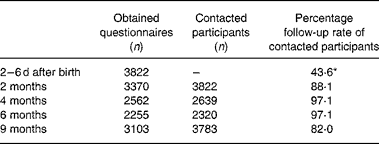
Of the 146 birth clinics in Bavaria, 141 participated as project partners in the study, two of them being baby-friendly hospitals. Ten birth houses and thirty midwives who support mothers in home birth also distributed questionnaires. Of the 8805 mothers who delivered in April 2005, some 3840 completed a questionnaire in the baseline survey (43·6 %). Eleven mothers were excluded because they were younger than 18 years old. Three participants withdrew their written consent later. Four questionnaires were excluded because they were filled in incorrectly or incompletely. Therefore 3822 valid questionnaires are included in the basic survey. The further follow-up rates range between 82 and 97 % (Table 1).
Participation and follow-up rates

* Participation rate (%) of all mothers who delivered in Bavaria in April 2005.
Characteristics of the study population
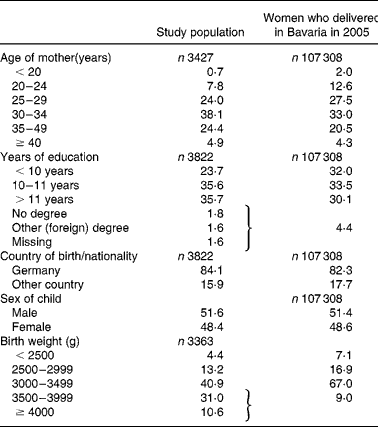
The average age of participating mothers was 31·7 (range 18–46) years. The participating mothers were older than the average age of mothers who delivered in 2005 (data regarding proportionality are shown in Table 2). The percentage of the mothers who were not born in Germany was 15·9. Most of them were born in Eastern European countries including the former Soviet Union. The percentage of the participants who did not live together with their partners was 4·7. The educational level of the participants was higher than the average of mothers in Bavaria. One in four participants had < 10 years of school education, 37·2 % 10–11 years and 35·7 % >11 years. Of the children 48 % were female and 1·3 % were twins; 27 % were delivered by Caesarean section.
Description of the study population and of the total population of women who delivered in Bavaria in the year 2005 by proportion (%)

Breastfeeding conditions
Only 42 % of the breastfeeding mothers participated in full rooming-in. Most of the mothers were instructed in the hospital by a (infant-) nurse or a midwife and only 2 % by a lactation consultant. Of the breastfed infants 37 % received formula or additional fluids during the first days of life.
Breastfeeding rates
Almost 90 % of mothers started to breastfeed (Table 3). Two months after birth 70 % still breastfed (44·7 % exclusive breastfeeding). After 4 months breastfeeding rates dropped to 61 %, after 6 months to 52 %.
Breastfeeding rates (%) at birth, 2, 4 and 6 months

Since a disproportionately high percentage of the loss to follow-up were participants who indicated in the baseline survey that they did not want to breastfeed we considered them in the analyses of the breastfeeding rates as participant who ceased breastfeeding (Table 3). When omitting the participants who did not answer all questionnaires (n 916) breastfeeding rates would be overrated: 2 months, 78 % v. 70 %; 4 months, 73 % v. 61 % and 6 months, 66 % v. 52 % (any breastfeeding).
Determinants of initial breastfeeding
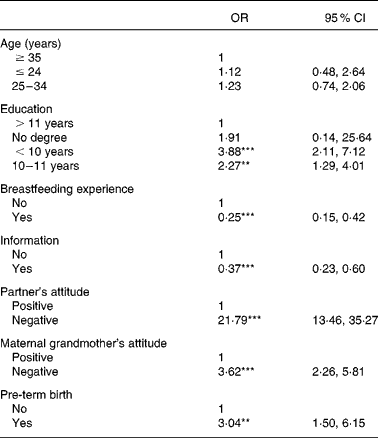
In a multivariate analysis we computed adjusted OR and CI using logistic regression. Due to missing values the number of cases is reduced to n 2316. The model shows OR for not breastfeeding v. starting to breastfeed after birth. Only variables which were significant in bivariate analyses were included in the model; child's sex and community size were therefore not included in the analyses. The main influencing factor on initial breastfeeding was the partner's attitude towards breastfeeding (Table 4). If the partner had a negative attitude, the mother had a twenty-two times higher risk not to breastfeed from the beginning (OR 21·79; 95 % CI 13·46, 35·27). The maternal grandmother also had an important influence on the mother's decision to breastfeed. Mothers with < 10 years of education were more likely not to breastfeed (OR 3·88; 95 % CI 2·11, 7·12). Participants with 10–11 years of education had a higher risk not to breastfeed than women with >11 years of education. Pre-term birth was a risk factor for not breastfeeding. Protective factors were previous breastfeeding experience (OR 0·25; 95 % CI 0·15, 0·42) and receipt of information on breastfeeding before birth (OR 0·37; 95 % CI 0·23, 0·60). No significant associations were observed for mother's age, country of birth, family status, smoking, birth mode, paternal grandmother's attitude towards breastfeeding or hospital size.
Determinants of no initial breastfeeding: adjusted OR and CI of having tried to breastfeed after birth v. no breastfeeding†

Model demonstrated significant effect of the variable: * P < 0·05; **P < 0·01; ***P < 0·001.
† Further variables in the model with no significant effect: district, clinic size, birth mode, paternal grandmother's attitude, family status, smoking and country of birth.
Determinants of breastfeeding duration up to four months
For the explanation of determinants of breastfeeding duration, breastfeeding was dichotomized: exclusive and full breastfeeding v. partial and no breastfeeding. In this model only variables which were significant in bivariate analyses were included in the model; child's sex and community size were left out of the analyses. Since information on breastfeeding and having more than one child are correlated strongly, only having more than one child was included in the analyses.
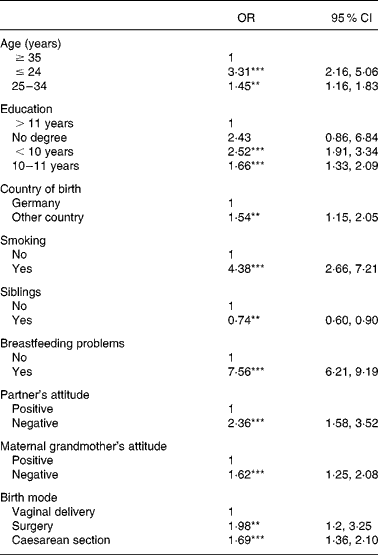
The main influencing factor on shorter breastfeeding duration was breastfeeding problems (Table 5). Mothers experiencing breastfeeding problems had a more than seven-fold higher risk to breastfeed < 4 months (OR 7·56; 95 % CI 6·21, 9·19). Two-thirds of the mothers who stopped breastfeeding during the first 4 months indicated breastfeeding problems compared with 27 % of mothers who still breastfed. Most mothers mentioned lack of milk, sore nipples and child's difficulties in sucking. Smoking was associated with reduced breastfeeding duration (OR 4·38; 95 % CI 2·66, 7·21). Younger participants and mothers with lower education breastfed for less time than older mothers with higher educational level. The partner's and maternal grandmother's attitude towards breastfeeding was also associated with breastfeeding duration, to a lesser degree. Having more than one child was a protective factor (OR 0·74; 95 % CI 0·60, 0·90). Further significant associations were found with birth mode and country of birth. No associations were found with paternal grandmother's attitude, pre-term birth, clinic size or district.
Determinants of breastfeeding duration up to 4 months: adjusted OR and CI of exclusive and full breastfeeding v. partial and no breastfeeding†
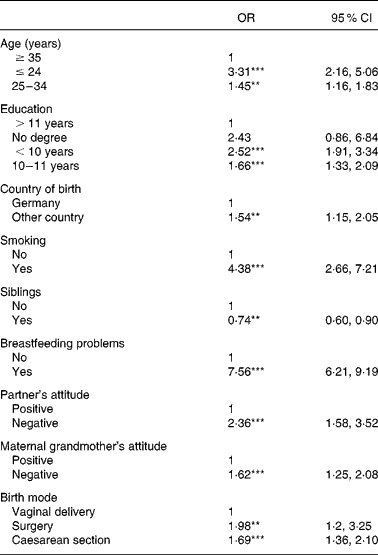
Model demonstrated significant effect of the variable: * P < 0·05; **P < 0·01; ***P < 0·001.
† Further variables in the model, no significant effect: district, family status, pre-term birth, clinic size, paternal grandmother's attitude.
Discussion
Breastfeeding rates in Germany have increased since the first surveys in the 1980s. Compared to the last German study, the nationwide SuSe Study conducted in 1996–1997(Reference Kersting and Dulon7), initial breastfeeding rate in the present study is similar but breastfeeding rates at fourth and sixth months are clearly higher. Previous studies on breastfeeding prevalence and duration in Germany showed even lower rates(Reference Kersting, Wember, Goddemeier, Koester, Wennemann and Schoch6, Reference Bergmann, Bergmann and Lau-Schadensdorf10).
The comparison of the results of our study with breastfeeding rates reported in other European countries is limited by different study methods and different definitions of breastfeeding. In many countries breastfeeding is not monitored consistently(Reference Yngve and Sjostrom11), and hence the WHO demands a common set of measures to assess breastfeeding practices, policies and programmes(8). Compared to data reported for Scandinavian countries, Switzerland and Austria(Reference Lande, Andersen, Baerug, Trygg, Lund-Larsen, Veierod and Bjorneboe12, Reference Cattaneo, Yngve, Koletzko and Guzman13), breastfeeding rates in Bavaria are lower at all infant ages, but they are comparable with data for Italy(Reference Giovannini, Riva, Banderali, Scaglioni, Veehof, Sala, Radaelli and Agostoni14) and higher than in the UK, Spain or the Netherlands(Reference Cattaneo, Yngve, Koletzko and Guzman13, Reference Lozano de la Torre, Martín-Calama and Hernandez-Aguilar15, Reference Bulk-Bunschoten, van Bodegom, Reerink, Pasker-de Jong and de Groot16).
Determinants of breastfeeding prevalence and duration
Our study confirmed some known determinants of breastfeeding initiation and duration(Reference Yngve and Sjostrom17). The strongest association with breastfeeding initiation was found with the partner's attitude towards breastfeeding. Scott et al. (Reference Scott, Binns and Aroni18) and Littman et al. (Reference Littman, VanderBrug Medendorp and Goldfarb19) found similar results for paternal support in an Australian cohort. Similar to our results, the German SuSe study found associations between short breastfeeding duration and negative attitude of the partner in both eastern and western German states(Reference Dulon, Kersting and Schach20). The attitude of the maternal grandmother as a predictor for initial breastfeeding was also described by Scott et al. (Reference Scott, Landers and Binns21).
Low socioeconomic status is known as a risk factor for breastfeeding initiation and duration in Europe and the USA(Reference Dulon, Kersting and Schach20, Reference Bertini, Perugi, Dani, Pezzati, Tronchin and Rubaltelli22–Reference Noble25). In our study lower education had a significant influence on initial breastfeeding and was also associated with shorter breastfeeding duration. Similarly, maternal age did not influence breastfeeding initiation but showed a clear gradient with breastfeeding duration, which was also reported by Scott et al. (Reference Scott, Landers and Binns21). Smoking did not influence breastfeeding initiation in the multivariate analysis but was a strong influencing factor on breastfeeding duration. A reason for this may be that the question for breastfeeding initiation was asked very early after delivery. The wording of the question was ‘Did you try to breastfeed after birth’. It may be that many smoking mothers answered ‘yes’ but ceased breastfeeding in the first or second week so that smoking does not appear as an influencing factor for breastfeeding initiation. Light smoking is not considered as a contraindication for breastfeeding by the American Academy of Pediatrics(Reference Lawrence and Lawrence26). Smoking mothers are advised to breastfeed since their children fare better regarding general health, respiratory illness and risk of sudden infant death syndrome when they are breastfed(Reference Lawrence and Lawrence26). An explanation may be that some mothers wanted to breastfeed but also to start smoking again after birth and were concerned about potential harm to their children with breastfeeding and smoking. It is also possible that mothers gave socially preferred answers to this question and stated not to smoke even if they did. Other reviews and studies however found strong associations between initial breastfeeding and maternal smoking(Reference Dennis27, Reference Yngve and Sjostrom17). The British ALSPAC Study found that smoking influences breastfeeding duration negatively even after controlling for intention for breastfeeding(Reference Donath and Amir28). Lande et al. (Reference Lande, Andersen, Baerug, Trygg, Lund-Larsen, Veierod and Bjorneboe12) found in Norway strong associations between smoking and breastfeeding cessation after 4 and 6 months.
Having breastfeeding problems during the first 4 months turned out to be the major influencing factor for short breastfeeding duration and breastfeeding cessation in the first 4 months, which was found to a lesser extent also in the SuSe study(Reference Dulon, Kersting and Schach20) and in an Australian cohort(Reference Scott, Binns, Oddy and Graham29). Breastfeeding problems might be reduced by implementing international guidelines concerning breastfeeding instruction and breastfeeding conditions such as general support of rooming-in and no supplementation with additional formula and fluids to breast-fed infants without a medical indication(Reference Merten, Dratva and Ackermann-Liebrich30). It appears to us that such guidelines are not widely implemented in all hospitals in Bavaria. Information before delivery and breastfeeding experience are protective factors for breastfeeding(Reference Yngve and Sjostrom17). Mothers who obtained information on breastfeeding are more interested and confident in breastfeeding(Reference Dennis27).
Strengths and limitations
The study was conducted as a prospective cohort study. Weekly breastfeeding rates and timely collection of reasons for breastfeeding cessation was possible. The risk of a recall bias is therefore low. The design was a complete cohort of all mothers who delivered in April 2005. The participation was voluntary; we therefore consider the participation rate (43 %) and follow-up rates (82–97 %) achieved as high. However, representation is limited since mothers more interested in breastfeeding and related issues would have been more likely to participate in the study. There is also an overrepresentation of older mothers and mothers with higher educational level in our sample, whereas younger mothers with lower education were more often lost to follow-up. Since these mothers breastfeed less often and for a shorter duration, breastfeeding rates may have been overestimated in this study.
Conclusions for breastfeeding promotion
Breastfeeding rates in Germany have increased in the last 10 years. However, the results of the study indicate various fields where breastfeeding promotion is still necessary. Since partners have a strong influence on mother's decision to breastfeed it appears important to motivate the mother's familial environment to support her during breastfeeding. Socially disadvantaged mothers need targeted support since breastfeeding rates are particularly low in this group and general promotion measures are often not attended by this group. Smoking mothers need assistance in smoking cessation in pregnancy and during breastfeeding to reduce infant exposure to environmental tobacco smoke.
Breastfeeding problems need to be addressed by integrative counselling of mothers during their stay in hospital and in the first weeks at home. Quality assurance in that field may lead to better results in breastfeeding duration. Centuori et al. (Reference Centuori, Burmaz, Ronfani, Fragiacomo, Quintero, Pavan, Davanzo and Cattaneo31) point out that modification of hospital practices and providing the mother with guidance on positioning may be more effective than products like nipple cream to prevent sore nipples. The management and support by health care professionals can enhance a mother's self confidence in breastfeeding and thus reduce breastfeeding problems. As a result of this study an intervention study will be conducted in a particular region where hospital staff and midwives who support mothers after birth will be trained. The goal of this study is to give mothers integrative support in the hospitals and to increase breastfeeding rates and duration in this region where breastfeeding rates now are particularly low.
Acknowledgements
This study was financially supported by the Bavarian Minister for Environment, Health and Consumer Protection, Munich, Germany. Berthold Koletzko is the recipient of a Freedom to Discover Award of the Bristol Myers Squibb Foundation, New York, NY, USA. All authors declare that they have no competing financial interests.
M. K. and B. R. contributed to the conception and design of the work, the acquisition of the data, the analysis of the data and to the writing of the manuscript.
U. S., B K. and H. F. contributed to the conception and design of the work and to the writing of the manuscript.