Introduction
Tobacco use remains the leading preventable cause of disease and death among Latinos, contributing to cancer, heart and lung disease, and stroke (Miller et al., Reference Miller, Goding Sauer, Ortiz, Fedewa, Pinheiro, Tortolero-Luna, Martinez-Tyson, Jemal and Siegel2018). Clinical practice guidelines recommend use of brief advice, counseling, and pharmacotherapy to treat tobacco use (Fiore et al., Reference Fiore, Jaen and Baker2008). These evidence-based therapies are underutilized among Latinos in the USA (Levinson, Perez-Stable, Espinoza, Flores, and Byers, Reference Levinson, Perez-Stable, Espinoza, Flores and Byers2004; Levinson, Borrayo, Espinoza, Flores, and Pérez-Stable, Reference Levinson, Borrayo, Espinoza, Flores and Pérez-Stable2006; Soto Mas et al., Reference Soto Mas, Papenfuss, Jacobson, Hsu, Urrutia-Rojas and Kane2005; Webb Hooper, Payne, and Parkinson, Reference Webb Hooper, Payne and Parkinson2017; Wetter et al., Reference Wetter, Mazas and Daza2007). Compared with both African Americans and non-Hispanic Whites, Latinos are less likely to receive advice to quit from healthcare providers (Soto Mas et al., Reference Soto Mas, Papenfuss, Jacobson, Hsu, Urrutia-Rojas and Kane2005; Webb Hooper et al., Reference Webb Hooper, Payne and Parkinson2017), utilize pharmacotherapy (Levinson et al., Reference Levinson, Perez-Stable, Espinoza, Flores and Byers2004, Reference Levinson, Borrayo, Espinoza, Flores and Pérez-Stable2006), and utilize state-funded smoking cessation quitlines (Wetter et al., Reference Wetter, Mazas and Daza2007). According to the 2015 National Interview Survey, only 16.6% of US Latinos used cessation pharmacotherapy compared with 32.6% of non-Latino whites. Estimates for utilization of counseling services follow a similar trend (5.1% versus 6.9%) (Babb, Reference Babb2017).
A number of factors may account for the low utilization of smoking cessation resources. Overall, Latinos report a lack of knowledge about smoking cessation treatment options and perceive a lack of cultural sensitivity in the Spanish-language resources available to support smoking cessation (Bock, Niaura, Neighbors, Carmona-Barros, and Azam, Reference Bock, Niaura, Neighbors, Carmona-Barros and Azam2005; Levinson et al., Reference Levinson, Perez-Stable, Espinoza, Flores and Byers2004). Many Latinos hold a number of misconceptions about smoking and smoking cessation and may tend to avoid pharmacotherapy, viewing smoking as a weakness, not an addiction (Diverse Racial Ethnic Groups and Nations (DREGAN) Project Team, 2006; Levinson et al., Reference Levinson, Borrayo, Espinoza, Flores and Pérez-Stable2006; Piñeiro et al., Reference Piñeiro, Diaz and Monsalve2018a).
Nicotine dependence has been conceptualized as a chronic disease involving repeated cycles of quit attempts and relapse (Fiore, Reference Fiore2000). For other chronic diseases where patients are not regularly receiving evidence-based care, case management (CM) has been commonly used to support the delivery of care (Philbin, Reference Philbin1999; Rich, Reference Rich1999, Reference Rich2001). CM is one strategy for improving patient care through the management of multiple aspects of a patient's care, including planning and assessment, coordination of services, and patient education (Benefits of case management for chronic illness limited: Comparative Effectiveness February, 2013). The managed care industry, including safety net clinics (Lewin, Baxter, Lewin, and Baxter, Reference Lewin and Baxter2007), frequently use case managers to provide behavioral counseling and help patients with chronic diseases coordinate their care (Wagner, Reference Wagner1998; Wagner, Reference Wagner2000; Wagner, Davis, Schaefer, Von Korff, and Austin, Reference Wagner, Davis, Schaefer, Von Korff and Austin1999). CM, however, has not been tested as a strategy for reducing the barriers in access to treatment for Latino smokers. The objective of this study was to test the feasibility of a CM approach for overcoming barriers to accessing pharmacotherapy and smoking cessation quitlines for Latino smokers. Therefore, an effective, feasible model for reaching and treating Latino smokers through community venues beyond clinical settings has the potential for immediate widespread adoption. Results from this study will help address tobacco-related disparities among Latinos. This study will add to existing literature by offering a practical method that helps Latinos quit smoking and that can be disseminated into community settings.
Methods
Study design
Eighty Latino smokers participated in a randomized, two-arm pilot study. Eligible participants were randomly assigned to the CM (n = 40) intervention group or the standard care control group (SC, n = 40). All study procedures were approved by the Human Subjects Committee of the University of Kansas Medical Center. This study was not registered as a clinical trial.
Recruitment
Latino smokers were recruited using via two community-based recruitment strategies: (1) Promotoras de Salud (Community Health Workers) recruited participants from venues with a high concentration of Latino including large health events and safety-net clinics, and (2) through telephone outreach using databases of smokers from two community-based organizations and one safety-net clinic.
Participant eligibility
Eligible participants (1) identified as Latino, (2) were ⩾18 years of age, (3) smoked a minimum of 5 days in the past week, (4) had an active telephone number, and (5) spoke English or Spanish. Individuals were excluded if (1) they were currently participating in a smoking cessation program or taking smoking cessation pharmacotherapy, (2) they were currently pregnant, breastfeeding or planning to do so in the following year, (3) they were not considering quitting smoking in the following 30 days, (4) they were planning to move from the area within the next 6 months, or (5) if they demonstrated mental incapacity to complete the survey. Bilingual (English and Spanish) trained staff determined participant eligibility. Consent forms were mailed to eligible participants’ home and verbal informed consent was provided over the phone.
Randomization
Participants were randomized between June 2011 and March 2012. The study biostatistician (H.W.Y.) prepared sealed envelopes with group assignments, which were randomly ordered. Research staff drew one envelope from this stack to determine whether participants were assigned to CM or SC. Hence, neither the participant nor study staff knew in advance the group assignment of each participant.
Intervention and control components
Educational material
Participants from both the intervention and control group received the SC for smoking cessation by mail, which included printed smoking cessation educational materials with information about pharmacotherapy, Pharmaceutical Assistance Programs (PAP), and the state-funded tobacco quitline. These materials were provided in either Spanish or English, depending on the participant's preferred language. Additionally, the mailing packages included application forms for the GlaxoSmithKline Bridges to Access and Pfizer's Connection to Care PAP (Mussulman et al., Reference Mussulman, Ellerbeck and Cupertino2014). These programs allow individuals who are uninsured or underinsured free access to either bupropion or varenicline, respectively, if they met the following conditions: being prescribed Pfizer/GlaxoSmithKline pharmacotherapy, reside in the USA, total gross annual household income at or below two times the federal poverty level adjusted for family size and either no insurance for prescription medicines or having coverage but experiencing financial hardship. The application forms were accompanied by a detailed letter in either English or Spanish that explained the application process. To apply to both programs, participants had to complete the application and provide income documentation and prescription(s) for the medication and mail the complete application to the indicated address. If approved, the applicant would be eligible to receive varenicline or bupropion for up to 1 year.
CM phone-based protocol
In addition to the SC educational materials, CM participants received CM telephone calls at baseline, and weeks 1, 4, and 6. Case managers were master-degree level bilingual research staff with training and experience in treating tobacco dependence. Case managers worked with participants to develop a quit plan and assessed the participant's unique smoking characteristics and preferences. Although case managers were not offering counseling, they used this information to motivate the individual to call the toll-free quitline number and to help them overcome barriers to pharmacotherapy utilization. A PhD psychologist (L.S.C.) with extensive experience in tobacco cessation research developed the counseling scripts. The psychologist also provided training and ongoing supervision to case managers to ensure they reliably conducted high quality, evidence-based CM.
In the first phone call (baseline), the case manager provided education on smoking cessation resources (specifically the quitline and pharmacotherapy options) and motivated participants to utilize these resources. Key decision points included whether or not the participant agreed to (a) develop a quit plan, (b) use the quitline, and (c) use smoking cessation pharmacotherapy. Case managers asked participants how they felt about cessation medications, and provided targeted information in response to the smoker's questions or concerns. If they were interested in using smoking cessation pharmacotherapy, the case manager helped the participant complete the application to receive pharmacotherapy. Participants not motivated to quit smoking or use cessation resources received a brief motivational interview using Miller and Rollnick's Motivation and Confidence Readiness rulers (Miller and Rollnick, Reference Miller and Rollnick2002). The Readiness Ruler is a helpful tool that supports motivational interviewing by guiding conversations about personal change. This technique helped the case manager to enhance the participant's confidence and plan for quitting smoking. If the motivational interview convinced participants to use pharmacotherapy and/or the quitline, the case manager assisted the participant in contacting the quitline and applying for pharmacotherapy.
CM participants received a second call at week 1 for any additional assistance with the pharmaceutical application forms. If they had lost the mailed materials, staff mailed a second copy to them followed by one additional support call. Participants who remained unmotivated to quit smoking received motivational support using smoking cessation resources using a decision matrix technique, in which smokers were invited to explore their ‘pros’ and ‘cons’ for quitting smoking and continuing to smoke (Miller and Rollnick, Reference Miller and Rollnick2002).
The week 4 phone call occurred 1 week after participants were scheduled to receive their medication either from a PAP or from their pharmacy. This call was used to identify any problems in utilizing pharmacotherapy or in making calls with the quitline. Participants who continued not to receive pharmacotherapy or counseling continued to receive the motivational interviewing strategies described above. At the week 6 phone call, the case manager helped the participant solve any additional issues related to accessing or using medications or quitline counseling. CM participants who were not ready to quit smoking continued to receive the motivational interviewing strategies described above.
Retention
Participants received a postcard reminder 1 week prior to the 6-month follow-up assessment. Participants were mailed a $20 retail store gift card upon completing the baseline survey and a second $20 gift card upon completing the 6-month assessment.
Measures
The baseline telephone assessment included the collection of (1) socio-demographic data (age, gender, education, income, etc.); (2) acculturation measures years living in the USA and language (Marin, Sabogal, Marin, Otero-Sabogal, and Perez-Stable, Reference Marin, Sabogal, Marin, Otero-Sabogal and Perez-Stable1987); and (3) smoking-related variables (number of cigarettes smoked per day, stage of change (Prochaska et al., Reference Prochaska, Velicer and Rossi1994), nicotine dependence (Heatherton, Kozlowski, Frecker, and Fagerstrom, Reference Heatherton, Kozlowski, Frecker and Fagerstrom1991, etc.)
The 6-month follow-up survey collected data on the primary and secondary outcomes as well as process measures. Primary outcomes included self-reported utilization of any smoking cessation pharmacotherapy and the state quitline. Secondary outcomes included self-reported 7-day point prevalence smoking abstinence. Process measures included the reasons for not using the cessation pharmacotherapy or quitline (quitting smoking immediately after baseline, the high cost of pharmacotherapy, difficulty in obtaining pharmacotherapy, not wanting to talk with counselors, and misconceptions about addiction, side effects, and efficacy). The 6-month follow-up survey also included specific questions for participants in the CM group. These questions asked about the appropriateness of the number and duration of CM calls, whether they would recommend the CM to a friend, general satisfaction, helpfulness of the CM to quit and connecting them to the quitline, and how much the CM influenced their decision to quit.
Sample
A sample size of 80 participants (40 for each of the CM and the SC groups) was calculated to provide 80% power, based on Fisher's exact test, to confidently detect significantly higher utilization of smoking cessation treatment among the CM compared with the control group (5% type I error rate at 6 months post-intervention). The projected utilization of smoking cessation treatment was 4% for the SC group and 25% for the CM group.
Statistical analyses
Means, standard deviations, and frequencies were calculated for the sample. Associations between the intervention and control groups on sample characteristics and outcomes were analyzed using χ2 tests for categorical variables, using the Fisher test when cells had expected counts <5. We report the outcomes of Intention to Treat (ITT) analyses and complete case analysis. In ITT, we assumed all participants lost to follow up at 6 months had not utilized either pharmacotherapy or the quitline and were smokers. In the complete case analysis, missing values in the outcome measure were considered to be missing.
Results
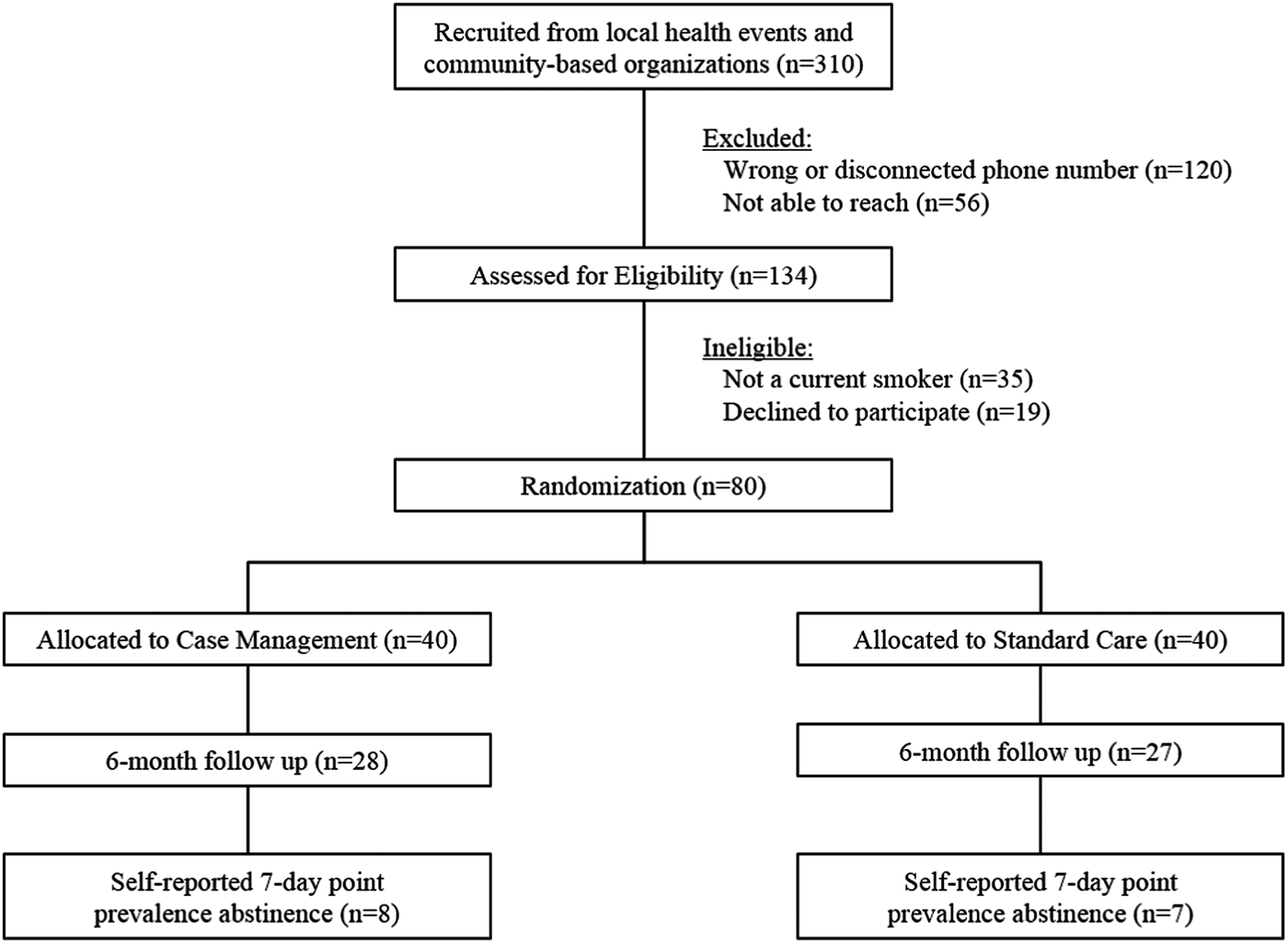
Of 310 identified smokers, 134 were reached by phone and completed screening. Of those screened, 80 (82.5%) were eligible and randomized to either the CM or SC group. Fifty-five (68.8%; CM = 28 and SC = 27) participants completed the 6-month follow-up survey (Figure 1).
Study design flow diagram.

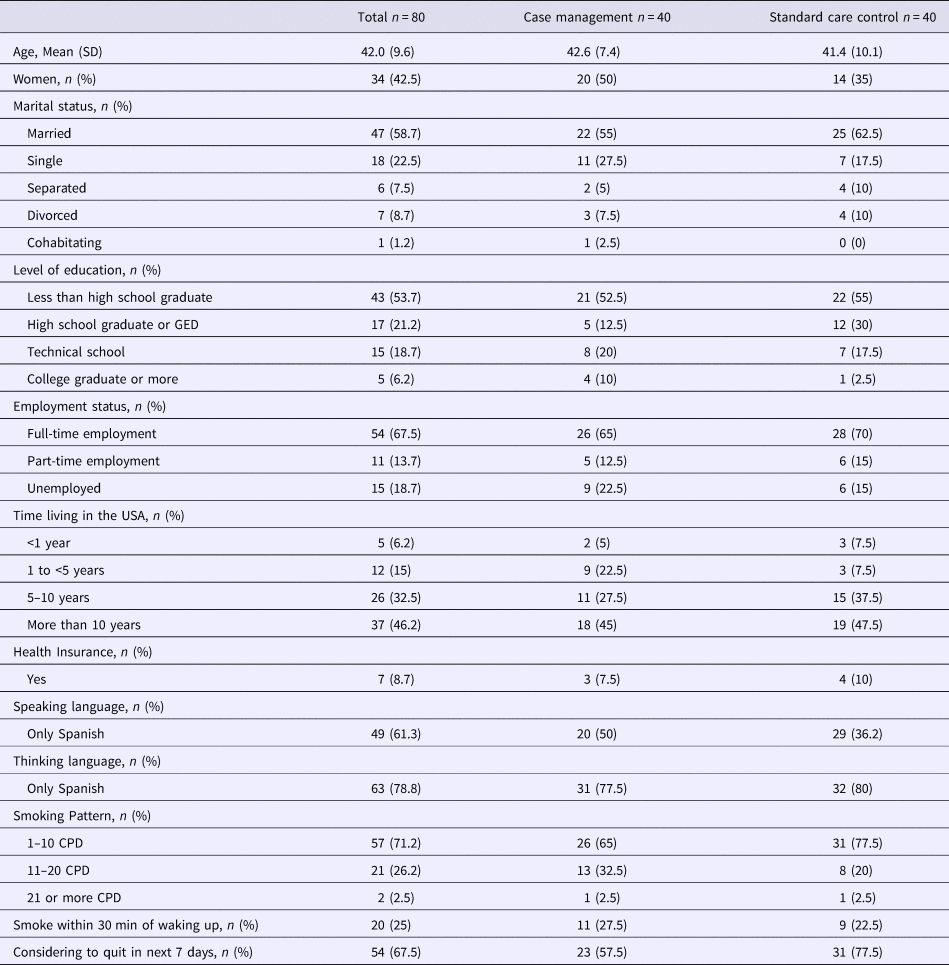
Randomization resulted in similar baseline characteristics between CM and SC groups (Table 1). Participants were on average 42 years old (SD 9.6), and 42.5% (n = 34) were female. Most were employed (81.2%; n = 65) but less than half had not completed high school (53.7%; n = 43), and only 8.7% (n = 7) had health insurance. More than half (53.7%; n = 43) reported living in the USA for <10 years, 61.3% (n = 49) reported speaking only in Spanish, and 78.8% (n = 63) reported thinking only in Spanish.
Socio-demographic characteristics of the sample

Most participants (71.2%; n = 57) were light smokers (smoked 1–10 cigarettes per day) and had tried to quit in the past year (62.5%; n = 50). However, few reported ever using the quitline or individual cessation counseling (5.0%; n = 4) and only 11.3% (n = 9) had received advice from a healthcare professional to stop smoking in the last year.
Primary and secondary outcomes: utilization of smoking cessation resources (pharmacotherapy and quitline) and self-reported 7-day point prevalence abstinence
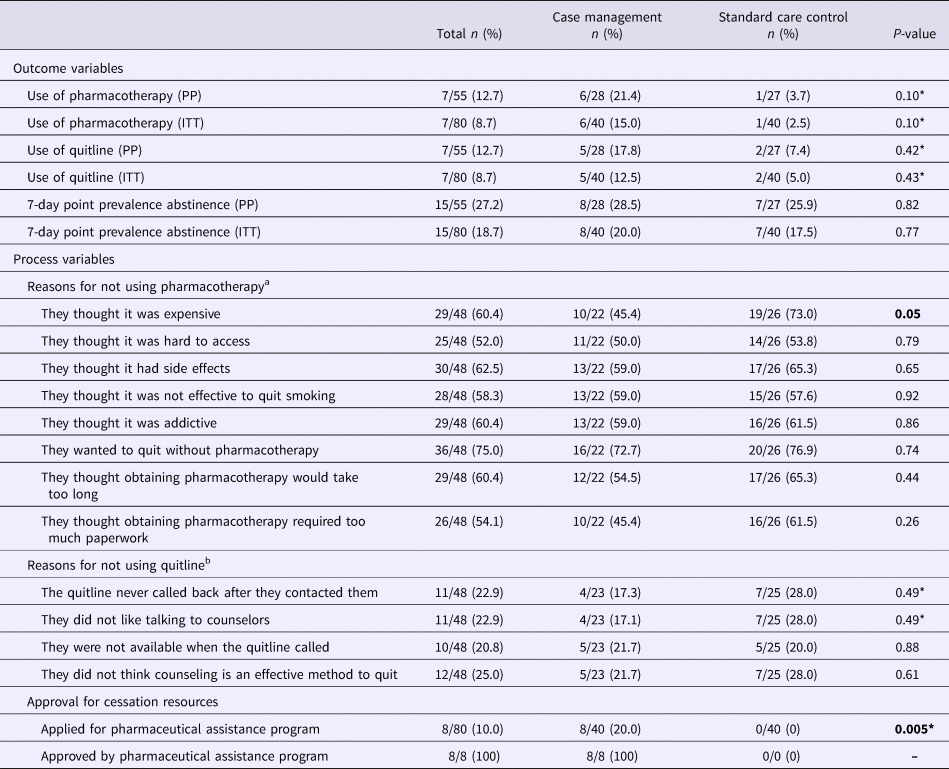
Using ITT analysis, CM participants reported higher utilization than SC for both pharmacotherapy (15.0% versus 2.5%; P = 0.10) and quitline (12.5% versus 5.0%; P = 0.43) (Table 2), although this finding was not significant. Complete case analysis also found that CM produced higher utilization than SC for pharmacotherapy (21.4% versus 3.7%; P = 0.10) and quitline (17.8% versus 7.4%; P = 0.42), although this was not significant.
Six month post-intervention outcomes and process variables

PP, Per-protocol; ITT, Intent-to treat: none of the missing cases used cessation resources or quit.
Boldface indicates statistical significance (P < 0.05).
a Analysis excludes participants lost to follow-up and those who self-reported using pharmacotherapy.
b Analysis excludes participants lost to follow-up and those who self-reported using the quitline.
*Fisher's exact probability test.
Self-reported abstinence was similar across the two treatment groups. ITT analysis found abstinence rates of 20.0% versus 17.5% for CM versus SC respectively (P = 0.77). Abstinence rates were 28.6% versus 25.9% for CM versus SC, respectively (P = 0.82), in the complete case analysis.
Process measures: approval for PAP and reasons for not using smoking cessation resources
Twenty percent (n = 8) of participants in the CM group applied for PAP; no SC group applied for PAP. This difference was statistically significant (Table 2). It is important to note that all participants who applied for PAP were approved and received the medication. Reasons for not submitting the application were beyond the control of case managers, and included no proof of income and loss of interest in varenicline.
Forty-eight participants reported not using pharmacotherapy at follow-up for multiple reasons (Table 2). Participants in CM compared with SC were significantly less likely to report that pharmacotherapy was expensive (45.4% versus 73.0%; P = 0.05). There were no significant differences among other reasons for not using pharmacotherapy between the two groups. The most common reasons for not using pharmacotherapy included wanting to quit without pharmacotherapy and fear of side effects.
Forty-eight participants reported not using the quitline at follow-up for multiple reasons (Table 2). Reasons for not using the quitline between the two groups did not differ significantly. Most commons reasons for not utilizing the quitline were that (1) participants thought counseling was an ineffective cessation method; (2) participants reported the quitline never called them back; and (3) participants did not like talking to counselors.
Process measures: retention rates, adherence to CM calls, and satisfaction
Twenty-eight CM participants completed follow-up at 6-months (70% retention). Twenty-seven SC participants completed follow-up at 6-months (67.5% retention). Out of the 40 CM participants, 80.0% completed at least one call, 52.5% completed two calls, 25.0% completed three calls, and 17.5% completed four calls. Most CM participants (96.4%) were satisfied with the CM approach. At 6-months follow-up, CM participants thought case managers helped them greatly in the process of quitting smoking (39.2%; n = 11), accessing pharmacotherapy (21.4%; n = 6), and connecting them with the state quitline (10.7%; n = 3).
Discussion
To the best of our knowledge, this is the first study to examine the feasibility of CM as a smoking cessation intervention for Latino smokers. CM resulted in a higher number of participants using pharmacotherapy, the quitline, and 7-day point prevalence abstinence, although these differences were not statistically significant. Significantly, fewer CM participants reported thinking pharmacotherapy was too expensive compared with the SC control group. Significantly, more SC participants reported thinking that obtaining pharmacotherapy would take too long. These differences may be explained by the assistance of the case manager, who helped participants in the CM intervention group obtain free pharmacotherapy.
The CM appeared to be feasible among Latino smokers. Estimates of the number of completed CM calls are comparable with a previous CM study conducted with mostly non-Latino white rural smokers (Cupertino et al., Reference Cupertino, Mahnken, Richter, Cox, Casey, Resnicow and Ellerbeck2007). In the current study, the average number of completed CM calls was 1.8 out of four possible calls compared with an average of 2.3 out of six in the prior study. However, there is room for improvement given that the US clinical practice guidelines suggest four or more person-to-person treatment in effectively increasing smoking abstinence rates (Fiore et al., Reference Fiore, Jaen and Baker2008). In general, the level of satisfaction with the CM was high among Latino smokers, despite different opinions regarding the number and length of the calls. However, 30% of CM participants did not show up at follow-up which might be related to dissatisfaction with CM or its components.
CM increased access to evidence-based cessation treatment by assisting with the completion of PAP forms and quitline referrals. Increasing access to evidence-based cessation interventions among Latinos is important as it alleviates some of the barriers experienced by this population (DeNavas-Walt, Proctor, and Smith, Reference DeNavas-Walt, Proctor and Smith2012). Our results suggest that mechanisms accountable for the increased access to pharmacotherapy include reducing barriers related to the cost of medication and the complexity of PAP paperwork.
Contrary to other smoking cessation CM trials (Joseph et al., Reference Joseph, Fu and Lindgren2011), this study was pragmatic as participants were not simply mailed free pharmacotherapy by the study staff, but they had to obtain it in a real-world setting (buying them or via PAP). The vast majority of participants in the present study had no health coverage, which is strongly associated with decreased engagement with treatment (Cupertino et al., Reference Cupertino, Mahnken, Richter, Cox, Casey, Resnicow and Ellerbeck2007; Odegard and Gray, Reference Odegard and Gray2008). This barrier was partly alleviated by the PAP and quitline assistance in the CM group. The lack of increase in use of resources compared with SC was partly related to misconceptions participants had about cessation resources including perceptions of addictiveness, lack of efficacy, side effects, and wanting to quit without pharmacological help. Latinos and other minorities are particularly prone to these sort of misconceptions about cessation resources (Carpenter, Ford, Cartmell, and Alberg, Reference Carpenter, Ford, Cartmell and Alberg2011; Diverse Racial Ethnic Groups and Nations (DREGAN) Project Team, 2006; Levinson et al., Reference Levinson, Perez-Stable, Espinoza, Flores and Byers2004, Reference Levinson, Borrayo, Espinoza, Flores and Pérez-Stable2006). These results suggest that CM for Latino smokers should put more effort into addressing misconceptions.
Results also suggest that, despite improvements in access to pharmacotherapy and counseling, access to these treatments remained an issue. Half of the participants thought pharmacotherapy was hard to access irrespective of their intervention group. Some participants interested in using the quitline were not available when the quitline called them while others did not like to talk to a counselor. It is important to recognize that this study was conducted in 2011, and participants tended to use the landline or pre-paid phones, in which a minimum credit was needed to make and receive calls. Pharmacotherapy access and use would probably increase if quitlines offered free NRT (not covered by PAP). Previous studies show that providing free NRT and counseling treatment via the state tobacco quitline leads to higher access to NRT increasing quit rates (Hollis et al., Reference Hollis, McAfee, Fellows, Zbikowski, Stark and Riedlinger2007; Swartz, Cowan, Klayman, Welton, and Leonard, Reference Swartz, Cowan, Klayman, Welton and Leonard2005; Tinkelman, Wilson, Willett, and Sweeney, Reference Tinkelman, Wilson, Willett and Sweeney2007).
This study has some limitations that should be considered when interpreting the findings. This was a pilot study with a modest sample size (n = 80) which decreases the power to detect differences between groups. Retention rates were modest and adherence to CM calls varied widely. Economic factors could account for the low adherence to CM calls. Latino immigrants often work multiple jobs with varying schedules and may not have the freedom to schedule CM sessions or respond to calls at will. They may also experience loss of cellphone service or frequent changes in their phone numbers due to inability to pay. This suggests a need for developing innovative strategies to deliver treatment that specifically target and address the needs and preferences of ethnically diverse individuals participating in smoking cessation treatment. Text messaging-based smoking cessation interventions are a good alternative for providing counseling as the treatment can be delivered at any time without the need to talk to a counselor in real time (Abroms, Carroll, Boal, Mendel, and Carpenter, Reference Abroms, Carroll, Boal, Mendel and Carpenter2016; Boal, Abroms, Simmens, Graham, and Carpenter, Reference Boal, Abroms, Simmens, Graham and Carpenter2016; Whittaker, McRobbie, Bullen, Rodgers and Gu, Reference Whittaker, McRobbie, Bullen, Rodgers and Gu2016). In addition, text message interventions are similar to quitlines regarding their potential for scalability and cost-effectiveness – given that notably less human resources are needed to interact with smokers. Finally, study outcome measures relied on self-report, which may increase the threat of social desirability bias (Piñeiro et al., Reference Piñeiro, Vidrine, Wetter, Hoover, Frank-Pearce, Nguyen, Zbikowski and Vidrine2018b). Caution should thus be made when interpreting findings. Biochemical verification is recommended to determine cessation rates within tobacco treatment intervention studies (SRNT Subcommittee on Biochemical Verification, 2002). Despite these limitations, this study has important strengths. This is the first study that assessed the effectiveness of a CM intervention in increasing access and utilization of pharmacotherapy and tobacco quitlines. Moreover, this is the first CM intervention to be studied among Latinos.
This study showed preliminary evidence that CM increases utilization for both pharmacotherapy and the smoking cessation quitline compared with the SC group. Although these findings were not statistically significant, they suggest a clinically relevant increase in access to pharmacotherapy and quitline use among participants engaged by case managers. Recently, the US government has sponsored large-scale demonstration projects to test the utility of CM to better serve people with low incomes who have chronic conditions (DeNavas-Walt et al., Reference DeNavas-Walt, Proctor and Smith2012; Lewin and Baxter, Reference Lewin and Baxter2007). Given the chronic nature of nicotine dependence (Fiore, Reference Fiore2000), a disease management approach is warranted. The present study demonstrates that case managers can be effective for coordinating care and linking Latino smokers with evidence-based treatments for smoking cessation. To enhance engagement, case managers should also explore asynchronous communication strategies such as text messages approaches – which have been shown to be effective for smoking cessation in the general population of smokers (Abroms et al., Reference Abroms, Carroll, Boal, Mendel and Carpenter2016; Boal et al., Reference Boal, Abroms, Simmens, Graham and Carpenter2016; Whittaker et al., Reference Whittaker, McRobbie, Bullen, Rodgers and Gu2016). Recent changes in healthcare finances now provide incentives from practices to address quality metrics (such as smoking cessation), develop ‘registries’ of patients in need of services, and offer CM services to these patients (Quality Payment Program, 2018). CM for smoking cessation, such as that in this study, could also be delivered via e-visits or virtual visits (Bringham and Women's Health, 2018).
Future CM interventions could further increase pharmacotherapy and tobacco quitline use by incorporating health education to directly address misconceptions about smoking cessation pharmacotherapy. Levinson stressed the idea of implementing cognitive reframing in cessation interventions to clarify, for example, that will-power is not dichotomous and incompatible with pharmacotherapy (Levinson et al., Reference Levinson, Borrayo, Espinoza, Flores and Pérez-Stable2006). Future interventions will need to address myths and misconceptions about pharmacotherapy and quitline to increase favorable attitudes towards their use and therefore increase utilization of evidence-based cessation resources.
Conclusion
CM holds promise as an effective intervention to connect Latino smokers to evidence-based cessation treatment. CM resulted in a higher number of participants using pharmacotherapy and the quitline, although it was not statistically significant. Future CM interventions should identify additional strategies to promote utilization of treatment resources to aid smoking cessation while focusing on addressing misconceptions about treatment and availability.
Financial support
This work was supported by the National Institutes of Health (K01-CA-136993-01A1).
Conflict of interest
None.
Ethical standards
The authors assert that all procedures contributing to this work comply with the ethical standards of the relevant national and institutional committees on human experimentation and with the Helsinki Declaration of 1975, as revised in 2008.