INTRODUCTION
On 11 November 1993, the Vietnam Women's Memorial (VWM) was inaugurated as part of the Vietnam Veterans Memorial (VVM) on the National Mall in Washington, DC. Unveiling the monument, Diane Carlson Evans – a former army nurse who served in Vietnam and the founder of the Vietnam Women's Memorial Project (VWMP) – compared this event to a veteran's long journey home from the war.Footnote 1 She described the memorial as a sacred place that would help to heal those who had suffered because of the war. Evans also announced that it was “the first monument in the history of the United States of America dedicated in the nation's capital honoring American women who served during wartime.”Footnote 2
The National Mall is the most important public space for American national identity. Filled with federal institutions, monuments, and museums, the Mall tells the story of the American people as a nation – it shows how they imagine their past, present, and future.Footnote 3 It speaks about the country's values and ideals and plays an active role in the process of shaping American collective memory and identity.Footnote 4 Kristin Ann Hass has noted that this symbolic center of American imagined community underwent a significant transformation at the end of the twentieth century. She writes, “From 1791, when the capital was designed, to 1982, the story told on the National Mall was the story of great American leaders and their triumphant ideas about democracy. There were no war memorials on the Mall.”Footnote 5 According to the McMillan Plan – a landscape development program which redesigned the center of Washington at the beginning of the twentieth century – the Mall was meant to convey democratic ideals and the power of the nation-state as personified by George Washington, Thomas Jefferson, and Abraham Lincoln. The focus of the Mall's narrative shifted to the sacrifices of soldiers only with the dedication of the VVM in 1982.Footnote 6 The establishment of the VWM, close to the Lincoln Memorial, was therefore an event of historical significance. For the first time, individual women were incorporated into the national Pantheon and recognized as heroines.
The VWM is not, however, a stand-alone memorial but part of a complex commemorative site – the VVM. As such, it should be viewed not only as a tribute to women, but also as an attempt to provide the US involvement in the Vietnam War – a lost military effort which created unprecedented dissent and divisions across American society and claimed the lives of 58,220 American military personnel, eight of whom were womenFootnote 7 – with official interpretations. My research is based on the premise that memory is an active process of construction. As Aleida Assmann and Linda Shortt explain, “Collective memories are produced through mediated representations of the past that involve selecting, rearranging, redescribing and simplifying, as well as the deliberate, but perhaps also unintentional, inclusion and exclusion of information.”Footnote 8 Taking this into account, I seek to understand the politics of memory surrounding the women's memorial. Specifically, I am interested in two interrelated questions: how did the VWMP portray female veterans – what cultural representations of womanhood, war, and military veterans did it refer to? And did the VWMP, by offering a female perspective on the Vietnam War, transform the meanings ascribed to this historic event or rather solidify the existing interpretations? To address those questions, I studied the archival documents collected at the VWMF, the National Archives (NA), and the Commission of Fine Arts (CFA); conducted twenty-two in-depth interviews with women who served in and during the Vietnam War, including Evans and other women who were involved with the VWMP; and observed the celebrations of the twentieth anniversary of the VWM's dedication in November 2013.
I am mindful of Viet Thanh Nguyen's remark that “all wars are fought twice, the first time on the battlefield, the second time in memory.”Footnote 9 As a child, Nguyen fled to the US with his family after the fall of Saigon. His book Nothing Ever Dies: Vietnam and the Memory of War explores the presences and absences that constitute American remembrance of the Vietnam War and Vietnamese remembrance of the American War. Critiquing both commemorative frameworks for their nationalistic tendencies, the author calls for greater inclusivity and fairness – an ethics of remembering “others” like “one's own.”Footnote 10 In a similar fashion, this article seeks to highlight presences and silences in the VWMP's discourse. As I will show, during an almost decade-long struggle to establish the women's memorial, the VWMP's leaders were making ethically, aesthetically, and politically sensitive choices which shed light on selected aspects of the past. Although the notions of healing and compassion were central to the organization's discourse, they were not equally applied to everyone who had suffered because of the war. Before discussing the results of my research, it is necessary to contextualize the VWMP's commemorative efforts. First, I discuss feminist scholarship, exploring the relationship between gender and nationalism, and juxtapose it with shifting US military policies toward women in the Vietnam era. Second, since the VWMP began articulating their claims after the symbolic and semantic frameworks of Vietnam War remembrance had already been established, I examine American public commemoration of the Vietnam War – its dominant modes, controversies, and ambivalences.
WOMEN IN THE MILITARY AND NATIONAL POLITICS – STRANGERS IN A MASCULINE WORLD
Men and women perform culturally constructed, gender-specific roles that exemplify different qualities – and nowhere does this become more noticeable than in military and wartime settings.Footnote 11 As Jean Bethke Elshtain writes, “We in the West are the heirs of a tradition that assumes an affinity between women and peace, between men and war, a tradition that consists of culturally constructed and transmitted myths and memories.”Footnote 12 Within this tradition, women are assigned the role of Beautiful Souls – nonviolent and compassionate life givers – as opposed to Just Warriors – bellicose and cruel men who act as life takers.Footnote 13 Cultural myths about femininity maintain that women are physically and mentally weaker than men and thus need their protection; they are naturally inclined to take care of children as they belong to the sphere of home and domesticity. These myths create a gendered social order which secures women's locations as noncombatants and men's positions as warriors.Footnote 14
Feminist scholars have examined the designated roles that men and women play in national and global politics, exposing the connections between masculinity, militarism, and nationalism. Cynthia Enloe argues that nationalism offered women a new identity – they could experience themselves outside the realm of domesticity and their roles as mothers and wives.Footnote 15 However, women quickly learned that nationalism is a male-dominated endeavor which relegates them to subordinate positions and often asks them to sacrifice their needs and ambitions. She notes, “Nationalism typically has sprung from masculinized memory, masculinized humiliation, and masculinized hope.”Footnote 16 Nonetheless, the political project of nationalism – more than other ideologies – relies on women's engagement in some scripted ways.Footnote 17 Nira Yuval-Davis and Floya Anthias identify five roles that women play in national processes and/or in relation to state processes: (1) biological reproducers of the nation; (2) reproducers of the normative boundaries of the national groups’ symbolic identities; (3) transmitters of cultural values and ideological reproducers of collectivities; (4) symbolic signifiers of national differences; (5) participants in national, political, economic, and military struggles – usually in supportive and nurturing relation to men.Footnote 18 Importantly, the state is neither the sole designer nor enforcer of gender divisions as they relate to broad-ranging societal processes of gender differentiation. Women not only reproduce the roles that they are supposed to perform, but also control other women in this regard.Footnote 19
Throughout history the US armed forces remained relatively unconcerned with the major evolution of women's roles and rights.Footnote 20 Women were mobilized only in times of war and then only because of a shortage of manpower. This rule also applied to nurses, although, in the broader American society, nursing was regarded as a feminine profession. The decision to integrate women – which was ratified in 1948 when Congress passed the Women's Armed Services Integration Act – was based on pragmatic considerations: the need to maximize military capacity in the event of another war.Footnote 21 Under that legislation women experienced opportunity without equality, as exemplified by the provisions concerning their recruitment, promotion, discharge, and retirement.Footnote 22 The armed forces’ insistence on keeping women out of combat prevented them from achieving leadership positions and obtaining higher remuneration.Footnote 23 Moreover, under the Integration Act, women – whether married or unmarried – who acquired dependents under the age of eighteen by birth, adoption, marriage, or other circumstances had to leave the military.Footnote 24
However, in the 1960s, due to increasing American involvement in the Vietnam War, the military adjusted some of their policies to recruit more women (who were exempted from the military draft). Nurses, who held officer rank, enjoyed respect and were quickly promoted.Footnote 25 The Army Nurse Corps (ANC) began to offer financial assistance and educational opportunities to student nurses in return for their service upon graduation.Footnote 26 The military advertised nursing as an attractive career for independent young women who aspired to travel around the world, perform meaningful work, and enjoy financial freedom.Footnote 27 Such an idyllic picture was meant to mitigate the controversy surrounding the Vietnam War. The picture also reflected the shifting understandings of gender and changing public attitudes toward women's roles that were taking place in American society at the time.Footnote 28 Although the armed forces advanced the position of its female personnel, they also upheld the traditional gendered expectations of servicewomen. They insisted that nurses were health professionals and officers, but above all they were women. Women's comfort and warmth were essential for the recovery of wounded soldiers.Footnote 29 Off duty, nurses were expected to wear civilian clothes, behave in a ladylike fashion, and accompany men to officers’ clubs.Footnote 30 The definition of military nursing in the Vietnam era was thus a blend of progressive and traditional elements.
Despite its various policy adjustments, the military remained an overwhelmingly masculine space. During the Vietnam War, women constituted less than 1 percent of the US armed forces.Footnote 31 The VWMP reports indicate the existence of 265,000 female Vietnam-era veterans.Footnote 32 The number of American women who served in the Republic of Vietnam during the war can only be approximated since the Department of Defense did not register the gender of the military personnel it deployed overseas. The VWMP suggests that 11,000 women were sent to Vietnam, 90 percent of whom served with the ANC.Footnote 33 Other sources, however, estimate the number of women nurses at 5,000 to 8,500.Footnote 34 Around 750 women went to Vietnam with the Women's Army Corps (WAC). These women served as clerks, typists, air traffic controllers; they worked in communications and intelligence.Footnote 35 Although women did not serve in combat in Vietnam, they were exposed to the war's dangers and, because the distinctions between combat and noncombat zones were blurred, often put their lives on the line. In fact, one of the eight US military women casualties – First Lieutenant Sharon Lane, who served as an army nurse – was mortally wounded in a Viet Cong rocket attack on her hospital in Chu Lai.Footnote 36 Nonetheless, the number of women who served and were killed or injured in the war was minuscule in comparison to their male counterparts.
When discussing public memory, one needs to be mindful that representations of the past reflect contemporary collective needs, fears, and aspirations.Footnote 37 The national effort to commemorate Vietnam veterans began in the 1980s. During that decade, the New Right – which had become a prominent political force – together with President Ronald Reagan in the White House insisted on strengthening Cold War militance and promoting the traditionally understood family as well as eradicating some of the cultural and social legacies of the 1960s, including the gains of the feminist movement.Footnote 38 Susan Jeffords argues that the 1980s saw what might be described as a remasculinization of American culture – a renegotiation of patriarchal relations through “a revival of the images, abilities, and evaluations of men and masculinity in dominant US culture.”Footnote 39 The masculine revival was especially visible in that decade's books and movies about the Vietnam War, many of which conjured up an image of a heroic veteran traumatized by defeat in Vietnam and protests at home.Footnote 40 Jeffords notes that the imagery of a wounded or scorned veteran who finds inner strength to reinvent himself as a masculine leader and who calls for a moral rejuvenation of America contributed to retraditionalizing the relations between genders and strengthening the mechanisms of patriarchy.Footnote 41
Those symbolic framings and cultural sentiments, however, were at odds with the challenges faced by the US military, which, having turned all-volunteer, increasingly relied on women's service in combat-adjacent positions. In 1981, women comprised 8.5 percent of the total US military strength and were one of its fastest-growing segments.Footnote 42 The military authorities were therefore inclined to consider women's needs and aspirations – including symbolic ones – concerning their recognition and commemoration. Such a situation created favorable conditions for the VWMP to begin articulating their commemorative claims. And, as I will show, although the organization argued that women's war experience was no less important than that of men and it deserved equal commemoration on the National Mall, the theme of gender retraditionalization as well as the remasculinization of America can also be identified in the organization's discourse, specifically in its portrayal of women as symbolic mothers – nurturers and consolers to the brave and suffering American soldiers in Vietnam.
MODES OF VIETNAM WAR REMEMBRANCE
The campaign to commemorate Vietnam veterans was led by Jan Scruggs – a former infantryman who served in Vietnam. In April 1979, he founded the Vietnam Veterans Memorial Fund (VVMF).Footnote 43 The basic commemorative rule established by the VVMF was to “separate the warrior from the war” – to honor the Vietnam soldiers without commenting on the nature of the war in which they had participated.Footnote 44 In creating a commemorative narrative, the organization borrowed concepts from therapeutic discourse. The VVMF used the metaphor of trauma and healing to describe the life situations of individual veterans, as well as the condition of American society after the war.Footnote 45 It held that social recognition would help veterans recover from psychological wounds and remove the stigma connected to their participation in a controversial war. At the same time, the organization saw veterans’ commemoration as a vehicle for national reconciliation. It believed that mourning the loss of the soldiers would help Americans heal the divisions caused by the war and restore prewar national unity.Footnote 46
The VVMF proposed to end divisive debates about the Vietnam War. However, the idea of commemorating an extremely politicized event, such as war, in an apolitical way runs counter to the rationale of such practices, since they are supposed to incorporate the object of commemoration into the existing historical narrative, which is always political in character. The idea of separating the veterans from the events in which they participated seems as dubious as the thought that individual trauma and healing can become a symbol of national unity. One of the documents collected at the CFA quotes the words of Paul Spreiregen, an architect commissioned by the VVMF, who said that “consideration had to be given to the fact that it [the VVM] was a memorial to servicemen and women in a war that was lost and a war for a cause that will remain a question.”Footnote 47 This makes it clear that, despite the VVMF's proclaimed “agnosticism over the war,”Footnote 48 its representatives held strong opinions about it. They revealed them behind a federal commission's closed doors but were reluctant to share them with the public. As I will show, the VVMF's privately conflicted approach to commemoration resulted in public disagreements and the addition of new elements to the memorial's site.
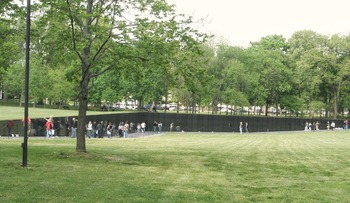
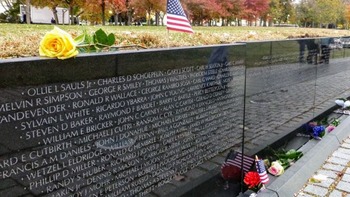
In 1980, President Jimmy Carter signed a Congressional resolution granting the VVMF a site in the Constitution Gardens in Washington, DC.Footnote 49 A blue-ribbon panel chose the winning memorial design – a work by Maya Ying Lin – which did not match the iconography of the National Mall as defined by the Washington Monument and the Lincoln Memorial – grand, white structures that express authority and command respect. The central feature of the VVM, dedicated in 1982 and popularly known as the Wall, is a V-shaped structure made of two blocks of polished black granite. These blocks, which are located below ground level, are inscribed with the names of every soldier known to have been killed in the war (Figures 1 and 2).
The Vietnam Veterans Memorial (the Wall) in Washington, DC (photograph by the author).

The memorial lists the names of American military personnel killed in the Vietnam War (photograph by the author).

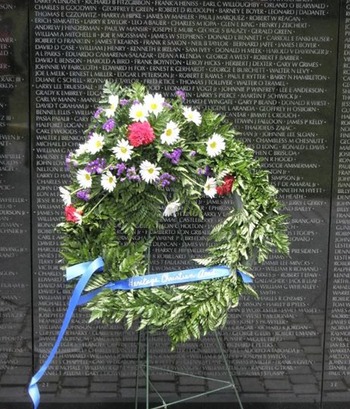
In her design statement, Lin described the memorial as “a rift in the earth – a long, polished black stone wall, emerging from and receding into the earth.”Footnote 50 She wrote, “Walking into the grassy site contained by the walls of this memorial we can barely make out the carved names upon the memorial's walls. These names, seemingly infinite in number, convey the sense of overwhelming numbers, while unifying the individuals into a whole.”Footnote 51 Lin's words show that she attempted to combine individual and collective planes of memorializing the war dead. The names of the dead do not bear any information about their age, ethnicity, or military rank, as if the designer wanted to emphasize that everyone is equal in the face of death. Lin explained that reading and touching the names on the Wall was supposed to help people mourn the loss of the soldiers – the memorial was not meant to be a representation of individual and collective pain, but rather an object that would enable visitors to experience catharsis and healing (Figure 3).Footnote 52
A tribute to the fallen – a wreath left by visitors to the Wall (photograph by the author).

The VVMF's proposal to commemorate the Vietnam War in an apolitical manner did not appeal to conservative and militaristic veterans who were interested in providing the war with a heroic interpretation. In 1981, a group led by Tom Carhart, a graduate of West Point and a Vietnam veteran, started articulating competing commemorative claims. They criticized the memorial's color and shape, as well as its underground location. In the most serious critique, Carhart called the memorial “the black gash of shame.”Footnote 53 He regarded the Wall as an anti-memorial which expressed an aversion to the US military effort in Vietnam and did not show proper respect to the soldiers who participated in the war. Carhart believed that the memorial's design should attest to the US's noble intentions and portray the veterans as national heroes. The conflict over the memorial's design ended in a compromise. The veterans agreed that the original design of the Wall would remain unchanged, but a “heroic statue” of a Vietnam serviceman would be added to the site, as would a flagpole, which would mark the entrance to the memorial.Footnote 54
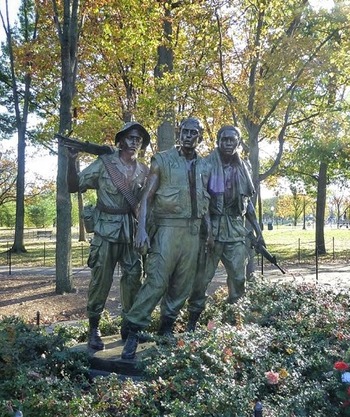
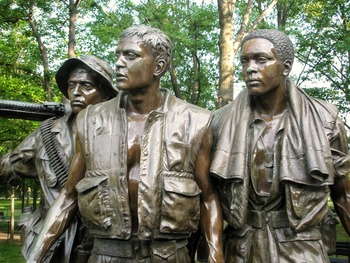
The bronze statue known as The Three Soldiers, designed by Frederick Hart, was unveiled in 1984 (Figure 4). The soldiers are young and well built, but they seem weary and confused. The helmets and weapons they are carrying seem too heavy for them; they are not ready to fight. The figures are only slightly bigger than the average size of the human body and are placed on a modest platform, which suggests that the commemorated men are not heroes but ordinary people. The sculptor explained, “The contrast between the innocence of their youth and the weapons of war underscores the poignancy of their sacrifice. There is about them the physical contact and sense of unity that bespeaks the bonds of love and sacrifice that is the nature of men at war.”Footnote 55 Although the soldiers are a source of support for each other, as Hart pointed out, each of them experiences existential loneliness: “And yet they are each alone. Their true heroism lies in these bonds of loyalty in the face of their aloneness and their vulnerability.”Footnote 56 Hart drew attention to the sense of helplessness experienced by the soldiers. This feeling is rarely acknowledged in the context of the male experience of war, as it does not fit the image of a war hero. The artist suggested that, in case of the Vietnam War, it was an act of courage to survive it with dignity and to keep faith with one's comrades-in-arms.
The bronze statue of The Three Soldiers added to the Wall in 1984 (photograph by the author).

Although the message of the veterans’ memorial was supposed to be apolitical, in designing the statue Hart was making artistic decisions that were inescapably political in character. For example, he had to portray the veterans in terms of their race and ethnicity (Figure 5). Hart's first sculptural model of The Three Soldiers depicted two white men of northern European heritage and one black man.Footnote 57 After Hispanic Americans insisted that the statue should also include a representation of their community, the sculptor modified the facial features of one of the figures to make it look more Latino.Footnote 58 When more groups started to raise their commemorative claims, Hart contended that the Hispanic figure would represent all veterans who were not black or white.Footnote 59 As he explained, since that figure had now acquired “ethnic features in a sense,” it could be “Jewish, Lebanese, Indian.”Footnote 60 Hart's comment reveals an understanding that it was impossible to include everybody who participated in the war and wanted to be commemorated. However, the idea that both Jews and Indians could be represented by a Latino seems to reflect a cultural script that flattens ethnic and racial distinctions into the Other. Although The Three Soldiers can be seen as an attempt to honor the service of racial and ethnic minorities, its central figure is a white male, a positioning which suggests that this person is the most important of the portrayed trio and, by extension, the most important representation of Americans as a nation.
The Three Soldiers – an ethnic representation of American servicemen in Vietnam (photograph by the author).

The above discussions demonstrate the lack of social consensus over how to commemorate American involvement in the Vietnam War. The competing demands made by the therapeutic and heroic modes of commemoration contributed to the tension and ambivalence that were ultimately inscribed into the semantic structure of the VVM. The Wall's symbolism, and the special kind of aura it creates, effectively restricted the symbolism of the other commemorative elements that were later added to the site. Juxtaposed with the Wall, The Three Soldiers could not unconditionally affirm the American military effort in Vietnam. The statue communicates that the price of American engagement in the war was the suffering and isolation of individual servicemen. It is worth emphasizing that neither the therapeutic nor the heroic mode of remembering the Vietnam War sought to engage with the historical, political, and ethical questions concerning the US intervention in Vietnam. The story of the Vietnam War, as conveyed through the commemoration process, obscured the presence of other participants in the conflict, including US military allies and enemies. Most notably, it elided the presence and suffering of the civilian populations of South East Asia, who were most affected by the conflict's immediate and long-term consequences. As I will show, the themes surrounding the creation of the VVM would find echoes in the campaign to commemorate the women who served in Vietnam. But that campaign would also raise additional issues reflecting the complex role of gender in the politics of memory.
COMMEMORATING “VIETNAM WOMEN”
Evans began advocating for the commemoration of women who had served in Vietnam after she heard about the plans to add the Three Soldiers statue to the Wall. She was concerned that a shift in the mode of commemoration – from the Wall's abstract form to the realistic and gender-specific representation of American soldiers in Vietnam – would result in “an exclusion of women who had been part of it.”Footnote 61 She argued, “Soldiers’ place in history was anchored in bronze. But the contributions of women … would be obliterated from the national memory … I had to do something about it.”Footnote 62 Evans understood the VVM's omission of women in terms of a social exclusion which condemned them to oblivion. She believed that women deserve to be remembered as much as men.
In 1984, Evans founded a nonprofit organization, called the Vietnam Nurses Memorial Project. A year later, the organization changed its name: “the word ‘nurses’ was deleted and the word ‘women's’ was inserted.”Footnote 63 In an interview, Evans explained that after announcing plans to add a statue of a nurse to the VVM, her organization was contacted by a number of women who carried out assignments in Vietnam that were not related to medical care.Footnote 64 Some of them served with the WAC; some were civilians employed by the US military. Some came to Vietnam with charitable organizations; others were missionaries, war correspondents, or Vietnam-era veterans – women who served in the US military during the Vietnam War, but not “in country.” All these women aspired to be commemorated too. Taking this into account, the leaders of the organization decided to expand the group of women on behalf of whom they spoke.Footnote 65 However, according to the women I interviewed, this decision was based on pragmatic considerations. Several months after launching a campaign to commemorate the Vietnam nurses, Evans realized that the group was too small to raise sufficient funds and gain the political support necessary to build the memorial. After the change the organization represented the symbolic interests of “Vietnam women,” i.e. Vietnam War and Vietnam-era veterans, as well as civilians who participated in the war.
Who are “Vietnam women”? My research shows that this term, coined by the VWMP, encompassed a heterogeneous group of women – diverse in terms of age, education, and military experience. At the center of the group were those who had served in the armed forces in Vietnam. What connected them with women civilians (in the VWMP's discourse called “civilian veterans”) was their war experience. With the Vietnam-era veterans, they shared an experience of serving in the US military. Interestingly, Congressional authorization to create the VWM specifies that it shall “honor women who served in the Armed Forces of the United States in the Republic of Vietnam during the Vietnam era.”Footnote 66 The legislation thus excludes women Vietnam-era veterans and civilians from national commemoration. The VWMP's documents, by contrast, define the commemorated group in various ways. Sometimes they suggest that the memorial would honor “women … in the armed forces in Vietnam,”Footnote 67 on other occasions “women in the Armed Forces of the United States,”Footnote 68 and sometimes, broadly defined, “American women who served their country during the Vietnam War.”Footnote 69 Although this inconsistency may seem accidental, I argue that the organization presented “Vietnam women” strategically, depending on the social setting and the audience they addressed. The term's symbolically defined boundaries were flexible, as the organization tended to extend them to incorporate new collectivities. This suggests that “Vietnam women” is a commemorative construct invented by the VWMP. Despite the “Vietnam women's” internal heterogeneity, the organization presented them as one particular group of women, united by similar values and ideals: women of the same “spirit.”Footnote 70
As this article explores both presences and absences in the VWMP's discourse, it is important to note that the term “Vietnam women,” which was deliberately developed to include different groups of women, referred to and encompassed only Americans. Even though the word “Vietnam” should be interpreted here as a reference to the Vietnam War rather than to the country of Vietnam itself,Footnote 71 it is hard to resist the impression that the term carries colonial overtones. Those overtones become particularly relevant when one considers Vietnam's colonial history as well as the ambiguous legal status of the American military intervention and the brutal way it was carried out. Most importantly, however, the term excludes the actual Vietnamese women who experienced and witnessed war violence – including rape, material deprivation, and loss – in a way most American woman did not. For those women, combat was happening in their country, on their land, and sometimes – quite literally – amidst their dwellings and yards. Calling the American women who served in the Vietnam War “Vietnam women” renders the actual Vietnamese women invisible and opens the door to the obliteration of their experiences and voices from American public discourse and memory. It also confirms the observation that in the US the remembrance of the Vietnam War was framed in terms of a national event of sorts. I will go into more detail about the VWMP's strategies of concealing the Vietnamese presence or representing them as the Other in the last section of this article.
THE VWM DESIGN AND THE POLITICS OF CONSOLATION
In 1991, the VWMP proposed a memorial design created by Glenna Goodacre which had received an honorable mention in a VWM design competition the year before.Footnote 72 At that time, the VWMP had already garnered the support of veteran organizations and Washington decision makers and obtained two separate pieces of Congressional legislation to establish the VWM. Within several months, Goodacre's memorial design obtained all necessary federal agency approvals; the memorial was dedicated on Veterans Day in November 1993.
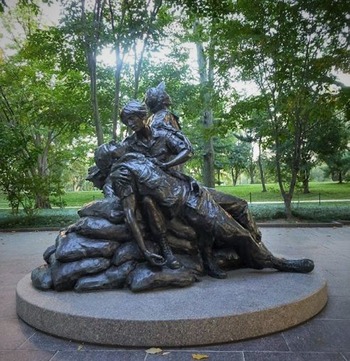
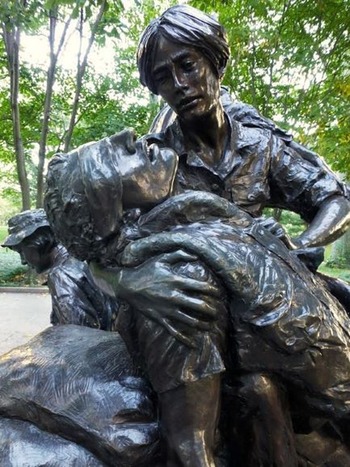
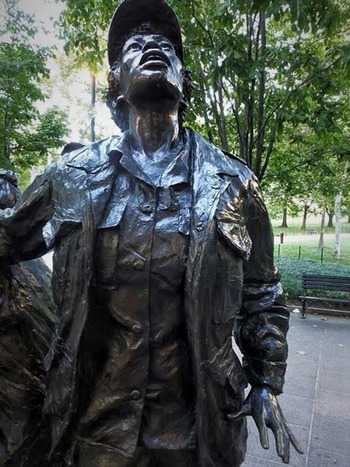
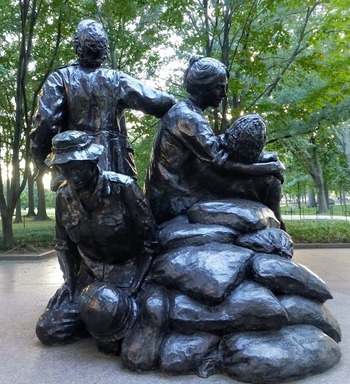
The bronze memorial shows three women of different ethnicities performing wartime duties (Figure 6). The women are gathered around a wounded white soldier who is at the center of the composition. The man is either dying or dead – his arm and leg are limp. His mouth is open, his eyes are covered with a band, and his face displays extreme suffering. The man's body rests upon the lap of a young, white woman who is sitting on a pile of sandbags. Her face is calm and gentle, but the grip of her hand on the soldier's shoulder is strong. Although she carries no medical equipment, one can guess that she is a military nurse (Figure 7). Behind her back, there is a second female figure – an African American, dressed in a field uniform and a baseball cap. This woman is standing straight, her head and eyes turned up, and her mouth open. She is probably crying for help for the wounded man or looking out for a helicopter that would take him to a hospital (Figure 8). The third female figure kneels at the back of the monument with her gaze down. She is wearing fatigues, and a boonie hat covers her face. She holds a helmet, which may belong to the wounded man. She looks depressed; her body language suggests anxiety and helplessness (Figure 9). The women's memorial and the statue The Three Soldiers are similarly realistic, but the VWM is more expressive, depicting more emotional variation. Overall, it is a highly dramatic portrait of war service.
The Vietnam Women's Memorial unveiled in 1993 (photograph by the author).

The central figure of the women's memorial – a nurse taking care of a wounded soldier (photograph by the author).

The figure of an African American represents enlisted women who served in the military during the Vietnam War (photograph by the author).

The kneeling figure is thought to commemorate civilian women who participated in the war (photograph by the author).

The central image of the VWM, a woman mothering a suffering soldier and bringing him comfort in his last moments of life, is a modern rendition of the tradition of pietà – from the Latin pietas, which means “love according to calling” – a religious representation of the Virgin Mary holding the body of the dead Christ. The iconography became popular in Europe in the late Middle Ages.Footnote 73 The composition of the Vatican Pietà – carved by Michelangelo at the end of the fifteenth century – has the shape of a triangle extending downwards. Its apex is marked by the Virgin Mary's head and its base is formed by her robes. In the case of the VWM, the base of the composition is formed by sandbags. The dying soldier is the memorial's protagonist. His suffering is reflected in the compassion of the woman who holds him, the vigilance of the standing woman, and the sadness of the kneeling woman. The monument thus portrays women as nurturers, consolers, and mourners. Looking at the VWM one may conclude that men's sacrifice legitimized women's participation in the war – i.e. women participated in the war because of and for the men – and made them worthy of national commemoration. Tellingly, the designer of The Three Soldiers, who attempted to portray the soldiers’ diversity in terms of their race and ethnicity, did not think it necessary to depict the gender diversity of those who served in Vietnam. This might suggest that both in wartime and in Washington's public spaces, women were marginalized to the point of being invisible. It is also worth noting that the central figure of both The Three Soldiers and the women's memorial is a white male. All other figures seem secondary to him. This white soldier, who is exhausted and confused (as portrayed by Hart) and suffering and dying (as depicted by Goodacre), not only symbolizes the American military, but also the American people during and after the Vietnam War.
The VWM's message is also expressed in a less explicit manner than by reference to a pietà. If one sets a protractor in the bottom right corner of the composition, a plane resembling a fan developing upwards will appear on the left. Its lowest point is marked by the sandbags, its midpoint by the head of the soldier and the nurse leaning over him, and its highest point by the baseball cap of the standing woman. From this perspective, the silhouette of the standing woman seems unnaturally straight and excessively bent forward. It expresses not so much determination and self-confidence, but triumph. The standing figure elevates the whole composition. It communicates a story that can be interpreted as follows: the suffering and death of the soldiers contributed to the symbolic victory of the nation on whose behalf they participated in the war.
I argue that the message of the VWM can be understood within the tradition of the politics of consolation. This term refers to the existential dimension of American politics which gains special prominence whenever the nation is in crisis.Footnote 74 The defining text of the politics of consolation is the Gettysburg Address, delivered by President Abraham Lincoln at the dedication of a military cemetery in Pennsylvania in November 1863.Footnote 75 A few months earlier, Gettysburg had been the scene of the bloodiest battle of the Civil War. Lincoln came to Gettysburg to transform the violence that killed thousands of soldiers into a symbol of national pride and console the American people. In his speech, Lincoln related the deaths of the soldiers to the Bible and the Declaration of Independence. He argued that the soldiers died in defense of the democratic ideals of the republic and emphasized that their sacrifice obliged the living to complete their work. He also expressed a belief that bloodshed would become a source of national renewal – it would contribute to the birth of a new freedom, ensuring that “government of the people, by the people, for the people, shall not perish from the earth.”Footnote 76
Like Lincoln's Gettysburg Address, the women's memorial sacralizes the nation's military effort. It is the only element of the VVM that places American intervention in Vietnam in the framework of religious references, endowing it with a messianic meaning. It suggests that the men, like Christ, laid their lives on the altar of freedom. The women, like the Virgin Mary, faithfully accompanied the men in their suffering and dying. By portraying veterans as saint figures, the memorial attempts to break the stigma connected to their participation in the Vietnam War. It suggests that Americans can be proud of the veterans. By transforming a soldier's death into a symbol of national renewal, the VWM tries to console the people and give them hope for the future. By casting the intervention in terms of a heroic and patriotic endeavor, the VWM reaffirms American national pride and unity. It is thus perhaps not surprising that the memorial obliterates any fraught dimension of the US intervention, such as its ultimate failure, the dissent it caused, or the violence against the Vietnamese civilians it perpetrated.
The figure of the dying soldier can also be interpreted as an allegory of the US as a redeeming nation – an idea deeply rooted in American political tradition.Footnote 77 For Puritans fleeing religious persecution in Europe, America was a new promised land. As Deborah L. Madsen points out, the Puritan settlers sought not only to save themselves but, by so doing, to become “a citie upon a hill,” an example capable of redeeming the entire world. This narrative casts the Americans as the chosen people, representing the forces of God and good in the world.Footnote 78 This national theology of redemption was extended to include the US military, attributing to it a unique status among the armies of the world as a bearer of freedom and social progress.Footnote 79 During the Vietnam War, however, information about atrocities perpetrated by American soldiers against the Vietnamese civilian population, the most infamous of which was the My Lai massacre, violated a belief both in the redeeming character of the US military and in the exceptional moral fiber of the American people.Footnote 80
The memorial does not show who mortally wounded the soldier. One can, however, guess that it was a Viet Cong partisan. The message of the VWM can therefore be interpreted as follows: in Vietnam, American soldiers gave their lives defending the freedom of another nation, saving the world from communism. By placing the participation of the American military in the Vietnam War in relation to the national theology of redemption, the VWM carries out its symbolic rehabilitation. It restores the narratives that Americans liked to tell about themselves before the Vietnam War, including those that depict the moral righteousness of the US as a country which defends the values of the democratic world and acts as a role model for other nations. In the following sections of the article, I provide an analysis of the image of “Vietnam women,” as conveyed through the VWMP's archival documents, and examine how those gendered depictions of American military personnel attempted to uphold a vision of the US as a country of virtuous intentions and exceptional character.
HEROINES: COURAGEOUS, COMPETENT, COMPASSIONATE
An analysis of the VWMP's documents indicates that the organization's leaders placed their commemorative claims within the narrative of trauma and healing established by the VVMF. They held that the process of individual and collective recovery from the Vietnam War, which began with the dedication of the Wall, would not be complete unless it included women. According to the VWMP, establishing a women's memorial was particularly important because it featured a nurse – a health professional, a healer. The VWMP attributed healing properties to all “Vietnam women” although, as I have pointed out, only some of them were nurses. Over the years, the VWMP also presented “Vietnam women” in terms of their strength, dedication, compassion, and professionalism. However, at the beginning of the 1990s, the organization consolidated the image of the women it represented by emphasizing their three predominant characteristics: courage, competence, and compassion. But how did the organization understand these attributes and what kind of meanings did it ascribe to them?
The VWMP argued that women were “one of the most courageous and valuable contingents” of those who served in the Vietnam War.Footnote 81 They showed outstanding bravery by volunteering to go to war. “They weren't drafted – they went willingly,”Footnote 82 reads the opening line of a donation request letter. The organization argued that women “volunteered for America”Footnote 83 and went on to explain that “their heroism lies in sacrifice to brothers-in-arms.”Footnote 84 Those claims were illustrated with examples taken from women's personal accounts. Evans recalled that she joined the ANC at her university. After passing her nursing exams, she served at a military hospital in Texas, where she took care of recovering Vietnam veterans. There she realized that she had to volunteer for Vietnam. Before departing for the war, she made a will that only her lawyer knew about. She understood that she could be killed.Footnote 85 Amelia Jane Carson – a Vietnam veteran and member of the VWMP's board of directors – explained her decision as follows: “I joined the ANC in 1962 because my country needed me. In 1969 I volunteered for duty in Vietnam because my country's soldiers were there so that is where I felt a compelling need to be.”Footnote 86 These accounts present the decision to volunteer for Vietnam as “obvious” and “natural” – “Vietnam women” felt impelled to serve their country and the soldiers. They conjure up the image of a hero – someone with a sense of personal mission in the world who is not afraid to make sacrifices. For these women – the VWMP argued – the decision to volunteer for Vietnam was a moral imperative, reflecting their love for America.
Why did the VWMP put so much emphasis on women's heroism? During my research, I found that there had been recurring criticism of – and sometimes direct opposition to – the establishment of the VWM from male-dominated veteran organizations, as well as from individual male veterans. To enter the sphere of public commemoration, the VWMP had to convince veteran organizations, Washington politicians and bureaucrats, and the general public that “women were brave and courageous, too.”Footnote 87 The VWMP's critics held that since nurses made up only a small percentage of American military personnel in Vietnam and were not involved in direct combat, there was no need to honor them with special commemoration.Footnote 88 This argument was underpinned by a conviction that only men who fight and die in war deserve to be called war heroes and commemorated as such. Hart made this clear when he said that the soldiers’ statue portrays “grunts” because they bore the greatest burden of the fighting.Footnote 89
The history of the Vietnam War itself, however, helped the VWMP to prove its claims of significance because it called into question the heroism not only of the soldiers who fought but, more generally, of the men who came of age during that time. Unlike the World War II generation, for whom conscription and military service were a matter of honor, the Vietnam generation was not eager to fight. For many young men, fighting for one's country was not a source of pride but a misfortune.Footnote 90 They criticized the American intervention in Vietnam and the policies surrounding the draft on moral and political grounds. Some segments of American society, however, still viewed military service as a measure of one's manhood and patriotism.Footnote 91 I posit that the VWMP used cultural shifts and ambivalences over understanding and representing masculinity and heroism to articulate their commemorative claims. The organization argued that, although women were not involved in direct combat (though a few of them did die in the war – this theme is strongly emphasized in the VWMP's narrative), they proved to be heroic because they answered the country's call to serve in the war, as so many men did not. The VWMP thus reaffirmed the notion of patriotism and restored the traditional image of a war hero as someone who is courageous and selfless, disciplined, and motivated. Only in this case, the hero happened to be a heroine.
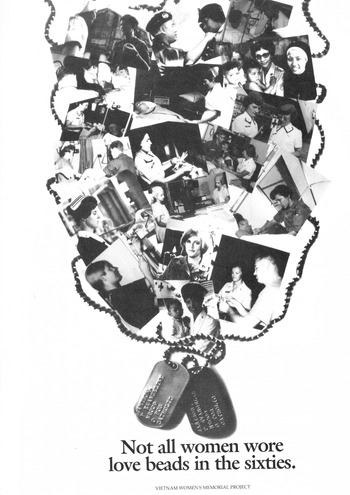
The theme of patriotism is also emphasized in the VWMP's promotional poster (Figure 10). It shows a collection of photographs of women in uniform, carrying out their duties in military and medical settings. The photographs are bound by a metal string hung with military identity tags (“dog tags”). The poster's caption reads, “Not all women wore love beads in the sixties.” Drawing on stereotypes reflecting the social divisions and domestic struggles of the 1960s, the VWMP juxtaposed “Vietnam women” (symbolized by “dog tags”) with the countercultural youth who protested the war (signified by “love beads”). In the 1960s, opinion polls consistently showed that a majority of Americans were critical of the antiwar movement, accused it of anti-American sentiments, and thought it could threaten efforts to bring the war to an honorable end.Footnote 92 Hippies were perceived as unruly and potentially violent people whose frivolous lifestyle threatened middle-class sensibilities.Footnote 93 The poster suggests that, unlike such unpatriotic youth, “Vietnam women” were dedicated to the service of their country and countrymen, and not afraid to put their lives on the line. This may indicate that the VWMP attempted to garner support for the women's memorial by weaving its message into the mainstream political discourse of the 1980s with its focus on restoring patriotism and conservative values.
The VWMP's promotional poster (courtesy of the VWMF/Eastern National).

Competence, the second of the three qualities that the VWMP attributed to “Vietnam women,” did not play as prominent a role in the organization's commemorative narrative as heroism and compassion did. The VWMP claimed that women “worked with skill,”Footnote 94 but did not discuss their formal education or training, nor mention the rules and procedures they followed during their service. The organization discussed women's competence in terms of their achievements. It pointed out that “men who would have died in previous wars survived Vietnam because of the determined efforts of women veterans.”Footnote 95 Thanks to women's expertise, thousands of soldiers’ lives were saved, families were reunited, and veterans could lead productive lives.Footnote 96 The VWMP claimed that “women saved the lives of ninety-eight percent of the wounded soldiers they cared for.”Footnote 97 While research studies do confirm the efficiency of nursing care in Vietnam,Footnote 98 the VWMP's statement should be read in light of the fact that such a high survival rate was not only due to the nurses’ competences but also to the contributions of other medical specialists: physicians, medics, laboratory analysts, and so on. The organization hardly ever mentioned the fact that around one-third of the nurses who served in Vietnam were male.Footnote 99 The above quotations indicate that women's achievements were presented through the prism of the nurses’ experiences. Nurses’ life-saving skills were extended to the whole of the “Vietnam women.” The organization also solidified a gendered representation of nursing as a uniquely female profession and emphasized its importance for the survival of male patients.
Why did the VWMP attribute the merits of the medical personnel in Vietnam exclusively to women nurses? I argue that the VWMP sought to shift the focus of conversations concerning who deserved to be commemorated, and on what grounds, from numbers to merits. It aimed to convince the veterans that, though the “Vietnam women” were sparse, their contributions were nothing short of remarkable. Evans repeated that women “worked around the clock”Footnote 100 and emphasized, “Theirs [women's] was a different battle with different weapons. Their weapons were instruments of healing which changed the course of history.”Footnote 101 The VWMP's suggestion that women emerged from the war victorious drew an implied contrast between this victory and the fact that the overall American military effort in Vietnam resulted in a defeat. The organization put forth an alternative understanding of victory, measured by the number of lives saved, not those taken away. Drawing attention to women's accomplishments, it attempted to refigure the image of Vietnam veterans as the vanquished and mitigate the sense of humiliation with which they were burdened. The organization suggested that Americans, who might be ashamed of other aspects of the war, could be proud of the women who served in Vietnam.
The VWMP's narrative suggests that in terms of courage and competence women were not inferior to men. It also maintains that compassion – a quality traditionally associated with femininity – made their war contributions deserving of memorialization. The organization used the term “compassion” to depict a variety of roles that “Vietnam women” played in and during the war. The following statement encapsulates the essence of the VWMP's understanding of compassion as a feminine quality displayed in a wartime setting: “While supposedly women were not asked to carry a gun and die for their country in combat, thousands of soldiers died in their arms.”Footnote 102 The statement is interesting because of the multiple meanings of the word “arms.” It juxtaposes an image of arms as weaponry – an instrument of violence – with arms as a symbol of care. One may thus conclude that in the ghastly reality of war, waged by men, the women's role was to preserve life in a peaceful and loving way. The VWMP's claim that soldiers died in women's arms is, of course, metaphorical. Accounts of nurses in Vietnam show that they were extremely busy and often could not pay as much attention to individual soldiers as they wanted to.Footnote 103 Nonetheless, stories about soldiers’ suffering and dying played a prominent role in the VWMP's discourse.
In one such story, Donna-Marie Boulay described how she looked after a young soldier in the intensive-care unit at a hospital in Long Binh.Footnote 104 She checked the soldier's temperature, gave him medications, and changed his dressings. At some point, however, she realized that the soldier was dying. She thus kept vigil at his bedside, holding his hand, and talking to him. She recounted, “About midnight he closed those eyes, his breathing shallow. We stopped talking. I kept holding his hand. Soon, his sparkle gone, Randy died.”Footnote 105 The story indicates that the service of nurses in Vietnam went beyond simply performing medical tasks, as they accompanied the soldiers in their dying. It places value on women's quiet presence and the invisible work of caring for those who transited from life to death. Evans elaborated on this idea in the following way:
Sometimes in war it all comes down to a voice to go with you. It is said to be the last sense we lose before we die. All of us who were nurses in Vietnam knew that what we said to our dying patients would be the voice that went with them. We tried to leave them with legacies of love.Footnote 106
Evans conveyed a sense that women's compassion was the ultimate gift to the soldiers, as it soothed their pain and loneliness. By emphasizing that women endowed the dying with a message of love, she portrayed them as carriers of universal human values.
When depicting the relations between “Vietnam women” and the soldiers, the organization often invoked the image of a mother looking after children. Boulay compared the moment she recognized Randy, who had been hospitalized before, to “discovering one of my own children lying in my Intensive Care Unit.”Footnote 107 Evans remarked that after a few weeks in Vietnam she began “to feel like those kids’ mother … They did seem so young.”Footnote 108 She also declared, “I had hundreds of sons whom I loved before my own three were born.”Footnote 109 Such depictions, however, raise certain doubts. The age difference between the genders was more indicative of a relationship between siblings than between parents and children. Moreover, owing to military regulations, most women who served during the Vietnam era did not have children.Footnote 110 Boulay and Evans referred to the imagined, rather than the lived, experience of motherhood. The organization suggested that “Vietnam women's” greatest accomplishments were related to the fact that they represented home in the military and wartime settings. Women's presence in the war created a sense of security and familiarity which helped the soldiers survive this difficult experience. The VWMP's narrative presented “Vietnam women” as carriers of domestic values and ideals that Americans, as a nation, cherish and are attached to.
Political scientist Joan C. Tronto argues that when marginalized groups seek to be recognized by those who occupy central positions in society, they need to show either that they are similar to those in the center or that they are different but nonetheless have something valuable to offer.Footnote 111 The VWMP combined those two strategies – it held that by serving in the military and volunteering for Vietnam, women had demonstrated courage and patriotism and thus proved themselves equal to men. It also claimed that women could offer the veterans’ community a unique gift: their compassion. Among the three qualities that the VWMP attributed to “Vietnam women,” competence played the least important role in the organization's discourse. Although the VWMP argued that women worked with knowledge and skill, it also held that their greatest accomplishments were related to exercising feminine qualities and representing domesticity in the military environment. In depicting women as selfless caregivers and compassionate consolers, the organization downplayed the fact that these women were highly trained and independent professionals, and many of them held officer rank. By simplifying the complexities and bracketing off some of the ambivalences that surrounded women's position in the military, the VWMP created a significantly traditional gendered portrait of women's wartime service, one that was more in keeping with a pre-1960s vision of womanhood than with the shifting understandings of gender experienced by the very women it sought to commemorate.
THE VIETNAMESE: THE MISSING OTHER
Having studied the VWMP's archival documents, one could conclude that the American soldiers were the sole victims of the Vietnam War. The organization paid significantly less attention to the suffering of other participants in the war and, at times, sought to conceal their presence. Consider, for example, the differences the archival documents reveal between the original memorial design and that which was eventually erected in the capital. The creator of the VWM modified the original memorial design that she had submitted for the design competition. In 1991, at a meeting with the CFA commissioners, Goodacre noted that it included “a standing figure that was between those two figures and she was holding a Vietnamese child, which was not acceptable.”Footnote 112 In the VWMF's archive, I found a sketch of the first memorial design. Indeed, in addition to the woman looking after the wounded soldier and the African American staring at the sky, it shows a young white woman holding a Vietnamese child in her arms. The woman is portrayed in motion – she looks as if she is running away from danger.
The VWMP's board of directors asked Goodacre to remove this figure.Footnote 113 The organization was concerned that such imagery could rekindle discussions about atrocities committed by the American soldiers and also, perhaps, about the fate of Vietnamese American children who were born during the war. The VWMP was afraid that this would cause veteran organizations to withdraw their hard-earned support for establishing the women's memorial.Footnote 114 Goodacre's laconic remark that the depiction of a woman with a child “was not acceptable” and the fact that none of the CFA commissioners commented on it seems noteworthy. Although it is difficult to interpret omissions in archival documents, given the controversy and ambivalences surrounding the commemoration of the Vietnam War one may suppose that the people gathered in the room shared a silent understanding that such a memorial design could raise questions about the American involvement in the war – questions that they wished to avoid. This situation reveals an area of self-censorship in the VWMP's discourse and suggests that the organization's narrative was restricted by the dominant mode of representing the Vietnam War through the lens of national sacrifices and the suffering of the American military personnel.
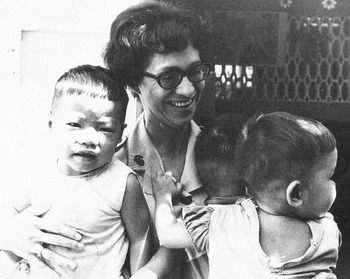
My research shows that the VWMP did not completely obliterate the presence of Vietnamese civilians. For example, a pamphlet published for the dedication of the VWM features several photographs of American women surrounded by Vietnamese children.Footnote 115 An essay written by Col. Mary V. Stremlow is illustrated with a photograph of a smiling white woman – the caption does not say if this is the author herself – holding three happy-looking Vietnamese toddlers on her lap (Figure 11).Footnote 116 The essay discusses the duties of women Marines in Vietnam. It notes that they volunteered to work in orphanages, taught English to children, and visited local families.Footnote 117 Another story depicting American women's care for the Vietnamese features a nurse who looked after a sick orphaned girl.Footnote 118 The woman became so fond of the girl that she decided to adopt her for her brother and sister-in-law as she herself could not have dependents.Footnote 119 Although not central to the VWMP's narrative, stories like these cast “Vietnam women” as humanitarians of sorts and emphasized their willingness to help the underprivileged and vulnerable, especially suffering children.
A portrait of a woman Marine holding Vietnamese children included in the pamphlet published for the dedication of the VWM (courtesy of the VWMF/Eastern National).

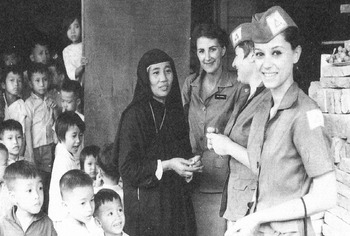
Children were not the only Vietnamese civilians depicted in VWMP materials, but the adults they chose to highlight are suggestive of ambivalent American attitudes toward Vietnamese people, and Vietnamese women in particular. Only four out of dozens of photographs in the pamphlet feature Vietnamese women. Three of these photographs show Catholic nuns. Two of the nuns’ photographs are included in a collage making up the VWMP's promotional poster captioned “Not all women wore love beads in the sixties.”Footnote 120 The first of these photographs portrays a Vietnamese nun in a white habit and a veil who is conversing with an American woman in military garb. The women are standing in front of a building topped with a cross.Footnote 121 In the second photograph, a young grinning Vietnamese nun is sitting next to an American military woman who is holding Vietnamese toddlers on her lap.Footnote 122 In the center of another photograph included in the pamphlet – which illustrates an article about civilian women who served in Vietnam – there is a smiling Vietnamese nun surrounded by several American women dressed in Army Special Services uniforms and a group of Vietnamese children (Figure 12).Footnote 123 The message of these photographs is uniformly positive. It suggests friendly cooperation between American and Vietnamese women in taking care of local children, replacing their parents whose absence – it needs to be noted – is not explained in any manner.
Women and children – another photograph from the VWM's dedication pamphlet (courtesy of the VWMF/Eastern National).

The VWMP's decision to portray Vietnamese women as nuns is particularly interesting in light of Heather Marie Stur's book entitled Beyond Combat: Women and Gender in the Vietnam Era.Footnote 124 The author argues that in American popular culture, military propaganda, and GI folklore alike, Asian women were often depicted either as damsels in distress (innocent, submissive, and in need of male protection), as dragon ladies (mysterious, erotically alluring, and treacherous), or as sexual objects to be dominated and possessed.Footnote 125 These contradictory and ambivalent representations of Asian femininity were informed by US foreign policies which embodied both the ideal of protection and a desire for dominance in South East Asia.Footnote 126 The imagery described above provided justification for American intervention in Vietnam; it also revealed fantasies and anxieties concerning Asian women and their sexuality.
By invoking the figure of a nun – someone who devoted her life to religious worship and charitable work – the VWMP placed Vietnamese women outside the framework of conventional gender roles and stereotypes. It undermined the prejudice regarding their morality and behavior. By showing the nuns’ gentleness and dependence on American help, the organization mitigated some of the controversy surrounding US involvement in Vietnam. Moreover, the stark contrast between the photographs of Vietnamese nuns – presented as an asexual Other in timeless habits – and American servicewomen – portrayed in uniforms and civilian clothes, sometimes wearing makeup and the latest in fashionable hairstyles – made the latter an emblem of the gendered social order the soldiers were familiar with, as well as a reminder of the women who waited for them back home. One could thus conclude that in the VWMP's discourse gender was used to signify national differences. This is supported by an observation that the organization's archival documents feature virtually no examples of women's transnational solidarity – gestures of empathy from American women toward Vietnamese women or interest in their war experiences and postwar fates.
CONCLUSIONS
The VWMP did not offer a novel interpretation of the Vietnam War. On the contrary, by adopting the premises and demands of both the therapeutic and heroic modes of remembering the war, the VWMP's narrative solidified the dominant understandings of this historic event in the US. The ambivalence surrounding the American military intervention and its defeat, as well as the shifts in the understanding of heroism and masculinity that had occurred during the war, created an opportunity for “Vietnam women” to articulate their commemorative claims and enter the sphere of national commemoration. In the absence of a consensus regarding how to commemorate the war and in the presence of uncertainties regarding the veterans’ courage and moral standing, the VWMP made a case that women deserved to be recognized as national heroines. Drawing on traditional depictions of a war hero as someone valiant and selfless, the organization argued that women's heroism consisted in the fact that they answered their country's call to serve and were not afraid to put their lives on the line. It also held that what made their contributions exceptionally valuable was their compassion. The organization thus reinstated the figure of the patriotic war hero, which had been undermined by the circumstances of the Vietnam War, but also emphasized that this hero's most important qualities were benignity and benevolence. The VWMP's depictions of “Vietnam women” as heroines of compassion embraced both the masculine ideal of heroism and the feminine ideal of care and nurturance. They addressed the multilayered sense of loss related to the Vietnam War and underscored the importance of compassion as an antidote to suffering.
The VWMP regarded women's role in military and wartime settings as secondary to that of the men. It emphasized that women supported and consoled the soldiers, provided them with maternal figures, and created an atmosphere of domesticity in the combat zone. Although the organization's narrative was firmly focussed on the relationship between the suffering soldiers and the compassionate “Vietnam women,” it included examples of women's care for Vietnamese children. However, the fact that the VWMP's narrative failed to engage with ethical concerns regarding American intervention, and avoided addressing its tragic consequences for the civilians, suggests that those examples were intended to project a positive image of American military personnel. The VWMP's understanding of wartime suffering as well as “Vietnam women's” compassion were informed by national loyalties and sentiments and, at the same time, served them in some important ways. By pointing to women's sympathy and care for the destitute and vulnerable, the organization sought to restore the narratives that the American people used to tell about themselves before the war. Those narratives held that the US was a redeemer nation, which acted for the good of the other nations of the world. By showing the sacrifices of the fighting men and the devotion of the women who supported them, the VWMP attempted to break the stigma connected to their participation in the war and transform this historic event into a symbol of national reconciliation – it sought to rehabilitate American involvement in the Vietnam War.
When I was preparing the first version of this article in the spring of 2020, a wave of protests and civil unrest was sweeping across the US after the murder of an African American named George Floyd at the hands of a white Minneapolis police officer. The protests pushed for a reexamination of the enduring legacies of colonialism and racial injustice in the US. Public monuments and statues were at the center of these intense reckonings with the past. Over the last year, many of the contentious monuments have been removed.Footnote 127 Those events made me wonder about the future of the memorial that I have been investigating. The annual Veterans Day and Memorial Day ceremonies at the VWM are attended by a declining number of women who served in Vietnam, and their families and friends. Although women involved with the VWMF speak passionately about their experiences, the organization has failed to engage with younger generations of female veterans. What social significance will the memorial have once Vietnam veterans pass away? It would be interesting to study the memorial's reception, particularly among women who serve in the military today. Those women make up more than 16 percent of the total US military strength and can serve in all positions, including ground combat.Footnote 128 Are they aware of the VWM's presence on the National Mall? Do they feel a connection to the memorial and the women it commemorates? What do they think about its portrayal of gender roles? An examination of the memorial's reception – especially shifts in its interpretations and the meanings ascribed to it – would complement the discussion of the VWMF's politics of memory presented in this article. A combination of those two approaches to studying the public memory surrounding the VWM could provide new insights into the complex processes by which communities imagine and reimagine their past, under what present circumstances, and with what visions of the future.