The National Science Foundation (NSF), authorized by Congress in 1950, funds political science research that “advances knowledge and understanding of citizenship, government, and politics” (National Science Foundation [NSF] Directorate for Social, Behavioral and Economic Sciences 2010). In recent years, the NSF political science program has supported research on subjects important to democratic governance such as elections, democratization, regime transition, and international conflict (NSF Directorate for Social, Behavioral and Economic Sciences 2010). In addition to funding faculty research, the political science program supports undergraduate and graduate research as well as the American National Election Studies (ANES) survey, one of the most important sources of data that exists on the political attitudes and behaviors of the American people. In fiscal year 2008, the NSF funded 34 new projects and 25 doctoral dissertation improvement grants totaling $5,201,068 (American Political Science Association 2009).
On October 13, 2009, Senator Tom Coburn (R-OK) filed an amendment to the 2010 Commerce, Justice, Science, and Related Agencies Appropriations Act (H.R. 2847) that would eliminate political science funding from the NSF budget (see appendix). Coburn argued that political science “really is not science at all” and that “theories on political behavior are best left to CNN, pollsters, pundits, historians, candidates, political parties, and the voters, rather than being funded out of taxpayers' wallets.”Footnote 1 While conceding that political scientists may have some “interesting theories,” Coburn contended that Americans can turn to “CNN, FOX News, MSNBC, the print media, and a seemingly endless number of political commentators on the internet who pore over this data and provide a myriad of viewpoints.” Coburn was also concerned that political scientists have not found “cures to cancer or any other disease” and noted his preference that funds be spent on “technology, engineering, and mathematics.”Footnote 2
The APSA organized to stop the passage of the Coburn Amendment. APSA President Henry Brady wrote a public letter to the members of the Senate arguing that “if we undercut one area of science, such as political science, we will weaken all the sciences and the potential for important contributions to society.”Footnote 3 In response to Coburn's concern that political science has not yet found a cure for cancer, Brady argued that “physical science research that may affect health or safety will not matter, or will be inefficiently or unfairly applied, if our understanding and application of policy making and of democratic processes are flawed or misunderstood.” Brady further contended that cutting NSF political science funding “would deprive the country of knowledge critical for making our own democracy stronger, for understanding the actions of nations around the world, of achieving efficiencies and fairness in our public policies, and of enriching the work of other sciences, physical, biological, social, and economic to address national needs through interdisciplinary partnerships.”
In addition to this open letter, the APSA worked with the Consortium of Social Science Associations, the American Council on Education, the American Psychological Association, the National History Coalition, and other supporters (Brintnall Reference Brintnall2009) to protest the amendment. APSA members were also encouraged to contact their senators and voice opposition to the amendment. A link to the Web site petition2Congress.com was distributed to APSA members encouraging them to sign a petition that would be sent to their respective senators.Footnote 4 3,840 people petitioned their senators through this portal before the vote.Footnote 5
The vote on the Coburn Amendment took place November 5, 2009. Little media attention was given to the proposed amendment, and little debate took place on the Senate floor.Footnote 6 Senator Coburn commented on the economics of his proposed amendment, stating that: “I would dare to say that maybe in a time of $1.4 trillion deficits, maybe at a time when we have 10 percent unemployment, maybe at a time when we are at the worst financial condition we have ever been in our country's history, maybe we ought not spend money asking the questions why politicians give vague answers, or how we can do tele-townhall meetings and raise our numbers. Maybe we ought not to spend this money on those kinds of things right now.”Footnote 7 Coburn went on to accuse political scientists of fiscal irresponsibility: “You see, it is instructive because those who are getting from the federal government now do not care about their grandchildren. What they want is what they are getting now. Give me now; it doesn't matter what happens to the rest of the generations that follow us.” Coburn even went so far as to compare funding political science grants to “waterboarding” American children.Footnote 8
Senator Barbara Mikulski (D-MD) argued against the amendment, citing that Elinor Ostrom, “the very first American woman to win the Nobel Prize for economics ever has received 28 awards from the National Science Foundation, the science program offered to political science professors.”Footnote 9 Mikulski also called the Coburn Amendment “an attack on science” and “an attack on academia.”
The amendment was defeated 36 to 62, with two senators not voting.Footnote 10 Thirty-one Republicans and five Democrats supported the measure. Fifty-one Democrats, nine Republicans, and two independents voted against the amendment.
Studies show that legislators' personal experiences and preferences, their place within the legislative body, and their constituencies' preferences and characteristics may all play a role in determining their voting behavior. The Coburn Amendment was not salient to the wider public or the media, and therefore we expected legislators' usual set of incentives—such as reelection and adherence to party—to be somewhat muted in comparison to their incentives in other votes (e.g., Uscinski et al. Reference Uscinski, Rocca, Sanchez and Brenden2009). There was little reason to expect this amendment to initiate a high-stakes battle on which party fortunes rested, and therefore little reason to expect parties to expend much effort in fighting it (e.g., Bawn and Koger Reference Bawn and Koger2008). Therefore, the vote on the Coburn Amendment provides an ideal case to determine the impact of each senator's individual, constituency, and institutional characteristics on his or her vote.
DATA
Dependent Variable
Our dependent variable was a binary measure of the vote. Votes against the amendment were coded 1; votes in favor of the amendment (and in favor of cutting political science funding) were coded 0. Sixty-two senators voted against the amendment, 36 voted in favor, and two abstained and were excluded from the data set. As a result, the data contain 98 observations.
Individual Characteristics
Previous research has shown that a legislator's background can impact his or her vote (e.g., Burden Reference Burden2007). For example, previous studies of House members have focused on legislators' personal experiences, religion, race, gender, and other relevant characteristics (e.g., Uscinski et al. Reference Uscinski, Rocca, Sanchez and Brenden2009; Rocca and Sanchez Reference Rocca and Sanchez2008; Rocca, Sanchez, and Uscinski Reference Rocca, Sanchez and Uscinski2008). With this said, there is little racial diversity in the Senate and little theoretical reason to believe that whatever religious diversity exists in the Senate would have any bearing on this particular vote. For explorative purposes, however, we did include a binary variable signifying the senators' gender (e.g., Swers Reference Swers2002; Swers Reference Swers2001; Swers Reference Swers1998). The dataset includes 16 female senators.
We also expected senators' educational experiences to affect their voting behavior. Because college students usually major in subjects for which they have an affinity, we expected senators who majored in political science as undergraduates to vote to keep NSF political science funding. We expected those that majored in other subjects to be more likely to vote to eliminate NSF funding. Twenty-eight senators in the dataset majored in political science as undergraduates and 70 did not.Footnote 11
Constituency Characteristics
Beyond making good policy, senators' prime concerns center on reelection, because without it, no other goals can be achieved (Fenno Reference Fenno1973; Mayhew Reference Mayhew1974). Therefore, scholars have found legislative behavior to be electorally oriented, and, as a result, the legislators' constituencies affect their voting behavior (Miller and Stokes Reference Miller and Stokes1963). In this study, we expected the characteristics of the senators' respective states (e.g., the amount of the constituency to be affected by, or to care about, NSF cuts) to affect voting on the Coburn Amendment. First, we expected senators from states with Ph.D. programs in political science to vote to keep political science NSF funding for fear of angering their constituents. We included three variables to measure this: the number of political science Ph.D. programs in each state, the number of top 50 Ph.D. political science programs in each state, and the number of top 20 Ph.D. political science programs in each state.Footnote 12 We expected increases in each of these variables to increase the likelihood of each senator voting to keep NSF funding.
We also expected senators from states with political science scholars that have recently received funding from the NSF to be less likely to support cutting NSF funding. Even though the Coburn Amendment would not affect past awardees, previous research suggests that senators do not want to be seen as “taking away the bacon,” or cutting future funding opportunities for scholars currently dependent on NSF grants (e.g., Jackson and King Reference Jackson and King1989). Therefore, we included a variable measuring the number of NSF political science grants awarded by state for fiscal year 2008 (American Political Science Association 2009). California had the most awardees, with 13. Texas and Illinois were tied for the second most recipients, with nine each.
We also obtained a direct measure of constituency pressure. The APSA encouraged members to petition their senators through the Web site petition2congress.com. This Web site sends an automated message to the constituent's respective senators. We obtained the number of constituents in each state that petitioned their senators to keep NSF funding for political science. We expected that more petitions from constituents would lead to a higher probability of voting to keep political science funding.Footnote 13 California had the most petitioners, with 433; Wyoming had the fewest, with one.
Our last measure of constituency opinion was the percentage of each state's population with an advanced degree.Footnote 14 We expected that a constituency with a high proportion of graduate degrees would be in favor of funding social science research; this would therefore encourage senators to vote to keep NSF funding. Vermont has the highest percentage of advanced degrees in the population, while California has the lowest.
Institutional Characteristics
Along with individual and constituency characteristics, institutional factors have also been shown to affect legislators' voting behavior (Fenno Reference Fenno1973; Groseclose Reference Groseclose1994; Snyder and Groseclose Reference Snyder and Groseclose2000). We included a binary variable to denote party identification; Democratic senators were coded 1. We expected Democrats to be more in favor of keeping political science funding, given that social scientists tend to overwhelmingly support Democrats (e.g., Cardiff and Klein Reference Cardiff and Klein2005). With this said, however, we had little reason to expect that Republicans would want to “target” political science.
Because senators' terms are staggered, we also expected support for the Coburn Amendment to be affected by the number of years until the senator's next election. Senators coming up for reelection in 2010 may have voted to cut NSF funding for political science to show their fiscal responsibility. Senators temporarily insulated from reelection may have felt freer to support further NSF funding, because this amendment was unlikely to be an issue with voters three or five years after the fact.
In our analysis, we also included a binary variable indicating membership on the Senate Appropriations Subcommittee on Labor, Health and Human Services, Education, and Related Agencies. This subcommittee oversees education spending and has experience judging the importance and merit of academic research. Therefore, we expected the 15 members of this subcommittee to support further NSF funding for political science.Footnote 15
Finally, we included a variable measuring the number of years since each senator first took office in the Senate. We expected that senior senators would support further political science funding, because it is likely that they have interacted with or relied on political scientists over the years for campaign strategy and policy analysis.Footnote 16
RESULTS
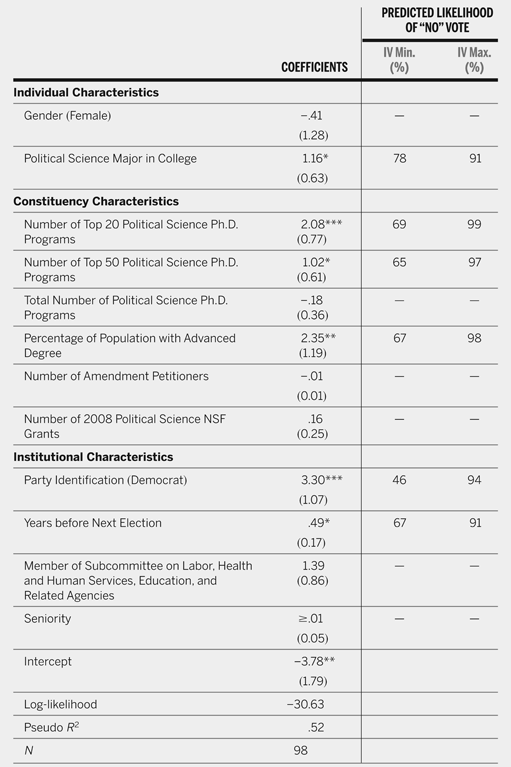
The results of our logistic regression analysis of the Coburn Amendment vote are presented in table 1. Positive coefficients indicate that the variable is indicative of a senator who is more favorable toward funding political science research (or at least is not unfavorable towards it), while negative coefficients indicate that the variable correlates with the likelihood of a senator having voted to end NSF political science funding. For significant coefficients, columns two and three of the table present the estimated substantive effect of each variable on the likelihood of voting against the Coburn Amendment.Footnote 17 Each estimate was made while holding all other factors in the model at their means. Dichotomous variables were interpreted by comparing the likelihood of voting no on the amendment in each of the two categories (i.e., Democrats, Republicans), while nondichotomous variables were interpreted by comparing the minimum and maximum values of the variable. The model correctly predicted the vote of 85% of senators: 88% of no votes were correctly predicted (56 of 64), while 79% of yes votes were correctly predicted (27 of 34).
Regression Analysis of “No” Vote on Coburn Amendment

Notes.
* p ≤ .10
** p ≤ .05
*** p ≤ .01 (robust standard errors in parentheses)
Standard errors were clustered by state. Two senators who abstained from the vote (Byrd and Landrieu) were not included in the analysis.
Individual Characteristics
Starting at the top of the table with the individual characteristics of senators, we see that gender has no relationship with how senators voted on the Coburn Amendment. However, senators who majored in political science as undergraduate students were more likely to support funding political science research.Footnote 18 Senators who majored in political science are 13 percentage points more likely to vote against the amendment than senators who did not major in political science. This suggests that senators have an affinity for the subjects they studied during their college years. For example, Kit Bond (R-MO) attended the Woodrow Wilson School of Public and International Affairs at Princeton as an undergraduate and voted to keep political science funding. However, not all political science majors supported political science funding: Claire McCaskill (D-MO), once a political science major at the University of Missouri, voted to end political science NSF funding.
Constituency Characteristics
We found that constituency characteristics are highly related to senators' voting behavior. Although the raw number of political science Ph.D.-granting institutions in each state has an insignificant relationship with vote choice, our analysis indicates that having more top 20 and top 50 political science Ph.D. programs in one's state increased the likelihood of voting against the Coburn Amendment. Substantively, the presence of more top 20 political science Ph.D. programs in a state increased the likelihood of a senator's no vote by 30 percentage points; the estimate for top 50 programs is comparable at 32 percentage points. These results suggest that senators may have been unwilling to deny potential funding to prominent political science programs in their states.
The results presented in table 1 also show that senators who represented states with higher percentages of residents with advanced degrees were more likely to vote against the Coburn Amendment. Substantively, the presence of more citizens with advanced degrees in a state increased the likelihood of a no vote by 31 percentage points. This tendency perhaps derives from the possibility that this part of the constituency is, because of their high educational attainment, likely to be sympathetic toward social scientific research.
In our analysis of constituency characteristics, we also accounted for direct lobbying by the public. The APSA made great efforts to mobilize the political science community; almost four thousand individuals contacted their senators about the amendment. The response of the political science community was even mentioned by Coburn: in a speech on the Senate floor preceding the vote, he referred to the political science community as “hot and bothered.”Footnote 19 Despite the lobbying efforts, our results show that the number of petitioners in each state did not correlate with senators' voting behavior.Footnote 20 This finding comports with recent works demonstrating the futility of mass e-mail lobbying campaigns (Shulman Reference Shulman2009).
Finally, we also found that the number of political science NSF grants received in each state in 2008 had no relationship to senators' votes on the Coburn Amendment.Footnote 21 Since NSF grants are competitive and awarded annually, senators may not have been concerned with the number of active grants currently in their state.
Institutional Characteristics
The bottom portion of table 1 suggests that institutional factors played a significant role in the vote as well. In this age of party polarization (Hetherington Reference Hetherington2001; Poole and Rosenthal Reference Poole and Rosenthal1984; Poole and Rosenthal Reference Poole and Rosenthal2007), one might expect party to be a major predictor of the senators' voting behavior in general. On the other hand, given that the Coburn Amendment was neither salient to the wider public nor tied to party reputation, one might expect party to play little role in the Coburn Amendment vote. Our results show that party is the most potent predictor of the vote; Democratic senators were more likely to vote against the Coburn Amendment while Republicans were more likely to vote to cut political science funding. Specifically, Democrats were 48 percentage points more likely to vote to maintain political science funding than Republicans.
Senators temporally insulated from reelection were also more likely to vote against the amendment. Conversely, those closer to reelection were more likely to vote in favor of eliminating political science funding. Senators who were farther away from reelection were 24 percentage points more likely to have voted against the amendment. Senators further from reelection may have felt insulated from the need to appear fiscally responsible and may have felt the freedom to continue to fund government programs during a time of economic crisis.
Finally, our data also show that being a member of the Senate Appropriations Subcommittee on Labor, Health and Human Services, Education, and Related Agencies had no relationship with how senators voted on the Coburn Amendment. A senator's seniority also had no relationship with their vote.
DISCUSSION
The vote on the Coburn Amendment provides a unique opportunity to not only identify political science's benefactors, but also to understand the factors that drive congressional voting behavior. Constituency characteristics such as the number of top 20 and top 50 political science Ph.D. programs in the state and the percent of the constituency with an advanced degree predict senators' voting patterns. Personal characteristics were significant predictors as well: senators that graduated with a bachelor's in political science were more likely to support political science funding. Given that almost a third of current senators were political science majors in college, our students may very well wind up in the Senate one day. As political science educators, we should expose our undergraduate students to political science research and stress our work's importance and contribution to society.
In conclusion, while this article sheds light on the determinants of the Coburn Amendment vote, a number of additional questions related to how Congress treats our field of study need to be addressed. This vote is the third time since 1995 that Republicans in Congress have attempted to cut NSF funding for social sciences. Why do Republicans seem to have a disdain for political science? Why was political science targeted and not the other social sciences? In light of the massive spending that is currently taking place in Washington, why would the NSF, with its relatively miniscule budget, receive scrutiny in the first place? We encourage our colleagues to apply for NSF political science funding to address these questions.
APPENDIX
This amendment was proposed to the bill H.R. 2847, an appropriations bill for the Departments of Commerce and Justice, and Science, and Related Agencies for the fiscal year ending September 30, 2010.
Sec. __. None of the funds appropriated under this Act may be used to carry out the functions of the Political Science Program in the Division of Social and Economic Sciences of the Directorate for Social, Behavioral, and Economic Sciences of the National Science Foundation.