INTRODUCTION
Thecosomata are holopelagic molluscs (Gastropoda: Opisthobranchia) and are important grazers on microplankton as well as prey for fish, squid, and other plankton (Mackas & Galbraith, Reference Mackas and Galbraith2012). Two groups of Thecosomata can be distinguished (Bouchet et al., Reference Bouchet, Rocroi, Fryda, Hausdorf, Ponder, Valdes and Waren2005). The older but still widely used names of the groups (see Ponder & Lindberg, Reference Ponder and Lindberg1997) are presented in parentheses. Cavolinoidea (Euthecosomata) which always produce an aragonite (a polymorph of calcium carbonate) shell (see Glaçon et al., Reference Glaçon, Rampal, Gaspard, Guillaumin and Staerker1994) and Cymbulioidea (Pseudothecosomata) which do not always produce a shell. Two groups exist within the Cavolinoidea: the Cavoliniidae with an uncoiled shell and the Limacinidae with a left-coiled shell. Within the Cymbulioidea, three groups exist: Cymbuliidae do not have a shell, these animals have a gelatinous pseudoconch, Desmopteridae neither have a shell nor a pseudoconch, and Peraclidae have a left-coiled shell often with structures. Recent molecular–genetic methods revealed that Thecosomata and Gymnosomata, which never have a shell, are sister groups (Klussmann-Kolb & Dinapoli, Reference Klussmann-Kolb and Dinapoli2006); together, they are also known as Pteropoda or sea-butterflies.
The muscular wings which are homologous to the gastropod foot allow swimming and feeding. These animals are mucous-filter-feeding organisms; they collect material with a mucous net and consume strings of the mucous containing food particles (Morton, Reference Morton1954; Gilmer, Reference Gilmer1974). The food mainly consists of dinoflagellates, diatoms, protozoans and organic aggregates (Bé & Gilmer, Reference Bé, Gilmer and Ramsay1977). Thecosomata themselves are prey for carnivorous organisms like Gymnosomata, Chaetognatha and fishes (McGowan, Reference McGowan1968). Mucous flocs, faeces, dead animals and their aragonitic shells can contribute significantly to the organic and inorganic particle flux into the ocean's interior (Betzer et al., Reference Betzer, Byrne, Acker, Lewis, Jolley and Feely1984; Alldredge & Silver, Reference Alldredge and Silver1988; Manno et al., Reference Manno, Tirelli, Accornero and Umani2010; Howard et al., Reference Howard, Roberts, Moy, Lindsay, Hopcroft, Trull and Bray2011; Hüneke & Henrich, Reference Hüneke, Henrich, Hüneke and Mulder2011). Worldwide, this group contributes at least 12% of the total vertical flux of calcium carbonate into the oceans (Berner & Honjo, Reference Berner and Honjo1981); however, 90% of the aragonite flux by Thecosomata is already remineralized in the upper 2200 m of the water column (Betzer et al., Reference Betzer, Byrne, Acker, Lewis, Jolley and Feely1984).
The CO2 concentration in the atmosphere has increased from 280 ppm in pre-industrial times to 390 ppm today due to fossil burning (see Feely et al., Reference Feely, Sabine, Lee, Berelson, Kleypas, Fabry and Millero2004). So far, the oceans absorbed approximately 30% of the surplus CO2 in the surface layers, which already dropped the surface pH of the ocean by ~0.1 units compared to pre-industrial values (Meehl et al., Reference Meehl, Stocker, Collins, Friedlingstein, Gaye, Gregory, Kitoh, Knutti, Murphy, Noda, Raper, Watterson, Weaver, Zhao, Solomon, Qin, Manning, Chen, Marquis, Averyt, Tignor and Miller2007; Turley et al., Reference Turley, Eby, Ridgwell, Schmidt, Findlay, Brownlee, Riebesell, Fabry, Feely and Gattuso2010). Releasing more CO2 into the atmosphere will cause additional acidification of the oceans. This will affect carbonate-shell bearing organisms since more energy is necessary to cope with decreased carbonate ion concentrations in seawater (Cohen & Holcomb, Reference Cohen and Holcomb2009), hence, shell-bearing Thecosomata are potentially threatened by increased CO2 concentrations (Orr et al., Reference Orr, Fabry, Aumont, Bopp, Doney, Feely, Gnanadesikan, Gruber, Ishida, Joos, Key, Lindsay, Maier-Reimer, Matear, Monfray, Mouchet, Najjar, Plattner, Rodgers, Sabine, Sarmiento, Schlitzer, Slater, Totterdell, Weirig, Yamanaka and Yool2005; Mackas & Galbraith, Reference Mackas and Galbraith2012). Wall-Palmer et al. (Reference Wall-Palmer, Hart, Smart, Sparks, Friant, Boudon, Deplus and Komorowski2012) concluded from the fossil record over the past 250,000 years that calcification in Thecosomata was linked to global changes in pCO2 and the pH of seawater has noticeably affected this group. Some newer publications deal with the response of Thecosomata to ocean acidification (Orr et al., Reference Orr, Fabry, Aumont, Bopp, Doney, Feely, Gnanadesikan, Gruber, Ishida, Joos, Key, Lindsay, Maier-Reimer, Matear, Monfray, Mouchet, Najjar, Plattner, Rodgers, Sabine, Sarmiento, Schlitzer, Slater, Totterdell, Weirig, Yamanaka and Yool2005; Comeau et al., Reference Comeau, Gorsky, Jeffree, Teyssie and Gattuso2009, Reference Comeau, Gorsky, Alliouane and Gattuso2010; Maas et al., Reference Maas, Wishner and Seibel2012a) and confirmed that Thecosomata are threatened by a reduced oceanic pH. Therefore, it is very important to monitor these species to quantify the ecosystem impacts resulting from species loss caused by ocean acidification in the Holocene (see also Hunt et al., Reference Hunt, Pakhomov, Hosie, Siegel, Ward and Bernard2008; Howard et al., Reference Howard, Roberts, Moy, Lindsay, Hopcroft, Trull and Bray2011).
Thecosomata mainly occupy the upper 200 m of the water column but some species also live in mesopelagic (van der Spoel & Dadon, Reference Spoel, Dadon and Boltovskoy1999) and deeper layers (van der Spoel, Reference Spoel, Gasca and Suárez-Morales1996). Most of the species can be found in the circumglobal warm-water belt, but a few taxa also abundantly inhabit polar and subpolar regions (Bé & Gilmer, Reference Bé, Gilmer and Ramsay1977), where they can contribute up to 35% of the zooplankton biomass (Pakhomov & Froneman, Reference Pakhomov and Froneman2004). Dadon & Masello (Reference Dadon and Masello1999) investigated the composition and abundance of Theocosomata in surface waters along a transect across the South Atlantic from Mar del Plata (Argentina) to Cape Town (South Africa). In total, the authors presented data for 10 species and referenced most of the older literature about ‘Pteropoda’, including the zoogeographic and taxonomic review of euthecosomatous Pteropoda by Bé & Gilmer (Reference Bé, Gilmer and Ramsay1977). Dadon & Masello (Reference Dadon and Masello1999) detected the highest abundance of a Limacinidae species (Limacina bulimoides) with almost 360,000 ind./1000 m−3 in the Benguela Current region.
The Benguela Current ecosystem belongs together with the Humboldt Current system, the Canary Current system and the California Current system to the four major eastern boundary upwelling systems of the world (Hutchings et al., Reference Hutchings, van der Lingen, Shannon, Crawford, Verheye, Bartholomae, Plas, Louw, Kreiner, Ostrowski, Fidel, Barlow, Lamont, Coetzee, Shillington, Veitch, Currie and Monteiro2009). The northern Benguela Upwelling zone extends from the perennial upwelling cell off Lüderitz (26–27°S) to the Angola Benguela Front at ~15°S (Shannon, Reference Shannon1985). Off Walvis Bay (23°S), central Namibia, maximum upwelling occurs from April to December (Hutchings et al., Reference Hutchings, Verheye, Huggett, Demarcq, Cloete, Barlow, Louw and Silva2006). The system was subject to long-term changes during the last 50 years. Overfishing, climate changes and eutrophication (see Heymans et al., Reference Heymans, Shannon and Jarre2004; Flynn et al., Reference Flynn, Richardson, Brierley, Boyer, Axelsen, Scott, Moroff, Kainge, Tjizoo and Gibbons2012) resulted in several changes of the ecosystem structure of the northern Benguela Current system. Verheye et al. (Reference Verheye, Richardson, Hutchings, Marska and Gianakouras1998) noted a long-term increase in zooplankton abundance and a change in species composition in the southern Benguela Current system from 1951 onwards. This was probably caused by a decrease in predation pressure due to a decrease in stocks of pelagic fish together with an intensification of coastal upwelling. There are some indications for a similar overall increasing long-term trend in coastal zooplankton abundance in the northern Benguela Current system (Hutchings et al., Reference Hutchings, Verheye, Huggett, Demarcq, Cloete, Barlow, Louw and Silva2006). Hansen et al. (Reference Hansen, Cloete and Verheye2005) observed a change in dominance towards larger copepods off Walvis Bay over the past four decades. Recently, Flynn et al. (Reference Flynn, Richardson, Brierley, Boyer, Axelsen, Scott, Moroff, Kainge, Tjizoo and Gibbons2012) provided some evidence that jellyfish abundance increased in the northern Benguela Current system concomitantly with a decline in fish stocks. These jellyfish can contribute significantly to the diet of the bearded goby Sufflogobius bibarbartus, a new key component of the pelagic food web off Namibia (van der Bank et al., Reference Bank, Utme-Palm, Pittman, Sweetman, Richoux, Brüchert and Gibbons2011).
Despite the importance of Thecosomata for particle flux dynamics and the potential threat posed to them by ocean acidification, little is known about this group and their ecological role in the changing Benguela Current ecosystem. In this publication, we will provide data on the taxonomic composition, abundance and ecology of Thecosomata from the coast into the open ocean in the northern Benguela Current region off central Namibia and speculate about their role in a more acidic ocean.
MATERIALS AND METHODS
Sampling
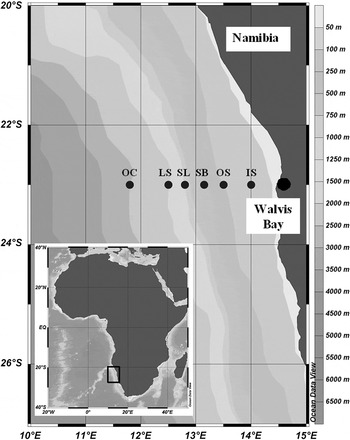
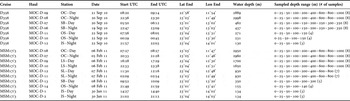
Sampling was conducted on a transect from the open ocean off Walvis Bay, Namibia, (23°S; 14°–11°30′E) in the northern Benguela Current System on a cruise with the British research vessel RRS ‘Discovery’ in September 2010 (four stations: inner and outer shelf, shelf break, oceanic; Figure 1, Table 1) and on a cruise with the German research vessel ‘Maria S. Merian’ in January/February 2011 (six stations: inner and outer shelf, shelf break, slope, lower slope, oceanic; Figure 1, Table 1).
Sampling sites off Walvis Bay, Namibia. OC, oceanic; LS, lower slope; SL, slope; SB, shelf break; OS, outer shelf; IS, inner shelf.

Sampling data.

D356, RRS ‘Discovery’ cruise 356; MSM17/3, RV ‘Maria S. Merian’ cruise 17/3; MOC; MOCNESS; OC, oceanic; LS, lower slope; SL, slope; SB, shelf break; OS, outer shelf; IS, inner shelf; local time, UTC + 2 hours.
Samples were taken by oblique hauls (towing speed: 2 knots) with a 1 m2-double-MOCNESS (Multiple Opening and Closing Net and Environmental Sensing System; Wiebe et al., Reference Wiebe, Morton, Bradley, Backus, Craddock, Barber, Cowles and Flierl1985) equipped with 18 nets of 333 µm mesh aperture. The nets can be sequentially opened and closed at defined depths (Table 1) allowing vertical resolution of the water column. The Double-MOCNESS is constructed of 2 × 9 nets side by side for parallel sampling. The filtered volume of each net was determined by a flow-meter. Veering and heaving speed of the winch was 0.5 m/s−1, by this maintaining a MOCNESS-frame angle of 45° and an effective mouth-opening of 1 m2. Changes in tilt were measured with an inclinometer and considered in the calculation of the filtered volume. Upon recovery of the MOCNESS, the nets were rinsed with seawater; plankton from nets of one side of the MOCNESS were preserved in a 4% formaldehyde–seawater solution buffered with sodium tetraborate (Steedman, Reference Steedman1976) for biomass and taxonomic analyses. The material from the residual nets was frozen at −20°C for later biochemical and stable isotope analyses. A CTD rosette sampler (SBE 911+) was used to collect water samples from different depth and to measure environmental data like temperature, salinity, oxygen and fluorescence during the two cruises. The South-Atlantic Central Water (SACW) fraction of central water was estimated based on the water mass definition for SACW and Eastern South-Atlantic Central Water (ESACW) given by Mohrholz et al. (Reference Mohrholz, Bartholomae, Plas and Lass2008). Based on the assumption that isopycnal mixing due to mesoscale dynamics is much larger than diapycnal mixing below the upper mixed layer, the SACW fraction was calculated along isopycnals in TS space.
Taxonomy and counting
In the laboratory, the preserved zooplankton samples were sieved into fractions of <0.5, 0.5–1, 1–2, 2–5 and >5 mm. After placing the fractions in 70% ethanol for 30 seconds and drying them on tissue paper, the material was wet weighed on an analytical balance. After weighing, the samples were transferred into a sorting fluid composed of 0.5% propylene-phenoxetol, 5.0% propylene-glycol and 94.5% fresh water (Steedman, Reference Steedman1976). The Thecosomata were removed from the fractionated samples, sorted to species level, and counted. The size-fractionated data were summed up for the purpose of this study. Individual concentrations related to a volume of 1000 m3 (ind./1000 m−3 = counts × 1000/filtered water volume) and standing stocks expressed as number of individuals below 1 m2 of the sampled water column (ind./m−2 = ∑(ind./m−3 × thickness of the sampled depth strata)i, where i are the strata sampled per haul) are presented in the study. To allow the presentation of zero values on a log-scale, 1 was added to the concentrations. The applied taxonomic classification was according to Bouchet et al. (Reference Bouchet, Rocroi, Fryda, Hausdorf, Ponder, Valdes and Waren2005). The key of van der Spoel & Dadon (Reference Spoel, Dadon and Boltovskoy1999) was used for species identification.
Weighted mean depth and community analyses
To determine the mean vertical distribution of the species, the weighted mean depth (WMD) was calculated (Perry et al., Reference Perry, Harding, Loder, Tremblay, Sinclair and Drinkwater1993):
 $${\rm WMD} = \sum \lpar N_{Di}\times D_{i}\rpar / \sum N_{Di}$$
where N Di is the abundance of the Thecosomata species in the depth layer (i) and D i the mean depth of the sampling interval in metres.
Diversity, evenness and the dominance of species (juveniles and taxa not assigned to a species were not included in the calculation) was calculated for each station using the following indices.
Diversity index (H) after Shannon & Weaver (Reference Shannon and Weaver1949)
 $$H=\sum \lcub \lpar n_{i}/N\rpar \times \ln \lpar n_{i}/N\rpar \rcub$$
where N is the total abundance of all Thecosomata species and ni represents the abundance of the (ith) species. The index usually assumes values between 0 and 5, where 0 represent only one species in the sample.
Evenness (J) at each station was calculated using Pielou's (Reference Pielou1966) formula based on the Shannon–Weaver index (H)
 $$J = H / \ln\lpar N\rpar$$
The values vary from 0 to 1, where 1 represents a community with perfect evenness.
The dominance index (D) was calculated according to Simpson (Reference Simpson1949)
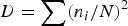 $$D = \sum \lpar n_{i}/N\rpar ^{2}$$
The dominance index ranges from 0 to 1, where 1 represents complete dominance (only one species present in the community).
Stable isotope measurements of Thecosomata
Frozen samples from the outer shelf, shelf break and oceanic stations and from the outer shelf, shelf break and lower shelf stations in September 2010 and February 2011, respectively, were defrosted in the laboratory and different species of Thecosomata were sorted out of the material. Shells were mechanically and/or chemically removed by placing the Thecosomata in 2N HCl. After the shells were dissolved, the remaining material was rinsed, placed on GF/C filters and dried in an oven at 60°C. Animals without a shell (e.g. Desmopterus papilio and Cymbulia sibogae) were not treated with HCl. The dried samples were pulverized using pestle and mortar.
Stable isotope analyses and concentration measurements of nitrogen and carbon were performed simultaneously with a THERMO/Finnigan MAT V isotope ratio mass spectrometer, coupled to a THERMO Flash EA 1112 elemental analyser via a THERMO/Finnigan Conflo III-interface at the stable isotope laboratory of the Museum für Naturkunde, Berlin. Stable isotope ratios were expressed in the conventional delta notation (δ13C or δ15N) relative to PDB (PeeDee Belemnite standard) and atmospheric nitrogen using the following formula:
 $$\delta ^{13}\hbox{C or} \;\delta ^{15}{\rm N} \% = \lpar R_{\rm sample} / R_{\rm Standard} - 1\rpar \times 1000$$
where R is the ratio of 13C/12C or 15N/14N of the sample or the standard.
Standard deviation for repeated measurements of laboratory standard material (peptone) is generally better than 0.15‰ for nitrogen and carbon. Standard deviations of concentration measurements of replicates of laboratory standards are <3% of the concentration analysed.
Stable isotope measurements of seston
The δ15N values of suspended particulate organic matter (POM) were measured in water samples from different depths in the upper 100 m at the same locations as above. The material was taken with a rosette sampler. Water amounts of 2–21 l (depending on total suspended matter concentrations) were immediately filtered on precombusted and pre-weighed GF filters (diameter: 47 mm; pore size ~0.7 µm). Filters were subsequently dried at 40°C overnight and stored dry and cool. Prior to final analyses calcium carbonate (CaCO3) was removed with 1N HCl. The dried samples were analysed for stable nitrogen isotopes (δ15N) with an isotope ratio mass spectrometer (THERMO/Finnigan MAT 252), coupled to a Carlo Erba EA 2500 elemental analyser via a THERMO/Finnigan Conflo III-interface using the same formula as above.
RESULTS
Hydrography
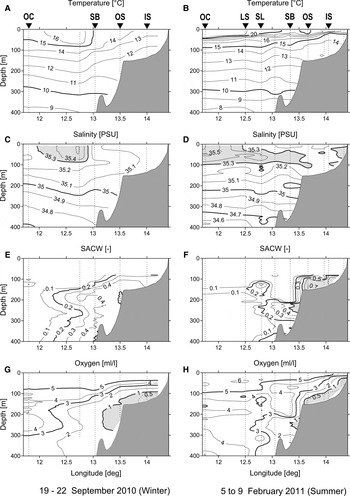
The observed surface temperatures follow the seasonal cycle with lower temperatures in September 2010 (southern spring) than in January/February 2011 (southern summer). In September 2010, temperatures in the upper 100 m were above 15°C at the offshore sites with a warmer core (>16°C) at 12°45′E (Figure 2A). On the shelf the temperature decreased towards the coast down to about 13.5°C. Vertically the temperature decreased continuously with increasing depth. In February 2011, the surface layer was covered by warm water with temperatures around 20°C (Figure 2B). The thermocline depth decreased from 60 m at the offshore stations to only 25 m near the coast. At the inner shelf surface temperatures of about 16.5°C point to former coastal upwelling. Below the thermocline, temperature decreased with increasing depth and the values were similar as in September 2010.
Hydrographical conditions along the sampling transect. OC, oceanic; LS, lower slope; SL, slope; SB, shelf break; OS, outer shelf; IS, inner shelf; SACW, Fraction of South Atlantic Central Water.

Salinity was around 35.2–35.5 psu in the upper 100 m on the shelf as well as offshore during both times of investigation. In contrast to September 2010, the salinity distribution depicts a subsurface maximum at 50–70 m depth in February 2011. This was caused by the seaward Ekman transport of surface water with lower salinity that had upwelled nearer to the coast. Below 100 m the salinity decreased continuously as expected for the central water layer (Figures 2C, D).
The oxygen distribution in the northern Benguela is controlled by the distribution of the two different central water masses: ESACW and SACW. ESACW originates from the subtropical cape region, whereas the oxygen depleted SACW is formed in the tropical Angola Gyre (Mohrholz et al., Reference Mohrholz, Bartholomae, Plas and Lass2008). Figure 2E, 2F depicts the distribution of the SACW fraction below the thermocline. In September 2010 the entire shelf is covered by 20 to 50% SACW. In contrast, in February 2011 only the inner shelf had significant fractions of SACW. However, there the fraction of SACW is up to 75% higher than in September 2010.
The oxygen concentration (Figure 2G, H) is closely related to the distribution of SACW. The surface layers were well oxygenated with values between 5 and 6 ml O2 l−1. In September 2010, an oxygen minimum (1–2 ml/l−1) beginning at 50 m at the onshore and at 150 m at the offshore stations was detectable (Figure 2G). In January/February 2011, the oxygen minimum started a few metres higher in the water column, but intrusions of oxygenated water down to 200 m depth at the shelf break station were detectable (Figure 2H).
Standing stocks, vertical distributions, and community analyses of Thecosomata
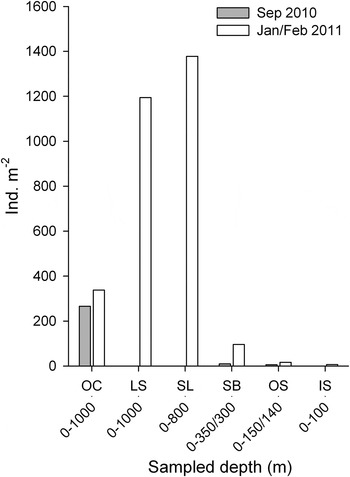
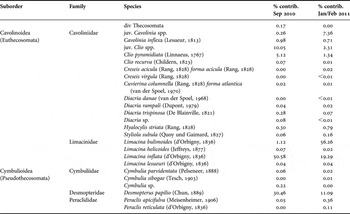
The standing stock (ind./m−2) of all Thecosomata sampled in the water column revealed lower values in September 2010 than in January/February 2011, with increasing numbers from shelf to offshore (Figure 3). Highest standing stocks were detected at the slope and lower slope stations in February 2011. Unfortunately, these stations were not sampled in September 2010. Thecosomata were almost absent below 400 m (see below); only 3% of the individuals were found below this depth during both times of investigation, which means that the differences in standing stocks between locations were not caused by differences of the total water depths sampled. Three species formed more than 80% of the total standing stock. The highest standing stock was detected for Limacina bulimoides with over 1200 ind./m−2 at the lower slope station in February 2011 (Supplementary Table 1). This species formed 56.3% of the Thecosomata population in February 2011, but only 1.1% in September 2010 (Table 2). The next most abundant taxa were Limacina inflata with 50.6% in September 2010 and 19.3% in January/February 2011, followed by Desmopterus papilio with 30.5% in September 2010 and 11.1% in January/February 2011. Noticeable is the standing stock of juvenile Cavolinia spp. and juv. Clio spp. and adult Clio pyramidata. These species accounted for 15.5% of the Thecosomata population in September 2010 and for 11.0% in January/February 2011. The remaining Thecosomata made up only 2.3% of the standing stock during both times of investigation.
Standing stock of Thecosomata as individuals below 1 m2 of the sampled water column (day and night mean) along the onshore–offshore transect in September 2010 and January/February 2011. OC, oceanic; LS, lower slope; SL, slope; SB, shelf break; OS, outer shelf; IS, inner shelf.

List of species detected off Walvis Bay, Namibia, and relative contribution in September 2010 and January/February 2011. Taxonomic classification of the clade Thecosomata after Bouchet et al. (Reference Bouchet, Rocroi, Fryda, Hausdorf, Ponder, Valdes and Waren2005). The older but still widely used names of the suborder are presented in parentheses.

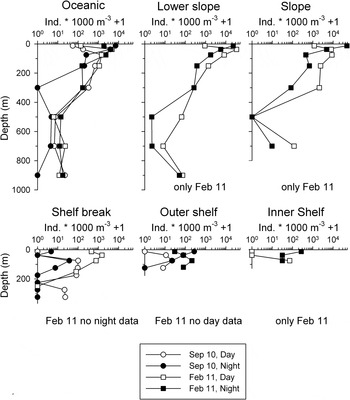
Thecosomata were mainly found in the upper 400 m (Figure 4). In the upper 50 m, the concentrations were generally higher during night than during day. This is also reflected by the calculated weighted mean depths (WMD; Supplementary Table 2) which were shallower at all stations during night than during the day for total Thecosomata. Overall, in relation to the hydrographic regime, Thecosomata were mainly distributed in the warmer offshore waters with a salinity exceeding 35.2 psu and oxygen concentrations above 3 ml/l−1. They were not abundant in waters with a high fraction of low oxygenated SACW.
Day and night vertical distributions of total Thecosomata on the Walvis Bay transect.

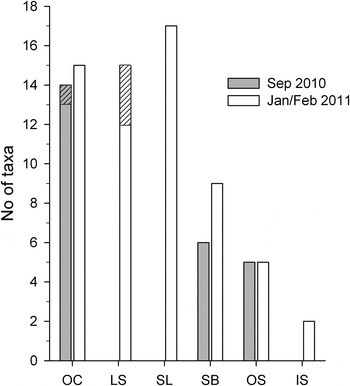
Twenty species of Thecosomata belonging to eleven genera and five families were found on the Walvis Bay transect off Namibia (Table 2). Different forma of some species were found, however, only the species names will be used for further descriptions in this study. The number of species increased from the shelf to the open ocean in September 2010 and in January/February 2011 (Figure 5). Most of the taxa were found in the upper 200 m. Below 200 m, one more taxon (Peraclis apifulva) was detected at the open ocean site in September 2010 and three more taxa (Diacria rampali, Cymbulia parvidentata and Clio recurva) at the lower slope site in February 2011, however, in low numbers only.
Number of Thecosomata taxa (day and night combined). Solid bars represent the number of taxa in the upper 200 m; patterned bars indicate additional taxa found below 200 m depth. OC, oceanic; LS, lower slope; SL, slope; SB, shelf break; OS, outer shelf; IS, inner shelf.

In February 2011, the number of taxa generally revealed a decreasing diversity towards the shore and the highest diversity was detected at the oceanic stations in February 2011 (Table 3), irrespective of the different total depths sampled. Pieleou's evenness index ranged between 0.22 and 0.71, indicating a medium evenness. The dominance of a single species ranged between 0.33 and 0.75 at stations with more than one species. Generally, the dominance of a single species decreased with increasing distance to the coast, with an exception at the lower slope station, where the distribution was dominated by L. bulimoides. Noticeable are the high dominance indices at the inner and outer shelf stations. Desmopterus papilio was the dominant species at the outer shelf station, however, only one (L. inflata) and two (D. papilio and L. inflata) species were detected at the inner shelf station during day and night, respectively.
Community analyses.

OC, oceanic; LS, lower slope; SL, slope; SB, shelf break; OS, outer shelf; IS, inner shelf; N, night; D, day.
In September 2010, the diversity indices at the oceanic stations were lower, but the evenness of the distribution was similar to February 2011. The dominance indices at this site, however, were slightly higher in September 2010, reflecting the high standing stocks of D. papilio during daytime and of L. inflata during night. The highest diversity and evenness and the lowest dominance of a single species in September 2010 were detected at the outer shelf and shelf break stations during night and day, respectively. Only one species was sampled at the outer shelf station at daytime and at the shelf break station during night.
Vertical distribution and day/night differences of the three most abundant Thecosomata taxa
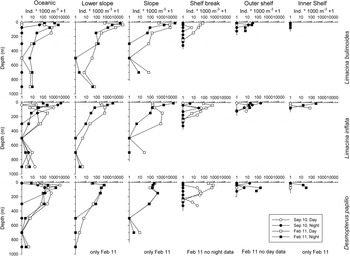
Limacina bulimoides was sparse or absent in September 2010 at all stations as well as at the shelf and shelf break stations in January/February 2011 reaching maximum values of 75 ind./1000 m−3, but the species occurred in high numbers up to 32,000 ind./1000 m−3 at the slope, lower slope and oceanic stations (Figure 6) during January/February 2011. At these stations, distinct day/night differences were detectable with higher concentrations in the upper water column during night. The population resided somewhat deeper during the day.
Day and night vertical distributions of Limacina bulimoides, Limacina inflata and Desmopterus papilio on the Walvis Bay transect.

The other abundant Limacina species (L. inflata) showed a similar day/night pattern (Figure 6), however, the concentrations at the deep stations (oceanic and lower slope) were generally lower (up to 3600 ind./1000 m−3) than those of L. bulimoides in 2011. On the shelf and at the shelf break somewhat higher concentrations (up to 650 ind./1000 m−3) than those of L. bulimoides were detected in February 2011.
Desmopterus papilio was found in moderate numbers on the shelf during both times of investigation and at the shelf break in September 2010 (up to 200 ind./1000 m−3), but high numbers were detected at the shelf break in February 2011 and at the deep stations with up to 4200 ind./1000 m−3 (Figure 6). The concentrations were generally higher in February 2011 than in September 2010. Day and night differences were not detectable at the open ocean and slope sites. Slight day and night differences may occur at the shelf break and shelf sites.
Carbon and nitrogen content of Thecosomata and stable isotope composition
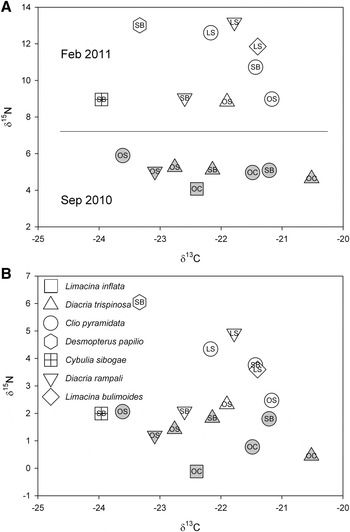
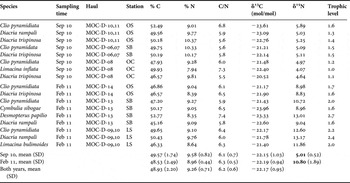
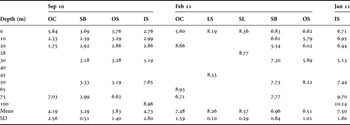
Seven species of Thecosomata from different stations and seasons (Table 4) were investigated for carbon and nitrogen content and for carbon and nitrogen stable isotope composition. Significant differences between seasons were not detectable in carbon (t-test, P = 0.256) and nitrogen (t-test, P = 0.086) contents of Thecosomata. Differences may have been present for nitrogen, but the sampling effort was not large enough to confirm it. The dry mass of Thecosomata (shells removed) consisted of 48.9% carbon and 9.3% nitrogen. The C/N ratio (6.2) was close to the Redfield ratio (6.6). δ13C-values ranged between −23.96 and −20.52‰ with no significant differences between September 2010 and January/February 2011 (t-test, P = 0.931). The pattern of nitrogen isotopes, however, was different (Figure 7A). The δ15N values in February 2011 (8.8–13.2‰, mean 10.8‰) were significantly higher (t-test, P < 0.001) than in September 2010 (4.1–5.9‰, mean 5.0‰). Assuming that seston provides a trophic baseline (first trophic level), the values for Thecosomata can be corrected by subtracting the mean δ15N values of seston from the upper 100 m at the sampled sites (Table 5) from the values measured for the Thecosomata. The new values still reveal differences between the two periods investigated (t-test, P = 0.005), but are now much closer together (Figure 7B) with a mean of 1.78‰ in September 2010 and 3.57‰ in February 2011. Assuming an increase of 3.4–3.8‰ per trophic level (Minagawa & Wada, Reference Minagawa and Wada1984; Hobson & Welch Reference Hobson and Welch1992), the trophic level of the Thecosomata species can be calculated by (δ15Nspecies + 3.6)/3.6. This results in trophic levels between 1.0 and 1.6 in September 2010 and 1.6–2.7 in February 2011 (Table 4), indicating that Thecosomata fed on the lower part of the food chain, consuming phytoplankton, protozoans and detritus particles. The highest value of 2.7 was detected for Cymbulia sibogae in February 2011, which suggests a carnivorous diet.
δ13C and δ15N values of different Thecosomata taxa (A) and seston baseline corrected values (B) at different stations in September 2010 and January/February 2011. OC, oceanic; LS, lower slope; SB, shelf break; OS, outer shelf; open symbols, sample from February 2011; grey symbols, samples from September 2010.

Carbon and nitrogen content and δ13C and δ15N values of specific taxa.

Species were taken from the nets of the upper 200 m and pooled. OC, oceanic; LS, lower slope; SB, shelf break; OS, outer shelf; SD, standard deviation. Bold values are significantly different between seasons (see text).
δ15N-values of water bottle seston samples taken at different depths at the same sites and times than the Thecosomata samples.

OC, oceanic; LS, lower slope; SL, slope; SB, shelf break; OS, outer shelf; IS, inner shelf; SD, standard deviation.
DISCUSSION
In this paper, we provided data on the Thecosomata composition and distribution along an onshore–offshore transect off Walvis Bay, Namibia; a group hitherto sparsely investigated in the region. In detail, the main taxa in the region and their horizontal and vertical distribution were recognized as well as day/night differences in the vertical distribution and their ecological role in the Benguela Current system.
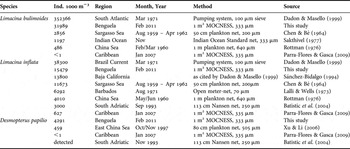
Limacina bulimoides was the most abundant species in our samples in January/February 2011. This species is generally distributed in the tropical Atlantic (Tesch, Reference Tesch1946). High abundances of this species in the Benguela Current region were previously observed by early investigators (Morton, Reference Morton1954) and confirmed by Dadon & Masello (Reference Dadon and Masello1999). The latter authors detected densities of more than 350,000 ind./1000 m−3, outnumbering other cited densities by a factor of more than 100 (Table 6). The highest detected density in our study was almost 32,000 ind./1000 m−3 in 25–50 m depth at the lower shelf station in February 2011 during daytime. The second most abundant species (Limacina inflata) is very common in the Brazil and Benguela Current regions (Dadon & Masello, Reference Dadon and Masello1999; van der Spoel & Dadon, Reference Spoel, Dadon and Boltovskoy1999) and is assumed to be one of the most successful Thecosomata worldwide (Lalli & Wells, Reference Lalli and Wells1978). Desmopterus papilio is completely shell-less, has a tropical and subtropical distribution and was also found in earlier studies in the Benguela Current region (van der Spoel & Dadon, Reference Spoel, Dadon and Boltovskoy1999). Published data on the abundance of this species are very limited, however, it was very abundant in the Benguela Current region (this study) and has also been found in relatively high numbers in the East China Sea (Xu & Li, Reference Xu and Li2006). It has also been detected (in low numbers only) in the Caribbean and South Adriatic Seas (see Table 6). All other taxa found in this study were numerically of less importance, but this will not rule out that they may gain importance in other seasons or at other locations in the Benguela Current region. For example, Martin (unpublished results) detected considerable amounts of Cymbuliidae in April 2008 in the Benguela Current Region, which were not abundant in September 2010 and February 2011. It is not easy to compare the densities of the species presented in Table 6 since different sampling methods and strategies were applied. However, the data provide a coarse estimate of the variability of these taxa.
Reported maximum densities of the three most abundant Thecosomata species in this study.

A high temporal and spatial variability was also detected for Thecosomata in other regions (e.g. Batistic et al., Reference Batistic, Krsinic, Jasprica, Graric, Vilicic and Lucic2004; Xu & Li, Reference Xu and Li2006; Hunt et al., Reference Hunt, Pakhomov, Hosie, Siegel, Ward and Bernard2008). The distributional variation is closely related to variations in primary production (Seibel & Dierssen, Reference Seibel and Dierssen2003) and water mass characteristics (Bé & Gilmer, Reference Bé, Gilmer and Ramsay1977; Dadon & Masello, Reference Dadon and Masello1999). These species can be used as zoogeographic indicators (van der Spoel & Pierrot-Bults, Reference Spoel, Pierrot-Bults, Spoel and Pierrot-Bults1979). In our study, the highest abundance of Thecosomata was detected in stratified waters at the slope and lower slope stations and the lowest abundance was detected at the shelf break and shelf stations where the upwelling intensity was highest. Although Thecosomata are sometimes found in neritic waters, no species are primarily coastal (van der Spoel & Dadon, Reference Spoel, Dadon and Boltovskoy1999). The low abundance of Thecosomata on the shelf can either be caused by the general oceanic distribution of this group or by the intrusion of low oxygenated SACW water (<1 ml/l−1). Although it is confirmed for some Thecosomata species that they can cope with low oxygen rates (<0.5 ml/l−1), they undergo a substantial change in metabolism with 30–50% reduction in O2 consumption (Maas et al., Reference Maas, Wishner and Seibel2012b). Therefore, it is likely that Thecosomata require time in well-oxygenated water to feed, grow and reproduce (Maas et al., Reference Maas, Wishner and Seibel2012b), which indeed is possible for vertically migrating organism. Oxygen values on the shelf and at the shelf break, however, were above 1 ml/l−1 in the upper 100 m, therefore, we assume that the offshore-onshore distribution of Thecosomata was not substantially influenced by SACW and low oxygenated waters. Another possible explanation for the absence from shelf waters is that these organisms cannot cope with high densities of large particles with a high lithogenic load and low nutritional value. Gilmer (Reference Gilmer1974) stated for Creseis and Cavolinia species that 82–95% of the food particles were smaller than 80 µm in diameter from which half was smaller than 20 µm. Based on particle size distribution patterns from ocean colour remote sensing data, Kostadinov et al. (Reference Kostadinov, Siegel and Maritorena2010) stated that oligotrophic areas are dominated by picoplankton particles (0.5–2 µm), whereas nanoplankton particles (2–20 µm) are ubiquitous in transition zones and microplankton particles (20–50 µm) contribute significantly in high productive areas. Thus, Thecosomata probably find favourable conditions for feeding and reproduction at the slope stations, which are at the transition between neritic to oceanic waters.
Daily vertical migration of Thecosomata species is common (Bé & Gilmer, Reference Bé, Gilmer and Ramsay1977). We detected strong diel vertical migration by Cavolinia inflexa, Clio pyramidata, Diacria rampali and L. inflata, whereas L. bulimoides indicated only slight vertical migrations and D. papilio almost no diel vertical migration. Vertical migration of animals can enhance the particle flux by actively transporting organic material into deep zones (Angel & Pugh, Reference Angel and Pugh2000). Interestingly, Maas et al. (Reference Maas, Wishner and Seibel2012a) investigated the physiological response of Thecosomata to increased levels of CO2 (1000 ppm). No effect was found in organisms migrating into oxygen minimum zones (Hyalocylis striata, C. pyramidata, Cavolinia longirostris and Creseis virgula), but a non-migrating species (Diacria quadridentata) showed reduced oxygen consumption and ammonia excretion rates. It would be of great interest to examine how the abundant shell-less and non-migrating species D. papilio will be affected by an increase in CO2 in the Benguela Current region.
Thecosomata are important food web members in epi- and upper mesopelagic zones of the oceans. They consume large amounts of seston particles including phytoplankton and protozoans (see Lalli & Gilmer, Reference Lalli and Gilmer1989) and they contribute largely to the particle flux in the ocean by discarding mucous flocs (see Alldredge & Silver, Reference Alldredge and Silver1988), by sinking faecal pellets (Bruland & Silver, Reference Bruland and Silver1981) and by the sinking of dead bodies and their shells (Hüneke & Heinrich, Reference Hüneke, Henrich, Hüneke and Mulder2011). Disregarding a possible temporal shift between the measurement of seston-baseline values and the incorporation of the δ15N signal in the animal tissue, stable nitrogen isotope analyses gave evidence that Thecosomata fed on seston particles. The absolute nitrogen stable isotope values, however, differed between the investigated seasons with much higher values in February 2011. Maximum upwelling in the northern Benguela occurred between April and December (Hutchings et al., Reference Hutchings, Verheye, Huggett, Demarcq, Cloete, Barlow, Louw and Silva2006) with the main season of cold surface water between July and September (Hagen et al., Reference Hagen, Feistel, Agenbag and Ohde2001). This coincides with temperature and nitrate measurements carried out with a Systea Ferrybox at 5 m water depth (Lahajnar et al., unpubl. res.). During maximum upwelling, reduced mean surface water temperatures of ~16°C and nitrate values of ~10 µmol/L−1 were measured on the 23°S-transect in September 2010. In February 2011, the temperature was higher (~21°C) and average nitrate values were lower (~4 µmol/L−1). Possible biogeochemical explanations for the higher δ15N baseline values in February 2011 are: (i) Nitrate (NO3−) as the dominating oceanic pool of combined nitrogen is the main source for primary production. During uptake and growth of primary producers nitrate concentrations on the central Namibian shelf become more and more depleted (Tyrrell & Lucas, Reference Tyrrell and Lucas2002) and as a direct effect, fractionation processes lead to progressively higher δ15NO3− values in the remaining nitrate pool (Rayleigh fractionation). Hence, primary producers taking up this isotopically enriched nitrate at the end of a growth season are also characterized by higher δ15N-values (Wada & Hattori, Reference Wada and Hattori1978; Waser et al., Reference Waser, Harrison, Nielsen, Calvert and Turpin1998). In other words, high δ15N-values are often associated with low nitrate concentrations; (ii) during intensified upwelling in late austral winter, more of the residual and at least partly denitrified and thus already isotopically enriched nitrate pool from suboxic to anoxic shelf zones enters the photic zone. This isotopically enriched nitrate as one major nutrient source leads to higher 15N-signals in the phytoplankton (Cline & Kaplan, Reference Cline and Kaplan1975; Holmes et al., Reference Holmes, Müller, Schneider, Segl, Pätzold and Wefer1996). Hence, bottom water processes governed by oxygen depletion and denitrification have a greater influence on shallow water primary productivity during periods of enhanced upwelling (Pichevin et al., Reference Pichevin, Martinez, Bertrand, Schneider, Giraudeau and Emeis2005; Emeis et al., Reference Emeis, Struck, Leipe and Ferdelman2009). In this study both processes may play a role for the δ15N-signal in our seston samples, but with regard to the isotopic signal it seems that Rayleigh fractionation is more dominant than bottom water upwelling since low nitrate values coincide with high 15N-values during weak upwelling in late austral summer (January–March). If bottom water upwelling of partly denitrified and thus isotopically enriched water masses was the main factor for the 15N-signature then highest 15N-values would occur during the period of strong upwelling (May–October) which is not the case in our study. The exact processes contributing to the low δ15N-values in September 2010 are not clear, the uptake of ammonium, which is isotopically lighter than the excreting organism (Checkley & Miller, Reference Checkley and Miller1989) as an additional nitrogen source (e.g. Yool et al., Reference Yool, Martin, Fernàndez and Clark2007) cannot be ruled out, but is unlikely to play a major role under conditions with sufficient nitrate supply. In fact, direct nutrient measurements performed in September 2010 and February 2011 showed that ammonium contributed only with ~5 % and ~12 %, respectively, to the dissolved inorganic nitrogen pool at 23°S (Lahajnar et al., unpublished research). These findings are consistent with nutrient studies from the northern part of the Benguela Upwelling System (Dittmar & Birkicht, Reference Dittmar and Birkicht2001). In addition, diazotrophic organisms, which are able to use atmospheric nitrogen, can lower the δ15N baseline down to ~0‰ within the food web in the surface layer (Montoya et al., Reference Montoya, Carpenter and Capone2002) and recent investigations discuss the potential importance of upwelling areas for N2-fixation (Sohm et al., Reference Sohm, Hilton, Noble, Zehr, Saito and Webb2011). However, phytoplankton studies carried out on both expeditions did not identify any well-known diazotrophic organisms such as Trichodesmium or Synechococcus in the northern Benguela upwelling system (Wasmund et al., unpublished results). At this stage it remains unresolved whether or not other (unicellular) diazotrophs significantly fix N2 in the study area (Sohm et al., Reference Sohm, Hilton, Noble, Zehr, Saito and Webb2011). Relatively high 15N-values (6–10‰) in suspended matter from the photic zone (Nagel et al., in review) though suggest that nitrogen fixation is rather of minor importance in the shelf region at 23°S.
CONCLUSION
Overall, the results have shown that Thecosomata were most abundant and diverse above the continental slope and offshore off Namibia and probably play an important role in food web dynamics and particle fluxes, but are of numerically less importance in the inshore zone. The shell-bearing Thecosomata are probably threatened by the ocean's acidification caused by anthropogenic CO2 increase. These organisms may become unable to maintain shells in low pH water which is undersaturated in aragonite (Orr et al., Reference Orr, Fabry, Aumont, Bopp, Doney, Feely, Gnanadesikan, Gruber, Ishida, Joos, Key, Lindsay, Maier-Reimer, Matear, Monfray, Mouchet, Najjar, Plattner, Rodgers, Sabine, Sarmiento, Schlitzer, Slater, Totterdell, Weirig, Yamanaka and Yool2005). Anthropogenic CO2 entering the ocean is now increasing at a rate 100 times faster than any changes seen in the past 650,000 years (Royal Society, Reference Royal2005; Fabry et al., Reference Fabry, Seibel, Feely and Orr2008; Wall-Palmer et al., Reference Wall-Palmer, Hart, Smart, Sparks, Friant, Boudon, Deplus and Komorowski2012). Additionally, CO2-rich deep water enters the upper water column in upwelling systems (see Feely et al., Reference Feely, Sabine, Hernandez-Ayon, Ianson and Hales2008). Hence, an increase in CO2 in the oceans is occurring and results in reduced pH-values (Broecker & Takahashi, Reference Broecker, Takahashi, Andersen and Malahoff1977; Broecker & Peng, Reference Broecker and Peng1982), which is expected to decline further by 0.3–0.4 pH units at the end of the century (Meehl et al., Reference Meehl, Stocker, Collins, Friedlingstein, Gaye, Gregory, Kitoh, Knutti, Murphy, Noda, Raper, Watterson, Weaver, Zhao, Solomon, Qin, Manning, Chen, Marquis, Averyt, Tignor and Miller2007; Turley et al., Reference Turley, Eby, Ridgwell, Schmidt, Findlay, Brownlee, Riebesell, Fabry, Feely and Gattuso2010). Therefore, it is very important to gain information about the taxonomy, abundance and the ecological role of these organisms in the Benguela Upwelling region. If the number of Thecosomata will be reduced by acidification of the ocean, the particle flux will probably be affected. It is known that these animals foster the building of marine snow (Alldredge & Silver, Reference Alldredge and Silver1988) which sinks into greater depth, by this transporting carbon into the ocean’s interior where it will be stored for hundreds or thousands of years (see Lampitt & Antia, Reference Lampitt and Antia1997; Koppelmann et al., Reference Koppelmann, Schäfer and Schiebel2000). It is very speculative to discuss the effects of reduced densities of Thecosomata by ocean's acidification. Maybe the gap will be closed by unshelled species like D. papilio, which already are abundant in the region but do not enhance the particle flux by diel vertical migrations, or the gap will be replaced by other zooplankton organisms, thus, changing the structure of the ecosystem. Different types and sizes of zooplankton carcasses, faecal pellets, or moults will then probably be transported into the ocean's interior. Most of the material will be degraded by trophic processes on its way through the water column. The remaining material will be stored for a long time in deep-sea sediments. Whatever happens if Thecosomata are significantly affected by ocean acidification will probably modify the organic and inorganic particle flux and therefore the amount and composition of material reaching the sea floor.
ACKNOWLEDGEMENTS
We express our thanks to the crews and officers of the research vessels ‘Discovery’ and ‘Maria S. Merian’ for their help in taking the samples. Karolina Bohata, Anneke Denda, Sarina Jung and Tina Kesselring assisted during the cruises. Holger Ossenbrügger and Uwe Piatkowski provided great help in identifying the Thecosomata. We are also indebted to Ulrich Struck for performing the stable isotope analyses of the Thecosomata and to Christian Möllmann and two unknown referees for critical reading of the manuscript. Toralf Heene kindly produced the hydrographical charts. This study was funded by the Ministry of Education and Research in Germany (FKZ 03F0497A).