Statement of Research Significance
Research Question(s) or Topic(s): Are there differences in neurocognitive outcomes following pediatric mild traumatic brain injury relative to non-injured and orthopedically injured children, while accounting for pre-injury individual differences? Main Findings: Results showed no significant differences in post-injury neurocognitive outcomes in children with mild traumatic brain injury relative to control groups, supporting previous findings that mild traumatic brain injury does not lead to detectable objective neurocognitive effects within a year following injury. Study Contributions: Study strengths include the prospective analysis, multiple control groups, and pre-injury neurocognitive assessments. The study findings advance understanding of pediatric mild traumatic brain injury by highlighting the importance of accounting for pre-injury characteristics in a prospective study design when assessing neurocognitive outcomes.
Introduction
Pediatric traumatic brain injury (TBI) is a major public health concern worldwide. Global incidence estimates range from 12 to 486 per 100,000 children annually, with mild TBI (mTBI) accounting for over 80% of cases in most regions (Dewan et al., Reference Dewan, Mummareddy, Wellons and Bonfield2016). In the United States (US), the annual number of children affected by mTBI is likely well over 1.5 million when including both emergency department (Centers for Disease Control and Prevention, 2019; Waltzman et al., Reference Waltzman, Womack, Thomas and Sarmiento2020) and outpatient visits (Lumba-Brown et al., Reference Lumba-Brown, Yeates, Sarmiento, Breiding, Haegerich, Gioia, Turner, Benzel, Suskauer, Giza, Joseph, Broomand, Weissman, Gordon, Wright, Moser, McAvoy, Ewing-Cobbs and Timmons2018; Mannix et al., Reference Mannix, O’Brien and Meehan2013). These figures likely underestimate the true incidence of mTBI, as many children are not treated in these settings (Arbogast et al., Reference Arbogast, Curry, Pfeiffer, Zonfrillo, Haarbauer-Krupa, Breiding, Coronado and Master2016; Cassidy et al., Reference Cassidy, Carroll, Peloso, Borg, von Holst, Holm, Kraus and Coronado2004). Given the high incidence of mTBI during a critical developmental period, concerns have been raised about its impact on neurobehavioral and psychiatric outcomes (Max et al., Reference Max, Judd, Bigler, Wilde, Patterson, Edwards, Calahorra, De La Garza and Vaida2021; H. G. Taylor et al., Reference Taylor, Dietrich, Nuss, Wright, Rusin, Bangert, Minich and Yeates2010), as well as neurocognitive function. However, findings on the neurocognitive effects of pediatric mTBI are inconsistent.
Some studies report reduced neurocognitive performance following mTBI, particularly in attention (Moore et al., Reference Moore, Pindus, Raine, Drollette, Scudder, Ellemberg and Hillman2016; Scherwath et al., Reference Scherwath, Sommerfeldt, Bindt, Nolte, Boiger, Koch and Petersen-Ewert2011), episodic memory (Babikian et al., Reference Babikian, Satz, Zaucha, Light, Lewis and Asarnow2011; McCauley et al., Reference McCauley, Wilde, Barnes, Hanten, Hunter, Levin and Smith2014; Nance et al., Reference Nance, Polk-Williams, Collins and Wiebe2009; Rieger et al., Reference Rieger, Lewandowski, Callahan, Spenceley, Truckenmiller, Gathje and Miller2013; Thomas et al., Reference Thomas, Collins, Saladino, Frank, Raab and Zuckerbraun2011), and working memory (Kooper et al., Reference Kooper, Van Houten, Niele, Aarnoudse-Moens, Van Roermund, Oosterlaan, Plötz and Königs2024; Moore et al., Reference Moore, Pindus, Raine, Drollette, Scudder, Ellemberg and Hillman2016; Nance et al., Reference Nance, Polk-Williams, Collins and Wiebe2009; Scherwath et al., Reference Scherwath, Sommerfeldt, Bindt, Nolte, Boiger, Koch and Petersen-Ewert2011). Reduced performance has been observed in children with mTBI relative to control groups (Babikian et al., Reference Babikian, Satz, Zaucha, Light, Lewis and Asarnow2011; Chadwick et al., Reference Chadwick, Roth, Minich, Taylor, Bigler, Cohen, Bacevice, Mihalov, Bangert, Zumberge and Yeates2021; Kooper et al., Reference Kooper, Van Houten, Niele, Aarnoudse-Moens, Van Roermund, Oosterlaan, Plötz and Königs2024; McCauley et al., Reference McCauley, Wilde, Barnes, Hanten, Hunter, Levin and Smith2014; Moore et al., Reference Moore, Pindus, Raine, Drollette, Scudder, Ellemberg and Hillman2016; Rieger et al., Reference Rieger, Lewandowski, Callahan, Spenceley, Truckenmiller, Gathje and Miller2013; Scherwath et al., Reference Scherwath, Sommerfeldt, Bindt, Nolte, Boiger, Koch and Petersen-Ewert2011) and standardized norms (Nance et al., Reference Nance, Polk-Williams, Collins and Wiebe2009; Scherwath et al., Reference Scherwath, Sommerfeldt, Bindt, Nolte, Boiger, Koch and Petersen-Ewert2011; Thomas et al., Reference Thomas, Collins, Saladino, Frank, Raab and Zuckerbraun2011), across various time points post-injury, including within 1 month (Nance et al., Reference Nance, Polk-Williams, Collins and Wiebe2009), within 3 months (Rieger et al., Reference Rieger, Lewandowski, Callahan, Spenceley, Truckenmiller, Gathje and Miller2013; Scherwath et al., Reference Scherwath, Sommerfeldt, Bindt, Nolte, Boiger, Koch and Petersen-Ewert2011; Thomas et al., Reference Thomas, Collins, Saladino, Frank, Raab and Zuckerbraun2011), 3–6 months (Chadwick et al., Reference Chadwick, Roth, Minich, Taylor, Bigler, Cohen, Bacevice, Mihalov, Bangert, Zumberge and Yeates2021), 6–12 months (Babikian et al., Reference Babikian, Satz, Zaucha, Light, Lewis and Asarnow2011), and beyond 12 months (Kooper et al., Reference Kooper, Van Houten, Niele, Aarnoudse-Moens, Van Roermund, Oosterlaan, Plötz and Königs2024; Moore et al., Reference Moore, Pindus, Raine, Drollette, Scudder, Ellemberg and Hillman2016) after injury. However, effect sizes tend to be small (Babikian & Asarnow, Reference Babikian and Asarnow2009; Goh et al., Reference Goh, Looi, Goh, Sultana, Goh, Lee and Chong2021; Hacker et al., Reference Hacker, Jones, Yasin, Preece, Davies, Hawkins, Belli and Paton2023), raising questions about the clinical significance of these findings. Conversely, a greater number of studies report no persistent neurocognitive effects of mTBI (Babikian et al., Reference Babikian, Merkley, Savage, Giza and Levin2015; Satz et al., Reference Satz, Zaucha, McCleary, Light, Asarnow and Becker1997), regardless of whether outcomes were assessed using traditional neuropsychological tests (Anderson et al., Reference Anderson, Catroppa, Morse, Haritou and Rosenfeld2005; Asarnow et al., Reference Asarnow, Satz, Light, Zaucha, Lewis, Mccleary, Broman and Michel1995; Studer et al., Reference Studer, Goeggel Simonetti, Joeris, Margelisch, Steinlin, Roebers and Heinks2014), computerized assessments (Brooks et al., Reference Brooks, McKay, Mrazik, Barlow, Meeuwisse and Emery2013; Iverson et al., Reference Iverson, Brooks, Collins and Lovell2006; Jones et al., Reference Jones, Prah, Starkey, Theadom, Barker-Collo, Ameratunga and Feigin2019; Maillard-Wermelinger et al., Reference Maillard-Wermelinger, Yeates, Gerry Taylor, Rusin, Bangert, Dietrich, Nuss and Wright2009), or general measures of cognition and academic achievement (Bijur et al., Reference Bijur, Haslum and Golding1990, Reference Bijur, Haslum and Golding1996; McKinlay et al., Reference McKinlay, Dalrymple-Alford, Horwood and Fergusson2002), and whether outcomes were evaluated within the first month (Iverson et al., Reference Iverson, Brooks, Collins and Lovell2006), within 3–6 months (Studer et al., Reference Studer, Goeggel Simonetti, Joeris, Margelisch, Steinlin, Roebers and Heinks2014), within 6–12 months (Asarnow et al., Reference Asarnow, Satz, Light, Zaucha, Lewis, Mccleary, Broman and Michel1995; Maillard-Wermelinger et al., Reference Maillard-Wermelinger, Yeates, Gerry Taylor, Rusin, Bangert, Dietrich, Nuss and Wright2009), or beyond 12 months (Anderson et al., Reference Anderson, Catroppa, Morse, Haritou and Rosenfeld2005; Bijur et al., Reference Bijur, Haslum and Golding1990, Reference Bijur, Haslum and Golding1996; Brooks et al., Reference Brooks, McKay, Mrazik, Barlow, Meeuwisse and Emery2013; Jones et al., Reference Jones, Prah, Starkey, Theadom, Barker-Collo, Ameratunga and Feigin2019) post-injury.
Several methodological limitations may contribute to these inconsistencies (Goh et al., Reference Goh, Looi, Goh, Sultana, Goh, Lee and Chong2021; Hacker et al., Reference Hacker, Jones, Yasin, Preece, Davies, Hawkins, Belli and Paton2023; Satz et al., Reference Satz, Zaucha, McCleary, Light, Asarnow and Becker1997). First, many studies lack clear injury characterization or vary in their inclusion of injury criteria, such as alteration of consciousness, loss of consciousness, or neuroimaging abnormalities (Yeates, Reference Yeates2010). Second, differences in sample characteristics, particularly heterogeneity in age at injury make it difficult to separate the injury-related effects from typical developmental changes (Lindsey et al., Reference Lindsey, Wilde, Caeyenberghs and Dennis2019). Third, few studies account for pre-injury neurocognitive function, and those that do focus on academic performance or rely on retrospective parent reports, which may introduce bias (Bijur et al., Reference Bijur, Haslum and Golding1990; McKinlay et al., Reference McKinlay, Dalrymple-Alford, Horwood and Fergusson2002).
Additionally, it is important to account for other factors that may influence neurocognitive outcomes following injury. Pre-morbid demographic and family (e.g., socioeconomic status, parental education) factors may interact with injury-related variables to influence neurocognitive outcomes and recovery following mTBI (Beauchamp et al., Reference Beauchamp, Aglipay, Yeates, Désiré, Keightley, Anderson, Brooks, Barrowman, Gravel, Boutis, Gagnon, Dubrovsky and Zemek2018; Kooper et al., Reference Kooper, van der Zee, Oosterlaan, Plötz and Königs2023). Lower socioeconomic status, lower parental education, and cultural factors have been associated with prolonged recovery, persistent symptoms, and worse cognitive performance (Kennepohl et al., Reference Kennepohl, Shore, Nabors and Hanks2004; Rigney et al., Reference Rigney, Jo, Williams, Terry and Zuckerman2023). There is also a need to consider factors beyond traditional demographic and family variables. Given that childhood is a period of rapid neuronal development, individual differences in brain maturation may influence recovery trajectories. Additionally, genetic factors associated with neuroinflammation, neural repair, and plasticity have been implicated in neurocognitive outcomes following mTBI (Kurowski et al., Reference Kurowski, Treble-Barna, Pilipenko, Wade, Yeates, Taylor, Martin and Jegga2019, Reference Kurowski, Treble-Barna, Pitzer, Wade, Martin, Chima and Jegga2017; Treble-Barna et al., Reference Treble-Barna, Pilipenko, Wade, Jegga, Yeates, Taylor, Martin and Kurowski2020), and population ancestry can modify risks associated with neurocognition (Naslavsky et al., Reference Naslavsky, Suemoto, Brito, Scliar, Ferretti-Rebustini, Rodriguez, Leite, Araujo, Borda, Tarazona-Santos, Jacob-Filho, Pasqualucci, Nitrini, Yaffe, Zatz and Grinberg2022). While prior research has examined influences such as academic function and family environment, incorporating structural neuroimaging and genetic ancestry data offers a more nuanced understanding of injury response and recovery following injury.
The overall goal of the current study was to assess neurocognitive outcomes in children with mTBI. We leveraged data from the nationally representative Adolescent Brain and Cognitive Development (ABCD) study, a prospective, longitudinal study of children’s health and brain development. Participants included children who sustained an mTBI or orthopedic injury (OI) after study enrollment and those who were non-injured (NI). Comprehensive pre-injury data were collected at study baseline to characterize status prior to mTBI. Thus, the aim of the study was to examine change in multiple neurocognitive domains from pre-injury to post-injury in children with mTBI in comparison to children with OI and NI, while accounting for pre-morbid demographics, behavioral, genetic, and structural neuroimaging variables.
Methods
ABCD study design and study sample
The ABCD Study (https://abcdstudy.org/) is a prospective and longitudinal study of children’s health and brain development. The study enrolled 11,868 children aged 9–10 from 2016 to 2018 across 21 sites in the US. Participants were followed annually for their biopsychosocial data, including demographic, genetic, behavioral, mental, neuroimaging, and neurocognitive assessments (Barch et al., Reference Barch, Albaugh, Avenevoli, Chang, Clark, Glantz, Hudziak, Jernigan, Tapert, Yurgelun-Todd, Alia-Klein, Potter, Paulus, Prouty, Zucker and Sher2018). For this study, ABCD baseline data and 2-year follow-up data (release 5.1) were used. Parental consent and child assent were obtained prior to participation and study procedures were approved by the University of California, San Diego Institutional Review Board to ensure research was conducted in accordance with the Helsinki Declaration.
Injury group: mTBI, OI, and NI
Measures of injury status
Children’s brain injury history was assessed through a modified Ohio State Traumatic Brain Injury Screen-Short Form (Bogner et al., Reference Bogner, Whiteneck, MacDonald, Juengst, Brown, Philippus, Marwitz, Lengenfelder, Mellick, Arenth and Corrigan2017; Corrigan & Bogner, Reference Corrigan and Bogner2007). Caregivers were asked nine yes/no questions about scenarios their children may have experienced that could lead to a concussion/TBI at their baseline visit and 2-year follow-up visit. TBI was categorized into five levels: Improbable TBI (no TBI or TBI without LOC or memory loss); Possible mild TBI (TBI without LOC but memory loss); Mild TBI (TBI with LOC ≤ 30 min); Moderate TBI (TBI with LOC 30 min – 24 hours); Severe TBI (TBI with LOC ≥ 24 hours). Possible mild and mild TBI groups were combined to form the mTBI group for analysis. The classification of mTBI relied on the presence of memory loss when LOC was absent. As such, this criterion may have led to underestimation of mTBI, particularly in children who experienced other post-concussive symptoms but did not report or recall memory loss. Further, as acute clinical imaging data were not available, we could not determine how many cases were complicated versus uncomplicated mTBI. However, T1-weighted MRI scans acquired at the 2-year follow-up were reviewed by a board-certified neuroradiologist to assess for structural abnormalities and incidental findings.
Children’s OI history was assessed by the medical history questionnaire, where parents answered the question “Has she/he ever been to a doctor for broken bones”.
Constructing injury groups
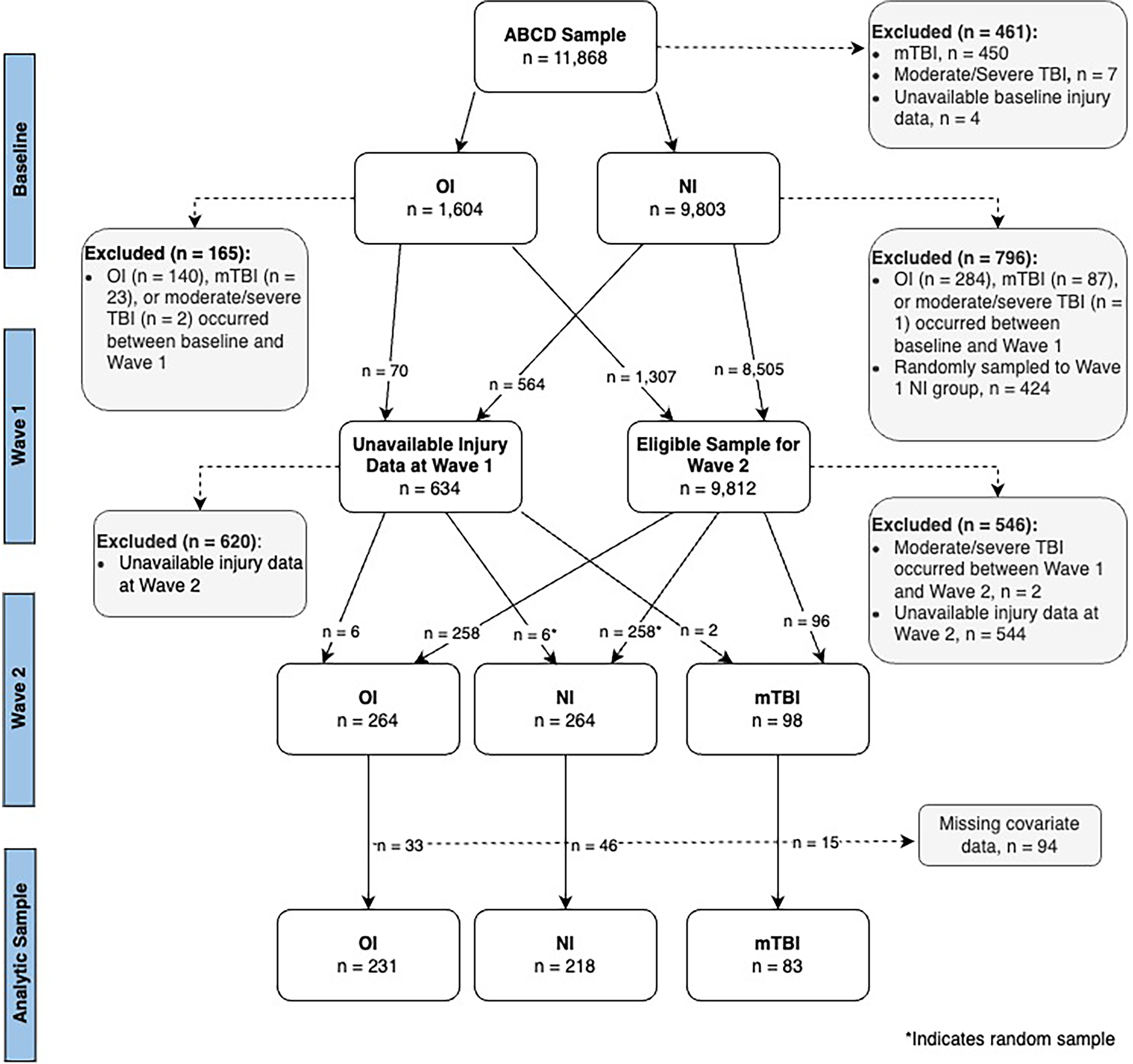
This study is part of an ongoing longitudinal design within the ABCD study, and participant groups were constructed to examine the effects of mTBI at each wave. The current analysis focused on injuries reported between the 1-year (Wave 1) and the 2-year (Wave 2) follow-ups (Figure 1), as the neuropsychological assessment occurs every two years, and we aimed to capture mTBI effects within a one-year window of that assessment. Future waves are planned, and similar group construction procedures will apply to those analyses. At each wave, injury groups are constructed based on newly reported injuries in the prior year. Participants who report an OI or mTBI and have not been previously included in any injury or comparison group are eligible for inclusion. Similarly, a random subset of eligible non-injured participants is selected to form the NI group, matched in size to the OI group. This strategy ensures sufficient sample sizes for each wave while preserving the broader pool of eligible NI participants for future waves.
Study flow diagram. Flow of participants through the waves of the ABCD study. Participants were categorized based on their injury status into groups at baseline, 1-year follow-up visit (Wave 1), and 2-year follow-up visit (Wave 2). OI = orthopedic injury, NI = non-injury, mTBI = mild traumatic brain injury.

Of the 11,868 participants enrolled at baseline, 461 were excluded due to prior mTBI (n = 450), moderate/severe TBI (n = 7), or missing injury data (n = 4), leaving 11,407 participants for subsequent categorization. Based on baseline injury history, 1,604 participants had an OI history, and 9,803 had NI history.
At Wave 1, injury status was reassessed. Within the baseline OI group, 165 participants reported new injuries in the prior year: OI (n = 140), mTBI (n = 23), or moderate/severe TBI (n = 2). Within the baseline NI group, 372 experienced new injuries: OI (n = 284), mTBI (n = 87), moderate/severe TBI (n = 1). Additionally, 424 NI participants were randomly selected for Wave 1 analyses. Participants with new OI or mTBI at Wave 1, or who were selected for prior analyses, were not eligible for Wave 2 analyses. Those with moderate/severe TBI were excluded.
At Wave 2, 546 participants were excluded due to missing injury data (n = 544) or moderate/severe TBI (n = 2). Between the 1-year and 2-year follow-ups, 98 participants sustained an mTBI and 264 had OI. To maintain balanced groups, 264 NI participants were randomly selected from the eligible cohort. Participants with missing covariate data were excluded, resulting in a final analytic sample of 231 OI, 218 NI, and 83 mTBI participants.
Neurocognitive measures
The neurocognitive variables of interest were selected from the ABCD 70-minute neurocognitive battery administered at baseline and 2-year follow-up, which comprised various cognitive tests covering key cognitive processes such as executive function, learning and memory, academic, and language (Luciana et al., Reference Luciana, Bjork, Nagel, Barch, Gonzalez, Nixon and Banich2018).
NIH toolbox cognition battery
The battery consists of seven tests to assess language ability, processing speed, attention, episodic memory, working memory, and executive function. Five tasks were administered at both the baseline and 2-year visits; List Sorting Working Memory Test and Dimensional Change Card Sort Task were not assessed at the 2-year visit and were not included in analyses.
Our primary outcomes were the Crystallized and Fluid Cognition Composite scores. The Crystallized Cognition Composite score was calculated from the Picture Vocabulary and Oral Reading Tasks (Akshoomoff et al., Reference Akshoomoff, Beaumont, Bauer, Dikmen, Gershon, Mungas, Slotkin, Tulsky, Weintraub, Zelazo and Heaton2013). Although the Fluid Cognition Composite score was intended as a co-primary outcome, the composite score could not be calculated due to missing data from the List Sort and Card Sort tasks.
Secondary outcomes included the individual component tasks: Picture Vocabulary, Oral Reading, Pattern Comparison Processing Speed Test, Picture Sequence Memory Test, and Flanker Task. These assessed specific domains such as language, reading ability, processing speed, visuospatial sequencing and memory, and cognitive control and attention, respectively. Uncorrected scores were included in analyses.
Rey Auditory Verbal Learning Test (RAVLT)
This task assesses children’s verbal learning and memory (Schmidt, Reference Schmidt1996). The task requires participants to listen and recall a 15-item word list (List A), and this procedure was repeated four additional times using the same word list. After the five learning trials, participants listened and recalled a new set of words (List B). Immediately after recalling List B, participants were asked to recall List A again, and the number of corrected recalled words was the Rey auditory verbal learning test (RAVLT) short-delay score. After a 30-minute delay, participants were asked to recall List A again, and the number of correct responses was the RAVLT long-delay score (B. Wang et al., Reference Wang, Giannakopoulou, Austin-Zimmerman, Irizar, Harju-Seppänen, Zartaloudi, Bhat, McQuillin, Kuchenbäcker and Bramon2022). Both RAVLT short-delay and long-delay scores were treated as secondary outcomes.
Demographic variables
Children’s age, sex assigned at birth, race, ethnicity, highest parental income, and highest parental education and whether the child had ever participated in a sport were reported by parents at baseline visits. We used ABCD’s range of income and education and both were treated as continuous variables. Income ranges from 1 to 10, where 1 = Less than $5,000; 2 = $5,000 through $11,999; 3 = $12,000 through $15,999; 4 = $16,000 through $24,999; 5 = $25,000 through $34,999; 6 = $35,000 through $49,999; 7 = $50,000 through $74,999; 8 = $75,000 through $99,999; 9 = $100,000 through $199,999; 10 = $200,000 and greater. Education ranges from 0 to 21, where 0 = Never attended/Kindergarten; 1 through 12 corresponds to 1st through 12th grade; 13 = High school graduate; 14 = GED or equivalent Diploma; 15 = Some college; 16 = Associate’s degree: Occupational; 17 = Associate’s degree: Academic Program; 18 = Bachelor’s degree; 19 = Master’s degree; 20 = Professional School degree; 21 = Doctoral degree.
Genetic variables
To account for confounding from population stratification due to genetic ancestry in the multi-ancestry cohort, adjusted models incorporated the first ten genetic principal components (PCs) of the genotype data as covariates, computed by the ABCD consortium using methods from GENESIS R package (Fan et al., Reference Fan, Loughnan, Wilson, Hewitt, Dowling, Garavan, LeBlanc, Neale, Friedman, Madden, Little, Brown, Jernigan and Thompson2023).
Behavioral measures
The Behavioral Inhibition and Behavioral Approach Systems (BIS/BAS) and Impulsive Behavior Scale - Short Version (UPPS-P) were used to assess reward responsivity and trait impulsivity, respectively, at study baseline (Barch et al., Reference Barch, Albaugh, Baskin-Sommers, Bryant, Clark, Dick, Feczko, Foxe, Gee, Giedd, Glantz, Hudziak, Karcher, LeBlanc, Maddox, McGlade, Mulford, Nagel, Neigh and Xie2021). We included four subscale scores from the BIS/BAS (BIS sum score, Reward Responsivity, Drive, Fun Seeking) and five subscale scores from the UPPS-P (Negative Urgency, Positive Urgency, Lack of Planning, Sensation Seeking, Lack of Perseverance) as covariates in analyses.
White matter microstructure variables
Diffusion magnetic resonance imaging scans were acquired across the research sites at study baseline using Siemens Prisma, GE750, and Philips 3T scanners. Scanning protocols were standardized across all sites and scanners. The full imaging acquisition protocol and ABCD processing pipeline have been described in detail elsewhere (Casey et al., Reference Casey, Cannonier, Conley, Cohen, Barch, Heitzeg, Soules, Teslovich, Dellarco, Garavan, Orr, Wager, Banich, Speer, Sutherland, Riedel, Dick, Bjork, Thomas and Dale2018; Hagler et al., Reference Hagler, Hatton, Cornejo, Makowski, Fair, Dick, Sutherland, Casey, Barch, Harms, Watts, Bjork, Garavan, Hilmer, Pung, Sicat, Kuperman, Bartsch, Xue and Dale2019). Briefly, the images were corrected for eddy current distortions, head motion, spatial and intensity distortions, and gradient nonlinearity distortions. Diffusion tensor imaging metrics, including fractional anisotropy (FA), mean diffusivity, radial diffusivity and axial diffusivity were calculated for major white matter tracts using the AtlasTrack atlas (Hagler et al., Reference Hagler, Ahmadi, Kuperman, Holland, McDonald, Halgren and Dale2009). All raw and processed images were reviewed by trained technicians as part of quality control procedures (Hagler et al., Reference Hagler, Hatton, Cornejo, Makowski, Fair, Dick, Sutherland, Casey, Barch, Harms, Watts, Bjork, Garavan, Hilmer, Pung, Sicat, Kuperman, Bartsch, Xue and Dale2019).
In the current study, FA values in the following tracts were included as covariates in adjusted models based on reported associations with mTBI (Lindsey et al., Reference Lindsey, Hodges, Greer, Wilde and Merkley2021): (1) right and left cingulum (cingulate portion), (2) right and left uncinate, (3) right and left inferior longitudinal fasciculus, (4) right and left inferior frontal-occipital fasciculus, (5) right and left superior longitudinal fasciculus, (6) right and left temporal superior longitudinal fasciculus (arcuate fasciculus), and (7) forceps minor.
Statistical analysis
For each neurocognitive outcome, the primary group comparison was between mTBI and OI with a secondary comparison between mTBI and NI groups, as pre-specified in the study design phase. The Crystallized Cognition Composite score was designated as the primary outcome and was assessed using an alpha level of 0.05. All secondary outcomes were assessed using the Holm method to control the family-wise error rate across the seven secondary outcomes.
Linear mixed-effects models were used to account for within-participant correlation of the baseline and 2-year follow-up scores. For each of the outcomes, model selection procedures were conducted. We began by determining whether a random intercept or random intercept and time slope model would provide a better fit. We first fitted a saturated model, i.e., including all covariates: age, sex, race, ethnicity, parental income, parental education, sport participation, 4 BIS/BAS subscale scores, 5 UPPS-P subscale scores, 10 genetic PCs, and 13 FA values as well as group (mTBI/NI/OI), time (baseline, 2-year follow-up), and their interaction. The restricted maximum likelihood (REML) Akaike information criterion (AIC) was used to choose between random intercept and random slope models. The saturated model with the chosen random effect structure was refitted using maximum likelihood (ML) estimation. Backward model selection with a threshold of p < 0.20 was applied to the potential confounders (Vittinghoff et al., Reference Vittinghoff, Glidden, Shiboski and McCulloch2012). Unadjusted analyses used similar modeling strategies but without confounders included in the model.
Results
Demographics and baseline characteristics
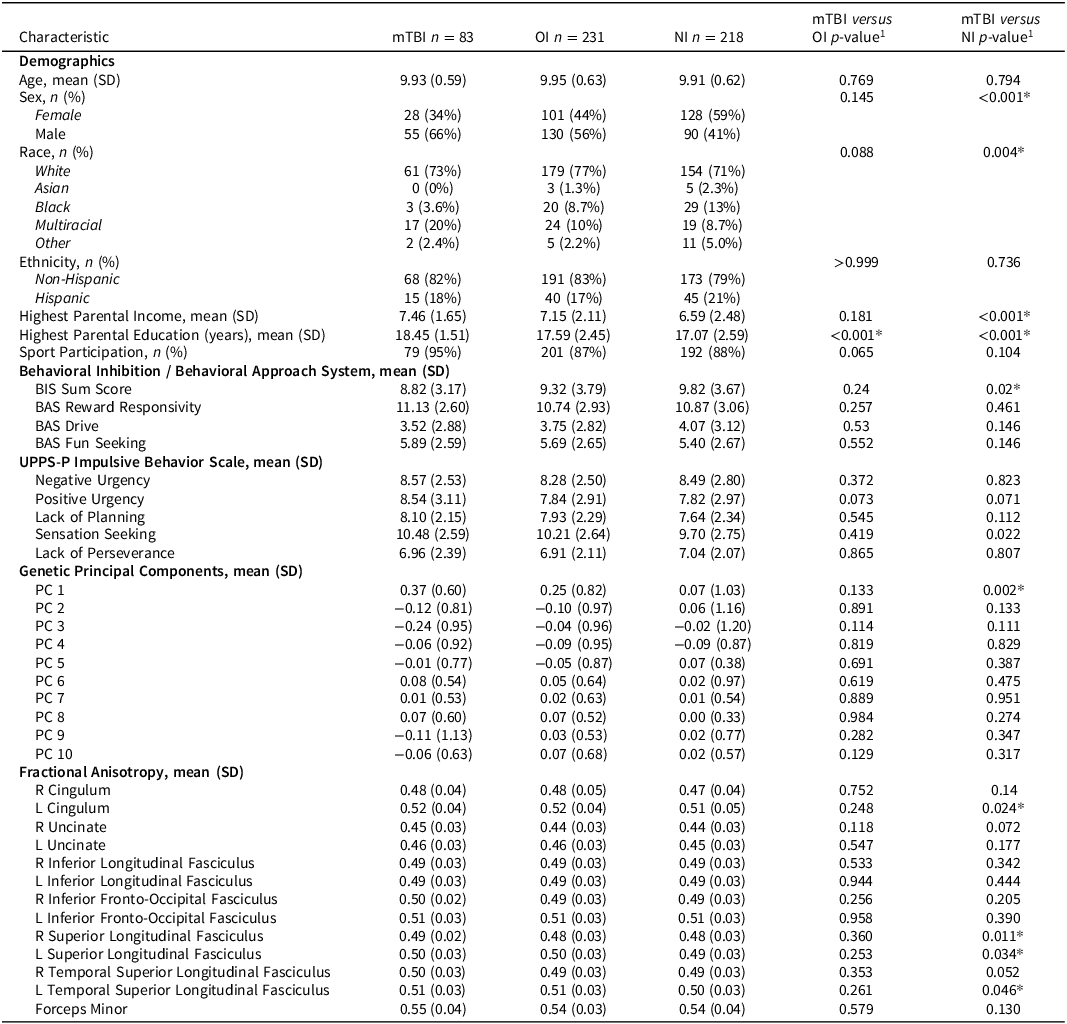
Table 1 summarizes participant characteristics for each group. As expected from the study design, the groups were similar in age, with a mean (standard deviation) of 9.93 (0.62) years. They also showed comparable distributions in ethnicity and prior sports participation, with most participants identifying as non-Hispanic (81%) and having played at least one sport (89%). The mTBI group was no different from the OI group in terms of sex, race, and parental income. However, compared to the NI group, the mTBI group had a higher proportion of males (mTBI: 66% vs. NI: 41%, p < .001), more participants identifying as multiracial (mTBI: 20% vs. NI: 8.7%, p = .004), and higher parental income (mTBI = 7.46 (1.65) vs. NI = 6.59 (2.48), p < .001). Additionally, the mTBI group had higher parental education levels than both the OI and NI groups (mTBI = 18.45 (1.51) vs. NI = 17.07 (2.59), p < .001; mTBI vs. OI = 17.59 (2.45), p < .001).
Demographic, behavioral, genetic, and white matter characteristics at baseline

1 mTBI versus OI is the primary group comparison, with a secondary comparison between mTBI and NI groups; Pearson’s chi-squared test; Welch’s two-sample t test.
* p-Value < .05; SD = standard deviation, R = right, L = left, PC = principal component, mTBI = mild traumatic brain injury, NI = non-injured controls, OI = orthopedic injury controls.
At study baseline prior to injury, the mTBI group had lower BIS sum scores (mTBI = 8.82 (3.17) vs. NI = 9.82 (3.67), p = .02), indicating lower inhibition and sensitivity to negative outcomes, and higher UPPS-P sensation seeking scores (mTBI = 10.48 (2.59) vs. NI = 9.70 (2.75), p = .02) than the NI group, but were no different from the OI group (ps > .05). There were no significant differences among groups in reward responsivity, drive, fun seeking, positive urgency, negative urgency, lack of planning, or lack of perseverance scores (ps > .05).
The mTBI group had significantly higher genetic PC1 values compared to the NI group (mTBI = 0.37 (0.60) vs. NI = 0.07 (1.03), p = .002), but did not differ from the OI group (ps > .05). No other baseline differences were found in genetic PCs (ps > .05).
Baseline comparisons of white matter microstructure showed elevated FA in the left cingulate, right and left superior longitudinal fasciculus, and left temporal superior longitudinal fasciculus in the mTBI group relative to the NI group, but no differences compared to the OI group. Of the 83 children with mTBI, 73 completed imaging that was reviewed by a board-certified neuroradiologist. At the 2-year follow-up, 13 children showed non-normal findings. In 10 of these cases, the abnormalities were already present at baseline and therefore not attributable to a subsequent injury. The remaining 3 children (4.1%) had new or additional findings at follow-up, but none were characteristic of trauma-related injury.
Primary outcome pre- and post-mTBI
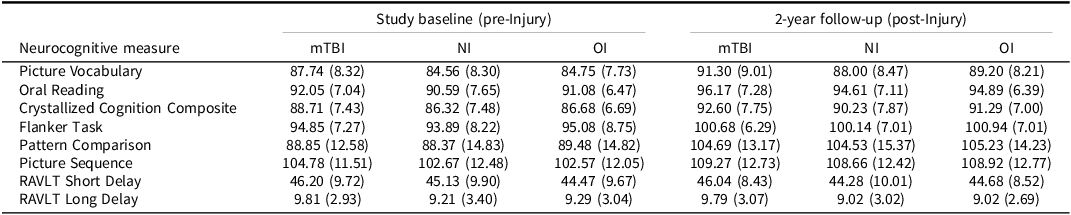
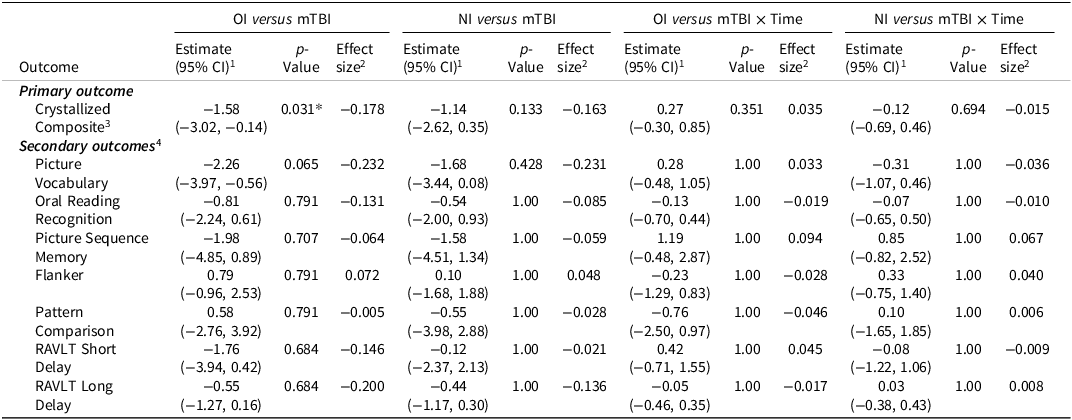
Table 2 summarizes the neurocognitive outcomes at study baseline (pre-injury) and 2-year follow-up (post-injury) for each group. In fully adjusted models, there were significant pre-injury group differences at study baseline between mTBI and OI in Crystallized Composite scores (coefficient = −1.58, 95% CI = −3.02, −0.14, p = .031), where the mTBI had higher scores than the OI group (Table 3; Supplemental Material for full tables). However, there were no significant Group × Time interaction for the Crystallized Composite, indicating a lack of mTBI effect post-injury on the primary outcome.
Means and standard deviations of neurocognitive uncorrected scores at baseline and 2-year follow-up

Mean (standard deviation), mTBI = mild traumatic brain injury, NI = non-injured, OI = orthopedic injury.
Fully adjusted estimates comparing neurocognitive outcomes by injury status pre- and post-injury

1 Estimates are the fixed effect coefficients in the linear mixed-effects model including group (mTBI/NI/OI), time (pre- and post-injury), and their interaction, and a child-specific random intercept. The p-values are from Wald’s test. Models were adjusted for demographic, behavioral, genetic, and imaging variables. See supplemental material for all estimates of unadjusted and adjusted models.
2 Effect sizes are reported as standardized regression coefficients.
3 Crystallized Composite score is a combination of the picture vocabulary and oral reading recognition performance.
4 P-values for secondary outcomes were adjusted for multiple comparisons using the Holm method.
Significant p-values highlighted * < .05; ** < .01.
CI = confidence interval, mTBI = mild traumatic brain injury, NI = non-injured controls, OI = orthopedic injury controls, RAVLT = Rey Auditory Verbal Learning.
Secondary outcomes pre- and post-mTBI
Among secondary outcomes in fully adjusted models, there were neither pre-injury group differences nor Group × Time interactions for any of the seven secondary measures after correction for multiple comparisons (Table 3; Supplemental Material for full tables).
Age-corrected scores for NIH toolbox outcome measures were also examined and reported in the Supplemental Material, with findings consistent with the reported analyses using uncorrected scores.
Discussion
Despite the high incidence of pediatric mTBI, controversies remain regarding the neurobehavioral outcomes associated with mTBI. Methodological limitations and variations in study design have made it challenging to isolate the direct effects of injury from pre-existing individual and developmental factors. The current study builds on previous work by incorporating comprehensive pre-injury neurocognitive, demographic, behavioral, genetic, and structural neuroimaging data within a nationally representative sample that was not selected based on injury status. Post-injury neurocognitive outcomes in children who sustained an mTBI during the course of the study were also compared to those who sustained OI or remained non-injured. Our findings revealed no significant differences in neurocognitive outcomes between children with mTBI relative to either control group.
These results are consistent with prior studies that found no persisting neurocognitive effects following pediatric mTBI (Anderson et al., Reference Anderson, Catroppa, Morse, Haritou and Rosenfeld2005; Asarnow et al., Reference Asarnow, Satz, Light, Zaucha, Lewis, Mccleary, Broman and Michel1995; Babikian et al., Reference Babikian, Merkley, Savage, Giza and Levin2015, Reference Babikian, Satz, Zaucha, Light, Lewis and Asarnow2011; Jones et al., Reference Jones, Prah, Starkey, Theadom, Barker-Collo, Ameratunga and Feigin2019; Maillard-Wermelinger et al., Reference Maillard-Wermelinger, Yeates, Gerry Taylor, Rusin, Bangert, Dietrich, Nuss and Wright2009; Studer et al., Reference Studer, Goeggel Simonetti, Joeris, Margelisch, Steinlin, Roebers and Heinks2014). Our findings also align with retrospective analyses of baseline ABCD data, where children with a history of mTBI showed no differences from OI and NI controls in Flanker performance (Betz et al., Reference Betz, Cetin-Karayumak, Bonke, Seitz-Holland, Zhang, Pieper, O’Donnell, Tripodis, Rathi, Shenton and Koerte2024) and where neurocognitive performance did not predict odds of prior mTBI (Dufour et al., Reference Dufour, Adams, Brody, Puente and Gray2020).
A key strength of this study is the inclusion of pre-injury neurocognitive measures, allowing for an objective assessment of cognitive outcomes following pediatric mTBI. Importantly, this approach controlled for pre-existing neurocognitive differences, which we observed between the mTBI and OI groups with the mTBI group performing better on the crystallized cognition composite measure. Previous prospective longitudinal birth cohort studies, such as the British Birth Cohort Study (Bijur et al., Reference Bijur, Haslum and Golding1990) and the Christchurch Health and Development Longitudinal Study (McKinlay et al., Reference McKinlay, Dalrymple-Alford, Horwood and Fergusson2002), included pre-injury data primarily focused on academic achievement measures, including reading, mathematics, and vocabulary, when evaluating cognitive outcomes following mTBI. These studies similarly found no significant reductions in cognition between children with mild head injury and both non-injured (Bijur et al., Reference Bijur, Haslum and Golding1990; McKinlay et al., Reference McKinlay, Dalrymple-Alford, Horwood and Fergusson2002) and OI control groups (Bijur et al., Reference Bijur, Haslum and Golding1990). The inclusion of multiple objective neurocognitive tests in the current study expands on these previous studies by assessing both crystallized and fluid cognition, capturing a broader range of cognitive abilities. Further, the use of the same standardized neurocognitive measures before and after injury allows for a post-injury assessment of cognitive change, and the two-year interval between tests reduces the likelihood that changes are due to practice effects, which would also apply to the control group.
In addition to pre-injury neurocognitive measures, a strength of this study is the inclusion of a wide range of contextual factors, including demographic variables, genetic data, and neuroimaging. This addresses a major limitation of prior individual studies, which may lack sufficient samples to model such complexity. Importantly, having access to these data allows us to control for factors that may independently contribute to differences in neurocognitive performance across groups, beyond the injury itself.
Another strength of this study was the inclusion of multiple control groups. At baseline, children who later sustained mTBI were no different to the OI group but differed from the NI group, particularly in characteristics associated with general injury risk. The mTBI group had a higher proportion of males, lower BIS sum scores indicating lower sensitivity to punishment, and higher sensation seeking scores compared to the NI group, all of which are factors associated with injury predisposition (Schwebel & Gaines, Reference Schwebel and Gaines2007). Further, baseline differences in genetic and white matter measures were found between the mTBI and NI groups but not between the mTBI and OI groups. Another study also found differences in DTI measures of white matter structure between mTBI and uninjured controls but not between mTBI and OI controls (Wilde et al., Reference Wilde, Ware, Li, Wu, McCauley, Barnes, Newsome, Biekman, Hunter, Chu and Levin2019). Our results align with prior studies suggesting that cognitive differences between both mTBI and OI groups relative to NI controls reflect a general injury effect rather than one specific to mTBI (Babikian et al., Reference Babikian, Satz, Zaucha, Light, Lewis and Asarnow2011; McCauley et al., Reference McCauley, Wilde, Barnes, Hanten, Hunter, Levin and Smith2014). Thus, individual pre-existing factors including behavioral traits, genetics, and brain structure may contribute to the likelihood of sustaining injuries in general. Further, these findings suggest that studies lacking control groups (Nance et al., Reference Nance, Polk-Williams, Collins and Wiebe2009; Thomas et al., Reference Thomas, Collins, Saladino, Frank, Raab and Zuckerbraun2011) or comparing only to an NI group (Kooper et al., Reference Kooper, Van Houten, Niele, Aarnoudse-Moens, Van Roermund, Oosterlaan, Plötz and Königs2024; Moore et al., Reference Moore, Pindus, Raine, Drollette, Scudder, Ellemberg and Hillman2016; Scherwath et al., Reference Scherwath, Sommerfeldt, Bindt, Nolte, Boiger, Koch and Petersen-Ewert2011) may overestimate the effects specific to mTBI. Taken together, this study adds further evidence that these differences may stem from pre-existing individual factors rather than the direct effects of mTBI, reinforcing the need for multiple control groups in future research.
Many previous studies have focused on children medically diagnosed with mTBI in the ED (Babikian et al., Reference Babikian, Satz, Zaucha, Light, Lewis and Asarnow2011; Nance et al., Reference Nance, Polk-Williams, Collins and Wiebe2009; Scherwath et al., Reference Scherwath, Sommerfeldt, Bindt, Nolte, Boiger, Koch and Petersen-Ewert2011; Studer et al., Reference Studer, Goeggel Simonetti, Joeris, Margelisch, Steinlin, Roebers and Heinks2014), which may overrepresent the more severe spectrum of mild injury. In contrast, the current study includes a broader range of mTBI severity, capturing children who may not have received medical care or a formal diagnosis. This approach allows for the inclusion of milder injuries, such as those involving transient alterations in consciousness but no LOC, as well as injuries with LOC of up to 30 minutes, consistent with established mTBI definitions (Department of Veterans Affairs/Department of Defense, 2016; Kay et al., Reference Kay, Harrington, Adams, Anderson, Berrol, Cicerone, Dahlberg, Gerber, Goka, Harley, Hilt, Horn, Lehmkuhl and Malec1993). Notably, a higher proportion of children included in the mTBI group did not experience LOC, aligning with previous estimates suggesting that many pediatric mTBIs do not result in LOC (Lee et al., Reference Lee, Monroe, Bachman, Glass, Mahajan, Cooper, Stanley, Miskin, Dayan, Holmes and Kuppermann2014; M. Y. Wang et al., Reference Wang, Griffith, Sterling, McComb and Levy2000) and may be unreported or managed outside of the ED (Arbogast et al., Reference Arbogast, Curry, Pfeiffer, Zonfrillo, Haarbauer-Krupa, Breiding, Coronado and Master2016; Macpherson et al., Reference Macpherson, Fridman, Scolnik, Corallo and Guttmann2014; A. M. Taylor et al., Reference Taylor, Nigrovic, Saillant, Trudell, Proctor, Modest and Vernacchio2015). By including these milder injuries, our findings may be more representative of mTBI cases than studies that include only hospital-based samples.
Despite its strengths, this study had several limitations. The neurocognitive assessments available in the ABCD study, while validated for use in children (Akshoomoff et al., Reference Akshoomoff, Beaumont, Bauer, Dikmen, Gershon, Mungas, Slotkin, Tulsky, Weintraub, Zelazo and Heaton2013), were not specifically designed for brain injury populations and may lack the sensitivity to detect subtle effects of mTBI. As such, our findings may reflect limitations in assessment rather than a true absence of differences. The NIH Toolbox Cognitive Battery, though useful as a broad assessment of neurocognition, was not specifically developed for mTBI. Further, the Fluid Cognition composite score could not be computed due to missing measures at follow-up, but may be the domain expected to be most affected by mTBI (Babikian & Asarnow, Reference Babikian and Asarnow2009; Chadwick et al., Reference Chadwick, Roth, Minich, Taylor, Bigler, Cohen, Bacevice, Mihalov, Bangert, Zumberge and Yeates2021; Tulsky et al., Reference Tulsky, Carlozzi, Holdnack, Heaton, Wong, Goldsmith and Heinemann2017). Similarly, the RAVLT, used to assess verbal learning, has demonstrated poor psychometric properties for studying mild TBI (Bigler, Reference Bigler2024; Bigler et al., Reference Bigler, Allder and Victoroff2024) and shows minimal changes even across different levels of injury (Kennedy et al., Reference Kennedy, Liebel, Lindsey, Vadlamani, Lei, Adamson, Alda, Alonso-Lana, Anderson, Arango, Asarnow, Avram, Ayesa-Arriola, Babikian, Banaj, Bird, Borgwardt, Brodtmann, Brosch and Dennis2024). Alternative approaches may be necessary to detect subtle neurocognitive effects. For instance, dual-tasking paradigms, where a cognitive task is performed while balancing or walking, have revealed neurocognitive impairments that are not evident when tasks are performed in isolation (Wilkerson et al., Reference Wilkerson, Nabhan and Perry2021). Moreover, neurocognitive testing may not fully capture cognitive symptoms that impact daily functioning, as individuals with mTBI may remain symptomatic despite normal neurocognitive performance (Heitger et al., Reference Heitger, Jones, Macleod, Snell, Frampton and Anderson2009), highlighting the importance of including broader symptom assessments beyond objective neurocognitive evaluations.
Injury data were obtained through a structured caregiver report, which may be subject to recall bias. However, this limitation is mitigated given that injuries occurred within the past year. The study sample was restricted to children who sustained their first recognized mTBI, as those with prior reported injuries were excluded. However, it is possible that parents did not recall more remote injuries. While this method captures injuries on the milder end of the injury spectrum, there was no medical documentation or acute imaging of injury, limiting the ability to determine occurrences of complicated mTBI. Relatedly, injuries were characterized by presence of LOC or memory-related symptoms, potentially excluding children who experienced other symptoms such as nausea or headache. However, given the mild nature of the injuries in this sample, this exclusion is unlikely to substantially alter findings. More broadly, the term “mTBI” is often inconsistently defined in clinical and research contexts, particularly in children, where it often overlaps with the term “concussion”. Although our criteria were based on established definitions, they do not resolve this conceptual ambiguity, and diagnostic precision remains limited. This should be considered when interpreting the generalizability and specificity of our findings. Finally, although the study design ensured that injuries occurred within the past year, the exact timing of each injury was not collected. The study also did not collect the mechanism of injury.
Conclusions
This study incorporated comprehensive pre-injury data and multiple control groups, finding no evidence of persistent neurocognitive declines within a year of pediatric mTBI. The findings suggest that previously reported cognitive differences may stem from pre-existing factors rather than mTBI itself. Our results did not support the idea of a general injury or a unique mTBI effect, highlighting the importance of rigorous study design when evaluating injury outcomes. Future research should continue to refine methodological approaches to better isolate the effects of injury from pre-existing individual differences.
Supplementary material
The supplementary material for this article can be found at https://doi.org/10.1017/S1355617725101537.
Funding statement
This research was supported by the National Institute of Child Health and Human Development (J.M., grant number HD105338) and the National Institute on Drug Abuse (J.J., grant numbers R01 DA054106, U01 DA041089).
Competing interests
Dr Max provides expert testimony in cases of traumatic brain injury on an ad hoc basis for plaintiffs and defendants on a more or less equal ratio. This activity constitutes approximately 5% of his professional activities. The other authors have no conflicts of interest to report.