Vikram Seth first learned about the death of “Lita” in the Chinese city of Turfan on a sultry July day in 1981. Today's celebrated poet and novelist was then an unknown Stanford University graduate student, about to embark upon an epic journey hitchhiking his way through Xinjiang, Tibet, and Nepal (Seth [1983] Reference Seth1987). “I hear that Lita died earlier this year,” an officer in the city's General Police Station had told Seth, empathetically adding: “I am very sorry to read about it. We take a lot of interest in Lita and Laz” (14). Rita and Raj were the names of the leading protagonists in Bollywood's earliest crossover hit, Awara (1951; Eng. Vagabond; Ch. Liulangzhe 流浪者). Nargis (1929–81), the Indian actress who played the role of Rita, had died a couple of months earlier in May, and the officer had read about it in a Chinese magazine.Footnote 1 This was not Seth's sole encounter with Awara, nor with its eponymous theme song, which he had heard “hummed on the streets of Nanjing.” On multiple occasions, he had to “dust off the perennial favorite” and belt it out in front of appreciative audiences, some of whom invariably joined in (11, 40, 128).Footnote 2
Seth has the likely distinction of being among the earliest Indians to possess an Awara story. Many Indians who have lived in or traveled through the People's Republic have their own version. These experiences have been notable enough in their frequency to warrant press coverage over the years as well as the occasional academic discussion (Aiyar Reference Aiyar2010, 45–47; Avasthi Reference Avasthi2014; Bhattacharjya OReference Bhattacharjya2014; Atish Ghosh Reference Ghosh2004; India Today Online 2011; Roy Chowdhury Reference Roy Chowdhury2008; Sarkar Reference Sarkar, Durovicova and Newman2010, 50–53). In each of these discussions, the wonder and bemusement of the experience were juxtaposed with fuzziness about what could have made it possible. Was the film's popularity an artefact of post–Cultural Revolution relaxation, when foreign films began to be screened again? Or could its popularity be traced further back to the 1950s? Perhaps it was Soviet influence that played a decisive role?Footnote 3 Theories were proposed and the odd bit of anecdotal evidence cited, but the fact that the film was first shown as part of an Indian film week in late 1955, during which two million tickets were sold across twenty major Chinese cities, remained largely forgotten.Footnote 4 It was only with the publication of Krista Van Fleit Hang's (Reference Van Fleit Hang2014) article that a serious study of the film's reception in China was attempted. And as Van Fleit Hang notes, the film was itself part of a larger exchange that included a similar Chinese film festival held in India earlier that year and bilateral visits by Indian and Chinese delegations of filmmakers (Times of India 1955a; Van Fleit Hang Reference Van Fleit Hang2014, 143–44).
Exceptions such as Van Fleit Hang's article aside, vagueness about mid-twentieth-century China-India history remains the norm. While everyone agrees that the 1950s were the heyday of Sino-Indian bonhomie, the statement rarely transcends the platitudes and generalities it is encased in. The reason is not hard to find. Late in 1962, India and China fought a short but brutal war over contested regions along their border. This war, which China won quite decisively, led to a complete breakdown in Sino-Indian relations. It also focused inordinate attention on international relations and strategic studies. The period thus evokes very specific images and terms: the slogan Hindi-Chini bhai-bhai (Indians and Chinese are brothers); the Panchsheel (Five Principles of Peaceful Coexistence) Treaty of 1954; the Bandung Conference of 1955; Tibet and the Dalai Lama's flight to India in 1959; escalating border disagreements throughout the decade; and, overshadowing them all, the war of 1962.Footnote 5 Indeed, the war has come to serve as a teleological end-point for China-India studies of this period, which continue to be dominated by geopolitics and an obsession with the causes, course, and legacy of the war.Footnote 6
But consider for a moment the kind of excitement that the birth of independent India and the establishment of the People's Republic of China generated. In 1953, Frank Moraes (1907–74), the first Indian editor of The Times of India and recently returned from a tour of China, wrote the following words:
By a quirk of fate Asia's two most densely populated countries, which are also neighbors, are the testing grounds for two differing and contending political philosophies. If China proves that her system of government ensures economic security to the vast mass of her people without detracting greatly from their sense of freedom, Asia will be lost to Communism. If India, on the other hand, demonstrates that democratic government can ensure not only economic security but individual liberty, then Asia will be won to democracy. What India and China are today doing is wrestling for the political soul of Asia. (Moraes Reference Moraes1953, 207)Footnote 7
The fate of the “political soul of Asia,” as Moraes called it, captured the imagination of many minds in the 1950s. As two distinct political and economic experiments, China and India offered ideological and practical roadmaps for newly emergent postcolonial nations. This was precisely the logic that drove “The India Project” at the Center for International Studies at MIT.Footnote 8 In the words of Wilfred Malenbaum, the economist who directed the project: “… countries, especially in Africa and Asia will be influenced in their own programs by what seems to be happening in these two lands. However much India and China disavow a state of competition between alternative paths for the transformation to growth, comparisons will be made everywhere, and lessons put into practice” (Malenbaum Reference Malenbaum1958, I2).
The two countries’ prospects also fired the imagination of intellectuals and political radicals the world over. P. M. S. Blackett, the left-leaning Nobel laureate in physics, once confided to the Indian planner and statistician P. C. Mahalanobis that he could foresee India in the future holding its own or perhaps even bettering its conditions but China, by contrast, he was sure would race much further ahead. The British economist Joan Robinson made similar observations to Mahalanobis about China's prospects, coming away from a visit in 1953 deeply impressed (Mahalanobis to Pant, June 24, 1954, NMML, Papers of Pitambar Pant [190 LII], 14).Footnote 9 Robinson would go on to visit China several times and was an enthusiastic and frequent communicator of her impressions and analyses (Robinson Reference Robinson1964, Reference Robinson1969, Reference Robinson1977; Robinson and Adler Reference Robinson and Adler1958). India too had its champions. The British biologist J. B. S. Haldane moved there in 1956 and eventually became a naturalized citizen in 1961. In a letter he wrote shortly thereafter, he explained: “I also happen to be proud of being a citizen of India, which is a lot more diverse than Europe, let alone the U.S.A., the U.S.S.R, or China, and thus a better model for a possible world organisation” (Guha Reference Guha2008, 769–70; see also Dronamraju Reference Dronamraju1987; Guha Reference Guha2001, 134). And then there were those such as the radical American journalist Harold Isaacs who spent four years interviewing 181 prominent Americans from a variety of fields in a bid to understand elite American perceptions of newly emergent China and India (Isaacs [1958] Reference Isaacs1980).
Such comparisons and the implicit competition they frequently implied were the twin crucibles in which people's perceptions of 1950s China and India were forged. They influenced each country's self-perception as well, and found expression in attempts to extend scientific and cultural (and civilizational) influence across Asia.Footnote 10 Less well understood, but no less significant, was the flourishing contact between China and India. And so, instead of 1962 and conflict, we find ourselves with a few other words: cooperation, contact, comparison, and competition. By taking them more seriously we can begin the process of decentering the teleology of 1962 and its overt emphasis on the evolution of Sino-Indian relations and instead approach afresh the possibilities of China-India history.Footnote 11 Needless to say, this cannot just entail the celebration of rediscovery alone. Rather, the task is to think about China through India, or about India through China. In spirit, it is thus informed by three distinct yet kindred projects of historical critique and intervention: Paul Cohen's ([1984] Reference Cohen2010) exhortation to abandon West-inflected histories of China, Dipesh Chakrabarty's ([2000] Reference Chakrabarty2007) call to provincialize Europe, and Kuan-Hsing Chen's (Reference Chen2010) much more recent “Asia as Method” proposition. Beyond the immediate payoff of contributing to the histories of China and India, such an approach can generate fresh perspectives in at least two other historiographical areas. It can help write new histories of the Global South, especially of south-south interactions that go beyond Bandung-style political solidarities. At the same time, by exploring a range of linkages that fall outside of US- and Soviet-centric frameworks, it can also expand our understanding of an increasingly post-imperial and early-Cold-War world.
What follows is a demonstration of this proposition in two stages. First, I establish the 1950s as an important and yet largely neglected era in China-India history. Crucial to remedying this neglect is the creation of a chronological database that highlights not only how little we know, but also that such a salvage operation is a necessary condition for pursuing a more critical engagement with the decade. From there I proceed to a somewhat more detailed analysis of two case studies that emerge directly from the chronological reconstruction and demonstrate the kind of analytic purchase a study of 1950s China-India affords us.
The Study of China-India and the 1950s as History
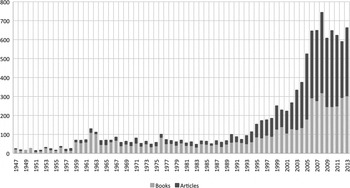
We stand at a particularly opportune moment to attempt such a task, for a few different reasons. The first of these has to do with the increased interest in recent years in studying China and India together. On the surface this appears to be solely a post-1990s phenomenon, as figure 1 suggests. Starting in the early 1990s, there seems to have been a large increase in articles and books containing “China” and “India” or “Sino-India” in the title.Footnote 12 By itself this is hardly surprising. The early 1990s were marked by Indian economic liberalization and a renewed emphasis on export-oriented growth in China following Deng's Southern Tour, policies that resulted in remarkable economic growth. Scholarly recognition of China and India's combined importance to the twenty-first-century global economy has also proceeded apace (Friedman and Gilley Reference Freidman and Gilley2005; Huang and Khanna Reference Huang and Khanna2003; Manuel Reference Manuel2015; Srinivasan Reference Srinivasan2006).
Books and articles with “China” and “India” or “Sino-India” in the title.

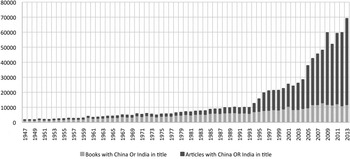
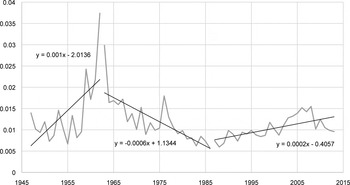
An initial impression of unfettered rise in interest post-1990s, however, needs to be tempered by data about overall publishing related to China and India. After all, the apparently dramatic shift in the 1990s could be part of a larger expansion in publishing as a whole. This does indeed seem to be the case: as figure 2 shows, once we consider data on books and articles that contain China or India in their titles—a much larger universe—we see a similar pattern of post-1990s increase. Combining the data from figures 1 and 2 allows us to normalize publications with China and India in the title against the larger universe of publications with China or India in the title and thereby get a better sense of growth trends. Accordingly, figure 3 tracks publications that have China and India or Sino-India in the title as a percent of publications that have China or India in the title. The picture that now emerges is one of not only recent growth, but also a more dynamic sequence of changes. Using years with the highest (1962) and lowest (1986) rates as points of break, we arrive at three possible periods: 1947–62, 1963–86, and 1987–2013. Fitting a regression line for each period provides us statistically significant trends (p = 0.05), with slopes that are positive, negative, and positive respectively. If we take publications whose titles contain China and India as an—admittedly unrefined and merely illustrative—heuristic for interest in the region, then our story becomes one of a growth in interest during 1947–62, followed by a period of gradual decline until 1986, only to witness a revival of interest since 1987.Footnote 13
Books and articles with “China” or “India” in the title.

Books and articles with “China” and “India” or “Sino-India” in the title as a percentage of books and articles with “China” or “India” in the title.

While it is reasonable to expect that this renewed interest in China-India is primarily driven by contemporary concerns and located within various science and social science disciplines, the discipline of history has also experienced exciting new developments. Allowing for some generalization, most historical scholarship on China-India falls into one of three categories, which are nonetheless united by their temporal focus on the years prior to 1949. The first of these we might label, tongue-somewhat-in-cheek, civilizational romanticism. In a recent interview, the Indian political psychologist Ashis Nandy articulated this approach quite succinctly: “China and India were not simply nation-states following the Westphalian model, they were also civilizations, civilizations which overlapped in a great measure. Culturally, China was partly inside India and India was partly inside China. Southeast Asia remains an example of that” (Kumar Reference Kumar2014). Such civilizational narratives, which take the ideas and concerns of contemporary nation-states and project them backward in time, are frequently coopted by nationalist projects of history writing and diplomacy. Leaders from both sides thus frequently speak of over 2,000 years of contact, peaceful coexistence, and the transmission of Buddhism, focusing in particular on the activities of the Chinese monks Faxian 法显 and Xuanzang 玄奘 (Tan Reference Chung1998; Zhang Reference Minqiu2006).Footnote 14
The second category of China-India history takes more seriously this civilizational interaction. Properly dubbed Sino-Indology, in a 2012 tribute to the Chinese Sino-Indologist Ji Xianlin 季羡林 (1911–2009), Tansen Sen explained that Sino-Indologists aim to demonstrate that “interactions between India and China during the first two millennia CE were multifaceted, changing and more complex than previously acknowledged” (Sen Reference Sen2012, 1, 6).Footnote 15 Topics in Sino-Indology have included the history of Buddhism and its spread; trade over the silk route; transfer of ideas and literary influences; the movement of technologies and goods (sugar, paper, porcelain); and much else (Xue Reference Keqiao2006). Given the linguistic dexterity and philological mastery required to carry out such work, strong barriers to entry exist, making for a lively and productive but relatively small subfield.
The third area of China-India history focuses on the years 1800 to 1949, and its most dominant strain is intellectual history, with a focus on the writings and views of major Chinese and Indian intellectuals, in particular Dai Jitao 戴季陶, Mohandas K. Gandhi, Kang Youwei 康有为, Liang Qichao 梁启超, Jawaharlal Nehru, Rabindranath Tagore, and Zhang Taiyan 章太炎.Footnote 16 Such research is particularly relevant in studies of Asian responses to the challenges of Western modernity and hegemony. Some work has also been done in other areas, such as on Indians who were deployed in China as part of the British Indian Army, on the medical aid that was offered to the communists during the 1930s, and on Sino-Indian diplomatic and economic history (Liu Reference Liu2015; Mosca Reference Mosca2013; Sharma Reference Sharma2013; Thampi Reference Thampi2005a, Reference Thampi2005b; Thampi and Sharma Reference Thampi and Sharma2015; Yang Reference Yang, Tagliacozzo, Siu and Perdue2015). The latest and most exciting development is a new, multi-year project on China-India history in the Republican period (1911–49) (Tsui Reference Tsui2013).
Though the revival in enthusiasm for studying China-India history has yet to permeate the study of the 1950s, the decade itself has become a new frontier within the historiographies of both China and India. In other words, the 1950s now belong to history. By this I mean specifically the ways in which disciplinary divisions of labor have changed in recent years. In the China and India fields, 1949 and 1947 long marked boundaries that historians did not transgress. What lay beyond was almost exclusively the domain of political scientists, sociologists, economists, and anthropologists. But over the last fifteen years, spurred by the increasing openness of national and local archives and by the possibilities of oral history, historians have begun to offer new and compelling perspectives on the early years of the People's Republic of China (PRC) and independent India.Footnote 17
In identifying these three factors—interest in China-India, the diversity of pre-1949 China-India historical scholarship, and the 1950s as history—and their salience for studying 1950s China-India history, it remains important to recognize a pervasive problem plaguing all such endeavors: the absence of strong China and India studies programs in the respective countries. The outcome is growing interest without language or area expertise in either country (Sen Reference Sen2013). And while programs devoted to China and India do exist in the Western academy, they remain relatively isolated from each other; each set of scholars largely ignorant about the other field. Such a state of affairs exists at a time when historians themselves have begun to stress anew the importance of inter-Asian connections. In January 2015, Harvard University Press published the first of a three-volume series that aims to survey “the historical, spatial, and human dimensions of inter-Asian connections” (Tagliacozzo, Siu, and Perdue Reference Tagliacozzo, Siu and Perdue2015). And in his latest book on Asian traditions, Prasenjit Duara argues that we have reached a point where a global crisis of sustainability has superseded the need for nation-centric modes of analysis. His solution is to “revisit the alternative traditions from China and India, many strains of which have adapted to the unceasing circulations of modernity, to examine whether they allow a more viable cosmological foundation for sustainability” (Duara Reference Duara2015, 2). This is an ambitious project, and regardless of its viability, it points to a more basic need: to think creatively about how we conceive and execute projects in Asian history. And that brings us to the 1950s.
A New Chronology for the 1950s
One result of the neglect of the 1950s is that even basic chronologies of the period tend to privilege diplomatic interactions such as prime ministerial visits, the signing of treaties, the arrival of ambassadors, and discussions concerning Tibet and the Sino-Indian border. While such events are no doubt important, a more holistic understanding of the decade can only begin with the reconstruction of more varied and inclusive chronologies. In 1961, Herbert Passin estimated that as many as 2,000 Indians may have visited the PRC during the previous decade (Passin Reference Passin1961, 91). I have not encountered a similar estimate for Chinese visitors to India, but reports from the Indian Embassy in Beijing indicate that 5,833 Chinese traveled to thirty-three countries in 1955 alone (NAI 3(5)-R&I/56, 4).
Both Indian and Chinese visitors were motivated by a combination of curiosity, admiration, and suspicion. Unfortunately, the documentary record of this mutual appraisal, and of the varied contacts that formed at least a part of its basis, is rather lopsided. The plentiful and ideologically varied published writings of Indian visitors make it hard to pinpoint an “Indian” view of China. Less is known of visiting Chinese delegations and individuals, in part because they were less prolific in producing detailed public reports of their activities. They all—Chinese and Indian alike—do, however, suggest an enthusiastic and frequently serious engagement.Footnote 18
The first task, therefore, is of historical reconstruction. A profitable way to begin this exercise is to chronicle the activities of the Friendship Associations in each country. In China, Friendship Associations were state-backed organs for promoting people-to-people contact with other nations. Their existence was formalized on May 3, 1954, by the establishment of the Chinese People's Association for Cultural Relations with Foreign Countries.Footnote 19 By that time, however, the China-India Friendship Association (CIFA; Zhongyin Youhao Xiehui 中印友好协会) had already been active for two years. Among those presiding at its founding in Beijing on May 16, 1952, were the physicist, playwright, and Vice-Minister for Culture Ding Xilin 丁西林 (1893–1974); the sociologist and one-time CCP spy Chen Hansheng 陈翰笙 (1897–2004); and the celebrated author Lao She 老舍 (1899–1966). Ding, who was elected President of the Association, had led the first Chinese cultural delegation to India in late 1951 and would continue to visit the country over the course of the decade. Chen, who had spent two years in India during the mid-1940s, was elected vice-president of the Association and Lao She its director. In attendance were over 100 scholars, experts, poets, and artists, including the President of the Chinese Academy of Sciences, Guo Moruo 郭沫若 (1892–1978); the political scientist and Minister of Education, Zhang Xiruo 张奚若 (1889–1973); the painter Wu Zuoren 吴作人 (1908–97); and the Indologist Ji Xianlin. India was represented by Vijaylakshmi Pandit (1900–90), the leader of the Indian Cultural Delegation then visiting China (FMA 105-00101-02, 105-00101-03, 105-00101-04, 105-00884-01; Renmin ribao 1952a). Until its activities were suspended in 1962, the CIFA remained the principal agency through which cultural and other forms of contact and exchange with India were funneled.Footnote 20
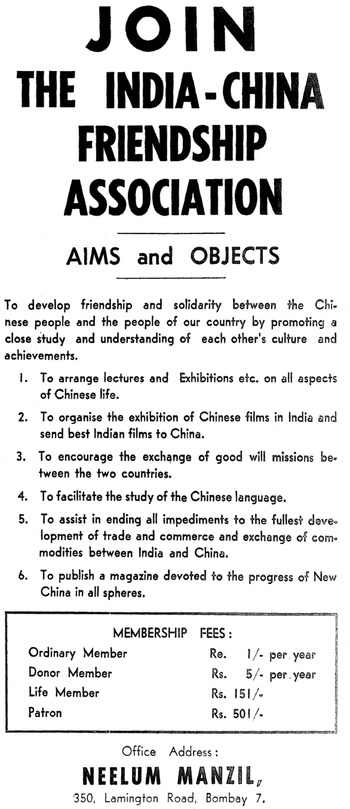
Unlike the CIFA, the India-China Friendship Association (ICFA; Yinzhong Youhao Xiehui 印中友好协会) remained an informal organization whose leadership was populated by politicians and bureaucrats, as well as by private citizens such as journalists, industrialists, artists, and academics. The first branch of the ICFA was founded in Calcutta on February 12, 1951, predating its Chinese analog by over a year (Renmin ribao 1951). By 1956, R. K. Karanjia (1912–2008), editor of the weekly tabloid Blitz and the president of the Bombay branch of the ICFA, boasted that the “movement … had now spread all over the country … [and] there were at present 18 such associations all over India” (Karanjia Reference Karanjia1956; Times of India 1956a). But this was mostly haphazard and atomized growth. In a letter written to the bureaucrat T. N. Kaul (1913–2000) during the summer of 1955, K. M. Panikkar (1894–1963), India's first ambassador to the PRC, had bemoaned precisely the “movement”-like character of the Association: “[it] has a large number of constituents but there is no regular membership register and very few paying members.” Panikkar sought to “regularise the membership of the Association and to have a programme of work.” He proposed setting up a permanent office with paid staff that would coordinate four types of activities: publication of a quarterly journal, arranging exhibitions of Chinese arts and crafts, arranging film screenings, and promoting visits of leading unofficial personalities. Kaul was sufficiently convinced by Panikkar's plan that he sanctioned a one-time subsidy of INR 5,000 (Panikkar to Kaul, July 8, 1955, NAI 1(41)-FEA/55, 6–7). By the following year, the ICFA was soliciting members in The Times of India (see figure 4).
ICFA advertisement soliciting new members (Times of India 1956b). Image produced by ProQuest LLC as part of ProQuest® Historical Newspapers. www.proquest.com.

According to one estimate, by early 1958 there had been approximately thirty CIFA delegations from China and forty ICFA ones from India (Times of India 1958). While it is tempting to dismiss both the CIFA and the ICFA as mere tools of propaganda, their active participation in numerous instances of bilateral contact and the prominent press coverage they received render them particularly fruitful conduits through which to begin our process of reconstruction. Of course, there was also much contact not channeled through the Friendship Associations. How else might we explain Herbert Passin's estimate for 1956, when “26 Indian delegations to China were counted and 33 Chinese delegations to India” (Passin Reference Passin1961, 91)? Accordingly, our reconstruction includes information on the activities of the ICFA and the CIFA compiled from newspapers such as The Times of India, Renmin ribao, and Guangming ribao, in combination with information gleaned from two other sets of sources: contemporary journal articles that discussed Sino-Indian interactions (Fisher and Bondurant Reference Fisher and Bondurant1956; Passin Reference Passin1961) and discoveries made in various archives and libraries in Beijing, New Delhi, Kolkata, Mumbai, and Toledo.
The result is an annual chronology that is strikingly different in comparison to existing chronologies of 1950s China-India history.Footnote 21 To demonstrate what I mean, consider the example of one year—1956. The left-hand column in table 1 is reproduced from an edited volume on fifty years of China and India published in 2001 (Narayan Reference Narayan, Deshpande and Acharya2001). I call this the standard chronology, for I believe it reflects the dominant mode of thinking about China-India in the 1950s: a focus on the border, the military, and visits of top leaders such as, as is the case here, Zhou Enlai. The right-hand column is the result of the chronological reconstruction I have just outlined above.
Comparing Chronologies.

As the example of 1956 shows, our reconstructed chronology helps identify a range of new actors, agencies, events, and processes, all heretofore neglected. The same is true for other years in the decade. Indeed, what emerges from the entire chronology is a veritable plethora of delegations, exhibitions, trade discussions, scientific exchanges, film screenings, gifts, lectures, sporting encounters, student exchanges, and language training. Consider the following topical sample:
-
• Films: Chinese films were screened in India in April 1952 as part of an international film festival, well before the aforementioned 1955 exchanges. Films screened included Bai mao nǚ 白毛女 (White haired girl, 1950), the theatrical version of which became one of the eight model plays of the Cultural Revolution, and a documentary of the first National Day celebration, Zhongguo minzu datuanjie 中国民族大团结 (The great unity of China's people, 1950). Two other films completed the roster: Gangtie zhanshi 钢铁战士 (Steel warriors, 1950) and Guangmang wanzhang 光芒万丈 (Boundless light, 1949).
-
• Sports: An Indian table-tennis team visited China in September 1952. An Indian volleyball team visited China in October 1955 and played against a team from the Central Athletics Institute. The Chinese Olympic Eleven toured India in June 1956, playing four soccer matches. They won three and lost one, inflicting on Calcutta League champions Mohun Bagan their worst defeat against foreign opposition (1–8).
-
• Students: An agreement to send two exchange students from China and one from India was signed in October 1954. Eventually, China sent three students and India one.Footnote 22 Ten additional Chinese students were in India by August 1955. In October that year, a delegation of thirty-two Indian teachers and students from ten universities traveled through China. And in January 1956, fourteen Indian students suffering from tuberculosis underwent treatment at the Asian Students’ Sanatorium in Beijing. In June 1956, eleven students enrolled in a six-month Chinese language course offered by ICFA, Bombay.
-
• Dance: Indian danseuses, the Laxman Sisters, visited China during March and April 1957; Uday Shankar's troupe also visited China that year. The Chinese dancer Yu Ying 于颖 was a member of the 1956 Wu Han–led cultural delegation to India.
-
• Goa: China expressed strong support to India in its bid to recover Goa from Portuguese colonial control, even holding a rally in Beijing in August 1955 that was attended by 5,000 people.
-
• Women's delegations: A Chinese women's delegation led by Minister of Justice Shi Liang 史良 (1900–85) visited India in December 1956.
-
• Notable individuals: The author of Hindi-Chini bhai-bhai, the poet, actor, and one-time parliamentarian Harindranath Chattopadhyay (哈.查托巴迪雅亚; 1898–1990), traveled to China in 1953. His collection of poems I Sing of Man (Wo gechang renlei 我歌唱人类) was subsequently translated into Chinese (Chattopadhyay Reference Chattopadhyay1955). Madan Mohanlal Atal (爱德华; 1888–1957), the leader of the Indian medical team to China during the Second World War, visited China late in 1957. He fell ill and died there in early December. Following a memorial meeting in his honor in Beijing, some of his ashes were immersed in the Yellow River. Atal's unexplored legacy has long been overshadowed by that of his team member, Dwarkanath Kotnis (柯棣华; 1910–42).
-
• Notable animals: In May 1953, Nehru gifted an elephant named Asha (阿萨) to the children of China. She was put on display in the Western Suburb Park, the forerunner of the Beijing Zoo.
-
• Scientific and technological exchange: In January 1951, India became the first non-socialist country to receive a delegation from the Chinese Academy of Sciences. Conference-level exchanges continued in subsequent years and included engineers, hydrologists, pharmacologists, doctors, botanists, etc. The year 1956 heralded a qualitative transformation in these exchanges, which shifted to longer visits by delegations seeking to study specific subjects—hydrology, planning, agricultural techniques, statistical methods, etc.—in greater detail.Footnote 23
Rebuilding a chronology that provides a fuller picture of 1950s China-India history, as noted earlier, is the first and necessary task. But it alone is insufficient. To substantiate the second part of my initial claim—to study one country through the other—I develop here two case studies, which through their variety suggest the distinct contributions they can make to the history of this period. The first deals with the question of bilateral trade between India and China, studies of which tend to ignore this decade in favor of starting with the normalization of relations in the early 1980s. The second focuses on the Indian demographer Sripati Chandrasekhar's visit to China in 1958.
Case Study I: Trade
In 2014, China became India's largest trading partner when measured by imports (second largest when measured by total trade) (Financial Express 2014). While India plays a far less important role in China's global trade, their bilateral trade has grown over ten times during the last decade; it was $7 billion in 2004 and touched $73 billion in 2011. Bilateral discussions these days thus focus as much on trade as they do on the thorny issue of border demarcation. That trade enjoys such status should hardly be surprising. It has been at the heart of interactions between the two regions going back millennia. Even so, the celebrated premodern history of inter-regional trade sits in uncomfortable tension with its more fraught early-modern and modern analog. After all, imperialism-driven trade in which opium and tea were central commodities contributed to the linked impoverishment and stagnation of both regions.
To the extent that bilateral trade has returned to the fore in recent years, the focus of research is, quite understandably, on the post-1978 years (Rao Reference Rao2014; Srinivasan Reference Srinivasan1994). And yet, trade offers a different vantage point from which to consider comparative and connected issues in the recent economic histories of both countries. Traditionally, this has been done via a focus on economic planning, with China's first five-year plan period (1953–57) frequently compared to India's second five-year plan period (1956–61). But for a limited discussion of border exchanges, trade is generally ignored under this approach, and it should come as no surprise that our knowledge of China-India trade for most of the twentieth century remains gloriously vague. Admittedly, the quantum of this trade was small; each country had its own key trade partners during the first half of the century. India traded primarily with the United Kingdom and the wider Commonwealth. China's trade had transitioned by the turn of the twentieth century, moving away from the United Kingdom and toward Japan and the United States. By the 1950s, it had been restructured to fit within an international socialist economy undergirded by bilateral trade agreements (Kirby Reference Kirby2006). The volume of mid-century China-India trade thus remains hard to ascertain.Footnote 24 According to unpublished UN estimates, of China's total exports of $1.13 billion in 1953, $46 million (4 percent) went to South Asia. India's corresponding figures were $1.12 billion and $3 million (0.3 percent). By 1959, China's total exports had grown to $2.21 billion, of which $66 million (3 percent) went to South Asia. India's corresponding figures read: $1.31 billion and $16 million (1.2 percent) (United Nations 1962).Footnote 25 But a focus on the quantum of trade is only one among multiple ways to approach the subject. Our reconstructed chronology offers useful clues.
Throughout the 1950s, interlocutors from both countries recognized the importance of trade, in its material as well as symbolic forms. “Economic and Trade Cooperation between India and China” had been on the agenda of the ICFA at its first annual meeting in Bombay in June 1952 (Times of India 1952). And harkening back to trade's central role in Asia's subjugation, Governor of Bombay Dr. Harekrushna Mahtab encouraged bilateral trade but cautioned against getting “caught once again in the ‘Western Trap’” (Times of India 1956a). In similar fashion, Kong Yuan 孔原 (1906–90), the leader of a twenty-nine-member trade delegation to India and Indonesia in 1954, observed that it was the common aspiration of not just China, India, and Indonesia, but all Asian and African countries to increase mutual trade and thereby overcome the historic effects and contemporary manifestations of imperialism (Kong Reference Yuan1955). Kong's trade delegation was on the road from June to November, and its negotiations in India culminated in the signing of a trade agreement on October 14, 1954. This two-year agreement followed close on the heels of the much more celebrated and memorialized Panchsheel Treaty, which had formalized border trade between Tibet and India and espoused the Five Principles of Peaceful Coexistence (Singh Reference Singh and Chung1998), and therefore points to a much broader conception of China-India trade. It listed a whole range of goods that each country would export to the other. Chinese exports included cereals, machinery, minerals, silk, animal products, paper and stationery, chemicals, and oils; Indian exports included grams, rice, pulses, unmanufactured tobacco, minerals and ores, wood and timber, fibers, textiles, skins, chemicals, and machinery.Footnote 26 The treaty's impact was immediate: trade in 1954–55 witnessed a seven-fold increase over the previous year, though it constituted a rather small share of India's global trade at 1.2 percent (Mody Reference Mody1956).
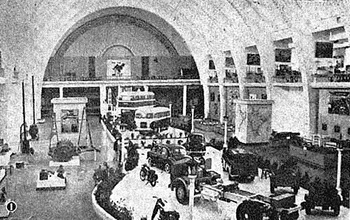
In addition to treaties, industrial exhibitions were the most tangible manifestation of trade-related activities between the two countries. The first Chinese exhibition took place in Bombay in the spring of 1952. It was part of a two-country tour (India and Pakistan) that lasted eighty days and involved a combined total of 4.5 million visitors (Renmin ribao 1952b). A second Chinese exhibition took place in Delhi in the winter of 1955 (Chen Hansheng Reference Hansheng1957). Traveling the other way, an Indian exhibition held in Beijing during four weeks in September and October 1957 was touted as the country's largest foreign exhibition. Containing products made by public and private enterprises, it occupied 10,400 square meters in the Western Suburbs Exhibition Hall (xijiao zhanlanguan 西郊展览馆) and attracted nearly one million visitors. Walking into the main hall, visitors were greeted by a variety of automobiles, including a double-decker bus, and other large industrial goods, before encountering handicrafts, textiles, and light industrial goods in adjoining rooms (see figure 5).
Indian exhibition, Western Suburbs Exhibition Hall, Beijing (Guangming ribao 1957a).

Newspaper reports suggest that the exhibition was a roaring success. The People's Daily carried a detailed laudatory review by Chen Hansheng, and the Guangming Daily provided enthusiastic coverage with numerous photographs. Internal departmental memos, however, offer a more sober appraisal. They note that footfall had been less than expected; many visitors were unimpressed by the scale and quality of the exhibition (bu fengfu 不丰富), racing through it in a mere thirty minutes. The memo did concede that the Rectification and Anti-Rightist campaigns then rampant across most work units may also have contributed to the lukewarm reception, but insisted that this was a secondary, relatively minor factor (BMA 002-020-00100, 13–16; Chen Hansheng Reference Hansheng1957; Guangming ribao 1957b; Renmin ribao 1957; Wen Reference Shizhen1957).
The most interesting and intriguing trade-related clues, however, are not state-backed initiatives such as treaties and exhibitions, but those instances where the boundary between the official and unofficial blurred. Late in 1956, the ICFA established a special wing called the Trade Information Bureau, whose purpose was to facilitate trade between the two countries. In an announcement, it explained:
The main objective of this Wing is to act as Liaison between our Importers and Exporters and the Chinese Importing Associations and Houses. The Wing will give them all the available information on trade matters and will also offer its services to solve problems and difficulties experienced in exchange, deliveries, standard of goods, shipping prices, etc. This Wing will be able to take up matters like introducing Indian exporters and importers to their counterparts in China and vice versa. (Mody Reference Mody1956)
Firms and companies interested in pursuing trade with China were encouraged to contact the Wing at the ICFA's Bombay headquarters located in Neelam Manzil on Lamington Road. K. K. Mody (Reference Mody1956), the treasurer of the (Bombay) ICFA and author of the article within which this announcement was placed, framed this bilateral trade within explicitly geopolitical and inter-Asian contexts. He explained that the recent Suez Crisis had shown India that it could not rely on trade with the West alone; had the war become a protracted one, the canal's likely prolonged closure would have had a perceptible effect on India. Furthermore, by turning toward Asian partners, Mody emphasized that “there is also a great possibility of our getting a fair deal for our products and paying fair prices for our imports, unlike some of the recent experience with some Western countries.” Further work will be needed to uncover the records of this wing and the firms and companies in India and China that it might have been in touch with. On the Chinese side, the Ministry of Foreign Trade (duiwai maoyibu 对外贸易部) was most certainly involved. For instance, between February and April 1958 it responded to an Indian request for chrysanthemum (juhua 菊花) seeds by sending over a large variety of seeds (BMA 002-010-00078).
Indian enthusiasm for trade did not escape the notice of visiting Chinese delegations. In 1956, the historian and vice-mayor of Beijing Wu Han 吴晗 (1909–69) led a twelve-member cultural delegation on a six-week tour of India. In whistle-stop fashion, they covered nearly 10,000 miles and visited forty-two cities (BMA 002-008-00068, 19–20). In Madras, the delegation was struck by the spontaneity and warmth (zidong yao jiedai women 自动要接待我们) of the descendants of local royalty (tuwang houyi 土王后裔) they encountered. Further north in Ahmedabad, the local Rotary Club (an organization of capitalists with ties to the United States, the delegation dutifully noted) had requested a meeting even though it was not part of the formal itinerary. When told that the delegation could not spare the time, the club had insisted that at least one delegate be sent, even if only for twenty minutes. In Kanpur, one of the city's prominent industrialists categorically explained to the delegation members that Indian capitalists were especially interested in promoting Sino-Indian trade. This sequence of discrete encounters culminated in Bombay at the second All-India ICFA meeting, where the central theme was “how to strengthen Sino-Indian trade relations.” The delegation noted that many of ICFA Bombay's members were capitalists themselves.Footnote 27 It is unclear if there was any appreciation of the fact that many major Indian industrial houses traced their origins to the opium trade. Even so, these experiences clearly took the delegation by surprise: the attitude of India's capitalists and landlords was a subject deserving of further attention, they concluded (zhidi women zhuyi 值得我们注意) (BMA 002-008-00068, 22).
The China-India trade of the 1950s deserves our attention too. The discussion here points to several fruitful directions for future research: the India-Tibet border trade and its relationship to China-India trade as a whole, the role of public and private firms and producers, the nature and quantum of goods traded, and the means and routes of transportation. Just as significant will be an analysis of the symbolic purpose served by both the actual trade and the discourse surrounding it. An initial focus on India and China can in time be expanded to include other countries as we arrive at new perspectives on the role of trade in the twentieth-century history of Asia, and the Global South more broadly, adding material and economic histories to existing political ones.
Case Study II: An Indian Demographer in China
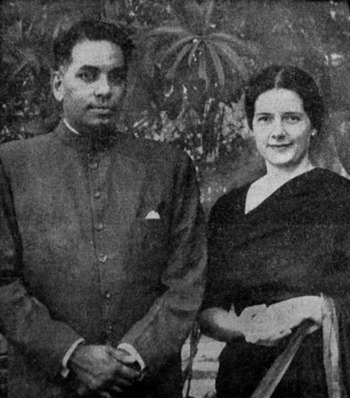
If the case of trade alerts us to the importance of institutional, entrepreneurial, and material connections between China and India, the case of Sripati Chandrasekhar's 钱得拉素卡尔 (1918–2001) four-week visit to the PRC in November and December 1958 highlights the possibilities of individual contacts. At the time of his visit, Chandrasekhar (see figure 6) was a professor of economics at Annamalai University and the director of the Indian Institute of Population Studies in Madras, and already an internationally renowned demographer.Footnote 28 He parlayed his boots-on-the-ground experience into short-lived but extensive fame as an authoritative expert on contemporary China and its “Population Problem,” delivering lectures in far-flung places, including Hong Kong, Taiwan, India, the United States, and various African countries (SCP B14 F20). The visit resulted in a slew of articles, important among which was a four-part series in the Calcutta-based The Statesman that was subsequently syndicated by the Associated Press (SCP B37 F48, 45, 47, 51, 53). Chandrasekhar also wrote or co-wrote four books in the immediate years after his visit (Chandrasekhar Reference Chandrasekhar1959, Reference Chandrasekhar1961a, Reference Chandrasekhar1961b; Chandrasekhar et al. Reference Chandrasekhar1960).Footnote 29
Chandrasekhar and his American wife, Anne, around the time of his visit to China (SCP B37 F48, 65).

Chandrasekhar's visit marked the first time that a trained demographer had the opportunity to visit the PRC. That the demographer happened to be from India, the second-largest nation in the world, and the first developing nation to have instituted family planning programs, makes it doubly interesting. At the same time, Chandrasekhar was trained in and sympathetic to the United States, had worked at the UN, and had a deep-seated interest in population control, all of which would make him suspicious in the eyes of his Chinese hosts. Also noteworthy is the fact that the visit took place during the early months of the Great Leap Forward (1958–61) and provides an eyewitness account of the early enthusiasm for the campaign. Finally, as an instance of private travel and research, it also reminds us of the diversity of these episodes. Today, however, this episode is largely forgotten. And yet, by mining not just Chandrasekhar's published works but also his personal papers and Chinese internal documents, we can gain fresh insights into such subjects as birth control in 1950s China, the Great Leap Forward, and, not least, the Chinese Foreign Ministry's handling of potentially troublesome guests.
The tour itself, however, nearly did not materialize. Chandrasekhar had been keen to visit China since the late 1940s, but had wanted to do so as a state guest and not in a private capacity or as a member of a delegation. This had made things difficult, and the trip only became possible after several rounds of negotiations.Footnote 30 Chinese officials were understandably wary of Chandrasekhar's connections to the United States and his liberal sympathies. In the end, the Foreign Ministry and the Institute of Foreign Affairs (waijiao xuehui 外交学会) informed the Chinese Embassy in Delhi that they could “only agree to a visit made by him in a private capacity, with all costs personally borne by him” (Telegram, April 16, 1957, FMA 105-00887-01, 11). This decision was relayed to Chandrasekhar and infuriated him to no end (Ma Mu-ming [First Secretary] to Chandrasekhar, May 3, 1957, SCP B14 F20). In a letter to K. M. Panikkar, India's former ambassador to the PRC, he complained: “… [The letter from the Chinese] is most unhelpful as you can see. It says that I can go to China, pay my expenses; as if all this correspondence is to get a formal permission to visit China. All sorts of people go to China as State Guests and the question of my going at my expense does not arise” (Chandrasekhar to Panikkar, May 8, 1957, SCP B14 F20). Chandrasekhar went on to beseech Panikkar's intervention. But the Chinese held firm and, after additional rounds of letter-writing, they reiterated: “[You are] … welcome to go to China on a private visit and on [sic] your own expenses” (Ma Mu-ming to Chandrasekhar, August 21, 1958, SCP B14 F20). Much as this snub hurt Chandrasekhar's sense of self-worth, corresponding Chinese internal memoranda provide fine-grained insight into the handling of potentially problematic guests. Consider the following guidelines pertaining to his visit: (1) Be polite but propagandize the Great Leap Forward; explain that China has no population problem; use him to understand the situation in India. (2) The State Statistics Bureau and the Foreign Ministry will handle most of his travel affairs. (3) No officials are to receive or send him off. (This is not an official visit.) (4) Only arrange one small [dinner] party in his honor (one table). (5) Schedule no meetings with political leaders. (Instead consult attached list of people in various bureaus.) (6) Disseminate no news/information about the visit. Take photos, but only for record keeping. (7) Finally, he must pay for everything (FMA 105-00887-01, 28–30).Footnote 31
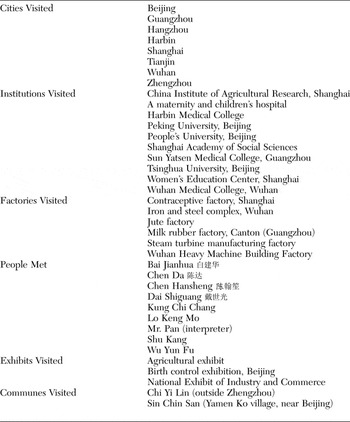
In spite of this cool attitude, Chandrasekhar spent a hectic month in the PRC. He visited a wide variety of institutions across several cities and met with numerous prominent Chinese experts. The majority of these activities are summarized in table 2.
Chandrasekhar's Activities in China.Footnote 33

Chandrasekhar came away from the trip with strongly negative views of Chinese society and its prospects for continued population growth, which, he was convinced, would result in attempts at militaristic expansion (Chandrasekhar 1961, 139). These views are interesting for what they tell us about Cold War constructions of the Chinese other, but they were also rightly criticized by contemporary reviewers for being too simplistic and perhaps even ideologically overdetermined (Han Reference Han1962).Footnote 32 Once we set aside Chandrasekhar's pronouncements about the prospects and perils of “Red China,” there remains, however, much else worthy of discovery and analysis.
Take the case of population, Chandrasekhar's principal area of interest. During his time in the PRC, he visited numerous hospitals, where he was introduced to contemporary approaches to birth control. He was told that birth control was recommended to promote better health among the Chinese people. To achieve this, women were permitted to carry out postpartum sterilization. In other instances, women were given diaphragms and an applicator jelly. If they wanted birth control for long periods, he wrote, a “ring is inserted into the uterus with an introducer and taken out after two or three years with a remover.” As for men, Chandrasekhar observed that sometimes they used “sheaths” (condoms). He concluded that “both sheaths and diaphragms are rather unpopular. The ring and sterilization are popular. Vasectomies are also performed but men don't like it. But women like post-partum sterilization.” Chandrasekhar was provided with samples of contraceptive devices and told that they were made locally in factories in Guangzhou, Shanghai, and Wuhan. He wrote in his diary that they “look like good products. Extremely cheap—a sheath costs one naya paisa. A diaphragm and jelly costs Rs. 2 in purchasing power exchange. They are given free or charged a trifle of the nominal price.” Given the Great Leap Forward's demand for steel, he was also told about introducers made from bamboo, which he found “well done and extremely ingenious” (SCP B19 F43, 7–8).
Chandrasekhar was taken to two major factories making birth control devices, in Shanghai and Canton (Guangzhou). He had already been told that an estimated “450,000,000 condoms, 300,000 diaphragms and 1,950,000 tubes of jelly were produced in 1957—about six times more than were produced in the previous year” (SCP B19 F43, 56).Footnote 34 At these factories, he was able to witness their production. The contraceptive factory in Shanghai, for example, employed 200 workers, 60 percent of whom were women. Average wages were around seventy yuan, and all raw materials were sourced from within China; the rubber coming mainly from southern Hainan. The factory had originally been established in 1938 under the Nationalists but had ceased operations in 1946, only to have been started up again in 1952. By 1958, it was making about five million sheaths (condoms) and about 50,000 diaphragms. Chandrasekhar was impressed with the production methods he observed, finding them simple enough for the Government of Madras or a private manufacturer in India to emulate. He went on to observe:
The sheaths [condoms] in China sell for 3 cents each – roughly 3 n.P. each, treating the yuan as equivalent to a rupee. The sheaths come in two sizes and the diaphragm in 5 sizes.… Some of these are exported to Asian countries. The demand for diaphragms is not as great as the demand for sheaths. Saw a lot of unmarried girl workers testing sheaths by blowing. They began to giggle when they saw me watching their testing! (SCP B19 F43, 90)
Towards the end of his travels, Chandrasekhar also visited the Canton Milk Rubber Factory, which was significantly larger than the Shanghai factory and employed 1,200 workers. The rubber was again sourced from Hainan. But unlike the Shanghai factory, it had been built from scratch in 1955. In 1957, it had produced sixty million sheaths, each of which was sold to peasants by the government at subsidized rates (two cents versus four). When he asked about how information about these products was disseminated, he was informed that the products were not advertised but peasants knew about them nonetheless and could purchase them in village shops. He also learned that “contraceptives for men are in greater demand than contraceptives for women. The peasants use them 5 or 6 times before they throw a sheath away.” In order to allow reuse, a sterilizing powder was provided with each sheath (SCP B19 F43, 96).Footnote 35
These are just a small sampling of the kind of detail that exists in these materials. Chandrasekhar's observations raise a whole variety of questions about the practice of birth control during the late 1950s, especially the manufacture and materiality of contraceptive devices and the micro-politics of their use. Pursuing them would allow us to look beyond the discursive analysis of policy documents and government manuals and move away from macro concerns to reconstruct a fuller history of birth planning and control in 1950s China. In the otherwise rich and diverse field of population studies of China, we do not yet possess this particular history.
Writing in the late 1970s, Leo Orleans noted: “China also had to make sure that the health establishment charged with the dissemination of birth control information would have at its disposal a plentiful supply of effective and acceptable contraceptives—a building block not in place until the 1960s” (Orleans Reference Orleans and Orleans1978, 8). In similar fashion, Thomas Scharping observed that “the production of modern contraceptives began in 1956,” but then dismissed this production as too small to have had any significant impact (Scharping Reference Scharping2003, 105).Footnote 36 Studies such as those of Scharping and Tyrene White (Reference White2006, 21–26) approach birth planning and population control during this period largely from the perspective of the speeches of leaders and official documents and do so primarily as brief background en route to more substantive discussions of later decades. Even the work of Susan Greenhalgh and Edwin Winckler (Reference Greenhalgh and Winckler2005, 64–74), which offers thus far the most meticulous and insightful discussion of contraception during the 1950s, confines itself largely to the discursive and policy field. By pursuing clues found in the Chandrasekhar materials, additional research on the materiality and production of contraceptive devices can complement existing scholarship and significantly enhance our understanding of birth control during this period in China's history.
Conclusion: A New Agenda
The chronology and the two case studies discussed here are scratches on a vast surface. Nonetheless, they demonstrate that an approach that takes seriously cultural, scientific, and economic life leads to different sources and different historical arguments from an approach focused on political (and especially high political) life. China-India history of the 1950s, to the extent that it has been done, remains mired in concerns related to border demarcations and the war of 1962. The price has been the disavowal of other important lines of historical inquiry. But by displacing (not dismissing) our monocular focus on 1962 and widening our lens to also include moments of contact, comparison, cooperation, and competition, we can offer fresh insights in a variety of historical fields. For starters, such a study of China-India relations can enrich our understanding of both Chinese and Indian history. But just as significant are the broader methodological implications of another form of displacement. Studying one country in the Global South through another also in the Global South decenters (again, does not dismiss) the West when writing histories of the twentieth century. Such an approach can lead to the (re)discovery of important episodes and offer exciting new interpretations of recent history.
In the China-India case, more specifically, the chronology can serve as a useful point of departure. Future research topics can include writings on China and India, especially popular and specialist perceptions of the prospects of each country; bilateral visits of intellectuals and practitioners; scientific contact and cooperation; the activities of the Friendship Associations; literary and cultural activities, including the screening and reception of films and the translation and reception of texts; competition for influence in places like Southeast and Central Asia; exploration of materials in vernacular languages; and the influence of Chinese communism (Maoism) on Indian communist movements. Were we to pursue these and other topics, I predict we will discover new and important perspectives on Chinese, India, Asian, and international history, all of which will crucially inform how we approach the challenges of the twenty-first century.
Writing thirty-odd years ago, Seth closed his China travelogue with these words: “… to learn about another great culture is to enrich one's life, to understand one's own country better, to feel more at home in the world, and indirectly to add to that reservoir of individual goodwill that may, generations from now, temper the cynical use of national power” (Seth [1983] Reference Seth1987, 178). Revisiting the 1950s in all their richness and complexity may thus not only yield a more multifaceted history but also produce that most elusive of diplomatic outcomes: an improvement in Sino-Indian relations.
Acknowledgments
I would like to thank Jeffrey Wasserstrom and the four anonymous reviewers for their incisive and thorough feedback on earlier drafts of this article. It originated in a talk I delivered at Northeastern University in the fall of 2014. I am grateful to Philip Thai for suggesting my name and to Gavin Shatkin for the invitation. A modified version was subsequently presented at the Center for Policy Research in New Delhi in July 2015; thanks, in particular, to the interest shown by Partha Mukhopadhyay, Pratap Bhanu Mehta, and Srinath Raghavan. Liz Perry, Emma Rothschild, Tansen Sen, Arne Westad, Rohit De, Mark Elliott, Partha S. Ghosh, Gal Gvili, Sunil Amrith, Matthew Connelly, Partha Chatterjee, and Richard So generously read or discussed various versions, in part or whole, offering much-needed criticism and encouragement along the way. Suqin Hou provided expert research assistance in collecting bibliometric data from WorldCat and other databases. Thanks also to Paul Vierthaler, Shannon Stewart, Donald Sturgeon, and Ameet Morjaria, who discussed the data with me.