

I. Introduction
In recent decades, Cognac exports have become a booming sector of the French economy. Cognac brandy is produced in a limited region but was sold in more than 140 countries in 2013; more than 95 percent of France's total Cognac production is exported every year. The value of Cognac shipments has reached more than 2 billion euros as of 2013.
International trade has been a historical priority for the Cognac region for ten centuries. Wine production started in the region in the Middle Ages, and the river Charente (nicknamed “the Walking Path” by the Romans) offered a unique way to transport products to the Atlantic Ocean and to northern Europe, particularly the Netherlands. The birth of Cognac brandy is also associated with international trade. Because the low-alcohol wine coming from the Cognac region did not keep well during its transportation to northern Europe, the Dutch decided to distill the product and then mix it with water for consumption at its destination; thus, the brandy known as Cognac was born. Today, more than 440,000 hectoliters of pure alcohol (HL PA), equivalent to more than 157 million bottles, are exported worldwide.
What are the reasons behind Cognac's success story? The objective of this paper is to identify the determinants of Cognac exports using a unique database covering Cognac shipments in volume to more than 140 destinations from 1996 to 2013Footnote 1 and a database on customs protections on brandy. We use these two resources to estimate the impact of geographical, demand and policy factors on the Cognac trade.
The contribution of this paper is twofold. First, we use this unique database to estimate the determinants of Cognac exports based on Heckman's (Reference Heckman1979) procedure, which allows us to analyze the impact of different determinants on the probability of trade to a destination and on the intensity of that trade. Second, by emphasizing the impact of customs protections on the Cognac trade, we provide evidence—which up until now, to the extent of our knowledge, has been relatively scarce—of the impact of trade costs on luxury and/or alcohol products.
We find that all covariates have the expected impact on Cognac exports, except for the impact of the average customs duties on the probability of trade (extensive margin). Correcting for an endogeneity bias using an instrumental variable (IV) estimation method, we find that protectionist measures have a significant negative impact on the extensive margin. The robustness of these results is tested by adopting a different measure of the importer's average customs duties and by using alternative estimation methods.
The article is structured as follows. We review the related literature in Section 2. Section 3 presents the database of Cognac exports along with a database on worldwide customs protections on Cognac. We also present some stylized statistics on the evolution of Cognac exports. In Section 4, we describe our econometric strategy, present our results, and conduct robustness checks. We also estimate a unit value equation. Section 5 presents our conclusions.
II. Review of Literature
This paper is directly related to the literature on the determinants of sales and exports of luxury and alcohol products.
Indeed, Cognac is a luxury product. Cognac VS (for Very Special, meaning that it is at least two years old) was sold at prices ranging from 25 euros to 45 euros per bottle in 2015; Cognac VSOP (for Very Superior Old Pale, meaning that it is at least four years old) was sold at prices ranging from 32 euros to 57 euros per bottle in 2015; and Cognac XO (for Extra Old, meaning that it is at least six years old), the highest quality of Cognac, was sold at prices ranging from 45 euros to 94 euros per bottle in 2015.
Important Cognac houses (e.g., Martell, Rémy Martin) belong to the famous Comité Colbert, an association of seventy-five French luxury brands founded in 1954 by Jean-Jacques Guerlain for the sole purpose of promoting the concept of luxury. Finally, it is worth noting that spirits are generally classified as a luxury good by studies estimating the income elasticity of demand. Fogarty (Reference Fogarty2010, p. 450–451) conducts a meta-analysis of the demand for alcohol literature, finding that “spirits income elasticity estimates range from –0.29 to 2.52 with a mean of 1.15 and a median of 1.24.” He concludes that “beer is a necessity, spirits are on balance a luxury.”Footnote 2
The literature focusing on the relationship between quality and trade is quite large. Interestingly, Crozet, Head, and Mayer (Reference Crozet, Head and Mayer2012) present it along three axes:
-
1. Studies that investigate the attributes of countries that trade higher quality goods. For example, Matsuyama (Reference Matsuyama2000) develops a Ricardian model of trade (one factor, perfect competition, no return to scale, international differences in technology) with nonhomothetic preferences. Rich countries export products of the higher spectrum of goods with higher income elasticities. Choi, Hummels, and Xiang (Reference Choi, Hummels and Xiang2009) investigate how differences in income distribution within and across countries affect patterns of consumption and international trade in goods differentiated by quality. They base their theoretical model on Flam and Helpman (Reference Flam and Helpman1987) to obtain a mapping wherein prices of imported goods rise with household income. These two references are useful contributions to explain international trade in goods differentiated by quality, but their main focuses are to relate the unit value of imported goods to income distributions; here, we evaluate the determinants of the volume of trade in high-quality goods. Hummels and Klenow (Reference Hummels and Klenow2005) find that quality increases with exporters' per-capita income. Hallak (Reference Hallak2006) designs an empirical framework to study the role of quality in trade patterns and concludes that rich countries tend to import relatively more from countries that produce high-quality goods. Fajgelbaum, Grossman, and Helpman (Reference Fajgelbaum, Grossman and Helpman2011) develop a framework for studying international trade in varieties and qualities with nonhomothetic preferences and study the pattern of trade between countries that differ in size and income distributions. Their main conclusion is that trade derives from a home market effect.
-
2. Studies, based on product-level trade data, that test the implications of models of firm-level heterogeneity in quality. For example, Johnson (Reference Johnson2012) estimates a heterogeneous firm trade model based on disaggregated data on export values and prices. He concludes that high-productivity firms produce and export high-quality goods and charge high prices.
-
3. Studies that confront firm-level theories with firm-level data. Manova and Zhang (Reference Manova and Zhang2012) use a new database on Chinese firms participating in international trade between 2003 and 2005, concluding that more successful exporters use higher-quality inputs to produce higher-quality goods and that the range of export prices offered by a firm varies significantly with the number of destinations.
Crozet et al. (Reference Crozet, Head and Mayer2012) should certainly be classified in the third axis. They match firm-level export data with a quality ranking conducted by an expert to estimate the key parameters of Melitz's (Reference Melitz2003) model, interpreted in terms of quality. They base their estimation on data on Champagne, which makes this study close to ours, even if we do not study quality sorting. Other empirical literature, specifically on international trade in high-quality products, is much smaller. Based on a world database of trade flows, Fontagné and Hatte (Reference Fontagné and Hatte2013) assess quality by high unit values and identify 416 high-quality products by a study of the distribution of unit values between 1994 and 2009. Exports of high-quality products—particularly of high-quality French goods—are less sensitive to distance than other products, but they are more sensitive to the per-capita gross domestic product (GDP) of the destination country. Martin and Mayneris (Reference Martin and Mayneris2015) find a null effect of distance and a positive effect of the importer's per-capita GDP on the export of high-quality products by French firms. They confirm the relatively low elasticity (in absolute value) of these exports to distance and the relatively large elasticity to per-capita GDP. This low distance-elasticity implies more geographic diversification.
Very few studies analyze the impact of trade costs on the trade of luxury and/or alcohol products. Dal Bianco et al. (Reference Dal Bianco, Boatto, Caracciolo and Santeramo2016) conduct an estimation of a gravity equation for wine and find that coefficients of tariffs are negative in all specifications. In their preferred estimation (PPML), the elasticity of trade to tariffs is –0.472. For Raimondi and Olper (Reference Raimondi and Olper2011), trade in spirits is negatively and significantly responsive to tariffs, but less (in absolute value) than trade in wine or soft drinks. The elasticity of trade to tariffs ranges from −1.0 to −2.1 across methodologies concerning spirits, from −1.4 to −8.4 concerning wine, and from −3.0 to −5.1 concerning soft drinks.
III. Data and Descriptive Statistics
Two specific databases have been constructed for this research: the first on worldwide Cognac exports over an eighteen-year period,Footnote 3 and the second on customs protections on Cognac from 1996 to 2013.Footnote 4
A. Cognac Sales and Export
Raw data regarding Cognac exports by year and destination have been provided by the Bureau National Interprofessionnel du Cognac. We use information on Cognac shipments to more than 140 destinations from 1996 to 2013.
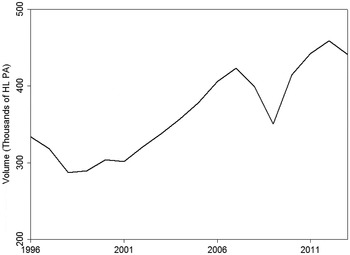
Figure 1 presents the evolution of total shipments, in volume, of Cognac from 1996 to 2013. Over these eighteen years, the volume of foreign shipments increased by 32 percent. As shown in Figure 1, Cognac exports increase steadily during the first half of the 2000s, until the financial crisis of 2007 and 2008. Global sales recover by 2010.
Evolution of Total Cognac Shipments from 1996 to 2013

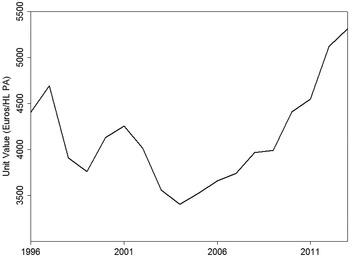
In 1996, the export unit value of Cognac is 4,402 euros/HL PA. Despite the ups and downs, it increases by 21 percent between 1996 and 2013, reaching more than 5,313 euros/HL PA in 2013 (see Figure 2). The average export unit value of Cognac during this period is more than 4,133 euros/HL PA.
Evolution of the Export Unit Value of Cognac from 1996 to 2013

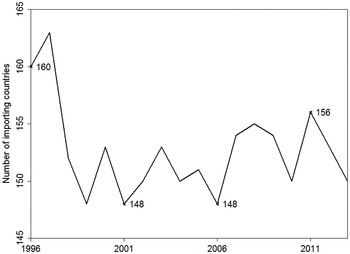
In 1996, Cognac was shipped to 160 countries. As shown in Figure 3, the number of importing countries decreases to 150 in 2013. The concentration of destination markets over time could be attributed to political factors, as some countries, particularly in Africa have experienced episodes of internal armed conflicts during the period we are examining (e.g., Chad, Libya, Syria, and Uganda). These countries consecutively interrupted their imports of Cognac. Other countries that ceased to import Cognac are small and by nature volatile in terms of imports (e.g., Guyana, Northern Mariana Islands, Vanuatu, Wallis and Futuna).
Number of Destinations of Cognac Exports from 1996 to 2013

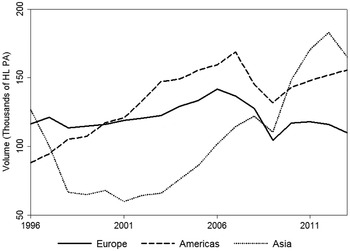
Europe has long been the center of Cognac consumption. In the eighteenth century, the first exports of Cognac were sent to England and northern Europe. Nevertheless, as shown in Figure 4, since the beginning of the twenty-first century, the American and then the Asian markets have become the most dynamic destinations for Cognac sales.
Cognac Exports by Continent from 1996 to 2013

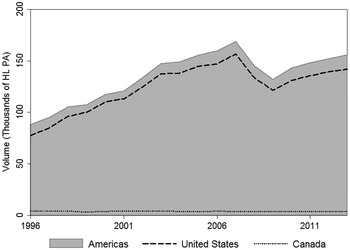
Figure 5 shows the evolution of Cognac exports to the Americas between 1996 and 2013. The United States has always been by far the main destination on this continent; Cognac exports to Canada and Latin America have been quite marginal.
Evolution of Cognac Exports to the Americas from 1996 to 2013

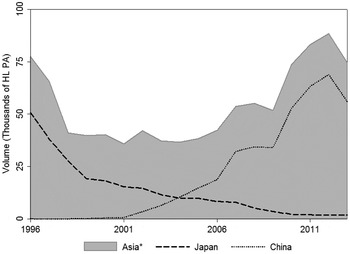
In 2010, Asia became the top Cognac-importing continent. It is worth noting that Cognac exports to Japan have continuously declined since the second half of the 1990s (see Figure 6). Exports to China, meanwhile, have substantially increased, making this destination a current priority for Cognac houses. Meanwhile, Africa and Oceania are only marginal destinations for Cognac exports, with fewer than 10,000 HL PA (around 3.6 million bottles) each.
Evolution of Cognac Exports to Asia* (Singapore and Hong Kong Excluded) from 1996 to 2013

B. The Protection Database
Two types of customs instruments restrict worldwide exports of Cognac: ad valorem duties (duties defined in percentage) and specific duties (defined in monetary units by units of volume). In the study, we do not consider domestic fiscality, particularly consumption taxes, levied on Cognac sales.Footnote 5
Information on ad valorem and specific customs duties comes from the International Trade Centre.Footnote 6
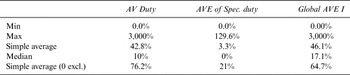
Table 1 Footnote 7 provides the summary statistics from this database, covering eighteen years and more than one hundred importing countries. It shows that customs protections on Cognac exports are very high. The simple average of ad valorem duties on all destination*year pairs is 42.8 percent when 0 are included, but 76.2 percent when 0 are excluded. The highest ad valorem duty is 3,000 percent, which is still assessed in Egypt as of 2015.
Worldwide Customs Protections on Cognac: Statistics for more than 100 Importing Countries, 1996−2013

AV = Ad Valorem; AVE = Ad Valorem Equivalent; excl. = excluding.
Note that Table 1 shows the average world protection on line HS6 220820: Spirits obtained by distilling grape wines or grape marcs (grape brandy). Therefore, this line mainly concerns Cognac.Footnote 8
The simple average of specific duties in ad valorem equivalent is 3.3 percent. To estimate ad valorem equivalents of specific duties (column 3), we divide the specific duty by the yearly average unit value. We take the annual average unit value and not the bilateral unit value to avoid an endogeneity bias; high specific duties could lead to a change in the composition of the quality exported to decrease protections in relative terms. The last column of Table 1 indicates a global average by adding the different elements of customs protections. National customs protections on Cognac vary from 0 percent to 3,000 percent.
IV. Econometric Estimation
In this section, we first detail our empirical strategy. Then, we present and discuss our results and conduct robustness checks. Finally, we provide some evidence on the determinants of Cognac export unit values.
A. Empirical Strategy and Data
Our evaluation of the determinants of Cognac exports is based on a gravity equation.Footnote 9 In this model, exports depend on demand (usually proxied by the GDP of the importing country), supply (GDP of the exporting country), and trade costs (tariffs and transportation costs proxied by distance and other geographical and historical factors).
Our equation presents specific features. First, as we perform estimations only on French exports, we do not need the exporter's GDP; supply can be controlled using time-fixed effects.
Second, we add importer's GDP per capita and religious factors to take into consideration the characteristics of Cognac demand as a luxury product and an alcoholic beverage.
Third, Anderson and van Wincoop (Reference Anderson and van Wincoop2003) recommend using relative trading costs in the gravity equation rather than absolute trading costs. In our specification, we do not need to construct a relative distance indicator and relative protection rate, because all exports are from France.
Fourth, following Helpman, Melitz, and Rubinstein (Reference Helpman, Melitz and Rubinstein2008), we consider the case where the sample of destinations of Cognac exports is nonrandom. In such a case, conventional estimators, such as ordinary least squares (OLS), applied on a sample of nonzero exports would be biased; thus, it is best to adopt Heckman's (Reference Heckman1979) procedure to correct the sample selection issue. In our case, a right selection variable is the armed conflict variable, a dummy equal to 1 if importing countries have experienced internal armed conflicts in a given year. We explain in Section 3.A that many countries that have ceased importing Cognac have experienced episodes of internal armed conflict.
Let Q j,t be the volume of Cognac exported to country j at time t. We estimate the following equation, using Heckman's (Reference Heckman1979) procedure:
 $$\eqalign{ ln(Q_{\,j,t} \; )& = \alpha _0 + \alpha _1 \; ln(Y_{\,j,t} \; ) + \alpha _2 \; ln(y_{\,j,t} \; ) + \alpha _3 \; ln(d_j \; ) + \alpha _4 \; ln(e_{\,j,t} \; ) \cr & \quad + \alpha _5 \; ln(AVE_{\,j,t} \; ) + \alpha _6 \; Ll_{\,j\;} + \alpha _7 \; Rel_j \; + \alpha _8 \; Conflict_{\,j,t} \; + \nu _t \; + u_{\,j,t},} $$
where Y j,t is country j’s GDP at time t, y j,t is the per-capita GDP of country j at time t, d j is the distance from France to country j, e j,t is the nominal exchange rate of country j’s currency against the euro, and AVE j,t is the global average customs protection on brandyFootnote 10 (ad valorem equivalent), implemented by country j at year t (see Section 3.B).
Other variables are dummies: Ll j is a dummy taking the value 1 if country j is landlocked, Rel j is a dummy taking the value 1 if fifty percent or more of country j’s population is Muslim, and Conflict j,t is a dummy taking the value 1 if country j has been involved in an internal armed conflict or internationalized internal armed conflictFootnote 11 in year t that resulted in at least one thousand battle-related deaths in that given year. Finally, ν t are time-fixed effects, and u j,t is the error term.Footnote 12
Data on each country j’s GDP and per-capita GDP are in constant 2005 U.S. dollars and were retrieved from the World Bank's World Development Indicators DataBank. Nominal exchange rates are annual averages of daily observations from fxtop.com,Footnote 13 and we use Centre d’Études Prospectives et d'Informations Internationales' (CEPII's) weighted bilateral distance measure (in kilometers). The variables Llj and Relj are from CEPII and the CIA Factbook, respectively.Footnote 14 Data on armed conflicts are retrieved from the UCDP/PRIO Armed Conflict Dataset v.4-2015.
Summary statistics of the aforementioned variables and the list of all importing countries in 2013 may be requested from the authors.
Equation 1 is estimated for the period from 1996 to 2013.
B. Results
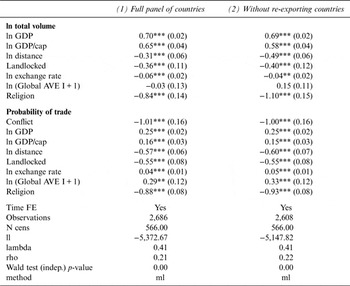
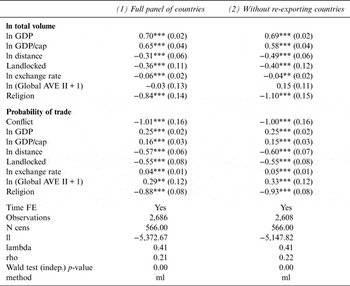
The top and bottom of Table 2 report the results of the estimation of equation 1, using Heckman's (Reference Heckman1979) procedure. The Wald test on the independence of equations suggests the presence of a selection bias.
Baseline Estimation: Heckman Procedure

Standard errors in parentheses.
* p < 0.10, ** p < 0.05, *** p < 0.01.
In column 1, we use the full panel of importing countries. As the international Cognac trade is characterized by a high level of re-exportation from a limited number of countries (Hong Kong, the Netherlands, Panama, Singapore, and United Arab Emirates; list provided by BNIC), we conduct a robustness test by excluding these destinations.
“Traditional” gravity variables have significant coefficients with the expected sign: the importing country's GDP has a significant and positive impact on Cognac exports, whether on the probability of trade (the extensive margin) or the trade volume (the intensive margin). Distance, on the other hand, has the opposite effect, both on the probability of trade and on the trade volume.
The per-capita GDP of the destination country has a positive impact on the extensive and intensive margins of trade. Being landlocked acts as a trade barrier, restricting positive trade volume and the probability of trade. The dummy variable controlling for religious factors in the destination markets has a negative impact on the extensive and intensive margins.
The exchange rate has a significant positive impact on the probability of trade and the opposite effect on the intensive margin, which means that an appreciation of the euro increases the probability of trade but decreases Cognac trade volumes. The decision in favor of exporting Cognac to a given destination depends on whether local sales are sufficient to cover the fixed costs of establishing a positive trade flow. When the euro appreciates, the price of the local currency (destination's currency) against the euro decreases, which implies that fixed trade costs in local currency also decrease. Therefore, as long as these costs are in the local currency, it is not surprising that the impact of the exchange rate on the extensive margin is positive.Footnote 15 This positive effect of the exchange rate on the extensive margin of trade as well as the negative effect on the intensive margin have some theoretical foundations (see, for example, Chaney, Reference Chaney2013).Footnote 16
Customs protections have no impact on the intensive margin, but they have a positive and significant effect on the extensive margin. These results are robust to the exclusion of re-exporting countries.
The significant positive impact of customs duties on the extensive margin of trade means that an increase of a tariff on Cognac leads to an increase in the probability of exporting the product. We suspect the presence of an endogeneity bias, so that the tariff may be induced by Cognac imports. Many importing countries are small and/or developing countries with a limited domestic fiscal base. Because Cognac imports are often associated with conspicuous consumption, governments may react to imports of this product on its territory by imposing customs duties. Customs duties are a politically appreciated source of public revenue (there is a large literature on endogenous protectionism). This effect is exacerbated considering that Cognac is a vice product and might be the object of high taxation in terms of not only excise duties but also customs duties. Increases in Cognac imports may encourage local authorities to augment customs duties on this product to collect more revenue and to fight the consumption of a vice product.
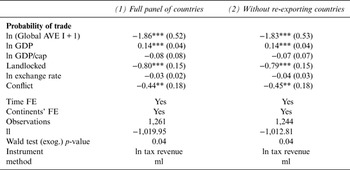
To correct for this potential bias, we use an instrumental variables (IV) approach for probit models. We use tax revenues in percentage of GDP as an instrument for the global ad valorem equivalent.Footnote 17 As explained in the previous paragraph, customs duties are a source of public revenue and therefore correlated with our instrument. On the other hand, we have no reason to believe that the volume of Cognac exports is correlated with tax revenues.Footnote 18
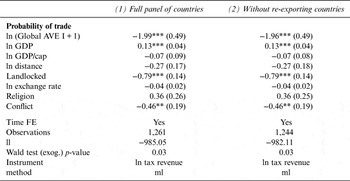
Results of the IV estimation on the probability of trade are presented in Table 3. The hypothesis of exogeneity of the instrumented variable is rejected. Correcting for the endogeneity bias shows that customs duties have a significant negative impact on the extensive margin, which is in line with the literature. The GDP of destination countries has a significant positive impact. The per-capita GDP, distance, exchange rate, and religion variables no longer have significant impacts, while being landlocked and experiencing armed conflicts negatively influence the probability of trade. These results are robust to the exclusion of re-exporting countries.
Baseline Estimation: IV Probit

Standard errors in parentheses.
* p < 0.10, ** p < 0.05, *** p < 0.01.
C. Discussion
We compare the results of Table 2 with those in the existing literature, particularly with studies focusing on the determinants of high-end versus low-end export flows.
According to our estimations, the elasticity of Cognac exports to the GDP of the importing country is 0.7 (0.69 when excluding re-exporting countries; see column 2). This estimated coefficient is greater than that for all luxury products considered all together, according to Fontagné and Hatte (Reference Fontagné and Hatte2013): 0.461 when considering worldwide export flows, and 0.556 in the case of French export flows. The destination country's per-capita GDP impact on Cognac trade flows, estimated at an order of magnitude of 0.65 (0.58 when excluding re-exporting countries), is also greater compared to Fontagné and Hatte's (Reference Fontagné and Hatte2013) estimations (0.3145 and 0.394 in the case of worldwide and French high-end export flows, respectively) but is lower than Martin and Mayneris's (Reference Martin and Mayneris2015) results (0.87), which are based on aggregated French firm-level data for two hundred products in 2005. The impact of distance on Cognac exports is lower in absolute value compared to all luxury products in Fontagné and Hatte (Reference Fontagné and Hatte2013): −0.31 in the case of Cognac, and −0.734 and −0.578 for worldwide and French exports, respectively. Thus, Cognac is a luxury product whose exports are negatively affected by distance, but it is much less sensitive to distance than other products, including other luxury products.Footnote 19 At the same time, customs protections have no significant impact on the intensive margin of trade. We do not find this result surprising, given the nature of our product. Using the same argument, one may expect a nonsignificant impact from the distance variable. However, even though distance is a relatively good proxy of transportation costs (in which case, for all else equal, a nonsignificant impact is indeed a plausible hypothesis), it includes influences from other factors, such as information costs.Footnote 20
D. Robustness Tests
We perform three tests to check the robustness of our results. First, we estimate equation 1 using an alternative measure of customs protections. Second, we estimate equation 1 adding continents' fixed effects. Third, we use the Poisson Pseudo Maximum Likelihood and the EK Tobit models (PPML and EK Tobit, respectively) as alternative estimation methods.
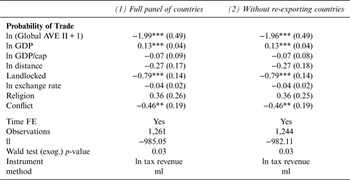
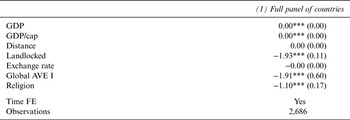
We use a different computation of the average protection on Cognac to test the robustness of our baseline results (see Table 4). The ad valorem equivalent of specific duties is either calculated by dividing the specific duty expressed in euros by HL PA by the annual average unit value on flows to all destinations (the methodology used in Table 1 and in the central estimations) or by the unit value of the flow to a specific destination (ln Global AVE II). This alternative measure of customs protections leads to the same results—that is, customs duties have no impact on the intensive margin, but they have a significant and positive impact on the extensive margin. When correcting for the endogeneity bias using the IV estimation method (see Table 5), we find that customs protections have a significant but negative impact. Results concerning the rest of the variables remain the same.
Robustness Check I: Alternative Customs Protections Measure: Heckman Procedure

Standard errors in parentheses.
* p < 0.10, ** p < 0.05, *** p < 0.01.
Robustness Check I: Alternative Customs Protections Measure: IV Probit

Standard errors in parentheses.
* p < 0.10, ** p < 0.05, *** p < 0.01.
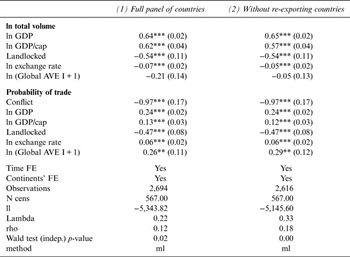
In Table 6, we estimate equation 1 adding continents' fixed effects. We add five dummies for Africa, the Americas, Asia, Europe, and Oceania. We exclude distance and religion variables because of possible intracontinent correlation. We find qualitatively similar results to our baseline estimation results when conducting the Heckman procedure (see Table 6) and correcting for the endogeneity bias (see Table 7), regardless of whether we exclude re-exporting countries.
Robustness Check II: Adding Continents' FE: Heckman Procedure

Standard errors in parentheses.
* p < 0.10, ** p < 0.05, *** p < 0.01.
Robustness Check II: Adding Continents' FE: IV Probit

Standard errors in parentheses.
* p < 0.10, ** p < 0.05, *** p < 0.01.
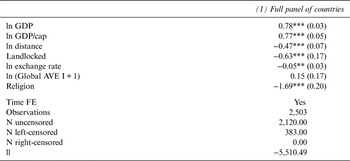
As additional robustness checks, we use a PPML approach to estimate the determinants of Cognac trade flows. The estimation considers the “0” trade flows (see Table 8). In Table 9, we show the results of a Tobit estimation based on Eaton and Kortum's (Reference Eaton and Kortum2001) method (EK Tobit). We find qualitatively similar results to the previous robustness checks using both approaches.
Robustness Check IIIa: Alternative Estimation Method: PPML

Standard errors in parentheses.
* p < 0.10, ** p < 0.05, *** p < 0.01.
Robustness Check IIIb: Alternative Estimation Method: EK Tobit

Standard errors in parentheses.
* p < 0.10, ** p < 0.05, *** p < 0.01.
E. Determinants of Export Unit Values
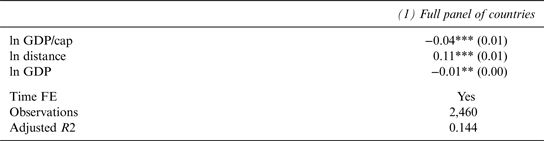
Table 10 shows the results of the OLS estimation of the determinants of the export unit values of Cognac. We base our estimation on equation 2:
 $$ln(UV_{\,j,t} \; ) = \alpha _0 + \alpha _1 \; ln(Y_{\,j,t} \; ) + \alpha_2\; ln(y_{\,j,t} \; ) + \alpha _3 \; ln(d_j \; ) + \nu _t \; + u_{\,j,t}, $$
with UV j,t the export unit value to destination country j at year t. The unit value for each importing country is calculated as the ratio of the value of Cognac shipments (in euros) to the volume of exports (in HL PA). Our sample consists only of nonzero observations.
OLS Estimation of the Determinants of Export Unit Values

Standard errors in parentheses.
* p < 0.10, ** p < 0.05, *** p < 0.01.
Our econometric strategy is similar to that of Baldwin and Harrigan (Reference Baldwin and Harrigan2011).Footnote 21 Consistent with their results, we find that distance has a positive and significant impact on export unit values, while the GDP and per-capita GDP of importing countries have the opposite effect. These results can be driven by quality sorting within Cognac, which will be soon the object of our consideration and will require a more detailed analysis of unit values and their determinants.
V. Conclusion
In this paper, we present a new database on Cognac exports to more than one hundred countries spanning a period of eighteen years. We successively evaluate the extensive and intensive margins of trade, and we confirm a result from the literature positing that the sale of luxury products is less sensitive to distance; in the case of Cognac, sales are even less sensitive than for other luxury products. On the other hand, customs duties have no significant impact on the intensive margin but a positive one on the probability of trade. The former result is not surprising, given the nature of Cognac, but the latter is counterintuitive. We suspect the presence of an endogeneity bias, because tariffs represent in many countries a significant source of public revenue. Correcting for this bias leads to a significant and negative impact of customs protections on the extensive margin. The other covariates have the expected impact on Cognac exports.
In the introduction to this paper, we question the reasons behind Cognac's global success. The first determinant of the number of Cognac exports is economic growth worldwide. The second reason is that exports of Cognac are not (relatively) affected by transportation costs.
Future work is still needed to fully understand the Cognac sector. In particular, the database of Cognac exports offers a precise measurement of quality by the age of the youngest eau-de-vie incorporated into the brandy. This is a better measurement of quality than the unit value or price, which are often used in the literature, or than a subjective expert's ranking. The structure by quality of exports is another fascinating subject that will be soon the object of our consideration.