Reading comprehension is a complex process that requires the orchestration of multiple cognitive and linguistic skills and competencies (cf. RAND, 2002). One of these is the ability to construct understanding of the relationship between clauses in a text (e.g., Graesser, McNamara, Louwerse, & Cai, Reference Graesser, McNamara, Louwerse and Cai2004; Perfetti, Landi, & Oakhill, Reference Perfetti, Landi, Oakhill, Snowling and Hulme2005; van Dijk & Kintsch, Reference van Dijk and Kintsch1983; Vellutino, Reference Vellutino, Sweet and Snow2003). Often interclausal relationships are expressed simply through juxtaposition of clauses and without explicit marking. However, certain linguistic devices, including adverbs, such as “therefore” and “nonetheless,” and conjunctions, such as “though” and “since,” act as guiding cues that can assist readers' understanding of how ideas in one clause relate to those in adjacent clauses. Frequently referred to as connectives (also “connectors” and “signals”), these linguistic devices carry high levels of meaning, yet they are difficult to infer from context.
An understanding of interclausal relationships is central to reading comprehension, because this understanding supports the broader ability to construct meaningful and coherent relations across a text (e.g., Degand & Sanders, Reference Degand and Sanders2002; Graesser, et al., Reference Graesser, McNamara, Louwerse and Cai2004; Millis & Just, 1995; Segal, Duchan & Scott, Reference Segal, Duchan and Scott1991; van Dijk & Kintsch, Reference van Dijk and Kintsch1983). Considerable evidence from research with adults who are skilled readers indicates that the presence of connectives supports reading comprehension in the native language (L1). First, there is evidence that connectives promote faster on-line integration of text information and therefore enable efficient text processing (Golding, Millis, Hauselt, & Sego, Reference Golding, Millis, Hauselt, Sego, Lorch and O'Brien1995; Haberlandt, Reference Haberlandt, Le Ny and Kintsch1982; Maury & Teisserenc, Reference Maury and Teisserenc2005; Millis & Just, Reference Millis and Just1994; Sanders & Noordman, Reference Sanders and Noordman2000), which is a hallmark of skilled reading (Perfetti, Reference Perfetti1985). Second, connectives enhance the ability to make accurate inferences while reading (Golding et al., Reference Golding, Millis, Hauselt, Sego, Lorch and O'Brien1995; Noordman & Vonk, Reference Noordman and Vonk1998). The presence of causal connectives, in particular, has been found to assist not only comprehension at the interclausal or intersentential level, but also with global comprehension (Degand & Sanders, Reference Degand and Sanders2002).
A poor understanding of connectives, at least at the sentence level, appears to contribute to reading comprehension difficulties for monolingual children. For example, in a study with 7- to 9-year-olds, Cain, Patson, and Andrews (Reference Cain, Patson and Andrews2005) compared a group of poor versus skilled comprehenders on an auditory comprehension cloze task, and found that the skilled group demonstrated a better understanding of connectives overall. They concluded that lack of understanding of connectives may be a source of difficulty that undermines comprehension. Employing a similar design with older English-speaking monolingual children, Geva and Ryan (Reference Geva and Ryan1985) found that students from low socioeconomic status backgrounds in Grades 5 and 7 who were classified as average or poor comprehenders, when compared to a high-performing group of students, demonstrated less knowledge about connectives in a cloze task that required them to select the most appropriate connective to link ideas across text at the clause or sentence level.
Studies with monolingual children from the very early stages of speech production through adolescence demonstrate that accurate knowledge about a range of connectives develops gradually over time (Badzinski, Reference Badzinski1988; Cain et al., Reference Cain, Patson and Andrews2005; McClure & Geva, Reference McClure and Geva1983; Nippold, Schwarz, & Undlin, Reference Nippold, Schwartz and Undlin1992). Geva's (Reference Geva and Horowitz2006a) review of this literature revealed that both semantic and syntactic factors influence the developmental trajectory of understanding of connectives for monolingual children. A key finding was that positive connectives (e.g., and, because) are typically acquired before connectives that indicate a negative relationship (or, even though) between clauses and complex sentences with connectives in which the order of logical relations matches the surface code are easier to understand that when they do not. Moreover, even after children begin producing connectives, this does not guarantee full understanding of their meanings. For example, in a study with children in the fourth, sixth, and eighth grades, McClure and Geva (Reference McClure and Geva1983) investigated the degree to which readers at different age levels understood the nuanced differences between the cohesion markers but and although, including their meanings in different syntactic structures (i.e., first position in a sentence, or medial position linking two clauses). They found that all students, particularly fourth graders, had difficulty understanding the differences between coordinating versus subordinating conjunctions.
Despite significant research in this area with monolinguals, minimal research has investigated the language and reading skills that underlie reading comprehension for language minority (LM) learners, a group of children who must negotiate the development and use of two languages and quickly master the task of reading effectively in their second language (L2). At present, very little is known about the developmental trajectory of how LM students come to comprehend different types of connectives (Geva, Reference Geva and Horowitz2006a), and the factors that influence the ease or difficulty with which these learners come to comprehend connectives. Yet LM children typically have limited vocabulary knowledge and oral proficiency in English; consequently, these learners are at very high risk for reading comprehension difficulties (e.g., August, Reference August, August and Shanahan2006; Garcia, Reference Garcia1991; Genesee, Lindholm-Leary, Saunders, & Christian, Reference Genesee, Lindholm-Leary, Saunders and Christian2005; Snow, Burns, & Griffin, Reference Snow, Burns and Griffin1998).
The few studies conducted with LM learners suggest that they do, indeed, have a poorer understanding of how connectives signal interclausal relationships in text than do native speakers (Droop & Verhoeven, Reference Droop and Verhoeven2003; Goldman & Murray, Reference Goldman and Murray1992; Hacquebord, Reference Hacquebord1994). However, of these three studies, only one was conducted with children, and this was with Turkish speakers acquiring Dutch in The Netherlands (Droop & Verhoeven, Reference Droop and Verhoeven2003). To advance our developmental understanding of aspects the reading comprehension for LM learners, the present study was conducted to investigate understanding of connectives among Spanish-speaking children who are faced with the challenge of effectively reading in English, in the United States.
ORAL LANGUAGE COMPETENCIES AND LM LEARNERS’ READING COMPREHENSION
Research that has investigated LM children's reading comprehension indicates that oral language competencies, especially vocabulary knowledge and listening comprehension ability, are strongly related to comprehension outcomes for LM children (Droop & Verhoeven, Reference Droop and Verhoeven2003; Geva, Reference Geva, August and Shanahan2006b; Hutchinson, Whiteley, Smith, & Connors, Reference Hutchinson, Whiteley, Smith and Connors2003; Proctor, Carlo, August, & Snow, Reference Proctor, Carlo, August and Snow2005). For example, in a study with LM fourth graders of Spanish-speaking backgrounds, Proctor and colleagues (Reference Proctor, Carlo, August and Snow2005) demonstrated that when vocabulary knowledge, word reading skills (i.e., alphabetic knowledge and word reading fluency), and listening comprehension were included in a single model of reading comprehension, listening comprehension and vocabulary knowledge exerted the strongest influences on reading comprehension outcomes; the influence of vocabulary knowledge exerted both a direct influence on reading comprehension and an indirect influence through listening comprehension. Further, in a study with LM children from a variety of Southeast Asian backgrounds schooled in English in the United Kingdom (Hutchinson et al., Reference Hutchinson, Whiteley, Smith and Connors2003), expressive vocabulary emerged as a significant predictor of fourth-grade reading comprehension. Finally, for LM children schooled in Dutch in The Netherlands, vocabulary knowledge and listening comprehension ability exerted equal influence on reading comprehension outcomes at the end of fourth grade (Droop & Verhoeven, Reference Droop and Verhoeven2003). Word reading skills (speed and accuracy) explained some variation in reading comprehension outcomes at the end of third grade, but these skills did not explain any significant proportion of the variation at the end of fourth grade. These studies' findings point to the important role of oral language competencies in LM learners' reading comprehension.
However, studies conducted with LM learners have typically measured comprehension with one global assessment. No study has investigated the relationship between these underlying language reading skills and an understanding of interclausal relationships marked by connectives. Although Droop and Verhoeven's (Reference Droop and Verhoeven2003) study included a measure that assessed understanding of connectives, in the analysis, performance on the measure was analyzed as a single factor together with the results from two other text comprehension assessments using structural equation modeling; thus, there remains a need to more clearly understand the obstacles to comprehending connectives specifically.
Indeed, LM learners, whose L2 oral language proficiency is often underdeveloped, and especially so in academic contexts, may lack sufficient understanding of the (sometimes genre-specific) rhetorical cues that connectives provide to signal relationships across text (Schleppegrell, Reference Schleppegrell1996; Schleppegrell & Colombi, Reference Schleppegrell and Colombi1997). For LM learners, this may, in turn, result in an impaired ability to exploit these linguistic cues to construct understanding as they read, contributing to difficulties in reading comprehension for a large proportion of these learners. In the case of native Spanish speakers, only very few English-language connectives share cognate relationships with their Spanish-language counterparts, an obstacle rendering it more difficult for LM readers to draw on their L1 literacy skills, even when these are well developed. To better support their reading comprehension development, research must investigate the specific aspects of this complex process for the growing population of LM learners who are faced with the challenge of analyzing sophisticated text in their second language.
The present study seeks to address this gap in the literature by probing the relative influence of specific oral language competencies (i.e., vocabulary knowledge and listening comprehension) on LM students' understanding of how connectives mark interclausal relationships. Given the research demonstrating their importance to LM children's text comprehension, we anticipated that these oral language competencies would contribute to students' understanding of connectives. Further, the robust finding that word reading speed and accuracy play a critical role in reading comprehension performance of monolingual English-speaking children (e.g., Perfetti et al., Reference Perfetti, Landi, Oakhill, Snowling and Hulme2005; Share, Reference Share1995), and the growing evidence that word reading skill also plays a role in LM students' comprehension (Droop & Verhoeven, Reference Droop and Verhoeven2003; Verhoeven, 1999, Reference Verhoeven2000), led us to hypothesize that word reading skills would predict some variance in understanding of connectives, but less than that of the oral competencies assessed.
In addition, we investigated the characteristics of the connectives themselves to identify the relative ease or difficulty with which LM learners understand them.
FACTORS THAT INFLUENCE THE RELATIVE DIFFICULTY OF SPECIFIC CONNECTIVES
Although connectives can be grouped as a class of linguistic devices, it is essential to consider important differences among connectives that may account for difficulties LM children encounter when constructing relationships between clauses. It is notable that, although relations between clauses can be pragmatic (i.e., the source of their coherence is highly contextualized such that the relation between segments is clear only in the specific social and verbal interaction between participants for a given speech act), the present study focused on the implications of understanding connectives for reading comprehension in academic tasks, and thus limited the discussion to relations that are semantic (i.e., the segments are related because of the content of their propositions; Sanders, Spooren & Noordman, Reference Sanders, Spooren and Noordman1992). It is important that the type of semantic relationship between the two clauses that is signaled by a given connective might influence the level of challenge they pose to LM children.
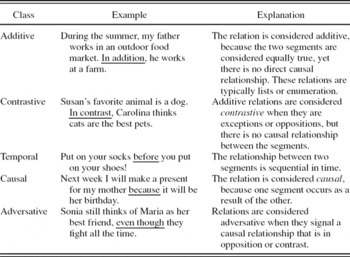
The bulk of research investigating understanding of connectives, primarily conducted with monolinguals, posits these skills on a developmental continuum and has grouped them into classes along that continuum, with each class reflecting the type of relationship they signal. Four common classes of semantic relations that appear in most taxonomies are the following: additive, temporal, causal, and adversative (Golding et al., Reference Golding, Millis, Hauselt, Sego, Lorch and O'Brien1995; Graesser et al., Reference Graesser, McNamara, Louwerse and Cai2004; Halliday & Hasan, Reference Halliday and Hasan1976). In this study, we included a fifth class: the contrastive relationship (or additive-negative, per Knott & Sanders, Reference Knott and Sanders1998; Sanders et al., Reference Sanders, Spooren and Noordman1992). Existing research suggests that not all connectives are equally easy to process; with few exceptions (notably, Cain et al., Reference Cain, Patson and Andrews2005; McClure & Steffensen, Reference McClure and Steffensen1985), there is substantial convergent evidence that the order of class from easiest to most difficult is as follows: additive, contrastive, temporal, causal, and adversative (Badzinski, Reference Badzinski1988; Bebout, Segalowitz, & White, Reference Bebout, Segalowitz and White1980; Bloom, Lahey, Hood, Lifter, & Fliess, Reference Bloom, Lahey, Hood, Lifter and Fliess1980; Cain et al., Reference Cain, Patson and Andrews2005; Geva, Reference Geva and Horowitz2006a; Goldman & Murray, Reference Goldman and Murray1992; Graesser & Haberlandt, 1993; Nippold et al., Reference Nippold, Schwartz and Undlin1992; Ozono & Ito, Reference Ozono and Ito2003; Pretorious, 2006; Shapiro & Hudson, Reference Shapiro and Hudson1991). An explanation of each class is presented in Table 1.
Classes of semantic relations

In this study we investigated two hypotheses that might account for the attributes that make a connective difficult to exploit effectively. The first, the word familiarity hypothesis, posits that the difficulty posed by certain connectives might be caused by limited vocabulary knowledge. That is, LM children might be capable of understanding the semantic relationship between the two clauses that is signaled by the connective, but they cannot discern that relationship because of the lexical challenge posed by that particular connective. For example, they may understand the contrastive relationship signaled in “Susan's favorite animal is a dog, but Carolina thinks cats are the best pets,” marked by the connective but, yet fail to understand “Susan's favorite animal is a dog. In contrast, Carolina thinks cats are the best pets” when the relationship between text segments is marked by the lower frequency expression in contrast. This is not because of a failure to understand the contrastive nature of the propositions, but is simply because of the greater difficulty presented by the lesser known connective. The competing hypothesis, the class of semantic relations hypothesis, posits that LM students have difficulty understanding the semantic relationship signaled by the connective; thus, the challenge lies in constructing the nature of relationship between ideas in the two clauses. For example, when text segments are marked by the connectives but and in contrast, LM children might have difficulty understanding the nature of the contrastive relationship between the two text segments, regardless of the ease or difficulty of the connectives as vocabulary items.
To our knowledge, these hypotheses have been tested only once in a study with monolingual English speakers (Nippold et al., Reference Nippold, Schwartz and Undlin1992). The results demonstrated that readers had more difficulty with passages with low-frequency connectives than those with high-frequency connectives, lending support to the word familiarity hypothesis. The importance of vocabulary knowledge to LM children's reading comprehension and the well-documented vocabulary gap between LM children and their native-speaking peers (e.g., Beech & Keys, Reference Beech and Keys1997; Carlisle & Beeman, Reference Carlisle and Beeman2000; Droop & Verhoeven, Reference Droop and Verhoeven2003; Hutchinson, et al., Reference Hutchinson, Whiteley, Smith and Connors2003; Proctor et al., Reference Proctor, Carlo, August and Snow2005; Verhoeven, Reference Verhoeven2000) suggests that the vocabulary challenge posed by a specific connective may be central to LM students' ability to infer interclausal relationships. Thus, we anticipated stronger support for the word familiarity hypothesis than for the class of semantic relations hypothesis.
The present study was guided by two research questions. What underlying language and reading skills (i.e., vocabulary, listening comprehension, and word reading) contribute to LM children's understanding of how connectives signal relationships between clauses? Which attributes of connectives influence the level of challenge that they pose to readers such that some markers are harder to understand than others?
These research questions were addressed with a sample of Spanish-speaking LM learners in the fourth grade. Research with monolingual English speakers has demonstrated that the upper elementary grades, in particular, represent a time when readers are especially dependent on connectives to support reading comprehension (Cain et al., Reference Cain, Patson and Andrews2005; Geva, Reference Geva and Horowitz2006a; Goldman & Murray, Reference Goldman and Murray1992; McClure & Geva, Reference McClure and Geva1983). Moreover, the later elementary years mark a point in schooling when children are expected to learn from increasingly complex, academic texts in which such markers are abundant (Butler, Bailey, Stevens, Huang, & Lord, Reference Butler, Bailey, Stevens, Huang and Lord2004).
METHOD
Participants
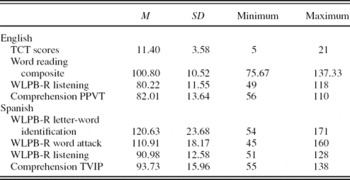
The participants in this study were 90 fourth graders (41 girls, 49 boys) of Spanish-speaking backgrounds who had received literacy instruction in both English and Spanish in a large, urban school district in the southwestern Unitrd States. They were enrolled in the district's biliteracy program in which they were instructed in both Spanish and English for some portion of each day in the primary grades. Descriptive information about the participants' Spanish oral language and literacy skills are presented in Table 2. It is notable that Spanish word recognition and decoding were close to or above national averages, whereas participants' Spanish oral language competencies were poorer overall. Specifically, performance on the measure of listening comprehension in Spanish was two-thirds of a standard deviation below national means, on average, and Spanish vocabulary knowledge was one-third of a standard deviation below national means on average. Although Spanish oral language competencies were within one standard deviation of national norms, L1 oral language was generally poor. Nonetheless, because performance on these L1 measures was superior to L2 performance, this sample appeared to be somewhat Spanish dominant despite participants' responses to a language-use survey that revealed that participants spoke English “most of the time” at school as well as with siblings at home.
Descriptive statistics for the text cohesion task and for the English and Spanish oral language and reading measures (n = 90)

Note: Standardized scores are reported for all variables except TCT Scores. PPVT, Peabody Picture Vocabulary Test (Dunn & Dunn, Reference Dunn and Dunn1997); WLPB-R, Woodcock Language Proficiency Battery—Revised (Woodcock & Muñoz-Sandoval, Reference Woodcock and Muñoz-Sandoval1995); TVIP, Test de Vocabulario en Imagenes Peabody (Dunn et al., Reference Dunn, Padilla, Lugo and Dunn1986).
Participants were recruited from 11 classrooms in three elementary schools. The mean age of participants was 9 years 9 months, with a standard deviation of 5.8 months. All students in this study were from low socioeconomic status backgrounds. All students who provided informed consent were included, unless they did not have sufficient language proficiency skills to understand the assessments in English or Spanish.
Measures
Vocabulary. Vocabulary knowledge was measured using the Peabody Picture Vocabulary Test (PPVT-IIIA; Dunn & Dunn, Reference Dunn and Dunn1997). In this receptive measure, the administrator says a word aloud, and the student chooses one of four pictures that best represents the word. The words become increasingly complex, and the task administration is discontinued when a specific proportion of items in a given level are failed. Standard scores were used for all analyses.
Word reading skills. Word reading accuracy was measured using the Woodcock Language Proficiency Battery—Revised (WLPB-R) letter–word identification subtest and WLPB-R word attack subtests (Woodcock, Reference Woodcock1991). In the former, participants are asked to read a list of English words of increasing complexity. In the latter, participants are asked to read a list of nonwords of increasing complexity. The task administration is discontinued when all items in a given level are failed. Word reading fluency was measured with the Test of Oral Word Reading Efficiency (TOWRE; Torgesen, Wagner, & Rashotte, Reference Torgesen, Wagner and Rashotte1999). In this test, participants are asked to read a list of real English words as quickly and accurately as possible in 45 s.
Listening comprehension. Listening comprehension was measured using the WLPB-R listening comprehension subtest (Woodcock, Reference Woodcock1991). In this test, the administrator reads a passage aloud to the participant. The passage is missing one word, which the participant must provide. Passages become more complex in terms of sentence complexity and vocabulary and the task administration is discontinued when a specific proportion of items in a given level are failed. Standard scores were used for all analyses.
Understanding of connectives. The Text Cohesion Task (TCT; see Appendix A) was developed based on Droop and Verhoeven's (Reference Droop and Verhoeven2003) Dutch coherence relations task. In this task, students read sentences that are missing a connective (e.g., in contrast, because, before) that links ideas between two sentences or two clauses. This cloze measure assesses text cohesion at the level of sentence or clause. Students are instructed to read the item stem and choose the connective that makes the most contextual sense from the four choices. For example,
Last week I had to go to the hospital __________ I stepped on a piece of broken glass.
1. while
2. but
3. because
4. therefore
The connectives for the task were selected based on previous research in this area (i.e., Halliday & Hasan, 1976; Knott & Sanders, Reference Knott and Sanders1998; Sanders et al., Reference Sanders, Spooren and Noordman1992). Two factors were taken into consideration when selecting target connectives: class of semantic relations and word familiarity of the connective. With respect to class of semantic relations, the classes (additive, temporal, causal, and adversative) represented the main types of conjunction relations identified by Halliday and Hasan (1976), each of which holds a close correlate with the cognitive classes of coherence relations identified by Sanders and colleagues (Reference Sanders, Spooren and Noordman1992); in addition, we included the contrastive class from Sanders' taxonomy (called additive-negative). This allowed us to distinguish coordinating (e.g., but) from subordinating (e.g., even though) conjunctions, which is important because subordinating conjunctions have been found to be more challenging to process for children (McClure & Geva, Reference McClure and Geva1983). The TCT included between three and six items for each of five classes of semantic relations (i.e., five additive, four contrastive, three temporal, four causal, and six adversative).
With respect to word familiarity, connectives were selected from those that represent words along a continuum from highly familiar to highly unfamiliar to fourth-grade monolingual English speakers. Word familiarity was ranked from 1 to 4 (1 = most familiar, 4 = most unfamiliar). The mean word familiarity was 2.14, with a standard deviation of 1.04, including between two and eight connectives for each class of word familiarity (i.e., eight most familiar; five familiar, seven unfamiliar, two most unfamiliar). Rankings were determined using Dale and O'Rourke's (Reference Dale and O'Rourke1981) Living Word Vocabulary corpus. Connectives that were known by at least 67% of the fourth graders sampled by Dale and O'Rourke were assigned a word familiarity score of 1; connectives that were known by at least 67% of sixth graders were assigned a score of 2, and so on. Within each semantic relation class target connectives representing both low (i.e., 1 or 2) and high (i.e., 3 or 4) of word familiarity were included, with a range of at least three word familiarity levels within each class (e.g., connectives ranged from at least one to three or two to four) with only the exception of temporal connectives.
When selecting distractor connectives, the most important criterion was to ensure that the foil did not make sense in the context of the cloze item. The second criterion was that the foil should not be exceedingly more difficult or easier than the target connective. To that end, the target connective for each item was compared to each foil in terms of the U value (Zeno, Ivans, Millard, & Duvvuri, Reference Zeno, Ivans, Millard and Duvvuri1995); that is, the frequency of this word per million words in fourth-grade texts. Target connectives that were low frequency were matched only with low- or medium-frequency foil connectives; target connectives that were medium or high frequency were matched only with medium- and high-frequency foils. Four items for which it was particularly challenging to identify foils that would not present plausible alternatives to the target connective did not meet this criterion. Because many connectives can indicate different classes of coherence relations depending on the context (e.g., while can be temporal or contrastive), the classes of semantic relation of the foils was not controlled.
Finally, the reading level of the item stems (i.e., the sentence or clause in which the cloze was embedded) was controlled by scoring stems with the Lexile Analyzer (www.lexile.com). Following the most conservative interpretation offered by the Lexile Framework, 18 of the item stems were at or below a fifth-grade reading level, and four were slightly above this level.
The TCT task contained 22 itemsFootnote 1 with an acceptable internal consistency reliability coefficient of 0.84 estimated using the classical test theory split halves method.Footnote 2 The TCT task was scaled using an item response theory (IRT) one-parameter logistic model. IRT comprises a series of measurement models employed in scaling and evaluating most of today's major tests. The one-parameter logistic model provides test scores for students and difficulty statistics for items (i.e., difficulty parameters), both on a scale with a mean equal to zero and standard deviation equal to one. In this model, the difficulty parameter corresponds to the point on the ability scale at which students have a 50% chance of responding to that particular item correctly. The greater the item difficulty parameter, the more challenging the item.
Procedure
A team of graduate students recruited from a local university was trained to administer the assessments. All assessments were administered within a 6-week period in the middle of the academic year. There was no fixed sequence for the measures. All tests were administered individually in a quiet location in the school.
RESULTS
Descriptive analyses
For the purposes of parsimonious analyses, a composite of the three word reading variables (i.e., WLPB-R letter–word ID and word attack and the TOWRE) was created, weighting each variable equally. Table 2 shows the descriptive statistics for each of the measures. The mean score on the TCT was 11.4 out of 22 items, with a moderate standard deviation of 3.581. The distribution was bimodal with peaks at the mean (scores = 10–11) and slightly above the mean (14–15).Footnote 3
On average, participants scored slightly above national means on all word reading measures, whereas mean performance on both WLPB-R Listening Comprehension (standardized mean = 80.22) and the PPVT (standardized mean = 82.01) were more than 1 standard deviation below national means. All three language and reading variables correlated moderately and significantly with TCT scores (word reading composite and TCT, r = .414, p < .001; listening comprehension and TCT, r = .576, p < .001; vocabulary and TCT, r = .552, p < .001). The magnitude of the correlation between vocabulary and listening comprehension was quite high (r = .70, p < .001), raising questions about the degree to which each oral language variable would predict unique variance in TCT scores given their interrelatedness.
Influence of underlying language and reading skills on understanding of connectives
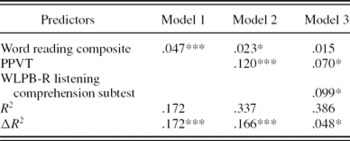
To investigate which underlying oral language and word reading skills contribute to understanding of connectives, a series of hierarchical regression analyses was performed to explain variance in TCT scores. The results of these analyses are presented in Table 3. Given the persistent importance of fluent word reading skill to comprehension outcomes for native English speakers (Perfetti et al., Reference Perfetti, Landi, Oakhill, Snowling and Hulme2005) and the evidence, albeit limited, that word reading skills predict a small amount of variance in reading comprehension outcomes in LM students (Droop & Verhoeven, Reference Droop and Verhoeven2003; Proctor et al., Reference Proctor, Carlo, August and Snow2005), the word reading composite was entered as a control in Step 1, followed by each of the oral language measures in Steps 2 and 3. All interactions were tested and none was significant.
Nested taxonomy of hierarchical regression models predicting the influence of listening comprehension, vocabulary knowledge, and word reading ability on understanding of connectives (n = 90)

Note: PPVT, Peabody Picture Vocabulary Test (Dunn & Dunn, Reference Dunn and Dunn1997); WLPB-R, Woodcock Language Proficiency Battery—Revised (Woodcock & Muñoz-Sandoval, Reference Woodcock and Muñoz-Sandoval1995).
*p < .05. ***p < .001.
As expected, word reading was a significant predictor of TCT scores (β = .047, p < .001), explaining 17.2% of their variance. In Step 2, vocabulary was added to the baseline model; the coefficients for both variables were significant (word reading composite β = .023, p = .04; vocabulary β = .120, p < .000). Including vocabulary in the model accounted for an additional 16.6% of the variance in TCT scores; together the two variables explained 33.7% of the variation in TCT scores. Finally, entering listening comprehension into the model in Step 3 significantly improved model fit (p = .011) and accounted for an additional 4.8% of the variance in TCT scores. Thus, despite the high correlation between the two language variables, each variable contributed a unique portion of the explained variance in TCT scores when word reading skills were controlled for. When both language variables were present in the model, the word reading skills factor was no longer significant. In the final model, the total amount of variance predicted in understanding of connectives was 38.6%. The model predicts that students with both low vocabulary knowledge and poor listening comprehension skills tend to have a poorer grasp of how connectives signal interclausal relationships.
Factors that influence the relative difficulty of specific connectives
The second research question addressed whether certain attributes of connectives influence their difficulty for LM fourth graders. We investigated two primary competing hypotheses. The word familiarity hypothesis stated that the level of test item challenge may be most related to the vocabulary difficulty level of the connective (i.e., word familiarity score). In contrast, the class of semantic relations hypothesis posited that the level of difficulty related to the type of semantic relationship between the two clauses signaled by the connective. The hypothesized order of difficulty was as follows: additive, contrastive, temporal, causal, and adversative.
With respect to descriptive statistics, the predictor variables of interest, word familiarity and class of semantic relations, had means of 2.14 and 3.09, respectively, and standard deviations of 1.037 and 1.57, respectively. The outcome variable, item difficulty, had a mean of −.120 and a standard deviation of 1.14 (range = −2.619 to 2.147). The only correlation that was significant, and notably of strong magnitude, was between word familiarity and item difficulty (r = .756, p > .000), lending tentative support to the word familiarity hypothesis.
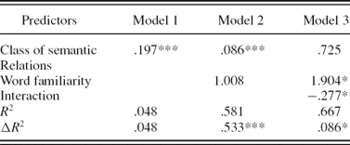
A series of nested regression models, shown in Table 4, was fitted to test whether the two predictor variables, word familiarity and class of semantic relations, uniquely explained variation in the difficulty parameter of TCT items. In Step 1, class of semantic relations as the sole predictor did not explain any significant portion of the variance. This finding suggested that difficulty in understanding connectives was not predicted by the degree to which students understood the semantic relationship between the two clauses as signaled by the connectives. In Step 2, with the addition of word familiarity, 58.1% of the variance in item difficulty was explained. Again, the effect of class of semantic relations was not significant (β = .086, p = .54), but there was a strong effect of word familiarity (β = 1.008, p > .000). However, when the interaction term between the two variables was added as a third step, the regression coefficients of all three variables were significant (class of semantic relations β = .725, p = .04; word familiarity β = 1.904, p = .001; interaction β = −.277, p = .04), and the R 2 increased (ΔR 2 = .086, p = .04), explaining a total of 66.7% of the variance in item difficulty.
Nested taxonomy of hierarchical multiple regression models predicting the contribution of vocabulary knowledge (“word familiarity”) and class of semantic relations to the text cohesion task item difficulty (n = 22 items)

Note: PPVT, Peabody Picture Vocabulary Test (Dunn & Dunn, Reference Dunn and Dunn1997); WLPB-R, Woodcock Language Proficiency Battery—Revised (Woodcock & Muñoz-Sandoval, Reference Woodcock and Muñoz-Sandoval1995).
*p < .05. ***p < .001.
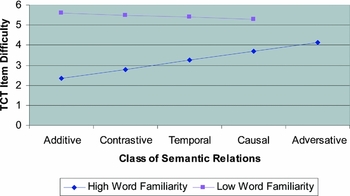
The interaction effect demonstrates that both word familiarity and class of semantic relations explained some unique variance in item difficulty, but the effect of word familiarity on item difficulty differed depending on the degree of difficulty of the class of semantic relations. In other words, for basic semantic relation classes, such as additive, the level of word familiarity exerted a strong influence on the difficulty of the item. For example, based on all students responses to all TCT items, the model suggests that additive items with the familiar connective “and” (word familiarity = 1) were much easier than additive items with the less familiar connective “moreover” (word familiarity = 3); this relationship is depicted in Figure 1.
A prototypical plot illustrating that item difficulty on the text cohesion task depends on both the degree of familiarity of the connective (high word familiarity = 1, low word familiarity = 3) and the level of complexity of the coherence relationship (additive = easiest, adversative = most difficult). The influence of word familiarity differs in each of the five categories of coherence relations (n = 22 items). [A color version of this figure can be viewed online at journals.cambridge.org/aps]

As an additional illustration of the model, contrastive items with the familiar connective “but” (word familiarity = 1) were easier than contrastive items with the less familiar connective, “in contrast.” In contrast, for items from more difficult semantic relation classes, the level of word familiarity of the connective was of far less importance. For example, for items in a difficult class of semantic relations, such as causal, whether the connectives were more familiar (e.g., because) or less familiar (e.g., since), the items were difficult regardless. Thus, the more complex the class of semantic relationship, the less that word familiarity exerted influence on the difficulty of the item.
DISCUSSION
Readers who know to exploit connectives to help them link ideas in text are more likely to read with understanding than their peers who are less knowledgeable about these linguistic cues (Degand & Sanders, Reference Degand and Sanders2002; Goldman & Murray, Reference Goldman and Murray1992; Graesser, et al., Reference Graesser, McNamara, Louwerse and Cai2004; Millis, Graesser, & Haberlandt, Reference Millis, Graesser and Haberlandt1993; Vellutino, Reference Vellutino, Sweet and Snow2003). This ability to construct an understanding of the relationship between clauses is a fundamental aspect of reading comprehension that may pose special difficulties for LM learners but, to our knowledge, has yet to be investigated in this population. Thus, in the present study, we investigated the factors that influence understanding of how connectives signal interclausal relationships for a sample of fourth-grade Spanish-speaking LM learners.
Our first key finding is that both vocabulary knowledge and listening comprehension emerged as important influences on understanding of connectives for LM students, accounting for 38.6% of the variance on a measure of text cohesion when we controlled for word reading skills. These two oral language competencies emerged as significant predictors, exerting approximately the same degree of influence, of LM students' understanding of connectives, which corroborates and extends the previous research conducted with LM learners that employed global measures of comprehension (e.g., Droop & Verhoeven, Reference Droop and Verhoeven2003; Hutchinson et al., Reference Hutchinson, Whiteley, Smith and Connors2003; Proctor et al., Reference Proctor, Carlo, August and Snow2005). Further, the finding corroborates with evidence, based on research conducted with adult foreign language learners, that oral language proficiency skills in the target language are directly related to difficulty understanding of connectives (Geva Reference Geva1992; Ozono & Ito, Reference Ozono and Ito2003).
However, it is possible that another measure of listening comprehension might have generated different findings. First, few of the WLPB-R listening comprehension subtest items contain connectives, thus the aspect of metalinguistic awareness tested by the TCT, understanding of how connectives signal coherence relations between clauses and sentences, is not well assessed by the measure employed. We would predict that a listening comprehension measure containing many connectives would have higher correlations with the TCT than we found. Second, the design and format of this listening comprehension measure likely influenced the results. Although the upper limits of the measure contain paragraph-length passages and assess discourse-level comprehension, the participants in our study demonstrated very poor performance on this measure (mean = 80.22, SD = 11.55), and many attained a ceiling before reaching these lengthier items. Therefore, the great majority of items administered to them were sentence-level items and the measure tended to operate as a sentence-level cloze measure. It may be that in the same way that performance on passage-level measures of reading comprehension are poorly related to reading comprehension tasks that use a sentence-cloze procedure (Nation & Snowling, Reference Nation and Snowling1997), the correlation between listening comprehension and the TCT we observed may not be apparent in discourse-level tasks measuring understanding of connectives. Thus, there is a need to replicate the study using discourse-level listening comprehension measures and perhaps with samples of LM learners with higher oral language proficiency.
Contrary to our hypothesis, word reading did not explain any significant amount of the variation in understanding of connectives when included in a model with the oral language variables. That word reading skills did not have a significant effect on understanding of connectives once the two oral language variables, vocabulary and listening comprehension, were accounted for was somewhat surprising given the robust body of research with native English speakers demonstrating the importance of fluent word reading skill to comprehension outcomes (e.g., Perfetti, Reference Perfetti1985; Share, Reference Share1995). Moreover, this finding is in contrast to that of Proctor and his colleagues (Reference Proctor, Carlo, August and Snow2005) who found that word reading skills (alphabetic knowledge and word reading fluency) played a predictive role in explaining Spanish-speaking LM fourth graders' reading comprehension, albeit less so than did listening comprehension and vocabulary knowledge. In fact, this finding may indicate that our measure of knowledge of connectives was not a measure of reading comprehension per se but one of metalinguistic skills that by nature draws on linguistic competencies over decoding skills. In either case, this finding underscores the need for investigations that tap specific facets of comprehension skill to effectively address the places where LM children's comprehension breaks down; it is likely that this difference between our results and those of previous studies is because of the specific focus on how connectives signal interclausal relationships specifically.
LM children with underdeveloped oral language competencies in English may face special difficulties making sense of what they read, in part, because they are unable to construct understanding of the relationships between clauses. This may prove to be one piece of the puzzle as to why many LM students, especially those with well-developed word reading skills, struggle with text comprehension (for a review, see Lesaux, Koda, Siegel, & Sharahan, Reference Lesaux, Koda, Siegel, Shanahan, August and Shanahan2006).
Our second key finding is that the degree of challenge posed by specific connectives was predicted not only by the difficulty they presented as vocabulary items, but also by the type of semantic relationship they signaled. These findings lend support for the two competing hypotheses tested, and in fact, suggest an interesting interplay between the two. The effect of word knowledge on item difficulty (i.e., word familiarity hypothesis) was pronounced for basic classes of coherence relations, such as additive relations, but had less influence for more complex classes, such as adversative relations. Thus, beyond a focus on the types of relationships signaled by connectives, which has been the primary focus of previous research (e.g., Cain et al., Reference Cain, Patson and Andrews2005; Goldman & Murray, Reference Goldman and Murray1992; Millis et al., Reference Millis, Graesser and Haberlandt1993; Murray, Reference Murray, Lorch and O'Brien1994, Reference Murray1997), the vocabulary challenges posed by the connectives themselves should also be a focus of research. This finding is particularly important in the case of LM learners because the influence of vocabulary knowledge on reading comprehension outcomes for these students may be even stronger than for their monolingual peers (Droop & Verhoeven, Reference Droop and Verhoeven2003; Hutchinson et al., Reference Hutchinson, Whiteley, Smith and Connors2003; Verhoeven, Reference Verhoeven2000). However, it is a complex picture: when semantic relationships and sentence structure become very challenging, word knowledge of connectives may not be sufficient for getting the meaning.
Implications
This study advances research focused on developing an understanding of LM students' facility with particular linguistic features of English that are especially important for comprehending academic texts (Butler, Bailey, Stevens, & Huang, Reference Butler, Bailey, Stevens, Huang and Lord2004; Snow & Uccelli, in press). In so doing, this study advances understanding of the reading comprehension of LM learners and, in particular, the role of connectives in this process for LM learners from Spanish-speaking backgrounds. The findings have implications for our understanding of the development of linguistic and reading competencies for LM learners, and raise several questions for further research in this area.
Designing instruction to teach the role of connectives in signaling relationships in text is important for supporting the comprehension skills of all learners and may be especially important for LMs. For this population, learning new words from context is especially difficult for any type of vocabulary word (Carlo et al., Reference Carlo, August, McLaughlin, Snow, Dressler and Lippman2004); presumably, learning the meaning of connectives represents an even greater challenge. The findings of this study suggest that inferring the meaning of connectives when the class of semantic relation is complex would pose an even more formidable challenge.
However, these findings also reinforce the complex nature designing any instruction aimed at increasing students' linguistic competencies. In particular, an effective approach to teaching about connectives will prove to be very complex, putting high demands on educators and clinicians alike with respect to their own level of linguistic knowledge. All students need to learn a variety of connectives, including the semantic nuances and syntactic constraints that distinguish them from each other, such as understanding when and why it would be appropriate to say “moreover” rather than “also.” This will require analyzing and employing connectives in meaningful contexts, in the process of making sense out of a text, via both guided and wide, independent reading, and in writing, and is not likely to be accomplished through discrete skills-driven instruction alone (cf. Gallini, Spires, Terry, & Gleaton, Reference Gallini, Spires, Terry and Gleaton1993).
In addition to the instructional issues on which these findings shed light, they raise several questions. For example, to what degree does encountering an unfamiliar connective, or encountering a particularly difficult kind of semantic relation, within a text, rather than isolated as a discrete item under experimental conditions, affect comprehension? Future research should explore the factors that influence LM children's understanding of connectives in more extended discourse. In this study, the text cohesion task was characterized by items that were typically short: two clauses connected by a connective. Under natural conditions, readers need to construct coherence relations between clauses and sentences within larger texts.
Studies that have addressed this question have contradictory findings. In a study conducted with native French-speaking university students learning English, Geva (Reference Geva1992) found that the ability to construct coherence relations at the level of sentences and clauses is a necessary, but not sufficient, precursor to constructing such relations in extended discourse. Further, Lehman and Schraw (Reference Lehman and Schraw2002) found that text cohesion only assists surface-level understanding of a text but does not support deep processing. In contrast, Degand and Sanders (Reference Degand and Sanders2002) found that the presence of causal connectives not only assisted comprehension of specific aspects of the text but also assisted with more global comprehension. We assume that the ability to construct interclausal relationships is a critical aspect of reading comprehension in this study, but empirical evidence of how and under what circumstances it is most beneficial for LM readers, particularly children, to exploit these linguistic cues is needed.
It is also important to note that our finding that vocabulary and listening comprehension predict understanding of connectives cannot be extrapolated beyond an understanding of connectives at the interclausal or intersentential level. An area for future research is to investigate the degree to which the competencies predict understanding of connectives in longer texts that reflect the kind of academic language children encounter in rigorous curricular materials. In doing so, an improvement upon the task in the present study would be to sample equally from each class of coherence relations.
It is equally important that future research should explore factors that influence understanding of connectives with students from a variety of linguistic backgrounds. In this study, we limited participation to LM students from Spanish-speaking backgrounds, a group representing the majority of LM learners in US schools (Kindler, Reference Kindler2002). However, the challenges associated with understanding connectives may play out differently with children from other linguistic backgrounds. For example, very few connectives hold cognate relationships between Spanish and English; in fact, none of the words targeted on the text cohesion task shares a root with the Spanish equivalents. Second, the syntactic function of connectives in English is very similar to Spanish. These two aspects of connectives (cognate relationships and syntactic function) could play out differently in other languages and thus present greater or less challenge for children from those linguistic backgrounds. Thus, replicating this study with other populations of at-risk readers is an important direction for future research in this area. In fact, the findings from this research may well have relevance for other populations of students, including monolingual English speakers, who have limited word knowledge in general or difficulties with the competencies measured by listening comprehension assessments. Indeed, developing a command of the meanings and functions of connectives is a critical aspect of academic English (Scarcella, Reference Scarcella2003; Snow & Uccelli, in press) in all major disciplines, and thus is arguably essential to school success.
APPENDIX A TEXT COHESION TASK
Instructions: Read each sentence, and choose which word would make the most sense to fill in the blank.
1. Some people like the mountains ______ other people prefer the ocean. (so, while, besides, for example)
2. Tim loves to play with blocks. ________, he likes painting. (therefore, also, either, because)
3. Next week I will make a present for my mother __________ it will be her birthday. (since, while, but, therefore)
4. Luckily, it started to rain after the picnic, ______ everything would have been wet. (or else, before, during, while)
5. Last week I had to go to the hospital __________ I stepped on a piece of broken glass. (while, but, because, therefore)
6. At the park there were swings and a slide, _______ there was a sand box with shovels and buckets. (so, while, and, then)
7. Laura watered the plants every Wednesday ______ she liked to watch them grow. (even though, for example, since, however)
8. Put on your socks _______ you put on your shoes! (because, although, before, during)
9. I play baseball. ________, I enjoy reading. (therefore, either, because, moreover)
10. Patrick washed the dishes and dried them ______ he hated to see the kitchen messy. (even though, for example, however, because).
11. Susan's favorite animal is a dog. _____ Carolina thinks cats are the best pets. (in contrast, so, besides, for example)
12. Sonia still thinks of Maria as her best friend, _________ they fight all the time. (because, even though, for example, and)
13. Lisa was quite happy _______ her favorite toy was lost and couldn't be found. (even though, because, since, while)
14. Lila's grandmother was not angry______ Lila drew on the sofa with colored pens. (because, for example, even though, however)
15. John was very hungry ______ he had just eaten a large plate of beans and rice. (because, despite that, for example, moreover)
16. Pedro's favorite color is green ______ Wendy prefers the color red. (while, therefore, besides, for example)
17. All the people ate a huge dinner of pork and rice, _______ they ate a dessert of chocolate and ice cream! (because, since, then, while)
18. Antonio loves all sweet food, ________ ice cream, bananas, and candy. (therefore, such as, either, because)
19. My grandmother was born _______ computers were invented. (before, because, but, during)
20. During the summer, my father works in an outdoor food market. ________, he works at a farm. (in addition, whereas, either, because)
21. Susan's favorite animal is a dog _____ Carolina thinks cats are the best pets. (but, so, besides, for example)
22. Jaime wasn't happy ______ he had just been to a baseball game. (in addition, despite that, for example, therefore)
APPENDIX B
Word familiarity, class of coherence relations of target connectives, lexile level for each text cohesion task item, and U values for foil connectives

Note: Word familiarity: 1 = 4th grade, 2 = 6th grade, 3 = 8th grade, and 4 = 10th grade and above. Based on Living Word Vocabulary (Dale & O'Rourke, Reference Dale and O'Rourke1981). Lexile level was determined by scoring stems with the Lexile Analyzer (www.lexile.com). The general interpretation of scores offered by the lexile framework is that texts at the third-grade level typically range from 500 to 700, texts at the fourth-grade level typically range from 650 to 850, and texts at the fifth-grade level typically range from 750 to 950. The U value (Zeno et al., Reference Zeno, Ivans, Millard and Duvvuri1995) indicates the frequency of this word per million words in fourth-grade texts. H, high frequency, the foil connective appears 1000 or more; M, medium frequency, the foil appears between 21 and 999 times; and L, low frequency, the foil appears ≤20 times per 1 million words in fourth-grade texts.
ACKNOWLEDGMENTS
This research was supported by National Institute for Child Health and Human Development Grant 1 R03 HD049674-01 awarded to Nonie K. Lesaux. Some of these findings were presented at the 2006 annual meeting of the American Educational Research Association (San Francisco, CA). The authors thank Catherine Snow, Margaret McKeown, and William E. Nagy for their helpful feedback on earlier drafts of this paper and Carol Barry, Debbie Beldock, and Carol Osborne for their support of this project. Finally, special thanks to the principals, teachers, and students who participated in this study.