Introduction
High profile terrorist attacks in major capital cities have seemingly become a regular occurrence and the resultant mass-casualty events continue to challenge health care systems.
Included in the category of man-made disasters along with transport and industrial accidents, terrorism events are fundamentally different in their health consequences. While most man-made disaster events are accidental and mitigated by safety measures intended to minimize victim impact, terrorism events are pre-designed to maximize death and destruction.
The emergence of Counter-Terrorism Medicine (CTM) as a Disaster Medicine sub-specialty addresses these unique terrorism-related issues relating to the mitigation, preparedness, and response measures to asymmetric, multi-modality terrorist attacks. Reference Court, Edwards, Issa, Voskanyan and Ciottone1
This study is an epidemiological examination of all terrorism-related events sustained from 1970-2019, analyzing historical weapon types used and the resulting fatal injuries (FI) and non-fatal injuries (NFI) sustained. This will allow responders to be better informed of the lethality and injury rates of the various weapons likely to be encountered in a terrorism event.
Methods
Data collection was performed using a retrospective database search through the Global Terrorism Database (GTD). 2 This database is open-access, with publicly available data collection methodology utilizing artificial intelligence that identifies events from news media around the world daily, as confirmed by human evaluation of the events by the National Consortium for the Study of Terrorism and Responses to Terrorism (College Park, Maryland USA). 3 The GTD defines terrorist attacks as: The threatened or actual use of illegal force and violence by a non-state actor to attain a political, economic, religious, or social goal through fear, coercion, or intimidation. The GTD database does not include acts of state terrorism. The GTD contains no personal identifiers for victims and links specific events to open-source news articles.
The GTD was searched using the internal database search functions for all events which occurred from January 1, 1970 - December 31, 2019. Years 2020 and 2021 were not yet available at the time of the study. All “weapon types” (pre-selected by the GTD) were selected for the purpose of this study and events that explicitly listed more than one modality were categorized as “mixed weapon.” Available counts of FI and NFI in each incident were then sorted and aggregated by weapon type to enable mean and standard deviation calculations. Geographical regions were also pre-selected by the GTD.
Results were exported into an Excel spreadsheet (Microsoft Corp; Redmond, Washington USA) for analysis. Attacks met inclusion criteria if they fulfilled the following three terrorism-related criteria, as set by the GTD. Ambiguous events were excluded when there was uncertainty as to whether the incident met any of the criteria for GTD inclusion as a terrorist incident. These criteria are determined within the database and not by the authors:
-
Criterion I: The act must be aimed at attaining a political, economic, religious, or social goal.
-
Criterion II: There must be evidence of an intention to coerce, intimidate, or convey some other message to a larger audience (or audiences) than the immediate victims.
-
Criterion III: The action must be outside the context of legitimate warfare activities (ie, the act must be outside the parameters permitted by international humanitarian law, particularly the admonition against deliberately targeting civilians or non-combatants).
Results
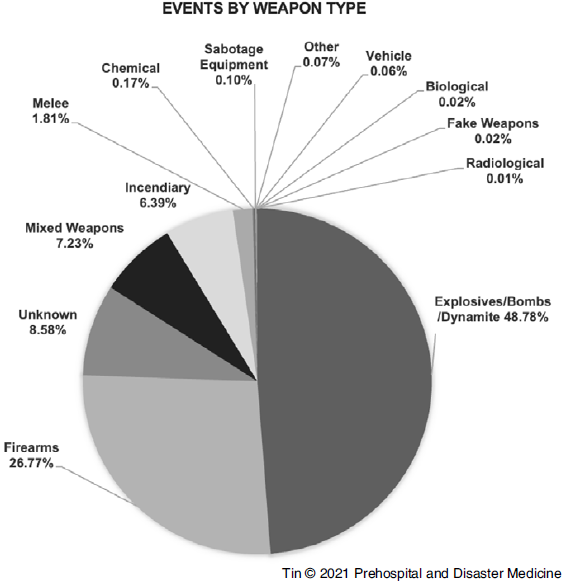
In total, 168,003 events were recorded from 1970-2019. Explosives, bombs, and/or dynamite (E/B/D) were the most commonly used weapon type and accounted for 48.78% of all terrorism events, followed by the use of firearms in 26.77% of events. Overall, 8.58% of events were listed as “unknown,” 7.23% of events used a mix of weapons, and 6.39% of events used incendiary weapons as the attack modality. Chemical, biological, radiation, and nuclear (CBRN) weapons, melee attacks, sabotage attempts, and other attack methods accounted for less than 2.2% of all events (Figure 1 and Table 1).
Events by Weapon Type.

Weapon Types, Fatal Injuries, and Non-Fatal Injuries

A total of 339,435 FI and 496,225 NFI resulted from all terrorism events that occurred during the study period.
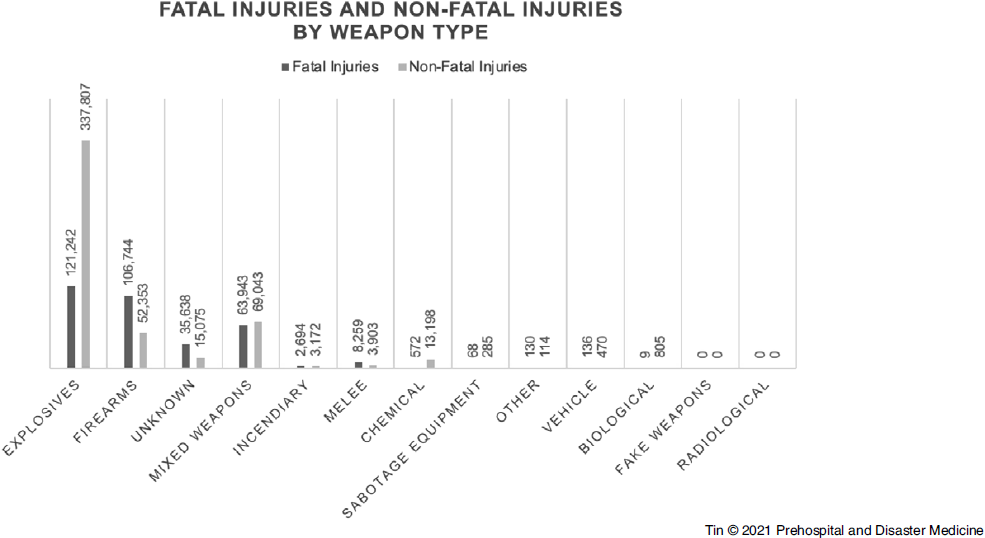
The E/B/D events inflicted 121, 242 FI and 337,807 NFI, accounting for the highest FI and NFI toll of all weapon types. Firearms inflicted 106,744 FI and 52, 353 NFI. Combined, E/B/D and firearms accounted for 75.55% of all events, 67.1% of all FI, and 79.3% of all NFI (Figure 2 and Table 1).
Fatal Injuries and Non-Fatal Injuries by Weapon Type.

Each individual terrorism event inflicted a mean FI rate of 2.14 FI per event (SD = 10.2) and a mean NFI rate of 3.22 NFI per event (SD = 45.19).
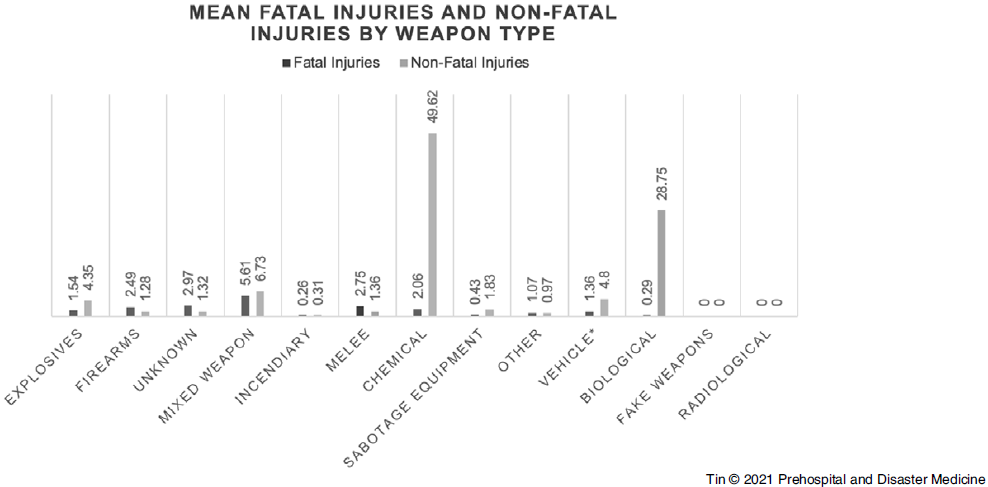
The use of mixed weapons accounted for the highest mean FI per event, inflicting 5.61 FI per event (SD = 25.71). Chemical weapons accounted for 2.06 FI per event (SD = 13.23) but inflicted the highest mean NFI count of all weapons with 49.62 NFI per event (SD = 354.21). Biological weapons accounted for the second highest mean NFI with 28.75 NFI per event (SD = 141.63; Figure 3 and Table 1).
Mean Fatal Injuries and Non-Fatal Injuries by Weapon Type.

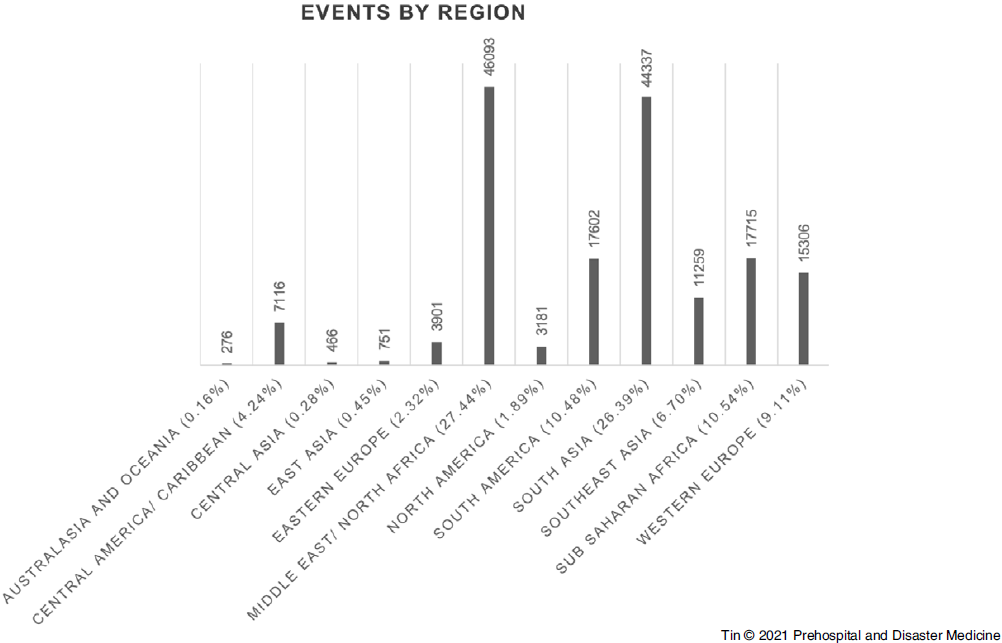
Overall, 27.44% of events took place in the Middle East and North Africa region, followed by 26.39% in South Asia; 10.54% of events took place in Sub-Saharan Africa, 10.48% in South America, and 9.11% in Western Europe (Figure 4).
Events by Region.

Discussion
Instilling fear, destabilizing governments, and causing both socio-political unrest and psychological trauma are some of the many complex goals of terrorists. Reference Richardson4 The threat of violence can be as effective as actual violence, and there are often disproportionate socio-economic consequences relative to the loss of life or injuries inflicted. Reference Bardwell and Iqbal5,Reference Krieger and Meierrieks6 Terrorists have historically favored attacks that avoid effective countermeasures and exploit vulnerabilities, and whilst their measure of success is not necessarily directly linked to death tolls and injuries, they will likely continue to pursue opportunities to inflict mass casualties. 7
Historically, terrorists have relied on proven conventional methods such as explosives and firearm attacks. Non-conventional methods, such as CBRN weapons, have only been used in a few instances but are perceived by governments and experts as serious potential threats and weapons of mass destruction (WMDs). Respected authorities have previously suggested that too much attention has been paid to such low-frequency, high-acuity attack methodologies, but this study shows both chemical and biological weapons are extremely effective, and far superior attack methodologies for inflicting mass NFI. Reference Frykberg8
Mixed weapon attacks have the highest FI rate and the third highest NFI rate, perhaps a reflection of the vulnerabilities and deficiencies that exist in emergency response services to asymmetric, multi-modality attacks. Reference Tin, Hart and Ciottone9
While the importance of studying historic attack methodologies cannot be understated, CTM specialists need to be forward thinking in anticipating novel attack methodologies. Reference Tin, Hertelendy and Ciottone10 The introduction of new weapons and technologies can potentially enable terrorists to kill more efficiently and in greater numbers. Furthermore, the COVID-19 pandemic has accelerated radicalization, exacerbated pandemic-related grievances in many western countries, and given life to right wing, white supremacist, and political extremist groups exploiting anti-government, anti-freedom sentiments to recruit lockdown-isolated and vulnerable individuals. Reference Daalder11,Reference Jones, Doxsee and Harrington12 This potential rise in home-grown, domestic terrorism has significant implications. Whilst the terrorists of old were clandestine, often located in developing countries with limited external access and historically relying on bombs and guns as attack methodologies, a new breed of terrorists is being seen who are potentially more visible, connected, and technologically savvy in Western countries. Reference Spence13–Reference Rachwani15
In this study, firearms were the second most popular weapon of choice (26.77%) with high FI rates, a consistent finding in previous research studies and further emphasizing the importance of firearm legislation in countries such as the US where they are readily available. Reference Tessler, Mooney and Witt16,Reference Tin, Hart, Hertelendy and Ciottone17
The recent lye poisoning attack in Florida (USA) is a good example of how rogue actors can leverage new technologies to cause harm in a way not previously seen. 18 Crop-spraying drones can be reappropriated to deliver toxic or deadly chemicals easily accessible on the black market, and with advanced swarm technology, can also be preprogrammed to simultaneously target multiple soft targets using an array of attack modalities. Reference Kallenborn and Bleek19,Reference Kallenborn20
Thus, CTM specialists must consider how these new and emerging technologies alter or create novel mass-casualty scenarios that can exploit vulnerabilities in medical preparedness.
While terrorist attack methods have remained consistent over the past five decades, CTM specialists need to be forward thinking and regularly collaborate with counter-terrorism and law enforcement agencies to understand the shifting attack strategies and weapons selection of terrorist groups so as to perfect risk mitigation and preparedness strategies to these persistent threats.
Limitations
The GTD is a comprehensive record of global events. It is maintained by the National Consortium for the Study of Terrorism and Responses to Terrorism and is the basis for other terrorism-related measures, such as the Global Terrorism Index. Reliance wholly on the GTD is partially mitigated by confirmation with other lay sources and searches for other online data, but if there are incidents not reported in the GTD, this could limit the veracity of the findings. Furthermore, injuries and fatalities were cross-matched with news records rather than formal hospital or coroner reports, so rely on the completeness and accuracy of these sources.
Conclusion
Although terrorism is complex and does not solely rely on death tolls as a measure of success, this analysis shows a historic mean FI rate of 2.14 and NFI rate of 3.22 per event over the past 50 years. Tried and tested weapons such as E/B/D and firearms combine to account for over 75% of weapon types used in all events. Use of WMDs such as CBRN weapons has been rare (0.2%), yet has extreme high potential to inflict mass casualties with mean NFI rates of 49.62 and 28.75 for chemical and biological weapons, respectively. In comparison, the next highest mean NFI rate for a single modality attack is vehicle-related attacks with a mean NFI rate of 4.8.
Conflicts of interest/funding
The authors declare no conflicts of interest or funding.