1 Introduction
Many previous phonetic and phonological studies of Spanish consonants have been based primarily on auditory transcriptions and acoustic analysis (Navarro Tomás Reference Navarro Tomás1918, Alarcos Llorach Reference Alarcos Llorach1965, Quilis Reference Quilis1993). There have been very few articulatory investigations of Spanish, and most of these works have been designed either to test specific hypotheses (Romero Reference Romero1995, Honorof Reference Honorof1999, Lavoie Reference Lavoie2001), or studied exclusively a single variety, Peninsular Spanish (Fernández Planas Reference Fernández Planas2007, Martínez Celdrán & Fernández Planas Reference Fernández Planas2007). The precise realization of Spanish consonant contrasts, the extent of phonetic variation across other varieties of Spanish, and differences between these varieties and Peninsular Spanish are still relatively poorly understood. Given this, there is a strong need for cross-dialectal phonetic studies to support or reject previous generalizations. This study uses electropalatography (EPG) to investigate articulatory characteristics of coronal consonant contrasts in two relatively understudied varieties of Spanish – Argentine Spanish from Buenos Aires and Cuban Spanish from Havana. The focus of the study is on place and manner of articulation, and specifically on similarities and differences between Argentine and Cuban Spanish, as well as between these two varieties and Peninsular Spanish.
1.1 Coronal contrasts in Spanish
1.1.1 Inventory and realizations
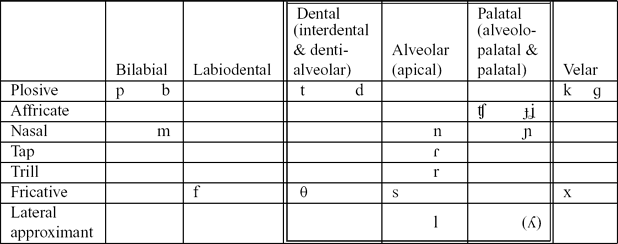
The consonant inventory of Standard Peninsular Spanish is presented in Table 1 (based on Martínez Celdrán, Fernández Planas & Carrera Sabaté Reference Martínez Celdrán, Planas and Sabaté2003; see also Navarro Tomás Reference Navarro Tomás1918, Quilis Reference Quilis1993). This variety has 12 coronal consonants (highlighted in the table) that fall into three general place classes (dental, alveolar, and palatal) and seven manner classes (plosive, affricate, nasal, tap, trill, fricative, and lateral approximant). These consonants are illustrated in the list just below Table 1 (also from Martínez Celdrán et al. Reference Martínez Celdrán, Planas and Sabaté2003: 255). There are some additional, non-contrastive differences in place and tongue shape: /θ/ is interdental, /t d/ are laminal denti-alveolars (i.e. [


]), while /n s l ɾ r/ are apical alveolars. In certain contexts, /d/ is realized as an interdental approximant [

]. The voiced palatal phoneme /ɟʝ/ (or /

/ depending on the analysis) is realized as an affricate after a pause, a nasal, or [l] ([elj ˈɟʝa
e] el yate ‘the yacht’), and as a palatal approximant [
] in all other contexts ([mi ˈ
ate] mi yate ‘my yacht’ (Martínez Celdrán et al. Reference Martínez Celdrán, Planas and Sabaté2003: 258). Although works on phonology and phonetics still include the palatal lateral /ʎ/ as part of the consonantal inventory of Peninsular Spanish, in most varieties this phoneme has merged with /ɟʝ/ and is being realized as a palatal affricate or approximant, depending on the characteristics of the preceding context, as in the case of /ɟʝ/ (Martínez Celdrán et al. Reference Martínez Celdrán, Planas and Sabaté2003; Hualde Reference Hualde2005: 180).

Consonant inventory of Standard Peninsular Spanish and words illustrating coronal contrasts.

The classification of Standard Peninsular Spanish consonants shown in Table 1 is largely uncontroversial and goes back to the early descriptive phonetic work by Navarro Tomás (Reference Navarro Tomás1918), whose observations were in part based on static palatography.Footnote 1 Much of the subsequent phonetic (mainly acoustic) and phonological work on Spanish has maintained its focus primarily on the Peninsular variety, while other varieties, and particularly Latin American Spanish, have received considerably less attention. One of the main well-known differences between Standard Peninsular Spanish and Latin American varieties of Spanish, such as Argentine and Cuban, is the absence of the dental/alveolar contrast in fricatives, /θ/ vs. /s/ (represented in orthography by 〈za, zo, zu, ce, ci〉 and 〈s〉). While in the northern and central parts of Spain the original Medieval Spanish affricates /ts dz/ and fricatives /s z/ have evolved into /θ/ vs. /s/, respectively, in southern Spain, the Canary Islands, and Latin America all four consonants have merged into a single fricative phoneme, generally /s/ (e.g. Lloyd Reference Lloyd1994). As a result of this merger, for example, the initial consonants in zona ‘zone’ and sola ‘alone’ are pronounced with [s]: [sona] and [sola] (see examples immediately below Table 1 above). The realization of /s/ in the ‘merging’ varieties is usually laminal rather than apical (Martínez Celdrán et al. Reference Martínez Celdrán, Planas and Sabaté2003: 258). The interdental realization of both 〈za, zo, zu, ce, ci〉 and 〈s〉 is also attested in some varieties, including those spoken in parts of Cuba (e.g. [θona] and [θola]). This phenomenon is referred to as ceceo (‘the use of [θ]’, as opposed to seseo ‘the use of [s]’; Quilis Reference Quilis1993: 283–286; Navarro Tomás Reference Navarro Tomás1918: Section 106). Most Latin American varieties are also characterized by a consistent merger of the lateral and non-lateral palatals /ʎ ɟʝ/ (orthographically represented as 〈ll, y〉), the phenomenon known as yeísmo (Quilis Reference Quilis1993: 314–321; Navarro Tomás Reference Navarro Tomás1918: Section 106).Footnote 2 As a result, both original consonants are realized as [ɟʝ] or [] depending on the context, as in innovative varieties of Peninsular Spanish (see above). In Argentine Spanish, however, the consonant is an alveolo-palatal fricative /ʒ/ or /ʃ/, with the voicing or voicelessness of the consonant being sociolinguistically conditioned (e.g. [ʒate] or [ʃate], [aˈʒi] or [aˈʃi]; Wolf & Jiménez Reference Wolf, Jiménez and Barrenechea1979, Wolf Reference Wolf, Lerner and Lerner1984). Among other differences in coronals is the variable realization of the palatal affricate (the orthographic 〈ch〉) as an affricate [ʧ] or a fricative [ʃ]. The latter variant is attested intervocalically in Caribbean Spanish (Cuban, Dominican Republic, and Puerto Rican), as well as in some South American varieties, such as Chilean (Quilis Reference Quilis1993: 302–304). Some additional differences have been observed in the realization of rhotics, including the assibilated realization of trills in several Latin American varieties (Bradley Reference Bradley, Authier, Bullock and Reed1999, Colantoni Reference Colantoni2001) and the neutralization of the lateral–rhotic contrast in codas, in particular in Caribbean Spanish (see Quilis Reference Quilis1993, Hualde Reference Hualde2005). Overall, however, there is little information on cross-dialectal differences involving coronal consonants. In fact, many of these consonants (the coronal stops /t d/, the fricative /s/, the nasals /n ɲ/, and the liquids /l ɾ/) in varieties such as Argentine and Cuban are traditionally described as similar to Peninsular Spanish (Quilis Reference Quilis1993).
1.1.2 Instrumental articulatory studies
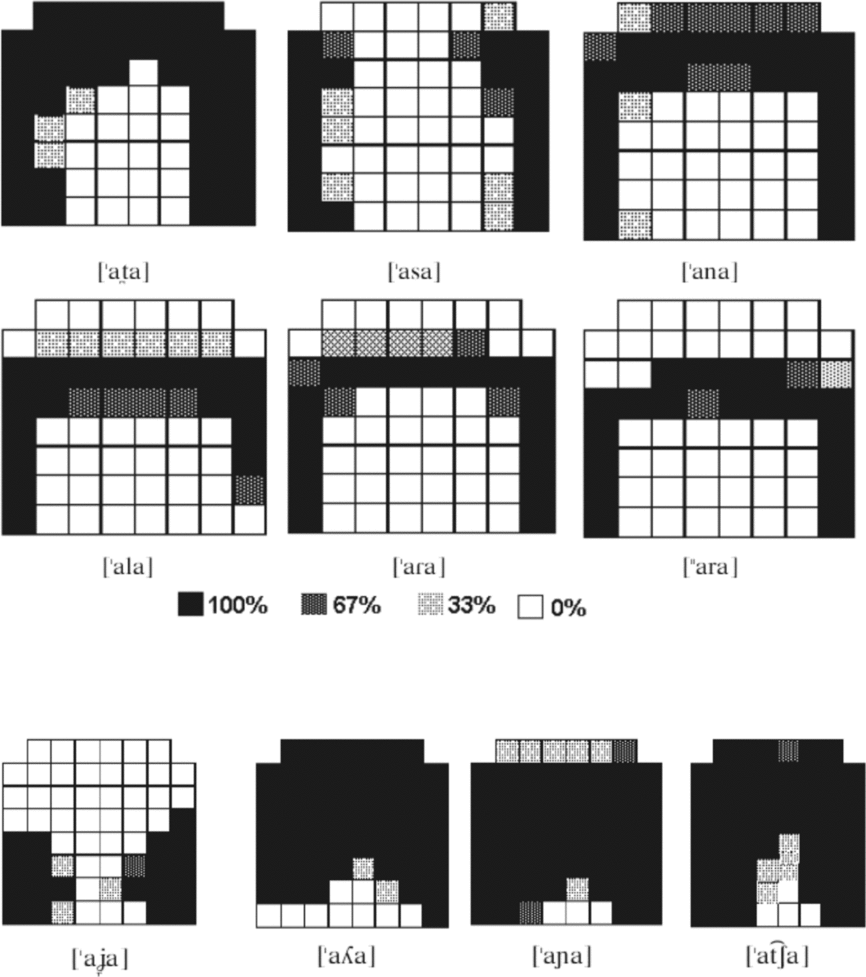
While there have been a number of instrumental articulatory studies involving Spanish (Romero Reference Romero1995, Honorof Reference Honorof1999, Lavoie Reference Lavoie2001), there seems to be only one systematic investigation of Spanish coronal contrasts to date – the work by Ana María Fernández Planas (her Ph.D. dissertation and related publications, Fernández Planas Reference Fernández Planas2000, Reference Fernández Planas2007, Reference Fernández Planas2008; Martínez Celdrán & Fernández Planas Reference Fernández Planas2007). In this work, the author employed electropalatography (EPG) to examine the production of coronal consonants by four speakers of Peninsular Spanish (who were from a variety of locations in Spain). The EPG method captures the contact between the tongue and the palate (from the alveolar ridge to the pre-velar region) thus allowing a fairly fine-grained characterization of most coronal constrictions. Figure 1 shows linguopalatal contact profiles for coronals produced by a representative speaker from Fernández Planas (Reference Fernández Planas2007) in the context [ˈa_a] (see Figures 8 and 14, pages 51 and 61 in the work cited here). These profiles represent averages over several repetitions and were taken at the point of maximum contact during the constriction. The rows of the palate can be assigned to specific articulatory regions: front alveolar (rows 1–2), post-alveolar (rows 3–4), and palatal (more specifically, prepalatal/mediopalatal and postpalatal: rows 5–7 and 8) (following Fontdevila, Pallarès & Recasens Reference Fontdevila, Pallarès and Recasens1994). It can be seen that for /t/ the constriction is in the first two rows showing an extensive side contact, thus representing a laminal front alveolar or denti-alveolar articulation. The constrictions for /s n l ɾ r/ are somewhat further back, taking up a single row or two (specifically, rows 2 and 3 or 3 and 4). This shows that these consonants are apical alveolars or post-alveolars. Unlike the other consonants, /s/ is characterized by wide central opening. The consonants that are usually categorized as ‘palatal’ (see Table 1) vary in the precise location of the constriction, which is at rows 1–5 for /ʎ/, at rows 2–6 for /ɲ/, at rows 1–4 for /ʧ/, and at rows 6–7 for [] (an allophone of /ɟʝ/). However, all of these consonants are characterized by a high degree of contact particularly in the palatal region, in stark contrast with more anterior consonants such as [t s n l ɾ r]. They, therefore, represent alveolo-palatal (/ʎ ɲ ʧ/) or palatal articulations ([]) (Fernández Planas Reference Fernández Planas2007: 59–71), thus supporting the traditional general classification of these consonants shown in Table 1 and the initial observations of Navarro Tomás (Reference Navarro Tomás1918) based on static palatography.Footnote 3
Linguopalatal profiles for Peninsular Spanish coronal consonants based on data from a representative speaker from Fernández Planas (Reference Fernández Planas2007: 51, 61).

Similar coronal contrasts in other Romance varieties have been investigated using EPG in a number of works. Among these are the palatal nasal and lateral, and their alveolar counterparts in Catalan and Italian (Recasens, Farnetani, Fontdevila & Pallarès Reference Recasens, Farnetani, Fontdevila and Pallarès1993), the trill and the tap in Catalan (Recasens & Pallarès Reference Recasens and Pallarès1999), and other coronal contrasts of Catalan, Italian, and French (Recasens, Pallarès & Fontdevila Reference Recasens, Pallarès and Fontdevila1997, Corneau Reference Corneau2000, Payne Reference Payne2006). For Catalan, for example, data from five speakers revealed that /n/ was most commonly articulated at rows 2 or 3 (apical alveolar/post-alveolar), /ʎ ɲ/ most commonly showed occlusion at rows 3–5 (alveolo-palatal), and /j/ at rows 6–8 (palatal). The Catalan tap and trill tended to show a narrow and often incomplete closure at rows 3 or 4 (apical post-alveolar); the fricative /s/ was articulated in the same region, having a relatively wide central channel (apical alveolar/post-alveolar), while the affricate /ʧ/ had a closure extending through rows 3–5 and a considerable lateral palatal contact (alveolo-palatal) (Recasens et al. Reference Recasens, Farnetani, Fontdevila and Pallarès1993, Reference Recasens, Pallarès and Fontdevila1997; Recasens & Pallarès Reference Recasens and Pallarès1999, Reference Recasens and Pallarès2001).Footnote 4 These results point to considerable similarity between Catalan and Peninsular Spanish in the articulatory realization of similar coronal contrasts (Fernández Planas Reference Fernández Planas2007). At the same time, EPG investigations have revealed some systematic articulatory differences between close varieties of the same language, such as Majorcan and Valencian Catalan (Recasens & Espinosa Reference Recasens and Espinosa2006a, Reference Recasens and Espinosa2007). Specifically, it was found that posterior sibilant affricates and fricatives /ʧ ʤ ʃ ʒ/ in Valencian were consistently more anterior and had less dorsopalatal contact than their counterparts in Majorcan. As a result, the articulatory contrast between the alveolar and post-alveolar sibilants ([ʦ ʣ s z] vs. [ʧ ʤ ʃ ʒ]) was considerably reduced in Valencian, showing some signs of neutralization in the case of the affricates. These results are interesting, as they demonstrate that dialects of a language sharing the same phonemic categories may differ significantly in the phonetic realization of these categories, and such differences are important for understanding the historic development and the synchronic system of phonological contrasts in the language.
In the current study we use the same method, EPG, to examine coronal consonants from two relatively phonetically unexplored varieties of Spanish – Argentine and Cuban. Based on previous descriptions of dialectal variation in Spanish consonants, we would expect that speakers of Argentine and Cuban Spanish would differ from Peninsular Spanish speakers in the absence of the inderdental/dental fricative contrast (〈za, zo, zu, ce, ci〉 and 〈s〉) and the lateral/non-lateral palatal contrast (〈ll〉 and 〈y〉). At the same time, the two groups are expected to differ in the details of realization of at least the latter: the consonant corresponding to 〈ll, y〉 should be realized as a palato-alveolar fricative (with variable voicing) by Argentine speakers and as a palatal affricate or approximant by the Cuban speakers. The affricate 〈ch〉 is also expected to show some variable fricative realization in Cuban productions. In other respects, there are no particular reasons to expect the results for both groups to differ significantly from each other, or from those from Peninsular Spanish reported in Fernández Planas (Reference Fernández Planas2007). To make the comparison between the two Latin American varieties and Peninsular Spanish more explicit, we also collected comparable data from a single speaker from Madrid, Spain.
2 Method
2.1 Participants
Five speakers of Argentine Spanish (four female: A1, A2, A3, A4; one male: A5), three speakers of Cuban Spanish (all female: C1, C2, C3), and one Peninsular Spanish speaker (female: P1) were recruited for the study. The participants’ age ranged between 23 and 49 years (average 39 years). To minimize sociolinguistic variation, care was taken to ensure that the speakers of each variety were from the same location and similar socio-economic status. All the Argentine speakers were born and raised in Buenos Aires, while the Cuban speakers in Havana; the Peninsular Spanish speaker was from Madrid. All the participants had university education and at the time of the experiment were residing in Toronto, Canada. All of them have lived outside their native countries from two to six years (average four years), except for A3 and P1 who have been residing in English-speaking countries for 10 and 15 years, respectively. All the participants reported to use Spanish extensively on a daily basis, and have been regularly visiting their home countries. None of the participants reported having a history of hearing or speech difficulties.
An artificial EPG palate with 62 electrodes was custom-made for each of the participants. In order to check for individual differences, the height and length of all palates were measured. (These measurements will be referred to in the presentation of the results where appropriate.) Prior to the recording, the speakers underwent a desensitization period during which they were asked to read a text and to have an extended conversation with the second author. The recording began when the participants were judged by this author, a native speaker of Spanish, to have normal undistorted speech.
2.2 Speech material
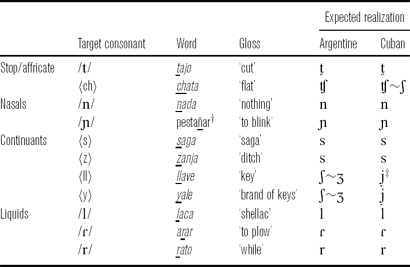
The stimuli consisted of words with coronal consonants shown in Table 2, grouped by four general manner categories: stop/affricate, nasals, continuants, and liquids. Here and below we will use orthographic labels to refer to the consonants whose realization is expected to be different in the examined varieties of Spanish (see the examples and discussion in the last paragraph of Section 1.1.1). Recall that 〈s, z, ll, y〉 refer to two phonemes in the investigated varieties, but to four phonemes in the conservative Central and Northern Peninsular Spanish. All target consonants in the stimuli were word-initial, except for /ɲ/, which rarely occurs in this position, and /ɾ/, which never occurs there. All the consonants were followed by the stressed vowel /a/. The stimuli were randomized and produced in a carrier phrase Diga __ otra vez ‘Say ___ again’. The reading list also included other stimuli elicited for a separate study. The participants were instructed to read the sentences at a normal, casual speaking rate.
Target consonants and words examined in the study.

† Although this word is frequently spelled this way in Latin America (Collins Spanish Dictionary, 2011), the standard spelling given by the Diccionario de la lengua española (Real Academia española 2001) is pestañear. None of the participants have commented on the non-standard spelling and appeared to produce 〈ñ〉 in this word the same way as in other words with the same consonant (e.g. pestaña and cañon). However, the details of pronunciation of both /ɲ/ and the sequence /n/ + /ea/ ([nja]) in Argentine Spanish require a more systematic investigation, as the contrast is reported to be neutralized (e.g. Malmberg Reference Malmberg1950).
‡ An approximant rather than an affricate realization for 〈ll〉 and 〈y〉 was expected since the consonant occurs intervocalically (see Section 1.1.1).
2.3 Instrumentation and procedure
Simultaneous articulatory and acoustic data were collected using a WinEPG system by Articulate Instruments (Wrench, Gibbon, McNeill & Wood Reference Wrench, Gibbon, McNeill, Wood, Hansen and Pellom2002). Articulatory data were sampled at 100 Hz, while acoustic data were sampled at 22,050 Hz. Recording took place at the Linguistics Phonetics Lab at the University of Toronto. The recordings were done in two separate sessions, with six repetitions of each sentence elicited per session. For C2 and C3 only one session was held. This has resulted in 1,056 tokens for analysis (11 stimuli × 12 repetitions × 7 participants + 11 stimuli × 6 repetitions × 2 participant).
2.4 Data analysis
The Articulate Assistant software (http://www.articulateinstruments.com/) was used for data collection, segmentation, annotation, and analysis. For all target consonants the onset and offset of the constriction was determined based on the following articulatory and acoustic criteria: the first and the last frames of a complete articulatory closure (a full row of electrodes) for stops, nasals, /l/, and the rhotics (if appropriate), and the onset and offset of fricative noise for fricatives.Footnote 5 For affricates, the closure was taken to be an interval between the first frame of a complete articulatory closure and the onset of fricative noise; the frication was based on the onset and offset of fricative noise. For each constriction we further identified the midpoint and the point of maximum contact (PMC) – the frame with the highest number of ‘on’ electrodes. If more than one such frame occurred, we selected the one closer to the midpoint. Measurements of the tongue–palate contact were made at PMC for all the consonants, except affricate releases, which were measured at the frication midpoint (see Recasens & Espinosa Reference Recasens and Espinosa2006a).Footnote 6 Extracted PMC data were converted to several articulatory indices described below (following Fontdevila et al. Reference Fontdevila, Pallarès and Recasens1994). Note that R1–R8 and C1–C8 refer to numbers of on-electrodes in the respective row or column of the EPG palate. The rows of the palate are conventionally assigned to different places of articulation – front alveolar, post-alveolar, and palatal (see Section 1.2 above for discussion).
• Contact Anteriority in the alveolar region (CAa): the frontmost position of the constriction in the first five rows, with higher values corresponding to a more anterior constriction.
CAa5 =
(log((1*(R5/8)+9*(R4/8)+81*(R3/8)+729*(R2/8)+4921*(R1/6))+1))/(log(5741+1))
• Contact Posteriority for the alveolar region (CPa): the backmost position of the constriction in the first five rows, with higher values corresponding to a more posterior constriction.
CPa5 =
(log((1*(R1/6)+9*(R2/8)+81*(R3/8)+729*(R4/8)+6561*(R5/8))+1))/(log(7381+1))
• Contact Centrality for the alveolar region (CCa): the degree of central occlusion in the 5 central columns of the first five rows, with higher values corresponding to a greater central occlusion.
CCa5 = (log((1((C1+C8)/8)+11((C2+C7)/10)+121((C3+C6)/10)+1331((C4+C5)/10))+1))/
(log(1464+1))
• Quotient of activation for the palatal region (Qp): the amount of contact in the last three rows, with higher values corresponding to sounds with greater palatal constriction.
Qp3 = ((R6 + R7 + R8)/24)
Articulatory analysis of target consonants was supplemented by their informal acoustic inspection. Statistical analyses based on articulatory indices were performed using repeated measures ANOVAs within relevant manner classes of consonants (see Table 2). Within-subject factors were Consonant with two (/t/ and 〈ch〉 or /n/ and /ɲ/), three (/l ɾ r/), or four levels (〈s, z, ll, y〉); the between-subject factor was Dialect with two levels (Argentine and Cuban). Data from the Peninsular Spanish speaker were not statistically analyzed, but were referred to informally.
3 Results
3.1 General observations
We will begin with a general presentation of the results here, followed by detailed examinations of the four manner groups of consonants, i.e. stops and affricates (Section 3.2), nasals (Section 3.3), continuants (Section 3.4), and liquids (Section 3.5).
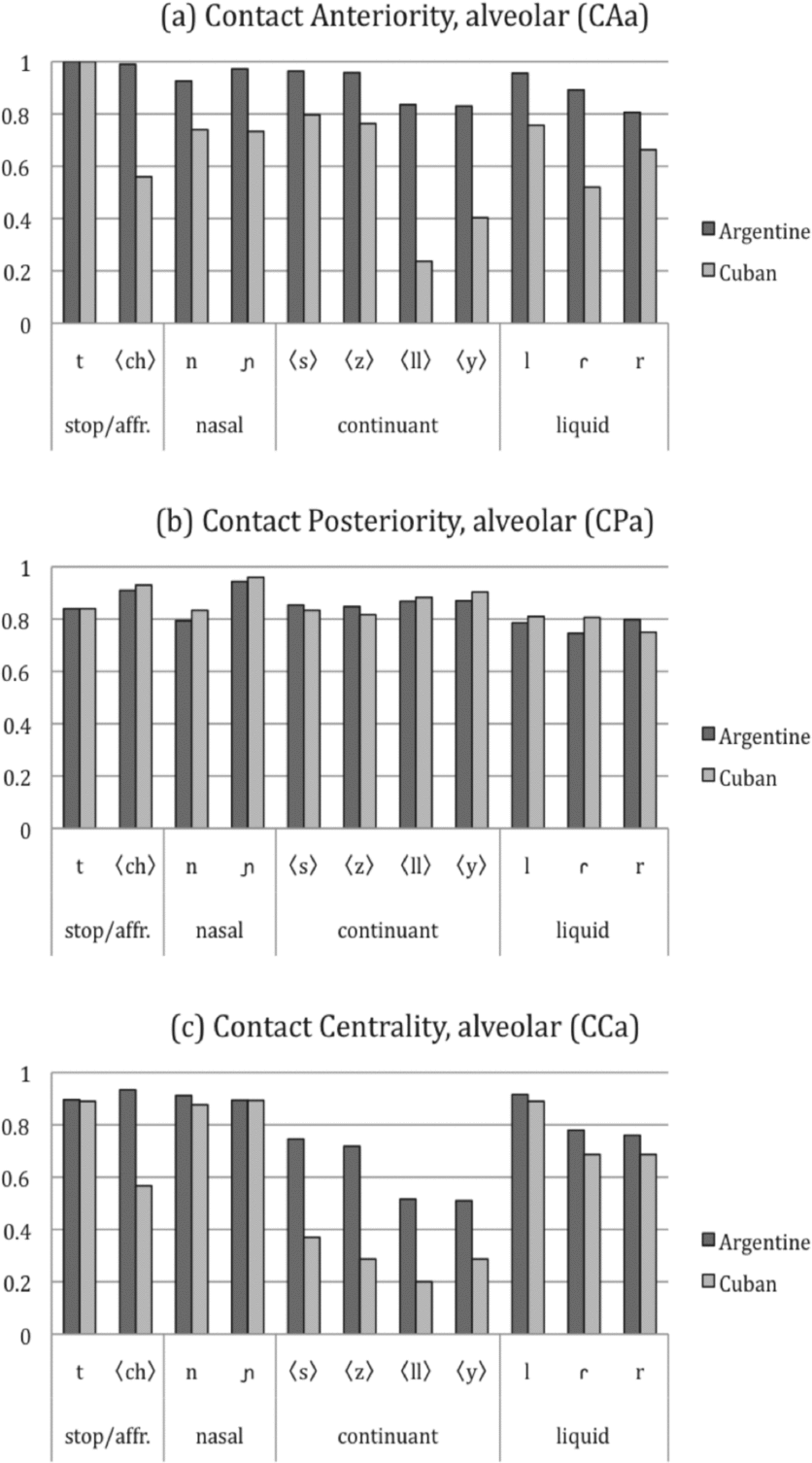
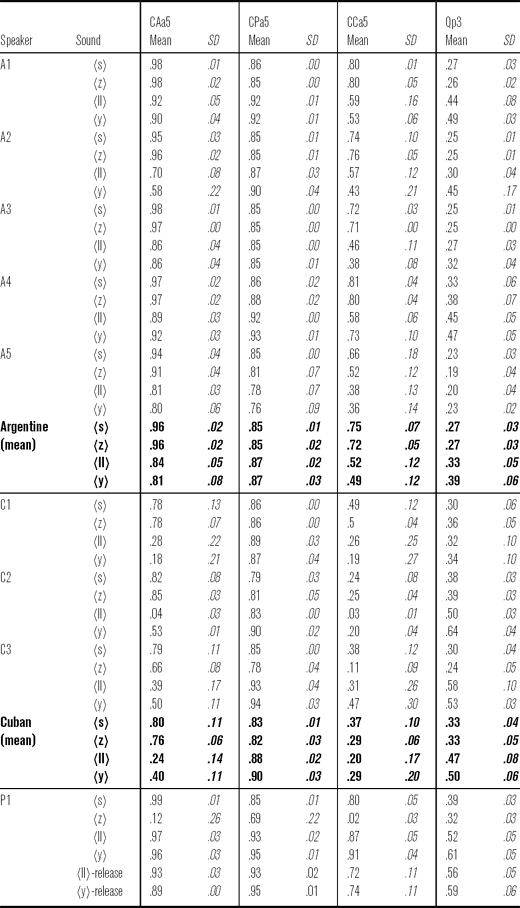
Figure 2 plots mean values for the CAa, CPa, CCa, and Qp indices for each of the target consonants produced by Argentine and Cuban speakers (i.e. the means for speakers A1–A5 and C1–C3). Individual values are given in the four tables in the appendix. It can be seen from the figure that Contact Anteriority (alveolar) values tended to be greater for consonants /t l/, 〈s, z〉, which are expected to have anterior coronal (denti-alveolar or alveolar) constrictions. Contact Posteriority (alveolar) values were higher for the consonants corresponding to 〈ch, ll, y〉 and /ɲ/, which are expected to have posterior (palato-alveolar, alveolo-palatal or palatal) constrictions. Contact Centrality (alveolar) distinguished between the consonants with constrictions having a full central occlusion (e.g. the stops, nasals, and laterals /t n ɲ l/) and those with a partial central occlusion (e.g. the rhotics /ɾ r/, and particularly the continuants 〈s, z, ll, y〉). The palatal quotient was greater for the more posterior consonants, and particularly for those conventionally described as ‘palatals’ (/ɲ/, 〈ch, ll, y〉). Of particular interest, however, are the overall differences between the Argentine and Cuban groups in Contact Anteriority and Contact Centrality values. The higher CAa values for the Argentine speakers indicate that all consonants, with the exception of /t/, had more anterior constrictions than for the Cubans. The lower CCa values for 〈ch〉 and the continuants produced by the Cubans show that these consonants had a reduced central contact, being realized as fricatives or approximants. All these differences among target consonants and between the two speaker groups are evaluated below.
CAa, CPa, CCa, and Qp values for target consonants corresponding to 11 consonants/graphemes averaged for Argentine and Cuban speakers.

3.2 Stops and affricates /t/ and 〈ch〉
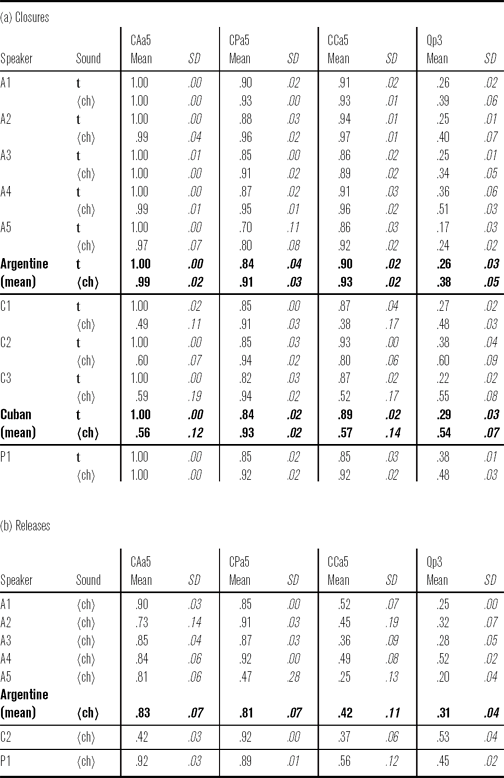
Repeated measures ANOVAs for the target consonants in tajo and chata (with the factors Consonant, and Dialect; see Section 2.4 above) were performed for each of the index variables. The Consonant effect was significant for all consonant indices (CAa: F(1,29) = 291.898, p < .001; CPa: F(1,29) = 50.505, p < .001; CCa: F(1,29) = 13.285, p < .02; Qp: F(1,29) = 113.098, p < .001). The Dialect effect was significant for CAa and CCa (F(1,6) = 255.627, p < .001; F(1,6) = 11.238, p < .02). Significant Consonant × Dialect interactions were obtained for CAa, CCa, and Qp (F(1,29) = 266.348, p < .001; F(1,29) = 21.417, p < .005; F(1,29) = 14.956, p < .009). These differences indicated that the constriction for 〈ch〉 was overall more posterior than for /t/, and this applied to a greater extent to Cuban than to Argentine speakers. For both groups, 〈ch〉 showed more palatal contact than /t/. For Cuban speakers, 〈ch〉 was also less centrally occluded than /t/, indicative of the realization of the former as a fricative or a partially deocclusivized affricate.
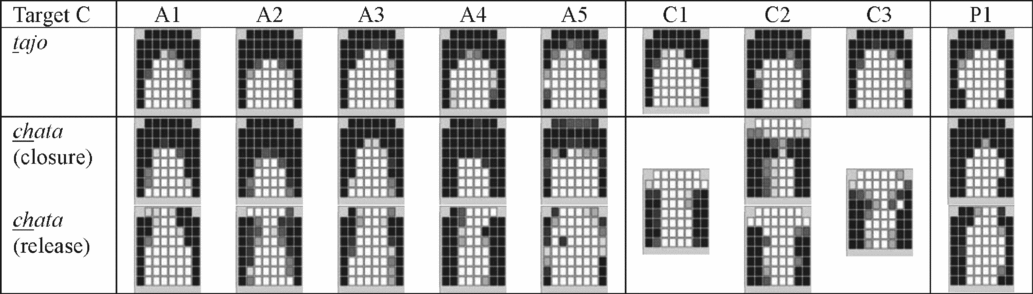
Figure 3 presents linguopalatal contact profiles for the two consonants for each of the Argentine (A1–A5) and Cuban speakers (C1–C3), as well as for the Peninsular speaker (P1). It can be seen that the closure for /t/ was consistently produced in the first two (most speakers) or first three (A2, C2) rows. The relatively large contact area, and particularly laterally at rows 3–4, indicates that the consonant was produced with the blade of the tongue (and possibly the tip articulating with the teeth). The consonant is thus a front laminal alveolar with presumably some dental contact (denti-alveolar). These findings support both Navarro Tomás’ (Reference Navarro Tomás1918: Section 98) articulatory description of Madrid Spanish and Martínez Celdrán's (Reference Martínez Celdrán, Colantoni and Steele2008) EPG study.
Individual linguopalatal contact profiles for /t/ and 〈ch〉, with shading indicating how frequently a given electrode was activated over multiple repetitions (black = 100%, white = 0%).

The consonant corresponding to 〈ch〉 was produced quite differently by the two groups. The Argentine speakers had a complete closure in the first two to four rows (rows 1–2: A3; 1–3: A1, A5; 1–4: A2, A4), that is, in the area extending from the front alveolar to the postalveolar region of the palate. The speakers differed somewhat in the location of the constriction at the release of the affricate, with the constriction being more posterior for some speakers than others (A2, A4, A5 vs. A1, A3). In contrast to the Argentine speakers, the Cubans tended to lack complete closure, with a more open constriction located in the third and fourth rows, that is, exclusively in the post-alveolar region. Interestingly, the consonant produced by the Peninsular speaker was more similar in constriction location and degree (both closure and release) to those of the Argentine speakers. Regardless of the differences in the primary constriction, almost all speakers showed greater lateral contact in the second half of the palate than for /t/, indicative of a more palatal-like (high and front) position of the tongue body for 〈ch〉.
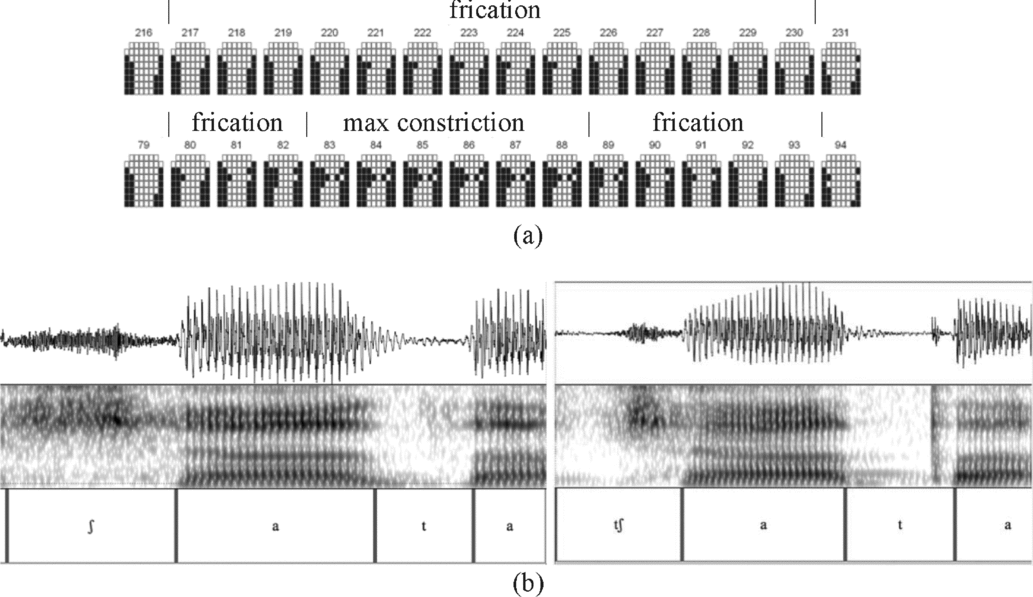
The variable realization of 〈ch〉 among the Cuban speakers requires special attention. The profile for C1 shows that the speaker produced a consistent post-alveolar fricative (with a wide central channel), rather than an affricate. In contrast, C2 produced a post-alveolar affricate, albeit with an incomplete closure. C3 showed more variation, vacillating between the fricative-like and affricate-like productions. Specifically, four of her six 〈ch〉 tokens were fricatives, characterized by a wide post-alveolar constriction and fricative noise; two tokens were produced as affricates. Interestingly, these affricates lacked a complete central occlusion and were preceded by a shorter fricative-like constriction. Two representative tokens with this speaker's 〈ch〉 are illustrated in Figure 4. In the first token, all the palates during the constriction have a wide central channel, thus representing a clear fricative [ʃ]. In the second token, the sound is a pre-fricated affricate, with palates 80–82 corresponding to a short fricative component, palates 83–88 corresponding to the acoustic closure, and palates 89–93 corresponding to the fricative release of the affricate. In sum, the results show that 〈ch〉 is realized as either a post-alveolar affricate [ʧ] or fricative [ʃ] by the Cuban speakers and consistently as an alveolar/post-alveolar affricate [ʧ] by the Argentine speakers. This variability in the realization of 〈ch〉 has also been reported for other Caribbean varieties, such as Puerto Rican Spanish (Quilis Reference Quilis1993). Based on acoustic data, Quilis (Reference Quilis1993: 299–306) identified up to six different realizations, ranging from the fricative [ʃ] to the affricate, with intermediate variants showing different degrees of pre-frication.
Palates from two tokens of 〈ch〉 in chata produced by speaker C3 (the palates are presented in chronological order) in (a) and the corresponding spectrograms of a fricative (left) and affricate (right) realization of 〈ch〉 in chata produced by speaker C3 in (b).

3.3 Nasals /n ɲ/
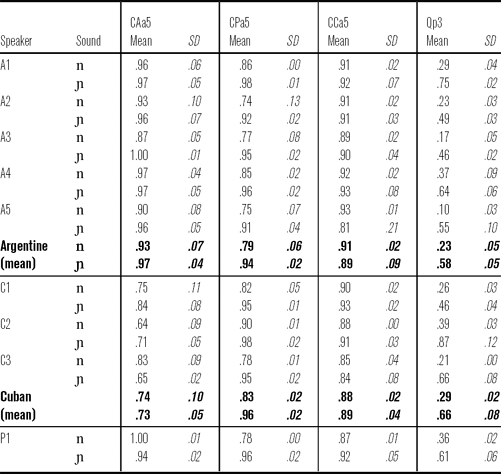
ANOVAs for the target consonants in nada and pestañar revealed a significant Consonant effect for CPa and Qp (F(1,29) = 99.326, p < .001; F(1,29) = 68.218, p < .001). The Dialect effect was significant only for CAa (F(1,6) = 56.472, p < .001). These differences showed that the constriction for /ɲ/ extended further back and had greater palatal contact than for 〈n〉, and that both nasals were overall more posterior for Cuban than for Argentine speakers.
It can be seen in Figure 5 that the closure for 〈n〉 was produced most commonly in the second and third rows of the palate, with somewhat more contact in the first row shown by Argentine speakers. Only C2 showed an exclusively post-alveolar constriction. Notably, the Peninsular speaker showed an even more fronted articulation of 〈n〉 with the closure at rows 1 and 2.
Individual linguopalatal contact profiles for [n] and [ɲ], with shading indicating how frequently a given electrode was activated over multiple repetitions (black = 100%, white = 0%).

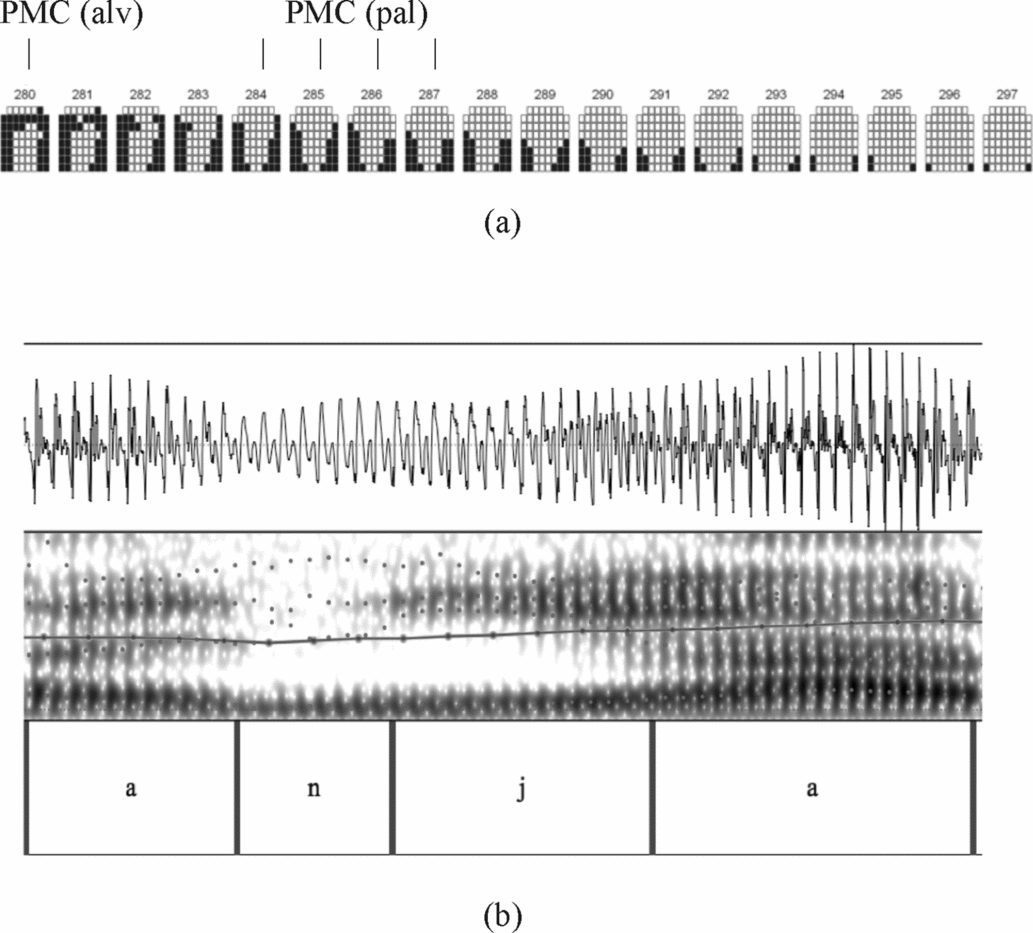
Overall, there was considerably more variation in the articulation of /ɲ/. For Argentine speakers the maximum closure for this consonant was in the relatively front part of the palate – in rows 2 and 3, or even in rows 1 and 2 (A3). In this respect, /ɲ/ was not considerably different from 〈n〉. This is indeed consistent with previous studies on Spanish (Fernández Planas Reference Fernández Planas2007, Reference Fernández Planas2009) and other Romance languages (Recasens et al. Reference Recasens, Farnetani, Fontdevila and Pallarès1993), which did not find differences between both nasals in CAa, but did in CPa. The key difference between the two was the presence or absence of additional side contact (columns 2, 3 and 6, 7) in rows 4–8. The degree of this contact was greater for some speakers in the palatal region (as clearly seen for speakers A4, A5), which suggests that the consonant had two distinct constrictions – alveolar/post-alveolar and palatal. It should be noted that the two constrictions were not necessarily produced simultaneously. Figure 6(a) presents palates from a single token of /ɲ/ produced by speaker A2, from the midpoint of the closure to the midpoint of the following vowel /a/. It can be seen that the points of maximum contact were different for the alveolar and palatal regions, at frames 280 and 284–287, respectively. In other words, the palatal constriction was considerably delayed with respect to the alveolar constriction, producing what seems to be a sequence of [n] and [j] or a palatalized alveolar [nj], rather than a single alveolo-palatal nasal. This is also seen in the corresponding spectrogram in Figure 6(b). Other Argentine speakers, however, seemed to differ in the realization of /ɲ/, producing a more typical alveolo-palatal nasal, albeit with a somewhat fronted closure. Unlike the Argentine speakers, the maximum closure for the Cuban speakers tended to be somewhat further back on the palate, in rows 2 to 4 (C1) or 3 to 4 with considerable additional contact further back (C3 and especially C2). This is characteristic of an alveolo-palatal articulation. The /ɲ/ of the Peninsular speaker had a somewhat more front closure and substantial palatal side contact.
(a) Palates from a single token of [ɲ] in pestañar produced by speaker A2 (the palates are from the midpoint of the closure to the midpoint of the following vowel). (b) The corresponding spectrogram illustrating the realization of [ɲ] as a sequence of nasal + glide, extracted from the word pestañar as produced by speaker A2.

3.4 Continuants: Fricatives (or affricates/glides) 〈s, z, ll, y〉
In most Latin American varieties, the graphemes 〈s, z, ll, y〉 correspond to two phonemes, as opposed to some Peninsular and a few Latin American varieties, where a phonemic distinction is maintained (see Section 1.1.1 above). Although differences were expected only between the consonants represented by 〈s, z〉 and 〈ll, y〉, respectively, statistics were run comparing all four word-initial consonants in order to confirm this expectation. ANOVAs for the target consonants in saga, zanja, llave, and yale yielded a significant Consonant effect for all indices (CAa: F(3,89) = 20.952, p < .001; CPa: F(3,89) = 4.325, p < .02; CCa: F(3,89) = 6.971, p < .004; Qp: F(3,89) = 7.928, p < .002). Bonferroni post-hoc tests for these variables showed that significant differences involved the pairs 〈s, z〉 and 〈ll, y〉. The Dialect effect was significant for CAa and CCa (F(1,6) = 98.094, p < .001; F(1,6) = 21.722, p < .004). There was a significant Consonant × Dialect interaction for CAa (F(3,89) = 8.040, p < .002). These differences reveal that, as expected, the constriction for the consonant represented by 〈ll, y〉 was more posterior and less centrally occluded than for the consonant represented by 〈s, z〉. This difference was more substantial for the Cuban than the Argentine speakers, given that in Argentine Spanish both /s/ and /ʃ~ʒ/ were fronted and both were sibilant fricatives. In addition, 〈ll, y〉 showed a greater palatal contact than 〈s, z〉 for both dialect groups.
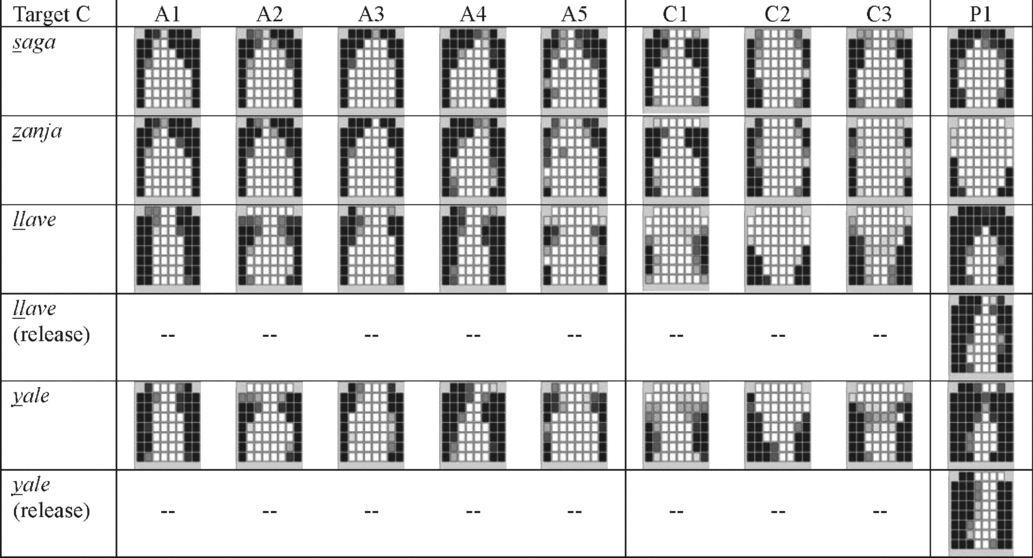
As seen in Figure 7, the consonants represented by the graphemes 〈s〉 and 〈z〉 were remarkably similar to each other within the Argentine and Cuban productions, given the historic merger mentioned earlier. For the Argentine speakers, 〈s〉 and 〈z〉 showed a very narrow central channel in the first two rows, thus representing a front alveolar sibilant fricative [s]. The consonant appears to be laminal, given some moderately large side contact in the rows immediately behind the constriction. For the Cuban speakers, the consonants in the two words had a slightly more posterior constriction (and apparently apical for C1), yet notably exhibiting a much wider central channel. In contrast to the Argentine and Cuban speakers, 〈s〉 and 〈z〉 clearly represent different phonemes in Peninsular Spanish, as seen in the front alveolar realization of 〈s〉 and an (apparently) interdental realization of 〈z〉 by P1. Note that the sibilant fricative produced by P1 was remarkably similar to the one produced by Argentine speakers (in having the contact is in the first two rows). This realization differs from the apical alveolar/post-alveolar realization expected for Peninsular Spanish.
Individual linguopalatal contact profiles for 〈s〉, 〈z〉, 〈ll〉, and 〈y〉, with shading indicating how frequently a given electrode was activated over multiple repetitions (black = 100%, white = 0%).

The first consonants in the other two words, llave and yale were produced by P1 as affricates, while showing some variation in the precise locations of the closure and release constrictions. In contrast, both 〈ll〉 and 〈y〉 were realized by Argentine speakers as a palato-alveolar fricative, as evident in the fricative-like constriction in rows 2 and 3 (or slightly more front or back for some speakers). Note also that the central channel for this fricative was wider than for [s], and that the latter consonant tended to have somewhat greater palatal side contact. While both 〈ll〉 and 〈y〉 were produced by the Cuban speakers similarly, their realization was strikingly different from both the Argentine speakers and the Peninsular speaker. The consonant in question for the Cubans was a weakly constricted approximant with more contact in the back post-alveolar and/or (pre-)palatal regions (rows 3–5 and 6–8). This suggests that a word boundary in the absence of a preceding pause is not a strengthening context for Cuban Spanish speakers. The same Cuban speakers, however, produced this consonant as an affricate (or palatal stop) after a nasal and utterance-initially (Kochetov & Colantoni Reference Kochetov and Colantoni2010), as would be expected in Peninsular Spanish.
Although the articulatory indices for place and manner reported here already reflect normalized data (see Recasens Reference Recasens2008: 336), it is possible that some between-variety differences in the realization of posterior coronal consonants such as 〈ll, y, ch〉, /ɲ/ could have been affected by physiological differences among the participants in these groups. It is known that speakers with highly domed palates tend to produce less contact at the hard palate than those with more flat palates (Recasens & Espinosa Reference Recasens and Espinosa2006a; see also Brunner, Fuchs & Perrier Reference Brunner, Fuchs and Perrier2009). Following the procedure outlined in Recasens & Espinosa (Reference Recasens and Espinosa2006a: 307–308), we measured the maximum height of the EPG palates of our speakers, which was on average 20 mm for the Argentine speakers (by speaker A1–A5: 20, 23, 19, 20, 18), 17 mm for the Cuban speakers (C1–C3: 19, 16, 17), and 23 mm for the Peninsular speaker. We also measured the length of each palate (along the midline from row 1 to row 8). It was on average 38 mm for the Argentine speakers (by speaker A1–A5: 38, 41, 39, 37.5, 35), 39 mm for the Cuban speakers (C1–C3: 39, 40, 38.5), and 37 mm for the Peninsular speaker. Given the overall differences in height, somewhat less contact at the hard palate would be expected for the Argentine group and for the Peninsular speaker, compared to the Cuban group (corresponding to differences in Qp and CCa values). Some of these expectations appear to hold, while others do not. For example, we do observe the overall greater Qp values for the Cuban group compared to the Argentine group (see Figure 2(d) above and appendix Table A3), yet CCa values for most Cuban consonants are lower than for the Argentine counterparts. This suggests that differences in palate height (or length) are unlikely to be a major factor in the observed differences between the groups, although they may explain some individual differences in constriction degree.
3.5 Liquids: Lateral 〈l〉 and rhotics /ɾ/ and /r/
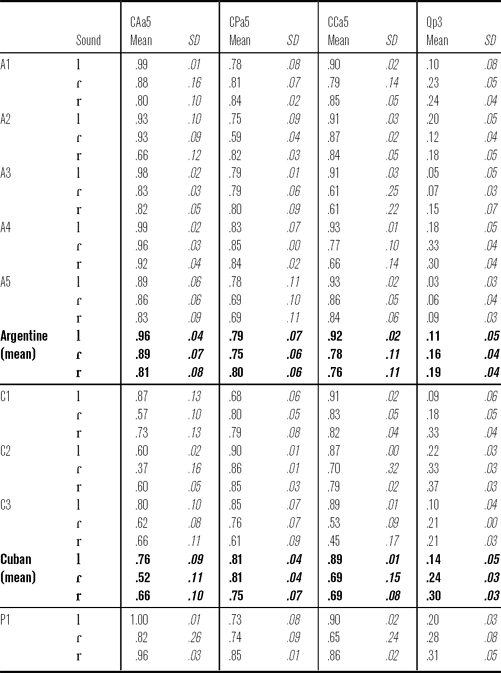
ANOVAs for the target consonants in laca, arar, and rato revealed a significant consonant effect for CAa, CCa, and Qp (F(2,59) = 12.602, p < .002; F(2,59) = 11.079, p < .003; F(2,59) = 12.830, p < .002). Bonferroni post-hoc tests for these variables showed that significant consonant differences were between the lateral 〈l〉 and the two rhotics, /r/ (in CAa, CCa, Qp) and /ɾ/ (in CAa, CCa). A significant Dialect effect and a Consonant × Dialect interaction were obtained only for CAa (F(1,6) = 19.467, p < .006; F(2,59) = 6.784, p < .02). Overall, these differences indicate that for both groups of speakers 〈l〉 had a more anterior and centrally occluded constriction than for the rhotics. The lateral also had less side contact in the palatal region compared to the trill. Once more, the liquids produced by Argentine speakers were overall more anterior than for the Cuban speakers, and the difference was particularly notable for the tap /ɾ/.
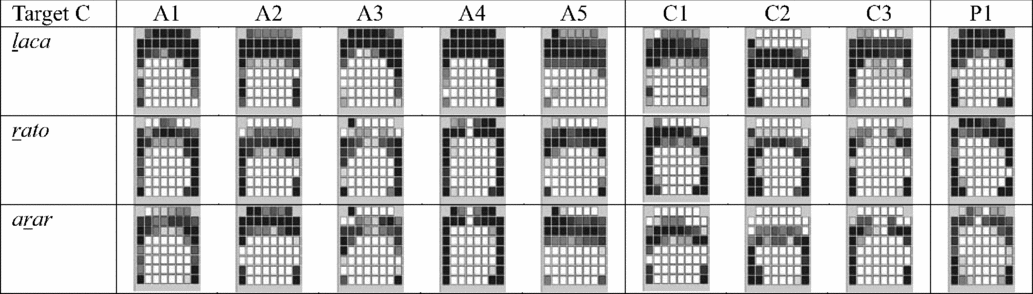
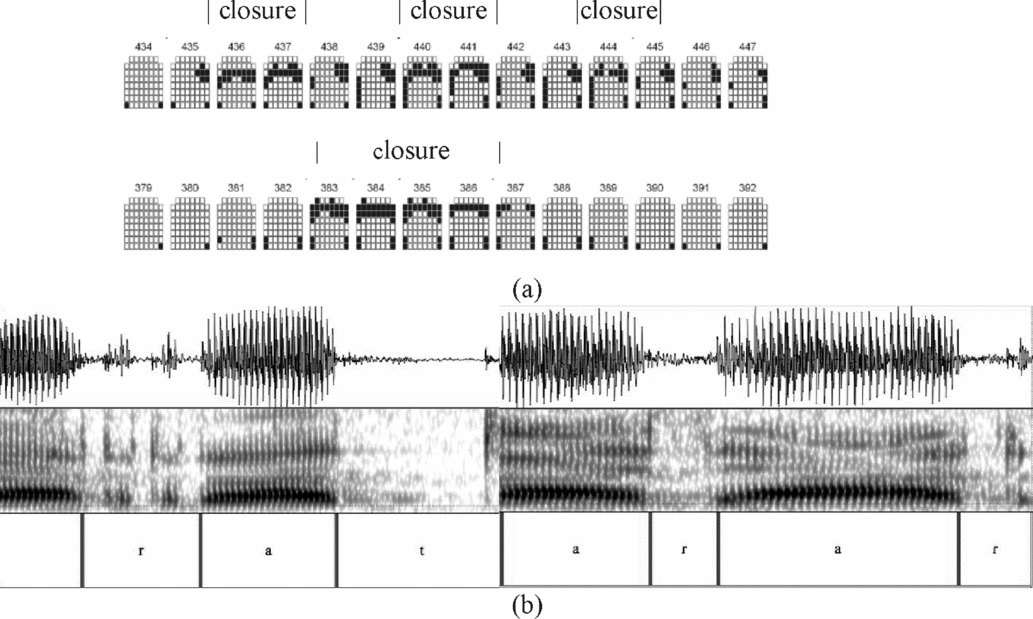
As seen in Figure 8, the constriction of 〈l〉 was produced by the Argentine speakers in the first two or three rows, and slightly further back (rows 2 and 3 or 3 and 4) by the Cuban speakers. In all cases, the constriction involved a complete closure, accompanied by relatively little side contact in the back half of the palate. The consonant is thus an apical alveolar/post-alveolar lateral that differed somewhat between the dialects in relative anteriority. The rhotics were different from the lateral in frequently having incomplete closures. The location of the closures for the tap and the trill varied across speakers, being most commonly realized at rows 2 and/or 3, and again somewhat further back for the Cubans than for the Argentine. Indeed, for the three Cuban speakers (probably less so for C3 for whom the differences are small), the tap was more posterior than the trill. Whereas two of the speakers (C1 and C3) produced what seemed to be typical Spanish trills, the third speaker (C2) produced pre-aspirated trills, which have also been reported for other Caribbean varieties (Quilis Reference Quilis1993: Section 10.4.9.3; Willis Reference Willis2007). The Argentine speakers, overall, showed the opposite tendency; that is, the tap was more fronted than the trill, but the differences were rather small, with the exception of A2 and possibly A1 (see appendix Table A4). However as would be expected, the two consonants differed in the numbers of closures. Based on the acoustic record, the trill consisted of mostly two closures (57% of the tokens) and less frequently one closure (23% of the instances).Footnote 7 Some cases of approximants and fricatives were also observed, and thus no closure was detected. The tap consisted of a single closure, sometimes longer than a closure of the trill. Examples of the two consonants produced by speaker A2 are shown in Figure 9, with the trill having three clear closures, two of which were with a complete closure and one a partial closure. The realization of all three consonants by the Peninsular speaker was relatively front (rows 1–2), similar to some of the Argentine speakers (see Tables A1 and A4 in the appendix).
Individual linguopalatal contact profiles for /l r ɾ/ and the two rhotics, with shading indicating how frequently a given electrode was activated over multiple repetitions (black = 100%, white = 0%).

(a) Palates from single tokens of /r/ in rato and /ɾ/ in arar produced by speaker A2 (with several palates before and after the constriction). (b) The corresponding spectrograms illustrating the realizations of /r/ in rato and /ɾ/ in arar produced by speaker A2.

4 General discussion
4.1 Coronal inventories within each variety
As expected, Cuban and Argentine Spanish have the same number of coronal phonemes. As in other Latin American varieties, the contrasts between /s/–/θ/ and /ʎ/–/ɟʝ/ have merged, although with different phonetic realizations in each variety. The results also revealed some other similarities, as well as considerable phonetic differences between the two varieties in the realization of other coronal consonants. In this section we provide a preliminary phonetic classification of the coronal consonants in each variety, based on our results, and making reference to the data obtained for our control Peninsular speaker.
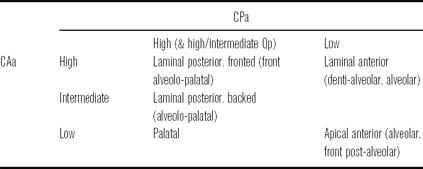
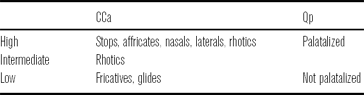
Before doing so, it is important to establish the criteria for our classification. The classification of place was based on the Contact Anteriority (alveolar) index (CAa) and the Contact Posteriority (alveolar) (CPa) index values averaged for each speaker group (as presented in Figures 2(a, b) above and the four appendix tables). Recall that these indices were calculated based on the degree of activation of the electrodes in the first five rows of the artificial palate (see Section 2.4), and thus provide information about the relative degree of fronting, backing, and the extent of coronal constriction of each consonant. Consonants characterized by high CPa are posterior in the traditional phonological sense (alveolo-palatal or palatal), while consonants characterized by low or intermediate CPa are anterior (denti-alveolar, alveolar, or front post-alveolar). Anterior coronals that have low CAa are apical, while those with high or intermediate CAa are laminal. Among the posterior coronals, (laminal) alveolo-palatals can differ in the degree of frontness/backness, corresponding to higher and intermediate CAa values. True palatals are expected to show the lowest CAa values (given little coronal contact). This place classification is shown in Table 3. The classification of manner (stricture) and secondary articulation (Table 4) is based on the averaged values for the Contact Centrality (alveolar) index and the Quotient of activation for the palatal region (Qp) (see also Figures 2(c, d) above and the four appendix tables). The former provides information about the relative width of the central channel in the alveolar region, whereas the latter indicates the amount of contact in the last three rows of the artificial palate. CCa values are high for consonants with complete closures (stops, affricates, nasals, laterals), and intermediate-to-low for consonants with incomplete closures or fricative/approximant-like central channels. Qp is high or intermediate for palatalized or (alveolo-)palatal consonants. Note that the labels ‘high’, ‘intermediate’, and ‘low’ are relative, and used for classification purposes only.
Classification criteria for place of articulation in coronal consonants based on the contact anteriority (CAa) and contact posteriority (CPa) indices. Qp = quotient of palatal activation.

Classification criteria for manner of articulation in coronal consonants based on the contact centrality (CCa) index and the quotient of palatal activation (Qp).

4.1.1 Argentine Spanish
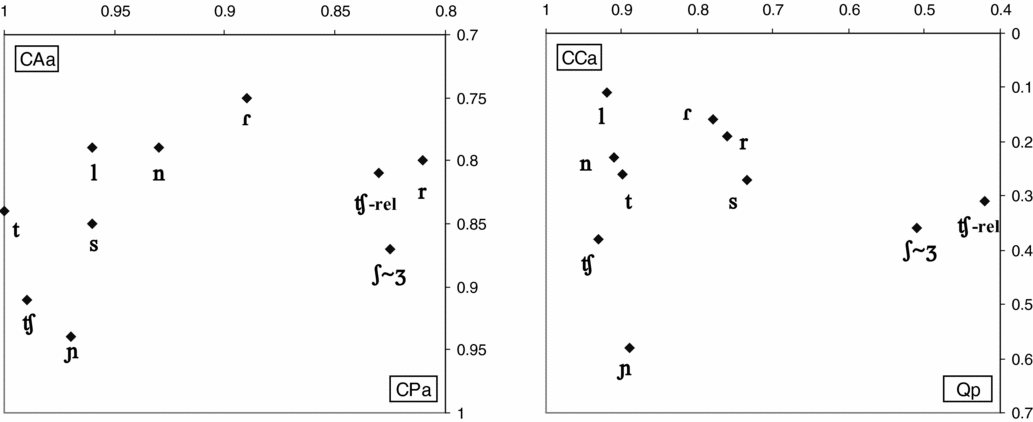
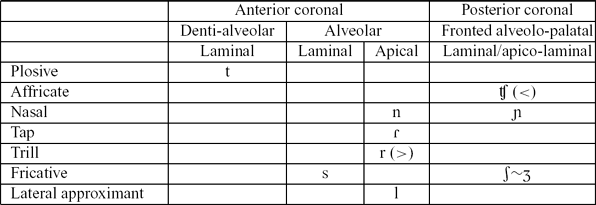
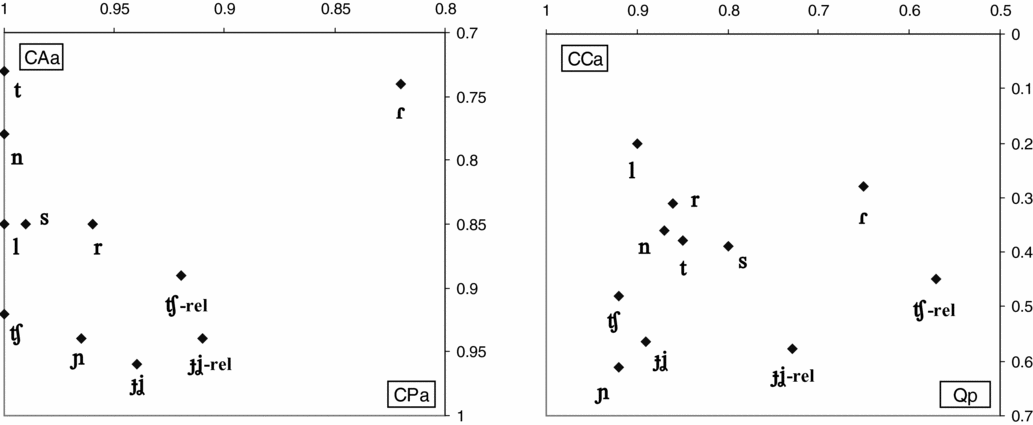
Based on the results reported and the criteria mentioned above, we start by discussing the classification of coronal consonants in Argentine Spanish. Figure 10 plots the results for place and manner. As we see in the left plot, the CPa dimension separates posterior and anterior coronals (leaving aside the /ʧ/ release). Among the posterior coronals, /ʧ/ (closure) (〈ch〉) and /ɲ/ are quite fronted (based on the high CAa), while /ʃ~ʒ/ (〈ll, y〉) is more backed and varies between more apical/fronted realizations (speakers A1, A3, A4) to more posterior realizations (speakers A2 and A5). These consonants thus represent either front or back alveolo-palatals, which also differ in the degree of laminality. This classification is somewhat controversial for /ɲ/, given the inter-speaker variation reported in Section 3.3 above. Recall that some speakers showed a decoupling of the nasal and palatal gestures, with the underlying palatal nasal having a front coronal constriction similar to that of the alveolar nasal (see Colantoni & Kochetov Reference Colantoni and Kochetov2010 for more data on the process). Indeed, these speakers may not even have a palatal nasal in their inventories. Since depalatalization and palatalization of nasal + glide sequences have been reported previously for Argentine Spanish (e.g. Malmberg Reference Malmberg1950), it is important to understand whether this is a change in progress or stable sociolinguistic variation.
Coronal consonants of Argentine Spanish plotted in terms of place (Contact Anteriority (CAa) and Posteriority (CPa), left) and manner/secondary articulation (Contact Centrality (CCa) and Palatal contact (Qp), right), averaged over five speakers.

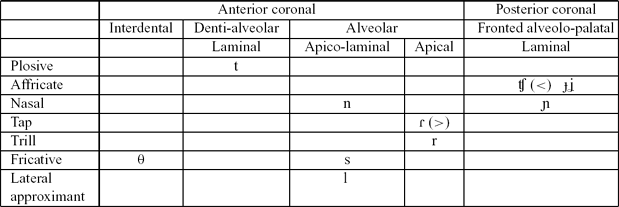
Small place differences were also obtained for the voiced and voiceless variants of this phoneme (/ʃ~ʒ/), which is consistent with the place differences reported by Recasens & Espinosa (Reference Recasens and Espinosa2007) for Catalan voiced and voiceless sibilants. Whether these differences can be attributed to different tongue-body shapes for the voiced and voiceless variants (see Ladefoged & Maddieson Reference Ladefoged and Maddieson1999) is not clear and requires further research. Our preliminary classification of the fricative /ʃ~ʒ/ is ‘apico-laminal’ (see Table 5).Footnote 8 Interestingly, the release of /ʧ/ is more apical (and somewhat more retracted) than its closure. In terms of these parameters, it is more similar to /ʃ~ʒ/, and even to the trill /r/. As seen in the right plot, the posterior coronals are characterized by higher palatal contact (Qp), which is considerably more extensive for the nasal.
Classification of Argentine Spanish coronal consonants (only consonants included in the study) based on the results from five speakers. < = more fronted articulation; > = more retracted articulation.

Among the anterior coronals, /t/ has the frontmost constriction (the highest CAa) presumably produced with the blade of the tongue (intermediate CPa). /s/ is also laminal, yet produced further back (alveolar). The other anterior coronals are apical (low CPa). Among the latter consonants, the rhotics are more backed, and particularly the trill, which based on these criteria can be optionally considered posterior. The differences between the rhotics require further testing given that the tap and the trill in our stimuli do not occur in the same context (i.e. we compared a word-initial trill to a word-medial tap). Further, the liquids /l ɾ r/ have the lowest palatal contact, Qp. The CCa dimension in the right plot separates the fully occluded stops/affricates, nasals, and /l/ from the partially occluded rhotics and fricatives. Among the latter, /ʃ~ʒ/ has considerably wider opening than /s/. The affricate release is most similar to, although somewhat more open than /ʃ~ʒ/. The patterning of the trill with fricatives seen in both plots is interesting, as fricative-like realizations of /r/ are not uncommon in some dialects of Argentine Spanish and other Latin American varieties (see Colantoni & Steele Reference Colantoni and Steele2005 and references therein). The results of our classification are summarized in Table 5.
4.1.2 Cuban Spanish
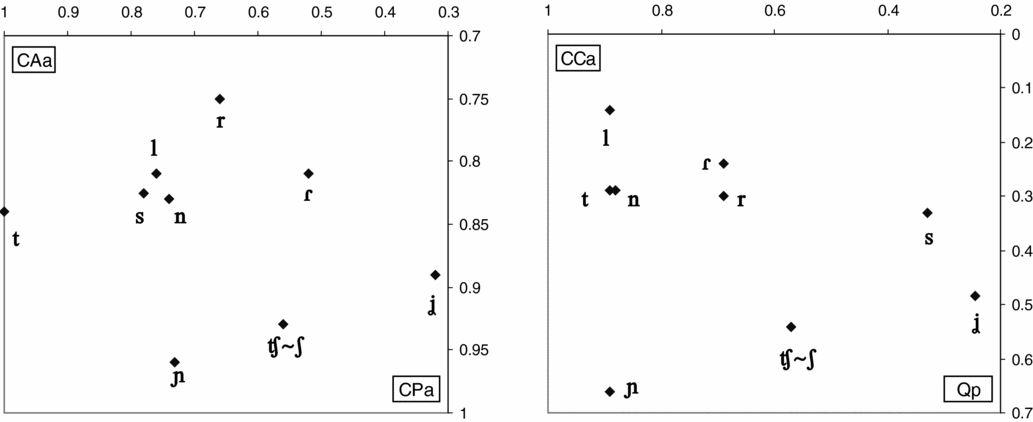
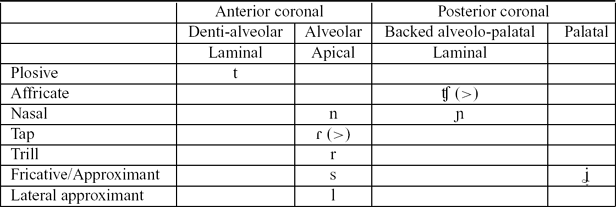
We turn now to the classification of the Cuban Spanish coronal inventory. Figure 11 displays the results for place and manner of articulation. The Cuban posterior and anterior coronals are clearly separated by the CPa dimension in the left plot. The posterior consonants /ʧ~ʃ/ (〈ch〉) and /ɲ/ are backed laminal alveolo-palatals (with the former being more posterior), while /ɟʝ/ (〈ll, y〉) is realized in the context used in the study as a true palatal approximant with little coronal contact, []. These three consonants are also characterized by a high degree of palatalization, as can be seen in the right plot. As mentioned in Section 3.1, the alveolo-palatal affricate is highly variable, across and within speakers: one of the speakers showed a weakly occluded affricate, another speaker almost exclusively produced sibilant fricatives, while the third speaker alternated affricates and fricatives in her production.
Coronal consonants of Cuban Spanish plotted in terms of place (Contact Anteriority (CAa) and Posteriority (CPa), left) and manner/secondary articulation (Contact Centrality (CCa) and Palatal (Qp) contact, right), averaged over 3 speakers.

Within the anterior coronals, the CAa dimension sets aside the laminal denti-alveolar /t/ (the highest CAa) from the apical alveolars /n l s/ (considerably lower CAa), and the more backed apical alveolars /r/ and /ɾ/. Note that the latter is produced with very low CAa, and can be alternatively classified as a posterior coronal. The grouping of /s/ with the clearly apical /n l/ may be a side effect of the relatively weak central coronal contact of the former, and thus the consonant may well be laminal. As expected, the lateral has the least palatal side contact. The CCa dimension in the right plot distinguishes between the fully occluded /t n ɲ l/, the partially or variably occluded rhotics and /ʧ~ʃ/, and the fricative /s/ and approximant /ɟʝ/. This supports a classification of this consonant as an approximant (see Martínez Celdrán Reference Martínez Celdrán, Colantoni and Steele2008 for Peninsular Spanish) rather than as a fricative.
The generalizations about place and manner of Cuban consonants are presented in Table 6. One important difference between this inventory and that for the Argentine speakers (Table 5) is the presence of a true palatal variant [] (corresponding to the Argentine alveolo-palatal /ʃ~ʒ/). Another important difference is in the phonetic realization of the apparently similar phonemic contrasts, which will be discussed in Section 4.2 below.
Classification of Cuban Spanish coronal consonants (only consonants included in the study) based on the results from three speakers. < = more fronted articulation; > = more retracted articulation.

4.1.3 Peninsular Spanish
We conclude this subsection by presenting our classification of the coronal consonants produced by our Peninsular Spanish speaker, as shown in Figure 12 and Table 7. This classification is discussed here with the purpose of comparing it against the target varieties and the conclusions clearly merit further investigation. The interdental /θ/, which has very low CAa, CPa, and CCa values (see appendix Table A3), is omitted from the figures. The presence of this consonant in the inventory (see Table 7), where it contrasts with the alveolar /s/, however, is one of the most salient characteristic of this variety.
Coronal consonants of Peninsular Spanish plotted in terms of place (Contact Anteriority (CAa) and Posteriority (CPa), left) and manner/secondary articulation (Contact Centrality (CCa) and Palatal (Qp) contact, right), based on data from speaker P1. Values for /θ/ are not shown (see appendix Table A3).

Classification of Peninsular Spanish coronal consonants (only consonants included in the study) produced by speaker P1. < = more fronted articulation; > = more retracted articulation.

As seen in the right plot of Figure 12, the coronal consonants produced by the Peninsular speaker are relatively poorly differentiated in place, given the overall front realization of most articulations. This is in striking contrast with the previously discussed results for Cuban Spanish (see above), as well as in some respects different from the previously published data on Peninsular Spanish (Fernández Planas Reference Fernández Planas2007; see also Figure 1 above). The left plot in Figure 12 shows some separation between the posterior and anterior coronals in CPa. The posterior coronals are considerably fronted and possibly laminal, with affricate releases produced somewhat further back than the respective closures. While /ɟʝ/ (〈ll, y〉) is somewhat more posterior (based on in CPa and CAa) than /ʧ/ (〈ch〉), it is still quite front to be classified as a true palatal. Among the anterior coronals, /t n l s/ have a very front contact, and the active articulator is either the blade or the tip of the tongue. The somewhat lower CPa value for /t/ is likely due to the contact extending further to the dental region that is only partially captured by the EPG palate. We therefore classify /t/ as laminal denti-alveolar, and /n l s/ as apico-laminal alveolars, although given the overall degree of fronting of these consonants, these differences may not be fully reliable. The trill is somewhat further back, while the tap is considerably more posterior and is clearly produced with the tip of the tongue. The relatively poor differentiation between posterior and anterior coronals in CPa/CAa is partly compensated by greater differences in Qp. The affricate closures and release, and the nasal /ɲ/ have higher palatal contact, somewhat higher for /ɟʝ/ and /ɲ/ than for /ʧ/. Based on these and CAa/CPa similarities and differences, we classify these three consonants produced by our speaker as laminal alveolo-palatals, with /ʧ/ being more fronted than the others.Footnote 9 In terms of CCa, the tap and affricate releases are more centrally open, while the separation between the fricative /s/ and the non-continuants is relatively small, reflecting the overall high constriction degree of the consonants produced by the speaker.
The finding that /s/ is a fronted laminal alveolar (having index values similar to those for its Argentine counterpart) is unexpected, given the standard characterization of Madrid Spanish as apical, as opposed to the laminal realization found in most Latin American varieties (e.g. Quilis Reference Quilis1993). This is clearly illustrated if we compare the palate in Figure 1 against that shown in Figure 7. While our results suggest that the phonemic distinction between the consonants corresponding to the orthographic 〈ll〉 vs. 〈y〉 is not maintained by this speaker, some differences found in the CCa and Qp indices (see appendix Table A3) require further study. The finding of the relatively weak central occlusion for the tap suggests that this consonant is articulated as an approximant, which is consistent with previous reports on Peninsular Spanish (see Blecua Reference Blecua2001). The more back articulation of the tap is similar to the results obtained for our Cuban speakers, yet different from those reported by Fernández Planas (Reference Fernández Planas2007) for Peninsular Spanish. Thus, more research is necessary to determine whether these and other previously noted deviations are due to dialectal or individual differences.
4.2 Dialectal differences in the realization of coronals
Our results revealed dialectal differences not reported in previous studies, in particular in what concerns place of articulation. For each of the consonants studied (with the exception of /t/), we have found that coronal consonants produced by Argentine speakers are more anterior than those produced by Cuban speakers. Interestingly, this was not only observed in the articulation of the initial consonant in words like llave and yale, which was expected to be more posterior in Cuban than in Argentine Spanish, but also in the case of liquids and nasals, for which no differences in place had been previously reported. Overall the ‘articulatory space’ of Cuban coronals is considerably more ‘dispersed’, compared to the more ‘crowded’ space of the Argentine inventory. The Cuban coronals are also overall less constricted than their Argentine counterparts. This is clearly seen in Contact Anteriority and Centrality ranges in Figure 11. Even excluding the palatal /ɟʝ/, CAa values for Cuban coronal consonants range from .52 to 1.00, while the range for the Argentine consonants is from about .81 to 1.00. Similarly, CCa values for Cuban consonants range from .33 to .89, while for the Argentine consonants the range is between .42 and .93, with most consonants clustering within an even narrower range of higher CCa values. One notable difference is that the Cuban /ʧ/ is substantially further back and variably de-affricated, compared to its Argentine counterpart. Given this, the phonetic contrast between this consonant and the stop /t/ is quite different phonetically (greater in Cuban than in Argentine), despite their similar phonological status in the two inventories.
Results obtained for Peninsular Spanish revealed similarities with both dialects. As in Argentine Spanish, the Peninsular speaker studied here showed fronting of most coronal consonants, which differs from the results reported by Fernández Planas (Reference Fernández Planas2007) for Peninsular Spanish. As in Cuban Spanish, the overall ‘articulatory space’ of coronal consonants occupies a wider range, taking into consideration interdentals.
These differences in place between Argentine and Cuban Spanish are similar to those reported for affricates and fricatives in two Catalan varieties (see Recasens & Espinosa Reference Recasens and Espinosa2007). In the case of Catalan, Valencian shows significantly more fronting than Majorcan, although the degree of fronting, as signaled by the anteriority indices, is not as prominent as in our Argentine Spanish data. The consistent cross-dialectal differences that we found may be indicative of an overall difference in articulatory settings between the varieties, if examined in the context of the Articulatory Settings theory (Honikman Reference Honikman, Abercrombie, Fry, MacCarthy, Scott and Trim1969). According to this theory, the articulatory settings of each language/variety are determined by the most frequent consonants in the language. In Spanish, coronals are the most frequent consonants, and alveolars in particular (Quilis Reference Quilis1993: Section 2.9.1). If the differences in articulatory settings apply across varieties, they should extend to non-coronal consonants as well as to vowels. Some acoustic and articulatory studies suggest that this may be the case. It is well known that word-final nasals in Cuban Spanish are articulated further back, as velars, and that the velar fricative /x/ is realized as a glottal fricative (Quilis Reference Quilis1993, Hualde Reference Hualde2005). Differences in the vocalic inventory may also exist, but the evidence reported so far is still inconclusive. Indirect evidence is presented by Guitart (Reference Guitart, King and Maley1985) who argued that differences observed in the production of English [ʌ] by Cuban and Peninsular speakers can be attributed to different feature specifications for vowels in each variety. Marinescu (Reference Marinescu2010), in her ongoing investigation, is reporting differences between Peninsular and Cuban Spanish in the direction predicted by the Articulatory Settings theory, namely, the vocalic system of Peninsular Spanish is more fronted when compared to Cuban Spanish, but comparable data on Argentine Spanish are not yet available.Footnote 10
Cross-dialectal differences were not only found for place but also for the degree of constriction. As mentioned, the difference between Cuban and Argentine Spanish is particularly salient in the articulation of /s/, which showed a wide central channel in Cuban Spanish, as indicated by the mean CCa values of .33 for Cuban and .74 for Argentine Spanish (see appendix Table A3). These differences in the constriction degree of /s/ are likely to be related to different stages in the weakening processes affecting coda /s/, which is more advanced in Cuban than in Argentine Spanish. This would be consistent with Terrell's (Reference Terrell1979) comparative analysis of /s/ weakening in codas, across several varieties, including Havana and Buenos Aires Spanish. Terrell concluded that, although weakening was attested in both varieties, it was much more advanced in Cuban Spanish, where [h] had become the most frequent allophone of /s/.
4.3 Comparisons with previous articulatory studies
Our results showed a number of parallels with those obtained by Fernández Planas (Reference Fernández Planas2000, Reference Fernández Planas2007, Reference Fernández Planas2009). First, in all three varieties, /t/ was the most fronted consonant among the coronals, and results indicated that it can be classified as laminal denti-alveolar. Second, [n s l r], as produced by our Peninsular speaker, can be classified as alveolar. Finally, our data also support the classification of /ʧ ɲ/ as alveolo-palatal. Our classification of /ɟʝ/ as alveolo-palatal rather than true palatal (although further back than /ʧ/) is different from Fernández Planas (Reference Fernández Planas2007). It should be noted, however, that her generalizations were based on the allophone of this phoneme occurring in a weak position ([ˈaa]), and thus are not fully compatible with our results.
Other, more substantial differences involving all three dialects were also found. First, our Peninsular speaker produced overall much more fronted coronals than Fernandez Planas’ participants, suggesting a greater degree of variation in Peninsular Spanish than has been previously reported. Second, the tap produced by our Madrid speaker was much more retracted than the mean values for the tap reported by Fernández Planas. In this sense, the data obtained for the Madrid speaker resemble more closely those for Cuban Spanish than previous results for Peninsular Spanish. The Argentine data, however, are consistent with the general tendencies reported by Fernández Planas (Reference Fernández Planas2007), and also by Recasens & Pallarès (Reference Recasens and Pallarès1999) for Catalan, namely for the tap to be more fronted than the trill. Finally, our data suggests that the palatal lateral has disappeared from the inventory of this speaker from Madrid, although more research is necessary to determine whether the small differences found in some of the values (CCa and Qp, in particular; see appendix Table A3) are indicative of some type of near-merger between the orthographic 〈ll〉 and 〈y〉.
When compared with the Catalan data presented by Recasens and colleagues (see especially Recasens & Pallarès Reference Recasens and Pallarès2001), we conclude that as in Catalan, /t/ is the most fronted coronal in the three varieties under study, whereas /ɟʝ/ is truly palatal both in Catalan and Cuban Spanish, with very similar CAa values. The alveolars /l, n/ are clearly less fronted in Catalan than in Argentine Spanish. Anteriority values for Cuban /l/ closely resemble those reported by Recasens & Pallarès (Reference Recasens and Pallarès2001: 98) for Catalan, but /n/ appears to be less fronted in Catalan than in Cuban. The sibilant /s/ has low CAa values in Catalan given its apical articulation, and clearly differs from the values obtained for both Cuban and Argentine Spanish. It does resemble the Cuban Spanish consonant in CCa values, indicating that in both Romance varieties this sound is articulated with a wide channel. As opposed to Peninsular Spanish, Catalan does have a post-alveolar voiceless sibilant fricative /ʃ/, which can be compared to the voiceless variant produced by some Argentine speakers and the deaffricated allophone of /ʧ/ produced by some Cuban participants. Indeed, the Catalan sibilant resembles the Cuban variant more closely than the Argentine realization, although it is slightly more posterior than the Cuban /ʃ/. In terms of the central constriction (CCa), on the other hand, the Catalan sibilant is more similar to Argentine than to the Cuban sibilant, where /ʃ/ is realized with a very wide central channel. The Catalan affricate, as both the Argentine and Peninsular affricate, is an alveolo-palatal consonant. The closure, however, is more fronted in Argentine and Peninsular Spanish than in Catalan. Finally, the alveolo-palatal nasal /ɲ/ is also less posterior in Argentine Spanish (and in our Peninsular speaker) than in Catalan (see also Recasens & Espinosa Reference Recasens and Espinosa2006a), and in terms of closure location, it resembles more closely the data reported for Italian (see Recasens et al. Reference Recasens, Farnetani, Fontdevila and Pallarès1993). Data obtained for Cuban Spanish are consistent with those reported for Catalan.
5 Conclusion
Our main goal was to further our understanding of cross-dialectal characteristics of Spanish coronal consonants by presenting new electropalatographic data of two understudied varieties (Cuban and Argentine Spanish). In addition, we compared the results obtained with those reported in the literature as well as with additional data obtained from one control Peninsular Spanish speaker native of Madrid. Our results have revealed similarities in the overall classification of coronal places. Thus, we have shown that in the three varieties under study /t/ is the most fronted sound, followed by /s l n/, which can be classified as fronted/anterior alveolar across varieties. A number of consistent expected and unexpected differences were also reported. As expected, the coronal inventory is larger in Peninsular than in Cuban and Argentine Spanish, and the merger of 〈ll, y〉 has resulted in a different phoneme in each variety (i.e. a post-alveolar sibilant in Argentine Spanish vs. a palatal approximant in Cuban). Interestingly, a number of unexpected differences emerged. First, we showed that the coronal space is more ‘crowded’ in Argentine Spanish than in the other two varieties. In this variety, coronals are fronted and very minute differences in anteriority were found. Second, differences in the degree of constriction of /s/ were found, with the sibilant being less constricted in Cuban than in Argentine Spanish. Finally, a number of interesting cases of within dialect variability were also apparent, such as de-affrication of /ʧ/ in Cuban Spanish and decomposition of the palatal nasal in Argentine Spanish.
Acknowledgements
We are grateful to Ana María Fernández Planas, two anonymous reviewers, and Editor Adrian Simpson for comments and suggestions that have helped to improve the article. We also thank Daniel Recasens and José Ignacio Hualde for valuable advice on the project at its earlier stages, as well as Bojana Radovanovic for assistance with the annotation of EPG data. All errors are the authors’ responsibility. The work was supported by University of Toronto Connaught and Victoria College grants to both authors.
Appendix. Individual mean values and standard deviations for the four articulatory indices discussed in the article
CAa5 = Contact Anteriority in the alveolar region (the first 5 rows); CPa5 = Contact Posteriority in the alveolar region (the first 5 rows); CCa5 = Contact Centrality in the alveolar region (the first 5 rows); Qp3 = Quotient of activation for the palatal region (the last 3 rows). See Section 2.4 for details.
Stops and affricates /t/ and 〈ch〉 (A, P /ʧ/, C /ʧ~ʃ/).

Nasals /n ɲ/.

Continuants 〈s, z, ll, y〉 (A, C, P /s/, P /θ/, A /ʃ~ʒ/, C, P /ɟʝ/).

Liquids /l ɾ r/.