1. INTRODUCTION
Audiowalk – St Enda’s Park is a site-specific geolocative sonic installation experienced over headphones. The work is an exploration of interactivity and improvisational listening within somatic art, which is essentially how we perceive our body from within: first-person perception as opposed to an exterior third-person viewpoint. In this case, proprioception is gained through the merging of aural, visual and kinaesthetic experience as the participant moves through the space of St Enda’s Park in an unprescribed and improvisational manner. The article will also explore concepts and terms such as: platial phenomenology (Parmar Reference Parmar2019), improvisational flow and ethnographic aural history and will then discuss how they are applied to this particular work.
Audiowalk is a process-orientated work that is grounded in the concept of soundwalking (Drever Reference Drever and Saunders2009). I will briefly explore the historical background of soundwalking in general, as it will lay the groundwork for the ensuing discussion on the improvisational nature of Audiowalk. Although this initial discussion is not focused purely on the improvisational act of listening and walking, it is nonetheless crucial for the overall contextualisation of the project.
The terms ‘soundscape composition’ and ‘soundwalking’ were coined in the late 1960s by R. Murray Schafer, Hildegard Westerkamp and Barry Truax (Truax Reference Truax2008). Together they have established and advanced what they term ‘acoustic ecology’ (Truax Reference Truax1984). Soundscape study emerged from the pedagogical intent of the World Soundscape Project (Schafer Reference Schafer1977). In its normal context, environmental sound is often unheard and ignored. Schafer intended to frame sound and draw the listener’s attention towards it by presenting it as a soundscape much like a visual artist would present a landscape. The intention is to reveal a deeper level of understanding associated with environmental sounds by invoking the listener’s semantic associations while walking through a specific location. A simple definition comes from Hildegard Westerkamp; she states that ‘[a] Sound Walk is … a listening exercise that helps us become aware of our immediate acoustic environment’ (Westerkamp n.d.). Anecdotally, while R. Murray Schafer never referred to soundwalking as an improvisational act, he did use improvisation within listening exercises as a method of aural education; he termed these ear-cleaning exercises (Schafer Reference Schafer1967).
Historically, one of the most influential practitioners concerning not only music but also art in general is John Cage. I have no intention of adding more to the Cagean polemic as such, but the causes and consequences of his silence trope need to be included and commented upon here, as it has a fundamental impact on my definition of improvisational listening within the project Audiowalk. It is notable that John Cage was initially interested in improvisation and incorporated it within his compositions (Fleming and Duckworth Reference Fleming and Duckworth1989: 16) but consequently he sought ‘to make improvisation a discipline’ that would involve ‘doing something beyond the control of the ego’ (Kauffmann and Cage Reference Kauffmann and Cage1966: 46). Apparently, because he saw improvisation as an ‘expression of emotion’, he abandoned it in favour of ‘chance and indeterminacy’ (Kostelanetz Reference Kostelanetz1988: 222). That said, composer Anthony Braxton contentiously argues that John Cage used these specific terms to ‘bypass the word improvisation and as such the influence of non-white sensibility on American music’ (as cited in Lewis Reference Lewis1996: 99).
Cage’s arguments in declaiming indeterminacy over improvisation notwithstanding, one of his most significant contributions was his highlighting of the perceptual experience of listening in the expanded sonic field; this in turn has had a significant impact on the foundation of sonic art, to which I contend the ‘soundwalk’ and ‘audiowalk’ both belong. Douglas Kahn suggests that Cage codified silence into a ‘musical’ event that could be experienced anywhere and at any time, essentially arguing that all sound – for example, the environmental sound that is ‘revealed’ through silence – could be music (Kahn Reference Kahn1997). Regardless of this debate, John Cage’s theories represent an aesthetic ideal of listening that does not impose an intention or will on the listener; instead it promotes an openness towards experiencing events simply as they are. It is precisely these heuristic principles that concern me and in particular the project Audiowalk.
Another early example of this type of active listening and mobility can be found in the works of Max Neuhaus. Interestingly, Neuhaus developed and performed improvised versions of John Cage’s piece Fontana Mix, entitled Fontana Mix-Feed (Neuhaus Reference Neuhaus1965), using feedback loops and percussion. Neuhaus then expanded this concept of the feedback loop as an organising principle in his work Public Supply (Neuhaus Reference Neuhaus1966b), ‘but this time the feedback loops incorporated living people and encompassed a community-sized space’ (Belgrad Reference Belgrad, Lewis and Piekut2014: 289). Essentially, he used the telephone network and radio transmission to create a feedback system; when a caller turned on their radio, they were both transmitting and receiving the same signal and hence it created signal feedback. But it is his piece LISTEN (1966a), exploring the concept of audience movement within an art piece, that is pertinent to this article. Neuhaus decided that instead of bringing sounds into the hall, why not simply take the audience outside (Lander and Lexier Reference Lander and Lexier2013). LISTEN is conceptually similar to Westerkamp’s and Schafer’s soundwalking, but they were more concerned with the eco-political implications of noise abatement (Murph Reference Murph2018). Neuhaus’s work was an attempt to open up new relationships concerning the act of listening; he is also considered one of the first artists to extend the concept of sound as a medium within a site-specific place. Neuhaus declared ‘I am building with sound to bring a place into being’ (Neuhaus and Des Jardin Reference Neuhaus and Des Jardin1994: 97). Subsequently, Christoph Cox indicates, ‘Neuhaus removed sound from time and instead set it in place’ (Cox Reference Cox2010: 113).
To conclude this introduction, I want to list some contemporary artists working within the area of soundwalking. Each artist mentioned here has a unique methodological approach to how they explore this experiential aspect of their work. First is Viv Corringham’s Shadow-walks (Corringham Reference Corringham2010), which explore improvisation and environmental field recordings. Corringham examines a person’s sense of place and how it links with their personal history and memory, through the act of singing and walking. Andrea Polli’s environmental work (Polli Reference Polli2020) blends art and science to create intermedia technological artworks principally related to environmental issues. She works in the area of sonification of data with a specific focus on understanding how climate can be understood through sound. Andra McCartney’s soundwalking interactions (McCartney Reference McCartney2010) specifically look at soundwalking as an improvisational rather than a compositional act. She contends that environmental sound is never fixed and never completely scoreable, and that as such it forms a bridge between the everyday experience of walking and mindful creative listening. Akio Suzuki’s Oto-date (Suzuki 2005) works explore the process of listening to the sounds of an urban environment from specific points within a city, which are mapped out with a stencil marking on the ground indicating where the participant should stand and listen. As Suzuki’s work is concerned primarily with the cityscape, the sonic environment is continuously changing.
However, the artists who have had the most significant impact on my approach to this type of work include Christina Kubisch, particularly her Electrical Walks (Kubisch Reference Kubisch2003), which explore electromagnetic fields of urban environments in the form of city walks. Kubisch converts this electromagnetic energy into an audible signal using built-in electrical coils built into headphones that respond to the magnetic waves that are ubiquitous within any urban city. Kubisch proposes that the perception of everyday reality changes when we listen to an electromagnetic field in this way: the sounds are much more musical than expected and there are many complex layers of high and low frequencies, loops of rhythmic sequences and groups of sounds that are constantly changing. Yolande Harris’s Displaced Sound Walks (Harris Reference Harris2002) explore expanded sensorial perception through the use of sonic location, visualisation and GPS data. She primarily investigates and explores ideas of sonic consciousness and our relationship to the environment. Janet Cardiff and George Bures Miller’s audio and video walks (Cardiff Reference Cardiff2006) weave fictional narrative with descriptions of the actual cityscape that the individual is walking through. These perambulatory works are presented in an audio-guide style, and are both immersive and theatrical; they also implicate the listener in their ‘elaborate storylines’ by superimposing a ‘private’ space on top of the experienced public space. Kathy Kennedy’s micro-radio walks (Kennedy Reference Kennedy2017) explore improvisation and acoustic ecology, utilising radio and live musicians in works that she terms ‘sonic choreographies’. Finally, Teri Rueb’s geolocative work Trace (Rueb Reference Rueb1999) is considered one of the first GPS locative sound installations. Rueb describes her work as a type of site-specific environmental sound installation that transforms a walking trail into a landscape of sound recordings that commemorate personal loss. As Rueb’s installation Trace was created prior to the smartphone, the participant had to wear a large rucksack with the GPS tracker, computer and associated electronics inside that were then connected to a headphone system for playback.
2. IMPROVISATIONAL LISTENING
For my purposes within this article, I define the project Audiowalk – St Enda’s Park as an improvisational and mediated perambulatory sonic work that explores perception of place. It must be experienced through headphones as it contains both a narrated audio track and a recorded binaural (3D)-designed soundscape. The work explores concepts such as improvisation and deterministic procedures, and how these two principles are interconnected through processual and kinaesthetic reactive movement. Audiowalk is a geolocated work that examines not only a specific location but also the sociopolitical urbanscape in terms of how a particular place and its history can have perceptual and emotional resonance. The work is intended as an interactive sonic exploration that borrows from the concept of the Dérive. Guy Debord proposed that ‘Dérives involve playful constructive behaviour and awareness of psychogeographical effects’ (Debord Reference Debord1956: 177). Psychogeography is a means of exploring the behavioural and emotional impact of an urban place (Coverley Reference Coverley2018: 9).
Audiowalk was designed to be experienced through headphones connected to a smartphone that employs the global positioning satellite system (GPS) using iBeacon technologyFootnote 1 to locate the user within specific map coordinates or geofenced area. The smartphone uses the geolocative application Echoes XYZ Footnote 2 to trigger the audio content, which has been designed around procedural and generative methods (discussed later). The sound design consists of onsite and unmodified binaural field recordings, recorded dialogue and electroacoustic generative compositions. The material was designed to evolve in form and texture and to provide the participants with diversity of aural perspective. Importantly, the audio content was designed not only to focus the participant’s attention but also to blend in with the real-time sounds of St Enda’s Park. This blending of naturally occurring and composed material is achieved through the incorporation of sections of silence within the soundtrack; as the participant moves through the park, they are essentially moving in and out of ‘nested’ GPS trigger locations (see Figure 1). The overarching perceptual experience is of the listener’s own making, as the improvised movement within the constrained cartographic location triggers specific audio events. As the participant/performer walks through the park while listening on headphones, they experience the sensual affordances engendered by the park’s pathways, architecture and natural woodlands. They are enlivened and challenged by a wealth of multisensory effects that are not only auditory but are also visual, olfactory and tactile.
GPS trigger points displayed as shaded intersecting circles.

Some participants who engage with this project may already be aware of the site of St Enda’s Park from a sociopolitical or architectural point of view. However, Audiowalk gives a new perspective that can be inadvertently obtained from a more phenomenological position. Sarah Pink (Reference Pink2009) contends that walking is significant and integral to our ethnographic and sensual perception of our environment. Sonic mediation while walking can emphasise embodiment and highlight interiority of self, through emplacement and sensoriality of place, which can lead to a more intimate understanding of a particular environment. The use of sound in this manner becomes a type of threshold where the vibrational intensities become transcorporeal as they entangle both the walker and the environment in real-time sound fields. This merging or collision of sound, vision and the participant’s movement can create an unpredictable, but exciting, mediated narrative.
The performer/participant may take any walking route within St Enda’s Park. They will explore and improvise with different walking directions; there is no teleological arc as such. Importantly, Audiowalk should be considered as an open work, in that the audience is invited to participate in the interpretive and creative process. The concept of the open work, much like improvisation, is an action or act that is continually in flux, without any fixed conclusion or authorial preconceived resolution (Eco and Cancogni Reference Eco and Cancogni1989). The participant may, therefore, encounter several different sequences of events that are decided by the direction they choose to walk. The audio content will react and update their position through GPS. This is therefore an embodied experience based upon unique individual choices that are both improvised and expanded upon by the user. Ultimately, compositional authority is devolved to the participant as they author their own experience through improvised movement. I consider this movement similar to an improvised musical performance, in that the musician negotiates and explores new potential and expressive avenues. Musicians venture into new sonic territory by departing from the musical status quo. This analogy also holds true for Audiowalk. The participant will find new sonic pathways within the park that may or may not compel them to move from their comfort zone into an area of unfamiliarity; through this movement they are triggering new audio events that merge together to create a unique and reactive experience for the individual. I contend that it is this sensorial exploration and searching that is similar to a musician’s improvisational experience.
3. MEMORY AND PLACE
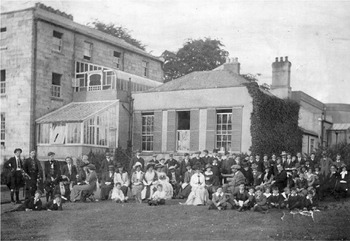
St Enda’s Park is situated on the foothills of the Dublin Mountains, in South County Dublin, approximately 6 km from the city centre. At the centre of the park is the Pearse Museum and visitor centre, which is a magnificent Georgian house. It was here that Irish educator and political figure Padraig Pearse (1879–1916) and his brother William set up Scoil Éanna in 1910, one of the most progressive and forward-looking schools for that period in Ireland (see Figure 2). Leading up to the 1916 Irish Rising, the school was used for many Republican meetings, and many of its staff were in the revolutionary army and were subsequently executed in 1916 for their part in the conflict. It is because of this and many other factsFootnote 3 associated with this park and surrounding area that Audiowalk – St Enda’s Park has such historical resonance and pathos for me.
Image of large crowd posing in front of the west side of Scoil Éanna at the Open Day c.1914.

When James Joyce was writing Ulysses, he wrote the small note that ‘places remember events’ (Orley Reference Orley, Andrews and Roberts2012: 1). I found this comment very powerful, that geographic places hold their own histories, resonating from the banal to the profound. I used this concept as the compositional springboard for the aural dramatisation of Padraig Pearse, who lived within the park and ran a school from 1910 to 1916. During this critical and tumultuous period of Irish history, Pearse wrote many works, which form the basis of the narrative component for this artistic intervention. Audiowalk could be considered as a site-specific sonic memorial, or a type of Lieu de Mémoire (Nora Reference Nora1989). Primarily, I am exploring concepts of nostalgia, memory, and mortality through site-specific aural events. As anthropologist Keith H. Basso (Reference Basso1996) suggests, places possess a marked capacity for ‘triggering’ self-reflection. Audiowalk creates an ‘inner-theatre’ that is achieved through intermedial and chorographic (not choreographic) principles that rely primarily on improvisational decision-making for its theatrical signification. If we consider the park itself as the mise en scène, and the participant as the actor or improviser, they are then experiencing embodiment within a site-determined performative installation. As Siddall and Waterman contend ‘improvisation is ineluctably embodied; its creative and political force is manifested through sounds and gestures that are the traces of experience at once relational and contextual’ (Siddall and Waterman Reference Siddall and Waterman2016: 4).
I consider Audiowalk as an intersubjective dialogue with the participant, their cultural history, and St Enda’s Park and its own sociopolitical history; these are conjoined in the immediacy of the experience. There is a reciprocal exchange between the participant and their environment. Lucy Lippard (Reference Lippard1997) emphasises this point further, noting that there is an emotional intervention when engaging with a soundscape as an ‘improvisational’ act, and she goes on to suggest that ‘space combined with memory defines place’ (1997: 9). Similarly, Miwon Kwon (Reference Kwon2004) expresses the opinion that improvised spatiality is based around ‘memory and knowledge’ and the conceptual idea of a ‘lived space’.
This project invites spatial participation and movement. It cannot be experienced through passive reception; any meaning is derived from the participant/performer’s constructive bodily engagement within the park. There is an element of creative spontaneity as they respond and react to the audio playback; there are no mistakes, only moments of re-creation and discovery. The improvisational process within this project, I believe, is not a random output of aleatoric sonic events, but rather it is a dialogical relationship of possibilities within specific geographic constraints. The participant is now within the narrative, which is an emergent, co-evolutionary and improvised process; they simultaneously create and interpret the work as they interact with the recorded and real-time sound fields. Although I am the creator/designer of this work, I do not have absolute control: there is no score; there is no fixed performance; the outcome cannot be predicted or measured; it is a purely qualitative and subjective experience, based on spatial mobility and active listening.
4. SOUND AND WALKING
Michel de Certeau considers ‘spatiality’ as the basis for walking improvisation; he further claims the ‘act of walking is to the urban system what the speech act is to language’ (de Certeau Reference De Certeau2011: 93). Artist Andra McCartney (Reference McCartney2010: 1) proposes: ‘what happens if we think of listening to the sound environment as an improvisational activity rather than as a composition? Does this not make more sense since the sound environment is never a fixed entity, never completely scoreable?’ Using McCartney’s definition as a starting point, Audiowalk attempts to develop a framework to guide improvised listening within a site-determined environment. I am interested in creating new forms of media-enhanced participation that question and problematise the hierarchical roles of creator, audience and performer. This work is not only interactive and improvisational but also co-creational, in that it is the participant who is responsible for their aesthetic experience. Granted, I have provided the sonic materials, but I have no control over how the individual will experience these sonic events, as they are triggered solely by their movement and position within the park; thus the individual is free to create and improvise their own perceptual experience. Peter Cusack suggests that ‘free improvisation would be a more accurate musical analogy for soundwalk composition if one is actually needed’ (Cusack Reference Cusack2000: 8). Many factors will affect the improvised experience of Audiowalk, such as weather conditions, temperature, and time of day. I see these conditions as unforeseen elements within the ‘composition’ that add to the complexity and uncertainty of the overall experience. They offer the participant discursive opportunities in the present moment that will generate new and ‘free’ performative outcomes.
I believe that active listening while walking allows one to become a more perceptive being, as it integrates complex perceptual layers of agency as we move through the environment. The ‘mundane’ practice of walking has been investigated extensively as a methodological and qualitative exercise (Castells Reference Castells2000; Paquette and McCartney Reference Paquette and McCartney2012; Lewis and Piekut Reference Lewis and Piekut2016; Springgay and Truman Reference Springgay and Truman2018; O’Neill Reference O’Neill2019). The lived experience that is perception and meaning-making is constructed through spatiotemporal encounters of relational positionality; walking could therefore be considered as an interactive aesthetic experience. Henry David Thoreau (Reference Thoreau1862) claimed that the ‘art of walking’ connects us perceptually and sensorially to a place and thus heightens our sense of the spiritual. He claimed that through walking the individual could ‘distil’ the topology of place within their consciousness. Thoreau also investigated ambient sound in terms of acoustic ecology, where he developed his relational ontological epistemology theory (Titon Reference Titon2015). Expanding on Thoreau’s theories, Steven Feld contends that walking has the potential to cultivate new sonic aesthetic experiences concerning ‘perceptual and sensory place-making’ through a type of social listening (Feld Reference Feld2012).
5. EMBODIED IMMERSIVITY
As this project should be considered as an embodied somatic artwork, the concept of immersivity will be briefly discussed here. Maurice Merleau-Ponty commented that perception is not merely a question of a singular sense of ‘vision’ but also involves the whole body, all senses. He goes on to state ‘I do not see [space] according to its exterior envelope; I live it from the inside; I am immersed in it’ (Merleau-Ponty Reference Merleau-Ponty, Edie and Cobb1964: 178). Embodied immersivity should be considered in terms of sensorial relations between participant and their environment. Audiowalk emphasises this relationship as it integrates the participant within the space co-extensively through corporeal and physical emplacement. Another view of immersivity comes from Turner Prize-winner Mark Leckey; he remarks ‘I don’t want to look at things, I want to be in them’ (Leckey cited in Charlesworth Reference Charlesworth2014). Interestingly, Christoph Cox observes that ‘lacking earlids, we are forever and inescapably bathed in sound, immersed in it in a way that we are not immersed in a world of visible objects’ (Cox Reference Cox2011: 150). Essentially, we experience sound as an embodied immersive event, and this can also encompass a type of kinaesthetic perception. Nick Kaye (Reference Kaye2000) posits that in terms of physical ‘site-specificity’, there are phenomenological interests that are ‘emotional’, ‘remembered’ and also ‘embodied’.
Philosopher John Dewey illustrates this concept of immersion and spatial activation; he maintained that we can only develop as human beings if we interact and immerse ourselves within our environment – a heightened vitality that comes from the ‘interpenetration’ of the self and the ‘world of objects and events’ (Reference Dewey1934: 18). Dewey’s concept of interpenetration can be seen in the work of Fluxus artist Alan Kaprow. The Latin term ‘Fluxus’ translates directly as ‘flow’; Kaprow defined his art as ‘environments’ or ‘happenings’, in that the audience is free to improvise around and through the work, and may in some cases interact with and ‘change the meaning of the work’ (Kaprow 1993). Importantly, and pertinent to my concept of Audiowalk, Kaprow claims he was not creating work to be ‘looked at’ but something to be played in, participated in by the audience who is also the co-creator and improviser; ‘ultimately the success of the work was no longer in the hands of just the artist’ (Kaprow 1993: 11).
Perhaps then, improvisational listening can engender and articulate a new dialogic relationship with an ‘embodied’ space. Rebecca Caines suggests that one of the most fundamental and fluid ways we experience phenomenological embodied spatiality is through sound (Caines Reference Caines, Siddall and Waterman2016). Auditory phenomenology reveals how aural awareness is not a passive state but is activated by the individual, as they engage in listening and embodying the perceptive sound field. This phenomenological auditory event emphasises ‘the richness of primary experience’ (Ihde Reference Ihde1976: 13). We may therefore conclude that walking methodologies privilege an embodied way to experience the immediate environment through emotional and relational behaviour.
6. FLOW
Mihaly Csikszentmihalyi (Reference Csikszentmihalyi2008) claims that when an individual is improvising they are experiencing a ‘flow’ state, which is a mental and physical state of utmost relaxation, focus and concentration, known to be conducive to creative thinking. Manuel Castells considers an urbanscape as a space of ‘flows’ (Castells Reference Castells2000). Viewed in this light, we can propose Audiowalk as a sonic mediation, an improvised discourse between memory and site, situated in the temporal ‘flow’ of the everyday. Improvisational listening within this project considers a recontextualisation of the soundscape–participant relationship. It emphasises an intermedial collaboration between person and place and, importantly, encourages improvisational decisions to create the work. Accordingly, the work is a departure from the environmental and acoustic ecological concerns of the traditional soundwalk. As such, I consider Audiowalk closer in some ways to the concept of installation art, which the audience physically enters, and which is often described as theatrical, immersive and experiential (Bishop Reference Bishop2005: 6). Niamh Ann Kelly also proposes, first and foremost, that the viewer is ‘not a passive spectator’ but an active agent in how the work ‘(re)defines place’ (Kelly Reference Kelly2010: 8). My point of departure from both Bishop’s and Kelly’s definitions of installation art is that I incorporate a form of participant improvisation within this work which in turn will impact the experiential outcome. Improvisation allows the participant to compose a performance that fits and enhances the moment and situation in which it takes place; ultimately it serves as a vehicle for the uniqueness of expression. How the participant navigates this interplay within these soundscapes is prioritised by both the directional and the relational aspects of the auditory events that are constantly reconfigured and adapted as they move through the park. Essentially this aural phenomenology constructs and affords a type of novel auditive agency for the participant.
7. PROCEDURAL DESIGN
Marshall McLuhan claimed that all technologies are an extension of the human body. He goes on to suggest that ‘information systems are live environments in the full organic sense. They alter our feelings and sensibilities’ (McLuhan and Fiore Reference McLuhan and Fiore2001). McLuhan’s enlightened concept is pertinent in understanding my technologically mediated work. Essentially, Audiowalk could not exist without the technologies of both GPS and the modern smartphone, with its ability to use map coordinates, to connect to Wi-Fi/4G networks and to play back audio through ‘Hertzian Space’ (Sant Reference Sant2006). The audio is streamed live from an internet hosting service, which uses the application Echoes XYZ to encode and replay the content. Once the software is installed, the participant enters the park, and the audio will instantly start to play. Each audio element has a specific GPS trigger point, as well as a command operator attached to it, such as loop, play once, complete to end, fade in/fadeout. By mixing and combining these commands it was possible to create a sophisticated procedural sound design that is both reactive and generative with regard to the participant’s precise location and movement within the park. As mentioned previously, there is no prescribed route through the park so the playback sequencing is undetermined and dependent upon the participant’s choice of direction, which will determine the sound event and its subsequent playback operator.
The recorded soundscape includes location and field recordings taken within St Enda’s Park; these were spatially recorded using the binaural microphone 3Dio and a handheld Zoom recorder. These field recording elements underscore the narrative and dramatisation of Padraig Pearse’s prose and poetic writing, which was recorded with a professional voice actor and presented monaurally. Not only do these illustrated prose pieces set the stage and mood of the work but they also describe the park at the turn of the twentieth century. I intended to establish a sense of history and place with these recorded elements, in what Salomé Voegelin terms as sonic memory material (Voegelin Reference Voegelin2006). I achieved this by ‘plundering’ elements from older media, and mainly (re)appropriating them into the sound design. I processed a very old recording ‘Somewhere a Voice Is Calling’, performed by Irish tenor John McCormack (Reference McCormack1914). This recording contextualised and emphasised the tension and ‘appeal to which memory responds’ (Bergson Reference Bergson1896: 153).
Many of the GPS trigger points contain recordings from Padraig Pearse’s diaries and his prose pieces, including Mise Éire, Fornocht do Chonac, The Rebel and Renunciation. I recorded pupils of the local secondary school Gaelcholáiste An Phiarsaigh performing notable Irish folk songs, including ‘Óró, sé do Bheatha Bhaile’, ‘Éist a Stór’, ‘An Drúcht Geal Ceo’ and ‘Siúil a Rún’. I also recorded the pupils reading Pearse’s Poems The Wayfarer, The Mother and Labhair an Teanga.
As stated earlier, St Enda’s Park was originally the site of a school from 1910 to 1916, and hearing children recite and sing the work of Pearse served well in establishing this historical relationship throughout the work. Compositionally, I incorporated techniques such as repetition and layering in the sound design approach. I also applied the audio processing techniques of convolution cross-synthesis and time-based effects, such as granular synthesis. For example if the participant enters into a specific GPS trigger point, the audio will start to fade-in a processed string-sound; this will then be followed by the dramatised Pearse poem monologue, which would then culminate with the children singing one of the traditional Irish songs. But it must be stressed here that these sound cues can occur in a different sequence as they are dependent upon the position of the participant within the park, which in turn will determine the experienced narrative of the work.
For me, a successful (designed) soundscape is a confluence of carefully shaped and chosen material in a given space and time; through a process of recollection and association, we can also incorporate repertoires of real and imagined sounds. These can be acted upon and improvised with, in what philosopher Jean-François Augoyard termed as ‘phonomnesis’, which is the capacity to imagine a sound or remember it without necessarily hearing it (Augoyard Reference Augoyard2006). So, by leaving gaps in the audio playback this principle can be utilised to great effect.
I also implemented interactive and procedural sound design strategies usually found in gaming audio design. These included layering and nesting of the locative positions of the GPS audio triggers, which, depending on the coordinate direction the participant entered from, will impact the audio playback order and subsequent operator process.
By combining both the recorded sound from the playback track and the natural occurring ambience, the participant experiences a third sound field: a liminal improvised sonic world. This enhances the perceived fusion between both the recorded and the real-time sound fields. These various sonic events, both spatial and temporal, form an ever-changing and complex perceptual environment that is not homogenous, absolute or linear, but could be typi cally described within the definition of the Deleuzean Rhizome. Deleuze stated that a Rhizome will have arbitrary complexity, structured in a non-causal manner, and can destabilise through moments of uncertainty and change (Deleuze Reference Deleuze1976). Audiowalk was created using this non-hierarchical concept: it has no prescribed entry and exit points, or compositional chronological ordering, but rather should be viewed as a nomadic system with no beginning or end that is in flux.
8. CONCLUSION
Listening connects us to the world outside our bodies; through sound vibrations that are continually encompassing us, bathing us in their physical and sensual effects, sound can focus our awareness and heighten our sensitivity to the environment. Improvisation, on the other hand, enables us to review the terms in which we listen and act. It does not privilege the creative artefact over the creative process. For this reason, I believe that improvisation should always be considered as a practice concerned with the present, attempting to sustain an intense moment of experience.
Henri Lefebvre claimed that walking through any space is the outcome of a process, with ‘many aspects and many contributing currents’ (Lefebvre Reference Lefebvre and Nicholson-Smith1974: 110). A sonically articulated space can enhance our field of experience independently of sight; it can offer us new experiential affordances that are in constant flux. It can also be a physical, conceptual and metaphorical medium, as it is both an activator of space and a transformative agent. With this in mind, my intention with Audiowalk is that the participant becomes the performer and improvisation becomes a means to engage with active listening and real-time decision-making within the field of sonic experimentation. As such, the participant/performer becomes an actor/body within the perceived narrative and is continually improvising new outcomes within this audial frame.
At its core, improvisation is a spontaneous act fuelled by energies of inspiration and invention. It can be a social activity that is not predetermined or scripted, thus enhancing interpersonal communication in terms of sociopolitical engagement. As a real-time artistic practice, improvisation encompasses creative decision-making, collaboration and exploration. As Audiowalk is usually experienced individually through headphones, this can limit this interpersonal and social experience but the improvisational and exploratory aspects are still present.
Audiowalk then forms a dialectic connection between the subjective walking experience and the practice of mindful and active listening. As the participant is engaged in the activity of walking, they create complex layers of agency through their movement within the environment. Thus their phenomenological experience is continuously being renegotiated, which in turn opens up new relational possibilities between bodily movement and place; this movement I believe becomes more confident over time as they create their own sonic narrative within the boundaries of the park.
Considered in this light then, Audiowalk participants are not bound by any compositional rule, but rather it is how they react to both the naturally occurring and the recorded sound fields that will ultimately create the experience. The work aims to address concepts of improvisation, agency and the role of the participant/performer within a sonic installation. I consider the participant as co-creator of the work, in that they bring their own physical, psychological and cultural story to the experience in an embodied manner, which distinguishes it from the passive listening experience in a concert hall. Within Audiowalk, the participant has the ability to compose a manifold real-time experience through the improvised spatial choices they make, which in turn can transform the nexus between content, personal experience and spatiotemporal location. Without declaiming improvisation as singularly responsible for the overall experience, it is at the heart of this site-specific and inter-textual work. We cannot escape from our past, from our own personal history and culture, but I suggest that improvisation is a means of narrating and conflating the past through an embodied somatic filter of the present.