
Introduction
Reduction and oxidation of hydrated metal cations in aqueous solution are the archetype of half-cell reactions, and redox processes involving two metal species in aqueous solution (and in bulk) are arguably the most prominent examples of cell reactions in electrochemistry. Metal–ligand interactions, like the ones occurring between the central ion and the solvation shell in aqueous metal salt solutions, have been and still are a very active area of research.[Reference Galstyan and Knapp1–Reference Varma and Rempe5] Especially coordinated transition metals (TMs) play a major role in numerous applications, such as catalysis or energy materials.[Reference Leenders, Gramage-Doria, de Bruin and Reek6–Reference Jiang, Klyukin and Alexandrov8]
Recent investigations shed light on the charge density distribution in TM compounds, revealing a surprisingly stable charge remainder localized on the metal cations, enabled by increasing TM d orbital contributions to the frontier orbitals with an increasing formal oxidation state (FOS) of the metal.[Reference Raebiger, Lany and Zunger9, Reference Wolczanski10] We have argued in a previous work that the FOS formalism based on electron counting[Reference Karen11–Reference Karen, McArdle and Takats13] falls short of the description of actual charge density distributions in real compounds and that the mechanistic understanding of redox processes in applications should consider actual charge distributions and fluxes.[Reference Koch and Manzhos14, Reference Koch and Manzhos15]
The understanding of charge self-regulation in solid TM complexes which leads to remarkably stable charges (i.e., actual oxidation states) on the metal center which are far from those implied by the FOS is helped by the fact that short-range charge transfer need not be quantized. Redox reactions in solutions involve long-range charge transfer which is quantized. This, however, does not exclude the charge self-regulation which must in this case operate between the metal center and the solvation shell.
In this work, we investigate the charge states of TMs in metal aquo complexes, using the quantum theory of atoms in molecules (QTAIM), an established approach to describe charge density distributions in molecular and periodic systems.[Reference Bader16] We have shown in Ref. [Reference Koch and Manzhos14] that QTAIM reliably accounts for charge states of atoms. We address the question whether TMs in aqueous solution show a similar charge self-regulation as in the solid state and quantify the charge transfer from water ligands to metal beyond the commonly used orbital-based picture.[Reference Griffith and Orgel17] The main objective is to rationalize TM–ligand bonding, complex stability, dissociation, and redox reactions of metal ions in aqueous solutions based on charge density distributions only. We argue that this point of view allows for a more intuitive understanding of the above processes based on a simple ligand ionization-by-dative bond picture, and simultaneously allows for a more quantitative electronic structure approach to explain the occurrence of certain TM complexes in aqueous solution and the instability of others.
We focus on TMs which have more than one stable oxidation state in aqueous solution to analyze the charge state progression for different FOSs on the same metal center in the existing metal aquo complexes. We begin with a comparison of the charge density distributions in [V(H2O)6]n+, [Cr(H2O)6]n+, [Mn(H2O)6]n+, and [Fe(H2O)6]n+ complexes, placed in a polarizable continuum model of the water solvent, and their changes upon variation of n. We then proceed to relate the occurring partial H2O ionization to the decreasing O–H bond strength in the water ligands and its effect on aquo complex stabilities. Thereafter follows a discussion of the same effects in non-TM complexes and the influence of factors beyond ionization on ligand stability. All the following results were obtained from unrestricted density functional theory (DFT) calculations employing the PBE0 functional, the cc-pVTZ basis set, and a polarizable continuum model. Atomic charges were obtained from a grid-based Bader charge analysis; the full computational details and supporting methodology tests are provided in the Supplementary Material.
Stabilization of TM ions by charge transfer from the solvation shell
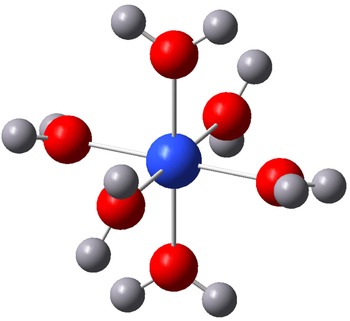
The hexaaqua complexes of V, Mn, Fe, and Cr were computed with different complex charges, where n of [M(H2O)6]n+ was ranging from 1 to 5 in the case of V and Fe, 1 to 6 for Cr, and 1 to 7 for Mn. A charge state up to +8|e| would have been formally possible for Fe, but no stable octahedrally (ligand oxygens) coordinated Fe(VI), Fe(VII), or Fe(VIII) complexes could be found with water ligands, the same is true for the aqueous Mn(VI) complex, which will be omitted in the following discussion as well. A general structure schematic of the investigated complexes is shown in Fig. 1. The metal center is coordinated by the six water oxygen atoms in an octahedral or a distorted octahedral coordination polyhedron, with the ligand hydrogen atoms pointing away from the metal center. Depending on the complex, the ligand hydrogen atoms can appear to be rotated around O–M–O axes or away from it.
Schematic representation of the investigated [M(H2O)6]n+ complexes (with M = V, Mn, Fe, and Cr). The metal center is represented by a blue, the oxygen atoms by red, and the hydrogen atoms by gray spheres. The metal center is coordinated by the ligand oxygens in a (distorted) octahedron, the hydrogen atoms are pointing away from the metal center.

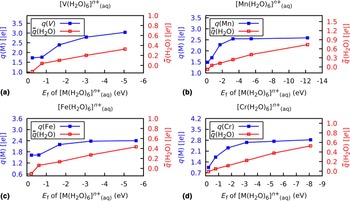
The lowest-energy spin states of these complexes, as obtained with this computational setup, were used in each case. These are: 5V(I), 4V(II), 3V(III), 2V(IV), 1V(V); 7Mn(I), 6Mn(II), 5Mn(III), 4Mn(IV), 3Mn(V), 1Mn(VII); 6Fe(I), 5Fe(II), 6Fe(III), 5Fe(IV), 4Fe(V); and 6Cr(I), 5Cr(II), 4Cr(III), 3Cr(IV), 2Cr(V), 1Cr(VI). The formation energies of the stable complexes were calculated against the corresponding ground-state metal cation in vacuum[Reference Kramida, Ralchenko and Reader18] and solvated water molecules. A more detailed description is given in the Supplementary Material. The formation energies of all investigated complexes were found to be negative and steadily decreasing (increasing in magnitude) with increasing complex charge state. The intuitive explanation for this trend would be a stabilization of the metal ion by charge density donation from the water ligands, which becomes more favorable when the charge on the cation is large, i.e., the stronger the central electrostatic field becomes due to diminished shielding at the metal center. In Fig. 2, the Bader charges on the metal centers are plotted against the complex formation energies (which are proportional to complex charge states).
Bader charges on the metal center q(M) (blue, filled squares) and average Bader charge on the water ligands  $\bar q$(H2O) (red, empty squares) in [M(H2O)6]n+ complexes with M = V (a), Mn (b), Fe (c), and Cr (d) versus the formation energy E f of the corresponding complex. The FOS of the metal center is increasing from left to right (with increasing formation energy) and spans from +I (all cases) to +V (V and Fe), +VI (Cr), and +VII (Mn).

In accordance with the previously mentioned results, the TM charge converges quickly and shows furthermore significant deviations from the overall charge state of the cationic complex. Observable, stable complexes of the investigated TMs have charge states of +2 and +3|e|.[Reference Cotton, Fair, Lewis, Mott, Ross, Schultz and Williams19–Reference Sham, Hastings and Perlman21] The Bader charge analyses suggest that the charge state of the TM center itself is slightly smaller in the case of M(II) complexes, with Bader charges between +1.6 and +1.8|e|, and significantly smaller in the case of M(III) complexes, with Bader charges between +2.2 and +2.4|e|. For none of the complexes does the metal Bader charge exceed +3.1|e|, indicating that especially for the hypothetical metal aquo complexes with high charges, the donation of electron density from the ligands would be expected to be of importance. For V(I), Mn(I), Fe(I), and Cr(I) complexes, the TM charge state is furthermore higher than the overall complex charge, indicating an actual charge donation from the metal to the water ligands.
Since the TM charges are not increasing significantly as the overall complex charges are steadily increasing, the average charge of the water ligands is consequently growing as well. In Fig. 2, the progression of the average H2O ligand Bader charge is plotted against the complex formation energy. As can be seen, for positive H2O charges, the ligand charge versus formation energy curve follows a nearly linear trend line. The slopes of these linear portions for positive ligand charges range between −0.063|e|/eV (Mn) and −0.079|e|/eV (Fe). In other words, the resilience of TM ions to ionization causes a steady, stabilizing charge flow from the water ligands in aqueous complexes as their overall charge is increasing, as can be seen from the linear increase of the magnitude of complex formation energy with increasing H2O ionization. In the investigated cases, the complex ions get stabilized between 12 and 16 eV per electron transferred from ligand to metal. The data points for V(I), Mn(I), Fe(I), and Cr(I) in Figs. 2(a) and 2(d) might seem like outliers, but they do not follow the same trend line as the other points due to the fact that the water ligands in these complexes are partially anionic and the charge acceptance–stabilization curve would presumably have a different slope than the charge donation–stabilization one.
These results have interesting implications for the mechanistic understanding of redox reactions between TMs in aqueous media. From a strict charge-density point of view, the half-cell reactions from M(III) to M(II) species of above TMs would read as:
 $$\lsqb {\hbox{V}^{2.39 +} {\lcub {{\lpar {\hbox{H}_{\rm 2}\hbox{O}} \rpar }_6} \rcub }^{0.61 +}} \rsqb + 1{\rm} \hbox{e}^ - \to {\rm} \lsqb {\hbox{V}^{1.76 +} {\lcub {{\lpar {\hbox{H}_{\rm 2}\hbox{O}} \rpar }_6} \rcub }^{0.24 +}} \rsqb $$
 $$\lsqb {\hbox{M}\hbox{n}^{2.28 +} {\lcub {{\lpar {\hbox{H}_{\rm 2}\hbox{O}} \rpar }_6} \rcub }^{0.72 +}} \rsqb + 1{\rm} \hbox{e}^ - \to {\rm} \lsqb {\hbox{M}\hbox{n}^{1.69 +} {\lcub {{\lpar {\hbox{H}_{\rm 2}\hbox{O}} \rpar }_6} \rcub }^{0.31 +}} \rsqb $$
 $$\lsqb {\hbox{F}\hbox{e}^{2.20 +} {\lcub {{\lpar {\hbox{H}_{\rm 2}\hbox{O}} \rpar }_6} \rcub }^{0.80 +}} \rsqb + 1{\rm} \hbox{e}^ - \to {\rm} \lsqb {\hbox{F}\hbox{e}^{1.64 +} {\lcub {{\lpar {\hbox{H}_{\rm 2}\hbox{O}} \rpar }_6} \rcub }^{0.36 +}} \rsqb $$
 $$\lsqb {\hbox{C}\hbox{r}^{2.31 +} {\lcub {{\lpar {\hbox{H}_{\rm 2}\hbox{O}} \rpar }_6} \rcub }^{0.69 +}} \rsqb + 1{\rm} \hbox{e}^ - \to {\rm} \lsqb {\hbox{C}\hbox{r}^{1.71 +} {\lcub {{\lpar {\hbox{H}_{\rm 2}\hbox{O}} \rpar }_6} \rcub }^{0.29 +}} \rsqb $$
Therefore, in the prototypical reduction reactions above, just about 60% of the overall charge is actually transferred to the vicinity of the TM nucleus, while the remaining charge is distributed over the water ligands. This is in accordance with our previous investigations of the magnitude of electron transfers during the lithiation of titanium dioxide.[Reference Koch, Golub and Manzhos22] The charge transfer to outer solvation shells was not taken into account, since only six water molecules were treated explicitly. The above metal complexes occur in a high-spin configuration in aqueous solutions, and besides the complex charges, also the complex magnetization is found to be partially delocalized on the water ligands. This is more pronounced the higher the multiplicity of the complex, e.g., the maximum magnetic moment carried by the six water ligands is found to be 0.58μ B in [Fe(H2O)6]3+, whereas the Fe center carries a spin of 4.42μ B. A table with spin distributions for all of the above M(II) and M(III) complexes can be found in the Supplementary Material.
Decreasing aquo ligand stability by ionization
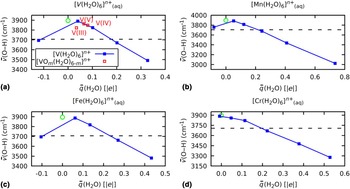
As mentioned above, only a few of the investigated hexaaqua TM complexes can be experimentally observed. Complexes with high TM FOSs generally do not occur, as high-FOS metal ions tend to form metalates, e.g., ferrate(VI), permanganate(VII), or chromate(VI) anions. A rather exotic case is the higher oxidation state ions of vanadium in aqueous solution, the oxycations [VO(H2O)5]2+ and [VO2(H2O)4]+.[Reference Bertrand, Stapleton, Wulff and Hepler23] The formation of the latter is normally attributed to the formation of strong V–O π bonds,[Reference Ballhausen and Gray24] favoring the formation of oxycations rather than hexaaqua complexes. Taking into account the above discussion of water ligand ionization at higher complex charges, the question arises whether the formation of these oxycations, or transition metalates in general, can also be rationalized in a charge-density based picture instead of the orbital-based one. The natural assumption would be that an increasing H2O ligand charge might destabilize the O–H bonds to an extent that dissociation becomes preferable. To judge the plausibility of this mechanism, the average O–H stretch frequencies of the water ligands in the previously introduced complexes are plotted against the average H2O Bader charges as shown in Fig. 3.
Average O–H stretch frequencies  $\bar \nu $(O–H) of different [M(H2O)6]n+ complexes with M = V (a), Mn (b), Fe (c), and Cr (d) versus the average Bader charges of the respective H2O ligands
 $\bar q$(H2O) (blue line, filled squares). The FOS of the metal center is increasing from left to right (with increasing formation energy) and spans from +I (all cases) to +V (V and Fe), +VI (Cr), and +VII (Mn). The dashed horizontal black lines indicate the average O–H stretch frequency of the H3O+ cation. The green, empty circle indicates the average O–H stretch frequency in a single solvated H2O molecule. The average O–H stretch frequencies in the vanadyl cations [VO(H2O)5]+, [VO(H2O)5]2+, and [VO2(H2O)5]+ versus the respective average H2O charges are indicated by red filled squares (labels indicate FOS of vanadium at each point) in panel (a).

The average O–H stretch frequencies are calculated as mean frequencies of the corresponding symmetric and asymmetric O–H stretch modes in the complex cations. The oscillator masses of the considered modes have been found to deviate only on the order of 1% from the oscillator masses in a free water molecule (placed in a polarizable continuum), which is why the admixture of M–O modes is considered to be negligible. As can be seen from Fig. 3, the average O–H stretch frequency in all complexes is smaller than the average O–H stretch frequency in a single-solvated water molecule (indicated by an empty green circle in Fig. 3), and decreases with increasing ionization of the water ligands (in either way, negative or positive). With the average O–H stretch frequency, also the average O–H bond strength in the water ligand molecules is decreasing. In the case of hexaaqua vanadium complexes, the transformation to vanadyl(IV) or vanadyl(V) oxycations would occur by a dissociation of one or two water ligands, with the protons forming hydronium ions (H3O+) with surrounding water molecules. The average O–H stretch frequency of a hydronium ion placed in a polarizable continuum is indicated by dashed black lines in Fig. 3. It is evident that for hexaaqua M(IV), M(V), and M(VI) complexes, the average O–H stretch frequency would drop below that of H3O+ and at least a partial dissociation would lead to a stronger O–H bond for the dissociating H+ ion while simultaneously reducing the positive charge on the remaining ligands. For the vanadyl oxycations, this strengthening of the O–H bonds after dissociation of one or two ligands is found, as shown in Fig. 3(a). Empty red squares indicate the frequency-charge points for the [VO(H2O)5]+, [VO(H2O)5]2+, and [VO2(H2O)5]+ cations. As can be seen, the ligand Bader charges in these three complexes are significantly lower than in the corresponding hexaaqua V(III), V(IV), or V(V) cations. For the V(IV) and V(V) oxycations, also the O–H vibrational frequencies are higher than in the corresponding hexaaqua complex, while for the V(III) complexes, the hexaaqua complex has stronger O–H bonds, as it would be expected. These results suggest that the increasing charge on the water ligands in hexaaqua TM complexes with high metal FOSs leads to a destabilization of the ligands’ O–H bonds and makes their dissociation energetically favorable, leading to the formation of TM oxycations or transition metalates. It shall be noted at this point that the negative charges of the water ligands in the hexaaqua M(I) complexes also significantly destabilize the water ligands, but only for iron and vanadium their average O–H stretch frequency falls below that in H3O+. The fact that there are nevertheless no stable hexaaqua Cr(I) or Mn(I) complexes reported is probably due to the inadequacy of the H3O+ cation as reference state, since no metalate(I) is reported for these elements as well, and there might be another reaction channel an aqueous Cr(I) or Mn(I) ion would take, different from the transformations previously discussed.
Comparison to fully ionized non-TM ions and the role of factors other than ligand ionization
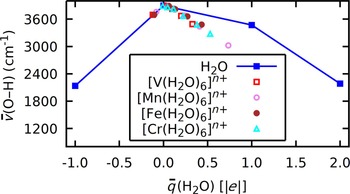
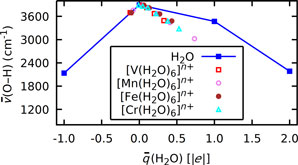
Up to this point, the O–H bond destabilization was only related to the ionization of the water ligands in hexaaqua TM complexes, but as can be already seen in Fig. 3(a), not all points lie on one charge–frequency trend line. For the (hypothetical) [VO(H2O)5]+ complex, with only slightly ionized water ligands, the O–H stretch frequencies lie lower than it would be expected judged by the positions of all the data points of the hexaaqua vanadium complexes and the other vanadyl cations. This already suggests that further factors apart from ionization contribute to the destabilization of O–H ligand bonds. In Fig. 4 the ligand O–H stretch frequencies of the complexes reported above are compared to the average O–H stretch frequencies in a single H2O molecule placed in a polarizable continuum, and its molecular ions H2O−, H2O+, and H2O2+.
Average O–H stretch frequencies  $\bar \nu $(O–H) versus average Bader charges
 $\bar q$(H2O) of water ligands in the investigated TM complexes and in a single water molecule and its molecule ions (H2O−, H2O, H2O+, and H2O2+) placed in a polarizable continuum.

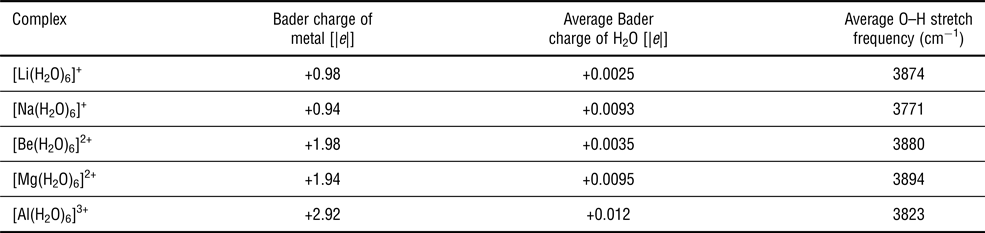
As can be seen in Fig. 4, the overall trends for the different types of H2O molecules are similar, weaker O–H bonds with increasing ionization, but there are significant quantitative differences between the free and ligand water molecules. The O–H bond strength of the TM ligands is decreasing more rapidly with increasing positive partial ionization than in their unbound counterpart. The trends among the TM ligand water molecules of different metal complexes on the other hand show also a good quantitative agreement. This suggests that the chemical environment of the water molecule under investigation influences the slope with which the bond strength decreases with the degree of ionization. A further excellent example of this is non-TM aquo complexes. In Table I, the Bader charges on the central ions and water ligands in [Li(H2O)6]+, [Na(H2O)6]+, [Be(H2O)6]2+, [Mg(H2O)6]2+, and [Al(H2O)6]3+ are listed along with the average O–H stretch frequencies in these complexes. First, it can be seen from Table I that the previously observed charge self-regulation of TM aquo complexes does not occur in non-TM–water complexes, or at least to a significantly smaller extent highlighting the critical role played by d states in self-regulation.[Reference Raebiger, Lany and Zunger9] The FOSs of the non-TMs Li, Na, Be, Mg, and Al do correspond to their Bader charges and the overall complex charge. Second, although the ionization of the water ligands is very small, the listed vibrational frequencies can deviate significantly. Therefore secondary factors, possibly steric effects or bond polarization, influence the extent to which ionization causes O–H bond weakening in hexaaqua metal complexes.
Bader charges on metals and water ligands in non-TM aquo complexes and the corresponding average O–H stretch frequencies.

Conclusion
In this work, we investigated the charge density distribution in charged hexaaqua TM complexes of V, Mn, Fe, and Cr, whose aqueous complexes are well studied and of practical relevance, using DFT and QTAIM. In accordance with previous investigations on bulk TM compounds, we find a remarkable stability of the TM charge state over a wide range of FOSs. This has implications for the fundamental mechanistic description of redox reactions involving aqueous (or generally solvated) metal ions, since electron transfers do, from a charge density point of view, not only occur to or from the metal center, but also to or from the surrounding water ligands, which act as a charge density reservoir to neutralize charge losses. We were furthermore able to relate the charge density transfer from the ligands to the metal center to a weakening of the O–H bonds in the aquo ligands. We argue that the occurrence of low-FOS hexaaqua ions in contrast to higher-FOS metalates and oxycations can be explained by the high degree of partial ionization that the aquo ligands would have to endure in highly charged complexes, and that aquo ligand dissociation may become more favorable due to the formation of relatively strong O–H bonds with surrounding H2O molecules, resulting in the formation of hydronium ions in the aqueous medium and M=O bonds in the complex. This strictly charge density-centered point of view is able to provide an alternative and arguably more intuitive mechanistic explanation for the formation of vanadyl cations in aqueous solution, fundamentally important species in the e.g., widely deployed vanadium redox-flow batteries,[Reference Alotto, Guarnieri and Moro25] which does not rely on orbitals, as well as for metalates in general.
Supplementary material
The supplementary material for this article can be found at https://doi.org/10.1557/mrc.2018.166
Acknowledgments
This work was supported by the Ministry of Education of Singapore (grant no. MOE2015-T2-1-011).