Ship Money was one of the most controversial schemes under the Personal Rule of Charles I. Against the background of the Thirty Years’ War, Charles I had decided to establish a standing fleet in 1628. In 1634, a committee of the Privy Council revived Ship Money, a medieval levy, that Elizabeth I had last successfully raised to cover the cost for a navy.Footnote 1 The Privy Council's writs claimed that England was threatened by foreign powers, and its trade and coastlines harassed by pirates. This crisis, it was argued, required the king to use his prerogative to ask his subjects for emergency funds in order to build a fleet. While many contemporaries questioned the government's claim that England was in imminent danger of war or even invasion, the Caroline Ship Money created controversy because it broke with precedent in four respects. First, the king asked for money to build a fleet and did not, as in the past, lease ships from coastal towns. Second, after a trial period in 1634 in which only coastal counties were charged, Ship Money was extended to all counties in 1635. In the past, only maritime places had paid for the naval defense of the realm. Third, unlike the traditional one-shot levy, Ship Money was raised year after year and seemed to turn into a permanent national tax that lacked any parliamentary approval. Fourth, with about £200,000 per annum (except for the 1638 levy, which was reduced because of the extra funding the counties were to bear for the war with Scotland), Ship Money was an unprecedented financial burden amounting to several subsidies. The constitutional objections to Ship Money were highlighted by the Long Parliament on 7 August 1641, when the levy was declared illegal on the grounds that it was “against the laws and statutes of the realm, the right of property, [and] the liberty of the subjects.”Footnote 2
Subsequently, Ship Money became one of the focal points for Whig historians arguing the case for a “Stuart Absolutism” and an “Eleven Years’ Tyranny.”Footnote 3 Local historians more recently have argued that the breakdown of the relationship between court and country was the main cause of the Civil War, and Ship Money was one factor among many that contributed to this alienation. Their county studies on local government in general and the collection of Ship Money in particular showed that the administration of this levy and the opposition it met was strongly influenced by local politics and went beyond the constitutional arguments suggested by Whig historians.Footnote 4 Some of these local surveys have come to the conclusion that the significance of political opposition was negligible, arguing that Ship Money ran into difficulties only after Hampden's case and the outbreak of the Scots’ War.Footnote 5 Others, however, have claimed that political objections were prevalent, but cleverly camouflaged, and that Ship Money put intolerable pressure on the machinery of local government.Footnote 6 An important unpublished doctoral thesis by Alison Gill provided the first nationwide analysis of Ship Money. Gill argued that, while there was no straightforward conflict between court and country, the crown's insistence on obedience frequently clashed with local tradition and hampered the smooth administration of the levy. Yet, despite identifying its political costs, Gill confirmed that Ship Money was a fiscal success and not seriously challenged before Hampden's case and that widespread dissatisfaction with the levy did not occur until its later years.Footnote 7 More recently, Kevin Sharpe has offered a much more revisionist view, not only rejecting the idea that Ship Money met extraordinary opposition but also suggesting that it was “one of the most successful taxes, indeed governmental enterprises, in early modern history.”Footnote 8 The collection of Ship Money, according to Sharpe, apparently proceeded smoothly, and some people objected to it only because they considered their personal assessment too high or disagreed with the proportion their locality had to raise. Above all, Ship Money was fiscally successful, as the Privy Council's accounts show that about ninety percent of each annual levy was collected.Footnote 9 The case on Ship Money seems now to be closed, and this final verdict has found its way into history textbooks.Footnote 10
While these different interpretations and approaches have enhanced our understanding of Ship Money, they leave a number of questions unanswered. Sharpe's insistence on the fiscal success of Ship Money, shown by the final tallies for each year, appears convincing, but his conclusions are at odds with the hostile response Ship Money met in the country. Local studies are not necessarily representative, and extrapolations from the success or failure of Ship Money in one county can be misleading. They also have tended to focus on the relationship between the sheriff and mayors as the chief officers in charge of the assessment and collection of Ship Money and the Privy Council in its supervisory role, rather than investigate the critical day-to-day enforcement of Ship Money and the administrative problems it caused. Gill studied Ship Money in order to show its role in demarcating the royal prerogative and exemplifying the perception of kingship during Charles I's Personal Rule. Despite extensive research of local sources and some attempts at quantifying the administration of Ship Money, Gill does not analyze chronological and geographical patterns of its administration and the variety of factors that led to the collapse of this levy. Her references suggest that she underestimates the early stage at which this levy collapsed. Above all, Gill's study does not investigate the role local officers played in its enforcement or the impact this levy had on the localities; and she comments that “it is often quite difficult to know how the service was routinely managed.”Footnote 11 This article aims to provide an answer to this question.
My first argument is based on an analysis of the payment of Ship Money and comes to the conclusion that its collection was, in fact, quite unimpressive. Second, I shall argue that Ship Money was a deeply unpopular tax and the difficulties in collecting it were mainly caused by a widespread reluctance to pay. While lack of equity and local assessment disputes were often valid arguments for nonpayment, political reservations provided the main justification of tax refusal. This observation will lead to my third and main argument that the ubiquitous opposition to Ship Money caused insubordination among local officers who declined to comply with their collection duties. As they were the key figures in the assessment and collection process, their refusal to enforce Ship Money caused its ultimate failure. Ship Money thus collapsed because the opposition of the people resulted in a breakdown of the local government agencies involved in its enforcement, most aptly described in the simple words of the sheriff of Sussex and Surrey in July 1636 “I finde all men & my officers all soe unwilling.”Footnote 12
As this article will focus on the interactions between central government, local coordinators, local collectors, and the taxpayers, the administrative procedures of this levy require some explanation. After deciding the annual sum to be levied on England and Wales, the Privy Council determined the figure payable by each county and corporate town. These sums were specified in the writs to the sheriffs and mayors, but there was room for modification. Within thirty days, the sheriffs were to meet with agents of the corporate towns in their county and the high constables of the hundreds to confirm or alter the borough rates and then establish the proportion for each hundred.Footnote 13 Once these had been established, the head officers of the towns and high constables summoned representatives of each ward or parish to further divide the rate within boroughs and hundreds. Parish officers finally set the contribution of each parishioner toward Ship Money. The assessment was completed once the sheriff had approved of the lists submitted by the parishes, hundreds, and boroughs. They then nominated collectors for each hundred, parish, and ward, although in most cases the collection automatically became the charge of the parish officers. Sheriffs were encouraged not to wait until the collection was complete but rather to send the money to Westminster in convenient batches. Stressing the immediate purpose of Ship Money, the recipient was not the Exchequer, but the treasurer of the navy. As with any other taxation, refusing ratepayers faced the likelihood of “distraint,” or being “distrained”; that is, their cattle or other valuables were impounded either by the professional bailiffs of the hundreds or the parish officers. If the owners did not redeem their cattle, the sheriff was authorized to sell it, deducting the amount due for Ship Money and restoring the surplus to the owner. Resisting distraint or concealing goods that could be distrained carried the threat of imprisonment. These procedures indicate that the sheriff's role as coordinator, accountant, and distant supervisor in the everyday enforcement of Ship Money was peripheral and that its key administrators were local assessors and collectors, particularly parish officers.Footnote 14
My findings are based on the comprehensive analysis of all the surviving papers documenting the administrative process of Ship Money. Of these nearly five thousand documents, the most relevant are the letters sent by the sheriffs to the Privy Council reporting on the progress of the levy. These often enclose the accounts of subordinate officers (high constables and parish officers) explaining the local context in greater detail. Countless personal or corporate petitions to the Privy Council provide the alternative perspective of the taxpayer, and, fortunately, the council's replies have survived in most cases. Specific instructions or admonitions from the Privy Council to the sheriffs, summonses of tax refusers and insubordinate officers, as well as the tallies by the treasurer of the navy complete the picture of Ship Money showing the workings of its architects and overseers and highlighting the levy's administrative complexity.Footnote 15
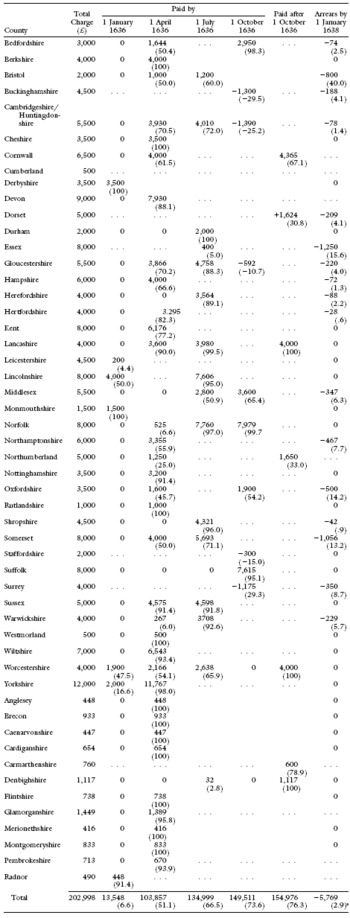
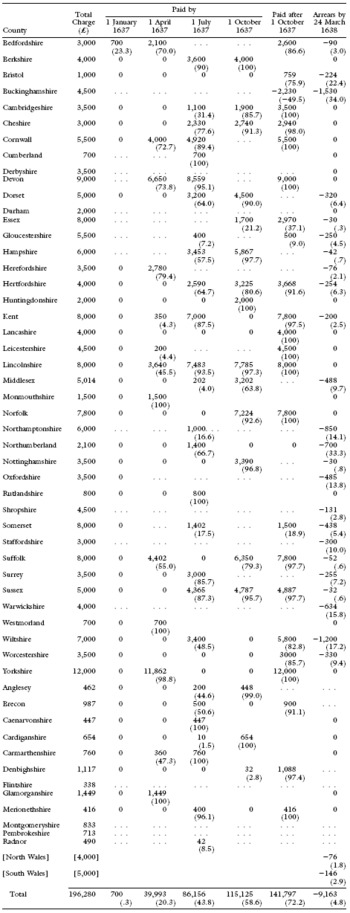
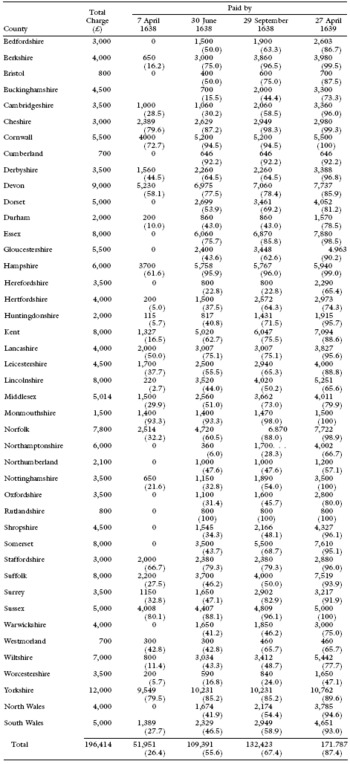
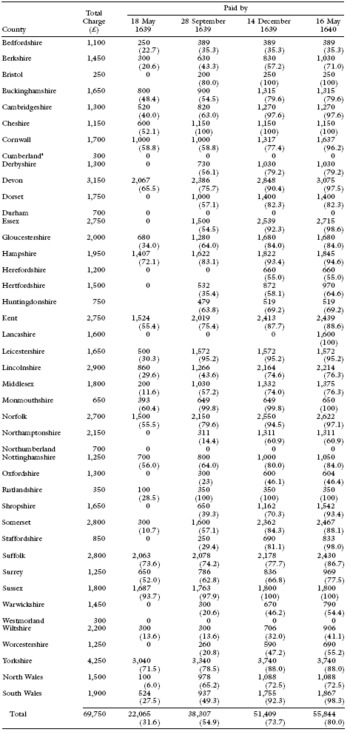
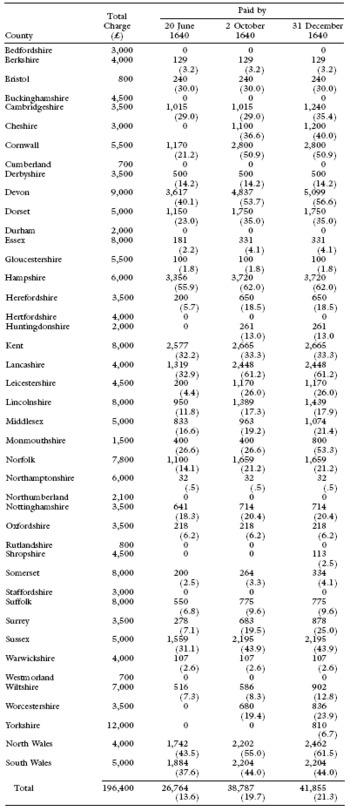
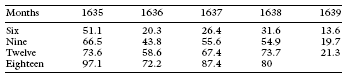
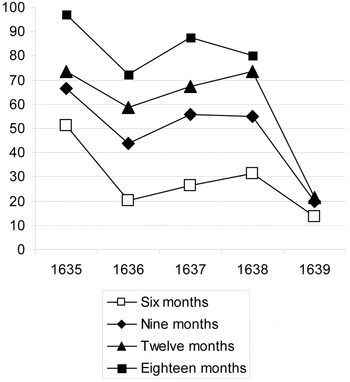
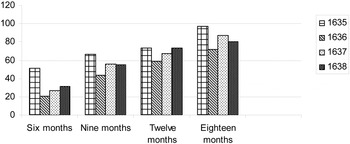
Historians who have claimed that Ship Money was a successful tax have focused on its fiscal record, arguing that it was nearly fully collected. A closer analysis of the payments across the country, however, shows that the final collection tallies are not necessarily useful parameters for measuring either the fiscal or the political success of this levy. First of all, the Privy Council expected payment of Ship Money to be completed three to four months after each assessment—and certainly by 1 April of the calendar year following the issuing of the writs.Footnote 16 In fact, the breakdown by county shows that even nine or twelve months after the writs had been sent to the sheriffs (a period that should be considered reasonable for any tax collection) substantial amounts had not been paid.Footnote 17 The totals used to show the fiscal success of Ship Money look impressive only in light of the fact that they are based on the final balances drawn up one and a half to two years after the writs had been sent out, thus allowing for a very generous period for collecting significant arrears. Second, the payment figures clearly show that the collection of Ship Money markedly slowed down between 1635 and 1640.Footnote 18 Within the six-, nine-, twelve-, and eighteen-month intervals much less money was collected in 1636 than in 1635. Admittedly, payment under the 1637 writ improved over that of 1636, but, in terms of pace and extent of collection, the collection figures by no means matched those of the 1635 writ. The relatively speedy collection under the 1638 writ (after six and twelve months only) must be attributed to the significantly reduced amount the Privy Council demanded that year. The collection under the 1639 writ never even took off. No collection between 1636 and 1639 ever surpassed the initial pace under the 1635 writ, and this relative success of the 1635 Ship Money suggests that people were prepared to pay a one-off levy, while the dramatic drop of payments under the 1636 writ reflects the nation's dismay that Ship Money had seemingly turned into a permanent tax. The steady decline of Ship Money payment over the years is illustrated by the number of counties reporting full payment. While the 1635 Ship Money was completed by nineteen out of the forty English counties after eighteen months, the 1636 Ship Money was fully paid by only seventeen counties in the same period. The two subsequent levies were completely collected after eighteen months in five and six counties, respectively, and the final Ship Money of 1639/40 was not fully paid by a single county.Footnote 19 The collection patterns of two arbitrary examples, Bedfordshire and Herefordshire, highlight this trend. In Bedfordshire, the 1635 Ship Money was collected within twelve months, but in 1636/7 it took fourteen months to collect 86.6 percent, and in 1637/8 eighteen months to collect 86.7 percent. In 1638/9, the mark never exceeded 35 percent, and in 1639/40 not a single pound was collected. In 1635/6, it took the sheriff of Herefordshire six months to collect 82 percent, but fourteen months went by in 1636/7 to gather 91 percent. In 1637/8 eighteen months elapsed to collect 74 percent, and in 1638/9 within the same period only 64 percent had been paid.
Finally, the data show that aggregate national figures conceal significant local variations in the payment of Ship Money. Some counties, such as Cheshire, Cornwall, Hampshire, Monmouthshire, Norfolk, and Sussex, were relatively good payers and collected about 90 percent by the end of the twelve- or eighteen-month period. Coastal counties were generally more forward in their payment than inland counties, although Devon, Dorset, Essex, Kent, Suffolk, and Yorkshire were slower in collecting than Cornwall, Hampshire, Norfolk, and Sussex. This suggests not only that coastal counties saw the value of a strong naval defense but also that inland counties objected to the unprecedented extension of Ship Money out of principle rather than for fiscal reasons. Some counties, such as Cornwall, Essex, Hampshire, Lancashire, and Yorkshire, performed badly only under the last writ of 1639 against the background of the Scots’ Wars. Elsewhere, the collapse of Ship Money started with the 1638 writ, coinciding with Hampden's case, as in Berkshire and Surrey, where payment after twelve months was significantly lower than in previous years. Yet, most historians have underestimated the difficulties Ship Money met across the country before 1638. In Derbyshire, Dorset, Herefordshire, Hertfordshire, Leicestershire, Shropshire, Warwickshire, and Worcestershire, for example, it already took considerably longer to collect smaller percentages under the 1637 writ.Footnote 20 In Wiltshire and Gloucestershire, Ship Money collection deteriorated dramatically even under the 1636 writ. In fact, in most parts of the country Ship Money proved difficult to collect from the very beginning. In Middlesex, after each twelve-month period, only 50–70 percent was paid, in Oxfordshire barely more than half the sum, and in Buckinghamshire even less, except for the 1638 Ship Money. After eighteen months, Northamptonshire was usually in arrears between 15 percent and 40 percent. Somerset and Worcestershire were notoriously slow payers as well.
The balance sheets not only show the fiscal shortcomings of Ship Money but suggest that the cause of incomplete and declining payments lay in an increasing resistance to the levy across the country. This resistance has been carefully documented in the sheriffs’ returns to the Privy Council. Again, it is remarkable that most counties were affected by widespread and serious opposition to Ship Money not only under the 1638 writ but also under the 1637 writ, which had been issued before Hampden's case. In July 1638, for example, Sheriff Russell of Cambridgeshire admitted that “little or noe monies can be gotten but by … forcible meanes.”Footnote 21 Sheriff Coningsby of Hertfordshire stated the arrears of each hundred, which in some parishes exceeded the 30 percent mark. The first critical report from Huntingdonshire arrived in May 1638 complaining of the county's “averseness.” Yet, in many counties, sheriffs were forced as early as the 1636 writ to use extensive coercive means to overcome resistance. In February 1637, for instance, Sheriff Skipwith of Leicestershire certified “soe manye complayners & opposers” and accused “some Puritanes that are soe neere to Northamptonshire” of stirring civil disobedience.Footnote 22 The same month, Sheriff Littleton of Staffordshire stated that he had been “very rough” with many but had only collected a quarter and that “weare I to suffer death for my neglect I weare not able to doe more.”Footnote 23 In March, Sheriff Harrington of Rutland frankly wrote that “the trouble I have been put to has been such that were it not the king's command no profit or reward could draw me to adventure upon the like business again.”Footnote 24 Even more remarkably, however, Ship Money was opposed in a very large number of counties right from its beginning in 1635. In early 1636, reports from Bedfordshire, Devon, Dorset, Essex, Gloucestershire, Hampshire, Herefordshire, Kent, Northamptonshire, Oxfordshire, Shropshire, Suffolk, Surrey, Warwickshire, Wiltshire, and Worcestershire described resistance considered significant enough that it was necessary to inform the Privy Council. In April 1636, Sheriff Trenchard of Dorset sent a list of more than 260 refusers to the Privy Council, responsible for arrears under the 1634 writ, amounting to £991 18s. 6 1/4d.Footnote 25 In February 1636, Sheriff Wentworth of Oxfordshire referred to “strong opposition” and his “excessive troble.”Footnote 26 In June, Sheriff Verney of Warwickshire implored the Privy Council's support to deal with the “resistance and opposicon.”Footnote 27
The strong language in the sheriffs’ reports may be dismissed as the well-known rhetoric of officeholders who responded to a burdensome and unpopular task by blaming delays in its enforcement on adverse circumstances or slack subordinate officers. However, the surviving correspondence between the sheriffs and the Privy Council reveals that opposition to Ship Money was real and widespread and employed a variety of forms of passive and active resistance. The most straightforward way of showing one's opposition to Ship Money was simply not to pay it. Remarkably, many members of the gentry or aristocracy—who could clearly afford to pay their assessments—took a leading part in this opposition and set a bad example to all the other taxpayers in their counties.Footnote 28 In November 1636, directions from the Privy Council to discharge from their commissions all those lord and deputy lieutenants and JPs whose goods were impounded indicate the nervousness at Westminster about the success of this levy as well as early signs of prominent resistance.Footnote 29 However, ordinary taxpayers, too, made it quite clear that they did not intend to pay Ship Money and often did so by using “scandalous language.”Footnote 30 William Painter of Maldon, in November 1635, claimed that “if he hade any leisuer, would spend a 100£ before he would paye this shipe money.”Footnote 31 Roger Harmans asked the constable of Sall (Norfolk), who had demanded 15s. Ship Money, “yf the Divell had sent him.”Footnote 32 Some of these outbursts verged dangerously close to treason. When George Plowright, constable of Burton Latimer (Northamptonshire) distrained some of his parishioners in February 1636, he was warned that “three score and six constables have been hange for doing the like service.”Footnote 33 In April 1638, Thomas Mace of Compton Abdale (Gloucestershire) replied to the collector's explanation that the king must be served, “If it be so, that the King must have all, I would the king were dead.”Footnote 34 In July 1635, Edward Boys of Bonnington (Kent) was denounced for saying, “yf wee have such taxes layd uppon us we must rebell, or we must faynt [feign?] to rebel.”Footnote 35
While revisionists seem to consider verbal abuse common in any early modern taxation, Mark Braddick's pioneering study on parliamentary taxation does not suggest that widespread tax refusals, distraining, and suits against tax collectors were the norm in Tudor and Stuart England. The countless reports of violence against collecting officers make Ship Money stand out as an unusually unpopular tax, surpassed only by the Amicable Grant of 1524–25 and the Forced Loan of 1629.Footnote 36 Violent incidents occurred particularly when constables and bailiffs confiscated goods or when the owners illegally repossessed their cattle from the pound, the area where the sheriff kept the animals in storage. Predictably, resistance reached endemic levels in the final years of Ship Money. In June 1640, Sheriff Pyrchard of Cambridgeshire was alarmed by a riot in Melbourne, where more than a hundred people “did greevously wound, and beate five or sixe of the sheriffes bayliffes and servants.”Footnote 37 In September 1640, Sheriff Powell of Cheshire informed the Privy Council that “4 Townes did rise ag[ains]t my men” who were “runne att w[i]th a pitchfork,” “dry beaten,” and abused as “errand Theeves & Rebells” shouting that “the Sheriff was noe better then a Rebell, being nether frend nor true subiect to his ma[jes]tie.”Footnote 38 In June, Sheriff Warcopp of Oxfordshire himself narrowly escaped with his life when he and his sons tried to distrain cattle from William Davis, gent.Footnote 39 Yet, the evidence suggests that everyday resistance to distraining and collection and assaults on officers occurred from the very beginning of this levy. In December 1636, Sheriff Mildmay of Essex sent his officers to distrain the cattle of Sir Thomas Latham, but “his sonnes and clarkes did resiste & stood in the gate & woulde not suffer his Cowes to be driven awaye.”Footnote 40 In May 1638, a Somerset bailiff “was runn into the back p[ar]te with a pike” when he was distraining “& hath bene like to dye.”Footnote 41 In September 1638, the constables of Kettering (Northamptonshire) related the story of Francis Sawyer, who had beaten up one bailiff and then fell upon the other bailiff. He “did beate him and both break his head and bruised his Armes drawing bloud at severall places. And Mr Sawyers two men and a mayde came one w[i]th a spit and the other with Staves, but we did not see them strike we had enough to doe to look to ourselves.”Footnote 42 From March to September 1637, Sheriff Thornhaugh of Nottinghamshire repeatedly entreated the Privy Council for assistance, since he and his officers were assaulted for impounding for Ship Money.Footnote 43 Many of these incidents turned into veritable riots. In April 1637, some of Sheriff Dryden's bailiffs distrained in Towcester hundred (Northamptonshire), “and in Tiffeild, Coldhigham and Grimscot, all the woomen in thos Towne fell upon them with forkes stones and Staves so that they could not doo any thing.”Footnote 44 In January 1638, in Long Buckby two Northamptonshire bailiffs faced “a great number of women, boayes & children w[i]th pitchforks & their aprons full of stones to the number of three scoare att least” and on the next day “the people did rise in Rebellion w[i]th forkes & staves … sayeinge knock them dowen beat out theer braynes hange them Roages.”Footnote 45 The synopsis of the vast documentation of Ship Money in the State Papers and Acts on payment, opposition, and the responses of local officers shows that verbal and physical abuse were far more common than the few examples quoted here might suggest.Footnote 46
More commonly, however, refusers resorted to a more subtle strategy of passive resistance by forcing parish officers or bailiffs to distrain cattle rather than handing over the sum they demanded. The overall number of reports referring to distraints as a matter of course is staggering, but, again, particularly remarkable is the extent to which sheriffs resorted to distraint under the first two writs. In September 1636, Sheriff Russell of Worcestershire complained to the Privy Council that he “receaved little or none but by distresses taken.”Footnote 47 In March 1637, Sheriff Bassett of Somerset stated that “most men force me to subscribe warrants to distress them,” and Sheriff Littleton of Staffordshire referred to “hundreds” of orders to distrain.Footnote 48 Distraining not only increased the political temperature in the localities but was frequently also a wholly unsuitable means of completing the collection of Ship Money. Many owners made their point in opposition to Ship Money by simply not reclaiming the goods in exchange for payment (the wished-for procedure). In May 1638, Sheriff Mallet of Somerset observed that refusers “suffer theire catle to starve in the pound,” and in June 1637 the mayor of Banbury reported that “his predecessor hath yet many parcels of goods w[hi]ch ly rotting by him.”Footnote 49 Far more telling was the reaction of the neighbors of these refusers who declined to buy any of the distrained cattle, which often forced sheriffs to simply return the confiscated items to their owners.Footnote 50 While solidarity with their neighbors may be one explanation for the want of buyers, many people simply considered Ship Money and any distraint associated with it illegal, claiming that sheriffs had no authority to sell distrained goods and expressing fear that their neighbors would sue them if they bought their goods.Footnote 51
Indeed, one of the most powerful instrument tax refusers used to derail Ship Money was threatening collecting or impounding officers with lawsuits, and over the course of the years more and more disgruntled taxpayers sued local officers. In October 1638, two Northamptonshire bailiffs who had distrained a horse from the earl of Peterborough were pursued by a hue and cry, “apprehended and taken in our bedes by on[e] of the Cunstables of Woodford,” and later bound to appear at the next Assize.Footnote 52 In 1638, Edmond Hungerford accused a distraining Wiltshire bailiff of “felony and Burglary and charged the Constable to have yor pet[itione]r before Sr Ffrancis Seymour the next morning.”Footnote 53 In many places, even sheriffs and head officers of corporate towns were threatened with suits.Footnote 54 Most alarmingly, many of those who resisted or became violent were certain that the law was on their side. The servants of Lady Ashley prevented several bailiffs from distraining and told them that “Mr. Holles (meaning Densell Holles Esq. sonne in Law to the said Lady) would beare them out in what they had done & would defend them in that matter if they had killed any.”Footnote 55 The aftermath of the above-mentioned riot at Melbourne showed that this was not an unrealistic proposition: the perpetrators did not face any serious consequences, as the next quarter session “would nott find … any of the rest guilty but found ignoramus for all and soe itt resteth.”Footnote 56 Countless surviving reports of refusals to pay, resistance to collectors, riots, and lawsuits against local officers show that the resistance to Ship Money was real and ubiquitous.
Why then, did so many people refuse to pay Ship Money? Local studies have often suggested that arguments between communities over the quotas allocated to them caused a major disruption of Ship Money and, indeed, the vast majority of the Privy Council's correspondence concerning Ship Money related to mediating assessment disputes between corporate towns and county divisions, between hundreds, and between corporate towns and their cathedral closes.Footnote 57 The heavy and unusually regular fiscal burden of Ship Money, as well as the latitude sheriffs were given to apply local assessment schemes, led to bitter quarrels over the most advantageous distribution allocation. Sheriff Bassett of Somerset, in February 1637, summed up the problem: “noe man living … can make any rate upon almost any hundred … for I had at one time the inhabitants of 3 sevall hundreds w[i]th me … ev[er]y hundred desiring to be assessed after that rate w[hi]ch will most ease them.”Footnote 58 Far more likely, however, people objected to Ship Money because they disagreed with their personal assessment. The trust that high constables and sheriffs put in the local knowledge of parish officers, and their inability to judge whether these local officers were fair in their individual assessment, resulted in three common grievances. Some taxpayers complained that they were charged proportionally more Ship Money than they were assessed in local rates.Footnote 59 More frequently, parish officers assessed small-holding tenants, day laborers, and cottagers, as well as absentee landowners, in order to spread out the fiscal burden of Ship Money as widely as possible.Footnote 60 This assessment policy was, of course, short-sighted in that, once the collection commenced, a proportion of assessed parishioners were not able to pay because they were too poor or absent, which caused either perpetual arrears or a cumbersome reassessment. A third reason for objecting to individual assessments was “the malice or favour of the Constables and their associate assessors.”Footnote 61 However difficult it is to prove allegations of partial assessment, there were numerous instances when officers abused their powers and deliberately underassessed themselves and their patrons or overassessed their local adversaries.Footnote 62
However, some historians have suggested that assessment disputes merely covered up political opposition to Ship Money and served as an inconspicuous means of sabotaging the enforcement of this rate.Footnote 63 The examples of Morton Briggs, esq., who challenged Wenlock over its boundaries; the Phelipses, who confronted the borough of Ilchester and Tintinhull hundred; and William Strode, who objected to the high constable's alterations of the assessment of South Petherton hundred, suggest that assessment disputes simply provided a convenient vehicle for disguising one's reluctance to pay Ship Money in the first place or to use assessment disputes as a spanner to throw into the machinery of Ship Money.Footnote 64 In May 1638, Sheriff Curzon of Derbyshire, for example, was surprised by complaints about unequal rates, because he had proceeded exactly as his predecessor and had not encountered objections at the time of the assessment. A few months earlier, Sheriff Irby of Lincolnshire had vented his anger about proportion disputes, since no complaints had been forwarded in eight meetings with representatives from all wapentakes until the collection had commenced.Footnote 65 Assessment disputes frequently provided a perfect smokescreen for localities and individuals who were determined to boycott Ship Money. Particularly if we consider the above-mentioned opposition local officers met collecting Ship Money—refusals to pay, resistance to distraint, riots, and lawsuits—we must wonder whether this opposition reflected merely fiscal or more principled objections. When Painter declared that he would rather spend £100 than pay Ship Money, and Harmans asked the collector whether the devil had sent him, did they only express their unhappiness about their personal assessment? Were the countless incidents of physical abuse and riots really normal in early modern taxation, or did they not indicate that people opposed Ship Money with particular venom for principled reasons? Taxpayers who suffered the distraint of their cattle were risking higher charges and other losses that far outweighed the assessment they had refused to pay. Did they threaten local officers with lawsuits or commence court cases only because they wanted to have their adequate assessment established, or because they objected to the process of distraint or the technicalities of collection? Can we exclude the possibility that these lawsuits intended to challenge the legality of Ship Money and the right of the assessors and collectors to levy it in the first place? This is clearly suggested by the fact that the leaders of the political opposition against Ship Money, such as Lord Saye and Sele and William Strode, attempted to establish the unconstitutional nature of the levy in the absence of a Parliament by initiating test cases.Footnote 66 Right from the beginning of the first nationwide Ship Money writ, cases were filed in a large number of counties at quarter sessions, assizes, and even the King's Bench. To Sheriff Mallet of Somerset, in charge of collecting the 1637 Ship Money, the stark choice was between “death or what is as bad, p[er]petual suits, if we p[ro]ceed in this kinde.”Footnote 67 Summonses to the Privy Council and orders to law courts at all levels to forbear any indictments of local officers show the government's serious concern that court cases against Ship Money could expose its questionable legality.Footnote 68 Precisely the response in the country to Ship Money after Hampden's case reflected the principled nature of popular opposition. A Somerset collector reported that “upon the rumor of the Judgs decision noe man will pay.”Footnote 69 Sheriff Thornhaugh of Nottinghamshire noticed that “The arguments of Judg Crooke and Hutton against the king for this ship money hath made men more backward then they would have bene.”Footnote 70 In Oxfordshire, rumors were reported about “another tryall the next terme not concerning the last to be a determinacon of the right.”Footnote 71 Far from suddenly raising people's awareness of the dubious legality of Ship Money, Hamden's case provided a valve for the political anxieties that had been bottled up for years and now found a powerful outlet.Footnote 72
A third reason why taxpayers refused to pay Ship Money, besides disagreeing with their assessment and political objections, was a common realization that the risk of facing negative consequences was minimal. The cautious proceedings of some sheriffs indicated that they were lukewarm about Ship Money themselves. In March 1638, Sheriff Curzon of Derbyshire, for example, thought it wiser to refrain from distraining rather than “to insense a multitude.”Footnote 73 In April 1639, Sheriff Whatton of Leicestershire seemed to believe that “if I may forbeare a while to distraine of such, the money will come the cheerfuller.”Footnote 74 Other sheriffs tried to delegate the prosecution of refusers to the Privy Council, but usually earned only scornful rebukes reminding them of their duty to deal with refusers themselves in letters beginning with “we do very much marvel you should send us such a relation of your proceedings” and ending with “we cannot interpret this to be any other than a wilful endeavour in you to delay the service.”Footnote 75 In some cases, sheriffs were told to certify the names of reluctant payers who then were bound to attend the Privy Council.Footnote 76 While it is not clear whether the Acts of the Privy Council registered all the tax refusers ever summoned before the lords, the overall numbers are small, and there appears to be no pattern in the summoning of tax refusers. Many summonses are recorded for people from Essex, Northamptonshire, and Surrey, but the substantial numbers of delinquents more than once reported by the sheriffs of Devon, Herefordshire, Hertfordshire, Oxfordshire, Warwickshire, and Worcestershire were not dealt with by the Privy Council. Probably, refusers were only summoned when their numbers had grown excessively in a particular locality, when the lords intended to make an example in a county, or when the offenses were more serious, involving seditious speeches, violent rescuing of distrained goods, or riots.Footnote 77 People soon realized that both sheriffs and the Privy Council lacked the resources to enforce the collection of Ship Money in every corner of the realm and were willing to take the risk of refusing payment. Moreover, sheriffs could only report, and the Privy Council only summon, those whom local officers named. As it was not difficult for offenders to work out who initiated their punishment, local officers may have been reluctant to denounce their fellow parishioners for fear of the antagonism this would cause in their communities.Footnote 78 Consequently, a combination of the sheriffs’ and Privy Council's inability to prosecute tax refusers and parish officers’ reluctance to report recalcitrant neighbors further accelerated the resistance to Ship Money in the country.
Yet, while widespread popular opposition was the key to the collapse of Ship Money, the unwillingness of local officers to vigorously enforce payment significantly contributed to the demise of this levy. Under the impact of tax refusals, verbal abuse, violence, and lawsuits, officers increasingly refused to carry out their duties. A few went so far as to challenge Ship Money's legality, such as the constables of South Newington (Oxfordshire), who, in June 1637, told Sheriff Wentworth that they would not collect Ship Money “till you shall make knowne to us a lawe or Statute Bindinge.”Footnote 79 More commonly, local officers claimed that they were willing to assess and collect Ship Money but refused to distrain. This point of view was often shared by the sheriffs who were aware of the delicate position local officers occupied between their superiors and their neighbors. In 1637, for example, one of the Middlesex sheriffs reassured the collectors of Pinner “that he thought it not fit that your pet[itioner]s should distrayne themselves because they would gett the ill will of their Neighbours.”Footnote 80 This reluctance to distrain jeopardized the success of a levy whose collection largely depended on distraint. Local officers also refused to assist bailiffs in distraining or absented themselves when bailiffs entered the village. When, in May 1637, bailiffs informed Leonard Browne, chief constable of Elloe wapentake (Lincolnshire), that they had orders to distrain from Thomas Cole, esq., he “answered he would nott goe then.”Footnote 81 In neighboring Aveland wapentake, the bailiff showed his warrant to the constable of Morton, who then “gott himselfe out of the towne.”Footnote 82 Two months earlier, Sheriff Cockayne of Northamptonshire pointed out that all high and petty constables “absolutely refuse to make distress, or to ioyne in any.”Footnote 83 The fact that relatively few officers were reported for refusing to distrain and those who did mainly originated from Lincolnshire, Northamptonshire, and Oxfordshire, where Ship Money met early resistance, however, does not suggest that elsewhere local officers willingly distrained. The more likely explanation for this is that sheriffs knew from the outset that they could not rely on parish officers for this purpose and either hired bailiffs of their own or employed their household servants—hence, the problem of parish officers refusing to assist in distraining rarely arose.
More significantly, relatively few reports of refusals to distrain or assist in distraining have survived, as parish officers declined to collect Ship Money in the first place and the stage of distraining in the administrative process was never reached. Unsurprisingly, the collapse of payment was universal in Ship Money's final year. Sheriff Alderne of Herefordshire repeatedly warned the Privy Council that most of his subordinates “utterly refuse to do any service.”Footnote 84 In April 1640, the sheriff of Oxfordshire commanded all officers to pay him at the assize, but “they brought in scarce the tenth part of their assessments and about fyve pounds in money.”Footnote 85 Sheriff Bellott of Staffordshire claimed that all constables “were soe menaced by theire neighbors, As they durst not [collect].”Footnote 86 Sheriff Milbourne of Monmouthshire arrested the collectors of Usk, who preferred prison to collecting Ship Money.Footnote 87 However, it would be a mistake to limit the collapse of collection to the period after Hampden's case and the Scots’ Wars. In many counties, local officers refused to proceed with the collection already in the early years of the levy. In June 1635, a high constable of Tintinhull hundred in Somerset told Sheriff Hodge's messenger that “he cared not a fart for the said warrant.”Footnote 88 Five months later, Sheriff Newton of Shropshire was unable to find collectors unless he promised them sixpence in each pound collected.Footnote 89 In January 1636, Sheriff Stephens of Gloucestershire named eleven constables of Kiftsgate hundred who ignored his warrants for collection. A few months later, the sheriff of Sussex and Surrey concluded “I much feare it must be my owne worke to doe it,” since his subordinates did not collect the levy.Footnote 90
The commencement of collection was an academic question, however, when local officers did not assess Ship Money. This, admittedly, was often not their fault but rather a consequence of the chief parishioners’ refusal to cooperate in this process.Footnote 91 Predictably, this problem arose particularly in the final year of Ship Money. In March 1640, for example, Sheriff Brownlowe of Lincolnshire complained of twelve chief constables, thirty-one petty constables, and thirty-one assessors refusing to participate in the assessment.Footnote 92 In February 1640, Sheriff Childe of Bedfordshire ordered the high constables to call all petty constables to divide the quota, but “only twoe cheife Constables did appeare before me & both of them answered yt there cam very fewe of ye pettye constables & townesmen to the said meeting and … they refused to doe it [to tax].”Footnote 93 Yet, a plethora of local examples suggest that many officers would not or could not assess their communities from the very beginning of Ship Money. Under the first writ of 1635, officers who refused to assess were reported in Essex, Gloucestershire, Oxfordshire, Warwickshire, and Wiltshire.Footnote 94 In October 1635, according to the chief constables of Bloxham hundred (Oxfordshire), their subordinate officers “thinke they have noe Authority to Assese or taxe any man neither do they conceive the warratt giveth them any power soe to doe.”Footnote 95 In February 1637, the petty constables of Cheshire sabotaged Ship Money by denying Sheriff Delves any data on the previous assessment.Footnote 96 In Harteswere hundred (Suffolk), there was a wholesale refusal to assess Ship Money in 1639. In Wickham Skeith, “theire answer is they have no leisure for to meet and refuse to make their rate.” In Palgrave, “the Constables answer is their chief inhabitants of their town are not at home and the rest refuse to meet or to make their rates.” In Finningham, “theire answer is they have no money therefore they will not meet nor make their rates.”Footnote 97
The key to the success of Ship Money was good communication during the assessment and collection. Sheriffs’ reports and notebooks suggest that written messages were common between the tiers of local government and that sheriffs spent a great deal of time and effort meeting high and petty constables at assizes and quarter sessions, personally visiting their villages, or inviting officers to their homes in order to receive assessment lists or payment.Footnote 98 Ship Money was guaranteed to collapse when local officers ignored scheduled meetings or warrants for assessing, collecting, or accounting for arrears. In November 1635, the sheriff of Essex reported a number of constables who had not replied to his letters.Footnote 99 In December 1636, the sheriff of Hertfordshire harshly reprimanded all high constables for having “neither agreed to my rate nor made any returns.”Footnote 100 In May 1638, Sheriff Boteler of Bedfordshire was perplexed because he had sent warrants to the parish officers of Tilsworth “& appointed them severall daies of appearance & sent two particular messingers to them & yet could never have any answer.”Footnote 101 Even when sheriffs took pains to visit their subordinates to monitor the collection or to offer their personal support, the collecting officers did not attend or pretended to be absent. In April 1637, Sheriff Pelham of Lincolnshire had appointed a conference with the collectors, but not a single one appeared. In June 1636, Sheriff Wentworth of Oxfordshire resolved to reprimand some of the officers “but could not finde them, and therfore left some threatninge speeches at the howses of the said Constables.” When his successor, Sheriff Warcopp was attacked in Watlington while collecting arrears, the constable cowered in his house instead of supporting him.Footnote 102
As we have seen, local officers applied a variety of strategies from the very beginning of Ship Money in order to prevent its full collection. Yet, part of the blame for the collapse of Ship Money must lie with both sheriffs and the Privy Council who proved themselves quite helpless in restoring discipline among their subordinates and unable to force them to get on with their duties. This was partly a result of the Privy Council's unwillingness to offer constructive support to the sheriffs as well as the sheriffs’ eagerness to delegate any major or minor problem to the Privy Council. Reports of negligent or rebellious local officers usually did not find the Privy Council's sympathetic ear. In 1636, the sheriffs of Gloucestershire and Warwickshire were told to make the assessment themselves if their subordinate officers refused to do so, and, in June 1640, their colleague in Somerset received a letter threatening that there “wilbee a Round Course taken ag[ains]t you, and a quicke and Exemplary reparacon required of you, p[ro]porconable to ye ill effects and dangerous Consequence of you Neglect.”Footnote 103 Occasionally the Privy Council was more supportive and prosecuted uncooperative officers. From 1637 to 1639, officers were summoned to the board from a wide range of counties. On the one hand, this could be a sign that the Privy Council felt more confident after the first ruling of the judges and Hampden's case to apply all available sanctions. On the other hand, the rising numbers of summoned officers also suggest that the taxpayers’ resistance had significantly increased in this period. Again, as in the case of summoned tax refusers, there is no recognizable geographical pattern. Under the 1637 writ, for example, nine officers from Bedfordshire were summoned before the Privy Council, with two from Buckinghamshire, eleven from Essex, four from Gloucestershire, two from Hampshire, three from Hertfordshire, one each from Lancashire and Lincolnshire, twenty-six from Middlesex, seven from Norfolk, eleven from Northamptonshire, three from Oxfordshire, and seven from Somerset. The counties from which officers were summoned in 1638 differed remarkably, except for the continuous deputations from Lincolnshire, Northamptonshire, Oxfordshire, and Somerset.Footnote 104 Did this mean that elsewhere opposition had been quelled by the Privy Council? Widespread reports of a hostile reception of Ship Money in the country do not support this assumption. Moreover, the Acts of the Privy Council show that central government never actively monitored Ship Money but merely reacted to information provided by sheriffs or petitions. Aware of its limited administrative capacity, the Privy Council also may have decided only to apply selective pressure, hoping that the experience of a summoned officer would strike fear into neighboring localities. The number of accountable parish officers in a county varied between 150 and more than 1,000, depending on its size, and, when ten officers were summoned from one county during the course of a year, it was a small minority. It would have been impossible for the Privy Council to summon, for example, even a third of the officers of a refractory shire. The decreasing number of summoned officers for 1639—a year when resistance to Ship Money reached unprecedented heights—shows that the Privy Council was never able to enforce more than one policy at the time. By now, the mobilization of the militias for the war with Scotland took precedence and preoccupied the council.Footnote 105 In any case, the effectiveness of fear in a system of government that relied heavily on consensus, cooperation, and goodwill of local elites must be questioned. In an administrative framework in which the machinery of correction and punishment was slow and inefficient, parish officers preferred the wrath of their superiors to the intimidations and stigmatization by their fellow parishioners. This eventually resulted in the collapse of the Ship Money machinery, because the collecting officers “rather fall into the hand of his Ma[jest]ie then into the hands of Resolute men,” as the sheriff of Somerset put it in 1640.Footnote 106
What were the alternatives to using local officers to implement an unpopular policy? Some sheriffs delegated the levy's administration to undersheriffs, but it was quite impossible for just one additional officer to administer Ship Money without cooperation from local officers.Footnote 107 The bailiffs of the hundreds were unsuitable assistants, as either they were farmed out to landowners often hostile to Ship Money or sheriffs considered them unreliable, corrupt, and unsuitable for the duty of collecting and distraining.Footnote 108 The extent to which sheriffs employed their own men because they could no longer rely on local officers has not been fully appreciated and is one of the clearest indication of the collapse of local government under Ship Money.Footnote 109 It never seemed to occur to the Privy Council that they were admitting administrative and political defeat when they encouraged the employment of ad hoc officers. In January 1636, for example, the lords told the Gloucestershire sheriff “to make choyce of others” if officers refused or delayed the collection, and in July 1638 the Oxfordshire sheriff was told that “you are by yorselfe and yor owne Ministers to performe the Service, as some other Sheriffs.”Footnote 110 Sheriff Cholmondeley's notebook shows that even in comparatively trouble-free counties the use of ad hoc officers was commonplace.Footnote 111 Whenever sheriffs mentioned in their letters “my bailiffs,” or “my officers,” we can assume that they referred to privately hired officers. Most remarkably, and once again confirming Ship Money's early difficulties, the dates of these references show that in many counties sheriffs relied on private officers from as early as 1636.Footnote 112 Where hired officers proved to be unreliable also, sheriffs commonly resorted to their household servants. In November 1636, the late Sheriff Leigh of Gloucestershire acknowledged that he had employed his own servants, when constables were deemed negligent. In December, Sheriff Mildmay of Essex sent the underbailiff of Chafford hundred together with two men of his own to impound the goods of Sir Thomas Latham. The same month, Sheriff Freke of Dorset, in charge of the 1635 Ship Money, announced that “ye bailiffs w[hi]ch were my servants fittest to act by distress ar now ye next Sherife servants” —a remarkable piece of evidence to the establishment of a second layer of privatized local government.Footnote 113 This collapse of the regular tax collection machinery provides probably the clearest evidence that Ship Money was not a successful tax.
In summary, the close analysis of Ship Money indicates that this levy never arrived on time at the navy treasurer's office and that, over the years, the pace of payment significantly slowed down. As local studies have suggested (but were never able to comprehensively map out), the pattern of payment varied considerably from county to county and town to town. Contrary to expectation, the delivery of Ship Money experienced a marked slowdown not after Hampden's case, or because of the Scots’ Wars, but as early as 1636 and 1637. What were the causes for these delays? Undoubtedly, lax sheriffs, assessment disputes, and oppositional aristocratic factions did not help the collection of Ship Money. Yet, the main cause of decreasing payments has to be found in the widespread popular unwillingness to pay Ship Money, because many ordinary taxpayers considered it a blatant attempt by the crown to raise unparliamentary taxation that imposed an unacceptable financial burden and recurred every year instead of funding emergency needs.
One may dismiss the surprising numbers of complaints from sheriffs from as early as 1636 as the well-known rhetoric of incompetent and lazy officials who cringed at their unaccustomed new authority as tax collectors-in-chief of their counties. Admittedly, it is difficult to disentangle the causes of assessment disputes that were often multifaceted and based on several grievances. However, while some of the boundaries between territorial units of counties were unclear, and while there was a confusing array of assessment schemes according to which this novel levy could be raised, many assessment disputes were only a convenient pretext for sabotaging Ship Money on principle. This is not to deny that, in a society obsessed with precedent, unfair assessments were a justified cause of unhappiness, and these grievances can be explained in part by the latitude given to parish officers, which they fully (and often incompetently) exploited. Some local officers were clearly involved in attempts at undermining Ship Money, but most were honest when they professed their helplessness as to how to proceed any further with the assessment and collection once parishioners refused to cooperate. By insisting on enforcing the collection on the basis of an inequitable assessment, sheriffs added insult to the injury Ship Money posed to many payers.
The textual analysis of early modern sources composed by semiliterate authors, the determination of their motives, the reliability of secondhand accounts to which they refer, and the obscure local context in which they wrote present a challenge for historians. The surviving evidence, however, points to the fact that Ship Money was an uncommon levy and generated unusual resistance for sixteenth- or seventeenth-century English responses to taxation. Besides the abuses of the system by local officers and the financial inconvenience of Ship Money, I believe, the perceived illegality drove ordinary people into opposition. As I have shown, the presence of prominent tax refusers cannot be explained by excessive rates or the championing of local interests alone. While tax refusers were cautious enough not to voice political dissent, many of the above-mentioned outbursts bordered on sedition. A far more effective way of both expressing and camouflaging political objections was simply not to pay, to refuse payment when asked, to prevent the distraining of goods, to rescue distrained goods, to abuse officers on duty, or to file a lawsuit against them. Ultimately, the motives behind these acts remain unclear, but while opposition may not always have been founded on principled objections to Ship Money, they should not be ruled out. The alarming number of incidents involving one or several forms of resistance suggests that it was not only the sums that people minded, but the political implications of Ship Money. The concurrent evidence of decreasing payment statistics, complaints from officers involved in the collection, and unprecedented levels of passive and active resistance among tax payers certainly indicate that Ship Money not only was one of the least successful taxes or governmental enterprises in early modern history but was a matter of utmost political contention. Nowhere is this shown more clearly than in the willingness of countless people to test the legality of Ship Money at a court of law. The nationwide synopsis of the relevant documentation concerning Ship Money also refutes the suggestion that panicky sheriffs merely highlighted the spectacular antics of a few reckless individuals. On the contrary, it is more likely that their reports showed only the tip of the iceberg of opposition to Ship Money.
The effects of this opposition on the existing structures of local government were devastating, since they placed unprecedented and most unwelcome pressure on its weakest link—the parish officers. Some openly sympathized with their reluctant fellow parishioners, challenged the legality of their superiors’ warrants, or even became ringleaders in riots. More cautious officers, with some justification, declined to distrain tax refusers. Those who were unwilling to offend their high constables or sheriffs, or feared retribution from either them or their parishioners, played for time by pretending to be ignorant of correspondence or by delaying the assessment and collection. This, in consequence, led to a breakdown of communication between the various layers of local government. In turn, many sheriffs slacked themselves or pleaded for support from the Privy Council, which, as we have seen, was often met with an unsympathetic response. The Privy Council, as the mastermind and monitoring government agency behind Ship Money, was not in the position to offer practical assistance, since it was not an administrative body and lacked the resources to enforce obedience across the country. While the lords summoned some of the refusers and negligent officers, the chance of getting away with nonpayment or insubordination was much greater and often considered to be worth the risk. The ultimate failure of local government as a collecting agency for a controversial levy was illustrated by the fact that most sheriffs soon resorted to employing their personal staff in this odious business. All this clearly demonstrates that the political costs of Ship Money manifestly outweighed its fiscal benefits.
Early modern English local government was based on the strategy of local administrators—JPs, sheriffs, and deputy lieutenants, but also parish officers—to scrutinize any scheme that originated in Westminster as to its compatibility with local values and practices. This very often meant that central policies were implemented selectively and reached the localities in a considerably diluted state. The more controversial and unpopular a directive was, the less likely it would be enforced thoroughly. While, for example, the persecution of vagrants and poor relief under the Book of Orders or the training of the Perfect Militia could be dealt with flexibly in a locality without threatening the social fabric or the political consensus, the unbending determination of the Privy Council to collect all Ship Money due was met with an equally resolved stubbornness by people not to pay.Footnote 114 The levy's unpopularity created unprecedented conflicting loyalties among local officers, who were both crown officers as well as spokesmen of their communities.Footnote 115 As Westminster's means to supervise and discipline local officers were insufficient, local government was paralyzed when these officers decided that it was worth risking the unlikely punishment of their superiors rather than the wrath of their neighbors. Besides its political controversy, Ship Money also failed because its administrative magnitude and complexity overstretched an executive power that suffered from amateurism, a lack of centralization, and an utter dependency on its lowest—and weakest—ranks. Ultimately, the success and failure of royal or Parliamentary policies were decided by parish officers.Footnote 116 In contrast to absolutist states, a system of local government in which relatively independent local elites interpreted and modified policies according to the liking of their communities prevented the crown from permanently imposing policies against the will of the people. Yet, while there were often national trends in responding to central policies, as in the case of Ship Money, local reactions varied. While some counties displayed consistently idiosyncratic responses to the Personal Rule, its enforcement was ultimately determined by each individual community. As the largely successful enforcement of the Book of Orders and the Perfect Militia suggests, English local government had by no means collapsed by 1639, nor was there a potential in England for a civil war between the king and those who opposed his policies. However, the officers’ revolt against Ship Money implicitly challenged the authority of the king and underlined the lack of legitimacy of his Personal Rule.
Appendix
—Ship Money Payment under the 1635 Writ

Sources.—TNA: PRO, APC 2/45, 71–80 and 85, dated 12 August 1635 (numbers are rounded, with percentages given in parentheses).
a This figure could be as high as 13,129 (6.5), if the arrears of the previous column are included for those counties marked with an ellipsis.
—Ship Money Payment under the 1636 Writ

Sources.—TNA: PRO, APC 2/46, 378–83 and 394–402, dated 9 October 1636 (numbers are rounded, with percentages given in parentheses).
—Ship Money Payment under the 1637 Writ

Sources.—TNA: PRO, APC 2/48, 236–42 and 255–64, dated 2 October 1637. Data are from SPD 16/387-37, 393-81, 399-33, 418-77 (numbers are rounded, with percentages given in parentheses).
—Ship Money Payment under the 1638 Writ

Sources.—TNA: PRO, APC 2/49, 449–54 and 466–73, dated 9 November 1638. Data are from SPD 16/421-80, 429-44, 435-78, 453-99 (numbers are rounded, with percentages given in parentheses).
a Cumberland, Durham, Northumberland, and Westmorland were subsequently exempt from payment due to the burden of the Scots’ War.
—Ship Money Payment under the 1639 Writ

Sources.—TNA: PRO, APC 2/51, 121–25 and 135–44, dated 1 December 1639. Data are from SPD 16/457-85, 461-17, 473-103 (numbers are rounded, with percentages given in parentheses).
—Ship Money Collection, 1635–39 (percent)
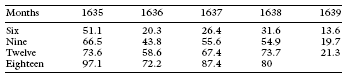
—Ship Money Collection, 1635–39 (percent).

—Ship Money Collection, 1635–39 (percent).