Social networks may promote tolerance by exposing people to heterogeneous ideas and actions, thereby freeing them from the bonds of provincial thought. In her recent path-breaking work, Diana Mutz shows that diversity in American social networks has a positive influence on tolerance.Footnote 1 We should not assume, however, that social networks in all nations are alike or that their effects on the members are similar. Perhaps cultural differences in the composition of social networks and in the norms of discussion within such networks give rise to characteristics that differ from those found by Mutz.
Many researchers investigate the influence of informal social networks on participation, but the impact on tolerance needs further analysis, especially in the context of socially homogeneous cultures. Scholars may mistakenly assume that the pressure to conform renders informal social networks homogeneous, and many concentrate on organized voluntary groups as heterogeneous networks.Footnote 2 Yet many nations, including Japan,Footnote 3 have politically diverse informal networks and scholars have not tested the impact of this diversity on tolerance in Japan.
Japan has relatively little diversity in terms of race or religion – two major sources of conflict – but we find that the Japanese are exposed to political disagreement. Thus we were able to test whether Mutz’s findings on the influence of diversity could be generalized to Japan. Specifically, we tested the hypothesis that exposure to members of politically heterogeneous informal social networks increases tolerance. For this study, we created and administered to a sample of respondents two new national sample surveys that utilize name-generator methodology. We also developed the first accurate measure of political diversity within social networks in nations that have a multi-party system. Using our new measure of diversity, we conclude that diversity in informal social networks has a positive influence on political and moral tolerance in Japan.
These results are interesting for the general study of democracy, since we explicitly detected two types of tolerance that follow the same logic of network theory in a generally homogeneous nation. In a culture that lacks a long history of social diversity, political diversity was shown to influence tolerance. For social network theory, it suggests that perceptions of difference – and what types of difference are important – are subjectively determined by the context, but the impact of difference remains. Japan may appear homogeneous because of the lack of diversity based on race, for example. But these results suggest that political diversity for the Japanese is enough exposure to difference in social networks to influence tolerance. Thus, the same social psychological mechanism works regardless of context: exposure to diversity produces tolerance.
Diversity and democracy
Democracy benefits from diverse input, even though new, beneficial ideas may at first seem abhorrent.Footnote 4 Citizens must be sufficiently tolerant of difference to open-mindedly join in public debates where heterogeneous worldviews, antagonistic partisans and supporters of incompatible policies coexist.Footnote 5 Deliberation requires an acceptance of the right of others to have beliefs that differ from one’s own. Unless citizens are tolerant enough to listen thoughtfully to people who hold different views, deliberation will merely result in irresolvable confrontation. Citizens need to exercise tolerance in order to allow for open consideration of different suggestions.Footnote 6 If people limit themselves to discourse within homogeneous groups, they may become suspicious of those with beliefs that differ from their own.Footnote 7 If a severe partisan cleavage creates a strongly ‘politicized collective identity’, it will accelerate confrontation and heighten pressure for conformity, and differentiation among groups will grow.Footnote 8 Under those circumstances, networking within warring political groups fosters intolerance. Examples of conflicts that have led to intolerance are not hard to find, as democratic politics is the art of carving out mutually beneficial compromises in an arena of struggle among a heterogeneous group of people. It requires discussion, confrontation and consensus building among heterogeneous partisans. These inevitable conflicts can create ‘cracks’ in the socialization of tolerance, and political discussion may actually give rise to an increase in intolerance.
While homogeneous interaction may decrease tolerance, some suggest that heterogeneous networking may increase tolerance by creating trust and developing understanding and appreciation between diverse social groups. Scholars often phrase the influence of diversity in social networks in terms of ‘bridging’ and ‘bonding’ social capital.Footnote 9 Bonding social capital derives from homogeneous social networks that create close-knit groups. Bridging social capital comes from heterogeneous social networks that span across the subdivisions in society and allow members of different groups to interact. Putnam posits that bridging social capital is a solution to the problem of how to develop a high degree of social interconnectedness that facilitates an effective democracy and avoids society degenerating into destructive tribalism.Footnote 10 The bridging social capital theory suggests that the interaction of people from diverse groups will improve attitudes between them.Footnote 11 Tolerance requires ‘perspective-taking’, which is the psychological ability to understand another person’s feelings and desires.Footnote 12 Developing skills such as the ability to take a perspective usually comes through co-operation and interaction.Footnote 13 Casual social interaction with people of opposing viewpoints allows one to see where the other person is coming from, to view matters from their perspective. Thus, our theorized causal mechanism is that hearing the other side personalizes them in the mind of the listener, by allowing the listener to understand the reasons why the opposing side thinks what they think.Footnote 14 Although they may still disagree with the other side, they can tolerate disagreement because they now understand the opposition’s line of thought and no longer see it as irrational or unreasonable.
Recently, researchers have found that informal relationships give some exposure to diverse worldviews.Footnote 15 We must, therefore, test whether casual social interaction with heterogeneous others increases tolerance. It seems likely, however, that people will naturally segregate themselves into homogeneous groups and hence do not encounter much diversity.Footnote 16 Elites can also impede network heterogeneity by creating structures that subtly segregate groups, making man-made differences seem natural.Footnote 17 Scholars usually assume that close-knit groups are homogeneous, and that bridging social capital must come from voluntary organizations. In particular, Japanese culture is famous for its reluctance to express true opinions or beliefs that may seem controversial. If this is the case, the question arises as to just how common informal political discussion between different types of people actually is. The data we report later in this article show that political diversity is not rare, and that Japanese people sometimes discuss politics with those who belong to different political parties. The diversity in discussion networks allows us to test its impact on tolerance. We include a two-stage least squares (2SLS) regression analysis to ensure that we are not merely finding that tolerant people have diverse friends.
Tolerance in Japan
Studying tolerance in Japan is particularly important. Japanese scholars, pundits and government officials often discuss the need for increasing tolerance as being crucial for Japan to fulfil its potential.Footnote 18 The study of tolerance of different views is particularly important because globalization is rapidly bringing about changes in lifestyles and a divergence from traditional behaviour. The remnants of rigid pre-modern social customs still influence Japanese culture. This leads to a culture with strict, exacting beliefs over what behaviour is acceptable and a generally negative attitude towards difference. The tendency towards intolerance is exacerbated by a common belief that Japan is a homogeneous population, whether true or not.Footnote 19 For example, the educational system has a widely discussed problem of severe bullying of those who are different, including the disabled. This intolerance contributes to a high level of suicides among young people and school violence. Another great concern is what will happen when this closed society opens up to immigration. The government plans to ease immigration laws substantially to allow more foreign workers to have permanent residency. Understanding Japanese tolerance is crucial, because this tolerance will be needed if these new immigrants are to live successfully in Japan. Our research reported below tests measures of tolerance that correlate highly with attitudes towards immigrants. Thus, our research has important real-world implications.
Japanese society, however, requires special attention to study its version of tolerance properly. The common view of political tolerance comes from Sullivan, Piereson and Marcus, who defined it as the willingness to extend liberties and protection to hated or extremist groups.Footnote 20 We tested this type of tolerance by using standard survey questions, which are discussed later. But this may not be the best measure of tolerance in Japan. Toshio Yamagishi cautions that research into Japanese political behaviour should take into account the unique Japanese cultural environment that stresses the ‘assurance of safety’.Footnote 21 There is a standard definition of tolerance that measures what Yamagishi calls ‘assurance’.Footnote 22 In discussing trust, he shows that the Japanese do not truly trust unknown others, but are assured that strangers will not harm them by their profound trust in the institutions set up to protect them. The institutions assure their safety. Although Yamagishi’s work is based on analysing trust, it is also informative for understanding tolerance. Japanese citizens may be tolerant of extremists simply because of their confidence that nothing will disrupt the existing democratic social system, rather than by virtue of a deliberate willingness to grant consideration to extremist views.
In other words, citizens may have such faith in the power of majority control – and in the judgement of others – that no one attempts to stop extremists from participating or existing.Footnote 23 These feelings may derive from confidence that social institutions are strong enough to guarantee safety, no matter who participates. In the Japanese context, political tolerance may measure whether survey respondents feel safe enough to allow extremists to use public facilities, not their actual tolerance for diversity of political opinion. Thus the traditional definition of political tolerance may measure reliance on the democratic system in Japan. We control for trust in government as a proxy variable for these feelings of assurance in the models below. However, to test our hypothesis in Japan to its full extent, it is imperative to analyse tolerance for types of behaviour that are hated but not explicitly threatening to the political system.
Conflicts over moral issues have less to do with overthrowing the government than with the views of extremist groups. Moral tolerance is closer to Yamagishi’s definition of trust. Thus we might learn more about a Japanese person’s acceptance of difference by examining their moral tolerance than by measuring political tolerance which is intertwined with their feelings about the level of systemic safety. Goren defines moral tolerance as ‘a willingness to accept or put up with people whose beliefs and behaviours regarding right and wrong differ from our own’.Footnote 24 This conception of tolerance is aligned closely with Uslaner’s predicted effects of trust, i.e. trust is a moral view of what is allowable in the world.Footnote 25 Moral tolerance is based on the respect/recognition of others’ independent opinions, and tolerance emerges as a belief that one can cohabit (coexist) with them regardless whose opinions these actually are. Thus this measure tests tolerance for moral deviance, but it is not a measure of assurance and is well-suited for the particular Japanese societal context.
Data
The data are from two separate national sample surveys administered by means of face-to-face interviews.Footnote 26 The political tolerance analysis uses the first survey which we conducted in April 2000, by means of face-to-face interviews in April, not held during an election period. The response rate was 64.7 per cent (n = 1,618).Footnote 27 We confirmed our initial findings with an additional measurement of tolerance in a survey done in two waves in 2004–05. This second survey had a panel design. In the second survey, the moral tolerance question was asked in the 2005 wave, while the social network questions were asked in 2004. The 2004 wave had 2,115 respondents (the response rate was 56.6 per cent of the total sample) and in the 2005 wave there were 1,511 respondents (71.4 per cent of the 2004 sample). There were no crucial salient issues specific to the survey period that would have changed attitudes about tolerance. In both surveys, we collected network data by asking the respondents about the people within their social network. In particular, we asked them to describe characteristics of the people with whom they most often have political discussions. This process is called a ‘name generator’. As this has been shown to be a valid method, many researchers use name generators to investigate social networks.Footnote 28
Dependent Variables
For political tolerance, we followed MutzFootnote 29 and used six questions, with a pair of choices for each response (one reflecting a tolerant attitude and the other reflecting intolerance). The questions, which are listed below, were newly prepared, based on the approach employed by Sullivan, Piereson and Marcus,Footnote 30 and were adjusted for the contemporary Japanese situation. They are:
— Whether high school teachers should be able to express their opinions on issues of religion, ethics and politics in class, even if their views are very different from those of society in general;
— Whether newspapers should be able to print the publisher’s opinions, no matter how biased they are;
— Whether use of public halls/facilities should be permitted for anti-democratic organizations, as long as they meet the other requirements;
— Whether political parties should be required to divulge information about their internal management to the public;
— Whether fundamental rights should be fully granted to a person who is suspected of committing a brutal crime;
— Whether it is acceptable for the police to spy on or wiretap an organization that may become a threat to the safety of society.
We subjected the answers to these six questions to a principal-component analysis and obtained a single factor named Political tolerance (eigenvalue 1.83), which loads about equally on the separate items (respectively, 0.31, 0.34, 0.38, 0.35, 0.48, 0.49). This suggests that political tolerance is a unified concept. Political tolerance is normally distributed, with a mean of about 0.
We measured moral tolerance by agreement with the statement: ‘We should be more tolerant of people who choose to live according to their own moral standards, even if they are very different from our own.’ As the distinction between political tolerance and moral tolerance is relatively new, we were only able to ask one question on the latter, and unfortunately we do not have a scale of questions on moral tolerance. This question was originally asked in the 2000 American National Elections Survey, and we translated it into Japanese. We subjected the moral tolerance question to tests to determine its construct validity. Test results suggest that this survey question does actually measure moral tolerance, and the results are available upon request. We assigned a numeric code to this variable: 0 for strongly disagree, 1 for partially disagree, 2 for neither agree nor disagree, 3 for partially agree, and 4 for strongly agree. Again, it is important to note that this question does not measure political tolerance, which is usually defined as the extension of rights to hated groups; instead, it measures tolerance for moral deviation. It is important to highlight this distinction because conflicts over moral beliefs can be intense and can have political consequences; hence this dimension of tolerance is valuable to research. The distribution of responses to this question is positively skewed.
Social Network Variables
In this survey, we collected network data by asking the respondents about the people with whom they discuss politics. In the first survey, we ask respondents to describe their spouse and two other frequent political discussants. Previous research has found an effect for different wordings of this question – i.e., between ‘political discussants’ and ‘people with whom you discuss important matters’ – but we used the ‘political discussants’ cue for our research. Our focus is on political diversity and this cue encourages the respondent to name people whose political beliefs they may actually know. It is possible, however, that this cue may influence the respondent towards naming discussants whom they have picked out as being diverse. In the second survey, we asked them about the four people with whom they most often have discussions about politics. We also asked the respondents to identify the party that they think each discussant supports, along with other characteristics. We were able to determine whether our respondents view their discussants’ vote choices as being similar to or different from their own; and use political diversity as a good measure of one important type of exposure to network heterogeneity.
We had to consider how to analyse a multi-party system’s social networks. The traditional method researchers use when analysing diversity with a four-person name generator in a two-party system is problematic when dealing with data for a multi-party system. Researchers usually measure political diversity by recoding to −1 if the respondent believes the discussant voted for the same party as him/herself, and +1 otherwise, and then summing the responses for all four discussants.Footnote 31 Political party support and vote choice are used because they are easier to recall than specific policy positions, and partisan conflict contains most political disagreements.Footnote 32 Thus the possible scores range from −4 (if the respondent thinks that all discussants voted for the same party as him/herself) to +4 (if the respondent thinks that all four discussants voted for the opposite party).Footnote 33
With Japan’s multi-party system, we could not assign a total score by simply summing the number of network members believed to have voted for the largest party – the Liberal Democratic Party (LDP) – and the number believed not to have done so, because supporters of other parties – such as the Japanese Communist Party (JCP) or Democratic Party of Japan (DPJ) – could also disagree among themselves. In a two-party system, it can be assumed, by default, that all disagreeing network voters voted for the opposite party (ignoring the small number of third-party voters). If we were to apply this two-party model to the Japanese multi-party system, however, we would be counting disagreeing voters simply on the basis of their common dissent from the LDP. Since the ideological and policy disagreements between JCP and DPJ supporters are every bit as serious and important as are the disagreements with the dominant LDP, and since there are at least three significant parties in any given Japanese election, use of the two-party model could underestimate the true degree of diversity within a network.
For example, in a four-person network (with the members identified as A, B, C and D), there are six possible agreements: 1. A–B, 2. A–C, 3. A–D, 4. B–C, 5. B–D, and 6. C–D. The other combinations are duplicates (e.g., B–A). To create a measure of political heterogeneity in social networks in a multi-party system, we established a separate variable for each of these possible agreements: coded −1 if the respondent thinks the pair voted for the same party’s candidate in the 2005 Lower House election, 0 for missing, and +1 if the respondent thinks the pair voted for candidates of different parties. We then summed the values of these dyadic variables. The first survey measures diversity with three discussants, while the second measures diversity based on four discussants. The distribution is skewed towards homogeneity in both surveys. A higher score equals greater perceived heterogeneity of social network vote choice in a multi-party system.Footnote 34
We also control for other social network factors that may influence tolerance. Following Huckfeldt, Johnson and Sprague, we use the amount of discussion to control for the amount of networking.Footnote 35 To evaluate this variable, we summed the amount of discussion over all discussants, which was coded from 0 for no discussion, 1 for some, and 2 for much political discussion. To determine involvement with formal networks, we created an index for each respondent by asking him/her to select from a list of common Japanese voluntary associationsFootnote 36 those with which he/she was affiliated and to indicate his/her level of involvement in each. We assigned a numeric code to each association according to the respondent’s degree of involvement: 3 for very actively involved, 2 for somewhat actively involved, 1 for limited involvement, and 0 for no involvement. Then we created the variable Formal networks by summing the number of associations joined weighted by involvement (Cronbach’s α = 0.79 for first survey, and 0.68 for the second).
Control Variables
Yamagishi’s work on assurance provides an interesting point of analysis for studying tolerance in Japan. Based on his findings, we control for trust in government, to alleviate concerns that we may actually have measured assurance with our key causal variable. This allows us to test the assurance influence on tolerance separately from the impact of social networking. Trust in government was coded numerically according to the degree of the respondent’s agreement with whether the government is trustworthy: 5 for agree, 4 for partially agree, 3 for neutral, 2 for partially disagree, and 1 for disagree. Ideology is the chief indicator of tolerance.Footnote 37 The more ideological respondents should have more intense opinions, and may be less tolerant.Footnote 38 The degree of ideological attitude is measured from middle of the road (0), slightly ideological (1), ideological (2), and very ideological (3). Socio-economic factors also affect tolerance – and, unless controlled for, can bias the results. The demographics that may influence tolerance are gender, age, education and income.Footnote 39 We coded Age in years and Education by having a degree or not, and we categorized Income ordinally, in brackets with a range of 2,000,000 yen.
Methods
For each dependent variable, we constructed three models: either two ordinary least squares (OLS) models or two ordered logistic (OL) regression models, and one 2SLS regression model. We created the 2SLS models to establish that our results do not exhibit endogeneity between Network political diversity – which could have been affected by the degree of tolerance of the respondents – and the dependent variables. We used variables that we found to be correlated with the independent variable but not with the dependent variables. Following Mutz,Footnote 40 we used whether or not the respondent works outside the home as an instrument, because having a career is probably not influenced by the respondent’s level of tolerance, but exposure to workplace diversity will be likely to influence their social networks. We also asked the respondents how dissimilar they are to their discussants in terms of placement within the social hierarchy. These instruments make intuitive sense, because one is usually not able to choose colleagues or superiors who support the same party. Perhaps one can choose not to initiate political discussion with certain colleagues and superiors, but the occupational or social hierarchy in a relationship is more likely than tolerance to be the determining factor in one’s exposure to political discussion in a network. Respondents are unlikely to be able to escape from discussion in these predefined networks, for example, at the office when fellow workers are discussing politics. Indeed, we found that Worker and Social hierarchy have a powerful influence on network heterogeneity but essentially no impact on political or moral tolerance. Thus these are intuitive variables that should isolate any bi-causality.
The impact of network diversity on tolerance
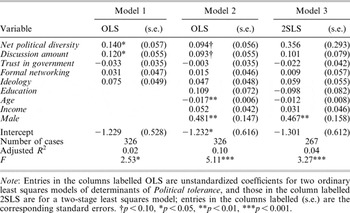
The results displayed in Table 1 show that political diversity has a positive impact on political tolerance: an increase in Network political diversity results in a small but significant increase in Political tolerance. We can interpret this as follows: the more someone’s discussants support different candidates, the greater the tolerance he/she acquires for politically divergent groups. The 2SLS results also show a positive coefficient but the standard error increases so that it is not significant at the p > 0.05 level. This may be due to imprecision in the variables, but we cannot definitively rule out the possibility that our results exhibit endogeneity between having politically diverse associates and being politically tolerant. We found that involvement in Formal networks is associated with a greater degree of tolerance, and that Discussion amount rises with tolerance, but not significantly. One interesting finding is that Trust in government is not significantly correlated with Political tolerance, which suggests that political tolerance may not be influenced by assurances of safety from the government. Thus, counter to our hypothesis drawing on Yamagishi’s work, the results suggest that assurance does not influence tolerance in Japan. The other significant variables match the theoretical predictions, as suggested by previous studies: Being ideological is not associated with tolerance, and though education leads to more tolerance the association is not significant. We found an influence of age and gender, but not income, on Political tolerance.
Determinants of Political Tolerance in Japan

Note: Entries in the columns labelled OLS are unstandardized coefficients for two ordinary least squares models of determinants of Political tolerance, and those in the column labelled 2SLS are for a two-stage least squares model; entries in the columns labelled (s.e.) are the corresponding standard errors. †p < 0.10, *p < 0.05, **p < 0.01, ***p < 0.001.
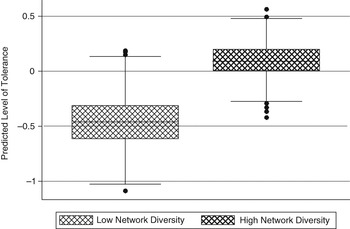
The main result can best be depicted graphically. Using clarify,Footnote 41 we generated from Model 2 in Table 1 the predicted levels of Political tolerance for two simulated networks, with all the control variables held at their mean. The lines represent the 95 per cent confidence intervals for the predicted probability of the influence of social network political diversity on political tolerance. High network diversity signifies a simulated network where all three discussants support different parties. Low network diversity signifies a network where all three support the same party. As shown in Figure 1, networks with high diversity increase political tolerance. A change from a three-person network in which all the members support the same party to a network in which all three discussants support different parties leads to a change in Political tolerance from −0.457 to 0.098, or an increase of about half of one standard deviation. It is interesting to note that, ceteris paribus, the predicted score of the low-diversity network is actually more intolerant than average (i.e., a negative value of Political tolerance), while the predicted score of the high-diversity network is more tolerant than average (i.e., a positive value of Political tolerance).
The impact of social network political diversity on political tolerance Note: This graph shows that political tolerance increases with social network political diversity. The lines represent the 95 per cent confidence intervals for the predicted probability of the influence of social network political diversity on political tolerance from an ordinary least squares regression model with all the control variables held constant. High network diversity signifies a simulated network where all three discussants support different parties. Low network diversity signifies a network where all three support the same party. Created by clarify from Model 2 in Table 2.

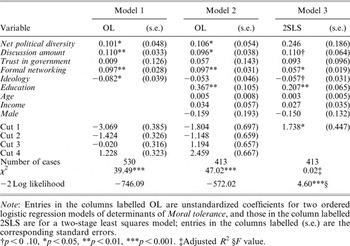
The results in Table 2 show that diversity in social networks has a positive impact on moral tolerance as well. The 2SLS result also shows an increase, but one that is not significant. This may mean that there is endogeneity or that these instruments are not the best measures of endogeneity for Japanese data. Discussion amount (which represents discussion within the network) also shows a positive effect. Joining voluntary organizations positively influences moral tolerance, and this is the first time this has been tested with Japanese data. Our results support the Putnamian thesis for moral tolerance. Trust in government is not related to moral tolerance. The demographic variables show that only Education increases moral tolerance; the other variables show no effect. These results suggest that in ‘homogeneous’ Japan moral tolerance is influenced by network diversity, and this extends Mutz’s hypothesis to a new type of tolerance.
Determinants of Moral Tolerance in Japan

Note: Entries in the columns labelled OL are unstandardized coefficients for two ordered logistic regression models of determinants of Moral tolerance, and those in the column labelled 2SLS are for a two-stage least squares model; entries in the columns labelled (s.e.) are the corresponding standard errors.
†p < 0 .10, *p < 0.05, **p < 0.01, ***p < 0.001. ‡Adjusted R 2 §F value.
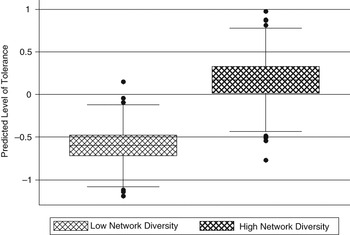
If we simulate the effect using clarify, again with all the control variables held at their mean, we see a clear impact of network diversity. As displayed in Figure 2, network diversity shows a statistically significant increase in moral tolerance. Networks with high diversity have a statistically significant increase in moral tolerance. A change from a four-person network in which all discussants support the same party to a network in which all the discussants support different parties leads to a predicted change in Moral tolerance from 2.40 to 3.17, or an increase of just over half of one standard deviation.
The impact of social network political diversity on moral tolerance Note: This graph shows that moral tolerance increases with social network political diversity. The lines represent the 95 per cent confidence intervals for the predicted probability of the influence of social network political diversity on moral tolerance from an ordinary least squares regression model with the control variables held constant. High network diversity signifies a simulated network where all four discussants support different parties. Low network diversity signifies a network where all four support the same party. Created by clarify from Model 2 in Table 2.

Conclusion
We find that diverse daily social interaction increases political and moral tolerance, and this supports the generalizability of Mutz’s findings. Tolerance increases with network diversity in both America and Japan. We examined two types of tolerance, because political tolerance may be more related to assurance in Japan. However, as is shown in our analysis, both measures of tolerance are influenced by network political diversity. In testing the generalizability of the results, we correctly predicted that homogeneous networks will make the Japanese less accepting of perceived deviance. We also find that involvement in voluntary organizations is associated with moral tolerance in Japan. The bridging social capital theory appears to be generalizable to Japan. This has interesting implications for Japanese public policy, because it shows, for example, that Japan could successfully be open to immigrants, as long as enough efforts were made to promote everyday social interaction. The results show that the Japanese could become even more morally tolerant.
The results show that the net effect of heterogeneity in political discussion has a similar impact in socially homogeneous societies such as Japan as it has in more diverse societies such as the United States. The similar effect is convincing evidence of the social-psychological force of exposure to diversity. We show that ‘hearing the other side’ creates tolerance in cultural contexts quite different from that in the original study. This shows the generalizable nature of the influence of diverse social networks on tolerance. In understanding the causes of prolonged conflicts and deep-rooted intolerance, it may be helpful to examine the daily social interaction of opposing groups. If social networks in these conflicts do not expose members to the opinions of the opposing groups, our research suggests it will be easier to be intolerant of them. Understanding the influence of social networks may allow opportunities to develop programmes that yield a greater degree of tolerance. This evidence provides support for the idea that even socially homogeneous cultures can use inter-group interaction as a tool to facilitate co-operation and tolerance.
There are some important caveats to our research which must be noted. First, the results from the 2SLS models have large standard errors. The coefficients were signed in the correct direction, but we must take care not to exaggerate the findings, as some of this effect may be attributable to tolerant people having diverse friends. Also, as the increase produced by diverse discussion is small, we must not exaggerate the potential of political discussion to improve society. These effects are small, and some of the impact may be due to endogeneity. Thus, political discussion as currently performed is not a complete cure for intolerance. Simply increasing the amount of informal discussion would not be enough to rid society of intolerance. This is particularly true since the total amount of diverse discussion initiated by average people is small because of cognitive dissonance. And finally, Mutz’s theory also shows a negative side of tolerance, in which vigourous active participation is decreased by tolerance. Many suggest that too much tolerance reduces civic unity, creating too much diversity for the centre to hold. It seems to us, however, that the down-side of intolerance – with the attendant horrors that it creates, such as ethnic cleansing – is worth the sacrifice of civic unity, but this is a matter beyond the scope of this research. Further study is needed on the effects of social networks on tolerance.
Although this study has produced a number of insights into the nature of social networks and tolerance, the results have indicated that additional questions need to be answered. If tolerance does increase with heterogeneous networks, what types of government programmes that sponsor informal interaction would best minimize intolerance? Moreover, if diverse casual interaction positively influences tolerance, does civic engagement in homogeneous voluntary organizations foster intolerance? In answering these questions, researchers should examine closely just how the embeddedness of citizens in organizations, groups and social networks leads to an increase in tolerance.