




No CrossRef data available.
Funding Self-Sustaining Development: The Role of Aid, FDI and Government in Economic Success
Published online by Cambridge University Press: 04 January 2006
Abstract
This article challenges a long-held development-policy assumption that aid and foreign-direct investment (FDI) serve as substitutes or complements in accelerating the development of the world's poorer countries. We show both theoretically and empirically that aid and FDI affect development differently. Aid contributes powerfully to both economic growth and human development, and the higher the level of human capital in a country, the more aid contributes. By contrast, FDI, at best, has no effect on economic growth and actually slows the rate of human development in less-developed countries. We find no evidence that the degree of democratic responsiveness in government conditions the effectiveness of either aid or FDI, although we do find that democracy independently increases human development in all but the most developed countries. Our results demonstrate that FDI and aid are not, and cannot be, substitutes in the development of the world's poorer countries. Nor even can they be thought of as complements—certainly not at mid to low levels of development. In the end, poor countries need democracy and aid, not FDI.We are extremely grateful to Susan Rose-Ackerman, Gustav Ranis, Frances Rosenbluth, Kenneth Scheve, and participants at the Leitner Political Economy Seminar at Yale University in December 2003 for very helpful comments. We also received valuable suggestions from two anonymous reviewers. Stephen Kosack would like to thank the National Science Foundation for the support of a Graduate Research Fellowship.
Information
- Type
- Research Article
- Information
- Copyright
- © 2006 The IO Foundation and Cambridge University Press
But as important as official assistance is to improving people's lives, the reality is that it is trade and private capital flows that will make the real difference that are more, more, much more significant.
U.S. Secretary of State Colin Powell1
In the dialogue on sustainable development, it is widely accepted that even the most promising less-developed country often lacks the resources to fund its own development and must look to foreign capital to augment domestic sources. These foreign capital inflows come most commonly in two forms: foreign aid, and foreign-direct investment (FDI). FDI has long been considered the preferable of the two, especially by the United States.2
The U.S. belief dates to the Marshall Plan; see McKinstry Robin 1984.
Since 2000, FDI flows have declined somewhat (mostly because of stagnating growth in the major investing economies), yet they remain the largest component of net resource flows to developing countries and continue to grow in proportion to total investment in these countries; see UNCTAD 2003. Details on the flows are discussed below.
Thus it is not at all surprising that donors and international financial institutions have increasingly called for developing countries to make themselves more attractive to international investors. Nor is it surprising that donors now call for public-private partnerships that might increase foreign investment as a more sustainable path to development. For example, last year Britain's Secretary for International Development Baroness Valerie Amos told the Kenyan government that it would do far better if it focused on making itself more attractive to investors rather than donors; and U.S. Secretary of State Colin Powell told the 2002 World Conference on Sustainable Development: “Official development aid alone is not enough. Countries must also be able to attract the trade and investment that account for 80 percent of the money that is available for development.”4
Powell 2002b. In particular, private-public partnerships was a major theme of the recent strategic plan for 2004–9 from the U.S. State Department and U.S. Agency for International Development. See U.S. State Department/U.S. Agency for International Development 2003, especially the section “Advanced Sustainable Development and Global Interest,” beginning on p. 19. From that section: “Recognizing that the value of private sector grants, remittances, assistance, and investments far exceed publicly funded Official Development Assistance, we will develop new business models to ally public resources with private sector flows. We will generate public-private partnerships to mobilize nonofficial resources and know-how.”
Yet behind these recommendations lurks an assumption. At its most general, it is that all foreign capital inflows help development. More specifically, it is that aid and FDI are to some degree substitutes or complements.
In this article we challenge this assumption. We show, both logically and empirically, that in funding development FDI is not more effective than aid. Nor are the two substitutes at all, or even complements. Instead, FDI and aid affect development differently. Once a country reaches a relatively low level of development, aid contributes powerfully to both economic growth and to building the kind of human capital essential for sustainable development. By contrast, in most countries FDI contributes little or nothing to growth or to human development, and it may actually inhibit development in the world's less-developed countries.
We present our work in two parts. In the first we lay out a theory of why aid and FDI affect development differently, and in the second we present empirical tests of the theory's validity.
Theory
We establish the intuition behind this article in four steps: first we distinguish between economic growth and development; next we examine the likely (disparate) ways that aid and FDI affect growth and development; and in the final two steps we show that the effectiveness of aid and FDI are likely to depend on government preferences and human capital.
The Difference Between Growth and Development
The link between foreign capital, governance, and development is complex and somewhat ambiguous. A first step toward uncovering it is to distinguish between “development” and “growth.” These two concepts are often used interchangeably; yet, while intimately related, they are distinct. Economic growth—increasing per-capita GDP—is of course a vital part of economic development. But economic growth itself is merely a measure of capacity; the extra money on its own does nothing to guarantee that a population is less impoverished, more educated, healthier, or, indeed, that the economy is in a better position to grow any further. To get closer to such guarantees, it is necessary to know, first, how the extra money is distributed, and, second, how it is used. A poor country with a growing economy may still develop little if the growth merely enriches a small élite, leaving the majority of the population without additional income. Nor does a poor country develop as much when its income is spent on, say, arms imports, rather than on public goods. The distinction between growth and development has a long history in development research; Sen gives one of its most articulate rationales: “It is as important to recognize the crucial role of wealth in determining living conditions and quality of life as it is to understand the qualified and contingent nature of this relationship. An adequate conception of development must go much beyond the accumulation of wealth and the growth of gross national product and other income-related variables.”5
Sen 1999. Other works foundational to the distinction between growth and development include Pigou 1952; Sen 1973; Griffin 1978; Morris 1979; Streeten et al. 1981; Stewart 1985.
Throughout this article, we use the concept of “human development” to distinguish between growth and development more generally. The concept of human development was established in the United Nation Development Programme's Human Development Reports and is meant to provide a more complete picture of development than economic growth. It includes not only income, but also measures of human capital—health and education—the tools that a person needs both to live a successful life in the modern world and to contribute to a country's economic progress.6
Development, according to the UN, should have as its basic objective the creation of “an enabling environment for people to enjoy long, healthy, and creative lives”; see United Nations Development Programme 1990. “Human development” itself was defined broadly as “a process of enlarging people's choices.” Ibid., 10.
A distinction between growth and human development naturally produces a question: what is the relationship between the two? For an answer we turn to work by Ranis, Stewart, and Ramirez.7
These authors undertake a theoretical and empirical analysis of the linkages between growth and human development, and determine, not surprisingly, that each can contribute to the other. The evidence shows that a focus on human development tends to reinforce economic growth (a process they label the “virtuous cycle”); by contrast, countries that focus on increasing growth rather than human development tend to find themselves spiraling down a “vicious cycle” in which poor performance in human development inhibits sustained growth. The mechanisms are complicated and multifaceted, but can be briefly described in Figures 1 and 2, and as follows.
From growth to human development

From human development to growth, and from growth to growth
human development contributes to economic growth by increasing the capacity of the workforce, which in turn alters the organization and adaptability of production and the range and complexity of economic output. This contributes to increasing national income through, among other things, social capital and the policy environment.
In turn, economic growth can contribute to human development by directly increasing government revenue, which, depending on government priorities, may then be reinvested further in human development. Growth can also contribute to human development by increasing household income (though the degree of the increase will depend on income distribution); households will then allocate a certain amount to investing in their own health, education, and welfare, according (as with the government) to their spending priorities.8
Several factors are likely to determine the amount of extra income spent on human development priorities, but one of the most prominent is how much of the income goes to women, and how educated these women are. Ranis, Stewart, and Ramirez cite abundant evidence that household caloric intake improves when women control more of the income (see Garcia 1990; and von Braun and Webb 1989); that women spend proportionately more on food (see Hoddinott and Haddad 1991); and that infant survival and nutrition increase with the education of women (see Barrera 1990; Rosenzweig and Schultz 1982; Wolfe and Behrman 1984).
Lastly, economic growth can contribute to further economic growth directly, entirely bypassing human development. Increasing income can increase savings, which in turn leads to increases in the capital stock. Investment in the capital stock increases productivity, and thereby contributes to further growth. (But as mentioned above, this type of growth—growth absent progress in human development—is likely to lead a country into a vicious cycle of low human development leading to reduced growth.)
The contributors to economic growth and human development are laid out in Figures 1 and 2.9
These figures are adapted (and simplified) from Figure 1, “The HD-GNP cycle,” in Ranis, Stewart, and Ramirez 2000.
External Funding for Development
In Figures 1 and 2, the only source of resources for use in development is domestic: economic growth. But developing countries often access a good deal of external funding, from states (official aid), and from private sources (individual remittances; private donations; commercial bank loans; and private foreign direct investment). Our concern is with aid and FDI, the two most prominent sources of external funding for economic growth and human development in developing countries.
While aid flows have remained largely stagnant in recent years, flows of FDI increased rapidly through 2000 (Figure 3). In the five years from 1995 to 2000, FDI in low- and middle-income countries grew at an average annual rate of 17 percent. While total flows have decreased in recent years, FDI continues to be the largest and most stable source of external finance for developing countries, exceeding by far the sum of commercial bank loans and official flows.10
Between 1997 and 2001, while FDI to developing countries was relatively flat (as a share of the GDP), the ratio between FDI and non-FDI flows varied from 4.6 to 1.8; see UNCTAD 2002. UNCTAD 2000 and 2003 also describes FDI as the most important source of private capital flows to developing countries.
According to UNCTAD 1997, during the 1990s more than fifty developing countries enacted more open domestic laws on foreign investment. During the same period the number of Bilateral Investment Treaties signed increased threefold. These treaties are seen as the primary means for promoting FDI to developing countries.

Inflows of aid and FDI, 1970–2001
Aid—by which we mean Official Development Assistance (ODA)—enters the picture we drew in the first section directly as government revenue. Despite donors' best efforts to ensure that aid is spent according to donor, not recipient, priorities, the empirical evidence is overwhelming that, at the margin, aid is little different from any other source of revenue.12
See, for example, Mosley, Hudson, and Horrel 1987; Boone 1996.
A large literature has reached this conclusion. Some examples include Maizels and Nissanke 1984; Frey and Schneider 1986; Trumbull and Wall 1994.
Dollar and Svensson 2000 suggest that conditionality has become too broad to function successfully. They note that structural adjustment loans carried over 100 specific conditions. In a sample of more than 220 reform programs, the authors found that nearly one-third failed to meet their objectives.
The implication of this is that aid is likely to affect human development (and, indirectly, economic growth) via government spending priorities. In countries whose governments give high priority to human development, aid is likely to add to human development, for it will add to spending on human development. Where governments give human development a low priority, aid may just as easily do nothing for human development. In the extreme, aid may even impede human development, if given to a country whose government prioritizes things that work against human development—for example, a brutal dictatorship whose ruler spends the nation's wealth on tools of repression to maintain his hold on power. Figure 4 shows the possible linkages between aid and human development.

From aid to human development
By contrast to government-centered aid, FDI is by nature private. Therefore, it enters our picture in a way quite different from aid; primarily, FDI is simply capital. Purchases of equity capital and reinvestment of profits by foreign investors act in the same way as domestic savings, by adding to the overall supply available to fund new investment. Insofar as these inflows lead to the creation of new fixed assets and/or the use of better technology, they may also increase the efficiency and productive capacity of a country's economy.15
FDI may also increase growth indirectly, through positive externalities. Foreign investors may introduce more-advanced technology and management practices; these may then spill over to domestic firms as they observe foreign-firm practices, or as labor—especially skilled labor or management personnel—moves between the two. In a similar way, domestic firms can absorb technical skills and quality-control techniques. Competition from foreign investors can also force domestic firms to increase their efficiency and their use of technology to keep pace. These externalities all may affect the organization and adaptability of production, and thereby play a role in increasing growth.16
See Rodriguez-Clare 1996. There is a broad literature on the influence of FDI on technology transfer. For a discussion, see, for example, Saggi 2002; Caves 1996; Findlay 1978; Mansfield and Romeo 1980; Koizumi and Kopecky 1980.
FDI may contribute to human development too, if it is able to increase household income or tax revenue. If so, FDI may work in much the same way as aid: by increasing the resources on which either governments or households may draw for their human-development spending.
Yet FDI can also work against a country's development. Any of the channels by which FDI contributes to either growth or human development depends, first, on the sort of FDI a country receives, and, second, on the ability of the country to absorb the investment's benefits. Both will depend on human capital, labor and wage standards, and existing technology in the host country.17
Blomstrom, Lipsey, and Zejan 1996, and Blomstrom and Kokko 1996 find that FDI plays an important role in promoting productivity and export growth in host countries, but the nature and extent of the impact vary depending on the industry and the country's policy environment.
Specifically, if a country attracts FDI only by granting foreign firms special incentives, FDI can cause serious economic distortions. For example, FDI may increase competition and thereby force domestic firms to become more efficient; but if foreign firms are too disproportionately advantaged, domestic firms may find it impossible to compete, and the FDI may result in a loss of indigenous enterprise. Along the same lines, if FDI is attracted only through tax incentives, then, far from raising government revenue, FDI may actually reduce it.
Another possibility is that, if FDI is heavily subsidized, domestic investors, crowded out by the FDI, may simply pretend to be outsiders by sending funds out of the country and then bringing them back so as to benefit from the subsidy for foreign firms.18
For example, Huang 1998 estimates that 15 percent of what is reported as FDI from Hong Kong in China is actually capital that originated in mainland China disguised as originating in Hong Kong in order to take advantage of benefits accorded to foreign investment in China.
In addition, foreign investment in industries that serve protected domestic markets may ally foreign and domestic investors in pushing for continuing distortionary trade and investment policies. Lastly, heavy subsidies may lead to fierce competition between developing countries to attract foreign investors, with little or no aggregate benefit to the world economy, and the resulting proverbial “race to the bottom” among developing countries.
Even if not attracted through subsidies and incentives, FDI may not bring benefits to a country. Foreign investors will often repatriate funds close or equal to the amount they originally brought into the country, and foreign firms will frequently invest by borrowing heavily in the domestic credit market, so that the actual amount of FDI flows overstates the amount of incoming capital.19
Finally, too much FDI can cause a country additional problems.20For example, Huang 2001a and 2001b argues that in China FDI substitutes for weak domestic institutions (such as capital markets and banks) rather than inducing domestic reforms that would create a stable investment climate. Huang claims that weaknesses in these institutions force private firms to turn to foreign investors as their only source of capital. Much of this capital goes to small- and medium-sized firms that do not gain from foreign technology, while domestic savings that could be used to invest in these firms in the presence of strong domestic institutions is instead invested in unprofitable state-owned enterprises. Thus, according to Huang, FDI in China, rather than forcing domestic institutional reform, aggravates the misallocation of domestic savings.
The existing empirical work has only begun to sort out these complexities, and so far the evidence on the benefits and costs of FDI is mixed. In particular, no one is sure whether FDI increases or decreases household income, or what it does to tax revenues.21
For a synthesis of the literature on FDI spillovers, see Blomstrom, Kokko, and Globerman 2001. For a review of the literature on FDI's impact on domestic investment, see Razin 2003.

From FDI to growth and human development
The analysis in this section points to a simple conclusion: aid should primarily affect human development; FDI may affect either growth or human development. But these effects are likely to be contingent: the effect of aid will depend on how a country's government spends its revenue, and the effect of FDI will depend on the type of FDI entering the economy and how well-equipped a country's economy is to harness its potential spillovers and make use of any extra capital it brings. We next examine each of these contingent relationships.
Aid and Government Preferences
Our analysis so far leads us to believe that aid will operate directly through the government. Thus to know aid's effect it is necessary to know government preferences on human-development expenditure.
For a variety of reasons, we believe that these preferences will be related to the level of democracy. The tendency of democracies to spend more on human development than autocracies is well-established.22
In addition to the studies cited in the text, see Sen 1989; Shin and Williamson 1989; Sirowy and Inkeles 1990; Spalding 1990; Szal 1979.
On primary school enrollment, see Brown 1999; on wages, see Przeworski et al. 2000; or Rodrik 1999; on infant mortality, see Zweifel and Navia 2000.
Brown and Hunter 1999 discover that Latin American democracies spend more on social programs, especially in economic crises. Ironically, Huntington 1968 theorized that, because democratic governments would be unable resist spending scarce resources, rather than investing them, democracy might actually inhibit development.
Thus our intuition is that, all else equal, democracies will invest more in human development than autocracies. Since aid operates directly through government preferences, democratic governance should be an important determinant of whether aid is spent in a way that drives human development. Recently several authors have found that aid usage does seem to be contingent on the level of democracy. Svensson shows that aid given to democracies increases growth, while aid given to autocracies does not; Kosack finds that aid to democracies hastens human development.27
See Svensson 1999; Kosack 2003.
FDI and Human Capital
In contrast to aid, FDI's impact on development will not depend directly on government policy preferences. As with aid, FDI may contribute to human development by increasing government revenue, but this is a tenuous channel. FDI's primary effect is through the market: the capital stock, household income, and technological spillovers. It is the character of the economy that will be important in determining how FDI affects development.28
Note that we are not saying that the general political environment is not important in determining the amount and type of FDI a country receives, only that the political environment will have relatively little to do with how much the FDI adds to a country's capital stock, or whether the economy can exploit the potential spillovers of the investment. Indeed, previous research has shown that FDI is highly dependent on the political environment of a country. If the political environment is unstable, it increases the cost of doing business and changes the type of investment that a country attracts; see Abbott 2000. Studies on corruption and political risk also show that foreign investors prefer to do business in environments with well-enforced property rights. A number of authors have hypothesized this link; see, for example, Goldsmith 1995; LeBlang 1996; and Grabowski and Schields 1989. Anderson's studies of corruption in Eastern Europe confirm the relationship empirically; see, for example, Anderson 2000.
With FDI, then, the question is: what sort of economy is likely to both attract the right sort of FDI, and allow that FDI to have a positive aggregate effect on growth and development? This sort of economy will be one that already has a high level of human capital. The reason is straightforward. As we discussed above, we know from past research that whether countries win or lose from FDI will depend, among other things, on human capital. Human capital will affect the nature and type of FDI that a country attracts, and to what extent the foreign investment augments or replaces domestic sources. In addition, the beneficial externalities from FDI, discussed earlier, are likely to be highly dependent on the level of human capital in a country. For example, if a country has a high enough level of human capital, it may be able to absorb a new technology brought by a foreign investor, where a country with a low level of human capital may not benefit at all from the same technology.29
As noted above (see fn. 21), a great deal of theory in the FDI literature simply assumes that all FDI produces beneficial spillovers, but the evidence does not support this assumption.
See, for example, Borensztein, De-Gregorio, and Lee 1998.
Empirics
We examine the validity of our theory in four steps. We first lay out our hypotheses, then specify our models, describe our data, and finally present and discuss our regression results.
Hypotheses
The implications of our theory are clear: aid should stimulate or depress human development; in turn, it may affect growth by adding to workforce capacity. FDI may directly affect both growth and human development. But our theory also suggests that the effects of both aid and FDI should be contingent: aid's on government human-development policy preferences; FDI's on the existing level of human capital.
Our theory also gives us some insight into whether these effects should be positive or negative. Our hypotheses are the following:
H1: The rate of human development will be positively associated with the democratic accountability of the government.
H2: The greater the commitment of a country's government to human development, the more aid given to that country will accelerate the rate of human development.
Corollary: Where aid accelerates human development, growth should increase as well.
H3: In countries with a high level of human capital, FDI should accelerate growth and human development.
In the following sections, we find considerable support for our Hypothesis 1 on democracy: in most countries, the more democratic a country's government, the faster is its rate of human development. But the relationship between democracy and human development decreases with development: it is strongest in the least-developed countries; weaker in more-developed countries; and may actual impede human development in the most-developed countries. We also find considerable support for our Hypothesis 2 on aid, but despite our confirmation of Hypothesis 1, our results show that the level of human capital, not democratic accountability, directly determines aid's effectiveness: in countries with extensive human capital, aid hastens human development and growth, but in countries with limited human capital aid has no effect on growth and can actually decelerate human development. Lastly, we find partial support for our Hypothesis 3 on FDI: FDI never increases growth or accelerates human development, but can decelerate human development in countries with limited human capital.
In the following sections we first specify the empirical model we use to test these hypotheses, and then discuss the results of our estimation.
Models of Growth and Human Development
To test our hypotheses we need to estimate models of the determinants of economic and human-development growth. Theories of growth have emphasized a range of determinants of growth, including capital accumulation, human capital, research, development and innovation, infrastructure, management, and organization.31
See, for example, Stern 1991 for a historical review of economic growth theory.
See Barro 1998.
Our base model takes the following form: Economic growth (y) or the rate of human development (h) depend on the log of the average level of income (i), the level of human capital (c), the level of democracy (p), aid receipts relative to GDP (a), FDI relative to GDP (f), various other exogenous variables that may affect y or h (z′), fixed time (τ) and country (η) effects for y or h, and an error term (ε).


Each of the variables is indexed by country (i) and time (t). The vector z′ contains six variables that may affect y or h:
- inflation and openness (the ratio of exports plus imports to GDP): proxies for sound economic policy;
- arms imports (as percentage of total imports): the proportion of international trade devoted to repression or war-making capabilities;
- gross national savings: a proxy for domestic investment;
- natural-resource exports (as a percentage of total exports): a proxy for the sophistication of the economy; and
- battle deaths: a proxy for the human costs of war.
In these regressions we measure h, the rate of human development, with growth in the United Nation Development Programme's (UNDP) Human Development Index (HDI). The HDI consists of three elements: life expectancy; knowledge (two-thirds literacy and one-third combined primary, secondary, and tertiary education enrollment); and wealth. The variable c—human capital—is simply the index of education and health from the HDI; it therefore differs from the HDI only in that it does not include income.
Contributors to human development—schools, hospitals, better-trained teachers and doctors, and so on—do not have an instantaneous effect on a population's level of human development, and will therefore take some time to show up in a country's score on the HDI. To account for this lag, the dependent variable h in equation (2) is the rate of human development in the period t + 1. For the same reason, any effect that aid will have on growth is likely to be delayed, since the only way that aid can affect growth is via human development (see Figure 4). Therefore, we also lag the variable a in equation (1).
All variables are described in detail in the section below on data.
Equations (1) and (2) are useful for examining the independent effects of aid and FDI on economic growth and human development, but our theory leads us to believe that these effects may be conditional. To examine this possibility, we next estimate our base models with a series of interactions.
In the section above on aid, we concluded that governments with higher preferences for human-development spending would tend to be more democratic. Yet when we interacted aid with the level of democracy, it was never significant. Because the level of democracy exerts an independent effect on the rate of human development, democracy does play a role, albeit an indirect one, in aid's effectiveness. But clearly democratic accountability is not the only way of increasing the priority governments put on human development. One observable implication of a government with a strong commitment to human development is, of course, higher human capital; therefore, human capital is one proxy for a government's human development priorities. It is this interaction that we include in our model.33
The level of human capital and the level of democracy are highly (positively) correlated (in our data the correlation coefficient is 0.63).
Equations (3) and (4) account for the possibility of contingency in the effects of aid, FDI, and democracy:


These equations are identical to equations (1) and (2), but each contain three interactions: aid × human capital, fdi × human capital, and democracy × human capital.
Initially, we estimated equations (1) through (4) using ordinary least squares (OLS), but immediately we ran into a problem: aid, FDI, and human capital may all be endogenously determined. We may, for example, expect that countries with lower levels of income and human capital should receive more aid. Similarly, we may expect that FDI is attracted to countries with higher growth (though not necessarily to countries with faster human development). Lastly, we know from our theoretical model that growth may add to human capital if it adds to government revenue and/or household income. It also seems reasonable that faster human development will be associated with lower human capital, as certain elements of human development may be progressively harder to achieve (for example, it might be easier to move from literacy of 50 to 60 percent than from 90 to 100 percent).34
This is not the case. In our data, a large number of highly developed countries nonetheless achieved rates of human development above the mean rate of about two points per period. Among these are Australia, Austria, Belgium, Canada, Finland, France, Germany, Sweden, the United Kingdom, and the United States.
Our data support these fears. Table 1 shows average values of aid, FDI, and human capital for each quartile of our dependent variables: economic growth and the rate of human development. We see from the table that aid goes disproportionately to countries with faster human development, though not to countries with faster economic growth. FDI flows disproportionately to countries with faster economic growth, though not to countries with faster human development. Finally, countries with the most limited human capital seem to have the fastest human development, and the slowest economic growth.
Average values of aid, FDI, and human capital

As a result, it is likely that OLS estimations of equations (1) and (2) are biased and inefficient. Political scientists typically deal with endogeneity in panel data with two-staged least squares-instrumental variable estimation (2SLS-IV). Initially we took this approach, but it too proved insufficient. First, the instruments available in the literatures on aid, FDI, and human capital are all weak and of questionable validity, and we were unable to construct more reliable instruments. Second, 2SLS-IV does not deal with the very real possibility that our model is serially correlated.
Thus instead of 2SLS-IV, we decided to use a panel estimator proposed by Arellano and Bond, and updated and extended by Arellano and Bover, and Blundell and Bond.35
While it is relatively unused in political science, the literature on economic growth widely exploits the beneficial properties of this estimator.36Wawro 2002 gives a good overview of the use of these and other dynamic panel data models in political science.
In the way it is applied by Arellano and Bond, GMM also allows us to control for endogeneity. Arellano and Bond's GMM estimator uses moment conditions to derive a set of valid instruments for our endogenous variables. The Arellano-Bond GMM technique therefore allows us to control for endogeneity in our explanatory variables, as well as to address the possibility of serial correlation.
The Arellano-Bond GMM technique has a number of other benefits. As with 2SLS-IV, it allows us to control for the fixed effects of time and of each country on our parameters, leaving only effects that are true across countries and across time. This frees our results from the effects of country-specific factors—for example, that Bolivia is land-locked—and time-specific factors—that, for example, there was an oil crisis in the 1970s.37
Arellano-Bond deals with time-specific factors identically to 2SLS-IV: with the addition of time dummies. It accounts for country-specific factors differently, but with the identical result. We discuss the precise manner below.
Readers familiar with the A-B technique will note that it was originally designed to estimate models that, unlike ours, include a lagged dependent variable as an independent variable. We do not include a lagged dependent variable because there is little theoretical justification for it—while growth or human development may persist year-to-year, there is not likely to be persistence across five-year periods—and Achen notes that including a lagged dependent variable without theoretical justification can artificially dominate a regression regardless of the variable's explanatory power.39
Achen argues that a lagged dependent variable is likely to be statistically significant, and that including it without theoretical justification can explain away variation in the dependent variable that should be explained by theoretically justified independent variables.40Despite the lack of a theoretical rationale for including lagged dependent variables, we wanted to be sure that excluding them did not unduly influence our results, so we reran our model with lagged dependent variables. Interestingly, these results did not differ in any substantive ways from those we present below. They are available from the authors upon request.
The Arellano-Bond GMM technique
Because the Arellano-Bond GMM technique is relatively new to political science, and because the verisimilitude of our results rests heavily on the validity of the technique, it is worth exploring further precisely how GMM operates in our case. Readers already familiar with the Arellano-Bond GMM technique may, of course, skip to the next section.
To start, we can rewrite our equations (1) and (2) as

where y is our dependent variable (economic growth or the rate of human development); x is the vector of explanatory variables defined above; η represents fixed country-specific effects; τ represents fixed time-specific effects; and ε is a time-varying error term. Subscript t indexes for time period, and i for country. For simplicity, we omit τi, our six time-period dummies, from the following equations.
The next step is to eliminate fixed country-specific effects (leaving only effects that are true across countries). To do so, we first-difference equation (1a):41

As we see in equation (1b), first-differencing eliminates country-specific effects (η). But the first-differenced equation introduces a new form of bias, because the error term (εi,t − εi,t−1) may now be correlated with the endogenous variables, which is to say that the expected value of the error term given the set of independent variables is now no longer equal to zero (E [Δεit /Δxi,t] = E [εi,t − εi,t−1 /xi,t − xi,t−1] ≠ 0).
To correct this problem, Anderson and Hsiao propose instrumenting for the endogenous variables with the second lagged difference of the dependent variable.42
Once this is done, the change in y (Δyit−2 = yit−2 − yit−3) is correlated with the dependent variable (yi,t − yi,t−1) but uncorrelated with the error term (εi,t − εi,t−1). Thus the Anderson-Hsiao estimator is consistent. For example, at t = 3, equation (1b) would take the following form:
and yi,3 is a valid instrument for yi,3 − yi,2(Δyi,2), because it is highly correlated with Δyi,2 but uncorrelated with (εi,3 − εi,2). At any time t, the valid instrument set is (yi,1,yi,2,…,yi,t−2).43
When lagged instruments are correlated with the fixed effects, future values of xi,t will be correlated with the current error term. These lagged instruments will only be valid instruments in periods prior to the current period, but not in the current period or any future period. But strictly exogenous instruments are uncorrelated with the fixed effects and so are valid instruments in every period.
However, Arellano shows that using the lagged difference as an instrument results in an estimator that has a very large variance, because Δyi,t is a linear combination of yi.44
So, while consistent, the Anderson-Hsiao estimator is inefficient. To increase the efficiency of the estimator, Arellano and Bond propose using additional instruments based on all of the available moment restrictions.45 This is possible with a GMM estimator. The estimator uses the sample moments that restrict the covariance between the regressor and the error to zero. Under the standard assumptions that, first, there is no serial correlation in the error term (εi,t − εi,t−1) and, second, the explanatory variables are weakly exogenous, we can use the following moment restrictions:
With these restrictions, we can create (T − 2)(T − 1)/2 moment restrictions for T ≥ 3 and then create an estimator based on these restrictions. Arellano and Bond and Kiviet use simulation methods to prove that this method—“the GMM first-difference estimator”—is more efficient than the traditional Anderson–Hsiao method outlined above.46
Here we do not derive the estimator; for that, see Bond, or Arellano and Bond.47
Adding additional instruments
As we noted above, the GMM first-difference technique already instruments for all the explanatory variables with their lagged values. Blundell and Bond show through myriad Monte-Carlo simulations that in the presence of weak instruments (instruments that are only weakly correlated with the endogenous variables) the GMM first-difference technique can be severely biased. But we can reduce the possibility of bias by including additional instruments for variables that may be endogenous.48
We discuss our specific instruments in the next section, but first we describe how the model uses them.Arellano and Bover, and Blundell and Bond show that it is possible to include additional instruments when at least part of the vector of explanatory variables is uncorrelated with fixed country and time effects.49
We can add these additional instruments to our model alongside the lagged instruments (those calculated from the moment restrictions). Arellano and Bover and Blundell and Bond show that we can combine into a single system a regression in differences (using lagged values as instruments) and a regression in levels (using the additional instruments) with a different vector of instruments for each type of regression.50Ibid.
Bond 2002 offers an excellent overview of all variations of the estimator.

where the instruments for the regression in differences (xi,t2) are lagged levels of the explanatory variables, while the instruments for the regression in levels (xi,t′2) are the lagged differences of the explanatory variables.
Put another way: endogenous explanatory variables in the level equations are instrumented with lags of their own first differences plus any additional instruments.53
Arellano and Bover and Blundell and Bond show that by estimating the two equations in a single system we reduce the potential bias and imprecision associated with the traditional first-difference GMM estimator.54Additional instruments for aid, FDI, and human capital
Thus it is possible with the Arellano-Bond GMM technique to reduce the possibility of endogeneity bias even further by adding additional instruments. To take advantage of this capacity, we experimented with a number of additional instruments.
In the literatures on both FDI and human capital, the accepted method for dealing with endogeneity is with lagged values of FDI or human capital.55
More than the literature on human capital, the literature on FDI often makes use of instruments other than the lagged value of FDI. However, all of the instruments proved to be too highly correlated with our dependent variable and relatively uncorrelated with current FDI.
Beyond the theoretical reasoning for our instruments, we performed some basic statistical operations to prove their validity. For population and distance to be valid instruments for aid, the correlations of aid with population and distance should be high, while the correlations of population and distance with economic growth and the rate of human development should be low. The correlation between aid and population and distance are 0.48 and 0.21, respectively, while the correlations of population with economic growth and the rate of human development are 0.19 and 0.24, respectively, and the correlations of distance with economic growth and the rate of human development are −0.16 and −0.05, respectively. Thus both theoretically and statistically, population and distance seem to serve as acceptable instruments for aid in both sets of regressions.
Model specification testing
The validity of our use of the system-GMM estimator depends on the validity of our instruments and on the assumption that our error term is not serially correlated. To evaluate both, we use two specification tests suggested by Arellano and Bond, Arellano and Bover, and Blundell and Bond57
Our first test is the Hansen (or Sargan/Hansen) test of overidentifying restrictions (or moment restrictions), which tests the overall validity of our instruments. Hansen tests whether the additional moment restrictions we use (those beyond what is necessary to identify the parameters) are valid. Because there are a larger number of instruments than parameters, the Hansen test is able to estimate the error term from the model excluding one instrumental variable at a time and test whether this estimated error term is uncorrelated with the excluded instrument.58
The null hypothesis of the Hansen test is that the instruments are not correlated with the residuals, or in other words that the instrumental variables are not correlated with the error term. According to Sargan, it “provides a significance test for the hypothesis that there is a relationship between the suggested variables with a residual independent of all the instrumental variables.”59Sargan 1958, 404.
Our second test is the Arellano-Bond test for autocorrelation in first-differences, which tests that our error term εi,t is not serially correlated. Arellano-Bond tests whether the differenced error term is second-order serially correlated. We constructed our model so that the differenced error term is the first difference of serially uncorrelated errors; therefore, while first-order serial correlation is probable, it would not affect the consistency of the estimator. Second-order autocorrelation, however, would indicate that lags of our dependent variables, which are being used as instruments, are in fact endogenous.
In all the regressions that follow, we present the results of both tests alongside the results. In no regression do we fail to reject the null hypotheses of either test; therefore both tests support the validity of our model in all of our regressions.
Variables and Data Sources
Our data cover an unbalanced panel of a maximum of 103 countries—both developed and developing—from 1970 to 1999. To smooth year-to-year variation, we average the data into six five-year periods. Data on all variables are not available for all periods, however; in the end our available observations range from a maximum of 363 over 90 countries to a minimum of 236 over 77 countries.60
Summary statistics for all variables are in Appendix 4.
For a discussion of these tests, please contact the authors.
Dependent variables
In equations (1) and (3), the dependent variable yit is per-capita GDP growth in constant 1996 U.S. dollars at price-purchasing parity, from the Penn World Tables.
In equations (2) and (4), the dependent variable is growth in human development, hit, which we proxy with growth in the HDI over the five years of each period. As noted above, the HDI consists of three elements: life expectancy; knowledge (two-thirds literacy and one-third combined primary, secondary, and tertiary education enrollment); and wealth. Wealth is measured by the log of per capita GDP (PPP U.S.-$): it is a measure of real income, and the log reflects the diminishing returns of wealth to quality of life. Each of these elements is indexed, and a simple average of the three forms the HDI. The 2002 edition of the Human Development Report has HDI statistics for most countries calculated for five-year periods from 1975 through 2000. To calculate our dependent variable of growth in human development, we simply subtract a country's HDI rating from its rating five years hence. This number becomes the growth in human development resulting from contributions to human development made in the previous period. For example, human-development growth for period 2 (1975–79) is the HDI for 1980 subtracted from the HDI for 1985. As noted above, we use near-future human-development growth on the logic that aid and FDI will take several years to have a noticeable effect on human development.
aid (a)
Aid is measured as the annual average, over a five-year period, of total disbursements of net ODA to a recipient country, where ODA includes grants or highly concessional loans (with a grant element of more than 25 percent) to developing countries. The measure includes financial flows and technical cooperation, but not grants, loans and credits for military purposes. These figures are net of any amortization payments and of the impact of other measures reducing debt (for example, forgiveness).
foreign-direct investment (f)
FDI is from the World Bank's World Development Indicators,62
and is included as the average over the five-year period as a percentage of GDP. The measure includes gross inflows of investment to acquire a lasting management interest (10 percent or more of voting stock) in an enterprise operating in an economy other than that of the investor. It is the sum of equity capital, reinvestment of earnings, other long-term capital, and short-term capital as shown in the balance of payments.level of democracy (p)
As a measure of democracy, we use the ratings from the Polity IV project.63
This measure is the difference between two indices—a negative one for autocratic characteristics, and a positive one for democratic characteristics—each of which is measured on a scale of 0 to 10. The value of p is a country's Polity IV rating averaged over the five-year period. In a few cases, most often when a country's government was in transition (for example, because of a civil war), Polity IV ratings are not available. In these cases, we take the average of the years for which data are available. In no case did a country's Polity information not exist for all five years of a period. To make the coefficients easier to interpret, we converted the −10 to +10 index to 0 to 20.Other variables
- log of average level of income (i). We use the log of a country's average per-capita GDP in constant 1996 U.S dollars at price-purchasing parity, from the Penn World Tables.
- level of human capital (c). Our measure of human capital is simply the Human Development Index recalculated without its income component. We provide full details on the calculation of this variable in Appendix 3.
- battle deaths. This is a combination of the number of deaths in inter-, extra-, and intra-state war of members of the armed forces from the Correlates of War (COW) data sets.64 For each conflict in the COW data sets, we calculate the average number of deaths per year, sum these for each of our six periods, and take the natural log of the result.
- inflation. We measure inflation as increases in the price level (national currency value divided by the real value in international dollars) over GDP divided by the exchange rate, multiplied by 100.
- gross national savings. We use gross domestic savings, plus net income and net current transfers from abroad (remittances), averaged over the five-year period (from World Development Indicators).
- natural resources. We use period averages of fuel, ores, and metal exports as a percentage of all merchandise exports (from World Development Indicators).
- arms imports. We use period averages of arms imports as a percentage of total imports. Data are from the U.S. Arms Control and Disarmament Agency (various editions).
- openness. We use period averages of the ratio of exports plus imports to GDP (from Penn World Tables).
- population. We use the natural log of average population over the period (from Penn World Tables).
- distance. We use the log of the distance of a country's capital city to the closest of three major commerce capitals: New York, Rotterdam, or Tokyo. This measure of distance is distinct from distance from the equator, which is probably correlated with both growth and human development.65
Regressions
Base models
We begin by estimating our base equations (1) and (2) by system GMM with and without the vector of control variables z′. The results are in Table 2. At this point, FDI and the level of democracy both seem to have no relationship with economic growth, but aid has a strong (positive) relationship once we include controls—columns (1) and (2). Aid also seems to have a strong positive relationship with the rate of human development, but only until we add our vector of controls. The level of democracy, too, seems in column (3) to have a weak, negative association with human development, but this relationship fades once we include control variables—column (4). As with economic growth, FDI is unassociated with the rate of human development.66
To ensure that the change in our results between those equations with and those without controls are the result of selection bias, not the change in sample size, we reran all of our equations, limiting the sample size to the model with the fewest observations (N = 269). None of our results changed substantively.
Equations (1) and (2) by system GMM

Accounting for contingency
As noted at the beginning of this article, we strongly suspect that the effects of both FDI and aid may be contingent: aid's rests on government human-development policy preferences; FDI's, on the existing level of human capital. Thus estimations of equations (3) and (4), which account for contingency through a series of interactions, are the most important evidence of the theoretical arguments in this article.
Columns (5) and (6) of Table 3 show estimates by system GMM of equation (3) (dependent variable: growth). As before, we first estimate the equation without controls, in column (5), then with controls, in column (6). In columns (5) and (6) neither FDI nor the level of democracy show a contingent relationship with economic growth (or any relationship at all). But there does indeed seem to be some contingency in the impact of aid, though one that at first glance seems to disappear when we add our controls—column (6).
Equations (3) and (4) by system GMM

It is always risky to put too much trust in coefficient estimates that are at best rough, but there is still value in examining the magnitude of effects, especially when they are interactive. Table 4 helps us to make sense of the interactions; it shows the conditional effect of each variable (aid, FDI, or the level of democracy) at various levels of c (human capital), using unique coefficient estimates and standard errors for each level of c generated from the coefficient estimates and the variance-covariance matrices from the regressions in columns (6) and (8). In column (9) of this table, we can see the interactive effect of aid on growth. Aid appears to have no effect on growth in countries with human capital of lower than 60, but in countries with human capital of 60 or higher its effect is large and positive (60 is roughly the level of Nigeria or Pakistan in the period from 1995 to 1999). The higher a country's level of human capital, the more aid contributes to growth. For example, in a country with a level of human capital of 75 (a level equivalent to Brazil in 1980–84, China in 1975–79, or Colombia or Thailand in 1995–99), an increase in aid of 1 percent of GDP, according to our estimation, would increase expected growth in the following period by 1.22 percent; and in a country with a level of human capital of 85 (a level equivalent to Albania or Mauritius in 1995–99), next-period growth would increase by 1.67 percent.
Conditional effects of aid, FDI, and the level of democracy

Turning back to Table 3, we see in columns (7) and (8) system-GMM estimates of Equation (4) (dependent variable: human development), with and without controls. In these results, aid and the level of democracy show strong associations with the rate of human development both with and without controls; FDI, though, has only a weak association, and only with controls.
Aid's effect on the rate of human development is contingent on human capital: from column (12) of Table 4, we see that aid's effect is large and positive at higher levels of human capital (55 or higher), and that this effect grows larger as the level of human capital increases. However, aid's effect is negligible at lower levels of human capital (50 or below) and turns negative at the lowest levels of human capital (below 30, a level equivalent to Burkina Faso in 1985–89 and Niger in 1995–99). Of course, few countries in our data set have such low levels of human capital (see Table A1 in the Appendix 2), so these precise cut-offs are no more than approximations. If the coefficients in column (12) are taken literally, when given to a hypothetical country with a level of human capital of 60, aid equivalent to 1 percent of GDP would increase the expected rate of human development by 0.19 points per period. To a country with a level of human capital of 75, the same amount of aid would increase the expected rate of human development by 0.37 points per period. But an increase in aid of 1 percent of GDP to a country with a level of human capital of 25—again, a level for which we have little data—would decrease the expected rate of human development by 0.22 points per period.
Turning now to the level of democracy, we see that it too has a contingent effect on the rate of human development: column (14) of Table 4 shows that this effect is positive at mid to low levels of human capital (65 or below), negligible at levels of human capital between 70 and 80, and it is actually slightly negative at the highest levels of human capital (85 or higher). That is, democracy adds to human development, but the more developed the country, the less important is democracy, and democracy may hinder human development in very developed countries. Put another way, the less developed the country, the more its development is helped by democracy.
FDI's negative association with human development contrasts with its lack of any association in column (4) of Table 2. Thus FDI's effect, like aid's, does seem to depend to some extent on the level of human capital in a country. We can see FDI's effect more clearly in column (13) in Table 4: FDI has a negligible effect on human development at levels of human capital above 55 (Bangladesh in 1990–94 or Rwanda in 1995–99); but at 55 and below, FDI has a negative effect on human development, and this effect grows stronger, the lower the level of human capital in the country. For example, an increase in FDI of 1 percent of GDP in a country with a level of human capital of 50 (a level equivalent to Senegal or the Côte d'Ivoire in the period 1995–99) would lower the expected rate of human development by 0.39 points per period.
Table 5 contains a summary of our regressions.
Summary of the regressions

To see our results at work, consider a few examples. If our results reflect accurately the way aid and FDI affect development, we should see that, in a country with a demonstrated commitment to human development, lots of aid is good for development. One of the most striking examples of this is China, whose level of human capital in 1980–84, 77.9, was not much higher than the mean level for that period, 74.1. Ironically China is often a poster case for the benefits of foreign investment, not aid. Yet in the 1980s and early 1990s, despite this reputation, China received a tremendous amount of aid, far more than it received in foreign investment (due mostly to Japan and Germany, who together provided an average of almost $1 billion in aid annually from 1980 to 1999). Only in the later 1990s did FDI overtake aid. Yet China achieved spectacular growth and extremely fast human development over the entire period from 1980 to 1999. Table 6 shows China's aid and FDI receipts alongside its economic growth and the rate of its human development. For Indonesia, another conventional poster case, the situation is similar; it is also shown in Table 6. (Indonesia's level of human capital in 1980–84 was 69.4, slightly below the mean for that period.)
Aid and FDI in the development of China and Indonesia

On the other hand, only a handful of countries have achieved rapid human development with a heavy reliance on FDI, and the vast majority of these countries already had extremely high levels of human capital. In fact, of the countries in our data set that had human capital of less than 85 (Malaysia in the early 1990s) and that received substantial amounts of FDI (more than 3 percent of GDP), only seven—Benin, Botswana, Egypt, Malaysia, Papua New Guinea, Singapore, Swaziland, and Togo—achieved at least the mean rate of human development (around 2 points each period). Of these only Botswana and Swaziland achieved this rate for more than one period,67
Botswana achieved this rate for the two periods from 1975–84; Swaziland achieved it for the three periods from 1970–84. Singapore and Malaysia are both close to the threshold level of human capital of 85 when they achieved this rate: Singapore achieved it in the period from 1970–74, whereupon its human capital becomes greater than 85; the same is true of Malaysia, which after one period of rapid human development from 1980–84 had human capital of more than 85.
The results in this section provide important insight into the way that aid, FDI, and democracy operate. Our theoretical discussion in the beginning of this article provides us with intuition into how democracy and human development interact: the priorities of democratic governments should give more weight to human-development spending than autocratic governments. The tendency of human development to be faster in most of the democratic countries in our data set is probably the result of a higher priority accorded to human development by democratic governments. Yet this tendency is not equally present in all countries: democracy appears to accelerate human development less as a country acquires more human capital, and democracy actually slows human development in countries with the most extensive human capital. Undoubtedly several factors are at work here, the most obvious of which is that countries that already have extensive human capital already possess governments that, for reasons other than democracy, have high human-development spending priorities, so that adding democracy to the mix does not do as much. A more interesting possibility is the one identified by Huntington: that because democracies are unable by their nature to resist public demands, they create waste and inefficiency and so may be inimical to economic development.68
In countries with very low levels of human development, these pressures may do a great deal of good by focusing the government's attention on badly needed public goods; but in highly developed countries, Huntington may have been right.We also know from our theoretical discussion that aid will affect human development via government revenue. Thus in countries with more extensive human capital—where governments are clearly more committed to human development—aid seems to increase government revenue, and, as a result, government spending on human development. In countries with limited human capital, however, government spending on human development may actually decrease with aid. Our results also show that, in countries with more extensive human capital, aid increases growth. The implication is that aid has the ability to help countries into the virtuous cycle from Ranis, Stewart, and Ramirez, where increasing human development reinforces economic growth, and so on.69
We showed earlier that FDI affects human development in two ways: through household income and through government revenue. Thus FDI's inability in our results to accelerate human development probably stems from a failure of FDI to increase either household income or government revenue. In countries with limited human capital—where FDI decelerates human development—FDI may even decrease household income (for example, by depressing wages) and government revenue (for example, if the foreign investment is only attracted through generous tax breaks). Similarly, we know that FDI can affect economic growth through two channels: technological spillovers and the capital stock. Thus, because FDI does not seem able to increase economic growth, it is likely that FDI does not in the aggregate increase the capital stock, or produce technological spillovers sufficient to alter the organization and adaptability of production.70
It is important to realize that our results might be true only of FDI generally. If we were able to separate FDI into sectors or types, we might see that certain types do, for example, produce significant technological spillovers, or that other types actually reduce the capital stock in a country. It could also be that FDI does affect human development or growth, but only in the long run.
Conclusion
The development community today faces an important conundrum: how is it possible to spur sustainable development in the poorest countries in the face of stagnant or shrinking aid budgets in the wealthiest countries? Many believe that the key to development is increased FDI. We show both theoretically and statistically that this belief is invalid, or, at the least, that it needs qualification.
In our model, FDI's impact is conditional on development: in the aggregate, FDI probably has no effect on economic growth, and it has no effect on human development in more highly developed countries. But in countries without extensive human capital, FDI can actually slow the rate of human development. If, as our study shows, countries at low levels of development are being harmed by increased inflows of FDI, then substituting investment incentives for aid should not be a priority of wealthy countries. Instead, the development community should discourage policies that make poor countries attractive to FDI that is potentially exploitative.
Aid also has a conditional relationship with economic growth and with human development. We find that in countries with extremely low levels of human capital, aid, like FDI, works against development. But once a country reaches even a minimal level of human capital, aid contributes powerfully to both higher growth and faster human development, and that effect grows stronger as a country becomes more developed.
Finally, this article lends further support to the growing literature on the benefits of good government for development; yet we part ways with those who measure “good” government by such Washington Consensus policy outputs as low budget deficits and low inflation. Instead, we find a positive relationship between human development and the degree of democratic accountability in government in all but the most highly developed countries. Moreover, the less developed the country, the more important is democracy for human development and economic growth.
Our most important conclusion, to which all these results point, is that the conventional wisdom that aid and FDI are substitutes is wrong. It is clear from our analysis that FDI and aid are not, and cannot, be substitutes in the development of the world's poorer countries. Nor even can they be thought of as complements—certainly not at mid to low levels of development. In the end, poor countries need democracy and aid, not FDI.
Appendix 1: Countries in Estimates of Equations (1) to (4).

Appendix 2: Range of Human Capital
Number of observations for each level of the human capital variable (c)

Countries by range of human capital (c) for the middle period (1980–84)

Appendix 3: Construction of the Human Capital Variable (c)
Because we want log of initial gdp to enter our equations as an independent variable, we cannot simply include the HDI as an independent variable. Instead, we removed the income component of the HDI and recalculate the index to form our measure of human capital. This section describes the calculation. All components of the index are from World Bank 2004
The index is calculated using data on life expectancy, infant mortality, literacy, and gross enrollment in primary, secondary, and tertiary education, by:

[This method is slightly different from the way the UN calculates the HDI; the un uses only life expectancy in the health index, not infant mortality. The difference is slight–the correlation between the indices by the two methods is 0.99—but we believe that the infant mortality rate provides a more accurate picture of a health care system than life expectancy.]
Appendix 4: Summary Statistics

Appendix 5: Correlations

References
REFERENCES
Abbott, Frederick M.
2000.
NAFTA and the Legalization of World Politics: A Case Study.
International Organization
54 (3):519–47.Google Scholar
Achen, Christopher.
2000.
Why Lagged Dependent Variables Can Suppress the Explanatory Power of
Other Dependent Variables.
Working paper.
Department of Political Science.
Ann Arbor:
University of Michigan.
Anderson, James.
2000.
Corruption in Slovakia: Results of Diagnostic Surveys.
Working paper.
Washington, D.C.:
World Bank.
Anderson, Theodore W., and
Cheng Hsiao.
1982.
Formulation and Estimation of Dynamic Models Using Panel
Data.
Journal of Econometrics
18 (1):47–82.Google Scholar
Arellano, Manuel.
1989.
A Note on the Anderson-Hsiao Estimator for Panel Data.
Economics Letters
31 (4):337–41.Google Scholar
Arellano, Manuel, and
Stephen Bond.
1991.
Some Tests of Specification for Panel Data: Monte Carlo Evidence and
an Application to Employment Equation.
Review of Economic Studies
58 (2):277–297.Google Scholar
Arellano, Manuel, and
O. Bover.
1995.
Another Look at Instrumental Variable Estimation of Error-Component
Models.
Journal of Econometrics
68 (1):29–51.Google Scholar
Barrera, Albino.
1990.
The Role of Maternal Schooling and Its Interaction with Public
Health Programs in Child Health Production.
Journal of Development Economics
32 (1):69–91.Google Scholar
Barro, Robert J.
1998.
Determinants of Economic Growth: A Cross-Country Empirical
Study.
Cambridge, Mass.:
MIT Press.
Blomstrom, Magnus, and
Ari Kokko.
1996.
The Impact of Foreign Investment on Host Countries: A Review of the
Empirical Evidence.
Policy Research Working Paper 1745.
Washington, D.C.:
World Bank.
Blomstrom, Magnus,
Ari Kokko, and
Steven Globerman.
2001.
The Determinants of Host Country Spillovers from Foreign Direct
Investment: A Review and Synthesis of the Literature. In
Inward Investment, Technological Change, and Growth: The Impact of
Multinational Corporations on the UK Economy, edited by
Nigel Pain,
34–65.
New York:
Palgrave.
Blomstrom, Magnus,
Robert Lipsey, and
Mario Zejan.
1996.
Is Fixed Investment the Key to Economic Growth?
Quarterly Journal of Economics:
111 (1):269–76.Google Scholar
Blundell, R., and
S. Bond.
1998.
Initial Conditions and Moment Restrictions in Dynamic Panel Data
Models.
Journal of Econometrics
87 (1):115–43.Google Scholar
Bond, Stephen.
2002.
Dynamic Panel Data Models: A Guide to Micro Data Methods and
Practice.
CWP09/02.
London:
Centre for Micro Data Methods and Practice, Institute for Fiscal
Studies.
Boone, Peter.
1996.
Politics and the Effectiveness of Foreign Aid.
European Economic Review
40 (2):289–329.Google Scholar
Borensztein, Eduardo,
Jose De-Gregorio, and
Jong-Wha Lee.
1998.
How Does Foreign Direct Investment Affect Economic Growth?
Journal of International Economics
45 (1):115–35.Google Scholar
Brown, David S.
1999.
Reading, Writing, and Regime Type: Democracy's Impact on
Primary School Enrollment.
Political Research Quarterly
52 (4):681–707.Google Scholar
Brown, David S., and
Wendy Hunter.
1999.
Democracy and Social Spending in Latin America,
1980–92.
American Political Science Review
93 (4):779–90.Google Scholar
Bueno de Mesquita, Bruce,
James D. Morrow,
Randolph M. Siverson, and
Alastair Smith.
1999.
An Institutional Explanation for the Democratic Peace.
American Political Science Review
93 (4):791–807.Google Scholar
Carkovic, Maria, and
Ross Levine.
2002.
Does Foreign Direct Investment Accelerate Economic Growth?
Working Paper.
Minneapolis:
Carlson School of Management, University of Minnesota.
Caves, Richard.
1996.
Multinational Enterprise and Economic Analysis.
Cambridge:
Cambridge University Press.
Dollar, David, and
Jakob Svensson.
2000.
What Explains the Success or Failure of Structural Adjustment
Programmes?
Economic Journal
110 (466):894–917.Google Scholar
Feenstra, Robert C., and
James R. Markusen.
1994.
Accounting for Growth with New Inputs.
International Economic Review
35 (2):429–47.Google Scholar
Findlay, Robert.
1978.
Some Aspects of Technology Transfer and Direct Foreign
Investment.
American Economic Review
68 (2):275–79.Google Scholar
Frey, R. Scott, and
Ali Al-Roumi.
1999.
Political Democracy and the Physical Quality of Life: Cross-National
Evidence.
Social Indicators Research
47 (1):73–97.Google Scholar
Frey, Bruno S., and
Friedrich Schneider.
1986.
Competing Models of International Lending Activity.
Journal of Development Economics
20 (2):225–45.Google Scholar
Gallup, John, and
Jeffrey D. Sachs.
1999.
Geography and Economic Development,
Center for International Development, Working Paper 1.
Cambridge, Mass.:
Harvard University.
Garcia, Marito.
1990.
Resource Allocation and Household Welfare: A Study of Personal
Sources of Income on Food Consumption, Nutrition and Health in the
Philippines.
Ph.D. diss.,
Institute of Social Studies,
The Hague, Netherlands.
Goldsmith, Arthur.
1995.
Democracy, Property Rights, and Economic Growth.
Journal of Development Studies
32 (2):157–75.Google Scholar
Grabowski, Richard, and
Michael Schields.
1989.
Lewis and Ricardo: A Reinterpretation.
World Development
17 (2):193–98.Google Scholar
Griffin, Keith B.
1978.
International Inequality and National Poverty.
London:
Macmillan.
Hoddinott, John, and
Lawrence Haddad.
1991.
Household Expenditures, Child Anthropometric Status and the
Intrahousehold Division of Income: Evidence from the Côte
d'Ivoire.
Research Program in Development Studies Discussion Paper
155.
Princeton, N.J.:
Woodrow Wilson School, Princeton University.
Huang, Yasheng.
1998.
Foreign Direct Investment in China.
Singapore. Singapore:
National University of Singapore Press.
Huang, Yasheng.
2001a.
Internal and External Reforms in China.
Cato Journal
21 (1):43–64.Google Scholar
Huang, Yasheng.
2001b.
The Role of Foreign-Invested Enterprises in the Chinese Economy: An
Institutional Foundation Approach. In
China, the United States and the Global Economy, edited by
Shuxun Chen, and
Charles Wolf, Jr.,
147–91.
Santa Monica, Calif.:
Rand.
Huntington, Samuel P.
1968.
Political Order in Changing Societies.
New Haven, Conn.:
Yale University Press.
International Monetary Fund (IMF).
2004.
International Financial Statistics.
Washington, D.C.:
IMF.
Kiviet, Jan F.
1995.
On Bias, Inconsistency, and Efficiency of Various Estimators in
Dynamic Panel Data Models.
Journal of Econometrics
68 (1):53–78.Google Scholar
Koizumi, Tetsunori, and
Kenneth J. Kopecky.
1980.
Foreign Direct Investment, Technology Transfer, and Domestic
Employment Effects.
Journal of International Economics
10 (1):1–20.Google Scholar
Kosack, Stephen.
2003.
Effective Aid: How Democracy Allows Development Aid to Improve the
Quality of Life.
World Development
31 (1):1–22.Google Scholar
LeBlang, David.
1996.
Property Rights, Democracy, and Economic Growth.
Political Research Quarterly
49 (1):5–27.Google Scholar
Loungani, Prakash, and
Assaf Razin.
2001.
How Beneficial Is Foreign Direct Investment for Developing
Countries.
Finance and Development
38 (2):6–9.Google Scholar
Maizels, Alfred, and
Machiko K. Nissanke.
1984.
Motivations for Aid to Developing Countries.
World Development
12 (9):879–900.Google Scholar
Mansfield, Edwin, and
Anthony Romeo.
1980.
Technology Transfer to Overseas Subsidiaries by U.S.-Based
Firms.
Quarterly Journal of Economics
95 (4):737–50.Google Scholar
Marshall, Monty G., and
Keith Jaggers.
2000.
Polity IV Project.
College Park:
University of Maryland.
McKinstry Robin, Patricia.
1984.
The BIT Won't Bite: The American Bilateral Investment Treaty
Program.
American University Law Review
33 (4):958.Google Scholar
Morris, M. D.
1979.
Measuring the Condition of the World's Poor: The Physical
Quality of Life Index.
Oxford:
Pergamon Press.
Mosley, Paul,
John Hudson, and
Sara Horrel.
1987.
Aid, the Public Sector and the Market in Less Developed
Countries.
Economic Journal
97 (387):616–41.Google Scholar
Pigou, Arthur C.
1952.
The Economics of Welfare.
4th ed.
London:
Macmillan.
Powell, Colin.
2002a.
Making Sustainable Development Work: Governance, Finance, and
Public-Private Cooperation.
Remarks at State Department Conference, Meridian International
Center, Washington, D.C.
Powell, Colin.
2002b.
Remarks at World Summit on Sustainable Development,
Johannesburg, South Africa.
Przeworski, Adam,
Michael E. Alvarez,
Jose Antonio Cheibub, and
Fernando Limongi.
2000.
Democracy and Development: Political Institutions and Material
Well-Being in the World. 1950–1990.
New York:
Cambridge University Press.
Ranis, Gustav,
Frances Stewart, and
Alejandro Ramirez.
2000.
Economic Growth and Human Development.
World Development
28 (2):197–219.Google Scholar
Razin, Assaf.
2003.
FDI Flows and Domestic Investment: Overview.
CESifo Economic Studies
49 (3):415–28.Google Scholar
Rodriguez-Clare, Andres.
1996.
Multinationals, Linkages and Economic Development.
American Economic Review
86 (4):852–73.Google Scholar
Rodrik, Dani.
1999.
Democracies Pay Higher Wages.
Quarterly Journal of Economics
114 (3):707–38.Google Scholar
Rosenzweig, Mark R., and
T. Paul Schultz.
1982.
Child Mortality and Fertility in Colombia: Individual and Community
Effects.
Health Policy and Education
2:305–48.Google Scholar
Saggi, Kamal.
2002.
Trade, Foreign Direct Investment, and International Technology
Transfer: A Survey.
World Bank Research Observer
17 (2):191–235.Google Scholar
Sargan, John D.
1958.
The Estimation of Economic Relationships Using Instrumental
Variables.
Econometrica
26 (3):393–415.Google Scholar
Sarkees, Meredith Reid.
2000.
The Correlates of War Data on War: An Update to 1997.
Conflict Management and Peace Science
18 (1):123–44.Google Scholar
Sen, Amartya.
1973.
On the Development of Basic Income Indicators to Supplement the GNP
Measure.
United Nations Economic Bulletin for Asia and the Far
East
24.
Sen, Amartya.
1999.
Development as Freedom.
New York:
Knopf.
Shin, Doh G., and
Jeffrey B. Williamson.
1989.
Political Democracy and the Quality of Citizens' Lives: A
Cross-National Study.
Journal of Developing Societies
5:30–41.Google Scholar
Sirowy, Larry, and
Alex Inkeles.
1990.
The Effects of Democracy on Economic Growth and Inequality: A
Review.
Studies in Comparative International Development
25 (1):126–57.Google Scholar
Spalding, Nancy L.
1990.
The Relevance of Basic Needs for Political and Economic
Development.
Studies in Comparative International Development
25 (3):90–115.Google Scholar
Stewart, Frances.
1985.
Basic Needs in Developing Countries.
Baltimore:
Johns Hopkins University Press.
Streeten, Paul,
Shahid Javel Bruki,
Mahbub ul Haq,
Norman Hicks, and
Frances Stewart.
1981.
First Things First: Meeting Basic Needs in Developing
Countries.
New York:
Oxford University Press.
Svensson, Jakob.
1999.
Aid, Growth, and Democracy.
Economics and Politics
11 (3):275–297.Google Scholar
Szal, Richard J.
1979.
Popular Participation, Employment and the Fulfillment of Basic
Needs.
International Labor Review
118:25–37.Google Scholar
Trumbull, William N., and
Howard J. Wall.
1994.
Estimating Aid-Allocation Criteria with Panel Data.
Economic Journal
104:876–82.Google Scholar
United Nations Conference on Trade and Development.
1997.
International Investment Towards the Year 2001.
New York.
United Nations Conference on Trade and Development.
2000.
World Investment Report.
Geneva.
United Nations Conference on Trade and Development.
2002.
World Investment Report.
Geneva.
United Nations Conference on Trade and Development.
2003.
World Investment Report.
Geneva.
United Nations Development Programme.
1990.
Human Development Report.
New York:
Oxford University Press.
U.S. Arms Control and Disarmament Agency.
Various editions.
World Military Expenditures and Arms Transfers.
Washington, D.C.
U.S. State Department/U.S. Agency for International
Development.
2003.
Strategic Plan for Fiscal Years 2004 to 2009.
Washington, D.C.
von Braun, Joachim, and
Patrick J. R. Webb.
1989.
The Impact of New Crop Technology on the Agricultural Division of
Labor in a West African Setting.
Economic Development and Cultural Change
37 (3):513–34.Google Scholar
Wawro, Gregory.
2002.
Estimating Panel Data Models in Political Science.
Political Analysis
10 (1):25–48.Google Scholar
White, Halbert.
1980.
A Heteroskedasticity-Consistent Covariance Matrix Estimator and a
Direct Test for Heteroskedasticity.
Econometrica
48 (4):817–38.Google Scholar
Wolfe, Barbara L., and
Jere R. Behrman.
1984.
Determinants of Women's Health Status and Health-Care
Utilization in a Developing Country: A Latent Variable Approach.
Review of Economics and Statistics
4:696–703.Google Scholar
World Bank.
2004.
World Development Indicators.
Washington, D.C.
Zweifel, Thomas D., and
Patricio Navia.
2000.
Democracy, Dictatorship, and Infant Mortality.
Journal of Democracy
11 (2):99–114.Google Scholar

From growth to human development

From human development to growth, and from growth to growth

Inflows of aid and FDI, 1970–2001

From aid to human development

From FDI to growth and human development

Average values of aid, FDI, and human capital

Equations (1) and (2) by system GMM

Equations (3) and (4) by system GMM

Conditional effects of aid, FDI, and the level of democracy
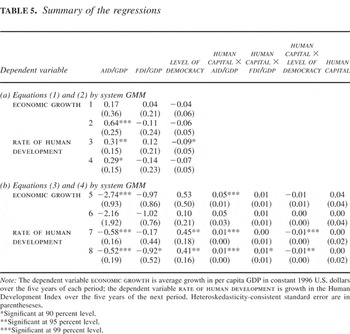
Summary of the regressions

Aid and FDI in the development of China and Indonesia

Number of observations for each level of the human capital variable (c)

Countries by range of human capital (c) for the middle period (1980–84)
 You have
Access
- 111
- Cited by