


Introduction
Based on different water masses and prevailing currents, two major oceanic sub-regions can be identified off the Antarctic Peninsula, the Bransfield Strait and the waters west of the Peninsula (Loeb et al. Reference Loeb, Kellermann, Koubbi, North and White1993). The hydrography of the Bransfield Strait has been described in detail by several studies (Stein Reference Stein1989, Capella et al. Reference Capella, Ross, Quetin and Hofmann1992, Hofmann et al. Reference Hofmann, Klinck, Lascara and Smith1996, Smith et al. Reference Smith, Hofmann, Klinck and Lascara1999). The cold and saline coastal waters from the Weddell Sea flow westward along the southern shelf of the Strait, mixing with the Bellingshausen Sea water flowing in from the west, then turn to the north and north-east forming a gyre. This influences the larval fish assemblage inhabiting the Bransfield Strait, which consists of low-Antarctic species at the southern limit of their distribution and high-Antarctic species probably carried into the area by the two main water masses mentioned above (Loeb et al. Reference Loeb, Kellermann, Koubbi, North and White1993). Pleuragramma antarcticum Boulenger typically dominate the larval fish assemblage associated with the Weddell Sea water masses. Other abundant nototheniids are Lepidonotothen (Nototheniops) larseni (Lönnberg), Lepidonotothen nudifrons (Lönnberg) and L. kempi (Norman), which occur in the two main water masses and in mixed waters of Bransfield Strait (Sinque et al. Reference Sinque, Koblitz and Costa1986, Kellermann Reference Kellermann1986, Reference Kellermann1989a). Chionodraco rastrospinosus Dewitt & Hureau is the most abundant channichthyid, frequently encountered in krill swarms and along with some larval nototheniids which represent their usual prey (Slosarczyk & Rembiszewski Reference Slosarczyk and Rembiszewski1982, Kellermann Reference Kellermann1989a, Reference Kellermann1989b).
In understanding fish population dynamics knowledge of early life history traits, such as larval duration and hatching time, is fundamental as these strongly influence rate of dispersal and connectivity between populations; as is the influence of oceanographic and ecological factors in shaping fish assemblages (Galarza et al. Reference Galarza, Carreras-Carbonell, MacPherson, Pascual, Roques, Turner and Rico2009). This is particularly true in the Bransfield Strait area, where circulation is characterized by a gyre that may lead to larval retention (Capella et al. Reference Capella, Ross, Quetin and Hofmann1992, Hofmann et al. Reference Hofmann, Klinck, Lascara and Smith1996). Conversely, wind forcing and proximity of the Antarctic Circumpolar Current (ACC) fronts influence rates of advection far from the Bransfield Strait (Fach & Klinck Reference Fach and Klinck2006), dramatically altering local fish assemblages (Kellermann & Kock Reference Kellermann and Kock1988). Based primarily on large-scale surveys associated with the BIOMASS program (e.g. FIBEX and SIBEX), much information has been provided on the composition, distribution, and abundance of early life stages of fishes around the Antarctic Peninsula (reviewed in Loeb et al. Reference Loeb, Kellermann, Koubbi, North and White1993). Nevertheless, the early life history traits of most species are still poorly understood.
As is commonly found in channichthyids, C. rastrospinosus spawns relatively few large yolky eggs in autumn (March–April), and the first apperance of larvae takes place in late winter–spring (Kock & Kellermann Reference Kock and Kellermann1991, Vanella et al. Reference Vanella, Calvo, Morriconi and Aureliano2005). Early life stages of C. rastrospinosus are distributed from November until March from Anvers Island to Elephant Island, although the main area of distribution is the southern shelf of the Bransfield Strait, which represents perhaps one of the main spawning areas for the species (Kellermann Reference Kellermann1986). The duration of the juvenile pelagic phase and the timing of demersal transition of this species is still uncertain (Kellermann Reference Kellermann1989a, Reference Kellermann1990). However, the absence of juveniles smaller than 20 cm standard length (SL) in bottom trawl catches would indicate a long pelagic period, at least off the South Shetland Islands (Gubsch Reference Gubsch1982). The temporal sequence of larval occurrence and size increase over time has provided rough estimates of daily growth rate of C. rastrospinosus, ranging from 0.21 mm between January and February to 0.37 mm between February and March (Kellermann Reference Kellermann1986).
Microincrement deposition of otoliths has been studied in only a few species of Antarctic larval fish (Radtke & Kellermann Reference Radtke and Kellermann1991), despite potentially providing more accurate determination of the timing of early life history events, such as hatching or first exogenous feeding, or individual growth rate variability (Kellermann et al. Reference Kellermann, Gauldie and Ruzicka2002). The onset of exogenous feeding and larval growth are strongly affected by the availability of suitable food in the environment, which in turn determines larval survival and recruitment success. Knowledge of food and feeding rates of early life stages is therefore essential in order to investigate factors that govern recruitment.
Larvae and juvenile C. rastrospinosus were collected during the US Antarctic Marine Living Resources (AMLR) oceanographic cruise carried out off the Antarctic Peninsula in February–March 2011, giving us the opportunity to provide additional insight into the early life history traits of this species. Based on otolith microstructure and stomach content analyses, the aim of this paper was to estimate age and growth and food and feeding rates during the early ontogeny, respectively. Ageing data enabled us to determine with accuracy the timing/size at hatching as well as the onset of first exogenous feeding.
Materials and methods
Sampling at sea
Early life stages of C. rastrospinosus were collected in the Bransfield Strait and adjacent areas over the period 13 February–15 March 2011 aboard the RV Moana Wave as part of the US AMLR 2010/11 Antarctic field season (Table I). The area surveyed included the Bransfield Strait from Brabant to Joinville islands and the shelf north of Elephant Island (Fig. 1). To study local pelagic finfish assemblages, sampling was carried out using two mid-water net systems for comparative purposes. A total of 76 stations were sampled by 1.8 m Isaac Kidd midwater trawl (IKMT) single net and 4 m2 multiple opening and closing Tucker trawl towed at single (0–170 m) and different (0–170, 170–300, 300–600 m) depth strata, respectively. The mesh size was 505 μm for the IKMT and 505 μm–5 mm for the Tucker trawl. At the end of each tow, all the individuals were sorted and identified according to the identification key and catalogue of larval Antarctic fish (Kellermann Reference Kellermann1990). Each individual was measured to the nearest mm below SL, weighed (mg) and stored in ethanol (70%) for further analyses. The length-weight relationship of fish was estimated by applying the exponential equation W = a x SLb, where W is total body weight (mg), SL is standard length (mm) and a and b are the regression parameters. To determine a and b, the equation was initially linearized applying the log10-transformation to the length-weight data pairs.
Sampling data including fishing stations (date, position and depth) and samples of Chionodraco rastrospinosus (number, size and age ranges) collected in the Bransfield Strait and adjacent areas.

Study area off the Antarctic Peninsula including the Bransfield Strait and the area north of Elephant Island, showing all sampling stations (empty circle) and stations where early life stages of Chionodraco rastrospinosus were caught (filled circle).

Otolith preparation and increment analysis
In the lab, pairs of sagittal otoliths were removed from each fish under a stereomicroscope and one of them randomly selected. They were embedded in epoxy resin (Petropoxy) medial side down directly on glass slides. The resin was cured at c. 80°C for about 12 hours. Otoliths were ground with a metallographic grinding paper disc (800 grit) until increments were readable along the counting path, and finally polished with 0.05 μm alumina using a lapping wheel (Remet).
Increment counts and measurements were made under a light microscope at 630 x magnification, equipped with a CCD (charge-coupled device) video camera connected to an image analysis software package (Image-Pro Plus, Media Cybernetics Inc, Silver Spring MD, USA). Generally, increment counts were made along the same counting path, i.e. from the core to the margin of rostrum. Two increment counts were carried out for each otolith, with the mean value between them assigned as individual age estimate in days. Based on similar deposition patterns and increment widths observed in other age-validated channichthyids (Slosarczyk Reference Slosarczyk1987, Kellermann et al. Reference Kellermann, Gauldie and Ruzicka2002, Morley et al. Reference Morley, Belchier, Dickson and Mulvey2005), we assumed the daily periodicity of increment deposition in otolith of C. rastrospinosus as well.
To detect changes in microincrement deposition patterns linked to events during early life, we focused on locating on otolith section check marks, which are wider zones of discontinuity within the common alternating pattern of microincrements. Otolith radius (OR, μm) was measured as the maximum distance from the primordium to the rostrum margin. The relationship between fish size (SL, mm) and OR was estimated using a least-squares linear regression.
Age and growth
For each individual, age was estimated by counting microincrements from primordium to otolith margin, assuming they are laid down from hatching onwards. The relationship between fish size (SL, mm) and age (days) was assessed by fitting a linear equation: SL = a + b age, where a is the fish size at age 0 (i.e. the estimated size at hatching) and b is the instantaneous growth rate. No pattern in the residuals nor overly influential observations (outliers) was observed in the linear regression. Assumption of homogeneity of variance and normality of data were checked applying Levene's test and the Shapiro-Wilk test, respectively. The index of average percent error (APE) (Beamish & Fournier Reference Beamish and Fournier1981) and the mean coefficient of variation (CV) (Chang Reference Chang1982) were calculated from the whole age dataset, to estimate the ageing precision between readings (Campana Reference Campana2001).
Based on ageing data and on dates of capture, the monthly hatch dates distribution was back-calculated. Unfortunately, age or size-selective mortality rates of early life stages of this species were unknown. The cumulative mortality differential between youngest and oldest specimens was probably greatly reduced, as all individuals aged were old enough to guarantee a low and stable mortality rate at the time of capture, providing reliable hatch date distribution (Campana & Jones Reference Campana and Jones1992).
Diet
The stomach contents of each specimen were washed out into a petri dish and sorted under a dissecting microscope. Whenever possible, each prey item was identified to the species level and the number of prey recorded. To evaluate the rate of feeding activity, the coefficient of emptiness V = Ne/Ns, where Ne is the number of empty stomachs and Ns is the total number of stomachs examined, was calculated. The contribution of each prey type to the diet was evaluated using the percentages by number (N%) and the frequency of occurrence (O%), defined as the number of stomachs containing a particular prey as percentage of the total number of stomachs examined (Hyslop Reference Hyslop1980).
Results
Fish samples
A total of 28 post-larvae and juvenile C. rastrospinosus ranging from 39–69 mm SL and from 150–1270 mg were collected and successfully aged. The estimated length-weight relationship was W = 6.57 x 10⁻⁵ SL3.93, showing a significant positive allometric growth (i.e. b > 3, t-test, P < 0.001). Due to the few individuals collected, the length frequency distribution was split into 5 mm size classes (Fig. 2). Most catches were located off Joinville Island and in the Bransfield Strait, with a few individuals sampled off Brabant and Trinity islands. Individuals were caught in the uppermost depth strata, between 0–170 m and 170–300 m (61% and 39%, respectively), mostly with the Tucker trawl (89%). No relationship was found between fish size and depth.
Length-frequency distribution of post-larvae and juveniles of Chionodraco rastrospinosus collected in the Bransfield Strait and adjacent areas in February–March 2011. SL = standard length.

Otolith microstructure
Sagittal otoliths of transforming larvae and juvenile C. rastrospinosus had a discoid shape, being at the onset of rostrum formation (Fig. 3). The otolith core consisted of primordium with multiple nuclei, encircled by relatively thin and evenly spaced microincrements ranging approximately from 1–1.8 μm (Fig. 4). They showed a common bipartite structure, consisting of a discontinuous zone (D-zone) and an incremental zone (L-zone), which appeared respectively dark and light under transmitted light. All otoliths were characterized by a strong check located at 23–52 microincrements of distance from the core (mean 38.1, SD 5.6) (Figs 3 & 4). This check was probably laid down after the absorption of the yolk sac (thus defined also first exogenous feeding check), as hypothesized in other channichthyids such as Chaenocephalus aceratus (Lönnberg) (La Mesa & Ashford Reference La Mesa and Ashford2008), Champsocephalus gunnari Lönnberg (Morley et al. Reference Morley, Belchier, Dickson and Mulvey2005) and Pseudochaenichthys georgianus Norman (Kellermann et al. Reference Kellermann, Gauldie and Ruzicka2002).
Medial side of sagittal otolith of post-larval Chionodraco rastrospinosus at the onset of rostrum formation, showing an evident check surrounding the primordium (arrow). Scale bar = 100 μm.

Core of sagittal otolith of post-larval Chionodraco rastrospinosus with multiple nuclei forming the primordium (arrowhead), encircled by thin end evenly spaced microincrements. Scale bar = 10 μm.

Age and growth
Based on microincrement counts, age estimates ranged from 105–211 days. The variability of age readings was relatively low, each differing less than 10% from the corresponding mean. The good consistency between readings was also indicated by the low value of indices of ageing precision CV and APE, being respectively 3.6% and 2.5%. Furthermore, no bias was present between readings across the whole age range estimated, as shown in the residuals plot (Fig. 5).
Residuals plot of pair-wise age estimates across the whole age range obtained by microincrement counts.

The hatch date distribution, back-calculated from the date of capture and pooled on a monthly basis, was spread over a relatively long period, lasting from August–November without any apparent peak (Fig. 6).
Hatch date monthly distribution of post-larvae and juvenile Chionodraco rastrospinosus back-calculated from age estimates and date of capture.

The relationship between fish size (SL, mm) and age (days) was described by the following linear equation (Fig. 7):
 $$ {{\rm{SL}}\,{\rm{ = }}\,{\rm{17}}{\rm{.24 \ ( \pm }}\,{\rm{2}}{\rm{.59, s}}{\rm{.e}}{\rm{.)}}\,{\rm{ + }}\,{\rm{0}}{\rm{.25 \ ( \pm }}\,{\rm{0}}{\rm{.02, s}}{\rm{.e}}{\rm{.)}}\ {\rm{age, }}\cr &n\,{\rm{ = }}\,{\rm{28, }}\ {{r}^{\rm{2}}} \,{\rm{ = }}\,{\rm{0}}{\rm{.89}}{\rm{.}}\eqno\rm$$
Relationship between estimated age and fish size (standard length (SL)) of post-larvae and juveniles of Chionodraco rastrospinosus collected in the Bransfield Strait and adjacent areas.

Accordingly, the instantaneous growth rate of transforming larvae and juvenile C. rastrospinosus was 0.25 mm day-1, with an estimated hatching size of c. 17.2 mm. Applying this relationship to the feeding check data, the estimated larval size at first exogenous feeding ranged from 22.9–30.1 mm (mean 26.6, SD 1.4).
The relationship between fish size (SL, mm) and otolith radius (OR, μm), fitted by a least-squares linear regression, was as follows (Fig. 8):
 $$ {{\rm{SL}}\,{\rm{ = }}\,{\rm{17}}{\rm{.22 \ ( \pm }}\,{\rm{2}}{\rm{.82, s}}{\rm{.e}}{\rm{.)}}\,{\rm{ + }}\,{\rm{0}}{\rm{.16 \ ( \pm }}\,{\rm{0}}{\rm{.01, s}}{\rm{.e}}{\rm{.) \,OR, }}\cr &n\,{\rm{ = }}\,{\rm{28, }}\ {{r}^{\rm{2}}} \,{\rm{ = }}\,{\rm{0}}{\rm{.88}}{\rm{.}}\eqno\rm$$
Relationship between otolith radius (OR) and fish size (standard length (SL)) of post-larvae and juveniles of Chionodraco rastrospinosus collected in the Bransfield Strait and adjacent areas.

Yet, the fish size at otolith formation (i.e. OR=0) was exactly the same as the fish size at hatching estimated above.
Diet
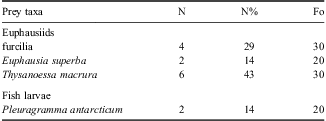
The stomach content analysis was carried out on the entire fish sample (28 individuals). The coefficient of emptiness was relatively high at c. 64% (18 empty stomachs). The food composition is summarized in Table II. The stomach contents consisted exclusively of pelagic prey, such as euphausiids and fish larvae. Prey taxa were evenly distributed, with the frequency of occurrence between 20% and 30%. Euphausia superba Dana, Thysanoessa macrura G.O. Sars and unidentified euphausiid furcilia were the main prey items, followed by larval stages of Pleuragramma antarcticum. Generally, most individuals (80%) contained single prey in their stomachs.
Stomach contents of juvenile Chionodraco rastrospinosus (n = 10) in the Bransfield Strait. N = number of prey, N% = percentages by number, Fo = frequency of occurrence.
Discussion
As described in previous studies carried out on larval fish assemblages in the Bransfield Strait (Kellermann & Kock Reference Kellermann and Kock1984, Kellermann Reference Kellermann1986), the area of confluence of the two water masses of Weddell and Bellingshausen seas origin is the northern limit of distribution of high-Antarctic species, such as C. rastrospinosus. Our data closely resembled the overall geographic distribution of early life stages of C. rastrospinosus previously reported in the Bransfield Strait, which included mainly the southern continental shelf of the west Antarctic Peninsula from Anvers Island to Elephant Island. In agreement with previous data (Kellermann Reference Kellermann1986, Morales-Nin et al. Reference Morales-Nin, Palomera and Schadwinkel1995), the vertical distribution of post-larvae and juveniles is restricted to the uppermost 200–300 m of the water column. Therefore, according to Garcia et al. (Reference Garcia, Castro, Rios, Doval, Roson, Gomis and Lopez2002), in summer the early life stages of C. rastrospinosus were mainly distributed in the Transitional Zonal Waters with Weddell Sea influence (TWW), which occupies almost the entire volume of the Bransfield basin.
The spatial and temporal distribution of larval fish is primarily determined by spawning location and main oceanographic features. The Bransfield Strait is characterized by a complex cyclonic gyre system driven by the ACC and the westward setting Polar current (Stein Reference Stein1989), acting as a potential retention area for larval fish at various stages. It represents a nursery area for several notothenioids, which spawn elsewhere in the north-western Weddell Sea and in the Bellingshausen Sea (Kellermann & Schadwinkel Reference Kellermann and Schadwinkel1991). Conversely, the Bransfield Strait and adjacent waters are the spawning grounds of C. rastrospinosus, as adults in pre-spawning conditions are commonly found in February–March around Elephant Island and the South Shetland Islands and at the tip of the Antarctic Peninsula (Kock et al. Reference Kock, Jones and Wilhelms2000, Kock & Jones Reference Kock and Jones2005). Spawning of C. rastrospinosus in the southern Scotia Arc lasts about two months, taking place in March and April (Gubsch Reference Gubsch1982, Kock Reference Kock1989, Kock & Kellermann Reference Kock and Kellermann1991, Kock & Jones Reference Kock and Jones2005).
Interestingly, age distribution of early life stages of C. rastrospinosus showed a spatial pattern consistent with the cyclonic gyre system within the Bransfield Strait, with mean age progressively increasing towards the south-westernmost stations located in the southern continental shelf of the west Antarctic Peninsula (i.e. from Joinville Island to Trinity Island).
The hatching period of this species occurs in late winter and spring, spread over a relatively long period lasting four months (i.e. from August–November) (Kellermann Reference Kellermann1986, this study). This is consistent with the observation of yolk-sac larvae ranging between 20–36 mm SL, which had been caught from late October to early December throughout the Bransfield Strait and adjacent waters (Kellermann Reference Kellermann1986, Reference Kellermann1989a). Coupling spawning and hatching times, the incubation period of eggs of C. rastrospinosus is about four to six months, significantly longer than previously reported (Kock Reference Kock1989). This is consistent with the large egg size at spawning for this species (4.8–5.0 mm) which is among the maximum values reported for notothenioids (Kock & Kellermann Reference Kock and Kellermann1991), and confirms the general rule that incubation time is directly related to egg size under similar environmental conditions (Kock Reference Kock1989). In turn, compared to other notothenioids, the size at hatching estimated for this species is relatively large (i.e. about 17 mm) (Kellermann Reference Kellermann1989a, this study).
The timing and duration of the yolk-sac larval stage of C. rastrospinosus (i.e. from hatching to complete yolk-sac absorption) was somewhat different between individuals (Kellermann Reference Kellermann1986, this study) and generally as long as one to two months due to the abundant yolk reserves produced by their large eggs. This is a rather common feature among channichthyids, such as C. aceratus and P. georgianus, which begin to feed exogenously at least one month after hatching (Kellermann et al. Reference Kellermann, Gauldie and Ruzicka2002, La Mesa & Ashford Reference La Mesa and Ashford2008). In this family, the yolk-sac duration and the related timing of exogenous feeding increases with egg size and larval size at hatching and decreases with relative fecundity (La Mesa & Ashford Reference La Mesa and Ashford2008). From an ecological perspective, large size and yolk reserves at hatching enable channichthyids to cope with frequent annual food variability, allowing them to utilize a larger spatial scale and a wide size range of prey which are highly variable in temporal occurrence, such as furcilia stages of krill and larval fishes. In particular, furcilia and adults of T. macrura and E. superba and post-larval stages of nototheniids, such as L. larseni, Gobionotothen gibberifrons Lönnberg, P. antarcticum and Trematomus newnesi Boulenger, are the common prey of post-larvae and juvenile C. rastrospinosus (Kellermann & Kock Reference Kellermann and Kock1984, Kellermann Reference Kellermann1986, Reference Kellermann1989b, this study).
Based on modal progression analysis of monthly length frequency distributions, including larvae of C. rastrospinosus between 22 and 56 mm SL collected from November–March, Kellermann (Reference Kellermann1986) estimated an exponential growth rate of 0.07–0.37 mm day-1. Our estimate of daily growth rate (i.e. 0.25 mm day-1 in individuals between 39 and 69 mm SL) falls within this range, and it is slightly lower than that estimated by modal progression analysis carried out on individuals of similar size caught in the Bransfield Strait in March (0.30 mm day-1, Slosarczyk Reference Slosarczyk1987). The difference between daily growth rates estimated by direct methods (microincrement counts) and modal progression analysis was previously reported for juvenile C. aceratus (La Mesa & Ashford Reference La Mesa and Ashford2008). Differently from microincrement counts, the modal progression analysis is generally carried out on individuals collected over a longer sampling period (several months), and potentially selects faster growing individuals which can result in an overestimate of daily growth rate.
The juvenile pelagic phase in most channichthyids is poorly known, but it may last up to two to four years (Kock Reference Kock2005). As most channichthyids are rather sedentary as adults, the duration of the larval and juvenile pelagic phase plays a fundamental role in determining dispersal and connectivity among populations related to the physical circulation of oceanic systems (Papetti et al. Reference Papetti, Susana, Patarnello and Zane2009, Ashford et al. Reference Ashford, La Mesa, Fach, Jones and Everson2010). Assuming a constant growth rate of 0.25 mm day-1 during the early life stages of C. rastrospinosus, smaller juveniles (14–16 cm) collected in December 2006–January 2007 from the South Shetland Islands by bottom trawl would be roughly 1.5 years old, consistent with the previous age estimation (i.e. 1+) based on the otolith annulation patterns (La Mesa & Ashford Reference La Mesa and Ashford2008). One and a half years can therefore be considered the first upper-bound estimate of their residence in pelagic waters. As a result, larvae and juveniles of C. rastrospinosus which form a consistent component of larval fish assemblages of the Bransfield Strait in summer remain there over much of following winter and spring.
The relatively long residence time in the water column would account for larval dispersal from the Bransfield Strait to areas downstream through the Southern Antarctic Circumpolar Current Front (SACCF) (Orsi et al. Reference Orsi and Whitworth1995), like the South Orkney Islands, as recently hypothesized in other studies (Papetti et al. Reference Papetti, Pujolar, Mezzavilla, La Mesa, Rock, Zane and Patarnello2012). Based on water circulation data obtained from drifters deployed to the east of the tip of the Antarctic Peninsula (Thompson et al. Reference Thompson, Heywood, Thorpe and Trasviña2009), early life stages of C. rastrospinosus found in the easternmost stations off Joinville Island could be possibly transported through the Antarctic Slope Front along the southern edge of the South Scotia Ridge, encountering the southern boundary of the ACC.
Acknowledgements
We thank all the crew members, personnel and scientific staff aboard of RV Moana Wave for their invaluable support in sampling activities. Comments of two anonymous reviewers greatly improved the early version of the manuscript. This study was supported by the PNRA (Italian National Antarctic Research Program).



