Punishing governments when the economy performs badly and rewarding them when it goes well is one of the pillars of democratic accountability. For decades, political scientists have thoroughly analyzed the validity and implications of this simple reward-punishment model applied to the economy.Footnote 1 The economic voting literature has developed around the idea that changes to the real-world economy affect citizens’ assessments of the economy’s performance, and that citizens’ economic evaluations influence their voting behavior.Footnote 2 The existence of alternative determinants of subjective economic evaluations to explain this causal nexus, however, has increasingly been a matter of debate. A new revisionist perspective argues that the classic reward-punishment model suffers from endogeneity biases, and that subjective perceptions of the national economy are partly a function of pre-existing party preferences.Footnote 3
The determinants of the type of economic discourse in parties’ communication strategies have recently received some attention.Footnote 4 The difference in parties’ economic positionsFootnote 5 and the competence signal of the incumbentFootnote 6 have proven to be important conditioning factors strengthening the link between the economy and vote choice. However, the capacity of party discourse to actually persuade voters about economic performance is absent from this debate. This is surprising, since parties’ capacity to place certain issues on the agenda and activate particular dimensions of conflict over others has proven to be remarkable in other subfields of political behavior.Footnote 7 Previous research on the political conditioning of economic perceptions has normally considered individual-level factors like party identification or party choice. This literature follows the Michigan tradition of political research and considers partisanship as a ‘perceptual screen’ that influences how voters reconcile information about policy outcomes with political choices.Footnote 8 This conception of political conditioning, however, neglects the role of external sources of political cueing and therefore only accounts for individual-level mechanisms. Moreover, party identification is known to be a very stable individual trait, so it cannot be responsible for short-term changes in subjective economic evaluations.
In this article we use a novel dataset of monthly party salience on economic issues obtained through content analyses of party questions in plenary debates in parliament. We have matched this dataset with objective macroeconomic indicators and survey data on individual determinants of evaluations of the national economy, such as ideological predispositions. Our analyses cover four electoral cycles in Spain (1996–2011). This time span and context is a conservative test for the effect of partisan sources of political conditioning of the economy, given the important variation in real macroeconomic conditions from remarkably good to dramatically bad during this period. During this time span, each of the two main Spanish parties (the conservative Partido Popular (PP) and the socialist Partido Socialista Obrero Español, PSOE) was in two separate single-party governments. This context is thus ideal to test how (lagged) party discourse can matter, by observing the two main Spanish parties as incumbents and challengers, and across varying macroeconomic conditions. Spain’s proportional, multiparty system makes this study a comparable case across Western democracies. The strong pivotal role of the two main parties and their alternation in power, however, allow us to better identify the effect of single-party discourse when in government and in opposition.
Our analyses show that party salience on the economy has a substantial effect on conditioning public economic perceptions. This is beyond the strong effect of objective macroeconomic conditions, ideology and vote choice. However, party discourse requires two conditions in order to be effective. First, the party needs to be the issue owner and therefore have a stronger reputation for dealing with economic issues (which in this case is the right-of-center PP). Secondly, the party needs to be in opposition, since the effect of the incumbent’s discourse vanishes when controlling for the real economy. These findings have important implications for both classic and revisionist perspectives on the study of subjective economic perceptions. In line with classic perspectives, incumbent parties are very constrained by how the economy is really doing, and therefore their capacity to condition public opinion and pervert classical processes of accountability is very limited. In line with revisionist perspectives, however, the risk of political conditioning by parties with a good economic reputation in opposition is remarkable. Moreover, this capacity to shape public opinion does not depend on how the economy is really doing, and does not only affect partisans or citizens with similar ideological views.
Conditioning Factors of Economic Perceptions
Conventional wisdom in political science holds that the state of the economy affects electoral outcomes. One of the main traditions in the economic voting literature relies on aggregate data. Vote shares or approval ratings of the incumbent party over time are regressed on levels of (or changes in) macroeconomic conditions.Footnote 9 Another tradition of research in the economic voting literature has used survey data to demonstrate the association between economic performance and electoral outcomes at the individual level. The survey approach to economic voting has usually relied on respondents’ views about the state of the economy.Footnote 10
A considerable amount of research in the second tradition has suggested that sociotropic economic perceptions are associated with vote choices.Footnote 11 The magnitude and robustness of this association, however, is much higher in research that uses objective aggregate indicators.Footnote 12 The effect of subjective evaluations of the economy on election results appears to largely depend on institutional factors,Footnote 13 and on individual-level characteristics explaining how voters articulate their perceptions of the economy or attribute political responsibility.Footnote 14 Thus, assessing sources of heterogeneity among individuals regarding the articulation of economic perceptions appears to be an important enterprise in this literature.
The systematic analysis of the whole range of factors that connects objective macroeconomic performance and individual subjective perceptions is still underdeveloped. One of the scarce works that directly tackles the individual heterogeneity of economic perceptions highlights four factors mediating the link between the objective and subjective economy: (1) personal financial experience, (2) group self-interest, (3) political attitudes, and (4) information and media exposure.Footnote 15 Political attitudes as a source of heterogeneity in evaluations of the national economy is by far the most developed line of research, and has generated an intense debate about the degree of exogeneity of these evaluations.Footnote 16 Political attitudes refer to the effect of ideology and partisanship on economic evaluations. The main expectation is that individuals with strong attachments to the incumbent may perceive the national economy more positively. There is increasing evidence that party identification acts as a ‘perceptual screen’ filtering facts from political reality.Footnote 17 However, the effectiveness of this screen also depends on the clarity of responsibility regarding the management of the economy.Footnote 18
The role of political factors like economic policy, political events and media coverage has been shown to condition levels of consumer confidence beyond the effect of the macroeconomy.Footnote 19 The literature assessing the mechanisms through which partisan cues can affect economic evaluations has not yet considered what parties say about the economy. Parties’ capacity to politicize existing dimensions of political competition has proved to be crucial in other subfields of political behavior, for example class cleavagesFootnote 20 or support for the political system.Footnote 21 This also seems to be particularly relevant for the economic voting literature, as focusing on a presumably stable trait such as party identification can provide very little leverage to account for short-term changes in economic evaluations. The study of the possible political conditioning of economic evaluations should take into account voters’ partisanship, but also a party’s capacity to cue voters. This approach can be relevant for the controversy at stake. If top-down processes of political conditioning exist, a scenario of bad economic times and strong levels of partisanship for an incumbent party, for example, might not be enough to bias economic perceptions toward more positive evaluations. The direction and magnitude of the bias will depend on the challenger’s capacity to place economic issues on the public agenda, and to persuade different kinds of voters across the ideological spectrum that the economy is performing badly.
Party Discourse as a Conditioning Factor
When including parties in economic voting studies, there are three main objects of study: (1) the type of economic discourse and campaign that will most likely be followed by opposition and incumbent parties,Footnote 22 (2) the conditioning role of party positionsFootnote 23 and (3) third-party competence signals.Footnote 24 These three characteristics have been found to be significant in activating the link between economic factors and the vote. The effect of party discourse on public economic perceptions, however, is still a prominent gap in the literature.
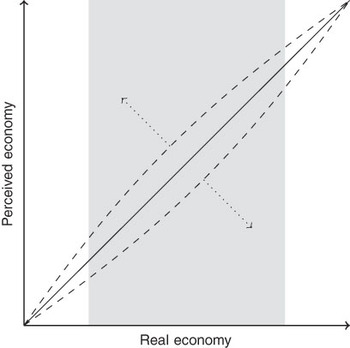
Figure 1 shows what would be a traditional expectation of political conditioning of the economy. In a perfect setting, we would expect citizens’ perceptions to match the cues given by the real economy; however, we know that this is not the case. As Parker-StephanFootnote 25 has found, for instance, partisan attachments alter this linear relationship and make government partisans more optimistic, and opponents more pessimistic. However, this partisan effect only exists in a middle-ranged zone, since in ‘too good’ or ‘too bad’ economic climates, citizens converge in their perceptions.Footnote 26
Political conditioning of the economy

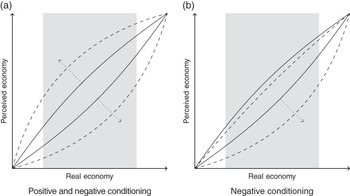
Following this line of argument, we argue that party discourse can effectively condition citizens’ economic perceptions in this middle zone. However, instead of discourse having the capability to affect these perceptions in a positive and/or negative way (as depicted in Figure 2a), we argue that it can only affect them negatively (as Figure 2b shows). Specifically, we reach this argument by merging the theory of issue ownershipFootnote 27 with that of negativity bias.Footnote 28
Political conditioning by party discourse

Issue ownership theory is an influential framework in economic voting studies, which allows us to derive observable implications regarding the effect of party discourse. It predicts that voters will evaluate parties or candidates on important issues, and that some issues will naturally advantage or disadvantage one party over the others.Footnote 29 In issue ownership terms, the party should prime an issue that it owns. The theoretical presumption is that when a party owns an issue, it is perceived by the electorate as being better and more credible at handling problems in that issue area.Footnote 30 For instance, in the United States, Democrats are considered to own the issue of health care, and Republicans are believed to own the issue of national security.Footnote 31 Similarly, in Western European countries, socialist parties are perceived to own welfare politics, while right-wing parties are believed to own the issues of immigration and economic growth, and green parties are believed to own environmental issues.Footnote 32 When a party owns an issue, and public opinion considers that issue important, the theory predicts that the party’s candidates should benefit electorally. A more refined interpretation of issue ownership has led researchers to consider some specific economic topics as likely to benefit the electoral prospects of certain types of parties. From this perspective, inflation is likely to benefit center-right parties, whereas unemployment is likely to connect with the issue priorities and competence reputation of center-left parties.Footnote 33 Recent comparative economic voting studies, however, have found mixed evidence for this refined version of issue ownership applied to the study of the economy and the vote.Footnote 34
Owning the economy (or having a strong political reputation of handling it effectively) becomes crucial according to this theoretical framework. The issue owner is thus expected to have more economic credibility and therefore to be able to condition public opinion more clearly. This expectation implies a direct effect of the issue owner’s discourse beyond (and independently of) the real economy. The idea that parties’ economic discourse is a sole function of the macroeconomy would imply that the former is in some sense a mirror image of the latter. If incumbents are to influence public opinion when the economy is performing well, and if challengers have to do so when the economy performs badly, the true driver of the effect is the macroeconomy; thus party discourse has very little leverage to shape public perceptions. If party discourse has any substantive relevance in the process of the political conditioning of economic perceptions, parties with a better reputation of handling economic issues should be able to persuade voters beyond how things are really going.
There are reasons, however, to suspect that the credibility of the issue owner’s messages will differ depending on whether it is in or out of power. In her study about how voters evaluate economic competence in Britain, ButtFootnote 35 shows that retrospective evaluations of economic performance influence evaluations of the incumbent, but not the challenger. While citizens can rely on an up-to-date performance record to judge the incumbent (through the real macroeconomy, for example), judgements about the discourse and hypothetical performance of the challenger can be more responsive to ideological predispositions and partisan cues.Footnote 36 The experience of living under the current government is certain and readily available, and therefore the discourse of the incumbent should have a much more limited power to persuade voters. By contrast, the evaluation of the prospective performance and current discourse of the challenger can be more subject to partisan sources of information and persuasion. While the incumbent has to deal with ‘real events’, the challenger can be judged ‘only by talk’.Footnote 37 This is consistent with De Boef and Kellsted’s findings that US presidents cannot always use the power of the press to maintain high approval ratings, and that while they are in power they ‘cannot use rhetoric to consistently dupe the public’.Footnote 38
The stronger potential for opposition parties to place economic issues on the agenda and condition public perceptions beyond the macroeconomic facts is also supported by research in political psychology, which documents negativity bias in information reception. Negative information has a significantly larger effect on impression formation.Footnote 39 From a political behavior perspective, ClaggettFootnote 40 showed that there is an asymmetric relationship between macroeconomic conditions and the response of the congressional electorate. Contractions reduce the vote share of the incumbent party, but it is not rewarded for economic expansions.Footnote 41 Lau also found evidence that negative information is more influential than positive information in affecting evaluations of presidential candidates.Footnote 42 More recently, media studies have provided evidence that negative views are more likely to attract the media’s attention and to be placed on the public agenda.Footnote 43
Based on these predictions, and if party discourse is able to shape public evaluations of economic performance, one can expect that the owner of the economy will be more successful at shaping public perceptions. Moreover, both the constraints of real facts for incumbent parties and the negativity bias framework expect the challenger’s discourse to be more likely to place economic issues on the agenda and to condition public opinion. Table 1 summarizes these predictions.
Theoretical Expectations

Our reasoning implies that important partisan sources of political conditioning of economic evaluations may be at play, and that this should be largely independent from the real economy and individual ideological predispositions. However, our expectations acknowledge the role of the real economy and classic accountability, in the sense that incumbent parties’ real performance should be more important than their discourse. Moreover, we only expect party effects among economically credible parties. It is important to stress that our theory does not intend to resolve the controversy between classic and revisionist perspectives. Our attempt is rather to include a substantively important factor that has been overlooked in the literature, and to deepen our understanding of when and why external partisan cues should shape public opinion.
Research Design
In this section we describe the data collected for the purposes of testing the expectations described above. Three elements are critical in this task: (1) choosing the country to analyze, (2) obtaining a measure of party salience and (3) assessing voters’ economic evaluations. Each of these three elements is explained below.
Spain: From Bounty to Crisis
The expectations of different economic voting models have been largely tested in Anglo-American democracies. The reward-punishment logic is a very intuitive model to apply in two-party majoritarian democracies, in which there are usually single-party governments and one clear challenger. We believe that extending the test to a multiparty proportional system like Spain, which is a less-studied context in the economic voting literature, can increase the comparative power of the propositions sketched out above. Spain is also a relevant context in which to test our theoretical propositions because it went from relatively good macroeconomic conditions to being one of the Western democracies most punished by the global economic meltdown. This is thus a conservative test for party discourse, given the presumably important effects of macroeconomic conditions.Footnote 44
The time span analyzed covers four electoral cycles. The two first cycles (March 1996–March 2000 and April 2000–March 2004) had a right-wing single-party government, and the two last cycles (April 2004–March 2008 and April 2008–November 2011) had a left-wing single-party government. This allows us to vary the ideological orientation of incumbent parties. We focus on the two main parties competing in general elections in Spain: the left-wing socialist PSOE and the right-wing conservative PP. Despite the presence of many other parties in the Spanish political spectrum, the PP and PSOE were able to govern two electoral cycles each without the need for a coalition partner. While acknowledging the role of other parties in the Spanish national parliament, we keep the distinction between one main incumbent and one main challenging party that is inherent in the theory described above.
The PP has a stronger reputation for dealing with economic issues. Apart from an intuitive link between economic priorities and economic issues in Western Europe,Footnote 45 the link between economic competence and right-wing parties is particularly likely in Spain given the country’s bad macroeconomic performance during its democratic stabilization (during the 1980s and early 1990s) under socialist rule. Furthermore, the PP is – according to survey data such as the European Election Studies (EES) – the party most able to handle the issue of the economy during the time span analyzed.Footnote 46 Previous research on economic voting in the Spanish context shows that the link between macroeconomic conditions and the PSOE’s electoral results is non-existent.Footnote 47 This finding confirms the lack of a connection between economic priorities, a reputation of economic competence and the PSOE’s electoral prospects. Rather than economic considerations, an electoral coalition of primarily blue-collar workers, rural voters and voters dependent on state-subsidized income explains the historical disconnection between the PSOE’s electoral victories and economic fluctuations.Footnote 48
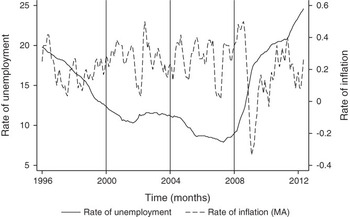
Figure 3 shows the evolution of the unemployment rate (solid line) and the rate of change in the consumer price index (dashed line),Footnote 49 which are the indicators used in the analyses below.Footnote 50 Unfortunately, data on GDP is only collected every three months, which considerably decreases the number of timepoints available in the analysis. Thus we only report the results concerning unemployment and inflation, for which we have monthly data.Footnote 51 The graph shows three vertical lines dividing each of the four governments in our study. There was a clear improvement in unemployment rates when the right-wing PP was in power (1996–2004), but there was a gradual and steady increase in inflation, which can be seen in the mostly positive change over time. In spite of the general feeling that the PP is economically competent – reflected by the famous slogan ‘España va bien’ (‘Spain is going well’) – the PSOE could have used the increase in prices exacerbated by the introduction of the euro in Spain (around the middle of the 1996–2004 period) and the maximal inflation rate value observed during the entire study period to call into question the PP’s handling of the economy. Even if, on average, the PSOE’s incumbency clearly experienced worse macroeconomic performance (especially due to the global economic meltdown in the 2008–11 period), there was still some macroeconomic variation that the challenger’s discourse could have used to its benefit between 1996 and 2004. Similarly, not everything was dramatically good or bad when the PSOE was in office. Even if unemployment and inflation rates both increased to maximal levels at the end of the time span analyzed, unemployment rates went down during the PSOE’s first term (2004–08). Thus the macroeconomic variation seems to be sufficient during each incumbency period to test the effect of party discourse not as a mirror image of macroeconomic variation, but as an independent effect beyond the economic reality.
Evolution of macroeconomic indicators over time

Party Questioning of Government
In order to measure the issue attention of the two major Spanish parties, we rely on the questions asked by party members in the plenary sessions of the Spanish Parliament. Most ‘plenos’ reserve time for members of parliament (MPs) to question representatives of the government.
Political parties’ attention to issues has received increasing attention in the literature. Most studies have focused on the salience of issues to political parties ahead of elections, by using party manifestos or expert surveys.Footnote 52 While these studies have advanced our knowledge of parties as strategic actors in the issue domain, they have shed little light on actual electoral dynamics and how they affect issue politics (and vice versa) – that is, the degree to which parties highlight more or less different issues for short spans of time. Thus plenary questions constitute an ideal source for measuring attention during the electoral cycle.
Party debates in Congress represent a unique source of data that has proved to be useful for many analyses of legislative behavior. The assumption is that parties’ attention to different issues in parliament is a good proxy with which to measure the issue hierarchy in the parties’ general communication strategy. In the same way that manifestos are a source of data to measure issue emphasis (even if most citizens do not read manifestos), research using parliamentary questions and speeches assumes that parties’ communication strategies will reach public opinion through the media and the public debate. Exchanges between legislators in plenary sessions have been used to analyze their ideological positioning,Footnote 53 or to understand the dynamics of who speaks and who does not.Footnote 54 In the Danish and Belgian cases, debates in the floor of parliament have allowed the study of who sets the agenda.Footnote 55 These two studies, for instance, find that MPs focus mostly on their owned issues and on the issues raised by the media. As can be seen from this short sample, speeches from the parliamentary floor are a relevant source of the dynamics of parliament, but also – and more relevant to this study – of the issue priorities of MPs and their parties.
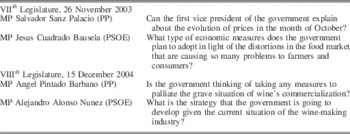
Table 2 shows some of these interactions in the Spanish Parliament. Specifically, it shows questions from a member of the governing PP party and from the opposition PSOE in a pleno from November 2003. Similarly, it shows questions from the governing PSOE and the opposition PP in December 2004. While all four questions refer to the issue of the economy, the tone with which these questions are asked makes it clear which party is in opposition. The harsher, more negative, questions – or framing – always come from the opposing party, while the subtle – more nuanced – questions come from the government side. The tone of these questions supports the underlying theme of this study. Because the opposing party will always be negative regarding the economy – as it has no advantage to do otherwise – when it draws attention to this issue it should affect citizens’ view of the topic.
Examples of Questions to the Government

Note: Questions translated by the authors.
We obtained the plenary debates from the publicly available data of the Spanish Parliament. From these, we selected all the plenary sessions that allowed MPs to question the government. Table 3 shows the total number of plenary sessions at which questions were asked; the number of questions asked, on average, in each session by the two main parties; and the total number of questions asked per legislature, by party.
Average Number of Questions Qsked in Plenos and Total per Legislature

It is clear that the PP and PSOE dominate the debates in the plenary sessions. It is interesting to note that regardless of their role, as government or opposition parties, they behave quite similarly. On average, both parties have a similar number of interactions per plenary, which is almost four times more than the rest of the parties combined. It is interesting to note that in the last legislature (2008–11) there is a big drop in both the number of sessions with questions and in the number of questions (especially from the PSOE). However, we see no need for concern over this. We acknowledge that as the crisis worsened, the PSOE implemented its agenda control mechanisms to minimize its exposure; it diminished the number of sessions with questioning and limited the interventions of its own members. Party questions in parliament therefore provide a detailed account of the issue priorities of political parties.
To analyze the questions and obtain issue attention measures, we use a similar quantitative text analysis approach to that of Sagarzazu (Reference Sagarzazu2011), which applies cluster analysis to textual data. This approach is the ‘Bag of Words’ family of text analysis mechanisms that considers words as independent observations.Footnote 56 The underlying assumption behind using clustering analysis to obtain issue measures is that words that belong to the same issue have similar patterns of behavior, as opposed to words that belong to different issue areas, which can be identified via clustering techniques.Footnote 57 Specifically, we estimate the distances between the correlations of different words and cluster the words based on these distances.
In order to be able to apply quantitative text analysis techniques to a raw text corpus, a series of preparatory steps is required. First, all questions need to be converted into plain text files, all HTML code tags need to be removed and all words need to be changed to lowercase. Secondly, stop words, punctuations, numbers, currencies and party labels are eliminated from the documents. Thirdly, a stemmer was used to convert words to their stemmed root.Footnote 58 Fourthly, with the dataset reduced to stem counts, we computed matrices that indicate how many times each stem occurs in each press release. Finally, following common practice in the literature, we removed very frequent words occurring in more than 95 per cent of the questions and very rare words occurring in less than 5 per cent of the texts.Footnote 59
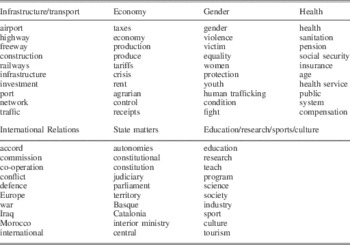
Having generated the initial word count matrix, we begin an iterative process in which we cluster words based on the distances between them. In each step we multiply the word matrix by its transposed matrix to calculate a word-to-word matrix in which each cell indicates the number of times two words are mentioned together. In order to correct for overdispersion – caused by too-frequent and too-infrequent joint mentions – we normalize this matrix by means of the squared root of each cell. We then estimate the distances between the word correlations and use this as the measure of closeness between different words needed for the clustering analysis.Footnote 60 This measure allows the clustering algorithm to establish groups based on the proximity of the elements.Footnote 61 The final stage of the process involves estimating the different word clusters. Specifically, we use a hierarchical clustering algorithmFootnote 62 that infers relationships from the data themselves.Footnote 63 Clustering techniques are mathematical tools that allow the classification of data according to latent characteristics.Footnote 64 The result of applying the clustering algorithm to the distances between the words is a tree-like structure in which words are organized by how close or distant they are between them.Footnote 65 In each iteration, the tree was automatically divided into clusters; we tried with varying sizes from five to twenty clusters. Based on this division, we assessed the organization of the words and clusters, and in each iteration we removed non-political words that were not members of any particular cluster but that instead (because they are mentioned in different issues irrespectively) are close to words from many clusters, and as such tend to remain high in the tree structure – and alone.Footnote 66 By doing this analysis, we were able to obtain a clear structure of words and clusters based on the co-occurrence of words. This structure was remarkably consistent throughout the different iterations. After four iterations we were able to identify seven politically relevant clusters:Footnote 67 economy, education, health, infrastructure, international relations, gender and state matters. The main words in each cluster are shown in Table 4.
Top Ten Key Terms per Issue Area

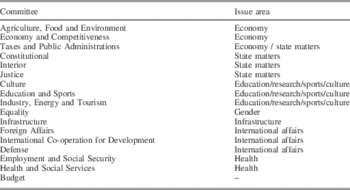
In addition to checking the face validity of the words and clusters, we looked for external validity. Given that we are looking at speeches in the floor of parliament, it can be assumed that the questions will resemble the structure of the parliamentary committees (which is similar to the structure of cabinet portfolios). As such, we checked the seven issue areas with the seventeen permanent legislative commissions. Given that we have fewer issues than committees, we will expect to have several committees grouped into one of our issue areas. Table 5 shows this grouping; the resemblance of the committee structure and the issues identified is quite similar. Most of the committees fall into a single issue area, with the exception of the Taxes and Public Administrations Committee, which deals with economic aspects as well as state matters. The only committee we could not match to only one issue area was the Budget/Appropriations Committee, given that budget discussions tend to be involved in every policy area.Footnote 68 As can be seen both from an internal standpoint (face validity) and an external validity check, our issue clusters provide a reasonable classification of parliamentary questions into relevant policy issues.
Key Terms in Economic Area

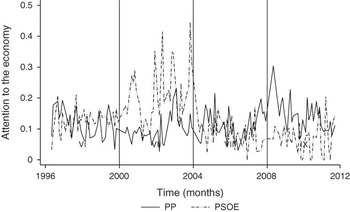
As we are particularly interested in the attention that parties give to the economy, we will focus solely on this issue. In order to illustrate how issue attention varies over the course of the four legislative terms, Figure 4 plots the attention that the PSOE and the PP paid to the economy as a proportion of the total time the party spoke. This figure shows two interesting dynamics that occur in the four legislatures. First, a similar attention dynamic can be found in the VI th and VIII th legislatures; in these two sections (the first and third) we can see no major differences between the parties. These legislatures are similar not only in the attention that parties give to the economy but also in the fact that they were the result of a change in control of parliament and end in a re-election of the governing party. The second dynamic can be seen in the second and fourth sections, in which the opposition party paid more attention to the economy (PSOE in the second – VII th legislature; PP in the last – IX th legislature). While the dominance of the PSOE is clearer in the VII th legislature than the PP’s dominance in the IX th legislature, the overall pattern is there throughout. Coincidentally, the issue attention of each party overrides that of the rival party when both the PP and PSOE are in opposition, and in the period prior to their access to power. This descriptive evidence is consistent with our intuition that parties have more incentives to stress economic issues and to have more potential persuasion power when in opposition than when there is a macroeconomic reality that speaks for their performance as incumbents.
Issue attention over time

Spanish Monthly Survey
For each month or timepoint with available party discourse data, we have matched monthly survey data conducted by the Centro de Investigaciones Sociologicas (CIS) in Spain.Footnote 69 The CIS conducts monthly barometers together with many other types of surveys in Spain.Footnote 70 Each of the monthly barometers contains a random sample of the Spanish population with valid answers to our dependent variable (n=2,376–4,874). The pooled dataset that we obtain after matching all the monthly surveys for which we have data on party discourse contains 320,793 individuals across 127 timepoints.
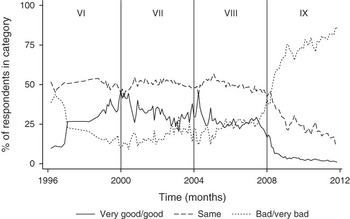
The dependent variable that is available in each of the surveys used in the models below is the assessment of the current national state of the economy.Footnote 71 The economic voting literature tends to rely on retrospective evaluations of the economy, which are unfortunately available in only fifty-eight surveys during the time period analyzed. The wording of the item is: ‘do you think that the current economic situation is better, the same, or worse than a year ago?’ Since we have more timepoints available for the item capturing current national conditions, we use this in the models reported below. In any case, the correlation between the current and the retrospective evaluations is moderately high (r=0.42, p=0.000). When running a factor and a principal components analysis, both items clearly load on the same dimension, with factor loadings of 0.54 and 0.71, respectively. When replicating the fully specified models shown below with retrospective evaluations as the dependent variable, our substantive results remain unchanged.Footnote 72 Figure 5 plots the aggregate responses to the subjective national economy question.
Evolution of subjective economic evaluations over time Note: The solid line represents the percentage of respondents that answers that the economy is good or very good; the dashed line represents neither good nor bad; the dotted line indicates bad or very bad.

We use two indicators to control for ideological predispositions. First, we use the standard left-right scale from 1 to 10, which is well known for summarizing a number of ideological predispositions and for being a good vote choice predictor in Western Europe.Footnote 73 Unfortunately, there is no indicator available for the whole time span that we are analyzing on party identification, as there is in American politics, for instance. Alternatively, we use vote recall in the last national election.Footnote 74 Finally, we also include a set of control variables available in the CIS surveys including age, gender, educational level and professional status (being unemployed).Footnote 75
Our modeling strategy conceptualizes our dataset as a two-level structure in which different individuals (Level 1) are nested in different months or timepoints (Level 2). In order to obtain accurate standard errors and non-inflated levels of significance for our time-level variables (namely party discourse and macroeconomic indicators), we predict individual economic assessments using hierarchical ordinal logit models.Footnote 76 We choose this modeling strategy because our outcome and some of the important determinants of economic perceptions identified in the literature (like partisan predispositions and all of our control variables) are measured at the individual level, while our hypothesized party effects and the macroeconomy are time-level indicators. This also allows us to use the full statistical power of our dataset. Our time or Level 2 equation, however, has a time-series structure, since monthly averages are regressed over time. To make sure that our main results are not biased by temporal autocorrelation, we conducted several tests and included the lagged monthly average of our dependent variable as a predictor. Our substantive results remained unchanged (see robustness checks and the Appendix). All the variables in our models have been centered around their mean in order to obtain meaningful intercept variances. It is important to note that the validity of our strategy relies on the assumption that our time-random effects are not correlated with any of the covariates included in the model. Our statistical model can be formalized as follows:
 $$Logit(Y_{{it}} )=\alpha {\plus}\beta _{1} X_{{it}} {\plus}\beta _{2} Z_{{t{\minus}1}} {\plus}\beta _{3} E_{{t{\minus}1}} {\plus}\Theta V_{i} {\plus}u_{t} {\plus}{\varepsilon}_{{it}}, $$
where
Y it is the level of economic evaluation for a given individual i at time t
α is the cut-off point of economic evaluations when all other covariates are 0
X it is individual-level ideological predispositions (left-right and vote choice at time t)
Z t−1 is lagged party discourse
E t−1 is lagged macroeconomic indicators (unemployment and inflation)
b k are the fixed parameters for party discourse, macroeconomic condition and ideological predispositions
u t is the random intercept at the time level
ε it is the prediction error of each observation
Θ is the vector of fixed parameters for the individual-level control variables (V i ).
Results
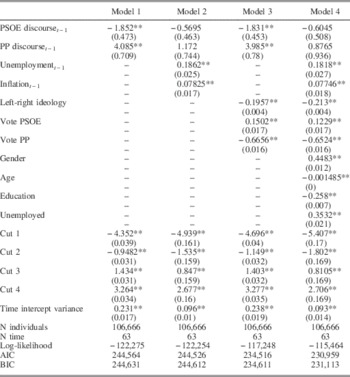
Table 6 reports a set of nested hierarchical ordinal logit models that predict economic evaluations (coded from positive to negative) corresponding to the period when the conservative PP was in power (March 1996–March 2004). The first model shows the direct effect of party discourse with no controls. The second model controls for macroeconomic variables, the third controls for ideological predispositions and the fourth reports a fully specified model with the whole set of controls. The fourth model shows the most satisfactory level of fit to the data, given a substantial and significant reduction in the AIC and BIC indexes. As explained above, Spain’s bad economic performance under socialist governments before 1996, the good economic reputation ratings of the PP in this period, and (most importantly) citizens’ perceptions of which party is most able to handle the economy allow us to consider the PP as having an advantage in terms of economic issue ownership.
Direct Effects of Party Discourse during PP Incumbency (1996–2004)

Even if party discourse appears to be significant in the first and third models, its statistical significance vanishes when (and only when) controlling for unemployment and inflation in the second and fourth models. Consistent with our expectations, despite the PP’s reputational advantage and the increasing improvement of the economy during 1996–2004, the effect of the objective economy outperforms the persuasion capacity of the issue owner as an incumbent. It is important to stress that the significance of the effect of party discourse resists the inclusion of attitudinal and socio-demographic variables, and only disappears when controlling for the objective economy. The persuasion capacity of both an incumbent party with a significant economic reputation (but constrained by the objective facts) and an opposition party with weaker economic credibility was very limited between 1996 and 2004.Footnote 77
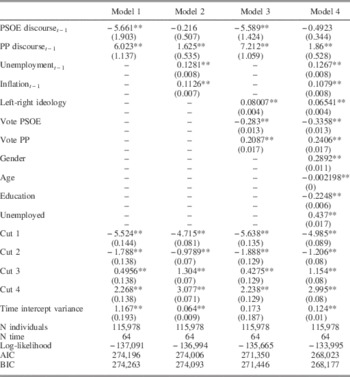
Table 7 replicated the same analyses for the 2004–11 period, when the PSOE was in government and the PP in opposition. Consistent with our expectations, the discourse of the party in power becomes insignificant when (and only when) controlling for the real macroeconomy in Models 2 and 4. When specified without controls, or together with ideological heuristics in Models 1 and 3, the effect of the PSOE’s insistence on the economy seems to decrease negative economic evaluations, as it would correspond to an incumbent party. Despite having an important advantage in economic reputation at the start of the period, the persuasion effect of the PSOE’s discourse is again tied to the real facts and overshadowed by the effects of unemployment and inflation. By contrast, the effect of the PP’s discourse is positive and significant across all model specifications, meaning that it consistently worsened public economic evaluations. As expected, this effect takes place when the conservatives were in opposition.
Direct Effects of Party Discourse during PSOE Incumbency (2004–11)

As noted above, our theoretical framework assumes that opposition parties have a more prominent role and capacity to place economic issues on the agenda. To find evidence to support this assumption, we constructed a measure capturing the total amount of attention to economic issues by the parties represented in the Spanish Parliament during the time span analyzed (PP, PSOE, Izquierda Unida, Grupo Mixto, and Catalan and Basque nationalists). We interpret this measure as a proxy for general economic saliency in parliament. When regressing this measure on lagged economic attention of the two main parties and a time trend, only the party in opposition has a positive and significant effect on general economic saliency (PSOE in the 1996–2004 period, and PP in 2004–11). By contrast, the effect of the incumbent party discourse is non-significant in 1996–2004 and negative in 2004–11. This confirms that governing parties experience greater constraints in placing economic issues on the agenda.Footnote 78
As expected by the classical punishment-reward model of economic voting, worsening macroeconomic conditions in terms of unemployment and inflation are strongly and significantly associated with worsening economic evaluations. However, our data do not validate classical refined issue ownership theories, which expect inflation and unemployment to benefit center-right and center-left parties, respectively.Footnote 79 This is consistent with recent comparative economic studies, which do not validate the heterogeneity of inflation and unemployment effects across ideological incumbent orientation.Footnote 80 The revisionist model is also validated with our data, since left-right ideology and vote choice are also consistently associated with economic perceptions. Right-wing and PP voters had more favorable views when the PP was in power, and left-wing and PSOE voters had more favorable views when the PSOE was in power.
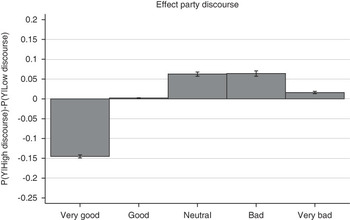
Figure 6 reports the results of a probability simulation in order to account for the magnitude of the effects described above. This simulation was performed on the basis of the fourth model of Table 7, which corresponds to the fully specified model for the 2004–11 period. After running the model, we obtained 10,000 random draws of the coefficients observed.
Change in probability of subjective economic evaluations caused by changes in level of party discourse Note: The Y axis corresponds to the change in probabilities and its 95 per cent confidence intervals when going from a minimal to a maximal value of party discourse. The rest of the covariates have been fixed at their mean. The X axis corresponds to each of the five categories of our dependent variable (very good, good, neutral, bad and very bad).

As shown in Figure 6, the conditioning effect of the PP’s discourse when in opposition affected mostly the respondents with very positive views. For this group, the change in probabilities when there is a change in discourse is quite significant, with a drop of about 15 per cent when discourse is at its highest. This 15 per cent drop sees a mirror increase in the neutral and bad categories, in which a change in party discourse increases the probabilities of having neutral or bad views of the economy by 6 per cent (in each). Party discourse thus tends to increase the probability of having moderately bad views on economic performance and to decrease very positive views of it. The magnitudes of change caused by party discourse are rather remarkable and very significant.Footnote 81
The effects of the macroeconomic variables and vote choice are as expected. Macroeconomic indicators remain the most influential variables, and vote choice has an important effect (even if smaller than the effect for discourse). The effects of the control variables are very consistent across model specifications. Being a man, having lower levels of education, being young and being unemployed are also consistently associated with more negative economic evaluations.
Given the time-series nature of our Level 2 equation, we replicated the fully specified model adding a lagged monthly average of the dependent variable as a predictor. This allows us to rule out the possibility of temporal autocorrelation bias. After this test, the effect of the PP’s discourse remained at conventional levels of significance, while the effect of unemployment vanished. We also replicated our main models (fully specified models in Tables 6 and 7 above) including a time trend in the fixed part of the equation, and our substantive results remained unchanged. Only the PP’s discourse remains strongly significant when in opposition, while the coefficients of unemployment fail to reach statistical significance in the 1996–2004 period.Footnote 82
Heterogeneous Effects
It could be argued that the direct average effect of the PP’s discourse when in opposition was partly driven by the dramatic turn in the real economy in the second part of the 2004–11 period. As stated above, in order to claim that party discourse has substantively meaningful conditioning effects, the effect of this discourse has to be independent of the real economy. This implies that the direct effect of party discourse needs to preserve its level of significance when controlling for real economic indicators (as shown above), and that the effect of partisan discourse cannot depend on any value of unemployment or inflation. In order to test this independence of party discourse, we ran tests modeling the PP and PSOE’s party discourse as a function of economic indicators over the whole time span considered here, and none of the models turned up as significant.Footnote 83 This implies that the effect of the issue owner was equally visible at high and low levels of unemployment and inflation.
In order to further check for heterogeneous effects, we also re-run the fully specified models shown in Tables 6 and 7 for each electoral cycle.Footnote 84 Consistent with our previous models, party discourse fails to reach statistical significance in the 1996–2000 and 2000–04 periods. Interestingly, however, the effect of PP discourse during the PSOE’s incumbency is more clearly observable in the 2004–08 period (log odds=0.97; standard error=0.57; p=0.08). When simulating probabilities, the effect of party discourse on ‘good’ and ‘very bad’ evaluations is non-significant, but the relative effect size of party discourse decreasing ‘very positive’ and increasing ‘neutral’ and ‘bad’ views is almost identical to the simulations reported in Figure 6. When looking at the 2008–11 period on its own, the effect of PP discourse on negative economic evaluations is only visible around the middle of the electoral cycle. More specifically, there is a positive contemporaneous bivariate correlation between economic perceptions and PP discourse (r=0.31) between October 2009 and November 2010. This corresponds to fourteen months right in the middle of the electoral cycle. By contrast, the fluctuation of PP discourse at the very beginning and very end of the 2008–11 cycle does not correspond to the steady increase in negative economic evaluations in public opinion. This finding implies that party discourse has an effect as long as economic turbulences are not so strong as to overshadow other effects. Despite the idiosyncratic last electoral cycle analyzed, however, the average effect of PP discourse on negative economic evaluations emerges as strong and significant when analyzing the 2004–11 period as a whole. This means that the coefficient of PP discourse across all model specifications in Table 7 is able to pick up the consistent hypothesized relationship between PP discourse and economic perceptions throughout the whole 2004–08 period and throughout the middle of the 2008–11 period.
Similarly to the previous check, it can be argued that the substantive effect of party discourse could be minimized if it only has an observable effect on very close voters or partisans. If that were the case, party discourse would have an interesting mobilizing effect on its own party constituency rather than a more transversal persuasion effect across more distant ideological spaces. To check for this possibility, we modeled a set of interactions between party discourse and vote choice across the whole time span analyzed, and some interactions between party discourse and partisan predispositions were significant. When simulating the actual magnitude of the effects, however, the effect size of these interactions are minimal and sometimes barely significant. Consistent with an ideological argument in which only partisans are responsive to their own party’s discourse, the PSOE’s discourse when in power (2004–11) decreased the probability that PSOE voters would have negative economic evaluations slightly more than PP voters. Similarly, the PP discourse increased the probability that its voters would switch from positive to neutral views slightly more when it was in opposition (2004–11). Inconsistently with ideological arguments, however, the PSOE’s discourse was equally insignificant among voters and non-voters in the 1996–2004 period. Moreover, the PP’s discourse when it was in power had a more visible effect among non-voters than among voters.Footnote 85
Conclusion
The study of the antecedents of citizens’ assessments of the economy’s performance has important implications for public opinion literature, economic voting studies, and democratic accountability in general. The effect of objective macroeconomic indicators and individual ideological predispositions has dominated the debate during the last decade. Even if the role of parties in activating issues of political competition has proved to be important in close research areas, a top-down perspective on the effect of party discourse on public economic perceptions was lacking until now. We believe that a complete portrait of the political conditioning of economic evaluations is not possible without analyzing what parties say about the economy. In this article we made a step forward in understanding an additional mechanism through which subjective evaluations of the economy may not always match economic reality.
We modeled novel monthly data on party salience on the economy through their interventions in parliament, macroeconomic changes and survey data predicting economic evaluations over four electoral cycles in Spain (1996–2011). Our results, via content analysis techniques and ordinal logit hierarchical regressions, confirm the association of macroeconomic changes (which are the strongest aggregate determinant of economic evaluations) and political predispositions like left-right ideology and vote choice with economic evaluations. Overall, we find evidence of both classic and revisionist interpretations of economic perceptions in a relatively understudied context like Spain. When adding the salience of economic issues in the discourse of the two main parties in competition, we find that party discourse can matter beyond (and independently of) macroeconomic conditions and individual-level heuristics. Two conditions need to be met in our data for party messages to have an effect, however. First, the party conditioning public economic perceptions has to be the issue owner, which in this case is the main right-wing party (PP) for almost the whole time span analyzed. Secondly, the issue owner has to be in opposition. These results confirm the idea that while the incumbent has to deal with facts, in the absence of an up-to-date record of performance, the challenger can be judged by talk and therefore has more leverage and credibility to persuade voters.Footnote 86 Moreover, our results are consistent with negativity biases documented in the psychological and political science literatures, in which negative inputs are more likely to be placed on the public agenda and to make an impression in public opinion.Footnote 87
Overall, our results suggest that the impact of party discourse is remarkable even if highly conditional. The high conditionality of our findings is consistent with current research on framing effects and public opinion, which shows that external cues are not equally likely to manipulate the public’s views in contemporary democracies.Footnote 88 Once the relevant conditions are met, however, our results suggest important persuasion effects from parties, which are able to shape public opinion independently of how the economy is really doing, and in ideological spaces that are not necessarily proximal. This implies that parties need to be brought into the equations used in economic voting studies. Previous research has shown how parties have the capacity to increase the link between the economy and electoral results by adopting distinct economic positionsFootnote 89 and by sending appropriate competence signals.Footnote 90 Our research builds on this and shows that parties are also able to shape economic evaluations.
Our findings cannot be interpreted as a sign that objective facts and classical democratic accountability play no role. Macroeconomic levels are the strongest determinant of citizens’ subjective economic views, and to be effective, parties need to have both economic credibility and the ability to articulate a discourse that is free from the cost of governing. This interpretation also allows us to build on recent research analyzing parties’ economic communication strategies. We confirm Vavreck’s proposition that, in bad economic times, incumbent parties’ optimal strategy is to bring advantageous non-economic issues onto the agenda.Footnote 91 This is so because even if the opposition party does not have a strong economic reputation, economic reality will exert a negative effect of its own. Our analyses also suggest, however, that talking about the economy in good economic times will not have any direct persuasion effect in favor of the incumbent. Opposition parties are more likely to place the economy on the agenda and to condition public views in a way that is not necessarily consistent with economic reality.
Future research will have to test the validity of our propositions in new countries and economic contexts. Spain is a conservative test for party persuasion effects, given the blatant and salient decrease in objective economic performance over the last years. It is also a relatively highly comparable case across Western democracies, given the proportional and multiparty character of its electoral system. It is also true, however, that the prominent role of the two primary Spanish mainstream parties allows us to identify the dynamics between government and opposition more easily than in systems with coalition governments and less clarity of responsibility. More systematic measures of issue ownership and economic credibility will also have to be discussed and analyzed in order to generalize when and why economic credibility is a necessary condition for parties to effectively persuade public opinion.